EP0273254B1 - Procédé et dispositif pour remplir des matières en vrac, spécialement du café - Google Patents
Procédé et dispositif pour remplir des matières en vrac, spécialement du café Download PDFInfo
- Publication number
- EP0273254B1 EP0273254B1 EP87118218A EP87118218A EP0273254B1 EP 0273254 B1 EP0273254 B1 EP 0273254B1 EP 87118218 A EP87118218 A EP 87118218A EP 87118218 A EP87118218 A EP 87118218A EP 0273254 B1 EP0273254 B1 EP 0273254B1
- Authority
- EP
- European Patent Office
- Prior art keywords
- bags
- tare
- weight
- value
- balance
- Prior art date
- Legal status (The legal status is an assumption and is not a legal conclusion. Google has not performed a legal analysis and makes no representation as to the accuracy of the status listed.)
- Expired - Lifetime
Links
- 238000000034 method Methods 0.000 title claims description 24
- 239000013590 bulk material Substances 0.000 title abstract 2
- 238000005070 sampling Methods 0.000 claims abstract 5
- 238000005303 weighing Methods 0.000 claims description 18
- 230000004888 barrier function Effects 0.000 claims description 7
- 238000004806 packaging method and process Methods 0.000 claims description 4
- 239000003292 glue Substances 0.000 claims description 3
- 230000015572 biosynthetic process Effects 0.000 claims description 2
- 238000001914 filtration Methods 0.000 claims 3
- 239000011343 solid material Substances 0.000 claims 3
- 230000001276 controlling effect Effects 0.000 claims 1
- 230000001105 regulatory effect Effects 0.000 claims 1
- 238000005259 measurement Methods 0.000 description 5
- 238000012935 Averaging Methods 0.000 description 4
- 230000033228 biological regulation Effects 0.000 description 4
- 238000007664 blowing Methods 0.000 description 3
- 230000009191 jumping Effects 0.000 description 3
- 238000012937 correction Methods 0.000 description 2
- 239000002699 waste material Substances 0.000 description 2
- 230000007423 decrease Effects 0.000 description 1
- 238000010586 diagram Methods 0.000 description 1
- 238000007599 discharging Methods 0.000 description 1
- 238000003780 insertion Methods 0.000 description 1
- 230000037431 insertion Effects 0.000 description 1
- 238000004519 manufacturing process Methods 0.000 description 1
- 239000000463 material Substances 0.000 description 1
- 230000010355 oscillation Effects 0.000 description 1
Images


Classifications
-
- G—PHYSICS
- G01—MEASURING; TESTING
- G01G—WEIGHING
- G01G15/00—Arrangements for check-weighing of materials dispensed into removable containers
- G01G15/02—Arrangements for check-weighing of materials dispensed into removable containers with provision for adding or removing a make-up quantity of material to obtain the desired net weight
-
- B—PERFORMING OPERATIONS; TRANSPORTING
- B65—CONVEYING; PACKING; STORING; HANDLING THIN OR FILAMENTARY MATERIAL
- B65B—MACHINES, APPARATUS OR DEVICES FOR, OR METHODS OF, PACKAGING ARTICLES OR MATERIALS; UNPACKING
- B65B1/00—Packaging fluent solid material, e.g. powders, granular or loose fibrous material, loose masses of small articles, in individual containers or receptacles, e.g. bags, sacks, boxes, cartons, cans, or jars
- B65B1/30—Devices or methods for controlling or determining the quantity or quality or the material fed or filled
- B65B1/32—Devices or methods for controlling or determining the quantity or quality or the material fed or filled by weighing
-
- G—PHYSICS
- G01—MEASURING; TESTING
- G01G—WEIGHING
- G01G23/00—Auxiliary devices for weighing apparatus
- G01G23/14—Devices for determining tare weight or for cancelling out the tare by zeroising, e.g. mechanically operated
- G01G23/16—Devices for determining tare weight or for cancelling out the tare by zeroising, e.g. mechanically operated electrically or magnetically operated
- G01G23/166—Devices for determining tare weight or for cancelling out the tare by zeroising, e.g. mechanically operated electrically or magnetically operated involving comparison with a reference value
Definitions
- the invention relates to a method for filling bulk goods, in particular coffee, and a device for carrying out the method according to the preamble of patent claims 1 and 11 respectively.
- the tare weight i.e. the weight of the bags to be filled
- certain fluctuations cannot be avoided either, since the thickness of the films from which the bags are made is only constant within certain limits due to the (known) manufacturing processes (bubbles). Since the cuts are the same for each bag, there are fluctuations in the tare weight, which are currently around 8%.
- the present invention is based on the object of developing methods and apparatus of the type mentioned at the outset in such a way that a sufficiently exact net weight can be achieved with less effort than previously.
- the control reacts particularly quickly if the moving averaging is carried out in two group sizes, a larger and a smaller group, and the control is based on the average of the smaller group if this is at least or more than a predetermined value from the average of the larger group Amount differs.
- the control behavior in general if the mean value of the smaller group within the permissible fluctuation range) ) is not unnecessarily uneasy, on the other hand, a rapid correction of sudden changes can still take place.
- the bags to be weighed are preferably fed to an (electronic) balance via a blowing device.
- the reference number 29 denotes a machine for producing bags, to which the film material is fed from a film roll 30.
- the fully folded and open top bags are conveyed on a conveyor belt 11 which feeds the bags to a filling machine 28.
- the filling machine 28 is supplied with coffee via a coffee feed 31, which in the bags should be filled.
- the conveyor belt 11 leaves the filling machine 28 with the fully filled and closed packs.
- a bag switch 32 is provided between the bag former 29 and the filling machine 28, the configuration of which is described in more detail below.
- the switch 32 is actuated by a control unit 21 at certain points in time such that individual bags are removed from the conveyor belt 11 and a tare weight 16 is fed via a conveyor tube 13.
- the tare scale 16 converts the weight of the bag into an electrical output signal, which in turn is fed to the control unit 21. After weighing, the weighed bag is pushed off the tare scale 16 via a device which can be controlled by the control unit 21 and which is described in more detail below. Furthermore, a light barrier 24 is provided above the tare scale 16, by means of which it can be determined whether a bag lies on the tare scale 16 or whether the bag lies correctly. The output signal of the light barrier 24 is also fed to the control unit 21.
- the system is also provided with a tape sensor 20, via which the clock rate with which the system works can be determined.
- This tape sensor 20 is used (among other things) for synchronization during the discharge process.
- a branch switch 26, also controlled by the control unit 21, is provided for discharging filled packs. These filled packs are passed over an (electronic) gross balance 25 and fed back into the feed stream via an insertion switch 27. In the gross scale 25, the weight of the weighed packs is converted into electrical signals converted, which are fed back to the control unit 21.
- An input unit 22 is also connected to the input of the control unit 21, via which input values can be entered.
- a control output 23 is connected to an actuator of the filling machine 28, the amount of coffee filled by the filling machine 28 being adjustable via the control signal of the control output 23.
- the gross weight of the filled (and closed) packages is weighed via the sensor 25 (gross balance) and fed to a comparator. Furthermore, the comparator is supplied with a setpoint, which is formed from the actual setpoint, namely the package contents, a constant tare specification (glue weight, label weight etc.) and the output signal of the sensor 16 (tare scale). The first two values are entered via the input unit 22.
- the sensor 16 (tare scale) sits at the outlet of the bag forming machine 29, which feeds the bags to the filling machine 28.
- the deviation between the measured gross value and the target gross value is fed to a computer 35, which is part of the control unit 21 and generates an output signal which is used to set the filling quantity in the filling machine 28.
- a closed control loop is formed, which enables a constant filling quantity (filling weight) independent of fluctuations in the tare weight.
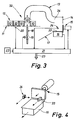
- the device part which is used to discharge and weigh the empty packs.
- the main problem here is the fragility and the low weight of the packs 10.
- the packs 10 arriving on the conveyor belt 11 are held in conveyor cells 12.
- the conveyor cells 12 are provided with an opening at the bottom, the mouth of a blow-out line 18 being attached under the conveyor belt 11 in such a way that the openings in the conveyor cells sweep past the conveyor belt 11 as it runs.
- the blow-out line 18 is connected to a compressed air source, not shown, via a solenoid valve 19.
- the solenoid valve 19 is controlled via an output of the control unit 21.
- the mouth of a conveyor tube 13 is positioned, the cross section of which is essentially adapted to that of the bags 10 to be conveyed.
- the arrangement is thus such that, with the correct positioning of a delivery cell 12 with a bag 10 therein, 18 bags 10 can be blown into the delivery pipe 13 above the mouth of the blow-out line.
- the directed air flow is dimensioned so that a bag blown into the line 13 is conveyed through the line.
- the line 13 runs essentially horizontally and is open at the bottom.
- a baffle plate 14 is attached in the axis of the end section 34, so that packs 10 which reach the end section 34 at a certain conveying speed are braked on the baffle plate 14 and fall down.
- a slide 15 is attached to the scale 16 and can be actuated via an output signal from the control unit 21.
- the slide 15 is arranged in such a way that a package 10 located on the weighing plate 33 of the balance 16 is pushed off the plate 33 when the slide 15 is actuated.
- a discharge chute 17 is attached to the scale 16, onto which a bag 10 pushed by the slide 15 from the plate 33 can fall, in order to then be fed to a waste container.
- the packs 10 can be removed from the plate 33 by blowing air (blowing nozzle - not shown) and conveyed to the waste container.
- a light barrier 24 which is described in more detail below, is attached above the weighing plate 33 and is connected to an input of the control unit 21.
- the way in which the light barrier 24 is attached is such that when a bag 10 lies on the weighing plate 33, the light path of the light barrier 24 is interrupted, so that the presence of a bag 10 on the weighing plate 33 can be detected.
- a light barrier (not shown), which is connected to the control unit 21, is preferably also mounted in the end section 34 of the delivery pipe 13 and via which a jamming of bags in the end section 34 can be detected.
- a belt sensor 20 is provided in the vicinity of the conveyor belt 11, the output signals of which are fed to the control unit 21 in order to synchronize the control of the solenoid valve 19 with the clock rate of the conveyor belt 11.
- the input unit 23, which is connected to an input of the control unit 21, is also shown in FIG. 3 for the sake of completeness.
- the control output 23 of the control unit 21 is also shown in FIG. 3 for the sake of completeness.
- the tare weight that is to say the weight of the empty bags, is plotted upwards, a jump-like change in the tare weight from weight G1 to weight G2 and back to weight G1 being shown to clarify the control behavior.
- the device according to the invention (or via the computer 35) not only carries out this averaging, but also a difference between the two averages G1 and G2 .
- the result of this difference formation is shown in Fig. 5 (c).
- the difference is compared with a threshold value (dashed line in FIG. (C)).
- the mean value is now normally G1 , which was obtained from the larger number of samples, as the tare value of the regulation (see FIG. 2).
- the mean value becomes G2 used as the tare value of the regulation. This fact is shown in Fig. 5 (d) in more detail.
- the resulting curve which represents the tare weight on which the control is based, therefore initially increases in the event of a sudden change in the actual measured values in accordance with the slope of the mean value curve G1 on (between n0 and n1). But as soon as the difference between the two averages G1 and G2 exceeds the threshold, the tare specification changes in accordance with the steeper rise in the mean value curve G2 fast (between n1 and n2), so that the tare value on which the regulation is based is very quickly approximated to the actual value. When the tare value decreases from weight G2 to weight G1, the process is reversed.
- the jumping back and forth between the two mean values results G1 and G2 Fluctuations in the control behavior, which can be seen in FIG. 5 (d) between the times n3 and n4 or n8 and n9.
- such fluctuations can be compensated for by jumping from the mean G1 to the mean G2 abruptly, jumping back from the mean G2 to the mean G1 (when calculating the tare specification) but with a delay.
- the correction value determined in the control unit 21 (or by the computer 35) for the adjustment of the filling machine is preferably fed to this filling machine via a motor-operated potentiometer.
- the motorized potentiometer is preferably used instead of the already manually adjustable potentiometer, with switching means being provided so that the system can be switched over to manual setting if necessary.
Landscapes
- Physics & Mathematics (AREA)
- General Physics & Mathematics (AREA)
- Engineering & Computer Science (AREA)
- Quality & Reliability (AREA)
- Mechanical Engineering (AREA)
- Basic Packing Technique (AREA)
- Auxiliary Devices For And Details Of Packaging Control (AREA)
- Tea And Coffee (AREA)
Claims (21)
- Procédé de remplissage de matières en vrac, en particulier de café, dans des emballages, dans lequel on ajuste la quantité de remplissage d'une machine de remplissage conformément au poids brut des emballages remplis et à une tare allouée, caractérisé en ce qu'on établit par échantillons de sondage la tare allouée qui tient compte du poids de l'emballage vide et en ce qu on amène la valeur déterminée du poids brut moins la valeur déterminée de la tare allouée et moins une tare allouée constante qui tient compte de fractions de poids constantes, telles que le poids de colle, le poids des étiquettes ou des poids analogues, à la machine de remplissage en tant que valeur de consigne dans une boucle de réglage fermée.
- Procédé suivant la revendication 1, caractérisé en ce qu'on détermine la tare allouée par une pesée par sondage d'emballages vides.
- Procédé suivant la revendication 2, caractérisé en ce qu'on effectue les sondages à des intervalles réguliers.
- Procédé suivant une des revendications précédentes, caractérisé en ce qu'on fait la moyenne de plusieurs sondages et en ce qu'on prend pour base du réglage la valeur moyenne.
- Procédé suivant la revendication 4, caractérisé en ce qu'on effectue une formation de valeur moyenne mobile sur un nombre défini d'emballages vides.
- Procédé suivant la revendication 5, caractérisé en ce qu'on rejette la valeur d'un sondage individuel qui dévie de la valeur moyenne momentanée de plus qu'un montant maximal prédéterminé, sans l'utiliser pour la formation de valeur moyenne ultérieure.
- Procédé suivant l'une des revendications 5 et 6, caractérisé en ce qu'on effectue la formation de valeur moyenne mobile dans deux grandeurs de groupes, un grand groupe et un petit groupe, et en ce qu'on prend pour base du réglage la valeur moyenne du petit groupe lorsque (et seulement lorsque) celui-ci dévie de la valeur moyenne du grand groupe d'au moins un montant prédéterminé.
- Procédé suivant l'une des revendications précédentes, caractérisé en ce qu'on établit le poids brut par sondages.
- Procédé suivant la revendication 8, caractérisé en ce qu'on prend les sondages de poids brut plus fréquemment que les sondages de tare.
- Procédé suivant l'une des revendications précédentes, caractérisé en ce qu'on rejette les emballages vides pesés.
- Dispositif de remplissage de matières en vrac, en particulier de café, comprenant une machine de formation de sacs (29) pour fabriquer des sacs à remplir (10), une balance de tare (16) pour peser des sacs à remplir, une machine de remplissage (28) pour remplir les sacs (10) par de la matière en vrac, une balance de poids brut (25) pour peser les sacs remplis (10) et une bande transporteuse (11) pour avancer les sacs (10), caractérisé par des moyens (changement de voie 32) pour évacuer des sacs vides (10) de la bande transporteuse (11), des moyens d'avancement (le tube de transport 13) pour transporter les sacs évacués à la balance de tare (16), un dispositif (22) d'entrée d'une tare allouée constante tenant compte de fractions de poids constantes, telles que le poids de colle, le poids des étiquettes ou des poids analogues, et une unité de réglage (21) qui, du côté entrée, est en liaison par des conducteurs de signaux avec des sorties de mesure de la balance de tare (16) et de la balance de poids brut (25) et dont la sortie de réglage (23) est, avec la machine de remplissage (28) et les moyens (32) d'évacuation des sacs vides, dans une liaison de commande telle que des sacs vides (10) sont évacués et posés dans une fréquence définie et que la machine de remplissage (28) est, en ce qui concerne la quantité de remplissage, ajustée conformément à la valeur déterminée du poids brut moins la valeur déterminée de la tare et la tare constante allouée.
- Dispositif suivant la revendication 11, caractérisé en ce que le changement de voie (32) destiné à évacuer les sacs vides (10) comportent un dispositif de soufflage (18) à soupape commandable (19).
- Dispositif suivant la revendication 12, caractérisé en ce que la bande transporteuse (11) comprend des ouvertures de passage pour lesquelles le dispositif de soufflage (18) est agencé de telle façon que les sacs (10) puissent être évacués vers le haut par soufflage en dehors de la ligne de transport.
- Dispositif suivant l'une des revendications 11 à 13, caractérisé en ce que les moyens de transport (13) destinés à avancer les sacs évacués (10) se terminent à une distance définie au-dessus de la balance de tare (16) de façon que les sacs évacués (10) tombent sur un plateau (33) de la balance de tare (16).
- Dispositif suivant la revendication 14, caractérisé en ce qu'au-dessus du plateau (33) de la balance de tare (16) est agencé un dispositif d'élimination (15) qui peut être actionné par l'unité de réglage (21), de telle façon que des sacs situés sur le plateau (33) de la balance puissent être amenés à une glissière d'évacuation (17).
- Dispositif suivant l'une des revendications 14 et 15, caractérisé en ce qu'au-dessus du plateau (33) de la balance, est agencé un dispositif de détection (barrage photoélectrique 24) qui est relié à une entrée de l'unité de réglage (21) et qui est destiné à constater la présence de sacs (10) sur le plateau (33) de la balance.
- Dispositif suivant l'une des revendications 12 à 16, caractérisé en ce que les moyens de transport (13) destinés à avancer les sacs évacués (10) sont réalisés sous la forme d'un conduit tubulaire.
- Dispositif suivant la revendication 17, caractérisé en ce que le conduit tubulaire (13) s'étend sensiblement horizontalement dans sa section d'extrémité (34) et en ce qu une chicane (14) est agencée perpendiculairement à la direction du tube et respectivement d'avancement, au-dessus du plateau (33) de la balance, de façon que les sacs avancés (10) soient freinés sur la chicane (14) et qu'ils tombent sur le plateau (33) de la balance.
- Dispositif suivant la revendication 15, caractérisé en ce que les sacs (10) peuvent être éliminés de la balance de tare (16) au moyen d'air de soufflage d'un dispositif de soufflage (tuyère de soufflage).
- Dispositif suivant l'une des revendications 11 à 19, caractérisé en ce que l'unité de réglage (28) est reliée, du côté entrée, à une unité d'entrée (22) par l'intermédiaire de laquelle les (autres) tares allouées sont entraînées.
- Dispositif suivant l'une des revendications 11 à 20, caractérisé en ce que l'unité de réglage (21) comporte un calculateur (35).
Priority Applications (1)
| Application Number | Priority Date | Filing Date | Title |
|---|---|---|---|
| AT87118218T ATE73072T1 (de) | 1986-12-30 | 1987-12-09 | Verfahren und vorrichtung zum abfuellen von schuettgut, insbesondere kaffee. |
Applications Claiming Priority (2)
| Application Number | Priority Date | Filing Date | Title |
|---|---|---|---|
| DE3644713 | 1986-12-30 | ||
| DE19863644713 DE3644713A1 (de) | 1986-12-30 | 1986-12-30 | Verfahren und vorrichtung zum abfuellen von schuettgut, insbesondere kaffee |
Publications (3)
| Publication Number | Publication Date |
|---|---|
| EP0273254A2 EP0273254A2 (fr) | 1988-07-06 |
| EP0273254A3 EP0273254A3 (en) | 1989-11-08 |
| EP0273254B1 true EP0273254B1 (fr) | 1992-03-04 |
Family
ID=6317378
Family Applications (1)
| Application Number | Title | Priority Date | Filing Date |
|---|---|---|---|
| EP87118218A Expired - Lifetime EP0273254B1 (fr) | 1986-12-30 | 1987-12-09 | Procédé et dispositif pour remplir des matières en vrac, spécialement du café |
Country Status (7)
| Country | Link |
|---|---|
| US (1) | US4890441A (fr) |
| EP (1) | EP0273254B1 (fr) |
| JP (1) | JPH0758220B2 (fr) |
| AT (1) | ATE73072T1 (fr) |
| CA (1) | CA1310576C (fr) |
| DE (2) | DE3644713A1 (fr) |
| ES (1) | ES2030420T3 (fr) |
Families Citing this family (5)
| Publication number | Priority date | Publication date | Assignee | Title |
|---|---|---|---|---|
| JP3088751B2 (ja) * | 1992-05-15 | 2000-09-18 | 株式会社イシダ | 風袋重量引き付き組合せ計量装置 |
| IT1258025B (it) * | 1992-07-31 | 1996-02-20 | Mg 2 Spa | Metodo e dispositivo per il dosaggio di un prodotto farmaceutico all'interno di capsule |
| US5806287A (en) * | 1997-04-21 | 1998-09-15 | Dimension Automation, Inc. | On-the-go check weigh system |
| US20070011993A1 (en) * | 2005-07-18 | 2007-01-18 | Jack Salvatore Mannoia | Method and system for manufacturing adhesive packets |
| DE102020128350A1 (de) | 2020-10-28 | 2022-04-28 | Wipotec Gmbh | Verfahren und Vorrichtung zum Nullstellen einer Waage |
Family Cites Families (7)
| Publication number | Priority date | Publication date | Assignee | Title |
|---|---|---|---|---|
| US3073398A (en) * | 1956-03-27 | 1963-01-15 | Foils Packaging Corp | Automatic weighing and packaging apparatus |
| US3684875A (en) * | 1970-09-28 | 1972-08-15 | Wm Ainsworth Inc | Analog-to-digital measuring apparatus |
| DE2323750B2 (de) * | 1973-05-10 | 1975-11-13 | Atoma Gmbh, 8264 Waldkraiburg | Wägevorrichtung für kontinuierliche Wägungen |
| DE2532105A1 (de) * | 1974-07-19 | 1976-02-26 | Telomex Horsham Ltd | Regler fuer pruefwaagen |
| US4049068A (en) * | 1976-05-03 | 1977-09-20 | Hi-Speed Checkweigher Co., Inc. | Price labeling system with floating zero reference |
| US4582150A (en) * | 1984-06-21 | 1986-04-15 | Taylor Products Co., Inc. | Automated, integrated, filling, check weighing, and self-correcting bagging apparatus and method |
| CH667922A5 (de) * | 1985-10-18 | 1988-11-15 | Mettler Instrumente Ag | Elektrische waage mit tariereinrichtung. |
-
1986
- 1986-12-30 DE DE19863644713 patent/DE3644713A1/de not_active Withdrawn
-
1987
- 1987-12-09 DE DE8787118218T patent/DE3777120D1/de not_active Expired - Fee Related
- 1987-12-09 EP EP87118218A patent/EP0273254B1/fr not_active Expired - Lifetime
- 1987-12-09 ES ES198787118218T patent/ES2030420T3/es not_active Expired - Lifetime
- 1987-12-09 AT AT87118218T patent/ATE73072T1/de not_active IP Right Cessation
- 1987-12-15 US US07/133,297 patent/US4890441A/en not_active Expired - Lifetime
- 1987-12-21 CA CA000554966A patent/CA1310576C/fr not_active Expired - Fee Related
- 1987-12-29 JP JP62336740A patent/JPH0758220B2/ja not_active Expired - Lifetime
Also Published As
| Publication number | Publication date |
|---|---|
| ATE73072T1 (de) | 1992-03-15 |
| ES2030420T3 (es) | 1992-11-01 |
| CA1310576C (fr) | 1992-11-24 |
| US4890441A (en) | 1990-01-02 |
| DE3777120D1 (de) | 1992-04-09 |
| JPS63173925A (ja) | 1988-07-18 |
| JPH0758220B2 (ja) | 1995-06-21 |
| EP0273254A2 (fr) | 1988-07-06 |
| EP0273254A3 (en) | 1989-11-08 |
| DE3644713A1 (de) | 1988-07-14 |
Similar Documents
| Publication | Publication Date | Title |
|---|---|---|
| EP0505618B1 (fr) | Procédé et dispositif pour determiner le débit de matière retiré par une extrudeuse d'une trémie d'alimentation | |
| EP0394869B1 (fr) | Procédé de commande de niveau d'un mélange consistant au moins de deux fluides à l'intérieur d'un récipient muni d'une sortie | |
| EP0215080A1 (fr) | Dispositif de detection automatique d'un debit continu de pulverulents par une balance de pesage continu. | |
| EP2621814B1 (fr) | Dispositif et procédé pour le dosage d' une matière en vrac | |
| DE19718455A1 (de) | Verfahren und Vorrichtung zum Dosieren von Mahlkaffee in Kaffeeverpackungen | |
| WO2011069578A1 (fr) | Dispositif et procédé pour doser des produits plats | |
| EP1952706A1 (fr) | Magasin de vidage et procédé de vidage de récipients remplis de produits en forme de tige, en particulier récipients en forme de colonne | |
| DE102009043445A1 (de) | Vorrichtung zur Dosierung pulverförmiger oder körniger Materialien in Kapseln oder dergleichen | |
| DE102011101045A1 (de) | Packmaschine und Verfahren zum Füllen von offenen Säcken | |
| DE4447051A1 (de) | Vorrichtung und Verfahren zur portionsweisen Abgabe von Schüttgut | |
| EP2359704B1 (fr) | Dispositif et procédé de réunion de flux de matière, notamment pour une cartouche de vidage | |
| EP0273254B1 (fr) | Procédé et dispositif pour remplir des matières en vrac, spécialement du café | |
| DE19939042A1 (de) | Verfahren zur Bereitstellung eines zu dosierenden Materialgemischs und Ermittlung des Durchsatzes, und Anlage zur Durchführung des Verfahrens | |
| EP2499603B1 (fr) | Appareil de comptage d'objets en vrac | |
| EP1149196B2 (fr) | Melange de composants fibreux | |
| EP4180777B1 (fr) | Dispositif de pesage et de transport et procédé de transport et de détection du débit massique de produits en vrac | |
| EP0095095A1 (fr) | Procédé par le pesage de matière en vrac et dispositif de pesage | |
| DE3303766C2 (fr) | ||
| EP0599047B1 (fr) | Procédé pour déterminer le débit de matière retirée par une extrudeuse d'une trémie d'alimentation | |
| DE102010003814B4 (de) | Verfahren zur automatischen Dosierung und Dosiervorrichtung | |
| WO1983004306A1 (fr) | Procede pour peser de la matiere en vrac et dispositif de pesee | |
| EP1135293B1 (fr) | Procede et dispositif pour remplir des futs | |
| EP3135128A2 (fr) | Station de vidage de baquets destinée à vider des baquets remplis de produits en forme de tige et procédé pour vider des baquets remplis de produits en forme de tige à l'aide d'une station de vidage de baquets | |
| DE202005012736U1 (de) | Vorrichtung zum Dosieren eines Rohstoffgemisches in einen Extruder | |
| DE10103854A1 (de) | Messvorrichtung und Verfahren zur Ermittlung eines kontinuierlichen Massenstroms von fliessfähigen Gütern |
Legal Events
| Date | Code | Title | Description |
|---|---|---|---|
| PUAI | Public reference made under article 153(3) epc to a published international application that has entered the european phase |
Free format text: ORIGINAL CODE: 0009012 |
|
| AK | Designated contracting states |
Kind code of ref document: A2 Designated state(s): AT BE CH DE ES FR GB IT LI NL |
|
| PUAL | Search report despatched |
Free format text: ORIGINAL CODE: 0009013 |
|
| AK | Designated contracting states |
Kind code of ref document: A3 Designated state(s): AT BE CH DE ES FR GB IT LI NL |
|
| 17P | Request for examination filed |
Effective date: 19900307 |
|
| 17Q | First examination report despatched |
Effective date: 19901001 |
|
| GRAA | (expected) grant |
Free format text: ORIGINAL CODE: 0009210 |
|
| AK | Designated contracting states |
Kind code of ref document: B1 Designated state(s): AT BE CH DE ES FR GB IT LI NL |
|
| REF | Corresponds to: |
Ref document number: 73072 Country of ref document: AT Date of ref document: 19920315 Kind code of ref document: T |
|
| GBT | Gb: translation of ep patent filed (gb section 77(6)(a)/1977) | ||
| REF | Corresponds to: |
Ref document number: 3777120 Country of ref document: DE Date of ref document: 19920409 |
|
| ITF | It: translation for a ep patent filed | ||
| ET | Fr: translation filed | ||
| REG | Reference to a national code |
Ref country code: ES Ref legal event code: FG2A Ref document number: 2030420 Country of ref document: ES Kind code of ref document: T3 |
|
| PLBE | No opposition filed within time limit |
Free format text: ORIGINAL CODE: 0009261 |
|
| STAA | Information on the status of an ep patent application or granted ep patent |
Free format text: STATUS: NO OPPOSITION FILED WITHIN TIME LIMIT |
|
| 26N | No opposition filed | ||
| PGFP | Annual fee paid to national office [announced via postgrant information from national office to epo] |
Ref country code: GB Payment date: 20001206 Year of fee payment: 14 |
|
| PGFP | Annual fee paid to national office [announced via postgrant information from national office to epo] |
Ref country code: FR Payment date: 20001212 Year of fee payment: 14 |
|
| PGFP | Annual fee paid to national office [announced via postgrant information from national office to epo] |
Ref country code: AT Payment date: 20001213 Year of fee payment: 14 |
|
| PGFP | Annual fee paid to national office [announced via postgrant information from national office to epo] |
Ref country code: CH Payment date: 20001215 Year of fee payment: 14 |
|
| PGFP | Annual fee paid to national office [announced via postgrant information from national office to epo] |
Ref country code: DE Payment date: 20001216 Year of fee payment: 14 |
|
| PGFP | Annual fee paid to national office [announced via postgrant information from national office to epo] |
Ref country code: ES Payment date: 20001220 Year of fee payment: 14 |
|
| PGFP | Annual fee paid to national office [announced via postgrant information from national office to epo] |
Ref country code: NL Payment date: 20001231 Year of fee payment: 14 |
|
| PGFP | Annual fee paid to national office [announced via postgrant information from national office to epo] |
Ref country code: BE Payment date: 20010315 Year of fee payment: 14 |
|
| PG25 | Lapsed in a contracting state [announced via postgrant information from national office to epo] |
Ref country code: GB Free format text: LAPSE BECAUSE OF NON-PAYMENT OF DUE FEES Effective date: 20011209 Ref country code: AT Free format text: LAPSE BECAUSE OF NON-PAYMENT OF DUE FEES Effective date: 20011209 |
|
| PG25 | Lapsed in a contracting state [announced via postgrant information from national office to epo] |
Ref country code: LI Free format text: LAPSE BECAUSE OF NON-PAYMENT OF DUE FEES Effective date: 20011231 Ref country code: CH Free format text: LAPSE BECAUSE OF NON-PAYMENT OF DUE FEES Effective date: 20011231 Ref country code: BE Free format text: LAPSE BECAUSE OF NON-PAYMENT OF DUE FEES Effective date: 20011231 |
|
| REG | Reference to a national code |
Ref country code: GB Ref legal event code: IF02 |
|
| BERE | Be: lapsed |
Owner name: JACOBS SUCHARD G.M.B.H. Effective date: 20011231 |
|
| PG25 | Lapsed in a contracting state [announced via postgrant information from national office to epo] |
Ref country code: NL Free format text: LAPSE BECAUSE OF NON-PAYMENT OF DUE FEES Effective date: 20020701 |
|
| PG25 | Lapsed in a contracting state [announced via postgrant information from national office to epo] |
Ref country code: DE Free format text: LAPSE BECAUSE OF NON-PAYMENT OF DUE FEES Effective date: 20020702 |
|
| GBPC | Gb: european patent ceased through non-payment of renewal fee |
Effective date: 20011209 |
|
| REG | Reference to a national code |
Ref country code: CH Ref legal event code: PL |
|
| PG25 | Lapsed in a contracting state [announced via postgrant information from national office to epo] |
Ref country code: FR Free format text: LAPSE BECAUSE OF NON-PAYMENT OF DUE FEES Effective date: 20020830 |
|
| NLV4 | Nl: lapsed or anulled due to non-payment of the annual fee |
Effective date: 20020701 |
|
| REG | Reference to a national code |
Ref country code: FR Ref legal event code: ST |
|
| PG25 | Lapsed in a contracting state [announced via postgrant information from national office to epo] |
Ref country code: ES Free format text: LAPSE BECAUSE OF NON-PAYMENT OF DUE FEES Effective date: 20021210 |
|
| REG | Reference to a national code |
Ref country code: ES Ref legal event code: FD2A Effective date: 20030113 |
|
| PG25 | Lapsed in a contracting state [announced via postgrant information from national office to epo] |
Ref country code: IT Free format text: LAPSE BECAUSE OF NON-PAYMENT OF DUE FEES Effective date: 20051209 |