EP0275567A2 - Composés organiques utilisés dans des éléments électrophotographiques - Google Patents
Composés organiques utilisés dans des éléments électrophotographiques Download PDFInfo
- Publication number
- EP0275567A2 EP0275567A2 EP87119411A EP87119411A EP0275567A2 EP 0275567 A2 EP0275567 A2 EP 0275567A2 EP 87119411 A EP87119411 A EP 87119411A EP 87119411 A EP87119411 A EP 87119411A EP 0275567 A2 EP0275567 A2 EP 0275567A2
- Authority
- EP
- European Patent Office
- Prior art keywords
- charge
- layer
- integer
- organic compound
- generation layer
- Prior art date
- Legal status (The legal status is an assumption and is not a legal conclusion. Google has not performed a legal analysis and makes no representation as to the accuracy of the status listed.)
- Granted
Links
Images


Classifications
-
- G—PHYSICS
- G03—PHOTOGRAPHY; CINEMATOGRAPHY; ANALOGOUS TECHNIQUES USING WAVES OTHER THAN OPTICAL WAVES; ELECTROGRAPHY; HOLOGRAPHY
- G03G—ELECTROGRAPHY; ELECTROPHOTOGRAPHY; MAGNETOGRAPHY
- G03G5/00—Recording-members for original recording by exposure, e.g. to light, to heat or to electrons; Manufacture thereof; Selection of materials therefor
- G03G5/02—Charge-receiving layers
- G03G5/04—Photoconductive layers; Charge-generation layers or charge-transporting layers; Additives therefor; Binders therefor
- G03G5/06—Photoconductive layers; Charge-generation layers or charge-transporting layers; Additives therefor; Binders therefor characterised by the photoconductive material being organic
- G03G5/0601—Acyclic or carbocyclic compounds
- G03G5/0612—Acyclic or carbocyclic compounds containing nitrogen
- G03G5/0614—Amines
- G03G5/06142—Amines arylamine
- G03G5/06144—Amines arylamine diamine
-
- G—PHYSICS
- G03—PHOTOGRAPHY; CINEMATOGRAPHY; ANALOGOUS TECHNIQUES USING WAVES OTHER THAN OPTICAL WAVES; ELECTROGRAPHY; HOLOGRAPHY
- G03G—ELECTROGRAPHY; ELECTROPHOTOGRAPHY; MAGNETOGRAPHY
- G03G5/00—Recording-members for original recording by exposure, e.g. to light, to heat or to electrons; Manufacture thereof; Selection of materials therefor
- G03G5/02—Charge-receiving layers
- G03G5/04—Photoconductive layers; Charge-generation layers or charge-transporting layers; Additives therefor; Binders therefor
- G03G5/06—Photoconductive layers; Charge-generation layers or charge-transporting layers; Additives therefor; Binders therefor characterised by the photoconductive material being organic
- G03G5/0601—Acyclic or carbocyclic compounds
- G03G5/0612—Acyclic or carbocyclic compounds containing nitrogen
- G03G5/0614—Amines
- G03G5/06142—Amines arylamine
Definitions
- This invention relates to electrophotography and, more specifically, to organic compounds useful in electrophotographic elements.
- the photoconductive composition comprises substituted xylylidene of the general formula: wherein R1, R2, R3 and R4 represent an alkyl or substituted alkyl group, an aryl or substituted aryl group, R5 and R6 represent a hydrogen or hydroxy group, Ar represents a phenylene or substituted phenylene group, and R7 and R8 represent a substituted or unsubstituted alkyl group, a substituted or unsubstituted aryl group or hydrogen.
- High Tg is desirable, for example, when an element is used in a thermal transfer process comprising the direct thermal transfer of a toner image from a reusable electrophotographic element to a plain paper receiver.
- toner is applied directly to the surface of the electrophotographic element, the receiver is positioned directly thereover and the sandwich is heated. It is necessary that the toner fully adhere to the receiver and then strip cleanly away from the element without damaging the element surface.
- the present invention provides an organic compounds having the formula selected from the group consisting of:
- cluster triarylamines The compounds of the present invention, described above, will hereinafter be referred to as "cluster triarylamines".
- electrophotographic elements are provided exhibiting unexpected increases in thermal stability. This highly beneficial result is obtained by incorporating in such electrophotographic elements one or more of the cluster triarylamines described above. It has been found that these cluster triarylamines exhibit an unexpectedly high glass transition temperature (Tg), (i.e. in excess of 90°C) and an unexpectedly high resistance to oxidation.
- Tg glass transition temperature
- one or more of the cluster triarylamines described above are employed in a continuous polymer phase of a multiphase aggregate photoconductive composition.
- An example of an aggregate photoconductive composition is the subject matter of U.S. Patent 3,615,414 issued October 26, 1971 to William A. Light and assigned to Eastman Kodak Company.
- one or more of the cluster triarylamines described above are employed in a homogeneous organic electrophotographic element, for example, an electrically conductive substrate having thereon a homogeneous organic photoconductive composition comprising a solid solution of one or more cluster triarylamines and a polymeric binder.
- one or more of the cluster triarylamines are employed to form one or more layers of a multilayer electrophotographic element.
- one layer functions as a charge-generation layer while a second layer functions as a transport layer for the generated charge.
- Cluster triarylamines may be used in either the charge-transport layer or as an addendum in the charge-generation layer.
- the electrophotographic elements of the present invention have substantially improved resistance to oxidation.
- the cluster triarylamines of the present invention enhance the thermal stability of electrophotographic elements. This combination of thermal stability and oxidation resistance is not found in prior art elements.
- Figure 1 is an absorption curve for a compound of the present invention which has been subjected to an accelerated oxidation test.
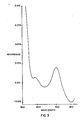
- Figures 2 and 3 are absorption curves for compounds outside the scope of the invention having the xylylidene linkage suggested by the prior art, which have been subjected to accelerated oxidation tests for comparison with compounds of the invention.
- the cluster triarylamines of the present invention possess a high resistance to oxidation to form colored products when compared with compounds such as those generically described in Belgian Patent 753,415. While the inventor does not wish to be bound by any explanation of the superior resistance of the present compounds to oxidation to colored products, it is theorized that the absence of a third aromatic ring on each carbon connecting each two triarylamine groups lends stability to the compounds; i.e. one does not have present the elements of a triphenylmethane leuco dye.
- the prior art compounds of U.S. Patent 4,140,529 and Belgian Patent 753,415 comprise a phenylene group connecting the two halves of the dimer, as can be seen in Reaction I (where R is another diarylmethane group). The phenylene group makes the prior-art compounds more susceptible to oxidation to form colored products because a positive charge formed can resonate (delocalize) into the phenyl ring, as well as into the two rings carrying nitrogen substituents.
- the compounds of this class are known as triphenylmethane dyes.
- the compounds of the present invention there is either an aliphatic chain in place of the phenyl so that this resonance cannot occur (e.g. compound I, Table I) or the oxidation-sensitive hydrogen has been replaced by a methyl group that does not oxidize (e.g. compound IV, Table I).
- Q4 can only represent CH3 (and not H) when x or z equals 1 or 2 and n is 0.
- the cluster triarylamines of the present invention also possess unexpectedly high T g .
- T g has been recognized in the prior art.
- U.S. Patent 4,140,529 states that the T g of a charge-transport layer in a multilayer electrophotographic element has to be substantially higher than normal copier operating temperatures to allow efficient charge transport as well as providing resistance to impaction by dry developers and leaching of the active components from the binder material.
- Belgian Patent 753,415 states that the compounds disclosed therein are thermally stable, however, it is referring to storage stability of elements containing the compound and not to their thermal stability during use in the copier.
- the cluster triarylamines of this invention are particularly useful in electrophotographic elements.
- compositions comprising the cluster triarylamines are applied as layers to electrically conductive substrates to form electrophotographic elements.
- the cluster triarylamines of this invention may be used in aggregate photoconductive compositions, homogeneous compositions and in both the charge-generation and charge-transport layers of multilayer electrophotographic elements.
- Aggregate photoconductive components comprise an organic sensitizing dye and a polymeric material such as an electrically insulating film-forming polymeric material. They may be prepared by several techniques, now well known in the art. Examples of these techniques include the dye-first technique described in Gramza et al, U.S. Patent 3,615,396 issued October 26, 1971 and the shearing method described in Gramza, U.S. Patent 3,615,415 issued October 26, 1971.
- the aggregate composition is combined with one or more cluster triarylamines which is coated on a suitable support to form a separately identifiable multiphase composition.
- the heterogeneous nature is generally apparent when viewed under magnification, although such compositions may appear to be substantially optically clear to the naked eye in the absence of magnification.
- Electrophotographic elements of the invention containing the above-described aggregate photoconductive composition can contain a dispersion or solution of the photoconductive composition, followed by a coating or forming a layer on an electrically conductive substrate.
- Supplemental materials useful for changing the spectral sensitivity or electrophotosensitivity of the element can be added to the composition of the element when it is desirable to produce the characteristic effect of such materials.
- other polymers can be incorporated in the vehicle, for example to alter physical properties such as adhesion of the photoconductive layer to the support and the like.
- homogeneous electrophotographic elements can be prepared with one or more cluster triarylamines of this invention in the usual manner.
- a dispersion or solution of the cluster triarylamines together with sensitizing dye and binder, when necessary or desirable, and coating or forming a layer on an electrically conductive substrate.
- Organic photoconductors known in the art can be combined with the present cluster triarylamines.
- supplemental materials useful for changing the spectral sensitivity, or electrophotosensitivity, of the element can be added when it is desirable to produce the characteristic effect of such materials.
- the organic compounds of this invention may be used in multilayer electrophotographic element typically comprises an electrically conductive substrate, a charge-generation layer in electrical contact with the conductive substrate and a charge-transport layer in electrical contact with the charge-generation layer.
- the charge-generation layer upon exposure to actinic radiation, is capable of generating and injecting charge into the charge-transport layer.
- the charge-transport layer accepts and transports the injected charge away from the charge-generation layer to the surface of the electrophotographic element, where it is neutralized.
- the charge-transport layer is substantially non-adsorbing in the spectral region of intended use, but is "active" in that it allows injection of photogenerated holes from the charge-generation layer and allows these holes to be transported therethrough.
- the charge-generation layer is a photoconductive layer which is capable of photogenerating and injecting photogenerated holes into the contiguous charge-transport layer.
- the organic compounds of this invention may be used in either the charge-generation layer or the charge-transport layer of a multilayer element.
- Suitable substrates for electrophotographic elements of the invention include electrically conducting substrates such as paper or conventional substrates, for example, cellulose acetate, cellulose nitrate, polystyrene, poly(ethylene terephthalate), poly(vinyl acetate), polycarbonate and related substrates having a conductive layer thereon.
- a useful conductive substrate is prepared by coating a transparent film support material with a layer containing a semiconductor such as cuprous iodide dispersed in a resin.
- Suitable conducting coatings are also prepared from the sodium salt of a carboxyester lactone of maleic anhydride-vinyl acetate copolymer.
- Additional useful conductive layers include carbon-containing layers such as conductive carbon particles dispersed in a resin binder.
- Metal coated papers; metal-paper laminates; metal foils such as aluminum foil; metal plates such as aluminum, copper, zinc, brass and galvanized plates; as well as vapor deposited metal layers such as silver, nickel or aluminum deposited on conventional film supports are also useful, as are conductive or conductor-coated glasses.
- Sensitizing compounds if desired for use with the photoconductive layers of the elements of the present invention, are selected from a wide variety of materials known in the art as sensitizers for organic photoconductors.
- sensitizer that is added to a photoconductive composition of the invention to give effective increases in speed varies widely.
- concentration will vary with the sensitizing compound used.
- substantial speed gains are obtained where an appropriate sensitizer is added in a concentration range from about 0.0001 to about 10 weight percent or more based on the weight of the coating composition.
- sensitizers are added to the coating composition in an amount of 0.005 to about 5.0 weight percent of the total coating composition.
- a quantity of the compound listed in claim 3 of U.S. Patent 4,140,529 was prepared by the procedure set forth in Example 2 of that reference. The compound, after five recrystallizations, was noted to be approximately 96% pure.
- the compound (which will be referred to as compound A) had a melting point of from 214 to 215.9°C and a T g of 70°C.
- the mass was crushed under the solvent and was filtered off, and rinsed with a small quantity of acetic acid.
- the solid was recrystallized three times from toluene-ethanol.
- the product was homogeneous as indicated by thin-layer chromatography (silica gel 60 plate, 30% toluene in cyclohexane).
- the white solid had a T g of 114°C.
- the m.p. was ill-defined but mass spectrometry showed that the product was the desired one, m/e 1212 and quantitative HPLC showed it to be 99.5 area % pure.
- the reaction mixture was chilled and the solid that had come down was filtered off, dissolved in toluene, treated with solid sodium carbonate, filtered and recovered by evaporation.
- the crude solid was chromatographed over a column of silica gel, (230-400 mesh), at 70 lbs/in2 pressure starting with 10% dichloromethane in cyclohexane, and gradually increasing the percentage of dichloromethane.
- the resulting viscous reaction mixture was poured slowly into 4 L of water using rapid stirring to break up the solids as they formed.
- the solids were collected by filtration and placed into an additional 4 L of water and leached under agitation.
- the solids were recollected by filtration, dissolved in a toluene/dichloromethane mixture (500 mL at 1/4 ratio), and extracted with three 600 mL portions of water. Additional dichloromethane was added as needed.
- the organic solvents were evaporated and the resulting solid was leached with cyclohexane.
- the cyclohexane was poured onto a short column of silica gel and eluted with dichloromethane until all of the unreacted 4,4 ⁇ -dimethyltriphenylamine was removed. The column was then eluted using 1/1 toluene/acetonitrile and the latter solvents were collected and evaporated. The resulting solids were added to the cyclohexane insoluble solids. The latter were then dissolved in dichloromethane and placed atop a new silica gel column. The colored materials were eluted using CH2Cl2. The column was then eluted with 1/1/toluene/acetonitrile.
- the product was isolated by separation of the toluene layer, with conventional methods following.
- the crude solid product was recrystallized from ethanol containing a small amount of ethyl acetate. When the solution was cooled slowly, with stirring and seeding, very fine crystals came out of solution slowly.
- the dried white solid showed no I.R. carbonyl absorption at 1710 cm ⁇ 1.
- a mass spectrum showed m/e 630, M for the desired alcohol.
- the first product fraction to come off was examined by field desorption mass spectrometry and showed only m/e 2046, M for the desired triester.
- a portion of this product was purified further by flash chromatography over silica by the method of Still, starting with 50% toluene in cyclohexane and gradually increasing the toluene content.
- the homogeneous fractions were identified by TLC, combined and evaporated down. Treatment with a little acetonitrile gave a hard solid which was crushed and dried. An I.R. spectrum showed a carbonyl absorption at 1740 cm ⁇ 1. Thermal analysis gave T g 120°C. Quantitative HPLC showed a purity of 99.4 area %.
- the Tg of the compounds were tested by differential scanning calorimetry (DSC).
- the samples were characterized using a DuPont 990 thermal analyzer equipped with a 960 module cell base and DSC cell. They were heated at 10 deg C/min in a nitrogen atmosphere.
- the glass transition temperature, Tg is defined as the mid-point of the heat capacity (delta C p ) shift. The range extends from the onset of the break in delta C p to where it stabilizes. The results are listed in Table II below.
- the cluster triarylamine (40%) was mixed with a polyester binder (60%) prepared from 4,4 ⁇ (2-norbornylidene)diphenol, 40 mol percent azelaic acid and 60 mol percent terephthalic acid.
- the compound was coated as a charge-transport layer over an aggregate charge-generation layer containing 1,1-Bis(4-di-p-tolylaminophenyl)cyclohexane (See U.S. Patent 4,127,412, Col. 5, lines 51-54.)
- a control was prepared in accordance with Example 1 of U.S. Patent 4,175,960 utilizing nickel coated polyethylene terephthalate as the conductive support.
Landscapes
- Physics & Mathematics (AREA)
- General Physics & Mathematics (AREA)
- Photoreceptors In Electrophotography (AREA)
- Organic Low-Molecular-Weight Compounds And Preparation Thereof (AREA)
Applications Claiming Priority (2)
| Application Number | Priority Date | Filing Date | Title |
|---|---|---|---|
| US6400 | 1987-01-23 | ||
| US07/006,400 US4788336A (en) | 1987-01-23 | 1987-01-23 | Novel organic compounds for use in electrophotographic elements |
Publications (3)
| Publication Number | Publication Date |
|---|---|
| EP0275567A2 true EP0275567A2 (fr) | 1988-07-27 |
| EP0275567A3 EP0275567A3 (en) | 1989-02-22 |
| EP0275567B1 EP0275567B1 (fr) | 1991-12-11 |
Family
ID=21720678
Family Applications (1)
| Application Number | Title | Priority Date | Filing Date |
|---|---|---|---|
| EP87119411A Expired EP0275567B1 (fr) | 1987-01-23 | 1987-12-31 | Composés organiques utilisés dans des éléments électrophotographiques |
Country Status (5)
| Country | Link |
|---|---|
| US (1) | US4788336A (fr) |
| EP (1) | EP0275567B1 (fr) |
| JP (1) | JP2559128B2 (fr) |
| CA (1) | CA1284652C (fr) |
| DE (1) | DE3775201D1 (fr) |
Families Citing this family (5)
| Publication number | Priority date | Publication date | Assignee | Title |
|---|---|---|---|---|
| JP2714666B2 (ja) * | 1988-05-16 | 1998-02-16 | 株式会社リコー | 電子写真用感光体 |
| DE69410655T2 (de) * | 1993-02-10 | 1998-12-03 | Shirota, Yasuhiko, Toyonaka, Osaka | Trisarylaminobenzolderivate, Verbindungen für ein organisches elektrolumineszierendes Element und organisches elektrolumineszierendes Element |
| CA2142735A1 (fr) * | 1993-06-18 | 1995-01-05 | Tatsuyoshi Tanaka | Derives du fluorenone, procede de preparation correspondant et agent de traitement ou de prevention de la degeneration du systeme nerveux central ou du systeme nerveux peripherique |
| US5882829A (en) * | 1997-06-30 | 1999-03-16 | Xerox Corporation | Photoreceptor containing improved charge transporting small molecule |
| US20030228534A1 (en) * | 2002-05-31 | 2003-12-11 | Jiayi Zhu | Organophotoreceptor with a light stabilizer |
Family Cites Families (12)
| Publication number | Priority date | Publication date | Assignee | Title |
|---|---|---|---|---|
| DE1251153B (de) * | 1961-12-29 | 1968-04-04 | Eastman Kodak Company, Rochester NY (V St A) | Photoleitfahige Schicht |
| US3542544A (en) * | 1967-04-03 | 1970-11-24 | Eastman Kodak Co | Photoconductive elements containing organic photoconductors of the triarylalkane and tetraarylmethane types |
| FR2055018A5 (en) * | 1969-07-14 | 1971-05-07 | Eastman Kodak Co | Electrographic photoconductive composition |
| BE756375A (fr) * | 1969-09-30 | 1971-03-01 | Eastman Kodak Co | Nouvelle composition photoconductrice et produit la contenant utilisables en electrophotographie |
| BE756943A (fr) * | 1969-10-01 | 1971-03-16 | Eastman Kodak Co | Nouvelles compositions photoconductrices et produits les contenant, utilisables notamment en electrophotographie |
| US4025341A (en) * | 1974-12-20 | 1977-05-24 | Eastman Kodak Company | Photoconductive polymer and photoconductive compositions and elements containing same |
| FR2295460A1 (fr) * | 1974-12-20 | 1976-07-16 | Eastman Kodak Co | Produit photoconducteur comprenant un photoconducteur polyarylalkane et son procede d'utilisation pour l'electrophotographie |
| US4127412A (en) * | 1975-12-09 | 1978-11-28 | Eastman Kodak Company | Photoconductive compositions and elements |
| US4140529A (en) * | 1977-09-22 | 1979-02-20 | Xerox Corporation | Charge transport overlayer in photoconductive element and method of use |
| US4360660A (en) * | 1979-12-22 | 1982-11-23 | Fuji Photo Film Co., Ltd. | Triphenylmethane polymer, process for production thereof, and photoconductive compositions and members formed therefrom |
| EP0052961B1 (fr) * | 1980-11-20 | 1985-09-11 | Xerox Corporation | Amines polymères et éléments de formation d'images contenant des amines polymères |
| JPS59116662A (ja) * | 1982-12-23 | 1984-07-05 | Tomoegawa Paper Co Ltd | 電子写真感光体 |
-
1987
- 1987-01-23 US US07/006,400 patent/US4788336A/en not_active Expired - Lifetime
- 1987-12-18 CA CA000554886A patent/CA1284652C/fr not_active Expired - Fee Related
- 1987-12-31 DE DE8787119411T patent/DE3775201D1/de not_active Expired - Fee Related
- 1987-12-31 EP EP87119411A patent/EP0275567B1/fr not_active Expired
-
1988
- 1988-01-22 JP JP63012466A patent/JP2559128B2/ja not_active Expired - Lifetime
Also Published As
| Publication number | Publication date |
|---|---|
| JP2559128B2 (ja) | 1996-12-04 |
| CA1284652C (fr) | 1991-06-04 |
| JPS63220251A (ja) | 1988-09-13 |
| EP0275567A3 (en) | 1989-02-22 |
| DE3775201D1 (de) | 1992-01-23 |
| EP0275567B1 (fr) | 1991-12-11 |
| US4788336A (en) | 1988-11-29 |
Similar Documents
| Publication | Publication Date | Title |
|---|---|---|
| EP0013172B1 (fr) | Eléments électrophotographiques | |
| US4585884A (en) | Silylated compositions, and deuterated hydroxyl squaraine compositions and processes | |
| JPS60172045A (ja) | 電子写真感光体 | |
| JPS6140985B2 (fr) | ||
| US4105447A (en) | Photoconductive insulating compositions including polyaryl hydrocarbon photoconductors | |
| EP0275567B1 (fr) | Composés organiques utilisés dans des éléments électrophotographiques | |
| EP0511664B1 (fr) | Photorécepteur électrophotographique | |
| US4700001A (en) | Novel squarylium compound and photoreceptor containing same | |
| US4329284A (en) | 1,2-Oxachalcogenol-1-ium salts | |
| US4045220A (en) | Low color photoconductive insulating compositions comprising nitrogen-free photoconductor and benzopyrilium sensitizer | |
| EP0214425B1 (fr) | Sensibilisateurs à base de tellurane pour compositions photoconductrices | |
| US4666811A (en) | Organic photoconductors having improved pre-exposure fatigue resistance and blooming properties | |
| EP0102745B1 (fr) | Composés de triarylméthane, leur préparation et leur application dans un système photoconducteur | |
| JPS61195165A (ja) | 新規スルホニル含有スチレン誘導体及びその製法 | |
| US5236797A (en) | Electrophotographic elements containing phospha-2,5-cyclohexadiene compounds as electron-transport agents | |
| US4628018A (en) | Silylated compositions, and deuterated hydroxyl squaraine compositions and processes | |
| US6090512A (en) | Electrophotographic photoreceptor | |
| JP2005121887A (ja) | フルオレノン誘導体、および該化合物を用いた電子写真感光体、電子写真装置 | |
| US5223362A (en) | Laminated organic photosensitive material | |
| KR940010124B1 (ko) | 전자사진 광수용체 | |
| US4525443A (en) | Novel 3-trihalochalcogenpropenone compounds | |
| JP2005053868A (ja) | ナフトキノン誘導体、および該化合物を用いた電子写真感光体、電子写真装置 | |
| US4590006A (en) | Organic photoconductors having improved pre-exposure fatigue resistance and blooming properties | |
| EP0124974B1 (fr) | Procédé de production de composés de chalcogénopentalène, compositions et constituants électrophotographiques contenant ces composés, et composés de telluropentalène | |
| JPH05165240A (ja) | 電子写真用感光体 |
Legal Events
| Date | Code | Title | Description |
|---|---|---|---|
| PUAI | Public reference made under article 153(3) epc to a published international application that has entered the european phase |
Free format text: ORIGINAL CODE: 0009012 |
|
| AK | Designated contracting states |
Kind code of ref document: A2 Designated state(s): DE FR GB |
|
| PUAL | Search report despatched |
Free format text: ORIGINAL CODE: 0009013 |
|
| AK | Designated contracting states |
Kind code of ref document: A3 Designated state(s): DE FR GB |
|
| 17P | Request for examination filed |
Effective date: 19890715 |
|
| 17Q | First examination report despatched |
Effective date: 19910131 |
|
| GRAA | (expected) grant |
Free format text: ORIGINAL CODE: 0009210 |
|
| AK | Designated contracting states |
Kind code of ref document: B1 Designated state(s): DE FR GB |
|
| REF | Corresponds to: |
Ref document number: 3775201 Country of ref document: DE Date of ref document: 19920123 |
|
| ET | Fr: translation filed | ||
| PLBE | No opposition filed within time limit |
Free format text: ORIGINAL CODE: 0009261 |
|
| STAA | Information on the status of an ep patent application or granted ep patent |
Free format text: STATUS: NO OPPOSITION FILED WITHIN TIME LIMIT |
|
| 26N | No opposition filed | ||
| PGFP | Annual fee paid to national office [announced via postgrant information from national office to epo] |
Ref country code: FR Payment date: 20001204 Year of fee payment: 14 |
|
| PGFP | Annual fee paid to national office [announced via postgrant information from national office to epo] |
Ref country code: DE Payment date: 20001222 Year of fee payment: 14 |
|
| PGFP | Annual fee paid to national office [announced via postgrant information from national office to epo] |
Ref country code: GB Payment date: 20011102 Year of fee payment: 15 |
|
| REG | Reference to a national code |
Ref country code: GB Ref legal event code: IF02 |
|
| PG25 | Lapsed in a contracting state [announced via postgrant information from national office to epo] |
Ref country code: DE Free format text: LAPSE BECAUSE OF NON-PAYMENT OF DUE FEES Effective date: 20020702 |
|
| PG25 | Lapsed in a contracting state [announced via postgrant information from national office to epo] |
Ref country code: FR Free format text: LAPSE BECAUSE OF NON-PAYMENT OF DUE FEES Effective date: 20020830 |
|
| REG | Reference to a national code |
Ref country code: FR Ref legal event code: ST |
|
| PG25 | Lapsed in a contracting state [announced via postgrant information from national office to epo] |
Ref country code: GB Free format text: LAPSE BECAUSE OF NON-PAYMENT OF DUE FEES Effective date: 20021231 |
|
| GBPC | Gb: european patent ceased through non-payment of renewal fee |
Effective date: 20021231 |