EP0277329B1 - Justierverfahren für den Ort einer Farbdichtemessung - Google Patents
Justierverfahren für den Ort einer Farbdichtemessung Download PDFInfo
- Publication number
- EP0277329B1 EP0277329B1 EP87118782A EP87118782A EP0277329B1 EP 0277329 B1 EP0277329 B1 EP 0277329B1 EP 87118782 A EP87118782 A EP 87118782A EP 87118782 A EP87118782 A EP 87118782A EP 0277329 B1 EP0277329 B1 EP 0277329B1
- Authority
- EP
- European Patent Office
- Prior art keywords
- sheet
- coordinate
- points
- axis
- density measurement
- Prior art date
- Legal status (The legal status is an assumption and is not a legal conclusion. Google has not performed a legal analysis and makes no representation as to the accuracy of the status listed.)
- Expired - Lifetime
Links
Images





Classifications
-
- B—PERFORMING OPERATIONS; TRANSPORTING
- B41—PRINTING; LINING MACHINES; TYPEWRITERS; STAMPS
- B41F—PRINTING MACHINES OR PRESSES
- B41F33/00—Indicating, counting, warning, control or safety devices
- B41F33/0036—Devices for scanning or checking the printed matter for quality control
-
- G—PHYSICS
- G01—MEASURING; TESTING
- G01N—INVESTIGATING OR ANALYSING MATERIALS BY DETERMINING THEIR CHEMICAL OR PHYSICAL PROPERTIES
- G01N21/00—Investigating or analysing materials by the use of optical means, i.e. using sub-millimetre waves, infrared, visible or ultraviolet light
- G01N21/17—Systems in which incident light is modified in accordance with the properties of the material investigated
- G01N21/59—Transmissivity
- G01N21/5907—Densitometers
- G01N21/5911—Densitometers of the scanning type
-
- G—PHYSICS
- G01—MEASURING; TESTING
- G01N—INVESTIGATING OR ANALYSING MATERIALS BY DETERMINING THEIR CHEMICAL OR PHYSICAL PROPERTIES
- G01N2201/00—Features of devices classified in G01N21/00
- G01N2201/10—Scanning
- G01N2201/101—Scanning measuring head
Definitions
- the present invention relates to a method for adjusting the position of colour density measurement reference points according to the preamble of claim 1.
- the quantity of supplied ink is controlled by using sample sheets on which the pattern is printed so that the density of this pattern can be maintained at a predetermined value.
- the sample sheets 42 as shown in Fig. 12 are usually provided with a belt-shaped solid mark 41 having a predetermined width W.
- This solid mark 41 is printed at an end portion of the sheet 42 in the same processes as the printing of the picture print 40.
- This solid mark 41 is divided in the length direction in various sections, so that the densities of the respective colours can be measured which are assigned to these sections. Thereby an adjustment of the solid mark 41 of the sample sheet 42 to a predetermined position has to be performed on basis of judgement by the human eye.
- the end of the sample sheet 42 can be brought in contact with a guide thereby positioning the sample sheet 42 with regard to the table.
- the densities of the respective colours are scanned and measured by the head unit of a densitometer, whereby the density of pattern 40 is represented by the density of the solid mark 41.
- the measurement area of the head unit of the densitometer falls within the width W of the solid mark 41. Since as a rule the solid mark 41 is broader than the measurement area of the head unit, the position adjustment can be performed rather easily.
- This method however, has the drawback that no direct control or supervision of the picture to be printed is performed because the colour density of the picture is obtained by measuring only the density of the separate solid mark 41. Thus, there may occurs instances, when the colour density of the actual picture 40 to be printed fails to be satisfactory while the density of the separate solid mark 41 is printed in a satisfactory way.
- EP-A-0 131 109 it is already known (see EP-A-0 131 109) to provide paper sheets to be printed with colour strips, so that the particular paper sheet can be scanned by means of an optical pen. From EP-A-0 143 744 it is further known, to make the colour density measurements directly within the pictures already printed thereby avoiding the provision of special colour strips which have to be cut away at a later stage.
- the object of the present invention to provide a method for adjusting the colour density measurement points which by reducing the burden on the operator, allows an extreme exact positioning of colour density measurement points of a reference sheet with regard to the corresponding coordinate positions of colour density measurement points of the following sample sheets, thereby making it possible that the colour density of a pattern to be printed is controlled in a direct way.
- Another object of the present invention is to provide a method for adjusting the colour density measurement position thereby allowing the use of a rather narrow solid mark thus making is possible to save printing paper accordingly.
- the positions of colour density measurement reference points provided on a reference sheet can be adjusted in an extremely precise way with corresponding coordinate positions of the colour density measurement points provided on the following sample sheets.
- FIG. 2 is a perspective view illustrating an embodiment of a density measurement apparatus to which the density measurement position adjustment method is applied.
- This density measurement apparatus includes an X-Y coordinate table 1, a scanning densitometer 2 arranged on the X-Y coordinate table 1 so that it is movable in the X-direction of the X-Y coordinate table 1 (in the left and right directions, i.e., in a transverse direction in the figure) and in the Y-direction thereof (in the front and rear directions in the figure), and an operation unit 3 constructed as a console panel on which various switches, a display and the like are arranged.
- a paper guide 4 is provided on the X-Y coordinate table 1.
- a paper 5 can be positioned and arranged as indicated by single dotted lines in the figure by allowing the paper end to be in contact with the paper guide 4. Further, a plurality of air holes (although not shown) are opened in one side surface of the X-Y coordinate table 1. By sucking air through these air holes, the paper 5 is held, thereby making possible to maintain flatness or evenness thereof on the X-Y coordinate table 1.
- the scanning densitometer 2 is constructed as a reflection type densitometer. In front of a position away from the density measurement area of its head unit, a position adjustment or registering mark 21 is provided.
- Fig. 3 is a block diagram illustrating the circuit arrangement of the above-mentioned density measurement apparatus.
- This density measurement apparatus includes a memory unit 6 for memorizing various data and programs, and a microprocessor 7 to execute data processing and the like in accordance with the programs constructed at the memory unit 6.
- the memory unit 6 and the microprocessor 7 are connected to an input device 31 and a display device 32 at the operation unit 3, a paper sucker 9, the scanning densitometer 2, and a position command circuit 10 through a data and control bus 8. Transmission and receiption of various kind of information may be conducted among these components. For example, A/D conversion of a density value detected at the scanning densitometer 2 is performed in response to a command from the microprocessor 7.
- the density value detected which has undergone A/D conversion is memorized or stored into the memory unit 6.
- the position command circuit 10 conducts transmission and receiption of data to and from an X-axis motor drive circuit 11 and a Y-axis motor drive circuit 12 through data and control buses 11a and 12a.
- the drive control of an X-axis motor 13 is performed by the X-axis motor drive circuit 11 and the drive control of a Y-axis motor 14 is performed by the Y-axis motor drive circuit 12. Namely, movements in X- and Y-directions on the X-Y coordinate table 1 of the scanning densitometer 2 are controlled by the X-axis and Y-axis motors 13 and 14, respectively.
- an OK sheet 51 (Fig. 4) which constitutes a density specimen of a pattern (reference sheet) as the paper 5 is set on the X-Y coordinate table 1 of this density measurement apparatus.
- reference marks 512, 513 and 514 are printed as portions of the pattern depicted at the bottom of the outer peripheral portion of the pattern portion 511. These reference marks 512, 513 and 514 are painted out in the form of rectangle by predetermined widths, respectively.
- the reference marks 512, 513 and 514 constitute reference marks A, B and C, respectively.
- the reference marks A and B are such that their edges in a length direction are arranged on the same straight line and their edges in a width direction are oppositely disposed with they being spaced from each other by a predetermined distance.
- the reference marks B and C cross at right angles at their end portions. Namely, by adjusting the end portion of the OK sheet 51 to which such reference marks are implemented to the paper guide 4, it is positioned and arranged on the X-Y coordinate table 1.
- setting of coordinate positions on the X-Y coordinate table of density measurement desired points (density measurement reference points) and the density measurement at the coordinate points are conducted.
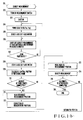
- step 101 when the operation of the flowchart is initiated (step 101), the paper sucker 9 is activated to suck the OK sheet 51 set on the X-Y coordinate table 1 (step 102). From such a condition, X-axis and Y-axis motor manual drive switches (not shown) included in the operation unit 3 are operated to move the scanning densitometer 2, thereby allowing the position adjustment mark 21 of the scanning densitometer 2 to be in correspondence with substantially the center of the reference mark A in a width direction (step 103). Then, a Y-axis switch (not shown) is depressed (step 104).
- a density measurement area 22 of the scanning densitometer 2 is located close to the side portion of the reference mark A(512).
- the Y-axis switch is to be depressed at the step 104.
- a coordinate position RSi(x si , y si ) of a central point P1 of the density measurement area 22 on the X-Y coordinate table 1 at this time is memorized into the memory unit 6 as a head position (step 105).
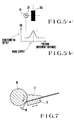
- the point P1 of the density measurement area 22 begins moving as indicated by single dotted lines and the density measurements caused to corresponding to coordinate positions on the X-Y coordinate table every fixed movement intervals during the movement of the density measurement area 22 are conducted.
- density values caused to correspond to such coordinate positions are memorized into the memory unit 6 (step 107).
- the Y-axis motor manual drive switch is cut off at step 108.
- a coordinate position REi(x Ei , y Ei ) of the point P1 on the X-Y coordinate table 1 at this time is memorized (step 109).
- the coordinate position showing the maximum value of the mountain-shaped waveform data represents the center of the reference mark A in a width direction.
- the coordinates indicative of the center in the width direction are memorized at step 110.
- the program execution returns to the step 103. Namely, for the reference mark B, the positioning mark 21 of the scanning densitometer 2 is adjusted to substantially the center in the width direction of the reference mark B.
- the central coordinates in the width direction thereof are determined at step 110.
- the positioning mark 21 of the scanning densitometer 2 is adjusted to a position which is slightly shifted to the left or right at substantially the center in a length direction of the reference mark C.
- the X-axis switch is depressed at step 104.
- the X-axis motor manual drive switch is turned on at step 106.
- the density measurement area 22 moves in the X-axis direction to scan the reference mark C.
- the central coordinates in the width direction are determined at step 110.
- density values measured are obtained as mountain-shaped data.
- the central coordinates in the width direction can be precisely detected.
- any color may be used. It is preferable that the color of the reference mark is "black” or the like in view of ensurance of clear contrast with respect to the paper.
- color of "visual” or any reference mark may be given by a switch to thereby automatically select a filter corresponding thereto.
- comparison of outputs of all filters of "visual", “Red”, “Green” and “Blue” may be made to thereby employ a value which is maximum at the difference between the vertex and the bottom side of the mountain-shaped waveform.
- the origin on the OK sheet 51 can be expressed as a point at which the straight line AB and a straight line drawn from C to the straight line AB intersect with each other.
- the coordinate transformation setting a point on the X-Y coordinate table 1 which is opposite to the origin of the OK sheet 51 as the position of origin O (0, 0) of the X-Y coordinate table 1 can be realized by a general numeric calculation program. In a manner similar to this, it is possible to set the straight lines AB and OC as the x-axis and y-axis, respectively.
- the microprocessor 7 determines the origin of the OK sheet 51 to consider this origin as the position of origin O (0, 0) on the X-Y coordinate table 1 and to consider the straight lines AB and OC as the x-axis and y-axis, respectively.
- the x-axis and y-axis motor manual drive switches are operated, thereby allowing the positioning mark 21 of the scanning densitometer 2 to be in correspondence with a density measurement desired point within the pattern portion 511 on the OK sheet 51.
- the density measurement area 22 moves on the basis of data indicative of quantity of positional shift between the positioning mark 21 and the density measurement area 22 to adjust the point P1 thereof to the density measurement desired point (step 114).
- a reference value setting switch (not shown) is depressed at step 113
- the density measurement area 22 moves on the basis of data indicative of quantity of positional shift between the positioning mark 21 and the density measurement area 22 to adjust the point P1 thereof to the density measurement desired point (step 114).
- the coordinate position on the X-Y coordinate table 1 at the density measurement desired point is recognized and the density at this point is read, whereby they are memorized as the reference measurement coordinate position and the reference density value (step 115).
- a series of works for setting density measurement reference points and reference densities using the OK sheet is completed at step 117.
- a sample sheet (not shown) is set in place of the OK sheet 51 on the X-Y coordinate table 1 in the same manner as in the OK sheet 51.
- a pattern identical to that on the OK sheet is printed (reference marks A to C are also printed).
- this sample sheet is set on the X-Y coordinate table 1 to initiate the density measurements at respective points on the sample sheet which correspond to density measurement reference points on the OK sheet 51 in accordance with the flowchart shown in Fig. 1(b).
- a measurement switch (not shown) is turned on at step 202.
- the sample sheet is sucked and held on the X-Y coordinate table 1 (step 203) and at the same time the central point P1 of the density measurement area 22 of the scanning densitometer 2 is automatically moved to the coordinate position RSi(x si , y si ) at the step 105 which has been memorized using the OK sheet 51 (step 204).
- the density measurement area 22 moves to a predetermined position close to the reference mark.
- step 205 the X-axis motor 13 or the Y-axis motor is driven (for the reference marks A and B, the Y-axis motor 14 is driven and for the reference mark C, the X-axis motor 13 is driven), the point P1 of the density measurement area 22 begins moving and the density measurements of reference marks caused to correspond to coordinate positions on the X-Y coordinate table 1 are conducted every predetermined movement intervals.
- density values caused to correspond to the coordinate positions are memorized (step 206).
- the X-axis motor 13 or the Y-axis motor 14 is stopped at step 208.
- the central coordinate position in a width direction of the reference mark is determined on the basis of the density measurement result caused to correspond to the above-mentioned coordinate position (step 209).
- the steps 204 to 209 are repeatedly executed until the result of step 210 becomes Y to determine central coordinate positions A ⁇ , B ⁇ and C ⁇ in respective width directions of the reference marks A, B and C.
- the origin on the sample sheet is determined. Namely, a vertical line is drawn from C ⁇ to the straight line A ⁇ B ⁇ to determine a point at which the vertical line and the straight line A ⁇ B ⁇ intersect with each other to be the origin O ⁇ and to apply coordinate transformation to a point on the X-Y coordinate table 1 which is opposite to the origin of the sample sheet to be the position of origin O(O, O).
- the straight lines A ⁇ B ⁇ and O ⁇ C ⁇ may be set to the x-axis and y-axis, respectively.
- the microprocessor 7 performs the above coordinate transformation to thereby consider the origin on the sample sheet as the position of origin O(O, O) on the X-Y coordinate table 1 and to consider the straight lines A ⁇ B ⁇ and O ⁇ C ⁇ as the x-axis and the y-axis, respectively.
- the coordinate position of origin and the x- and y-axis on the OK sheet 51 and the coordinate position of origin and x- and y-axis on the sample sheet are in correspondence with each other on the X-Y coordinate table 1.
- the position of the density measurement point corresponding to the density measurement reference point is corrected (step 212).
- the density measurement reference point on the OK sheet 51 and the density measurement point on the sample sheet are in correspondence with each other on the coordinate of the X-Y coordinate table 1.
- the scanning densitometer automatically moves, so that the point P1 of the density measurement area 22 is precisely located at the density measurement point on the sample sheet which is in correspondence with the coordinate position of the density measurement reference point of the OK sheet 51 (step 213).
- the density measurement at this point is conducted (step 214).
- the density measurements of density measurement points on the sample sheet corresponding to all density measurement reference points on the OK sheet are determined by repeatedly executing the steps 211 to 214 until the result of the step 215 becomes Y.
- the density measurement values at respective measurement points are memorized in correspondence with the reference density values at the density measurement reference points on the OK sheet 51.
- Fig. 6 shows an example of a flowchart for conducting a pertinent control of a quantity of an ink supplied to a printing machine on the basis of the result having been explained to effect a density control of a printing picture.
- the density control is initiated at step 301, data related to a paper size is read at step 302. Then, at step 303, the coordinate position on the X-Y coordinate table 1 of the density measurement reference point having been determined using the OK sheet 51 is read. A correspondence divisional blade number in the printing machine which corresponds to the coordinate position thus read is memorized (step 304).
- Fig. 7 is a side cross sectional view showing the essential part of the ink supply unit in the printing machine.
- the relationship in respect of the supply quantity of the ink 17, the printing density and the density difference varies in accordance with the kind of the printing machine.
- the blade opening quantity HI is adjusted to thereby adjust an ink supply quantity, thus to perform a density control.
- the relationship in respect of the ink supply quantity, the printing density and the density difference is memorized in advance as data caused to correspond to a printing machine employed. As shown in Fig.
- the blade 15 is disposed in a range broader than the width W1 of the paper 18 to be printed and is composed of a plurality of divisional blades 151 to 1524 of which blade opening quantities are independently adjustable.
- predetermined blade numbers of No. 1 to No. 24 as shown are assigned, respectively. Since the paper 18 to be printed is fed to the printing machine with the paper central line indicated by single dotted lines in the figure being in correspondence with the center of the printing machine, the center in a transverse direction of the printed paper is adjusted to the center of the X-Y coordinate table by the paper guide. Accordingly, the positional relationship between the divisional blades and the density measurement points can be determined using width values of respective blades which can be known in advance.
- step 303 For example, where a coordinate position of a density measurement reference point corresponding to the point P2 shown in Fig. 8 is read at step 303, the divisional blade 158 corresponding to the density measurement desired point thus read is selected. As a result, No. 8 which is the blade number thereof is memorized at step 304. Then, at step 305, the difference between the reference density of the density measurement reference point on the OK sheet and the density measured value of the sample sheet having been memorized in correspondence therewith is computed. By repeatedly executing the steps 303 to 305 until the result of the step 306 becomes Y, correspondence blade numbers for the all density measurement points are memorized and density differences between the all density measurement points and reference densities of the all density measurement reference points are determined.
- step 307 whether or not density measurement points of which blade numbers overlap with each other are present is confirmed. If density measurement points of which blade numbers overlap with each other are present, the average of the density difference between density measured values and reference densities at these density measurement points is computed at step 308. The program execution shifts to step 309. In contrast, if density measurement points of which blade numbers overlap with each other are not present, the program execution directly shifts to the step 309. At this step 309, correcting quantities of the blade opening quantities of the divisional blades corresponding to the respective density measurement points are computed on the basis of the density differences. In accordance with the correcting quantities thus computed, blade opening quantities of respective blades are corrected (step 310).
- densities at points corresponding to respective density measurement points of the printing paper 18 which is to be printed from now are precisely in correspondence with the reference densities having been determined using the OK sheet.
- densities or density values defined in this embodiment are values obtained by implementing color separation to measure respective values of "Cyan”, “Magenta”, “Yellow” and "Black”.
- the density measurement position adjustment method can conduct a density control of a pattern using narrower reference marks A to C without use of the broder solid mark 41 as shown in Fig. 12. This permits a quantity of papers to be cut after printing to be reduced to save papers accordingly. Moreover, since the density of the pattern is directly measured, the precision of the density control is extremely improved as compared to the conventional method to make a measurement using a solid mark. Further, the densities of significant portions of the pattern can be selectively supervised, resulting in high control efficiency. Furthermore, the scanning densitometer is used for detecting origins on the OK sheet and the sample sheet, resulting in simplified structure, low cost and high precision in the agreement between detection positions and measurement positions.
- the reference marks A to C are printed at the bottom portion of the paper in this embodiment, it is preferable that they are printed at the central portion of the paper in an actual sense. Namely, the longitudinal length of a paper may be expanded by about 1 mm by the application of printing pressure to the paper. Where portions to which the density control is applied are not solid portions in a pattern but significant points for printing of halftone portions therein, even if there occurs positional displacement of only 0.1 mm, the measured densities greately change at portions where tone continuously varies. For this reason, it is preferable to print reference marks at the central portion of a paper where the influence of expansion and contraction of the paper on results of computation for correction of position is small even if expansion and contraction of the paper might occur to some extent. Such an implementation permits precise density control. In addition, reference density values at density measurement reference points may be manually input. On the display device 32, coordinate positions, density measured values and the like on the X-Y coordinate table of the scanning densitometer 2 are displayed.
- reference marks B and C are printed in a manner that they intersect with each other in this embodiment, they do not necessarily intersect with each other but may be printed with they being spaced from each other.
- the directions of moving the scanning densitometer after reference marks are designated are different for reference marks A and B and for reference mark A, respectively. Such directions vary depending upon how the OK sheet and the sample sheet are placed on the X-Y coordinate table.
- the sequence of scanning is determined in advance, thereby making it possible to automatically set its moving direction.
- the moving direction can be automatically determined when an arrangement pattern of reference marks is registered into a memory without prescribing the placement manner of the OK sheet and the sample sheet and the positional relationship with respect to respective reference marks thus to allow an operator to select the arrangement pattern, the moving direction can be automatically determined.
- any portions serving as a reference may be selected from the pattern to thereby designate lines in X- and Y-axis directions on the basis of the portions serving as the reference to consider then as reference marks.
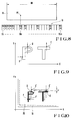
- it is desirable that the center of the portion considered as the reference mark is not selected as a reference, but the position of the density gradient designated at the rising portion or at the falling portion of the boundary thereof is selected as a reference. For example, it is assumed that a character of "PT" as shown in Fig.
- the scanning densitometer is moved in a Y-axis direction with respect to the character "PT" to thereby set a reference point D (a first reference point) at the time of rise of the density gradient. Then, by the movement of the scanning densitometer in the Y-axis direction with respect to the character "T", a reference point E (a second reference point) is set at the time of rise of the density gradient. Likewise, by the movement of the scanning densitometer in the X-axis direction with respect to the character "P", a reference point F (a third reference point) is set at the time of rise of the density gradient.
- Such settings are made for the OK sheet set on the X-Y coordinate table.
- a sample sheet 20 is set, e.g., at a position shifted as indicated by broken lines in this figure relative to an OK sheet 19 indicated by a solid line in this figure. Accordingly, the character "PT" of the sample sheet 20 is shifted in appearance relative to the character "PT" of the OK sheet 19 as indicated by broken lines in the figure.
- points corresponding to D, E and F on the OK sheet 19 obtained by the scanning operation using the scanning densitometer are obtained as D ⁇ , E ⁇ and F ⁇ , respectively.
- Such a coordinate transformation may be accomplished by the steps of obtaining an inclination angle ⁇ from the coordinate positions of the reference points D ⁇ and E ⁇ , correcting an aberration in a rotational direction of the character "PT" by this inclination angle ⁇ , thereafter moving the character "PT" for the purpose of allowing the Y-coordinate of the reference point D ⁇ to be in correspondence with the Y-coordinate of the reference point D, and further moving the character "PT" for the purpose of allowing the X-coordinate of the reference point F ⁇ to be in correspondence with the X-axis of the reference point F.
- the density measurement position adjustment method comprises the step of: setting a reference sheet on which a predetermined pattern is printed on an X-Y coordinate table; designating at least three reference points referred to as first to third reference points within the pattern of the reference sheet; determining coordinate positions on the X-Y coordinate table of the three reference points; memorizing coordinate positions at density measurement reference points within the pattern of the reference sheet with a single point and two intersecting lines obtained by computation based on the coordinate positions of the reference points being as an origin, an X-axis and a Y-axis, respectively; setting a sample sheet on which the same pattern as the pattern on the reference sheet is printed on the X-Y coordinate table; detecting coordinate positions on the X-Y coordinate table of points, which correspond to the three reference points on the reference sheet, within the pattern on the sample sheet; determining a detection origin, a detection X-axis and a detection Y-axis by computation based on the coordinate positions of the points on the sample sheet; and correcting coordinate positions
Landscapes
- General Health & Medical Sciences (AREA)
- Immunology (AREA)
- Physics & Mathematics (AREA)
- Health & Medical Sciences (AREA)
- Life Sciences & Earth Sciences (AREA)
- Chemical & Material Sciences (AREA)
- Analytical Chemistry (AREA)
- Biochemistry (AREA)
- Quality & Reliability (AREA)
- Engineering & Computer Science (AREA)
- General Physics & Mathematics (AREA)
- Pathology (AREA)
- Inking, Control Or Cleaning Of Printing Machines (AREA)
- Investigating Or Analysing Materials By Optical Means (AREA)
- Silver Salt Photography Or Processing Solution Therefor (AREA)
- Spectrometry And Color Measurement (AREA)
- Accessory Devices And Overall Control Thereof (AREA)
- Analysing Materials By The Use Of Radiation (AREA)
Claims (27)
- Verfahren zur Einstellung der Farbdichtemeßposition, um die Koordinatenpositionen von Farbdichtemeßpunkten (A'-C', D'-F') auf einem X-Y-Tisch (1) aufgelegten Testbogen (20) in Übereinstimmung mit den Koordinatenpositonen von Farbdichtenmeßreferenzpunkten (A-C, D-F) eines Referenzbogens (19, 51) zu bringen gekennzeichnet durch die folgenden Verfahrensschrittea) Auflegen eines mit einem vorgegebenen gedruckten Muster (511) versehenen Referenzbogens (19, 51) auf einem X-Y-Koordinatentisch (1),b) Festlegen von wenigstens drei Referenzpunkten (A-C, D-F) auf dem Referenzbogen (19, 51), welche entweder innerhalb des Bildflächenbereiches (511) oder als äußere perifäre Referenzmarkierungen (512-514) der Bildfläche des Referenzbogens (19, 51) auftreten,c) Festlegen auf dem X-Y-Koordinatentisch (1) der Koordinatenpositionen der drei Referenzpunkte (A-C, D-F) des Referenzbogens (19, 51),d) Berechnung eines einzelnen Punktes und zwei einander schneidender Linien anhand der Koordinatenpositionen der Referenzpunkte (A-C, D-F), wodurch der Koordinatenursprung, die X-Achse und die Y-Achse in Bezug auf den Referenzbogen (19, 51) festgelegt werden,e) Einspeicherung der Koordinatenpositionen der Farbdichtemeßreferenzpunkte innerhalb des Musters (511) auf dem Referenzbogen (19, 51) unter Verwendung eines einzelnen Punktes und der zwei einander schneidender Linien,f) Auflegen eines Testbogens (20) auf dem X-Y-Koordinatentisch (1), wobei dieser Testbogen (20) mit demselben Muster (511) wie das Muster (511) des Referenzbogens (19, 51) versehen ist,g) Festlegung der Koordinatenpositionen (A'-C', D'-F') der Punkte (A'-C', D'-F') auf dem Testbogen (20), welche den drei Referenzpunkten (A-C, D-F) auf dem Referenzbogen (19, 51) entsprechen,h) Bestimmung des Koordinatenursprungs, der X-Achse und der Y-Achse durch Berechnung aufgrund der Koordinatenpositionen der auf dem Testbogen (20) befindlichen Punkte (A'-C', D'-F') undi) Korrigieren der Koordinatenpositonen der Farbdichtemeßpunkte, welche den Farbdichtemeßpunkten auf dem Referenzbogen (19, 51) innerhalb des Musters (511) auf dem Testbogen (20, 42) entsprechen, so daß der Koordinatenursprung, die X-Achse und die Y-Achse auf dem Testbogen (20) in Übereinstimmung mit dem Koordinatenursprung, der X-Achse und der Y-Achse des Referenzbogens (19, 51) gebracht werden.
- Verfahren nach Anspruch 1, dadurch gekennzeichnet, daß der erste Referenzpunkt (D) auf einer ersten Achse des Referenzbogens (19, 51) liegt, während der zweite Referenzpunkt (E) auf der ersten Achse oder einer dazu parallel verlaufenden Achse angeordnet ist, so daß der zweite Referenzpunkt (E) in Bezug auf den ersten Referenzpunkt (D) in einem gewissen Abstand auftritt, und daß der dritte Referenzpunkt (F) entlang einer zweiten senkrecht zur ersten Achse liegenden zweiten Achse auftritt.
- Verfahren nach Anspruch 2, dadurch gekennzeichnet, daß die Referenzpunkte (D-F) durch Referenzmarkierungen (512-514) vorgegebener Fläche gebildet werden, welche zuvor als Teile des Musters (511) auf dem Referenzbogen (19, 51) aufgedruckt sind.
- Verfahren nach Anspruch 3, dadurch gekennzeichnet, daß die Koordinatenpositionen der Referenzpunkte (D-F) auf der Basis von Änderungen der Dichtewerte festgelegt werden, welche durch Abtastung von entsprechenden Referenzmarkierungen (512-514) mit Hilfe eines Abtastmeßgerätes (2) gebildet werden.
- Verfahren nach Anspruch 3, dadurch gekennzeichnet, daß die mit Hilfe des Abtastmeßgerätes (2) bestimmten Farbdichtewerte in Form von Spitzenwerten bestimmt werden.
- Verfahren nach Anspruch 3, dadurch gekennzeichnet, daß die ersten und zweiten Referenzmarkierungen (512, 513) derart festgelegt werden, indem ihre Ränder in der Längsrichtung entlang derselben geraden Linie auftreten, und die Kanten in der Breitenrichtung auf gegenüberliegenden Seiten angeordnet sind und einen gewissen Abstand voneinander einnehmen, während die zweiten und dritten Referenzmarkierungen (513, 514) in ihren Endbereichen sich senkrecht zueinander schneiden.
- Verfahren nach Anspruch 4, dadurch gekennzeichnet, daß die Koordinatenpositionen der Referenzmarkierungen (D-F) als Koordinatenpositonen festgelegt werden, sobald der mittlere Punkt des Farbdichtenmeßbereiches (22) des Abtastfarbdichtenmeßgerätes (2) in den mittleren Bereichen der Referenzmarkierungen (512-514) positioniert ist.
- Verfahren nach Anspruch 7, dadurch gekennzeichnet, daß die Breite der Referenzmarkierungen (512-514) schmäler als der Farbdichtenmeßbereich (22) des Abtastfarbdichtenmeßgerätes (2) ist.
- Verfahren nach Anspruch 3, dadurch gekennzeichnet, daß die Referenzmarkierungen (512-514) in Form von ausgefüllten rechteckigen Bereichen ausgebildet sind.
- Verfahren nach Anspruch 9, dadurch gekennzeichnet, daß die Referenzmarkierungen (512-514) schwarz gefärbt sind.
- Verfahren nach Anspruch 7, dadurch gekennzeichnet, daß bei Bezeichnung der mittleren Koordinatenpositionen in der Breitenrichtung der ersten bis dritten Referenzmarkierungen (512-514) als A, B und C der als Punkt O bezeichnete Koordinatenursprung des Referenzbogens (19, 51) jene Stelle ist, an welcher die gerade Linie AB und die von C ausgehende senkrecht dazu gezogene Linie einander schneiden.
- Verfahren nach Anspruch 11, dadurch gekennzeichnet, daß der Koordinatenursprung auf dem Referenzbogen (19, 51) auf den Koordinatenursprung des X-Y-Koordinatentisches 1 transformiert wird, indem eine vorgegebene Koordinatentransformation durchgeführt wird.
- Verfahren nach Anspruch 7, dadurch gekennzeichnet, daß die geraden Linien AB und OC auf dem Referenzbogen (19, 51) auf die X- und Y-Achsen des Koordinatentisches (1) durch Vornahme einer vorgegebenen Koordinatentransformation transformiert werden.
- Verfahren nach Anspruch 7, dadurch gekennzeichnet, daß im Fall, in welchem die mittleren Koordinatenpositionen in den Breitenrichtungen der den Referenzpunkten (A-C) des Referenzbogens (19, 51) entsprechenden Punkten als A', B' und C' bezeichnet werden, auf dem Testbogen (20) der Punkt O' jeder ist, an welchem die gerade Linie A'B' und die senkrecht von dem Punkt C' gezogene Linie einander schneiden.
- Verfahren nach Anspruch 14, dadurch gekennzeichnet, daß der Koordinatenursprung auf dem Testbogen (20) auf den Koordinatenursprung des X-Y-Koordinatentisches (1) transformiert wird, indem eine vorgegebene Koordinatentransformation durchgeführt wird.
- Verfahren nach Anspruch 14, dadurch gekennzeichnet, daß die geraden Linien A'B' und O'C' auf dem Referenzbogen (19, 51) auf die X-Achse und die Y-Achse des X-Y-Koordinatentisches (1) transformiert werden, indem eine vorgegebene Koordinatentransformation durchgeführt wird.
- Verfahren nach Anspruch 1, dadurch gekennzeichnet, daß die Referenzpunkte (D-F) dadurch erhalten werden, indem auf dem Referenzbogen (19, 51) vorgegebene Teile (P,T) des vorhandenen Musters (511) in unveränderter Form verwendet werden.
- Verfahren nach Anspruch 17, dadurch gekennzeichnet, daß die Koordinatenpositionen der Referenzpunkte (D-F) auf der Basis von Veränderungen der gemessenen Farbdichten festgelegt werden, indem die entsrechenden Referenzmarkierungen (P,T) mit Hilfe eines Abtastfarbdichtenmeßgerätes (2) abgetastet werden.
- Verfahren nach Anspruch 18, dadurch gekennzeichnet, daß die Koordinatenpositionen der Referenzpunkte (D-F) als Koordinatenpositionen festgelegt werden, sobald der mittlere Punkt des Farbdichtenmeßbereiches (22) des Abtastfarbdichtenmeßgerätes (2) die jeweiligen Grenzbereiche der vorgegebenen Bereiche der Referenzmarkierungen (P,T) übersteigt.
- Verfahren nach Anspruch 1, dadurch gekennzeichnet, daß im Fall, in welchem eine Differenz zwischen den eingestellten Positionen des auf dem Koordinatentisch (1) befindlichen Referenzbogens (19, 51) und des Testbogens (20) auftritt, das Korrekturverfahren den Schritt aufweist, daß eine Koordinatentransformation vorgenommen wird, um die Koordinatenpositionen der Punkte, welche den Referenzpunkten (D-F) auf dem Testbogen (20) entsprechen, auf die Koordinatenpositionen der Referenzpunkte (A-C, D-F) auf dem Referenzbogen (19, 51) einzustellen.
- Verfahren nach Anspruch 20, dadurch gekennzeichnet, daß die Koordinatentransformation durchgeführt wird, indem der Neigungswinkel (Θ) bestimmt wird, welcher durch die Punkte festgelegt ist, die den Referenzpunkten (D'-F') auf dem Testbogen (20) entsprechen, um auf diese Weise den winkelmäßigen Fehler unter Verwendung des Neigungswinkels (Θ) zu korrigieren, während in der Folge die entsprechenden Punkte auf dem Testbogen (20) translatorisch verschoben werden, so daß die Koordinatenpositionen der Punkte (D'-F') auf dem Testbogen (20) in Übereinstimmung mit denen der Referenzpunkte (D-F) auf dem Referenzbogen (19, 51) gebracht werden.
- Verfahren nach Anspruch 21, dadurch gekennzeichnet, daß die zweiten und dritten Referenzpunkte (E, F) gegenüber der Achse versetzt sind, auf welchem der erste Referenzpunkt (D) vorhanden ist.
- Verfahren nach Anspruch 22, dadurch gekennzeichnet, daß die Korrektur der Koordinatenpositionen der Farbdichtenmeßpositionen innerhalb des Musters (511) auf dem Testbogen (20) durchgeführt wird, indem im wesentlichen dieselbe Koordinatentranformation wie die bereits erwähnte Koordinatentransformation durchgeführt wird.
- Verfahren nach Anspruch 2, dadurch gekennzeichnet, daß die Referenzmarkierungen (P,T) im wesentlichen im mittleren Bereich des Referenzbogens (19, 51) aufgedruckt sind.
- Verfahren nach Anspruch 1, dadurch gekennzeichnet, daß der Vorgang zum Einstellen der Farbdichtenmeßpunkte auf der Basis von Veränderungen der Farbdichte durchgeführt wird, welche durch Abtastung entsprechend der Referenzmarkierungen (512-514; P,T) unter Einsatz eines Abtastfarbdichtenmeßgerätes (2) gemessen werden.
- Verfahren nach einem der Ansprüche 1 bis 25, dadurch gekennzeichnet, daß der Stromkreis zur Durchführung des Verfahrens unter Verwendung eines Abtastfarbdichtenmeßgerätes (2) einen rechnergesteuerten Kreis (3, 6, 7), ferner eine Positionssteuereinheit (10) mit entsprechenden Motortreiberkreisen (11, 12) zum Antrieb von entsprechenden X- und Y-Motoren (12, 13) sowie eine Papieransaugeinheit (9) zum Ansaugen der Referenz- und Abtastbögen (19, 20, 51) auf dem X-Y-Koordinatentisch (1) umfaßt.
- Verfahren nach Anspruch 26, dadurch gekennzeichnet, daß der rechnergesteuerte Kreis (3, 6, 7) eine Speichereinheit (6) zur Speicherung der verschiedenen Daten und Programme, ferner einen Mikrorechner (7) für die durch Durchführung der Datenverarbeitung in Übereinstimmung mit dem innerhalb der Speichereinheit (6) eingespeicherten Programm sowie eine Steuereinheit (3) umfaßt, wobei letztere eine Eingangseinheit (31) zur Einstellung der notwendigen Eingangsdaten, wie der Referenzfarbdichtenwerte an den Referenzmeßpunkten (A-C, D-F) sowie eine Anzeigeeinheit (32) zur Anzeige der Koordinatenpositionen der gemessenen Farbdichtenwerte und dgl. aufweist.
Priority Applications (1)
| Application Number | Priority Date | Filing Date | Title |
|---|---|---|---|
| AT87118782T ATE103241T1 (de) | 1987-02-03 | 1987-12-17 | Justierverfahren fuer den ort einer farbdichtemessung. |
Applications Claiming Priority (2)
| Application Number | Priority Date | Filing Date | Title |
|---|---|---|---|
| JP21879/87 | 1987-02-03 | ||
| JP62021879A JPS63191041A (ja) | 1987-02-03 | 1987-02-03 | 濃度測定位置合わせ方法 |
Publications (3)
| Publication Number | Publication Date |
|---|---|
| EP0277329A2 EP0277329A2 (de) | 1988-08-10 |
| EP0277329A3 EP0277329A3 (en) | 1990-07-18 |
| EP0277329B1 true EP0277329B1 (de) | 1994-03-23 |
Family
ID=12067409
Family Applications (1)
| Application Number | Title | Priority Date | Filing Date |
|---|---|---|---|
| EP87118782A Expired - Lifetime EP0277329B1 (de) | 1987-02-03 | 1987-12-17 | Justierverfahren für den Ort einer Farbdichtemessung |
Country Status (5)
| Country | Link |
|---|---|
| US (1) | US4949284A (de) |
| EP (1) | EP0277329B1 (de) |
| JP (1) | JPS63191041A (de) |
| AT (1) | ATE103241T1 (de) |
| DE (1) | DE3789440T2 (de) |
Families Citing this family (24)
| Publication number | Priority date | Publication date | Assignee | Title |
|---|---|---|---|---|
| US5359702A (en) * | 1988-08-31 | 1994-10-25 | Fuji Photo Film Co., Ltd. | Image signal interface system |
| JPH02103446A (ja) * | 1988-10-12 | 1990-04-16 | Maruzen Petrochem Co Ltd | 濃度パターン解析装置 |
| DE4004056A1 (de) * | 1990-02-10 | 1991-08-14 | Roland Man Druckmasch | Verfahren und vorrichtung zur farbsteuerung und zonenweisen voreinstellung |
| US5208655A (en) * | 1991-08-07 | 1993-05-04 | Graphics Microsystems, Inc. | Method and apparatus for automatic densitometer alignment |
| US5841955A (en) * | 1991-12-02 | 1998-11-24 | Goss Graphic Systems, Inc. | Control system for a printing press |
| DE4321179A1 (de) * | 1993-06-25 | 1995-01-05 | Heidelberger Druckmasch Ag | Verfahren und Einrichtung zur Steuerung oder Regelung von Betriebsvorgängen einer drucktechnischen Maschine |
| WO1996008703A1 (en) * | 1994-09-14 | 1996-03-21 | X-Rite, Incorporated | Scanning colorimeter |
| US5812705A (en) * | 1995-02-28 | 1998-09-22 | Goss Graphic Systems, Inc. | Device for automatically aligning a production copy image with a reference copy image in a printing press control system |
| US5767980A (en) * | 1995-06-20 | 1998-06-16 | Goss Graphic Systems, Inc. | Video based color sensing device for a printing press control system |
| US5814405A (en) * | 1995-08-04 | 1998-09-29 | W. L. Gore & Associates, Inc. | Strong, air permeable membranes of polytetrafluoroethylene |
| US5805280A (en) * | 1995-09-28 | 1998-09-08 | Goss Graphic Systems, Inc. | Control system for a printing press |
| US5903712A (en) * | 1995-10-05 | 1999-05-11 | Goss Graphic Systems, Inc. | Ink separation device for printing press ink feed control |
| US6382101B1 (en) * | 1997-03-04 | 2002-05-07 | Heidelberg Harris, Inc. & Heidelberger Druckmaschinen | Remote ink fountain selection method and apparatus |
| US6613203B1 (en) | 2001-09-10 | 2003-09-02 | Gore Enterprise Holdings | Ion conducting membrane having high hardness and dimensional stability |
| US8038013B2 (en) * | 2007-03-06 | 2011-10-18 | E.I. Du Pont De Nemours And Company | Liquid filtration media |
| US7993523B2 (en) * | 2007-03-06 | 2011-08-09 | E. I. Du Pont De Nemours And Company | Liquid filtration media |
| DE102007015097A1 (de) * | 2007-03-29 | 2008-10-02 | Heidelberger Druckmaschinen Ag | Farbmessgerät mit Koordinatenabgleich |
| JP4572951B2 (ja) * | 2008-04-11 | 2010-11-04 | 富士ゼロックス株式会社 | 記録材移動装置及び画像形成装置 |
| WO2010065949A1 (en) * | 2008-12-05 | 2010-06-10 | E. I. Du Pont De Nemours And Company | Filter media with nanoweb layer |
| DE102013211403B4 (de) * | 2013-06-18 | 2020-12-17 | Carl Zeiss Smt Gmbh | Verfahren und Vorrichtung zum automatisierten Bestimmen eines Referenzpunktes einer Ausrichtungsmarkierung auf einem Substrat einer photolithographischen Maske |
| US20160075914A1 (en) | 2014-09-12 | 2016-03-17 | W. L. Gore & Associates, Inc. | Porous Air Permeable Polytetrafluoroethylene Composites with Improved Mechanical and Thermal Properties |
| US9862859B2 (en) | 2014-09-12 | 2018-01-09 | W. L. Gore & Associates, Inc. | Porous air permeable polytetrafluoroethylene composites with improved mechanical and thermal properties |
| WO2016047378A1 (ja) * | 2014-09-26 | 2016-03-31 | 富士フイルム株式会社 | 測定位置提示方法及び測定位置提示ガイドの製造方法及び印刷物の測定方法及び印刷物の測定位置決定方法及び印刷物の測定位置決定装置 |
| EP3253196A1 (de) | 2015-02-02 | 2017-12-13 | E. I. du Pont de Nemours and Company | Wurzeleindringungsverbesserungen in bewässerungsrohren |
Family Cites Families (17)
| Publication number | Priority date | Publication date | Assignee | Title |
|---|---|---|---|---|
| US3883251A (en) * | 1974-04-12 | 1975-05-13 | Bendix Corp | Single photo epipolar scan instrument |
| JPS5877606A (ja) * | 1981-09-04 | 1983-05-11 | エム・ア−・エヌ−ロ−ラント・ドルツクマシ−ネン・アクチエンゲゼルシヤフト | 支持体上の印刷用紙の位置検出装置 |
| DE3136701C1 (de) * | 1981-09-16 | 1983-04-07 | M.A.N.- Roland Druckmaschinen AG, 6050 Offenbach | Vorrichtung zum Abtasten von auf Druckgut aufgedruckten,die Lagegenauigkeit des Druckfarbenauftrages charakterisierender Passmarken |
| DE3238167A1 (de) * | 1981-10-15 | 1983-04-28 | Dai Nippon Insatsu K.K., Tokyo | Verfahren, einrichtung und plattenbiegemaschine zum einrichten einer offset-druckpresse |
| US4546700A (en) * | 1981-12-30 | 1985-10-15 | Kollmorgen Technologies Corporation | Method and apparatus for sensing and maintaining color registration |
| JPS59119204A (ja) * | 1982-12-27 | 1984-07-10 | Toshiba Corp | マ−ク位置検出方法 |
| JPS59206839A (ja) * | 1983-05-10 | 1984-11-22 | Toppan Printing Co Ltd | 網点面積率入力装置 |
| JPS59206705A (ja) * | 1983-05-11 | 1984-11-22 | Dainippon Screen Mfg Co Ltd | パタ−ン検査方法 |
| DE3324951A1 (de) * | 1983-07-11 | 1985-01-24 | M.A.N.- Roland Druckmaschinen AG, 6050 Offenbach | Vorrichtung zum ermitteln und auswerten von farbmessfeldern auf einem auf einem messtisch liegenden druckbogen mit einem densitometer |
| JPS6021523A (ja) * | 1983-07-15 | 1985-02-02 | Toshiba Corp | マスク欠陥検査方法 |
| JPS6080739A (ja) * | 1983-10-07 | 1985-05-08 | Ee D S:Kk | 二次元濃度計 |
| US4649502A (en) * | 1983-11-04 | 1987-03-10 | Gretag Aktiengesellschaft | Process and apparatus for evaluating printing quality and for regulating the ink feed controls in an offset printing machine |
| US4699515A (en) * | 1984-02-28 | 1987-10-13 | Nippon Kogaku K. K. | Process of transfer of mask pattern onto substrate and apparatus for alignment therebetween |
| US4652914A (en) * | 1984-04-27 | 1987-03-24 | Dainippon Screen Mfg. Co., Ltd. | Method of recording register marks |
| US4651287A (en) * | 1984-06-14 | 1987-03-17 | Tsao Sherman H | Digital image processing algorithm for output devices with discrete halftone gray scale capability |
| US4755750A (en) * | 1985-04-08 | 1988-07-05 | Sgs Semiconductor Corporation | Wafer keys for wafer probe alignment |
| US4764880A (en) * | 1986-01-09 | 1988-08-16 | Gerber Garment Technology, Inc. | Compound plotting apparatus and related method of operation |
-
1987
- 1987-02-03 JP JP62021879A patent/JPS63191041A/ja active Pending
- 1987-12-17 DE DE3789440T patent/DE3789440T2/de not_active Expired - Fee Related
- 1987-12-17 EP EP87118782A patent/EP0277329B1/de not_active Expired - Lifetime
- 1987-12-17 AT AT87118782T patent/ATE103241T1/de not_active IP Right Cessation
- 1987-12-18 US US07/134,696 patent/US4949284A/en not_active Expired - Fee Related
Also Published As
| Publication number | Publication date |
|---|---|
| JPS63191041A (ja) | 1988-08-08 |
| DE3789440D1 (de) | 1994-04-28 |
| US4949284A (en) | 1990-08-14 |
| EP0277329A3 (en) | 1990-07-18 |
| EP0277329A2 (de) | 1988-08-10 |
| DE3789440T2 (de) | 1994-07-21 |
| ATE103241T1 (de) | 1994-04-15 |
Similar Documents
| Publication | Publication Date | Title |
|---|---|---|
| US4949284A (en) | Method of adjusting density measurement position | |
| US5241187A (en) | Registration method for screen printing and apparatus including elongated screen | |
| US6755499B2 (en) | Printer device alignment method and apparatus | |
| US4596468A (en) | System for scanning color printing register marks printed on the printed sheets | |
| US5487011A (en) | Garment marker system having computer assisted alignment of variable contrast cloth designs | |
| US5327826A (en) | Register adjustment device on a printing machine with a plurality of printing units and method of operating the device | |
| EP3401109B1 (de) | Drucker und steuerungsverfahren eines druckers | |
| EP0906827A1 (de) | Vorrichtung und verfahren zum siebdrucken | |
| US5014618A (en) | Sensor based inking control for a printing press | |
| GB2107047A (en) | Measuring ink concentrations in printed matter | |
| US4426152A (en) | Method and machine for positioning films on base sheets | |
| JP2004130798A (ja) | 印刷された紙ウェブ上のマークの位置および/または形状を決定するためのプロセスおよび装置 | |
| US5208655A (en) | Method and apparatus for automatic densitometer alignment | |
| EP0221472A2 (de) | Vorrichtung und Verfahren zur Messung von Registerfehlern bei Druckprodukten | |
| US4707930A (en) | Apparatus for mounting a relief plate for letterpress printing | |
| JP2003113577A (ja) | 裁断機における裁断位置補正方法 | |
| JPH03175304A (ja) | 記録紙の位置のズレ量測定装置 | |
| JPH10305562A (ja) | 印刷物評価装置 | |
| JPH0588379A (ja) | 感光材料焼付装置 | |
| JPH08327455A (ja) | 自動xy測色機 | |
| US12491652B2 (en) | Method for correcting an alignment of a cutting layer and cutting machine | |
| EP0169967A2 (de) | Vorrichtung zur Winkelstellung einer Vorlage für Abtaster | |
| JPS6021403A (ja) | 印刷面積測定法 | |
| EP0464672B1 (de) | Vorrichtung zum Messen der Grösse der Lageabweichung eines Aufzeichnungsbogens | |
| JP2611760B2 (ja) | 半導体露光装置 |
Legal Events
| Date | Code | Title | Description |
|---|---|---|---|
| PUAI | Public reference made under article 153(3) epc to a published international application that has entered the european phase |
Free format text: ORIGINAL CODE: 0009012 |
|
| 17P | Request for examination filed |
Effective date: 19880113 |
|
| AK | Designated contracting states |
Kind code of ref document: A2 Designated state(s): AT CH DE FR GB IT LI SE |
|
| PUAL | Search report despatched |
Free format text: ORIGINAL CODE: 0009013 |
|
| AK | Designated contracting states |
Kind code of ref document: A3 Designated state(s): AT CH DE FR GB IT LI SE |
|
| RAP1 | Party data changed (applicant data changed or rights of an application transferred) |
Owner name: KOMORI CORPORATION |
|
| 17Q | First examination report despatched |
Effective date: 19920124 |
|
| GRAA | (expected) grant |
Free format text: ORIGINAL CODE: 0009210 |
|
| AK | Designated contracting states |
Kind code of ref document: B1 Designated state(s): AT CH DE FR GB IT LI SE |
|
| REF | Corresponds to: |
Ref document number: 103241 Country of ref document: AT Date of ref document: 19940415 Kind code of ref document: T |
|
| REF | Corresponds to: |
Ref document number: 3789440 Country of ref document: DE Date of ref document: 19940428 |
|
| ITF | It: translation for a ep patent filed | ||
| ET | Fr: translation filed | ||
| PG25 | Lapsed in a contracting state [announced via postgrant information from national office to epo] |
Ref country code: GB Effective date: 19941217 Ref country code: AT Effective date: 19941217 |
|
| PG25 | Lapsed in a contracting state [announced via postgrant information from national office to epo] |
Ref country code: SE Effective date: 19941218 |
|
| PG25 | Lapsed in a contracting state [announced via postgrant information from national office to epo] |
Ref country code: LI Effective date: 19941231 Ref country code: CH Effective date: 19941231 |
|
| PLBE | No opposition filed within time limit |
Free format text: ORIGINAL CODE: 0009261 |
|
| STAA | Information on the status of an ep patent application or granted ep patent |
Free format text: STATUS: NO OPPOSITION FILED WITHIN TIME LIMIT |
|
| EAL | Se: european patent in force in sweden |
Ref document number: 87118782.9 |
|
| 26N | No opposition filed | ||
| GBPC | Gb: european patent ceased through non-payment of renewal fee |
Effective date: 19941217 |
|
| PG25 | Lapsed in a contracting state [announced via postgrant information from national office to epo] |
Ref country code: FR Effective date: 19950831 |
|
| REG | Reference to a national code |
Ref country code: CH Ref legal event code: PL |
|
| PG25 | Lapsed in a contracting state [announced via postgrant information from national office to epo] |
Ref country code: DE Effective date: 19950901 |
|
| EUG | Se: european patent has lapsed |
Ref document number: 87118782.9 |
|
| REG | Reference to a national code |
Ref country code: FR Ref legal event code: ST |
|
| PG25 | Lapsed in a contracting state [announced via postgrant information from national office to epo] |
Ref country code: IT Free format text: LAPSE BECAUSE OF NON-PAYMENT OF DUE FEES;WARNING: LAPSES OF ITALIAN PATENTS WITH EFFECTIVE DATE BEFORE 2007 MAY HAVE OCCURRED AT ANY TIME BEFORE 2007. THE CORRECT EFFECTIVE DATE MAY BE DIFFERENT FROM THE ONE RECORDED. Effective date: 20051217 |