EP0278907B1 - Neue Cyclohexandione - Google Patents
Neue Cyclohexandione Download PDFInfo
- Publication number
- EP0278907B1 EP0278907B1 EP88810062A EP88810062A EP0278907B1 EP 0278907 B1 EP0278907 B1 EP 0278907B1 EP 88810062 A EP88810062 A EP 88810062A EP 88810062 A EP88810062 A EP 88810062A EP 0278907 B1 EP0278907 B1 EP 0278907B1
- Authority
- EP
- European Patent Office
- Prior art keywords
- formula
- alkyl
- dione
- cyclohexane
- cycloalkyl
- Prior art date
- Legal status (The legal status is an assumption and is not a legal conclusion. Google has not performed a legal analysis and makes no representation as to the accuracy of the status listed.)
- Expired - Lifetime
Links
- OILAIQUEIWYQPH-UHFFFAOYSA-N cyclohexane-1,2-dione Chemical class O=C1CCCCC1=O OILAIQUEIWYQPH-UHFFFAOYSA-N 0.000 title claims abstract 5
- 125000004169 (C1-C6) alkyl group Chemical group 0.000 claims abstract 23
- 150000001875 compounds Chemical class 0.000 claims abstract 23
- 125000005913 (C3-C6) cycloalkyl group Chemical group 0.000 claims abstract 15
- 239000001257 hydrogen Substances 0.000 claims abstract 14
- 229910052739 hydrogen Inorganic materials 0.000 claims abstract 14
- RWRDLPDLKQPQOW-UHFFFAOYSA-N Pyrrolidine Chemical compound C1CCNC1 RWRDLPDLKQPQOW-UHFFFAOYSA-N 0.000 claims abstract 13
- 125000004435 hydrogen atom Chemical group [H]* 0.000 claims abstract 12
- 125000000229 (C1-C4)alkoxy group Chemical group 0.000 claims abstract 11
- YNAVUWVOSKDBBP-UHFFFAOYSA-N Morpholine Chemical compound C1COCCN1 YNAVUWVOSKDBBP-UHFFFAOYSA-N 0.000 claims abstract 6
- 229910052736 halogen Inorganic materials 0.000 claims abstract 6
- 238000000034 method Methods 0.000 claims abstract 6
- 125000004178 (C1-C4) alkyl group Chemical group 0.000 claims abstract 5
- -1 C1-C4-alkylthio Chemical group 0.000 claims abstract 5
- 125000001797 benzyl group Chemical group [H]C1=C([H])C([H])=C(C([H])=C1[H])C([H])([H])* 0.000 claims abstract 5
- 229910052757 nitrogen Inorganic materials 0.000 claims abstract 5
- 125000004433 nitrogen atom Chemical group N* 0.000 claims abstract 5
- 125000001997 phenyl group Chemical group [H]C1=C([H])C([H])=C(*)C([H])=C1[H] 0.000 claims abstract 5
- NQRYJNQNLNOLGT-UHFFFAOYSA-N tetrahydropyridine hydrochloride Natural products C1CCNCC1 NQRYJNQNLNOLGT-UHFFFAOYSA-N 0.000 claims abstract 5
- 125000004093 cyano group Chemical group *C#N 0.000 claims abstract 4
- 125000004765 (C1-C4) haloalkyl group Chemical group 0.000 claims abstract 3
- 125000000171 (C1-C6) haloalkyl group Chemical group 0.000 claims abstract 3
- 125000000449 nitro group Chemical group [O-][N+](*)=O 0.000 claims abstract 3
- 239000002253 acid Substances 0.000 claims abstract 2
- 150000007513 acids Chemical class 0.000 claims abstract 2
- 230000002363 herbicidal effect Effects 0.000 claims abstract 2
- 150000003839 salts Chemical class 0.000 claims abstract 2
- 229910052801 chlorine Inorganic materials 0.000 claims 4
- 239000000460 chlorine Substances 0.000 claims 4
- 150000002367 halogens Chemical group 0.000 claims 4
- 230000008635 plant growth Effects 0.000 claims 4
- WKBOTKDWSSQWDR-UHFFFAOYSA-N Bromine atom Chemical group [Br] WKBOTKDWSSQWDR-UHFFFAOYSA-N 0.000 claims 3
- ZAMOUSCENKQFHK-UHFFFAOYSA-N Chlorine atom Chemical group [Cl] ZAMOUSCENKQFHK-UHFFFAOYSA-N 0.000 claims 3
- 239000002585 base Substances 0.000 claims 3
- GDTBXPJZTBHREO-UHFFFAOYSA-N bromine Chemical group BrBr GDTBXPJZTBHREO-UHFFFAOYSA-N 0.000 claims 3
- 229910052794 bromium Inorganic materials 0.000 claims 3
- 125000000956 methoxy group Chemical group [H]C([H])([H])O* 0.000 claims 3
- 125000002496 methyl group Chemical group [H]C([H])([H])* 0.000 claims 3
- 230000001105 regulatory effect Effects 0.000 claims 3
- 230000001276 controlling effect Effects 0.000 claims 2
- 125000000113 cyclohexyl group Chemical group [H]C1([H])C([H])([H])C([H])([H])C([H])(*)C([H])([H])C1([H])[H] 0.000 claims 2
- 125000001559 cyclopropyl group Chemical group [H]C1([H])C([H])([H])C1([H])* 0.000 claims 2
- 125000001495 ethyl group Chemical group [H]C([H])([H])C([H])([H])* 0.000 claims 2
- SQDFHQJTAWCFIB-UHFFFAOYSA-N n-methylidenehydroxylamine Chemical group ON=C SQDFHQJTAWCFIB-UHFFFAOYSA-N 0.000 claims 2
- GHMLBKRAJCXXBS-UHFFFAOYSA-N resorcinol Chemical compound OC1=CC=CC(O)=C1 GHMLBKRAJCXXBS-UHFFFAOYSA-N 0.000 claims 2
- 125000002023 trifluoromethyl group Chemical group FC(F)(F)* 0.000 claims 2
- 125000006273 (C1-C3) alkyl group Chemical group 0.000 claims 1
- XAOVPKITWQDITO-UHFFFAOYSA-N 1-(3-chlorophenyl)-3-[4-(n-ethoxy-c-propylcarbonimidoyl)-3,5-dioxocyclohexyl]urea Chemical compound C1C(=O)C(C(=NOCC)CCC)C(=O)CC1NC(=O)NC1=CC=CC(Cl)=C1 XAOVPKITWQDITO-UHFFFAOYSA-N 0.000 claims 1
- VUQHRQTZEPXDML-UHFFFAOYSA-N 1-[4-(2,4-dichlorobenzoyl)-3,5-dioxocyclohexyl]-3-propan-2-ylurea Chemical compound O=C1CC(NC(=O)NC(C)C)CC(=O)C1C(=O)C1=CC=C(Cl)C=C1Cl VUQHRQTZEPXDML-UHFFFAOYSA-N 0.000 claims 1
- GIAAEYQMPGMSIW-UHFFFAOYSA-N 1-[4-(N-methoxy-C-propylcarbonimidoyl)-3,5-dioxocyclohexyl]-3-phenylurea Chemical compound C1(=CC=CC=C1)NC(NC1CC(C(C(C1)=O)C(CCC)=NOC)=O)=O GIAAEYQMPGMSIW-UHFFFAOYSA-N 0.000 claims 1
- ONSUZUYVLBEWJP-UHFFFAOYSA-N 1-[4-(n-ethoxy-c-methylcarbonimidoyl)-3,5-dioxocyclohexyl]-3-phenylurea Chemical compound C1C(=O)C(C(C)=NOCC)C(=O)CC1NC(=O)NC1=CC=CC=C1 ONSUZUYVLBEWJP-UHFFFAOYSA-N 0.000 claims 1
- VSVMXMMJMTWEMM-UHFFFAOYSA-N 1-[4-(n-ethoxy-c-propylcarbonimidoyl)-3,5-dioxocyclohexyl]-3-(2-methylphenyl)urea Chemical compound C1C(=O)C(C(=NOCC)CCC)C(=O)CC1NC(=O)NC1=CC=CC=C1C VSVMXMMJMTWEMM-UHFFFAOYSA-N 0.000 claims 1
- NGTBOFAGZQSUKK-UHFFFAOYSA-N 1-[4-(n-ethoxy-c-propylcarbonimidoyl)-3,5-dioxocyclohexyl]-3-phenylurea Chemical compound C1C(=O)C(C(=NOCC)CCC)C(=O)CC1NC(=O)NC1=CC=CC=C1 NGTBOFAGZQSUKK-UHFFFAOYSA-N 0.000 claims 1
- 125000003903 2-propenyl group Chemical group [H]C([*])([H])C([H])=C([H])[H] 0.000 claims 1
- 125000001494 2-propynyl group Chemical group [H]C#CC([H])([H])* 0.000 claims 1
- BRXVVCGFLUWQHW-UHFFFAOYSA-N 3-(3,5-dioxo-4-propanoylcyclohexyl)-1,1-dimethylurea Chemical compound CCC(=O)C1C(=O)CC(NC(=O)N(C)C)CC1=O BRXVVCGFLUWQHW-UHFFFAOYSA-N 0.000 claims 1
- ATVAFLXPMBVXPU-UHFFFAOYSA-N 3-(4-butanoyl-3,5-dioxocyclohexyl)-1,1-dimethylurea Chemical compound CCCC(=O)C1C(=O)CC(NC(=O)N(C)C)CC1=O ATVAFLXPMBVXPU-UHFFFAOYSA-N 0.000 claims 1
- MTRYODCGVBFLQA-UHFFFAOYSA-N 3-[4-(2,4-dichlorobenzoyl)-3,5-dioxocyclohexyl]-1,1-dimethylurea Chemical compound O=C1CC(NC(=O)N(C)C)CC(=O)C1C(=O)C1=CC=C(Cl)C=C1Cl MTRYODCGVBFLQA-UHFFFAOYSA-N 0.000 claims 1
- BAYIECMHINUTOQ-UHFFFAOYSA-N 3-[4-(N-ethoxy-C-ethylcarbonimidoyl)-3,5-dioxocyclohexyl]-1,1-dimethylurea Chemical compound CN(C(NC1CC(C(C(C1)=O)C(CC)=NOCC)=O)=O)C BAYIECMHINUTOQ-UHFFFAOYSA-N 0.000 claims 1
- LFQSCWFLJHTTHZ-UHFFFAOYSA-N Ethanol Chemical compound CCO LFQSCWFLJHTTHZ-UHFFFAOYSA-N 0.000 claims 1
- JOYRKODLDBILNP-UHFFFAOYSA-N Ethyl urethane Chemical compound CCOC(N)=O JOYRKODLDBILNP-UHFFFAOYSA-N 0.000 claims 1
- AVXURJPOCDRRFD-UHFFFAOYSA-N Hydroxylamine Chemical compound ON AVXURJPOCDRRFD-UHFFFAOYSA-N 0.000 claims 1
- XSQUKJJJFZCRTK-UHFFFAOYSA-N Urea Chemical compound NC(N)=O XSQUKJJJFZCRTK-UHFFFAOYSA-N 0.000 claims 1
- 239000004480 active ingredient Substances 0.000 claims 1
- 239000002671 adjuvant Substances 0.000 claims 1
- 150000001412 amines Chemical class 0.000 claims 1
- 239000004202 carbamide Substances 0.000 claims 1
- 239000000969 carrier Substances 0.000 claims 1
- 125000001309 chloro group Chemical group Cl* 0.000 claims 1
- 239000008139 complexing agent Substances 0.000 claims 1
- JHIVVAPYMSGYDF-UHFFFAOYSA-N cyclohexanone Chemical compound O=C1CCCCC1 JHIVVAPYMSGYDF-UHFFFAOYSA-N 0.000 claims 1
- SPKFPNNDVNKSPY-UHFFFAOYSA-N ethyl n-(4-butanoyl-3,5-dioxocyclohexyl)carbamate Chemical compound CCCC(=O)C1C(=O)CC(NC(=O)OCC)CC1=O SPKFPNNDVNKSPY-UHFFFAOYSA-N 0.000 claims 1
- AVSHGZVCUVGMNI-UHFFFAOYSA-N ethyl n-[4-(2,4-dichlorobenzoyl)-3,5-dioxocyclohexyl]carbamate Chemical compound O=C1CC(NC(=O)OCC)CC(=O)C1C(=O)C1=CC=C(Cl)C=C1Cl AVSHGZVCUVGMNI-UHFFFAOYSA-N 0.000 claims 1
- 229910052731 fluorine Inorganic materials 0.000 claims 1
- 239000011737 fluorine Substances 0.000 claims 1
- 125000001153 fluoro group Chemical group F* 0.000 claims 1
- 230000012010 growth Effects 0.000 claims 1
- 239000012948 isocyanate Substances 0.000 claims 1
- 150000002513 isocyanates Chemical class 0.000 claims 1
- 125000004184 methoxymethyl group Chemical group [H]C([H])([H])OC([H])([H])* 0.000 claims 1
- NKOGQQXXQSRSRF-UHFFFAOYSA-N n-(3,5-dioxo-4-propanoylcyclohexyl)acetamide Chemical compound CCC(=O)C1C(=O)CC(NC(C)=O)CC1=O NKOGQQXXQSRSRF-UHFFFAOYSA-N 0.000 claims 1
- 150000002923 oximes Chemical class 0.000 claims 1
- 125000001424 substituent group Chemical group 0.000 claims 1
- 239000011592 zinc chloride Substances 0.000 claims 1
- JIAARYAFYJHUJI-UHFFFAOYSA-L zinc dichloride Chemical compound [Cl-].[Cl-].[Zn+2] JIAARYAFYJHUJI-UHFFFAOYSA-L 0.000 claims 1
- 125000005843 halogen group Chemical group 0.000 abstract 2
- 150000002431 hydrogen Chemical group 0.000 abstract 2
- 239000000543 intermediate Substances 0.000 abstract 1
- 0 CCCC(CC(C)C(*1)C2C1CCC2)C1CCC1 Chemical compound CCCC(CC(C)C(*1)C2C1CCC2)C1CCC1 0.000 description 11
- KYINPWAJIVTFBW-UHFFFAOYSA-N CC1CNCC1 Chemical compound CC1CNCC1 KYINPWAJIVTFBW-UHFFFAOYSA-N 0.000 description 1
Classifications
-
- C—CHEMISTRY; METALLURGY
- C07—ORGANIC CHEMISTRY
- C07D—HETEROCYCLIC COMPOUNDS
- C07D295/00—Heterocyclic compounds containing polymethylene-imine rings with at least five ring members, 3-azabicyclo [3.2.2] nonane, piperazine, morpholine or thiomorpholine rings, having only hydrogen atoms directly attached to the ring carbon atoms
- C07D295/16—Heterocyclic compounds containing polymethylene-imine rings with at least five ring members, 3-azabicyclo [3.2.2] nonane, piperazine, morpholine or thiomorpholine rings, having only hydrogen atoms directly attached to the ring carbon atoms acylated on ring nitrogen atoms
- C07D295/20—Heterocyclic compounds containing polymethylene-imine rings with at least five ring members, 3-azabicyclo [3.2.2] nonane, piperazine, morpholine or thiomorpholine rings, having only hydrogen atoms directly attached to the ring carbon atoms acylated on ring nitrogen atoms by radicals derived from carbonic acid, or sulfur or nitrogen analogues thereof
- C07D295/215—Radicals derived from nitrogen analogues of carbonic acid
-
- A—HUMAN NECESSITIES
- A01—AGRICULTURE; FORESTRY; ANIMAL HUSBANDRY; HUNTING; TRAPPING; FISHING
- A01N—PRESERVATION OF BODIES OF HUMANS OR ANIMALS OR PLANTS OR PARTS THEREOF; BIOCIDES, e.g. AS DISINFECTANTS, AS PESTICIDES OR AS HERBICIDES; PEST REPELLANTS OR ATTRACTANTS; PLANT GROWTH REGULATORS
- A01N37/00—Biocides, pest repellants or attractants, or plant growth regulators containing organic compounds containing a carbon atom having three bonds to hetero atoms with at the most two bonds to halogen, e.g. carboxylic acids
- A01N37/18—Biocides, pest repellants or attractants, or plant growth regulators containing organic compounds containing a carbon atom having three bonds to hetero atoms with at the most two bonds to halogen, e.g. carboxylic acids containing the group —CO—N<, e.g. carboxylic acid amides or imides; Thio analogues thereof
-
- A—HUMAN NECESSITIES
- A01—AGRICULTURE; FORESTRY; ANIMAL HUSBANDRY; HUNTING; TRAPPING; FISHING
- A01N—PRESERVATION OF BODIES OF HUMANS OR ANIMALS OR PLANTS OR PARTS THEREOF; BIOCIDES, e.g. AS DISINFECTANTS, AS PESTICIDES OR AS HERBICIDES; PEST REPELLANTS OR ATTRACTANTS; PLANT GROWTH REGULATORS
- A01N47/00—Biocides, pest repellants or attractants, or plant growth regulators containing organic compounds containing a carbon atom not being member of a ring and having no bond to a carbon or hydrogen atom, e.g. derivatives of carbonic acid
- A01N47/08—Biocides, pest repellants or attractants, or plant growth regulators containing organic compounds containing a carbon atom not being member of a ring and having no bond to a carbon or hydrogen atom, e.g. derivatives of carbonic acid the carbon atom having one or more single bonds to nitrogen atoms
- A01N47/10—Carbamic acid derivatives, i.e. containing the group —O—CO—N<; Thio analogues thereof
- A01N47/18—Carbamic acid derivatives, i.e. containing the group —O—CO—N<; Thio analogues thereof containing a —O—CO—N< group, or a thio analogue thereof, directly attached to a heterocyclic or cycloaliphatic ring
-
- A—HUMAN NECESSITIES
- A01—AGRICULTURE; FORESTRY; ANIMAL HUSBANDRY; HUNTING; TRAPPING; FISHING
- A01N—PRESERVATION OF BODIES OF HUMANS OR ANIMALS OR PLANTS OR PARTS THEREOF; BIOCIDES, e.g. AS DISINFECTANTS, AS PESTICIDES OR AS HERBICIDES; PEST REPELLANTS OR ATTRACTANTS; PLANT GROWTH REGULATORS
- A01N47/00—Biocides, pest repellants or attractants, or plant growth regulators containing organic compounds containing a carbon atom not being member of a ring and having no bond to a carbon or hydrogen atom, e.g. derivatives of carbonic acid
- A01N47/08—Biocides, pest repellants or attractants, or plant growth regulators containing organic compounds containing a carbon atom not being member of a ring and having no bond to a carbon or hydrogen atom, e.g. derivatives of carbonic acid the carbon atom having one or more single bonds to nitrogen atoms
- A01N47/28—Ureas or thioureas containing the groups >N—CO—N< or >N—CS—N<
- A01N47/32—Ureas or thioureas containing the groups >N—CO—N< or >N—CS—N< containing >N—CO—N< or >N—CS—N< groups directly attached to a cycloaliphatic ring
Definitions
- the present invention relates to new cyclohexanediones with herbicidal and plant growth-regulating action, agrochemical compositions comprising these cyclohexanediones, their use for controlling unwanted plant growth and for regulating plant growth, and processes for the preparation of the compounds according to the invention.
- the invention also relates to new intermediates and processes for their production.
- Alkyl includes the straight-chain or branched C 1 -C 6 alkyls, such as methyl, ethyl, n-propyl, iso-propyl, n-butyl, iso-butyl, tert-butyl, and the isomeric pentyl and hexyl radicals.
- Halogen is fluorine, chlorine, bromine and iodine; primarily fluorine and chlorine.
- C 1 -C 4 alkoxy is methoxy, ethoxy, n-propyloxy, iso-propyloxy, and the isomeric butyloxy radicals. Methoxy and ethoxy are preferred.
- C 1 -C 4 -alkoxy-C 1 -C 4 -alkyl comprises the isomeric alkoxyalkyls which can be derived from the alkoxy and alkyl radicals in the context of the above definition.
- Preferred is C 1 -C 2 alkoxy-C 1 -C 2 alkyl, such as methoxymethyl, ethoxymethyl, 2-methoxyethyl, 1-methoxyethyl or 2-ethoxyethyl.
- Haloalkyl means the completely or partially identical or different halogen-substituted alkyl radicals according to the respective definition; such as trifluoromethyl, trichloromethyl, chloromethyl, Dichloromethyl, 2,2,2-triflorethyl etc.
- the C 3 -C 6 alkenyl, C 3 -C 6 haloalkenyl or C 3 -C 6 alkynyl radicals are bonded to the oxygen atom of the oxime group by a saturated carbon atom.
- the allyl and propargyl radical and the 3-chloroprop-2-en-1-yl radical are preferred.
- C 3 -C 6 cycloalkyl are cyclopropyl, cyclobutyl, cyclopentyl and cyclohexyl. Cyclopropyl and cyclohexyl should be emphasized.
- the diketones of the formula I which can easily be enolized via the equilibrium system I ⁇ I ' ⁇ I, form salts with relatively weak bases.
- the compounds of the formula form the anionic part.
- Suitable cations include: alkaline earth, alkali and ammonium ions.
- ammonium ions also mean the various mono-, di-, tri- and tetraalkylammonium ions.
- suitable salts can influence, inter alia, the water solubility and overall the bioavailability and the spectrum of action of the compounds of the formula I.
- the invention thus also relates to the new cyclohexanones of the formula II wherein A and R are to the same extent as defined under formula and the new cyclohexanones of formula IV wherein A and R and B are to the same extent as defined under formula, with the proviso that B is not for the oxime ether group stands.
- the resorcinols of the formula V required as the starting compound can be prepared analogously to known processes [J. Org. Chem. 40 (1975), 1556; Helv. Chim. Acta 56 (1973) 510] by the reaction of phloroglucin IX with amines of the formula X to give the aminoresorcins of the formula XI.
- Starting from the aminoresorcins XI are the N-acylated Compounds of the formula V easily accessible by reaction with XII.
- the radicals R and A in the above reaction scheme correspond to the definition of the formula I, Y represents a nucleofugal group which can be split off under the reaction conditions, such as halogen, C 1 -C 4 -alkoxy or phenoxy.
- the urethanes and ureas of the formula II, in which A is OR 3 or NR 3 R 4 , can be prepared in an alternative synthetic route starting from the cyclohexane carboxylic acid XIII.
- XV is then easily accessible by adding alcohols VII or amines VIII to compound XVI.
- the desired end product II can be generated from XVI by ether cleavage.
- the new compounds of formula II are in tautomeric equilibrium II ⁇ II ' ⁇ II with diketo form II'
- the compounds of the formula are highly active plant active compounds which, at suitable application rates, are outstandingly suitable as selective herbicides for weed control in crops. This means that at these application rates, the active compounds of the formula I are distinguished by good selective herbicidal properties against weeds. Cultivated plants such as rye, barley, oats, wheat, corn, millet, rice, cotton and soy remain practically undamaged at low application rates. With increased application rates, the crop plants are only slightly influenced in their growth. If very high application rates are applied, the substances of Formula 1 develop total herbicidal properties.
- the selective herbicidal activity of the compounds according to the invention is determined both in the preemergent and in the postemergent use. These active ingredients can therefore be used with good success in the pre-emergence and post-emergence for selective weed control.
- the compounds of the formula also have strong plant growth-regulating, in particular plant growth-inhibiting, properties. Both monocots and dicots are impaired in their growth.
- the legumes which are often cultivated in agriculture in tropical regions as "cover crops” are selectively inhibited in their growth by the compounds of the formula I, so that although soil erosion between the crop plants is prevented, the "cover crops” do not compete can be for culture.
- Inhibiting vegetative growth enables denser planting in many crops the culture, so that an additional yield, based on the floor area, can be achieved.
- Another mechanism of increasing yields with growth inhibitors is based on the fact that the nutrients benefit the flowering and fruiting to a greater extent, while vegetative growth is restricted.
- the invention also relates to herbicidal and plant growth regulating compositions which contain a new active ingredient of the formula, and to processes for pre- and post-emergent weed control and for inhibiting the growth of monocotyledonous and dicotyledonous plants, in particular grasses, tropical soil coverers and tobacco avarice shoots.
- the compounds of the formula are used in unchanged form or, preferably, as agents together with the auxiliaries customary in formulation technology and are therefore, for example, to emulsion concentrates, directly sprayable or dilutable solutions, diluted emulsions, wettable powders, soluble powders, dusts, granules, also encapsulations in e.g. polymeric materials processed in a known manner.
- the application methods such as spraying, atomizing, dusting, scattering or pouring, are selected in the same way as the type of agent, in accordance with the desired objectives and the given conditions.
- the formulations i.e. the agents, preparations or compositions containing the active ingredient of the formula and optionally a solid or liquid additive are prepared in a known manner, e.g. by intimately mixing and / or grinding the active ingredients with extenders, e.g. with solvents, solid carriers, and optionally surface-active compounds (surfactants).
- extenders e.g. with solvents, solid carriers, and optionally surface-active compounds (surfactants).
- Possible solvents are: aromatic hydrocarbons, preferably the fractions C 8 to C 12 , such as xylene mixtures or substituted naphthalenes, phthalic esters such as dibutyl or dioctyl phthalate, aliphatic hydrocarbons such as cyclohexane or paraffins, alcohols and glycols and their ethers and esters, such as Ethanol, ethylene glycol, ethylene glycol monomethyl or ethyl ether ketones such as cyclohexanone, strongly polar solvents such as N-methyl-2-pyrrolidone, dimethyl sulfoxide or dimethylformamide, and optionally epoxidized vegetable oils such as epoxidized coconut oil or soybean oil or water.
- aromatic hydrocarbons preferably the fractions C 8 to C 12 , such as xylene mixtures or substituted naphthalenes, phthalic esters such as dibutyl or dioctyl phthalate, ali
- solid carriers e.g. natural dust, such as calcite, talc, kaolin, montmorillonite or attapulgite
- solid carriers e.g. natural dust, such as calcite, talc, kaolin, montmorillonite or attapulgite
- highly disperse silica or highly disperse absorbent polymers can also be added.
- adsorptive granulate carriers come porous types such as Pumice stone, broken brick, sepiolite or bentonite, as non-sorptive carrier materials e.g. Calcite or sand in question.
- a large number of pregranulated materials of inorganic or organic nature such as, in particular, dolomite or comminuted plant residues can be used.
- non-ionic, cationic and / or anionic surfactants with good emulsifying, dispersing and wetting properties are suitable as surface-active compounds.
- surfactants are also to be understood as mixtures of surfactants.
- Suitable anionic surfactants can be both so-called water-soluble soaps and water-soluble synthetic surface-active compounds.
- soaps are the alkali, alkaline earth or optionally substituted ammonium salts of higher fatty acids (CwCw, such as the Na or K salts of oleic or stearic acid, or of natural fatty acid mixtures which can be obtained from coconut or tallow oil, for example
- CwCw higher fatty acids
- the fatty acid methyl taurine salts should also be mentioned.
- the fatty sulfonates or sulfates are usually present as alkali, alkaline earth or optionally substituted ammonium salts and have an alkyl radical with 8 to 22 carbon atoms, alkyl also including the alkyl part of acyl radicals, e.g. the Na or Ca salt of lignin sulfonic acid, dodecylsulfuric acid ester or a fatty alcohol sulfate mixture made from natural fatty acids.
- This subheading also includes the salts of sulfuric acid esters and sulfonic acids from fatty alcohol-ethylene oxide adducts.
- the sulfonated benzimidazole derivatives preferably contain 2-sulfonic acid groups and a fatty acid residue with 8 to 22 carbon atoms.
- Alkylarylsulfonates are e.g. the Na, Ca or triethanolamine salts of dodecylbenzenesulfonic acid, dibutylnaphthalenesulfonic acid or a naphthalenesulfonic acid-formaldehyde condensation product.
- Corresponding phosphates such as e.g. Salts of the phosphoric acid ester of a p-nonylphenol (4-14) ethylene oxide adduct or phospholipids in question.
- Suitable nonionic surfactants are primarily polyglycol ether derivatives of aliphatic or cycloaliphatic alcohols, saturated or unsaturated fatty acids and alkylphenols, which have 3 to 10 glycol ether groups and 8 to 20 carbon atoms in the (aliphatic) hydrocarbon radical and 6 to 18 May contain carbon atoms in the alkyl radical of the alkylphenols.
- nonionic surfactants are the water-soluble polyethylene oxide adducts containing 20 to 250 ethylene glycol ether groups and 10 to 100 propylene glycol ether groups on polypropylene glycol, ethylene diaminopolypropylene glycol and alkylpolypropylene glycol with 1 to 10 carbon atoms in the alkyl chain, the compounds mentioned usually contain 1 to 5 ethylene glycol units per propylene glycol unit.
- nonionic surfactants are nonylphenol polyethoxyethanols, castor oil polyglycol ethers, polypropylene-polyethylene oxide adducts, tributylphenoxypolyethoxyethanol, polyethylene glycol and octylphenoxypolyethoxyethanol.
- Fatty acid esters of polyoxyethylene sorbitan such as polyoxyethylene sorbitan trioleate, are also suitable.
- the cationic surfactants are primarily quaternary ammonium salts which contain at least one alkyl radical having 8 to 22 carbon atoms as N substituents and which have lower, optionally halogenated alkyl, benzyl or lower hydroxyalkyl radicals as further substituents.
- the salts are preferably in the form of halides, methyl sulfates or ethyl sulfates, e.g. the stearyltrimethylammonium chloride or the benzyldi (2-chloroethyl) ethylammonium bromide.
- the active substance preparations generally contain 0.1 to 95%, in particular 0.1 to 80% of active substance of the formula 1 to 99.9% of one or more solid or liquid additives and 0 to 25% of a surfactant.
- Emulsifiable concentrates are:
- the use forms can be diluted down to 0.001% of active ingredient.
- the application rates are generally 0.001 to 4 kg of AS / ha, preferably 0.005 to 1 kg of AS / ha.
- the agents can also contain other additives such as stabilizers, defoamers, viscosity regulators, binders, adhesives and fertilizers or other active ingredients to achieve special effects.
- Analogous to example H.1.1. is obtained from 69.5 g (0.5 mol) of 5-methylaminoresorcinol and 52 ml (0.53 mol) of isopropyl isocyanate 113 g (84%) of the title compound of the formula as crystals of mp.> 230 ° C (dec.); the crystals of the title compound contain 0.5 molar equivalents of dioxane (Verb. No. 1.022).
- the porridge thus obtained is triturated several times with diethyl ether and suction filtered.
- a solution of 0.1 mol (154 g of the compound obtainable according to Example H 1.1) N-isopropyl-N '- (3,5-dihydroxyphenyl) urea in 440 ml of 1 N-NaOH are at 60-65 ° C for 18 hours / 10 bar hydrogenated in the presence of 30 g Ra-Ni-H 2 0.
- the filtrate is acidified to pH 1 with HCl and cooled to 5 ° C., the product precipitating.
- a solution of 16.7 g (0.1 mol) of 5-acetamidoresorcinol in 110 ml of 0.1 N NaOH is hydrogenated in the presence of 10 g of Ra-Ni-H 2 0 at 60-65 ° C / 10 bar for 50 hours. After filtering off the catalyst and acidifying the aqueous solution, the mixture is concentrated to dryness at 50 ° C., the residue with 200 ml of ethanol and 0.1 ml of conc. Added sulfuric acid and separated from the precipitated sodium chloride and the filtrate was again evaporated to dryness.
- 30.7 ml (0.22 mol) of triethylamine are added to a suspension of 34 g (0.2 mol) of 3-methoxy-cyclohex-3-en-5-one-carboxylic acid in 500 ml of toluene, a clear solution being formed.
- 21.5 ml (0.22 mol) of ethyl chloroformate are added dropwise to this solution at 0-5 ° C.
- the mixture is stirred at 0-5 ° C for 1 hour and then a solution of 16.25 g (0.25 mol) of sodium azide in 100 ml of water was added dropwise to the resulting suspension.
- the mixture is stirred for another hour at 0-5 ° C and then mixed with 200 ml of toluene.
- the organic phase is washed with 200 ml of sodium bicarbonate solution (50%) and dried over molecular sieve (4 A). After removing the molecular sieve, 20 ml (0.22 mol) of aniline are added. The solution is then slowly warmed to 90 ° C. Nitrogen begins to develop from 80 ° C. It is left at 90 ° C. for 2 hours and the product is then precipitated by adding hexane.
- N-phenyl-N '- (3-methoxycyclohex-3-en-5-one-1-yl) urea are stirred in 230 ml of tetrahydrofuran, 11.5 ml of water and 1 ml of 37% hydrochloric acid at room temperature for 12 hours .
- the mixture is then evaporated to dryness in a water jet vacuum and the residue is triturated with diethyl ether, suction filtered and dried.
- Example F.6.1 Formulation example for active ingredients of the formula I.
- Emulsions of any desired concentration can be prepared from such concentrates by dilution with water.
- the solutions are suitable for use in the form of tiny drops.
- the active ingredient is dissolved, sprayed onto the carrier and the solvent is then evaporated off in vacuo.
- Ready-to-use dusts are obtained by intimately mixing the carrier substances with the active ingredient.
- the active ingredient is mixed well with the additional furnaces and ground well in a suitable mill.
- Spray powder is obtained which can be diluted with water to give a suspension of any desired concentration.
- the active ingredient is mixed with the additives, ground and moistened with water. This mixture is extruded and then dried in an air stream.
- the finely ground active ingredient is applied evenly in a mixer to the kaolin moistened with polyethylene glycol. In this way, dust-free coating granules are obtained.
- a suspension concentrate is thus obtained, from which suspensions of any desired concentration can be prepared by dilution with water.
- the surface of the earth is treated in the greenhouse with an aqueous dispersion of the active ingredients, obtained from a 25% emulsion concentrate. Concentrations of 4 kg of active substance / hectare are used.
- the seed pans are kept in the greenhouse at 22-25 ° C and 50-70% relative humidity and the test is evaluated after 3 weeks.
- the herbicidal activity is assessed on the basis of a linear nine-stage rating scheme, in which 1 stands for total damage (100% herbicidal activity) and 9 for no activity (test plant grows like the untreated reference).
- the test is evaluated 15 days after the treatment.
- the water weeds Echinochloa crus galli and Monocharia vag. are sown in plastic beakers (60 cm 2 surface, 500 ml volume). After sowing, water is added to the surface of the earth. 3 days after sowing, the water level is raised to slightly above the earth's surface (3-5 mm). The application is carried out 3 days after sowing with an aqueous emulsion of the test substances by spraying onto the vessels at a rate of 0.5 to 4 kg AS per hectare. The plant cups are then placed in the greenhouse under optimal growth conditions for the rice weeds, ie at 25 ° -30 ° C. and high air humidity.
- test plants centrosema plumieri and centrosema pubescens
- the test plants are grown to the fully grown stage and cut back to a height of 60 cm.
- the active ingredient is injected as an aqueous emulsion.
- the test plants are kept at 70% relative air humidity and 6000 lux plastic, 14 hours a day, at temperatures of 27 ° during the day and 21 ° C at night.
- the test is evaluated 4 weeks after the application.
- the new growth compared to the control is estimated and weighed and the phytotoxicity is assessed.
- the plants treated with active ingredients according to preparation examples 4 and 5 in application rates of up to 3000 g / ha showed a significant reduction in new growth without the test plants being damaged in the process.
- Hordeum vulgare (summer barley) and Secale (summer rye) are sown in cereals in the greenhouse and watered as required.
- the sprouts are sprayed about 21 days after sowing with the aqueous spray mixture of an active ingredient according to preparation example 5 or 5.
- the amount of active ingredient is up to 100 g active ingredient per hectare.
- the growth of the grain is assessed 21 days after application. Compared to untreated controls, the treated plants show a reduction in new growth (60-90% of the control), and in some cases an increase in stem diameter.
- the grasses Lolium perenne, Poa pratensis, Festuca ovina, Dactylis glomerata and Cynodon dactylon are sown in plastic trays with soil-peat-sand mixture (6: 3: 1) in the greenhouse and watered as required.
- the accumulated grasses are cut back to a height of 4 cm weekly and sprayed with the aqueous spray mixture of an active ingredient according to Preparation Example 4 or 5 about 50 days after sowing and one day after the last cut.
- the amount of active ingredient is equivalent to up to 500 g of active ingredient per hectare.
- the growth of the grass is assessed 21 days after application.
Landscapes
- Life Sciences & Earth Sciences (AREA)
- Agronomy & Crop Science (AREA)
- Pest Control & Pesticides (AREA)
- Plant Pathology (AREA)
- Health & Medical Sciences (AREA)
- Engineering & Computer Science (AREA)
- Dentistry (AREA)
- General Health & Medical Sciences (AREA)
- Wood Science & Technology (AREA)
- Zoology (AREA)
- Environmental Sciences (AREA)
- Chemical & Material Sciences (AREA)
- Organic Chemistry (AREA)
- Organic Low-Molecular-Weight Compounds And Preparation Thereof (AREA)
- Agricultural Chemicals And Associated Chemicals (AREA)
- Indole Compounds (AREA)
- Low-Molecular Organic Synthesis Reactions Using Catalysts (AREA)
Description
- Die vorliegende Erfindung betrifft neue Cyclohexandione mit herbizider und pflanzenwuchsregulatorischer Wirkung, agrochemische Mittel, enthaltend diese Cyclohexandione, deren Verwendung zur Bekämpfung unerwünschten Pflanzenwachstums und zur Regulierung des Pflanzenwuchses sowie Verfahren zur Herstellung der erfindungsgemässen Verbindungen. Ferner betrifft die Erfindung auch neue Zwischenprodukte und Verfahren zu deren Herstellung.
- Es sind bereits zahlreiche 2,5-disubstituierte Cyclohexan-1,3-dione mit herbizider Wirkung bekannt geworden. Diese Verbindungen befriedigen nicht immer im Hinblick auf Wirkungsstärke, Wirkdauer, Selektivität und Anwendbarkeit. Demgegenüber wurde überraschenderweise gefunden, dass die neuen 2,5-disubstituierten Cyclohexan-1,3-dione der allgemeinen Formel gut herbizid und pflanzenwuchsregulatorisch wirksam sind.
- Die Erfindung betrifft die neuen Cyclohexan-1,3-dione der Formel I
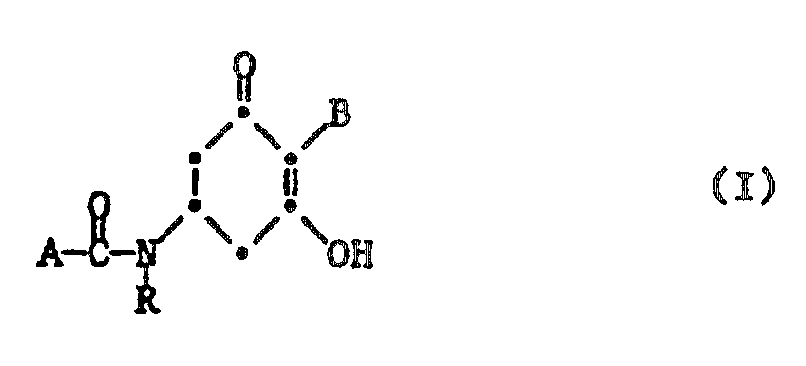
- R für Wasserstoff oder C1-C6-Alkyl,
- A für R2, OR3 oder NR3R4,
- R2 für C3-C6-Cycloalkyl oder gegebenenfalls einfach durch C1-C4-Alkoxy oder ein- oder mehrfach durch Halogen substituiertes C1-C6-Alkyl,
- R3 für C1-C6-Alkyl, C3-C6-Cycloalkyl oder gegebenenfalls bis zu dreifach durch R5 substituiertes Phenyl oder Benzyl,
- R4 für Wasserstoff, C1-C6-Alkyl, C1-C4-Alkoxy oder C3-C6-Cycloalkyl,
- R3 und R4 ausserdem gemeinsam mit dem Stickstoffatom, an welches sie gebunden sind für einen Pyrrolidin-, Morpholin- oder Piperidinrest,
- B für einen der Reste

- m für 0, 1, 2 oder 3
- R5 für Halogen, Nitro, Cyano, C1-C4-Alkyl, C1-C4-Alkoxy, C1-C4-Alkylthio, C1-C4-Halogenalkyl, C1-C4-Alkylsul- finyl oder C1-C4-Alkylsulfonyl,
- R6 für C1-C6-Alkyl oder C3-C6-Cycloalkyl,
- R7 für Wasserstoff, C1-C6-Alkyl, C1-C6-Halogenalkyl, C3-C6-Alkenyl, C3-C6-Halogenalkenyl oder C3-C6-Alkinyl steht
sowie Salze des Verbindungen der Formel mit Säuren, Basen oder Komplexbildnern. - Im Rahmen der hier offenbarten Erfindung umfassen die generischen Begriffe beispielsweise die nachstehend genannten Einzelsubstituenten, wobei diese Aufzählung keine Beschränkung der Erfindung darstellt.
- Alkyl umfasst die geradkettigen oder verzweigten C1-C6-Alkyle, wie Methyl, Ethyl, n-Propyl, iso-Propyl, n-Butyl, iso-Butyl, tert-Butyl, sowie die isomeren Pentyl- und Hexylreste.
- Halogen ist Fluor, Chlor, Brom und lod ; in erster Linie Fluor und Chlor.
- C1-C4-Alkoxy ist Methoxy, Ethoxy, n-Propyloxy, iso-Propyloxy, sowie die isomeren Butyloxyreste. Bevorzugt ist Methoxy und Ethoxy.
- C1-C4-Alkoxy-C1-C4-alkyl umfasst die isomeren Alkoxyalkyle, die im Rahmen der vorstehenden Definition aus den Alkoxy- und Alkylresten herleitbar sind. Bevorzugt ist C1-C2-Alkoxy-C1-C2-alkyl, wie Methoxymethyl, Ethoxymethyl, 2-Methoxyethyl, 1-Methoxyethyl oder 2-Ethoxyethyl.
- Mit Halogenalkyl sind die ganz oder teilweise gleich oder unterschiedlich halogensubstituierten Alkylradikale gemäss der jeweiligen Definitionsbreite gemeint ; wie etwa Trifluormethyl, Trichlormethyl, Chlormethyl, Dichlormethyl, 2,2,2-Triflorethyl etc.
- Die C3-C6-Alkenyl-, C3-C6-Halogenalkenyl- bzw. C3-C6-Alkinylreste sind durch ein gesättigtes Kohlenstoffatom an das Sauerstoffatom der Oximgruppe gebunden. Bevorzugt sind der Allyl- und Propargylrest sowie der 3-Chlorprop-2-en-1-yl-Rest.
- C3-C6-Cycloalkyl sind Cyclopropyl, Cyclobutyl, Cyclopentyl und Cyclohexyl. Hevorzuheben sind Cyclopropyl und Cyclohexyl.
- In Fällen, in welchen ein Substituent, wie etwa R5, mehrfach vorkommen kann, sind die jeweiligen Bedeutungen aus der diesem Substituenten zugeordneten Gruppe von Radikalen frei wählbar.
- Unter Beibehaltung der Definitionsbreite der jeweiligen anderen Substituenten können die Verbindungen der Formel I hinsichtlich ihrer Struktur als
- a) Cyclohexyl-Phenyl-Ketone

- b) Cyclohexyl-Alkyl-Ketone

- c) Cyclohexyl-Cycloalkyl-Ketone

- d) Oxime

- e) Harnstoffe (mit A = NR3R4),
- f) Urethane (mit A = OR3) oder
- g) Carbamide (mit A = R2) bezeichnet werden.
- Hervorzuheben sind die Verbindungen der Formel I,

- R für Wasserstoff oder C1-C4-Alkyl,
- A für R2, OR3 oder NR3R4,
- R2 für Cyclopropyl, Cyclopentyl, Cyclohexyl oder gegebenenfalls einfach durch C1-C4-Alkoxy oder ein- oder mehrfach durch Halogen substituiertes C1-C4-Alkyl,
- R3 für C1-C4-Alkyl, Cyclopropyl, Cyclopentyl. Cyclohexyl oder für gegebenenfalls bis zu zweifach durch R5 substituiertes Phenyl oder Benzyl,
- R4 für Wasserstoff, C1-C4-Alkyl, Methoxy, Cyclopropyl, Cyclopentyl oder Cyclohexyl,
- R3 und R4 ausserdem gemeinsam mit dem Stickstoffatom, an welches sie gebunden sind für einen Pyrrolidin oder Piperidinrest,
- B für einen der Reste

- R5 für Fluor, Chlor, Brom, Nitro, Cyano, C1-C4-Alkyl, C1-C4-Alkoxy, C1-C4-Alkylthio, Triflormethyl, C1-C4-Alkyl- sulfinyl oder C1-C4-Alkylsulfonyl,
- R6 für C1-C4-Alkyl, Cyclopropyl, Cyclopentyl oder Cyclohexyl,
- R7 für Wasserstoff, C1-C4-Alkyl, C1-C4-Halogenalkyl, C3-C4-Alkenyl, C3-C4-Halogenalkenyl oder C3-C4-Alkinyl steht.
- Bevorzugt sind die Verbindungen der Formel

- R für Wasserstoff oder C1-C3-Alkyl,
- A für R2, OR3 der NR3R4,
- R2 für C1-C4-Alkyl, Methoxymethyl oder Trifluormethyl,
- R3 für C1-C4-Alkyl, Cyclopropyl, Cyclohexyl, Benzyl oder gegebenenfalls durch Chlor, Methoxy oder Methyl substituiertes Phenyl
- R4 für Wasserstoff, Methyl, Methoxy oder Ethyl,
- R3 und R4 ausserdem gemeinsam mit dem Stickstoffatom, an welches sie gebunden sind für einen Pyrrolidin oder Piperidinrest,
- B für einen der Reste

- R5 für Fluor, Chlor, Brom, Nitro, Methyl, Methoxy, Trifluormethyl, C1-C4-Alkylthio, C1-C4-Alkylsulfinyl oder C1-C4-Alkylsulfonyl,
- R6 für C1-C6-Alkyl, Cyclopropyl oder Cyclohexyl,
- R7 für Methyl, Ethyl, Allyl, Propargyl oder 3-Chlor-prop-2-en-1-yl steht
- Besonders bevorzugt sind die Verbindungen der Formel I
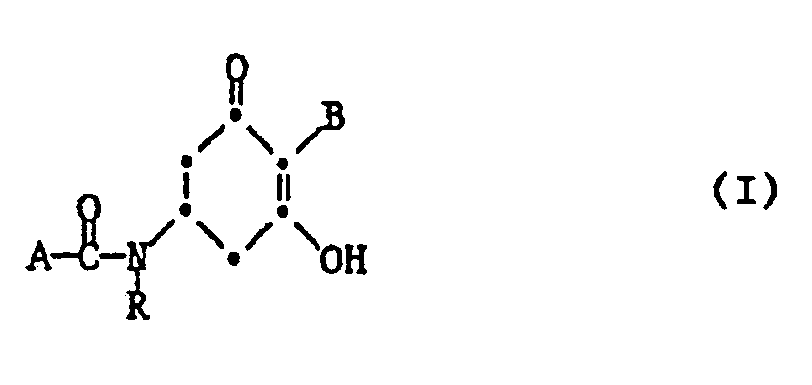
- R für Wasserstoff oder C1-C3-Alkyl,
- A für R2, OR3 oder NR3R4,
- R2 für Methoxymethyl oder C1-C4-Alkyl,
- R3 für C1-C4-Alkyl oder gegebenenfalls durch Chlor oder Methyl substituiertes Phenyl
- R4 für Wasserstoff oder Methyl,
- R3 und R4 ausserdem gemeinsam mit dem Stickstoffatom, an welches sie gebunden sind für einen Pyrrolidinrest,
- B für einen der Reste

- R5 für Chlor, Nitro, Trifluoromethyl, Methylthio, Methylsulfinyl oder Methylsulfonyl, Re für C1-C3-Alkyl oder Cyclopropyl
- R7 für Methyl, Allyl, Ethyl oder 3-Chlor-prop-2-en-1-yl steht.
- Aufgrund ihrer herbiziden, beziehungsweise pflanzenwuchsregulatorischen Wirkung sind die folgenden Einzelverbindungen zu nennen :
- 2-Butanoyl-5-ethoxycarbonylaminocyclohexan-1,3-dion,
- 2-Propanoyl-5-(N',N'-dimethylureido)-cyclohexan-1,3-dion,
- 2-Butanoyl-5-(N',N'-dimethylureido)-cyclohexan-1,3-dion,
- 5-Acetamido-2-propanoyl-cyclohexan-1,3-dion,
- 2-(2,4-Dichlorbenzoyl)-5-ethoxycarbonylamino-cyclohexan-1,3-dion,
- 2-(2,4-Dichlorbenzoyl)-5-(N'-isopropylureido)-cyclohexan-1,3-dion,
- 2-(2,4-Dichlorbenzoyl)-5-(N',N'-dimethylureido)-cyclohexan-1,3-dion,
- 5-(N'-tert-Butylureido)-2-(1-allyloxyiminobutyl)-cyclohexan-1,3-dion,
- 5-(N',N'-Dimethylureido)-2-(1-ethoxyiminopropyl)-cyclohexan-1,3-dion,
- 5-(N'-Phenylureido)-2-(1-ethoxyiminobutyl)-cyclohexan-1,3-dion,
- 5-(N'-Phenylureido)-2-[1-(3-chlorallyl)oxyiminobutyl]-cyclohexan-1,3-dion,
- 5-(N'-Phenylureido)-2-(1-ethoxyiminobutyl)-cyclohexan-1,3-dion,
- 5-(N'-Phenylureido)-2-(1-methoxyiminobutyl)-cyclohexan-1,3-dion,
- 5-[N'-(2-Methylphenyl)-ureido)-2-(1-ethoxyiminobutyl)-cyclohexan-1,3-dion und
- 5-[N'-(Chlorphenyl)-ureido]-2-(1-ethoxyiminobutyl)-cyclohexan-1,3-dion.
- Die Cyclohexandione der Formel I liegen in einem tautomeren Gleichgewicht gemäss nachstehender Gleichung vor:

- Die über das Gleichgewichtsstystem I⇄I' ⇄I leicht enolisierbaren Diketone der Formel I bilden bereits mit relativ schwachen Basen Salze. In den daraus resultierenden Salzen bilden die Verbindungen der Formel den anionischen Teil. Als geeignete Kationen sind zu nennen : Erdalkali-, Alkali- und Ammoniumionen. Unter Ammoniumionen sind neben dem unsubstituierten Ammoniumion auch die verschiedenen Mono-, Di-, Tri- und Tetraalkylammoniumionen zu verstehen. Durch Bildung geeigneter Salze kann unter anderem die Wasserlöslichkeit sowie insgesamt die Bioverfügbarkeit und das Wirkungsspektrum der Verbindungen der Formel I beeinflusst werden.
- Die Verbindungen der Formel können hergestellt werden, indem man
- a) eine Cyclohexandion der Formel mit einer Verbindung der


- b) ein Cyclohexandion der Formel II mit einer Verbindung


- c) ein Cyclohexylketon der Formel la mit einem

- Die als Zwischenprodukte verwendeten Cyclohexane der Formel und IV sind ebenfalls neu. Sie sind wertvolle Edukte zur Herstellung von Verbindungen der Formel I.
- Die Erfindung betrifft somit auch die neuen Cyclohexanone der Formel II


- Die Verbindungen der Formel können hergestellt werden, indem man
- a) ein Resorcin der Formel V nach an sich bekannten Verfahren hydriert
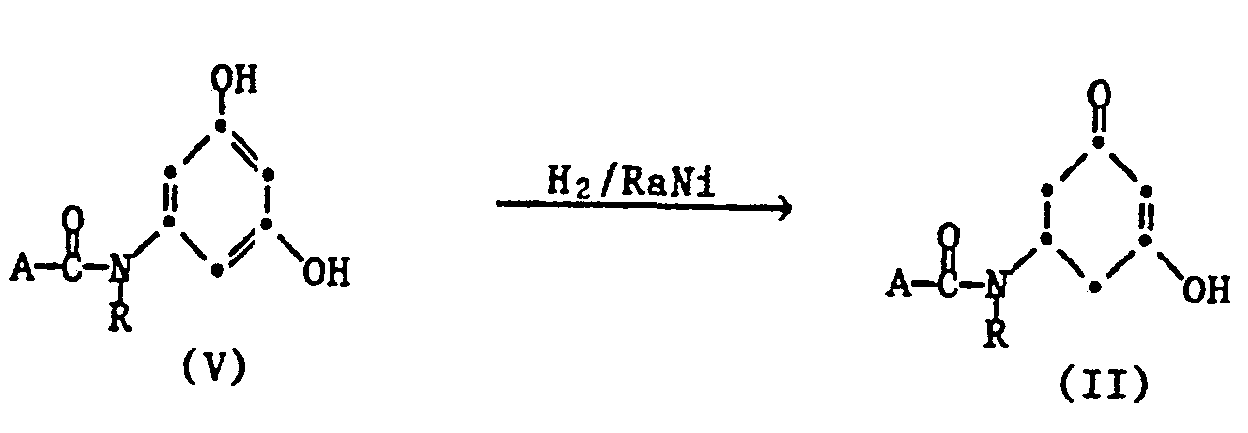
- b) ein Isocyanat der Formel VI mit einem Alkohol oder einem Amin der Formel VII bzw. VIII

- Die als Ausgangsverbindung benötigten Resorcine der Formel V können analog zu bekannten Verfahren [J. Org. Chem. 40 (1975), 1556 ; Helv. Chim. Acta 56 (1973) 510] durch die Umsetzung von Phloroglucin IX mit Aminen der Formel X zu den Aminoresorcinen der Formel XI umgesetzt werden. Ausgehend von den Aminoresorcinen XI sind die N-acylierten

- Die Urethane und Harnstoffe der Formel II, in denen A für OR3 oder NR3R4 steht können auf einem alternativen Syntheseweg ausgehend von der Cyclohexancarbonsäure XIII hergestellt werden.

- Dazu wird aus XIII zunächst der Monoether XIV mit Alk = C1-C4-Alkyl hergestellt und dieserdann nach Curtius via Azid in das Isocyanat XV überführt.

- Aus XV ist dann durch Addition der Alkohole VII bzw. der Amine VIII Verbindung XVI leicht zugänglich. Aus XVI kann durch Etherspaltung das gewünschte Endprodukt II generiert werden.
- Die neuen Verbindungen der Formel II liegen im tautomeren Gleichgewicht II ⇄II' ⇄II mit der Diketoform II' vor
-

- Die Verbindungen der Formel sind hochaktive Pflanzenwirkstoffe, welche sich bei geeigneten Aufwandmengen hervorragend als Selektivherbizide zur Unkrautbekämpfung in Nutzpflanzenkulturen eignen. Das heisst, bei diesen Aufwandmengen zeichnen sich die Wirkstoffe der Formel I durch gute selektiv-herbizide Eigenschaft gegen Umkräuter aus. Kulturpflanzen wie Roggen, Gerste, Hafer, Weizen, Mais, Hirse, Reis, Baumwolle und Soja bleiben bei niedrigen Aufwandmengen praktisch ungeschädigt. Bei gesteigerten Aufwandmengen werden die Kuturpflanzen nur geringfügig in ihrem Wachstum beeinflusst. Werden sehr hohe Aufwandmengen appliziert, entfalten die Substanzen der Formel 1 totalherbizide Eigenschaften.
- Die selektiv-herbizide Wirkung der erfindungsgemässen Verbindungen wird sowohl bei der preemergenten als auch der postemergenten Anwendung festgestellt. Diese Wirkstoffe können daher im vorauflaufverfahren und im Nachauflaufverfahren zur selektiven Unkrautbekämpfung mit gutem Erfolg verwendet werden.
- Die Verbindungen der Formel haben ausserdem starke pflanzenwuchsregulierende, insbesondere pflanzenwuchshemmende, Eigenschaften. Es werden sowohl Monokotyledonen als auch Dikotyledonen in ihrem Wachstum beeinträchtigt.
- So können z.B. die in der Landwirtschaft in tropischen Gegenden häufig als "covercrops" (Bodenbedecker) angepflanzte Leguminosen durch die Verbindungen der Formel I in ihrem Wachstum selektiv gehemmt werden, so dass zwar die Bodenerosion zwischen den Kulturpflanzen verhindert wird, die "cover crops" hedoch nicht zur Konkurrenz für die Kultur werden können.
- Eine Hemmung des vegetativen Wachstums erlaubt bei vielen Kulturpflanzen eine dichtere Anpflanzung der Kultur, so dass ein Mehrertrag, bezogen auf die Bodenfläche, erzielt werden kann.
- Ein weiterer Mechanismus der Ertragssteigerung mit Wachstumshemmern beruht darauf, dass die Nährstoffe in stärkerem Masse der Blüten-und Fruchtbildung zugute kommen, während das vegetative Wachstum eingeschränkt wird.
- Bei grösseren Aufwandmengen an Wirkstoffen der Formel werden alle getesteten Pflanzen in ihrer Entwicklung so geschädigt, dass sie absterben.
- Die Erfindung betrifft auch herbizide und pflanzenwachstumsregulierende Mittel, welche einen neuen Wirkstoff der Formel enthalten, sowie Verfahren zur pre- und post-emergenten Unkrautbekämpfung und zur Hemmung des Pflanzenwuchses von monokotylen und dikotylen Pflanzen, insbesondere Gräsern, tropischen Bodenbedeckern und Tabakgeiztrieben.
- Die Verbindungen der Formel werden in unveränderter Form oder vorzugsweise als Mittel zusammen mit den in der Formulierungstechnik üblichen Hilfsmitteln eingesetzt und werden daher z.B. zu Emulsionskonzentraten, direkt versprühbaren oder verdünnbaren Lösungen, verdünnten Emulsionen, Spritzpulvem, löslichen Pulvern, Stäubemitteln, Granulaten, auch Verkapselungen in z.B. polymeren Stoffen in bekannter Weise verarbeitet. Die Anwendungsverfahren wie Versprühen, Vernebeln, Verstäuben, Verstreuen oder Giessen werden gleich wie die Art der Mittel den angestrebten Zielen und den gegebenen Verhältnissen entsprechend gewählt.
- Die Formulierungen, d.h. die den Wirkstoff der Formel und gegebenenfalls einen festen oder flüssigen Zusatzstoff enthaltenden Mittel, Zubereitungen oder Zusammensetzungen werden in bekannterweise hergestellt, z.B. durch inniges Vermischen und/oder Vermahlen der Wirkstoffe mit Streckmitteln, wie z.B. mit Lösungsmitteln, festen Trägerstoffen, und gegebenenfalls oberflächenaktiven Verbindungen (Tensiden).
- Als Lösungsmittel können in Frage kommen : Aromatische Kohlenwasserstoffe, bevorzugt die Fraktionen C8 bis C12, wie z.B. Xylolgemische oder substituierte Naphthaline, Phthalsäureester wie Dibutyl- oder Dioctylphthalat, aliphatische Kohlenwasserstoffe wie Cyclohexan oder Paraffine, Alkohole und Glykole sowie deren Ether und Ester, wie Ethanol, Ethylenglykol, Ethylenglykolmonomethyl- oder -ethylether Ketone wie Cyclohexanon, stark polare Lösungsmittel wie N-Methyl-2-pyrrolidon, Dimethylsulfoxid oder Dimethylformamid, sowie gegebenenfalls epoxidierte Pflanzenöle, wie epoxidiertes Kokosnussöl oder Sojaöl oder Wasser.
- Als feste Trägerstoffe, z.B. für Stäubemittel und dispergierbare Pulver, werden in der Regel natürliche Gesteinsmehle verwendet, wie Calcit, Talkum, Kaolin, Montmorillonit oder Attapulgit. Zur Verbesserung der physikalischen Eigenschaften können auch hochdisperse Kieselsäure oder hochdisperse saugfähige Polymerisate zugesetzt werden. Als gekörnte, adsorptive Granulatträger kommen poröse Typen wie z.B. Bimsstein, Ziegelbruch, Sepiolit oder Bentonit, als nicht sorptive Trägermaterialien z.B. Calcit oder Sand in Frage. Darüberhinaus kann eine Vielzahl von vorgranulierten Materialien anorganischer oder organischer Natur wie insbesondere Dolomit oder zerkleinerte Pflanzenrückstände verwendet werden.
- Als oberflächenaktive Verbindungen kommen je nach derart des zu formulierenden Wirkstoffes der Formel I nichtionogene, kation- und/oder anionaktive Tenside mit guten Emulgier-, Dispergier- und Netzeigenschaften in Betracht. Unter Tensiden sind auch Tensidgemische zu verstehen.
- Geeignete anionische Tenside können sowohl sog. wasserlösliche Seifen als auch wasserlösliche synthetische oberflächenaktive Verbindungen sein.
- Als Seifen seien die Alkali-, Erdalkali-odergegebenenfalls substituierte Ammoniumsalze von höheren Fettsäuren (CwCw, wie z.B. die Na- oder K-Salze der Oel- oder Stearinsäure, oder von natürlichen Fettsäuregemischen, die z.B. aus Kokosnuss- oder Talgöl gewonnen werden können, genannt. Ferner sind auch die Fettsäuremethyl-taurinsalze zu erwähnen.
- Häufiger werden jedoch sogenannte synthetische Tenside verwendet, insbesondere Fettsulfonate, Fettsulfate, sulfonierte Benzimidazolderivate oder Alkylarylsulfonate.
- Die Fettsulfonate oder -sulfate liegen in der Regel als Alkali-, Erdalkali- oder gegebenenfalls substituierte Ammoniumsalze vor und weisen einen Alkylrest mit 8 bis 22 C-Atomen auf, wobei Alkyl auch den Alkylteil von Acylresten einschliesst, z.B. das Na- oder Ca-Salz der Ligninsulfonsäure, des Dodecylschwefelsäureesters oder eines aus natürlichen Fettsäuren hergestellten Fettalkoholsulfatgemisches.
- Hierher gehören auch die Salze der Schwefelsäureester und Sulfonsäuren von Fettalkohol-Ethylenoxid-Addukten. Die sulfonierten Benzimidazolderivate enthalten vorzugsweise 2-Sulfonsäuregruppen und einen Fettsäurerest mit 8 bis 22 C-Atomen. Alkylarylsulfonate sind z.B. die Na-, Ca- oder Triethanolaminsalze der Dodecylbenzolsulfonsäure, der Dibutylnaphthalinsulfonsäure odereines Naphthalinsulfonsäure-Formaldehydkondensationsproduktes.
- Ferner kommen auch entsprechende Phosphate wie z.B. Salze des Phosphorsäureesters eines p-Nonylphenol-(4-14)-Ethylenoxid-Adduktes oder Phospholipide in Frage.
- Als nicht ionische Tenside kommen in erster Linie Polyglykoletherderivate von aliphatischen oder cycloaliphatischen Alkoholen, gesättigten oder ungesättigten Fettsäuren und Alkylphenolen in Frage, die 3 bis 10 Glykolethergruppen und 8 bis 20 Kohlenstoffatome im (aliphatischen) Kohlenwasserstoffrest und 6 bis 18 Kohlenstoffatome im Alkylrest der Alkylphenole enthalten können.
- Weitere geeignete nichtionische Tenside sind die wasserlöslichen, 20 bis 250 Ethylenglykolethergruppen und 10 bis 100 Propylenglykolethergruppen enthaltenden Polyethylenoxidaddukte an Polypropylenglykol, Ethylendiaminopolypropylenglykol und Alkylpolypropylenglykol mit 1 bis 10 Kohlenstoffatomen in der Alkylkette, die genannten Verbindungen enthalten üblicherweise pro Propylenglykol-Einheit 1 bis 5 Ethylenglykoleinheiten.
- Als Beispiele nichtionischer Tenside seien Nonylphenolpolyethoxyethanole, Ricinusölpolyglykolether, Polypropylen-Polyethylenoxidaddukte, Tributylphenoxypolyethoxyethanol, Polyethylenglykol und Octylphenoxypolyethoxyethanol erwähnt.
- Ferner kommen auch Fettsäureester von Polyoxyethylensorbitan wie das Polyoxyethylensorbitan-trioleat in Betracht.
- Bei den kationischen Tensiden handelt es sich vor allem um quatemäre Ammoniumsalze, welche als N-Substituenten mindestens einen Alkylrest mit 8 bis 22 C-Atomen enthalten und als weitere Substituenten niedrige, gegebenenfalls halogenierte Alkyl-, Benzyl- oder niedrige Hydroxyalkylreste aufweisen. Die Salze liegen vorzugsweise als Halogenide, Methylsulfate oder Ethylsulfate vor, z.B. das Stearyltrimethylammoniumchlorid oder das Benzyldi(2-chlorethyl)-ethylammoniumbromid.
- Die in der Formulierungstechnik gebräuchlichen Tenside sind u.a. in folgenden Publikationen beschrieben:
- 1985 International Mc Cutcheon's Emulsifiers a Detergents Glen Rock, NJ. USA ;
- H. Stache, "Tensid-Taschenbuch", 2. Auflage., C. Hanser Verlag, München, Wien, 1981 ;
- M. and J. Ash. "Encyclopedia of Surfactants", Vol. 1-111, Chemical Publishing Co., New York, 1980-1981.
- Die Wirkstoffzubereitungen enthalten in der Regel 0,1 bis 95%, insbesondere 0,1 bis 80% Wirkstoff der Formel 1 bis 99,9% eines oder mehrerer fester oder flüssiger Zusatzstoffe und 0 bis 25% eines Tensides.
- Insbesondere setzen sich bevorzugte Formulierungen folgendermassen zusammen : (% = Gewichtsprozent).
-

-

-

-

-

- Während als Handelsware eher konzentrierte Mittel bevorzugt werden, verwendet der Endverbraucher in der Regel verdünnte Mittel. Die Anwendungsformen können bis hinab zu 0,001 % an Wirkstoff verdünntwerden. Die Aufwandmengen betragen in der Regel 0,001 bis 4 kg AS/ha, vorzugsweise 0,005 bis 1 kg AS/ha.
- Die Mittel können auch weitere Zusätze wie Stabilisatoren, Entschäumer, Viskositätsregulatoren, Bindemittel, Haftmittel sowie Dünger oder andere Wirkstoffe zur Erzielung spezieller Effekte enthalten.
- 500 g (4 Mol) Phloroglucin werden portionsweise in 4 1 einer 30%igen wässrigen Ammoniaklösung eingetragen und sodann noch während 40 min. NH3-Gas eingeleitet. Nach vierundzwanzigstündigem Rühren bei Raumtemperatur wird die so erhaltene klare braune Lösung bei 45°C am Wassertrahlvakuum eingeengt. Der zurückbleibende Feststoff wird mit Toluol und wenig Aceton verrieben, abgenutscht und bei 45°C im Vakuum getrocknet.
- Man isoliert 464 g (92,8%) der Titelverbindung der Formel

- Zu einer Lösung von 189 g (1.5 Mol) Phloroglucin in 1500 ml Dimethylformamid und 1000 ml Wasser werden bei 25°C 140 ml einer40%-igen wässrigen Methylaminlösung getropft. Es wird noch 20 Stunden bei Raumtemperatur nachgerührt und dann bei 70°C im Vakuum das Lösungsmittel abdestilliert und im Hochvakuum getrocknet.
- Der Rückstand wird dann nochmals mit Diethylether verrieben und getrocknet.
- Man isoliert 173 g (83%) der Titelverbindung der Formel
- Zu einer Lösung von 1560 g (10 Mol) Cyclohexan-3,5-dion-carbonsäure in 3 I Methanol werden 10 ml konzentrierter Schwefelsäure gegeben und für 3 Stunden unter Rühren bei 20-25°C belassen. Danach wird mit 3 I Diethylether versetzt und von dem ausgefallenen Produkt abgesaugt.
- Man isoliert 1508 g (88,7%) der Titelverbindung der Formel

- Zu einer Lösung von 62,5 g (0.5 Mol) 5-Aminoresorcin in 1000 ml Dioxan werden innerhalb von 20 min 52 ml (0.53 Mol) Isopropylisocyanatzugetropft, wobei die Innentemperatur auf 35°C ansteigt. Es wird noch 5 Stunden bei Raumtemperatur nachgerührt und dann mit 1000 ml Petrolether versetzt, wobei die Titelverbindung feinkristallin ausfällt.
- Man isoliert 162 g (84%) der Titelverbindung der Formel
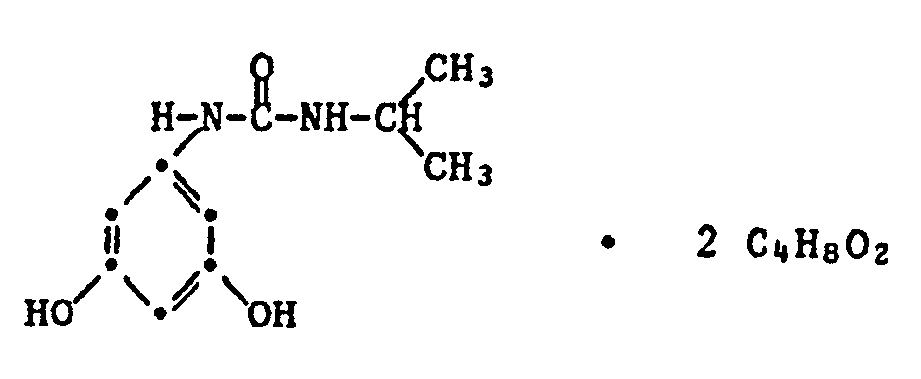
- Analog zu Beispiel H.1.1. erhält man aus 69,5 g (0,5 Mol) 5-Methylaminoresorcin und 52 ml (0.53 Mol) Isopropylisocyanat 113 g (84%) der Titelverbindung der Formel

- Zu einer Lösung von 12,5 g (0,1 Mol) 5-Aminoresorcin in 100 ml Dioxan werden 10,4 ml (0,11 Mol) Acetanhydrid so zugetropft, dass die Innentemperatur 50°C nicht übersteigt. Es wird noch 2 Stunden nachgerührt und dann mit 200 ml Petrolether versetzt, wobei das Produkt ausfällt.
- Man isoliert 15,3 g (91,7%) der Titelverbindung der Formel

- Zu einem Gemisch von 375 g 5-Aminoresorcin, 270 g Natriumacetat und 30 ml Dimethylformamid in 3 I Dioxan werden unter Kühlen bei 15-20°C 410 ml Chlorameisensäurephenylester getropft. Es wird noch 1 Stunde bei 20-25°C nachgerührt und dann mit 3 I Essigsäureethylester verdünnt und von dem ausfallenden Natriumchlorid abfiltriert. Nach Abdestillieren des Lösungsmittels wird aus Petrolether umkristallisiert.
- Man isoliert 868 g (87%) der Titelverbindung der Formel

- Zu einer Lösung von 840 g N-(3,5-Dihydroxyphenyl)-carbaminsäure-phenylester in 2,5 I Ethanol werden 900 ml einer33%-igen ethanolischen Dimethylaminlösung gegeben. Es wird für weitere 10 Stunden bei 20 bis 25°C gerührt und danach das Lösungsmittel im Vakuum abdestilliert.
- Der so erhältliche Brei wird mehrfach mit Diethylether verrieben und abgenutscht.
- Man isoliert 469 g (95%) der Titelverbindung der Formel

- Analog sind die Verbindungen der Tabelle 1 herstellbar.


- Eine Lösung von 0,1 Mol (154 g der nach Beispiel H 1.1 erhältlichen Verbindung) N-lsopropyl-N'-(3,5-dihydroxyphenyl)-harnstoff in 440 ml 1 N-NaOH werden 18 Stunden bei 60-65°C/10 bar in Gegenwart von 30 g Ra-Ni-H20 hydriert. Nach Abfiltrieren des Katalysators wird das Filtrat mit HCI auf pH 1 angesäuert und auf 5°C gekühlt, wobei das Produkt ausfällt.
- Nach dem Abnutschen wird mit Wasser gespült und bei 60°C/0,1 bar getrocknet.
- Man isoliert 76 g (90%) der Titelverbindung der Formel

- Analog zu Beispiel H.2.1 erhält man aus 0.37 Mol (100 g der nach Beispiel H 1.2 erhältlichen Verbindung 1.022) N-lsopropyl-N'-methyl-N'-(3,5-dihydroxyphenyl)-hamstoff beim Hydrieren 58,2 g der Titelverbindung der Formel

- Eine Lösung von 16.7 g (0.1 Mol) 5-Acetamidoresorcin in 110 ml 0,1 N NaOH wird in Gegenwart von 10 g Ra-Ni-H20 bei 60-65°C/10 bar 50 Stunden hydriert. Nach Abfiltrieren des Katalysators und Ansäuern der wässrigen Lösung wird bei 50°C zur Trockene eingeengt, der Rückstand mit 200 ml Ethanol und 0,1 ml konz. Schwefelsäure versetzt und vom ausfallenden Natriumchlorid abgetrennt und das Filtrat erneut bis zur Trockene eingeengt. Der Rückstand wird in 200 ml Tetrahydrofuran und 10 mi 1N-Salzsäure aufgenommen, 15 Stunden bei Raumtemperatur belassen und die so erhaltene Suspension über einem Molekularsieb getrocknet und nach Abtrennen des Molekularsiebes erneut zur Trockene eingeengt.
- Man isoliert 11,5 g (68%) der Titelverbindung der Formel

- Analog sind die Verbindungen der Tabelle 2 erhältlich.


- Eine Lösung von 13,5 g (68 mMol) N,N-Dimethyl-N'-(cyclohexan-3,5-dion-1-yl)-harnstoff in 10,5 ml Triethylamin und 70 ml Essigsäuerethylester werden unter Kühlen auf 20-25°C mit 6,4 ml (71 mMol) Propionsäurechlorid versetzt und 15 Stunden bei Raumtemperatur nachgerührt. Danach wird von dem ausgefallenen Triethylamin-Hydrochlorid abfiltriert und das Filtrat zur Trockene eingeengt.
- Man isoliert 16.8 g (97%) der Titelverbindung der Formel

- Zu einer Suspension von 34 g (0.2 Mol) 3-Methoxy-cyclohex-3-en-5-on-carbonsäure in 500 ml Toluol werden 30,7 ml (0,22 Mol) Triethylamin gegeben, wobei eine klare Lösung entsteht. Zu dieser Lösung werden bei 0-5°C 21,5 ml (0,22 Mol) Chlorameisensäure-ethylester getropft. Es wird noch 1 Stunde bei 0-5°C nachgerührt und zu der dabei entstehenden Suspension dann eine Lösung von 16,25 g (0.25 Mol) Natriumazid in 100 ml Wasser getropft. Es wird erneut eine Stunde bei 0-5°C nachgerührt und dann mit 200 ml Toluol versetzt.
- Die organische Phase wird mit 200 ml Natriumbicarbonatlösung (50%) gewaschen und über Molekularsieb (4 A) getrocknet. Nach Entfernen des Molekularsiebs wird mit 20 ml (0,22 Mol) Anilin versetzt. Die Lösung wird dann langsam auf 90°C erwärmt. Ab 80°C beginnt sich Stickstoff zu entwickeln. Es wird für 2 Stunden bei 90°C belassen und das Produkt anschliessend durch Zusatz von Hexan ausgefällt.
- Man isoliert 31 g (60%) der Titelverbindung der Formel

- 30 g N-Phenyl-N'-(3-methoxycyclohex-3-en-5-on-1-yl)-harnstoff werden in 230 ml Tetrahydrofuran, 11.5 ml Wasser und 1 ml 37%-iger Salzsäure 12 Stunden bei Raumtemperatur gerührt. Anschliessend wird im Wasserstrahlvakuum bis zur Trockne eingeengt und der Rückstand mit Diethylether verrieben, abgesaugt und getrocknet.
- Man isoliert 28 g (98,9%) der Titelverbindung der Formel

- Eine Lösung von 12,7 g (50 mMol) N,N-Dimethyl-N'-(3-propionyloxy-cyclohex-3-en-5-on-1-yl)-harnstoff in 100 ml Dichlorethan wird zusammen mit 6,1 g (50 mMol) 4-Dimethylaminopyridin 15 Stunden bei Raumtemperatur gerührt. Anschliessend wird mit 0,5 N Salzsäure (100 ml) neutralisiert, die organische Phase über MgS04 getrocknet und zur Trockene eingeengt.
- Man isoliert 8.2 g (64.6%) der Titelverbindung der Formel

- Zu einer Lösung von 140 mMol N-lsopropyl-N'-(3-hydroxycyclohex-3-en-5-on-1-yl)-harnstoff in 80 ml Dichlormethan und 23 ml (0,16 Mol) Triethylamin werden unter Kühlen 8,8 g (40 mMol) 4-Chlor-2-nitrobenzo- ylchlorid getropft und noch 1 Stunde bei Raumtemperatur nachgerührt. Danach wird mit 1 ml Acetoncyanhydrin versetzt und weitere 15 Stunden bei Raumtemperatur gerührt. Das Reaktionsgemisch wird eingedampft und mit 400 ml 0,5 N Salzsäure verrührt. Das ausgefallene Produkt wird abgetrennt, mit Wasser gewaschen und getrocknet. Die Rohausbeute beträgt 174 g. Zur Reinigung wird das Produkt in das Natriumsalz überführt und erneut durch Säurezusatz gefällt.
- Man isoliert 7.7 g (53.5%) der Titelverbindung der Formel

- Analog sind die Verbindungen der Tabelle 3 und 4 erhältlich.


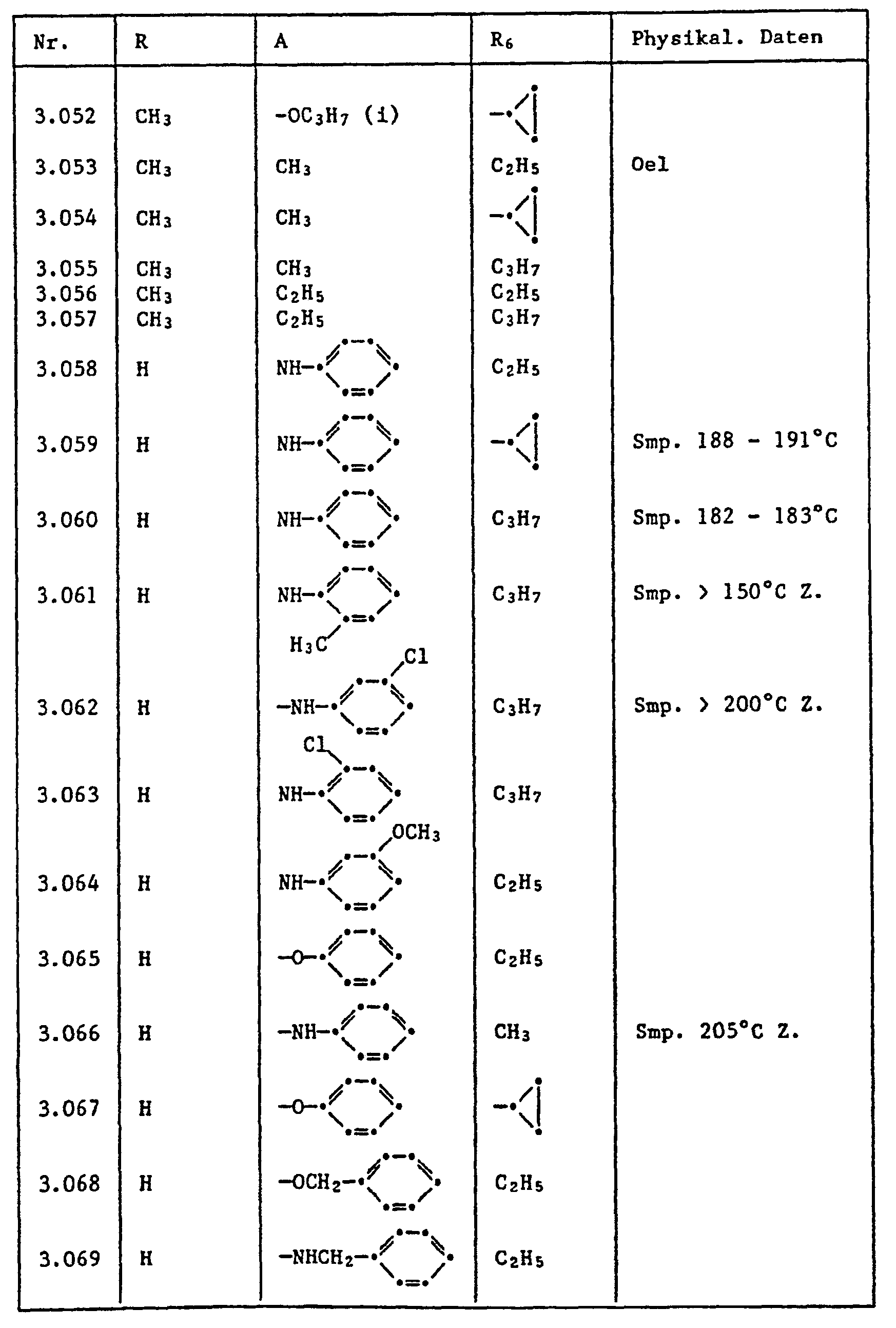


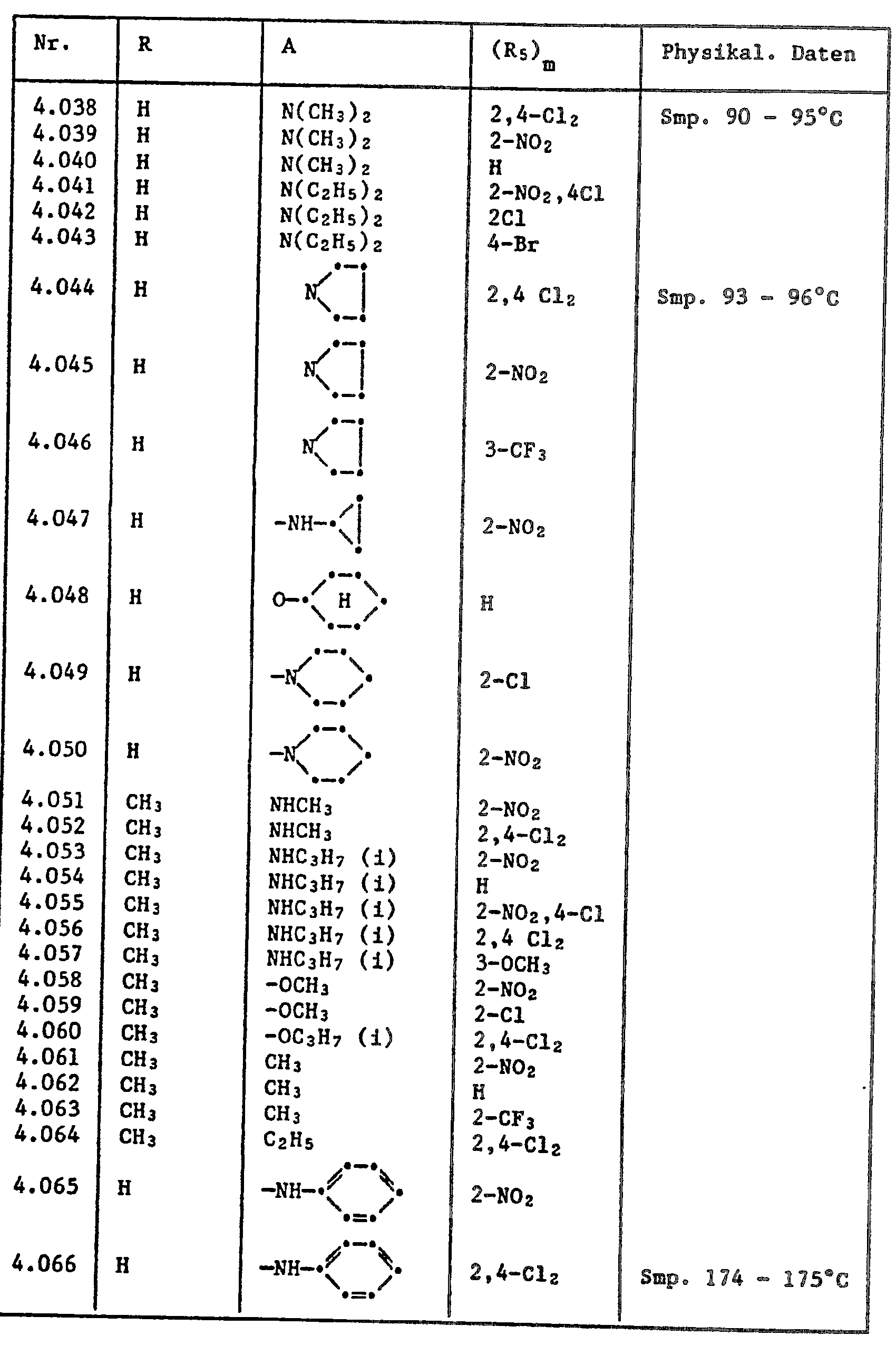


- 3,05 g (12 mMol) 5-(N,N-Dimethylureido)-2-propionyl-cyclohexan-1,3-dion, 1,3 g (13 mMol) O-Ethylhydroxylaminhydrochlorid und 2 ml (13 mMol) 1,8-Diazabicyclo(5, 4, 0)undec-7-en in 24 ml Ethanol werden 15 Stunden bei Raumtemperatur gerührt. Das Reaktionsgemisch wird danach mit 200 ml Essigsäureethylester verdünnt und unter Kühlen auf 0-5°C mit 1 N-Salzsäure auf pH 1-2 gestellt, mehrmals mit Wasser gewaschen und nach dem Trocknen über MgS04 zur Trockne eingedampft. Das so erhaltene Rohprodukt wird an Kieselgel mit Essigsäureethylester/Ethanol (10 : 1) gereinigt.
- Man isoliert 2,4 g (67,3%) der Titelverbindung der Formel


-

- Aus solchen Konzentraten können durch Verdünnen mit Wasser Emulsionen jeder gewünschten Konzentration hergestellt werden.

- Die Lösungen sind zur Anwendung in Form kleinster Tropfen geeignet.

- Der Wirkstoff wird gelöst, auf den Träger aufgesprüht und das Lösungsmittel anschliessend im Vakuum abgedampft.

- Durch inniges Vermischen der Trägerstoffe mit dem Wirkstoff erhält man gebrauchsfertiges Stäubemittel.

- Der Wirkstoff wird mit den Zusatzstofen gut vermischt und in einer geeigneten Mühle gut vermahlen. Man erhält Spritzpulver, die sich mit Wasser zur Suspension jeder gewünschten Konzentration verdünnen lassen.
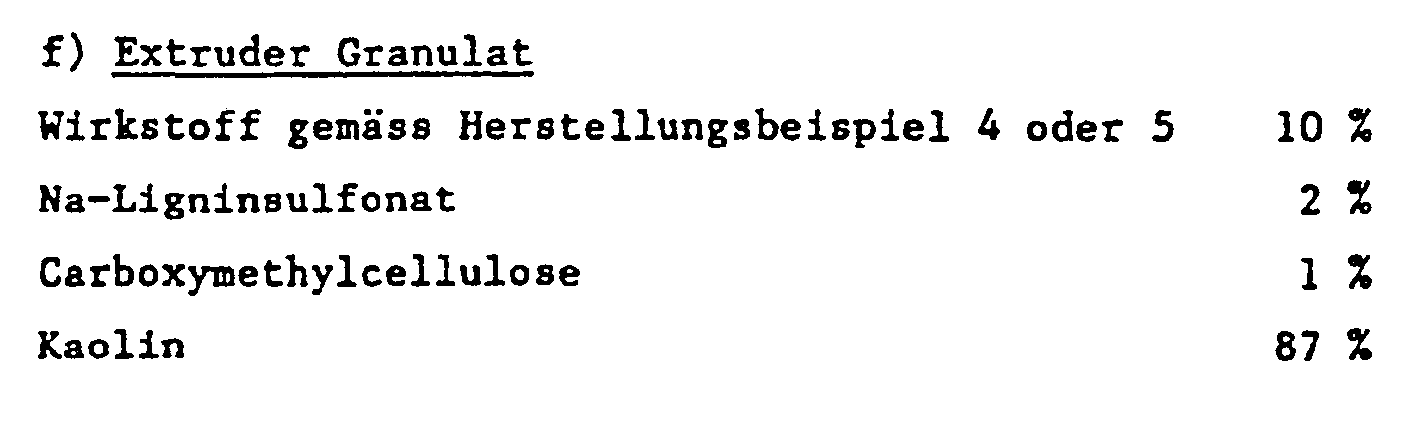
- Der Wirkstoff wird mit den Zusatzstoffen vermischt, vermahlen und mit Wasser angefeuchtet. Dieses Gemisch wird extrudiert und anschliessend im Luftstrom getrocknet.

- Der fein gemahlene Wirkstoff wird in einem Mischer auf das mit Polyäthylenglykol angefeuchtete Kaolin gleichmässig aufgetragen. Auf diese Weise erhält man staubfreie Umhüllungs-Granulate.

- Der fein gemahlene Wirktoff wird mit den Zusatzstoffen innig vermischt. Man erhält so ein SuspensionsKonzentrat, aus welchem durch Verdünnen mit Wasser Suspensionen jeder gewünschten Konzentration hergestellt werden können.
- Im Gewächshaus wird unmittelbar nach der Einsaat der Versuchspflanzen in Saatschalen die Erdoberfläche mit einer wässrigen Dispersion der Wirkstoffe, erhalten aus einem 25%igen Emulsions-Konzentrat behandelt. Es werden Konzentrationen von 4 kg Wirksubstanz/Hektar angewendet. Die Saatschalen werden im Gewächshaus bei 22-25°C und 50-70% relativer Luftfeuchtigkeit gehalten und der Versuch nach 3 Wochen ausgewertet.
- Die herbizide Wirkung wird anhand eines linearen neunstufigen Bonitierungsschemas bewertet, in welchem 1 für totale Schädigung (100% Herbizidwirkung) und 9 für keine Wirkung (Versuchspflanze wächst wie die unbehandelte Referenz) steht.
- Einzelergebnisse sind in Tabelle 6 zusammengestellt.

- Eine Anzahl Unkräuter, sowohl monokotyle wie dikotyle, wurden nach dem Auflaufen (im 4- bis 6-Blattstadium) mit einer wässrigen Wirkstoffdispersion in einer Dosierung von 4 kg Wirksubstanz pro Hektar auf die Pflanzen gespritzt und diese bei 24°-26°C und 45-60% relativer Luftfeuchtigkeit gehalten. 15 Tage nach der Behandlung wird der Versuch ausgewertet.
- In diesem Versuch zeigen die Verbindungen nach Herstellungsbeispiel 4 und 5 starke bis sehr starke Herbizidwirkung.
- Die Wasserunkräuter Echinochloa crus galli und Monocharia vag. werden in Plastikbechern (60 cm2 Oberfläche, 500 ml Volumen) ausgesät. Nach der Saat wird bis zur Erdoberfläche mit Wasser aufgefüllt. 3 Tage nach der Saat wird der Wasserspiegel bis leicht über die Erdoberfläche erhöht (3-5 mm). Die Applikation erfolgt 3 Tage nach der Saat mit einer wässrigen Emulsion der Prüfsubstanzen durch eine Spritzung auf die Gefässe mit einer Aufwandmenge von 0,5 bis 4 kg AS pro Hektar. Die Pflanzenbecher werden dann im Gewächshaus unter optimalen Wachstumsbedingungen für die Reisunkräuter aufgestellt, d.h. bei 25°-30°C und hoher Luftfeuchtigkeit.
- Die Auswertung der Versuche findet 3 Wochen nach Applikation statt.
- Einzelergebnisse sind in Tabelle 7 zusammengestellt.

- Die Versuchspflanzen (centrosema plumieri und centrosema pubescens) werden bis zum ausgewachsenen Stadium herangezogen und bis auf eine Höhe von 60 cm zurückgeschnitten. Nach 7 Tagen wird der Wirkstoff als wässrige Emulsion gespritzt. Die Versuchspflanzen werden bei 70% relativer Luftfeuchtigkeit und 6000 lux Kunsflicht, pro Tag 14 Stunden, bei Temperaturen von 27° bei Tag und 21°C bei Nacht gehalten. 4 Wochen nach der Applikation wird der Versuch ausgewertet. Es werden dabei der Neuzuwachs im Vergleich zur Kontrolle abgeschätzt und gewogen und die Phytotoxizität bewertet. In diesem Versuch zeigen die mit Wirkstoffen gemäss Herstellungsbeispiel 4 und 5 in Aufwandmengen bis zu 3000 g/ha behandelten Pflanzen eine deutliche Reduktion des Neuzuwachses, ohne dass dabei die Versuchspflanzen geschädigt wurden.
- In Kunststoffbehältern mit einem Erde-Torf-Sandgemisch im Verhältnis 6 :3 : 1 werden Sojabohnen der Sorte "Hark" angesät und in eine Klimakammer gegeben. Durch optimale Temperaturwahl, Beleuchtung, Düngerzugabe und Bewässerung entwickeln sich die Pflanzen nach ca. 5 Wochen bis zum 5-6 Trifolia-Blattstadium. Zu diesem Zeitpunkt werden die Pflanzen mit der wässrigen Brühe eines Wirkstoffs der Formel bis zur guten Benetzung besprüht. Die Wirkstoffkonzentration beträgt bis zu 100 g AS/ha. Die Auswertung erfolgt ca. 5 Wochen nach der Applikation des Wirkstoffs. Im Vergleich zu unbehandelten Kontrollpflanzen bewirken erfindungsgemässe Wirkstoffe gemäss Herstellungsbeispiel 4 und 5 eine merkliche Erhöhung der Anzahl und des Gewichts der Schoten im Haupttrieb.
- In Kunststofftöpfen mit sterilisierter Erde werden in Getreidearten Hordeum vulgare (Sommergerste) und Secale (Sommerroggen) im Gewächshaus angesät und nach Bedarf bewässert. Die Sprösslinge werden ca. 21 Tage nach der Aussaat mit der wässrigen Spritzbrühe eines Wirkstoffes gemäss Herstellungsbeispiel 5 oder 5 besprüht. Die Wirkstoffmenge beträgt bis zu 100 g Aktivsubstanz pro Hektar. 21 Tage nach Applikation wird das Wachstum des Getreides beurteilt. Die behandelten Pflanzen weisen im Vergleich zu unbehandelten Kontrollen eine Verringerung des Neuzuwachses (60-90% der Kontrolle), sowie teilweise eine Zunahme der Stengeldurchmesser auf.
- In Kunststoffschalen mit Erde-Torf-Sand-Gemisch (6: 3: 1) werden die Gräser Lolium perenne, Poa pratensis, Festuca ovina, Dactylis glomerata und Cynodon dactylon im Gewächshaus angesät und nach Bedarf bewässert. Die aufgelaufenen Gräser werden wöchentlich bis auf 4 cm Höhe zurückgeschnitten und ca. 50 Tage nach derAussaatund einen Tag nach dem letzten Schnitt mit der wässrigen Spritzbrühe eines Wirkstoffes gemäss Herstellungsbeispiel 4 oder 5 besprüht. Die Wirkstoffmenge beträgt umgerechnet bis zu 500 g Aktivsubstanz pro Hektar. 21 Tage nach Applikation wird Wachstum der Gräser beurteilt.
- Verbindungen gemäss Herstellungsbeispiel 4 und 5 bewirken eine Reduzierung des Neuzuwachses im Vergleich zur unbehandelten Kontrolle.
Claims (12)


Priority Applications (1)
| Application Number | Priority Date | Filing Date | Title |
|---|---|---|---|
| AT88810062T ATE63901T1 (de) | 1987-02-09 | 1988-02-03 | Neue cyclohexandione. |
Applications Claiming Priority (2)
| Application Number | Priority Date | Filing Date | Title |
|---|---|---|---|
| CH46987 | 1987-02-09 | ||
| CH469/87 | 1987-02-09 |
Publications (2)
| Publication Number | Publication Date |
|---|---|
| EP0278907A1 EP0278907A1 (de) | 1988-08-17 |
| EP0278907B1 true EP0278907B1 (de) | 1991-05-29 |
Family
ID=4187721
Family Applications (1)
| Application Number | Title | Priority Date | Filing Date |
|---|---|---|---|
| EP88810062A Expired - Lifetime EP0278907B1 (de) | 1987-02-09 | 1988-02-03 | Neue Cyclohexandione |
Country Status (12)
| Country | Link |
|---|---|
| US (1) | US4872902A (de) |
| EP (1) | EP0278907B1 (de) |
| JP (1) | JPS63201152A (de) |
| AT (1) | ATE63901T1 (de) |
| AU (1) | AU613008B2 (de) |
| BR (1) | BR8800531A (de) |
| DE (1) | DE3862944D1 (de) |
| DK (1) | DK61788A (de) |
| ES (1) | ES2045177T3 (de) |
| GR (1) | GR3002031T3 (de) |
| YU (1) | YU23388A (de) |
| ZA (1) | ZA88850B (de) |
Cited By (1)
| Publication number | Priority date | Publication date | Assignee | Title |
|---|---|---|---|---|
| LT3198B (en) | 1989-07-04 | 1995-03-27 | Nippon Soda Co | Substituted bicycloheptandione derivatives |
Families Citing this family (7)
| Publication number | Priority date | Publication date | Assignee | Title |
|---|---|---|---|---|
| IL91083A (en) * | 1988-07-25 | 1993-04-04 | Ciba Geigy | Cyclohexanedione derivatives, their preparation and their use as herbicides |
| WO1992008696A1 (en) * | 1990-11-20 | 1992-05-29 | Dunlena Pty. Limited | Herbicides |
| DE4305696A1 (de) * | 1993-02-25 | 1994-09-01 | Hoechst Ag | Nachweisverfahren zur Identifizierung von Inhibitoren |
| BR9811314A (pt) * | 1997-08-20 | 2000-08-29 | Novartis Ag | Derivados de benzotiofeno como herbicidas |
| US6392099B1 (en) | 1998-11-19 | 2002-05-21 | Eagleview Technologies, Inc. | Method and apparatus for the preparation of ketones |
| US6369276B1 (en) | 1998-11-19 | 2002-04-09 | Eagleview Technologies, Inc. | Catalyst structure for ketone production and method of making and using the same |
| US6545185B1 (en) | 2001-03-29 | 2003-04-08 | Eagleview Technologies, Inc. | Preparation of ketones from aldehydes |
Family Cites Families (5)
| Publication number | Priority date | Publication date | Assignee | Title |
|---|---|---|---|---|
| US4002767A (en) * | 1974-11-20 | 1977-01-11 | E. I. Du Pont De Nemours And Company | 1-Tertiary-alkyl-3-(substituted cyclohexenyl)ureas as antihypertensive agents |
| AR206020A1 (es) * | 1974-04-17 | 1976-06-23 | Du Pont | Procedimiento para la preparacion de compuestos de 1-t-alquil-3-(3-oxo-ciclohexen-1-il) ureas |
| DE3132690A1 (de) * | 1981-08-19 | 1983-03-17 | Bayer Ag, 5090 Leverkusen | (thio)-harnstoffe, ein verfahren zu ihrer herstellung, ihre verwendung als pflanzenschutzmittel und zwischenprodukte zu ihrer herstellung |
| US4584013A (en) * | 1983-05-18 | 1986-04-22 | Ciba-Geigy Corporation | Cyclohexanedionecarboxylic acid derivatives with herbicidal and plant growth regulating properties |
| US4640706A (en) * | 1984-03-30 | 1987-02-03 | Ciba-Geigy Corporation | Cyclohexenonecarboxylic acid derivatives with herbicidal and plant growth regulating properties |
-
1988
- 1988-02-03 DE DE8888810062T patent/DE3862944D1/de not_active Expired - Lifetime
- 1988-02-03 ES ES88810062T patent/ES2045177T3/es not_active Expired - Lifetime
- 1988-02-03 AT AT88810062T patent/ATE63901T1/de not_active IP Right Cessation
- 1988-02-03 EP EP88810062A patent/EP0278907B1/de not_active Expired - Lifetime
- 1988-02-05 YU YU00233/88A patent/YU23388A/xx unknown
- 1988-02-08 US US07/153,376 patent/US4872902A/en not_active Expired - Lifetime
- 1988-02-08 ZA ZA880850A patent/ZA88850B/xx unknown
- 1988-02-08 DK DK061788A patent/DK61788A/da not_active Application Discontinuation
- 1988-02-08 AU AU11386/88A patent/AU613008B2/en not_active Ceased
- 1988-02-09 BR BR8800531A patent/BR8800531A/pt unknown
- 1988-02-09 JP JP63028636A patent/JPS63201152A/ja active Pending
-
1991
- 1991-05-30 GR GR91400648T patent/GR3002031T3/el unknown
Cited By (1)
| Publication number | Priority date | Publication date | Assignee | Title |
|---|---|---|---|---|
| LT3198B (en) | 1989-07-04 | 1995-03-27 | Nippon Soda Co | Substituted bicycloheptandione derivatives |
Also Published As
| Publication number | Publication date |
|---|---|
| ZA88850B (en) | 1988-08-09 |
| YU23388A (en) | 1989-10-31 |
| DK61788A (da) | 1988-08-10 |
| BR8800531A (pt) | 1988-09-27 |
| DK61788D0 (da) | 1988-02-08 |
| EP0278907A1 (de) | 1988-08-17 |
| AU1138688A (en) | 1988-08-11 |
| AU613008B2 (en) | 1991-07-25 |
| ES2045177T3 (es) | 1994-01-16 |
| GR3002031T3 (en) | 1992-12-30 |
| US4872902A (en) | 1989-10-10 |
| JPS63201152A (ja) | 1988-08-19 |
| DE3862944D1 (de) | 1991-07-04 |
| ATE63901T1 (de) | 1991-06-15 |
Similar Documents
| Publication | Publication Date | Title |
|---|---|---|
| EP0262096B1 (de) | Aminopyrazinone und Aminotriazinone | |
| DD223147A5 (de) | Verfahren zur herstellung von cyclohexandion-carbonsaeurederivaten | |
| EP0003805A1 (de) | Pyridazonverbindungen und diese enthaltende herbizide Zusammensetzungen | |
| EP0103537B1 (de) | N-Arylsulfonyl-N'-triazolylharnstoffe | |
| EP0459949A1 (de) | Sulfonylharnstoffe mit herbizider und pflanzenwuchsregulierender Wirkung | |
| EP0152378A2 (de) | Herbizide Sulfonylharnstoffe | |
| EP0136647A2 (de) | Cyclohexenonderivate, Verfahren zu ihrer Herstellung sowie ihre Verwendung zur Bekämpfung unerwünschten Pflanzenwuchses | |
| EP0211805A2 (de) | Neue N-(2-Fluorphenyl)-azolidine | |
| EP0125205A1 (de) | N-Phenylsulfonyl-N'-pyrimidinyl- und -triazinylharnstoffe | |
| EP0278907A1 (de) | Neue Cyclohexandione | |
| DD292917A5 (de) | Herbizide [[(1,3,5-triazin-2-yl) aminocarbonyl] aminosulfonyl] benzoesaeureester, verfahren zu ihrer herstellung und ihre verwendung | |
| EP0434624B1 (de) | Triazolylsulfonamide | |
| EP0401168A2 (de) | Neue Herbizide | |
| EP0468924A2 (de) | Neue Herbizide | |
| EP0135838B1 (de) | 3-Phenyl-4-methoxycarbonylpyrazole, Verfahren zu ihrer Herstellung und ihre Verwendung zur Bekämpfung unerwünschten Pflanzenwuchses | |
| EP0259265B1 (de) | 3-Methylphthalimide | |
| EP0206995B1 (de) | N-Heterocyclosulfonyl-N'-pyrimidinyl-, N'-triazolyl- und N'-triazinyl-harnstoffe | |
| EP0145664A2 (de) | Herbizide Sulfonylharnstoffe | |
| EP0090258B1 (de) | 3-Chlor-8-cyano-chinoline, Verfahren zu ihrer Herstellung und ihre Verwendung zur Bekämpfung unerwünschten Pflanzenwuchses | |
| EP0259264A1 (de) | Neue 4-Methylphthalimide | |
| EP0493321A1 (de) | Pyrimidinyl- und Triazinyl-salicylamide sowie deren Verwendung und Herstellung | |
| EP0120448A1 (de) | Cyclohexan-1,3-dion-derivate, Verfahren zu ihrer Herstellung und ihre Verwendung zur Bekämpfung unerwünschten Pflanzenwuchses | |
| EP0065189B1 (de) | Heterocyclische Dihalogenacetamide, Verfahren zu ihrer Herstellung und herbizide Mittel, die Acetanilide als herbizide Wirkstoffe und diese Dihalogenacetamide als antagonistische Mittel enthalten | |
| EP0149427B1 (de) | (Poly-)Oxyalkylamino-diphenyläther mit herbizider Wirkung | |
| EP0001271A1 (de) | Heterocyclische Norbornanderivate, Mittel zur Beeinflussung des Pflanzenwachstums die diese Verbindungen enthalten, und Verfahren zur Herstellung dieser Mittel |
Legal Events
| Date | Code | Title | Description |
|---|---|---|---|
| PUAI | Public reference made under article 153(3) epc to a published international application that has entered the european phase |
Free format text: ORIGINAL CODE: 0009012 |
|
| 17P | Request for examination filed |
Effective date: 19880205 |
|
| AK | Designated contracting states |
Kind code of ref document: A1 Designated state(s): AT BE CH DE ES FR GB GR IT LI LU NL SE |
|
| 17Q | First examination report despatched |
Effective date: 19900724 |
|
| GRAA | (expected) grant |
Free format text: ORIGINAL CODE: 0009210 |
|
| ITF | It: translation for a ep patent filed | ||
| AK | Designated contracting states |
Kind code of ref document: B1 Designated state(s): AT BE CH DE ES FR GB GR IT LI LU NL SE |
|
| REF | Corresponds to: |
Ref document number: 63901 Country of ref document: AT Date of ref document: 19910615 Kind code of ref document: T |
|
| REF | Corresponds to: |
Ref document number: 3862944 Country of ref document: DE Date of ref document: 19910704 |
|
| ET | Fr: translation filed | ||
| GBT | Gb: translation of ep patent filed (gb section 77(6)(a)/1977) | ||
| PGFP | Annual fee paid to national office [announced via postgrant information from national office to epo] |
Ref country code: LU Payment date: 19911211 Year of fee payment: 5 |
|
| PGFP | Annual fee paid to national office [announced via postgrant information from national office to epo] |
Ref country code: GR Payment date: 19911223 Year of fee payment: 5 |
|
| PLBE | No opposition filed within time limit |
Free format text: ORIGINAL CODE: 0009261 |
|
| STAA | Information on the status of an ep patent application or granted ep patent |
Free format text: STATUS: NO OPPOSITION FILED WITHIN TIME LIMIT |
|
| EPTA | Lu: last paid annual fee | ||
| 26N | No opposition filed | ||
| REG | Reference to a national code |
Ref country code: GR Ref legal event code: FG4A Free format text: 3002031 |
|
| PG25 | Lapsed in a contracting state [announced via postgrant information from national office to epo] |
Ref country code: LU Free format text: LAPSE BECAUSE OF NON-PAYMENT OF DUE FEES Effective date: 19930203 |
|
| PG25 | Lapsed in a contracting state [announced via postgrant information from national office to epo] |
Ref country code: GR Free format text: THE PATENT HAS BEEN ANNULLED BY A DECISION OF A NATIONAL AUTHORITY Effective date: 19930831 |
|
| PGFP | Annual fee paid to national office [announced via postgrant information from national office to epo] |
Ref country code: FR Payment date: 19931213 Year of fee payment: 7 |
|
| PGFP | Annual fee paid to national office [announced via postgrant information from national office to epo] |
Ref country code: DE Payment date: 19931223 Year of fee payment: 7 |
|
| REG | Reference to a national code |
Ref country code: ES Ref legal event code: FG2A Ref document number: 2045177 Country of ref document: ES Kind code of ref document: T3 |
|
| PGFP | Annual fee paid to national office [announced via postgrant information from national office to epo] |
Ref country code: AT Payment date: 19940117 Year of fee payment: 7 |
|
| PGFP | Annual fee paid to national office [announced via postgrant information from national office to epo] |
Ref country code: GB Payment date: 19940121 Year of fee payment: 7 |
|
| PGFP | Annual fee paid to national office [announced via postgrant information from national office to epo] |
Ref country code: ES Payment date: 19940209 Year of fee payment: 7 |
|
| PGFP | Annual fee paid to national office [announced via postgrant information from national office to epo] |
Ref country code: SE Payment date: 19940225 Year of fee payment: 7 |
|
| PGFP | Annual fee paid to national office [announced via postgrant information from national office to epo] |
Ref country code: NL Payment date: 19940228 Year of fee payment: 7 |
|
| PGFP | Annual fee paid to national office [announced via postgrant information from national office to epo] |
Ref country code: BE Payment date: 19940309 Year of fee payment: 7 |
|
| PGFP | Annual fee paid to national office [announced via postgrant information from national office to epo] |
Ref country code: CH Payment date: 19940505 Year of fee payment: 7 |
|
| REG | Reference to a national code |
Ref country code: GR Ref legal event code: MM2A Free format text: 3002031 |
|
| EAL | Se: european patent in force in sweden |
Ref document number: 88810062.5 |
|
| PG25 | Lapsed in a contracting state [announced via postgrant information from national office to epo] |
Ref country code: GB Effective date: 19950203 Ref country code: AT Effective date: 19950203 |
|
| PG25 | Lapsed in a contracting state [announced via postgrant information from national office to epo] |
Ref country code: SE Effective date: 19950204 Ref country code: ES Free format text: LAPSE BECAUSE OF NON-PAYMENT OF DUE FEES Effective date: 19950204 |
|
| PG25 | Lapsed in a contracting state [announced via postgrant information from national office to epo] |
Ref country code: LI Effective date: 19950228 Ref country code: CH Effective date: 19950228 Ref country code: BE Effective date: 19950228 |
|
| BERE | Be: lapsed |
Owner name: CIBA-GEIGY A.G. Effective date: 19950228 |
|
| PG25 | Lapsed in a contracting state [announced via postgrant information from national office to epo] |
Ref country code: NL Effective date: 19950901 |
|
| GBPC | Gb: european patent ceased through non-payment of renewal fee |
Effective date: 19950203 |
|
| PG25 | Lapsed in a contracting state [announced via postgrant information from national office to epo] |
Ref country code: FR Effective date: 19951031 |
|
| NLV4 | Nl: lapsed or anulled due to non-payment of the annual fee |
Effective date: 19950901 |
|
| PG25 | Lapsed in a contracting state [announced via postgrant information from national office to epo] |
Ref country code: DE Effective date: 19951101 |
|
| EUG | Se: european patent has lapsed |
Ref document number: 88810062.5 |
|
| REG | Reference to a national code |
Ref country code: FR Ref legal event code: ST |
|
| REG | Reference to a national code |
Ref country code: ES Ref legal event code: FD2A Effective date: 19990301 |
|
| PG25 | Lapsed in a contracting state [announced via postgrant information from national office to epo] |
Ref country code: IT Free format text: LAPSE BECAUSE OF NON-PAYMENT OF DUE FEES;WARNING: LAPSES OF ITALIAN PATENTS WITH EFFECTIVE DATE BEFORE 2007 MAY HAVE OCCURRED AT ANY TIME BEFORE 2007. THE CORRECT EFFECTIVE DATE MAY BE DIFFERENT FROM THE ONE RECORDED. Effective date: 20050203 |