EP0468924A2 - Neue Herbizide - Google Patents
Neue Herbizide Download PDFInfo
- Publication number
- EP0468924A2 EP0468924A2 EP91810577A EP91810577A EP0468924A2 EP 0468924 A2 EP0468924 A2 EP 0468924A2 EP 91810577 A EP91810577 A EP 91810577A EP 91810577 A EP91810577 A EP 91810577A EP 0468924 A2 EP0468924 A2 EP 0468924A2
- Authority
- EP
- European Patent Office
- Prior art keywords
- formula
- alkyl
- oder
- oxygen
- sulfur
- Prior art date
- Legal status (The legal status is an assumption and is not a legal conclusion. Google has not performed a legal analysis and makes no representation as to the accuracy of the status listed.)
- Withdrawn
Links
- 0 CCC(C)(*)CC(C)(*)C(C)(*)Sc1cc(N=C=O)c(*)cc1* Chemical compound CCC(C)(*)CC(C)(*)C(C)(*)Sc1cc(N=C=O)c(*)cc1* 0.000 description 11
- USSHPOSVUMICHH-HKWRFOASSA-N COC(C1(CC1)Sc(c(Cl)c1)cc(/N=C(/N2N3CCCC2)\SC3=O)c1F)=O Chemical compound COC(C1(CC1)Sc(c(Cl)c1)cc(/N=C(/N2N3CCCC2)\SC3=O)c1F)=O USSHPOSVUMICHH-HKWRFOASSA-N 0.000 description 1
- RTQHBXQSFPIDCR-UHFFFAOYSA-O [NH3+]c(cc(c(Cl)c1)SC2(CC2)C(O)=O)c1F Chemical compound [NH3+]c(cc(c(Cl)c1)SC2(CC2)C(O)=O)c1F RTQHBXQSFPIDCR-UHFFFAOYSA-O 0.000 description 1
Classifications
-
- C—CHEMISTRY; METALLURGY
- C07—ORGANIC CHEMISTRY
- C07D—HETEROCYCLIC COMPOUNDS
- C07D207/00—Heterocyclic compounds containing five-membered rings not condensed with other rings, with one nitrogen atom as the only ring hetero atom
- C07D207/02—Heterocyclic compounds containing five-membered rings not condensed with other rings, with one nitrogen atom as the only ring hetero atom with only hydrogen or carbon atoms directly attached to the ring nitrogen atom
- C07D207/30—Heterocyclic compounds containing five-membered rings not condensed with other rings, with one nitrogen atom as the only ring hetero atom with only hydrogen or carbon atoms directly attached to the ring nitrogen atom having two double bonds between ring members or between ring members and non-ring members
- C07D207/34—Heterocyclic compounds containing five-membered rings not condensed with other rings, with one nitrogen atom as the only ring hetero atom with only hydrogen or carbon atoms directly attached to the ring nitrogen atom having two double bonds between ring members or between ring members and non-ring members with hetero atoms or with carbon atoms having three bonds to hetero atoms with at the most one bond to halogen, e.g. ester or nitrile radicals, directly attached to ring carbon atoms
- C07D207/36—Oxygen or sulfur atoms
- C07D207/40—2,5-Pyrrolidine-diones
- C07D207/404—2,5-Pyrrolidine-diones with only hydrogen atoms or radicals containing only hydrogen and carbon atoms directly attached to other ring carbon atoms, e.g. succinimide
- C07D207/408—Radicals containing only hydrogen and carbon atoms attached to ring carbon atoms
-
- A—HUMAN NECESSITIES
- A01—AGRICULTURE; FORESTRY; ANIMAL HUSBANDRY; HUNTING; TRAPPING; FISHING
- A01N—PRESERVATION OF BODIES OF HUMANS OR ANIMALS OR PLANTS OR PARTS THEREOF; BIOCIDES, e.g. AS DISINFECTANTS, AS PESTICIDES OR AS HERBICIDES; PEST REPELLANTS OR ATTRACTANTS; PLANT GROWTH REGULATORS
- A01N37/00—Biocides, pest repellants or attractants, or plant growth regulators containing organic compounds containing a carbon atom having three bonds to hetero atoms with at the most two bonds to halogen, e.g. carboxylic acids
- A01N37/36—Biocides, pest repellants or attractants, or plant growth regulators containing organic compounds containing a carbon atom having three bonds to hetero atoms with at the most two bonds to halogen, e.g. carboxylic acids containing at least one carboxylic group or a thio analogue, or a derivative thereof, and a singly bound oxygen or sulfur atom attached to the same carbon skeleton, this oxygen or sulfur atom not being a member of a carboxylic group or of a thio analogue, or of a derivative thereof, e.g. hydroxy-carboxylic acids
- A01N37/38—Biocides, pest repellants or attractants, or plant growth regulators containing organic compounds containing a carbon atom having three bonds to hetero atoms with at the most two bonds to halogen, e.g. carboxylic acids containing at least one carboxylic group or a thio analogue, or a derivative thereof, and a singly bound oxygen or sulfur atom attached to the same carbon skeleton, this oxygen or sulfur atom not being a member of a carboxylic group or of a thio analogue, or of a derivative thereof, e.g. hydroxy-carboxylic acids having at least one oxygen or sulfur atom attached to an aromatic ring system
-
- A—HUMAN NECESSITIES
- A01—AGRICULTURE; FORESTRY; ANIMAL HUSBANDRY; HUNTING; TRAPPING; FISHING
- A01N—PRESERVATION OF BODIES OF HUMANS OR ANIMALS OR PLANTS OR PARTS THEREOF; BIOCIDES, e.g. AS DISINFECTANTS, AS PESTICIDES OR AS HERBICIDES; PEST REPELLANTS OR ATTRACTANTS; PLANT GROWTH REGULATORS
- A01N43/00—Biocides, pest repellants or attractants, or plant growth regulators containing heterocyclic compounds
- A01N43/90—Biocides, pest repellants or attractants, or plant growth regulators containing heterocyclic compounds having two or more relevant hetero rings, condensed among themselves or with a common carbocyclic ring system
-
- A—HUMAN NECESSITIES
- A01—AGRICULTURE; FORESTRY; ANIMAL HUSBANDRY; HUNTING; TRAPPING; FISHING
- A01N—PRESERVATION OF BODIES OF HUMANS OR ANIMALS OR PLANTS OR PARTS THEREOF; BIOCIDES, e.g. AS DISINFECTANTS, AS PESTICIDES OR AS HERBICIDES; PEST REPELLANTS OR ATTRACTANTS; PLANT GROWTH REGULATORS
- A01N53/00—Biocides, pest repellants or attractants, or plant growth regulators containing cyclopropane carboxylic acids or derivatives thereof
-
- C—CHEMISTRY; METALLURGY
- C07—ORGANIC CHEMISTRY
- C07C—ACYCLIC OR CARBOCYCLIC COMPOUNDS
- C07C323/00—Thiols, sulfides, hydropolysulfides or polysulfides substituted by halogen, oxygen or nitrogen atoms, or by sulfur atoms not being part of thio groups
- C07C323/23—Thiols, sulfides, hydropolysulfides or polysulfides substituted by halogen, oxygen or nitrogen atoms, or by sulfur atoms not being part of thio groups containing thio groups and nitrogen atoms, not being part of nitro or nitroso groups, bound to the same carbon skeleton
- C07C323/31—Thiols, sulfides, hydropolysulfides or polysulfides substituted by halogen, oxygen or nitrogen atoms, or by sulfur atoms not being part of thio groups containing thio groups and nitrogen atoms, not being part of nitro or nitroso groups, bound to the same carbon skeleton having the sulfur atom of at least one of the thio groups bound to a carbon atom of a six-membered aromatic ring of the carbon skeleton
- C07C323/33—Thiols, sulfides, hydropolysulfides or polysulfides substituted by halogen, oxygen or nitrogen atoms, or by sulfur atoms not being part of thio groups containing thio groups and nitrogen atoms, not being part of nitro or nitroso groups, bound to the same carbon skeleton having the sulfur atom of at least one of the thio groups bound to a carbon atom of a six-membered aromatic ring of the carbon skeleton having at least one of the nitrogen atoms bound to a carbon atom of the same non-condensed six-membered aromatic ring
- C07C323/35—Thiols, sulfides, hydropolysulfides or polysulfides substituted by halogen, oxygen or nitrogen atoms, or by sulfur atoms not being part of thio groups containing thio groups and nitrogen atoms, not being part of nitro or nitroso groups, bound to the same carbon skeleton having the sulfur atom of at least one of the thio groups bound to a carbon atom of a six-membered aromatic ring of the carbon skeleton having at least one of the nitrogen atoms bound to a carbon atom of the same non-condensed six-membered aromatic ring the thio group being a sulfide group
-
- C—CHEMISTRY; METALLURGY
- C07—ORGANIC CHEMISTRY
- C07C—ACYCLIC OR CARBOCYCLIC COMPOUNDS
- C07C323/00—Thiols, sulfides, hydropolysulfides or polysulfides substituted by halogen, oxygen or nitrogen atoms, or by sulfur atoms not being part of thio groups
- C07C323/23—Thiols, sulfides, hydropolysulfides or polysulfides substituted by halogen, oxygen or nitrogen atoms, or by sulfur atoms not being part of thio groups containing thio groups and nitrogen atoms, not being part of nitro or nitroso groups, bound to the same carbon skeleton
- C07C323/39—Thiols, sulfides, hydropolysulfides or polysulfides substituted by halogen, oxygen or nitrogen atoms, or by sulfur atoms not being part of thio groups containing thio groups and nitrogen atoms, not being part of nitro or nitroso groups, bound to the same carbon skeleton at least one of the nitrogen atoms being part of any of the groups, X being a hetero atom, Y being any atom
- C07C323/40—Y being a hydrogen or a carbon atom
-
- C—CHEMISTRY; METALLURGY
- C07—ORGANIC CHEMISTRY
- C07C—ACYCLIC OR CARBOCYCLIC COMPOUNDS
- C07C331/00—Derivatives of thiocyanic acid or of isothiocyanic acid
- C07C331/16—Isothiocyanates
- C07C331/28—Isothiocyanates having isothiocyanate groups bound to carbon atoms of six-membered aromatic rings
-
- C—CHEMISTRY; METALLURGY
- C07—ORGANIC CHEMISTRY
- C07D—HETEROCYCLIC COMPOUNDS
- C07D207/00—Heterocyclic compounds containing five-membered rings not condensed with other rings, with one nitrogen atom as the only ring hetero atom
- C07D207/02—Heterocyclic compounds containing five-membered rings not condensed with other rings, with one nitrogen atom as the only ring hetero atom with only hydrogen or carbon atoms directly attached to the ring nitrogen atom
- C07D207/44—Heterocyclic compounds containing five-membered rings not condensed with other rings, with one nitrogen atom as the only ring hetero atom with only hydrogen or carbon atoms directly attached to the ring nitrogen atom having three double bonds between ring members or between ring members and non-ring members
- C07D207/444—Heterocyclic compounds containing five-membered rings not condensed with other rings, with one nitrogen atom as the only ring hetero atom with only hydrogen or carbon atoms directly attached to the ring nitrogen atom having three double bonds between ring members or between ring members and non-ring members having two doubly-bound oxygen atoms directly attached in positions 2 and 5
- C07D207/448—Heterocyclic compounds containing five-membered rings not condensed with other rings, with one nitrogen atom as the only ring hetero atom with only hydrogen or carbon atoms directly attached to the ring nitrogen atom having three double bonds between ring members or between ring members and non-ring members having two doubly-bound oxygen atoms directly attached in positions 2 and 5 with only hydrogen atoms or radicals containing only hydrogen and carbon atoms directly attached to other ring carbon atoms, e.g. maleimide
- C07D207/452—Heterocyclic compounds containing five-membered rings not condensed with other rings, with one nitrogen atom as the only ring hetero atom with only hydrogen or carbon atoms directly attached to the ring nitrogen atom having three double bonds between ring members or between ring members and non-ring members having two doubly-bound oxygen atoms directly attached in positions 2 and 5 with only hydrogen atoms or radicals containing only hydrogen and carbon atoms directly attached to other ring carbon atoms, e.g. maleimide with hydrocarbon radicals, substituted by hetero atoms, directly attached to the ring nitrogen atom
-
- C—CHEMISTRY; METALLURGY
- C07—ORGANIC CHEMISTRY
- C07D—HETEROCYCLIC COMPOUNDS
- C07D209/00—Heterocyclic compounds containing five-membered rings, condensed with other rings, with one nitrogen atom as the only ring hetero atom
- C07D209/02—Heterocyclic compounds containing five-membered rings, condensed with other rings, with one nitrogen atom as the only ring hetero atom condensed with one carbocyclic ring
- C07D209/44—Iso-indoles; Hydrogenated iso-indoles
- C07D209/48—Iso-indoles; Hydrogenated iso-indoles with oxygen atoms in positions 1 and 3, e.g. phthalimide
-
- C—CHEMISTRY; METALLURGY
- C07—ORGANIC CHEMISTRY
- C07D—HETEROCYCLIC COMPOUNDS
- C07D211/00—Heterocyclic compounds containing hydrogenated pyridine rings, not condensed with other rings
- C07D211/04—Heterocyclic compounds containing hydrogenated pyridine rings, not condensed with other rings with only hydrogen or carbon atoms directly attached to the ring nitrogen atom
- C07D211/80—Heterocyclic compounds containing hydrogenated pyridine rings, not condensed with other rings with only hydrogen or carbon atoms directly attached to the ring nitrogen atom having two double bonds between ring members or between ring members and non-ring members
- C07D211/84—Heterocyclic compounds containing hydrogenated pyridine rings, not condensed with other rings with only hydrogen or carbon atoms directly attached to the ring nitrogen atom having two double bonds between ring members or between ring members and non-ring members with hetero atoms or with carbon atoms having three bonds to hetero atoms, with at the most one bond to halogen directly attached to ring carbon atoms
- C07D211/86—Oxygen atoms
- C07D211/88—Oxygen atoms attached in positions 2 and 6, e.g. glutarimide
-
- C—CHEMISTRY; METALLURGY
- C07—ORGANIC CHEMISTRY
- C07D—HETEROCYCLIC COMPOUNDS
- C07D265/00—Heterocyclic compounds containing six-membered rings having one nitrogen atom and one oxygen atom as the only ring hetero atoms
- C07D265/04—1,3-Oxazines; Hydrogenated 1,3-oxazines
- C07D265/12—1,3-Oxazines; Hydrogenated 1,3-oxazines condensed with carbocyclic rings or ring systems
- C07D265/14—1,3-Oxazines; Hydrogenated 1,3-oxazines condensed with carbocyclic rings or ring systems condensed with one six-membered ring
- C07D265/24—1,3-Oxazines; Hydrogenated 1,3-oxazines condensed with carbocyclic rings or ring systems condensed with one six-membered ring with hetero atoms directly attached in positions 2 and 4
- C07D265/26—Two oxygen atoms, e.g. isatoic anhydride
-
- C—CHEMISTRY; METALLURGY
- C07—ORGANIC CHEMISTRY
- C07D—HETEROCYCLIC COMPOUNDS
- C07D471/00—Heterocyclic compounds containing nitrogen atoms as the only ring hetero atoms in the condensed system, at least one ring being a six-membered ring with one nitrogen atom, not provided for by groups C07D451/00 - C07D463/00
- C07D471/02—Heterocyclic compounds containing nitrogen atoms as the only ring hetero atoms in the condensed system, at least one ring being a six-membered ring with one nitrogen atom, not provided for by groups C07D451/00 - C07D463/00 in which the condensed system contains two hetero rings
- C07D471/04—Ortho-condensed systems
-
- C—CHEMISTRY; METALLURGY
- C07—ORGANIC CHEMISTRY
- C07D—HETEROCYCLIC COMPOUNDS
- C07D487/00—Heterocyclic compounds containing nitrogen atoms as the only ring hetero atoms in the condensed system, not provided for by groups C07D451/00 - C07D477/00
- C07D487/02—Heterocyclic compounds containing nitrogen atoms as the only ring hetero atoms in the condensed system, not provided for by groups C07D451/00 - C07D477/00 in which the condensed system contains two hetero rings
- C07D487/04—Ortho-condensed systems
-
- C—CHEMISTRY; METALLURGY
- C07—ORGANIC CHEMISTRY
- C07D—HETEROCYCLIC COMPOUNDS
- C07D513/00—Heterocyclic compounds containing in the condensed system at least one hetero ring having nitrogen and sulfur atoms as the only ring hetero atoms, not provided for in groups C07D463/00, C07D477/00 or C07D499/00 - C07D507/00
- C07D513/02—Heterocyclic compounds containing in the condensed system at least one hetero ring having nitrogen and sulfur atoms as the only ring hetero atoms, not provided for in groups C07D463/00, C07D477/00 or C07D499/00 - C07D507/00 in which the condensed system contains two hetero rings
- C07D513/04—Ortho-condensed systems
-
- C—CHEMISTRY; METALLURGY
- C07—ORGANIC CHEMISTRY
- C07F—ACYCLIC, CARBOCYCLIC OR HETEROCYCLIC COMPOUNDS CONTAINING ELEMENTS OTHER THAN CARBON, HYDROGEN, HALOGEN, OXYGEN, NITROGEN, SULFUR, SELENIUM OR TELLURIUM
- C07F7/00—Compounds containing elements of Groups 4 or 14 of the Periodic Table
- C07F7/02—Silicon compounds
- C07F7/08—Compounds having one or more C—Si linkages
- C07F7/0803—Compounds with Si-C or Si-Si linkages
- C07F7/081—Compounds with Si-C or Si-Si linkages comprising at least one atom selected from the elements N, O, halogen, S, Se or Te
- C07F7/0812—Compounds with Si-C or Si-Si linkages comprising at least one atom selected from the elements N, O, halogen, S, Se or Te comprising a heterocyclic ring
Definitions
- the present invention relates to novel, herbicidally active and plant growth-regulating cycloalkanecarboxylic acid derivatives, processes for their preparation, agents containing them as active ingredients and their use for controlling weeds, especially selectively in crops for crops or for regulating and inhibiting plant growth.
- S-phenyl-thioglycolic acid derivatives with herbicidal activity are known from European patent applications Nos. 0 238 711 and 0 304 920 and from US Pat. Nos. 4,885,023, 4,684,397 and 4,801,408.
- the active ingredients disclosed there cannot always meet the requirements regarding potency and selectivity. There is therefore a need for more effective and more selective active ingredients.
- halogen, fluorine, chlorine, bromine and iodine is preferably to be understood as fluorine, chlorine and bromine, in particular with R 2 chlorine and bromine.
- Alkyl is, for example, methyl, ethyl, isopropyl, n-propyl, n-butyl, iso-butyl, sec-butyl, tert-butyl and the various isomeric pentyl, hexyl, heptyl, octyl, nonyl and decyl radicals.
- Haloalkyl are, for example, fluoromethyl, difluoromethyl, trifluoromethyl, chloromethyl, dichloromethyl, trichloromethyl, 2,2,2-trifluoroethyl, 2-fluoroethyl, 2-chloroethyl and 2,2,2-trichlorethyl; preferably trichloromethyl, difluorochloromethyl, trifluoromethyl and dichlorofluoromethyl.
- Alkoxy is, for example, methoxy, ethoxy, propyloxy, i-propyloxy, n-butyloxy, i-butyloxy, s-butyloxy and t-butyloxy; preferably methoxy and ethoxy.
- Haloalkoxy is e.g. Fluoromethoxy, difluoromethoxy, trifluoromethoxy, 2,2,2-trifluoroethoxy, 1,1,2,2-tetrafluoroethoxy, 2-fluoroethoxy, 2-chloroethoxy and 2,2,2-trichloroethoxy; preferably difluoromethoxy, 2-chloroethoxy and trifluoromethoxy.
- alkylthio examples include methylthio, ethylthio, propylthio, isopropylthio, n-butylthio, i-butylthio, s-butylthio, t-butylthio or the isomeric pentylthio, preferably methylthio and ethylthio.
- Alkenyl is to be understood as straight-chain or branched alkenyl, such as, for example, vinyl, allyl, methallyl, 1- Methyl vinyl, but-2-en-1-yl, 3-pentenyl, 2-hexenyl or 3-heptenyl.
- Alkenyl radicals with a chain length of 2 to 3 carbon atoms are preferred.
- alkynyl radicals occurring in the definitions of the substituents can be straight-chain or branched, such as, for example, ethynyl, propargyl, 3-butynyl, 1-methylpropargyl, 2-pentynyl or 2-hexynyl. Ethynyl and propargyl are preferred.
- the alkenyl and alkynyl groups bonded to oxygen or nitrogen are generally bonded via a saturated carbon atom.
- Cycloalkyl stands for example for cyclopropyl, dimethylcyclopropyl, cyclobutyl, cyclopentyl, methylcyclopentyl, cyclohexyl or cycloheptyl, but preferably for cyclopropyl, cyclopentyl or cyclohexyl.
- Alkoxycarbonyl is, for example: methoxycarbonyl, ethoxycarbonyl, n-propyloxycarbonyl, i-propyloxycarbonyl and n-butyloxycarbonyl, preferably methoxycarbonyl and ethoxycarbonyl.
- alkoxyalkyl examples include: methoxymethyl, ethoxymethyl, propyloxymethyl, methoxyethyl, ethoxyethyl, propyloxyethyl, methoxypropyl, ethoxypropyl or propyloxypropyl.
- alkylthioalkyl examples include: methylthiomethyl, ethylthiomethyl, methylthioethyl, ethylthioethyl, or isopropylthioethyl.
- alkylaminoalkyl examples include: methylaminoethyl, dimethylaminoethyl, ethylaminoethyl or diethylaminoethyl.
- cyanoalkyl examples include: cyanomethyl, cyanoethyl or cyanopropyl.
- R 4 and R 14 are simultaneously different from hydrogen and n is one, R 4 and R 14 are preferably bonded to the same carbon atom.
- Halogencycloalkyl is, for example: 2,2-dichlorocyclopropyl or pentachlorocyclohexyl.
- alkylsulfonyl examples include: methylsulfonyl, ethylsulfonyl, propylsulfonyl or butylsulfonyl. Methyl and ethyl sulfonyl are preferred.
- Cycloalkoxycarbonyl is, for example: cyclopentyloxycarbonyl or cyclohexyloxycarbonyl.
- Phenyl also as part of a substituent such as phenoxy, phenylthio, phenoxycarbonyl, phenylaminocarbonyl, benzyl or benzoyl, can generally be unsubstituted or substituted by other substituents.
- the substituents can then be in the ortho, meta and / or para position.
- Preferred substituent positions are the ortho and para positions to the ring linking point.
- Preferred substituents are halogen atoms.
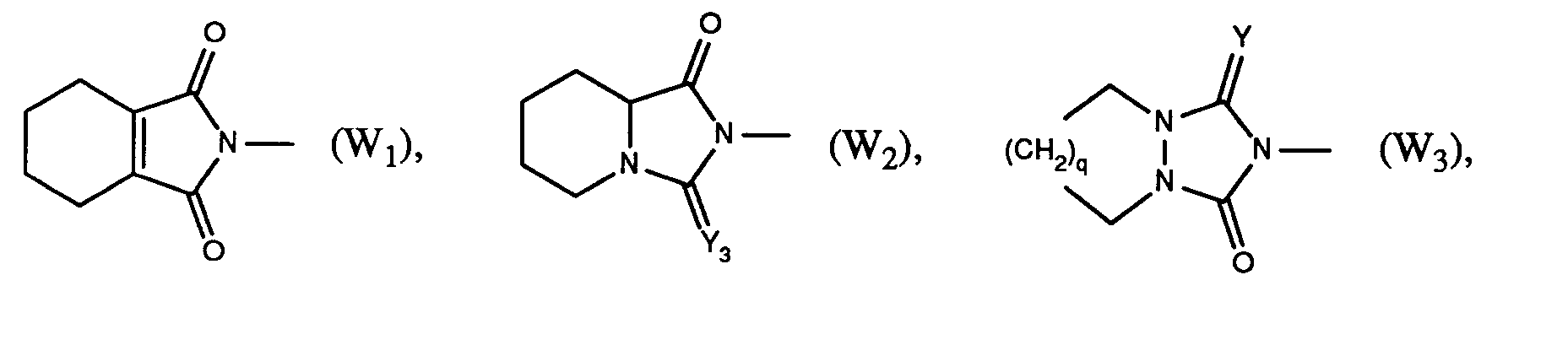
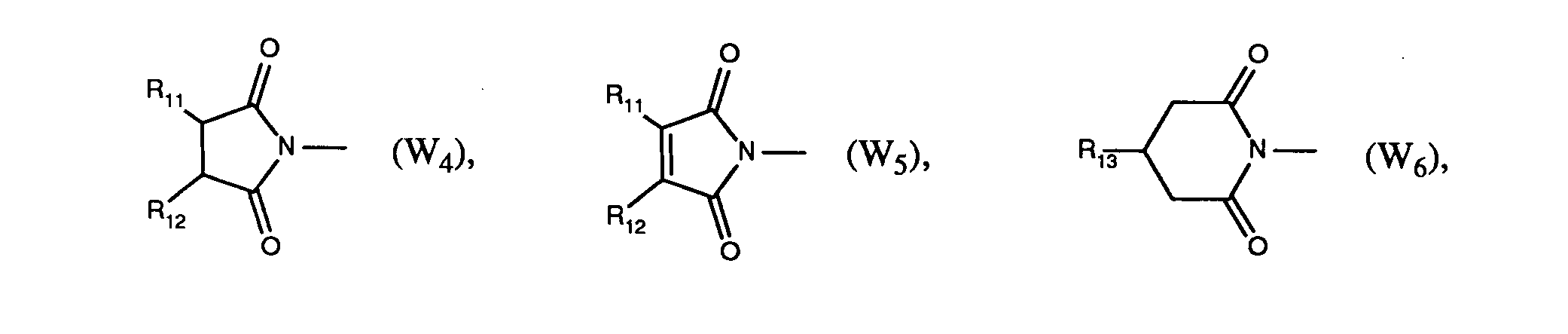
- W is W 1 , W 2 , W 3 , W s , W 8 or Wg, where R 14 is preferably hydrogen.
- A is CO-R 3 and R 3 is preferably XR 5 .
- R 5 is C 1 -C 10 alkyl, but in particular C 1 -C 4 alkyl.
- W stands for W 8 or Wg show particularly good biological activity.
- R 4 is hydrogen and X is oxygen, where n is preferably 1.
- W represents W 1 , W 4 , W 5 or W 6
- W 1 tetrahydrophthalic anhydride
- W 4 maleic anhydride
- W 5 succinic anhydride
- W 6 glutaric anhydride
- compounds of the formula in which W is W 6 can be prepared by reacting a glutaric anhydride of the formula II in which R 13 is as defined under formula with amines of the formula III in which A, R 1 , R 2 , R 4 and n are as defined under formula I, converted to a glutaric acid monoanilide of the formula IV, and then the resulting monoamide of the formula IV is cyclized with a condensing agent to give a cycloalkanecarboxylic acid derivative of the formula I.
- the above reaction is advantageously carried out in an inert organic solvent.
- the reaction temperature is generally between room temperature and the boiling temperature of the reaction mixture, preferably the reaction mixture is heated to reflux.
- the condensation reaction can be accelerated by adding condensation catalysts and removing the water formed. The same effect is achieved by adding dehydrating agents such as Sulfuric acid. High-boiling hydrocarbons, lower alkane carboxylic acids and their esters and amides, higher-boiling ketones and ethers are particularly suitable as solvents.
- Suitable solvents are: benzene, toluene, xylene, dimethylformamide, dimethylacetamide, acetic acid, ethyl acetate, diisopropyl ether, ethylene glycol dimethyl ether, tetrahydrofuran or 2-butanone.
- Suitable catalysts are, for example: p-toluenesulfonic acid, benzoic acid, 4-dimethylaminopyridine, sulfuric acid, hydrogen chloride or naphthalene sulfonic acid.
- the compounds of the formula in which W is W 1 , W 4 or W 5 can be prepared in an analogous manner.
- the thiophenols of formula V are known from EP-A-0 259 265.
- the compounds of formula VI are known or can be prepared analogously to known methods (see, for example, J. Org. Chem. 54, 6096-6100 (1989)).
- X 1 and X 2 are preferably chlorine.
- Suitable bases for these reactions are oxides, hydrides, hydroxides, carbonates, carboxylic acid salts or alcoholates of an alkali or alkaline earth metal, trialkylamines or pyridine bases.
- Sodium methylate, sodium ethylate, sodium hydroxide, potassium hydroxide, sodium carbonate or potassium carbonate have proven to be particularly suitable bases.
- Solvents suitable for these reactions are, for example, compounds from the group of open-chain or cyclic ethers, such as dioxane, tetrahydrofuran, diethyl ether, diisopropyl ether, dimethoxymethane or 1,2- Dimethoxyethane, from the group of alcohols such as methanol, ethanol or isopropanol or from the group of ketones, such as acetone, methyl ethyl ketone or methyl isobutyl ketone.
- the reactions are generally carried out at from room temperature to the boiling point of the solvent.
- the compounds of the formula in which W is W 3 and Y is sulfur can also be prepared from the compounds of the formula in which W is W 3 and Y is oxygen by heating them with a reagent capable of introducing the thioxo group.
- reagents are, for example, phosphorus pentafluoride or the Lawesson reagent (2,4-bis (4-methoxyphenyl) -1,3-dithia-2,4-diphosphine-2,4-disulfide).
- reagents are, for example, phosphorus pentafluoride or the Lawesson reagent (2,4-bis (4-methoxyphenyl) -1,3-dithia-2,4-diphosphine-2,4-disulfide).
- Lawesson reagent 2,4-bis (4-methoxyphenyl) -1,3-dithia-2,4-diphosphine-2,4-disulfide.
- the compounds of the formula I in which W is W 9 , can be prepared by using an isothiocyanate of the formula VIIa wherein the substituents A, R 1 , R 2 , R 4 , R 14 and n have the meaning given under formula, with a 1,4,5,6-tetrahydropyridazine of the formula XI into the compound of formula XII transferred and then with a compound of formula Xa wherein Z 2 represents oxygen or sulfur, in the presence of a base.
- the compounds of the formula in which W is Wg can also be prepared by using a tetrahydropyridazin-3-one of the formula XIII to hexahydropyridazin-3-one of formula XIV hydrogenated, this with an isothiocyanate of the formula VIIa wherein the substituents A, R 1 , R 2 , R 4 , R 14 and n have the meaning given under formula, for the compound of formula XVI implements this with a compound of formula Xa wherein Z 2 represents oxygen or sulfur, or with Cl 3 (CO) 3 Cl 3 (triphosgene) in the compound of formula XVII transferred this with sodium borohydride to the compound of formula XVIII implemented and then dehydrated in the presence of acid.
- reaction of the isothiocyanates of the formula VIII with the pyridazines of the formulas VIII and XI and the pyridazin-3-ones of the formula XIV is advantageously in a reaction-inert solvent at temperatures from -5 ° C to the boiling point of the solvent, in particular from 0 to + 50 ° C, particularly preferably carried out at room temperature.
- Suitable solvents for this reaction are, for example, toluene, xylene, ethyl acetate or acetonitrile.
- reaction of the compound of formulas IX and XII with the compound of formula X and the reaction of the compound of formula XVI with the compound of formula X or with triphosgene is advantageously carried out in an inert solvent at low temperatures, preferably at 0 to +50 ° C. , particularly preferably at 0 to +15 ° C.
- Suitable bases for this reaction are, for example, pyridine, triethylamine or N, N-dimethylaniline.
- suitable solvents are 1,2-dichloroethane, dichloromethane or toluene.
- reaction of the compound of formula XVII with sodium borohydride in the compound of formula XVIII is advantageously carried out at temperatures from room temperature to +50 ° C., alcohols being preferred as solvents.
- the subsequent dehydration of the compound of formula XVIII is advantageously carried out in toluene at the reflux temperature in the presence of p-toluenesulfonic acid, sulfuric acid or trifluoroacetic acid.
- the ring closure takes place in the presence of the equimolar amount of an organic or inorganic base in an inert solvent or diluent at a temperature from room temperature to the boiling point of the reaction mixture.
- Suitable reactive carbonic acid or thiocarbonic acid esters are e.g. Phosgene, thiophosgene, ethyl chloroformate, methyl chloroformate, in question.
- Acetone, methyl ethyl ketone, dioxane or tetrahydrofuran, acetonitrile, toluene or chloroform are suitable as solvents and diluents.
- the intermediates of formula XIX are new compounds. They were specially developed for the preparation of the compounds of the formula I.
- the intermediates of formula XIX therefore also form an object of the present invention.
- morpholinocyclohexene is reacted with an isocyanate or isothiocyanate of the formula VII and the resulting 2-morpholino-cyclohex-1-ene-carboxylic acid anilide or 2-morpholino-cyclohex-1-en-thiocarboxylic acid anilide is hydrolyzed
- Formula XXII then in aqueous acid solution according to the reaction scheme:
- the isoyanates or isothiocyanates of formula VII are new.
- Formula VII includes the isothiocyanates of the formula VIII and the isocyanates of the formula VIII.
- the compounds of the formula VII were specially developed for the preparation of the compounds of the formula and likewise form an object of the present invention.
- the isocyanates or isothiocyanates of the formula VII are prepared in a manner known per se by reacting the corresponding amines of the formula III obtained with phosgene or thiophosgene or with a reactive carbonic acid or thiocarbonic acid ester of the formula XXa. Such methods are described for example in EP-A-0304920.
- the condensation of the isocyanate or isothiocyanate of the formula VII with the 1-morpholinocyclohex-1-ene generally takes place spontaneously with the development of heat. However, it is advisable to carry out the reaction in an absolute solvent, with freshly distilled 1-morpholinocyclohex-1-ene with the connection of atmospheric oxygen, e.g. by displacing the air in the reaction vessel with nitrogen or an inert gas and heating the reaction after the exothermic temperature increase has subsided.
- 16.6 g of 5-amino-2-chloro-4-fluorophenylthiophenol are added to a solution of 4.7 g of sodium methylate in 100 ml of methanol stirred at room temperature. After the tropical addition of 16.6 g of 1-bromo-cyclobutane-carboxylic acid ethyl ester, the mixture is slowly heated to boiling. After the reaction mixture is kept at the reflux temperature for 6 hours, the mixture is poured into ice water. The organic phase is then extracted with ether and dried over sodium sulfate.
- Example H4 Preparation of 9- [4-chloro-2-fluoro-5- (1-methoxycarbonylcyclobutylthio) phenylimino] -8-thia-1,6-diazabicyclo [4.3.0] nonan-7-one
- Example H 15 Preparation of 1- (5-amino-2-chloro-4-fluoro-phenylthio) -cyclopropanecarboxylic acid methyl ester:
- Example H 16 Preparation of 1- (5-amino-2-chloro-4-fluoro-phenylthio) -cyclopropanecarboxylic acid methyl ester:
- a solution of 5.5 g of 1- (5-amino-2-chloro-4-fluorophenylthio) is added to a mixture of 3 g of calcium carbonate, 2 ml of thiophosgene in 20 ml of ethylene chloride and 20 ml of water with stirring at room temperature.
- the active compounds of the formula are generally successfully used at application rates of 0.001 to 4 kg / ha, in particular 0.005 to 1 kg / ha.
- the dosage required for the desired effect can be determined by experiment. It depends on the type of action, the stage of development of the crop and the weed, and on the application (place, time, method) and, depending on these parameters, can vary within wide ranges.
- the compounds of the formula are distinguished by growth-inhibiting and herbicidal properties which make them excellent for use in crops of useful plants, in particular in cereals, cotton, soybean, rapeseed, maize and rice, use in maize culture being very particularly preferred .
- the invention also relates to herbicidal and plant growth regulating compositions which comprise a new active ingredient of the formula I, and to processes for inhibiting plant growth.
- Plant growth regulators are substances which bring about agronomically desired biochemical and / or physiological and / or morphological changes in / on the plant.
- the active substances contained in the agents according to the invention influence plant growth in various ways depending on the time of application, dosage, type of application and environmental conditions.
- Plant growth regulators of the formula can, for example, inhibit the vegetative growth of plants. This type of effect is of interest on lawns, in ornamental plant growing, in orchards, on road embankments, on sports and industrial facilities, but also in the targeted inhibition of secondary drives such as tobacco.
- the inhibition of vegetative growth in cereals by means of stalk reinforcement leads to reduced storage, similar agronomic effects can be achieved in rapeseed, sunflowers, maize and other crops.
- the number of plants per area can be increased by inhibiting vegetative growth.
- Another area of application for growth inhibitors is the selective control of soil-covering plants in plantations or long-range crops by strong growth inhibition, without killing these ground cover plants, so that competition with the main crop is eliminated, but the agronomically positive effects such as erosion prevention, nitrogen binding and soil loosening are retained.
- a process for inhibiting plant growth is to be understood as controlling natural plant development without changing the life cycle of the plant, which is determined by genetic properties, in the sense of a mutation.
- the process of growth regulation becomes an individual case applied at the determined time of development of the plant.
- the active compounds of the formula I can be applied before or after the plants emerge, for example already on the seeds or the seedlings, on roots, bulbs, stems, leaves, flowers or other parts of plants. This can be done, for example, by applying the active substance itself or in the form of an agent to the plants and / or by treating the nutrient medium of the plant (soil).
- the dressing of the seeds or the treatment of the germinated seedlings are naturally the preferred methods of application because the active ingredient treatment is completely aimed at the target culture.
- 0.001 g to 4.0 g of active substance per 1 kg of seed is used, depending on the method, which also allows the addition of other active substances or micronutrients, to deviate upwards or downwards from the specified limit concentrations (repeat stain).
- the active ingredient is applied to mineral granulate carriers or polymerized granules (urea / formaldehyde) in solution and left to dry. If necessary, a coating can be applied (coating granules), which allows the active ingredient to be dispensed in doses over a certain period of time.
- mineral granulate carriers or polymerized granules urea / formaldehyde
- a coating can be applied (coating granules), which allows the active ingredient to be dispensed in doses over a certain period of time.
- the compounds of the formula are used in unchanged form, as can be obtained from synthesis, or preferably with the auxiliaries customary in formulation technology and are therefore used, for example, in to emulsifiable concentrates, directly sprayable or dilutable solutions, diluted emulsions, wettable powders, soluble powders, dusts, granules, also encapsulations in e.g. polymeric materials processed in a known manner.
- the application methods such as spraying, atomizing, dusting, wetting, scattering or pouring, are selected in the same way as the type of agent, in accordance with the intended objectives and the prevailing conditions.
- the formulations i.e. the agents, preparations or compositions containing the active ingredient of the formula and optionally one or more solid or liquid additives are prepared in a known manner, e.g. by intimately mixing and / or grinding the active ingredients with extenders, e.g. with solvents, solid carriers and optionally surface-active compounds (surfactants).
- extenders e.g. with solvents, solid carriers and optionally surface-active compounds (surfactants).
- Possible solvents are: aromatic hydrocarbons, in particular fractions C 8 to C 12 , such as mixtures of alkylbenzenes, for example xylene mixtures or alkylated naphthalenes; aliphatic and cycloaliphatic hydrocarbons such as paraffins, cyclohexane or tetrahydronaphthalene; Alcohols such as ethanol, propanol or butanol; Glycols and their ethers and esters, such as propylene glycol or dipropylene glycol ether, ketones such as cyclohexanone, isophorone or diacetone alcohol, strong polar solvents such as N-methyl-2-pyrrolidone, dimethyl sulfoxide or water, vegetable oils and their esters such as rapeseed, castor or soybean oil; possibly also silicone oils.
- aromatic hydrocarbons in particular fractions C 8 to C 12 , such as mixtures of alkylbenzenes, for example xylene mixtures
- solid carriers e.g. natural dust, such as calcite, talc, kaolin, montmorillonite or attapulgite
- solid carriers e.g. natural dust, such as calcite, talc, kaolin, montmorillonite or attapulgite
- highly disperse silica or highly disperse absorbent polymers can also be added.
- adsorptive granulate carriers come porous types such as Pumice stone, broken brick, sepiolite or bentonite, as non-sorptive carrier materials e.g. Calcite or sand in question.
- a large number of pregranulated materials of inorganic or organic nature such as, in particular, dolomite or comminuted plant residues can be used.
- suitable surface-active compounds are nonionic, cationic and / or anionic surfactants with good emulsifying, dispersing and wetting properties.
- surfactants are also to be understood as mixtures of surfactants.
- Suitable anionic surfactants can be both so-called water-soluble soaps and water-soluble synthetic surface-active compounds.
- soaps are the alkali, alkaline earth or optionally substituted ammonium salts of higher fatty acids (C 1O -C 22 ), such as the Na or K salts of oleic or stearic acid, or of natural fatty acid mixtures, for example from coconut or Tallow oil can be extracted.
- higher fatty acids C 1O -C 22
- the fatty acid methyl taurine salts should also be mentioned.
- the fatty alcohol sulfonates or sulfates are usually present as alkali, alkaline earth or optionally substituted ammonium salts and have an alkyl radical with 8 to 22 carbon atoms, alkyl also including the alkyl part of acyl radicals, e.g. the Na or Ca salt of lignin sulfonic acid, dodecylsulfuric acid ester or a fatty alcohol sulfate mixture made from natural fatty acids.
- This subheading also includes the salts of sulfuric acid esters and sulfonic acids from fatty alcohol-ethylene oxide adducts.
- the sulfonated benzimidazole derivatives preferably contain 2 sulfonic acid groups and a fatty acid residue with 8-22 carbon atoms.
- Alkylarylsulfonates are e.g. the sodium, calcium or triethanolamine salts of dodecylbenzenesulfonic acid, dibutylnaphthalenesulfonic acid, or a naphthalenesulfonic acid-formaldehyde condensation product.
- Corresponding phosphates such as e.g. Salts of the phosphoric acid ester of a p-nonylphenol (4-14) ethylene oxide adduct or phospholipids in question.
- Suitable nonionic surfactants are primarily polyglycol ether derivatives of aliphatic or cycloaliphatic alcohols, saturated or unsaturated fatty acids and alkylphenols, which can contain 3 to 30 glycol ether groups and 8 to 20 carbon atoms in the (aliphatic) hydrocarbon radical and 6 to 18 carbon atoms in the alkyl radical of the alkylphenols.
- nonionic surfactants are the water-soluble polyethylene oxide adducts containing 20 to 250 ethylene glycol ether groups and 10 to 100 propylene glycol ether groups with polypropylene glycol, ethylene diaminopolypropylene glycol and alkyl polypropylene glycol with 1 to 10 carbon atoms in the alkyl chain.
- the compounds mentioned usually contain 1 to 5 ethylene glycol units per propylene glycol unit.
- nonionic surfactants include nonylphenol polyethoxyethanols, castor oil polyglycol ethers, polypropylene-polyethylene oxide adducts, tributylphenoxypolyethoxyethanol, polyethylene glycol and octylphenoxypolyethoxyethanol.
- Fatty acid esters of polyoxyethylene sorbitan such as polyoxyethylene sorbitan trioleate, are also suitable.
- the cationic surfactants are primarily quaternary ammonium salts which contain at least one alkyl radical having 8 to 22 carbon atoms as N substituents and, as further substituents, have lower, optionally halogenated alkyl, benzyl or lower hydroxyalkyl radicals.
- the salts are preferably in the form of halides, methyl sulfates or ethyl sulfates, e.g. the stearyl trimethyl ammonium chloride or the benzyl di (2-chloroethyl) ethyl ammonium bromide.
- the pesticidal preparations generally contain 0.1 to 99%, in particular 0.1 to 95%, active ingredient of the formula I, 1 to 99% of a solid or liquid additive and 0 to 25%, in particular 0.1 to 25% of one Surfactants.
- the agents can also contain other additives such as stabilizers e.g. optionally epoxidized vegetable oils (epoxidized coconut oil, rapeseed oil or soybean oil), defoamers, e.g. Contain silicone oil, preservatives, viscosity regulators, binders, adhesives as well as fertilizers or other active ingredients to achieve special effects.
- stabilizers e.g. optionally epoxidized vegetable oils (epoxidized coconut oil, rapeseed oil or soybean oil), defoamers, e.g. Contain silicone oil, preservatives, viscosity regulators, binders, adhesives as well as fertilizers or other active ingredients to achieve special effects.
- Emulsifiable concentrates are:
- Emulsions of any desired concentration can be prepared from such concentrates by dilution with water.
- the solutions are suitable for use in the form of tiny drops.
- the active ingredient is dissolved in methylene chloride, sprayed onto the carrier and the solvent is then evaporated off in vacuo.
- Ready-to-use dusts are obtained by intimately mixing the carrier substances with the active ingredient.
- the active ingredient is mixed well with the additives and ground well in a suitable mill.
- Spray powder is obtained which can be diluted with water to form suspensions of any desired concentration.
- Emulsions of any desired concentration can be prepared from this concentrate by dilution with water
- Ready-to-use dusts are obtained by mixing the active ingredient with the carriers and grinding them in a suitable mill.
- the active ingredient is mixed with the additives, ground and moistened with water. This mixture is extruded and then dried in a stream of air.
- the finely ground active ingredient is evenly applied in a mixer to the kaolin moistened with polyethylene glycol. In this way, dust-free coating granules are obtained.
- the finely ground active ingredient is intimately mixed with the additives.
- a suspension concentrate is thus obtained, from which suspensions of any desired concentration can be prepared by dilution with water.
- the compounds of the formula I are used in unchanged form or, preferably, as an agent, together with the auxiliaries customary in formulation technology, and are therefore used, e.g. to emulsion concentrates, directly sprayable or dilutable solutions, diluted emulsions, wettable powders, soluble powders, dusts, granules, also encapsulations in e.g. polymeric fabrics, processed in a known manner.
- the methods of application such as spraying, atomizing, dusting, scattering or pouring are chosen in the same way as the type of agent, in accordance with the intended objectives and the prevailing conditions.
- the earth's surface is treated in the greenhouse with an aqueous spray mixture corresponding to an application rate of 4 kg of active substance / hectare.
- the seed pans are kept in the greenhouse at 22-25 ° C and 50-70% relative humidity.
- Ratings of 1 to 4 indicate good to very good herbicidal activity. Rating grades from 6 to 9 (especially from 7 to 9) indicate a good tolerance (especially in crops).
- Example B3 Herbicidal action for water rice (paddy)
- the water weeds Echinochloa crus galli and Monocharia vag. are sown in plastic beakers (60 cm 2 surface, 500 ml volume). After sowing, water is added to the surface of the earth. 3 days after sowing, the water level is raised to slightly above the earth's surface (3-5 mm). The application takes place 3 days after sowing by a
- the dose used corresponds to an amount of active ingredient of 2 kg AS per hectare.
- the plant cups are then placed in the greenhouse under optimal growth conditions for the rice weeds, i.e. at 25 ° -30 ° C and high humidity.
- the tests are evaluated 3 weeks after application.
- the compounds of Table I damage the weeds, but not the rice.
- Example B4 Growth inhibition in tropical ground cover legumes (cover crops)
- the test plants Centrosema pubescens and Psophocarpus palustris are propagated by cuttings in 4 cm peat pots with soil (45%), peat (45%) and zonolite (10%).
- the cultivation takes place in the greenhouse at a day temperature of 27 ° C and a night temperature of 23 ° C.
- the lighting duration is at least 14 hours / day with an intensity of at least 7000 lux.
- Approx. 50 days after the cuttings have been placed they are plugged into 13 cm pots, 4 - 5 plants / pot. After a further 60 days, the plants are cut back to a height of approximately 15 cm and applied. They are sprayed with 0.1 to 300 g of active ingredient / ha (generally 25% formulated) in an aqueous spray mixture. The water application rate is approx. 200 I / ha.
- the new weight gain is determined and shown in% of the average of the untreated controls.
- the necrotic damage is listed in% of the total leaf area.
- the new growth of the treated plants proves to be significantly lower than that of the untreated plants Controls.
- Test plants of the Williams variety are sown in 11 cm clay pots with soil (45%), peat (45%) and zonolite (10%) and grown in the climate chamber at a daytime temperature of 24 ° C and a night temperature of 19 ° C.
- the lighting duration is 16 hours a day with an intensity of approx. 350 micro Einstein.
- the treated plants show a significantly lower new growth than the untreated controls.
- Test plants (summer barley of the Iban variety) are sown in 15 cm plastic pots with sterile land and grown in the climate chamber at a daytime temperature of 10 - 15 ° C and a nighttime temperature of 5 - 10 ° C.
- the lighting duration is 13.5 hours per day with an intensity of approx. 25000 lux.
- Approx. 34 days after sowing and thinning out on 4 plants / pot the application is carried out with 0.1 to 300 g of active ingredient / ha, generally formulated in 25% and in an aqueous spray mixture.
- the water application rate is approx. 500 I / ha.
- the plants are placed in a greenhouse at a daily temperature of at least 10 ° C.
- the lighting duration is at least 13.5 hours / day.
- the treated plants show a reduction in new growth compared to untreated controls.
- a mixture of grasses e.g. Poa, Festuca, Lolium, Bromus, Cynosurus
- clover Trifolium pratense / repens
- the lighting duration is 13.5 hours / day with a light intensity of at least 7000 lux.
- the plants are cut back to a height of approx. 6 cm a week.
- Approx. 42 days after sowing and 1 day after the last cut application is carried out with 0.1 to 300 g of active ingredient / ha, generally 25% formulated and in an aqueous spray mixture.
- the water application rate is approx. 500 I / ha.
- the tested compounds in Table 1 bring about a reduction in new growth compared to the untreated control.
Landscapes
- Chemical & Material Sciences (AREA)
- Organic Chemistry (AREA)
- Life Sciences & Earth Sciences (AREA)
- Dentistry (AREA)
- Wood Science & Technology (AREA)
- Plant Pathology (AREA)
- Health & Medical Sciences (AREA)
- Engineering & Computer Science (AREA)
- Agronomy & Crop Science (AREA)
- General Health & Medical Sciences (AREA)
- Pest Control & Pesticides (AREA)
- Zoology (AREA)
- Environmental Sciences (AREA)
- Agricultural Chemicals And Associated Chemicals (AREA)
- Organic Low-Molecular-Weight Compounds And Preparation Thereof (AREA)
- Nitrogen Condensed Heterocyclic Rings (AREA)
- Heterocyclic Carbon Compounds Containing A Hetero Ring Having Nitrogen And Oxygen As The Only Ring Hetero Atoms (AREA)
- Pyrrole Compounds (AREA)
- Nitrogen And Oxygen Or Sulfur-Condensed Heterocyclic Ring Systems (AREA)
Abstract



- A CO-R3 oder CN ;
- R1 Wasserstoff oder Fluor;
- R2 Halogen oder Cyano ;
- R3 Chlor, X-R5, Amino, C1-C4-Alkylamino, Di-C1-C4-alkylamino, C2-C4-Halogenalkylamino, Di-C2-C4-halogenalkylamino, C1-C4-Hydroxyalkylamino, Di-C2-C4-hydroxyalkylamino, C3-C4-Alkenylamino, Diallylamino, -N-Pyrrolidino, -N-Piperidino, -N-Morpholino, -N-Thiomorpholino, -N-Piperidazino, die Gruppe -O-N=C-(R9)R10 oder die Gruppe -N-R6(OR6);
- R4 und R14 unabhängig voneinander Wasserstoff, Fluor, Chlor, Brom, C1-C4-Alkyl oder Trifluormethyl; R5 Wasserstoff, C1-C10-Alkyl, C1-C4-Alkoxy-C1-C4-alkyl, Halogen-C1-C8-alkyl, C1-C10-Alkylthio-C1-C4-alkyl, Di-C1-C4-alkylamino-C1-C4-alkyl, Cyano-C1-C8-alkyl, C3-C8-Alkenyl, Halogen-C3-C8-alkenyl, C3-C8-Alkinyl, C3-C7-Cycloalkyl, C3-C7-Cycloalkyl-C1-C4-alkyl, Halogen-C3-C7-cycloalkyl oder Benzyl, das unsubstituiert oder am Phenylring gleich oder verschieden bis zu dreifach durch Halogen, C1-C4-Alkyl, Halogen-C1-C4-alkyl, Halogen-C1-C4-alkoxy oder C1-C4-alkoxy substituiert ist oder Alkali-, Erdalkali-lonen und Ammoniumionen, die Gruppe -[CHR6-(CH2)m]-COOR7, oder die Gruppe [CHR6-(CH2)t-Si(R8)3];
- R6 Wasserstoff oder C1-C4-Alkyl;
- R7 Wasserstoff, C1-C6-Alkyl, C3-C8-Alkenyl, C3-C8-Alkinyl, C1-C8-Alkoxy-C2-C8-alkyl, C1-C8-Alkylthio-C2-C8-alkyl oder C3-C7-Cycloalkyl;
- R8 C1-C4-Alkyl;
- R9 C1-C4-Alkyl;
- R10 C1-C4-Alkyl oder Phenyl ;
- oder R9 und R10 zusammen mit dem Kohlenstoffatom, an welches sie gebunden sind, eien Cyclohexanring ;
- R11 C1-C8-Alkyl;
- R12 Wasserstoff oder C1-C8-Alkyl;
- R13 Wasserstoff, C1-C6-Alkyl, C3-C7-Cycloalkyl ; C1-C4-Alkoxy-C1-C4-Alkyl, C1-C4-Alkylthio-C1-C4-alkyl; Halogen-C1-C7-alkyl, C3-C7-Alkenyl oder C3-C7-Alkinyl;
- X Sauerstoff oder Schwefel;
- Y Sauerstoff oder Schwefel;
- Y1 Sauerstoff oder Schwefel ;
- Y2 Sauerstoff oder Schwefel ;
- Y3 Sauerstoff oder Schwefel ;
- Y4 Sauerstoff oder Schwefel ;
- Z1 Sauerstoff oder Schwefel ;
- Z2 Sauerstoff oder Schwefel ;
- n 0, 1, 2, 3 oder 4 ;
- m 0, 1, 2, 3 oder 4 ;
- q 1 oder 2 ; und
- t 0, 1, 2, 3 oder 4
- bedeutet, unter Einschluss der Salze und Komplexe mit Säuren, Basen oder Komplexbildnern, sowie der möglichen Stereoisomeren, die in Form von Enantiomeren, Diastereomeren oder deren Gemische vorliegen, haben gute pre- und postemergent-selektive herbizide und wuchsregulierende Eigenschaften.
Description
- Die vorliegende Erfindung betrifft neue, herbizid wirksame und pflanzenwuchsregulierende Cycloalkancarbonsäurederivate, Verfahren zu ihrer Herstellung, die sie als Wirkstoffe enthaltende Mittel sowie deren Verwendung zum Bekämpfen von Unkräutern, vor allem selektiv in Nutzpflanzenkulturen oder zum Regulieren und Hemmen des Pflanzenwachstums.
- S-Phenyl-thioglykolsäurederivate mit herbizider Wirkung sind aus den Europäischen Patentanmeldungen Nr. 0 238 711 und 0 304 920 sowie aus den US-Patenten USP 4,885,023, USP 4,684,397 und USP 4,801,408 bekannt. Die dort offenbarten Wirkstoffe können jedoch die Anforderungen bezüglich Wirkungsstärke und Selektivität nicht immer erfüllen. Es besteht somit ein Bedarf nach besser wirksamen und selektiveren Wirkstoffen.
- Es wurden nun neue Cycloalkancarbonsäurederivate mit verbesserter herbizider und pflanzenwuchsregulierender Wirkung gefunden.
- Die erfindungsgemässen Cycloalkancarbonsäurederivate entsprechen der Formel


- A CO-R3 oder CN;
- R1 Wasserstoff oder Fluor;
- R2 Halogen oder Cyano;
- R3 Chlor, X-R5, Amino, C1-C4-Alkylamino, Di-C1-C4-alkylamino, C2-C4-Halogenalkyl-amino, Di-C2-C4-haloge- nalkylamino, C1-C4-Hydroxyalkylamino, Di-C1-C4-hydroxyalkylamino, C3-C4-Alkenylamino, Diallylamino, -N-Pyrrolidino, -N-Piperidino, -N-Morpholino, -N-Thiomorpholino, -N-Piperidazino, die Gruppe -O-N=C-(R9)R10 oder die Gruppe -N-R6(OR6);
- R4 und R14 unabhängig voneinander Wasserstoff, Fluor, Chlor, Brom, C1-C4-Alkyl oder Trifluormethyl;
- R5 Wasserstoff, C1-C10-Alkyl, C1-C4-Alkoxy-C1-C4-alkyl, Halogen-C1-C8-alkyl, C1-C10-Alkylthio-C1-C4-alkyl, Di-C1-C4-alkylamino-C1-C4-alkyl, Cyano-C1-C8-alkyl, C3-C8-Alkenyl, Halogen-C3-C8-alkenyl, C3-C8-Alkinyl, C3-C7-Cycloalkyl, C3-C7-Cycloalkyl-C1-C4-alkyl, Halogen-C3-C7-cycloalkyl oder Benzyl, das unsubstituiert oder am Phenylring gleich oder verschieden bis zu dreifach durch Halogen, C1-C4-Alkyl, Halogen-C1-C4-alkyl, Halogen-C1-C4-alkoxy oder C1-C4-alkoxy substituiert ist oder Alkali-, Erdalkali-lonen und Ammoniumionen, die Gruppe -[CHR6-(CH2)m]-COOR7, oder die Gruppe [CHR6-(CH2)t-Si(R8)3];
- R6 Wasserstoff oder C1-C4-Alkyl;
- R7 Wasserstoff, C1-C6-Alkyl, C3-C8-Alkenyl, C3-C8-Alkinyl, C1-C8-Alkoxy-C2-C8-alkyl, C1-C8-Alkylthio-C2-C8-alkyl oder C3-C7-Cycloalkyl;
- R8 C1-C4-Alkyl;
- Rg C1-C4-Alkyl;
- R10 C1-C4-Alkyl oder Phenyl;
- oder Rg und R10 zusammen mit dem Kohlenstoffatom, an welches sie gebunden sind, einen Cyclohexanring; R11 C1-C8-Alkyl;
- R12 Wasserstoff oder C1-C8-Alkyl;
- R13 Wasserstoff, C1-C6-Alkyl, C3-C7-Cycloalkyl: C1-C4-Alkoxy-C1-C4-Alkyl, C1-C4-Alkylthio-C1-C4-alkyl; Halogen-C1-C7-alkyl, C3-C7-Alkenyl oder C3-C1-Alkinyl;
- X Sauerstoff oder Schwefel;
- Y Sauerstoff oder Schwefel;
- Y1 Sauerstoff oder Schwefel;
- Y2 Sauerstoff oder Schwefel;
- Y3 Sauerstoff oder Schwefel;
- Y4 Sauerstoff oder Schwefel;
- Z1 Sauerstoff oder Schwefel;
- Z2 Sauerstoff oder Schwefel;
- n 0, 1, 2, 3 oder 4;
- m 0, 1, 2, 3 oder 4;
- q 1 oder 2; und
- t 0, 1, 2, 3 oder 4
- bedeutet, unter Einschluss der Salze und Komplexe mit Säuren, Basen oder Komplexbildnern, sowie der möglichen Stereoisomeren, die in Form von Enantiomeren, Diastereomeren oder deren Gemische vorliegen.
- In den in dieser Beschreibung verwendeten Definitionen umfassen die angegebenen generischen Begriffe, sowie die durch Kombination einzelner Unterbegriffe erhältlichen Einzelbedeutungen der Substituenten, beispielsweise die folgenden Einzelsubstituenten, wobei diese Aufzählung keine Einschränkung der Erfindung darstellt.
- In den obigen Definitionen ist unter Halogen, Fluor, Chlor, Brom und Jod vorzugsweise Fluor, Chlor und Brom zu verstehen, insbesondere bei R2 Chlor und Brom.
- Alkyl ist beispielsweise Methyl, Ethyl, Isopropyl, n-Propyl, n-Butyl, iso-Butyl, sek-Butyl, tert-Butyl sowie die verschiedenen isomeren Pentyl-, Hexyl-, Heptyl-, Octyl-, Nonyl- und Decylradikale.
- Halogenalkyl sind beispielsweise Fluormethyl, Difluormethyl, Trifluormethyl, Chlormethyl, Dichlormethyl, Trichlormethyl, 2,2,2-Trifluorethyl, 2-Fluorethyl, 2-Chlorethyl und 2,2,2-Trichlorethyl; vorzugsweise Trichlormethyl, Difluorchlormethyl, Trifluormethyl und Dichlorfluormethyl.
- Alkoxy ist beispielsweise Methoxy, Ethoxy, Propyloxy, i-Propyloxy, n-Butyloxy, i-Butyloxy, s-Butyloxy und t-Butyloxy; vorzugsweise Methoxy und Ethoxy.
- Halogenalkoxy ist z.B. Fluormethoxy, Difluormethoxy, Trifluormethoxy, 2,2,2-Trifluorethoxy, 1,1,2,2-Tetrafluorethoxy, 2-Fluorethoxy, 2-Chlorethoxy und 2,2,2-Trichlorethoxy; vorzugsweise Difluormethoxy, 2-Chlorethoxy und Trifluormethoxy.
- Alkylthio ist beispielsweise Methylthio, Ethylthio, Propylthio, Isopropylthio, n-Butylthio, i-Butylthio, s-Butylthio, t-Butylthio oder die isomeren Pentylthio, vorzugsweise Methylthio und Ethylthio.
- Unter Alkenyl ist geradkettiges oder verzweigtes Alkenyl zu verstehen, wie z.B. Vinyl, Allyl, Methallyl, 1-Methylvinyl, But-2-en-1-yl, 3-Pentenyl, 2-Hexenyl oder 3-Heptenyl. Bevorzugt sind Alkenylreste mit einer Kettenlänge von 2 bis 3 Kohlenstoffatomen.
- Die in den Definitionen der Substituenten vorkommenden Alkinylreste können geradkettig oder verzweigt sein wie beispielsweise Ethinyl, Propargyl, 3-Butinyl, 1-Methylpropargyl, 2-Pentinyl oder 2-Hexinyl. Bevorzugt sind Ethinyl und Propargyl. Im Rahmen der vorliegenden Erfindung sind die an Sauerstoff oder Stickstoff gebundenen Alkenyl- und Alkinylgruppen in der Regel über ein gesättigtes Kohlenstoffatom gebunden.
- Cycloalkyl steht beispielsweise für Cyclopropyl, Dimethylcyclopropyl, Cyclobutyl, Cyclopentyl, Methylcyclopentyl, Cyclohexyl oder Cycloheptyl, vorzugsweise aber für Cyclopropyl, Cyclopentyl oder Cyclohexyl.
- Alkoxycarbonyl ist z.B.: Methoxycarbonyl, Ethoxycarbonyl, n-Propyloxycarbonyl, i-Propyloxycarbonyl und n-Butyloxycarbonyl, vorzugsweise Methoxycarbonyl und Ethoxycarbonyl.
- Alkoxyalkyl ist z.B.: Methoxymethyl, Ethoxymethyl, Propyloxymethyl, Methoxyethyl, Ethoxyethyl, Propyloxyethyl, Methoxypropyl, Ethoxypropyl oder Propyloxypropyl.
- Alkylthioalkyl ist z.B.: Methylthiomethyl, Ethylthiomethyl, Methylthioethyl, Ethylthioethyl, oder Isopropylthioethyl.
- Alkylaminoalkyl ist z.B.: Methylaminoethyl, Dimethylaminoethyl, Ethylaminoethyl oder Diethylaminoethyl.
- Cyanoalkyl ist z.B.: Cyanomethyl, Cyanoethyl oder Cyanopropyl.
- Wenn R4 und R14 gleichzeitig verschieden von Wasserstoff sind und n eins bedeutet, sind R4 und R14 vorzugsweise am gleichen Kohlenstoffatom gebunden.
- Halogencycloalkyl ist z.B.: 2,2-Dichlorcyclopropyl oder Pentachlorcyclohexyl.
- Alkylsulfonyl ist z.B.: Methylsulfonyl, Ethylsulfonyl, Propylsulfonyl oder Butylsulfonyl. Bevorzugt sind Methyl- und Ethylsulfonyl.
- Cycloalkoxycarbonyl ist z.B.: Cyclopentyloxycarbonyl oder Cyclohexyloxycarbonyl.
- Phenyl, auch als Teil eines Substituenten wie Phenoxy, Phenylthio, Phenoxycarbonyl, Phenylaminocarbonyl, Benzyl oder Benzoyl, kann im allgemeinen unsubstituiert oder durch weitere Substituenten substituiert vorliegen. Die Substituenten können dann in ortho-, meta- und/oder para-Stellung stehen. Bevorzugte Substituentenstellungen sind die ortho- und para-Position zur Ringverknüpfungsstelle. Bevorzugte Substituenten sind Halogenatome.
- In den weiteren Substituenten, welche aus mehreren Grundelementen zusammengesetzt sind, haben die Teilelemente die oben an Beispielen erläuterten Bedeutungen. Diese Aufzählungen bedeuten auch in diesen Fällen keine Einschränkung der Erfindung: sie haben illustrierenden Charakter.
- Von den Verbindungen der Formel sind diejenigen bevorzugt, in denen W für W1, W2, W3, Ws, W8 oder Wg steht, wobei R14 vorzugsweise Wasserstoff bedeutet.
- Ferner sind aus dem Umfang der Formel diejenigen Verbindungen bevorzugt, in denen R1 für Fluor und R2 für Chlor steht.
- Bei einer besonders herausragenden Gruppe von Verbindungen der Formel 1 steht A für CO-R3 und R3 vorzugsweise für X-R5. Aus dieser Gruppe sind diejenigen Verbindungen bevorzugt, in denen R5 für C1-C10-Alkyl, insbesondere aber C1-C4-Alkyl steht. Ganz besonders gute biologische Wirkung zeigen diejenigen Verbindungen dieser Gruppe, bei denen W für W8 oder Wg steht. In den ganz besonders bevorzugten Verbindungen dieser Gruppe steht R4 für Wasserstoff und X für Sauerstoff, wobei n vorzugsweise 1 bedeutet.
- Als herausragende Einzelverbindungen aus dem Umfang der Formel sind zu nennen:
- 1-[2-Chlor-4-fluor-5-(1,2,3,4,5,6-hexahydro-1,3-dioxo-isoindolyl)-phenylthio]-cyclopropancarbonsäuremethylester,
- 9-[4-Chlor-2-fluor-5-(1-methoxycarbonyl-cyclobutylthio)-phenylimino]-8-thia-1,6-diazabicyclo[4.3.0]-nonan-7-on;
- 9-[4-chlor-2-fluor-5-(1-methoxycarbonyl-cyclopropylthio)-phenylimino]-8-thia-1,6-diazabicyclo[4.3.0]-nonan-7-on; sowie
- 1-[4-Chlor-2-fluor-5-(1-methoxycarbonyl-cyclobutyl)-phenylthio]-4-trifluormethyl-piperidin-2,6-dion.
- Die Verbindungen der Formel 1, in welcher W für W1, W4, W5 oder W6 steht, können hergestellt werden, indem man die jeweiligen Anhydride der Reste W1(Tetrahydrophtalsäureanhydrid), W4(Maleinsäureanhydrid), W5(Bernsteinsäureanhydrid) und W6(Glutarsäureanhydrid) mit Aminen der Formel III


- Mit Vorteil führt man die obige Reaktion in einem inerten organischen Lösungsmittel aus. Die Reaktionstemperatur liegt im allgemeinen zwischen der Raumtemperatur und der Siedetemperatur des Reaktionsgemisches, vorzugsweise wird die Reaktionsmischung zum Rückfluß erhitzt. Die Kondensationsreaktion kann durch Zusatz von Kondensationskatalysatoren und Entfernung des entstehenden Wassers beschleunigt werden. Eine gleiche Wirkung erzielt man durch Zusatz von wasserentziehenden Mitteln, wie beispielsweise Schwefelsäure. Als Lösungsmittel eignen sich insbesondere höhersiedende Kohlenwasserstoffe, niedere Alkancarbonsäuren sowie deren Ester und Amide, höhersiedende Ketone und Ether. Beispiele für geeignete Lösungsmittel sind: Benzol, Toluol, Xylol, Dimethylformamid, Dimethylacetamid, Essigsäure, Ethylacetat, Diisopropylether, Ethylenglykoldimethylether, Tetrahydrofuran oder 2-Butanon.
- Geeignete Katalysatoren sind beispielsweise: p-Toluolsulfonsäure, Benzoesäure, 4-Dimethylaminopyridin, Schwefelsäure, Chlorwasserstoff oder Naphtalinsulfonsäure. In analoger Weise können die Verbindungen der Formel in denen W für W1, W4, oder W5 steht, hergestellt werden.
- Die Verbindungen der Formel II, bzw. die entsprechenden Anhydride der Reste W1, W4, und W5 sowie die Verbindungen der Formel IV sind bekannt oder können analog zu bekannten Verfahren hergestellt werden.
- Zur Synthese von Anhydriden der Formel II sowie den Anhydriden der Reste W1, W4, und W5 sind in der Literatur verschiedene Wege beschrieben.
- Als geeignet für die Herstellung der Verbindungen der Formel erweist sich beispielsweise die in Schema 1 dargestellte Reaktionssequenz, die von einfachsten, allgemein verfügbaren Synthesebausteinen (Aldehyd und Cyanessigsäureester) ausgeht:

- Das Verfahren gemäss Schema 1 ist unter anderem in folgenden Literaturstellen näher beschrieben: J. Chem. Soc. 117 (1920) 1465; J. Chem. Soc. 123 (1923), 3131; J. Chem. Soc. 1952,4785; Rec. Trav. Chim. Pays-Bas 84 (1965), 1183 und J. Ind. Chem. Soc. 13 (1936), 322.
- Eine andere Verfahrensvariante zur Herstellung der Glutarsäureanhydride der Formel II basiert auf einer Malonestersynthese und ist im Schema 2 zusammengefasst:
-

- Chem. Soc. Perkin Trans. I, 1978, 1636; J. Am. Chem. Soc. 95 (1973), 7437; Org. Prep. Proc. Int. 7, (1975), 283.
- Die Aniline der Formel III sind neu und wurden speziell für die Synthese der Verbindungen der Formel entwickelt. Sie bilden daher ebenfalls einen Gegenstand der vorliegenden Erfindung. Sie können beispielsweise nach an sich bekannten Methoden durch
- a) Reduktion der entsprechenden Nitroverbindungen durch katalytische Verfahren (z.B. H2/Pd/C, oder H2/Pt) oder
- b) Umsetzung eines Thiophenols der Formel V mit einer Verbindung der Formel VI in Gegenwart einer Base nach folgendem Schema hergestellt werden:


- Die Thiophenole der Formel V sind aus EP-A-0 259 265 bekannt. Die Verbindungen der Formel VI sind bekannt oder lassen sich analog bekannter Methoden herstellen (siehe z.B. J. Org. Chem. 54, 6096-6100 (1989)).
- Die Verbindungen der Formel III können auch hergestellt werden, indem man ein Thiophenol der Formel V

- worin R1 und R2 die unter Formel angegebene Bedeutung haben, in Gegenwart einer Base mit einer Verbindung der Formel XXI
-

- a) wenn A für CN steht:
- zu einer Verbindung der Formel XXIII

- umsetzt, welche anschließend in Gegenwart einer Base zur Verbindung der Formel III, worin A für CN steht, cyclisiert wird, oder
- zu einer Verbindung der Formel XXIII
- b) wenn A für COOH steht: zu einer Verbindung der Formel XXllla


- a) wenn A für CN steht:
- Die Verbindungen der Formel III, worin A für CN steht, können auch hergestellt werden, indem man eine Verbindung der Formel Va

- worin R1 und R2 die unter Formel V angegebene Bedeutung haben, in Gegenwart einer Base mit einer Verbinduna der Formel XXIa
-

- Eine weitere Variante, die Verbindungen der Formel III, worin A für CN steht, herzustellen, besteht darin, daß man Verbindungen der Formel III, worin A für COCI steht, mit Ammoniak zum entsprechenden Acetamid umsetzt, welches durch Wasserabspaltung (z.B. Einwirkung von Phosphorpentoxid) in das gewünschte Nitril überführt werden kann. Derartige Reaktionen sind bekannt und dem Fachmann geläufig.
- In der Formel XXI steht X1 und X2 vorzugsweise für Chlor. Geeignete Basen für diese Umsetzungen sind Oxide, Hydride, Hydroxide, Carbonate, Carbonsäuresalze oder Alkoholate eines Alkali- oder Erdalkalimetalls, Trialkylamine oder pyridinbasen. Als besonders gut geeignete Basen haben sich Natriummethylat, Natriumethylat, Natriumhydroxid, Kaliumhydroxid, Natriumcarbonat oder Kaliumcarbonat erwiesen. Für diese Reaktionen geeignete Lösungsmittel sind beispielsweise Verbindungen aus der Gruppe der offenkettigen oder cyclischen Ether, wie Dioxan, Tetrahydrofuran, Diethylether, Diisopropylether, Dimethoxymethan oder 1,2-Dimethoxyethan, aus der Gruppe der Alkohole wie Methanol, Ethanol oder Isopropanol oder aus der Gruppe der Ketone, wie Aceton, Methyl-ethylketon oder Methyl-isobutylketon. Die Umsetzungen erfolgen im allgemeinen bei Temperaturen von Raumtemperatur bis zur Siedetemperatur des Lösungsmittels.
- Die Verbindungen der Formel I, worin W für W2 steht und Y3 Sauerstoff bedeutet, werden hergestellt, indem man ein Isocyanat der Formel Vllb

- worin R1, R2, R4, R14, A und n die unter Formel angegebene Bedeutung haben, in einem organischem Lösungsmittel in Gegenwart einer Base bei einer Temperatur von 0 bis +150°C mit einem 2-Carboxylpiperidin der Formel XXIV
-


- Die Verbindungen der Formel worin W für W2 steht und Y3 Schwefel bedeutet, werden hergestellt, indem man ein Isothiocyanatcyanat der Formel Vlla
-

-


- Die Verbindungen der Formel worin W für W3 steht und Y Schwefel bedeutet, können hergestellt werden, indem man ein Isocyanat der Formel Vllb

- worin R1, R2, R4, R14, A und n die unter Formel angegebene Bedeutung haben, in einem organischem Lösungsmittel in Gegenwart einer Base bei einer Temperatur von 0 bis +150°C mit einer Verbindung der Formel XXVI
-


- Die Verbindungen der Formel l, worin W für W3 steht und Y Sauerstoff bedeutet, können hergestellt werden, indem man ein Isocyanat der Formel Vllb

- worin R1, R2, R4, R14, A und n die unter Formel angegebene Bedeutung haben, in einem organischem Lösungsmittel in Gegenwart einer Base bei einer Temperatur von 0 bis +150°C mit einer Verbindung der Formel XXVI
-


-


- Die Verbindungen der Formel worin W für W3 steht und Y Schwefel bedeutet, können auch aus den Verbindungen der Formel worin W für W3 steht und Y Sauerstoff bedeutet, hergestellt werden, indem man diese mit einem zur Einführung der Thioxogruppe befähigten Reagenz erhitzt. Solche Reagenzien sind beispielsweise Phosphorpentafluorid oder das Lawesson-Reagenz (2,4-Bis-(4-methoxyphenyl)-1,3-dithia-2,4-diphos- phetan-2,4-disulfid). Derartige Umsetzungen sind bekannt und ihre Durchführung dem Fachmann geläufig.
- Die Verbindungen der Formel in welcher W für W7 steht und Y4 Sauerstoff bedeutet, werden hergestellt, indem man ein Isocyanat der Formel Vllb

- worin die Substituenten A, R1, R2, R4, R14 sowie n die unter Formel angegebene Bedeutung haben, mit einer Verbindung der Formel XXX
-


- Die Verbindungen der Formel in welcher W für W7 steht und Y4 Schwefel bedeutet, werden hergestellt, indem man ein Isothiocyanat der Formel Vlla

- worin die Substituenten A, R1, R2, R4, R14 sowie n die unter Formel angegebene Bedeutung haben, mit einer Verbindung der Formel XXX
-


- Die Verbindungen der Formel in welcher W für W8 steht, werden hergestellt, indem man ein Isothiocyanat der Formel Vlla


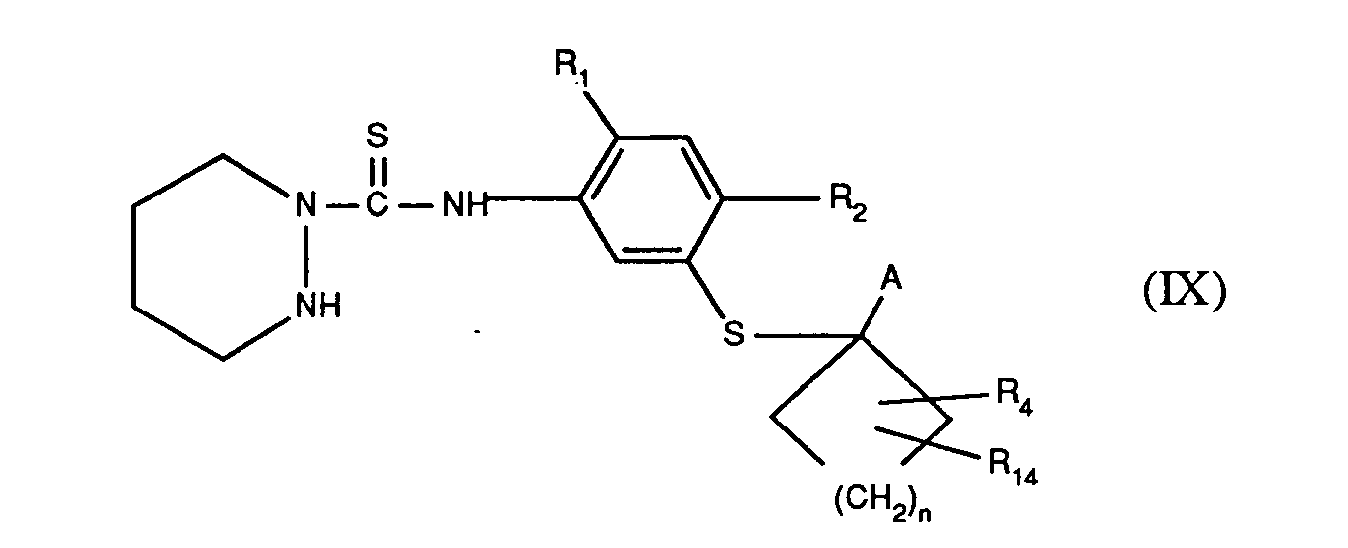

- Die Verbindungen der Formel l, in welcher W für W9 steht, können hergestellt werden, indem man ein Isothiocyanat der Formel Vlla


- Die Verbindungen der Formel, in welcher W für Wg steht, können auch hergestellt werden, indem man ein Tetrahydropyridazin-3-on der Formel XIII


- Verbindungen der Formel worin W für W8 steht, können auch hergestellt werden, indem man Verbindungen der Formel l, worin W für W9 steht, hydriert. Derartige Hydrierungsverfahren sowie die Hydrierung der Verbindung der Formel XIII zur Verbindung der Formel XIV sind dem Fachmann geläufig. Sie können beispielsweise mit Wasserstoff in Gegenwart von Edelmetallkatalysatoren wie Platin durchgeführt werden.
- Die Umsetzung der Isothiocyanate der Formel Vlla mit den Pyridazinen der Formeln VIII und XI sowie den Pyridazin-3-onen der Formel XIV wird mit Vorteil in einem reaktionsinerten Lösungsmittel bei Temperaturen von -5 °C bis zur Siedetemperatur des Lösungsmittels, insbesondere von 0 bis +50°C, besonders bevorzugt bei Raumtemperatur, durchgeführt. Geeignete Lösungsmittel für diese Reaktion sind beispielsweise Toluol, Xylol, Essigsäureethylester oder Acetonitril.
- Die Umsetzung der Verbindung der Formeln IX und XII mit der Verbindung der Formel X sowie die Umsetzung der Verbindung der Formel XVI mit der Verbindung der Formel X oder mit Triphosgen erfolgt vorteilhaft in einem reaktionsinerten Lösungsmittel bei niedrigen Temperaturen, vorzugsweise bei 0 bis +50°C, besonders bevorzugt bei 0 bis +15°C. Geeignete Basen für diese Reaktion sind beispielsweise Pyridin, Triethylamin oder N,N-Dimethylanilin. Als Lösungsmittel eignen sich beispielsweise 1,2-Dichlorethan, Dichlormethan oder Toluol.
- Die Umsetzung der Verbindung der Formel XVII mit Natriumborhydrid in die Verbindung der Formel XVIII wird vorteilhaft bei Temperaturen von Raumtemperatur bis +50°C durchgeführt, wobei als Lösungsmittel Alkohole bevorzugt sind. Die anschliessende Dehydratisierung der Verbindung der Formel XVIII wird mit Vorteil in Toluol bei Rückflußtemperatur in Gegenwart von p-Toluolsulfonsäure, Schwefelsäure oder Trifluoressigsäure durchgeführt.
- Die für die erfindungsgemässen Verbindungen der Formel I, worin W für W8 oder Wg steht, als Ausgangsprodukte verwendeten Pyridazine der Formeln VIII und XI sowie die Pyridazin-3-one der Formel XIV sind bekannt oder lassen sich analog zu literaturbekannten Verfahren herstellen. Die Herstellung derartiger Verbindungen ist beispielsweise in Coll. Czechoslov. Chem. Commun. 33, 2087 (1968), Khimiya Geterotsiklicheskikh Soedinenii, 4, (3), 530-535 ( 1968), Beilstein, E III/IV 23, S. 465 sowie EP-A-0304920 beschrieben.
- Die Verbindungen der Formel l, in welcher W für W10 steht, können hergestellt werden durch Umsetzung von einem 2-Hydroxy-cyclohex-1-en-carbonsäure- oder-thiocarbonsäureanilid der Formel XIX

- worin A, R1, R2, R4, R14, Y2 und n unter der Formel l gegebene Bedeutung haben, mit einem reaktiven Kohlensäure- oder Thiokohlensäure-Derivat der Formel XX
-

- Der Ringschluß erfolgt in Gegenwart der äquimolaren Menge einer organischen oder anorganischen Base in einem inerten Lösungs- oder Verdünnungsmittel bei einer Temperatur von Raumtemperatur bis zum Siedepunkt des Reaktionsgemisches.
- Als reaktionsfähige Kohlensäure- beziehungsweise Thiokohlensäureester kommen z.B. Phosgen, Thiophosgen, Chlorameisensäure-ethylester, Chlorameisensäuremethylester, in Frage.
- Als Lösungs- und Verdünnungsmittel eignen sich Aceton, Methylethylketon, Dioxan oder Tetrahydrofuran, Acetonitril, Toluol oder Chloroform.
- Die Zwischenprodukte der Formel XIX sind neue Verbindungen. Sie wurden speziell zur Herstellung der Verbindungen der Formel I entwickelt. Die Zwischenprodukte der Formel XIX bilden daher ebenfalls einen Gegenstand der vorliegenden Erfindung. Um die Verbindungen der Formel XIX herzustellen, setzt man z.B. Morpholinocyclohexen mit einem Isocyanat oder Isothiocyanat der Formel VII um und hydrolisiert das entstandene 2-Morpholino-cyclohex-1-en-carbonsäureanilid bzw. 2-Morpholino-cyclohex-1-en-thiocarbonsäureanilid der Formel XXII anschliessend in wässrig saurer Lösung entsprechend dem Reaktionsschema:


- In den obigen Formeln haben die Substituenten die unter der Formel gegebene Bedeutung.
- 1 -Morpholinocyclohex-1-en ist bekannt.
- Die Isoyanate bzw. Isothiocyanate der Formel VII sind neu. Unter die Formel VII fallen die Isothiocyanate der Formel Vlla und die Isocyanate der Formel Vllb. Die Verbindungen der Formel VII wurden speziell zur Herstellung der Verbindungen der Formel entwickelt und bilden ebenfalls einen Gegenstand der vorliegenden Erfindung. Die Isocyanate bzw. Isothiocyanate der Formel VII werden in an sich bekannter Weise durch Umsetzen der entsprechenden Amine der Formel III

- In der Formel 111 haben die Substituenten die unter Formel angegebene Bedeutung. In der Formel XXa bedeutet Y2 Sauerstoff oder Schwefel, Hal Chlor oder Brom und E Chlor, Brom oder C1-C4-Alkoxy.
- Die Kondensation des Isocyanates bzw. Isothiocyanates der Formel VII mit dem 1-Morpholinocyclohex-1-en geschieht im allgemeinen spontan unter Wärmeentwicklung. Es empfiehlt sich aber die Reaktion in einem absolutem Lösungsmittel, mit frisch destilliertem 1-Morpholinocyclohex-1-en unter Anschluss von Luftsauerstoff, z.B. durch Verdrängen der Luft im Reaktionsgefäss mit Stickstoff oder einem Edelgas vorzunehmen und die Reaktion nach Abklingen des exothermen Temperaturanstieges zu erhitzen.
- Die vorstehend aufgeführten Verfahren können analog zu literaturbekannten Verfahren durchgeführt werden. Die in diesen Verfahren bevorzugten Reaktionsbedingungen, wie Temperatur, molare Verhältnisse der Edukte, Reaktionsführung. Lösungsmittel, gegebenenfalls erforderliche Reagentien, wie Säuren, Basen, wasserbindende Mittel usw., sind dem Fachmann geläufig.
- Beispiel H1: Herstellung von 1-(5-Amino-2-chlor-4-fluor-phenylthio)-cyclobutancarbonsäuremethylester:

- Zu einer bei Raumtemperatur gerührten Lösung aus 4,7 g Natriummethylat in 100 ml Methanol gibt man 16,6 g 5-Amino-2-chlor-4-fluor-phenylthiophenol hinzu. Nach tropenweiser Zugabe von 16,6 g 1-Brom-cyclobutan-carbonsäurem ethylester erwärmt man langsam zum Sieden. Nachdem die Reaktionsmischung 6 Stunden lang auf Rückflußtemperatur gehalten wurde, gibt man die Mischung in Eiswasser. Anschließend wird die organische Phase mit Ether extrahiert und über Natriumsulfat getrocknet. Nach Einengen der Lösung und chromatographischer Reinigung durch Kieselgelchromatographie erhält man 12 g 1-(5-Amino-2-chlor-4-fluor-phenylthio)-cyclobutancarbonsäuremethylester mit einem Schmelzpunkt von +94 bis +95 °C.
-

- Zu einem Gemisch aus 12 g Calciumcarbonat und 8 ml Thiophosgen in 40 ml Ethylenchlorid und 40 ml Wasser gibt man unter Rühren bei einer Temperatur von +25 bis +30°C eine Lösung aus 12 g gemäß Beispiel H1 erhaltenen 1-(5-Amino-2-chlor-4-fluor-phenylthio)-cyclobutancarbonsäuremethylester in 30 ml Ethylenchlorid tropfenweise hinzu. Anschließend wird das Reaktionsgemisch 18 Stunden lang gerührt. Nach Abfiltrieren des entstandenen Niederschlages wird die organische Phase über Calciumchlorid getrocknet und anschließend im Vakuum eingeengt. Man erhält 13,1 g 2-(2-chlor-4-fluor-5-isothiocyanato-phenylthio)cyclobutancar- bonsäuremethylester in Form eines Öles.
-

- Zu einer Lösung aus 4 g Hexahydropyridazin in 30 ml Ethanol gibt man unter Rühren bei Raumtemperatur eine Lösung von 13,1 g gemäß Beispiel H2 erhaltenen 1-(2-chlor-4-fluor5-isothiocyanatophenylthio)-cyclobu- tancarbonsäuremethylesters in 200 ml Ethanol tropfenweise hinzu. Nach 3-stündigem Rühren bei Raumtemperatur wird die Reaktionsmischung im Vakuum eingedampft. Man erhält 10,8 g 1-[2-chlor-4-fluor-5-(1-hexa- hydropyridazinyl-thiocarbonylamino)-phenylthio]-cyclobutancarbonsäuremethylester mit einem Schmelzpunkt von +112 bis +113°C.
-

- Zu einer Lösung von 10,4 g 1-[2-chlor-4-fluor-5-(1-hexahydropyridazinyl-thiocarbonylamino)-phenylthio] - cyclobutancarbonsäuremethylester und 10 ml Triethylamin in 100 ml Toluol gibt man unter Rühren bei einer Temperatur von + 10°C 12,5 ml 20%-ige toluolische Lösung von Phosgen tropfenweise hinzu. Anschließend läßt man die Reaktionsmischung 6 Stunden lang rühren und gibt sie dann in Eiswasser. Anschließend wird die organische Phase abgetrennt und über Natriumsulfat getrocknet. Nach dem Eindampfen und anschließender chromatographischer Reinigung mittels Kieselgelchromatographie erhält man 4,6 g 9-[4-chlor-2-fluor-5-(1-met- hoxycarbonylcyclobutylthio)-pheny limino]-8-thia-1,6-diazabicyclo[4.3.0]-nonan-7-on, ηD22 1,6010.
-

- Ein Gemisch aus 4,4 g 1-(5-Amino-2-chlor-4-fluor-phenylthio)-cyclobutancarbonsäuremethylester und 2,4 g 3,4,5,6-Tetrahydrophtalsäureanhydrid in 60 ml Eisessig wird 5 Stunden lang unter Rühren am Rückfluß erhitzt. Anschließend wird das Reaktionsgemisch in Eiswasser gegeben und das ausgefallene klebrige Produkt mit Essigsäureethylester extrahiert. Nach Trocknen der organischen Phase über Natriumsulfat und Eindampfen im Vakuum wird der erhaltene Rückstand mit Petrolether versetzt, wobei die Substanz sich verfestigt. Nach dem Abfiltrieren erhält man 4 g 1-[2-Chlor-4-fluor-5-(1,2,3,4,5,6-hexahydro-1,3-dioxo-isoindolyl)-phenylthio]-cyclobutancarbonsäuremethylester mit einem Schmelzpunkt von +98°C.
-

-

- Zu einer Lösung aus 14,2 g 2-(5-Amino-2-chlor-4-fluor-phenylthio)-4-chlor-buttersäureeth ylester in 25 ml Ethanol gibt man unter Rühren bei einer Temperatur von +5°C eine Lösung von 2,4 g Kaliumhydroxid in 50 ml Ethanol tropfenweise hinzu. Nach 18-stündigem Rühren gibt man weitere 3-mal 0,9 g Kaliumhydroxid hinzu und rührt jeweils die Reaktionsmischung für 6 Stunden bis zum vollständigem Umsatz. Anschließend wird das Reaktionsgemisch eigeengt mit Wasser versetzt und mit Essigsäureethylester 3-mal extrahiert. Die vereinigten organischen Phasen werden über Natriumsulfat getrocknet und anschließend eingedampft. Nach Umkristallisation des Rückstands aus Essigsäureethylester/n-Hexan erhält man 8,4 g 1-(5-Amino-2-chlor-4-fluor-phenylthio)-cyclopropancarbonsäure mit einem Schmelzpunkt von +266 bis +267°C.
-

- Ein Gemisch aus 2,4 g 1-(5-Amino-2-chlor-4-fluor-phenylthio)-cyclopropancarbonsäure, 1,5 g 3,4,5,6-Tetrahydrophtalsäureanhydrid und 100 ml Eisessig wird 18 Stunden lang unter Rühren am Rückfluß erhitzt. Anschließend wird das Reaktionsgemisch in Eiswasser gegeben und das ausgefallene Produkt mit Essigsäureethylester extrahiert. Nach Trocknen über Natriumsulfat und Eindampfen der Lösung erhält man 1,7 g 1-[2-Chlor-4-fluor-5-(1,2,3,4,5,6-hexahydro-1,3-dioxo-isoindolyl)-phenylthio]-cyclopropancarbonsäure mit einem Schmelzpunkt von +186 bis +188°C.
-
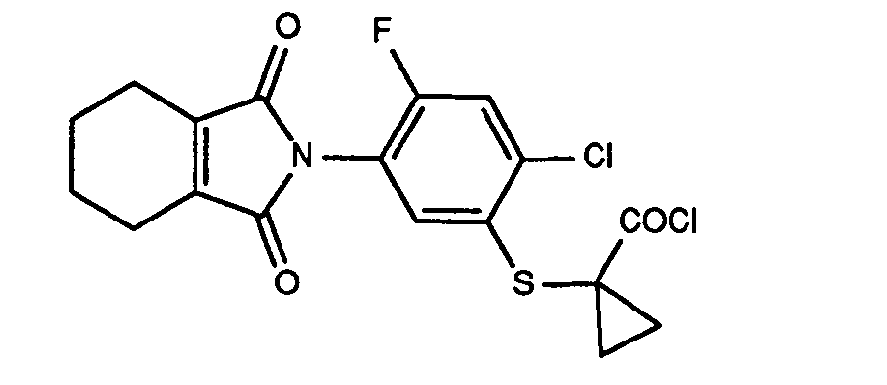
- Zu einer Lösung aus 1 g 1-[2-Chlor-4-fluor-5-(1,2,3,4,5,6-hexahydro-1,3-dioxo-isoindolyl)-phenylthio]-cyclopropancarbonsäure und einem Tropfen Dimethylformamid in 40 ml Ethylenchlorid gibt man unter Rühren bei Raumtemperatur 3 ml Thionylchlorid hinzu und erhitzt anschließend für 3 Stunden am Rückfluß. Nach dem Eindampfen der Reaktionsmischung erhält man 1 g 1-[2-Chior-4-fiuor-5-(1,2,3,4,5,6-hexahydro-t,3-dioxo-isoindo- lyl)-phenylthio]-cyclopropancarbonsäurechlorid in Form eines Öles.
-

- Zu einer Lösung aus 10 ml Methanol und 0,5 ml Triethylamin in 10 ml Essigsäuremethylestergibt man unter Rühren bei Raumtemperatur eine Lösung aus 1 g gemäß Beispiel H9 erhaltenen 1-[2-Chlor-4-fluor-5-(1,2,3,4,5,6-hexahydro-1,3-dioxo-isoindolyl)-phenylthio]-cyclopropancarbonsäurechlorids in 10 ml Essigsäuremethylester tropfenweise hinzu. Nach 3-stündigem Rühren bei Raumtemperatur filtriert man das ausgefallene Triethylaminhydrochlorid ab und dampft das Filtrat ein. Man erhält 0,9 g 1-[2-Chlor-4-fluor-5-(1,2,3,4,5,6-hexahydro-1,3-dioxo-isoindolyl)-phenylthio]-cyclopropancarbonsäuremethylester mit einem Schmelzpunkt von +142 bis +144°C.
-

- Ein Gemisch aus 3,6 g 3-Trifluormethyl-glutarsäureanhydrid und 5,8 g 1-(5-Amino-2-chlor-4-fluor-phenylthio)-cyclobutancarbonsäuremethylester in 65 ml Benzol wird unter Rühren 3 Stunden lang am Rückfluß erhitzt. Anschließend wird der entstandene Niederschlag abgetrennt, mit Diisopropylether gewaschen und getrocknet. Man erhält 7,9 g N-[4-chlor-2-fluor-5-(1-methoxycarbonyl-cyclobutylthio)-phenyl] -3-trifluormethyl-glutarsäure- monoamid mit einem Schmelzpunkt von +165 bis +167°C.
-

- Ein Gemisch aus 7,9 g N-[4-chlor-2-fluor-5-(1-methoxycarbonyl-cyclobutylthio)-phenyl]-3-trifluormethyl- glutarsäuremonoamid und 1,4 g Natriumacetat in 34 ml Essigsäureanhydrid wird 30 Minuten lang bei einer Temperatur von +100°C gerührt. Anschließend wird die Reaktionsmischung eingedampft und der Rückstand mit einer Mischung aus Diethylether und Eiswasser versetzt. Die Etherphase wird nacheinander mit Eiswasser, 10%-iger Natriumhydrogencarbonatlösung und gesättigter Kochsalzlösung gewaschen und danach über Natriumsulfat getrocknet. Das nach dem Abdampfen des Ethers zurückbleibende Öl wird aus n-Hexan unter Zugabe von wenig Diisopropylether und anschließend aus Methanol umkristallisiert. Man erhält 5 g 1-[4-Chlor-2-fluor-5-(1-methoxycarbonyl-cyclobutyl)-phenylthio]-4-trifluormethyl-piperidin-2,6-dion mit einem Schmelzpunkt von +115 bis +117°C.
-

- Ein Gemisch aus 12,5 g 2-(5-Amino-2-chlor-4-fluor-phenylthio)-4-chlor-buttersäureeth ylester, 10,6 g Kaliumcarbonat und 0,7 g Tetrabutylammoniumhydrogensulfat in 14 ml Toluol wird 40 Stunden bei +80°C gehalten. Anschließend werden die festen Teile der Reaktionsmischung abfiltriert und mit Aceton gewaschen. Nach dem Abdampfen des Lösungsmittels und Umkristallisieren aus n-Hexan und wenig Essigsäureethylester erhält man 7,9 g 1-(5-Amino-2-chlor-4-fluor-phenylthio)-cyclopropancarbonsäureethyestermit einem Schmelzpunkt von +96 bis +97°C.
-

- Zu einem Gemisch aus 17,8 g 5-Amino-2-chlor-4-fluor-thiophenol und 15,2 g Kaliumcarbonat in 160 ml Methylethylketon gibt man bei Raumtemperatur 28,6 g 2,4-Dibrombuttersäuremethylester tropfenweise hinzu (exotherme Reaktion). Anschließend wird die Reaktionsmischung 2 Stunden am Rückfluß erhitzt. Nach dem Abkühlen der Reaktionsmischung wird der anorganische Teil der Mischung abfiltriert und mit Methylethylketon gewaschen. Nach Eindampfen der organischen Lösung und chromatographischer Reinigung des Rückstandes durch Kieselgelchromatographie erhält man 25,5 g 2-(5-Amino-2-chlor-4-fluor-phenylthio)-4-brom-buttersäuremethylester mit einem Schmelzpunkt von +97 bis +99°C.
-

- Ein Gemisch aus 12,5 g 2-(5-Amino-2-chlor-4-fluor-phenylthio)-4-brom-buttersäuremethylester, 30,4 g Kaliumcarbonat und 1,7 g Tetrabutylammoniumhydrogensulfat in 38 ml Toluol wird 40 Stunden bei +80°C gehalten. Anschließend werden die festen Teile der Reaktionsmischung abfiltriert und mit Aceton gewaschen. Nach dem Abdampfen des Lösungsmittels erhält man 17 g 1-(5-Amino-2-chlor-4-fluor-phenylthio)-cyclopro- pancarbonsäuremethyester mit einem Schmelzpunkt von +119 bis +124°C.
-

- Eine Lösung aus 3,6 g 1-(5-Amino-2-chlor-4-fluor-phenylthio)-cyclopropancarbonsäure und einigen Tropfen Schwefelsäure in 50 ml Methanol wird solange am Rückfluß erhitzt, bis kein Ausgangsprodukt mehr nachweisbar ist. Anschließend wird das Methanol abgedampft, der Rückstand mit Wasser und Eessigsäureethylester versetzt und die organische Phase nacheinander mit Natriumhydrogencarbonatlösung, Wasser und gesättigter Natriumchloridlösung gewaschen. Nach dem Einengen und Reinigen des Rohprodukts mittels Kieselgelchromatographie erhält man 5,7 g 1-(5-Amino-2-chlor-4-fluor-phenylthio)-cyclopropancarbonsäuremet- hyester mit einem Schmelzpunkt von + 119 bis + 121 °C.
-

- Zu einem Gemisch aus 3 g Calciumcarbonat, 2 ml Thiophosgen in 20 ml Ethylenchlorid und 20 ml Wasser gibt man unter Rühren bei Raumtemperatur eine Lösung aus 5,5 g 1-(5-Amino-2-chlor-4-fluor-phenylthio)-cyc- lopropancarbonsäuremethyester in 20 ml Ethylenchlorid tropfenweise hinzu. Nach 4-stündigem Rühren bei Raumtemperaturwird deranorganische Teil der Reaktionsmischung abfiltriert, die organische Phase über Calciumchlorid getrocknet und anschließend eingedampft. Man erhält 6,3 g 1-(2-chlor-4-fluor-5-isothiocyanato- phenylthio)-cyclopropancarbonsäuremethyester mit einem Schmelzpunkt von +100 bis +101 °C.
-

- Zu einer Lösung aus 2,2 g Hexahydropyridazin in 30 ml Ethanol gibt man unter Rühren bei Raumtemperatur eine Lösung von 6,3 g 1-(2-chlor-4-fluor5-isothiocyanato-phenylthio)-cyclopropancarbonsäuremethylesters in 30 ml Ethanol tropfenweise hinzu. Nach 30-minütigem Rühren bei Raumtemperatur wird die Reaktionsmischung im Vakuum eingedampft. Man erhält 7,9 g 1-[2-chlor-4-fluor-5-(1-hexahydropyridazinyl-thiocarbony- lamino)-phenylthio]-cyclopropancarbonsäuremethylester mit einem Schmelzpunkt von +156 bis +157°C.
-

- Zu einer Lösung von 3,7 g 1-[2-chlor-4-fluor-5-(1-hexahydropyridazinyl-thiocarbonylamino)-phenylthio]-cyclopropancarbonsäuremethylester und 4,6 ml Triethylamin in 100 ml Toluol gibt man unter Rühren bei einer Temperatur von o bis +10°C 5,7 ml 20%-ige toluolische Lösung von Phosgen tropfenweise hinzu. Anschließend läßt man die Reaktionsmischung 4 Stunden lang rühren und gibt sie dann in Eiswasser. Anschließend wird die organische Phase abgetrennt und über Natriumsulfat getrocknet. Nach dem Eindampfen und anschließender chromatographischer Reinigung mittels Kieselgelchromatographie erhält man 3,7 g 9-[4-chlor-2-fluor-5-(1-methoxycarbonyl-cyclopropylthio)-phenylimino]-8-thia-1,6-diazabicyclo[4.3.0]-nonan-7-on, mit einem Schmelzpunkt von +149°C.
- Analog zu vorstehenden Beispielen und den in der Beschreibung genannten Herstellungsverfahren können die Verbindungen der Tabellen 1 bis 12 hergestellt werden:
-


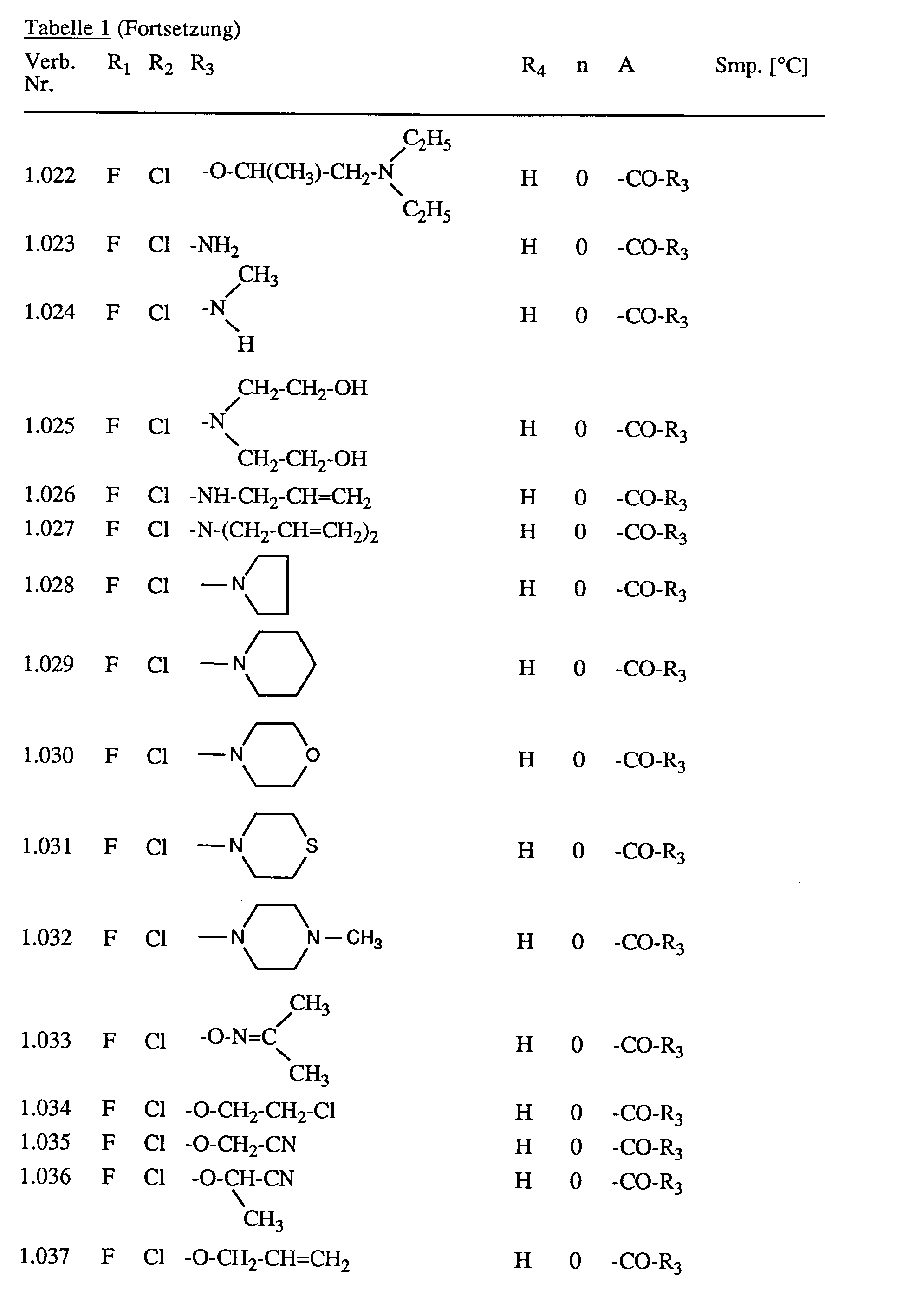


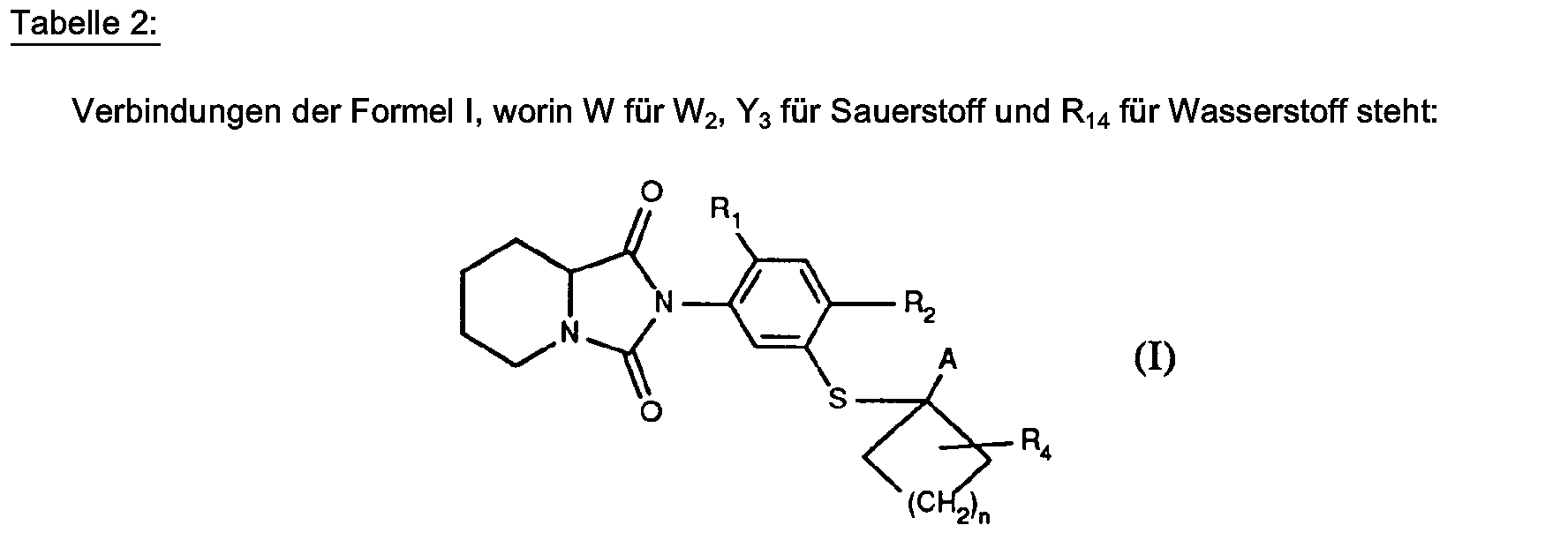


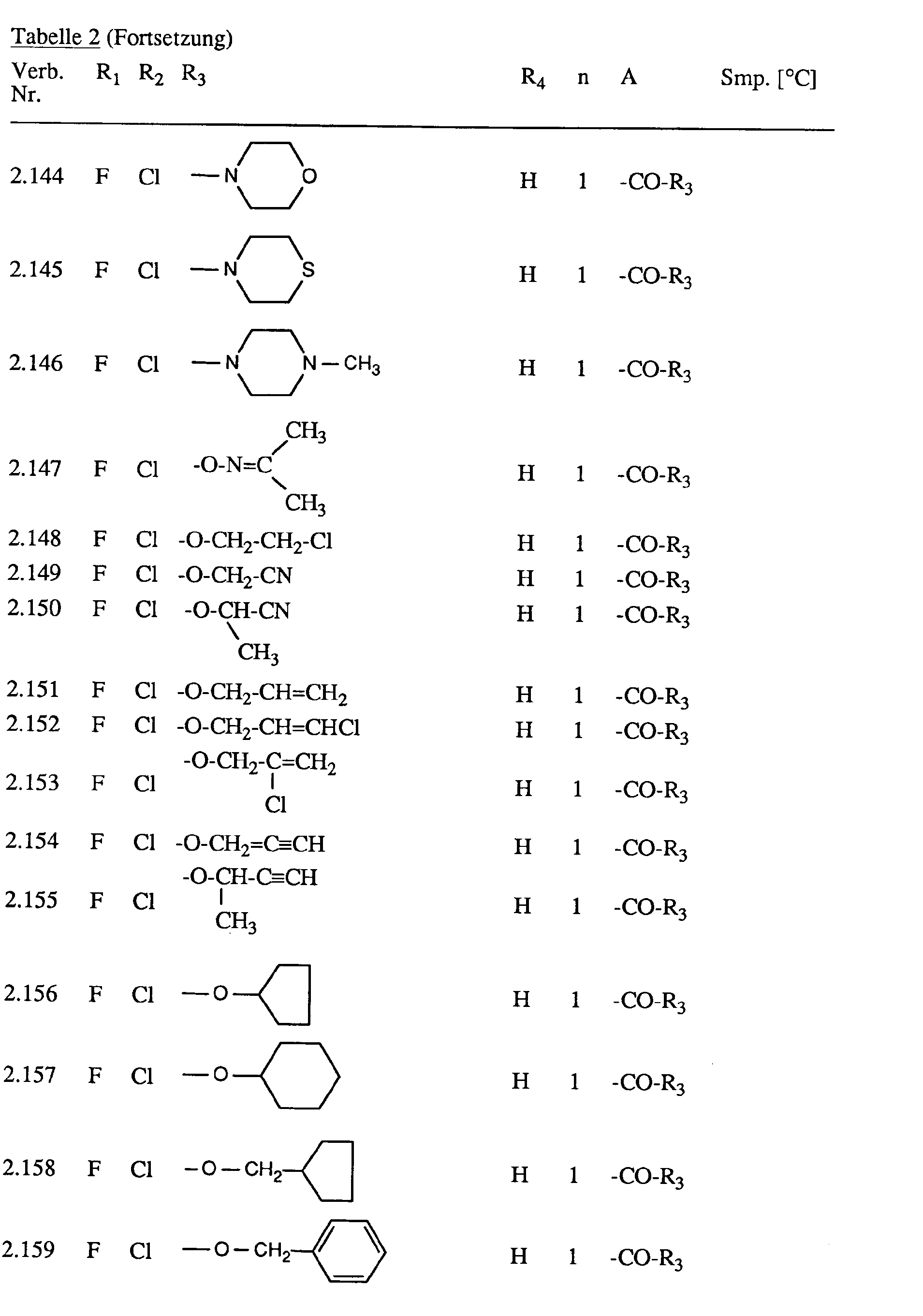


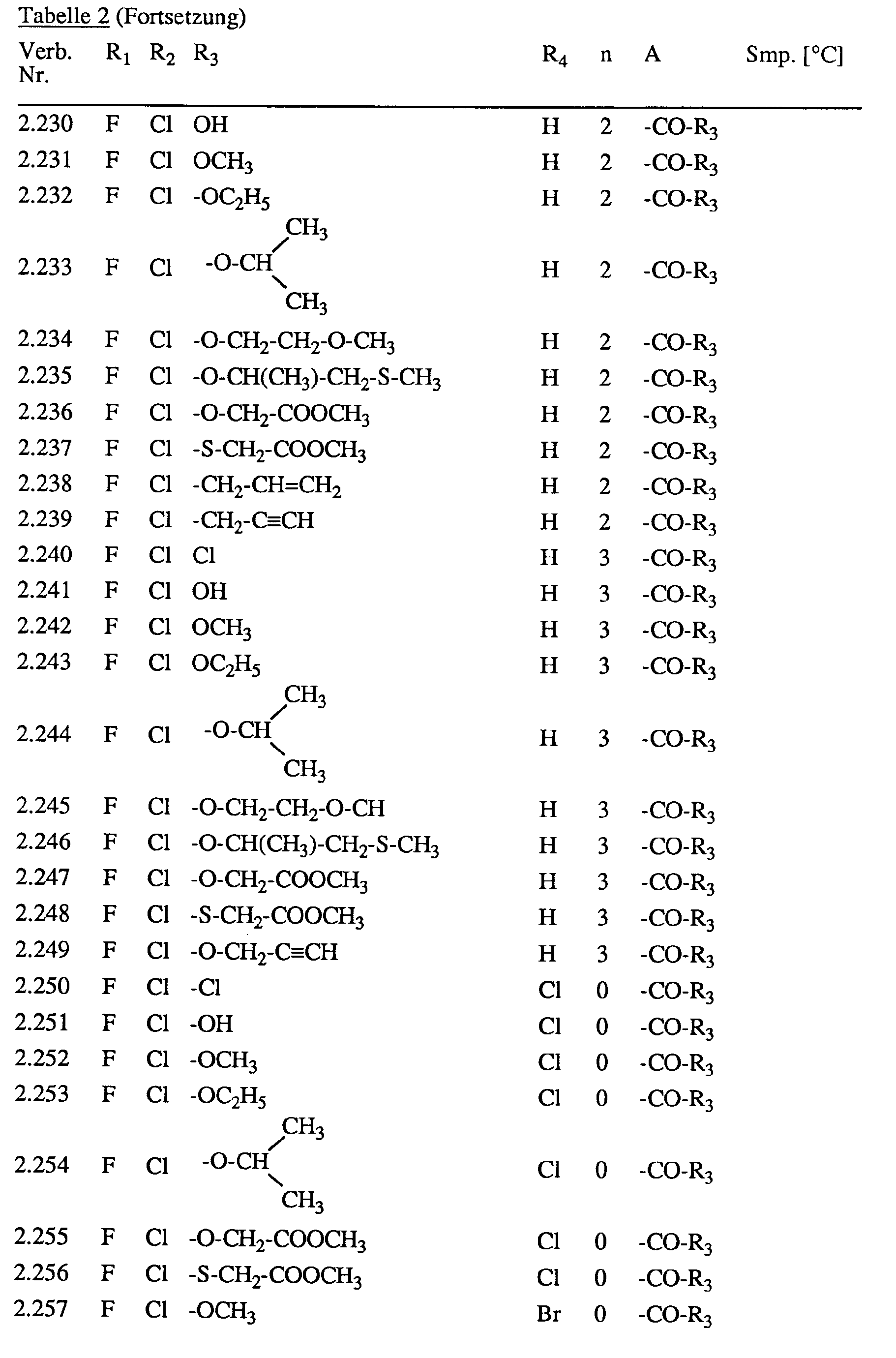


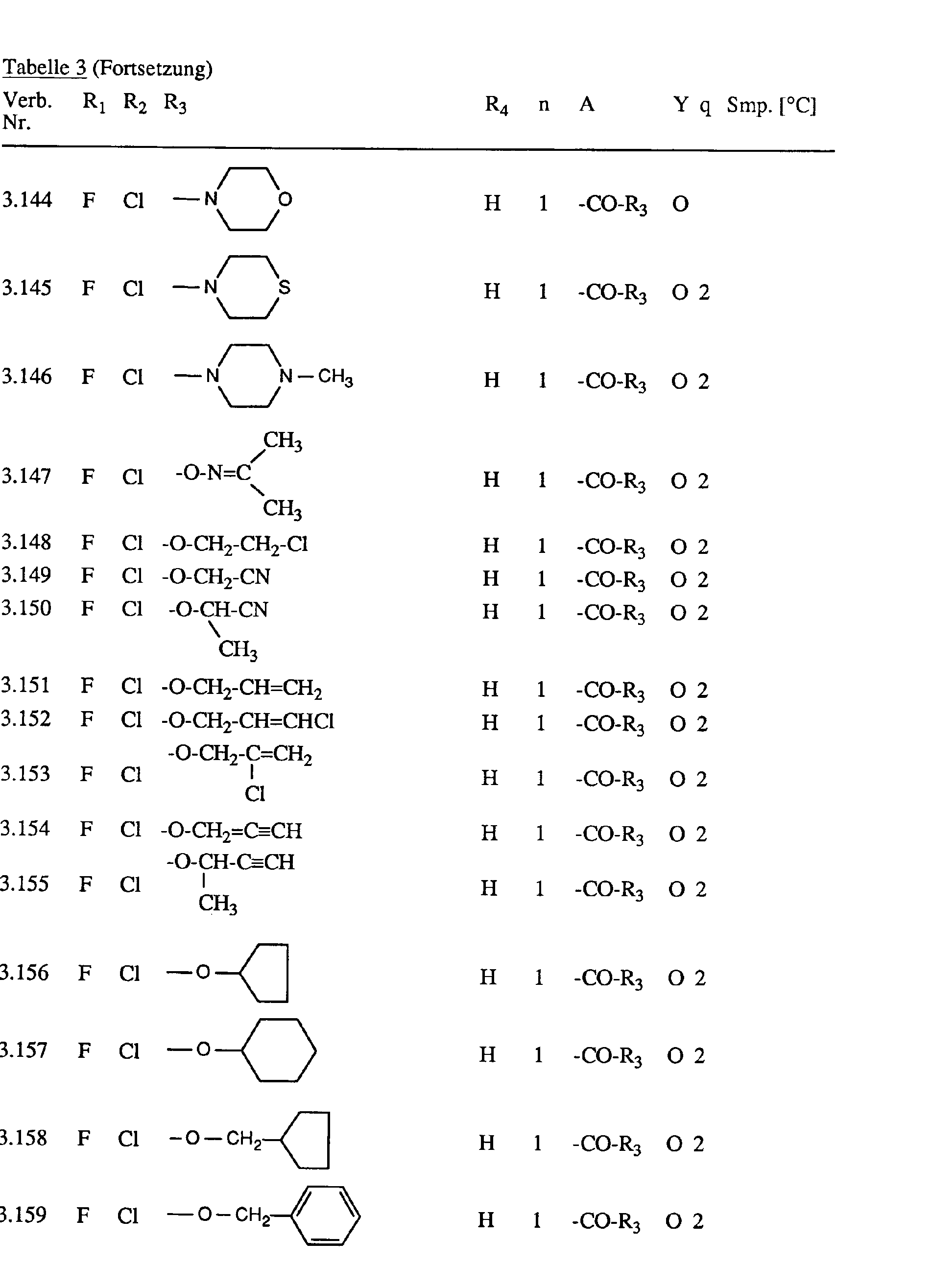


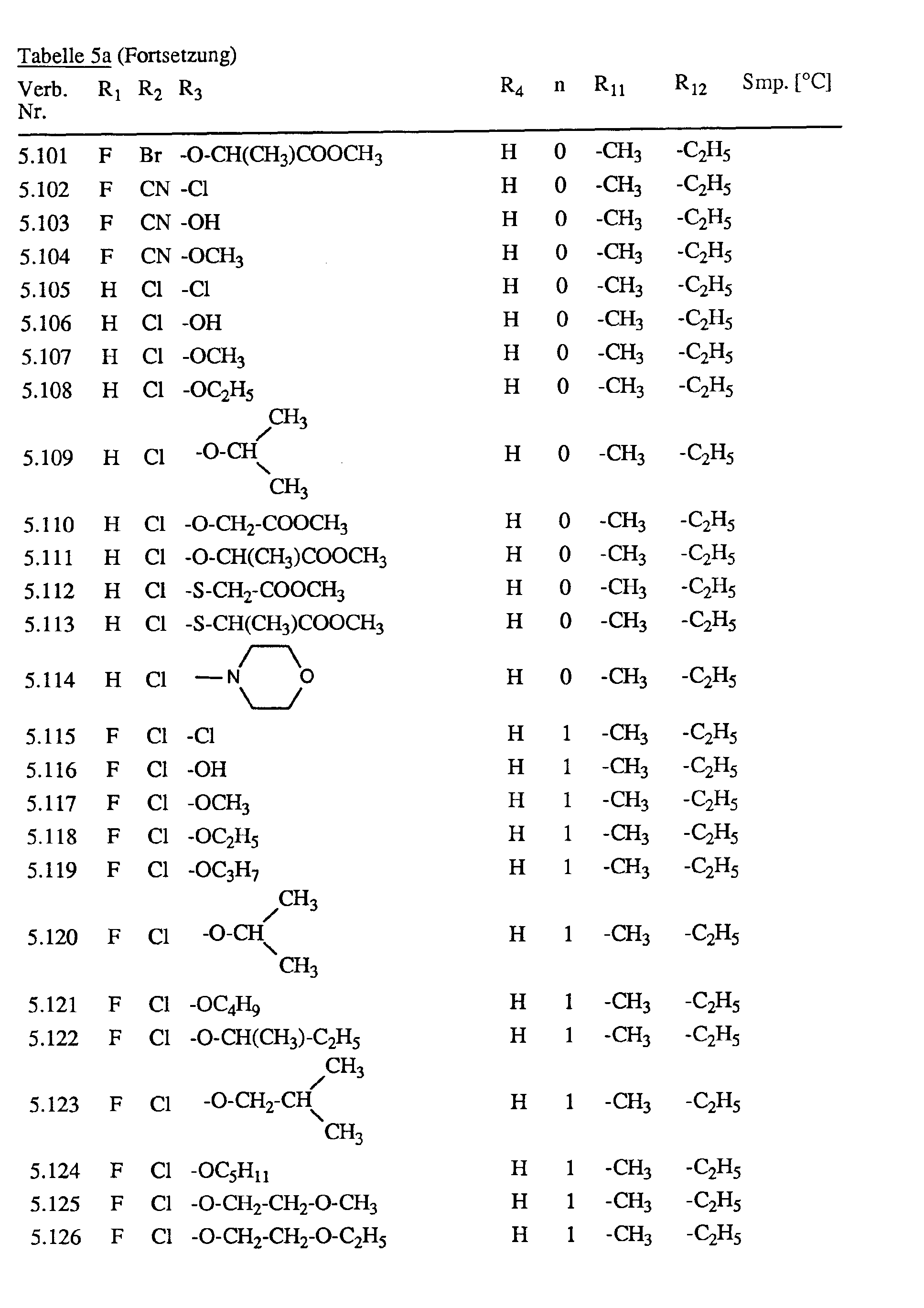


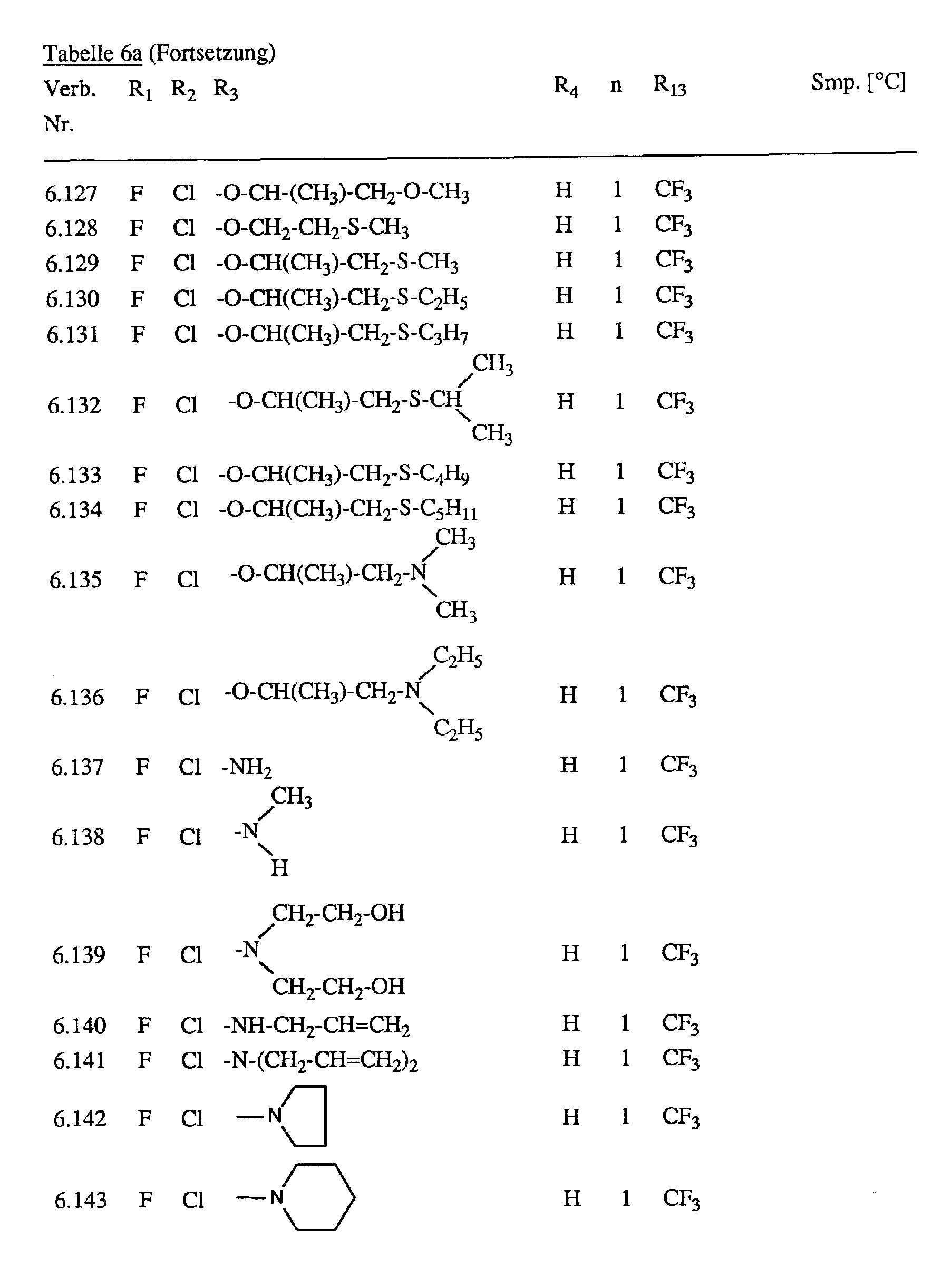


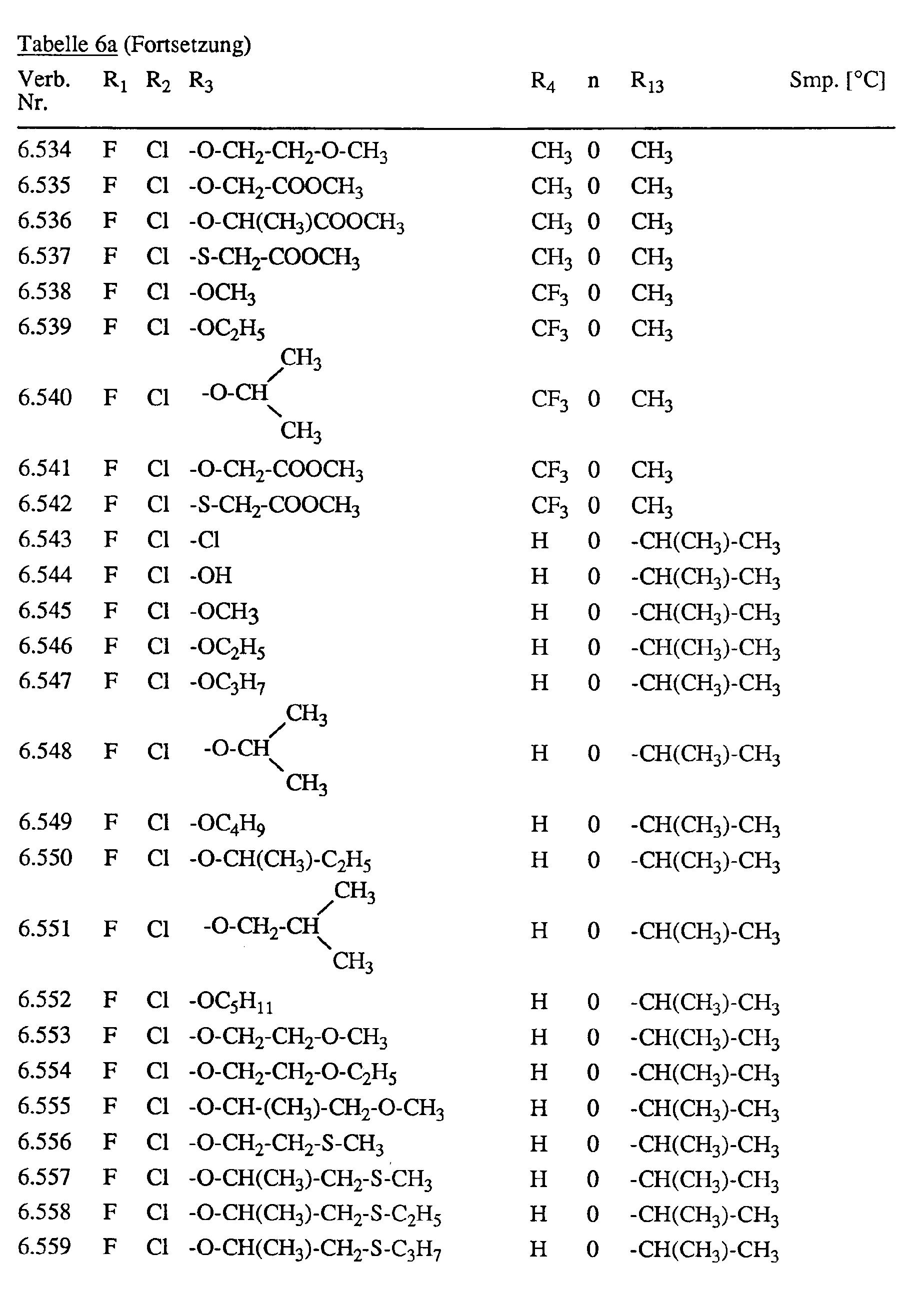


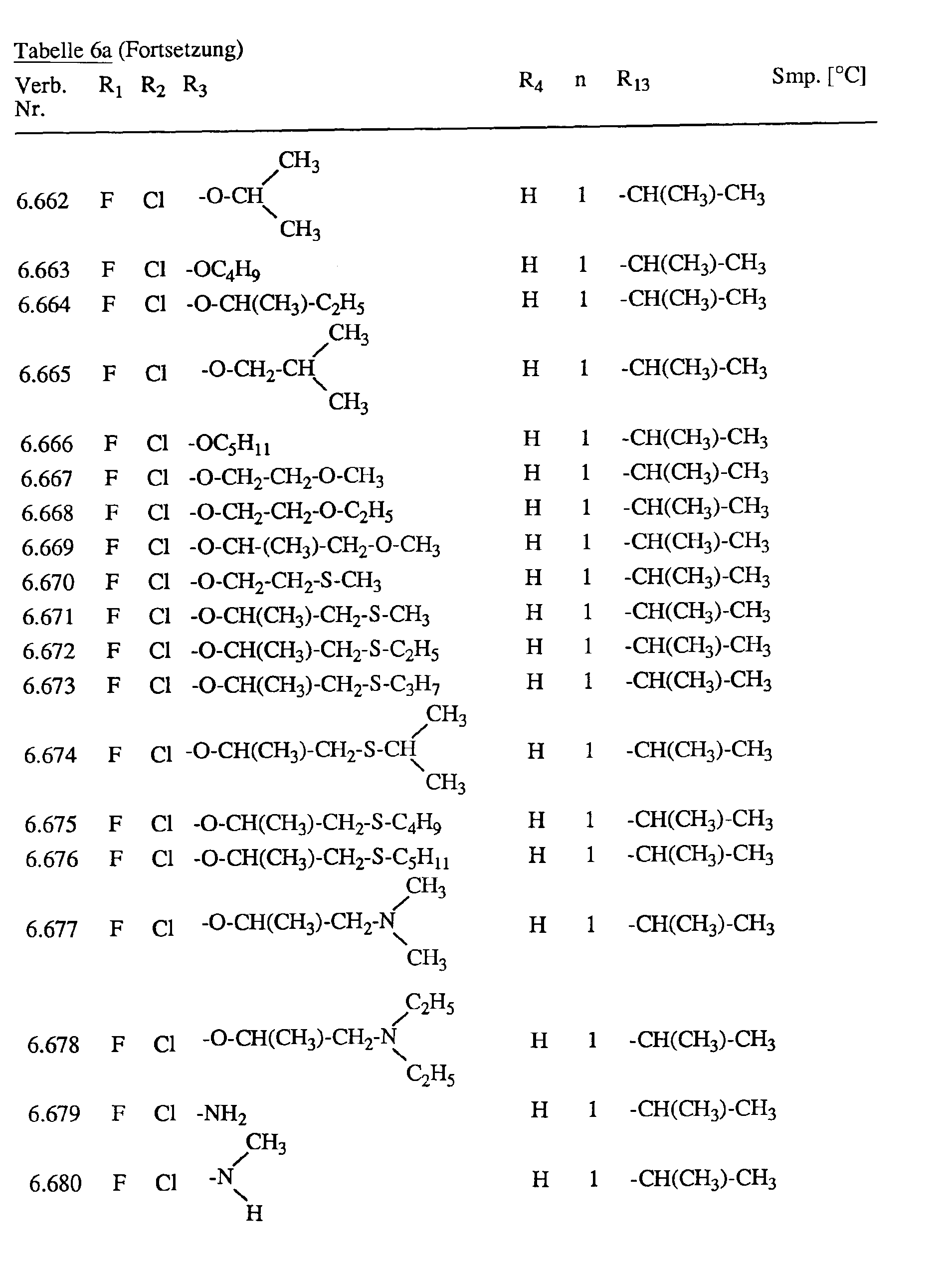


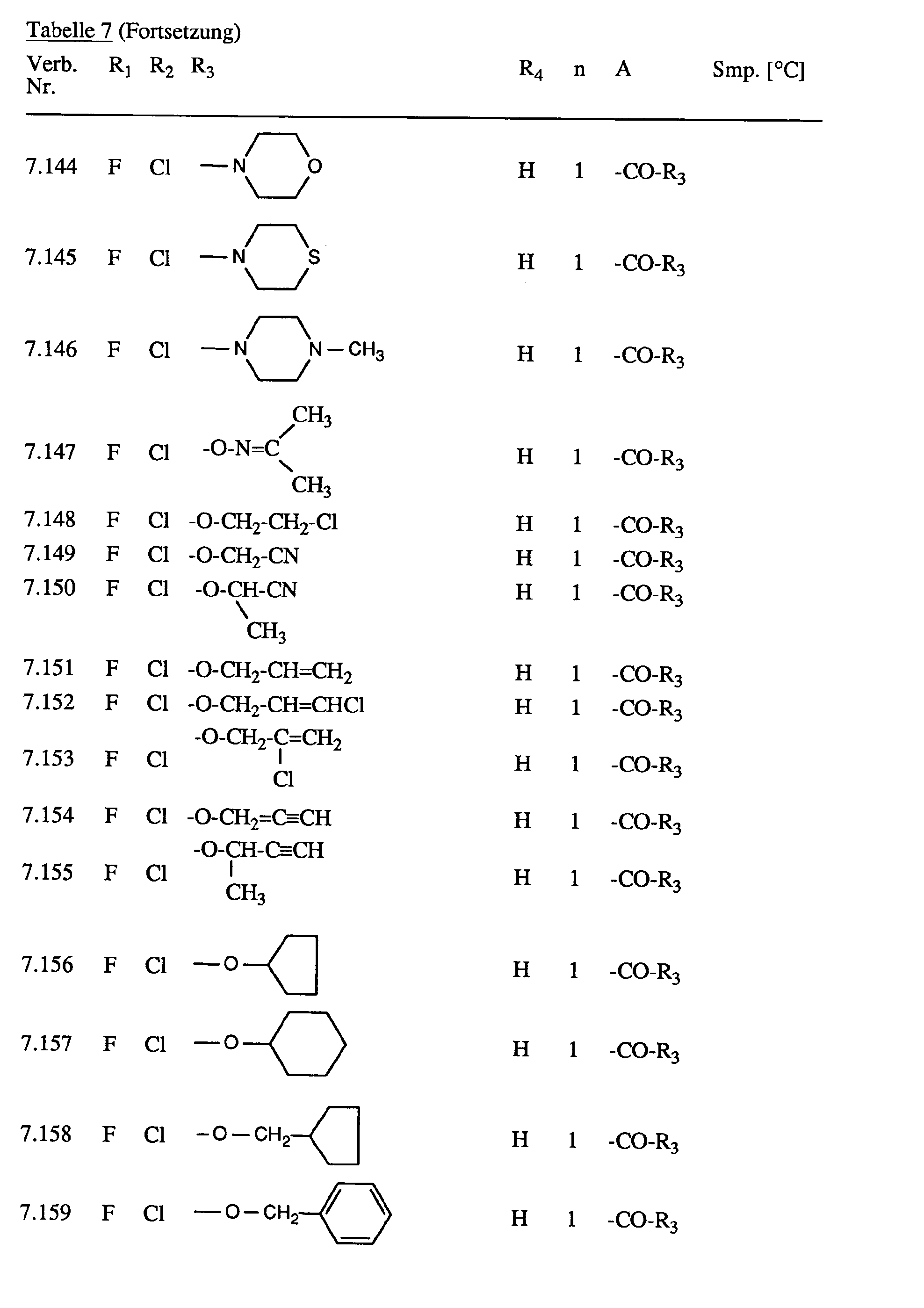


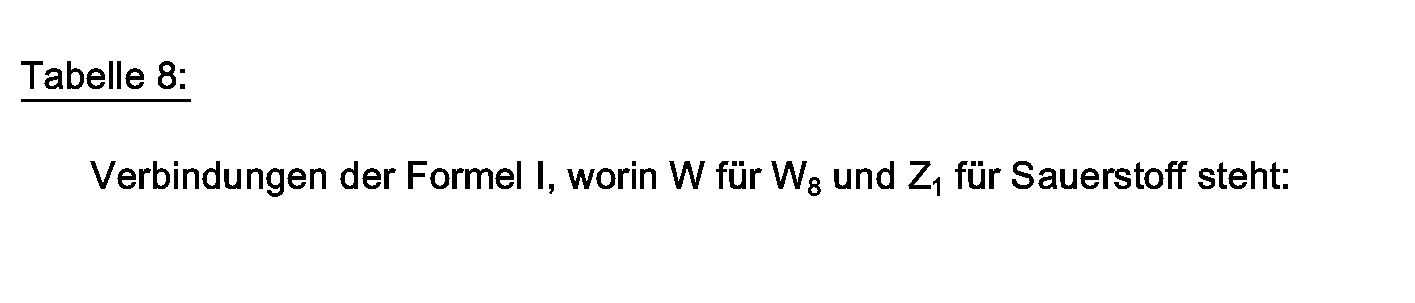


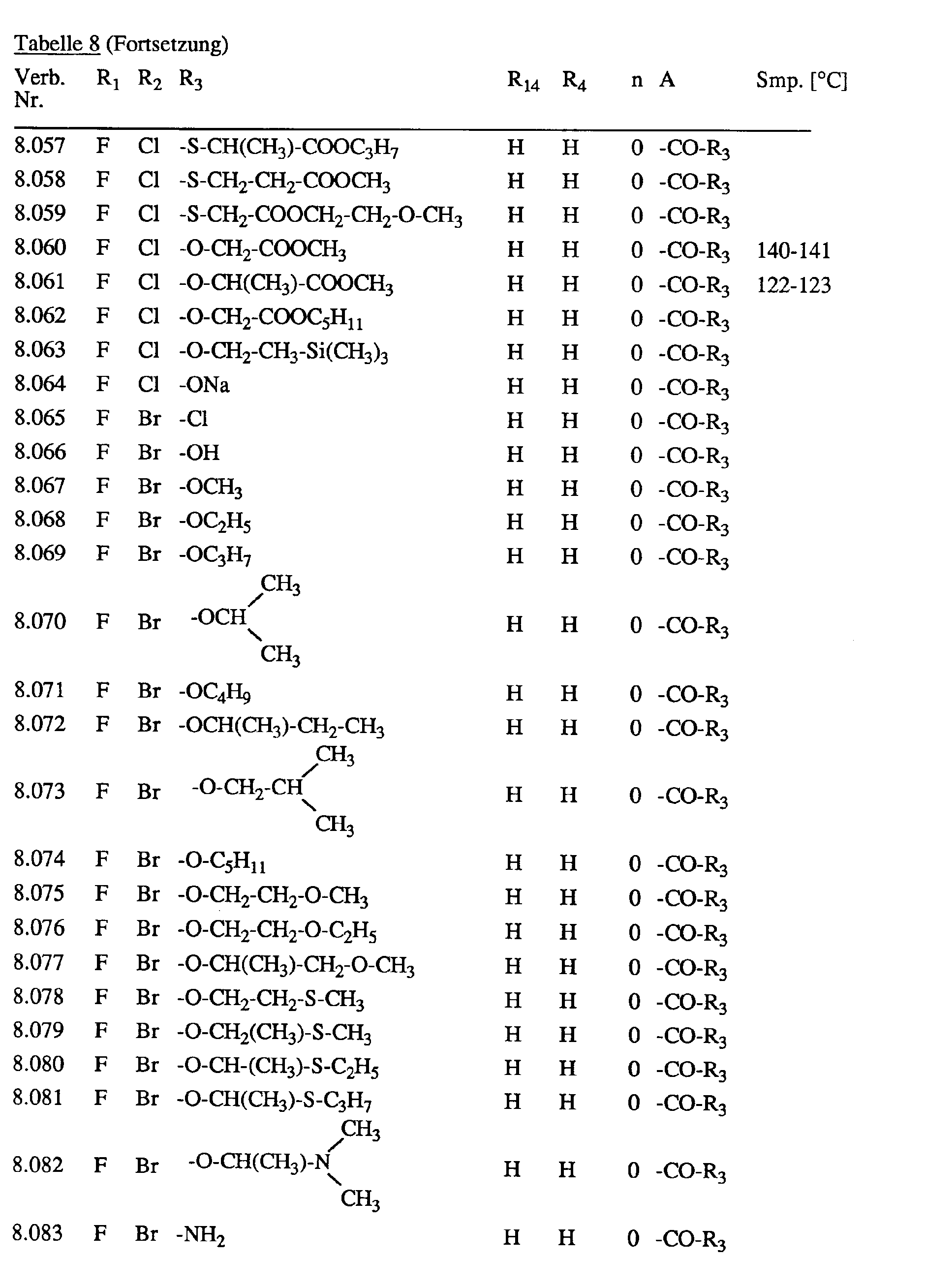


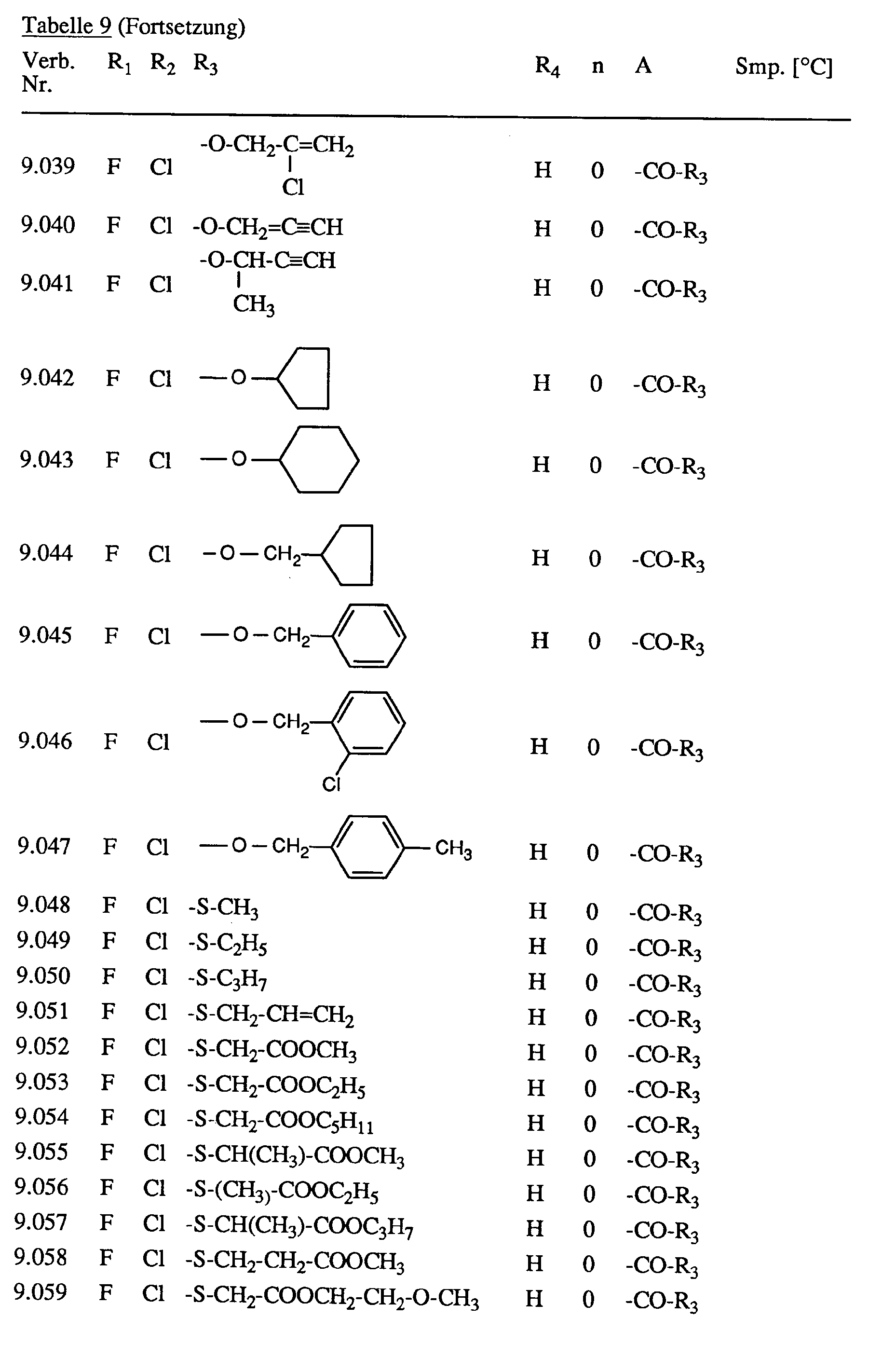


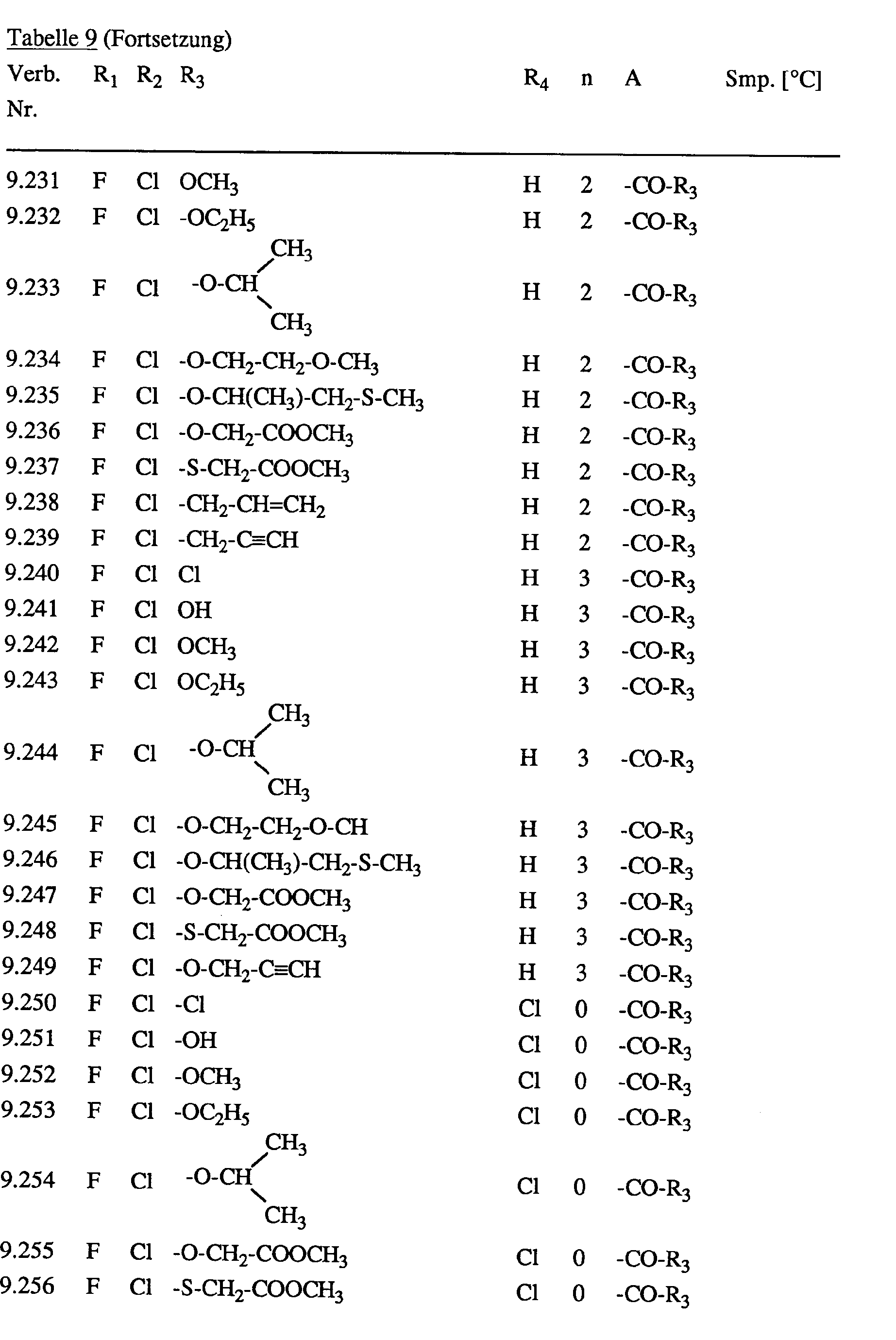


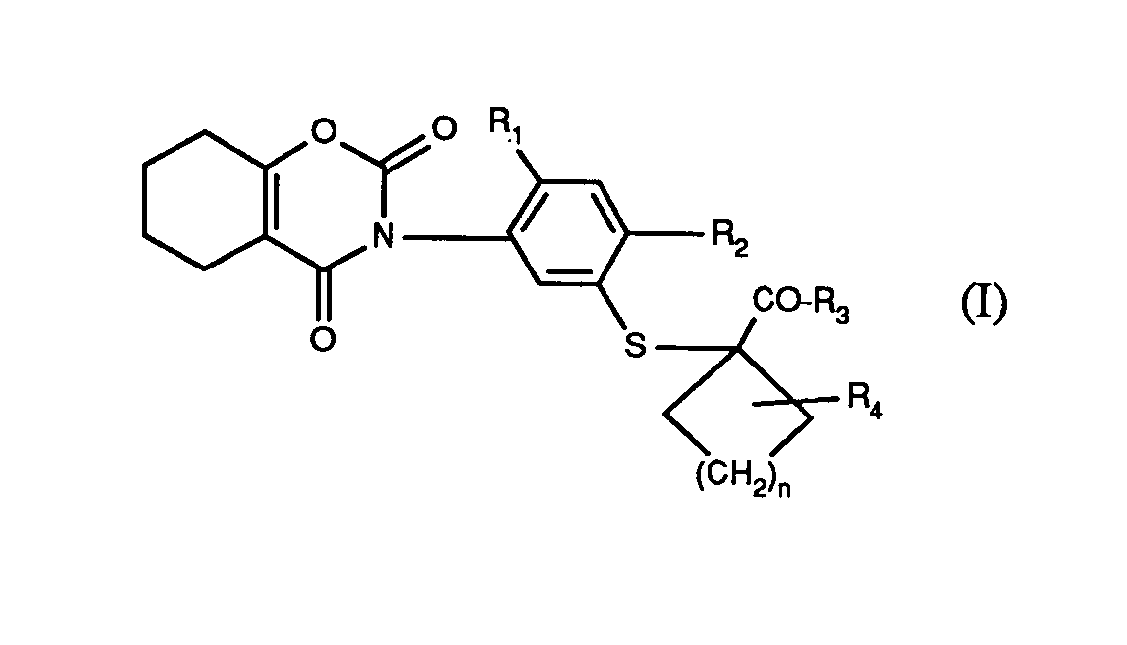
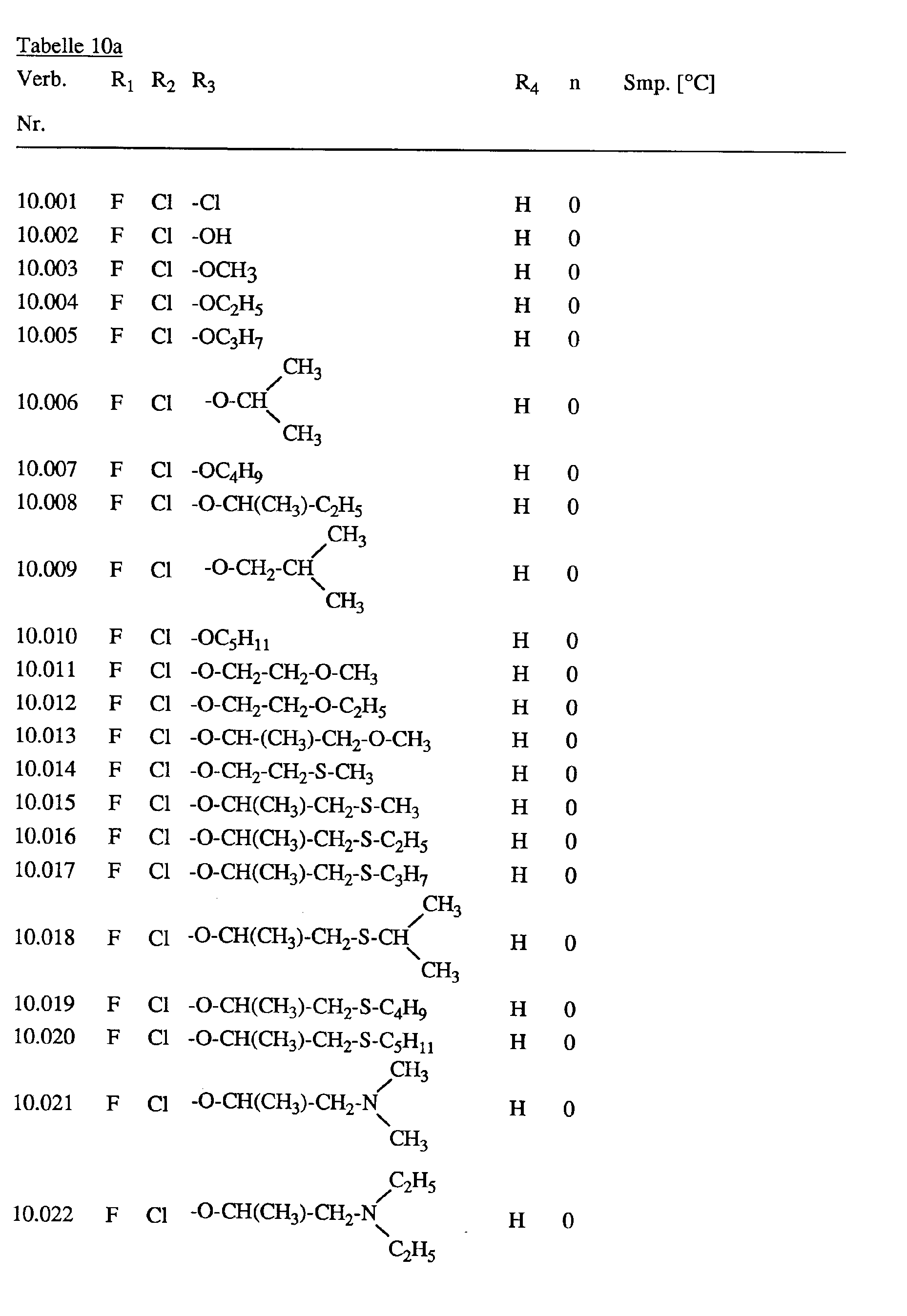


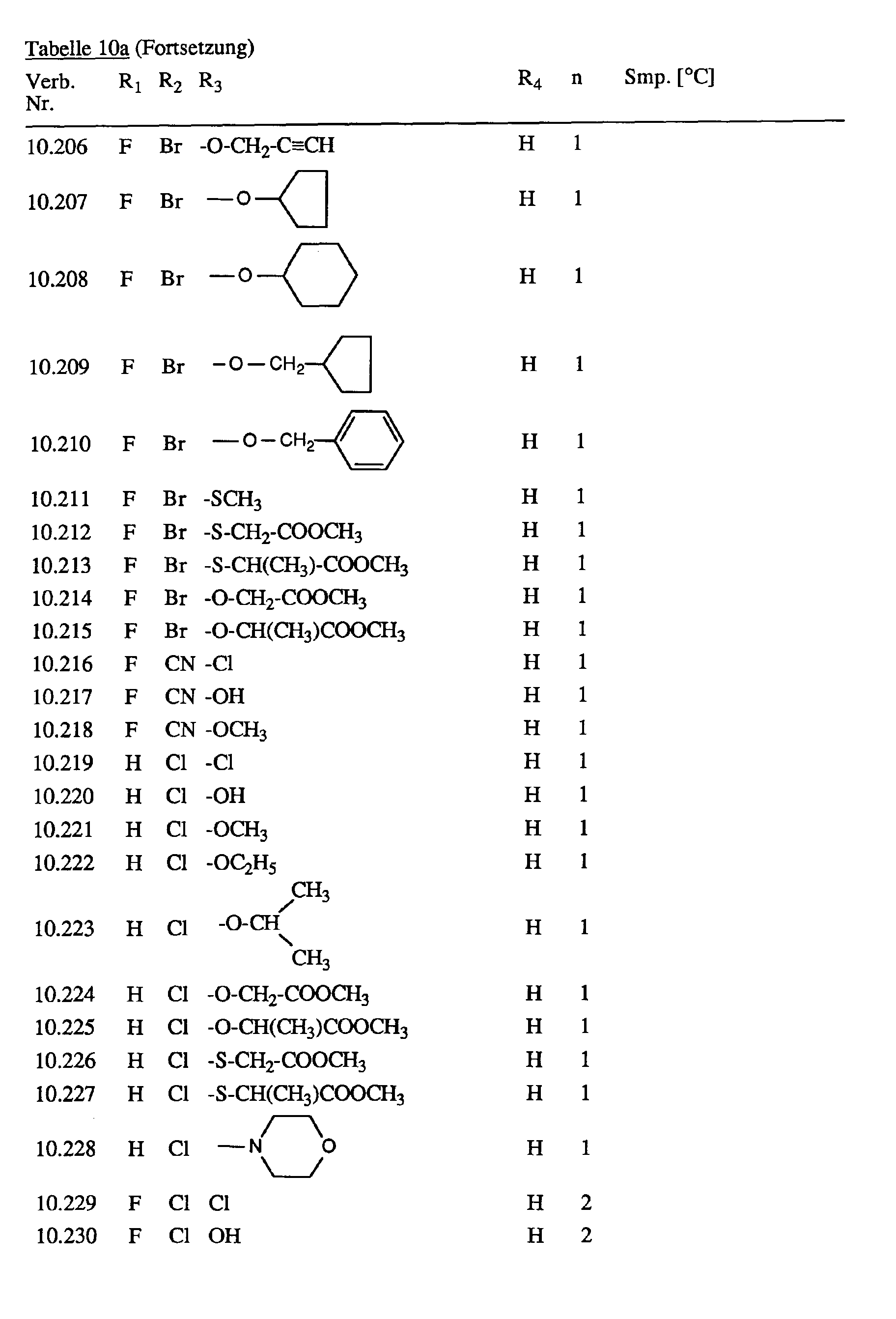


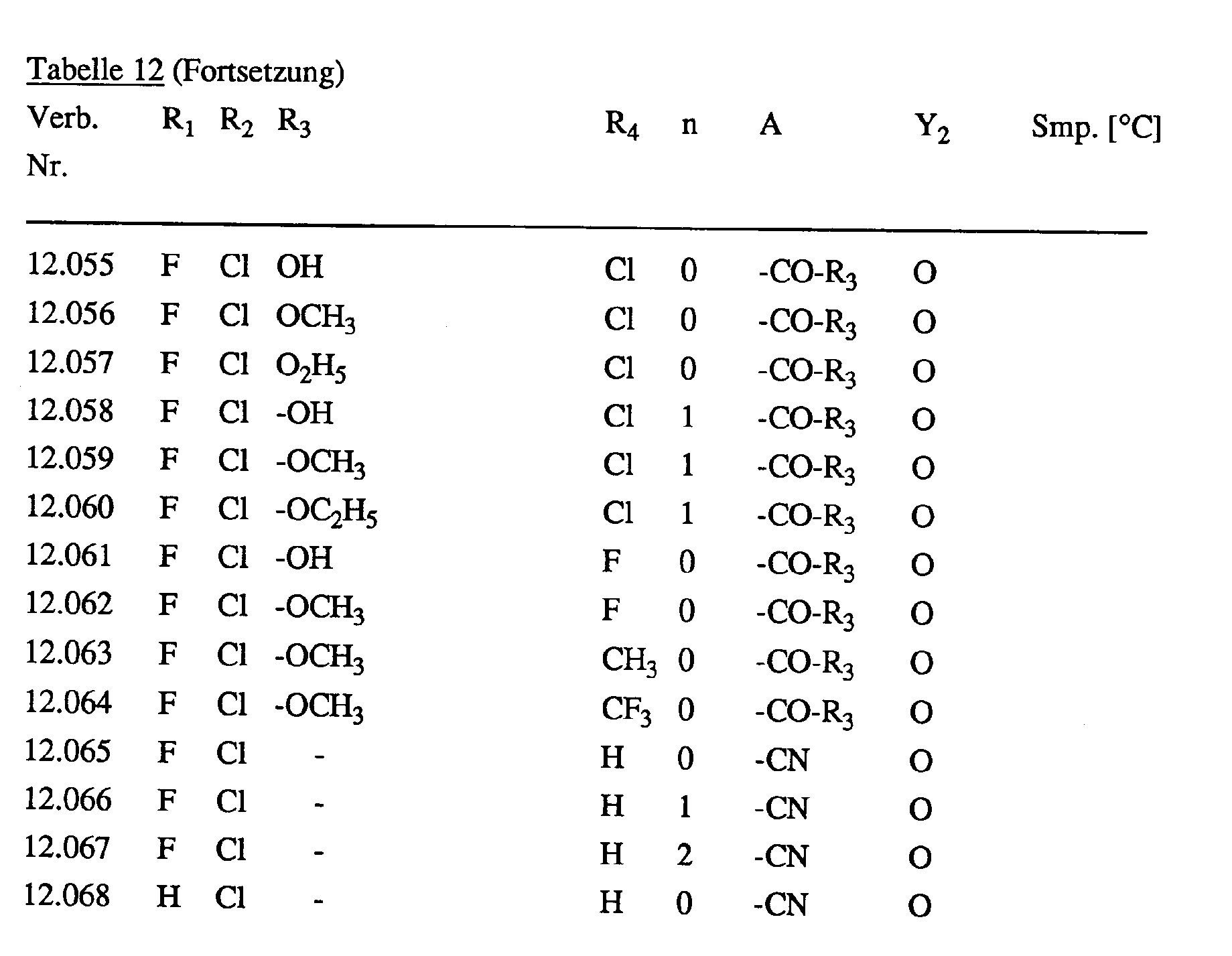
- Die Wirkstoffe der Formel werden in der Regel mit Aufwandmengen von 0,001 bis 4 kg/ha insbesondere 0,005 bis 1 kg/ha erfolgreich eingesetzt. Die für die erwünschte Wirkung erforderliche Dosierung kann durch Versuche ermittelt werden. Sie ist abhängig von der Art der Wirkung, dem Entwicklungsstadium der Kulturpflanze und des Unkrauts sowie von der Applikation (Ort, Zeit, Verfahren) und kann, bedingt durch diese Parameter, innerhalb weiter Bereiche variieren.
- Bei geringeren Aufwandmengen zeichnen sich die Verbindungen der Formel durch wuchshemmende und herbizide Eigenschaften aus, die sie ausgezeichnet zum Einsatz in Kulturen von Nutzpflanzen, insbesondere in Getreide, Baumwolle, Soja, Raps, Mais und Reis befähigen, wobei der Einsatz in Maiskultur ganz besonders bevorzugt ist.
- Die Erfindung betrifft auch herbizide und pflanzenwachstumsregulierende Mittel, welche einen neuen Wirkstoff der Formel I enthalten, sowie Verfahren zur Hemmung des Pflanzenwuchses.
- Pflanzenwachstumsregulatoren sind Substanzen, die in/an der Pflanze agronomisch erwünschte biochemische und/oder physiologische und/oder morphologische Veränderungen bewirken.
- Die in den erfindungsgemäßen Mitteln enthaltenen Wirkstoffe beeinflussen das Pflanzenwachstumje nach Applikationszeitpunkt, Dosierung, Applikationsart und Umweltbedingungen in verschiedener Weise. Pflanzenwuchsregulatoren der Formel können zum Beispiel das vegetative Wachstum von Pflanzen hemmen. Diese Art der Wirkung ist von Interesse auf Rasenflächen, im Zierpflanzenbau, in Obstplantagen, an Straßenböschungen, auf Sport- und Industrieanlagen, aber auch bei der gezielten Hemmung von Nebentrieben wie bei Tabak. Im Ackerbau führt die Hemmung des vegetativen Wachstums bei Getreide über eine Halmverstärkung zu reduziertem Lager, ähnliche agronomische Wirkungen erreicht man in Raps, Sonnenblumen, Mais und anderen Kulturpflanzen. Des weiteren kann durch Hemmung des vegetativen Wachstums die Anzahl Pflanzen pro Fläche erhöht werden. Ein weiteres Einsatzgebiet von Wuchshemmern ist die selektive Kontrolle von bodendeckenden Pflanzen in Plantagen oder weitreihigen Kulturen durch starke Wuchshemmung, ohne diese Bodendecker abzutöten, sodaß die Konkurrenz gegenüber der Hauptkultur ausgeschaltet ist, die agronomisch positiven Effekte wie Erosionsverhinderung, Stickstoffbindung und Bodenlockerung aber erhalten bleiben.
- Unter einem Verfahren zur Hemmung des Pflanzenwachstums ist eine Steuerung der natürlichen Pflanzenentwicklung zu verstehen, ohne den von genetischen Eigenschaften determinierten Lebenszyklus der Pflanze im Sinne einer Mutation zu verändern. Das Verfahren derWuchsregulierung wird zu einem im Einzelfall zu bestimmenden Entwicklungszeitpunkt der Pflanze angewendet. Die Applikation der Wirkstoffe der Formel I kann vor oder nach dem Auflaufen der Pflanzen erfolgen, beispielsweise bereits auf die Samen oder die Sämlinge, auf Wurzeln, Knollen, Stengel, Blätter, Blüten oder andere Pflanzenteile. Dies kann z.B. durch Aufbringen des Wirkstoffes selbst oder in Form eines Mittels auf die Pflanzen und/oder durch Behandlung des Nährmediums der Pflanze (Erdboden) geschehen.
- Für die Verwendung der Verbindung der Formel oder sie enthaltender Mittel zur Regulierung des Pflanzenwachstums kommen verschiedene Methoden und Techniken in Betracht, wie beispielsweise die folgenden:
-
- a) Beizung der Samen mit einem als Spritzpulver formulierten Wirkstoff durch Schütteln in einem Gefäß bis zur gleichmäßigen Verteilung auf der Samenoberfläche (Trockenbeizung). Man verwendet dabei bis zu 4 g Wirkstoff der Formel (bei einer 50 %igen Formulierung: bis zu 8,0 g Spritzpulver) pro 1 kg Saatgut.
- b) Beizung der Samen mit einem Emulsionskonzentrat des Wirkstoffs oder mit einer wäßrigen Lösung des als Spritzpulver formulierten Wirkstoffs der Formel nach Methode a) (Naßbeizung).
- c) Beizung durch Tauchen des Saatguts in einer Brühe mit bis zu 1000 ppm Wirkstoff der Formel während 1 bis 72 Stunden und gegebenenfalls nachfolgendes Trocknen der Samen (Tauchbeizung, Seed soaking).
- Die Beizung des Saatguts oder die Behandlung des angekeimten Sämlings sind naturgemäß die bevorzugten Methoden der Applikation, weil die Wirkstoffbehandlung vollständig auf die Zielkultur gerichtet ist. Man verwendet in der Regel 0,001 g bis 4,0 g Aktivsubstanz pro 1 kg Saatgut, wobei man je nach Methodik, die auch den Zusatz anderer Wirkstoffe oder Mikronährstoffe ermöglicht, von den angegebenen Grenzkonzentrationen nach oben oder unten abweichen kann (Wiederholungsbeize).
- Der Wirkstoff wird in Lösung auf mineralische Granulatträger oder polymerisierte Granulate (Harnstoff/Formaldehyd) aufgezogen und trocknen gelassen. Gegebenenfalls kann ein Überzug aufgebracht werden (Umhüllungsgranulate), der es erlaubt, den Wirkstoff über einen bestimmten Zeitraum dosiert abzugeben.
- Die Verbindungen der Formel werden in unveränderter Form, wie aus der Synthese erhältlich, oder vorzugsweise mit den in der Formulierungstechnik üblichen Hilfsmitteln eingesetzt und werden daherz.B. zu emulgierbaren Konzentraten, direkt versprühbaren oder verdünnbaren Lösungen, verdünnten Emulsionen, Spritzpulvern, löslichen Pulvern, Stäubemitteln, Granulaten, auch Verkapselungen in z.B. polymeren Stoffen in bekannter Weise verarbeitet. Die Anwendungsverfahren wie Versprühen, Vernebeln, Verstäuben, Benetzen, Verstreuen oder Gießen werden gleich wie die Art der Mittel den angestrebten Zielen und den gegebenen Verhältnissen entsprechend gewählt.
- Die Formulierungen, d.h. die den Wirkstoff der Formel und gegebenenfalls einen oder mehrere feste oder flüssige Zusatzstoffe enthaltenden Mittel, Zubereitungen oder Zusammensetzungen werden in bekannter Weise hergestellt, z.B. durch inniges Vermischen und/oder Vermählen derWirkstoffe mit Streckmitteln, wie z.B. mit Lösungsmitteln, festen Trägerstoffen und gegebenenfalls oberflächenaktiven Verbindungen (Tensiden).
- Als Lösungsmittel können in Frage kommen: Aromatische Kohlenwasserstoffe, insbesondere die Fraktionen C8 bis C12, wie Mischungen von Alkylbenzolen, z.B. Xylolgemische oder alkylierte Naphthaline; aliphatische und cycloaliphatische Kohlenwasserstoffe wie Paraffine, Cyclohexan oder Tetrahydronaphthalin; Alkohole, wie Ethanol, Propanol oder Butanol; Glykole sowie deren Ether und Ester, wie Propylenglykol oder Dipropylenglykolether, Ketone wie Cyclohexanon, Isophoron oder Diacetonalkohol, starke polare Lösungsmittel wie N-Methyl-2-pyrrolidon, Dimethylsulfoxid oder Wasser Pflanzenöle sowie deren Ester, wie Raps-, Ricinus- oder Sojaöl; gegebenenfalls auch Silikonöle.
- Als feste Trägerstoffe, z.B. für Stäubemittel und dispergierbare Pulver, werden in der Regel natürliche Gesteinsmehle verwendet, wie Calcit, Talkum, Kaolin, Montmorillonit oder Attapulgit. Zur Verbesserung der physikalischen Eigenschaften können auch hochdisperse Kieselsäure oder hochdisperse saugfähige Polymerisate zugesetzt werden. Als gekörnte, adsorptive Granulatträger kommen poröse Typen wie z.B. Bimsstein, Ziegelbruch, Sepiolit oder Bentonit, als nicht sorptive Trägermaterialien z.B. Calcit oder Sand in Frage. Darüber hinaus kann eine Vielzahl von vorgranulierten Materialien anorganischer oder organischer Natur wie insbesondere Dolomit oder zerkleinerte Pflanzenrückstände verwendet werden.
- Als oberflächenaktive Verbindungen kommen je nach der Art des zu formulierenden Wirkstoffes der Formel I nichtionogene, kation- und/oder anionaktive Tenside mit guten Emulgier-, Dispergier- und Netzeigenschaften in Betracht. Unter Tensiden sind auch Tensidgemische zu verstehen.
- Geeignete anionische Tenside können sowohl sog. wasserlösliche Seifen wie wasserlösliche synthetische oberflächenaktive Verbindungen sein.
- Als Seifen seien die Alkali-, Erdalkali oder gegebenenfalls substituierten Ammoniumsalze von höheren Fettsäuren (C1O-C22), wie z.B. die Na- oder K-Salze der Öl- oder Stearinsäure, oder von natürlichen Fettsäuregemischen genannt, die z.B. aus Kokosnuß- oder Talgöl gewonnen werden können. Ferner sind auch die Fettsäure-methyl-taurinsalze zu erwähnen.
- Häufiger werden jedoch sog. synthetische Tenside verwendet, insbesondere Fettalkoholsulfonate, Fettalkoholsulfate, sulfonierte Benzimidazolderivate oder Alkylarylsulfonate.
- Die Fettalkoholsulfonate oder -sulfate liegen in der Regel als Alkali-, Erdalkali- oder gegebenenfalls substituierte Ammoniumsalze vor und weisen einen Alkylrest mit 8 bis 22 C-Atomen auf, wobei Alkyl auch den Alkylteil von Acylresten einschließt, z.B. das Na- oder Ca-Salz der Ligninsulfonsäure, des Dodecylschwefelsäureesters oder eines aus natürlichen Fettsäuren hergestellten Fettalkoholsulfatgemisches. Hierher gehören auch die Salze der Schwefelsäureester und Sulfonsäuren von Fettalkohol-Ethylenoxid-Addukten. Die sulfonierten Benzimidazolderivate enthalten vorzugsweise 2 Sulfonsäuregruppen und einen Fettsäurerest mit 8-22 C-Atomen. Alkylarylsulfonate sind z.B. die Na-, Ca- oder Triethanolaminsalze der Dodecylbenzolsulfonsäure, die Dibutylnaphthalinsulfonsäure, oder eines Naphthalinsulfonsäure-Formaldehydkondensationsproduktes. Ferner kommen auch entsprechende Phosphate wie z.B. Salze des Phosphorsäureesters eines p-Nonylphenol-(4-14)-Ethylenoxid-Adduktes oder Phospholipide in Frage.
- Als nichtionische Tenside kommen in erster Linie Polyglykoletherderivate von aliphatischen oder cycloaliphatischen Alkoholen, gesättigten oder ungesättigten Fettsäuren und Alkylphenolen in Frage, die 3 bis 30 Glykolethergruppen und 8 bis 20 Kohlenstoffatome im (aliphatischen) Kohlenwasserstoffrest und 6 bis 18 Kohlenstoffatome im Alkylrest der Alkylphenole enthalten können.
- Weitere geeignete nichtionische Tenside sind die wasserlöslichen, 20 bis 250 Ethylenglykolethergruppen und 10 bis 100 Propylenglykolethergruppen, enthaltenden Polyethylenoxidaddukte an Polypropylenglykol, Ethylendiaminopolypropylenglykol und Alkylpolypropylenglykol mit 1 bis 10 Kohlenstoffatomen in der Alkylkette. Die genannten Verbindungen enthalten üblicherweise pro Propylenglykol-Einheit 1 bis 5 Ethylenglykoleinheiten.
- Als Beispiele nicht ionischer Tenside seien Nonylphenolpolyethoxyethanole, Ricinusölpolyglykolether, Polypropylen-Polyethylenoxidaddukte, Tributylphenoxypolyethoxyethanol, Polyethylenglykol und Octylphenoxypolyethoxyethanol erwähnt.
- Ferner kommen auch Fettsäureester von Polyoxyethylensorbitan wie das Polyoxyethylensorbitan-trioleat in Betracht.
- Bei den kationischen Tensiden handelt es sich vor allem um quartäre Ammoniumsalze, welche als N-Substituenten mindestens einen Alkylrest mit 8 bis 22 C-Atomen enthalten und als weitere Substituenten niedrige, gegebenenfalls halogenierte Alkyl-, Benzyl- oder niedrige Hydroxyalkylreste aufweisen. Die Salze liegen vorzugsweise als Halogenide, Methylsulfate oder Ethylsulfate vor, z.B. das Stearyltrimethylammoniumchlorid oder das Benzyldi-(2-chlorethyl)-ethylammoniumbromid.
- Die in der Formulierungstechnik gebräuchlichen Tenside sind u.a. in folgenden Publikationen beschrieben:
- - "Mc Cutcheon's Detergents and Emulsifiers Annual", Mc Publishing Corp., Glen Rock, New Jersey, 1988.
- - M. and J. Ash, "Encyclopedia of Surfactants", Vol. 1-111, Chemical Publishing Co., New York, 1980-1981.
- - Dr. Helmut Stache "Tensid-Taschenbuch", Carl Hanser Verlag, München/Wien 1981.
- Die pestiziden Zubereitungen enthalten in der Regel 0,1 bis 99 %, insbesondere 0,1 bis 95 %, Wirkstoff der Formel I, 1 bis 99 % eines festen oder flüssigen Zusatzstoffes und 0 bis 25 %, insbesondere 0,1 bis 25 % eines Tensides.
- Während als Handelsware eher konzentrierte Mittel bevorzugt werden, verwendet der Endverbraucher in der Regel verdünnte Mittel.
- Die Mittel können auch weitere Zusätze wie Stabilisatoren z.B. gegebenenfalls epoxydierte Pflanzenöle (epoxydiertes Kokosnußöl, Rapsöl oder Sojaöl), Entschäumer, z.B. Silikonöl, Konservierungsmittel, Viskositätsregulatoren, Bindemittel, Haftmittel sowie Dünger oder andere Wirkstoffe zur Erzielung spezieller Effekte enthalten.
- Insbesondere setzen sich bevorzugte Formulierungen folgendermaßen zusammen:
- (% = Gewichtsprozent)
-
- Aktiver Wirkstoff: 1 bis 90 %, vorzugsweise 5 bis 20 %
- oberflächenaktives Mittel: 1 bis 30 %, vorzugsweise 10 bis 20 %
- flüssiges Trägermittel: 50 bis 94 %, vorzugsweise 70 bis 85 %
-
- Aktiver Wirkstoff: 0,1 bis 10 %, vorzugsweise 0,1 bis 1 %
- festes Trägermittel: 99,9 bis 90 %, vorzugsweise 99,9 bis 99 %
-
- Aktiver Wirkstoff: 5 bis 75 %, vorzugsweise 10 bis 50 %
- Wasser: 94 bis 24 %, vorzugsweise 88 bis 30 %
- oberflächenaktives Mittel: 1 bis 40 %, vorzugsweise 2 bis 30 %
-
- Aktiver Wirkstoff: 0,5 bis 90 %, vorzugsweise 1 bis 80 %
- oberflächenaktives Mittel: 0,5 bis 20 %, vorzugsweise 1 bis 15 %
- festes Trägermaterial: 5 bis 95 %, vorzugsweise 15 bis 90 %
-
- Aktiver Wirkstoff: 0,5 bis 30 %, vorzugsweise 3 bis 15 %
- festes Trägermittel: 99,5 bis 70 %, vorzugsweise 97 bis 85 %
-

- Aus solchen Konzentraten können durch Verdünnen mit Wasser Emulsionen jeder gewünschten Konzentration hergestellt werden.

- Die Lösungen sind zur Anwendung in Form kleinster Tropfen geeignet.

- Der Wirkstoff wird in Methylenchlorid gelöst, auf den Träger aufgesprüht und das Lösungsmittel anschließend im Vakuum abgedampft.

- Durch inniges Vermischen der Trägerstoffe mit dem Wirkstoff erhält man gebrauchsfertige Stäubemittel.
-

- Der Wirkstoff wird mit den Zusatzstoffen gut vermischt und in einer geeigneten Mühle gut vermahlen. Man erhält Spritzpulver, die sich mit Wasser zu Suspensionen jeder gewünschten Konzentration verdünnen lassen.

- Aus diesem Konzentrat können durch Verdünnen mit Wasser Emulsionen jeder gewünschten Konzentration hergestellt werden

- Man erhält anwendungsfertige Stäubemittel, indem der Wirkstoff mit den Trägern vermischt und auf einer geeigneten Mühle vermahlen wird.
-

- Der Wirkstoff wird mit den Zusatzstoffen vermischt, vermahlen und mit Wasser angefeuchtet. Dieses Gemisch wird extrudiert und anschließend im Luftstrom getrocknet.
-

- Der fein gemahlene Wirkstoff wird in einem Mischer auf das mit Polyethylenglykol angefeuchtete Kaolin gleichmäßig aufgetragen. Auf diese Weise erhält man staubfreie Umhüllungs-Granulate.

- Der fein gemahlene Wirkstoff wird mit den Zusatzstoffen innig vermischt. Man erhält so ein SuspensionsKonzentrat, aus welchem durch Verdünnen mit Wasser Suspensionen jeder gewünschten Konzentration hergestellt werden können.Die Verbidungen der Formel I werden in unveränderter Form oder vorzugsweise als Mittel zusammen mit den in der Formulierungstechnik üblichen Hilfsmitteln eingesetzt und werden daher z.B. zu Emulsionskonzentraten, direkt versprühbaren oder verdünnbaren Lösungen, verdünnten Emulsionen, Spritzpulvern, löslichen Pulvern, Stäubemitteln, Granulaten, auch Verkapselungen in z.B. polymeren Stoffen, in bekannter Weise verarbeitet. Die Anwendungsverfahren wie Versprühen, Vernebeln, Verstäuben, Verstreuen oder Gießen werden gleich wie die Art der Mittel den angestrebten Zielen und den gegebenen Verhältnissen entsprechend gewählt.
- Im Gewächshaus wird unmittelbar nach der Einsaat der Versuchspflanzen in Saatschalen die Erdoberfläche mit einer wäßrigen Spritzbrühe entsprechend einer Aufwandmenge von 4 kg Wirksubstanz/Hektar behandelt. Die Saatschalen werden im Gewächshaus bei 22 - 25°C und 50 - 70 % relativer Luftfeuchtigkeit gehalten.
- Nach 3 Wochen wird die Herbizidwirkung mit einem neunstufigen (1 = vollständige Schädigung, 9 = keine Wirkung) Boniturschema im Vergleich in einer unbehandelten Kontrollgruppe bewertet.
- Boniturnoten von 1 bis 4 (insbesondere 1 bis 3) weisen auf eine gute bis sehr gute Herbizidwirkung hin. Boniturnoten von 6 bis 9 (insbesondere von 7 bis 9) weisen auf eine gute Toleranz (insbesondere bei Kulturpflanzen) hin.
- In diesem Versuch zeigen die Verbindungen der Tabelle 1 starke Herbizidwirkung.
- Eine Anzahl Unkräuter, sowohl monokotyle wie dikotyle, wurden nach dem Auflaufen (im 4- bis 6-Blattstadium) mit einer wässrigen Wirkstoffdispersion in einer Dosierung von 250-1000 g Wirksubstanz pro Hektar auf die Pflanzen gespritzt und diese bei 24°-26°C und 45-60 % relativer Luftfeuchtigkeit gehalten. 15 Tage nach der Behandlung wird die Herbizidwirkung mit einem neunstufigen (1 = vollständige Schädigung, 9 = keine Wirkung) Boniturschema im Vergleich mit einer unbehandelten Kontrollgruppe bewertet. Einzelergebnisse sind in den Tabellen B1 und B2 zusammengestellt:

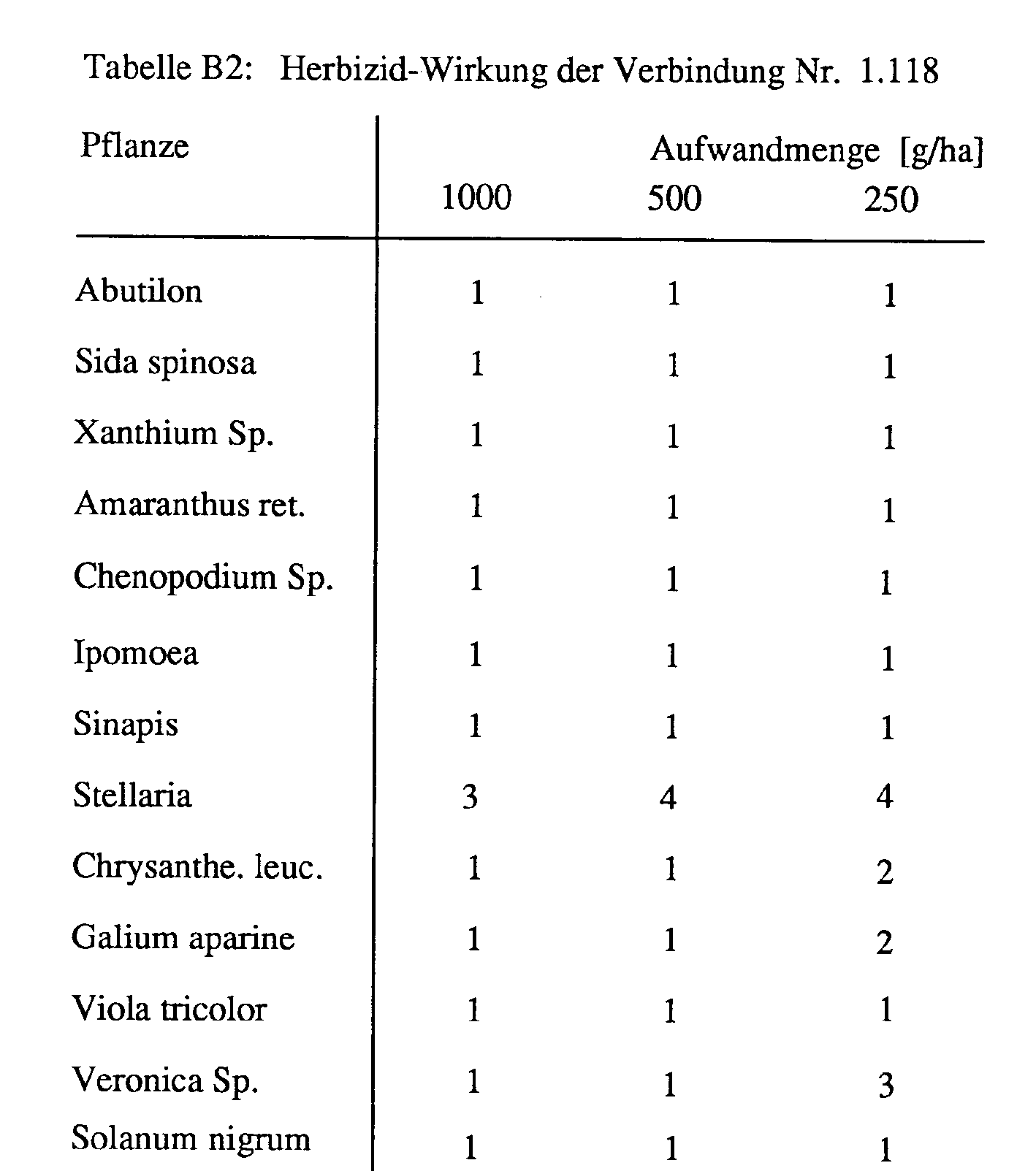
- Die Wasserunkräuter Echinochloa crus galli und Monocharia vag. werden in Plastikbechern (60 cm2 Oberfläche, 500 ml Volumen) ausgesät. Nach der Saat wird bis zur Erdoberfläche mit Wasser aufgefüllt. 3 Tage nach der Saat wird der Wasserspiegel bis leicht über die Erdoberfläche erhöht (3-5 mm). Die Applikation erfolgt 3 Tage nach der Saat durch eine
- Spritzung der Prüfsubstanzen auf die Gefäße. Die verwendete Dosis entspricht einer Wirkstoffmenge von 2 kg AS pro Hektar. Die Pflanzenbecherwerden dann im Gewächshaus unter optimalen Wachstumsbedingungen für die Reisunkräuter aufgestellt, d.h. bei 25°-30°C und hoher Luftfeuchtigkeit.Die Auswertung der Versuche findet 3 Wochen nach Applikation statt. Die Verbindungen der Tabelle I schädigen dabei die Unkräuter, nicht aber den Reis.
- Die Versuchspflanzen Centrosema pubescens und Psophocarpus palustris werden in 4 cm - Torftöpfen mit Landerde (45 %), Torf (45 %) und Zonolit (10 %) durch Stecklinge vermehrt. Die Anzucht erfolgt im Gewächshaus bei einer Tagestemperatur von 27°C und einer Nachttemperatur von 23°C. Die Beleuchtungsdauer ist mindestens 14 Stunden/Tag bei einer Intensität von mindestens 7000 Lux.
- Ca. 50 Tage nach Ansatz der Stecklinge erfolgt das Vertopfen in 13 cm-Töpfe, 4 - 5 Pflanzen/Topf. Nach weiteren 60 Tagen werden die Pflanzen auf ca. 15 cm Höhe zurückgeschnitten und appliziert. Dabei werden sie mit 0,1 bis 300 g Wirkstoff/ha (in der Regel 25 %ig formuliert) in wäßriger Spritzbrühe besprüht. Die Wasseraufwandmenge beträgt ca. 200 I/ha.
- 4 Wochen nach der Applikation wird der Neuzuwachs im Gewicht ermittelt und in % zum Durchschnitt der unbehandelten Kontrollen dargestellt. Die nekrotischen Schäden sind in % zur gesamten Blattfläche aufgeführt.
- Der Neuzuwachs der behandelten Pflanzen erweist sich als deutlich geringer als der der unbehandelten Kontrollen.
- Versuchspflanzen der Sorte Williams werden in 11 cm - Tontöpfen mit Landerde (45 %), Torf (45 %) und Zonolit (10 %) angesät und in der Klimakammer bei einer Tagestemperatur von 24°C und einer Nachttemperatur von 19°C angezogen. Die Beleuchtungsdauer ist 16 Stunden pro Tage bei einer Intensität von ca. 350 Mikro-Einstein.
- Ca. 24 Tage nach der Saat erfolgt das Umtopfen in 18 cm - Töpfe, 2 Pflanzen/Topf. Nach weiteren 12 Tagen und im Stadium von 5 - 6 Trifolia-Blätter findet die Applikation mit 0,1 bis 300 g Wirkstoff/ha statt, in der Regel 25 %ig formuliert und in wäßriger Spritzbrühe. Die Waßeraufwandmenge beträgt ca. 200 I/ha.
- Ca. 4 Wochen nach der Applikation findet die Auswertung statt. Hierbei wird die Höhe des Neuzuwachses gemessen und in % zum Durchschnitt der unbehandelten Kontrollen dargestellt. Die nekrotischen Schäden sind in % zur gesamten Blattfläche aufgeführt.
- Die behandelten Pflanzen zeigen einen deutlich geringeren Neuzuwachs als die unbehandelten Kontrollen.
- Versuchspflanzen (Sommergerste der Sorte Iban) werden in 15 cm-Kunststofftöpfen mit steriler Landerde angesät und in der Klimakammer bei einer Tagestemperatur von 10 - 15°C und einer Nachttemperatur von 5 - 10°C angezogen. Die Beleuchtungsdauer ist 13.5 Stunden pro Tag bei einer Intensität von ca. 25000 Lux.
- Ca. 34 Tage nach der Saat und dem Ausdünnen auf 4 Pflanzen/Topf erfolgt die Applikation mit 0,1 bis 300 g Wirkstoff/ha, in der Regel 25 %ig formuliert und in wäßriger Spritzbrühe. Die Wasseraufwandmenge ist ca. 500 I/ha. Nach der Applikation werden die Pflanzen im Gewächshaus bei einer Tagestemperatur von mindestens 10°C aufgestellt. Die Beleuchtungsdauer ist mind. 13.5 Stunden/Tag.
- Ca. 28 Tage nach der Behandlung findet die Auswertung statt. Hierbei wird die Höhe des Neuzuwachses in % zum Durchschnitt der unbehandelten Kontrollen dargestellt. Die nekrotischen Schäden sind in % zur gesamten Blattfläche aufgeführt.
- Die behandelten Pflanzen weisen im Vergleich zu unbehandelten Kontrollen eine Verringerung des Neuzuwachsese auf.
- Eine Mischung von Gräsern (z.B. Poa, Festuca, Lolium, Bromus, Cynosurus) und Klee (Trifolium pratense/ repens) wird in 15 cm-Kunststofftöpfen mit steriler Landerde angesät und im Gewächshaus bei einer Tagestemperatur von 21°C und einer Nachttemperatur von 17°C angezogen. Die Beleuchtungsdauer ist 13.5 Stunden/Tag bei einer Lichtintensität von mind. 7000 Lux. Nach dem Auflauf werden die Pflanzen wöchentlich auf ca. 6 cm Höhe zurückgeschnitten. Ca. 42 Tage nach der Saat und 1 Tag nach dem letzten Schnitt erfolgt die Applikation mit 0,1 bis 300 g Wirkstoff/ha, in der Regel 25 %ig formuliert und in wäßriger Spritzbrühe. Die Wasseraufwandmenge ist ca. 500 I/ha.
- Ca. 3 Wochen nach der Behandlung findet die Auswertung statt. Hierbei wird die Höhe des Neuzuwachses gemessen und in % zum Durchschnitt der unbehandelten Kontrollen dargestellt. Die nekrotischen Schäden sind in % zur gesamten Blattfläche aufgeführt.
- Die geprüften Verbindungen der Tabelle 1 bewirken eine Reduzierung des Neuzuwachses im Vergleich zur unbehandelten Kontrolle.
Claims (60)


bedeutet, unter Einschluss der Salze und Komplexe mit Säuren, Basen oder Komplexbildnern, sowie der möglichen Stereoisomeren, die in Form von Enantiomeren, Diastereomeren oder deren Gemische vorliegen.





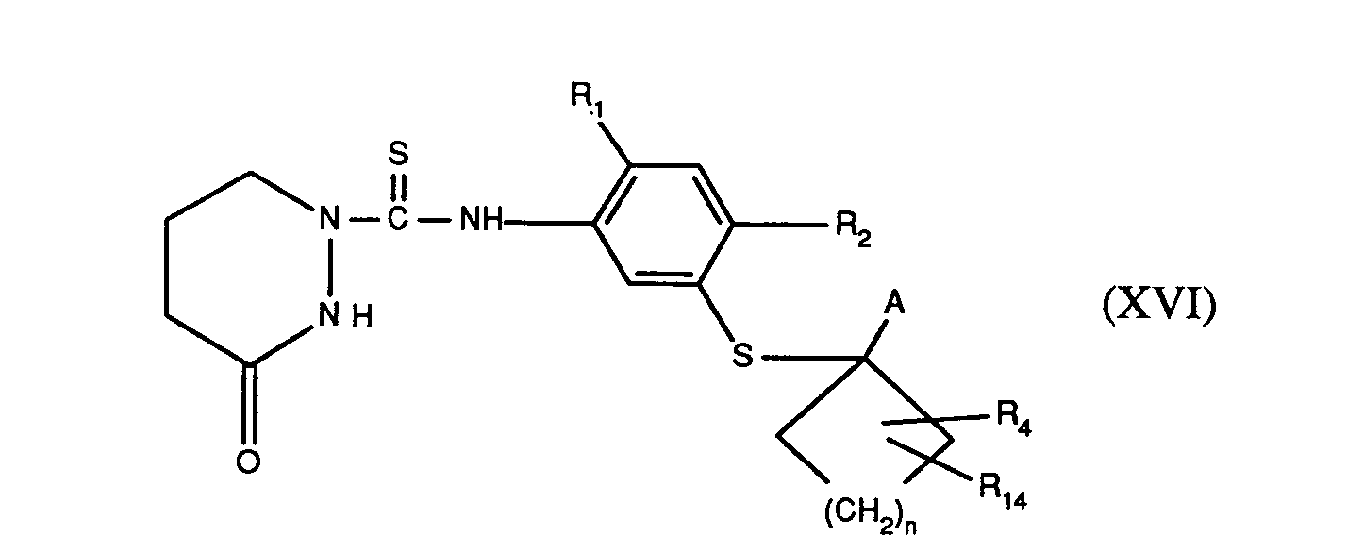


Applications Claiming Priority (2)
| Application Number | Priority Date | Filing Date | Title |
|---|---|---|---|
| CH2439/90 | 1990-07-23 | ||
| CH243990 | 1990-07-23 |
Publications (2)
| Publication Number | Publication Date |
|---|---|
| EP0468924A2 true EP0468924A2 (de) | 1992-01-29 |
| EP0468924A3 EP0468924A3 (en) | 1992-04-29 |
Family
ID=4233843
Family Applications (1)
| Application Number | Title | Priority Date | Filing Date |
|---|---|---|---|
| EP19910810577 Withdrawn EP0468924A3 (en) | 1990-07-23 | 1991-07-16 | New herbicides |
Country Status (8)
| Country | Link |
|---|---|
| US (1) | US5180418A (de) |
| EP (1) | EP0468924A3 (de) |
| JP (1) | JPH04234360A (de) |
| AU (1) | AU638854B2 (de) |
| BR (1) | BR9103125A (de) |
| CA (1) | CA2047489A1 (de) |
| IE (1) | IE912571A1 (de) |
| ZA (1) | ZA915720B (de) |
Cited By (6)
| Publication number | Priority date | Publication date | Assignee | Title |
|---|---|---|---|---|
| EP0530642A1 (de) * | 1991-09-04 | 1993-03-10 | Ciba-Geigy Ag | Herbizide Oxetan und Thiaetanderivate |
| WO1994010147A1 (de) * | 1992-10-31 | 1994-05-11 | Basf Aktiengesellschaft | Substituierte n-phenylglutarimide und n-phenylglutarsäureamide, deren herstellung und verwendung in der landwirtschaft |
| EP0611768A3 (de) * | 1993-02-17 | 1995-02-01 | Ciba Geigy Ag | Phenylimino-thiadiazabicyclononanon-Salze mit herbiziden Eigenschaften. |
| WO1995033746A1 (en) * | 1994-06-08 | 1995-12-14 | E.I. Du Pont De Nemours And Company | Cyclic sulfonamide herbicides |
| EP0688773A1 (de) * | 1994-06-23 | 1995-12-27 | Sandoz Ltd | 2-Phenyl-7-chlor-perhydroimidazo(1,5-a)pyridine |
| US5874382A (en) * | 1996-11-13 | 1999-02-23 | E. I. Du Pont De Nemours And Company | Cyclic sulfonamide herbicides |
Families Citing this family (5)
| Publication number | Priority date | Publication date | Assignee | Title |
|---|---|---|---|---|
| DE59208657D1 (de) * | 1991-08-19 | 1997-08-07 | Ciba Geigy Ag | Benzothiazolon Herbizide |
| EP0716655A1 (de) * | 1993-09-03 | 1996-06-19 | E.I. Du Pont De Nemours And Company | Oxa- und thia (di) azabicyclic compounds |
| US6117896A (en) * | 1997-02-10 | 2000-09-12 | Molecumetics Ltd. | Methods for regulating transcription factors |
| AU2003219809A1 (en) | 2002-02-14 | 2003-09-04 | Myriad Genetics, Inc. | Beta-sheet mimetics and composition and methods relating thereto |
| JP4708342B2 (ja) * | 2003-07-25 | 2011-06-22 | デックスコム・インコーポレーテッド | 埋設可能な装置に用いる酸素増大膜システム |
Family Cites Families (13)
| Publication number | Priority date | Publication date | Assignee | Title |
|---|---|---|---|---|
| JPS59212472A (ja) * | 1983-05-16 | 1984-12-01 | Sumitomo Chem Co Ltd | 4,5,6,7−テトラヒドロ−2h−イソインド−ル−1,3−ジオン誘導体、その製造法およびそれを有効成分とする除草剤 |
| US4789394A (en) * | 1985-07-24 | 1988-12-06 | Ciba-Geigy Corporation | Annularly-linked triazole compounds |
| EP0238711B1 (de) * | 1986-03-25 | 1990-11-28 | Kumiai Chemical Industry Co., Ltd. | Thiadiazabicyclononanderivate, Verfahren zu ihrer Herstellung und herbizide Zusammensetzungen |
| EP0259264A1 (de) * | 1986-09-03 | 1988-03-09 | Ciba-Geigy Ag | Neue 4-Methylphthalimide |
| US4804400A (en) * | 1986-09-12 | 1989-02-14 | Ciba-Geigy Corporation | N-phenyl-maleimides and herbicidal and plant growth regulating methods of use thereof |
| US4885023A (en) * | 1986-12-24 | 1989-12-05 | Kumiai Chemical Industry Co., Ltd. | Thiadiazabicyclononane derivatives and herbicidal compositions |
| DE3714372A1 (de) * | 1987-04-30 | 1988-11-10 | Hoechst Ag | Alkyl-n-aryl-tetrahydrophthalimide, verfahren zu ihrer herstellung sowie ihre verwendung im pflanzenschutz |
| CA1309716C (en) * | 1987-08-28 | 1992-11-03 | Jun Satow | Condensed heterocyclic derivative, process for their production and herbicides |
| DE3889412T2 (de) * | 1987-10-16 | 1994-12-22 | Ihara Chemical Ind Co | Thiadiazabicyclononanderivate und herbizide Zubereitungen. |
| DE3835168A1 (de) * | 1988-10-15 | 1990-04-19 | Bayer Ag | N-aryl-stickstoffheterocyclen, mehrere verfahren zu ihrer herstellung und ihre verwendung als herbizide |
| DE3836742A1 (de) * | 1988-10-28 | 1990-05-03 | Bayer Ag | Verwendung von neuen und bekannten n-phenyl-substituierten oxazindionen als herbizide sowie neue n-phenyl-substituierte oxazindione und mehrere verfahren zu deren herstellung |
| EP0370955B1 (de) * | 1988-11-25 | 1994-10-12 | Ciba-Geigy Ag | Herbizid wirksame N-Phenylazole |
| HUT62296A (en) * | 1990-12-18 | 1993-04-28 | Sandoz Ag | Herbicidal composition comprising hydantoin derivative as active ingredient and process for producing the active ingredient |
-
1991
- 1991-07-16 EP EP19910810577 patent/EP0468924A3/de not_active Withdrawn
- 1991-07-19 CA CA002047489A patent/CA2047489A1/en not_active Abandoned
- 1991-07-19 US US07/732,988 patent/US5180418A/en not_active Expired - Fee Related
- 1991-07-22 ZA ZA915720A patent/ZA915720B/xx unknown
- 1991-07-22 BR BR919103125A patent/BR9103125A/pt not_active Application Discontinuation
- 1991-07-22 AU AU81261/91A patent/AU638854B2/en not_active Ceased
- 1991-07-22 IE IE257191A patent/IE912571A1/en unknown
- 1991-07-23 JP JP3206542A patent/JPH04234360A/ja active Pending
Cited By (10)
| Publication number | Priority date | Publication date | Assignee | Title |
|---|---|---|---|---|
| EP0530642A1 (de) * | 1991-09-04 | 1993-03-10 | Ciba-Geigy Ag | Herbizide Oxetan und Thiaetanderivate |
| WO1993005037A1 (en) * | 1991-09-04 | 1993-03-18 | Ciba-Geigy Ag | Oxetane and thiaetane derivatives |
| WO1994010147A1 (de) * | 1992-10-31 | 1994-05-11 | Basf Aktiengesellschaft | Substituierte n-phenylglutarimide und n-phenylglutarsäureamide, deren herstellung und verwendung in der landwirtschaft |
| US5698494A (en) * | 1992-10-31 | 1997-12-16 | Basf Aktiengesellschaft | Substituted N-phenylglutarimides and N-phenylglutaramides, their preparation and use |
| EP0611768A3 (de) * | 1993-02-17 | 1995-02-01 | Ciba Geigy Ag | Phenylimino-thiadiazabicyclononanon-Salze mit herbiziden Eigenschaften. |
| WO1995033746A1 (en) * | 1994-06-08 | 1995-12-14 | E.I. Du Pont De Nemours And Company | Cyclic sulfonamide herbicides |
| US5750471A (en) * | 1994-06-08 | 1998-05-12 | E. I. Du Pont De Nemours And Company | Cyclic sulfonamide herbicides |
| EP0688773A1 (de) * | 1994-06-23 | 1995-12-27 | Sandoz Ltd | 2-Phenyl-7-chlor-perhydroimidazo(1,5-a)pyridine |
| US5665681A (en) * | 1994-06-23 | 1997-09-09 | Sandoz Ltd. | 2-phenyl-7-chloro-perhydroimidazo[1,5A]pyridines |
| US5874382A (en) * | 1996-11-13 | 1999-02-23 | E. I. Du Pont De Nemours And Company | Cyclic sulfonamide herbicides |
Also Published As
| Publication number | Publication date |
|---|---|
| ZA915720B (en) | 1992-03-25 |
| EP0468924A3 (en) | 1992-04-29 |
| US5180418A (en) | 1993-01-19 |
| BR9103125A (pt) | 1992-04-28 |
| CA2047489A1 (en) | 1992-01-24 |
| AU638854B2 (en) | 1993-07-08 |
| AU8126191A (en) | 1992-01-30 |
| IE912571A1 (en) | 1992-01-29 |
| JPH04234360A (ja) | 1992-08-24 |
Similar Documents
| Publication | Publication Date | Title |
|---|---|---|
| DE69932628T2 (de) | Herbizide | |
| RU2246492C2 (ru) | Промежуточные соединения для получения производных 3-гидрокси-4-арил-5-оксопиразолина с гербицидным действием | |
| EP0337943A2 (de) | N-Phenyl-N-pyrimidin-2-yl-Harnstoffe mit herbiziden und pflanzenwuchsregulierender Wirkung | |
| EP0262096B1 (de) | Aminopyrazinone und Aminotriazinone | |
| EP0097122B1 (de) | N-Heterocyclosulfonyl-N'-pyrimidinyl- und -triazinylharnstoffe | |
| EP0337944B1 (de) | Harnstoffe | |
| EP0353187A2 (de) | Neue Herbizide | |
| DE69225768T2 (de) | Sulfonylharnstoffe | |
| EP0072347A1 (de) | N-Phenylsulfonyl-N'-pyrimidinyl- und -triazinylharnstoffe | |
| EP0496701A1 (de) | Sulfonylharnstoffe als Herbizide | |
| EP0264348B1 (de) | Harnstoffe | |
| EP0459949A1 (de) | Sulfonylharnstoffe mit herbizider und pflanzenwuchsregulierender Wirkung | |
| EP0303573B1 (de) | Pyrrolidin-2,5-dione und 4,5,6,7-Tetrahydroisoindol-1,3-dione | |
| EP0434624B1 (de) | Triazolylsulfonamide | |
| EP0558445A1 (de) | Sulfonylharnstoffe als Herbizide | |
| EP0103537A2 (de) | N-Arylsulfonyl-N'-triazolylharnstoffe | |
| EP0401168A2 (de) | Neue Herbizide | |
| JPH04234360A (ja) | 新規な除草剤 | |
| EP0298029B1 (de) | Substituierte Imidazolone mit herbizider Wirkung | |
| EP0278907B1 (de) | Neue Cyclohexandione | |
| EP0337946B1 (de) | Harnstoffe | |
| EP0305332A2 (de) | Imidazol-Derivate | |
| EP0260228A2 (de) | N-Phenyl-maleinimide und N-Phenyl-succinimide mit herbizider und pflanzenwuchsregulierender Wirkung | |
| EP0402316B1 (de) | Sulfonylharnstoffe | |
| EP0582021B1 (de) | Sulfonylharnstoffe als Herbizide |
Legal Events
| Date | Code | Title | Description |
|---|---|---|---|
| PUAI | Public reference made under article 153(3) epc to a published international application that has entered the european phase |
Free format text: ORIGINAL CODE: 0009012 |
|
| 17P | Request for examination filed |
Effective date: 19910718 |
|
| AK | Designated contracting states |
Kind code of ref document: A2 Designated state(s): AT BE CH DE DK ES FR GB GR IT LI LU NL SE |
|
| PUAL | Search report despatched |
Free format text: ORIGINAL CODE: 0009013 |
|
| AK | Designated contracting states |
Kind code of ref document: A3 Designated state(s): AT BE CH DE DK ES FR GB GR IT LI LU NL SE |
|
| 17Q | First examination report despatched |
Effective date: 19941114 |
|
| STAA | Information on the status of an ep patent application or granted ep patent |
Free format text: STATUS: THE APPLICATION IS DEEMED TO BE WITHDRAWN |
|
| 18D | Application deemed to be withdrawn |
Effective date: 19970201 |