EP0281090B1 - Tendamistat-Derivate - Google Patents
Tendamistat-Derivate Download PDFInfo
- Publication number
- EP0281090B1 EP0281090B1 EP88103141A EP88103141A EP0281090B1 EP 0281090 B1 EP0281090 B1 EP 0281090B1 EP 88103141 A EP88103141 A EP 88103141A EP 88103141 A EP88103141 A EP 88103141A EP 0281090 B1 EP0281090 B1 EP 0281090B1
- Authority
- EP
- European Patent Office
- Prior art keywords
- tendamistat
- gene
- derivative
- derivatives
- amino acid
- Prior art date
- Legal status (The legal status is an assumption and is not a legal conclusion. Google has not performed a legal analysis and makes no representation as to the accuracy of the status listed.)
- Expired - Lifetime
Links
Classifications
-
- C—CHEMISTRY; METALLURGY
- C07—ORGANIC CHEMISTRY
- C07K—PEPTIDES
- C07K14/00—Peptides having more than 20 amino acids; Gastrins; Somatostatins; Melanotropins; Derivatives thereof
-
- C—CHEMISTRY; METALLURGY
- C07—ORGANIC CHEMISTRY
- C07K—PEPTIDES
- C07K14/00—Peptides having more than 20 amino acids; Gastrins; Somatostatins; Melanotropins; Derivatives thereof
- C07K14/195—Peptides having more than 20 amino acids; Gastrins; Somatostatins; Melanotropins; Derivatives thereof from bacteria
- C07K14/36—Peptides having more than 20 amino acids; Gastrins; Somatostatins; Melanotropins; Derivatives thereof from bacteria from Actinomyces; from Streptomyces (G)
-
- A—HUMAN NECESSITIES
- A61—MEDICAL OR VETERINARY SCIENCE; HYGIENE
- A61P—SPECIFIC THERAPEUTIC ACTIVITY OF CHEMICAL COMPOUNDS OR MEDICINAL PREPARATIONS
- A61P37/00—Drugs for immunological or allergic disorders
- A61P37/02—Immunomodulators
- A61P37/06—Immunosuppressants, e.g. drugs for graft rejection
Definitions
- the invention relates to proteins which are derived from the ⁇ -amylase inhibitor tendamistat.
- the DNA coding for Tendamistat is given in published European patent application (EP-A 1) 0 161 629 or in South African patent specification 85/3672 (as DNA sequence C).
- This structural gene contains several interfaces for restriction enzymes that can be used to modify the encoded amino acid sequence.
- the interfaces for BstEII in the region of triplets 31 and 32, StuI in the region of triplets 43 and 44 and Sau3A in the region of triplets 52 and 53 are suitable.
- one or more additional amino acids can be inserted at these points, DNA Segments between these interfaces can be eliminated or shortened amino acid sequences can be encoded by incorporating stop codons.
- any amino acids can be inserted, exchanged or eliminated by site-specific mutagenesis. In this way, proteins are obtained which show ⁇ -amylase inhibitory activity, or proteins without this activity, but which still react with the corresponding receptors.
- the Tendamistat derivatives according to the invention thus represent modified ⁇ -amylase inhibitors on the one hand.
- the different structure enables the following changes in properties: A reduced half-life after application enables better control of the inhibition process. An improved degradability by proteases in the blood stream shortens the length of stay in the blood. Inhibitors that are not bound by ⁇ -amylase and enter the bloodstream, for example, through phagocytosis, cause no or a greatly reduced antibody formation there because immunogenic Regions in the molecule have been removed or changed. This reduced immunogenicity enables long-term therapy with these substances.
- the tendamistate derivatives especially those with a significantly shortened amino acid chain, can react reversibly with the specific receptors in the form of a competitive inhibitory mechanism.
- tendamistat gene Another possibility for a modification of the tendamistat gene according to the invention is to use the tendamistat structural gene as a "carrier" for another gene. In this way, fusion proteins are obtained which can be secreted from the host cell and which, after isolation from the culture medium, are cleaved chemically or enzymatically.
- the invention also relates to plasmids which contain the modified genes and in particular expression plasmids which are capable of expressing the encoded tendamistate derivatives in Streptomycetes.
- the modified inhibitors can be expressed in a manner known per se, the signal peptide upstream of the natural tendamistatgen advantageously being used for the secretion of the inhibitors into the culture medium.
- the expression and secreted proteins can also be isolated in a manner known per se, advantageously by adsorption or ion exchange chromatography and / or gel filtration.
- the starting plasmid is pKAI650, the production of which is in the unpublished European patent application EP-A2 0 218 204 or in the corresponding ZA-A 86/7697 is proposed.
- a 650 bp HincII-SstI fragment is isolated from the plasmid pKAI1 described in German patent application 3,331,860 and inserted into the commercially available plasmid pUC19, which was previously opened with these enzymes.
- CKAI gradient centrifugation purified DNA from pKAI650 is completely digested for 2 hours in a 50 ⁇ l reaction mixture with StuI according to the manufacturer's instructions and the enzyme is removed by phenol extraction.
- the linearized DNA is precipitated with ethanol, redissolved and introduced into a ligation mixture containing 0.1 ⁇ g of the chemically synthesized, 5-end phosphorylated, double-stranded oligonucleotide (1) as an additional reaction partner. is added.
- pKK1 is 12 base pairs larger than pKAI650 and has a nucleotide sequence that extends the amino acid sequence by 4 amino acids as follows: Isolated pKK1 plasmid DNA is subjected to preparative gel electrophoresis after double digestion with the restriction endonucleases SstI and SphI and the approximately 660 bp fragment with the modified amylase inhibitor (AI) gene is isolated.
- AI modified amylase inhibitor
- the following 12mer nucleotide sequence (3) is inserted into the unique StuI interface of pKAI650 analogously to Examples 1 and 2:
- the plasmid pKK3 obtained after transformation of E. coli JM 109 has an additional interface for the restriction enzyme HindIII, 12 base pairs larger than pKAI650 and has a nucleotide sequence by which the amino acid sequence is expanded by 4 amino acids as follows: In analogy to Example 1, the approximately 660 bp fragment with the modified AI gene is isolated.
- Lys-N A-1 Protease II, Wingard et al., J. Bacteriology 112 (1972) 940-949
- Lysobacter enzymogenes which cleaves the protein on the amino-terminal side of lysine, and by incubation e.g. With the endoproteinase Lys-C (US Pat. No.
- a corresponding protein is obtained by exposure e.g. of the endoproteinase Lys-C and subsequent action of the enzyme carboxypeptidase B.
- the modified inhibitor can be used for the synthesis of a functional foreign protein.
- pKK5 codes for an inhibitor which has the following carboxy-terminal structure: Glu29 - Thr30 - Val31 - Thr32 - Glu33 - COOH
- the inhibitor is therefore shortened by 41 amino acids compared to tendamistat and, in contrast to this, no longer acts irreversibly, but instead has a competitive inhibitory mechanism.
- oligonucleotides (6) and (7) are used as mutagenic "primers", with the result that the two cysteines mentioned are replaced by alanine.
- the synthesized oligonucleotides are separated using preparative polyacrylamide gel electrophoresis and the product bands are cut out.
- the oligonucleotides are eluted from the gel and the eluate is purified by chromatography ( R SEPHADEX G50 fine and BIOGEL P6, 100 to 200 mesh, column 25 ⁇ 1.6 cm).
- the yields are 4.6 nmoles for the oligonucleotide of the formula (7) and 11.7 nmoles for the oligonucleotide of the formula (6).
- the 650 bp PstI-SstI fragment from pKAI650 is cloned into phage M13mp18am (M13mp18am contains two amber mutations in essential genes).
- E. coli cells BMH 71-18
- a suppressor mutant are transfected and plated on Xgal-IPTG plates. Colorless individual plaques are cut out, the phages are cultivated in BMH 71-18 and the DNA is isolated from different clones.
- the positive clones contain the 650 bp fragment from pKAI650.
- the ssDNA (+ strand) from the recombinant phages was incubated with the larger of the two fragments from the PstI-SstI digestion of the phage M13mp18rev; this resulted in the "gapped duplex DNA" with the two amber mutations and the insertion on the + strand and the "gap" on the revertant - strand. Then the "gapped duplex" DNA is incubated with the primers (7) and (8), the DNA is filled in to a double strand, ligated and thus transfected with E. coli BMH 71-18mut S. The mutS mutant of E. coli cannot carry out a "mismatch" repair and thus enables the multiplication of phages with the genetic constitution of both the + and - strands.
- the clones subsequently cultivated in E. coli MK 30-3 and identified as positive by restriction analysis are sequenced, all 8 clones tested containing the 650 bp SstI-HindIII fragment with the AI sequence and 5 of these 8 clones the newly created SstII- Have interface.
- the strain E. coli MK 30-3 is not a suppressor mutant, so that only phages with the genetic makeup of the --strang (rev) can multiply.
- the SstI-SphI insert was cloned from the RF DNA of the phages which carry the modified AI gene into the plasmid pUC19, the plasmids pKAI750 and pKAI850 being obtained.
- the SstI-SphI insert, which carries the modified AI gene, is isolated according to Example 1.
- the 650 bp SstI-SphI DNA fragment from pKAI650 is cloned according to Example 6 into the E. coli phage M13mp11, the single-stranded DNA is isolated and this is isolated using the mutagenic "primer" 3 ⁇ C TCG ACC GAC ATG AGT G 5 ⁇ and the mutagenesis system from Amersham (Braunschweig, Code No. NPM 2322) mutagenized by the Eckstein method.
- the result is a double-stranded DNA fragment in which, as proven by DNA sequencing, the codon CGG for Arg19 was replaced by the codon CTG for Leu19 in the coding region for Tendamistat.
- the SstI-SphI fragment mutagenized in this way is cloned into pUC19 analogously to Example 6, the plasmid pKAI 950 being obtained. Expression of the mutated gene gives a tendamistate derivative with modified binding properties, which acts as a competitive inhibitor.
- the plasmid pIJ702 is completely digested with the restriction endonucleases SphI and SstI and the approx. 400 bp SstI-SphI fragment from the tyrosinase gene region (Hopwood, DA et al., Genetic Manipulation of Streptomyces: A Laboratory Manual John Innes Foundation, Norwich, 1985) separated from the remaining vector DNA by gel electrophoresis in a 0.5% agarose gel. 1 ⁇ g of the vector DNA purified in this way is ligated with 0.2 ⁇ g of the SstI-SphI fragment isolated according to Examples 1 to 7 with the modified inhibitor gene.
- the ligation mixture is transformed into Streptomyces lividans TK 24 in a manner known per se.
- the desired clones are selected for resistance to thiostrepton (20 ⁇ g / ml) and production of amylase inhibitor according to the plate test described below
- the colonies are poured with 5 ml of an aqueous solution containing 0.4 to 1.0 mg / ml of pancreatin and incubated at 37 ° C. for 1 hour. The solution is then removed and replaced with 5 ml of a 2% by weight starch agar. After 2 hours of incubation at 37 ° C., 5 ml of an iodine-potassium iodide solution are poured over the plates for development. Colonies with a blue halo indicate that the clones synthesize and excrete AI.
- Transformed clones of S. lividans are transferred to nutrient medium R2YE (Hopwood et al., Op. Cit.) With 20 ⁇ g / ml thiostrepton and are incubated for 5 to 7 days by incubation at 26 to 28 ° C.
- R2YE Hopwood et al., Op. Cit.
- the medium is autoclaved at 121 ° C and 1 bar for 30 minutes, the pH is 7.0 to 7.2.
- the inoculation flasks are incubated for 2 days at 28 ° C on a shaker. Then 2 ml of the pre-culture grown in 20 ml main culture medium, which is in 100 ml Erlenmeyer flasks, are inoculated: soluble starch 2 - 4% Soy flour 0.4% Cornsteep, liquid 0.4% Skimmed milk powder 0.7% glucose 1.0% (NH4) 2HPO4 1.2%
- the pH of the medium after autoclaving is pH 7.6.
- the culture is shaken for 4 days at 28 ° C and 220 rpm.
- the mycelium is then separated from the culture solution by centrifugation and the inhibitor present in the culture solution is isolated.
Landscapes
- Health & Medical Sciences (AREA)
- Chemical & Material Sciences (AREA)
- Organic Chemistry (AREA)
- Medicinal Chemistry (AREA)
- General Health & Medical Sciences (AREA)
- Life Sciences & Earth Sciences (AREA)
- Immunology (AREA)
- Molecular Biology (AREA)
- Genetics & Genomics (AREA)
- Biophysics (AREA)
- Proteomics, Peptides & Aminoacids (AREA)
- Biochemistry (AREA)
- Bioinformatics & Cheminformatics (AREA)
- Gastroenterology & Hepatology (AREA)
- Engineering & Computer Science (AREA)
- Veterinary Medicine (AREA)
- Public Health (AREA)
- Animal Behavior & Ethology (AREA)
- Pharmacology & Pharmacy (AREA)
- Nuclear Medicine, Radiotherapy & Molecular Imaging (AREA)
- General Chemical & Material Sciences (AREA)
- Chemical Kinetics & Catalysis (AREA)
- Transplantation (AREA)
- Organic Low-Molecular-Weight Compounds And Preparation Thereof (AREA)
- Acyclic And Carbocyclic Compounds In Medicinal Compositions (AREA)
- Preparation Of Compounds By Using Micro-Organisms (AREA)
- Peptides Or Proteins (AREA)
- Medicines That Contain Protein Lipid Enzymes And Other Medicines (AREA)
- Micro-Organisms Or Cultivation Processes Thereof (AREA)
- Enzymes And Modification Thereof (AREA)
- Macromolecular Compounds Obtained By Forming Nitrogen-Containing Linkages In General (AREA)
- Immobilizing And Processing Of Enzymes And Microorganisms (AREA)
Description
- Die Erfindung betrifft Proteine, die sich von dem α-Amylase-Inhibitor Tendamistat ableiten.
- Die für Tendamistat kodierende DNA ist in der veröffentlichten europäischen Patentanmeldung (EP-A 1) 0 161 629 bzw. in der südafrikanischen Patentschrift 85/3672 (als DNA-Sequenz C) angegeben. In diesem Strukturgen befinden sich mehrere Schnittstellen für Restriktionsenzyme, die zur Modifikation der kodierten Aminosäurefolge genutzt werden können. Geeignet sind die Schnittstellen für BstEII im Bereich der Tripletts 31 und 32, StuI im Bereich der Tripletts 43 und 44 sowie Sau3A im Bereich der Tripletts 52 und 53. Durch Einbau entsprechender Linker können an diesen Stellen eine oder mehrere zusätzliche Aminosäuren eingeschoben werden, DNA-Segmente zwischen diesen Schnittstellen eliminiert werden oder durch Einbau von Stopp-Kodons verkürzte Aminosäuresequenzen kodiert werden. Darüber hinaus können durch ortsspezifische Mutagenese beliebige Aminosäuren eingefügt, ausgetauscht oder eliminiert werden. Man erhält so Proteine, die α-Amylase-Inhibitorwirkung zeigen, oder aber Proteine ohne diese Wirksamkeit, die aber noch mit den entsprechenden Rezeptoren reagieren.
- Die erfindungsgemäßen Tendamistat-Derivate stellen also einerseits modifizierte α-Amylase-Inhibitoren dar. Durch die unterschiedliche Struktur sind folgende Veränderungen in den Eigenschaften möglich: Durch eine reduzierte Halbwertszeit nach der Applikation ist eine bessere Kontrolle des Hemmprozesses möglich. Eine verbesserte Abbaubarkeit durch Proteasen in der Blutbahn verkürzt die Verweildauer im Blut. Nicht durch α-Amylase gebundene Inhibitoren, die beispielsweise durch Phagocytose in die Blutbahn gelangen, rufen dort keine oder eine stark verringerte Antikörperbildung hervor, weil immunogene Regionen im Molekül beseitigt oder verändert wurden. Durch diese verringerte Immunogenität wird eine Langzeittherapie mit diesen Substanzen ermöglicht.
- Andererseits können die Tendamistat-Derivate, insbesondere diejenigen mit deutlich verkürzter Aminosäurekette, in reversibler Weise mit den spezifischen Rezeptoren in Form eines kompetitiven Hemmechanismus reagieren.
- Eine weitere Möglichkeit für eine erfindungsgemäße Modifikation des Tendamistatgens besteht darin, das Tendamistat-Strukturgen als "Träger" für ein anderes Gen zu benutzen. Man erhält so Fusionsproteine, die aus der Wirtszelle sekretiert werden können und nach Isolierung aus dem Kulturmedium chemisch oder enzymatisch gespalten werden.
- Die Erfindung betrifft außerdem Plasmide, die die modifizierten Gene enthalten und insbesondere Expressionsplasmide, die befähigt sind, die kodierten Tendamistat-Derivate in Streptomyceten zu exprimieren.
- Die Expression der modifizierten Inhibitoren kann in an sich bekannter Weise erfolgen, wobei zweckmäßig das dem natürlichen Tendamistatgen vorgelagerte Signalpeptid zur Sekretion der Inhibitoren in das Kulturmedium genutzt wird. Die Isolierung der exprimierten und sezernierten Proteine kann ebenfalls in an sich bekannter Weise, vorteilhaft durch Adsorptions- oder Ionenaustauschchromatographie und/oder Gelfiltration erfolgen.
- In den folgenden Beispielen wird die Erfindung näher erläutert. Sofern keine anderen Angaben gemacht sind, beziehen sich Prozentangaben auf das Gewicht.
- Als Ausgangsplasmid dient pKAI650, dessen Herstellung in der nicht vorveröffentlichten europäischen Patentanmeldung EP-A2 0 218 204 bzw. in der entsprechenden ZA-A 86/7697 vorgeschlagen ist. Zur Herstellung dieses Plasmids wird aus in dem in der deutschen Offenlegungsschrift 3 331 860 beschriebenen Plasmid pKAI1 ein 650bp HincII-SstI-Fragment isoliert und in das handelsübliche Plasmid pUC19 eingesetzt, das zuvor mit diesen Enzymen geöffnet wurde.
- 2 µg über CsCl-Gradientenzentrifugation gereinigte DNA von pKAI650 wird 2 Stunden in einem 50 µl-Reaktionsansatz mit StuI nach den Angaben des Herstellers komplett verdaut und das Enzym durch Phenolextraktion entfernt. Die linearisierte DNA wird mit Ethanol gefällt, wieder gelöst und in ein Ligationsgemisch eingebracht, dem als zusätzlicher Reaktionspartner 0,1 µg des chemisch synthetisierten, am 5ʹ-Ende phosphorylierten, doppelsträngigen Oligonukleotids (1)

zugegeben wird. - Nach Transformation des Ligationsgemisches in E. coli JM 109 werden solche Klone isoliert, die das rekombinante Plasmid pKK1 tragen. Die isolierte Plasmid-DNA ist durch eine zusätzliche Schnittstelle für das Restriktionsenzym BamHI gekennzeichnet, die eine Charakterisierung durch Restriktionsanalyse erlaubt. pKK1 ist um 12 Basenpaare größer als pKAI650 und weist eine Nukleotidsequenz auf, durch die die Aminosäuresequenz wie folgt um 4 Aminosäuren erweitert wird:
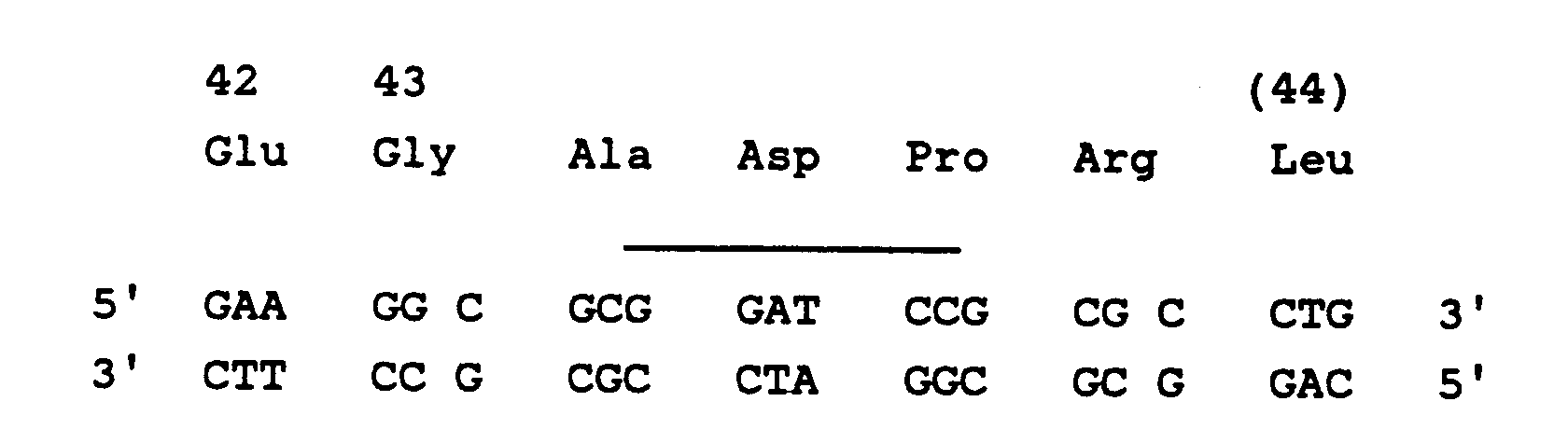
Isolierte pKK1-Plasmid-DNA wird nach Doppelverdauung mit den Restriktionsendonukleasen SstI und SphI einer präparativen Gelelektrophorese unterworfen und das ca. 660 bp umfassende Fragment mit dem modifizierten Amylase-Inhibitor (AI)-Gen isoliert. - Verfährt man entsprechend Beispiel 1, setzt jedoch anstelle des Oligonukleotids (1) das synthetische Oligonukleotid (2)

ein, so erhält man das Plasmid pKK2. Dieses kodiert für einen modifizierten AI mit der folgenden veränderten Aminosäurefolge: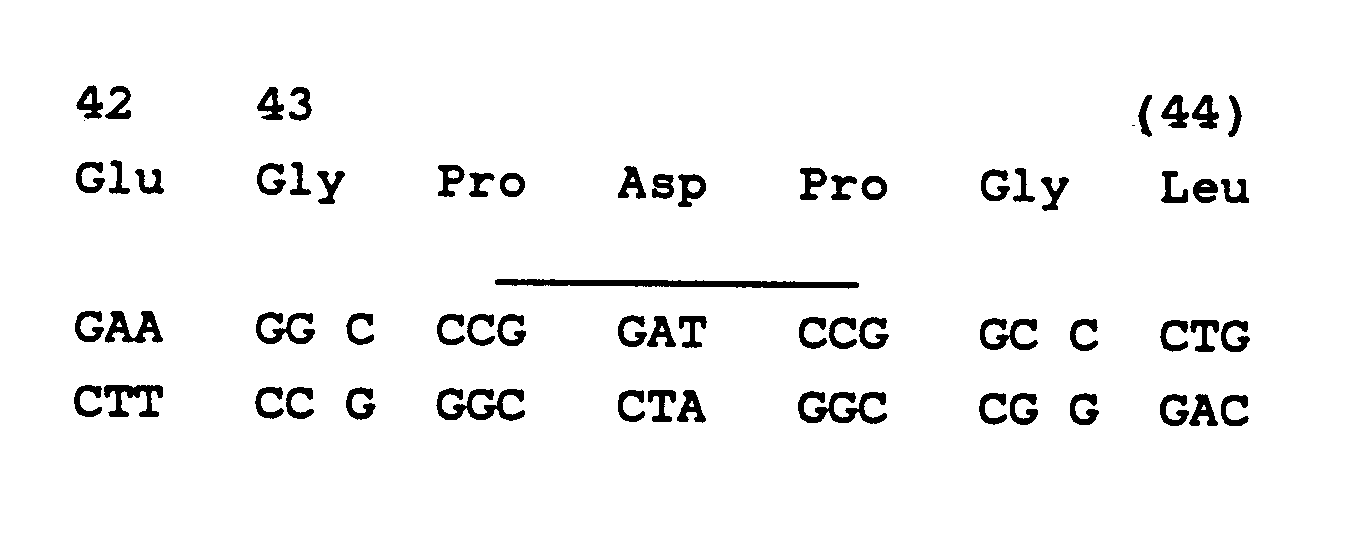
- In die singuläre StuI-Schnittstelle von pKAI650 wird analog den Beispielen 1 und 2 folgende 12mer-Nukleotidsequenz (3) eingefügt:

Das nach Transformation von E. coli JM 109 erhaltene Plasmid pKK3 ist durch eine zusätzliche Schnittstelle für das Restriktionsenzym HindIII gekennzeichnet, 12 Basenpaare größer als pKAI650 und weist eine Nukleotidsequenz auf, durch welche die Aminosäuresequenz wie folgt um 4 Aminosäuren erweitert wird:
In Analogie zu Beispiel 1 wird das ca. 660 bp umfassende Fragment mit dem modifizierten AI-Gen isoliert. - Verfährt man gemäß Beispiel 1, setzt jedoch anstelle des Oligonukleotids (1) das chemisch synthetisierte und an den 5ʹ-Enden phosphorylierte Oligonukleotid (4)

ein, so erhält man das um 96 Basenpaare vergrößerte Plasmid pKK4. Dieses kodiert für einen modifizierten AI mit der folgenden veränderten Aminosäuresequenz:

In Analogie zum Beispiel 1 wird das ca. 750 bp umfassende SstI-SphI-Fragment mit dem modifizierten AI-Gen isoliert und gemäß Beispiel 8 und 9 zur Expression gebracht. - Durch Einwirkung der Endoproteinase Lys-N (AL-1 Protease II, Wingard et al., J. Bacteriology 112 (1972) 940-949) aus Lysobacter enzymogenes, die das Protein an der aminoterminalen Seite von Lysin spaltet, sowie durch Inkubation z.B. mit der Endoproteinase Lys-C (US-Patentschrift 4 414 332) aus Lysobacter enzymogenes, die das Protein an der carboxyterminalen Seite von Lysin spaltet, auf den aus dem Kulturfiltrat isolierten Inhibitor, erhält man ein 28 Aminosäuren umfassendes Protein, das chromatographisch gereinigt werden kann und das nach chemischer oder enzymatischer Amidierung am Gly²⁸* funktionell dem Hormon Sekretin entspricht.
- Ein entsprechendes Protein erhält man durch Einwirkung z.B. der Endoproteinase Lys-C und anschließender Einwirkung des Enzyms Carboxypeptidase B. Durch dieses Vorgehen läßt sich der modifizierte Inhibitor für die Synthese eines funktionalen Fremdeiweißes nutzen.
- 1 µg isolierter Plasmid-DNA von pKAI650 wird vollständig mit dem Restriktionsenzym BstEII verdaut. Das Enzym wird durch Phenolextraktion entfernt, die linearisierte DNA mit Ethanol gefällt und mit 0,1 µg der chemisch synthetisierten und am 5ʹ-Ende phosphorylierten DNA (5) folgender Struktur ligiert:

Nach Transformation in E. coli JM 109 werden solche Klone isoliert, die 2 Schnittstellen für das Enzym EcoRI aufweisen und das gesuchte Plasmid pKK5 tragen. pKK5 kodiert für einen Inhibitor, der folgende carboxyterminale Struktur aufweist:
Glu²⁹ - Thr³⁰ - Val³¹ - Thr³² - Glu³³ - COOH
Der Inhibitor ist folglich gegenüber Tendamistat um 41 Aminosäuren verkürzt und wirkt im Gegensatz zu diesem nicht mehr irreversibel, sondern weist einen kompetitiven Hemmechanismus auf. - Zur Eliminierung der Cysteine in Position 11 und 27 nach der "gapped duplex"-Methode (B. Kramer et al., Cell 38 (1984) 879-889) werden die folgenden einsträngigen Oligonukleotide nach der β-Cyanethoxyphosphoramidit-Methode (N.D. Sinha et al., Tetrahedron Letters 24 (1983) 5843) mit dem DNA-Synthesizer 380A der Firma Applied Biosystems, Pfungstadt, hergestellt. Die Ansatzgröße ist 0,2 µmol, die Ausbeute pro Syntheseschritt 96,9 %.

- Diese Oligonukleotide (6) und (7) werden als mutagene "Primer" eingesetzt, was zur Folge hat, daß die beiden genannten Cysteine durch Alanin ersetzt werden.
- Die synthetisierten Oligonukleotide werden über präparative Polyacrylamid-Gelelektrophorese getrennt und die Produktbanden ausgeschnitten. Die Oligonukleotide werden aus dem Gel eluiert und das Eluat durch Chromatographie gereinigt (RSEPHADEX G50 fein und BIOGEL P6, 100 bis 200 mesh, Säule 25 · 1,6 cm). Die Ausbeuten betragen 4,6 nMol für das Oligonukleotid der Formel (7) und 11,7 nMol für das Oligonukleotid der Formel (6).
- Das 650 bp große PstI-SstI-Fragment aus pKAI650 wird in den Phagen M13mp18am umkloniert (M13mp18am enthält zwei amber-Mutationen in essentiellen Genen). Mit den rekombinanten Phagen werden E. coli-Zellen (BMH 71-18), einer Suppressor-Mutante, transfiziert und auf Xgal-IPTG-Platten ausplattiert. Farblose Einzelplaques werden ausgestochen, die Phagen in BMH 71-18 kultiviert und die DNA aus verschiedenen Klonen isoliert. Die positiven Klone enthalten das 650 bp-Fragment aus pKAI650.
- Die ssDNA (+-Strang) aus den rekombinanten Phagen wurde mit dem größeren der beiden Fragmente aus der PstI-SstI-Verdauung des Phagen M13mp18rev inkubiert; hierbei entstand die "gapped duplex DNA" mit den beiden Ambermutationen und der Insertion auf dem +-Strang und dem "gap" auf dem revertanten --Strang. Dann wird die "gapped duplex"-DNA mit den Primern (7) und (8) inkubiert, die DNA zum Doppelstrang aufgefüllt, ligiert und damit E. coli BMH 71-18mut S transfiziert. Die mutS-Mutante von E. coli kann keine "mismatch"-Reparatur durchführen und ermöglicht damit die Vermehrung von Phagen mit der genetischen Konstitution sowohl des +- als auch des --Stranges.
- Die anschließend in E. coli MK 30-3 kultivierten und durch Restriktionsanalyse als positiv identifizierten Klone werden sequenziert, wobei alle 8 getesteten Klone das 650 bp SstI-HindIII-Fragment mit der AI-Sequenz enthalten und 5 dieser 8 Klone die neu engeführte SstII-Schnittstelle aufweisen. Der Stamm E. coli MK 30-3 ist keine Suppressor-Mutante, so daß sich lediglich Phagen mit der genetischen Konstitution des --Stranges (rev) vermehren können.
- Aus der RF-DNA der Phagen, die das modifizierte AI-Gen tragen, wurde das SstI-SphI-Insert in das Plasmid pUC19 umkloniert, wobei die Plasmide pKAI750 und pKAI850 erhalten werden. Die Isolierung des SstI-SphI-Inserts, das das veränderte AI-Gen trägt, erfolgt gemäß Beispiel 1.
- Das 650 bp große SstI-SphI-DNA-Fragment aus pKAI650 wird gemäß Beispiel 6 in den E. coli-Phagen M13mp11 umkloniert, die Einzelstrang-DNA isoliert und diese mit Hilfe des mutagenen "Primer"
3ʹ C TCG ACC GAC ATG AGT G 5ʹ
und des Mutagenese-Systems der Firma Amersham (Braunschweig, Code Nr. NPM 2322) nach der Eckstein-Methode mutagenisiert. Es resultiert ein doppelstrangiges DNA-Fragment, in dem, wie durch DNA-Sequenzierung belegt, im kodierenden Bereich für Tendamistat das Codon CGG für Arg¹⁹ gegen das Codon CTG für Leu¹⁹ ausgetauscht wurde. Das so mutagenisierte SstI-SphI-Fragment wird analog Beispiel 6 in pUC19 umkloniert, wobei das Plasmid pKAI 950 erhalten wird. Durch Expression des mutierten Gens erhält man ein Tendamistat-Derivat mit veränderten Bindungseigenschaften, das als kompetitiver Inhibitor wirkt. - Das Plasmid pIJ702 wird mit den Restriktionsendonukleasen SphI und SstI komplett verdaut und das ca. 400 bp SstI-SphI-Fragment aus der Tyrosinase-Gen-Region (Hopwood, D.A. et al., Genetic Manipulation of Streptomyces: A Laboratory Manual John Innes Foundation, Norwich, 1985) von der verbleibenden Vektor-DNA durch Gelelektrophorese in einem 0,5 %igen Agarosegel abgetrennt. 1 µg der so gereinigten Vektor-DNA wird mit 0,2 µg des gemäß Beispiel 1 bis 7 isolierten SstI-SphI-Fragments mit dem modifizierten Inhibitorgen ligiert. Das Ligations-Gemisch wird in an sich bekannter Weise in Streptomyces lividans TK 24 transformiert. Die Selektion der gewünschten Klone erfolgt auf Resistenz gegenüber Thiostrepton (20 µg/ml) und Produktion von Amylase-Inhibitor gemäß dem nachstehend beschriebenen Plattentest
- Die Kolonien werden mit 5 ml einer 0,4 bis 1,0 mg/ml Pankreatin enthaltenden wäßrigen Lösung übergossen und 1 Stunde bei 37°C inkubiert. Die Lösung wird dann entfernt und durch 5 ml eines 2 Gew.-%igen Stärke-Agars ersetzt. Nach 2 Stunden Inkubation bei 37°C werden die Platten mit 5 ml einer Jod-Kaliumjodid-Lösung zur Entwicklung übergossen. Kolonien mit einem blauen Hof zeigen an, daß die Klone AI synthetisieren und exkretieren.
- Transformierte Klone von S. lividans werden auf Nährmedium R2YE (Hopwood et al., a. a. O.) mit 20 µg/ml Thiostrepton übertragen und durch Bebrütung bei 26 bis 28°C für 5 bis 7 Tage zur Versporung gebracht.
- Ca. 0,25 cm² versporten Mycels werden in 100 ml Erlenmeyer-Kolben überimpft, die mit 25 ml des folgenden Kulturmediums gefüllt sind:
Sojamehl 2 % Glucose 3 % Maisstärke 0,2 % Harnstoff 0,1 % Ammoniumcitrat 0,1 % Malzextrakt 0,5 % KH₂PO₄ 0,2 % - Das Medium wird 30 Minuten bei 121°C und 1 Bar autoklaviert, der pH-Wert beträgt 7,0 bis 7,2. Die Impfkolben werden 2 Tage bei 28°C auf einer Schüttelmaschine inkubiert. Dann werden 2 ml der gewachsenen Vorkultur in 20 ml Hauptkulturmedium, das sich in 100 ml Erlenmeyer-Kolben befindet, überimpft:
lösliche Stärke 2 - 4 % Sojamehl 0,4 % Cornsteep, flüssig 0,4 % Magermilchpulver 0,7 % Glucose 1,0 % (NH₄)₂HPO₄ 1,2 % - Der pH-Wert des Mediums beträgt nach dem Autoklavieren pH 7,6.
- Die Kultur wird für 4 Tage bei 28°C und 220 U/min geschüttelt. Danach wird das Mycel von der Kulturlösung durch Zentrifugation abgetrennt und der sich in der Kulturlösung befindliche Inhibitor isoliert.
Claims (8)
- Verfahren zur Herstellung von Tendamistat-Derivaten, deren Aminosäuresequenz sich von Tendamistat durch Austausch, Einschub oder Eliminierung von Aminosäuren unterscheidet, dadurch gekennzeichnet, daß das Strukturgen für Tendamistat durch Basenaustausch, Eliminierung oder Zufügung von Basen variiert und das derart veränderte Gen exprimiert wird.
- Verfahren nach Anspruch 1, dadurch gekennzeichnet, daß in das Strukturgen für Tendamistat das Gen für ein anderes Polypeptid oder Protein eingebaut wird und das entsprechende Fusionsprotein exprimiert wird.
- Verfahren nach Anspruch 1 oder 2, dadurch gekennzeichnet, daß man das Gen, das für ein Tendamistat-Derivat nach Anspruch 1 oder 2 kodiert, in ein Plasmid einbaut und damit die Wirtszelle transformiert.
- Verfahren zur Herstellung von Tendamistat-Derivaten nach Anspruch 2, dadurch gekennzeichnet, daß man die kodierende Sequenz für das gewünschte Protein in das gegebenenfalls modifizierte Tendamistatgen einbaut, das rekombinante Gen in einer Streptomycetenzelle exprimiert und das Fusionsprotein aus dem Kulturmedium gewinnt.
- Verwendung der nach Anspruch 1, 2, 3 oder 4 erhältlichen Tendamistat-Derivate zur Freisetzung eines darin enthaltenen Proteins.
Priority Applications (1)
| Application Number | Priority Date | Filing Date | Title |
|---|---|---|---|
| AT88103141T ATE89603T1 (de) | 1987-03-06 | 1988-03-02 | Tendamistat-derivate. |
Applications Claiming Priority (2)
| Application Number | Priority Date | Filing Date | Title |
|---|---|---|---|
| DE19873707150 DE3707150A1 (de) | 1987-03-06 | 1987-03-06 | Tendamistat-derivate |
| DE3707150 | 1987-03-06 |
Publications (3)
| Publication Number | Publication Date |
|---|---|
| EP0281090A2 EP0281090A2 (de) | 1988-09-07 |
| EP0281090A3 EP0281090A3 (en) | 1990-05-02 |
| EP0281090B1 true EP0281090B1 (de) | 1993-05-19 |
Family
ID=6322379
Family Applications (1)
| Application Number | Title | Priority Date | Filing Date |
|---|---|---|---|
| EP88103141A Expired - Lifetime EP0281090B1 (de) | 1987-03-06 | 1988-03-02 | Tendamistat-Derivate |
Country Status (11)
| Country | Link |
|---|---|
| EP (1) | EP0281090B1 (de) |
| JP (1) | JPS63230095A (de) |
| KR (1) | KR880011200A (de) |
| AT (1) | ATE89603T1 (de) |
| AU (1) | AU611417B2 (de) |
| DE (2) | DE3707150A1 (de) |
| DK (1) | DK118888A (de) |
| FI (1) | FI880986L (de) |
| NO (1) | NO880952L (de) |
| PT (1) | PT86891B (de) |
| ZA (1) | ZA881555B (de) |
Families Citing this family (5)
| Publication number | Priority date | Publication date | Assignee | Title |
|---|---|---|---|---|
| DE3714866A1 (de) * | 1987-05-05 | 1988-11-24 | Hoechst Ag | Verfahren zur herstellung von fremdproteinen in streptomyceten |
| US5426036A (en) * | 1987-05-05 | 1995-06-20 | Hoechst Aktiengesellschaft | Processes for the preparation of foreign proteins in streptomycetes |
| DE4012818A1 (de) * | 1990-04-21 | 1991-10-24 | Hoechst Ag | Verfahren zur herstellung von fremdproteinen in streptomyceten |
| DE3837271A1 (de) * | 1988-11-03 | 1990-05-10 | Hoechst Ag | Verfahren zur selektiven spaltung von fusionsproteinen |
| EP0367163B1 (de) * | 1988-11-03 | 1996-01-03 | Hoechst Aktiengesellschaft | Verfahren zur Herstellung eines Insulin-Vorprodukts in Streptomyceten |
Family Cites Families (3)
| Publication number | Priority date | Publication date | Assignee | Title |
|---|---|---|---|---|
| DE3331860A1 (de) * | 1983-09-03 | 1985-03-21 | Hoechst Ag, 6230 Frankfurt | Verfahren zur herstellung von tendamistat |
| DE3418274A1 (de) * | 1984-05-17 | 1985-11-21 | Hoechst Ag, 6230 Frankfurt | Signalpeptid fuer die exkretion von peptiden in streptomyceten |
| US4910297A (en) * | 1987-06-29 | 1990-03-20 | Abi Biotechnology Inc. | Alpha-amylase inhibitor |
-
1987
- 1987-03-06 DE DE19873707150 patent/DE3707150A1/de not_active Withdrawn
-
1988
- 1988-03-02 AT AT88103141T patent/ATE89603T1/de not_active IP Right Cessation
- 1988-03-02 EP EP88103141A patent/EP0281090B1/de not_active Expired - Lifetime
- 1988-03-02 DE DE8888103141T patent/DE3881080D1/de not_active Expired - Fee Related
- 1988-03-03 FI FI880986A patent/FI880986L/fi not_active Application Discontinuation
- 1988-03-03 PT PT86891A patent/PT86891B/pt not_active IP Right Cessation
- 1988-03-03 NO NO880952A patent/NO880952L/no unknown
- 1988-03-04 DK DK118888A patent/DK118888A/da not_active Application Discontinuation
- 1988-03-04 AU AU12643/88A patent/AU611417B2/en not_active Expired - Fee Related
- 1988-03-04 ZA ZA881555A patent/ZA881555B/xx unknown
- 1988-03-05 JP JP63052489A patent/JPS63230095A/ja active Pending
- 1988-03-05 KR KR1019880002281A patent/KR880011200A/ko not_active Withdrawn
Also Published As
| Publication number | Publication date |
|---|---|
| EP0281090A2 (de) | 1988-09-07 |
| AU1264388A (en) | 1988-09-08 |
| DE3707150A1 (de) | 1988-09-15 |
| JPS63230095A (ja) | 1988-09-26 |
| FI880986A0 (fi) | 1988-03-03 |
| DK118888A (da) | 1988-09-07 |
| PT86891A (pt) | 1988-04-01 |
| DK118888D0 (da) | 1988-03-04 |
| PT86891B (pt) | 1992-05-29 |
| ZA881555B (en) | 1988-08-25 |
| NO880952L (no) | 1988-09-07 |
| DE3881080D1 (de) | 1993-06-24 |
| FI880986A7 (fi) | 1988-09-07 |
| EP0281090A3 (en) | 1990-05-02 |
| ATE89603T1 (de) | 1993-06-15 |
| AU611417B2 (en) | 1991-06-13 |
| KR880011200A (ko) | 1988-10-27 |
| NO880952D0 (no) | 1988-03-03 |
| FI880986L (fi) | 1988-09-07 |
Similar Documents
| Publication | Publication Date | Title |
|---|---|---|
| DE3785864T2 (de) | Verfahren zur Herstellung von menschlichem Epidermalwachstumsfaktor und dessen Analogen. | |
| DE69032743T2 (de) | Herstellung von fusionsproteinen | |
| EP0376156B1 (de) | Neue Insulinderivate, Verfahren zu deren Herstellung, ihre Verwendung und eine sie enthaltende pharmazeutische Zubereitung | |
| EP0764172B1 (de) | Synthetische peptidanaloge des lungenoberflächenproteins sp-c | |
| DE3020528C2 (de) | ||
| DE69018920T2 (de) | Verwendung von dns-fragmenten, die ein signalpeptid kodieren zur sekretion von reifen proteinen in rekombinanten hefen, expressions-kassetten, transformierte hefen und verfahren zur herstellung dieser proteine. | |
| US5227293A (en) | Fusion proteins, their preparation and use | |
| EP0211299B1 (de) | Fusionsproteine, Verfahren zu ihrer Herstellung und ihre Verwendung | |
| DE69227519T2 (de) | Dna-sequenzen kodierend für das polypeptid gelonin | |
| EP0510658B1 (de) | Verbesserung der Ausbeute bei der Sekretion von disulfidverbrückten Proteinen | |
| DD210070A5 (de) | Verfahren zur herstellung eines polypeptids | |
| DE2848051A1 (de) | Synthetische dna und verfahren zu ihrer herstellung | |
| DE10108212A1 (de) | Fusionsprotein zur Sekretion von Wertprotein in bakterielle Überstände | |
| DD219505A5 (de) | Verfahren zur herstellung von schweine-wachstumshormonaehnlichen polypeptiden | |
| DE10196565B4 (de) | Rekombinantes Human-Parathyroidhormon erzeugender Hefe-Transformant und Verfahren zur Herstellung des Hormons | |
| DE3887856T2 (de) | Methode zur Herstellung von natürlichen, menschlichen Wachstumshormon in reiner Form. | |
| EP0281090A2 (de) | Tendamistat-Derivate | |
| DE3751081T2 (de) | [Leu 13] Motilin, dessen kodierende DNS-Moleküle und Verfahren zu dessen Herstellung. | |
| DE3485923T2 (de) | Dna-gen, verfahren zu seiner herstellung und dieses gen enthaltendes plasmid. | |
| EP0289936B1 (de) | Verfahren zur Herstellung von Fremdproteinen in Streptomyceten | |
| EP0161629B1 (de) | Signalpeptid für die Exkretion von Peptiden in Streptomyceten | |
| DE3788592T2 (de) | Plasmidvektor zur Expression im Bazillus, dessen Umwendung für die Klonierung des menschlichen Wachstumshormongens und Verfahren zur Produktion des Hormons. | |
| EP0367163B1 (de) | Verfahren zur Herstellung eines Insulin-Vorprodukts in Streptomyceten | |
| EP0244627A2 (de) | Expressionsvektoren zur Gewinnung von Polypeptiden | |
| EP1169461B1 (de) | Verwendung von pankreatischer Procarboxypeptidase B zur Herstellung von Insulin |
Legal Events
| Date | Code | Title | Description |
|---|---|---|---|
| PUAI | Public reference made under article 153(3) epc to a published international application that has entered the european phase |
Free format text: ORIGINAL CODE: 0009012 |
|
| AK | Designated contracting states |
Kind code of ref document: A2 Designated state(s): AT BE CH DE ES FR GB GR IT LI LU NL SE |
|
| PUAL | Search report despatched |
Free format text: ORIGINAL CODE: 0009013 |
|
| AK | Designated contracting states |
Kind code of ref document: A3 Designated state(s): AT BE CH DE ES FR GB GR IT LI LU NL SE |
|
| 17P | Request for examination filed |
Effective date: 19900809 |
|
| 17Q | First examination report despatched |
Effective date: 19911111 |
|
| GRAA | (expected) grant |
Free format text: ORIGINAL CODE: 0009210 |
|
| AK | Designated contracting states |
Kind code of ref document: B1 Designated state(s): AT BE CH DE ES FR GB GR IT LI LU NL SE |
|
| PG25 | Lapsed in a contracting state [announced via postgrant information from national office to epo] |
Ref country code: GR Free format text: LAPSE BECAUSE OF FAILURE TO SUBMIT A TRANSLATION OF THE DESCRIPTION OR TO PAY THE FEE WITHIN THE PRESCRIBED TIME-LIMIT Effective date: 19930519 |
|
| REF | Corresponds to: |
Ref document number: 89603 Country of ref document: AT Date of ref document: 19930615 Kind code of ref document: T |
|
| ITF | It: translation for a ep patent filed | ||
| REF | Corresponds to: |
Ref document number: 3881080 Country of ref document: DE Date of ref document: 19930624 |
|
| ET | Fr: translation filed | ||
| GBT | Gb: translation of ep patent filed (gb section 77(6)(a)/1977) |
Effective date: 19930726 |
|
| REG | Reference to a national code |
Ref country code: GR Ref legal event code: FG4A Free format text: 3008517 |
|
| PG25 | Lapsed in a contracting state [announced via postgrant information from national office to epo] |
Ref country code: GB Effective date: 19940302 Ref country code: AT Effective date: 19940302 |
|
| PG25 | Lapsed in a contracting state [announced via postgrant information from national office to epo] |
Ref country code: SE Free format text: LAPSE BECAUSE OF NON-PAYMENT OF DUE FEES Effective date: 19940303 Ref country code: ES Free format text: LAPSE BECAUSE OF NON-PAYMENT OF DUE FEES Effective date: 19940303 |
|
| PLBE | No opposition filed within time limit |
Free format text: ORIGINAL CODE: 0009261 |
|
| STAA | Information on the status of an ep patent application or granted ep patent |
Free format text: STATUS: NO OPPOSITION FILED WITHIN TIME LIMIT |
|
| PG25 | Lapsed in a contracting state [announced via postgrant information from national office to epo] |
Ref country code: LU Free format text: LAPSE BECAUSE OF NON-PAYMENT OF DUE FEES Effective date: 19940331 Ref country code: LI Effective date: 19940331 Ref country code: CH Effective date: 19940331 Ref country code: BE Effective date: 19940331 |
|
| 26N | No opposition filed | ||
| BERE | Be: lapsed |
Owner name: HOECHST A.G. Effective date: 19940331 |
|
| PG25 | Lapsed in a contracting state [announced via postgrant information from national office to epo] |
Ref country code: NL Effective date: 19941001 |
|
| GBPC | Gb: european patent ceased through non-payment of renewal fee |
Effective date: 19940302 |
|
| NLV4 | Nl: lapsed or anulled due to non-payment of the annual fee | ||
| PG25 | Lapsed in a contracting state [announced via postgrant information from national office to epo] |
Ref country code: FR Effective date: 19941130 |
|
| REG | Reference to a national code |
Ref country code: CH Ref legal event code: PL |
|
| PG25 | Lapsed in a contracting state [announced via postgrant information from national office to epo] |
Ref country code: DE Effective date: 19941201 |
|
| REG | Reference to a national code |
Ref country code: FR Ref legal event code: ST |
|
| EUG | Se: european patent has lapsed |
Ref document number: 88103141.3 Effective date: 19941010 |
|
| REG | Reference to a national code |
Ref country code: GR Ref legal event code: MM2A Free format text: 3008517 |
|
| REG | Reference to a national code |
Ref country code: ES Ref legal event code: FD2A Effective date: 20010910 |
|
| PG25 | Lapsed in a contracting state [announced via postgrant information from national office to epo] |
Ref country code: IT Free format text: LAPSE BECAUSE OF NON-PAYMENT OF DUE FEES;WARNING: LAPSES OF ITALIAN PATENTS WITH EFFECTIVE DATE BEFORE 2007 MAY HAVE OCCURRED AT ANY TIME BEFORE 2007. THE CORRECT EFFECTIVE DATE MAY BE DIFFERENT FROM THE ONE RECORDED. Effective date: 20050302 |