EP0281094B1 - Zähler - Google Patents
Zähler Download PDFInfo
- Publication number
- EP0281094B1 EP0281094B1 EP88103151A EP88103151A EP0281094B1 EP 0281094 B1 EP0281094 B1 EP 0281094B1 EP 88103151 A EP88103151 A EP 88103151A EP 88103151 A EP88103151 A EP 88103151A EP 0281094 B1 EP0281094 B1 EP 0281094B1
- Authority
- EP
- European Patent Office
- Prior art keywords
- digit
- digital position
- value
- signed
- radix
- Prior art date
- Legal status (The legal status is an assumption and is not a legal conclusion. Google has not performed a legal analysis and makes no representation as to the accuracy of the status listed.)
- Expired - Lifetime
Links
Images



Classifications
-
- H—ELECTRICITY
- H03—ELECTRONIC CIRCUITRY
- H03K—PULSE TECHNIQUE
- H03K23/00—Pulse counters comprising counting chains; Frequency dividers comprising counting chains
- H03K23/004—Counters counting in a non-natural counting order, e.g. random counters
Definitions
- the present invention relates to a counter.
- a conventional high-speed binary counter includes a synchronous counter formed by D flip-flops, as shown in Fig. 4. The counting operation of this counter starts with presetting therein an initial value according to a count number, followed by count-up operation counter until it detects an overflow.
- Reference numeral 41 indicates binary counters and 42 initial value registers.
- CMOS complementary MOS
- a CMOS (complementary MOS) circuit is usually employed for forming a large scale integrated circuit of small power dissipation, but the maximum fan-in limit of the CMOS circuit is as small as 5 or so.
- the prior art system includes a circuit of a large fan-in, and hence inevitably adopts a multi-stage configuration therefore, leading to the defect that the operating speed of the conventional high-speed counter decreases with an increase in the count value.
- EP-A-0 029 706 discloses an arithmetic circuit with overflow detection capability in consecutive addition or subtraction operations on data represented in two's complement-fixed point notation.
- An embodiment of the present invention can provide a counter which permits a high-speed counting operation to be implemented within a certain period of time, without dependence on the count value, using radix-2 Signed-Digit redundancy representation and radix-2 Signed-Digit adders for each digit of the counter.
- the radix-2 Signed-Digit adder is capable of performing a parallel addition without carry-propagation, permitting an addition in a certain period of time, regardless of an addend and an augend.
- the radix-2 Signed-Digit adder performs an addition without carry-propagation, by the following two steps of operation.
- the carry classification c is generated following the logic shown below in Table 1.
- the carry classification thus obtained is provided to higher adjacent digital position, i.e. the (i -1)th digital position.
- Table 2 shows a rule of addition according to which the transfer digit and the interim sum digit are derived from the addend and the augend in the i-th digital position, based on the carry classification c from the (i -1)th digital position.
- one of the two kinds of generation logic by which the transfer digit and the interim sum digit are set to 0 and -1 or -1 and +1, respectively, is chosen according to the carry classification c, thereby preventing the occurrence of the -1 carry propagation from the i-th digital position when the transfer digit from the (i - 1)th digital position and the interim sum digit in the i-th digital position are added together.
- one of the two kinds of generation logic by which the transfer digit and the interim sum digit are set to 0 and +1 or +1 and -1 is chosen according to the carry classification c from the (i - 1)th digital position, thereby preventing the occurrence of the +1 carry propagation from the i-th digital position when the transfer digit from the (i - 1)th digital position and the interim sum digit in the i-th digital position are added together.
- the logic of carry classification and the logic of transfer digit and interim sum digit based on the carry classification are such as shown in Tables 1 and 2, respectively.
- the upper columns show the case where the -1 transfer never occurs from the lower adjacent digital position and the lower columns show the case where the +1 transfer never occurs from the lower adjacent digital position.
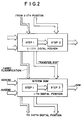
- Fig. 3 illustrates a specific operative example of the circuit arrangement of an adder of one digit of a radix-2 Signed-Digit adder, shown in Fig. 2, which performs an addition in accordance with the above-described rules of addition. More specifically, Fig. 3 shows an example of the adder in which each digit formed by any one of three values -1, 0 and +1 of the radix-2 Signed-Digit redundancy representation is represented by a binary code, as depicted below in Table 3, and the rules of addition shown in Tables 1 and 2 are employed.
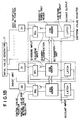
- Fig. 1A illustrates in block form a basic arrangement of a counter embodying the present invention and Fig. 1B an arrangement including an initial value generator.
- each digit unit 5 of the counter is formed by a radix-2 Signed-Digit adder 1, an initial value register 2 for presetting an initial value, an interim value register 3 for holding an interim value during the counting operation and an initial value and interim value selector 4 for switching between the initial value and the interim value.
- Reference numeral 10 indicates a count input, 11 a count output, 12 an addend input, 13 an Augend input, 14 an interim value input, 15 a transfer digit, and 16 a carry classification.
- an initial value Prior to the counting operation an initial value is preset.
- the initial value is precalculated from a count value so that an overflow can be detected at a specified digital position when the count has advanced by a desired value.
- radix-2 Signed-Digit redundancy representation may be used for a value p ( 2 q-1 ⁇ p ⁇ 2 q - 1 ) which is preset as the initial value for the counter, the accumulated value obtained by repeatedly adding +1 (+1 only at the least significant digital position and 0s at all the other (n - 1) digital positions in the radix-2 Signed-Digit redundancy representation of n-digit length) through application of the rules of addition shown in Tables 1 and 2 should be represented in the same form as the accumulated value obtained at a point 2 q + 1 in Table 5, that is, the accumulated value obtained by repeatedly adding +1 (+1 only at the least significant digital position and 0s at all the other (n - 1) digital positions in the radix-2 Signed-Digit redundancy representation of n-digit length) to the initial value 0 (0s at all n-digits in the radix-2 Signed -Digit redundancy representation of n
- each digit of the preset value represented by an ordinary 2's complement is replaced with a digit represented by the radix-2 Signed-Digit redundancy code (namely, the value 0 or 1 of each digit represented by the 2's complement is replaced with 0 or +1, respectively, in the radix-2 Signed redundancy representation).
- dots indicate that the value of the digit is equal to those of the higher adjacent and lower adjacent digits. In the above, dots indicates that the value of the digit is equal to those of the higher adjacent and lower adjacent digits.
- the values k and ⁇ k and the preset value are calculated from the desired count value A by the above-described method. Based on the values thus obtained, the counter shown in Fig. 1 is formed by digit units of (k + 1) digits so that n equals k.
- An interim value register 3 is synchronized with counting pulses from a count input 10 and is supplied with a new interim value which is the result of addition obtained by a radix-2 Signed-Digit adder 1, from an interim value input 14, and updates this interim value.
- An addend input 12 of the radix-2 Signed-Digit adder 1 for each digit is fixedly supplied with "+1" at the least significant digital position and "0s" at the other digital positions (corresponding to a value 1 as a whole). Accordingly, by adding the value 1 in the radix-2 Signed-Digit redundancy representation to the value of an augend input 13, which is also the output of an initial value and interim value selector 4, which is called an increment operation is realized, thereby performing a count-up operation of the counter.
- the most significant digital position of an interim value register 4 is used as a count output 11 and a control signal for the initial value and interim value selector 4.
- the most significant digital position is "+1"
- the initial value and interim value selector 4 selects the output value of the initial value register 2, and, at the same time, generates a count end pulse to the count output 11.
- the most significant digital position is "0”
- the initial value and interim value selector 4 selects the output value of the interim value register 3 and sends it to the addend input 12 of the radix-2 Signed-Digit adder 1 without generating count end pulse to the count output 11.
- the preset value ( ⁇ k - A) calculated from the desired count value A by the afore-said method is generated by an initial value generator 17 and the stored into the initial value register 2. Moreover, "+1" in the radix-2 Signed-Digit redundancy representation is stored into the interim value register 2, for each digit, prior to the counting operation.
- the counter Upon application of the count pulse arrived at the count input, the counter starts counting (time t ⁇ 0).
- the initial value and interim value selector 4 selects the output value of the initial value register 2, which is sent to the augend input 13 of the radix-2 Signed-Digit adder 1.
- To the addend input 12 are sent "+1" at the least significant digital position and "0s" at the other digital positions, and the result of addition is provided to an interim value input 14 of the interim value register 3.
- the initial value and interim value selector 4 selects the output value of the interim value register 3 and provides it to the augend input 13 of the radix-2 Signed Digit adder 1.
- the initial value to be preset can easily be precalculated by subtracting the count value from the value at which an overflow occurs.
- the counter of the present invention does not include a circuit of a large fan-in even if the count value is large. Also in the case where the counter is formed by a CMOS, which has generally a small fan-in limit but is widely used in a large scale integrated circuit because of its small power dissipation logic circuit, the counter can operate at high speed with a certain delay time of operation, regardless of an increase in the desired count value.
- CMOS complementary metal-oxide
- the counter can operate at high speed with a certain delay time of operation, regardless of an increase in the desired count value.
- a Signed-Digit adder For a radix-2 Signed-Digit adder, it is possible to calculate a value at which an overflow occurs at each digital position and to precalculate the initial value corresponding to the count value, through use of an iteration equation based on the rules of addition by using a Signed-Digit arithmetic technique. Accordingly, a Signed-Digit counter of high-speed operation can be realized by the radix-2 Signed-Digit adder, the initial value register and the interim value register and the initial value and interim value selector.
- the counter of the present invention does not include a circuit of a large fan-in limit even if the desired count value increases, the counter, even if formed by the CMOS logic circuit or the like, can operate at high speed, with a certain delay time of operation, regardless of an increase in the desired count value.
- a counter which is capable of performing a high-speed operation with a certain delay time of operation, regardless of an increase in the count value, can be provided through utilization of the radix-2 Signed-Digit redundancy representation.
Landscapes
- Complex Calculations (AREA)
Claims (4)
- Zähler, umfassend
einen Anfangswertgenerator zur Berechnung eines voreinzustellenden Anfangswertes;
einen Voreinstellschaltkreis zur Voreinstellung des Anfangswertes;
einen Zweierbasis-Addierschaltkreis mit vorzeichenbehafteten Ziffern, der ausgehend vom voreingestellten Anfangswert derart aufwärts zählt, daß bei jedem Aufwärtszählschritt +1 an der geringstwertigen Ziffernposition addiert wird, wobei der Addierschaltkreis aus einer Vielzahl von Ziffernpositionen aus Zweierbasis-Addierern für vorzeichenbehaftete Ziffern, einem Übertragszifferngenerator und einem Zwischensummengenerator besteht; und
einen Schaltkreis zur Feststellung eines Überlaufs an einer bestimmten Ziffernposition,
worin
der Anfangswertgenerator einen Wert ϑk gemäß den nachstehenden Gleichungen erzeugt, bei dem im Verlauf des Höchzählens von Null an an der bestimmten k-ten Ziffernposition ein Überlauf erfolgen würde:


und j gleich 0 oder gleich einer positiven Zahl,
und der weiterhin dem Voreinstell-Schaltkreis als Anfangswert das Ergebnis der Subtraktion des Wertes A von ϑk in derjenigen Zweierbasis-Darstellung mit vorzeichenbehafteten Ziffern liefert, die keinerlei Bits vom Wert "-1" enthält, mit

wobei A der gewünschte Zählwert ist, bei dem an der gewählten k-ten Ziffernposition der Überlauf erfolgt. - Ein Zähler nach Anspruch 1, worin an jeder Ziffernposition der betreffende Zweierbasis-Addierer mit vorzeichenbehafteten Ziffern eine erste Vorrichtung umfaßt, durch welche eine Übertragsziffer und eine Zwischensummenziffer, die beide Zwischenwerte sind, auf der Basis einer Übertragsklassifikation von der nächstniedrigeren Ziffernposition erzeugt werden, sowie eine zweite Vorrichtung, mit deren Hilfe die Übertragsziffer von der nächstniedrigeren Ziffernposition und die im Addierer erzeugte Zwischensummenziffer zu einer Summe addiert werden.
- Ein Zähler nach Anspruch 2, in dem für jede Ziffernposition die Übertragsklassifikation (c,
c ) aus den zu dieser Ziffernposition gehörigen Eingangswerten von Addend und Augend gemäß den in der nachfolgenden Tabelle dargestellten Klassifikationsverknüpfungen erzeugt werden:
- Ein Zähler nach Anspruch 2 oder 3, worin an jeder Ziffernposition die Zwischensummenziffer und die Übertragsziffer des betreffenden Zweierbasis-Addierers mit vorzeichenbehafteten Ziffern aus den zu dieser Ziffernposition gehörigen Eingangswerten von Addend und Augend und der Übertragsklassifikation von der nächstniedrigeren Ziffernposition gemäß den in der nachfolgenden Tabelle dargestellten Verknüpfungen für Übertragsziffer und Zwischensummenziffer erzeugt werden:
Addend Augend Übertragsklassifikation von der nächstniedrigeren Ziffernposition Übertragsziffer Zwischensummenziffer +1 -1 φ +1 0 +1 0 c +1 -1 0 +1 c 0 +1 0 0 φ 0 0 -1 +1 +1 -1 0 -1 c 0 -1 -1 0 c -1 +1 -1 -1 φ -1 0 c: +1 Übertrag von der nächstniedrigeren Ziffernposition tritt niemals auf.
c : -1 Übertrag von der nächstniedrigeren Ziffernposition tritt niemals auf.
φ: Übertragsklassifikation von der nächstniedrigeren Ziffernposition kann entweder c oderc sein.
Applications Claiming Priority (2)
| Application Number | Priority Date | Filing Date | Title |
|---|---|---|---|
| JP49616/87 | 1987-03-04 | ||
| JP62049616A JPH07120267B2 (ja) | 1987-03-04 | 1987-03-04 | カウンタ回路 |
Publications (3)
| Publication Number | Publication Date |
|---|---|
| EP0281094A2 EP0281094A2 (de) | 1988-09-07 |
| EP0281094A3 EP0281094A3 (en) | 1990-05-09 |
| EP0281094B1 true EP0281094B1 (de) | 1994-06-01 |
Family
ID=12836165
Family Applications (1)
| Application Number | Title | Priority Date | Filing Date |
|---|---|---|---|
| EP88103151A Expired - Lifetime EP0281094B1 (de) | 1987-03-04 | 1988-03-02 | Zähler |
Country Status (5)
| Country | Link |
|---|---|
| US (1) | US4837791A (de) |
| EP (1) | EP0281094B1 (de) |
| JP (1) | JPH07120267B2 (de) |
| CA (1) | CA1291267C (de) |
| DE (1) | DE3889746T2 (de) |
Families Citing this family (8)
| Publication number | Priority date | Publication date | Assignee | Title |
|---|---|---|---|---|
| JP2606326B2 (ja) * | 1988-10-25 | 1997-04-30 | 日本電気株式会社 | 乗算器 |
| JPH07120929B2 (ja) * | 1990-10-29 | 1995-12-20 | 三菱電機株式会社 | パルス発生回路 |
| RU2151463C1 (ru) * | 1997-09-23 | 2000-06-20 | Российский Федеральный Ядерный Центр - Всероссийский Научно-Исследовательский Институт Экспериментальной Физики | Устройство для счета импульсов |
| KR100308205B1 (ko) * | 1998-09-29 | 2001-11-30 | 윤종용 | 저전력소모카운터 |
| RU2179784C2 (ru) * | 2000-04-07 | 2002-02-20 | Пензенский технологический институт | Реверсивный счетчик импульсов с переменным модулем счета |
| US7397056B2 (en) * | 2005-07-06 | 2008-07-08 | Asml Netherlands B.V. | Lithographic apparatus, contaminant trap, and device manufacturing method |
| US7830729B2 (en) * | 2007-06-15 | 2010-11-09 | Micron Technology, Inc. | Digital filters with memory |
| US8667045B1 (en) * | 2011-05-11 | 2014-03-04 | Altera Corporation | Generalized parallel counter structures in logic devices |
Family Cites Families (9)
| Publication number | Priority date | Publication date | Assignee | Title |
|---|---|---|---|---|
| US3375358A (en) * | 1965-08-30 | 1968-03-26 | Fabri Tek Inc | Binary arithmetic network |
| US3462589A (en) * | 1965-12-22 | 1969-08-19 | Bell Telephone Labor Inc | Parallel digital arithmetic unit utilizing a signed-digit format |
| US3946219A (en) * | 1974-12-24 | 1976-03-23 | Veeder Industries, Inc. | Multiple purpose electronic counting system |
| JPS5674774A (en) * | 1979-11-22 | 1981-06-20 | Nec Corp | Arithmetic circuit with overflow detector |
| JPS5686535A (en) * | 1979-12-17 | 1981-07-14 | Fujitsu Ltd | Program counter circuit |
| US4751631A (en) * | 1983-02-04 | 1988-06-14 | Signal Processing Systems, Inc. | Apparatus for fast generation of signal sequences |
| US4700325A (en) * | 1984-02-08 | 1987-10-13 | Hewlett-Packard Company | Binary tree calculations on monolithic integrated circuits |
| JPS6126332U (ja) * | 1984-07-20 | 1986-02-17 | カルソニックカンセイ株式会社 | 積算計回路 |
| US4623982A (en) * | 1985-06-10 | 1986-11-18 | Hewlett-Packard Company | Conditional carry techniques for digital processors |
-
1987
- 1987-03-04 JP JP62049616A patent/JPH07120267B2/ja not_active Expired - Fee Related
-
1988
- 1988-02-29 US US07/162,096 patent/US4837791A/en not_active Expired - Fee Related
- 1988-03-02 DE DE3889746T patent/DE3889746T2/de not_active Expired - Fee Related
- 1988-03-02 EP EP88103151A patent/EP0281094B1/de not_active Expired - Lifetime
- 1988-03-03 CA CA000560385A patent/CA1291267C/en not_active Expired
Non-Patent Citations (2)
| Title |
|---|
| J.Markus, "Modern Electronic Circuits Reference Manual", McGraw-Hill 1980, page 239, circuit "Calculator/Counter" * |
| U.Tietze and Ch.Schenk, "Halbleiter-Schaltungstechnik", 5th edition, Springer Verlag, Berlin Heidelberg New York, 1980, pages 505-506 * |
Also Published As
| Publication number | Publication date |
|---|---|
| JPS63216132A (ja) | 1988-09-08 |
| CA1291267C (en) | 1991-10-22 |
| EP0281094A2 (de) | 1988-09-07 |
| EP0281094A3 (en) | 1990-05-09 |
| DE3889746T2 (de) | 1994-09-08 |
| DE3889746D1 (de) | 1994-07-07 |
| US4837791A (en) | 1989-06-06 |
| JPH07120267B2 (ja) | 1995-12-20 |
Similar Documents
| Publication | Publication Date | Title |
|---|---|---|
| US5978827A (en) | Arithmetic processing | |
| US4616330A (en) | Pipelined multiply-accumulate unit | |
| US3711692A (en) | Determination of number of ones in a data field by addition | |
| US3636334A (en) | Parallel adder with distributed control to add a plurality of binary numbers | |
| CA1332196C (en) | Radix-16 divider using overlapped quotient bit selection and concurrent quotient rounding and correction | |
| US5132925A (en) | Radix-16 divider using overlapped quotient bit selection and concurrent quotient rounding and correction | |
| EP0416869B1 (de) | Digitaler Addierer/Akkumulator | |
| JPS5650439A (en) | Binary multiplier cell circuit | |
| US4683548A (en) | Binary MOS ripple-carry parallel adder/subtracter and adder/subtracter stage suitable therefor | |
| US3603776A (en) | Binary batch adder utilizing threshold counters | |
| US5177703A (en) | Division circuit using higher radices | |
| US4837791A (en) | Counter | |
| US4623872A (en) | Circuit for CSD-coding of a binary number represented in two's complement | |
| EP0467524B1 (de) | Übertragvorgriffsaddierer | |
| EP0109137A2 (de) | Teilproduktakkumulation in Hochleistungsmultipliziern | |
| US4503512A (en) | Cellular division circuit | |
| EP0332215A2 (de) | Operationsschaltung für auf die Fliesskommadarstellung basierenden Operanden | |
| US3982112A (en) | Recursive numerical processor | |
| EP0822481A1 (de) | Konstantteiler | |
| EP0442220B1 (de) | Dekodierer | |
| JP3137131B2 (ja) | 浮動小数点乗算器及び乗算方法 | |
| US3705299A (en) | Circuit arrangement for converting a decimal number coded in the bcd code into a pure binary number | |
| SU1179322A1 (ru) | Устройство дл умножени двух чисел | |
| SU1803913A1 (en) | Division device | |
| EP0213854A2 (de) | Serielle Festkoeffizientmultiplikation und Digitalschaltungen zu deren Ausführung |
Legal Events
| Date | Code | Title | Description |
|---|---|---|---|
| PUAI | Public reference made under article 153(3) epc to a published international application that has entered the european phase |
Free format text: ORIGINAL CODE: 0009012 |
|
| AK | Designated contracting states |
Kind code of ref document: A2 Designated state(s): DE FR GB |
|
| PUAL | Search report despatched |
Free format text: ORIGINAL CODE: 0009013 |
|
| AK | Designated contracting states |
Kind code of ref document: A3 Designated state(s): DE FR GB |
|
| 17P | Request for examination filed |
Effective date: 19900823 |
|
| 17Q | First examination report despatched |
Effective date: 19920408 |
|
| GRAA | (expected) grant |
Free format text: ORIGINAL CODE: 0009210 |
|
| AK | Designated contracting states |
Kind code of ref document: B1 Designated state(s): DE FR GB |
|
| REF | Corresponds to: |
Ref document number: 3889746 Country of ref document: DE Date of ref document: 19940707 |
|
| ET | Fr: translation filed | ||
| PLBE | No opposition filed within time limit |
Free format text: ORIGINAL CODE: 0009261 |
|
| STAA | Information on the status of an ep patent application or granted ep patent |
Free format text: STATUS: NO OPPOSITION FILED WITHIN TIME LIMIT |
|
| 26N | No opposition filed | ||
| REG | Reference to a national code |
Ref country code: FR Ref legal event code: CA |
|
| PGFP | Annual fee paid to national office [announced via postgrant information from national office to epo] |
Ref country code: GB Payment date: 19980102 Year of fee payment: 11 |
|
| PGFP | Annual fee paid to national office [announced via postgrant information from national office to epo] |
Ref country code: FR Payment date: 19980311 Year of fee payment: 11 |
|
| PGFP | Annual fee paid to national office [announced via postgrant information from national office to epo] |
Ref country code: DE Payment date: 19980326 Year of fee payment: 11 |
|
| PG25 | Lapsed in a contracting state [announced via postgrant information from national office to epo] |
Ref country code: GB Free format text: LAPSE BECAUSE OF NON-PAYMENT OF DUE FEES Effective date: 19990302 |
|
| GBPC | Gb: european patent ceased through non-payment of renewal fee |
Effective date: 19990302 |
|
| PG25 | Lapsed in a contracting state [announced via postgrant information from national office to epo] |
Ref country code: FR Free format text: LAPSE BECAUSE OF NON-PAYMENT OF DUE FEES Effective date: 19991130 |
|
| REG | Reference to a national code |
Ref country code: FR Ref legal event code: ST |
|
| PG25 | Lapsed in a contracting state [announced via postgrant information from national office to epo] |
Ref country code: DE Free format text: LAPSE BECAUSE OF NON-PAYMENT OF DUE FEES Effective date: 20000101 |