EP0282096A2 - Poly(dinaphthylaryleneether) und seine Herstellung - Google Patents
Poly(dinaphthylaryleneether) und seine Herstellung Download PDFInfo
- Publication number
- EP0282096A2 EP0282096A2 EP88103958A EP88103958A EP0282096A2 EP 0282096 A2 EP0282096 A2 EP 0282096A2 EP 88103958 A EP88103958 A EP 88103958A EP 88103958 A EP88103958 A EP 88103958A EP 0282096 A2 EP0282096 A2 EP 0282096A2
- Authority
- EP
- European Patent Office
- Prior art keywords
- range
- polymer
- group
- integer
- naphthoxy
- Prior art date
- Legal status (The legal status is an assumption and is not a legal conclusion. Google has not performed a legal analysis and makes no representation as to the accuracy of the status listed.)
- Withdrawn
Links
Images
Classifications
-
- C—CHEMISTRY; METALLURGY
- C08—ORGANIC MACROMOLECULAR COMPOUNDS; THEIR PREPARATION OR CHEMICAL WORKING-UP; COMPOSITIONS BASED THEREON
- C08G—MACROMOLECULAR COMPOUNDS OBTAINED OTHERWISE THAN BY REACTIONS ONLY INVOLVING UNSATURATED CARBON-TO-CARBON BONDS
- C08G77/00—Macromolecular compounds obtained by reactions forming a linkage containing silicon with or without sulfur, nitrogen, oxygen or carbon in the main chain of the macromolecule
- C08G77/48—Macromolecular compounds obtained by reactions forming a linkage containing silicon with or without sulfur, nitrogen, oxygen or carbon in the main chain of the macromolecule in which at least two but not all the silicon atoms are connected by linkages other than oxygen atoms
- C08G77/50—Macromolecular compounds obtained by reactions forming a linkage containing silicon with or without sulfur, nitrogen, oxygen or carbon in the main chain of the macromolecule in which at least two but not all the silicon atoms are connected by linkages other than oxygen atoms by carbon linkages
- C08G77/52—Macromolecular compounds obtained by reactions forming a linkage containing silicon with or without sulfur, nitrogen, oxygen or carbon in the main chain of the macromolecule in which at least two but not all the silicon atoms are connected by linkages other than oxygen atoms by carbon linkages containing aromatic rings
-
- C—CHEMISTRY; METALLURGY
- C07—ORGANIC CHEMISTRY
- C07C—ACYCLIC OR CARBOCYCLIC COMPOUNDS
- C07C45/00—Preparation of compounds having >C = O groups bound only to carbon or hydrogen atoms; Preparation of chelates of such compounds
- C07C45/61—Preparation of compounds having >C = O groups bound only to carbon or hydrogen atoms; Preparation of chelates of such compounds by reactions not involving the formation of >C = O groups
- C07C45/67—Preparation of compounds having >C = O groups bound only to carbon or hydrogen atoms; Preparation of chelates of such compounds by reactions not involving the formation of >C = O groups by isomerisation; by change of size of the carbon skeleton
- C07C45/68—Preparation of compounds having >C = O groups bound only to carbon or hydrogen atoms; Preparation of chelates of such compounds by reactions not involving the formation of >C = O groups by isomerisation; by change of size of the carbon skeleton by increase in the number of carbon atoms
- C07C45/70—Preparation of compounds having >C = O groups bound only to carbon or hydrogen atoms; Preparation of chelates of such compounds by reactions not involving the formation of >C = O groups by isomerisation; by change of size of the carbon skeleton by increase in the number of carbon atoms by reaction with functional groups containing oxygen only in singly bound form
- C07C45/71—Preparation of compounds having >C = O groups bound only to carbon or hydrogen atoms; Preparation of chelates of such compounds by reactions not involving the formation of >C = O groups by isomerisation; by change of size of the carbon skeleton by increase in the number of carbon atoms by reaction with functional groups containing oxygen only in singly bound form being hydroxy groups
-
- C—CHEMISTRY; METALLURGY
- C08—ORGANIC MACROMOLECULAR COMPOUNDS; THEIR PREPARATION OR CHEMICAL WORKING-UP; COMPOSITIONS BASED THEREON
- C08G—MACROMOLECULAR COMPOUNDS OBTAINED OTHERWISE THAN BY REACTIONS ONLY INVOLVING UNSATURATED CARBON-TO-CARBON BONDS
- C08G61/00—Macromolecular compounds obtained by reactions forming a carbon-to-carbon link in the main chain of the macromolecule
- C08G61/12—Macromolecular compounds containing atoms other than carbon in the main chain of the macromolecule
Definitions
- High impact strength, high glass transition temperature (Tg), and resisitance to thermal degradation, are among the most desirable properties of commercially successful high performance resins.
- Polymers of arylene ether ketones and arylene ether sulfones, referred to as polyarylene polyethers and polyarylene polythioethers, together referred to herein as polyarylene poly(thio)ethers (PAPE) such as those disclosed in U.S. Patent No. 4,562,2243, rank high among polymers which have such desirable properties, particularly excellent thermal properties and impact strength.
- the emphasis has been to produce other aromatic polyethers which have even better properties, and might be even more economical to manufacture.
- thermoplastics of this kind having a Tg high enough for advanced aerospace applications, exceeding that obtainable with the aforesaid PAPE polymers.
- High Tg PAPE polymers would result from appropriate monomers containing fused aromatic rings, particularly if polymerization occurred through coupling of such rings. This invention describes the preparation of such polymers.
- the polymers of this invention are prepared by the well known Scholl reaction which is generally applied to the dehydrogenative condensation of aromatic compounds to yield dimers, or other relatively small molecules.
- the dehydrogenative condensations also referred to as "oxidative polymerization" can take place in either an inter- or an intramolecular way.
- Intermolecular Scholl reactions are numerous and include such reactions as the formation of biphenyl from benzene:
- oxidizing agents that can include certain transition metal salts, e.g. FeCl3 or CuCl2, or Lewis acid catalysts in oxidizing media, e.g. nitrobenzene.
- linking residue containing a polar group might lend itself to a successful Scholl polymerization.
- a di(4-naphthoxyphenyl) repeating unit linked with a polar residue, or a linking group containing a polar residue might yield a polymer with desirable properties.
- PAPE polyarylene polyether
- It is therefore a general object of this invention to provide homo- and copolymers (1) having a repeating unit in which a 4,4 ⁇ -di(1-naphthoxyphenyl) moiety is connected through its phenyl rings to a bivalent polar residue or moiety Y, thus: wherein, Y represents SO2, C O, S, O, -[O-SiR2] O, where R represents C1-C12 alkyl, C6-C10 aryl and C7-C18 aralkyl, m is an integer in the range from 1 to about 20, and, n is an integer in the range from 2 to about 500.
- Dehydrogenative condensation or oxidative polymerization of bis(naphthoxy) monomers produces rings competitively with linear chain extension, making it difficult to produce long chains.
- the extent to which long chains are formed is influenced by the linking or connecting group.
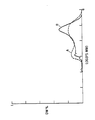
- Fig 1 there is shown a plot of logarithm of molecular weight (mw) relative to polystyrene, log(PS mw), against differential weight percent (DW %) made in accordance with ASTM test procedures D3536-76 and D3593-80, the disclosures of which are incorporated by reference thereto as if fully set forth herein.
- the plot is generated on a gel permeation chromatograph (GPC) so that the weight fraction of polymer having a particular mol wt may be determined for each of the foregoing polymerizations.
- GPC gel permeation chromatograph
- Curve A (dashed line), is a plot for the polymer from 2,2 ⁇ -bis(1-naphthoxy)biphenyl. It clearly shows two different mw populations separated by a valley in the curve. Considerable low mw polymer is present, with 37% of the total population being below 8,000. This is significant because the extent of ring formation is too great to be useful for making a high mol wt polymer economically. That this low mw fraction consists largely of cyclic oligomers is confirmed by size exclusion HPLC/MaSS spectrometry.
- Curve B (solid line), is a plot for the polymer from 4,4 ⁇ -di(1-naphthoxy)diphenyl sulfone, polymerized under the same conditions as those used for the foregoing 2,2 ⁇ -bis(1-naphthoxy)biphenyl plotted as curve A.
- Curve B also shows a bimodal distribution but only a relatively small low mw population. The major portion of the polymer has a mw greater than 10,000.
- crosslinking appears to originate from abnormal coupling of a growing chain end with one of the carbon atoms in another chain.
- the extent to which the connecting group influences crosslinking can only be determined by actual testing.
- the DNDPS was charged into a 100 ml glass vesel prepared from a 45/50 female glass joint.
- the head was prepared from the corresponding male joint and contains smaller joints for a paddle stirrer, thermowell, nitrogen inlet, and an additional funnel fitted with a gas bubbler.
- the flask was charged with monomer and nitrobenzene, vigorously stirred and equilibrated in a constant temperature bath.
- the system was purged with nitrogen and the ferric chloride solution delivered over a 30 min period. After stirring for 17 hr, the system was cooled and the reaction mixture added to 500 ml of rapidly stirred methanol.
- the larger of solid pieces of polymer formed were cut into smaller pieces and the solids resuspended in fresh methanol overnight. It was then filtered, and dried in a vacuum oven at 85°C.
- the polymerizations carried out at 30°C and 90°C gave 96 and 100% yields respectively. Both were cryogenically ground to a fine powder, and 3 g of each was vigorously stirred with chloroform for 24 hr.
- the volume of chloroform used was 45 ml for the polymer prepared at 30°C and 100 ml for the polymer prepared at 90°C. While 85% of the former was soluble, only 29% of the latter dissolved.
- the monomer (2) is prepared by the displacement of halide, X, from the 4,4 ⁇ -dihalophenyl end groups in the structure (3) wherein Y is a divalent, electron withdrawing group which activates the halogens toward displacement, with the postassium salt of 1-naphthol.
- X halide
- Y is a divalent, electron withdrawing group which activates the halogens toward displacement, with the postassium salt of 1-naphthol.
- the polymerization rate of the monomers is controlled by the amount and rate of addition of ferric chloride or other oxidant used, the stirring intensity of the polymerizing reaction mass, and reaction temperature. Other process variables can be, and may need to be varied depending upon the selection of Y.
- the polyether sulfones obtained from DNDPS and the polyether ketones obtained from DNBP are each soluble in conventional solvents such as chloroform and methylene chloride. They do not lose weight up to about 400°C (TGA) and have high Tgs in the range from about 250°C to about 300°C, which is higher than that for PAPE polymers produced by nucleophilic displacement, as taught in U.S. Patent Nos. 4,562,243; 4,634,742; and, 4,638,039.
- the mixture was reheated to 150-155°C as toluene was removed by distillation and maintained at that temperature for 6 hr.
- the mixture was then cooled to about room temperature, poured into 5 liters of stirred methanol containing 1 liter of water, filtered, and dried in a vacuum oven.
- the combined product from two such preparations was dissolved in toluene and passed through 200 g of Woelm N alumina.
- the solution was then heated to 70°C and hexane added until turbid. Cooling, finally in ice, gave the main crop of crystals.
- a second crop was obtained similarly, giving 277 g (0.556 mol), a yield of 85% having a melting point 154°C.
- a 2-liter creased resin flask was fitted with a glass cover containing ports for nitrogen, an addition funnel fitted with a gas bubbler, and a Teflon propeller stirrer.
- the flask was charged with 110 g (0.219 mol) of 4,4 ⁇ -di(1-naphthoxy)diphenyl sulfone (DNDPS) and purged with nitrogen.
- Nitrobenzene (440 ml) dried over 3A molecular sieves, was added.
- a solution of 115.3 g (0.7106 mol) of anhydrous FeCl3 was dissolved in 880 ml of dried nitrobenzene and charged to the addition funnel.
- the flask was thermally equilibrated at 30°C while vigorously stirred.
- the FeCl3 solution was added over a period of 43 min. Polymer precipitated during 17 hr of stirring.
- the nitrobenzene solution was decanted off and the polymer subdivided and stirred with 1 liter of chloroform containing 250 ml of water.
- the chloroform layer was separated, washed with additional water, and filtered under pressure.
- the filtrate was then precipitated from methanol using a draft tube. After filtering and drying in a vacuum oven at 125°C, 79.4 g of polymer was obtained.
- Precipitation of the nitrobenzene-soluble polymer gave an additional 9.5 g for a combined yield of 81%.
- the nitrobenzene insoluble polymer had Tg 284°C, Mw 68,700, Mn 11,900, peak 59,000 (polystyrene equivalents).
- DNBP was prepared by the etherification of 20 g (91.66 mmole) of 4,4 ⁇ -difluorobenzophenone with 33.04 g (229.15 mmole) of 1-naphthol in the presence of 34.83 g (252.06 mmole) of K2CO3 in dimethylacetamide under reaction conditions generally analogous to those set forth hereinabove for synthesis of DNDPS.
- the product was crystallized from 1/4, v/v acetone/methanol and has m p 108.8°C. The yield was 91%.
- the above structure was confirmed by 1H-NMR spectrographic analysis.
- the polymerization of DNBP is carried out in a manner analogous to that described hereinabove for DNDPS, and the polymer obtained purified by conventional methods.
- a 500 ml, three-necked flask was fitted with an additional funnel, paddle stirrer, and thermometer.
- the flask was charged with 20.9 g (0.096 mol) of BNIB and 200 ml of dimethyl formamide (DMF).
- the mixture was stirred until a solution was developed.
- the amine (45.0 g, 0.192 mol), dissolved in 50 ml of DMF was placed in the addition funnel, and added to the stirred anhydride solution (mild exotherm). After 30 min, acetic anhydride (24.5 g, 0.24 mol) and sodium acetate (1.92 g) were added.
- the mixture was heated to 50°C. Solid began to separate from solution.
- a 100 ml, three-necked flask equipped with a nitrogen inlet, gas bubbler, and magnetic stirrer bar was purged with nitrogen and charged with 50 ml of dry dimethylacetamide containing 3.00 g (6.40 mmols) of 4,4 ⁇ -di[4-aminophenoxy-1-naphthyl].
- To the stirred solution was added 1.40 g (6.40) mmols) of BNIB. The solution was stirred for 24 hr at room temperature.
- Polymer films are obtained by casting the solution on glass plates and drying in air followed by further drying and dehydration to the polyimide in an oven in temperature stages ending at 300°C.
- Example 7 Synthesis of polyimide having the structure (1) wherein
- the polymer is prepared in a manner analogous to that described hereinabove in Example 6, employing 2.06 g of 3,3 ⁇ ,4,4 ⁇ -benzophenone tetracarboxylic dianhydride, casting on a glass plate, and drying in an air oven at temperature stages ending at 300°C.
- a 500 ml, three-necked flask was fitted with a magnetic stirrer, nitrogen inlet, and a Dean-Stark strap with a gas bubbler mounted on the water cooled condenser.
- the flask was charged with 60.0 g (0.254 mol) of 4-(1-naphthoxy)phenol and 300 ml of toluene.
- the solution was stirred under nitrogen while water was rigorously removed by azeotropic distillation.
- the solution was cooled and 0.127 mol of dimethyldichlorosilane was slowly added. HCl was purged from the system.
- the monomer was recovered by concentrating the solution on a rotary evaporator at 80°C, and the product allowed to crystallize on cooling.
- the monomer is polymerized in a manner analogous to that described in Example 2 hereinabove.
- the structure of the polymer was confirmed by 1H-NMR spectrographic analysis.
Landscapes
- Chemical & Material Sciences (AREA)
- Organic Chemistry (AREA)
- Chemical Kinetics & Catalysis (AREA)
- Health & Medical Sciences (AREA)
- Medicinal Chemistry (AREA)
- Polymers & Plastics (AREA)
- Polyethers (AREA)
- Polyoxymethylene Polymers And Polymers With Carbon-To-Carbon Bonds (AREA)
Applications Claiming Priority (2)
| Application Number | Priority Date | Filing Date | Title |
|---|---|---|---|
| US07/025,544 US4806617A (en) | 1987-03-13 | 1987-03-13 | Poly(dinaphthyl arylene ether) and preparation thereof |
| US25544 | 1987-03-13 |
Publications (2)
| Publication Number | Publication Date |
|---|---|
| EP0282096A2 true EP0282096A2 (de) | 1988-09-14 |
| EP0282096A3 EP0282096A3 (de) | 1988-10-26 |
Family
ID=21826704
Family Applications (1)
| Application Number | Title | Priority Date | Filing Date |
|---|---|---|---|
| EP88103958A Withdrawn EP0282096A3 (de) | 1987-03-13 | 1988-03-12 | Poly(dinaphthylaryleneether) und seine Herstellung |
Country Status (3)
| Country | Link |
|---|---|
| US (1) | US4806617A (de) |
| EP (1) | EP0282096A3 (de) |
| JP (1) | JPS6454025A (de) |
Cited By (5)
| Publication number | Priority date | Publication date | Assignee | Title |
|---|---|---|---|---|
| WO1990000573A1 (en) * | 1988-07-05 | 1990-01-25 | Raychem Limited | Ethersulphone polymers |
| WO1991009070A1 (en) * | 1989-12-08 | 1991-06-27 | Raychem Corporation | Fluorinated poly(naphthyl ethers) |
| EP0413662A3 (en) * | 1989-08-15 | 1991-10-23 | Ciba-Geigy Ag | Polyaryleneethers |
| US5145936A (en) * | 1989-12-08 | 1992-09-08 | Raychem Corporation | Fluorinated poly (naphthyl ether) |
| US5256826A (en) * | 1991-09-19 | 1993-10-26 | Basf Aktiengesellschaft | Preparation of aromatic carbonyl or sulfonyl compounds with an aryl ether structure |
Families Citing this family (2)
| Publication number | Priority date | Publication date | Assignee | Title |
|---|---|---|---|---|
| GB8725886D0 (en) * | 1987-11-04 | 1987-12-09 | Raychem Ltd | Poly(ar-lene ether ketones) |
| US6791144B1 (en) | 2000-06-27 | 2004-09-14 | International Business Machines Corporation | Thin film transistor and multilayer film structure and manufacturing method of same |
Family Cites Families (2)
| Publication number | Priority date | Publication date | Assignee | Title |
|---|---|---|---|---|
| GB1365394A (en) * | 1971-05-21 | 1974-09-04 | Ici Ltd | Aromatic polyethers |
| UST932004I4 (en) * | 1971-05-21 | 1975-03-04 | Defensive publication |
-
1987
- 1987-03-13 US US07/025,544 patent/US4806617A/en not_active Expired - Fee Related
-
1988
- 1988-03-12 EP EP88103958A patent/EP0282096A3/de not_active Withdrawn
- 1988-03-14 JP JP63058545A patent/JPS6454025A/ja active Pending
Cited By (6)
| Publication number | Priority date | Publication date | Assignee | Title |
|---|---|---|---|---|
| WO1990000573A1 (en) * | 1988-07-05 | 1990-01-25 | Raychem Limited | Ethersulphone polymers |
| EP0413662A3 (en) * | 1989-08-15 | 1991-10-23 | Ciba-Geigy Ag | Polyaryleneethers |
| WO1991009070A1 (en) * | 1989-12-08 | 1991-06-27 | Raychem Corporation | Fluorinated poly(naphthyl ethers) |
| US5108840A (en) * | 1989-12-08 | 1992-04-28 | Raychem Corporation | Multilayer electronic circuit article having a poly(naphthyl ether) dielectric |
| US5145936A (en) * | 1989-12-08 | 1992-09-08 | Raychem Corporation | Fluorinated poly (naphthyl ether) |
| US5256826A (en) * | 1991-09-19 | 1993-10-26 | Basf Aktiengesellschaft | Preparation of aromatic carbonyl or sulfonyl compounds with an aryl ether structure |
Also Published As
| Publication number | Publication date |
|---|---|
| US4806617A (en) | 1989-02-21 |
| JPS6454025A (en) | 1989-03-01 |
| EP0282096A3 (de) | 1988-10-26 |
Similar Documents
| Publication | Publication Date | Title |
|---|---|---|
| EP0243997B1 (de) | Herstellung von Polyarylenetherketonen | |
| CA1241795A (en) | Polyarylnitrile polymers and a method for their production | |
| US4374974A (en) | Method for making polyformals and polyformal products made thereby | |
| US4806617A (en) | Poly(dinaphthyl arylene ether) and preparation thereof | |
| US4474932A (en) | Process for the production of aromatic ethers and aromatic polyethers | |
| JPS63500384A (ja) | ポリ(アリ−ルエ−テルケトン)を含有するブロック重合体類とその製法 | |
| CA1077648A (en) | Preparation of aromatic polymer | |
| EP0407386A1 (de) | Herstellung von polyaryletherketonen | |
| JPS6354423A (ja) | アミノ末端ポリ(アリ−ルエ−テルケトン類) | |
| JPH0676491B2 (ja) | エーテル―ケトン―イミド芳香族ポリマー | |
| US4745225A (en) | Phosphorus-containing polyarylene ethers | |
| US5064929A (en) | Aromatic polyethers containing azo groups | |
| JPH0737525B2 (ja) | ブロツク共重合体の製造方法 | |
| JPH07118382A (ja) | ポリエ−テル樹脂及びその製造方法 | |
| Karim et al. | Synthesis and properties of poly (phenylacetylene) s with pendant imino groups | |
| US4764578A (en) | Compositions of polyaryloxypyridine oligomers with phthalonitrile end groups, their preparation and use for manufacturing polyaryloxypyridine co-phthalocyanine lattices | |
| Percec et al. | Functional polymers and sequential copolymers by phase transfer catalysis VII. synthesis and characterization of alternating block copolymers of aromatic poly (ether sulfone) s with aliphatic polysulfldes and aliphatic polysulfones | |
| WO1999021910A1 (en) | Optically active poly(aryl)ethers containing optically pure spirobiindane or indane moieties | |
| JPH0536452B2 (de) | ||
| Elce et al. | Novel fluorinated poly (aryl ether ketone) s | |
| Tingerthal et al. | Synthesis and characterization of ABA triblock copolymers containing poly (2, 6‐dimethyl‐1, 4‐phenylene oxide) as A blocks and tetramethyl bisphenol‐A polysulfone as B blocks | |
| EP0407714A2 (de) | Polyarylsulfone, abgeleitet von 1,4"-(Bishalophenylsulfon)terphenyl | |
| US3772248A (en) | Polyether/polyarylsulfones | |
| EP0267076A1 (de) | Zusammensetzungen von acetylenbeendeten Polyaryloxypyridinoligomeren, ihre Herstellung und die durch ihre thermische Polymerisation erhaltenen Gitter | |
| EP0423220A1 (de) | Polyäthersulfone |
Legal Events
| Date | Code | Title | Description |
|---|---|---|---|
| PUAI | Public reference made under article 153(3) epc to a published international application that has entered the european phase |
Free format text: ORIGINAL CODE: 0009012 |
|
| PUAL | Search report despatched |
Free format text: ORIGINAL CODE: 0009013 |
|
| AK | Designated contracting states |
Kind code of ref document: A2 Designated state(s): AT BE DE FR GB IT SE |
|
| AK | Designated contracting states |
Kind code of ref document: A3 Designated state(s): AT BE DE FR GB IT SE |
|
| 17P | Request for examination filed |
Effective date: 19890321 |
|
| 17Q | First examination report despatched |
Effective date: 19910701 |
|
| STAA | Information on the status of an ep patent application or granted ep patent |
Free format text: STATUS: THE APPLICATION IS DEEMED TO BE WITHDRAWN |
|
| 18D | Application deemed to be withdrawn |
Effective date: 19911112 |