EP0284526A1 - Verfahren und Anlage zur Wiedergewinnung von bedruckten Altpapieren - Google Patents
Verfahren und Anlage zur Wiedergewinnung von bedruckten Altpapieren Download PDFInfo
- Publication number
- EP0284526A1 EP0284526A1 EP19880420086 EP88420086A EP0284526A1 EP 0284526 A1 EP0284526 A1 EP 0284526A1 EP 19880420086 EP19880420086 EP 19880420086 EP 88420086 A EP88420086 A EP 88420086A EP 0284526 A1 EP0284526 A1 EP 0284526A1
- Authority
- EP
- European Patent Office
- Prior art keywords
- paste
- ink
- washing
- flotation
- installation
- Prior art date
- Legal status (The legal status is an assumption and is not a legal conclusion. Google has not performed a legal analysis and makes no representation as to the accuracy of the status listed.)
- Granted
Links
- 238000000034 method Methods 0.000 title claims abstract description 31
- 238000004064 recycling Methods 0.000 title claims abstract description 12
- 239000002699 waste material Substances 0.000 title abstract 2
- 238000005188 flotation Methods 0.000 claims abstract description 54
- 238000005406 washing Methods 0.000 claims abstract description 35
- 239000003643 water by type Substances 0.000 claims abstract description 19
- 239000000725 suspension Substances 0.000 claims abstract description 18
- 239000000835 fiber Substances 0.000 claims abstract description 15
- 239000000945 filler Substances 0.000 claims abstract description 12
- 229920001131 Pulp (paper) Polymers 0.000 claims abstract description 5
- XLYOFNOQVPJJNP-UHFFFAOYSA-N water Substances O XLYOFNOQVPJJNP-UHFFFAOYSA-N 0.000 claims description 30
- 239000000463 material Substances 0.000 claims description 27
- 238000009434 installation Methods 0.000 claims description 26
- 238000004061 bleaching Methods 0.000 claims description 11
- 239000000126 substance Substances 0.000 claims description 7
- 230000008030 elimination Effects 0.000 claims description 5
- 238000003379 elimination reaction Methods 0.000 claims description 5
- 235000011837 pasties Nutrition 0.000 claims description 5
- 238000002156 mixing Methods 0.000 claims description 3
- 230000002087 whitening effect Effects 0.000 claims description 3
- 239000010893 paper waste Substances 0.000 claims description 2
- 239000007787 solid Substances 0.000 claims description 2
- 230000000712 assembly Effects 0.000 claims 1
- 238000000429 assembly Methods 0.000 claims 1
- 239000000976 ink Substances 0.000 description 33
- 239000002761 deinking Substances 0.000 description 15
- HEMHJVSKTPXQMS-UHFFFAOYSA-M Sodium hydroxide Chemical compound [OH-].[Na+] HEMHJVSKTPXQMS-UHFFFAOYSA-M 0.000 description 9
- MHAJPDPJQMAIIY-UHFFFAOYSA-N Hydrogen peroxide Chemical compound OO MHAJPDPJQMAIIY-UHFFFAOYSA-N 0.000 description 8
- 230000008719 thickening Effects 0.000 description 8
- 239000000203 mixture Substances 0.000 description 7
- 239000003153 chemical reaction reagent Substances 0.000 description 6
- 239000004115 Sodium Silicate Substances 0.000 description 3
- 239000012071 phase Substances 0.000 description 3
- NTHWMYGWWRZVTN-UHFFFAOYSA-N sodium silicate Chemical compound [Na+].[Na+].[O-][Si]([O-])=O NTHWMYGWWRZVTN-UHFFFAOYSA-N 0.000 description 3
- 229910052911 sodium silicate Inorganic materials 0.000 description 3
- UDHXJZHVNHGCEC-UHFFFAOYSA-N Chlorophacinone Chemical compound C1=CC(Cl)=CC=C1C(C=1C=CC=CC=1)C(=O)C1C(=O)C2=CC=CC=C2C1=O UDHXJZHVNHGCEC-UHFFFAOYSA-N 0.000 description 2
- 239000002671 adjuvant Substances 0.000 description 2
- 238000010790 dilution Methods 0.000 description 2
- 239000012895 dilution Substances 0.000 description 2
- 239000008396 flotation agent Substances 0.000 description 2
- 239000011343 solid material Substances 0.000 description 2
- 238000001665 trituration Methods 0.000 description 2
- 238000011144 upstream manufacturing Methods 0.000 description 2
- XZMCDFZZKTWFGF-UHFFFAOYSA-N Cyanamide Chemical compound NC#N XZMCDFZZKTWFGF-UHFFFAOYSA-N 0.000 description 1
- YZCKVEUIGOORGS-IGMARMGPSA-N Protium Chemical compound [1H] YZCKVEUIGOORGS-IGMARMGPSA-N 0.000 description 1
- CDBYLPFSWZWCQE-UHFFFAOYSA-L Sodium Carbonate Chemical compound [Na+].[Na+].[O-]C([O-])=O CDBYLPFSWZWCQE-UHFFFAOYSA-L 0.000 description 1
- 239000005708 Sodium hypochlorite Substances 0.000 description 1
- 239000000654 additive Substances 0.000 description 1
- 239000007900 aqueous suspension Substances 0.000 description 1
- 239000013043 chemical agent Substances 0.000 description 1
- 230000003749 cleanliness Effects 0.000 description 1
- 230000000295 complement effect Effects 0.000 description 1
- 239000000356 contaminant Substances 0.000 description 1
- 230000001955 cumulated effect Effects 0.000 description 1
- 235000014113 dietary fatty acids Nutrition 0.000 description 1
- 239000006185 dispersion Substances 0.000 description 1
- 239000000194 fatty acid Substances 0.000 description 1
- 229930195729 fatty acid Natural products 0.000 description 1
- 150000004665 fatty acids Chemical class 0.000 description 1
- 239000002657 fibrous material Substances 0.000 description 1
- 239000006260 foam Substances 0.000 description 1
- 238000005194 fractionation Methods 0.000 description 1
- 238000002955 isolation Methods 0.000 description 1
- 238000004900 laundering Methods 0.000 description 1
- 239000007791 liquid phase Substances 0.000 description 1
- 238000004519 manufacturing process Methods 0.000 description 1
- 239000002736 nonionic surfactant Substances 0.000 description 1
- 230000001590 oxidative effect Effects 0.000 description 1
- 150000002978 peroxides Chemical class 0.000 description 1
- 229920000867 polyelectrolyte Polymers 0.000 description 1
- 239000002994 raw material Substances 0.000 description 1
- 238000004062 sedimentation Methods 0.000 description 1
- 239000010802 sludge Substances 0.000 description 1
- JVBXVOWTABLYPX-UHFFFAOYSA-L sodium dithionite Chemical compound [Na+].[Na+].[O-]S(=O)S([O-])=O JVBXVOWTABLYPX-UHFFFAOYSA-L 0.000 description 1
- SUKJFIGYRHOWBL-UHFFFAOYSA-N sodium hypochlorite Chemical compound [Na+].Cl[O-] SUKJFIGYRHOWBL-UHFFFAOYSA-N 0.000 description 1
- 239000003381 stabilizer Substances 0.000 description 1
- 239000002562 thickening agent Substances 0.000 description 1
- 230000000699 topical effect Effects 0.000 description 1
- 238000010792 warming Methods 0.000 description 1
Images


Classifications
-
- D—TEXTILES; PAPER
- D21—PAPER-MAKING; PRODUCTION OF CELLULOSE
- D21C—PRODUCTION OF CELLULOSE BY REMOVING NON-CELLULOSE SUBSTANCES FROM CELLULOSE-CONTAINING MATERIALS; REGENERATION OF PULPING LIQUORS; APPARATUS THEREFOR
- D21C5/00—Other processes for obtaining cellulose, e.g. cooking cotton linters ; Processes characterised by the choice of cellulose-containing starting materials
- D21C5/02—Working-up waste paper
- D21C5/025—De-inking
-
- D—TEXTILES; PAPER
- D21—PAPER-MAKING; PRODUCTION OF CELLULOSE
- D21B—FIBROUS RAW MATERIALS OR THEIR MECHANICAL TREATMENT
- D21B1/00—Fibrous raw materials or their mechanical treatment
- D21B1/04—Fibrous raw materials or their mechanical treatment by dividing raw materials into small particles, e.g. fibres
- D21B1/12—Fibrous raw materials or their mechanical treatment by dividing raw materials into small particles, e.g. fibres by wet methods, by the use of steam
- D21B1/30—Defibrating by other means
- D21B1/32—Defibrating by other means of waste paper
-
- D—TEXTILES; PAPER
- D21—PAPER-MAKING; PRODUCTION OF CELLULOSE
- D21B—FIBROUS RAW MATERIALS OR THEIR MECHANICAL TREATMENT
- D21B1/00—Fibrous raw materials or their mechanical treatment
- D21B1/04—Fibrous raw materials or their mechanical treatment by dividing raw materials into small particles, e.g. fibres
- D21B1/12—Fibrous raw materials or their mechanical treatment by dividing raw materials into small particles, e.g. fibres by wet methods, by the use of steam
- D21B1/30—Defibrating by other means
- D21B1/32—Defibrating by other means of waste paper
- D21B1/325—Defibrating by other means of waste paper de-inking devices
-
- Y—GENERAL TAGGING OF NEW TECHNOLOGICAL DEVELOPMENTS; GENERAL TAGGING OF CROSS-SECTIONAL TECHNOLOGIES SPANNING OVER SEVERAL SECTIONS OF THE IPC; TECHNICAL SUBJECTS COVERED BY FORMER USPC CROSS-REFERENCE ART COLLECTIONS [XRACs] AND DIGESTS
- Y02—TECHNOLOGIES OR APPLICATIONS FOR MITIGATION OR ADAPTATION AGAINST CLIMATE CHANGE
- Y02W—CLIMATE CHANGE MITIGATION TECHNOLOGIES RELATED TO WASTEWATER TREATMENT OR WASTE MANAGEMENT
- Y02W30/00—Technologies for solid waste management
- Y02W30/50—Reuse, recycling or recovery technologies
- Y02W30/64—Paper recycling
Definitions
- the invention relates to a new method for recycling old printed paper, in particular unselected; it also relates to an installation for the implementation of this process.
- this recycling requires two essential operations, namely an essential deinking operation, and an optional laundering operation.
- This last bleaching operation becomes essential when it is desired to obtain recycled pulps of a high level of whiteness.
- These two operations can be simultaneous or consecutive.
- deinking consists in unhooking the ink from the fibrous support during the suspension of the old paper in a pulper, in the presence of chemical reagents, in particular of alkaline reagents and this, at a consistency of between 5 and 15 %, then removing the ink from this pasty suspension, in particular by flotation or washing.
- Whitening consists in treating the dough with chemical agents which can either be oxidizing (hydrogen peroxide, sodium hypochlorite), or reducing (sodium hydrosulfite), in order to ennoble this dough or compensate for the loss of whiteness caused by alkaline treatment during deinking. Depending on the case, this bleaching can be carried out at high or low concentration.
- chemical agents which can either be oxidizing (hydrogen peroxide, sodium hypochlorite), or reducing (sodium hydrosulfite), in order to ennoble this dough or compensate for the loss of whiteness caused by alkaline treatment during deinking. Depending on the case, this bleaching can be carried out at high or low concentration.
- the waste paper is put in aqueous suspension by trituration in a pulper (1) in the absence of chemicals.
- the suspension is then purified (2) then thickened (3) to 25-30% and sent in a hot pulverizer type device (4) where it receives the treatment chemicals, steam and mechanical energy.
- the paste thus treated is then subjected to three successive washing-dilutions in thickeners (5,6 and 7) operating in countercurrent. In other words, the waters from these washes (5,6 and 7) are reused each time in the previous dilution. This gives a first paste P1 called "primary paste".
- the water from the first wash (5) is recovered, then subjected to a selective flotation treatment (8) which makes it possible to remove the ink (9), and gives a second paste P2 called "secondary paste"".
- This interesting process nevertheless has certain drawbacks: - on the one hand, there is only one phase of ink removal, which is often considered insufficient to obtain optimal deinking efficiency, - on the other hand, the selective flotation being carried out on waters containing all of the ink removed from the pulp, this limits the possibilities of completely eliminating the ink from the pulp P2, in particular in the case of treatment of heavily inked paper; -
- two pastes P1 and P2 are obtained, respectively, of very different quality, both in fiber composition and in whiteness. This generally requires a separate use of these two pastes and frequently it is not possible to use the paste P2 in isolation given its lower quality.
- the invention overcomes these drawbacks. It relates to a process for recycling old printed paper, by deinking, which makes it possible to increase the gain in whiteness, obtained with conventional deinking without significant increase in material losses, not to unnecessarily overload the installation and to obtain a only quality paste, containing most of the fibrous materials and reusable fillers.
- This process for improving the quality of de-inked pulp, obtained by recycling old printed paper, and in which: . said papers are transformed into a pasty suspension, . most of the ink is removed from this suspension, in particular by selective primary flotation of the ink, . and the de-inked paste is washed in order to remove the residual ink before sending it into the circuit for using the paste, is characterized in that the waters of this washing are first of all subjected to a selective secondary flotation to remove only the residual ink therefrom, the suspension of the remaining materials (fibers and fillers) then being mixed with the pulp resulting from the washing.
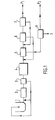
- the invention consists (see FIG. 3) in eliminating the ink in two stages. Firstly, most of the ink is eliminated in a conventional primary phase (11), in particular by flotation. Then after having washed (5) the deinking paste to extract the residual ink, the waters (24) of this washing (5) are subjected to a so-called secondary flotation (16), after which these waters are reused (18) for dilute the previously washed paste (15) (5).
- This secondary flotation can be carried out directly on the dough after the first flotation or after bleaching; in this case, the size of the installation would be significant since it would be necessary to treat all of the dough. On the other hand, if this flotation is carried out on the washing water, it can thus significantly reduce the size of the installation and also improve the treatment efficiency.
- the invention differs from the process described in document EP-A-0187909, on the one hand, by the fact that it is a complementary deinking known as "secondary" and on the other hand, by the fact that the purpose of the selective flotation operation is essentially to separate the residual ink from the rest of the solid materials (fibers and fillers) and not to extract all of the solid materials from the liquid phase.
- the washing operation is carried out by thickening on a partially deinking paste whose concentration at the inlet is at least 2%, preferably 2.5%, which makes it possible to obtain a higher concentration at the outlet. at 4%, advantageously at least 10% and more.
- the remaining materials (fibers, fillers) entrained with the washing water are of the order of 10 to 30%, preferably between 15 and 25%.
- the floated water (18) of the secondary flotation is then treated to separate: - On the one hand, the suspended matter (23) which is then mixed with the washed paste (15); - on the other hand, the water (20) containing the unconsumed chemicals which are then recycled at the head of the installation, in particular to the pulper.
- the secondary flotation characteristic of the invention is carried out with equipment known for this type of treatment. It is possible, for example, to use a conventional turbine cell, a cell with injectors, a cell with stepped diffusers or any type of selective flotation device.
- This flotation selects tive is made on water (24) from washing (5) of the dough already rid of most of its ink. These waters (24) therefore contain only the residual ink. The volume of these waters (24) is also lower than that of the pulp.
- This secondary selective flotation operation therefore requires, as already said, smaller equipment, less bulky and resulting in less investment. In this way, the process turns out to be much less expensive.
- the efficiency of the secondary flotation is improved and thereby the whiteness if, in known manner, suitable additives are incorporated into the washing water to be treated.
- the method according to the invention has many technical and economic advantages over those mentioned in the preamble. First of all, this process fits perfectly and easily into all existing flotation de-inking chains. It does not require the addition of additional washing water. Finally, between the entry and exit of the installation, the composition of the dough is not changed. As the secondary flotation step is carried out only on the residual ink extracted during washing, the materials in suspension in these waters have a cleanliness comparable to that of the washed paste produced and can therefore be incorporated therein, without harming the final whiteness .
- this process makes it possible to improve the whiteness of deinked pastes by flotation without causing a significant increase in losses, since the characteristic secondary flotation treatment, therefore with reduced losses, only applies to a fraction of the materials treated in the 'installation.
- FIG. 3 shows diagrammatically an installation according to the invention in its simplified version integrated in a conventional deinking chain, while a variant with clarifier is shown diagrammatically in FIG. 4.
- the invention also relates to an installation, shown in FIGS. 3 and 4, for the recycling treatment of want printed papers, of the type comprising in order: . a first set (1) of pasty suspension of these triturated old papers to unhook the ink from the fibers, . a second assembly (11) for primary elimination, in particular by flotation, for eliminating most of the ink (12) from the treated suspension, . a third set (5) for washing the dough, .
- a fourth assembly (14) for sending the treated paste P4 into the use circuit is characterized in that it also includes - Means for recovering the washing water (24) (5) of the de-inked paste which still contains residual ink, and for subjecting them to a selective secondary flotation (16) in order to eliminate (17) only this residual ink; - Means for then mixing the remaining materials (fibers and fillers) (18) from the secondary flotation (16) with the paste (15) from the washing (5).
- the installation also includes: - a set (4) for whitening the deinked dough, disposed between the second (11) and the third (5) sets - a device (see FIG. 4) arranged after the secondary flotation station (16), capable of separating: . suspended solids (fibers and fillers) to mix them (23) with the washed paste (14), . water containing non-consumed chemicals which are recycled (20) at the head of the installation (1).
- the treatment in the first pulper assembly (1) is carried out in the presence of a composition of reagents consisting of 1% by weight of sodium hydroxide, 2.5% by weight of sodium silicate, 0.6% by weight of fatty acid and 1.0% hydrogen peroxide.
- the temperature is maintained at around 45 ° C and the consistency of the dough is close to 6%.
- the suspension After defibering in the pulper (1) and stripping, the suspension is diluted, then is sent to the primary flotation assembly (11) to eliminate the ink in (12), for example in two vertical flotation cells. Flotation foam is eliminated in 12). The dough is then thickened on a vacuum filter (21). This paste has a whiteness of 57, measured like all the whiteness indicated in the description according to standard AFNOR Q 03-039.
- the thickened paste is diluted by adding white water and clear water to a consistency of 4%, then is thickened to 16% on an inclined screw.
- the whiteness of the thickened paste is then 60.5.
- the water (24) from the thickening is then floated in content in a cell (16) with LAMORT injectors in the presence of a suitable adjuvant.
- the whiteness of the materials contained in the thickening water is 55 before flotation (16), but 59 after this flotation.
- the final paste P4 has a whiteness of 60.
- Example 1 is repeated.
- the dough is thickened (21) on a vacuum filter, then in a screw press, so that the consistency is suitable for high consistency bleaching (4).
- the dough After passing through a mixing and warming screw, the dough is sent to the bleaching tower (4) where it receives 2% by weight of hydrogen peroxide and 1% of sodium hydroxide, 2.5% of sodium silicate and 0.2 of orgnophosphoric stabilizer. After a latency time in the bleaching tower (4) of one hour at a temperature of 60 ° C, the dough has a whiteness of 61 measured according to the AFNOR Q 03-039 standard.
- This pulp treated in the bleaching tower (4) is diluted by adding white water and clear water to a consistency of 4%, then is thickened to 14% on an inclined screw.
- the whiteness of the thickened paste is then 65.
- the water from this thickening contains unused bleaching reagents as well as fibers, fillers and residual ink.
- the whiteness of the materials contained in the thickening water is 56 before flotation (16), but 63 after this flotation.
- the final paste P4 has a whiteness of 64.5.
- Example 1 is repeated, but this time using an installation shown in FIG. 4.
- the water (18) having undergone the secondary flotation treatment (16) is then treated in a KROFTA clarifier (19) in the presence of polyelectrolytes.
- the first fraction (23) relatively concentrated (3 to 4%) represents about 80% of the materials contained in the waters and has a whiteness of 63%.
- the second clear fraction (20) which represents the rest, about 20%, concentrated at 0.25%, contains a large proportion of bleaching reagents which are not consumed (0.6 g / l of peroxide and 0.35 g / l soda). These clarified waters (20) are recycled to the pulper (1).
- the pulper trituration (1) is carried out using the water (20) previously recovered in the KROFTA clarifier (19), without additional addition of hydrogen peroxide and by limiting the addition of sodium hydroxide to 0.4% and that of 2% sodium silicate.
- the recovered materials (23) are mixed with the KROFTA clarifier (19) with the washed bleached paste (15).
- a paste P4 with a whiteness of 64.5 is thus obtained, therefore identical to that of Example 2.
- This paste is washed (5) on an inclined screw with thickening of 4 to 16%. We then obtain a whiteness of 79 for a yield of 85%.
- the materials contained in the waters (24) of this washing represent 15% of the total materials and have a whiteness of 68. They are then treated in a conventional VOITH flotation cell in the presence of a flotation aid known under the name PP22 of American Cyanamid at a rate of 5 kg per tonne of dry matter contained in the waters. We obtain waters with a whiteness of materials of 78.
- the materials (18) obtained after secondary flotation (16) can be incorporated into the washed paste (15) since the whiteness is very close to give a single paste P4 with whiteness 78.5.
- a non-ionic surfactant is used, sold by SEPPIC under the name MONTACELL-F200.
- Example 4 is repeated but on a paste having a whiteness of 71 before washing (5) and 77 after washing.
- the materials contained in the water (24) of the wash (5) represent 15% of the material washed and have a whiteness of 67.
- the method according to the invention has many advantages over those described in the preamble.
- the method according to the invention makes it possible to improve the whiteness gain by a washing treatment (5) while limiting at a very low rate the losses of materials due to it.
- the secondary flotation (16) allows to isolate the residual ink (17) in a small volume and to reincorporate (18 or 23) in the dough (15) the de-inked material.
- the method and the installation according to the invention can therefore be used advantageously for the recycling treatment of old printed papers of the most varied origins, sorted or not.
Landscapes
- Engineering & Computer Science (AREA)
- Life Sciences & Earth Sciences (AREA)
- Wood Science & Technology (AREA)
- Mechanical Engineering (AREA)
- Paper (AREA)
- Inking, Control Or Cleaning Of Printing Machines (AREA)
Priority Applications (1)
| Application Number | Priority Date | Filing Date | Title |
|---|---|---|---|
| AT88420086T ATE84085T1 (de) | 1987-03-13 | 1988-03-10 | Verfahren und anlage zur wiedergewinnung von bedruckten altpapieren. |
Applications Claiming Priority (2)
| Application Number | Priority Date | Filing Date | Title |
|---|---|---|---|
| FR8703696 | 1987-03-13 | ||
| FR8703696A FR2612212B1 (fr) | 1987-03-13 | 1987-03-13 | Procede et installation pour le recyclage de vieux papiers imprimes |
Publications (2)
| Publication Number | Publication Date |
|---|---|
| EP0284526A1 true EP0284526A1 (de) | 1988-09-28 |
| EP0284526B1 EP0284526B1 (de) | 1992-12-30 |
Family
ID=9349112
Family Applications (1)
| Application Number | Title | Priority Date | Filing Date |
|---|---|---|---|
| EP88420086A Expired - Lifetime EP0284526B1 (de) | 1987-03-13 | 1988-03-10 | Verfahren und Anlage zur Wiedergewinnung von bedruckten Altpapieren |
Country Status (7)
| Country | Link |
|---|---|
| US (1) | US4865690A (de) |
| EP (1) | EP0284526B1 (de) |
| JP (1) | JPS63243390A (de) |
| AT (1) | ATE84085T1 (de) |
| DE (1) | DE3877028T2 (de) |
| ES (1) | ES2036707T3 (de) |
| FR (1) | FR2612212B1 (de) |
Cited By (1)
| Publication number | Priority date | Publication date | Assignee | Title |
|---|---|---|---|---|
| EP0742310A1 (de) * | 1995-05-12 | 1996-11-13 | Ecc International Limited | Behandlung der Abwässer eines Papierbehandlungverfahrens |
Families Citing this family (26)
| Publication number | Priority date | Publication date | Assignee | Title |
|---|---|---|---|---|
| US5137599A (en) * | 1988-10-03 | 1992-08-11 | Prime Fiber Corporation | Conversion of pulp and paper mill sludge to papermaking pulp |
| US4983258A (en) * | 1988-10-03 | 1991-01-08 | Prime Fiber Corporation | Conversion of pulp and paper mill waste solids to papermaking pulp |
| FR2664627B1 (fr) * | 1990-07-12 | 1995-11-24 | Tech Ind Papiers C Centre | Procede pour desencrer les papiers imprimes. |
| US5069751A (en) * | 1990-08-09 | 1991-12-03 | Kamyr, Inc. | Hydrocyclone deinking of paper during recycling |
| DE4130472C2 (de) * | 1991-09-13 | 1995-05-11 | Escher Wyss Gmbh | Verfahren und Vorrichtung zur Behandlung einer Faserstoffsuspension |
| US5259969A (en) * | 1991-09-16 | 1993-11-09 | International Paper Company | Deinking of impact and non-impact printed paper |
| DE4134607A1 (de) * | 1991-10-19 | 1993-04-22 | Escher Wyss Gmbh | Verfahren zur entfernung von feinen verunreinigungen aus altpapierfaserstoff |
| US5814187A (en) * | 1993-04-14 | 1998-09-29 | Alfa Laval Celleco Ab | Apparatus and method for treating a pulp slurry of waste paper |
| US5527426A (en) * | 1994-01-21 | 1996-06-18 | Westvaco Corporation | Magnetic deinking of waste papers |
| US5582681A (en) * | 1994-06-29 | 1996-12-10 | Kimberly-Clark Corporation | Production of soft paper products from old newspaper |
| US6001218A (en) * | 1994-06-29 | 1999-12-14 | Kimberly-Clark Worldwide, Inc. | Production of soft paper products from old newspaper |
| US6074527A (en) * | 1994-06-29 | 2000-06-13 | Kimberly-Clark Worldwide, Inc. | Production of soft paper products from coarse cellulosic fibers |
| US5714040A (en) * | 1996-02-14 | 1998-02-03 | Pellerin Milnor Corporation | Method for recovering fiber from printed wastepaper |
| US6159381A (en) * | 1996-04-11 | 2000-12-12 | Bleakley; Ian Stuart | Waste paper treatment process |
| US6296736B1 (en) | 1997-10-30 | 2001-10-02 | Kimberly-Clark Worldwide, Inc. | Process for modifying pulp from recycled newspapers |
| US6387210B1 (en) | 1998-09-30 | 2002-05-14 | Kimberly-Clark Worldwide, Inc. | Method of making sanitary paper product from coarse fibers |
| FI109135B (fi) * | 1999-09-21 | 2002-05-31 | Metso Paper Inc | Menetelmä ja laite puukuitumassan käsittelemiseksi |
| ATE343013T1 (de) * | 2002-03-07 | 2006-11-15 | Voith Patent Gmbh | Verfahren zur reduzierung und einstellung des gehaltes von feinen feststoffen in einer papierfasersuspension |
| EP1418269B1 (de) * | 2002-11-05 | 2009-02-11 | Rohm And Haas Company | Verfahren zum Bleichen von mechanischer Pulpe |
| DE10254862A1 (de) * | 2002-11-25 | 2004-06-03 | Degussa Ag | Verfahren zur Druckfarbenentfärbung aus Altpapier durch Flotationsdeinking |
| US8480731B2 (en) * | 2008-04-14 | 2013-07-09 | Medtronic ATS Medical, Inc. | Tool for implantation of replacement heart valve |
| DE102009047156A1 (de) * | 2009-11-26 | 2011-06-01 | Voith Patent Gmbh | Auflösung |
| RU2430208C1 (ru) * | 2010-06-17 | 2011-09-27 | Олег Савельевич Кочетов | Способ переработки бумаги |
| CH708421A8 (de) | 2013-02-28 | 2015-05-15 | Dissolvetech Ag | Datenträgervernichtungsverfahren, Sammelfahrzeug und Verwendung einer Auflösevorrichtung. |
| US10895038B2 (en) | 2017-05-31 | 2021-01-19 | Gpcp Ip Holdings Llc | High consistency re-pulping method, apparatus and absorbent products incorporating recycled fiber |
| CN111379181B (zh) * | 2020-03-09 | 2021-09-14 | 内蒙古农业大学 | 一种基于破损浸渍纸和浸渍纸裁切边角料的溶解回收再利用的方法 |
Citations (3)
| Publication number | Priority date | Publication date | Assignee | Title |
|---|---|---|---|---|
| FR2421241A1 (fr) * | 1978-03-29 | 1979-10-26 | Voith Gmbh | Procede et installation de retraitement de vieux papiers |
| EP0187909A1 (de) * | 1984-12-19 | 1986-07-23 | Sulzer-Escher Wyss Gmbh | Verfahren und Vorrichtung zum Entfernen von Verunreinigungen aus Altpapier |
| EP0233517A2 (de) * | 1986-02-19 | 1987-08-26 | Hermann Finckh Maschinenfabrik GmbH & Co. | Verfahren und Anlage zur Entfernung von Farbpartikeln aus einer aus Altpapier hergewonnenen Fasersuspension |
-
1987
- 1987-03-13 FR FR8703696A patent/FR2612212B1/fr not_active Expired - Fee Related
-
1988
- 1988-03-08 US US07/165,467 patent/US4865690A/en not_active Expired - Fee Related
- 1988-03-10 DE DE8888420086T patent/DE3877028T2/de not_active Revoked
- 1988-03-10 AT AT88420086T patent/ATE84085T1/de active
- 1988-03-10 EP EP88420086A patent/EP0284526B1/de not_active Expired - Lifetime
- 1988-03-10 ES ES88420086T patent/ES2036707T3/es not_active Expired - Lifetime
- 1988-03-11 JP JP63058111A patent/JPS63243390A/ja active Pending
Patent Citations (3)
| Publication number | Priority date | Publication date | Assignee | Title |
|---|---|---|---|---|
| FR2421241A1 (fr) * | 1978-03-29 | 1979-10-26 | Voith Gmbh | Procede et installation de retraitement de vieux papiers |
| EP0187909A1 (de) * | 1984-12-19 | 1986-07-23 | Sulzer-Escher Wyss Gmbh | Verfahren und Vorrichtung zum Entfernen von Verunreinigungen aus Altpapier |
| EP0233517A2 (de) * | 1986-02-19 | 1987-08-26 | Hermann Finckh Maschinenfabrik GmbH & Co. | Verfahren und Anlage zur Entfernung von Farbpartikeln aus einer aus Altpapier hergewonnenen Fasersuspension |
Non-Patent Citations (2)
| Title |
|---|
| TAPPI JOURNAL, vol. 63, no. 9, septembre 1980, pages 113-116; L. PFALZER: "Deinking of secondary fibers. A comparison of washing and flotation" * |
| TAPPI JOURNAL, vol. 68, no. 2, février 1985, pages 61-63, Easton, Pennsylvania, US; R.A. KOFFINKE: "Modern newsprint system combines flotation and washing deinking" * |
Cited By (1)
| Publication number | Priority date | Publication date | Assignee | Title |
|---|---|---|---|---|
| EP0742310A1 (de) * | 1995-05-12 | 1996-11-13 | Ecc International Limited | Behandlung der Abwässer eines Papierbehandlungverfahrens |
Also Published As
| Publication number | Publication date |
|---|---|
| ES2036707T3 (es) | 1993-06-01 |
| US4865690A (en) | 1989-09-12 |
| JPS63243390A (ja) | 1988-10-11 |
| DE3877028D1 (de) | 1993-02-11 |
| DE3877028T2 (de) | 1993-04-22 |
| ATE84085T1 (de) | 1993-01-15 |
| FR2612212A1 (fr) | 1988-09-16 |
| EP0284526B1 (de) | 1992-12-30 |
| FR2612212B1 (fr) | 1990-06-29 |
Similar Documents
| Publication | Publication Date | Title |
|---|---|---|
| EP0284526B1 (de) | Verfahren und Anlage zur Wiedergewinnung von bedruckten Altpapieren | |
| EP0466615B1 (de) | Verfahren zum De-inken von bedruckten Papieren | |
| US5417806A (en) | Method of removing fine contaminants from used paper fibre material | |
| CN101775749B (zh) | 废纸脱墨漂白处理工艺 | |
| CN100595375C (zh) | 非木本植物材料的化学机械脱硅 | |
| US5298118A (en) | Preparation of bleached chemithermomechanical pulp | |
| EP0351330B1 (de) | Verfahren zur Herstellung von gebleichten chemithermomechanischen Zellstoffen | |
| EP0172118B1 (de) | Verfahren und Vorrichtung zur Wiedergewinnung von gedrucktem Altpapier | |
| US20050279467A1 (en) | Process for high temperature peroxide bleaching of pulp with cool discharge | |
| JP3799989B2 (ja) | 高灰分印刷古紙からの脱墨パルプの製造方法 | |
| CA2510463C (en) | Process for pulping waste paper containing impurities | |
| EP0635598B1 (de) | Verfahren zur Entfärbung von Altpapier | |
| JP3191828B2 (ja) | 印刷古紙の脱墨漂白方法 | |
| KR100247570B1 (ko) | 고백색도 재생펄프의 제조방법 | |
| JP2645303B2 (ja) | コート印刷故紙の脱墨方法 | |
| EP1065314B1 (de) | Verfahren zur Herstellung von Papierprodukten | |
| JP4647083B2 (ja) | 脱墨パルプの製造方法及び再生紙の製造方法 | |
| JPH11200269A (ja) | 印刷古紙の脱墨方法 | |
| EP1101859A1 (de) | Verfahren zur Deinken, Entfärbung, Desinfektion und Bleiche von Altpapier | |
| BE1011129A4 (fr) | Procede continu de delignification et/ou de blanchiment de pate a papier chimique vierge ou recyclee. | |
| CA1335687C (en) | Method for increasing the degree of whiteness of waste paper with neutral water circulation | |
| JPH08199489A (ja) | 印刷古紙の脱インキ方法 | |
| JPH08120580A (ja) | 印刷古紙の脱インキ方法 | |
| SU1052594A1 (ru) | Способ удалени типографской краски из печатной макулатуры | |
| WO2003071024A2 (fr) | Procede de traitement de papiers uses par l'ozone |
Legal Events
| Date | Code | Title | Description |
|---|---|---|---|
| PUAI | Public reference made under article 153(3) epc to a published international application that has entered the european phase |
Free format text: ORIGINAL CODE: 0009012 |
|
| AK | Designated contracting states |
Kind code of ref document: A1 Designated state(s): AT BE CH DE ES FR GB GR IT LI NL SE |
|
| 17P | Request for examination filed |
Effective date: 19881123 |
|
| 17Q | First examination report despatched |
Effective date: 19910516 |
|
| GRAA | (expected) grant |
Free format text: ORIGINAL CODE: 0009210 |
|
| AK | Designated contracting states |
Kind code of ref document: B1 Designated state(s): AT BE CH DE ES FR GB GR IT LI NL SE |
|
| PG25 | Lapsed in a contracting state [announced via postgrant information from national office to epo] |
Ref country code: NL Effective date: 19921230 |
|
| REF | Corresponds to: |
Ref document number: 84085 Country of ref document: AT Date of ref document: 19930115 Kind code of ref document: T |
|
| REF | Corresponds to: |
Ref document number: 3877028 Country of ref document: DE Date of ref document: 19930211 |
|
| GBT | Gb: translation of ep patent filed (gb section 77(6)(a)/1977) |
Effective date: 19930120 |
|
| ITF | It: translation for a ep patent filed | ||
| PG25 | Lapsed in a contracting state [announced via postgrant information from national office to epo] |
Ref country code: LI Free format text: LAPSE BECAUSE OF NON-PAYMENT OF DUE FEES Effective date: 19930331 Ref country code: CH Free format text: LAPSE BECAUSE OF NON-PAYMENT OF DUE FEES Effective date: 19930331 Ref country code: BE Effective date: 19930331 |
|
| PG25 | Lapsed in a contracting state [announced via postgrant information from national office to epo] |
Ref country code: GR Free format text: LAPSE BECAUSE OF FAILURE TO SUBMIT A TRANSLATION OF THE DESCRIPTION OR TO PAY THE FEE WITHIN THE PRESCRIBED TIME-LIMIT Effective date: 19930402 |
|
| REG | Reference to a national code |
Ref country code: ES Ref legal event code: FG2A Ref document number: 2036707 Country of ref document: ES Kind code of ref document: T3 |
|
| NLV1 | Nl: lapsed or annulled due to failure to fulfill the requirements of art. 29p and 29m of the patents act | ||
| PLBI | Opposition filed |
Free format text: ORIGINAL CODE: 0009260 |
|
| BERE | Be: lapsed |
Owner name: SOC. DE PATE A PAPIER SAVOIE DAUPHINE Effective date: 19930331 Owner name: CENTRE TECHNIQUE DE L'INDUSTRIE DES PAPIERS CARTO Effective date: 19930331 |
|
| PLBI | Opposition filed |
Free format text: ORIGINAL CODE: 0009260 |
|
| 26 | Opposition filed |
Opponent name: HEATON, JOHN RAYMOND DOUGLAS Effective date: 19930923 |
|
| 26 | Opposition filed |
Opponent name: SULZER-ESCHER WYSS GMBH Effective date: 19930929 Opponent name: HEATON, JOHN RAYMOND DOUGLAS Effective date: 19930923 |
|
| REG | Reference to a national code |
Ref country code: CH Ref legal event code: PL |
|
| PGFP | Annual fee paid to national office [announced via postgrant information from national office to epo] |
Ref country code: AT Payment date: 19940221 Year of fee payment: 7 |
|
| PGFP | Annual fee paid to national office [announced via postgrant information from national office to epo] |
Ref country code: GB Payment date: 19940304 Year of fee payment: 7 |
|
| PGFP | Annual fee paid to national office [announced via postgrant information from national office to epo] |
Ref country code: SE Payment date: 19940317 Year of fee payment: 7 Ref country code: ES Payment date: 19940317 Year of fee payment: 7 |
|
| PGFP | Annual fee paid to national office [announced via postgrant information from national office to epo] |
Ref country code: DE Payment date: 19940326 Year of fee payment: 7 |
|
| PGFP | Annual fee paid to national office [announced via postgrant information from national office to epo] |
Ref country code: FR Payment date: 19940328 Year of fee payment: 7 |
|
| EAL | Se: european patent in force in sweden |
Ref document number: 88420086.6 |
|
| PG25 | Lapsed in a contracting state [announced via postgrant information from national office to epo] |
Ref country code: ES Free format text: LAPSE BECAUSE OF NON-PAYMENT OF DUE FEES Effective date: 19950311 |
|
| PLAB | Opposition data, opponent's data or that of the opponent's representative modified |
Free format text: ORIGINAL CODE: 0009299OPPO |
|
| R26 | Opposition filed (corrected) |
Opponent name: HEATON, JOHN RAYMOND DOUGLAS * 930929 SULZER-ESCHE Effective date: 19930923 |
|
| RDAG | Patent revoked |
Free format text: ORIGINAL CODE: 0009271 |
|
| STAA | Information on the status of an ep patent application or granted ep patent |
Free format text: STATUS: PATENT REVOKED |
|
| 27W | Patent revoked |
Effective date: 19950428 |
|
| GBPR | Gb: patent revoked under art. 102 of the ep convention designating the uk as contracting state |
Free format text: 950428 |