EP1065314B1 - Verfahren zur Herstellung von Papierprodukten - Google Patents
Verfahren zur Herstellung von Papierprodukten Download PDFInfo
- Publication number
- EP1065314B1 EP1065314B1 EP00401639A EP00401639A EP1065314B1 EP 1065314 B1 EP1065314 B1 EP 1065314B1 EP 00401639 A EP00401639 A EP 00401639A EP 00401639 A EP00401639 A EP 00401639A EP 1065314 B1 EP1065314 B1 EP 1065314B1
- Authority
- EP
- European Patent Office
- Prior art keywords
- pulp
- broke
- pulper
- treatment
- carbon dioxide
- Prior art date
- Legal status (The legal status is an assumption and is not a legal conclusion. Google has not performed a legal analysis and makes no representation as to the accuracy of the status listed.)
- Revoked
Links
Images

Classifications
-
- D—TEXTILES; PAPER
- D21—PAPER-MAKING; PRODUCTION OF CELLULOSE
- D21H—PULP COMPOSITIONS; PREPARATION THEREOF NOT COVERED BY SUBCLASSES D21C OR D21D; IMPREGNATING OR COATING OF PAPER; TREATMENT OF FINISHED PAPER NOT COVERED BY CLASS B31 OR SUBCLASS D21G; PAPER NOT OTHERWISE PROVIDED FOR
- D21H11/00—Pulp or paper, comprising cellulose or lignocellulose fibres of natural origin only
- D21H11/14—Secondary fibres
-
- D—TEXTILES; PAPER
- D21—PAPER-MAKING; PRODUCTION OF CELLULOSE
- D21H—PULP COMPOSITIONS; PREPARATION THEREOF NOT COVERED BY SUBCLASSES D21C OR D21D; IMPREGNATING OR COATING OF PAPER; TREATMENT OF FINISHED PAPER NOT COVERED BY CLASS B31 OR SUBCLASS D21G; PAPER NOT OTHERWISE PROVIDED FOR
- D21H17/00—Non-fibrous material added to the pulp, characterised by its constitution; Paper-impregnating material characterised by its constitution
- D21H17/63—Inorganic compounds
- D21H17/65—Acid compounds
-
- D—TEXTILES; PAPER
- D21—PAPER-MAKING; PRODUCTION OF CELLULOSE
- D21H—PULP COMPOSITIONS; PREPARATION THEREOF NOT COVERED BY SUBCLASSES D21C OR D21D; IMPREGNATING OR COATING OF PAPER; TREATMENT OF FINISHED PAPER NOT COVERED BY CLASS B31 OR SUBCLASS D21G; PAPER NOT OTHERWISE PROVIDED FOR
- D21H23/00—Processes or apparatus for adding material to the pulp or to the paper
- D21H23/02—Processes or apparatus for adding material to the pulp or to the paper characterised by the manner in which substances are added
- D21H23/04—Addition to the pulp; After-treatment of added substances in the pulp
- D21H23/06—Controlling the addition
- D21H23/14—Controlling the addition by selecting point of addition or time of contact between components
Definitions
- the present invention relates to an improvement in the manufacturing processes of paper products to incorporate in these products paper waste requiring basic treatment, including broken.
- the paper process comprises two successive, distinct parts.
- the first part is the preparation of paper pulp; in this part, paper pulp is made from various fibrous materials containing cellulose (wood and / or annuals) using chemical agents and / or mechanical actions.
- the second part is paper making.
- paper means in fact a paper product, it may be for example, and not limited to, graph paper, wrapping paper, household paper, various specialty papers, as well as cardboard and others. The two terms will be used indifferently in the rest of the text.
- the starting material of this papermaking is paper pulp, i.e. a suspension of fibers in water.
- the fibers In order to obtain the paper, the fibers must be dispersed in water and then worked to obtain the desired paper characteristics for the final product, they must be refined including, entangled, dried. During drying, the fibers have the property of adhering naturally to each other.
- various non-fibrous materials such as fillers, dyes, starches and other auxiliaries can be attached to the fibers.
- This incorporation can be done by adding in the fibrous mat or by depositing on the surface of the sheet of paper; its purpose is to confer on the final product particular properties appropriate to its use.
- the present invention relates to the second part of papermaking, that is to the process of obtaining the paper product from pulp.
- the pulp is obtained from various cellulosic fibrous materials.
- this paste When it is obtained from raw materials (wood, various plants) this paste is commonly called “virgin pulp", it can be of the chemical, mechanical, chemi-mechanical, chemical-thermomechanical ... or other type, in depending on the nature of the plants and the mechanical or chemical means used to obtain it. It has characteristics related to its manufacturing process (pH, presence of additives ).
- the virgin pulp may have been manufactured in the factory (integrated plant), it is then in the form of a suspension consisting essentially of cellulosic fibers in water, at a concentration of about 4 to 30% by weight .
- the factory does not manufacture the dough, or if it is stored intermediately, it may be in the form of bales to a dryness generally close to 90%.
- the first operation of papermaking will then be to suspend the cellulose fibers in water. This operation, called disintegration, aims to obtain individual fibers, it is facilitated by the affinity of the fiber for water, affinity due to the many OH groups of cellulose.
- the pulp used for papermaking may also be a recycled pulp, that is to say a pulp from the recycling of waste paper, the waste paper undergoing a treatment schematically comprising all or part (depending on the use to which it is is intended for the recycled pulp) stages of pulping, rough purification, de-inking, bleaching and other complementary treatments ...
- the paper pulp used in the manufacture of paper comes mostly from one or other of these two origins, or from a mixture of pasta of these two origins that may include different virgin pastes of various natures and different pastes recycled from various natures.
- the term "new pulp”, used by the applicant in the rest of the text, means a mixture of pasta including 0 to 100% virgin pasta and 0 to 100% recycled pasta.
- pasta types mentioned above is added a third type of pulp resulting from the reincorporation into the process of paper waste especially from the formation of the paper sheet.
- These paper waste is called broken; they come in particular from leaf breaks, edge shavings leaves, we can also find papers of various origins, among which, coated papers, uncoated papers, coming from one or more paper machines, as well as papermaking waste of various origins.
- the process can be schematically separated into two parts: a first part concerns the treatment of the pulp, it is essentially carried out in the short circuit or primary circuit in which the pulp coming from the mixing chamber is diluted and purified before entering the pulp. paper machine.
- the second part of the process is the formation of the sheet, it is carried out in the paper machine.
- the paste from the short circuit is injected into the paper machine at the machine head.
- the pulp previously refined in a refiner 1 is introduced into a mixing tank 2 into which are introduced, at 3, various additional materials, the broken ones, the dough-making auxiliaries among which include starch, sizing agents and fillers.
- the dough prepared in the mixing vat 2 is then introduced via 4 into the dough house 5 where it is stored before being introduced into the so-called short or primary circuit for preparing the dough.
- the line 9 for supplying the aqueous dough dilution vehicle essential elements of what is conventionally referred to in the field as the short dough treatment circuit, circuit in which the dough prepared beforehand and possibly stored in the pulp house is both purified and suitably diluted before its introduction into the paper machine 10.
- the said aqueous vehicle is formed in particular from white water, recovery water from the machine to paper 10 and from the dewatering of the dough in the wet section 11 of said machine 10 which conventionally represent at least 80% and preferably at least 90% of said vehicle; the complement consisting in particular of process water and / or fresh water.
- white water, white water and aqueous vehicle will be used indifferently to designate the aqueous vehicle described above.
- the head element 11 of the paper machine 10, also called the headbox, delivers an identical fibrous suspension jet over its width.
- the paper sheet is then formed by depositing the fibers on a fabric; the free water is evacuated through the canvas by gravity and possibly using vacuum pumps.
- This water resulting from the dewatering of the dough constitutes what is called the white water, mentioned above, and is used in particular in the dough dilution operations during the circulation thereof in the short circuit previously defined.
- This so-called white water contains various fine and varied elements. It contains, in particular, a small proportion of cellulosic fibers which have not been fixed on the sheet during the formation thereof.
- the sheet previously formed in said headbox penetrates into the section 12 of the paper machine, said section presses where the sheet is squeezed to a dryness of about 40 %.
- This section of the paper machine formed of the headbox and the section of the presses constitutes the wet part of the paper machine.
- the paper sheet then enters the dryer section 13 of the paper machine where the remaining water is removed by evaporation to achieve a dryness greater than 90%, preferably of the order of 95% or more.
- the roughness of the surface of the sheet is then eventually corrected in the following sections of the machine.
- the surface roughness of the sheet can be corrected as required by smoothing or calendering, generally performed by crushing the sheet between cast iron rolls.
- coating coating composition in order to improve the state of the surface of the sheet, is deposited on its surface elements, in particular fine pigments and adhesives contained in a so-called coating coating composition.
- this coating operation is performed only for certain paper applications, for example for the manufacture of paper intended for writing or printing.
- the coating operation is not necessarily performed on the paper machine itself. It can be done outside the machine after smoothing the product coming out of the paper machine.
- Rewetting the paper with stirring is usually sufficient to separate the fibers during recycling.
- This operation called “defibration” or “trituration” is preferably carried out in a low-profile pulper (5%) or average (15%) concentration and does not pose a standard problem for untreated papers (eg newsprint).
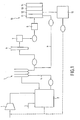
- Figure 2 shows, in more detail, an example of operation performed on broken before reintroduction into the dough. It is given by way of non-limiting illustration.
- the treatment of broken consists of a prior treatment with sodium hydroxide and various other complementary treatments which are detailed with reference to Figure 2.
- the broken are then introduced according to the treatment that they have undergone, either directly in the mixing vat 2 or in the mixing vat after having undergone a complementary refining operation in the refiner 1.
- the broken pieces coming from the section of the presses 12 of the paper machine 10 are introduced into the broken pulper 15 through the pipe 16.
- soda is also introduced by the pipe 17 and a fraction of the white water recovered from the treated pulp in the head section. This introduction is through the pipes 18 and 19 so that within the broken pulper is obtained a fiber concentration of the order of 15%.
- the suspension is then diluted by a new introduction of white water through the pipe 20, so as to bring its concentration to a value of about 8%.
- the suspension of fibers is again diluted by a new introduction of white water through the pipe 24 to bring it to a concentration generally of the order of 3 to 4% before introducing it either into the cellar. mixture 2, or in the refiner 1 to undergo a complementary refining operation before introduction into the mixing tank 2.
- the dough resulting from broken thus obtained having undergone all or part of the treatment treatment and / or de-pelletization is mixed again to the new dough in a mixing vat. Before being added to the new dough, it is diluted to bring its concentration to a value close to that of the new dough to which it is incorporated, for example a value of the order of 3%.
- the present invention relates specifically to the processes for producing paper products in which a portion of the cellulosic pulp used comes from the recovery of papermaking waste of the kind of broken or similar, resulting from the process used, or from another process paper type.
- the present invention proposes a solution to all the problems related to traditional acidification processes of broken, in particular those described above, and proposes to regulate the pH in the treatment of broken by introduction of carbon dioxide in at least one point said circuit broken.
- the patent application EP 0 911 443 describes a process for the treatment of broken batch type in which the broken undergo a basic treatment at high temperature in a pulper, then are acidified in one step and diluted in the said pulper before being reincorporated in a paper process. It provides no solution to the problem that arises for the skilled person who wishes to achieve a fine pH regulation, flexible, adapted to the constraints of the various stages of the treatment of broken, easy to implement, both during treatments in Continuous breaks only discontinuously, and regardless of the temperature in the pulper 15. In addition, this addition of carbon dioxide at the pulp in the pulper affects the accuracy of regulation. It is to these problems also that the method according to the invention provides solutions.
- the preferred variant of the invention which consists in injecting judicious quantities of carbon dioxide directly into the white waters of the process used for the dilution of the dough resulting from the preliminary treatment. broken provides all the advantages listed above with, in addition, increased efficiency, simplicity and flexibility of implementation also increased, which is a further advantage of the present invention over the prior art. It allows in particular, from different points of introduction of the white waters in the circuit, to ensure jointly paste consistency and pH best suited for each step of the treatment of broken, and this both for continuous treatment only for discontinuous treatments, whatever the temperature in the pulper 15.
- FIG. 1 relates to an exemplary embodiment of papermaking products according to the prior art as well as with reference to FIGS. 2 and 3 which give particular but nonlimiting examples of embodiments. preferred embodiments of the invention.
- the first step of the treatment of the broken consists in a trituration of these broken, preferentially in the presence of white water from different stages of the process and in an alkaline medium at a pH generally between 8.5 and 13. This trituration step is carried out in what is classically called a broken pulper 15.
- the pulp resulting from this broken pulper preferably has a concentration of the order of 15%.
- This paste must therefore be diluted to bring it to a suitable concentration, generally from 3 to 4% in the mixing chamber 2 where the cellulose pulp is prepared for entering the short circuit of the process for preparing the cellulosic pulp.
- the mixture of the paste resulting from broken and the new paste entering the process is preferably carried out, but not necessarily at this stage of the process.
- the paste from the broken pulper 15 will therefore have to be diluted.
- this dilution is carried out by introducing white water from the process in at least one step.
- This dilution is often carried out in two steps as shown in FIG. 2. A larger number of dilution steps can be envisaged without departing from the process of the invention.
- Patent application EP 0 911 443 recommends for its part the introduction of carbon dioxide into the pulper 15 at the end of the mixing step.
- carbon dioxide acidification as described this invention is carried out in the pulper at the end of the trituration step in an alkaline medium . Realized under these conditions, it does not allow a satisfactory mixture of carbon dioxide in the medium to be treated. It is thus time consuming and carbon dioxide for a poor result.
- limited to discontinuous treatment of broken it does not provide a satisfactory solution to the problem.
- the invention therefore proposes to advantageously replace the acidification modes of the prior art by introducing carbon dioxide into at least one point of the treatment circuit of the broken after their exit from the broken pulper 15, and this, so to regulate the pH of the dough during the successive stages of the treatment of broken, to bring it to a desired pH at the level of the mixing vat, preferably close to that of the new dough contained in said vat where said paste will be introduced at the end of treatment of broken.
- This pH is generally between 5.5 and 8.5.
- said second stage comprises at least two stages of dilution with white water.
- the carbon dioxide is injected into the white water used for the dilution of the paste from the broken.
- the white water used for the dilution of the paste resulting from the broken parts comprises the white water recovered from the paper machine and possibly the white water of other origins, in particular white water resulting from the preparation of the dough and or clarified waters from different stages of the process.
- the introduction of carbon dioxide is carried out at least two points of the circuit of treatment of broken, partly at the exit of the broken pulper and partly at the end of treatment of broken.
- the introduction of carbon dioxide can be carried out at any point between the output of the basic treatment pulper of the broken and the step of mixing the pulp from the broken with the rest of the cellulosic pulp, it is particularly advantageous to achieve this injection of carbon dioxide at the dilution water of the paste from the broken.
- the introduction of carbon dioxide in a relatively concentrated suspension of fibers requires the use of a specific material of the porous candle type or static mixer intended to obtain the dispersion and the dissolution of the gaseous CO 2 within this fiber dispersion.
- the recommended injection of carbon dioxide directly into the white water used for the dilution of the pulp and, because of the very low concentration of solid white water, can be done without resorting to specific injection equipment.
- the second step of the treatment of broken includes at least one de-pelletizing step and / or at least one additional purification step of the pulp resulting from the treatment carried out in the pulper 15.
- the carbon dioxide is introduced at at least two points, at a first point so as to obtain an intermediate pH adapted during de-pelletizing steps 22 and / or purification 21,23 of said paste and in a second point after said steps and before the end of the circuit of the broken so as to have a pH of the diluted dough resulting from the treatment of broken substantially compatible with the pH maintained in the mixing vat 2.
- the pH of the diluted dough resulting from the treatment of the broken products is between 5.5 and 8.5.
- the intermediate pH of the pulp during the de-pelletizing step 22 and / or during the purification steps 21, 23 is between 7.5 and 9, and preferentially between 8 and 8.5.
- carbon dioxide is advantageously introduced via a first dilution water inlet after the exit of the pulper from the broken particles so as to obtain a pH of between 7.5 and 9, and preferably 8 and 8. 5 at the de-pelletizing device complementary to said paste, and via a second dilution water inlet located between the outlet of this device and the end of the circuit of the broken in order to have a pH diluted pulp resulting from the treatment of broken substantially equal to the pH maintained in the mixing chamber of the pulp resulting from broken with the rest of the cellulosic pulp.
- Carbon dioxide can come in many forms. It can be essentially in gaseous form. It can be essentially in liquid form. It may be partly in gaseous form and partly in liquid form.
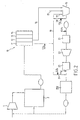
- FIG. 3 shows a particularly advantageous particular case of a complete process according to the invention for preparing a paper product in which carbon dioxide is introduced via the white waters of the process.
- the following description is made with reference to this FIG. 3 where the reference numbers indicated correspond to those used for the description of the devices of the prior art according to Figures 1 and 2 above.
- FIG. 3 diagrammatically shows the steps of treatment of the broken pieces from their introduction into the broken pulper 15 until they are re-injected into the mixing chamber 2, without seeking to represent in this figure all the preparation steps. paper from the prepared dough in the mixing vat 2.
- broken from the processing step in the section of the presses 11 of the paper machine are recovered and introduced into the broken pulper 15 where they are treated in an alkaline medium in the presence of white water from different stages of the process.
- the broken from the section of the presses 11 and possibly waste of other origins but also requiring treatment in an alkaline medium at a pH of between 9 and 13, in the presence of white water are subjected. from the process.
- a paste generally having a concentration of cellulosic fibers of the order of 15% by weight is prepared.
- This paste then undergoes a first dilution by means of white water from the process in which carbon dioxide has been introduced beforehand to bring the paste to a pH generally of the order of 8 to 8.5, and then submits this dough thus diluted at different stages of complementary treatments schematized by block 26.
- These complementary steps may comprise, in particular, steps as described with reference to FIG. 2 of primary purification 21, de-pelletizing 22 and finer purification 23, the cascade of complementary treatments depending in fact on the state of the paste from the broken after treatment in the broken pulper and the degree of purity sought.
- the pulp thus treated is then subjected to a second dilution by means of white water from the process containing carbon dioxide.
- This white water is introduced into the circuit via the pipe 24.
- the CO 2 is advantageously introduced upstream of the point of separation of the white water supply. intended to carry out the two dilution steps, which makes it possible to proceed to a single injection of CO 2 .
- the supply of white water intended for the dilution of the pulp resulting from the preliminary treatment of the broken parts comprises in the case represented in FIG. 3 on the one hand white water coming from the first stage of preparation of the paper in the headbox 11 of the paper machine.
- This water is introduced through line 18. It contains, in addition, other water from other process steps introduced respectively by pipes 27 and 28. This is, for example, other white water from the step of thickening the dough during its washing to remove the various impurities and which leads to recovering diluted water.
- the paste is brought to a pH of the order of that which it is sought to impose in the mixing tank, for example a pH of 8.0 and at a temperature of dilution generally of the order of 3 to 4%, dilution which is also that which is carried out in the mixing tank 2.
- a pH of the order of that which it is sought to impose in the mixing tank for example a pH of 8.0 and at a temperature of dilution generally of the order of 3 to 4%, dilution which is also that which is carried out in the mixing tank 2.
- the broken ones are of the type REH (resistant wet state) (it was not proceeded during the tests reported here with injections of carbon dioxide in the white waters).
- the treatment of broken has, in the step of de-pelletization, a loop circuit in which the broken are pumped into the tray 25 and reinjected between 21 and 22 until the satisfactory finished product ; they are then evacuated to 2 according to Figure 2.
- Test No. 3 is a good compromise between industrial use and good dissolution performance.
Landscapes
- Chemical & Material Sciences (AREA)
- Inorganic Chemistry (AREA)
- Paper (AREA)
- Making Paper Articles (AREA)
Claims (14)
- Verfahren zur Herstellung eines Papierprodukts aus Cellulosepaste, wobei ein Teil aus Bruchstoffen stammt, wobei die Bruchstoffe einer so genannten Bruchstoffbehandlung unterzogen wurden, umfassend:- einen ersten Schritt, der darin besteht, die in den Bruchstoffen enthaltenen Cellulosefasern unter Schütteln und in einem alkalischen Medium einer neuerlichen Lösung zu unterziehen, wobei der Schritt in einem so genannten Bruchstoffzerfaserer (15) durchgeführt wird,- dann einen zweiten Schritt, der dazu bestimmt ist, die aus dem Zerfaserer (15) kommende Paste auf eine Konzentration und einen pH-Wert nahe dem der neuen, in dem Mischbehälter (2) enthaltenen Paste zu bringen, wobei der zweite Schritt mindestens einen Schritt der Verdünnung durch Bleiwasser des Verfahrens und mindestens einen Schritt der Säurebildung umfasst,dadurch gekennzeichnet, dass der Schritt der Säurebildung durch Einspritzen von Kohlendioxid an mindestens einem Punkt des Behandlungskreises der Bruchstoffe erfolgt, der sich zwischen dem Ausgang des Bruchstoffzerfaserers (15) und dem Gemisch aus der aus der Bruchstoffbehandlung kommenden Paste und der neuen Paste befindet.
- Verfahren nach Anspruch 1, dadurch gekennzeichnet, dass der zweite Schritt mindestens zwei Schritte der Verdünnung durch Bleiwasser umfasst.
- Verfahren nach einem der Ansprüche 1 oder 2, dadurch gekennzeichnet, dass das Kohlendioxid in das Bleiwasser eingespritzt wird, das zur Verdünnung der aus der Bruchstoffbehandlung kommenden Paste dient.
- Verfahren nach einem der Ansprüche 1 bis 3, dadurch gekennzeichnet, dass das Bleiwasser, das zur Verdünnung der aus den Bruchstoffen stammenden Paste dient, Bleiwasser, das aus der Papiermaschine rückgeführt wurde, und eventuell Bleiwasser anderen Ursprungs umfasst, insbesondere Bleiwasser, das aus der Herstellung der Paste und/oder Klarwasser stammt, das aus verschiedenen Schritten des Verfahrens kommt.
- Verfahren nach einem der Ansprüche 1 bis 4, dadurch gekennzeichnet, dass das Kohlendioxid an mindestens zwei Punkten des Behandlungskreises der Bruchstoffe eingeleitet wird, zum Teil am Ausgang des Bruchstoffzerfaserers und zum Teil am Ende der Bruchstoffbehandlung.
- Verfahren nach einem der Ansprüche 1 bis 5, dadurch gekennzeichnet, dass der zweite Schritt der Bruchstoffbehandlung mindestens einen Schritt des Cleanings und/oder mindestens einen Schritt der ergänzenden Reinigung der aus der im Zerfaserer (15) durchgeführten Behandlung stammenden Paste umfasst.
- Verfahren nach Anspruch 6, dadurch gekennzeichnet, dass das Kohlendioxid an mindestens zwei Punkten eingeleitet wird, an einem ersten Punkt, um einen Zwischen-pH-Wert, der an die Schritte des Cleanings (22) und/oder der Reinigung (21, 23) der Paste angepasst ist, zu erhalten, und an einem zweiten Punkt, der sich nach diesen Schritten und vor dem Ende des Bruchstoffkreislaufs befindet, um einen pH-Wert der verdünnten Paste, die aus der Bruchstoffbehandlung kommt, zu erhalten, der im Wesentlichen mit dem pH-Wert vereinbar ist, der in dem Mischbehälter (2) aufrechterhalten wird.
- Verfahren nach einem der Ansprüche 1 bis 7, dadurch gekennzeichnet, dass der pH-Wert der verdünnten Paste, die aus der Bruchstoffbehandlung kommt, zwischen 5,5 und 8,5 beträgt.
- Verfahren nach einem der Ansprüche 1 bis 8, dadurch gekennzeichnet, dass der Zwischen-pH-Wert der Paste beim Schritt des Cleanings (22) und/oder bei den Reinigungsschritten (21, 23) zwischen 7,5 und 9 und vorzugsweise zwischen 8 und 8,5 beträgt.
- Verfahren nach einem der Ansprüche 1 bis 9, dadurch gekennzeichnet, dass das Kohlendioxid an einem und/oder mehreren der folgenden Punkte eingeleitet wird:- in das Bleiwasser, das für die Verdünnung der Bruchstoffe (18) bestimmt ist,- in das Bleiwasser (20) für die Verdünnung am Ausgang des Bruchstoffzerfaserers (15),- in das Bleiwasser (24) zur Verdünnung am Ende der Behandlung der Bruchstoffe vor dem Mischen mit der neuen Paste,- in die Bruchstoffpaste am Ausgang des Zerfaserers (15) und vor den Schritten (21 und/oder 22 und/oder 23),- in die Bruchstoffpaste am Ende der Bruchstoffbehandlung und vor dem Mischen mit der neuen Paste.
- Verfahren nach einem der Ansprüche 1 bis 10, dadurch gekennzeichnet, dass das Kohlendioxid mit Hilfe einer ersten Verdünnungswasserzuleitung nach dem Ausgang des Bruchstoffzerfaserers eingeleitet wird, um einen pH-Wert zwischen 7,5 und 9 und vorzugsweise 8 und 8,5 im Bereich der ergänzenden Cleaning-Vorrichtung der Paste zu erhalten, und mit Hilfe einer zweiten Verdünnungswasserzuleitung, die sich zwischen dem Ausgang dieser Vorrichtung und am Ende des Bruchstoffkreislaufs befindet, eingeleitet wird, um einen pH-Wert der aus der Bruchstoffbehandlung kommenden verdünnten Paste im Wesentlichen gleich dem pH-Wert zu erhalten, der in dem Behälter zum Mischen der aus den Bruchstoffen stammenden Paste mit der restlichen Cellulosepaste aufrechterhalten wird.
- Verfahren nach einem der Ansprüche 1 bis 11, dadurch gekennzeichnet, dass das Kohlendioxid im Wesentlichen in gasförmiger Form vorhanden ist.
- Verfahren nach einem der Ansprüche 1 bis 11, dadurch gekennzeichnet, dass das Kohlendioxid im Wesentlichen in flüssiger Form vorhanden ist.
- Verfahren nach einem der Ansprüche 1 bis 11, dadurch gekennzeichnet, dass das Kohlendioxid teilweise in gasförmiger und teilweise in flüssiger Form vorhanden ist.
Applications Claiming Priority (2)
| Application Number | Priority Date | Filing Date | Title |
|---|---|---|---|
| FR9908482 | 1999-07-01 | ||
| FR9908482A FR2795753B1 (fr) | 1999-07-01 | 1999-07-01 | Perfectionnement aux procedes de fabrication de produits papetiers en vue de l'incorporation dans lesdits produits de dechets papetiers necessitant un traitement basique |
Publications (2)
| Publication Number | Publication Date |
|---|---|
| EP1065314A1 EP1065314A1 (de) | 2001-01-03 |
| EP1065314B1 true EP1065314B1 (de) | 2007-06-06 |
Family
ID=9547588
Family Applications (1)
| Application Number | Title | Priority Date | Filing Date |
|---|---|---|---|
| EP00401639A Revoked EP1065314B1 (de) | 1999-07-01 | 2000-06-09 | Verfahren zur Herstellung von Papierprodukten |
Country Status (8)
| Country | Link |
|---|---|
| EP (1) | EP1065314B1 (de) |
| AT (1) | ATE364107T1 (de) |
| BR (1) | BR0002954A (de) |
| CA (1) | CA2311279A1 (de) |
| DE (1) | DE60035084T2 (de) |
| ES (1) | ES2286991T3 (de) |
| FR (1) | FR2795753B1 (de) |
| PT (1) | PT1065314E (de) |
Family Cites Families (3)
| Publication number | Priority date | Publication date | Assignee | Title |
|---|---|---|---|---|
| AU1175188A (en) * | 1987-02-27 | 1988-09-01 | Boc Group, Inc., The | Use of gaseous carbon dioxide to adjust ph of cellulosic pulp |
| US6200416B1 (en) * | 1997-06-10 | 2001-03-13 | Praxair Technology, Inc. | Recycled paper production process which incorporates carbon dioxide |
| US6086714A (en) * | 1997-10-24 | 2000-07-11 | Praxair Technology, Inc. | Process for adjusting the alkalinity of pulp slurry in a broke pulper using carbon dioxide |
-
1999
- 1999-07-01 FR FR9908482A patent/FR2795753B1/fr not_active Expired - Fee Related
-
2000
- 2000-06-09 DE DE60035084T patent/DE60035084T2/de not_active Expired - Lifetime
- 2000-06-09 EP EP00401639A patent/EP1065314B1/de not_active Revoked
- 2000-06-09 ES ES00401639T patent/ES2286991T3/es not_active Expired - Lifetime
- 2000-06-09 AT AT00401639T patent/ATE364107T1/de active
- 2000-06-09 PT PT00401639T patent/PT1065314E/pt unknown
- 2000-06-09 CA CA002311279A patent/CA2311279A1/fr not_active Abandoned
- 2000-06-30 BR BR0002954-8A patent/BR0002954A/pt not_active Application Discontinuation
Also Published As
| Publication number | Publication date |
|---|---|
| ATE364107T1 (de) | 2007-06-15 |
| DE60035084D1 (de) | 2007-07-19 |
| EP1065314A1 (de) | 2001-01-03 |
| ES2286991T3 (es) | 2007-12-16 |
| BR0002954A (pt) | 2001-04-03 |
| PT1065314E (pt) | 2007-08-06 |
| FR2795753B1 (fr) | 2001-09-14 |
| FR2795753A1 (fr) | 2001-01-05 |
| CA2311279A1 (fr) | 2001-01-01 |
| DE60035084T2 (de) | 2008-01-31 |
Similar Documents
| Publication | Publication Date | Title |
|---|---|---|
| FI63607B (fi) | Foerfarande foer framstaellning av cellulosamassor i utbytesomraodet 65-95 % | |
| FI122815B (fi) | Menetelmä lignoselluloosamateriaalien ja niistä saatujen jakeiden fraktioimiseksi | |
| JP2023517688A (ja) | ポリコットン混合物の分離 | |
| EP0284526A1 (de) | Verfahren und Anlage zur Wiedergewinnung von bedruckten Altpapieren | |
| US4324612A (en) | Process for the preparation of groundwood pulp | |
| JP2000226784A (ja) | パルプ収率の向上のための方法及び装置 | |
| CN100595375C (zh) | 非木本植物材料的化学机械脱硅 | |
| FR2641010A1 (de) | ||
| CA2846646A1 (en) | Pulp composition | |
| EP0573497A1 (de) | Wiederverwendung von cellulosischem abfall. | |
| CZ287686B6 (en) | Oxygen delignification of waste cellulosic paper products | |
| CN101389808B (zh) | 用于制造机械纸浆和纸张产品的方法 | |
| EP1065314B1 (de) | Verfahren zur Herstellung von Papierprodukten | |
| Akbarpour | Synergistic deinking effect of neutral sodium sulfite with fungal hemicellulase enzyme for improved recycling of waste papers | |
| EP0351330B1 (de) | Verfahren zur Herstellung von gebleichten chemithermomechanischen Zellstoffen | |
| JP7842123B2 (ja) | 非木材原料を処理するためのプロセス | |
| KR100662042B1 (ko) | 대나무 섬유용 펄프의 제조방법 및 그 펄프 | |
| EP0293309B1 (de) | Verfahren zur Herstellung von chemithermomechanischen Zellstoffen | |
| CN116971197A (zh) | 一种湿强解离剂及其使用方法 | |
| Danielewicz et al. | Pulping and bleaching OCC. Part II. Oxygen delignification and bleaching | |
| JPH09502229A (ja) | リグノセルロースパルプの改良漂白方法 | |
| US20020148581A1 (en) | Processes for paper manufacture, useful for incorporating paper waste requiring a basic treatment into paper products | |
| FR2480321A1 (fr) | Procede de fabrication de pulpe mecanique de cellulose exempte de resine | |
| Liu et al. | The Use of Mg (OH) 2 in the Final Peroxide Bleaching Stage of Wheat Straw Pulp. | |
| FR2836938A1 (fr) | Perfectionnement aux procedes de fabrication de produits papetiers par amelioration du comportement physico-chimique de la pate a papier |
Legal Events
| Date | Code | Title | Description |
|---|---|---|---|
| PUAI | Public reference made under article 153(3) epc to a published international application that has entered the european phase |
Free format text: ORIGINAL CODE: 0009012 |
|
| AK | Designated contracting states |
Kind code of ref document: A1 Designated state(s): AT BE CH CY DE DK ES FI FR GB GR IE IT LI LU MC NL PT SE |
|
| AX | Request for extension of the european patent |
Free format text: AL;LT;LV;MK;RO;SI |
|
| 17P | Request for examination filed |
Effective date: 20010703 |
|
| AKX | Designation fees paid |
Free format text: AT BE CH CY DE DK ES FI FR GB GR IE IT LI LU MC NL PT SE |
|
| RAP1 | Party data changed (applicant data changed or rights of an application transferred) |
Owner name: L'AIR LIQUIDE, S.A. AE DIRECTOIRE ET CONSEIL DE SU |
|
| GRAP | Despatch of communication of intention to grant a patent |
Free format text: ORIGINAL CODE: EPIDOSNIGR1 |
|
| RAP1 | Party data changed (applicant data changed or rights of an application transferred) |
Owner name: L'AIR LIQUIDE, SOCIETE ANONYME POUR L'ETUDE ET L'E |
|
| GRAS | Grant fee paid |
Free format text: ORIGINAL CODE: EPIDOSNIGR3 |
|
| GRAA | (expected) grant |
Free format text: ORIGINAL CODE: 0009210 |
|
| AK | Designated contracting states |
Kind code of ref document: B1 Designated state(s): AT BE CH CY DE DK ES FI FR GB GR IE IT LI LU MC NL PT SE |
|
| REG | Reference to a national code |
Ref country code: GB Ref legal event code: FG4D Free format text: NOT ENGLISH |
|
| RAP2 | Party data changed (patent owner data changed or rights of a patent transferred) |
Owner name: L'AIR LIQUIDE, SOCIETE ANONYME POUR L'ETUDE ET L'E |
|
| REG | Reference to a national code |
Ref country code: CH Ref legal event code: EP |
|
| REG | Reference to a national code |
Ref country code: IE Ref legal event code: FG4D Free format text: LANGUAGE OF EP DOCUMENT: FRENCH |
|
| REF | Corresponds to: |
Ref document number: 60035084 Country of ref document: DE Date of ref document: 20070719 Kind code of ref document: P |
|
| REG | Reference to a national code |
Ref country code: PT Ref legal event code: SC4A Free format text: AVAILABILITY OF NATIONAL TRANSLATION Effective date: 20070725 |
|
| NLT2 | Nl: modifications (of names), taken from the european patent patent bulletin |
Owner name: L'AIR LIQUIDE, SOCIETE ANONYME POUR L'ETUDE Effective date: 20070627 |
|
| GBT | Gb: translation of ep patent filed (gb section 77(6)(a)/1977) |
Effective date: 20070815 |
|
| REG | Reference to a national code |
Ref country code: SE Ref legal event code: TRGR |
|
| NLV1 | Nl: lapsed or annulled due to failure to fulfill the requirements of art. 29p and 29m of the patents act | ||
| REG | Reference to a national code |
Ref country code: ES Ref legal event code: FG2A Ref document number: 2286991 Country of ref document: ES Kind code of ref document: T3 |
|
| REG | Reference to a national code |
Ref country code: IE Ref legal event code: FD4D |
|
| PG25 | Lapsed in a contracting state [announced via postgrant information from national office to epo] |
Ref country code: MC Free format text: LAPSE BECAUSE OF NON-PAYMENT OF DUE FEES Effective date: 20070630 Ref country code: IE Free format text: LAPSE BECAUSE OF FAILURE TO SUBMIT A TRANSLATION OF THE DESCRIPTION OR TO PAY THE FEE WITHIN THE PRESCRIBED TIME-LIMIT Effective date: 20070606 Ref country code: NL Free format text: LAPSE BECAUSE OF FAILURE TO SUBMIT A TRANSLATION OF THE DESCRIPTION OR TO PAY THE FEE WITHIN THE PRESCRIBED TIME-LIMIT Effective date: 20070606 |
|
| PLBI | Opposition filed |
Free format text: ORIGINAL CODE: 0009260 |
|
| PLAX | Notice of opposition and request to file observation + time limit sent |
Free format text: ORIGINAL CODE: EPIDOSNOBS2 |
|
| 26 | Opposition filed |
Opponent name: LINDE AKTIENGESELLSCHAFT Effective date: 20080306 |
|
| PG25 | Lapsed in a contracting state [announced via postgrant information from national office to epo] |
Ref country code: GR Free format text: LAPSE BECAUSE OF FAILURE TO SUBMIT A TRANSLATION OF THE DESCRIPTION OR TO PAY THE FEE WITHIN THE PRESCRIBED TIME-LIMIT Effective date: 20070907 Ref country code: DK Free format text: LAPSE BECAUSE OF FAILURE TO SUBMIT A TRANSLATION OF THE DESCRIPTION OR TO PAY THE FEE WITHIN THE PRESCRIBED TIME-LIMIT Effective date: 20070606 |
|
| PLAF | Information modified related to communication of a notice of opposition and request to file observations + time limit |
Free format text: ORIGINAL CODE: EPIDOSCOBS2 |
|
| PLBB | Reply of patent proprietor to notice(s) of opposition received |
Free format text: ORIGINAL CODE: EPIDOSNOBS3 |
|
| PG25 | Lapsed in a contracting state [announced via postgrant information from national office to epo] |
Ref country code: CY Free format text: LAPSE BECAUSE OF FAILURE TO SUBMIT A TRANSLATION OF THE DESCRIPTION OR TO PAY THE FEE WITHIN THE PRESCRIBED TIME-LIMIT Effective date: 20070606 |
|
| PG25 | Lapsed in a contracting state [announced via postgrant information from national office to epo] |
Ref country code: LU Free format text: LAPSE BECAUSE OF NON-PAYMENT OF DUE FEES Effective date: 20070609 |
|
| PGFP | Annual fee paid to national office [announced via postgrant information from national office to epo] |
Ref country code: FI Payment date: 20100615 Year of fee payment: 11 Ref country code: ES Payment date: 20100623 Year of fee payment: 11 Ref country code: PT Payment date: 20100604 Year of fee payment: 11 Ref country code: FR Payment date: 20100706 Year of fee payment: 11 |
|
| PGFP | Annual fee paid to national office [announced via postgrant information from national office to epo] |
Ref country code: IT Payment date: 20100626 Year of fee payment: 11 Ref country code: AT Payment date: 20100614 Year of fee payment: 11 |
|
| PGFP | Annual fee paid to national office [announced via postgrant information from national office to epo] |
Ref country code: CH Payment date: 20100623 Year of fee payment: 11 Ref country code: BE Payment date: 20100611 Year of fee payment: 11 |
|
| PGFP | Annual fee paid to national office [announced via postgrant information from national office to epo] |
Ref country code: SE Payment date: 20100614 Year of fee payment: 11 Ref country code: GB Payment date: 20100618 Year of fee payment: 11 Ref country code: DE Payment date: 20100625 Year of fee payment: 11 |
|
| RDAF | Communication despatched that patent is revoked |
Free format text: ORIGINAL CODE: EPIDOSNREV1 |
|
| REG | Reference to a national code |
Ref country code: DE Ref legal event code: R064 Ref document number: 60035084 Country of ref document: DE Ref country code: DE Ref legal event code: R103 Ref document number: 60035084 Country of ref document: DE |
|
| RDAG | Patent revoked |
Free format text: ORIGINAL CODE: 0009271 |
|
| STAA | Information on the status of an ep patent application or granted ep patent |
Free format text: STATUS: PATENT REVOKED |
|
| REG | Reference to a national code |
Ref country code: PT Ref legal event code: MP4A Effective date: 20110809 |
|
| REG | Reference to a national code |
Ref country code: CH Ref legal event code: PL |
|
| 27W | Patent revoked |
Effective date: 20110411 |
|
| GBPR | Gb: patent revoked under art. 102 of the ep convention designating the uk as contracting state |
Effective date: 20110411 |
|
| REG | Reference to a national code |
Ref country code: DE Ref legal event code: R107 Ref document number: 60035084 Country of ref document: DE Effective date: 20111020 |
|
| REG | Reference to a national code |
Ref country code: SE Ref legal event code: ECNC |
|
| PG25 | Lapsed in a contracting state [announced via postgrant information from national office to epo] |
Ref country code: CH Free format text: LAPSE BECAUSE OF THE APPLICANT RENOUNCES Effective date: 20070606 Ref country code: LI Free format text: LAPSE BECAUSE OF THE APPLICANT RENOUNCES Effective date: 20070606 |