EP0286520A1 - Chariot à provisions pliable - Google Patents
Chariot à provisions pliable Download PDFInfo
- Publication number
- EP0286520A1 EP0286520A1 EP88400789A EP88400789A EP0286520A1 EP 0286520 A1 EP0286520 A1 EP 0286520A1 EP 88400789 A EP88400789 A EP 88400789A EP 88400789 A EP88400789 A EP 88400789A EP 0286520 A1 EP0286520 A1 EP 0286520A1
- Authority
- EP
- European Patent Office
- Prior art keywords
- plate
- walls
- trolley
- frame
- basket
- Prior art date
- Legal status (The legal status is an assumption and is not a legal conclusion. Google has not performed a legal analysis and makes no representation as to the accuracy of the status listed.)
- Granted
Links
- 238000005096 rolling process Methods 0.000 claims description 8
- 230000000903 blocking effect Effects 0.000 description 3
- 229910000831 Steel Inorganic materials 0.000 description 1
- 240000008042 Zea mays Species 0.000 description 1
- 229910052782 aluminium Inorganic materials 0.000 description 1
- XAGFODPZIPBFFR-UHFFFAOYSA-N aluminium Chemical compound [Al] XAGFODPZIPBFFR-UHFFFAOYSA-N 0.000 description 1
- 239000002131 composite material Substances 0.000 description 1
- 239000003365 glass fiber Substances 0.000 description 1
- 238000004519 manufacturing process Methods 0.000 description 1
- 239000000463 material Substances 0.000 description 1
- 229910052751 metal Inorganic materials 0.000 description 1
- 239000002184 metal Substances 0.000 description 1
- 239000010959 steel Substances 0.000 description 1
Images

Classifications
-
- B—PERFORMING OPERATIONS; TRANSPORTING
- B62—LAND VEHICLES FOR TRAVELLING OTHERWISE THAN ON RAILS
- B62B—HAND-PROPELLED VEHICLES, e.g. HAND CARTS OR PERAMBULATORS; SLEDGES
- B62B3/00—Hand carts having more than one axis carrying transport wheels; Steering devices therefor; Equipment therefor
- B62B3/02—Hand carts having more than one axis carrying transport wheels; Steering devices therefor; Equipment therefor involving parts being adjustable, collapsible, attachable, detachable or convertible
- B62B3/022—Hand carts having more than one axis carrying transport wheels; Steering devices therefor; Equipment therefor involving parts being adjustable, collapsible, attachable, detachable or convertible folding down the body to the wheel carriage or by retracting projecting parts
-
- B—PERFORMING OPERATIONS; TRANSPORTING
- B62—LAND VEHICLES FOR TRAVELLING OTHERWISE THAN ON RAILS
- B62B—HAND-PROPELLED VEHICLES, e.g. HAND CARTS OR PERAMBULATORS; SLEDGES
- B62B3/00—Hand carts having more than one axis carrying transport wheels; Steering devices therefor; Equipment therefor
- B62B3/02—Hand carts having more than one axis carrying transport wheels; Steering devices therefor; Equipment therefor involving parts being adjustable, collapsible, attachable, detachable or convertible
- B62B3/027—Hand carts having more than one axis carrying transport wheels; Steering devices therefor; Equipment therefor involving parts being adjustable, collapsible, attachable, detachable or convertible collapsible shopping trolleys
-
- B—PERFORMING OPERATIONS; TRANSPORTING
- B62—LAND VEHICLES FOR TRAVELLING OTHERWISE THAN ON RAILS
- B62B—HAND-PROPELLED VEHICLES, e.g. HAND CARTS OR PERAMBULATORS; SLEDGES
- B62B2205/00—Hand-propelled vehicles or sledges being foldable or dismountable when not in use
-
- B—PERFORMING OPERATIONS; TRANSPORTING
- B62—LAND VEHICLES FOR TRAVELLING OTHERWISE THAN ON RAILS
- B62B—HAND-PROPELLED VEHICLES, e.g. HAND CARTS OR PERAMBULATORS; SLEDGES
- B62B2205/00—Hand-propelled vehicles or sledges being foldable or dismountable when not in use
- B62B2205/06—Foldable with a scissor-like mechanism
Definitions
- the present invention relates to shopping carts used by buyers in self-service stores to receive and transport the goods they have chosen.
- trolleys of the type comprising a rigid frame mounted on casters and a rigid quadrilateral plate carried by the frame and constituting the flat bottom of a basket with four rigid flat walls, namely: two lateral walls constituted by grids, one front wall and a rear wall.
- the tray has a trapezoidal shape and the front wall has reduced dimensions to allow horizontal stacking.
- the assembly must be robust to meet the conditions of permanent use by different customers more or less careful. Therefore, the trolleys considered have a high manufacturing cost, they are heavy and bulky, which is troublesome, in particular for stores that do not benefit from a lot of storage space near the boxes.
- a fleet of trolleys of this type also results in significant labor costs because it is necessary to periodically collect the trolleys abandoned by users in the car parks.
- Department store managers who are very aware of this problem, have sought to remedy it, in particular by recording the carts in order to force customers to bring them back. But this formula upsets the clientele and does not prevent the abandonment of the trolleys, especially when the distances to be traveled to bring them back are large.
- the invention aims to provide a shopping trolley of the type defined above which better meets those previously known than the requirements of practice, in particular in that it has a very low cost in comparison of the cost of the carts of the prior art, in that it makes it possible to reduce the personnel costs by reducing the storage easements of the carts, in that it allows the customer an easy transport of his purchases not only from the store to his car, but also from his car to his home and in that he can also avoid unnecessary handling of goods.
- the invention starts from the idea of a good capacity shopping trolley usable as such in the store but which is foldable and of dimensions suitable for its storage in the trunk of a car, and this by giving it either the dimensions of a suitcase, or by reducing it to the dimensions of the basket in which the provisions can be left. This allows the customer to keep the trolley which is no longer attached to the store and therefore no longer has to be stored in it.
- the trolley Due to its low cost the trolley can be supplied free of charge by the store, with proof of a certain loyalty, or even be purchased by the user.
- the invention provides a shopping trolley of the type defined above, characterized in that it comprises at least one carrying handle, support means adjustable in height between the frame and the plate, said height being adjustable between two extreme values corresponding respectively to a high rolling position and a low storage and carrying position of the carriage and of the means for locking said support means in these two positions, in that the plate is rectangular and horizontal, and in that the four walls are pivotally mounted around horizontal axes rigidly connected to the tray so as to be able to tilt in the folded position towards the inside of the basket, said axes being provided at respective respective levels so as to allow the walls adopt horizontal folded positions superimposed.
- the height-adjustable support means comprise two cross spaced transversely formed by two rigid bars arranged in a cross, one end of each bar being pivotally mounted on the frame and its other sliding end on the plate, - the plate has two longitudinal grooves in which parts fixed to the ends of the bars slide, - the carrying handle is secured to the tray.
- the front and rear walls are extended laterally by longitudinal cheeks suitable for overlapping the side walls, the cheeks according to the preceding paragraph are arranged so as to form a box with a parallelepipedal appearance with the front and rear walls, with the plate and with the vertical panels which connect this plate to these walls when the carriage is folded,
- the rear wall of the carriage comprises a push bar pivoting about a transverse axis integral with said wall so as to be able to take two positions, a position for pushing the carriage unfolded and a position for storing the carriage folded inwards basket
- the frame has a rigid flat surface disposed between the rollers, and suitable for serving as additional storage space
- the rear wall has a foldable child seat consisting of a flat seat pivotally mounted towards the inside of the basket around a transverse axis rigidly connected to said wall and by means for supporting the free end of said seat in position horizontal, -
- the carriage has two carrying handles placed on two opposite sides of said carriage.
- FIG. 1 shows a shopping trolley 1 comprising a pair of front casters 2 which are transversely spaced and a pair of rear coaxial rollers 3, which are spaced transversely.
- the axes 6 of the rollers are mounted on a frame rigid 4 by means of yokes 5 with two branches.
- the yokes 5 or support forks of the front rollers are pivotally mounted around vertical axes 7 making these front rollers orientable relative to the frame 4.
- the yokes 5 of the rear rollers are fixedly mounted on the frame 4.
- the carriage 1 also includes support means 8 for a tray 9 formed by two cross-pieces 10 spaced transversely.
- Each crosspiece is composed of two rigid bars 11 arranged in a cross and of length less than the longitudinal dimension of the plate 9.
- the bars 11 each have one end pivotally mounted around an axis 12 integral with the frame 4 and the other end slidingly mounted in a groove 13 integral with a longitudinal side 14 of the plate 9.
- FIG. 2 and a detailed view of a groove 13 formed in a longitudinal side 14 of the plate 9.
- the end 15 of each bar 11 is provided with a pin 16 on which is mounted a roller 17 adapted to roll freely in the groove 13 extending along a longitudinal side 14 of the plate 9.
- Manual locking means as represented by a stop key 18 in FIG. 2, or automatic locking means as known per se, ensure the blocking of the rollers 17 in the grooves 13 for two predetermined heights of the plate 9, namely, a high rolling position ( Figures 1 and 3) and a low storage and carrying position ( Figures 4, 5, 6 and 7).
- the plate 9 is rectangular and horizontal. It constitutes the bottom of a basket 19 comprising four rigid walls, namely a front wall 20, a rear wall 21 and two side walls 22 formed by grids.
- the front and rear walls can be grids, plates or a combination of the two and can be made of any type of material such as metal (steel or aluminum for example) or plastic, possibly reinforced with glass fibers (composite material).
- the capacity of such a trolley is for example of the order of 150 dm 3, with dimensions of the basket of 0.5 m wide, 0.5 m high and 0.6 m long.
- the four rigid walls are pivotally mounted around horizontal axes rigidly connected to the plate 9 so as to be able to tilt in the folded position towards the inside of the basket 19, as shown in dotted lines in FIGS. 1, 5 and 6; for this purpose these axes are provided at respective different levels to allow the walls to adopt superimposed horizontal folded positions.
- the axes 23 of the side walls 22 are placed near the bottom, slightly offset vertically relative to each other, and the axes 24 and 25 of the front walls 20 and rear 21 are also vertically offset between them higher than the axes 23 as shown in FIG. 1.
- the plate 9 has front and rear flanges or vertical sections 26 and 27 delimited above by the axes 24 and 25.
- fixing means 28 such as elastic tabs.
- Two carrying bars 29 integral with the plate 9 are fixed transversely on the latter, at the two longitudinal ends thereof.
- a handle constituted by a push bar 30 is pivotally mounted about an axis 31 integral with the rear wall 21 of the carriage so as to be able to assume an unfolded position for pushing the carriage by a user and a position folded inwards, trolley storage.
- Locking means 32 of the handle are provided in the carriage pushing position.
- the walls 20 and 21 are extended laterally by longitudinal cheeks 33 directed from the basket and on which the lateral walls 22 come to bear while preferably being fixed thereon by known means per se, for example of the type of "clips" or “latches” (not shown).
- the cheeks 33 frame the side walls 22 so as to form a closed case for storing and carrying the carriage: for this purpose, the cheeks of the front wall have dimensions compatible with the dimensions of the cheeks of the rear wall so as to allow the folding of the walls.
- Locking means prevent the walls of the basket in the folded position from opening unexpectedly during transport.
- the carriage of Figure 1 further comprises a foldable seat 41 constituted by a flat seat 42 pivotally mounted towards the inside of the basket around a transverse axis 43 rigidly connected to said wall and means for supporting the free end of said seat in a horizontal position.
- a foldable seat 41 constituted by a flat seat 42 pivotally mounted towards the inside of the basket around a transverse axis 43 rigidly connected to said wall and means for supporting the free end of said seat in a horizontal position.
- the rollers 17 slide freely in the grooves 13 and locking means ensure the blocking in the high position.
- the rigid flat storage surface in the lower part between the rollers makes it possible to transport a pack of bottles.
- the trolley thus stocked is then moved to the level of the box arranged at the outlet of the store.
- the height of the tray and the transparency of the side grids allow the cashier to check the contents of the basket.
- the goods unloaded for payment are replaced in the basket by the user who brings the trolley to his car trunk where two choices are offered to him: either the basket is unloaded in the trunk and the trolley is fully folded by performing the reverse operations to those described above to be stored as is in the car, either the cross-pieces are simply folded and the basket, whose overall height does not exceed a standard trunk depth, of the car is placed directly in the latter; this solution avoids unnecessary handling of goods, the two handles 29 located on either side of the trolley allowing it to be grasped and carried easily, even charge.
- the invention is in no way limited to those of its modes of application and embodiments which have been more especially envisaged; on the contrary, it embraces all variants, in particular: - those where the means for locking, blocking and fixing the walls to one another are different from those previously mentioned, being constituted for example by hooks, buttons or magnets, - those where the carrying means are straps or handles and not bars, - those where the trolley, by its neat fittings added to a basic model of the type described above, allows true personalization of the trolley, in particular by its donor and / or its seller.
Landscapes
- Engineering & Computer Science (AREA)
- Chemical & Material Sciences (AREA)
- Combustion & Propulsion (AREA)
- Transportation (AREA)
- Mechanical Engineering (AREA)
- Handcart (AREA)
Abstract
Description
- La présente invention concerne les chariots à provisions utilisés par les acheteurs dans les magasins à libre service pour recevoir et transporter les marchandises qu'ils ont choisies.
- Elle vise plus particulièrement les chariots du type comprenant un bâti rigide monté sur roulettes et un plateau quadrilatéral rigide porté par le bâti et constituant le fond plan d'un panier à quatre parois planes rigides, savoir : deux parois latérales constituées par des grilles, une paroi avant et une paroi arrière.
- Dans des modes de réalisation connus, le plateau présente une forme trapézoïdale et la paroi avant a des dimensions réduites pour permettre le gerbage horizontal. De plus, l'ensemble doit être robuste pour répondre à des conditions d'utilisation permanente par des clients différents plus ou moins soigneux. De ce fait, les chariots considérés présentent un coût élevé de fabrication, ils sont lourds et encombrants, ce qui est gênant, en particulier pour les magasins ne bénéficiant pas de beaucoup de place de rangement à proximité des caisses. Un parc de chariots de ce type entraîne par ailleurs des coûts de main d'oeuvre importants car il est nécessaire de rassembler périodiquement les chariots abandonnés par les utilisateurs sur les parkings. Les responsables des grandes surfaces, très conscients de ce problème, ont cherché à y remédier, notamment en consignant les chariots afin d'obliger les clients à les ramener. Mais cette formule indispose la clientèle et n'empêche pas l'abandon des chariots, notamment lorsque les distances à parcourir pour les ramener sont grandes.
- L'invention vise à fournir un chariot à provisions du type ci-dessus défini répondant mieux que ceux antérieurement connus aux exigences de la pratique, notamment en ce qu'il présente un coût très réduit en comparaison du coût des chariots de l'art antérieur, en ce qu'il permet de diminuer les coûts de personnel en réduisant les servitudes de rangement des chariots, en ce qu'il permet au client un transport aisé de ses achats non seulement du magasin à sa voiture, mais également de sa voiture à son domicile et en ce qu'il peut également éviter des manutentions inutiles de marchandises.
- Pour ce faire, l'invention part de l'idée d'un chariot à provisions de bonne capacité utilisable en tant que tel dans le magasin mais qui est pliable et de dimensions propres à permettre son rangement dans le coffre d'une voiture, et ce en lui donnant soit les dimensions d'une valise, soit en le ramenant aux dimensions du panier dans lequel les provisions peuvent être laissées. Ceci permet au client de conserver le chariot qui n'est plus rattaché au magasin et n'a donc plus à être rangé dans celui-ci.
- Du fait de son coût faible le chariot peut être fourni gratuitement par le magasin, moyennant la preuve d'une certaine fidèlité, ou encore être acheté par l'utilisateur.
- L'utilisation plus soignée et moins fréquente du chariot par son "propriétaire" autorise une constitution moins robuste et une conceptionn plus personnalisée dudit chariot.
- Dans ces buts, l'invention propose un chariot à provisions du type ci-dessus défini, caractérisé en ce qu'il comprend au moins une poignée de portage, des moyens de support règlables en hauteur entre le bâti et le plateau, ladite hauteur étant règlable entre deux valeurs extrêmes correspondant respectivement à une position de roulage haute et à une position de rangement et de portage basse du chariot et des moyens de verrouillage desdits moyens de support dans ces deux positions, en ce que le plateau est rectangulaire et horizontal, et en ce que les quatre parois sont montées pivotantes autour d'axes horizontaux liés rigidement au plateau de faon à pouvoir basculer en position repliée vers l'intérieur du panier, lesdits axes étant prévus à des niveaux respectifs différents de façon à permettre aux parois d'adopter des positions repliées horizontales superposées.
- Dans des modes de réalisation préférés, on a recours en outre à l'une et/ou à l'autre des dispositions suivantes :
- les moyens de support règlables en hauteur comprennent deux croisillons espacés transversalement formés par deux barres rigides disposées en croix, une extrémité de chaque barre étant montée pivotante sur le bâti et son autre extrémité coulissante sur le plateau,
- le plateau comporte deux gorges longitudinales dans lesquelles coulissent des pièces fixées aux extrémités des barres,
- la poignée de portage est solidaire du plateau.
- les parois avant et arrière sont prolongées latéralement par des joues longitudinales propres à chevaucher les parois latérales,
- les joues selon l'alinéa précédent sont agencées de façon à former un boîtier d'allure parallèlépipédique avec les parois avant et arrière, avec le plateau et avec les pans verticaux qui raccordent ce plateau à ces parois lors du pliage du chariot,
- la paroi arrière du chariot comporte une barre de poussée pivotante autour d'un axe transversal solidaire de ladite paroi de façon à pouvoir prendre deux positions, une position de poussée du chariot dépliée et une position de rangement du chariot repliée vers l'intérieur du panier,
- le bâti comporte une surface plane rigide disposée entre les roulettes, et propre à servir d'espace de rangement supplémentaire,
- la paroi arrière comporte un siège pliable pour enfant constitué par une assise plane montée pivotante vers l'intérieur du panier autour d'un axe transversal lié rigidement à ladite paroi et par des moyens de soutien de l'extrémité libre de ladite assise en position horizontale,
- le chariot comporte deux poignées de portage placées sur deux côtés opposés dudit chariot. - L'invention sera mieux comprise à la lecture de la description qui suit de modes particuliers de réalisation, donnés à titre d'exemples non limitatifs.
- La description se réfère aux dessins qui l'accompagnent dans lesquels :
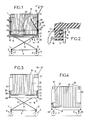
- - la figure 1 est une vue de côté du chariot selon l'invention en position de roulage,
- - la figure 2 est en vue agrandie d'une fixation coulissante d'une barre de support de panier dans un chariot selon l'invention,
- - la figure 3 est une vue de côté d'une variante selon l'invention du chariot toujours en position de roulage,
- - la figure 4 montre le chariot de la figure 3, support replié mais panier toujours ouvert, en position dite de roulage "ramassée",
- - la figure 5 est une vue de face du chariot des figures 3 et 4 en position de rangement et de portage,
- - la figure 6 est une vue de côté du chariot des figures 3, 4 et 5 en position de rangement,
- - la figure 7 est une vue en perspective schématique d'une variante du chariot selon l'invention porté par son utilisateur,
- La figure 1 montre un chariot 1 à provisions comprenant une paire de roulettes avant 2 orientables espacées transversalement et une paire de roulettes arrière 3 coaxiales, espacées transversalement.
- Les axes 6 des roulettes sont montés sur un bâti rigide 4 par l'intermédiaire de chapes 5 à deux branches.
- Les chapes 5 ou fourches de soutien des roulettes avant sont montées pivotantes autour d'axes verticaux 7 rendant ces roulettes avant orientables par rapport au bâti 4.
- Les chapes 5 des roulettes arrières sont montées fixement sur le bâti 4.
- Le chariot 1 comprend également des moyens de support 8 d'un Plateau 9 formés par deux croisillons 10 espacés transversalement.
- Chaque croisillon est composé de deux barres 11 rigides disposées en croix et de longueur inférieure à la dimension longitudinale du plateau 9. Les barres 11 ont chacune une extrémité montée pivotante autour d'un axe 12 solidaire du bâti 4 et l'autre extrémité montée coulissante dans une gorge 13 solidaire d'un côté longitudinal 14 du plateau 9.
- La figure 2 et une vue de détail d'une gorge 13 pratiquée dans un côté longitudinal 14 du plateau 9. L'extrémité 15 de chaque barre 11 est munie d'un axe 16 sur lequel est monté un galet 17 propre à rouler librement dans la gorge 13 s'étendant le long d'un côté longitudinal 14 du plateau 9.
- Des moyens de verrouillage manuels comme représentés par une clavette de butée 18 sur la figure 2, ou automatiques comme connus en soi, assurent le blocage des galets 17 dans les gorges 13 pour deux hauteurs prédéterminées du plateau 9, savoir, une position haute de roulage (figures 1 et 3) et une position basse de rangement et portage (figures 4, 5, 6 et 7).
- Le plateau 9 est rectangulaire et horizontal. Il constitue le fond d'un panier 19 comportant quatre parois rigides, savoir une paroi avant 20, une paroi arrière 21 et deux parois latérales 22 constituées par des grilles.
- Les parois avant et arrière peuvent être des grilles, des plaques ou une combinaison des deux et être réalisées en tout type de matériau tel que métal (acier ou aluminium par exemple) ou matière plastique, éventuellement armée de fibres de verre (matériau composite). La capacité d'un tel chariot est par exemple de l'ordre de 150 dm3, avec des dimensions du panier de 0,5m de large, 0,5m de hauteur et 0,6m de long.
- Les quatre parois rigides sont montées pivotantes autour d'axes horizontaux liés rigidement au plateau 9 de façon à pouvoir basculer en position repliée vers l'intérieur du panier 19, comme montré en pointillé sur les figures 1, 5 et 6 ; à cet effet ces axes sont prévus à des niveaux différents respectifs pour permettre aux parois adopter des positions repliées horizontales superposées.
- Les axes 23 des parois latérales 22 sont placés à proximité du fond, légèrement décalés verticalement l'un par rapport à l'autre, et les axes 24 et 25 des parois avant 20 et arrière 21 sont également décalés verticalement entre eux plus haut que les axes 23 comme représenté sur la figure 1.
- Le plateau 9 comporte en avant et en arrière des rebords ou pans verticaux 26 et 27 délimités supérieurement par les axes 24 et 25.
- Lorsque les parois sont dépliées, elles sont fixées entre elles par des moyens de fixation 28 tels que des pattes élastiques.
- Deux barres 29 de portage solidaires du plateau 9 sont fixées transversalement sur ce dernier, aux deux extrémités longitudinales de celui-ci.
- Une poignée constituée par une barre de poussée 30 est montée pivotante autour d'un axe 31 solidaire de la paroi arrière 21 du chariot de façon à pouvoir prendre une position dépliée de poussée du chariot par un utilisateur et une position repliée vers l'intérieur, de rangement du chariot. Il est prévu des moyens de blocage 32 de la poignée en position de poussée du chariot.
- Dans une variante de réalisation illustrée sur les figures 3 à 6, les parois 20 et 21 sont prolongées latéralement par des joues 33 longitudinales dirigées du panier et sur lesquelles viennent prendre appui les parois latérales 22 en s'y fixant de préférence par des moyens connus en soi, par exemple du type des "clips" ou "loquets" (non représentés).
- En position repliée (voir figures 5 et 6) les joues 33 encadrent les parois latérales 22 de façon à former un boitier fermé pour le rangement et le portage du chariot : à cet effet, les joues de la paroi avant ont des dimensions compatibles avec les dimensions des joues de la paroi arrière de façon à permettre le pliage des parois.
- Des moyens de verrouillage non représentés empèchent les parois du panier en position repliée de s'ouvrir intempestivement pendant le transport.
- Le chariot de la figure 1 comporte de plus un siège pliable 41 constitué par une assise 42 plane montée pivotante vers l'intérieur du panier autour d'un axe transversal 43 lié rigidement à ladite paroi et des moyens de soutien de l'extrémité libre de ladite assise en position horizontale.
- Le fonctionnement des chariots à provisions décrits ci-dessus est le suivant.
- L'utilisateur qui conserve rangé dans son coffre de voiture le chariot plié tel que représenté sur la figure 6, le sort du coffre et le transporte manuellement en le prenant par une poignée de portage 29, comme montré sur la figure 7 jusqu'au lieu de ses achats. L'utilisateur déplie alors le chariot en déverrouillant les croisillons initialement bloqués en leur position repliée et en soulevant le plateau 9 jusqu'à une position haute prédéterminée distante de l'ordre de 1m du bâti resté à proximité du sol. Les galets 17 coulissent librement dans les gorges 13 et des moyens de verrouillage assurent le blocage en position haute.
- L'utilisateur déplie ensuite successivement la paroi arrière 21 et sa poignée 30 qu'il verrouille en position de poussée, puis la paroi avant 20, et enfin les parois latérales 22 qu'il fixe fermement sur les autres parois ou sur les joues 33 dans le cas où de telles joues sont prévues.
- Il peut alors déplacer le chariot jusqu'au magasin et dans celui-ci et empiler dans le panier les marchandises qu'il choisit.
- La surface plane rigide de rangement en partie basse entre les roulettes, permet notamment de transporter un pack de bouteilles.
- Le chariot ainsi garni est ensuite déplacé au niveau de la caisse disposée à la sortie du magasin.
- La hauteur du plateau et la transparence des grilles latérales permettent au caissier de vérifier le contenu du panier.
- Les marchandises déchargées pour paiement sont remises en place dans le panier par l'utilisateur qui amène le chariot jusqu'à son coffre de voiture où deux choix lui sont offerts :
soit le panier est déchargé dans le coffre et le chariot est plié entièrement en réalisant les opérations inverses de celles décrites précédemment pour être rangé tel quel dans la voiture,
soit les croisillons sont simplement repliés et le panier,dont l'encombrement en hauteur ne dépasse pas une profondeur de coffre standard, de voiture est placé directement dans ce dernier; cette solution évite une manutention inutile de marchandises, les deux poignées 29 situées de part et d'autre du chariot permettant de saisir celui-ci et de le porter facilement, même chargé. - Lorsque l'utilisateur est rentré chez lui, il peut utiliser son chariot en position de roulage haute, de portage par ses deux poignées 29 ou de roulage basse ou ramassée.
- Comme il va de soi, et comme il en résulte d'ailleurs de ce qui précède, l'invention ne se limite nullement à ceux de ses modes d'application et de réalisation qui ont été plus spécialement envisagés ; elle en embrasse au contraire toutes les variantes, notamment :
- celles où les moyens de verrouillage, de blocage et de fixation des parois les unes sur les autres sont différents de ceux préalablement évoqués, étant constitués par exemple par des crochets, boutons ou aimants,
- celles où les moyens de portage sont des sangles ou poignées et non des barres,
- celles où le chariot, par son accastillage soigné ajouté à un modèle de base du type décrit ci-dessus, permet une véritable personnalisation du chariot, en particulier par son donateur et/ou son vendeur.
Claims (10)
Applications Claiming Priority (2)
| Application Number | Priority Date | Filing Date | Title |
|---|---|---|---|
| FR8704642A FR2613309B1 (fr) | 1987-04-02 | 1987-04-02 | Chariot a provisions pliable |
| FR8704642 | 1987-04-02 |
Publications (2)
| Publication Number | Publication Date |
|---|---|
| EP0286520A1 true EP0286520A1 (fr) | 1988-10-12 |
| EP0286520B1 EP0286520B1 (fr) | 1990-06-20 |
Family
ID=9349715
Family Applications (1)
| Application Number | Title | Priority Date | Filing Date |
|---|---|---|---|
| EP19880400789 Expired - Lifetime EP0286520B1 (fr) | 1987-04-02 | 1988-03-31 | Chariot à provisions pliable |
Country Status (4)
| Country | Link |
|---|---|
| EP (1) | EP0286520B1 (fr) |
| DE (1) | DE3860240D1 (fr) |
| ES (1) | ES2015611B3 (fr) |
| FR (1) | FR2613309B1 (fr) |
Cited By (14)
| Publication number | Priority date | Publication date | Assignee | Title |
|---|---|---|---|---|
| AU645057B2 (en) * | 1990-01-29 | 1994-01-06 | Bioapatite Ab | Apparatus for diagnosing inflammatory condition relating to periodonititis |
| GB2289025A (en) * | 1994-05-05 | 1995-11-08 | Derek William Roberts | Shopping trolley |
| US5649718A (en) * | 1996-08-01 | 1997-07-22 | Groglio; Valerie Defede | Utility cart |
| GB2319229A (en) * | 1996-11-16 | 1998-05-20 | Theodorick Romeo Miller | Collapsible two part shopping trolley. |
| DE19707744C1 (de) * | 1997-02-27 | 1998-10-22 | Rauschenberger Metallwaren Gmb | Zusammenlegbarer Transportwagen |
| FR2768684A1 (fr) * | 1997-09-25 | 1999-03-26 | Francette Lastra | Dispositif deployable et repliable pour rehausser et rendre mobiles les paniers de collecte des achats |
| WO2003013937A1 (fr) | 2001-08-10 | 2003-02-20 | Burkhard Koch | Moyen de transport etirable |
| DE10138306A1 (de) * | 2001-10-31 | 2003-03-06 | Burkhard Koch | Aufspannbares Transportmittel |
| EP1733947A3 (fr) * | 2005-06-17 | 2008-02-06 | Willi Dürr | Chariot d'achat |
| US7427080B2 (en) | 2002-06-28 | 2008-09-23 | Francois Paulus Naude, Jr. | Shopping trolleys |
| WO2015188321A1 (fr) * | 2014-06-10 | 2015-12-17 | 林福泽 | Chariot d'achat |
| CN107116519A (zh) * | 2017-04-12 | 2017-09-01 | 耐世特凌云驱动系统(芜湖)有限公司 | 驱动轴轴杆摆放器具 |
| US20230150561A1 (en) * | 2019-08-07 | 2023-05-18 | Jason Gardner | Personal shopping cart and method of use |
| CN116968794A (zh) * | 2023-07-28 | 2023-10-31 | 湖南第一师范学院 | 一种工厂用计算机包装转运设备 |
Citations (4)
| Publication number | Priority date | Publication date | Assignee | Title |
|---|---|---|---|---|
| US2155896A (en) * | 1937-05-04 | 1939-04-25 | Sylvan N Goldman | Combination basket and carriage |
| US2604333A (en) * | 1950-02-16 | 1952-07-22 | Elmer Jonathan | Combination bassinet, stroller, and playpen |
| US2613951A (en) * | 1950-07-10 | 1952-10-14 | Rusnak Paul | Folding utility cart |
| US3863985A (en) * | 1973-07-09 | 1975-02-04 | Chauncey E Zuber | Offal cart |
-
1987
- 1987-04-02 FR FR8704642A patent/FR2613309B1/fr not_active Expired - Lifetime
-
1988
- 1988-03-31 ES ES88400789T patent/ES2015611B3/es not_active Expired - Lifetime
- 1988-03-31 DE DE8888400789T patent/DE3860240D1/de not_active Expired - Lifetime
- 1988-03-31 EP EP19880400789 patent/EP0286520B1/fr not_active Expired - Lifetime
Patent Citations (4)
| Publication number | Priority date | Publication date | Assignee | Title |
|---|---|---|---|---|
| US2155896A (en) * | 1937-05-04 | 1939-04-25 | Sylvan N Goldman | Combination basket and carriage |
| US2604333A (en) * | 1950-02-16 | 1952-07-22 | Elmer Jonathan | Combination bassinet, stroller, and playpen |
| US2613951A (en) * | 1950-07-10 | 1952-10-14 | Rusnak Paul | Folding utility cart |
| US3863985A (en) * | 1973-07-09 | 1975-02-04 | Chauncey E Zuber | Offal cart |
Cited By (23)
| Publication number | Priority date | Publication date | Assignee | Title |
|---|---|---|---|---|
| AU645057B2 (en) * | 1990-01-29 | 1994-01-06 | Bioapatite Ab | Apparatus for diagnosing inflammatory condition relating to periodonititis |
| GB2289025A (en) * | 1994-05-05 | 1995-11-08 | Derek William Roberts | Shopping trolley |
| GB2289025B (en) * | 1994-05-05 | 1997-09-10 | Derek William Roberts | Improvements in shopping trolleys |
| US5649718A (en) * | 1996-08-01 | 1997-07-22 | Groglio; Valerie Defede | Utility cart |
| GB2319229A (en) * | 1996-11-16 | 1998-05-20 | Theodorick Romeo Miller | Collapsible two part shopping trolley. |
| WO1998022324A1 (fr) * | 1996-11-16 | 1998-05-28 | Theodorick Romeo Miller | Chariot pliable |
| GB2319229B (en) * | 1996-11-16 | 2001-01-17 | Theodorick Romeo Miller | Collapsible trolley |
| DE19707744C1 (de) * | 1997-02-27 | 1998-10-22 | Rauschenberger Metallwaren Gmb | Zusammenlegbarer Transportwagen |
| FR2768684A1 (fr) * | 1997-09-25 | 1999-03-26 | Francette Lastra | Dispositif deployable et repliable pour rehausser et rendre mobiles les paniers de collecte des achats |
| WO2003013937A1 (fr) | 2001-08-10 | 2003-02-20 | Burkhard Koch | Moyen de transport etirable |
| DE10138306A1 (de) * | 2001-10-31 | 2003-03-06 | Burkhard Koch | Aufspannbares Transportmittel |
| DE10138306B4 (de) * | 2001-10-31 | 2004-01-22 | Burkhard Koch | Aufspannbares Transportmittel |
| US7427080B2 (en) | 2002-06-28 | 2008-09-23 | Francois Paulus Naude, Jr. | Shopping trolleys |
| CN100448726C (zh) * | 2002-06-28 | 2009-01-07 | 小弗朗索瓦P诺德 | 购物手推车 |
| EP1733947A3 (fr) * | 2005-06-17 | 2008-02-06 | Willi Dürr | Chariot d'achat |
| WO2015188321A1 (fr) * | 2014-06-10 | 2015-12-17 | 林福泽 | Chariot d'achat |
| US10081381B2 (en) | 2014-06-10 | 2018-09-25 | Fuze Lin | Shopping cart |
| CN107116519A (zh) * | 2017-04-12 | 2017-09-01 | 耐世特凌云驱动系统(芜湖)有限公司 | 驱动轴轴杆摆放器具 |
| US20230150561A1 (en) * | 2019-08-07 | 2023-05-18 | Jason Gardner | Personal shopping cart and method of use |
| US12017694B2 (en) * | 2019-08-07 | 2024-06-25 | Jason Gardner | Personal shopping cart and method of use |
| US20240300562A1 (en) * | 2019-08-07 | 2024-09-12 | Jason Gardner | Personal shopping cart and method of use |
| US12420853B2 (en) * | 2019-08-07 | 2025-09-23 | Jason Gardner | Personal shopping cart and method of use |
| CN116968794A (zh) * | 2023-07-28 | 2023-10-31 | 湖南第一师范学院 | 一种工厂用计算机包装转运设备 |
Also Published As
| Publication number | Publication date |
|---|---|
| FR2613309A1 (fr) | 1988-10-07 |
| EP0286520B1 (fr) | 1990-06-20 |
| DE3860240D1 (de) | 1990-07-26 |
| ES2015611B3 (es) | 1990-09-01 |
| FR2613309B1 (fr) | 1991-08-16 |
Similar Documents
| Publication | Publication Date | Title |
|---|---|---|
| EP0286520B1 (fr) | Chariot à provisions pliable | |
| EP0849140B1 (fr) | Chariot destiné aux courses dans les magasins, chargeable plein et sans efforts dans un coffre de voiture | |
| EP0206872B1 (fr) | Dispositif repliable pour le transport et/ou la manutention d'objects ou d'articles en vrac | |
| EP0274782A1 (fr) | Mallette pour le rangement d'un équipement de golf, convertible en un chariot de golf | |
| FR2977229A1 (fr) | Tricycle equipe d'un caisson de chargement | |
| FR2569151A1 (fr) | Chariot de type " caddie " a recipients amovibles | |
| EP3947104B1 (fr) | Chariot pour supporter et peser un contenant | |
| FR2673587A1 (fr) | Chariot reglable de transport a roues escamotables a charger plein dans tout coffre automobile sans operation mecanique. | |
| FR2708898A1 (fr) | Chariot destiné à la manutention d'objets divers. | |
| FR3066747A1 (fr) | Chariot a provisions, vehicule, ensemble et procede de chargement associes | |
| WO2015145065A1 (fr) | Chariot universel | |
| EP2097306B1 (fr) | Chariot de service de chambre pour les hôtels | |
| CH659219A5 (en) | Wheeled trolley with basket | |
| FR2747634A1 (fr) | Chariot individuel de transport de marchandises et contenant amovible destine a etre utilise avec un tel chariot | |
| FR2752406A1 (fr) | Chariot a provisions ayant un siege destine a un enfant ou a un bebe | |
| WO2010112706A1 (fr) | Sac equipe d ' un mini-chariot a 4 roulettes, pliable et multifonctions " trois en un" | |
| FR2492768A1 (fr) | Chariot destine a la manutention et au transport de diverses marchandises | |
| EP2221231B1 (fr) | Ensemble de transport comprenant un chariot roulant et au moins deux caisses adaptées | |
| FR2752211A1 (fr) | Chariot multi-usages du genre diable | |
| FR2580248A2 (fr) | Chariot de manutention pour recipients amovibles | |
| CH676952A5 (fr) | ||
| FR3084869A1 (fr) | Chariot multifonctionnel | |
| WO2011124769A1 (fr) | Chariot modulaire encastrable | |
| FR2672560A1 (fr) | Chariot libre-service a volume variable. | |
| EP0374335A1 (fr) | Dispositif de manutention de type "diable" à une roue |
Legal Events
| Date | Code | Title | Description |
|---|---|---|---|
| PUAI | Public reference made under article 153(3) epc to a published international application that has entered the european phase |
Free format text: ORIGINAL CODE: 0009012 |
|
| AK | Designated contracting states |
Kind code of ref document: A1 Designated state(s): DE ES GB IT |
|
| 17P | Request for examination filed |
Effective date: 19880930 |
|
| 17Q | First examination report despatched |
Effective date: 19891115 |
|
| GRAA | (expected) grant |
Free format text: ORIGINAL CODE: 0009210 |
|
| ITF | It: translation for a ep patent filed | ||
| AK | Designated contracting states |
Kind code of ref document: B1 Designated state(s): DE ES GB IT |
|
| GBT | Gb: translation of ep patent filed (gb section 77(6)(a)/1977) | ||
| REF | Corresponds to: |
Ref document number: 3860240 Country of ref document: DE Date of ref document: 19900726 |
|
| PGFP | Annual fee paid to national office [announced via postgrant information from national office to epo] |
Ref country code: DE Payment date: 19910222 Year of fee payment: 4 |
|
| PGFP | Annual fee paid to national office [announced via postgrant information from national office to epo] |
Ref country code: ES Payment date: 19910307 Year of fee payment: 4 |
|
| ITTA | It: last paid annual fee | ||
| PLBE | No opposition filed within time limit |
Free format text: ORIGINAL CODE: 0009261 |
|
| STAA | Information on the status of an ep patent application or granted ep patent |
Free format text: STATUS: NO OPPOSITION FILED WITHIN TIME LIMIT |
|
| 26N | No opposition filed | ||
| PG25 | Lapsed in a contracting state [announced via postgrant information from national office to epo] |
Ref country code: GB Effective date: 19920331 |
|
| PG25 | Lapsed in a contracting state [announced via postgrant information from national office to epo] |
Ref country code: ES Free format text: LAPSE BECAUSE OF NON-PAYMENT OF DUE FEES Effective date: 19920401 |
|
| GBPC | Gb: european patent ceased through non-payment of renewal fee | ||
| PG25 | Lapsed in a contracting state [announced via postgrant information from national office to epo] |
Ref country code: DE Effective date: 19921201 |
|
| REG | Reference to a national code |
Ref country code: ES Ref legal event code: FD2A Effective date: 19990301 |
|
| PG25 | Lapsed in a contracting state [announced via postgrant information from national office to epo] |
Ref country code: IT Free format text: LAPSE BECAUSE OF NON-PAYMENT OF DUE FEES;WARNING: LAPSES OF ITALIAN PATENTS WITH EFFECTIVE DATE BEFORE 2007 MAY HAVE OCCURRED AT ANY TIME BEFORE 2007. THE CORRECT EFFECTIVE DATE MAY BE DIFFERENT FROM THE ONE RECORDED. Effective date: 20050331 |