EP0286853A2 - Verfahren zur Abdichtung von Schuhen im Sohlenbereich - Google Patents
Verfahren zur Abdichtung von Schuhen im Sohlenbereich Download PDFInfo
- Publication number
- EP0286853A2 EP0286853A2 EP88104129A EP88104129A EP0286853A2 EP 0286853 A2 EP0286853 A2 EP 0286853A2 EP 88104129 A EP88104129 A EP 88104129A EP 88104129 A EP88104129 A EP 88104129A EP 0286853 A2 EP0286853 A2 EP 0286853A2
- Authority
- EP
- European Patent Office
- Prior art keywords
- layer
- insole
- area
- shoe upper
- sealing lip
- Prior art date
- Legal status (The legal status is an assumption and is not a legal conclusion. Google has not performed a legal analysis and makes no representation as to the accuracy of the status listed.)
- Granted
Links
- 238000007789 sealing Methods 0.000 title claims abstract description 22
- 238000000034 method Methods 0.000 title claims abstract description 19
- 238000002347 injection Methods 0.000 claims abstract description 14
- 239000007924 injection Substances 0.000 claims abstract description 14
- 239000000463 material Substances 0.000 claims abstract description 10
- 230000002045 lasting effect Effects 0.000 claims description 10
- 239000012528 membrane Substances 0.000 claims description 4
- 239000004814 polyurethane Substances 0.000 claims description 4
- 229920001343 polytetrafluoroethylene Polymers 0.000 claims description 3
- 239000004810 polytetrafluoroethylene Substances 0.000 claims description 3
- 229920002635 polyurethane Polymers 0.000 claims description 3
- 229920000728 polyester Polymers 0.000 claims description 2
- -1 polytetrafluoroethylene Polymers 0.000 claims description 2
- 239000011527 polyurethane coating Substances 0.000 claims description 2
- 244000043261 Hevea brasiliensis Species 0.000 claims 1
- 229920003052 natural elastomer Polymers 0.000 claims 1
- 229920001194 natural rubber Polymers 0.000 claims 1
- 229920000915 polyvinyl chloride Polymers 0.000 claims 1
- 239000004800 polyvinyl chloride Substances 0.000 claims 1
- 229920003051 synthetic elastomer Polymers 0.000 claims 1
- 239000005061 synthetic rubber Substances 0.000 claims 1
- 239000000853 adhesive Substances 0.000 description 4
- 230000001070 adhesive effect Effects 0.000 description 4
- 239000003566 sealing material Substances 0.000 description 4
- 238000005507 spraying Methods 0.000 description 3
- 239000000243 solution Substances 0.000 description 2
- 238000005452 bending Methods 0.000 description 1
- 230000001419 dependent effect Effects 0.000 description 1
- 239000003292 glue Substances 0.000 description 1
- 230000001771 impaired effect Effects 0.000 description 1
- 239000010985 leather Substances 0.000 description 1
- 239000007788 liquid Substances 0.000 description 1
- 239000011344 liquid material Substances 0.000 description 1
- 238000000465 moulding Methods 0.000 description 1
- 239000007921 spray Substances 0.000 description 1
- 230000007704 transition Effects 0.000 description 1
- 230000037303 wrinkles Effects 0.000 description 1
Images

Classifications
-
- A—HUMAN NECESSITIES
- A43—FOOTWEAR
- A43D—MACHINES, TOOLS, EQUIPMENT OR METHODS FOR MANUFACTURING OR REPAIRING FOOTWEAR
- A43D1/00—Foot or last measuring devices; Measuring devices for shoe parts
-
- B—PERFORMING OPERATIONS; TRANSPORTING
- B29—WORKING OF PLASTICS; WORKING OF SUBSTANCES IN A PLASTIC STATE IN GENERAL
- B29D—PRODUCING PARTICULAR ARTICLES FROM PLASTICS OR FROM SUBSTANCES IN A PLASTIC STATE
- B29D35/00—Producing footwear
- B29D35/06—Producing footwear having soles or heels formed and joined on to preformed uppers using a moulding technique, e.g. by injection moulding, pressing and vulcanising
- B29D35/061—Producing footwear having soles or heels formed and joined on to preformed uppers using a moulding technique, e.g. by injection moulding, pressing and vulcanising by injection moulding
-
- A—HUMAN NECESSITIES
- A43—FOOTWEAR
- A43B—CHARACTERISTIC FEATURES OF FOOTWEAR; PARTS OF FOOTWEAR
- A43B17/00—Insoles for insertion, e.g. footbeds or inlays, for attachment to the shoe after the upper has been joined
- A43B17/10—Insoles for insertion, e.g. footbeds or inlays, for attachment to the shoe after the upper has been joined specially adapted for sweaty feet; waterproof
- A43B17/107—Insoles for insertion, e.g. footbeds or inlays, for attachment to the shoe after the upper has been joined specially adapted for sweaty feet; waterproof waterproof
-
- A—HUMAN NECESSITIES
- A43—FOOTWEAR
- A43B—CHARACTERISTIC FEATURES OF FOOTWEAR; PARTS OF FOOTWEAR
- A43B7/00—Footwear with health or hygienic arrangements
- A43B7/12—Special watertight footwear
- A43B7/125—Special watertight footwear provided with a vapour permeable member, e.g. a membrane
Definitions
- the invention relates to a method according to the preamble of patent claim 1.
- Shoes have recently been produced whose shoe upper consists of water-impermeable and preferably vapor-permeable material. There are difficulties in making a waterproof connection between the shoe upper and the outsole to be attached to it.
- the shoe upper is glued to the insole with an adhesive sticking method and a sole is applied to this glued unit, which can be an midsole or directly the outsole.
- the weak point in this solution is the glue points between the insole and the shoe upper, since the adhesive either does not seal the entire transition area between the shoe upper and the shoe sole from the outset, or it can become brittle and therefore water-permeable due to bending stresses when using the shoe.
- the shoe upper and glued insole have been lined with a sock-like insert made of waterproof, vapor-permeable material.
- a sock-like insert made of waterproof, vapor-permeable material.
- it In order to obtain the required form of the insert, it must be sewn and hot welded at the seams. This method is not only complex and correspondingly expensive, but also leads to problems because the use tends to wrinkle and warp.
- the invention has for its object to improve the method of the type mentioned in such a way that, if any outsoles can be used, a connection between the shoe upper and the insole area that is reliably watertight even over a long period of use is ensured.
- a relatively simple injection mold can be used for the method according to the invention.
- a spray stamp with a raised sealing lip is sufficient. Since the exact attachment line of the sealing lip on the insole provided with the insole does not matter, this shape can be used for a large number of differently sized shoes.
- the contour of the sealing lip preferably runs offset inwards from the outer edge of the shoe upper. Any outsole can then be applied to the layer sprayed on according to the invention. The sprayed-on layer then no longer needs to be visible, so that the aesthetic appearance of the shoe need not be impaired by such a layer.
- the layer preferably consists of polyurethane, which is liquefied for spraying and sprayed on with a pressure of preferably 3 to 5 at. This pressure ensures that the liquid material penetrates into the area to be sealed between the insole and the upper and makes this connection watertight.
- waterproof material which is preferably vapor-permeable.
- a film made of stretched polytetrafluoroethylene (PTFE), a polyester membrane or a microporous polyurethane coating are suitable for this.
- Fig. 1 shows a shoe upper 1, which is glued to an insole 4 by means of a lasting adhesive 3.
- the shoe upper 1 can consist of different materials. 1 shows two possibilities.
- the left side shows a shoe upper, which consists of a laminate 7 with an outer layer 9, a middle layer 11 made of a water-impermeable, vapor-permeable membrane and an inner layer 13.
- the laminate 7 can be lined on the inside with a lining 15.
- Fig. 1 shows an embodiment of a shoe upper, which has an outer layer 17, for example made of leather, which is lined with a laminate serving as a lining, which in turn contains a water-impermeable, vapor-permeable membrane.
- the lasting fold 19 has a loose end region 21 which is not glued to the insole 4.
- the lining 15 is preferably made shorter in the lasting fold than the laminate 7 and only the area of the laminate 7 provided with lining 15 is glued to the insole 4.
- the area of the laminate 7 projecting over the lining forms the loose part of the lasting fold 19.
- the outer layer 17 in the region of the lasting fold 19 has a shorter length than the laminate 7 applied to the outer layer 17. After the shoe upper 1 is glued to the insole 4, the front end region 21 of the laminate 7 remains not connected to the insole 4.
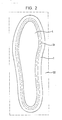
- FIG. 1 also shows an injection mold 30 with a self-sealing lip 31 which roughly follows the shape of the insole 4, as can be seen in FIG. 2.
- a left sealing lip part 31l and a right sealing lip part 31r can be seen.
- the injection mold 30 is provided with an inflow opening, the outlet opening of which lies in the area between the two sealing lip parts 31l and 31r.
- the sealing material 5 is liquefied and injected into the space enclosed by the sealing lip 31 at a pressure in the range of, for example, 3 to 5 at.
- the liquid sealing material also penetrates into the area between the insole 4 and the loose ends 21 of the lasting fold 19.
- the spraying process fills the entire space between the insole and the inner contour of the injection mold lying between the sealing lip 31 with the sealing material. After the sealing material has hardened, there is a watertight seal in the bottom area of the Insole 4 connected shoe upper 1 given.
- the method according to the invention can also be used when the design is stroked.
- the sealing lip 31 of the injection mold 30 is positioned such that the strobe seam lies within the area of the injection mold 30 enclosed by the sealing lip 31.
Landscapes
- Health & Medical Sciences (AREA)
- Epidemiology (AREA)
- General Health & Medical Sciences (AREA)
- Public Health (AREA)
- Engineering & Computer Science (AREA)
- Mechanical Engineering (AREA)
- Footwear And Its Accessory, Manufacturing Method And Apparatuses (AREA)
- Crushing And Grinding (AREA)
- Holders For Apparel And Elements Relating To Apparel (AREA)
Abstract
Description
- Die Erfindung betrifft ein Verfahren gemäß Oberbegriff des Patentanspruchs 1.
- In neuerer Zeit sind Schuhe hergestellt worden, deren Schuhschaft aus wasserundurchlässigem und dabei vorzugsweise dampfdurchlässigem Material besteht. Es bestehen Schwierigkeiten, eine wasserdichte Verbindung zwischen dem Schuhschaft und der daran anzubringenden Laufsohle herzustellen.
- Bei dem bekannten AGO-Verfahren wird der Schuhschaft mit einem Klebezwickverfahren mit der Brandsohle verklebt und auf diese verklebte Einheit eine Sohle aufgebracht, die eine Zwischensohle oder direkt die Laufsohle sein kann. Schwachstelle bei dieser Lösung sind die Klebestellen zwischen Brandsohle und Schuhschaft, da der Kleber entweder von vornherein nicht den gesamten Übergangsbereich zwischen Schuhschaft und Brandsohle abdichtet oder durch Biegebeanspruchungen bei der Schuhbenutzung brüchig und damit wasserdurchlässig werden kann.
- Um dieses Problem zu überwinden, hat man die Einheit aus Schuhschaft und damit verklebter Brandsohle mit einem sockenartigen Einsatz aus wasserdichtem, dampfdurchlässigem Material ausgekleidet. Um die erforderliche Form des Einsatzes zu erhalten, muß er vernäht und an den Nahtstellen heiß verschweißt werden. Dieses Verfahren ist nicht nur aufwendig und entsprechend teuer sondern führt auch zu Problemen deswegen, weil der Einsatz zu Faltenneigung und Verwerfungen neigt.
- Weiterhin ist es bekannt, den Sohlenbereich eines gestrobelten Schuhschaftes mit einer PU-(Polyurethan-)Laufsohle zu um spritzen. Hierzu benötigt man eine zweigeteilte Spritzform, die von beiden Seiten an den Schuhschaft herangeführt wird. Diese Spritzform ist relativ teuer. Aufgrund der hohen Formkosten sind die Schuhhersteller auf sehr wenige Sohlenformen beschränkt. Außerdem lassen sich mit solchen angespritzten Laufsohlen keine Schuhe eleganten Aussehens erzielen.
- Der Erfindung liegt die Aufgabe zugrunde, das Verfahren der eingangs angegebenen Art so zu verbessern, daß bei Verwendbarkeit beliebiger Laufsohlen eine auch über eine lange Benutzungszeit zuverlässig wasserdichte Verbindung zwischen Schuhschaft und Brandsohlenbereich gewährleistet wird.
- Die Lösung dieser Aufgabe ist im Patentanspruch 1 angegeben und kann den Unteransprüchen gemäß vorteilhaft weitergebildet werden.
- Für das erfindungsgemäße Verfahren kann eine relativ einfache Spritzform eingesetzt werden. Es genügt ein Spritzstempel, der mit einer hochstehenden Dichtlippe versehen ist, deren Verlauf in etwa der Kontur der Brandsohle entspricht. Da es auf die exakte Ansatzlinie der Dichtlippe an dem mit der Brandsohle versehenen Schuhschaft nicht ankommt, kann diese Form für eine große Anzahl unterschiedlich bemessener Schuhe verwendet werden.
- Vorzugsweise verläuft die Kontur der Dichtlippe von dem Außenrand des Schuhschaftes nach innen versetzt. Auf die erfindungsgemäß aufgespritzte Schicht kann dann eine beliebige Laufsohle aufgebracht werden. Die aufgespritzte Schicht braucht dann nicht mehr sichtbar zu sein, so daß die ästhetische Erscheinung des Schuhs durch eine solche Schicht nicht beeinträchtigt zu werden braucht.
- Vorzugsweise besteht die Schicht aus Polyurethan, das zum Aufspritzen verflüssigt und mit einem Druck von vorzugsweise 3 bis 5 at aufgespritzt wird. Dieser Druck stellt sicher, daß das flüssige Material in den abzudichtenden Bereich zwischen Brandsohle und Schuhschaft eindringt und diese Verbindung wasserdicht macht.
- Um den Schuhschaft wasserdicht zu machen, ist mindestens ein Teil, vorzugsweise der gesamte Schuhschaft mit wasserdichtem Material ausgekleidet, das vorzugsweise dampfdurchlässig ist. Hierfür eignen sich beispielsweise eine Folie aus gerecktem Polytetrafluoräthylen (PTFE), eine Polyestermembran oder eine mikroporöse Polyurethan-Beschichtung.
- Im folgenden wird die Erfindung anhand von Ausführungsformen näher erläutert. In den Zeichnungen zeigen:
- Fig. 1 eine schematische Vertikalschnittansicht eines mit einer Brandsohle verklebten Schuhschaftes mit daran angesetzter Spritzform und der damit erzeugten Dichtungsschicht;
und - Fig. 2 eine schematische Darstellung eines mit einer Brandsohle verklebten Schuhschaftes und einer daran angesetzten Spritzform.
- Fig. 1 zeigt einen Schuhschaft 1, der mittels eines Zwickklebers 3 mit einer Brandsohle 4 verklebt ist. Der Schuhschaft 1 kann aus unterschiedlichen Materialien bestehen. In Fig. 1 sind zwei Möglichkeiten dargestellt. Die linke Seite zeigt einen Schuhschaft, der aus einem Laminat 7 mit einer Außenschicht 9, einer Mittelschicht 11 aus einer wasserundurchlässigen, dampfdurchlässigen Membran und einer Innenschicht 13 besteht. Auf der Innenseite kann das Laminat 7 mit einem Futter 15 ausgekleidet sein.
- Die rechte Seite von Fig. 1 zeigt eine Ausführungsform eines Schuhschaftes, der eine Außenschicht 17, beispielsweise aus Leder, aufweist, die mit einem als Futter dienenden Laminat ausgekleidet ist, das wiederum eine wasserundurchlässige, dampfdurchlässige Membran enthält.
- Der Zwickeinschlag 19 weist einen losen Endbereich 21 auf, der nicht mit der Brandsohle 4 verklebt ist.
- Bei der in Fig. 1 links gezeigten Ausführungsform wird im Zwickeinschlag das Futter 15 vorzugsweise kürzer gemacht als das Laminat 7 und nur der mit Futter 15 versehene Bereich des Laminats 7 an der Brandsohle 4 festgeklebt. Der über das Futter überstehende Bereich des Laminats 7 bildet den losen Teil des Zwickeinschlages 19.
- Bei der in Fig. 1 rechts dargestellten Ausführungsform weist die Außenschicht 17 im Bereich des Zwickeinschlages 19 eine kürzere Länge auf als das auf die Außenschicht 17 aufgebrachte Laminat 7. Nach dem Verkleben des Schuhschaftes 1 mit der Brandsohle 4 bleibt der vordere Endbereich 21 des Laminats 7 mit der Brandsohle 4 unverbunden.
- Fig. 1 zeigt außerdem eine Spritzform 30 mit einer in sich geschlossenen Dichtlippe 31, die in etwa der Form der Brandsohle 4 folgt, wie dies in Fig. 2 zu sehen ist. In der Schnittdarstellung in Fig. 1 ist ein linker Dichtlippenteil 31l und ein rechter Dichtlippenteil 31r zu sehen. Beim Spritzvorgang liegen die Dichtlippenteile 31l, 31r unterhalb der Bereiche des Zwickklebers 3 an den Zwickeinschlägen 19 an. Die Spritzform 30 ist mit einer Einströmöffnung versehen, deren Austrittsmündung in dem Bereich zwischen den beiden Dichtlippenteilen 31l und 31r liegt.
- Zum Einspritzen wird das Dichtmaterial 5 verflüssigt und mit einem Druck im Bereich von beispielsweise 3 bis 5 at in den von der Dichtlippe 31 eingeschlossenen Raum eingespritzt. Dabei dringt das flüssige Dichtmaterial auch in den Bereich zwischen der Brandsohle 4 und den losen Enden 21 des Zwickeinschlages 19. Durch den Spritzvorgang wird der gesamte Raum zwischen Brandsohle und zwischen der Dichtlippe 31 liegender Innenkontur der Spritzform mit dem Dichtungsmaterial ausgefüllt. Nach dem Aushärten des Dichtungsmaterials ist ein wasserdichter Abschluß im Bodenbereich des mit der Brandsohle 4 verbundenen Schuhschaftes 1 gegeben.
- Das erfindungsgemäße Verfahren läßt sich auch bei gestrobelter Machart anwenden. In diesem Fall wird die Dichtlippe 31 der Spritzform 30 so positioniert, daß die Strobelnaht innerhalb des von der Dichtungslippe 31 eingeschlossenen Bereichs der Spritzform 30 liegt.
Claims (8)
dadurch gekennzeichnet,
daß an die Unterseite des mit dem Brandsohlenbereich (4) verbundenen Schuhschaftes (1) eine Spritzform (30) angesetzt wird, die eine zum Brandsohlenbereich (4) hochstehende Dichtlippenanordnung (31) aufweist, die beidseits der abzudichtenden Verbindungszone verläuft,
und daß die Schicht in den von der Dichtlippenanordnung (31) begrenzten Bereich gespritzt wird.
dadurch gekennzeichnet,
daß die Schicht aus Polyurethan besteht.
dadurch gekennzeichnet,
daß die Schicht aus Polyvinylchlorid besteht.
dadurch gekennzeichnet,
daß die Schicht aus Naturkautschuk besteht.
dadurch gekennzeichnet,
daß die Schicht aus Synthese-Kautschuk besteht.
dadurch gekennzeichnet,
daß mindestens ein Teil des Schuhschaftes (1) aus wasserdichtem, dampfdurchlässigem Material (11) besteht oder mit solchem Material ausgekleidet ist.
dadurch gekennzeichnet,
daß das wasserdichte, dampfdurchlässige Material eine Folie aus gerecktem Polytetrafluoräthylen, eine Polyestermembran oder eine mikroporöse Polyurethan-Beschichtung ist.
dadurch gekennzeichnet,
daß der innere Randbereich (21) des Zwickeinschlages (19) unverklebt gehalten wird,
daß der unverklebte Randbereich (21) innerhalb des von der Dichtlippenanordnung (31) begrenzten Bereichs positioniert wird
und daß das Material der Schicht auf beiden Seiten des losen Randbereichs (21) aufgebracht wird.
Priority Applications (1)
| Application Number | Priority Date | Filing Date | Title |
|---|---|---|---|
| AT88104129T ATE95676T1 (de) | 1987-04-15 | 1988-03-15 | Verfahren zur abdichtung von schuhen im sohlenbereich. |
Applications Claiming Priority (2)
| Application Number | Priority Date | Filing Date | Title |
|---|---|---|---|
| DE3712901A DE3712901C1 (de) | 1987-04-15 | 1987-04-15 | Verfahren zur Abdichtung von Schuhen im Sohlenbereich |
| DE3712901 | 1987-04-15 |
Publications (4)
| Publication Number | Publication Date |
|---|---|
| EP0286853A2 true EP0286853A2 (de) | 1988-10-19 |
| EP0286853A3 EP0286853A3 (en) | 1990-10-10 |
| EP0286853B1 EP0286853B1 (de) | 1993-10-13 |
| EP0286853B2 EP0286853B2 (de) | 1998-07-15 |
Family
ID=6325749
Family Applications (1)
| Application Number | Title | Priority Date | Filing Date |
|---|---|---|---|
| EP88104129A Expired - Lifetime EP0286853B2 (de) | 1987-04-15 | 1988-03-15 | Verfahren zur Abdichtung von Schuhen im Sohlenbereich |
Country Status (13)
| Country | Link |
|---|---|
| EP (1) | EP0286853B2 (de) |
| JP (1) | JPH062081B2 (de) |
| KR (1) | KR880012184A (de) |
| CN (1) | CN88102190A (de) |
| AT (1) | ATE95676T1 (de) |
| CA (1) | CA1333318C (de) |
| DD (1) | DD284590A5 (de) |
| DE (2) | DE3712901C1 (de) |
| HU (1) | HUT57564A (de) |
| PT (1) | PT87217B (de) |
| RO (1) | RO100073B1 (de) |
| TR (1) | TR25076A (de) |
| YU (1) | YU64088A (de) |
Cited By (10)
| Publication number | Priority date | Publication date | Assignee | Title |
|---|---|---|---|---|
| DE4311768A1 (de) * | 1993-04-08 | 1994-10-13 | Gore W L & Ass Gmbh | Verfahren zur Abdichtung von Schuhen im Sohlenbereich |
| DE4436495A1 (de) * | 1994-10-12 | 1996-04-18 | Gore W L & Ass Gmbh | Verfahren zur Abdichtung von Schuhen im Sohlenbereich |
| EP0595941B1 (de) * | 1991-07-12 | 1997-08-27 | W.L. Gore & Associates, Inc. | Herstellungsverfahren einer wasserdichten Schuhwaren |
| WO2000024280A1 (de) | 1998-10-28 | 2000-05-04 | W.L. Gore & Associates Gmbh | Schuhwerk mit zwickeinschlagabdichtung und verfahren zu dessen herstellung |
| WO2000024279A1 (de) | 1998-10-28 | 2000-05-04 | W.L. Gore & Associates Gmbh | Abgedichteter schuh und verfahren zu dessen herstellung |
| EP1002474A1 (de) | 1998-11-17 | 2000-05-24 | W.L. GORE & ASSOCIATES GmbH | Schuhwerk mit Zwickeinschlagabdichtung und Verfahren zu dessen Herstellung |
| WO2000044252A1 (de) | 1999-01-29 | 2000-08-03 | W.L. Gore & Associates Gmbh | Schuhwerk mit abgedichteter funktionsschicht und verfahren zu dessen herstellung |
| WO2001082731A2 (en) | 2000-04-27 | 2001-11-08 | W.L. Gore & Associates Gmbh | Footwear with a sealed lasting allowance and process for its production |
| EP1457126A1 (de) * | 2003-03-11 | 2004-09-15 | Jolly Scarpe S.p.A. | Verfahren zur Herstellung eines wasserdichten atmungsaktiven Schuhwerks und durch dieses Verfahren hergestellter Schuh |
| US6839987B2 (en) * | 2001-06-29 | 2005-01-11 | Salomon S.A. | Boot |
Families Citing this family (9)
| Publication number | Priority date | Publication date | Assignee | Title |
|---|---|---|---|---|
| DE3840087A1 (de) * | 1988-11-28 | 1990-05-31 | Wagner Lowa Schuhfab | Schuh - stichwort: kunststoffzwickrand |
| DE4000156C2 (de) * | 1990-01-04 | 1998-07-30 | Gore W L & Ass Gmbh | Verfahren zur Herstellung eines wasserdichten Schuhs sowie wasserdichter Schuh |
| DE4138836C5 (de) * | 1991-11-26 | 2004-07-15 | W.L. Gore & Associates Gmbh | Wasserdichtes, atmungsaktives Schuhwerk |
| DE4429158C2 (de) * | 1994-07-30 | 1998-12-03 | Oskar Welz | Schuhwerk |
| DE19738744A1 (de) | 1997-09-04 | 1999-04-08 | Gore W L & Ass Gmbh | Schuh und Verfahren zu dessen Herstellung |
| ES2219111T3 (es) * | 1998-10-28 | 2004-11-16 | W.L. GORE & ASSOCIATES GMBH | Calzado con estructura de suela estanqueizada y procedimiento para su fabricacion. |
| WO2001012003A1 (en) * | 1999-08-16 | 2001-02-22 | Gore Enterprise Holdings, Inc. | Waterproof breathable footwear with cemented outsoles |
| CN102342622B (zh) * | 2010-07-29 | 2015-07-15 | 阿基里斯株式会社 | 防水鞋和其所采用的防水内衬 |
| CN107348617A (zh) * | 2017-08-31 | 2017-11-17 | 成都卡美奇鞋业有限公司 | 提高鞋底粘合强度的粘接制鞋工艺 |
Family Cites Families (5)
| Publication number | Priority date | Publication date | Assignee | Title |
|---|---|---|---|---|
| DE1680553A1 (de) * | 1967-06-16 | 1971-04-29 | Ashtabula Bow Socket Co | Fahrradgabelschaftrohr |
| GB1228172A (de) * | 1967-06-21 | 1971-04-15 | ||
| US4599810A (en) * | 1981-08-06 | 1986-07-15 | W. L. Gore & Associates | Waterproof shoe construction |
| DE3147202A1 (de) * | 1981-11-27 | 1983-06-01 | W.L.Gore & Co. GmbH, 8011 Putzbrunn | Wasserdampfdurchlaessiges (schweissdurchlaessiges) schuhwerk |
| FR2550065B1 (fr) * | 1983-08-01 | 1986-02-07 | Eymery Jean Pierre | Procede pour la fabrication d'articles chaussants a semelles minces en matiere plastique directement injectee sur tige |
-
1987
- 1987-04-15 DE DE3712901A patent/DE3712901C1/de not_active Expired
-
1988
- 1988-03-15 AT AT88104129T patent/ATE95676T1/de not_active IP Right Cessation
- 1988-03-15 DE DE88104129T patent/DE3884843D1/de not_active Expired - Lifetime
- 1988-03-15 EP EP88104129A patent/EP0286853B2/de not_active Expired - Lifetime
- 1988-03-30 YU YU00640/88A patent/YU64088A/xx unknown
- 1988-04-07 RO RO13296988A patent/RO100073B1/ro unknown
- 1988-04-12 DD DD88314664A patent/DD284590A5/de not_active IP Right Cessation
- 1988-04-12 PT PT87217A patent/PT87217B/pt not_active IP Right Cessation
- 1988-04-13 HU HU881904A patent/HUT57564A/hu unknown
- 1988-04-14 KR KR1019880004266A patent/KR880012184A/ko not_active Withdrawn
- 1988-04-14 JP JP63090436A patent/JPH062081B2/ja not_active Expired - Lifetime
- 1988-04-14 CA CA000564088A patent/CA1333318C/en not_active Expired - Fee Related
- 1988-04-15 CN CN198888102190A patent/CN88102190A/zh active Pending
- 1988-04-15 TR TR88/0280A patent/TR25076A/xx unknown
Non-Patent Citations (1)
| Title |
|---|
| None |
Cited By (12)
| Publication number | Priority date | Publication date | Assignee | Title |
|---|---|---|---|---|
| EP0595941B1 (de) * | 1991-07-12 | 1997-08-27 | W.L. Gore & Associates, Inc. | Herstellungsverfahren einer wasserdichten Schuhwaren |
| DE4311768A1 (de) * | 1993-04-08 | 1994-10-13 | Gore W L & Ass Gmbh | Verfahren zur Abdichtung von Schuhen im Sohlenbereich |
| DE4436495A1 (de) * | 1994-10-12 | 1996-04-18 | Gore W L & Ass Gmbh | Verfahren zur Abdichtung von Schuhen im Sohlenbereich |
| WO2000024280A1 (de) | 1998-10-28 | 2000-05-04 | W.L. Gore & Associates Gmbh | Schuhwerk mit zwickeinschlagabdichtung und verfahren zu dessen herstellung |
| WO2000024279A1 (de) | 1998-10-28 | 2000-05-04 | W.L. Gore & Associates Gmbh | Abgedichteter schuh und verfahren zu dessen herstellung |
| EP1002474A1 (de) | 1998-11-17 | 2000-05-24 | W.L. GORE & ASSOCIATES GmbH | Schuhwerk mit Zwickeinschlagabdichtung und Verfahren zu dessen Herstellung |
| WO2000044252A1 (de) | 1999-01-29 | 2000-08-03 | W.L. Gore & Associates Gmbh | Schuhwerk mit abgedichteter funktionsschicht und verfahren zu dessen herstellung |
| WO2001082731A2 (en) | 2000-04-27 | 2001-11-08 | W.L. Gore & Associates Gmbh | Footwear with a sealed lasting allowance and process for its production |
| DE10020738C1 (de) * | 2000-04-27 | 2002-01-24 | Gore W L & Ass Gmbh | Schuhwerk mit abgedichtetem Zwickeinschlag und Verfahren zu dessen Herstellung |
| WO2001082731A3 (en) * | 2000-04-27 | 2002-05-02 | Gore W L & Ass Gmbh | Footwear with a sealed lasting allowance and process for its production |
| US6839987B2 (en) * | 2001-06-29 | 2005-01-11 | Salomon S.A. | Boot |
| EP1457126A1 (de) * | 2003-03-11 | 2004-09-15 | Jolly Scarpe S.p.A. | Verfahren zur Herstellung eines wasserdichten atmungsaktiven Schuhwerks und durch dieses Verfahren hergestellter Schuh |
Also Published As
| Publication number | Publication date |
|---|---|
| YU64088A (en) | 1990-06-30 |
| EP0286853B2 (de) | 1998-07-15 |
| DE3712901C1 (de) | 1988-08-04 |
| CN88102190A (zh) | 1988-11-02 |
| CA1333318C (en) | 1994-12-06 |
| KR880012184A (ko) | 1988-11-26 |
| PT87217A (pt) | 1989-05-12 |
| HUT57564A (en) | 1991-12-30 |
| ATE95676T1 (de) | 1993-10-15 |
| EP0286853A3 (en) | 1990-10-10 |
| EP0286853B1 (de) | 1993-10-13 |
| DD284590A5 (de) | 1990-11-21 |
| TR25076A (tr) | 1992-09-23 |
| JPH062081B2 (ja) | 1994-01-12 |
| RO100073B1 (en) | 1992-06-01 |
| DE3884843D1 (de) | 1993-11-18 |
| PT87217B (pt) | 1994-09-30 |
| JPS6420803A (en) | 1989-01-24 |
Similar Documents
| Publication | Publication Date | Title |
|---|---|---|
| EP0286853B1 (de) | Verfahren zur Abdichtung von Schuhen im Sohlenbereich | |
| DE60308750T2 (de) | Schuh mit wasserdurchlässigem und atmungsaktivem Oberschuh, der zumindest teilweise eine atmungsaktiv-gewordene wasserundurchlässige Sohle bedeckt | |
| DE69423984T2 (de) | Wasserdichter schuh und verfahren um einen schuh wasserdicht zu machen | |
| EP0298360B1 (de) | Wasserdichtes Schuhwerk | |
| DE69221874T2 (de) | Herstellungsverfahren einer wasserdichten Schuhwaren | |
| DE60112679T3 (de) | Herstellungsverfahren eines atmenden schuhes | |
| WO1996011596A1 (de) | Verfahren zur abdichtung von schuhen im sohlenbereich | |
| DE4000156C2 (de) | Verfahren zur Herstellung eines wasserdichten Schuhs sowie wasserdichter Schuh | |
| EP0688511A1 (de) | Wasserdichtes Schuhwerk und Verfahren zur Herstellung desselben | |
| DE3840263A1 (de) | Schuh mit einer wasserdichten verbindung zwischen schaft und laufsohle und verfahren zur herstellung dieser verbindung | |
| EP1340434A1 (de) | Verfahren zur Herstellung eines wasserdichten Schuhwerkes sowie Schuhwerk | |
| DE4004674A1 (de) | Wasserdichtes aber wasserdampfdurchlaessiges schuhwerk und verfahren zu dessen herstellung | |
| DE60004238T2 (de) | Schuhwerk mit Abdichtungselement | |
| DE19547276A1 (de) | Wasserdichter Schuh und Verfahren zu dessen Herstellung | |
| DE2919470A1 (de) | Verfahren zum herstellen von hohlen formteilen zum aufbau von schlauchbooten | |
| EP0082885A1 (de) | Verfahren zum Verbinden von mit PU beschichteten Geweben | |
| DE2924842A1 (de) | Papierbehaelter, der aus einem mantelteil und einem bodenteil zusammengesetzt ist | |
| DE8814974U1 (de) | Wasserundurchlässiger Schuh | |
| DE835569C (de) | Verfahren zur Herstellung von Schuhwerk | |
| DE2725622A1 (de) | Schuh mit nach aussen gerichtetem naehrand einstueckig mit der sohle | |
| EP1124458A1 (de) | Schuhwerk mit zwickeinschlagabdichtung und verfahren zu dessen herstellung | |
| EP0020330A1 (de) | Verfahren zur maschinellen herstellung von schuhwerk mit vollständig überzogenem schuhboden | |
| DE7717933U1 (de) | Schuh mit im Querschnitt sägezahnförmigem Nährand | |
| DE1485628C (de) | Verfahren zum Herstellen eines Schuhes mit einem mehrschichtigen Boden | |
| AT379944B (de) | Spritzform zur herstellung eines schuhs |
Legal Events
| Date | Code | Title | Description |
|---|---|---|---|
| PUAI | Public reference made under article 153(3) epc to a published international application that has entered the european phase |
Free format text: ORIGINAL CODE: 0009012 |
|
| AK | Designated contracting states |
Kind code of ref document: A2 Designated state(s): AT BE CH DE ES FR GB GR IT LI LU NL SE |
|
| RAP1 | Party data changed (applicant data changed or rights of an application transferred) |
Owner name: W.L. GORE & ASSOCIATES GMBH |
|
| RAP1 | Party data changed (applicant data changed or rights of an application transferred) |
Owner name: W.L. GORE & ASSOCIATES GMBH |
|
| PUAL | Search report despatched |
Free format text: ORIGINAL CODE: 0009013 |
|
| AK | Designated contracting states |
Kind code of ref document: A3 Designated state(s): AT BE CH DE ES FR GB GR IT LI LU NL SE |
|
| 17P | Request for examination filed |
Effective date: 19901210 |
|
| 17Q | First examination report despatched |
Effective date: 19920130 |
|
| GRAA | (expected) grant |
Free format text: ORIGINAL CODE: 0009210 |
|
| AK | Designated contracting states |
Kind code of ref document: B1 Designated state(s): AT BE CH DE ES FR GB GR IT LI LU NL SE |
|
| PG25 | Lapsed in a contracting state [announced via postgrant information from national office to epo] |
Ref country code: SE Effective date: 19931013 Ref country code: NL Effective date: 19931013 Ref country code: GR Free format text: LAPSE BECAUSE OF FAILURE TO SUBMIT A TRANSLATION OF THE DESCRIPTION OR TO PAY THE FEE WITHIN THE PRESCRIBED TIME-LIMIT Effective date: 19931013 Ref country code: ES Free format text: THE PATENT HAS BEEN ANNULLED BY A DECISION OF A NATIONAL AUTHORITY Effective date: 19931013 Ref country code: BE Effective date: 19931013 |
|
| REF | Corresponds to: |
Ref document number: 95676 Country of ref document: AT Date of ref document: 19931015 Kind code of ref document: T |
|
| ITF | It: translation for a ep patent filed | ||
| REF | Corresponds to: |
Ref document number: 3884843 Country of ref document: DE Date of ref document: 19931118 |
|
| GBT | Gb: translation of ep patent filed (gb section 77(6)(a)/1977) |
Effective date: 19931108 |
|
| ET | Fr: translation filed | ||
| NLV1 | Nl: lapsed or annulled due to failure to fulfill the requirements of art. 29p and 29m of the patents act | ||
| PG25 | Lapsed in a contracting state [announced via postgrant information from national office to epo] |
Ref country code: LU Free format text: LAPSE BECAUSE OF NON-PAYMENT OF DUE FEES Effective date: 19940331 |
|
| PLBI | Opposition filed |
Free format text: ORIGINAL CODE: 0009260 |
|
| 26 | Opposition filed |
Opponent name: AKZO NOBEL FASER AG Effective date: 19940712 |
|
| PLAW | Interlocutory decision in opposition |
Free format text: ORIGINAL CODE: EPIDOS IDOP |
|
| PLAW | Interlocutory decision in opposition |
Free format text: ORIGINAL CODE: EPIDOS IDOP |
|
| PUAH | Patent maintained in amended form |
Free format text: ORIGINAL CODE: 0009272 |
|
| STAA | Information on the status of an ep patent application or granted ep patent |
Free format text: STATUS: PATENT MAINTAINED AS AMENDED |
|
| 27A | Patent maintained in amended form |
Effective date: 19980715 |
|
| AK | Designated contracting states |
Kind code of ref document: B2 Designated state(s): AT BE CH DE ES FR GB GR IT LI LU NL SE |
|
| REG | Reference to a national code |
Ref country code: CH Ref legal event code: AEN Free format text: AUFRECHTERHALTUNG DES PATENTES IN GEAENDERTER FORM |
|
| GBTA | Gb: translation of amended ep patent filed (gb section 77(6)(b)/1977) | ||
| ET3 | Fr: translation filed ** decision concerning opposition | ||
| PGFP | Annual fee paid to national office [announced via postgrant information from national office to epo] |
Ref country code: FR Payment date: 19990218 Year of fee payment: 12 |
|
| PGFP | Annual fee paid to national office [announced via postgrant information from national office to epo] |
Ref country code: CH Payment date: 19990224 Year of fee payment: 12 |
|
| PG25 | Lapsed in a contracting state [announced via postgrant information from national office to epo] |
Ref country code: LI Free format text: LAPSE BECAUSE OF NON-PAYMENT OF DUE FEES Effective date: 20000331 Ref country code: CH Free format text: LAPSE BECAUSE OF NON-PAYMENT OF DUE FEES Effective date: 20000331 |
|
| REG | Reference to a national code |
Ref country code: CH Ref legal event code: PL |
|
| PG25 | Lapsed in a contracting state [announced via postgrant information from national office to epo] |
Ref country code: FR Free format text: LAPSE BECAUSE OF NON-PAYMENT OF DUE FEES Effective date: 20001130 |
|
| REG | Reference to a national code |
Ref country code: FR Ref legal event code: ST |
|
| PGFP | Annual fee paid to national office [announced via postgrant information from national office to epo] |
Ref country code: GB Payment date: 20010221 Year of fee payment: 14 |
|
| REG | Reference to a national code |
Ref country code: GB Ref legal event code: IF02 |
|
| PG25 | Lapsed in a contracting state [announced via postgrant information from national office to epo] |
Ref country code: GB Free format text: LAPSE BECAUSE OF NON-PAYMENT OF DUE FEES Effective date: 20020315 |
|
| GBPC | Gb: european patent ceased through non-payment of renewal fee |
Effective date: 20020315 |
|
| PG25 | Lapsed in a contracting state [announced via postgrant information from national office to epo] |
Ref country code: IT Free format text: LAPSE BECAUSE OF NON-PAYMENT OF DUE FEES;WARNING: LAPSES OF ITALIAN PATENTS WITH EFFECTIVE DATE BEFORE 2007 MAY HAVE OCCURRED AT ANY TIME BEFORE 2007. THE CORRECT EFFECTIVE DATE MAY BE DIFFERENT FROM THE ONE RECORDED. Effective date: 20050315 |
|
| PGFP | Annual fee paid to national office [announced via postgrant information from national office to epo] |
Ref country code: AT Payment date: 20060221 Year of fee payment: 19 |
|
| PGFP | Annual fee paid to national office [announced via postgrant information from national office to epo] |
Ref country code: DE Payment date: 20070430 Year of fee payment: 20 |
|
| PG25 | Lapsed in a contracting state [announced via postgrant information from national office to epo] |
Ref country code: AT Free format text: LAPSE BECAUSE OF NON-PAYMENT OF DUE FEES Effective date: 20070315 |