EP0288769A1 - Multiplexeur/démultiplexeur de longueur d'onde multivoie - Google Patents
Multiplexeur/démultiplexeur de longueur d'onde multivoie Download PDFInfo
- Publication number
- EP0288769A1 EP0288769A1 EP88105096A EP88105096A EP0288769A1 EP 0288769 A1 EP0288769 A1 EP 0288769A1 EP 88105096 A EP88105096 A EP 88105096A EP 88105096 A EP88105096 A EP 88105096A EP 0288769 A1 EP0288769 A1 EP 0288769A1
- Authority
- EP
- European Patent Office
- Prior art keywords
- birefringent
- beams
- sequential
- beam splitting
- networks
- Prior art date
- Legal status (The legal status is an assumption and is not a legal conclusion. Google has not performed a legal analysis and makes no representation as to the accuracy of the status listed.)
- Withdrawn
Links
- 239000013078 crystal Substances 0.000 claims abstract description 32
- 238000000576 coating method Methods 0.000 claims description 38
- 230000010287 polarization Effects 0.000 claims description 31
- 239000011248 coating agent Substances 0.000 claims description 27
- 230000003287 optical effect Effects 0.000 claims description 19
- 230000009471 action Effects 0.000 claims description 2
- 230000003455 independent Effects 0.000 claims 1
- 108091006146 Channels Proteins 0.000 description 38
- 239000000306 component Substances 0.000 description 36
- 230000005540 biological transmission Effects 0.000 description 9
- 239000000543 intermediate Substances 0.000 description 9
- 230000015572 biosynthetic process Effects 0.000 description 5
- 230000008859 change Effects 0.000 description 5
- 238000003786 synthesis reaction Methods 0.000 description 5
- 238000010586 diagram Methods 0.000 description 4
- 239000010453 quartz Substances 0.000 description 4
- VYPSYNLAJGMNEJ-UHFFFAOYSA-N silicon dioxide Inorganic materials O=[Si]=O VYPSYNLAJGMNEJ-UHFFFAOYSA-N 0.000 description 4
- 238000000034 method Methods 0.000 description 3
- 239000011521 glass Substances 0.000 description 2
- 230000002441 reversible effect Effects 0.000 description 2
- 239000002131 composite material Substances 0.000 description 1
- 238000010276 construction Methods 0.000 description 1
- 230000001419 dependent effect Effects 0.000 description 1
- 239000000835 fiber Substances 0.000 description 1
- 238000004519 manufacturing process Methods 0.000 description 1
- 238000012986 modification Methods 0.000 description 1
- 230000004048 modification Effects 0.000 description 1
- 230000000737 periodic effect Effects 0.000 description 1
- 230000009466 transformation Effects 0.000 description 1
- 238000000844 transformation Methods 0.000 description 1
Images

Classifications
-
- G—PHYSICS
- G02—OPTICS
- G02B—OPTICAL ELEMENTS, SYSTEMS OR APPARATUS
- G02B6/00—Light guides; Structural details of arrangements comprising light guides and other optical elements, e.g. couplings
- G02B6/24—Coupling light guides
- G02B6/26—Optical coupling means
- G02B6/28—Optical coupling means having data bus means, i.e. plural waveguides interconnected and providing an inherently bidirectional system by mixing and splitting signals
- G02B6/293—Optical coupling means having data bus means, i.e. plural waveguides interconnected and providing an inherently bidirectional system by mixing and splitting signals with wavelength selective means
- G02B6/29302—Optical coupling means having data bus means, i.e. plural waveguides interconnected and providing an inherently bidirectional system by mixing and splitting signals with wavelength selective means based on birefringence or polarisation, e.g. wavelength dependent birefringence, polarisation interferometers
-
- G—PHYSICS
- G02—OPTICS
- G02B—OPTICAL ELEMENTS, SYSTEMS OR APPARATUS
- G02B27/00—Optical systems or apparatus not provided for by any of the groups G02B1/00 - G02B26/00, G02B30/00
- G02B27/28—Optical systems or apparatus not provided for by any of the groups G02B1/00 - G02B26/00, G02B30/00 for polarising
- G02B27/288—Filters employing polarising elements, e.g. Lyot or Solc filters
-
- G—PHYSICS
- G02—OPTICS
- G02B—OPTICAL ELEMENTS, SYSTEMS OR APPARATUS
- G02B6/00—Light guides; Structural details of arrangements comprising light guides and other optical elements, e.g. couplings
- G02B6/24—Coupling light guides
- G02B6/26—Optical coupling means
- G02B6/28—Optical coupling means having data bus means, i.e. plural waveguides interconnected and providing an inherently bidirectional system by mixing and splitting signals
- G02B6/293—Optical coupling means having data bus means, i.e. plural waveguides interconnected and providing an inherently bidirectional system by mixing and splitting signals with wavelength selective means
- G02B6/29379—Optical coupling means having data bus means, i.e. plural waveguides interconnected and providing an inherently bidirectional system by mixing and splitting signals with wavelength selective means characterised by the function or use of the complete device
- G02B6/2938—Optical coupling means having data bus means, i.e. plural waveguides interconnected and providing an inherently bidirectional system by mixing and splitting signals with wavelength selective means characterised by the function or use of the complete device for multiplexing or demultiplexing, i.e. combining or separating wavelengths, e.g. 1xN, NxM
-
- G—PHYSICS
- G02—OPTICS
- G02B—OPTICAL ELEMENTS, SYSTEMS OR APPARATUS
- G02B6/00—Light guides; Structural details of arrangements comprising light guides and other optical elements, e.g. couplings
- G02B6/24—Coupling light guides
- G02B6/26—Optical coupling means
- G02B6/27—Optical coupling means with polarisation selective and adjusting means
- G02B6/2706—Optical coupling means with polarisation selective and adjusting means as bulk elements, i.e. free space arrangements external to a light guide, e.g. polarising beam splitters
- G02B6/2713—Optical coupling means with polarisation selective and adjusting means as bulk elements, i.e. free space arrangements external to a light guide, e.g. polarising beam splitters cascade of polarisation selective or adjusting operations
- G02B6/272—Optical coupling means with polarisation selective and adjusting means as bulk elements, i.e. free space arrangements external to a light guide, e.g. polarising beam splitters cascade of polarisation selective or adjusting operations comprising polarisation means for beam splitting and combining
-
- G—PHYSICS
- G02—OPTICS
- G02B—OPTICAL ELEMENTS, SYSTEMS OR APPARATUS
- G02B6/00—Light guides; Structural details of arrangements comprising light guides and other optical elements, e.g. couplings
- G02B6/24—Coupling light guides
- G02B6/26—Optical coupling means
- G02B6/27—Optical coupling means with polarisation selective and adjusting means
- G02B6/2753—Optical coupling means with polarisation selective and adjusting means characterised by their function or use, i.e. of the complete device
- G02B6/2773—Polarisation splitting or combining
Definitions
- This invention relates to multichannel optical wavelength multiplexers/demultiplexers. Accordingly, it is a general object of this invention to provide new and improved multiplexers/demultiplexers of such character.
- An optical birefringent filter of the type first described by Solc in 1953 and reviewed in his article "Birefringent Chain Filters", Journal of the Optical Society of America, Vol. 55, No. 6, pages 621-625 (1965), is particularly adaptable for use in wavelength division multiplexers and demultiplexers because it consists of a substantially lossless network of birefringent crystal elements between two polarizing devices. Its transmission characteristics are periodic functions of optical frequency that can be shaped as desired by choosing an appropriate number of equal length elements and their rotational orientations according to a synthesis procedure outlined by S.E. Harris, E.O. Ammann and I.C. Chang, "Optical Network Synthesis using Birefringent Crystals. I.
- n channel demultiplexer configured as a tree structure of n-1 two channel demultiplexers each with a single birefringent element in their U.S. patent no. 4,566,761 referred to hereinabove. As shown therein, each stage would have a sinusoidal transfer function, and successive stages would have halved periods. An input beam with n wavelength channel components would be demultiplexed into two, four, and finally n output beams, each containing only one wavelength channel. Successive stages would consist of two polarizing beam splitters between which would be located a birefringent network with an appropriate number of elements to achieve the desired transfer function.
- Related art to the present invention includes a configuration disclosed by B.M. Foley in her application Serial No. (Docket 86-3-088) referred to hereinabove. It includes successive stages of birefringent filters, each including a sequential network of birefringent crystal elements between polarizing beam splitters. In a demultiplexer mode of operation, they separate an input beam into four output beams. Each output beam contains light wavelengths in only one of the optical wavelength channels determined by the transmission functions of each filter. The overall device is reversible, and, in the reverse direction multiplexer mode, four separate beams enter the device, merge, and exit as a single beam, provided that each of the separate beams consists only of light within the optical wavelength channels determined by the same transmission functions.
- the input beam enters a beam splitter prism where only a first vertically polarized component is reflected by a dielectric multilayer coating, and is thereby separated from a second horizontally polarized component which continues into an initial sequential network of eleven birefringent crystal elements.
- the first component beam is again reflected internally in the prism at a facet which is parallel to the plane of the coating. It, then, also traverses the initial sequential network parallel to the second component.
- both enter a second beam splitter where the first component is again internally reflected and recombined with the second component at a dielectric multilayer coating associated with the second beam splitter.
- Wavelength components of the input beam that fall within separate channels A and B undergo essentially no net change in polarization state in traversing the sequential network and appear in one beam, while wavelength components that fall within channels C and D (Fig. 1a) are essentially converted to the opposite polarization state and appear in a different beam.
- the second filter stage functions in essentially the same manner except that it is rotated in orientation by 90 degrees such that its parallel input beams are processed independently.
- Each is separated by another input polarizing beam splitter into horizontally and vertically polarized components which traverse a sequential network of five birefringent crystal elements and recombine in still another output polarizing beam splitter.
- Wavelength components of input beams that fall within channels A and C of Fig. 1b undergo essentially no net change in polarization state in traversing the latter filter stage and appear in two of the output beams, while wavelength components that fall within channels B and D are essentially converted to the opposite polarization state and appear in two other output beams.
- the two stages separate wavelength components of the input beam within the four channels into four separate output beams.
- An alternative geometry for a four channel birefringent multiplexer/demultiplexer includes two stages that function in the same way as described above, but the second stage is not rotated relative to the first. Instead, it is made broader to accommodate four parallel beams in the same plane as the two beams in the first stage filter.
- a multichannel birefringent multiplexer/demultiplexer does not require two cascaded filter stages in which wavelength components entering the input are first separated into two groups by a first stage, and then into four groups by a second stage and the like.
- Still another object of this invention is to provide for a new and improved multichannel birefringent multiplexer/demultiplexer in which only one beam splitter prism is located between two adjacent sequential networks of birefringent crystal elements.
- Yet another object of this invention is to provide for a new and improved multichannel wavelength multiplexer/demultiplexer in which the two orthogonally polarized component beams from each sequential network of birefringent crystal elements are further separated in a eam splitter and are not recombined until the component beams reach the last output beam splitter.
- Still yet another object of this invention is to provide for a new and improved multichannel wavelength multiplexer/demultiplexer in which the polarizing beam splitter between two adjacent sequential networks of birefringent crystal elements contains two dielectric coated interfaces, but wherein each of the component beams is reflected or transmitted only once by a dielectric coated interface of such polarizing beam splitter.
- a combination of polarizing beam splitters are provided in an n channel birefringent multiplexer/demultiplexer having log2n sequential networks of birefringent crystal elements, wherein n represents the number of optical wavelength channels capable of being multiplexed/ demultiplexed and log2n is an integer greater than one.
- a first of the beam splitters (termed an “input beam splitter”) is oriented before the first of the sequential networks, and another of the beam splitters (referred to as an "output beam splitter”) is oriented after the last of the sequential networks.
- one such beam splitter is oriented between each adjacent pair of said sequential networks of birefringent crystal elements such that, upon application of an input beam to the input beam splitter, horizontally and vertically polarized components thereof are separated thereat, independently traverse all of the sequential networks of birefringent crystal elements, and recombine to form output beams solely upon reaching the output beam splitter following the last of the sequential networks.
- multiple channel birefringent demultiplexing apparatus includes log2n sequential networks of birefringent crystal elements which are serially coupled together, wherein n represents the number of optical wavelength channels capable of being demultiplexed and wherein log2n is an integer greater than one.
- the apparatus includes an input polarizing beam splitter means coupled to a first of the sequential networks filters for converting an input beam of collimated light whose polarization is immaterial into two orthogonally plane polarized beams parallel to each other.
- An output polarizing beam splitting means is coupled to a last of the sequential networks for converting n intermediate beams, each intermediate beam having a pair of different wavelength channels with different polarizations into n single wavelength channel output beams of immaterial polarization.
- Solely one intermediate beam splitter means is oriented between each adjacent pair of sequential networks of birefringent crystal elements.
- Each one intermediate beam splitter means contains two beam splitting coatings, whereby upon application of an input beam to the input beam splitting means, horizontally and vertically polarized components thereof are separated thereby, independently traversing all of the sequential networks including all the intermediate beam splitting means. They are then recombined as intermediate beams to form n output beams solely upon action by the output polarizing beam splitting means upon the n intermediate beams reaching the output beam splitting means.
- Still another aspect of this invention is to provide a new and improved multiple channel birefringent demultiplexing apparatus which includes log2n sequential networks of birefringent crystal elements serially coupled together.
- the number of optical wavelength channels capable of being demultiplexed is represented by n, and log2n is an integer greater than one.
- An input polarizing beam splitting means is coupled to a first of the sequential networks of birefringent crystal elements.
- the input polarizing beam splitting means has a single beam splitting coating for converting an input beam of collimated light whose polarization is immaterial into two orthogonally polarized beams parallel to each other.
- One of the polarized beams is reflected once by the single beam splitting coating, the other of the polarized beams is transmitted once by the single beam splitting coating.
- Solely one intermediate beam splitting means is oriented between the first sequential network of birefringent crystal elements and an adjacent second one of the sequential networks of birefringent crystal elements.
- the intermediate beam splitting means has two independent beam splitting coatings therein so that one of the polarized beams transformed by the first sequential network is directed to one of the two independent beam splitting layers.
- the other of the polarized beams transformed by the first sequential network is directed to the other of the two independent beam splitting coatings, yielding four transformed beams parallel to each other.
- An output polarizing beam splitting means having one beam splitting coating is coupled to the output of the last sequential network of birefringent crystal elements for converting n pairs of the wavelength channels at different polarizations to n single wavelength channel output beams of immaterial polarization.
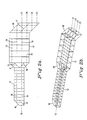
- the optical intensity transfer functions of the birefringent filters upon which all of the above described four channel demultiplexers are based are shown in Figs. 1(a) and 1(b).
- the sequential network 11 (Fig. 2) includes five quartz crystal element plates each having a thickness of 5978 microns and oriented with its optic axis perpendicular to the beam direction. From left to right these axes are also rotationally oriented relative to the principal polarization axes of the beam splitter devices at angles of 45, -14.5, -14.5, 9.31, and 9.31 degrees.
- Fig. 1(b) represents the fraction of the beam intensity that leaves the five element sequential network 11 with the same linear polarization state in which it entered. The angles are chosen using the synthesis technique of Harris et al.
- a sequential network 12 consists of eleven quartz crystal element plates each having a thickness of 3008 microns and oriented with its optic axis perpendicular to the beam direction. From left to right their orientation angles are 45, -2.71, -2.71, -41.65, -41.65, 15.20, 15.20, 30.36, 30.36, -26.04, and -26.04 degrees.
- Fig. 1(a) represents the fraction of the beam intensity that leaves the eleven element sequential network 12 with the same linear polarization state in which it entered. Both approximate square wave transmission functions with uniform and equal passband and stopband ripples.
- the eleventh order network 12 has thinner elements and therefore a longer wavelength period. The higher order is required to achieve approximately the same cutoff characteristic as the fifth order network 11. Since in both sequential networks 11, 12 there are identically oriented adjacent elements, they may in fact be double length plates thereby simplifying their fabrication.
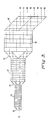
- the wavelength components of an input beam 13 that fall within channel A undergo essentially no net change in polarization state while traversing either the network 12 or the network 11.
- Their horizontally polarized component is transmitted by dielectric multilayer coatings 14, 16, 17, so that after traversing the networks 12 and 11 as beams 18 and 19 it emerges as part of an output beam 21.
- Their vertically polarized component is reflected by dielectric multilayer coatings 14, 15, 17, so that after traversing the sequences 12, 11 as beams 26, 27 it also emerges as part of the output beam 21.
- the wavelength components of the input beam 13 that fall within channel B are reversed in polarization state only while traversing the network 11.
- Their horizontally polarized component is transmitted by the dielectric multilayer coatings 14, 16, but while traversing the network 11 as the beam 19, it becomes vertically polarized.
- After reflection by the dielectric multilayer coating 17 it emerges as part of the output beam 22.
- Their vertically polarized component is reflected by the dielectric multilayer coatings 14 and 15, but while traversing the network 11 as the beam 27, it becomes horizontally polarized. After transmission by the dielectric multilayer coating 17 it also emerges as part of the output beam 22.
- the wavelength components of the input beam 13 that fall within channel C are reversed in polarization state only in traversing the network 12.
- Their horizontally polarized component is transmitted by the dielectric multilayer coating 14, but while traversing network 12 as the beam 18, it becomes vertically polarized and is then reflected by dielectric multilayer coating 16. It continues as the beam 28 unchanged through the network 11, and after reflection by dielectric multilayer coating 17 it emerges as part of the output beam 23.
- Their vertically polarized component is reflected by the dielectric multilayer coating 14, but while traversing network 12 as beam 26, it becomes horizontally polarized and is then transmitted by the dielectric multilayer coating 15. It continues as beam 29 unchanged through the network 11, and after transmission by dielectric multilayer coating 17 it also emerges as part of the output beam 23.
- the wavelength components of the input beam 13 that fall within channel D are reversed in polarization state while traversing both networks 12 and 11.
- Their horizontally polarized component is transmitted by the dielectric multilayer coating 14, but, while traversing the network 12 as the beam 18, it becomes vertically polarized and is then reflected by the dielectric multilayer coating 16.
- While traversing the network 11 as the beam 28 it again becomes horizontally polarized and after transmission by the dielectric multilayer coating 17 it emerges as part of the output beam 24.
- Their vertically polarized component is reflected by the dielectric multilayer coating 14, but while traversing the network 12 as the beam 26, it becomes horizontally polarized and is then transmitted by the dielectric multilayer coating 15. While traversing the network 11 as the beam 29 it again becomes vertically polarized, and after reflection by the dielectric multilayer coating 17 it also emerges as part of the output beam 24.
- the wavelength components of the input beam 13 that fall within the channels A, B, C, or D of Figs. 1(a) and 1(b) are routed in a demultiplexing mode of operation to the outputs 21, 22, 23, and 24, respectively, regardless of their input polarization states.
- four input channels A, B, C, and D when applied to the ports 21, 22, 23, 24, respectively become combined with essentially no loss into the composite beam 13.
- the present invention is an n channel birefringent multiplexer/demultiplexer using log2n sequential networks of birefringent crystal elements, but with only a single polarizing beam splitting interface between adjacent networks.
- the optical intensity transfer functions approximate square waves with filter sequences having periods in a 1:2:4:8::: ratio.
- the longer period functions should have essentially the same absolute cutoff characteristic as the shortest, and this necessitates using higher order birefringent networks with correspondingly larger numbers of elements.
- An eight channel version of the present invention is depicted in Fig. 3.
- Polarizing beam splitter prisms 10 and 30 are constructed from two glass prisms with an interface coated with a dielectric multilayer that reflects essentially all of the incident light with its electric vector normal to the plane of incidence (TE wave) and transmits essentially all of the incident light having its electric vector in the plane of incidence (TM wave).
- Polarizing beam splitter prisms 31 (Figs. 2 and 3) and 32 (Fig. 3) are similarly constructed from three glass prisms coated on both of their interfaces. The design of such polarizing prisms and their coating are well known in the art. See, for example, U.S. Patent No. 2,403,731, S.M. MacNeille, "Beam Splitter", issued July 9, 1946.
- the network 33 comprises 21 quartz crystal element plates with a thickness of 1522.5 microns, approximately half those of the network 12 and having rotational orientations selected by the synthesis procedure of Harris et al. referred to hereinabove.
- An appropriate set of rotational orientations for the 21 crystal elements is 45.00, 107.15, 107.15, 75.30, 75.30, 95.20, 95.20, 81.29, 81.29, 91.58, 91.58, 83.75, 83.75, 89.79, 89.79, 85.13, 85.13, 88.68, 88.68, 86.05 and 86.05 degrees.
- the wavelength components of the input beam 13 within eight successive channels are routed by the demultiplexer to one of the output beams 41 through 48 regardless of their polarization state.
Landscapes
- Physics & Mathematics (AREA)
- General Physics & Mathematics (AREA)
- Optics & Photonics (AREA)
Applications Claiming Priority (2)
| Application Number | Priority Date | Filing Date | Title |
|---|---|---|---|
| US07/033,275 US4744075A (en) | 1987-04-02 | 1987-04-02 | Multichannel wavelength multiplexer/demultiplexer |
| US33275 | 1996-12-09 |
Publications (1)
| Publication Number | Publication Date |
|---|---|
| EP0288769A1 true EP0288769A1 (fr) | 1988-11-02 |
Family
ID=21869478
Family Applications (1)
| Application Number | Title | Priority Date | Filing Date |
|---|---|---|---|
| EP88105096A Withdrawn EP0288769A1 (fr) | 1987-04-02 | 1988-03-29 | Multiplexeur/démultiplexeur de longueur d'onde multivoie |
Country Status (2)
| Country | Link |
|---|---|
| US (1) | US4744075A (fr) |
| EP (1) | EP0288769A1 (fr) |
Families Citing this family (24)
| Publication number | Priority date | Publication date | Assignee | Title |
|---|---|---|---|---|
| US4987567A (en) * | 1988-11-21 | 1991-01-22 | Gte Laboratories Incorporated | Optical wavelength multiplexer/demultiplexer and demultiplexer/remultiplexer |
| GB2245118A (en) * | 1990-06-14 | 1991-12-18 | Stc Plc | Optical wavelength division multiplexer/demultiplexer |
| US5296958A (en) * | 1992-05-29 | 1994-03-22 | Eastman Kodak Company | Multiple wavelength laser beam scanning system |
| US5194980A (en) * | 1992-05-29 | 1993-03-16 | Eastman Kodak Company | Thresholded, high power laser beam scanning system |
| EP0593205A1 (fr) * | 1992-10-16 | 1994-04-20 | AT&T Corp. | Coupleur optique |
| US5355237A (en) * | 1993-03-17 | 1994-10-11 | The United States Of America As Represented By The Administrator Of The National Aeronautics And Space Administration | Wavelength-division multiplexed optical integrated circuit with vertical diffraction grating |
| GB2286937B (en) * | 1994-02-26 | 1998-06-10 | Northern Telecom Ltd | Spectral polarisation separator |
| US6704065B1 (en) * | 1995-04-07 | 2004-03-09 | Colorlink, Inc. | Optical system for producing a modulated color image |
| US5771120A (en) * | 1995-12-26 | 1998-06-23 | Lucent Technologies Inc. | Optical apparatus with combined polarization functions |
| US5606439A (en) * | 1996-04-10 | 1997-02-25 | Macro-Vision Technology , Inc. | Tunable add/drop optical filter |
| US6163393A (en) | 1996-10-29 | 2000-12-19 | Chorum Technologies Inc. | Method and apparatus for wavelength multipexing/demultiplexing |
| US6243200B1 (en) | 2000-03-02 | 2001-06-05 | Chorum Technologies, Inc. | Optical wavelength router based on polarization interferometer |
| US6847786B2 (en) | 1996-10-29 | 2005-01-25 | Ec-Optics Technology, Inc. | Compact wavelength filter using optical birefringence and reflective elements |
| US6545783B1 (en) | 1996-10-29 | 2003-04-08 | Chorum Technologies Lp | Optical wavelength add/drop multiplexer |
| US6115155A (en) | 1996-10-29 | 2000-09-05 | Chorum Technologies Inc. | System for dealing with faults in an optical link |
| US6259560B1 (en) | 1999-04-16 | 2001-07-10 | The United States Of America As Represented By The Secretary Of The Navy | Continuously variable beam combiner |
| US6519060B1 (en) | 1999-06-04 | 2003-02-11 | Chorum Technologies Lp | Synchronous optical network in frequency domain |
| US6301046B1 (en) * | 1999-12-31 | 2001-10-09 | Jds Uniphase Corporation | Interleaver/deinterleavers causing little or no dispersion of optical signals |
| US6335830B1 (en) * | 1999-12-31 | 2002-01-01 | Jds Uniphase Corporation | Double-pass folded interleaver/deinterleavers |
| US6687462B1 (en) | 2000-02-01 | 2004-02-03 | Oplink Communications, Inc. | Wavelength slicer for optical signal switching |
| US6421177B1 (en) * | 2000-03-03 | 2002-07-16 | Arroyo Optics, Inc. | Interleaving optical filter |
| JP2002107579A (ja) * | 2000-07-26 | 2002-04-10 | Furukawa Electric Co Ltd:The | 光合分波モジュール |
| US6437916B1 (en) | 2000-10-10 | 2002-08-20 | Jds Uniphase Corporation | Strain-stabilized birefringent crystal |
| US6515786B1 (en) | 2001-08-03 | 2003-02-04 | Chorum Technologies Lp | Bandwidth variable wavelength router and method of operation |
Citations (2)
| Publication number | Priority date | Publication date | Assignee | Title |
|---|---|---|---|---|
| GB2076994A (en) * | 1980-06-03 | 1981-12-09 | Western Electric Co | Polarization independent optical switch |
| EP0177800A2 (fr) * | 1984-09-13 | 1986-04-16 | GTE Laboratories Incorporated | Multiplexeur/démultiplexeur de longueurs d'onde optique biréfringent |
Family Cites Families (5)
| Publication number | Priority date | Publication date | Assignee | Title |
|---|---|---|---|---|
| US2182142A (en) * | 1937-02-12 | 1939-12-05 | Technicolor Motion Picture | Dividing polarized light beams |
| US3532890A (en) * | 1967-09-11 | 1970-10-06 | Bell Telephone Labor Inc | Optical multiplexing and demultiplexing systems |
| US3584221A (en) * | 1967-12-29 | 1971-06-08 | Nippon Electric Co | Polarization and time division light multiplex communciation system |
| JPS54157003A (en) * | 1978-05-31 | 1979-12-11 | Nippon Telegr & Teleph Corp <Ntt> | Polarization multiplex two-way optical transmission system |
| US4685773A (en) * | 1984-09-13 | 1987-08-11 | Gte Laboratories Incorporated | Birefringent optical multiplexer with flattened bandpass |
-
1987
- 1987-04-02 US US07/033,275 patent/US4744075A/en not_active Expired - Fee Related
-
1988
- 1988-03-29 EP EP88105096A patent/EP0288769A1/fr not_active Withdrawn
Patent Citations (2)
| Publication number | Priority date | Publication date | Assignee | Title |
|---|---|---|---|---|
| GB2076994A (en) * | 1980-06-03 | 1981-12-09 | Western Electric Co | Polarization independent optical switch |
| EP0177800A2 (fr) * | 1984-09-13 | 1986-04-16 | GTE Laboratories Incorporated | Multiplexeur/démultiplexeur de longueurs d'onde optique biréfringent |
Non-Patent Citations (4)
| Title |
|---|
| JOURNAL OF THE OPTICAL SOCIETY OF AMERICA, vol. 54, no. 10, October 1964, pages 1267-1279, New York, US; S.E. HARRIS et al.: "Optical network synthesis using birefringent crystals. I. Synthesis of lossless networks of equal-lenght crystals" * |
| PATENT ABSTRACTS OF JAPAN, vol. 10, no. 183 (P-472)[2239], 26th June 1986; & JP-A-61 032 030 (NIPPON TELEGR & TELEPH CORP) 14-02-1986 * |
| PATENT ABSTRACTS OF JAPAN, vol. 7, no. 130 (P-202)[1275], 7th June 1983; & JP-A-58 048 018 (MITSUBISHI DENKI K.K.) 19-03-1983 * |
| SOVIET INVENTIONS ILLUSTRATED, week E23, section electr., 21st July 1982, abstract no. G8914,E/23, Derwent Publications Ltd, London, GB; & SU-A-857 904 (B.A. GORSHTEIN) 25-08-1981 * |
Also Published As
| Publication number | Publication date |
|---|---|
| US4744075A (en) | 1988-05-10 |
Similar Documents
| Publication | Publication Date | Title |
|---|---|---|
| US4744075A (en) | Multichannel wavelength multiplexer/demultiplexer | |
| US4987567A (en) | Optical wavelength multiplexer/demultiplexer and demultiplexer/remultiplexer | |
| US6847786B2 (en) | Compact wavelength filter using optical birefringence and reflective elements | |
| CA1255135A (fr) | Multiplexeur-demultiplexeur de longueur d'onde optique birefringent | |
| JP2545047B2 (ja) | 光通信ネットワ―クにおける光搬送波抽出,再挿入機器 | |
| US6498680B1 (en) | Compact tunable optical wavelength interleaver | |
| US6373604B1 (en) | Optical MUX/DEMUX | |
| WO2001065704A2 (fr) | Routeur de longueur d'onde base sur un interferometre de polarisation | |
| US4745591A (en) | Multiple channel wavelength division multiplexer/demultiplexer | |
| US6252711B1 (en) | Polarization diversity for birefingent filters | |
| US6694066B2 (en) | Method and apparatus for an optical filter | |
| CA2438185C (fr) | Procede et appareil pour filtre optique | |
| JP2001281493A (ja) | 波長分波合波モジュール | |
| US6393039B1 (en) | Double-pass polarization diversified birefringent filter | |
| US20030231391A1 (en) | Method and apparatus for an optical multiplexer and demultiplexer with an optical processing loop | |
| US6643063B2 (en) | Deinterleaver with high isolation and dispersion compensation and 50/200GHz interleaver and deinterleaver | |
| US20020171931A1 (en) | Integrated optical device with polarization based signal routing | |
| CN1348277A (zh) | 无色散光学滤波器 | |
| US6490377B1 (en) | Optical interleaver | |
| JPH01263619A (ja) | 複数チャネル波長マルチプレクサ/デマルチプレクサ | |
| WO2001039380A2 (fr) | Mux-demux optique | |
| JP2002323678A (ja) | インターリーバ | |
| JPS6217710A (ja) | 光結合部品 | |
| JPS5993429A (ja) | 光デバイス |
Legal Events
| Date | Code | Title | Description |
|---|---|---|---|
| PUAI | Public reference made under article 153(3) epc to a published international application that has entered the european phase |
Free format text: ORIGINAL CODE: 0009012 |
|
| AK | Designated contracting states |
Kind code of ref document: A1 Designated state(s): BE DE FR GB IT NL |
|
| 17P | Request for examination filed |
Effective date: 19890410 |
|
| 17Q | First examination report despatched |
Effective date: 19910425 |
|
| STAA | Information on the status of an ep patent application or granted ep patent |
Free format text: STATUS: THE APPLICATION IS DEEMED TO BE WITHDRAWN |
|
| 18D | Application deemed to be withdrawn |
Effective date: 19910906 |