EP0299384A2 - Verfahren zur Herstellung von orientierten Folien - Google Patents
Verfahren zur Herstellung von orientierten Folien Download PDFInfo
- Publication number
- EP0299384A2 EP0299384A2 EP88110946A EP88110946A EP0299384A2 EP 0299384 A2 EP0299384 A2 EP 0299384A2 EP 88110946 A EP88110946 A EP 88110946A EP 88110946 A EP88110946 A EP 88110946A EP 0299384 A2 EP0299384 A2 EP 0299384A2
- Authority
- EP
- European Patent Office
- Prior art keywords
- film
- polydiacetylene
- monomer
- diacetylene
- alkyl
- Prior art date
- Legal status (The legal status is an assumption and is not a legal conclusion. Google has not performed a legal analysis and makes no representation as to the accuracy of the status listed.)
- Granted
Links
- XBHTYKIYEUHMIA-UHFFFAOYSA-N Cc1c(C)cc(C(F)(F)F)cc1 Chemical compound Cc1c(C)cc(C(F)(F)F)cc1 XBHTYKIYEUHMIA-UHFFFAOYSA-N 0.000 description 1
Images



Classifications
-
- C—CHEMISTRY; METALLURGY
- C08—ORGANIC MACROMOLECULAR COMPOUNDS; THEIR PREPARATION OR CHEMICAL WORKING-UP; COMPOSITIONS BASED THEREON
- C08J—WORKING-UP; GENERAL PROCESSES OF COMPOUNDING; AFTER-TREATMENT NOT COVERED BY SUBCLASSES C08B, C08C, C08F, C08G or C08H
- C08J5/00—Manufacture of articles or shaped materials containing macromolecular substances
- C08J5/18—Manufacture of films or sheets
-
- C—CHEMISTRY; METALLURGY
- C08—ORGANIC MACROMOLECULAR COMPOUNDS; THEIR PREPARATION OR CHEMICAL WORKING-UP; COMPOSITIONS BASED THEREON
- C08J—WORKING-UP; GENERAL PROCESSES OF COMPOUNDING; AFTER-TREATMENT NOT COVERED BY SUBCLASSES C08B, C08C, C08F, C08G or C08H
- C08J7/00—Chemical treatment or coating of shaped articles made of macromolecular substances
- C08J7/12—Chemical modification
- C08J7/16—Chemical modification with polymerisable compounds
-
- C—CHEMISTRY; METALLURGY
- C08—ORGANIC MACROMOLECULAR COMPOUNDS; THEIR PREPARATION OR CHEMICAL WORKING-UP; COMPOSITIONS BASED THEREON
- C08J—WORKING-UP; GENERAL PROCESSES OF COMPOUNDING; AFTER-TREATMENT NOT COVERED BY SUBCLASSES C08B, C08C, C08F, C08G or C08H
- C08J2349/00—Characterised by the use of homopolymers or copolymers of compounds having one or more carbon-to-carbon triple bonds; Derivatives of such polymers
Definitions
- This invention relates to a polydiacetylene molecular orientated film useful as non-linear optical devices, chromism devices, photoelectric devices, etc. in the field of electronics and optoelectronics.
- Diacetylene compounds are known as extremely unique substances capable of forming crystalline polymers upon solid phase polymerization by heat, light, ⁇ -rays, etc. and are expected to serve as photoelectronic materials, such as conductive materials, chromism materials, photoelectric materials, non-linear optical materials, and the like. For example, it is predicted that these compounds show a ultra-high speed switch phenomenon in the order of about 10 ⁇ 12 second by their non-linear optical effects and, therefore, they are promising for application to photo information processing systems.
- Japanese Laid-Open Patent Application No. 62608/84 discloses a process for producing a thin film of a diacetylene polymer which comprises forming a thin film of a diacetylene monomer on a base by spraying or spinning a solution or suspension of a diacetylene compound or by vacuum depositing the diacetylene compound, followed by polymerization.
- the resulting film has very poor crystallinity, namely involves many brawbacks, such as cracks, a domain structure, a stacking disorder, and poor evenness of the plane.
- Macromolecules , Vol. 18, 2341-2344 (1985) teaches that a diacetylene compound is heated to a temperature above its melting point and a shear force is applied thereto to thereby induce orientation and crystallization of the molecules.
- the diacetylene compound undergoes thermal polymerization on elevation of temperature, resulting in incomplete shearing orientation, bringing disadvantages such as no improvement on crystallinity and orientation, etc.
- the resulting film is limited in thickness and area.
- One object of this invention is to provide a process for producing a molecular orientated film of polydiacetylene in which molecules are highly and epitaxially orientated and crystallized by taking advantage of rigidity and straightness of the polydiacetylene molecular chain.
- Another object of this invention is to provide a process for producing a molecular orientated film of polydiacetylene, which is applicable to any kind of polydiacetylene compounds irrespective of solubility or liability to thermal polymerization.
- a still another object of this invention is to provide a process for producing a molecular orientated film of polydiacetylene, which permits of control of film thickness and area without any limitation.
- a further object of this invention is to provide a process for producing a molecular orientated film of polydiacetylene having excellent orientation and crystallinity to the degree equal to, or even higher than, single crystals.
- a still further object of this invention is to provide a process for producing a molecular orientated film of polydiacetylene fully manifesting the photoelectronic functions possessed by polydiacetylene, particularly non-linear optical effects, electro-optical effects and anisotropic photoconduction.
- a polydiacetylene molecular orientated film wherein the main chain of the polydiacetylene is orientated in a specific direction so as to have a dichroism constant (degree of orientation) of 3 or more can be produced by subjecting a diacetylene polymer film to rubbing with a silicone cloth, etc., building up a diacetylene monomer on the polymer film, and polymerizing the monomer film in a solid phase.
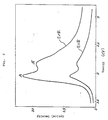
- Figures 1 to 4 each shows absorption spectrum of the polymer film obtained in Examples 1, 3, 4, and 5, respectively.
- the polydiacetylene which can be used in the present invention is a polymer of a diacetylene monomer.
- diacetylene monomer as used herein embraces all the compounds having a conjugated diacetylene linkage -C ⁇ C-C ⁇ C- inclusive of various derivatives thereof and are represented by formula (I): R-C ⁇ C-C ⁇ C-R (I) wherein R is a substituent, and the two R substituents may be the same or different.
- Preferred polydiacetylenes include polymers of diacetylene monomers having, in the side chain thereof, a residue of an acid, e.g., carboxylic acids and sulfonic acid, or an ester, amide or salt thereof; a residue of an alcohol or an ester thereof with carboxylic acids, sulfonic acid, sulfinic acid, isocyanic acid, carbamic acid, etc.; a hydrocarbon group; a heterocyclic compound residue; or a phenyl group.
- Implicit in the above-described diacetylene monomers are: CH3(CH2) m -C ⁇ C-C ⁇ C-(CH2) n COOH R i NHCOO(CH2) m -C ⁇ C-C ⁇ C-(CH2) n OCONHR j R i SO2O(CH2) m -C ⁇ C-C ⁇ C-(CH2) n OSO2R j wherein m and n, which may be the same or different, each represents an integer; and R i and R j , which may be the same or different, each is the same substituent as R.
- diacetylene monomers those of formula (I) wherein R represents -(CH2) n OCONHCH2COOC4H9 (wherein n is 3 or 4),
- R represents an alkyl, aryl, aryl-substituted alkyl or alkyl-substituted aryl group each having a fluorine atom and up to 12 carbon atoms, e.g., and those having an alkylurethane linkage
- R represents a group of formula -(CH2) p OCONHR1, wherein R1 represents an alkyl, aryl, aryl-substituted alkyl or alkyl-substituted aryl group each having up to 20 carbon atoms; and p represents an integer of from 1 to 8, and especially -(CH2)4OCONH-C q H 2q+1 , wherein q represents an integer of from 1 to 20.
- the moiety -C q H 2q+1 is preferably a straight chain alkyl group, and q is preferably 3 or more, more preferably from 3 to 10.
- the diacetylene monomers wherein R is a group of -(CH2)4OCONH-C q H 2q+1 can be synthesized by starting with 5,7-dodecadiyne-1,12-diol as illustrated by the following synthesis examples.
- a solution of 4 times the molar quanity of an alkylamine in 30 ml of THF is added thereto dropwise at 15°C, followed by allowing the mixture to react for 30 minutes.
- the reaction mixture is rendered neutral by washing with hydrochloric acid and then extracted with a mixed solvent of water and ethyl ether.
- the extract is dissolved in acetone and then dried over sodium sulfate.
- the residue is purified by column chromatography on activated alumina using acetone as an eluent to obtain a 5,7-dodecadiyne-1,12-diol-bis(alkylurethane).
- 5,7-Dodecadiyne-1,12-dichlorocarbonate as prepared in the same manner as described in (i) above is dissolved in 30 ml of THF.
- a solution of double the molar quantity of an alkylamine and double the molar quantity of triethylamine in 50 ml of THF is added dropwise to the solution at 15°C, and the mixture is allowed to react for 30 minutes.
- the reaction mixture is made neutral by washing with hydrochloric acid and then extracted with a mixed solvent of ethyl ether and water.
- the extract is dissolved in chloroform and dried over sodium sulfate.
- the residue is purified by column chromatography on activated alumina using chloroform as an eluent to thereby obtain 5,7-dodecadiyne-1,12-diol-bis(alkylurethane).
- diacetylene monomers having an alkylurethane linkage are characterized by their film forming properties exhibited in, for example, vacuum deposition onto a base, excellent polymerizability in a solid phase as a film, and excellent orientation properties in a specific direction on rubbing of the polymerized film.
- the molecular orientated film according to the present invention can be produced from the above-described diacetylene monomers by following at least four steps as set forth below.
- the first step comprises forming a polydiacetylene thin film on a base.
- the base to be used includes glass (e.g., quartz glass, high silica glass, borosilicate glass, soda-lime glass, Vycor glass, Pyrex glass, etc.), ceramics (e.g., alumina, steatite, forsterite, beryllia, spinel, etc.
- glass e.g., quartz glass, high silica glass, borosilicate glass, soda-lime glass, Vycor glass, Pyrex glass, etc.
- ceramics e.g., alumina, steatite, forsterite, beryllia, spinel, etc.
- plastics e.g., polyethylene, an ethylene-vinyl acetate copolymer, polypropylene, polyethylene terephthalate, polytetrafluoroethylene, polyvinylidene fluoride, polyvinyl fluoride, an ethylene fluoride-vinylidene fluoride copolymer, polyvinyl chloride, polyvinylidene chloride, polyacrylonitrile, polystyrene, acetal resins, polycarbonate, polyamide, phonolic resins, melamine resins, a styrene-acrylonitrile copolymer, an acrylonitrile-butadiene-styrene copolymer, polyphenylene oxide, polysulfone, etc.), metals (e.g., pure metals, e.g., silver, aluminum, gold, beryllium, cobalt, chromium, copper, iron, iridium, magnesium, molybdenum, nickel
- brass, bronze, Monel metal aluminum alloys, stainless steel, magnesium alloys, Elinvar, Inconel, etc.
- single crystals e.g., diamond, graphite, silicon, germanium, halite, potassium chloride, lithium fluoride, gallium arsenate, indium arsenate, indium antimonide, gallium phosphide, etc.), and so on.
- Formation of a polydiacetylene film on the base can be carried out by either a method comprising forming a film of diacetylene monomer on a base and then polymerizing the monomer or a method comprising directly filming polydiacetylene on a base.
- Any of the above-described diacetylene monomers is employable in the first step, but it is preferable to use the diacetylene monomers of formula (I) wherein R is a substituent containing a fluorine atom or a substituent containing an alkylurethane linkage.
- the diacetylene monomer film can be formed by dry processes, such as vacuum evaporation deposition by resistive heating, hot walling or a laser beam, deposition by a molecular beam, an ionic beam or an ionic cluster beam, sputtering, ion plating, and the like; or wet processes, such as dipping, spraying, spinning, casting, etc. using a solution or suspension of a diacetylene monomer.
- dry processes such as vacuum evaporation deposition by resistive heating, hot walling or a laser beam, deposition by a molecular beam, an ionic beam or an ionic cluster beam, sputtering, ion plating, and the like
- wet processes such as dipping, spraying, spinning, casting, etc. using a solution or suspension of a diacetylene monomer.
- Polymerization of the thus formed diacetylene monomer film can be effected by irradiation with ultraviolet rays, X-rays, ⁇ -rays, etc., or application of heat or pressure.
- a polydiacetylene film can be produced by wet processes, such as dipping, spraying, spinning, casting, and the like using a solution or suspension of a polydiacetylene.
- a suitable solvent to be used is chloroform or 2-methyltetrahydrofuran in the case of starting with a diacetylene monomer of formula (I) wherein R is -(CH2)4OCONHCH2COOC4H9 (hereinafter referred to as 4BCMU), or 1,2-dichloroethane, chloroform or dimethylformamide in the case of starting with a diacetylene monomer of formula (I) wherein R is -(CH2)3OCONHCH2COOC4H9 (hereinafter referred to as 3BCMU).
- the first step is carried out by a method comprising forming a film of diacetylene monomer on a base by a dry process and then polymerizing the monomer.
- the film of polydiacetylene thus formed on a base has a thickness of from 20 ⁇ to 5000 ⁇ , preferably from 50 ⁇ to 3000 ⁇ .
- the thus formed polydiacetylene film is subjected to unidirectional rubbing once or more, generally 3 to some hundreds of times, preferably 5 to 200 times, and more preferably 10 to 100 times.
- the rubbing can be affected by abrading the surface of the film in one direction with a cloth made of silicone fibers, Teflon fibers, cotton fibers, etc., preferably silicone fibers (i.e., silicone cloth).
- the unidirectional rubbing is preferably conducted in one way, i.g., unreciprocatedly.
- a diacetylene monomer is built up on the polydiacetylene film having been subjected to rubbing treatment.
- the building up can be carried out by depositing a diacetylene monomer on the polydiacetylene film according to the dry processes as described in the first step.
- the diacetylene monomer to be used here may be the same or different to that used in the first step, but it is preferable to use a diacetylene monomer of formula (I) wherein R has an alkylurethane linkage in the first step and to use a diacetylene monomer having a substituent containing a fluorine atom in the third step.
- the thickness of the build-up formed in the third step ranges from 20 ⁇ to 50 ⁇ m, preferably from 100 ⁇ to 5 ⁇ m.
- the build-up (diacetylene monomer layer) formed in the third step is subjected to solid phase polymerization.
- the polymerization can be carried out in the same manner as described in the first step.
- the process of the present invention comprises the above-described first step and at least one combination of the second to fourth steps in the order described to obtain a molecular orientated film of a polydiacetylene. That is, after the formation of a polydiacetylene film on a base, the process including rubbing with silicone cloth, etc., building up of a diacetylene monomer and polymerization may be performed once or more, to orientate the polydiacetylene main chain in a specific direction.
- the final thickness of the film thus obtained is in the range of from 50 ⁇ to 800 ⁇ m, preferably from 100 ⁇ to 500 ⁇ m.
- the feature of the present invention lies in the rubbing of a polydiacetylene layer followed by formation of a polydiacetylene layer thereon.
- the polydiacetylene itself serves as an orientating agent, and the diacetylene monomer built up thereon is epitaxially grown and polymerized to thereby provide a film of high crystallinity in which the main chain of the polymer is orientated in a specific direction. Further, such high orientation and crystallinity can be assured over a wide area of several tens of centimeters or even more.
- the main chain of the polydiacetylene is uniformly orientated in the same direction as the rubbing direction parallel to the base.
- the present invention makes it possible to control the film thickness by building up the polydiacetylene layer while retaining orientation and crystallinity.
- an unpolymerized diacetylene monomer or a dopant e.g., a photosensitizer, a dye, etc.
- a dopant e.g., a photosensitizer, a dye, etc.
- the molecular orientation of the film according to the present invention can be evaluated by a dichroism constant as defined below.
- absorption axis means a direction of orientation of the polydiacetylene main chain which corresponds to the direction of rubbing parallel to a base.
- transmission axis means a direction perpendicular to the absorption axis, i.e., a direction perpendicular to the rubbing direction and parallel to a base.
- linear polarized light is passed through the film at a right angle.
- the transmission in the absorption axis ⁇ a is determined with the polarizing direction agreeing with the absorption axis
- the transmission in the transmission axis ⁇ t is determined with the polarizing direction agreeing with the transmission axis.
- the polydiacetylene molecular orientated film according to the present invention has two characteristic absorption peaks in its absorption spectrum in the visible light region. More specifically, blue polydiacetylenes called acetylene type have absorption peaks in the vicinity of 1.9 eV and 2.1 eV, which are based on the ⁇ - ⁇ * exciton of the polydiacetylene main chain and its phonon side band, respectively; and red polydiacetylenes called butatriene type have absorptions in the vicinity of 2.3 eV and 2.5 eV based on the ⁇ - ⁇ * exciton and its phonon side band, respectively.
- the dichroism constant Rd can be calculated from the absorption axial transmission ⁇ a and the transmission axial transmission ⁇ t both determined at the absorption peak due to the ⁇ - ⁇ * exciton in the vicinity of 1.9 eV as for the acetylene type, or in the vicinity of 2.3 eV as for the butatriene type.
- the polydiacetylene molecular orientated film in accordance with the present invention exhibits a dichroism constant of not less than 3, preferably not less than 5, more preferably not less than 10, and most preferably not less than 20.
- a 4BCMU monomer was vacuum deposited on a cleaned glass base to form a diacetylene monomer film having a thickness of 500 ⁇ .
- the film was irradiated with ultraviolet rays emitted from an ultra-high pressure mercury lamp (200 W) to effect solid phase polymerization to thereby obtain a 4BCMU polymer film.
- the surface of the resulting polymer film was repeatedly rubbed with a silicone cloth unidirectionally and also in one way. Then, a 4BCMU monomer was built up thereon by vacuum evaporation to a thickness of 5000 ⁇ , and the build-up was polymerized in a solid phase by ultraviolet rays emitted from an ultra-high pressure mercury lamp to obtain a 4BCMU polymer film having a total thickness of 5400 ⁇ and an area of 40 cm2.
- IE indicates the polarizing direction of the linear polarized light
- IR indicates the direction of the rubbing. Therefore, IE // IR means that linear polarized light whose polarizing direction is parallel to the rubbing direction is vertically incident upon the film, and IE ⁇ IR means that linear polarized light whose polarizing direction is perpendicular to the rubbing direction is vertically incident, upon the film.
- the Fig. revealed agreement between the orientation direction of the 4BCMU polymer main chain and the rubbing direction. Seeing that this polarized absorption characteristic had no positional dependence in the film, it was confirmed that the main chains were orientated in the same direction over the entire area of the film. It can be seen that the absorption peaks (A, A′) in the vicinity of 1.9 eV and 2.1 eV, which are due to the ⁇ - ⁇ * exciton of the 4BCMU polymer main chain and its phonon side band, respectively, were very close to each other and well distinguishable, indicating high crystallinity. In addition, the dichroism constant at the absorption peak in the vicinity of 1.9 eV due to the ⁇ - ⁇ * exciton was found to be 6.5.
- An orientated 4BCMU polymer film was produced in the same manner as described in Example 1, except that the resulting polymer film was further subjected to the same rubbing treatment as performed previously and a 4BCMU monomer was built up thereon followed by solid phase polymerization by ultraviolet rays in the same manner as performed previously. The second rubbing was carried out in the same direction as the first rubbing.
- the built-up of the 4BCMU monomer had a thickness of 5000 ⁇ .
- the resulting polymer film had an area of 40 cm2 and a total thickness of 1.0 ⁇ m.
- Example 1 the absorption spectrum using linear polarized light revealed agreement between the orientation direction of the main chain and the rubbing direction. Since the polarized absorption characteristic was not dependent on position of the film, it was confirmed that the main chains were orientated in the same direction over the entire area of the film. The dichroism constant at the absorption peak in the vicinity of 1.9 eV due to the ⁇ - ⁇ * exciton was found to be 7.2.
- a 4BCMU monomer was vacuum deposited onto a glass base to form a 4BCMU monomer film having a thickness of 1.0 ⁇ m, which was then irradiated with ultraviolet rays to polymerize in a solid phase to obtain a 4BCMU polymer film.
- the polymer film was subjected to rubbing in the same manner as in Example 1.
- the resulting polymer film had a thickness of 1.0 ⁇ m.
- the (12,8) monomer was vacuum deposited onto a glass base to form a (12,8) monomer film of 600 ⁇ in thickness, and the film was solid phase polymerized by irradiating ultraviolet rays to obtain a (12,8) polymer film.
- the polymer film was rubbed with a silicone cloth, and a (12,8) monomer was then built up thereon by vacuum evaporation to a thickness of 6000 ⁇ , followed by solid phase polymerization by ultraviolet rays to obtain a (12,8) polymer film having an area of 40 cm2 and a thickness of 6500 ⁇ .
- the linear polarized light absorption spectrum of the (12,8) polymer film is shown in Fig. 2.
- IE and IR in Fig. 2 have the same meanings as in Fig. 1. From the Fig. it can be seen that the orientation direction of the main chain was consistent with the rubbing direction. From the fact that the polarized absorption characteristic was not dependent on position of the film, it can be seen that the main chains were orientated in the same direction over the entire area of the film.
- the above prepared monomer was deposited on a cleaned glass base by vacuum evaporation to form a 500 ⁇ thick monomer film.
- the monomer film was solid phase polymerized by irradiating ultraviolet rays emitted from an ultra-high pressure mercury lamp (200 W) to obtain a polymer film.
- the surface of the resulting polymer film was repeatedly rubbed with a silicone cloth unidirectionally in one way. Thereafter, the same monomer was built up thereon by vacuum evaporation to a thickness of 4500 ⁇ and subjected to solid phase polymerization in the same manner as above to obtain a polymer film having an area of 36 cm2 and a total thickness of 4800 ⁇ .
- the absorption spectrum of the resulting polymer film using linear polarized light is shown in Fig. 3.
- IE and IR in the Fig. have the same meanings as in Fig. 1. From the Fig. it can be seen that the orientation direction of the polymer main chain was consistent with the rubbing direction. From the fact that the polarized absorption characteristic was not dependent on position of the film, it can be seen that the main chains were orientated in the same direction over the entire area of the film.
- the above synthesized monomer was deposited on a cleaned glass base by vacuum evaporation to form a monomer film having a thickness of 500 ⁇ .
- the monomer film was solid phase polymerized by ultraviolet rays emitted from an ultra-high pressure mercury lamp (200 W) to obtain a polymer film.
- the polymer film was repeatedly rubbed with a silicone cloth unidirectionally in one way, and the same monomer was then built up thereon to a thickness of 5000 ⁇ by vacuum evaporation.
- the built-up was polymerized in a solid phase by ultraviolet rays emitted from an ultra-high pressure mercury lamp to obtain a polymer film having an area of 40 cm2 and a total thickness of 5400 ⁇ .
- the absorption spectrum of the resulting polymer film using linear polarized light is shown in Fig. 4. It can be seen from Fig. 4 that the orientation direction of the polymer main chain agreed with the rubbing direction. From the fact that the polarized absorption characteristic was not dependent on position of the film, it can be seen that the main chains were orientated in the same direction over the entire area of the film.
- the above synthesized monomer was deposited on a cleaned glass base by vacuum evaporation to form a monomer film having a thickness of 600 ⁇ .
- the monomer film was solid phase polymerized by ultraviolet rays emitted from an ultra-high pressure mercury lamp (200 W) to obtain a polymer film.
- the polymer film was repeatedly rubbed with a silicone cloth unidirectionally in one way, and the same monomer was built up thereon to a thickness of 6500 ⁇ by vacuum evaporation.
- the built-up was polymerized in a solid phase by ultraviolet rays emitted from an ultra-high pressure mercury lamp to obtain a polymer film having an area of 40 cm2 and a total thickness of 7000 ⁇ .
- the linear polarized light absorption spectrum of the resulting polymer film proved of agreement between the orientation direction of the polymer main chain and the rubbing direction. From the fact that the polarized absorption characteristic was not dependent on position of the film, it can be seen that the main chains were orientated in the same direction over the entire area of the film.
Landscapes
- Chemical & Material Sciences (AREA)
- Organic Chemistry (AREA)
- Manufacturing & Machinery (AREA)
- Engineering & Computer Science (AREA)
- Health & Medical Sciences (AREA)
- Chemical Kinetics & Catalysis (AREA)
- Medicinal Chemistry (AREA)
- Polymers & Plastics (AREA)
- Materials Engineering (AREA)
- General Chemical & Material Sciences (AREA)
- Addition Polymer Or Copolymer, Post-Treatments, Or Chemical Modifications (AREA)
- Manufacture Of Macromolecular Shaped Articles (AREA)
- Application Of Or Painting With Fluid Materials (AREA)
- Laminated Bodies (AREA)
- Polymerisation Methods In General (AREA)
Applications Claiming Priority (4)
| Application Number | Priority Date | Filing Date | Title |
|---|---|---|---|
| JP17526387 | 1987-07-13 | ||
| JP175263/87 | 1987-07-13 | ||
| JP257854/87 | 1987-10-12 | ||
| JP62257854A JP2578442B2 (ja) | 1987-07-13 | 1987-10-12 | 分子配向性薄膜 |
Publications (3)
| Publication Number | Publication Date |
|---|---|
| EP0299384A2 true EP0299384A2 (de) | 1989-01-18 |
| EP0299384A3 EP0299384A3 (en) | 1989-07-26 |
| EP0299384B1 EP0299384B1 (de) | 1991-08-14 |
Family
ID=26496587
Family Applications (1)
| Application Number | Title | Priority Date | Filing Date |
|---|---|---|---|
| EP88110946A Expired EP0299384B1 (de) | 1987-07-13 | 1988-07-08 | Verfahren zur Herstellung von orientierten Folien |
Country Status (4)
| Country | Link |
|---|---|
| US (1) | US4863763A (de) |
| EP (1) | EP0299384B1 (de) |
| JP (1) | JP2578442B2 (de) |
| DE (1) | DE3864208D1 (de) |
Cited By (4)
| Publication number | Priority date | Publication date | Assignee | Title |
|---|---|---|---|---|
| US4987209A (en) * | 1987-09-28 | 1991-01-22 | The President And Fellows Of Harvard | Diethynyl monomers and polymers thereof |
| EP0562587A1 (de) * | 1992-03-24 | 1993-09-29 | Sumitomo Electric Industries, Ltd. | Verfahren zur Herstellung eines organischen Kristallfilmes |
| EP0444703B1 (de) * | 1990-03-02 | 1996-06-05 | Hitachi, Ltd. | Polarisatoren, Verfahren zu ihrer Herstellung und Flüssigkristall-Anzeigevorrichtungen |
| EP1768466A3 (de) * | 2000-04-27 | 2007-06-27 | Fujitsu Limited | Organischer lumineszenter Stoff und organisches lichtemittierendes Bauelement |
Families Citing this family (21)
| Publication number | Priority date | Publication date | Assignee | Title |
|---|---|---|---|---|
| US5176786A (en) * | 1988-07-13 | 1993-01-05 | Minnesota Mining And Manufacturing Company | Organic thin film controlled molecular epitaxy |
| US5207862A (en) * | 1989-09-08 | 1993-05-04 | Bell Communications Research, Inc. | Technique for epitaxial growth of oriented thin films of polydiacetylenes |
| EP0418833A3 (en) * | 1989-09-20 | 1993-03-17 | Hitachi, Ltd. | Organic thin film and liquid crystal display devices with the same |
| US5235449A (en) * | 1990-03-02 | 1993-08-10 | Hitachi, Ltd. | Polarizer with patterned diacetylene layer, method for producing the same, and liquid crystal display device including such polarizer |
| US7978391B2 (en) * | 2004-05-17 | 2011-07-12 | Transitions Optical, Inc. | Polarizing, photochromic devices and methods of making the same |
| US8518546B2 (en) * | 2003-07-01 | 2013-08-27 | Transitions Optical, Inc. | Photochromic compounds and compositions |
| US8698117B2 (en) | 2003-07-01 | 2014-04-15 | Transitions Optical, Inc. | Indeno-fused ring compounds |
| US9096014B2 (en) | 2003-07-01 | 2015-08-04 | Transitions Optical, Inc. | Oriented polymeric sheets exhibiting dichroism and articles containing the same |
| US8089678B2 (en) * | 2003-07-01 | 2012-01-03 | Transitions Optical, Inc | Clear to circular polarizing photochromic devices and methods of making the same |
| US7342112B2 (en) * | 2003-07-01 | 2008-03-11 | Ppg Industries Ohio, Inc. | Photochromic compounds |
| US8545015B2 (en) | 2003-07-01 | 2013-10-01 | Transitions Optical, Inc. | Polarizing photochromic articles |
| US8211338B2 (en) | 2003-07-01 | 2012-07-03 | Transitions Optical, Inc | Photochromic compounds |
| US7632540B2 (en) | 2003-07-01 | 2009-12-15 | Transitions Optical, Inc. | Alignment facilities for optical dyes |
| US8545984B2 (en) * | 2003-07-01 | 2013-10-01 | Transitions Optical, Inc. | Photochromic compounds and compositions |
| US7256921B2 (en) * | 2003-07-01 | 2007-08-14 | Transitions Optical, Inc. | Polarizing, photochromic devices and methods of making the same |
| US8582192B2 (en) | 2003-07-01 | 2013-11-12 | Transitions Optical, Inc. | Polarizing photochromic articles |
| US20110140056A1 (en) * | 2003-07-01 | 2011-06-16 | Transitions Optical, Inc. | Indeno-fused ring compounds |
| US7097303B2 (en) * | 2004-01-14 | 2006-08-29 | Ppg Industries Ohio, Inc. | Polarizing devices and methods of making the same |
| JP2011503517A (ja) * | 2006-11-13 | 2011-01-27 | アテリス テクノロジーズ,エルエルシー | 農薬バイオマーカー |
| JP2011511930A (ja) * | 2007-11-14 | 2011-04-14 | アテリス テクノロジーズ,エルエルシー | バイオマーカー検出 |
| US10866455B2 (en) | 2017-10-19 | 2020-12-15 | Ppg Industries Ohio, Inc. | Display devices including photochromic-dichroic compounds and dichroic compounds |
Family Cites Families (8)
| Publication number | Priority date | Publication date | Assignee | Title |
|---|---|---|---|---|
| US4215208A (en) * | 1977-10-05 | 1980-07-29 | Allied Chemical Corporation | Thermochromic polyacetylenes containing urethane groups |
| GB8309583D0 (en) * | 1983-04-08 | 1983-05-11 | British Petroleum Co Plc | Polyacetylene production |
| JPS6023906A (ja) * | 1983-07-19 | 1985-02-06 | 株式会社東芝 | 半導性有機薄膜の形成法 |
| US4693915A (en) * | 1984-04-20 | 1987-09-15 | Canon Kabushiki Kaisha | Film forming method, recording medium formed thereby and recording method therewith |
| US4684434A (en) * | 1985-02-26 | 1987-08-04 | Gte Laboratories Incorporated | Method for the preparation of thin large-area single crystals of diacetylenes and polydiacetylenes |
| US4698121A (en) * | 1985-02-26 | 1987-10-06 | Gte Laboratories Incorporated | Methods for the preparation of oriented thin large-area single crystals of diacetylenes and polydiacetylenes |
| JPH0610266B2 (ja) * | 1986-04-01 | 1994-02-09 | 出光石油化学株式会社 | ポリジアセチレン系フイルム |
| US4783136A (en) * | 1986-04-16 | 1988-11-08 | Gte Laboratories Incorporated | Optical waveguides and methods for making same |
-
1987
- 1987-10-12 JP JP62257854A patent/JP2578442B2/ja not_active Expired - Lifetime
-
1988
- 1988-07-08 EP EP88110946A patent/EP0299384B1/de not_active Expired
- 1988-07-08 DE DE8888110946T patent/DE3864208D1/de not_active Expired - Lifetime
- 1988-07-08 US US07/216,349 patent/US4863763A/en not_active Expired - Fee Related
Cited By (5)
| Publication number | Priority date | Publication date | Assignee | Title |
|---|---|---|---|---|
| US4987209A (en) * | 1987-09-28 | 1991-01-22 | The President And Fellows Of Harvard | Diethynyl monomers and polymers thereof |
| EP0444703B1 (de) * | 1990-03-02 | 1996-06-05 | Hitachi, Ltd. | Polarisatoren, Verfahren zu ihrer Herstellung und Flüssigkristall-Anzeigevorrichtungen |
| EP0562587A1 (de) * | 1992-03-24 | 1993-09-29 | Sumitomo Electric Industries, Ltd. | Verfahren zur Herstellung eines organischen Kristallfilmes |
| US5385116A (en) * | 1992-03-24 | 1995-01-31 | Sumitomo Electric Industries, Ltd. | Method for producing organic crystal film |
| EP1768466A3 (de) * | 2000-04-27 | 2007-06-27 | Fujitsu Limited | Organischer lumineszenter Stoff und organisches lichtemittierendes Bauelement |
Also Published As
| Publication number | Publication date |
|---|---|
| EP0299384B1 (de) | 1991-08-14 |
| DE3864208D1 (de) | 1991-09-19 |
| JP2578442B2 (ja) | 1997-02-05 |
| US4863763A (en) | 1989-09-05 |
| EP0299384A3 (en) | 1989-07-26 |
| JPH01139255A (ja) | 1989-05-31 |
Similar Documents
| Publication | Publication Date | Title |
|---|---|---|
| EP0299384B1 (de) | Verfahren zur Herstellung von orientierten Folien | |
| JP3293641B2 (ja) | 支持体に適用された層要素 | |
| Wang et al. | Light-driven autonomous self-oscillation of a liquid-crystalline polymer bimorph actuator | |
| US2533166A (en) | Process for polymerizing watersoluble polyacrylamides and poly-alpha-substituted acrylamides | |
| Fischer et al. | Liquid crystalline side group block copolymers with n-butyl methacrylate as an amorphous A-block: synthesis and characterization | |
| Isoda | Epitaxial synthesis of poly (p-xylylene) | |
| US5061768A (en) | Vinylidene cyanide copolymer | |
| US4684434A (en) | Method for the preparation of thin large-area single crystals of diacetylenes and polydiacetylenes | |
| US4868284A (en) | Process for producing stretched molded articles of conjugated polymers and highly conductive compositions of said polymers | |
| Kaneko | Superacid-catalyzed preparation of ionic polyhedral oligomeric silsesquioxanes and their properties, polymerization, and hybridization | |
| JPH0829298B2 (ja) | 分子配向性薄膜の製造方法 | |
| Verduzco et al. | Bent-core liquid crystal elastomers | |
| JPH0832743B2 (ja) | 分子配向性薄膜の製造方法 | |
| JP3992203B2 (ja) | 配向分子薄膜 | |
| KR102705506B1 (ko) | 극성 작용기를 포함하는 광학 필름용 그라디언트 공중합체 및 이의 제조방법 | |
| GB2209169A (en) | Polymer compound | |
| JPS6046123B2 (ja) | 含フツ素共重合体およびその製造方法 | |
| JPS62141003A (ja) | 不飽和環カルボアルデヒド−アセタ−ル化ポリビニルアルコ−ル | |
| RU2786691C1 (ru) | Терагерцовая кристаллическая керамика системы TlBr0,46I0,54 -AgI | |
| JPS63221150A (ja) | 含フツ素ラングミユア・ブロジエツト膜 | |
| JP3227496B2 (ja) | ポリシラン配向膜の作製方法 | |
| KR100464064B1 (ko) | 비스다이아세틸렌기를 포함하는 신규 화합물, 이 화합물을이용한 유기박막과 박막의 제조방법 | |
| JPH10251631A (ja) | 液晶性フォトクロミック材料及び該材料からなる記録媒体 | |
| US20040097677A1 (en) | Partially fluorinated amorphous copolymer which makes it possible to manufacture light-conducting materials | |
| JPH0556791B2 (de) |
Legal Events
| Date | Code | Title | Description |
|---|---|---|---|
| PUAI | Public reference made under article 153(3) epc to a published international application that has entered the european phase |
Free format text: ORIGINAL CODE: 0009012 |
|
| AK | Designated contracting states |
Kind code of ref document: A2 Designated state(s): DE FR GB |
|
| PUAL | Search report despatched |
Free format text: ORIGINAL CODE: 0009013 |
|
| AK | Designated contracting states |
Kind code of ref document: A3 Designated state(s): DE FR GB |
|
| 17P | Request for examination filed |
Effective date: 19890824 |
|
| RIN1 | Information on inventor provided before grant (corrected) |
Inventor name: ITSUBO, AKIRA C/O MITSUBISHI PETROCHEM. CO. LTD Inventor name: KOJIMA, TAKASHI C/O MITSUBISHI PETROCHEM. CO. LTD Inventor name: KANETAKE, TATSUO Inventor name: ISHIKAWA, KEN Inventor name: TAKEDA, KENJI |
|
| 17Q | First examination report despatched |
Effective date: 19901217 |
|
| GRAA | (expected) grant |
Free format text: ORIGINAL CODE: 0009210 |
|
| AK | Designated contracting states |
Kind code of ref document: B1 Designated state(s): DE FR GB |
|
| REF | Corresponds to: |
Ref document number: 3864208 Country of ref document: DE Date of ref document: 19910919 |
|
| ET | Fr: translation filed | ||
| PLBE | No opposition filed within time limit |
Free format text: ORIGINAL CODE: 0009261 |
|
| STAA | Information on the status of an ep patent application or granted ep patent |
Free format text: STATUS: NO OPPOSITION FILED WITHIN TIME LIMIT |
|
| 26N | No opposition filed | ||
| PGFP | Annual fee paid to national office [announced via postgrant information from national office to epo] |
Ref country code: GB Payment date: 19990707 Year of fee payment: 12 |
|
| PGFP | Annual fee paid to national office [announced via postgrant information from national office to epo] |
Ref country code: FR Payment date: 19990709 Year of fee payment: 12 |
|
| PGFP | Annual fee paid to national office [announced via postgrant information from national office to epo] |
Ref country code: DE Payment date: 19990712 Year of fee payment: 12 |
|
| PG25 | Lapsed in a contracting state [announced via postgrant information from national office to epo] |
Ref country code: GB Free format text: LAPSE BECAUSE OF NON-PAYMENT OF DUE FEES Effective date: 20000708 |
|
| GBPC | Gb: european patent ceased through non-payment of renewal fee |
Effective date: 20000708 |
|
| PG25 | Lapsed in a contracting state [announced via postgrant information from national office to epo] |
Ref country code: FR Free format text: LAPSE BECAUSE OF NON-PAYMENT OF DUE FEES Effective date: 20010330 |
|
| REG | Reference to a national code |
Ref country code: FR Ref legal event code: ST |
|
| PG25 | Lapsed in a contracting state [announced via postgrant information from national office to epo] |
Ref country code: DE Free format text: LAPSE BECAUSE OF NON-PAYMENT OF DUE FEES Effective date: 20010501 |