EP0300265A2 - Procédé de détection numérique de tonalités - Google Patents
Procédé de détection numérique de tonalités Download PDFInfo
- Publication number
- EP0300265A2 EP0300265A2 EP88110703A EP88110703A EP0300265A2 EP 0300265 A2 EP0300265 A2 EP 0300265A2 EP 88110703 A EP88110703 A EP 88110703A EP 88110703 A EP88110703 A EP 88110703A EP 0300265 A2 EP0300265 A2 EP 0300265A2
- Authority
- EP
- European Patent Office
- Prior art keywords
- signals
- sequence
- predetermined
- signal
- tone
- Prior art date
- Legal status (The legal status is an assumption and is not a legal conclusion. Google has not performed a legal analysis and makes no representation as to the accuracy of the status listed.)
- Granted
Links
Images
Classifications
-
- H—ELECTRICITY
- H04—ELECTRIC COMMUNICATION TECHNIQUE
- H04Q—SELECTING
- H04Q1/00—Details of selecting apparatus or arrangements
- H04Q1/18—Electrical details
- H04Q1/30—Signalling arrangements; Manipulation of signalling currents
- H04Q1/44—Signalling arrangements; Manipulation of signalling currents using alternate current
- H04Q1/444—Signalling arrangements; Manipulation of signalling currents using alternate current with voice-band signalling frequencies
- H04Q1/45—Signalling arrangements; Manipulation of signalling currents using alternate current with voice-band signalling frequencies using multi-frequency signalling
- H04Q1/457—Signalling arrangements; Manipulation of signalling currents using alternate current with voice-band signalling frequencies using multi-frequency signalling with conversion of multifrequency signals into digital signals
- H04Q1/4575—Signalling arrangements; Manipulation of signalling currents using alternate current with voice-band signalling frequencies using multi-frequency signalling with conversion of multifrequency signals into digital signals which are transmitted in digital form
Definitions
- the present invention relates to digital detection and generation of periodic signals and, more particularly, to a method using Chebyschev polynomials and trigonometric formulae to approximate periodic waveforms.
- Digital tone detection and generation is useful in telecommunications, such as in dual-tone multi-frequency (DTMF) used in "two tone” or “multi-tone” signaling.
- DTMF dual-tone multi-frequency
- Sinerom, Taylor series and discrete fourier transform methods of generation are computationally complex and require a large storge memory.
- analog filtering of tones followed by analog energy detection is employed.
- tone detection apparatus typically employs an analog tone filter which receives an input signal.
- the tone filter is typically a high-"Q" (quality-factor) providing extremely sharp rise and fall characteristics around the resonant frequency.
- quality-factor quality-factor
- the tone detection apparatus employs an energy detector following the tone filter responsive to the filtered signal which requires that a "confidence level” be selected.
- the energy detector produces a signal which is monitored by a decision device which determines whether the detected energy exceeds a "threshold” level and produces a binary-valued output therefrom indicating whether the received signal has the appropriate frequency at a satisfactory energy level.
- the time required to detect a tone by such apparatus is determined by the Q factor and confidence level selected. This time can be substantial if a high level of quality and confidence is required.
- the present invention provides a method for generation and detection of tone signals by digital means.
- terms of a Chebyshev sequence are used recursively to digitally generate a sequence of normalized tone signals. Because roundoff and truncation errors will propagate and accumulate, errors will tend to grow if no corrective action is taken.
- the method of the instant invention provides that when a term in the sequence exceeds a predetermined value, the generation of tone signals is restarted.
- the method of the instant invention is particularly suited to digital computation because it involves only one left shift, one multiplication and one subtraction to generate each term in the sequence of tone signals. Accordingly, little or no delay is experienced in the tone detection according to the invention.
- terms of a trignometric formulae are employed iteratively to generate both cosine and sine wave tone signals.
- the method of the instant invention calls for restarting of the generation of tones whenever a term exceeds a predetermined value.
- the alternative method is equally well suited to digital computation.
- a method of digital tone detection is provided by the instant invention.
- the term-by-term difference between a sequence of measured tone signals and the signal predicted by the corresponding term of the Chebyshev sequence is determined. If the absolute value of this difference is less than a predetermined threshold value then it is concluded that the measured tone signals have the frequency of the Chebyshev sequence.
- the digital tone detection method of the instant invention can be controlled to provide a high "Q” or a low “Q” filter. Independently, a selectable confidence level can be provided for the detection.
- Any single tone signal can be appropriately scaled to be represented as a cosine or sine waveform using methods well-known to those of ordinary skill in the art.
- C m+1 (x) 2C m (x)C1(x) - C m-1 (x).
- tone signals can thus be effected by repeated recalculation of Equation (3).
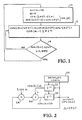
- a flowchart of the method of the instant invention is provided as Fig. 1.
- a block 10 is initially entered which performs the initialization steps indicated by Equations (4).
- a block 12 is next entered which performs the iterative calculation of the next sample term according to Equation (3).
- a decision block 14 is entered which tests whether the term calculated in block 12 exceeds 0.999. If not a "No" exit is taken from decision block 14 back to block 12 and the next sample term is calculated in block 12. If the test performed in block 14 indicates that the term exceeded 0.999 a "YES" exit is taken from block 14 which causes block 10 to be entered. Accordingly, any accumulated error is removed as the sequence of terms is reinitialized and restarted once again.
- the calculations to generate one sample at block 12 requires one left shift, one multiplication and one subtraction.
- Equation (5) the particular frequency and amplitude desired in the resulting waveform, S, is given by Equation (5).
- the value used in block 12 of 0.999 is selected to be near the maximum value that the cosine function can take (1.0) and yet be readily reached within a few iterations of the loop including the "No" exit.
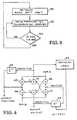
- An initialization block 20 generates the first two terms of the sequence of a tone signal according to Equation (4). These signals are received at a first input of a one time-unit delay block 22 and a first input of a one time-unit delay block 24.
- Delay block 22 generates a signal received by an adder node 26 at a subtractice input thereto. Adder 26 also receives at an additive input a signal generated by a multiplier node 28.
- Multiplier 28 receives at a first input the signal generated by second delay block 24 and at a second input the fixed signal 2cosT.
- the signal generated by delay 24 is also conducted to a second input of delay 22 and the signal generated by adder 26 is conducted to a second input of delay 24.
- the signal generated by delay 24 is also conducted to the initialization block 20 and is the output signal corresponding to equation (3). Circuitry internal to block 20 implements the test performed in flowchart decision block 12 (Fig. 1) and resets the signals generated so that the first two terms of the sequence of tone signals are conducted to delays 22 and 24.
- Delay blocks 22 and 24 receive control signals (not shown) from initialization block 20 which cause the signals at their first inputs to be selected during the first time period after initialization and signals at their second inputs to be selected at all other time periods.
- the trigonometric, identities can be employed in an iterative manner to generate both cosine and sine wave samples of frequency f at intervals of T seconds.
- a block 50 is initially executed which calls for initialization of the cos 2 ⁇ fT and sin 2 ⁇ fT terms. Such initialization values can be provided by numerical analysis methods know to those of ordinary skill in the art.
- a block 52 is entered which employs Equations (6) to iteratively calculate the next sample values of cosine and sine.
- a decision block 54 is next entered which tests whether cos 2 ⁇ fT exceeds 0.999. This test results in either a return to the initialization block 50 or the recalculation block 52 as was described hereinabove in connection with the Chebyschev method of Fig. 1.
- An initialization block 60 generates the first term of the sequence of tone signals.
- the signal is received at a first input of a one time-unit delay block 62 and a first input of a one time-unit delay block 64.
- Delay block 62 generates a signal received at a first input of a multiplier node 64 and a first input of a multiplier node 66.
- the signal generated by delay 64 is received at a first input of a multiplier node 68 and a first input of a multiplier node 70.
- a signal corresponding to cos T is received at a second input of multipliers 64 and 68.
- a signal corresponding to sin T is received at a second input of multiplers 66 and 70.
- An adder node 72 receives the signal generated by multiplier 64 at an additive input and the signal generated by multiplier 70 at a subtractive input.
- An adder node 74 receives the signal generated by multiplier 74 at an additive input and the signal generated by multiplier 68 at a subtractive input.
- the signal generated by adder 72 is conducted to a second input of delay 62 and to the initialization block 60.
- the signal generated by adder 74 is conducted to a second input of delay 64 and is the output signal corresponding to the second of equations (6).
- the signal generated by delay 62 is the output signal corresponding to the first of equations (6).
- Circuitry internal to block 60 implements the test performed in flowchart decision block 54 (Fig. 3) and resets the signal generated so that the first term of the sequence of tone signals are conducted to delays 62 and 64.
- Delay blocks 62 and 64 receive control signals (not shown) from initialization block 60 which cause the signals at their first inputs to be selected during the first time period following initialization and signals at their second inputs to be selected at all other time periods.
- Equation (9) represents the difference between the measured tone signals Xn and the signal predicted by the corresponding term of the Chebyschev sequence Cn, shown in terms of Xn-1 and Xn-2.
- the threshold value can be lowered, resulting in a "high-Q” filter, or raised, resulting in a “low-Q” filter.
- a voting-logic scheme can be used. For instance, several previous sampoes can be used in equation (9) to generate the predicted signal, rather than merely two, X n-1 and X n-2 . Then if a predetermined percentage of these samples, such as 90%, satisfy equation (10), it is determined that the sequence of received samples (8) has the frequency of sequence (7). In this way, the two major parameters affecting the detection of tones can be chosen independently. This feature of the instant invention provides a significant advantage over the tone detectors of the prior art.
Landscapes
- Engineering & Computer Science (AREA)
- Computer Networks & Wireless Communication (AREA)
- Digital Transmission Methods That Use Modulated Carrier Waves (AREA)
- Measurement Of Mechanical Vibrations Or Ultrasonic Waves (AREA)
- Electrophonic Musical Instruments (AREA)
Applications Claiming Priority (2)
| Application Number | Priority Date | Filing Date | Title |
|---|---|---|---|
| US07/077,268 US4839842A (en) | 1987-07-24 | 1987-07-24 | Digital tone detection and generation |
| US77268 | 1987-07-24 |
Publications (3)
| Publication Number | Publication Date |
|---|---|
| EP0300265A2 true EP0300265A2 (fr) | 1989-01-25 |
| EP0300265A3 EP0300265A3 (en) | 1990-10-24 |
| EP0300265B1 EP0300265B1 (fr) | 1995-05-10 |
Family
ID=22137084
Family Applications (1)
| Application Number | Title | Priority Date | Filing Date |
|---|---|---|---|
| EP88110703A Expired - Lifetime EP0300265B1 (fr) | 1987-07-24 | 1988-07-05 | Procédé de détection numérique de tonalités |
Country Status (6)
| Country | Link |
|---|---|
| US (1) | US4839842A (fr) |
| EP (1) | EP0300265B1 (fr) |
| JP (1) | JP2681105B2 (fr) |
| AT (1) | ATE122523T1 (fr) |
| DE (1) | DE3853747T2 (fr) |
| ES (1) | ES2071611T3 (fr) |
Cited By (6)
| Publication number | Priority date | Publication date | Assignee | Title |
|---|---|---|---|---|
| EP0543490A1 (fr) * | 1991-11-22 | 1993-05-26 | Advanced Micro Devices, Inc. | Dispositif pour l'accordement adaptif à un signal périodique reçu |
| WO2004002002A1 (fr) * | 2002-06-24 | 2003-12-31 | Freescale Semiconductor, Inc. | Systeme de communication et procede |
| US6961423B2 (en) | 2002-06-24 | 2005-11-01 | Freescale Semiconductor, Inc. | Method and apparatus for performing adaptive filtering |
| US7215765B2 (en) | 2002-06-24 | 2007-05-08 | Freescale Semiconductor, Inc. | Method and apparatus for pure delay estimation in a communication system |
| US7242762B2 (en) | 2002-06-24 | 2007-07-10 | Freescale Semiconductor, Inc. | Monitoring and control of an adaptive filter in a communication system |
| US7529363B2 (en) | 2002-08-28 | 2009-05-05 | Freescale Semiconductor, Inc. | Tone detector and method therefor |
Families Citing this family (6)
| Publication number | Priority date | Publication date | Assignee | Title |
|---|---|---|---|---|
| JPH0740884B2 (ja) * | 1990-04-27 | 1995-05-10 | 雪印乳業株式会社 | リキュール類を含んだシャーベットとその製造方法 |
| US5343414A (en) * | 1991-11-22 | 1994-08-30 | Advanced Micro Devices, Inc. | Apparatus for adaptively tuning to a received periodic signal |
| US5305248A (en) * | 1993-04-23 | 1994-04-19 | International Business Machines Corporation | Fast IEEE double precision reciprocals and square roots |
| US6167063A (en) * | 1995-12-08 | 2000-12-26 | At&T Corp | Synchronization of wireless base stations by a service circuit in a telecommunication switching system |
| US6677513B1 (en) | 1998-05-29 | 2004-01-13 | International Business Machines Corporation | System and method for generating and attenuating digital tones |
| US7508886B2 (en) * | 2005-03-29 | 2009-03-24 | Lockheed Martin Corporation | System for generating a digital signal |
Family Cites Families (6)
| Publication number | Priority date | Publication date | Assignee | Title |
|---|---|---|---|---|
| US3649821A (en) * | 1970-06-15 | 1972-03-14 | Philco Ford Corp | Digital multiple-tone generator |
| CH534468A (de) * | 1971-06-18 | 1973-02-28 | Hasler Ag | Empfänger für Mehrfrequenzcode-Übertragungsverfahren |
| FR2424669A1 (fr) * | 1978-04-27 | 1979-11-23 | Materiel Telephonique | Dispositifs analyseurs numeriques de spectres |
| FR2429468A1 (fr) * | 1978-06-21 | 1980-01-18 | Materiel Telephonique | Generateur numerique de signaux sinusoidaux |
| NL181385C (nl) * | 1978-06-30 | 1987-08-03 | Nippon Musical Instruments Mfg | Toonproductie-inrichting voor een electronisch muziekinstrument. |
| US4403298A (en) * | 1981-06-15 | 1983-09-06 | Bell Telephone Laboratories, Incorporated | Adaptive techniques for automatic frequency determination and measurement |
-
1987
- 1987-07-24 US US07/077,268 patent/US4839842A/en not_active Expired - Lifetime
-
1988
- 1988-07-05 ES ES88110703T patent/ES2071611T3/es not_active Expired - Lifetime
- 1988-07-05 EP EP88110703A patent/EP0300265B1/fr not_active Expired - Lifetime
- 1988-07-05 DE DE3853747T patent/DE3853747T2/de not_active Expired - Fee Related
- 1988-07-05 AT AT88110703T patent/ATE122523T1/de not_active IP Right Cessation
- 1988-07-20 JP JP63181477A patent/JP2681105B2/ja not_active Expired - Lifetime
Cited By (7)
| Publication number | Priority date | Publication date | Assignee | Title |
|---|---|---|---|---|
| EP0543490A1 (fr) * | 1991-11-22 | 1993-05-26 | Advanced Micro Devices, Inc. | Dispositif pour l'accordement adaptif à un signal périodique reçu |
| WO2004002002A1 (fr) * | 2002-06-24 | 2003-12-31 | Freescale Semiconductor, Inc. | Systeme de communication et procede |
| US6961423B2 (en) | 2002-06-24 | 2005-11-01 | Freescale Semiconductor, Inc. | Method and apparatus for performing adaptive filtering |
| US7215765B2 (en) | 2002-06-24 | 2007-05-08 | Freescale Semiconductor, Inc. | Method and apparatus for pure delay estimation in a communication system |
| US7242762B2 (en) | 2002-06-24 | 2007-07-10 | Freescale Semiconductor, Inc. | Monitoring and control of an adaptive filter in a communication system |
| US7388954B2 (en) | 2002-06-24 | 2008-06-17 | Freescale Semiconductor, Inc. | Method and apparatus for tone indication |
| US7529363B2 (en) | 2002-08-28 | 2009-05-05 | Freescale Semiconductor, Inc. | Tone detector and method therefor |
Also Published As
| Publication number | Publication date |
|---|---|
| JP2681105B2 (ja) | 1997-11-26 |
| US4839842A (en) | 1989-06-13 |
| DE3853747T2 (de) | 1995-12-21 |
| ES2071611T3 (es) | 1995-07-01 |
| EP0300265B1 (fr) | 1995-05-10 |
| ATE122523T1 (de) | 1995-05-15 |
| JPS6449460A (en) | 1989-02-23 |
| EP0300265A3 (en) | 1990-10-24 |
| DE3853747D1 (de) | 1995-06-14 |
Similar Documents
| Publication | Publication Date | Title |
|---|---|---|
| EP0300265B1 (fr) | Procédé de détection numérique de tonalités | |
| US4232192A (en) | Moving-average notch filter | |
| EP0008160B1 (fr) | Détecteur digital programmable pour signaux à fréquences acoustiques | |
| US3937899A (en) | Tone detector using spectrum parameter estimation | |
| CA1280808C (fr) | Calcul du coefficient d'attenuation d'un filtre numerique | |
| US4829463A (en) | Programmed time-changing coefficient digital filter | |
| EP0795986A2 (fr) | Détecteur de signaux à multifréquence employant un filter IIR adaptatif | |
| JPH06317619A (ja) | 位相応答傾斜に対する最小2乗適合を用いた群遅延予測システム | |
| US4326261A (en) | Single tone detector | |
| Mukhopadhyay et al. | Parametric modelling of non-stationary signals: A unified approach | |
| US4087657A (en) | Testing of inductively loaded transmission lines for correct loading | |
| US5790412A (en) | Recursive frequency aging estimation and prediction devices, methods and computer programs for crystal oscillators | |
| WO1983003732A1 (fr) | Appareil d'identification de signaux numeriques a frequences multiples | |
| US4455665A (en) | Data modem clock extraction circuit | |
| Gawthrop | Parameter estimation from noncontiguous data | |
| US4087656A (en) | Testing of inductively loaded transmission lines for correct loading | |
| RU97113716A (ru) | Система управления огнем | |
| US5121350A (en) | Digital tone generation based on difference equations | |
| RU2836461C1 (ru) | Способ оценки амплитуд многочастотного сигнала методом спектрального анализа, проводимого с различной длительностью времени анализа | |
| RU219015U1 (ru) | Нейросетевой адаптивный фильтр электрического сигнала | |
| JP2668721B2 (ja) | リミツタ補間型dft演算方式 | |
| RU2786547C1 (ru) | Способ выделения речевого сигнала с использованием временного анализа спектра аддитивной смеси сигнала и акустических помех | |
| RU2858034C1 (ru) | Способ определения значений фаз гармоник речевых сигналов | |
| SU432463A1 (ru) | Способ измерения скорости протекания переходного процесса электрической системы | |
| RU2137142C1 (ru) | Способ измерения закона перестройки несущей частоты радиоимпульсов с частотной модуляцией и устройство для его осуществления |
Legal Events
| Date | Code | Title | Description |
|---|---|---|---|
| PUAI | Public reference made under article 153(3) epc to a published international application that has entered the european phase |
Free format text: ORIGINAL CODE: 0009012 |
|
| AK | Designated contracting states |
Kind code of ref document: A2 Designated state(s): AT BE CH DE ES FR GB GR IT LI LU NL SE |
|
| PUAL | Search report despatched |
Free format text: ORIGINAL CODE: 0009013 |
|
| AK | Designated contracting states |
Kind code of ref document: A3 Designated state(s): AT BE CH DE ES FR GB GR IT LI LU NL SE |
|
| 17P | Request for examination filed |
Effective date: 19910204 |
|
| 17Q | First examination report despatched |
Effective date: 19921110 |
|
| GRAA | (expected) grant |
Free format text: ORIGINAL CODE: 0009210 |
|
| AK | Designated contracting states |
Kind code of ref document: B1 Designated state(s): AT BE CH DE ES FR GB GR IT LI LU NL SE |
|
| REF | Corresponds to: |
Ref document number: 122523 Country of ref document: AT Date of ref document: 19950515 Kind code of ref document: T |
|
| ITF | It: translation for a ep patent filed | ||
| REF | Corresponds to: |
Ref document number: 3853747 Country of ref document: DE Date of ref document: 19950614 |
|
| REG | Reference to a national code |
Ref country code: ES Ref legal event code: FG2A Ref document number: 2071611 Country of ref document: ES Kind code of ref document: T3 |
|
| ET | Fr: translation filed | ||
| REG | Reference to a national code |
Ref country code: GR Ref legal event code: FG4A Free format text: 3016517 |
|
| PLBE | No opposition filed within time limit |
Free format text: ORIGINAL CODE: 0009261 |
|
| STAA | Information on the status of an ep patent application or granted ep patent |
Free format text: STATUS: NO OPPOSITION FILED WITHIN TIME LIMIT |
|
| 26N | No opposition filed | ||
| PGFP | Annual fee paid to national office [announced via postgrant information from national office to epo] |
Ref country code: SE Payment date: 19970722 Year of fee payment: 10 Ref country code: AT Payment date: 19970722 Year of fee payment: 10 |
|
| PGFP | Annual fee paid to national office [announced via postgrant information from national office to epo] |
Ref country code: BE Payment date: 19970723 Year of fee payment: 10 |
|
| PGFP | Annual fee paid to national office [announced via postgrant information from national office to epo] |
Ref country code: GR Payment date: 19970725 Year of fee payment: 10 |
|
| PGFP | Annual fee paid to national office [announced via postgrant information from national office to epo] |
Ref country code: CH Payment date: 19970730 Year of fee payment: 10 |
|
| PGFP | Annual fee paid to national office [announced via postgrant information from national office to epo] |
Ref country code: LU Payment date: 19971010 Year of fee payment: 10 |
|
| PG25 | Lapsed in a contracting state [announced via postgrant information from national office to epo] |
Ref country code: LU Free format text: LAPSE BECAUSE OF NON-PAYMENT OF DUE FEES Effective date: 19980705 Ref country code: AT Free format text: LAPSE BECAUSE OF NON-PAYMENT OF DUE FEES Effective date: 19980705 |
|
| PG25 | Lapsed in a contracting state [announced via postgrant information from national office to epo] |
Ref country code: SE Free format text: LAPSE BECAUSE OF NON-PAYMENT OF DUE FEES Effective date: 19980706 |
|
| PG25 | Lapsed in a contracting state [announced via postgrant information from national office to epo] |
Ref country code: BE Free format text: LAPSE BECAUSE OF NON-PAYMENT OF DUE FEES Effective date: 19980731 Ref country code: GR Free format text: LAPSE BECAUSE OF NON-PAYMENT OF DUE FEES Effective date: 19980731 Ref country code: LI Free format text: LAPSE BECAUSE OF NON-PAYMENT OF DUE FEES Effective date: 19980731 Ref country code: CH Free format text: LAPSE BECAUSE OF NON-PAYMENT OF DUE FEES Effective date: 19980731 |
|
| BERE | Be: lapsed |
Owner name: ADVANCED MICRO DEVICES INC. Effective date: 19980731 |
|
| REG | Reference to a national code |
Ref country code: CH Ref legal event code: PL |
|
| EUG | Se: european patent has lapsed |
Ref document number: 88110703.1 |
|
| PGFP | Annual fee paid to national office [announced via postgrant information from national office to epo] |
Ref country code: NL Payment date: 20000620 Year of fee payment: 13 |
|
| PGFP | Annual fee paid to national office [announced via postgrant information from national office to epo] |
Ref country code: FR Payment date: 20000707 Year of fee payment: 13 |
|
| PGFP | Annual fee paid to national office [announced via postgrant information from national office to epo] |
Ref country code: ES Payment date: 20000712 Year of fee payment: 13 |
|
| PGFP | Annual fee paid to national office [announced via postgrant information from national office to epo] |
Ref country code: DE Payment date: 20000727 Year of fee payment: 13 |
|
| PG25 | Lapsed in a contracting state [announced via postgrant information from national office to epo] |
Ref country code: ES Free format text: LAPSE BECAUSE OF NON-PAYMENT OF DUE FEES Effective date: 20010706 |
|
| REG | Reference to a national code |
Ref country code: GB Ref legal event code: IF02 |
|
| PG25 | Lapsed in a contracting state [announced via postgrant information from national office to epo] |
Ref country code: NL Free format text: LAPSE BECAUSE OF NON-PAYMENT OF DUE FEES Effective date: 20020201 |
|
| PG25 | Lapsed in a contracting state [announced via postgrant information from national office to epo] |
Ref country code: FR Free format text: LAPSE BECAUSE OF NON-PAYMENT OF DUE FEES Effective date: 20020329 |
|
| NLV4 | Nl: lapsed or anulled due to non-payment of the annual fee |
Effective date: 20020201 |
|
| PG25 | Lapsed in a contracting state [announced via postgrant information from national office to epo] |
Ref country code: DE Free format text: LAPSE BECAUSE OF NON-PAYMENT OF DUE FEES Effective date: 20020501 |
|
| REG | Reference to a national code |
Ref country code: FR Ref legal event code: ST |
|
| REG | Reference to a national code |
Ref country code: ES Ref legal event code: FD2A Effective date: 20020810 |
|
| PG25 | Lapsed in a contracting state [announced via postgrant information from national office to epo] |
Ref country code: IT Free format text: LAPSE BECAUSE OF NON-PAYMENT OF DUE FEES Effective date: 20050705 |
|
| PGFP | Annual fee paid to national office [announced via postgrant information from national office to epo] |
Ref country code: GB Payment date: 20070618 Year of fee payment: 20 |
|
| REG | Reference to a national code |
Ref country code: GB Ref legal event code: PE20 Expiry date: 20080704 |
|
| PG25 | Lapsed in a contracting state [announced via postgrant information from national office to epo] |
Ref country code: GB Free format text: LAPSE BECAUSE OF EXPIRATION OF PROTECTION Effective date: 20080704 |