EP0300413A2 - Mikrobizide Mittel - Google Patents
Mikrobizide Mittel Download PDFInfo
- Publication number
- EP0300413A2 EP0300413A2 EP88111548A EP88111548A EP0300413A2 EP 0300413 A2 EP0300413 A2 EP 0300413A2 EP 88111548 A EP88111548 A EP 88111548A EP 88111548 A EP88111548 A EP 88111548A EP 0300413 A2 EP0300413 A2 EP 0300413A2
- Authority
- EP
- European Patent Office
- Prior art keywords
- formula
- triazole
- dichlorophenyl
- propyl
- ylmethyl
- Prior art date
- Legal status (The legal status is an assumption and is not a legal conclusion. Google has not performed a legal analysis and makes no representation as to the accuracy of the status listed.)
- Granted
Links
Classifications
-
- C—CHEMISTRY; METALLURGY
- C07—ORGANIC CHEMISTRY
- C07D—HETEROCYCLIC COMPOUNDS
- C07D405/00—Heterocyclic compounds containing both one or more hetero rings having oxygen atoms as the only ring hetero atoms, and one or more rings having nitrogen as the only ring hetero atom
- C07D405/02—Heterocyclic compounds containing both one or more hetero rings having oxygen atoms as the only ring hetero atoms, and one or more rings having nitrogen as the only ring hetero atom containing two hetero rings
- C07D405/06—Heterocyclic compounds containing both one or more hetero rings having oxygen atoms as the only ring hetero atoms, and one or more rings having nitrogen as the only ring hetero atom containing two hetero rings linked by a carbon chain containing only aliphatic carbon atoms
-
- C—CHEMISTRY; METALLURGY
- C07—ORGANIC CHEMISTRY
- C07D—HETEROCYCLIC COMPOUNDS
- C07D249/00—Heterocyclic compounds containing five-membered rings having three nitrogen atoms as the only ring hetero atoms
- C07D249/02—Heterocyclic compounds containing five-membered rings having three nitrogen atoms as the only ring hetero atoms not condensed with other rings
- C07D249/08—1,2,4-Triazoles; Hydrogenated 1,2,4-triazoles
-
- A—HUMAN NECESSITIES
- A01—AGRICULTURE; FORESTRY; ANIMAL HUSBANDRY; HUNTING; TRAPPING; FISHING
- A01N—PRESERVATION OF BODIES OF HUMANS OR ANIMALS OR PLANTS OR PARTS THEREOF; BIOCIDES, e.g. AS DISINFECTANTS, AS PESTICIDES OR AS HERBICIDES; PEST REPELLANTS OR ATTRACTANTS; PLANT GROWTH REGULATORS
- A01N43/00—Biocides, pest repellants or attractants, or plant growth regulators containing heterocyclic compounds
- A01N43/64—Biocides, pest repellants or attractants, or plant growth regulators containing heterocyclic compounds having rings with three nitrogen atoms as the only ring hetero atoms
- A01N43/647—Triazoles; Hydrogenated triazoles
- A01N43/653—1,2,4-Triazoles; Hydrogenated 1,2,4-triazoles
-
- C—CHEMISTRY; METALLURGY
- C07—ORGANIC CHEMISTRY
- C07D—HETEROCYCLIC COMPOUNDS
- C07D231/00—Heterocyclic compounds containing 1,2-diazole or hydrogenated 1,2-diazole rings
- C07D231/02—Heterocyclic compounds containing 1,2-diazole or hydrogenated 1,2-diazole rings not condensed with other rings
- C07D231/10—Heterocyclic compounds containing 1,2-diazole or hydrogenated 1,2-diazole rings not condensed with other rings having two or three double bonds between ring members or between ring members and non-ring members
- C07D231/12—Heterocyclic compounds containing 1,2-diazole or hydrogenated 1,2-diazole rings not condensed with other rings having two or three double bonds between ring members or between ring members and non-ring members with only hydrogen atoms, hydrocarbon or substituted hydrocarbon radicals, directly attached to ring carbon atoms
-
- C—CHEMISTRY; METALLURGY
- C07—ORGANIC CHEMISTRY
- C07D—HETEROCYCLIC COMPOUNDS
- C07D233/00—Heterocyclic compounds containing 1,3-diazole or hydrogenated 1,3-diazole rings, not condensed with other rings
- C07D233/54—Heterocyclic compounds containing 1,3-diazole or hydrogenated 1,3-diazole rings, not condensed with other rings having two double bonds between ring members or between ring members and non-ring members
- C07D233/56—Heterocyclic compounds containing 1,3-diazole or hydrogenated 1,3-diazole rings, not condensed with other rings having two double bonds between ring members or between ring members and non-ring members with only hydrogen atoms or radicals containing only hydrogen and carbon atoms, attached to ring carbon atoms
-
- C—CHEMISTRY; METALLURGY
- C07—ORGANIC CHEMISTRY
- C07D—HETEROCYCLIC COMPOUNDS
- C07D413/00—Heterocyclic compounds containing two or more hetero rings, at least one ring having nitrogen and oxygen atoms as the only ring hetero atoms
Definitions
- the present invention relates to a process for the preparation of the 2RS, 4S diastereomer mixture of 1- [2- (2,4-dichlorophenyl) -4-n-propyl-1,3-dioxolan-2-ylmethyl] -1H-1,2 , 4-triazole, and microbicidal agents which contain these compounds as active ingredient.
- the invention further relates to the new 2RS, 4S diastereomer mixture and the use of the new active compounds or the agents mentioned to combat harmful microorganisms and to prevent fungal attack, in particular when dressing seeds.
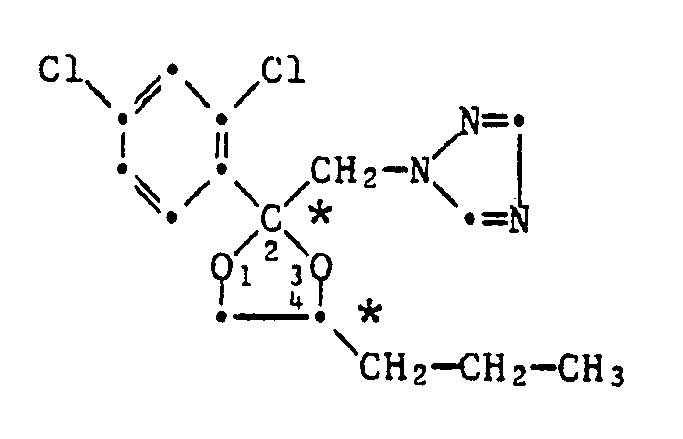
- the isomeric active ingredients include the racemic product 1- [2- (2,4-dichlorophenyl) -4-n-propyl-1,3-dioxolan-2-ylmethyl] -1H-1,2, known under the name "Propiconazole”. 4-triazole of the formula based on which has become known from GB-A 1,522,657 as a fungicide. It contains two asymmetric carbon atoms at the marked positions (*). In the production of this "propiconazole”, approx. 60% of the "cis racemate” is formed, and approx. 40% the "trans racemate".
- the "cis racemate” contains the pair of enantiomers with the 2R, 4S or 2S, 4R configuration
- the "trans racemate” contains the pair of enantiomers with the 2S, 4S or 2R, 4R configuration. This fact is not explicitly mentioned in GB-A 1,522,657.
- the four pure enantiomers have different activities as leaf fungicides and can be classified according to their potency as follows: 2S, 4R> 2S, 4S> 2R, 4S> 2R, 4R [E. Ebert et al: Structure Activity Relationships of Fungicidally Active Triazoles, (The Physicochemical and Biophysical Panel of the Society of Chem. Ind. 26.2.85, London)].
- 1H-1,2,4-triazolyl fungicides When used on fruit trees to combat mildew and rust, dwarfism is very often observed, for example, in the ripening fruit, which in practice is synonymous with crop failure.
- 1H-1,2,4-triazolyl fungicides have only a low phytotoxicity, whereby this term should be understood to mean any form of deviating plant development.
- Such a side effect is also when using 1- [2- (2,4-dichlorophenyl) -4-n-propyl-1,3-dioxolan-2-ylmethyl] -1H-1,2,4-triazole as a leaf fungicide and especially to be observed with the seed dressing.
- Propiconazole has not found its way into practice as a seed dressing because, even with careful use, the germination capacity of treated seeds is generally significantly reduced and the maturing capacity of the culture is delayed too much.
- 1H-1,2,4-triazole derivatives generally exert a plant growth-influencing, generally plant growth-inhibiting effect, which is more or less pronounced depending on the molecular structure, but is at least always latent.
- the aim of the present invention is to provide a sustainably microbicidal, in particular plant fungicidal, active substance without an adverse phytotoxic side effect, which in particular allows its use in fruit tree crops and as a seed dressing.
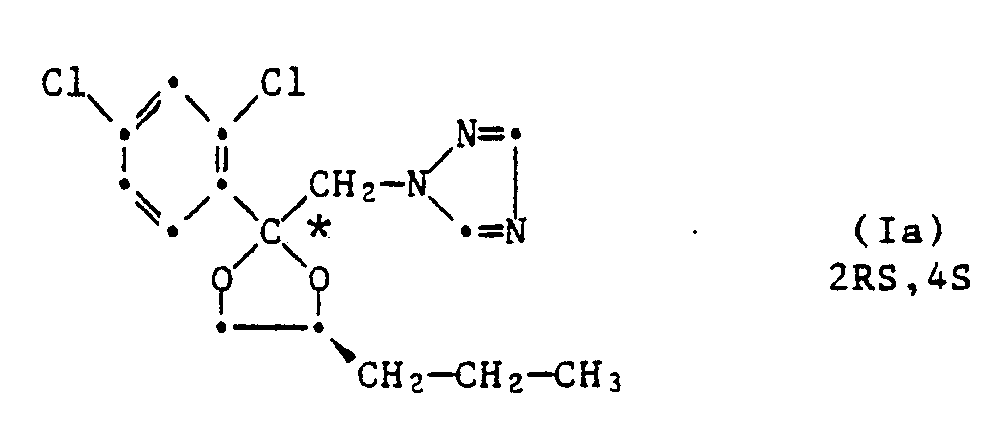
- the 2RS, 4S diastereomer mixture of the formula Ia is obtained by using the diastereomer mixture 2RS-4S-2- [2- (2,4-dichlorophenyl) -2-bromomethyl-4-n-propyl-1,3-dioxolane of the formula III with 1,2,3-triazole of the formula IV in a solvent at 10-160 ° C, in the presence of a base as an acid acceptor to the diastereomer mixture 2RS, 4S-1- [2- (2,4-dichlorophenyl) -4-n-propyl-1,3-dioxolan-2-ylmethyl ] -1H-1,2,4-triazole of the formula Ia.
- the 2R, 4S-1- [2- (2,4-dichlorophenyl) -4-n-propyl-1,3-dioxolan-2-ylmethyl] -1H-1,2,4 -triazole separated from the diastereomer 2S, 4S-1- [2- (2,4-dichlorophenyl) -4-n-propyl-1,3-dioxolan-2-ylmethyl] -1H-1,2,4-triazole and isolated will.
- the separation can be carried out according to one of the usual methods on an adsorption / desorption material, for example on an acidic ion exchange resin or on silica gel, for example by column chromatography.
- the 2RS, 4S diastereomer mixture or the pure 2R, 4S isomer can optionally be converted into a salt by reaction with a salt-forming acid.
- examples of such acids are among the inorganic acids hydrohalic acids such as hydrofluoric acid, hydrochloric acid, hydrobromic acid or hydroiodic acid as well as sulfuric acid, phosphoric acid, phosphorous acid, nitric acid and among the organic acids acetic acid, trifluoroacetic acid, trichloroacetic acid, propionic acid, glycolic acid, thiocyanic acid, lactic acid, lactic acid, lactic acid Benzoic acid, cinnamic acid, oxalic acid, formic acid, benzenesulfonic acid, p-toluenesulfonic acid, methanesulfonic acid, salicylic acid, p-aminosalicylic acid, 2-phenoxybenzoic acid or 2-acetoxybenzoic acid.
- a solvent for the reaction of the compound of formula III with 1,2,4-triazole - optionally halogenated - aliphatic or aromatic hydrocarbons for example toluene, xylene, chlorobenzene, o-dichlorobenzene, methylene chloride, carbon tetrachloride, tetrachlorethylene, and also aliphatic ethers, for example Diethyl ether or diisopropyl ether, finally apolar, aprotic solvents, for example dimethylformamide or dimethyl sulfoxide, can be used.
- the apolar, aprotic solvents in particular dimethyl sulfoxide, are preferred.
- Alkali metal hydroxides in particular potassium hydroxide, are preferred as bases.
- the preferred temperature range of the reaction is between 130 and 150 ° C.
- Solvents with suitable polarity can be used as solvents or solvents for the column chromatographic separation.
- Preferred solvents are aliphatic hydrocarbons and aliphatic esters and the mixtures.
- the ethyl acetate / hexane mixture (1: 1) is preferred.
- the separation is carried out in the temperature range from 10 ° -60 ° C., preferably at room temperature to approx. 40 ° C.
- the separation can also take place on other stationary phases, for example on ion exchangers with acidic residues.
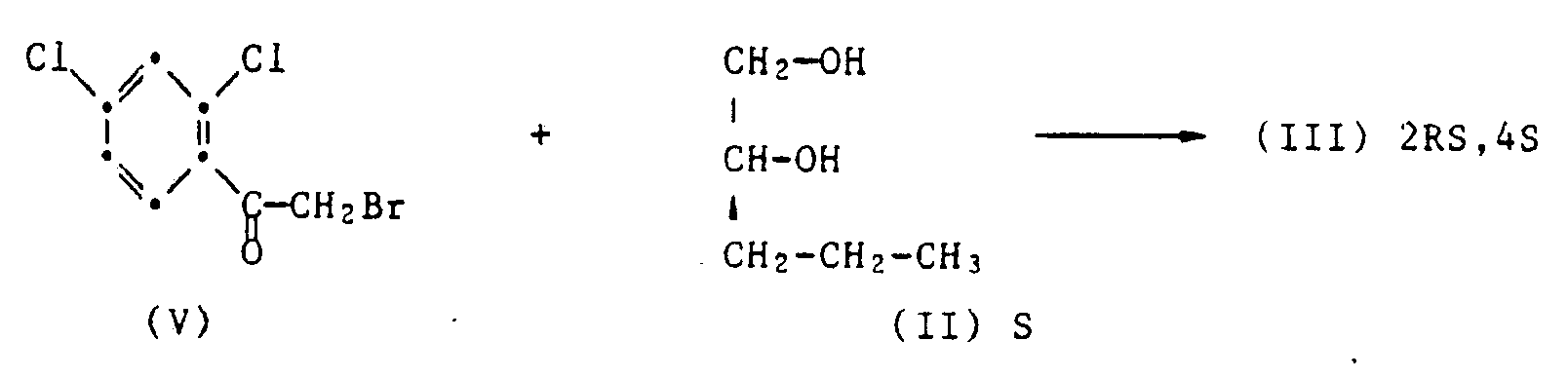
- the compound of formula III can be prepared by condensing the 2 ', 4'-dichloro-2-bromoacetophenone of the formula V with S-1,2-pentanediol of the formula II.
- the diol of the formula II is expediently prepared by reducing the S- ⁇ -hydroxyvaleric acid of the formula VI with a suitable reducing agent, such as, for example, the borane-dimethyl sulfide complex of the formula VII in tetrahydrofuran:
- the compounds of the formula I and Ia are particularly suitable for permanently protecting plants from fungal and bacterial attack and for promoting their development.
- the main area of application of the compound of the formula I and Ia is in the control of harmful phytopathogenic fungi.
- the compounds of the formula I or Ia have a curative, preventive and systemic action which is very favorable for practical needs for the protection of crop plants without influencing them by undesirable side effects.
- crop plants are, for example, cereals (wheat, barley, rye, oats, rice); Beets (sugar and fodder beets); Pome, stone and berry fruits (apples, pears, plums, peaches, almonds, cherries, strawberries, raspberries and blackberries); Legumes (beans, lentils, peas, soybeans); Oil crops (rapeseed, mustard, poppy seeds, olives, sunflowers, coconut, castor bean, cocoa, peanuts); Cucumber plants (pumpkin, cucumber, melons); Fiber plants (cotton, flax, hemp, jute); Citrus fruits (oranges, lemons, grapefruit, tangerines); Vegetables (spinach, lettuce, asparagus, cabbage, carrots, onions, tomatoes, potatoes, peppers) or plants such as corn, tobacco, nuts, coffee, sugar cane, tea, grapevines, hops, bananas, avocados and natural rubber plants as well as ornamental plants.
- cereals wheat, barley,
- the microorganisms that occur on plants or on parts of plants (fruits, flowers, leaves, stems, tubers, roots) of these and related crops can be contained or destroyed, with growing parts of the plants being spared by such microorganisms .
- the compounds of the formula I and Ia can therefore be used particularly as a dressing for the treatment of seeds (fruits, tubers, grains) and plant cuttings for the protection of fungal infections and against phytopathogenic fungi occurring in the soil.
- pathogens are attacked which affect cereals at any stage of development, be it during emergence, during tillering, during ripening, during the storage of seeds (seed dressing) or during sowing.
- Cereals include wheat, rye, barley, oats, rice, corn and millet.
- the following major pathogens are combated by compound Ia and especially compound I, among others Helminthosporium gramineum (barley, wheat) Helminthosporium oryzae (rice) Tilletia caries (barley, wheat, rye) Drechslera teres (barley, wheat) Ustilago tritici (wheat) Ustilago maydis (maize) Puccinia graminis (wheat, barley, rye, oats) Erysiphe graminis (wheat, barley, rye, oats) Fusarium nivale (rye) Fusarium culmorum (wheat) Pseudocercosporella herpotrichoides (rye).
- Helminthosporium gramineum barley, wheat
- Helminthosporium oryzae rice
- Tilletia caries barley, wheat, rye
- the invention thus also relates to the use of the compounds of the formulas I and Ia for combating phytopathogenic microorganisms or for the preventive prevention of infestation on plants such as fruit trees which are usually inhibited by triazole fungicides in the growth or fruit set or are otherwise adversely affected.
- the invention relates in particular to the use of compound Ia and especially compound I for dressing cereal seeds, which are usually delayed by triazole fungicides or generally germinates insufficiently.
- the respective active ingredient of the formula I or Ia is usually used in the form of compositions and can be added to the area or plant to be treated simultaneously or in succession with further active ingredients.
- These other active ingredients can be both fertilizers, trace element mediators or other preparations which influence plant growth.
- it can also be selective herbicides, insecticides, fungicides, bactericides, nematicides, molluscicides or mixtures of several of these preparations, together with any other carriers, surfactants or other application-promoting additives which are customary in formulation technology.
- Suitable carriers and additives can be solid or liquid and correspond to the substances useful in formulation technology, e.g. natural or regenerated mineral substances, solvents, dispersants, wetting agents, adhesives, thickeners, binders or fertilizers.
- the compounds of the formula I or Ia are used in unchanged form or preferably together with the auxiliaries customary in formulation technology and are therefore, for example, to emulsion concentrates, spreadable pastes, directly sprayable or dilutable solutions, diluted emulsions, wettable powders, soluble powders, dusts, granules, by encapsulation in e.g. polymeric materials processed in a known manner.
- the methods of application like the nature of the means, are chosen in accordance with the objectives and the circumstances. In the agricultural sector, favorable application rates are generally from 50 g to 5 kg of active substance (AS) each; preferably 100 g to 2 kg ai / ha, in particular 100 g to 600 g ai / ha.
- Aromatic hydrocarbons preferably the fractions C8 to C12, such as xylene mixtures or substituted naphthalenes, phthalic esters such as dibutyl or dioctyl phthalate, aliphatic hydrocarbons such as cyclohexane or paraffins, alcohols and glycols and their ethers and esters such as ethanol, ethylene glycol, ethylene glycol monomethyl or ethyl ether, ketones such as cyclohexanone, strongly polar solvents such as N-methyl-2-pyrrolidone, dimethyl sulfoxide or dimethylformamide, and optionally epoxidized vegetable oils such as epoxidized coconut oil or soybean oil; or water.
- Aromatic hydrocarbons preferably the fractions C8 to C12, such as xylene mixtures or substituted naphthalenes, phthalic esters such as dibutyl or dioctyl phthalate, aliphatic hydrocarbons such as
- application-promoting additives that can lead to a large reduction in the application rate are also natural (animal or vegetable) or synthetic phospholipids from the range of the cephalins and lecithins, such as Phosphatidylethanolamine, Phosphatidylserine, Phosphatidylglycerin or Lysolecithin.
- suitable surface-active compounds are nonionic, cationic and / or anionic surfactants with good emulsifying, dispersing and wetting properties.
- surfactants are also to be understood as mixtures of surfactants.
- Agents are therefore preferred in which the propiconazole content consists of at least 70 percent by weight, particularly at least 90 percent by weight or 98-100 percent by weight, of the plant-compatible 2R, 4S isomer of the formula I.
- the agents can also contain other additives such as stabilizers, defoamers, viscosity regulators, binders, adhesives and fertilizers or other active ingredients to achieve special effects.
- the partially crystalline residue is stirred with 2 liters of ethyl ether, the boric acid which has precipitated is filtered off and the filtrate is evaporated.
- the residue is dissolved in 650 ml of water, brought to pH 13 with barium hydroxide, filtered through silica gel and the filtrate is evaporated to about 300 ml at 60 ° C. in vacuo.
- the barium borate is precipitated by adding 800 ml of acetone, filtered off, the filter cake is washed with acetone and the combined filtrates are evaporated.
- the residue is taken up in 1.5 liters of diethyl ether, dried over sodium sulfate, filtered and the solvent evaporates.
- Emulsion concentrates a) b) c) Active substance [70% 2R, 4S] 25% 40% 50% Ca-dodecylbenzenesulfonate 5% 8th% 6% Castor oil-polyethylene glycol ether (36 moles of ethylene oxide 5% - - Tributylphenoyl polyethylene glycol ether (30 moles of ethylene oxide) - 12% 4% Cyclohexanone - 15% 20% Xylene mixture 65% 25% 20%
- Such concentrates can be used to prepare emulsions of any desired concentration by dilution with water, which are suitable for foliar application or wet dressing.
- Granules a) b) Active substance [45% 2R, 4S] 5% 10% kaolin 94% Fumed silica 1% - Attapulgite - 90%
- Ready-to-use dusts are obtained by intimately mixing the carrier substances with the active ingredient. Such dusts are suitable for dry dressing of grain seeds.
- the active ingredient is mixed well with the additives and ground in a suitable mill.
- Spray powder is obtained which can be diluted with water to form suspensions of any desired concentration. Such suspensions are suitable for dressing grain seeds.
- Emulsions of any desired concentration can be prepared from this concentrate by dilution with water.
- the active ingredient is mixed with the additives, ground and moistened with water. This mixture was extruded and then dried in a stream of air.
- the finely ground active ingredient is applied evenly in a mixer to the kaolin moistened with polyethylene glycol. In this way, dust-free coating granules are obtained. If you add grain seeds in the same mixer after some time, you get coated or coated seeds in the same operation.
- Active substance [93% 2R, 4S] 40% Ethylene glycol 10% Nonylphenol polyglycol ether (15 mol ethylene oxide) 6% N-lignin sulfonate 10% Carboxymethyl cellulose 1% 37% aqueous formaldehyde solution 0.2% Silicone oil in the form of a 75% aqueous emulsion 0.8% Water 32%
- the finely ground active ingredient is intimately mixed with the additives.
- Such suspensions are suitable for dressing grain seeds (dip dressing, spray dressing).
- 80 g dry cereal grains are mixed well in closable plastic cups with 2R, 4S-propiconazole of formula I or with 2RS, 4S-propiconazole of formula Ia in the form of an aqueous suspension, emulsion or solution.
- the substance application is measured so that an active ingredient concentration of 0.06 to 0.001%, based on the dry grain weight, is achieved.
- Example 3.1 Seed dressing of wheat with stereoisomers of 1- [2- (2,4-dichlorophenyl) -4-n-propyl-1,3-dioxolan-2-ylmethyl] -1H-1,2,4-triazole and with its commercially available mixture1, against Erysiphe graminis
- 3 x 100 wheat grains are placed in 3 seed bowls filled with natural soil and kept in the greenhouse under the same conditions.
- the activity of the fungicides was calculated 30 days after sowing on the basis of the percentage area infested by the fungus, and the delay in emergence by measuring the growth height after 14 and after 19 days. For comparison, an experiment with untreated, infected wheat was carried out.
- This untreated wheat was 2.2 cm and 10.3 cm in height after 14 and 19 days and showed about 80% fungal attack after 30 days.
- Wheat seed treated with commercially available propiconazole had a growth height of 1.4 cm and 8.0 cm at the same time and showed about 40% fungal attack.
- the wheat seed treated with the 2R, 4S isomer according to the invention had a growth height of 2.1 cm or 10.3 cm at the same time and showed a fungal attack of less than 10%.
- the wheat seed treated with the 2RS, 4S diasteromer mixture of propiconazole according to the invention had a growth height of 1.8 cm or 10.1 cm and showed a fungal infection of 10-15%.
- Example 3.2 Pickling action against Fusarium nivale on rye
- 50 ppm AS 5 g AS / 100 kg seed
- 100 ppm AS 100 seeds of the infected and treated rye are sown in the climatic room in 40 cm2 seed trays and kept under stress conditions that correspond to those of natural winter seeds at low temperatures and the darkness of a blanket of snow.
- the seed pans are kept in complete darkness and at + 4 ° C for 4 weeks, then the temperature is slowly increased to 10 ° C and a day and night change is simulated with artificial lighting.
- the percentage of plants infected with Fusarium is counted after a total of 10 weeks. Number of emerged plants plants infested with it at 50 ppm AS 100 ppm AS at 50 ppm AS 100 ppm AS 2R, 4S isomer 89 91 6 3rd 2RS, 4S diastereomer 89 - 9 - racem.
- Propiconazole 80 - 12 - untreated but infected control 60 23 - not checked
- the infected and treated barley is sown outdoors in October with a seeder on plots of 2 m in length and 3 rows of seeds, with 3 repetitions per test product.
- the trial planting is cultivated under normal field conditions.
- the percentage of stalks infected with Helminthosporium is counted at the time of ear spinning.
- the infected and treated wheat is sown in the field in October with a seeder on plots of 2 m in length and 3 rows of seeds, with 3 repetitions per test product.
- test planting is cultivated under normal field conditions.
- Apple cuttings with 10-20 cm long fresh shoots are sprayed with a very dilute spray mixture (50 ppm active substance) made from wettable powder of the active ingredient for a comparative demonstration of different growth inhibition.
- a very dilute spray mixture 50 ppm active substance
- the treated plants are infected with a conidia suspension of the fungus.
- the plants are then incubated for 5 days at 90-100% relative atmospheric humidity and placed in a greenhouse at 20-24 ° C. for a further 10 days. Scab infestation is assessed 15 days after infection.
- Propiconazole 77% 80% * made by mixing 20 parts of 2R, 4S and 30 parts of 2RS, 4S)
Landscapes
- Organic Chemistry (AREA)
- Chemical & Material Sciences (AREA)
- Life Sciences & Earth Sciences (AREA)
- Environmental Sciences (AREA)
- Agronomy & Crop Science (AREA)
- Engineering & Computer Science (AREA)
- Dentistry (AREA)
- General Health & Medical Sciences (AREA)
- Wood Science & Technology (AREA)
- Zoology (AREA)
- Plant Pathology (AREA)
- Pest Control & Pesticides (AREA)
- Health & Medical Sciences (AREA)
- Agricultural Chemicals And Associated Chemicals (AREA)
- Plural Heterocyclic Compounds (AREA)
- Acyclic And Carbocyclic Compounds In Medicinal Compositions (AREA)
- Polysaccharides And Polysaccharide Derivatives (AREA)
- Organic Low-Molecular-Weight Compounds And Preparation Thereof (AREA)
- Nitrogen Condensed Heterocyclic Rings (AREA)
- Pharmaceuticals Containing Other Organic And Inorganic Compounds (AREA)
- Cosmetics (AREA)
- Food Preservation Except Freezing, Refrigeration, And Drying (AREA)
Abstract
Description
- Die vorliegende Erfindung betrifft ein Verfahren zur Herstellung des 2RS,4S-Diastereomerengemischs vom 1-[2-(2,4-Dichlorphenyl)-4-n-propyl-1,3-dioxolan-2-ylmethyl]-1H-1,2,4-triazol, sowie mikrobizide Mittel, die als Wirkstoff diese Verbindungen enthalten. Die Erfindung betrifft ferner das neue 2RS,4S-Diastereomerengemisch und die Verwendung der neuen Wirkstoffe bzw. der genannten Mittel zur Bekämpfung von schädlichen Mikroorganismen und zur Verhütung von Pilzbefall, insbesondere bei der Beizung von Saatgut.
- Den isomeren Wirkstoffen liegt das unter dem Namen "Propiconazol" bekanntgewordene racemische Produkt 1-[2-(2,4-Dichlorphenyl)-4-n-propyl-1,3-dioxolan-2-ylmethyl]-1H-1,2,4-triazol der Formel
- Die vier reinen Enantiomeren weisen als Blattfungizide unterschiedliche Aktivitäten auf und lassen sich nach Wirkungsstärke etwa wie folgt einordnen: 2S,4R>2S,4S>2R,4S>2R,4R [E. Ebert et al: Structure Activity Relationships of Fungicidally Active Triazoles, (The Physicochemical and Biophysical Panel of the Society of Chem. Ind. 26.2.85, London)].
- Es hat sich nun in den letzten Jahren vermehrt gezeigt, dass die zu den Ergosterinbiosynthese-Inhibitoren zählende Stoffklasse der 1H-1,2,4-Triazolylverbindungen in der Agrochemie nicht nur als Pflanzenfungizide, sondern auch als Pflanzenwuchshemmer einsetzbar ist. Unter der Fülle von Publikationen, in denen beide Eigenschaften als Anwendungsgebiet vorgeschlagen werden, seien als Beispiele EP-A-15 387, EP-A-32 200, EP-A-44 993, EP-A-53 311, EP-A-87 148, EP-A-123 160, EP-A-114 487, EP-A-47 594 genannt. In Nutzkulturen ist diese wuchshemmende oder wuchsregulierende Eigenschaft sehr häufig nicht erwünscht, da unerwartete Effekte im Pflanzenwuchs auftreten können. Bei der Anwendung an Obstbäumen zur Bekämpfung von Mehltau- und Rostbefall wird beispielsweise bei den reifenden Früchten sehr häufig Zwergwuchs beobachtet, der in der Praxis gleichbedeutend mit Ernteausfall ist. Im besten Falle besitzen 1H-1,2,4-Triazolyl-Fungizide nur eine geringe Phytotoxizität, wobei unter diesem Begriff jede Form der abweichenden Pflanzenentwicklung verstanden werden soll. Eine solche Nebenwirkung ist auch bei der Verwendung des 1-[2-(2,4-Dichlorphenyl)-4-n-propyl-1,3-dioxolan-2-ylmethyl]-1H-1,2,4-triazol als Blattfungizid und insbesondere bei der Saatbeizung zu beobachten. Als Saatbeizmittel hat Propiconazol keinen Eingang in die Praxis gefunden, weil auch bei vorsichtiger Anwendung die Keimfähigkeit von behandeltem Saatgut in der Regel deutlich vermindert ist und das Auflaufvermögen der Kultur zeitlich zu stark verzögert wird.
- Aufgrund der jahrlangen intensiven Forschung hat sich in der Fachwelt die Meinung gebildet, dass 1H-1,2,4-Triazolderivate generell einen pflanzenwuchsbeeinflussenden, im allgemeinen pflanzenwuchshemmenden Effekt ausübten, der je nach Molekülstruktur stärker oder schwächer hervortrete, jedoch mindestens latent immer vorhanden sei.
- Es hat sich nun ganz unerwartet gezeigt, dass das 2R,4S-Isomere des Propiconazols bei voller pflanzenmikrobizider Aktivität im Gegensatz zu den übrigen drei obengenannten Isomeren praktisch keine sichtbare Pflanzenwuchsbeeinflussung, also keine Phytotoxizität, aufweist und dass die Phytotoxizität des 2S,4S-Isomeren vergleichsweise gering ist.
- Dies ist im Hinblick auf das vorher Gesagte überraschend, und es ist um so überraschender, als die GB-A-1,522,657 keine Hinweise auf unterschiedliche biologische bzw. mikrobizide oder phytotoxische Wirkung der Isomeren enthält.
- Ziel der vorliegenden Erfindung ist die Bereitstellung einer nachhaltig mikrobiziden, besonders pflanzenfungiziden Aktivsubstanz ohne nachteilige phytotoxische Nebenwirkung, die insbesondere ihren Einsatz in Obstbaumkulturen und als Saatbeizmittel erlaubt.
- Es wurde überraschend gefunden, dass das 2R,4S-Isomere der Formel I des 1-[2-(2,4-Dichlorphenyl)-4-n-propyl-1,3-dioxolan-2-ylmethyl]-1H-1,2,4-triazols diesen Anforderungen voll entspricht und dass auch das 2RS,4S-Diastereomerengemisch der Formel Ia für die Mehrzahl der Fälle diesen Anforderungen genügt. Dieses 2RS,4S-Diatereomerengemisch setzt sich zu gleichen Teilen aus dem 2R,4S-Enantiomeren und dem 2S,4S-Enantiomeren zusammen und ist neu, denn weder das obenerwähnte "cis-Racemat" noch das "trans-Racemat" entsprechen dieser Isomerenzusammensetzung.

- Entscheidend für die Gewinnung ist, dass man von vornherein durch den gezielten Einsatz von S-1,2-Pentandiol der Formel II
₂- CH₂CH₂CH₃
(II) S
zu Verbindungen mit 4S-Konfiguration gelangt. Damit wird die Entstehung von Verbindungen mit 4R-Konfiguration vermieden, die im Falle des Propiconazol im wesentlichen für die phytotoxischen Erscheinungen verantwortlich sind. - Das 2RS,4S-Diastereomerengemisch der Formel Ia wird erhalten, indem man das Diastereomerengemisch 2RS-4S-2-[2-(2,4-Dichlorphenyl)-2-brommethyl-4-n-propyl-1,3-dioxolan der Formel III mit 1,2,3,-Triazol der Formel IV

- Aus dem 2RS,4S-Diastereomerengemisch kann das 2R,4S-1-[2-(2,4-Dichlorphenyl)-4-n-propyl-1,3-dioxolan-2-ylmethyl]-1H-1,2,4-triazol vom Diastereomeren 2S,4S-1-[2-(2,4-Dichlorphenyl)-4-n-propyl-1,3-dioxolan-2-ylmethyl]-1H-1,2,4-triazol abgetrennt und isoliert werden. Die Trennung kann nach einer der üblichen Methoden an einem Adsorption/Desorption-Material erfolgen, z.B. an einem sauren Ionenaustauscherharz oder an Kieselgel, beispielsweise durch Säulenchromatographie.
- Das 2RS,4S-Diastereomerengemisch oder das reine 2R,4S-Isomere können gegebenenfalls durch Umsetzung mit einer salzbildenden Säure in ein Salz überführt werden. Beispiele solcher Säuren sind unter den anorganischen Säuren Halogenwasserstoffsäuren wie Fluorwasserstoffsäure, Chlorwasserstoffsäure, Bromwasserstoffsäure oder Jodwasserstoffsäure sowie ferner Schwefelsäure, Phosphorsäure, phosphorige Säure, Salpetersäure und unter den organischen Säuren Essigsäure, Trifluoressigsäure, Trichloressigsäure, Propionsäure, Glycolsäure, Thiocyansäure, Milchsäure, Bernsteinsäure, Zitronensäure, Benzoesäure, Zimtsäure, Oxalsäure, Ameisensäure, Benzolsulfonsäure, p-Toluolsulfonsäure, Methansulfonsäure, Salicylsäure, p-Aminosalicylsäure, 2-Phenoxybenzoesäure oder 2-Acetoxybenzoesäure. Dieses Verfahren, das zur Herstellung der Reinsubstanzen 2RS-4S- bzw. 2R,4S-1-[2-(2,4-Dichlorphenyl)-4-n-propyl-1,3-dioxolan-2-ylmethyl]-1H-1,2,4-triazol dient, ist neu und ist ebenfalls Gegenstand der vorliegenden Erfindung.
- Als Lösungsmittel für die Umsetzung der Verbindung der Formel III mit 1,2,4-Triazol können - gegebenenfalls halogenierte - aliphatische oder aromatische Kohlenwasserstoffe, beispielsweise Toluol, Xylol, Chlorbenzol, o-Dichlorbenzol, Methylenchlorid, Tetrachlorkohlenstoff, Tetrachloräthylen, ferner aliphatische Aether, beispielsweise Diäthyläther oder Diisopropyläther, schliesslich apolare, aprotische Lösungsmittel, beispielsweise Dimethylformamid oder Dimethylsulfoxid eingesetzt werden.
- Bevorzugt werden von den erwähnten Lösungsmittel die apolaren, aprotischen Lösungsmittel, insbesondere das Dimethylsulfoxid.
- Bevorzugt werden als Basen die Alkalihydroxide, insbesondere das Kaliumhydroxid.
- Der bevorzugte Temperaturbereich der Umsetzung liegt zwischen 130 und 150°C.
- Als Lösungsmittel oder Laufmitel für die säulenchromatographische Trennung können Lösungsmittel mit geeigneter Polarität, wie gegebenenfalls halogenierte aliphatische oder aromatische Kohlenwasserstoffe, Ester, Aether oder deren Gemische verwendet werden. Bevorzugt werden als Lösungsmittel aliphatische Kohlenwasserstoffe und aliphatische Ester und der Gemische. Insbesondere wird das Aethylacetate/Hexan-Gemisch (1:1) bevorzugt. Die Trennung wird im Temperaturbereich von 10°-60°C durchgeführt, vorzugsweise bei Raumtemperatur bis ca. 40°C.
- Die Trennung kann auch an anderen stationären Phasen, wie beispielsweise an Ionenaustauschern mit sauren Resten erfolgen.
- Die Verbindung der Formel III kann durch Kondensation des 2′,4′-Dichlor-2-bromacetophenons der Formel V mit S-1,2-Pentandiol der Formel II hergestellt werden.
- Die Herstellung des Diols der Formel II erfolgt zweckmässig durch Reduktion der S-α-Hydroxyvaleriansäure der Formel VI mit einem geeigneten Reduktionsmittel, wie beispielsweise dem Boran-Dimethylsulfid-Komplex der Formel VII in Tetrahydrofuran:

- Die Herstellung der Verbindung der Formel VI (S) ist im J. Am. Chem. Soc. 78, 2423 (1956) beschrieben. Ihre Reinigung kann über geeignete Salze, beispielsweise über das S(-)-1-Penyläthylammoniumsalz erfolgen.
- Die Verbindungen der Formeln IV, V und VII sind im Handel erhältliche Chemikalien.
- Die Verbindungen der Formel I und Ia sind insbesondere geeignet, Pflanzen vor Pilz- und Bakterienbefall dauerhaft zu schützen und ihre Entwicklung zu fördern. Sie stellen als pflanzenverträgliche mikrobizide Aktivsubstanzen eine ganz wesentliche Bereicherung der Technik dar.
- Das Haupteinsatzgebiet der Verbindung der Formel I und Ia liegt in der Bekämpfung von schädlichen phytopathogenen Pilzen. So besitzen die Verbindungen der Formel I bzw. Ia eine für praktische Bedürfnisse sehr günstige kurative, präventive und systemische Wirkung zum Schutz von Kulturpflanzen, ohne diese durch unerwünschte Nebenwirkungen zu beeinflussen. Kulturpflanzen seien im Rahmen vorliegender Erfindung beispielsweise Getreide (Weizen, Gerste, Roggen, Hafer, Reis); Rüben (Zucker- und Futterrüben); Kern-, Stein- und Beerenobst (Aepfel, Birnen, Pflaumen, Pfirsiche, Mandeln, Kirschen, Erdbeeren, Himbeeren und Brombeeren); Hülsenfrüchte (Bohnen, Linsen, Erbsen, Soja); Oelkulturen (Raps, Senf, Mohn, Oliven, Sonnenblumen, Kokos, Rizinus, Kakao, Erdnüsse); Gurkengewächse (Kürbis, Gurken, Melonen); Fasergewächse (Baumwolle, Flachs, Hanf, Jute); Citrusfrüchte (Orangen, Zitronen, Pampelmusen, Mandarinen); Gemüseorten (Spinat, Kopfsalat, Spargel, Kohlarten, Möhren, Zwiebeln, Tomaten, Kartoffeln, Paprika) oder Pflanzen wie Mais, Tabak, Nüsse, Kaffee, Zuckerrohr, Tee, Weinreben, Hopfen, Bananen, Avocados und Naturkautschukgewächse sowie Zierpflanzen.
- Mit dem Wirkstoff der Formel I bzw. Ia können an Pflanzen oder an Pflanzenteilen (Früchten, Blüten, Laubwerk, Stengel, Knollen, Wurzeln) dieser und verwandter Nutzkulturen die auftretenden Mikroorganismen eingedämmt oder vernichtet werden, wobei auch später zuwachsende Pflanzenteile von derartigen Mikroorganismen verschont bleiben. Die Wirkstoffe sind vor allem gegen die den folgenden Klassen angehörenden phytopathogenen Pilze wirksam: Ascomycetes (wie Erysiphe, Venturia, Pyrenophora (= reife Form von Helminthosporium), Calonectria graminicola (= reife Form von Fusarium); Basidiomycetes wie Tilletia und Ustilago; Fungi imperfecti wie Helminthosporium, Fusarium, Septoria, Cercospora.
- Die Verbindungen der Formel I und Ia können deshalb besonders als Beizmittel zur Behandlung von Saatgut (Früchte, Knollen, Körner) und Pflanzenstecklingen zum Schutz von Pilzinfektionen sowie gegen im Erdboden auftretende phytopathogene Pilze eingesetzt werden.
- Insbesondere werden Krankheitserreger bekämpft, die Getreidearten in irgendeinem Entwicklungsstadium befallen, sei es beim Auflaufen, bei der Bestockung, bei der Reifung, bei der Lagerung des Saatguts (Saatbeizung) oder bei der Aussaat. Als Getreidearten seien beispielsweise Weizen, Roggen, Gerste, Hafer, Reis, Mais und Kulturhirse genannt. Bekämpft werden durch die Verbindung Ia und besonders die Verbindung I unter anderen folgende bedeutende Krankheitserreger
Helminthosporium gramineum (Gerste, Weizen)
Helminthosporium oryzae (Reis)
Tilletia caries (Gerste, Weizen, Roggen)
Drechslera teres (Gerste, Weizen)
Ustilago tritici (Weizen)
Ustilago maydis (Mais)
Puccinia graminis (Weizen, Gerste, Roggen, Hafer)
Erysiphe graminis (Weizen, Gerste, Roggen, Hafer)
Fusarium nivale (Roggen)
Fusarium culmorum (Weizen)
Pseudocercosporella herpotrichoides (Roggen). - In Klammern sind nur die wichtigsten Kulturen aufgeführt.
- Die Erfindung betrifft somit auch die Verwendung der Verbindungen der Formel I und Ia zur Bekämpfung phytopathogener Mikroorganismen bzw. zur präventiven Verhütung eines Befalls an Pflanzen wie Obstbäumen, die üblicherweise durch Triazol-Fungizide im Wuchs oder Fruchtansatz gehemmt oder anderweitig ungünstig beeinflusst werden.
- Die Erfindung betrifft insbesondere die Verwendung der Verbindung Ia und vor allem der Verbindung I zur Beizung von Getreide-Saatgut, das üblicherweise durch Triazol-Fungizide eine Auflauf-Verzögerung erfährt oder generell ungenügend keimt. Durch die Bereitstellung des völlig pflanzenverträglichen 2R,4S-1-[2-(2,4-Dichlorphenyl)-4-n-propyl-1,3-dioxolan-2-ylmethyl]-1H-1,2,4-triazols wird das Problem des dauerhaften Schutzes von Getreide-Saatgut vor pilzlichen Krankheitserregern gelöst. Die Erfindung bezieht sich auch auf so behandeltes Saatgut.
- Der jeweilige Wirkstoff der Formel I bzw. Ia wird üblicherweise in Form von Zusammensetzungen verwendet und kann gleichzeitig oder nacheinander mit weiteren Wirkstoffen auf die zu behandelnde Fläche oder Pflanze gegeben werden. Diese weiteren Wirkstoffe können sowohl Düngemittel, Spurenelement-Vermittler oder andere das Pflanzenwachstum beeinflussende Präparate sein. Es können aber auch selektive Herbizide, Insektizide, Fungizide, Bakterizide, Nematizide, Molluskizide oder Gemische mehrerer dieser Präparate sein, zusammen mit gegebenenfalls weiteren in der Formulierungstechnik üblichen Trägerstoffen, Tensiden oder anderen applikationsfördernden Zusätzen.
- Geeignete Träger und Zusätze können fest oder flüssig sein und entsprechen den in der Formulierungstechnik zweckdienlichen Stoffen, wie z.B. natürlichen oder regenerierten mineralischen Stoffen, Lösungsm-, Dispergier-, Netz-, Haft-, Verdickungs-, Binde- oder Düngemitteln.
- Die Verbindungen der Formel I bzw. Ia werden dabei in unveränderter Form oder vorzugsweise zusammen mit den in der Formulierungstechnik üblichen Hilfsmittel eingesetzt und werden daher z.B. zu Emulsionskonzentraten, streichfähigen Pasten, direkt versprühbaren oder verdünnbaren Lösungen, verdünnten Emulsionen, Spritzpulvern, löslichen Pulvern, Stäubemitteln, Granulaten, durch Verkapselungen in z.B. polymeren Stoffen in bekannter Weise verarbeitet. Die Anwendungsverfahren werden gleich wie die Art der Mittel den angestrebten Zielen und den gegebenen Verhältnissen entsprechend gewählt. Im Agrarsektor liegen günstige Aufwandmengen im allgemeinen bei 50 g bis 5 kg Aktivsubstanz (AS) je hat; bevorzugt 100 g bis 2 kg AS/ha, insbesondere bei 100 g bis 600 g AS/ha.
- Als Lösungsmittel können in Frage kommen: Aromatische Kohlenwasserstoffe, bevorzugt die Fraktionen C₈ bis C₁₂, wie z.B. Xylolgemische oder substituierte Naphthaline, Phthalsäureester wie Dibutyl- oder Dioctyl phthalat, aliphatische Kohlenwasserstoffe wie Cyclohexan oder Paraffine, Alkohole und Glykole sowie deren Ether und Ester, wie Ethanol, Ethylenglykol, Ethylenglykolmonomethyl- oder Ethylether, Ketone wie Cyclohexanon, stark polare Lösungsmittel wie N-Methyl-2-pyrrolidon, Dimethylsulfoxid oder Dimethylformamid, sowie gegebenenfalls epoxydierte Pflanzenöle wie epoxydiertes Kokosnussöl oder Sojaöl; oder Wasser.
- Besonders vorteilhafte, applikationsfördernde Zuschlagstoffe, die zu einer starken Reduktion der Aufwandmenge führen können, sind ferner natürliche (tierische oder pflanzliche) oder synthetische Phospholipide aus der Reihe der Kephaline und Lecithine, wie z.B. Phosphatidylethanolamin, Phosphatidylserin, Phosphatidylglycerin oder Lysolecithin.
- Als oberflächenaktive Verbindungen kommen je nach Art des zu formulierenden Wirkstoffes der Formel I nichtionogene, kation-und/oder anionaktive Tenside mit guten Emulgier-, Dispergier- und Netzeigenschaften in Betracht. Unter Tensiden sind auch Tensidgemische zu verstehen.
- Die in der Formulierungstechnik gebräuchlichen Tenside sind u.a. in folgenden Publikationen beschrieben:
"Mc Cutcheon's Detergents and Emulsifiers Annual" BC Publishing Corp., Ringwood New Jersey, 1981; Helmut Stache "Tensid-Taschenbuch" Carl Hanser-Verlag München/Wien 1981.
M. and J. Ash. "Encyclopedia of Surfactants", Vol. I-III, Chemical Publishing Co., New York, 1980-1981. - Die hierin beschriebenen pflanzenmikrobiziden Mittel enthalten in der Regel 0,01 bis 95 %, bevorzugt 0,1 % bis 60 % Wirkstoff auf Propiconazol-Basis, und zusätzlich einen oder mehrere übliche Trägerstoffe und/oder Netzmittel (=oberflächenaktive Präparate).
- Die Mittel sind gemäss vorliegender Erfindung dadurch gekennzeichnet, dass der Wirkstoff Propiconazol einen möglichst hohen, mindestens aber 45 %-igen (= Gew.-%) Anteil an 2R,4S-Isomeren und kaum Anteile oder bevorzugt keine Anteile an 4R-Isomeren enthält. Je höher der Anteil des 2R,4S-Isomeren in der Propiconazol-Wirkstoffkomponente ist, desto problemloser lassen sich derartige Mittel zur Pflanzenapplikation, z.B. an Apfel- und Birnbäumen, besonders aber zur Saatbeizung, auch bei zufälliger Höherdosierung anwenden. Bevorzugt sind daher Mittel, bei denen der Propiconazol-Anteil zu mindestens 70 Gewichtsprozent, besonders zu mindestens 90 Gewichtsprozent oder zu 98-100 Gewichtsprozent aus dem pflanzenverträglichen 2R,4S-Isomeren der Formel I besteht.
- Sofern das Diastereomerengemisch 2RS,4S-1-[2,(2,4-Dichlorphenyl)-4-n-propyl-1,3-dioxolan-2-ylmethyl]-1H-1,2,4-triazol eingesetzt wird (mit gleichen Anteilen an 2R,4S-Isomeren und 2S,4S-Isomerem), beträgt sein Anteil am Propiconazol-Gesamt-Wirkstoff demgemäss mindestens 90 Gew.-%. Ein solcher Anteil, der noch 10 Gew.-% oder weniger phytotoxisches 4R-Isomeres enthalten kann, gewährleistet in der Mehrzahl der Praxisfälle eine noch hinreichende Pflanzenverträglichkeit. Den erfindungsgemässen Mitteln kann also in geringen Mengen beispielsweise racemisches Propiconazol beigemischt sein, so dass der Anteil an 4R-Isomeren den Betrag von 10 Gew.-% nicht überschreitet, bevorzugt jedoch unter 5 Gew.-% liegt und besonders bevorzugt Null ist.
- Während als Handelsware eher konzentrierte Mittel bevorzugt werden, verwendet der Endverbraucher in der Regel vedünnte Mittel mit Konzentrationen von 0,001 % bis 1 %.
- Die Mittel können auch weitere Zusätze wie Stabilisatoren, Entschäumer, Viskositätsregulatoren, Bindemittel, Haftmittel sowie Dünger oder andere Wirkstoffe zur Erzielung spezieller Effekte enthalten.
- Die nachfolgenden Beispiele dienen der Illustration der Erfindung, ohne dieselbe einzuschränken.
-
- HOOC-CH₂-CH₂-CH₃

Die nach M. Winitz et al [J. Amer. Chem. Soc. 78, 2423 (1956)] hergestellte rohe Säure wird durch Kristallisation ihres S(-)-1-Phenyläthylammoniumsalzes aus Acetonitril gereinigt. Das reine Salz schmilzt bei 96-99°C; [α]
- 90 g (0,4 Mol) des gereinigten Salzes werden in 1,5 Liter Dioxan suspendiert und mit 40 ml konz. Salzsäure versetzt. Das Lösungsmittel wird weitgehend verdampft, der viskose Rückstand erneut in 500 ml Dioxan gelöst, das S-1-Phenyläthylaminhydrochlorid mit 2,5 Liter Diäthyläther aufgefällt, der Niederschlag filtriert, mit Diäthyläther nachgewaschen und das Lösungsmittel aus dem Filtrat im Vakuum verdampft. Es werden 61 g der S-α-Hydroxyvaleriansäure in Form eines hellgelben Oeles erhalten, das noch ca. 20% Dioxan enthält.
- 61 g (∼0,42 Mol) der S-α-Hydroxyvaleriansäure, die noch ca. 20% Dioxan enthält, werden in 600 ml Tetrahydrofuran gelöst. Zu dieser Lösung werden innerhalb einer Stunde unter Rühren bei 55-56°C 64 ml (0,64 Mol) Boran-Dimethylsulfid-Komplex zugetropft, vier Stunden unter Rückfluss erhitzt, auf Raumtemperatur gekühlt und in der Kälte mit 160 ml Methanol versetzt. Nach beendeter Wasserstoffentwicklung werden 80 ml 0,1 N Salzsäure zugefügt, 1/2 Stunde gerührt und das Lösungsmittel im Vakuum verdampft. Der teils kristalline Rückstand wird mit 2 Liter Däthyläther verrührt, die ausgefallene Borsäure abfiltriert und das Filtrat eingedampft. Der Rückstand wird in 650 ml Wasser gelöst, mit Bariumhydroxyd auf pH 13 gebracht, über Kieselgel filtriert und das Filtrat bei 60°C im Vakuum auf ca. 300 ml eingedampft. Durch Zugabe von 800 ml Aceton wird das Bariumborat ausgefällt, abfiltriert, das Nutschgut mit Aceton nachgewaschen und die vereinigten Filtrate eingedampft. Der Rückstand wird in 1,5 Liter Diäthyläther aufgenommen, über Natriumsulfat getrocknet, filtriert und das Lösungsmittel verdampft. Nach Destillation des Rückstands erhält man 33 g (76 % der Theorie) S-1,2-Pentandiol als farbloses Oel, Kp. 106-108/21 mbar, [α]

-

- 77,7 g (0,29 Mol) 2′,4′-Dichlor-2-bromacetophenon, 33 g (0,32 Mol) S-1,2-Pentandiol und 2,5 g p-Toluolsulfonsäure in 500 ml Toluol werden 16 Stunden am Wasserabscheider unter Rückfluss erhitzt. Nach dem Abkühlen auf Raumtemperatur wird mit 750 ml Diäthyläther verdünnt, die Lösung zur Beseitigung der p-Toluolsulfonsäure mit 200 ml 1 N Sodalösung behandelt, mit Wasser neutral gewaschen, über Natriumsulfat getrocknet und das Lösungsmittel verdampft. Nach Destillation des Rückstands werden 72,5 g (70,6 % der Theorie) 2RS,4S-2-(2,4-Dichlorphenyl)-2-brommethyl-4-n-propyl-1,3-dioxolan erhalten; Kp. 125-129°C/10⁻³ mbar.
-

- 41,4 g (0,6 Mol) 1,2,4-Triazol werden in 350 ml Dimethylsulfoxid mit 33 g (0,5 Mol) 85%igem KOH versetzt und bei 45°C bis zur Bildung einer klaren, farblosen Lösung gerührt. Zu dieser Lösung werden 126 g (0,356 Mol) des Diastereomerengemisches 2RS,4S-2-(2,4-Dichlorphenyl)-2-brommethyl-4-n-propyl-1,3-dioxolan in 50 ml Dimethylsulfoxid zugegeben und das Gemisch 17 Stunden bei 140°C gerührt. Nach dem Abkühlen auf Raumtemperatur wird das Reaktionsgut mit 1,5 Liter Wasser verrührt, mit 2 Liter Diethylether extrahiert, die Etherphase neutral gewaschen, über Natriumsulfat getrocknet, filtriert und das Lösungsmittel verdampft. Nach der Destillation des Rückstands werden 89,3 g (73 % der Theorie) des Diastereomerengemisches 2RS,4S-1-[2-(2,4-Dichlorphenyl)-4-n-propyl-1,3-dioxolan-2-ylmethyl]-1H-1,2,4-triazol erhalten; Sdp. 155-160°/10⁻³ mbar.
- Die Auftrennung des destillierten Produkts in die beiden Isomeren erfolgt durch Säulenchromatographie über Kieselgel mit Essigsäureäthylester/Hexan (1:1) als Laufmittel. Es werden 38,3 g 2R,4S-1-[2-(2,4-Dichlorphenyl)-4-n-propyl-1,3-dioxolan-2-ylmethyl]-1H-1,2,4-triazol: [α]


- [In Klammern Prozentsatz an 2R,4S-Isomeren im Propiconazol-Wirkstoff]
2.1. Emulsion-Konzentrate a) b) c) Wirkstoff [70 % 2R,4S] 25% 40% 50% Ca-Dodecylbenzolsulfonat 5% 8% 6% Ricinusöl-polyäthylenglykoläther (36 Mol Aethylenoxid 5% - - Tributylphenoyl-polyäthylenglykoläther (30 Mol Aethylenoxid) - 12% 4% Cyclohexanon - 15% 20% Xylolgemisch 65% 25% 20% - Aus solchen Konzentraten können durch Verdünnen mit Wasser Emulsionen jeder gewünschten Konzentration hergestellt werden, die sich für die Blattapplikation oder die Nassbeizung eignen.
2.2. Lösungen a) b) c) d) Wirkstoff [90 % 2R,4S] 80% 10% 5% 95% Aethylenglykol-monomethyläther 20% - - - Polyäthylenglykol M G 400 - 70% - - N-Methyl-2-pyrrolidon - 20% - - Epoxydiertes Kokosnussöl - - 1% 5% Benzin (Siedegrenzen 160-190°C) - - 94% - (MG = Molekulargewicht) 2.3. Granulate a) b) Wirkstoff [45 % 2R,4S] 5% 10% Kaolin 94% Hochdisperse Kieselsäure 1% - Attapulgit - 90% - Der Wirkstoff wird in Methylenchlorid gelöst, auf den Träger ausgesprüht und das Lösungsmittel anschliessend im Vakuum abgedampft.
2.4. Stäubemittel a) b) Wirkstoff [98 % 2R,4S] 2% 5% Hochdisperse Kieselsäure 1% 5% Talkum 97% - Kaolin - 90% - Durch inniges Vermischen der Trägerstoffe mit dem Wirkstoff erhält man gebrauchsfertige Stäubemittel. Solche Stäubemittel sind zur Trockenbeizung von Getreide-Saatgut geeignet.
- Wirkstoff [80 % 2R, 4S] 25%
Na-Ligninsulfonat 5%
Na-Laurylsulfat 3%
Na-Diisobutylnaphthalinsulfonat -
Octylphenolpolyäthylenglykoläther (7-8 Mol Aethylenoxid -
Hochdisperse Kieselsäure 5%
Kaolin 62% - Der Wirkstoff wird mit den Zusatzstoffen gut vermischt und in einer geeigneten Mühle vermahlen. Man erhält Spritzpulver, die sich mit Wasser zu Suspensionen jeder gewünschten Konzentration verdünnen lassen. Solche Suspensionen sind für die Beizung von Getreidesaat geeignet.
- Wirkstoff [70 % 2R,4S] 10%
Octylphenolpolyäthylenglykoläther (4-5 Mol Aethylenoxid) 3%
Ca-Dodecylbenzosulfonat 3%
Ricinusölpolyglykoläther (35 Mol Aethylenoxid) 4%
Cyclohexanon 30%
Xylolgemisch 50% - Aus diesem Konzentrat können durch Verdünnen mit Wasser Emulsionen jeder gewünschten Konzentration hergestellt werden.
- Wirkstoff [50 % 2R,4S] 10%
Na-Ligninsulfonat 2%
Carboxymethylcellulose 1%
Kaolin 87% - Der Wirkstoff wird mit den Zusatzstoffen vermischt, vermahlen und mit Wasser angefeuchtet. Dieses Gemisch wurde extrudiert und anschliessend im Luftstrom getrocknet.
- Wirkstoff [45 % 2R,4S] 3%
Polyäthylenglykol M G 200 3%
Kaolin 94%
(MG = Molekulargewicht) - Der fein gemahlene Wirkstoff wird in einem Mischer auf das mit Polyäthylenglykol angefeuchtete Kaolin gleichmässig aufgetragen. Auf diese Weise erhält man staubfreie Umhüllungs-Granulate. Dosiert man im gleichen Mischer nach einiger Zeit Getreide-Saatgut dazu, erhält man im selben Arbeitsgang beschichtetes, bzw. umhülltes Saatgut.
- Wirkstoff [93 % 2R,4S] 40%
Aethylenglykol 10%
Nonylphenolpolyäthyleglykoläther (15 Mol Aethylenoxid) 6%
N-Ligninsulfonat 10%
Carboxymethylcellulose 1%
37%ige wässrige Formaldehyd-Lösung 0,2%
Silikonöl in Form einer 75%igen wässrigen Emulsion 0,8%
Wasser 32% - Der fein gemahlene Wirkstoff wird mit den Zusatzstoffen innig vermischt. Man erhält so ein Suspensions-Konzentrat, aus welchem durch Verdünnen mit Wasser Suspensionen jeder gewünschten Konzentration hergestellt werden können. Solche Suspensionen sind für die Beizung von Getreidesaat (Tauchbeizung, Sprühbeizung) geeignet.
- 80 g trockene Getreidekörner (z.B. Mais) werden in veschliessbaren Plastikbechern mit 2R,4S-Propiconazol der Formel I oder mit 2RS,4S-Propiconazol der Formel Ia in Form einer wässrigen Suspension, Emulsion oder Lösung gut durchmischt.
- Die Substanzapplikation wird so bemessen, dass eine Wirkstoff-Konzentration von 0,06 bis 0,001 %, bezogen auf das Korntrockengewicht, erreicht wird.
- ¹ "Propiconazol" gemäss Pesticide Manual 8th Edition, S. 10170
- Mit Erysiphe graminis auf künstliche Weise infiziertes Weizensaatgut wird mit den zu prüfenden Fungiziden in einer Konzentration von jeweils 6 g Aktivsubstanz/100 kg Saatgut gebeizt (= 60 ppm AS).
- Für jedes zu prüfende Fungizid werden 3 x 100 Weizenkörner in 3 Saatschalen, gefüllt mit Naturboden, gesetzt und im Treibhaus unter denselben Bedingungen gehalten.
- Die Aktivität der Fungizide wurde 30 Tage nach der Aussaat aufgrund der durchschnittlich vom Pilz befallenen prozentualen Fläche berechnet, und die Auflaufverzögerung durch Messung der Wuchshöhe nach 14 und nach 19 Tagen. Zum Vergleich lief ein Versuch mit unbehandeltem, infizierten Weizen mit.
- Dieser unbehandelte Weizen wies nach 14 und 19 Tagen 2,2 cm bzw. 10,3 cm Wuchshöhe auf und zeigte nach 30 Tagen ca. 80% Pilzbefall.
- Mit handelsüblichem Propiconazol behandelte Weizensaat wies zum gleichen Zeitpunkt 1,4 cm bzw. 8,0 cm Wuchshöhe auf und zeigte ca. 40% Pilzbefall.
- Dagegen wies die mit dem erfindungsgemässen 2R,4S-Isomeren behandelte Weizensaat zum gleichen Zeitpunkt eine Wuchshöhe von 2,1 cm bzw. 10,3 cm auf und zeigte einen Pilzbefall von unter 10%.
- gleichermassen wies die mit dem erfindungsgemässen 2RS,4S-Diasteromerengemisch des Propiconazols behandelte Weizensaat zum gleichen Zeitpunkt eine Wuchshöhe von 1,8 cm bzw. 10,1 cm auf und zeigte einen Pilzbefall von 10-15%.
- Natürlich mit Fusarium nivale infizierter Roggen wird auf einer Mischrolle mit der Prüfsubstanz gebeizt, wobei folgende Konzentrationen zur Anwendung gelangen: 50 ppm AS (= 5 g AS/100 kg Saatgut) und in einigen Fällen 100 ppm AS. Je 100 Samenkörner des infizierten und behandelten Roggens werden im Klimaraum in 40 cm² grosse Saatschalen eingesät und unter Stressbedingungen gehalten, die denen der natürlichen Wintersaat bei niederen Temperaturen und der Dunkelheit einer Schneedecke entsprechen. Während 4 Wochen werden die Saatschalen bei völliger Dunkelheit und bei +4°C gehalten, danach wird die Temperatur langsam auf 10°C erhöht und mit künstlicher Beleuchtung ein Tag- und Nacht-Wechsel simuliert.
- Zur Ermittlung der Wirkstoffaktivität wird nach insgesamt 10 Wochen der prozentuale Anteil mit Fusarium befallener Pflanzen ausgezählt.
Zahl aufgelaufener Pflanzen davon befallene Pflanzen bei 50 ppm AS 100 ppm AS bei 50 ppm AS 100 ppm AS 2R,4S-Isomeres 89 91 6 3 2RS,4S-Diastereomeres 89 - 9 - racem. Propiconazol 80 - 12 - unbehandelte, aber infizierte Kontrolle 60 23 - = nicht geprüft - Natürlich mit Helminthosporium gramineum infizierte Wintergerste der Sorte "Cl" wird auf einer Mischrolle mit der Prüfsubstanz bei 25 ppm AS (= 2,5 g AS/100 kg Gerste) gebeizt.
- Die infizierte und behandelte Gerste wird im Oktober im Freiland mit einer Sämaschine auf Parzellen von 2 m Länge und 3 Saatreihen ausgesät, mit 3 Wiederholungen pro Versuchsprodukt.
- Bis zur Befallsauswertung wird die Versuchspflanzung unter normalen Feldbedingungen kultiviert.
- Zur Ermittlung der Wirkstoffaktivität werden zum Zeitpunkt des Aehrenschiebens der prozentuale Anteil mit Helminthosporium befallener Halme ausgezählt.

- Unbehandelte jedoch infizierte Kontrollpflanzen wiesen einen Krankheitsbefall von 100 % auf.
- Natürlich mit Ustilago nuda infizierter Winterweizen wird auf einer Mischrolle mit der Prüfsubstanz 25 ppm AS (= 2,5 g AS/100 kg Weizen) gebeizt.
- Der infizierte und behandelte Weizen wird im Oktober im Freiland mit einer Sämaschine auf Parzellen von 2 m Länge und 3 Saatreihen ausgesät, mit 3 Wiederholungen pro Versuchsprodukt.
- Bis zur Befallauswertung wird die Versuchspflanzung unter normalen Feldbedingungen kultiviert.
- Zur Ermittlung der Wirkstoffaktivität wird während der Blüte der prozentuale Anteil vom Pilz befallener Aehren ausgezählt.
Befall Pflanzenwuchs 2R,4S-Isomeres 0 % normal 2RS,4S-Diastereom. 22 % kaum beeinträchtigt (ca. 95 % der Saat aufgelaufen) racem. Propiconazol 43 % ca. 80 % der Saat aufgelaufen - Die Ergebnisse der vorstehenden Versuche 3.1 bis 3.4 belegen, dass handelsübliches Propiconazol wegen seiner Phytotoxizität für Saatgutbehandlung ungeeignet ist, hingegen das 2RS,4S-Diastereomerengemisch eine befriedigende und das 2R,4S-Isomere eine ungewöhnlich hohe Schutzwirkung erzielen, wobei letzteres die Keimfähigkeit von Getreidesaatgut nicht im geringsten beeinträchtigt.
- Apfelstecklinge mit 10-20 cm langen Frischtrieben werden zum vergleichenden Demonstration unterschiedlicher Wuchshemmung mit einer aus Spritzpulver des Wirkstoffes hergestellten sehr verdünnten Spritzbrühe (50 ppm Aktivsubstanz) besprüht. Nach 24 Stunden werden die behandelten Pflanzen mit einer Konidiensuspension des Pilzes infiziert. Die Pflanzen werden dann während 5 Tagen bei 90-100 % relativer Luftfeuchtigkeit inkubiert und während 10 weiteren Tagen in einem Gewächshaus bei 20-24°C aufgestellt. Der Schorfbefall wird 15 Tage nach der Infektion beurteilt.
Befall Wuchshemmung (Wuchs unbeeinflusst = 100 %) 2R,4S-Isomeres (99%-ig) 52 % 97 % 2R,4S-Isomeres (70%-ig)* 58 % 93 % racem. Propiconazol 77 % 80 % * (hergestellt durch Vermischen von 20 Teilen 2R,4S und 30 Teilen 2RS,4S) - Die Einsatzmöglichkeit des 2R,4S-Isomeren und des 2RS,4S-Diastereomeren im Obstbau ist damit gegeben.
Claims (24)


Priority Applications (1)
| Application Number | Priority Date | Filing Date | Title |
|---|---|---|---|
| AT88111548T ATE93856T1 (de) | 1987-07-20 | 1988-07-18 | Mikrobizide mittel. |
Applications Claiming Priority (2)
| Application Number | Priority Date | Filing Date | Title |
|---|---|---|---|
| CH2746/87 | 1987-07-20 | ||
| CH274687 | 1987-07-20 |
Publications (3)
| Publication Number | Publication Date |
|---|---|
| EP0300413A2 true EP0300413A2 (de) | 1989-01-25 |
| EP0300413A3 EP0300413A3 (en) | 1989-03-15 |
| EP0300413B1 EP0300413B1 (de) | 1993-09-01 |
Family
ID=4240674
Family Applications (1)
| Application Number | Title | Priority Date | Filing Date |
|---|---|---|---|
| EP88111548A Expired - Lifetime EP0300413B1 (de) | 1987-07-20 | 1988-07-18 | Mikrobizide Mittel |
Country Status (11)
| Country | Link |
|---|---|
| US (1) | US4940799A (de) |
| EP (1) | EP0300413B1 (de) |
| JP (1) | JP2694449B2 (de) |
| KR (1) | KR890002120A (de) |
| AT (1) | ATE93856T1 (de) |
| AU (1) | AU621825B2 (de) |
| CA (1) | CA1339000C (de) |
| DE (1) | DE3883654D1 (de) |
| ES (1) | ES2058187T3 (de) |
| IL (1) | IL87148A (de) |
| ZA (1) | ZA885207B (de) |
Cited By (3)
| Publication number | Priority date | Publication date | Assignee | Title |
|---|---|---|---|---|
| EP0396078A3 (de) * | 1989-05-03 | 1991-12-11 | BASF Aktiengesellschaft | 1-Hydroxi-azolverbindungen und diese enthaltende Fungizide |
| WO1994000988A1 (en) * | 1992-07-07 | 1994-01-20 | S. Dyrup & Co. A/S | A fungicide |
| WO2008117037A1 (en) * | 2007-03-23 | 2008-10-02 | Syngenta Limited | Co-crystals of propiconazole |
Families Citing this family (9)
| Publication number | Priority date | Publication date | Assignee | Title |
|---|---|---|---|---|
| US5158949A (en) * | 1990-12-20 | 1992-10-27 | Syntex (U.S.A.) Inc. | 1,3-dioxolane derivatives as cholesterol-lowering agents |
| US5274108A (en) * | 1992-06-18 | 1993-12-28 | Syntex (U.S.A.) Inc. | Process for preparing 1,3-dioxolane derivatives |
| KR100331609B1 (ko) * | 1995-04-21 | 2002-11-18 | 성 렬 류 | 신규한시스-튜불라졸유도체및그의제조방법 |
| CN102225935B (zh) * | 2011-04-27 | 2014-04-02 | 山东潍坊双星农药有限公司 | 一种丙环唑原药的生产方法 |
| JP5958905B2 (ja) * | 2011-10-20 | 2016-08-02 | 公立大学法人秋田県立大学 | 植物成長調節剤 |
| JP6452752B2 (ja) * | 2017-04-25 | 2019-01-16 | 国立研究開発法人理化学研究所 | プライミング後の種子の生存率維持剤及び生存率維持方法 |
| CN110229144A (zh) * | 2019-06-28 | 2019-09-13 | 浙江禾本科技有限公司 | 一种丙环唑合成中缩合反应的改进工艺 |
| CN112279839A (zh) * | 2020-08-24 | 2021-01-29 | 江苏禾本生化有限公司 | 一种丙环唑高收率制备方法 |
| CN113861170B (zh) * | 2021-10-19 | 2023-04-11 | 浙江禾本科技股份有限公司 | 一种丙环唑残渣中回收丙环唑的方法 |
Family Cites Families (7)
| Publication number | Priority date | Publication date | Assignee | Title |
|---|---|---|---|---|
| NZ179111A (en) * | 1974-11-18 | 1978-03-06 | Janssen Pharmaceutica Nv | I-(aryl)-ethyl-1h-1,2,4-triazole ketals,anti-microbial and plant growth controlling compositions |
| US4079062A (en) * | 1974-11-18 | 1978-03-14 | Janssen Pharmaceutica N.V. | Triazole derivatives |
| CA1065873A (en) * | 1975-01-27 | 1979-11-06 | Janssen Pharmaceutica Naamloze Vennootschap | Imidazole derivatives |
| US4160838A (en) * | 1977-06-02 | 1979-07-10 | Janssen Pharmaceutica N.V. | Antimicrobial and plant-growth-regulating triazole derivatives |
| AU526321B2 (en) * | 1978-07-24 | 1983-01-06 | Janssen Pharmaceutica N.V. | 1-(2-aryl-4,5-disubstituted-1,3-dioxolan-2-yl-methyl)-1h- imidazoles and 1h-1,2,4-triazoles |
| JPS62212307A (ja) * | 1986-03-06 | 1987-09-18 | チバ−ガイギ− アクチエンゲゼルシヤフト | 殺菌剤組成物及びその使用方法 |
| JP6128674B2 (ja) | 2012-11-29 | 2017-05-17 | 高砂熱学工業株式会社 | ブロー排水の熱交換装置 |
-
1988
- 1988-07-13 US US07/218,189 patent/US4940799A/en not_active Expired - Fee Related
- 1988-07-18 IL IL87148A patent/IL87148A/xx not_active IP Right Cessation
- 1988-07-18 DE DE88111548T patent/DE3883654D1/de not_active Expired - Fee Related
- 1988-07-18 EP EP88111548A patent/EP0300413B1/de not_active Expired - Lifetime
- 1988-07-18 ES ES88111548T patent/ES2058187T3/es not_active Expired - Lifetime
- 1988-07-18 AT AT88111548T patent/ATE93856T1/de not_active IP Right Cessation
- 1988-07-18 CA CA000572274A patent/CA1339000C/en not_active Expired - Fee Related
- 1988-07-19 AU AU19228/88A patent/AU621825B2/en not_active Ceased
- 1988-07-19 ZA ZA885207A patent/ZA885207B/xx unknown
- 1988-07-20 JP JP63181465A patent/JP2694449B2/ja not_active Expired - Lifetime
- 1988-07-20 KR KR1019880009126A patent/KR890002120A/ko not_active Ceased
Cited By (5)
| Publication number | Priority date | Publication date | Assignee | Title |
|---|---|---|---|---|
| EP0396078A3 (de) * | 1989-05-03 | 1991-12-11 | BASF Aktiengesellschaft | 1-Hydroxi-azolverbindungen und diese enthaltende Fungizide |
| WO1994000988A1 (en) * | 1992-07-07 | 1994-01-20 | S. Dyrup & Co. A/S | A fungicide |
| WO2008117037A1 (en) * | 2007-03-23 | 2008-10-02 | Syngenta Limited | Co-crystals of propiconazole |
| CN101679389B (zh) * | 2007-03-23 | 2012-11-07 | 先正达有限公司 | 丙环唑的共晶 |
| US8318789B2 (en) | 2007-03-23 | 2012-11-27 | Syngenta Limited | Co-crystals of propiconazole |
Also Published As
| Publication number | Publication date |
|---|---|
| EP0300413A3 (en) | 1989-03-15 |
| KR890002120A (ko) | 1989-04-08 |
| ZA885207B (en) | 1989-03-29 |
| US4940799A (en) | 1990-07-10 |
| ES2058187T3 (es) | 1994-11-01 |
| ATE93856T1 (de) | 1993-09-15 |
| JPS6447783A (en) | 1989-02-22 |
| AU621825B2 (en) | 1992-03-26 |
| EP0300413B1 (de) | 1993-09-01 |
| IL87148A0 (en) | 1988-12-30 |
| CA1339000C (en) | 1997-03-18 |
| DE3883654D1 (de) | 1993-10-07 |
| JP2694449B2 (ja) | 1997-12-24 |
| IL87148A (en) | 1993-05-13 |
| AU1922888A (en) | 1989-01-27 |
Similar Documents
| Publication | Publication Date | Title |
|---|---|---|
| EP0275955B1 (de) | Mikrobizides Mittel | |
| DE3406993C2 (de) | ||
| EP0096658B1 (de) | Mittel zur Bekämpfung von Pflanzenkrankheiten, dessen Herstellung und dessen Verwendung im Pflanzenschutz | |
| EP0015387B1 (de) | 1-Vinyltriazol-Derivate, Verfahren zu ihrer Herstellung sowie ihre Verwendung als Wachstumsregulatoren und Fungizide | |
| EP0548025B1 (de) | Mikrobizide | |
| DE3534948A1 (de) | Fungizide und wachstumsregulatorische mittel | |
| EP0300413B1 (de) | Mikrobizide Mittel | |
| EP0086173B1 (de) | Fungizid wirkende und den Pflanzenwuchs regulierende Triazolcarbinolderivate | |
| DD257575A5 (de) | Fungizide mittel | |
| EP0182737A2 (de) | 3-Phenylpyrrolderivate, Verfahren zu ihrer Herstellung und ihre Verwendung als Schädlingsbekämpfungsmittel | |
| EP0163606B1 (de) | Mikrobizide 1-Fluor-1-azolyl-2,2-diarylethanderivate | |
| EP0091398B1 (de) | Mikrobizide und wuchsregulierende Azolylpropan-Derivate | |
| EP0112292B1 (de) | Neue Wuchsregulatoren und Mikrobizide | |
| EP0627164A1 (de) | Mikrobizide Mischungen die Prochloraz und Cyprodinil enthalten | |
| EP0063101B1 (de) | Nitroaryl-alkylsulfon-derivate als Gametozide | |
| EP0130149B1 (de) | 3-Phenyl-4-cyanopyrrol-Derivate, Verfahren zu deren Herstellung und deren Verwendung als Mikrobizide | |
| EP0183217B1 (de) | Mikrobizide Mittel | |
| EP0655441B1 (de) | Kristallmodifikation von (4-Cyclopropyl-6-methyl-pyrimidin-2-yl)- phenyl-amin, und Verfahren zu dessen Herstellung | |
| EP0065483B1 (de) | Mikrobizide Acylanilin- und Acylnaphthylamin-Derivate, Verfahren zu deren Herstellung und ihre Verwendung | |
| EP0133155A2 (de) | Mittel und Verfahren zur Steigerung des Ernteertrages | |
| EP0116262B1 (de) | Fluorazolyl-propanol-Derivate als Mikrobizide und wuchsregulierende Mittel | |
| EP0207890B1 (de) | Mikrobizide Mittel | |
| EP0275523B1 (de) | Optisch aktives Tetrahydro-2-furanon-Derivat als Mikrobizid | |
| EP0175652A2 (de) | 5-Acylaminopyrimidine | |
| EP0113644A2 (de) | Halogenazolyl-propan-Derivate als mikrobizide und wuchsregulierende Mittel |
Legal Events
| Date | Code | Title | Description |
|---|---|---|---|
| PUAI | Public reference made under article 153(3) epc to a published international application that has entered the european phase |
Free format text: ORIGINAL CODE: 0009012 |
|
| PUAL | Search report despatched |
Free format text: ORIGINAL CODE: 0009013 |
|
| 17P | Request for examination filed |
Effective date: 19880718 |
|
| AK | Designated contracting states |
Kind code of ref document: A2 Designated state(s): AT BE CH DE ES FR GB GR IT LI LU NL SE |
|
| AK | Designated contracting states |
Kind code of ref document: A3 Designated state(s): AT BE CH DE ES FR GB GR IT LI LU NL SE |
|
| 17Q | First examination report despatched |
Effective date: 19910722 |
|
| GRAA | (expected) grant |
Free format text: ORIGINAL CODE: 0009210 |
|
| ITF | It: translation for a ep patent filed | ||
| AK | Designated contracting states |
Kind code of ref document: B1 Designated state(s): AT BE CH DE ES FR GB GR IT LI LU NL SE |
|
| REF | Corresponds to: |
Ref document number: 93856 Country of ref document: AT Date of ref document: 19930915 Kind code of ref document: T |
|
| REF | Corresponds to: |
Ref document number: 3883654 Country of ref document: DE Date of ref document: 19931007 |
|
| ET | Fr: translation filed | ||
| REG | Reference to a national code |
Ref country code: GR Ref legal event code: FG4A Free format text: 3009119 |
|
| GBT | Gb: translation of ep patent filed (gb section 77(6)(a)/1977) |
Effective date: 19931203 |
|
| PLBE | No opposition filed within time limit |
Free format text: ORIGINAL CODE: 0009261 |
|
| STAA | Information on the status of an ep patent application or granted ep patent |
Free format text: STATUS: NO OPPOSITION FILED WITHIN TIME LIMIT |
|
| 26N | No opposition filed | ||
| EPTA | Lu: last paid annual fee | ||
| REG | Reference to a national code |
Ref country code: ES Ref legal event code: FG2A Ref document number: 2058187 Country of ref document: ES Kind code of ref document: T3 |
|
| EAL | Se: european patent in force in sweden |
Ref document number: 88111548.9 |
|
| REG | Reference to a national code |
Ref country code: CH Ref legal event code: PFA Free format text: CIBA-GEIGY AG TRANSFER- NOVARTIS AG |
|
| PGFP | Annual fee paid to national office [announced via postgrant information from national office to epo] |
Ref country code: FR Payment date: 19970409 Year of fee payment: 10 |
|
| PGFP | Annual fee paid to national office [announced via postgrant information from national office to epo] |
Ref country code: NL Payment date: 19970416 Year of fee payment: 10 Ref country code: DE Payment date: 19970416 Year of fee payment: 10 |
|
| PGFP | Annual fee paid to national office [announced via postgrant information from national office to epo] |
Ref country code: SE Payment date: 19970417 Year of fee payment: 10 Ref country code: GR Payment date: 19970417 Year of fee payment: 10 |
|
| REG | Reference to a national code |
Ref country code: GB Ref legal event code: 732E |
|
| NLS | Nl: assignments of ep-patents |
Owner name: NOVARTIS AG |
|
| PGFP | Annual fee paid to national office [announced via postgrant information from national office to epo] |
Ref country code: GB Payment date: 19970606 Year of fee payment: 10 |
|
| PGFP | Annual fee paid to national office [announced via postgrant information from national office to epo] |
Ref country code: CH Payment date: 19970617 Year of fee payment: 10 |
|
| PGFP | Annual fee paid to national office [announced via postgrant information from national office to epo] |
Ref country code: ES Payment date: 19970710 Year of fee payment: 10 |
|
| PGFP | Annual fee paid to national office [announced via postgrant information from national office to epo] |
Ref country code: AT Payment date: 19970714 Year of fee payment: 10 |
|
| PGFP | Annual fee paid to national office [announced via postgrant information from national office to epo] |
Ref country code: LU Payment date: 19970807 Year of fee payment: 10 |
|
| PGFP | Annual fee paid to national office [announced via postgrant information from national office to epo] |
Ref country code: BE Payment date: 19970905 Year of fee payment: 10 |
|
| REG | Reference to a national code |
Ref country code: FR Ref legal event code: TP |
|
| REG | Reference to a national code |
Ref country code: ES Ref legal event code: PC2A |
|
| PG25 | Lapsed in a contracting state [announced via postgrant information from national office to epo] |
Ref country code: LU Free format text: LAPSE BECAUSE OF NON-PAYMENT OF DUE FEES Effective date: 19980718 Ref country code: GB Free format text: LAPSE BECAUSE OF NON-PAYMENT OF DUE FEES Effective date: 19980718 Ref country code: AT Free format text: LAPSE BECAUSE OF NON-PAYMENT OF DUE FEES Effective date: 19980718 |
|
| PG25 | Lapsed in a contracting state [announced via postgrant information from national office to epo] |
Ref country code: SE Free format text: LAPSE BECAUSE OF NON-PAYMENT OF DUE FEES Effective date: 19980719 |
|
| PG25 | Lapsed in a contracting state [announced via postgrant information from national office to epo] |
Ref country code: ES Free format text: LAPSE BECAUSE OF NON-PAYMENT OF DUE FEES Effective date: 19980720 |
|
| PG25 | Lapsed in a contracting state [announced via postgrant information from national office to epo] |
Ref country code: LI Free format text: LAPSE BECAUSE OF NON-PAYMENT OF DUE FEES Effective date: 19980731 Ref country code: GR Free format text: LAPSE BECAUSE OF NON-PAYMENT OF DUE FEES Effective date: 19980731 Ref country code: CH Free format text: LAPSE BECAUSE OF NON-PAYMENT OF DUE FEES Effective date: 19980731 Ref country code: BE Free format text: LAPSE BECAUSE OF NON-PAYMENT OF DUE FEES Effective date: 19980731 |
|
| BERE | Be: lapsed |
Owner name: NOVARTIS A.G. Effective date: 19980731 |
|
| PG25 | Lapsed in a contracting state [announced via postgrant information from national office to epo] |
Ref country code: NL Free format text: LAPSE BECAUSE OF NON-PAYMENT OF DUE FEES Effective date: 19990201 |
|
| GBPC | Gb: european patent ceased through non-payment of renewal fee |
Effective date: 19980718 |
|
| REG | Reference to a national code |
Ref country code: CH Ref legal event code: PL |
|
| EUG | Se: european patent has lapsed |
Ref document number: 88111548.9 |
|
| PG25 | Lapsed in a contracting state [announced via postgrant information from national office to epo] |
Ref country code: FR Free format text: LAPSE BECAUSE OF NON-PAYMENT OF DUE FEES Effective date: 19990331 |
|
| NLV4 | Nl: lapsed or anulled due to non-payment of the annual fee |
Effective date: 19990201 |
|
| PG25 | Lapsed in a contracting state [announced via postgrant information from national office to epo] |
Ref country code: DE Free format text: LAPSE BECAUSE OF NON-PAYMENT OF DUE FEES Effective date: 19990501 |
|
| REG | Reference to a national code |
Ref country code: FR Ref legal event code: ST |
|
| REG | Reference to a national code |
Ref country code: ES Ref legal event code: FD2A Effective date: 20020603 |
|
| PG25 | Lapsed in a contracting state [announced via postgrant information from national office to epo] |
Ref country code: IT Free format text: LAPSE BECAUSE OF NON-PAYMENT OF DUE FEES;WARNING: LAPSES OF ITALIAN PATENTS WITH EFFECTIVE DATE BEFORE 2007 MAY HAVE OCCURRED AT ANY TIME BEFORE 2007. THE CORRECT EFFECTIVE DATE MAY BE DIFFERENT FROM THE ONE RECORDED. Effective date: 20050718 |