EP0301523B1 - Objet formé à base d'une résine de poly(oxyde de phénylène) modifiée - Google Patents
Objet formé à base d'une résine de poly(oxyde de phénylène) modifiée Download PDFInfo
- Publication number
- EP0301523B1 EP0301523B1 EP88112166A EP88112166A EP0301523B1 EP 0301523 B1 EP0301523 B1 EP 0301523B1 EP 88112166 A EP88112166 A EP 88112166A EP 88112166 A EP88112166 A EP 88112166A EP 0301523 B1 EP0301523 B1 EP 0301523B1
- Authority
- EP
- European Patent Office
- Prior art keywords
- polyphenylene oxide
- molding
- modified polyphenylene
- oxide resin
- resin
- Prior art date
- Legal status (The legal status is an assumption and is not a legal conclusion. Google has not performed a legal analysis and makes no representation as to the accuracy of the status listed.)
- Expired
Links
- 239000004721 Polyphenylene oxide Substances 0.000 title claims description 33
- 229920006380 polyphenylene oxide Polymers 0.000 title claims description 33
- 239000011347 resin Substances 0.000 title claims description 29
- 229920005989 resin Polymers 0.000 title claims description 29
- 238000000465 moulding Methods 0.000 title claims description 17
- 239000003431 cross linking reagent Substances 0.000 claims description 14
- 150000002148 esters Chemical class 0.000 claims description 9
- 230000005865 ionizing radiation Effects 0.000 claims description 8
- 239000002131 composite material Substances 0.000 claims description 7
- BJELTSYBAHKXRW-UHFFFAOYSA-N 2,4,6-triallyloxy-1,3,5-triazine Chemical compound C=CCOC1=NC(OCC=C)=NC(OCC=C)=N1 BJELTSYBAHKXRW-UHFFFAOYSA-N 0.000 claims description 6
- 238000010894 electron beam technology Methods 0.000 claims description 6
- KOMNUTZXSVSERR-UHFFFAOYSA-N 1,3,5-tris(prop-2-enyl)-1,3,5-triazinane-2,4,6-trione Chemical compound C=CCN1C(=O)N(CC=C)C(=O)N(CC=C)C1=O KOMNUTZXSVSERR-UHFFFAOYSA-N 0.000 claims description 4
- 229910019142 PO4 Inorganic materials 0.000 claims description 4
- NBIIXXVUZAFLBC-UHFFFAOYSA-K phosphate Chemical compound [O-]P([O-])([O-])=O NBIIXXVUZAFLBC-UHFFFAOYSA-K 0.000 claims description 4
- 239000010452 phosphate Substances 0.000 claims description 4
- DAKWPKUUDNSNPN-UHFFFAOYSA-N Trimethylolpropane triacrylate Chemical compound C=CC(=O)OCC(CC)(COC(=O)C=C)COC(=O)C=C DAKWPKUUDNSNPN-UHFFFAOYSA-N 0.000 claims description 3
- OKKRPWIIYQTPQF-UHFFFAOYSA-N Trimethylolpropane trimethacrylate Chemical compound CC(=C)C(=O)OCC(CC)(COC(=O)C(C)=C)COC(=O)C(C)=C OKKRPWIIYQTPQF-UHFFFAOYSA-N 0.000 claims description 3
- 229940096522 trimethylolpropane triacrylate Drugs 0.000 claims description 3
- NEXZVOLIDKSFBH-UHFFFAOYSA-N (1,1-diphenyl-2-phosphonooxyethyl) 2-methylprop-2-enoate Chemical compound C=1C=CC=CC=1C(COP(O)(O)=O)(OC(=O)C(=C)C)C1=CC=CC=C1 NEXZVOLIDKSFBH-UHFFFAOYSA-N 0.000 claims description 2
- YRIOTLGRXFJRTJ-UHFFFAOYSA-N (1,1-diphenyl-2-phosphonooxyethyl) prop-2-enoate Chemical compound C=1C=CC=CC=1C(OC(=O)C=C)(COP(O)(=O)O)C1=CC=CC=C1 YRIOTLGRXFJRTJ-UHFFFAOYSA-N 0.000 claims description 2
- -1 2-acryloyloxyethyl Chemical group 0.000 claims description 2
- SEILKFZTLVMHRR-UHFFFAOYSA-N 2-phosphonooxyethyl 2-methylprop-2-enoate Chemical compound CC(=C)C(=O)OCCOP(O)(O)=O SEILKFZTLVMHRR-UHFFFAOYSA-N 0.000 claims description 2
- 239000002253 acid Substances 0.000 claims description 2
- 125000003545 alkoxy group Chemical group 0.000 claims description 2
- 125000000217 alkyl group Chemical group 0.000 claims description 2
- 125000004438 haloalkoxy group Chemical group 0.000 claims description 2
- 229910052736 halogen Inorganic materials 0.000 claims description 2
- 150000002367 halogens Chemical class 0.000 claims description 2
- 229910052739 hydrogen Inorganic materials 0.000 claims description 2
- 239000001257 hydrogen Substances 0.000 claims description 2
- 125000004435 hydrogen atom Chemical class [H]* 0.000 claims description 2
- 125000001424 substituent group Chemical group 0.000 claims description 2
- 230000005251 gamma ray Effects 0.000 claims 1
- ZWEHNKRNPOVVGH-UHFFFAOYSA-N 2-Butanone Chemical compound CCC(C)=O ZWEHNKRNPOVVGH-UHFFFAOYSA-N 0.000 description 12
- 238000005336 cracking Methods 0.000 description 11
- 238000004132 cross linking Methods 0.000 description 9
- 230000005855 radiation Effects 0.000 description 8
- 239000002904 solvent Substances 0.000 description 6
- 239000000805 composite resin Substances 0.000 description 5
- 238000000034 method Methods 0.000 description 5
- 239000004793 Polystyrene Substances 0.000 description 3
- 230000000052 comparative effect Effects 0.000 description 3
- 239000004014 plasticizer Substances 0.000 description 3
- 229920002223 polystyrene Polymers 0.000 description 3
- CTQNGGLPUBDAKN-UHFFFAOYSA-N O-Xylene Chemical compound CC1=CC=CC=C1C CTQNGGLPUBDAKN-UHFFFAOYSA-N 0.000 description 2
- NBIIXXVUZAFLBC-UHFFFAOYSA-N Phosphoric acid Chemical compound OP(O)(O)=O NBIIXXVUZAFLBC-UHFFFAOYSA-N 0.000 description 2
- 239000004952 Polyamide Substances 0.000 description 2
- 229920006038 crystalline resin Polymers 0.000 description 2
- 238000002425 crystallisation Methods 0.000 description 2
- 230000008025 crystallization Effects 0.000 description 2
- 238000007598 dipping method Methods 0.000 description 2
- 238000000605 extraction Methods 0.000 description 2
- 239000000463 material Substances 0.000 description 2
- 238000005259 measurement Methods 0.000 description 2
- 238000002156 mixing Methods 0.000 description 2
- 229920002647 polyamide Polymers 0.000 description 2
- 239000004800 polyvinyl chloride Substances 0.000 description 2
- 238000007493 shaping process Methods 0.000 description 2
- 229920005992 thermoplastic resin Polymers 0.000 description 2
- 239000008096 xylene Substances 0.000 description 2
- RNFJDJUURJAICM-UHFFFAOYSA-N 2,2,4,4,6,6-hexaphenoxy-1,3,5-triaza-2$l^{5},4$l^{5},6$l^{5}-triphosphacyclohexa-1,3,5-triene Chemical compound N=1P(OC=2C=CC=CC=2)(OC=2C=CC=CC=2)=NP(OC=2C=CC=CC=2)(OC=2C=CC=CC=2)=NP=1(OC=1C=CC=CC=1)OC1=CC=CC=C1 RNFJDJUURJAICM-UHFFFAOYSA-N 0.000 description 1
- MIGNNVYXEOGGRC-UHFFFAOYSA-N 5-(phosphonooxymethyl)nonan-5-yl 2-methylprop-2-enoate Chemical compound CCCCC(CCCC)(COP(O)(O)=O)OC(=O)C(C)=C MIGNNVYXEOGGRC-UHFFFAOYSA-N 0.000 description 1
- PSMQLFYOBYVVRF-UHFFFAOYSA-N 9-(phosphonooxymethyl)heptadecan-9-yl 2-methylprop-2-enoate Chemical compound CCCCCCCCC(OC(=O)C(C)=C)(COP(O)(O)=O)CCCCCCCC PSMQLFYOBYVVRF-UHFFFAOYSA-N 0.000 description 1
- 0 Cc1c(*)c(OC)c(*)c(O*)c1C Chemical compound Cc1c(*)c(OC)c(*)c(O*)c1C 0.000 description 1
- 239000000654 additive Substances 0.000 description 1
- 229910000147 aluminium phosphate Inorganic materials 0.000 description 1
- 239000003086 colorant Substances 0.000 description 1
- 150000001875 compounds Chemical class 0.000 description 1
- 239000004020 conductor Substances 0.000 description 1
- 229920001971 elastomer Polymers 0.000 description 1
- 239000000806 elastomer Substances 0.000 description 1
- 239000003063 flame retardant Substances 0.000 description 1
- 125000000524 functional group Chemical group 0.000 description 1
- 238000001764 infiltration Methods 0.000 description 1
- 230000008595 infiltration Effects 0.000 description 1
- 239000011256 inorganic filler Substances 0.000 description 1
- 229910003475 inorganic filler Inorganic materials 0.000 description 1
- 150000002576 ketones Chemical class 0.000 description 1
- 239000007788 liquid Substances 0.000 description 1
- 239000000203 mixture Substances 0.000 description 1
- 239000000178 monomer Substances 0.000 description 1
- 229920001955 polyphenylene ether Polymers 0.000 description 1
- 229920000915 polyvinyl chloride Polymers 0.000 description 1
- 230000002040 relaxant effect Effects 0.000 description 1
- 239000003381 stabilizer Substances 0.000 description 1
- 239000000126 substance Substances 0.000 description 1
- 125000000391 vinyl group Chemical group [H]C([*])=C([H])[H] 0.000 description 1
- 229920002554 vinyl polymer Polymers 0.000 description 1
Images
Classifications
-
- C—CHEMISTRY; METALLURGY
- C08—ORGANIC MACROMOLECULAR COMPOUNDS; THEIR PREPARATION OR CHEMICAL WORKING-UP; COMPOSITIONS BASED THEREON
- C08J—WORKING-UP; GENERAL PROCESSES OF COMPOUNDING; AFTER-TREATMENT NOT COVERED BY SUBCLASSES C08B, C08C, C08F, C08G or C08H
- C08J3/00—Processes of treating or compounding macromolecular substances
- C08J3/24—Crosslinking, e.g. vulcanising, of macromolecules
-
- C—CHEMISTRY; METALLURGY
- C08—ORGANIC MACROMOLECULAR COMPOUNDS; THEIR PREPARATION OR CHEMICAL WORKING-UP; COMPOSITIONS BASED THEREON
- C08F—MACROMOLECULAR COMPOUNDS OBTAINED BY REACTIONS ONLY INVOLVING CARBON-TO-CARBON UNSATURATED BONDS
- C08F283/00—Macromolecular compounds obtained by polymerising monomers on to polymers provided for in subclass C08G
- C08F283/06—Macromolecular compounds obtained by polymerising monomers on to polymers provided for in subclass C08G on to polyethers, polyoxymethylenes or polyacetals
- C08F283/08—Macromolecular compounds obtained by polymerising monomers on to polymers provided for in subclass C08G on to polyethers, polyoxymethylenes or polyacetals on to polyphenylene oxides
-
- C—CHEMISTRY; METALLURGY
- C08—ORGANIC MACROMOLECULAR COMPOUNDS; THEIR PREPARATION OR CHEMICAL WORKING-UP; COMPOSITIONS BASED THEREON
- C08J—WORKING-UP; GENERAL PROCESSES OF COMPOUNDING; AFTER-TREATMENT NOT COVERED BY SUBCLASSES C08B, C08C, C08F, C08G or C08H
- C08J3/00—Processes of treating or compounding macromolecular substances
- C08J3/28—Treatment by wave energy or particle radiation
-
- C—CHEMISTRY; METALLURGY
- C08—ORGANIC MACROMOLECULAR COMPOUNDS; THEIR PREPARATION OR CHEMICAL WORKING-UP; COMPOSITIONS BASED THEREON
- C08L—COMPOSITIONS OF MACROMOLECULAR COMPOUNDS
- C08L71/00—Compositions of polyethers obtained by reactions forming an ether link in the main chain; Compositions of derivatives of such polymers
- C08L71/08—Polyethers derived from hydroxy compounds or from their metallic derivatives
- C08L71/10—Polyethers derived from hydroxy compounds or from their metallic derivatives from phenols
- C08L71/12—Polyphenylene oxides
- C08L71/126—Polyphenylene oxides modified by chemical after-treatment
-
- C—CHEMISTRY; METALLURGY
- C08—ORGANIC MACROMOLECULAR COMPOUNDS; THEIR PREPARATION OR CHEMICAL WORKING-UP; COMPOSITIONS BASED THEREON
- C08J—WORKING-UP; GENERAL PROCESSES OF COMPOUNDING; AFTER-TREATMENT NOT COVERED BY SUBCLASSES C08B, C08C, C08F, C08G or C08H
- C08J2371/00—Characterised by the use of polyethers obtained by reactions forming an ether link in the main chain; Derivatives of such polymers
- C08J2371/08—Polyethers derived from hydroxy compounds or from their metallic derivatives
- C08J2371/10—Polyethers derived from hydroxy compounds or from their metallic derivatives from phenols
- C08J2371/12—Polyphenylene oxides
Definitions
- the present invention relates to a molding which is obtained by shaping a composite of modified polyphenylene oxide resin into a configuration suitable for use.
- Modified polyphenylene oxide resin which is obtained by mixing or grafting thermoplastic resin such as polystyrene into polyphenylene oxide (PPO) such as poly-2,6-dimethylparaphenylene oxide, is widely applied to a material for parts of various electric products or the like, due to its excellence in dimensional stability and electrical property.
- PPO polyphenylene oxide
- modified PPO resin is noncrystalline and inferior in flexibility, strain is left in shaping to easily cause cracking upon contact with a solvent of ketone, a plasticizer for polyvinyl chloride (PVC) or the like.
- PVC polyvinyl chloride
- modified PPO resin cannot be employed in such a field where the same may be brought into contact with such a chemical.
- an electrical part formed by modified PPO resin may be cracked if the same is in contact with a PVC-covered conductor. Such cracking is caused by a plasticizer added to PVC.
- the aforementioned problem has generally been solved by a method of introducing crystalline resin such as polyamide into a composite of modified PPO resin to decrease residual strain by relaxing stress applied in crystallization so that no cracking is caused by a solvent, or a method of adding highly flexible elastomer to a composite of modified PPO resin to suppress residual strain.
- a second component is added in a large amount to sacrifice original electrical property and heat resistance of the modified PPO resin.
- crystalline resin is added, such a new problem is caused that the rate of mold shrinkage is increased or a warp or a sink mark is caused by difference in crystallization between parts.
- US-A- 3 356 761 discloses a composition consisting of a high molecular weight polyphenylene ether and a liquid polymerizable vinyl unsaturated material, which is curable by exposure to a source of radiation.
- DE-A- 1 694 287 refers to polyphenyleneoxide and modified polyphenyleneoxide films crosslinked by ionizing radiation.
- JP-A- 61 083 223 discloses a molding of polystyrene modified polyphenyleneoxide and crosslinkable monomer, such as triallyl isocyanurate, which is crosslinked by irradiation with beta- or gamma-rays.
- An object of the present invention is to provide a molding of a modified PPO resin composite, which can suppress lowering of various characteristics, such as heat resistance, electrical property and flame resistance, of modified PPO resin to the utmost, and prevent cracking caused by contact with a solvent or a plasticizer.
- a resin molding according to the present invention comprises a composite of modified polyphenylene oxide resin containing polyphenylene oxide having structure expressed in the following general formula (I) as a basic skeleton, said composite of modified polyphenylene oxide resin containing a phosphoric ester having an unsaturated group as a cross linking agent, said molding being crosslinked by ionizing radiation with a dose in the range of 5 to 800 kGy: where R1, R2, R3 and R4 represent univalent substituents selected from hydrogen, alkyl group, halogen, alkoxyl group and haloalkoxyl group, and n represents a natural number.
- modified PPO resin indicates resin which is obtained by mixing or grafting thermoplastic resin such as polystyrene or polyamide into polyphenylene oxide (PPO) such as poly-2,6-dimethylparaphenylene oxide.
- resin is cross-linked to provide three-dimensional network structure, so that no cracking is caused by a solvent or the like. Although internal strain of resin is still left in this method, infiltration of the solvent is extremely suppressed in practice by cross linking, whereby cracking can be sufficiently and effectively prevented.
- electron beam and gamma rays may be employed as ionizing radiation.
- the type of ionizing radiation can be arbitrarily selected depending on the configuration of the molding to be irradiated to the same.
- the radiation dose is within a range of 5 kGy to 800 kGy (0.5 to 80 Mrad). If the radiation dose is smaller than 5 kGy (0.5 Mrad), sufficient cross linking cannot be attained. If the radiation dose is in excess of 800 kGy (80 Mrad), on the other hand, cross linking cannot be attained in a degree proportional to the radiation dose, to lead to a disadvantage in cost.
- a commercially available product of modified PPO resin of an arbitrary grade can be employed in the present invention. If a sufficient degree of cross linking cannot be attained by simply applying ionizing radiation to such a commercially available product of modified PPO resin a cross linking agent is added to the product of modified PPO resin, thereby to provide a resin composite.
- cross linking agents examples include triallyl cyanurate, triallyl isocyanurate, trimethylol propane trimethacrylate, trimethylol propane triacrylate.
- cross linking agents are added in a large amount, however, original mechanical and electrical properties of the resin itself are reduced while the cost is increased since such a cross linking agent is high-priced. Further, if the radiation dose required for cross linking is increased, the cost is increased to cause a problem in profitability. Particularly when gamma rays are employed, several days are required to merely apply 100 kGy (10 Mrad), and hence it is difficult to use the same in general technique of working a resin molding.
- the inventor has made study on a cross linking agent prepared by a compound having various functional groups to cause cross linking in a small amount of addition and a small radiation dose. It has been recognized through such study that a phosphoric ester having an unsaturated group is particularly suitable for a cross linking agent to be employed in the present invention. The inventor has further discovered that phosphoric ester having unsaturated group can be effectively applied to a cross linking agent as compared with triallyl cyanurate, to attain substantially equivalent cross linking density with a radiation dose of less than half that of triallyl cyanurate.
- Examples of such phosphoric esters are 2-methacryloyloxyethyl acid phosphate, 2-acryloyloxyethyl acid phosphate, diphenyl-2-methacryloyloxyethyl phosphate, diphenyl-2-acryloyloxyethyl phosphate, dibutyl-methacryloyloxyethyl phosphate, dibutyl-2-acryloyloxydiethyl phosphate, dioctyl-2-methacryloyloxyethyl phosphate, and dioctyl-2-acryloyloxydiethyl phosphate.
- Such phosphoric ester having unsaturated group can be employed with another cross linking agent such as triallyl cyanurate, triallyl isocyanurate, trimethylol propane trimethacrylate, and trimethylol propane triacrylate, to attain good cross linking efficiency.
- another cross linking agent such as triallyl cyanurate, triallyl isocyanurate, trimethylol propane trimethacrylate, and trimethylol propane triacrylate
- the molding of the resin composite according to the present invention can be used with various additives such as a colorant, a stabilizer, a flame retardant, an inorganic filler etc., depending on its use.
- resin composites were prepared to form test pieces of 40 mm in length, 10 mm in width and 1 mm in thickness. Each test piece was irradiated by electron beam or gamma rays, for measurement of the gel ratio. Each molding thus irradiated by electron beam or gamma rays was extracted in xylene at 130°C for 24 hours, thereby to obtain the gel ratio from the weight of the remainder after extraction.
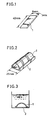
- Fig. 1 is a perspective view showing each test piece 1.
- test piece 1 irradiated to electron beam or gamma rays was introduced into a frame 2, to be bent by application of stress as shown in Fig. 2. Then the test piece 1 was dipped in methyl ethyl ketone (MEK) for one minute as shown in Fig. 3, to examine whether or not cracking was caused. Table 1 shows the result.
- MEK methyl ethyl ketone
- test pieces according to reference examples 1 to 5 were 0 % in gel ratio, and cracked after dipping in MEK.
- each of the test pieces thus prepared was irradiated to electron beam or gamma rays, for measurement of the gel ratio.
- each molding was extracted in xylene at 130°C for 24 hours, thereby to obtain the gel ratio from the weight of the remainder after extraction.
- Table 2 shows the result. Due to the character of this test, it has been impossible to obtain correct values of the gel ratios indicated as " ⁇ 30" in Table 2.
- test pieces employing phosphoric acid as the cross linking agent were at high gel ratios, to be extremely improved in cross linking efficiency as compared with those employing triallyl cyanurate etc. as a cross linking agent.
Landscapes
- Chemical & Material Sciences (AREA)
- Health & Medical Sciences (AREA)
- Chemical Kinetics & Catalysis (AREA)
- Medicinal Chemistry (AREA)
- Polymers & Plastics (AREA)
- Organic Chemistry (AREA)
- General Chemical & Material Sciences (AREA)
- Compositions Of Macromolecular Compounds (AREA)
- Graft Or Block Polymers (AREA)
- Treatments Of Macromolecular Shaped Articles (AREA)
Claims (5)
- Une pièce moulée à base de résine de poly(oxyde de phénylène) modifiée comprenant un composite de résine de poly(oxyde de phénylène) modifiée contenant du poly(oxyde de phénylène) ayant une structure exposée dans la formule générale (I) comme squelette de base,
ledit composite de résine de poly(oxyde de phénylène) modifiée contenant un ester phosphorique ayant un groupe insaturé comme agent de réticulation,
ladite pièce moulée étant réticulée par rayonnement ionisant avec une dose de l'ordre de 5 à 800 kGy :
- Une pièce moulée de résine de poly(oxyde de phénylène) modifiée conforme à la revendication 1, dans laquelle ledit ester phosphorique est au moins un type unique d'ester phosphorique choisi dans un groupe de phosphate acide de 2-méthacryloyloxyéthyle, phosphate acide de 2-acryloyloxyéthyle, phosphate de diphényl-2-méthacryloyloxyéthyle et phosphate de diphényl-2-acryloyloxyéthyle.
- Une pièce moulée de résine de poly(oxyde de phénylène) modifiée conforme à la revendication 1, dans laquelle ledit rayonnement ionisant est un faisceau électronique.
- Une pièce moulée de résine de poly(oxyde de phénylène) modifiée conforme à la revendication 1, dans laquelle ledit rayonnement ionisant est un rayonnement gamma.
- Une pièce moulée de résine de poly(oxyde de phénylène) modifiée conforme à la revendication 1, dans laquelle du cyanurate triallylique, de l'isocyanurate triallylique, du triméthacrylate de propane de triméthylol ou du triacrylate de propane de triméthylol est fourni comme agent de réticulation.
Applications Claiming Priority (4)
| Application Number | Priority Date | Filing Date | Title |
|---|---|---|---|
| JP18947387A JPS6431840A (en) | 1987-07-28 | 1987-07-28 | Modified polyphenylene oxide polymer molded article |
| JP189473/87 | 1987-07-28 | ||
| JP233269/87 | 1987-09-16 | ||
| JP23326987A JPH0832821B2 (ja) | 1987-09-16 | 1987-09-16 | 変性ポリフェニレンオキサイド樹脂成形品 |
Publications (3)
| Publication Number | Publication Date |
|---|---|
| EP0301523A2 EP0301523A2 (fr) | 1989-02-01 |
| EP0301523A3 EP0301523A3 (en) | 1989-02-08 |
| EP0301523B1 true EP0301523B1 (fr) | 1992-09-30 |
Family
ID=26505489
Family Applications (1)
| Application Number | Title | Priority Date | Filing Date |
|---|---|---|---|
| EP88112166A Expired EP0301523B1 (fr) | 1987-07-28 | 1988-07-27 | Objet formé à base d'une résine de poly(oxyde de phénylène) modifiée |
Country Status (3)
| Country | Link |
|---|---|
| US (1) | US4978693A (fr) |
| EP (1) | EP0301523B1 (fr) |
| DE (1) | DE3875007T2 (fr) |
Families Citing this family (5)
| Publication number | Priority date | Publication date | Assignee | Title |
|---|---|---|---|---|
| US5444123A (en) * | 1991-09-06 | 1995-08-22 | Basf Aktiengesellschaft | Halogen-free flameproofed thermoplastic molding materials based on polyphenylene ethers and polystyrene |
| DE4129765A1 (de) * | 1991-09-06 | 1993-03-11 | Basf Ag | Halogenfrei flammfest ausgeruestete thermoplastische formmassen auf basis von polyphenylenethern und polystyrol |
| DE10311500A1 (de) * | 2003-03-15 | 2004-09-30 | Cooper-Standard Automotive (Deutschland) Gmbh | Rohr, insb. flexibles Kühlwasserleitungsrohr |
| US20080194724A1 (en) * | 2007-02-12 | 2008-08-14 | Pankaj Singh Gautam | Method of forming a crosslinked poly(arylene ether) film, and film formed thereby |
| US20090084574A1 (en) * | 2007-09-28 | 2009-04-02 | Kim Gene Balfour | Poly(arylene ether) composition and its use in the fabrication of extruded articles and coated wire |
Family Cites Families (5)
| Publication number | Priority date | Publication date | Assignee | Title |
|---|---|---|---|---|
| US3373226A (en) * | 1965-08-02 | 1968-03-12 | Gen Electric | Polymeric films comprising a polyphenylene oxide and blends thereof with polystyrene |
| US3356761A (en) * | 1967-04-12 | 1967-12-05 | Gen Electric | Melt processable polyphenylene ether and process |
| US4438190A (en) * | 1981-03-04 | 1984-03-20 | Hitachi Chemical Company, Ltd. | Photosensitive resin composition containing unsaturated monomers and unsaturated phosphates |
| JPS6183223A (ja) * | 1984-09-29 | 1986-04-26 | Matsushita Electric Works Ltd | ポリフエニレンオキサイド系固化物の改質法 |
| US4623558A (en) * | 1985-05-29 | 1986-11-18 | W. R. Grace & Co. | Reactive plastisol dispersion |
-
1988
- 1988-07-27 EP EP88112166A patent/EP0301523B1/fr not_active Expired
- 1988-07-27 DE DE8888112166T patent/DE3875007T2/de not_active Expired - Fee Related
- 1988-07-28 US US07/225,422 patent/US4978693A/en not_active Expired - Lifetime
Also Published As
| Publication number | Publication date |
|---|---|
| US4978693A (en) | 1990-12-18 |
| EP0301523A2 (fr) | 1989-02-01 |
| DE3875007T2 (de) | 1993-07-22 |
| DE3875007D1 (de) | 1992-11-05 |
| EP0301523A3 (en) | 1989-02-08 |
Similar Documents
| Publication | Publication Date | Title |
|---|---|---|
| US3894118A (en) | Crosslinking agents for fluorocarbon polymers | |
| EP0301523B1 (fr) | Objet formé à base d'une résine de poly(oxyde de phénylène) modifiée | |
| US4693937A (en) | Flame retardant wire with high insulation resistance | |
| US4209566A (en) | Method of improving the electrical properties of polymeric insulations containing polar additives, and the improved polymeric insulation product thereof | |
| US4158617A (en) | Radiation cured and monomer modified silicon elastomers | |
| DE3301980A1 (de) | Kunstharzmasse mit erhoehter flammverzoegerung | |
| WO1990008805A1 (fr) | Compositions de fluoropolymeres | |
| JPS5912936A (ja) | 架橋ポリアミド樹脂組成物 | |
| EP0073613B1 (fr) | Tube thermorétrécissant | |
| DE69431422T2 (de) | Flammfeste isolierende Gegenstände, mit hohem Oberflächenwiderstand | |
| JPS5912935A (ja) | 架橋ポリアミド樹脂成型物 | |
| CN109749334A (zh) | 一种氙灯抗uv的无卤阻燃热塑性弹性体及其制备方法和应用 | |
| US3931091A (en) | Polyvinyl chloride compositions plasticized with m-ethylphenyl phosphate | |
| CN110499015B (zh) | 一种高cti、高gwit的无卤阻燃ppo/hips合金材料及其制备方法 | |
| EP0606636B1 (fr) | Matières à mouler à base de polyméthacrylate de méthyle ayant une résistance aux chocs améliorée | |
| US4139523A (en) | Stabilization of polyphosphazene vulcanizates with a metal complex | |
| US4371653A (en) | Method of improving the electrical properties of polymeric insulations containing polar additives, and the improved polymeric insulation product thereof | |
| EP0163825B1 (fr) | Agents de réticulation pour réticuler des fluoropolymères par irridation | |
| KR101533481B1 (ko) | 내충격성이 향상된 열가소성 난연 수지 조성물 | |
| JPH0832821B2 (ja) | 変性ポリフェニレンオキサイド樹脂成形品 | |
| JPH05504582A (ja) | 耐着火性カーボネートポリマー配合組成物 | |
| JP2585702B2 (ja) | 難燃性樹脂組成物並びにそれを用いた難燃性電線及び難燃性熱収縮チューブ | |
| JPS6126810B2 (fr) | ||
| JPS60137952A (ja) | 照射架橋用難燃性透明樹脂組成物の製造方法 | |
| JP2654666B2 (ja) | 耐熱性絶縁組成物 |
Legal Events
| Date | Code | Title | Description |
|---|---|---|---|
| PUAI | Public reference made under article 153(3) epc to a published international application that has entered the european phase |
Free format text: ORIGINAL CODE: 0009012 |
|
| PUAL | Search report despatched |
Free format text: ORIGINAL CODE: 0009013 |
|
| AK | Designated contracting states |
Kind code of ref document: A2 Designated state(s): BE DE FR GB NL |
|
| AK | Designated contracting states |
Kind code of ref document: A3 Designated state(s): BE DE FR GB NL |
|
| RAP1 | Party data changed (applicant data changed or rights of an application transferred) |
Owner name: SUMITOMO ELECTRIC INDUSTRIES, LIMITED |
|
| 17P | Request for examination filed |
Effective date: 19890629 |
|
| 17Q | First examination report despatched |
Effective date: 19901001 |
|
| GRAA | (expected) grant |
Free format text: ORIGINAL CODE: 0009210 |
|
| AK | Designated contracting states |
Kind code of ref document: B1 Designated state(s): BE DE FR GB NL |
|
| REF | Corresponds to: |
Ref document number: 3875007 Country of ref document: DE Date of ref document: 19921105 |
|
| ET | Fr: translation filed | ||
| PLBE | No opposition filed within time limit |
Free format text: ORIGINAL CODE: 0009261 |
|
| STAA | Information on the status of an ep patent application or granted ep patent |
Free format text: STATUS: NO OPPOSITION FILED WITHIN TIME LIMIT |
|
| 26N | No opposition filed | ||
| REG | Reference to a national code |
Ref country code: GB Ref legal event code: 746 Effective date: 19980331 |
|
| REG | Reference to a national code |
Ref country code: FR Ref legal event code: D6 |
|
| REG | Reference to a national code |
Ref country code: GB Ref legal event code: IF02 |
|
| PGFP | Annual fee paid to national office [announced via postgrant information from national office to epo] |
Ref country code: NL Payment date: 20050703 Year of fee payment: 18 |
|
| PGFP | Annual fee paid to national office [announced via postgrant information from national office to epo] |
Ref country code: FR Payment date: 20050708 Year of fee payment: 18 |
|
| PGFP | Annual fee paid to national office [announced via postgrant information from national office to epo] |
Ref country code: DE Payment date: 20050721 Year of fee payment: 18 |
|
| PGFP | Annual fee paid to national office [announced via postgrant information from national office to epo] |
Ref country code: GB Payment date: 20050727 Year of fee payment: 18 |
|
| PGFP | Annual fee paid to national office [announced via postgrant information from national office to epo] |
Ref country code: BE Payment date: 20050913 Year of fee payment: 18 |
|
| PG25 | Lapsed in a contracting state [announced via postgrant information from national office to epo] |
Ref country code: GB Free format text: LAPSE BECAUSE OF NON-PAYMENT OF DUE FEES Effective date: 20060727 |
|
| PG25 | Lapsed in a contracting state [announced via postgrant information from national office to epo] |
Ref country code: BE Free format text: LAPSE BECAUSE OF NON-PAYMENT OF DUE FEES Effective date: 20060731 |
|
| PG25 | Lapsed in a contracting state [announced via postgrant information from national office to epo] |
Ref country code: NL Free format text: LAPSE BECAUSE OF NON-PAYMENT OF DUE FEES Effective date: 20070201 Ref country code: DE Free format text: LAPSE BECAUSE OF NON-PAYMENT OF DUE FEES Effective date: 20070201 |
|
| GBPC | Gb: european patent ceased through non-payment of renewal fee |
Effective date: 20060727 |
|
| NLV4 | Nl: lapsed or anulled due to non-payment of the annual fee |
Effective date: 20070201 |
|
| REG | Reference to a national code |
Ref country code: FR Ref legal event code: ST Effective date: 20070330 |
|
| BERE | Be: lapsed |
Owner name: *SUMITOMO ELECTRIC INDUSTRIES LTD Effective date: 20060731 |
|
| PG25 | Lapsed in a contracting state [announced via postgrant information from national office to epo] |
Ref country code: FR Free format text: LAPSE BECAUSE OF NON-PAYMENT OF DUE FEES Effective date: 20060731 |