EP0302406B1 - Copolymères alternants - Google Patents
Copolymères alternants Download PDFInfo
- Publication number
- EP0302406B1 EP0302406B1 EP88112336A EP88112336A EP0302406B1 EP 0302406 B1 EP0302406 B1 EP 0302406B1 EP 88112336 A EP88112336 A EP 88112336A EP 88112336 A EP88112336 A EP 88112336A EP 0302406 B1 EP0302406 B1 EP 0302406B1
- Authority
- EP
- European Patent Office
- Prior art keywords
- group
- isopentenyl
- alkyl group
- ether
- maleic anhydride
- Prior art date
- Legal status (The legal status is an assumption and is not a legal conclusion. Google has not performed a legal analysis and makes no representation as to the accuracy of the status listed.)
- Expired - Lifetime
Links
Classifications
-
- C—CHEMISTRY; METALLURGY
- C08—ORGANIC MACROMOLECULAR COMPOUNDS; THEIR PREPARATION OR CHEMICAL WORKING-UP; COMPOSITIONS BASED THEREON
- C08F—MACROMOLECULAR COMPOUNDS OBTAINED BY REACTIONS ONLY INVOLVING CARBON-TO-CARBON UNSATURATED BONDS
- C08F216/00—Copolymers of compounds having one or more unsaturated aliphatic radicals, each having only one carbon-to-carbon double bond, and at least one being terminated by an alcohol, ether, aldehydo, ketonic, acetal or ketal radical
- C08F216/12—Copolymers of compounds having one or more unsaturated aliphatic radicals, each having only one carbon-to-carbon double bond, and at least one being terminated by an alcohol, ether, aldehydo, ketonic, acetal or ketal radical by an ether radical
- C08F216/14—Monomers containing only one unsaturated aliphatic radical
- C08F216/16—Monomers containing no hetero atoms other than the ether oxygen
- C08F216/18—Acyclic compounds
- C08F216/20—Monomers containing three or more carbon atoms in the unsaturated aliphatic radical
-
- C—CHEMISTRY; METALLURGY
- C08—ORGANIC MACROMOLECULAR COMPOUNDS; THEIR PREPARATION OR CHEMICAL WORKING-UP; COMPOSITIONS BASED THEREON
- C08F—MACROMOLECULAR COMPOUNDS OBTAINED BY REACTIONS ONLY INVOLVING CARBON-TO-CARBON UNSATURATED BONDS
- C08F216/00—Copolymers of compounds having one or more unsaturated aliphatic radicals, each having only one carbon-to-carbon double bond, and at least one being terminated by an alcohol, ether, aldehydo, ketonic, acetal or ketal radical
- C08F216/02—Copolymers of compounds having one or more unsaturated aliphatic radicals, each having only one carbon-to-carbon double bond, and at least one being terminated by an alcohol, ether, aldehydo, ketonic, acetal or ketal radical by an alcohol radical
- C08F216/04—Acyclic compounds
Definitions
- This invention relates to alternate copolymers comprising an isopentenyl compound as one constituent.
- the carbon-carbon double bond of isopentenyl compounds is so low in reactivity that they do not homopolymerize by radical polymerization. Accordingly, few studies have been made on the polymerization of the compounds except that the copolymerization among isopentenyl alcohol or prenyl alcohol and unsaturated carboxylic acids or salts thereof has been proposed only in Japanese Laid-open Patent Applications Nos. 59-108010 and 59-102496.
- copolymers obtained by the above processes have a compositional ratio of the isopentenyl alcohol or prenyl alcohol of 15 to 33 mole% and are not alternate copolymers.
- An object of the invention is to provide alternate copolymers having isopentenyl compounds as one constituent.
- R1 represents, as defined above, a hydrogen atom, an alkyl group, an alkyl group with an ether bond, an aryl group, a cycloalkyl group, an aralkyl group or an acyl group.
- the alkyl group includes, for example, a methyl group, an ethyl group, a propyl group, a butyl group, a pentyl group, a hexyl group, and has thus preferably from 1 to 6 carbon atoms.
- the alkyl group having an ether bond includes, for example, a methoxymethyl group, a methoxyethyl group, an ethoxymethyl group, an ethoxyethyl group, a propoxymethyl group, a propoxyethyl group, a butoxymethyl group, a butoxyethyl group, a pentoxymethyl group, a pentoxyethyl group, an isopentenoxymethyl group, an isopentenoxyethyl group.
- the aryl group include a phenyl group, a tolyl group, a xylyl group.
- the cycloalkyl group includes, for example, a cyclopentyl group or a cyclohexyl group.
- the aralkyl group includes, for example, a benzyl group, a 1-phenylethyl group, a 2-phenylethyl group or a 3-phenylpropyl group.
- the acyl group include a formyl group, an acetyl group, a propionyl group, a butyryl group, a valeryl group, a hexanoyl group, a 2-ethylhexanoyl group, a heptanoyl group, an octanoyl group, a nonanoyl group, a decanoyl group, a undecanoyl group, a dodecanoyl group, a cyclohexanoyl group, a methylcyclohexanoyl group.
- the acyl group has favorably from 1 to 12 carbon atoms.
- R2 represents an alkyl group, an alkyl group with an ether bond, a cycloalkyl group, an aryl group or an aralkyl group.
- alkyl group include a methyl group, an ethyl group, a propyl group, a butyl group, a pentyl group, a hexyl group, and are preferably those which have from 1 to 6 carbon atoms.
- the alkyl group having an ether bond includes, for example, a methoxymethyl group, a methoxyethyl group, an ethoxymethyl group, an ethoxyethyl group, a propoxymethyl group, a propoxyethyl group, a butoxymethyl group, a butoxyethyl group, a pentoxymethyl group, a pentoxyethyl group, an isopentenoxymethyl group, an isopentenoxyethyl group.
- the cycloalkyl group includes, for example, a cyclopentyl group or a cyclohexyl group.
- the aryl group is, for example, a phenyl group, a tolyl group or a xylyl group.
- the aralkyl group includes, for example, a benzyl group, a 1-phenylethyl group, a 2-phenylethyl group or a 3-phenylpropyl group.
- isopentenyl compounds of the general formula (A) include: isopentenyl alcohol; isopentenyl ethers such as isopentenyl methyl ether, isopentenyl ethyl ether, isopentenyl propyl ether, isopentenyl butyl ether, isopentenyl amyl ether, isopentenyl hexyl ether, isopentenyl cyclohexyl ether, isopentenyl cyclopentyl ether, isopentenyl benzyl ether, or isopentenyl phenyl ether; and esters such as isopentenyl formate, isopentenyl acetate, isopentenyl propionate, isopentenyl butyrate, isopentenyl valerate, isopentenyl caprylate, isopentenyl caprate, isopentenyl pelargonate, isopentenyl undecylate, isopentenyl laurate,
- isopentenyl compounds (B) include methyl prenyl ether, ethyl prenyl ether, propyl prenyl ether, butyl prenyl ether, amyl prenyl ether, isoamylprenyl ether, hexyl prenyl ether, cyclohexyl prenyl ether, cyclopentyl prenyl ether, benzyl prenyl ether, phenyl prenyl ether.
- the unsaturated compounds which are capable of forming alternate copolymers in combination with the above-indicated isopentenyl compounds are: maleic anhydride; maleimides such as maleimide, N-methylmaleimide, N-ethylmaleimide, N-(carboxylphenyl)maleimide, N-propylmaleimide, N-butylmaleimide, N-phenylmaleimide, N-(sulfophenyl)maleimide; dialkyl maleates such as dimethyl maleate, diethyl maleate, dipropyl maleate, dibutyl maleate, dihexyl maleate, dioctyl maleate; dialkyl fumarates such as dimethyl fumarate, diethyl fumarate, dipropyl fumarate, dibutyl fumarate, dihexyl fumarate, dioctyl fumarate; acrylic esters such as methyl acrylate, ethyl acrylate, propyl
- the alternate copolymers of the invention should preferably have an average molecular weight of 3,000 to 300,000.
- the isopentenyl compound of the general formula (A) or (B) can be copolymerized with the unsaturated compound by known techniques. For instance, there may be used solution polymerization in organic solvent, emulsion or suspension polymerization in water, or solution, suspension or emulsion polymerization in a mixed solvent of a water-soluble organic solvent and water. Alternatively, since the isopentenyl compound does not polymerize by itself, solution polymerization using large excess of the compound as a monomer and solvent is possible. From the standpoint of the reactivity, reaction procedures and treatment for the reaction mixture, it is preferred that the isopentenyl compound is used in excess, partly as a solvent.
- a radial initiator such as an azo compound or organic peroxide may be used as a polymerization initiator especially in an organic solvent or in a solution polymerization using an isopentenyl compound as a solvent.
- persulfates or hydrogen peroxide can be used for polymerization in water.
- the above-indicated polymerization initiators are suitably used for the polymerization in a mixed solvent of a water-soluble organic solvent and water.
- the polymerization temperature is not critical and should preferably be a temperature at which the polymerization initiator used decomposes quickly.
- the alternate copolymers of this invention consist of monomers having a hydroxyl group, an ester group or an acid anhydride group and are easily soluble in chemically inactive and commonly used solvents, so that they could be subjected to intra- or inter-molecular reaction to give crosslinked polymers and high performanced polymers.
- alternate copolymers containing maleic anhydride as comonomer have a highly reactive acid anhydride group in the polymer, they readily react with compounds having a nucleophilic functional group such as a hydroxyl group, an amino group, a mercapto group, an epoxy group, an isocyanate group, thereby forming a covalent bond.
- the maleic anhydride units contained in the copolymers may form an ionic bond with various metal ionic compounds.
- the alternate copolymers of the invention can be imparted with various characteristic properties by combination of the structural units (I) and (II).
- the copolymers have thus wide utility as polymeric carriers, polymeric surface treating agents, highly water-absorbing resins, ion-exchange resins, medical materials, anti-clouding agents, scale inhibitors, dispersants, adhesives, sizing agents, materials for separation membranes, electronic materials, photoresist materials.
- M w and M w/ M n were obtained by calculation from the results of GPC method using polystyrene as a standard, and copolymerization composition ratio was obtained by calculation on the basis of 1H-NMR data.
- Methyl prenyl ether or methyl isopentenyl ether were polymerized with maleic anhydride, using azobisisobutyronitrile as an initiator (0.06 mole% based on the maleic anhydride) at 65°C for 5 hours under conditions indicated in Table 4.
- the powder was dissolved in acetone and then the solution was added to cyclohexane to allow the resultant polymer to precipitate.
- Table 4 The results are shown in Table 4 and 5.
- the filtrate was subjected to analysis of residual monomers by gas chromatography and alkaline titration. As a result, it was found that the conversion of the isopentenyl acetate was 39.5% and the conversion of the maleic anhydride was 41.9%.
- the elementary analysis of the polymer revealed C: 57.92% (58.41%) and H: 61.7% (6.19%), these values being substantially coincident with the theoretical as an alternate copolymer.
- 0.5 g of the polymer and 0.18 g of sodium hydroxide were added to 50 g of methanol and heated under reflux for 3 hours.
- the resultant solution was poured into a 0.3N sulfuric acid aqueous solution for neutralization to cause the polymer to precipitate, followed by removal by filtration, washing and drying.
- the copolymers obtained in Examples 18 and 19 were subjected to a performance test as a water-soluble hot-melt adhesive.
- the polymers were each extruded at a maximum temperature of 200°C to give a 0.2 mm thick sheet.
- the sheet was interposed between aluminum plates, each having a size of 50 mm x 25 mm (adhesion area of 25 mm x 25 mm) and pressed at a temperature of 210°C under a pressure of 4.90 x 10⁵ Pa (5 kg/cm2), thereby the aluminum plates were bonded together.
- the copolymers When the two types of the bonded aluminum plates were each immersed in a 0.1N sodium hydroxide aqueous solution at 80°C, the copolymers were dissolved to permit the aluminum plates to be readily separated. This means that the copolymers have the properties as a water-soluble hot-melt adhesive.
- the copolymer obtained in Example 18 was evaluated as a water-absorbing resin.
- the thus obtained sheet was subjected to heat treatment at 150°C for 1 hour for crosslinking reaction between the carboxyl groups and the hydroxyl groups and resulted in insolubilization in water. Thereafter, the sheet was immersed in destilled water at room temperature for 1 hour and subjected to water-absorbing test to obtain water-absorption factor of 8. This means that the copolymer serves as a water-absorbing resin.
Landscapes
- Chemical & Material Sciences (AREA)
- Health & Medical Sciences (AREA)
- Chemical Kinetics & Catalysis (AREA)
- Medicinal Chemistry (AREA)
- Polymers & Plastics (AREA)
- Organic Chemistry (AREA)
- Addition Polymer Or Copolymer, Post-Treatments, Or Chemical Modifications (AREA)
- Organic Low-Molecular-Weight Compounds And Preparation Thereof (AREA)
Claims (5)
- Copolymère alternant qui consiste essentiellement en des motifs structurels [I] à base d'un composé isopentényl de la formule suivante (A) ou (B)
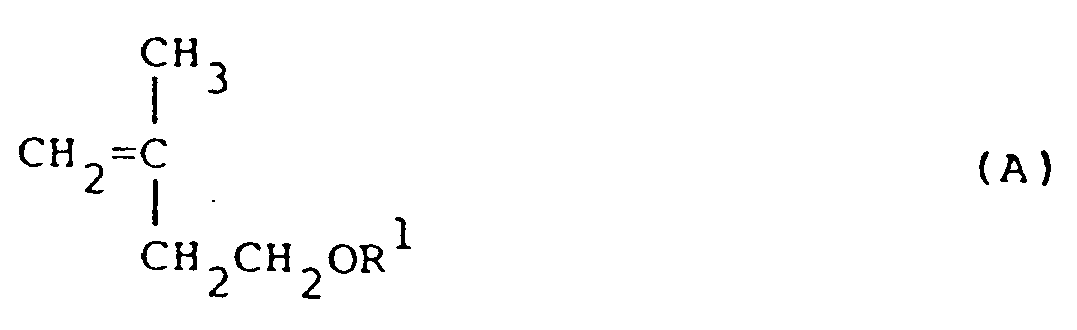

- Copolymère alternant selon la revendication 1, dans lequel R¹ représente un groupe alkyle ayant de 1 à 6 atomes de carbone.
- Copolymère alternant selon la revendication 1, dans lequel R¹ représente un groupe acyle ayant de 1 à 12 atomes de carbone.
- Copolymère alternant selon la revendication 1, dans lequel R² représente un groupe alkyle ayant de 1 à 6 atomes de carbone.
- Copolymère alternant selon la revendication 1, dans lequel le copolymère a une masse moléculaire moyenne allant de 3000 à 300 000.
Applications Claiming Priority (2)
| Application Number | Priority Date | Filing Date | Title |
|---|---|---|---|
| JP194918/87 | 1987-08-03 | ||
| JP19491887 | 1987-08-03 |
Publications (3)
| Publication Number | Publication Date |
|---|---|
| EP0302406A2 EP0302406A2 (fr) | 1989-02-08 |
| EP0302406A3 EP0302406A3 (fr) | 1991-04-17 |
| EP0302406B1 true EP0302406B1 (fr) | 1994-10-05 |
Family
ID=16332509
Family Applications (1)
| Application Number | Title | Priority Date | Filing Date |
|---|---|---|---|
| EP88112336A Expired - Lifetime EP0302406B1 (fr) | 1987-08-03 | 1988-07-29 | Copolymères alternants |
Country Status (3)
| Country | Link |
|---|---|
| US (1) | US4814425A (fr) |
| EP (1) | EP0302406B1 (fr) |
| DE (1) | DE3851731T2 (fr) |
Families Citing this family (2)
| Publication number | Priority date | Publication date | Assignee | Title |
|---|---|---|---|---|
| CN1039420C (zh) * | 1992-09-09 | 1998-08-05 | 中国科学院化学研究所 | 一种具有自协同效应的高分子稳定剂的制备方法 |
| CN103717627B (zh) | 2011-07-22 | 2016-05-25 | 巴斯夫欧洲公司 | 制备马来酸-异戊二烯醇共聚物的方法 |
Family Cites Families (2)
| Publication number | Priority date | Publication date | Assignee | Title |
|---|---|---|---|---|
| DE2000751A1 (de) * | 1969-01-17 | 1970-09-03 | Lonza Ag | Copolymerisate von Isopropenylalkylaethern und Verfahren zu deren Herstellung |
| US3819596A (en) * | 1973-02-23 | 1974-06-25 | Dow Chemical Co | Homopolymers of isopropenyl alkyl ethers |
-
1988
- 1988-07-28 US US07/225,720 patent/US4814425A/en not_active Expired - Fee Related
- 1988-07-29 EP EP88112336A patent/EP0302406B1/fr not_active Expired - Lifetime
- 1988-07-29 DE DE3851731T patent/DE3851731T2/de not_active Expired - Fee Related
Also Published As
| Publication number | Publication date |
|---|---|
| EP0302406A2 (fr) | 1989-02-08 |
| US4814425A (en) | 1989-03-21 |
| EP0302406A3 (fr) | 1991-04-17 |
| DE3851731D1 (de) | 1994-11-10 |
| DE3851731T2 (de) | 1995-04-20 |
Similar Documents
| Publication | Publication Date | Title |
|---|---|---|
| EP0542877B1 (fr) | Polymerisation de monomeres vinyliques avec un nouveau systeme catalytique | |
| JPH02281013A (ja) | ジケトン化合物系共重合体 | |
| US4778725A (en) | Functional polymers derived from polyamines and process for producing the same | |
| US4833202A (en) | Multi-ethylenic monomers from glycosides | |
| US4814425A (en) | Novel alternate copolymers | |
| US6339129B1 (en) | Powder coatings from cyclic carbonate functional polymers and amine carbamate salts | |
| US5480954A (en) | Allyl ester copolymers with allylic alcohols or propoxylated allylic alcohols | |
| JP2882648B2 (ja) | 熱可塑性水溶性樹脂の製造法 | |
| JP2506964B2 (ja) | 新規な交互共重合体 | |
| Iwakura et al. | Preparation of polymers containing sugar residues | |
| JPH02193958A (ja) | メタルクリル酸エステル及びその製造法 | |
| CA1263798A (fr) | Procede de preparation de polymeres de vinyl saccharide hydrosolubles | |
| US3057829A (en) | Copolymers of diallyl barbituric acids and vinyl monomers | |
| US5310839A (en) | Copolymers of vinyl dioxolanes and maleimides | |
| SU1067016A1 (ru) | Способ получени св зующего дл покрытий электродов | |
| KR100216449B1 (ko) | 로진유도체, 그의 중합물, 그의 공중합물 및 그의 제조방법 | |
| EP0192997B1 (fr) | Procédé de modification de polymères de diesters de l'acide fumarique | |
| JP2629149B2 (ja) | 新規な交互共重合体 | |
| JP2593897B2 (ja) | 新規な架橋方法 | |
| US3933775A (en) | 2[(1-Cyano-1-methylethyl)azo]-2-methylpropionamide | |
| JPH0689079B2 (ja) | 共重合体の製造方法 | |
| SU1141102A1 (ru) | Способ получени привитого сополимера | |
| SU451336A1 (ru) | Способ получени полимерных эфиров | |
| SU443871A1 (ru) | Способ получени гидроксилсодержащего акрилового сополимера | |
| WO1999062970A1 (fr) | Copolymeres de carbonate d'ethylene vinylique |
Legal Events
| Date | Code | Title | Description |
|---|---|---|---|
| PUAI | Public reference made under article 153(3) epc to a published international application that has entered the european phase |
Free format text: ORIGINAL CODE: 0009012 |
|
| AK | Designated contracting states |
Kind code of ref document: A2 Designated state(s): CH DE FR LI NL |
|
| PUAL | Search report despatched |
Free format text: ORIGINAL CODE: 0009013 |
|
| AK | Designated contracting states |
Kind code of ref document: A3 Designated state(s): CH DE FR LI NL |
|
| 17P | Request for examination filed |
Effective date: 19910705 |
|
| 17Q | First examination report despatched |
Effective date: 19930119 |
|
| GRAA | (expected) grant |
Free format text: ORIGINAL CODE: 0009210 |
|
| AK | Designated contracting states |
Kind code of ref document: B1 Designated state(s): CH DE FR LI NL |
|
| REF | Corresponds to: |
Ref document number: 3851731 Country of ref document: DE Date of ref document: 19941110 |
|
| ET | Fr: translation filed | ||
| PLBE | No opposition filed within time limit |
Free format text: ORIGINAL CODE: 0009261 |
|
| STAA | Information on the status of an ep patent application or granted ep patent |
Free format text: STATUS: NO OPPOSITION FILED WITHIN TIME LIMIT |
|
| 26N | No opposition filed | ||
| PGFP | Annual fee paid to national office [announced via postgrant information from national office to epo] |
Ref country code: FR Payment date: 19970709 Year of fee payment: 10 |
|
| PGFP | Annual fee paid to national office [announced via postgrant information from national office to epo] |
Ref country code: NL Payment date: 19970731 Year of fee payment: 10 |
|
| PGFP | Annual fee paid to national office [announced via postgrant information from national office to epo] |
Ref country code: DE Payment date: 19970801 Year of fee payment: 10 |
|
| PGFP | Annual fee paid to national office [announced via postgrant information from national office to epo] |
Ref country code: CH Payment date: 19970806 Year of fee payment: 10 |
|
| PG25 | Lapsed in a contracting state [announced via postgrant information from national office to epo] |
Ref country code: LI Free format text: LAPSE BECAUSE OF NON-PAYMENT OF DUE FEES Effective date: 19980731 Ref country code: CH Free format text: LAPSE BECAUSE OF NON-PAYMENT OF DUE FEES Effective date: 19980731 |
|
| PG25 | Lapsed in a contracting state [announced via postgrant information from national office to epo] |
Ref country code: NL Free format text: LAPSE BECAUSE OF NON-PAYMENT OF DUE FEES Effective date: 19990201 |
|
| REG | Reference to a national code |
Ref country code: CH Ref legal event code: PL |
|
| PG25 | Lapsed in a contracting state [announced via postgrant information from national office to epo] |
Ref country code: FR Free format text: LAPSE BECAUSE OF NON-PAYMENT OF DUE FEES Effective date: 19990331 |
|
| NLV4 | Nl: lapsed or anulled due to non-payment of the annual fee |
Effective date: 19990201 |
|
| PG25 | Lapsed in a contracting state [announced via postgrant information from national office to epo] |
Ref country code: DE Free format text: LAPSE BECAUSE OF NON-PAYMENT OF DUE FEES Effective date: 19990501 |
|
| REG | Reference to a national code |
Ref country code: FR Ref legal event code: ST |