EP0302516B1 - Article optique réalisé en résine polyester thermoplastique amorphe - Google Patents
Article optique réalisé en résine polyester thermoplastique amorphe Download PDFInfo
- Publication number
- EP0302516B1 EP0302516B1 EP88112796A EP88112796A EP0302516B1 EP 0302516 B1 EP0302516 B1 EP 0302516B1 EP 88112796 A EP88112796 A EP 88112796A EP 88112796 A EP88112796 A EP 88112796A EP 0302516 B1 EP0302516 B1 EP 0302516B1
- Authority
- EP
- European Patent Office
- Prior art keywords
- group
- aromatic ring
- stands
- carbon atoms
- optical article
- Prior art date
- Legal status (The legal status is an assumption and is not a legal conclusion. Google has not performed a legal analysis and makes no representation as to the accuracy of the status listed.)
- Expired - Lifetime
Links
Classifications
-
- C—CHEMISTRY; METALLURGY
- C08—ORGANIC MACROMOLECULAR COMPOUNDS; THEIR PREPARATION OR CHEMICAL WORKING-UP; COMPOSITIONS BASED THEREON
- C08G—MACROMOLECULAR COMPOUNDS OBTAINED OTHERWISE THAN BY REACTIONS ONLY INVOLVING UNSATURATED CARBON-TO-CARBON BONDS
- C08G63/00—Macromolecular compounds obtained by reactions forming a carboxylic ester link in the main chain of the macromolecule
- C08G63/02—Polyesters derived from hydroxycarboxylic acids or from polycarboxylic acids and polyhydroxy compounds
- C08G63/12—Polyesters derived from hydroxycarboxylic acids or from polycarboxylic acids and polyhydroxy compounds derived from polycarboxylic acids and polyhydroxy compounds
- C08G63/16—Dicarboxylic acids and dihydroxy compounds
- C08G63/18—Dicarboxylic acids and dihydroxy compounds the acids or hydroxy compounds containing carbocyclic rings
- C08G63/181—Acids containing aromatic rings
-
- G—PHYSICS
- G02—OPTICS
- G02B—OPTICAL ELEMENTS, SYSTEMS OR APPARATUS
- G02B1/00—Optical elements characterised by the material of which they are made; Optical coatings for optical elements
- G02B1/04—Optical elements characterised by the material of which they are made; Optical coatings for optical elements made of organic materials, e.g. plastics
-
- G—PHYSICS
- G11—INFORMATION STORAGE
- G11B—INFORMATION STORAGE BASED ON RELATIVE MOVEMENT BETWEEN RECORD CARRIER AND TRANSDUCER
- G11B7/00—Recording or reproducing by optical means, e.g. recording using a thermal beam of optical radiation by modifying optical properties or the physical structure, reproducing using an optical beam at lower power by sensing optical properties; Record carriers therefor
- G11B7/24—Record carriers characterised by shape, structure or physical properties, or by the selection of the material
-
- G—PHYSICS
- G11—INFORMATION STORAGE
- G11B—INFORMATION STORAGE BASED ON RELATIVE MOVEMENT BETWEEN RECORD CARRIER AND TRANSDUCER
- G11B7/00—Recording or reproducing by optical means, e.g. recording using a thermal beam of optical radiation by modifying optical properties or the physical structure, reproducing using an optical beam at lower power by sensing optical properties; Record carriers therefor
- G11B7/24—Record carriers characterised by shape, structure or physical properties, or by the selection of the material
- G11B7/241—Record carriers characterised by shape, structure or physical properties, or by the selection of the material characterised by the selection of the material
- G11B7/242—Record carriers characterised by shape, structure or physical properties, or by the selection of the material characterised by the selection of the material of recording layers
- G11B7/244—Record carriers characterised by shape, structure or physical properties, or by the selection of the material characterised by the selection of the material of recording layers comprising organic materials only
-
- G—PHYSICS
- G11—INFORMATION STORAGE
- G11B—INFORMATION STORAGE BASED ON RELATIVE MOVEMENT BETWEEN RECORD CARRIER AND TRANSDUCER
- G11B7/00—Recording or reproducing by optical means, e.g. recording using a thermal beam of optical radiation by modifying optical properties or the physical structure, reproducing using an optical beam at lower power by sensing optical properties; Record carriers therefor
- G11B7/24—Record carriers characterised by shape, structure or physical properties, or by the selection of the material
- G11B7/241—Record carriers characterised by shape, structure or physical properties, or by the selection of the material characterised by the selection of the material
- G11B7/242—Record carriers characterised by shape, structure or physical properties, or by the selection of the material characterised by the selection of the material of recording layers
- G11B7/244—Record carriers characterised by shape, structure or physical properties, or by the selection of the material characterised by the selection of the material of recording layers comprising organic materials only
- G11B7/245—Record carriers characterised by shape, structure or physical properties, or by the selection of the material characterised by the selection of the material of recording layers comprising organic materials only containing a polymeric component
-
- G—PHYSICS
- G11—INFORMATION STORAGE
- G11B—INFORMATION STORAGE BASED ON RELATIVE MOVEMENT BETWEEN RECORD CARRIER AND TRANSDUCER
- G11B7/00—Recording or reproducing by optical means, e.g. recording using a thermal beam of optical radiation by modifying optical properties or the physical structure, reproducing using an optical beam at lower power by sensing optical properties; Record carriers therefor
- G11B7/24—Record carriers characterised by shape, structure or physical properties, or by the selection of the material
- G11B7/241—Record carriers characterised by shape, structure or physical properties, or by the selection of the material characterised by the selection of the material
- G11B7/252—Record carriers characterised by shape, structure or physical properties, or by the selection of the material characterised by the selection of the material of layers other than recording layers
- G11B7/253—Record carriers characterised by shape, structure or physical properties, or by the selection of the material characterised by the selection of the material of layers other than recording layers of substrates
Definitions
- the present invention relates to optical articles made of an amorphous thermoplastic polyester resin. More particularly, the present invention relates to optical articles such as optical disks and optical lenses which are made of an amorphous polyester resin having aromatic rings in the main chain and the side chain of the recurring units.
- the optical articles have a good heat resistance, resistance to absorption of moisture and optical characteristics.
- Plastics have an excellent processability and productivity as industrial materials, and have a light weight, and these excellent characteristics have increased the demands for the utilization of plastics.
- Poly(methyl methacrylate) and polycarbonates are mainly used as the plastics for optical materials at present.
- Poly(methyl methacrylate) has excellent optical characteristics but an unsatisfactory heat resistance and resistance to absorption of moisture. Accordingly, for example, deformation of an optical disk or a deformation of grooves often occurs during use.
- a polycarbonate has an excellent heat resistance but a poor melt flowability and moldability, and a problem arises of a large birefringence due to molding distortion.
- a resin for an optical material must have a good heat resistance, an excellent transparency, and a small birefringence, but a resin for an optical material which is capable of satisfying these requirements has not been developed.
- Aromatic polyester type resins are known in the prior art, such as, for example, from the JP-A 60 38 423, the US-A 3 351 624, or the US-A 4 279 803.
- the JP-A-61 149 901 such aromatic polyester type resins are used to obtain a material for optical instruments having superior heat resistance, coefficient of photoelasticity, superior moldability, small residual strain in the molded product, and small birefringence.
- the JP-A-61 149 901 discloses a material for optical instruments which comprises a copolymer having recurring units of an aromatic polyester type monomer and an aromatic polycarbonat monomer.
- the polyester type recurring units of this known material for an optical instrument have benzene rings only in their main chain.
- the polyester recurring units may be derived from a diol having benzene rings in the main chain as well as in one or two pendant group(s) thereof.
- the structural unit comprising the aromatic rings within the diol component is represented by a phenyl(diphenylene)- methylene or a diphenyl(diphenylene)-methylene group.
- the dicarboxylic acid unit of the polyester does not contain any aromatic ring.
- polycarbonat as an essential component in the copolymer composition for the material of the optical article is used in this document, namely from 80 to 95 mol-%.
- polycarbonate is associated with some problems as indicated above.
- the present inventors carried out research into the development of a high-performance optical material satisfying all of the above requirements, and, as a result, found that an amorphous aromatic polyester having a specific structure has an excellent heat resistance, resistance to absorption of moisture, and transparency, and has a small birefringence.
- an optical article made of an amorphous thermoplastic polyester resin which comprises recurring units having aromatic rings and being derived from a dicarboxylic acid and a diol, characterized in that one of the dicarboxylic acid and the diol of each recurring unit has an aromatic ring in the main chain thereof and the other has an aromatic ring in a pendant group thereof, each recurring unit being represented by the following general formula (I) or (II): wherein R1 stands for a phenylene group which may have a substituent selected from the group consisting of halogen atoms and an alkyl group having 1 to 5 carbon atoms, R2 and R3 independently stand for an alkylene group having 1 to 5 carbon atoms or a direct bond wherein the sum of the carbon numbers of R2 and R3 is up to 5, R4 stands for a phenyl or benzyl group which may have a substituent selected from the group consisting of halogen atoms and an alkyl group
- optical articles of the present invention include, for example, optical disks, and optical lenses, more particularly, a video disk, a file disk, a rod lens, and an eyeglass lens.
- the amorphous thermoplastic polyester resins used for the preparation of optical articles of the present invention may further include a second type polyester resin comprising recurring units derived from a dicarboxylic acid and a diol, at least one of the dicarboxylic acid and the diol having an aromatic ring in the main chain thereof and the other having an aromatic ring in a pendant group thereof.
- a typical example of this second type polyester resin is such that the dicarboxylic acid is represented by the following general formula (III) or the diol is represented by the following general formula (IV): wherein X stands for or a direct bond, R7 and R9 stand for a hydrogen atom or an alkyl group having 1 to 5 carbon atoms, R8 and R10 stand for a phenyl or benzyl group which may have a substituent selected from the group consisting of halogen atoms and an alkyl group having 1 to 5 carbon atoms; and when X is a direct bond, R6 stands for a phenyl or benzyl group which may have a substituent selected from the group consisting of halogen atoms and an alkyl group having 1 to 5 carbon atoms; when X is R6 stands for a hydrogen atom or an alkyl group having 1 to 5 carbon atoms.
- a diol to be reacted with the dicarboxylic acid of the general formula (III) and a dicarboxylic acid to be reacted with the diol of the general formula (IV) are not particularly critical and may be any structure.
- Another third type of polyester resin which may additionally be contained as an amorphous thermoplastic polyester resin in the optical article according to the present invention is derived from a hydroxycarboxylic acid having an aromatic ring in the main chain thereof and an aromatic ring in a pendant group thereof.
- a typical example of the third such a type polyester resin is such that the hydroxycarboxylic acid is represented by the following general formula (V): wherein X and R6 are as defined with regard to the formulae (III) and (IV), and one of Y and Z stands for a hydroxyl group and the other stands for a carboxyl group.
- the amorphous thermoplastic polyester resin may be of a structure which is a combination of at least two of the above mentioned three types.
- the polyester resin according to the present invention has at least 50% by mole of the recurring units of the formula (I) or (II).
- the additional second type polyester resin is preferably such that at least 50% by mole of the dicarboxylic acid used for the preparation of the polyester resin is represented by the formula (III) or at least 50% by mole of the diol used for the preparation of the polyester resin is represented by the formula (IV); and the additional third type polyester resin is preferably such that at least 50% by mole of the hydroxycarboxlic acid used for the preparation of the polyester resin is represented by the formula (V).
- the processes for the preparation of the amorphous thermoplastic polyester resin according to the present invention can be classified into the following two processes.
- the processes (1) or (2) can be employed alone or in combination with one or more of the processes (A), (B) and (C).
- dicarboxylic acid having an aromatic ring in the main chain there can be mentioned terephthalic acid, isophthalic acid, phthalic acid, diphenyl-p,p'-dicarboxylic acid, diphenyl-m,m'-dicarboxylic acid, benzophenone-4,4'-dicarboxylic acid, and p-phenylenediacetic acid.
- the diol having an aromatic ring in the side chain there can be mentioned phenylethyleneglycol, 2-phenyl-1,3-propanediol, 2-methyl-2-phenyl-1,3-propanediol, 2-ethyl-2-phenyl-1,3-propanediol, 2-methyl-2-phenyl-1,4-butanediol, 2-benzyl-1,3-propanediol, 2-methyl-2-benzyl-1,3-propanediol and 2-ethyl-2-benzyl-1,3-propanediol.
- the diol of this type must have an asymmetric substituent and the carbon number of the aliphatic hydrocarbon constituting the main chain must be up to 5.
- diol having an aromatic ring in the main chain there can be mentioned hydroquinone, resorcinol, 2,2-bis-(4-hydroxyphenyl)propane, 2,2-bis-(4-hydroxy-3,5-dichlorophenyl)-propane, 4,4'-dihydroxybiphenol, 4,4'-dihydroxybiphenylsulfone, 4,4'-dihydroxybiphenyl ether, 4,4'-dihydroxydiphenyl sulfide, 4,4'-dihydroxyphenyl ketone, and 4,4'-dihydroxybiphenylmethane.
- hydroquinone resorcinol
- 2,2-bis-(4-hydroxyphenyl)propane 2,2-bis-(4-hydroxy-3,5-dichlorophenyl)-propane
- 4,4'-dihydroxybiphenol 4,4'-dihydroxybiphenylsulfone
- the dicarboxylic acid having an aromatic ring in a pendant group or the side chain there can be mentioned phenylmalonic acid, methylphenylmalonic acid, ethylphenylmalonic acid, phenylsuccinic acid, 2-methyl-2-phenylsuccinic acid, 2-methyl-3-phenylsuccinic acid, benzylmalonic acid and benzylsuccinic acid.
- the dicarboxylic acid of this type must have an asymmetric substituent and the carbon number of the aliphatic hydrocarbon constituting the main chain must be up to 5.
- dicarboxylic acid having an aromatic ring in the main chain and an aromatic ring in a pendant group or the side chain there can be mentioned phenylterephthalic acid, phenylisophthalic acid, p-(carboxybenzyl)benzoic acid, p-(phenylcarboxyethyl)benzoic acid, 1-phenyl-2,2-bis-(4-carboxyphenyl)propane and 1-phenyl-3,3-bis-(4-carboxyphenyl)butane.
- phenylhydroquinone 4,4'-dihydroxy)triphenylmethane
- p-hydroxyphenyl phenyl methanol
- 2-(p-hydroxyphenyl)-1-phenyl ethanol 2-(p-hydroxyphenyl)-1-phenyl ethanol
- 1-phenyl-2,2-bis(4-hydroxyphenyl)propane 1-phenyl-3,3-bis(4-hydroxyphenyl)butane.
- hydroxycarboxylic acid having an aromatic ring in the main chain and an aromatic ring in a pendant group or the side chain there can be mentioned phenylhydroxybenzoic acid, (p-carboxyphenyl)phenyl methanol, (p-hydroxyphenyl)phenyl acetic acid, 1-phenyl-2-(4-hydroxyphenyl)-2-(4'-carboxyphenyl)butane and 1-phenyl-3-(4-hydroxy-phenyl)-3-(4'-carboxylphenyl) butane.
- the process of the polycondensation for the production of the amorphous thermoplastic polyester resin is not particularly critical, and a usual process such as the heat-melting polycondensation process and the solution polymerization process can be adopted.
- a salt of a metal such as antimony, manganese, tin or titanium or a tertiary amine can be used as a catalyst for the polycondensation.
- a small amount of other dicarboxylic acid or diol may be copolymerized.
- the amorphous thermoplastic polyester resin can be processed into a predetermined optical material according to customary procedures. Namely, the aromatic polyester is molded into a predetermined shape and size by injection molding, or compression molding according to the intended product such as an optical disk, or an optical lens, and the molded resin is subjected to predetermined processing and post treatment, whereby an intended optical article can be obtained.
- the amorphous thermoplastic polyester resin used in the present invention may contain various stabilizers, for example, a light stabilizer such as an ultraviolet absorbent and a heat stabilizer such as an antioxidant.
- a light stabilizer such as an ultraviolet absorbent
- a heat stabilizer such as an antioxidant
- An optical article of the present invention which is composed of the specified aromatic polyester has an excellent heat resistance, resistance to absorption of moisture, and optical characteristics, and moreover, the balance of these properties in this thermoplastic resin is excellent compared to optical materials of conventional plastics.
- the light transmittance was measured by an integrating-sphere photometer, using a test piece having a thickness of 3 mm, according to JIS K-6714.
- the absorption of water at 23°C for 24 hours was measured, using a test piece having a thickness of 3 mm and a diameter of 50 mm, according to JIS K-6911.
- a disk having a thickness of 1.2 mm and a diameter of 130 mm was formed by injection molding, and the retardation value of the disk was measured at room temperature (20°C) by a Sénarmont compensator equipped with a polarization microscope and a sodium lamp as the light source.
- a three-neck flask equipped with a stirrer was charged with 50 parts by weight of dimethyl phthalate, 50 parts by weight of 2-methyl-2-phenyl-1,3-propanediol, and 0.01 part by weight of tetrabutoxy titanium, and the temperature was elevated from 200° to 280°C over a period of 2 hours under atmospheric pressure in a nitrogen atmosphere with stirring, and the methanol formed was removed by distillation. Then, the temperature was elevated to 300°C over a period of 1 hour, and during this period, the pressure was gradually reduced to produce conditions of 300°C and 0.2 mmHg. Under these conditions, reaction was conducted for 1 hour to obtain a polymer.
- the obtained polymer was extruded and pelletized according to customary procedures, and a test piece for evaluation was formed by injection molding. The light transmittance, water absorption, and retardation of this test piece were measured, and the results are shown in the Table 1 below. Note, the 7 sp/c value of the polymer as measured in chloroform at a concentration of 0.5 g/dl was 0.65.
- Polymers were prepared by using compounds shown in the Table 1 in a manner similar to that described in Example 1, and the obtained polymers were molded and evaluated in the same manner as described in Example 1. The results are shown in the Table 1 below. Note, all of “parts” in the table are by weight, and the 7 sp/c values of the obtained polymers were in the range of from 0.63 to 0.69. Accordingly, it was proved that the polymers had a good heat resistance.
- Example 1 Composition of Charge Light transmittance (%) Retardation (nm) Water absorption (%)
- Example 2 45 parts of dimethyl terephthalate, 5 parts of dimethyl isophthalate, 50 parts of 2-methyl-2-phenyl-1,3-propanediol and 0.01 part of tetrabutoxy titanium 86 25 0.2
- Example 3 47 parts of dimethyl terephthalate, 53 parts of 2-ethyl-2-phenyl-1,3-propanediol and 0.01 part of tetrabutoxy titanium 86 25 0.2
- Example 4 65 parts of diphenyl terephthalate, 35 parts of 2-phenyl-1,2-propanediol and 0.01 part of tetrabutoxy titanium 86 30 0.2
- Example 5 45 parts of dimethyl terephthalate, 55 parts
- a three-neck flask equipped with a stirrer was charged with 69 parts by weight of benzylsuccinyl dichloride, 31 parts by weight of hydroquinone, 500 parts by weight of chloroform and 30 parts by weight of pyridine, and the polycondensation was carried out at 10°C for 6 hours in a nitrogen atmosphere with stirring.
- the polymerization mixture was put into a salient amount of methanol to precipitate a polymer.
- the polymer was recovered, dried and then extruded and pelletized.
- a test piece was made and evaluated in the same manner as described in Example 1.
- the light transmittance was 86%, the water absorption was 0.2% and the retardation was 22 nm.
Landscapes
- Physics & Mathematics (AREA)
- Chemical & Material Sciences (AREA)
- General Physics & Mathematics (AREA)
- Optics & Photonics (AREA)
- Health & Medical Sciences (AREA)
- Chemical Kinetics & Catalysis (AREA)
- Medicinal Chemistry (AREA)
- Polymers & Plastics (AREA)
- Organic Chemistry (AREA)
- Polyesters Or Polycarbonates (AREA)
Claims (7)
- Article optique réalisé en résine polyester thermoplastique amorphe comprenant des unités récurrentes ayant des cycles aromatiques et dérivant d'un acide dicarboxylique et d'un diol, caractérisé en ce qu'un de l'acide dicarboxylique et du diol de chaque unité récurrente a un cycle aromatique dans la chaîne principale de celui-ci et l'autre a un cycle aromatique dans un groupe pendant de celui-ci, chaque unité récurrente étant représentée par la formule générale (I) ou (II) suivante :

- Article optique selon la revendication 1, qui comprend en outre une résine polyester thermoplastique amorphe comprenant des unités récurrentes qui dérivent d'un acide dicarboxylique et du diol, au moins un de l'acide dicarboxylique et du diol ayant un cycle aromatique dans la chaîne principale de celui-ci et un cycle aromatique dans un groupe pendant de celui-ci.
- Article optique selon la revendication 2, dans lequel ledit acide dicarboxylique est représenté par la formule générale III suivante ou ledit diol est représenté par la formule générale IV suivante :
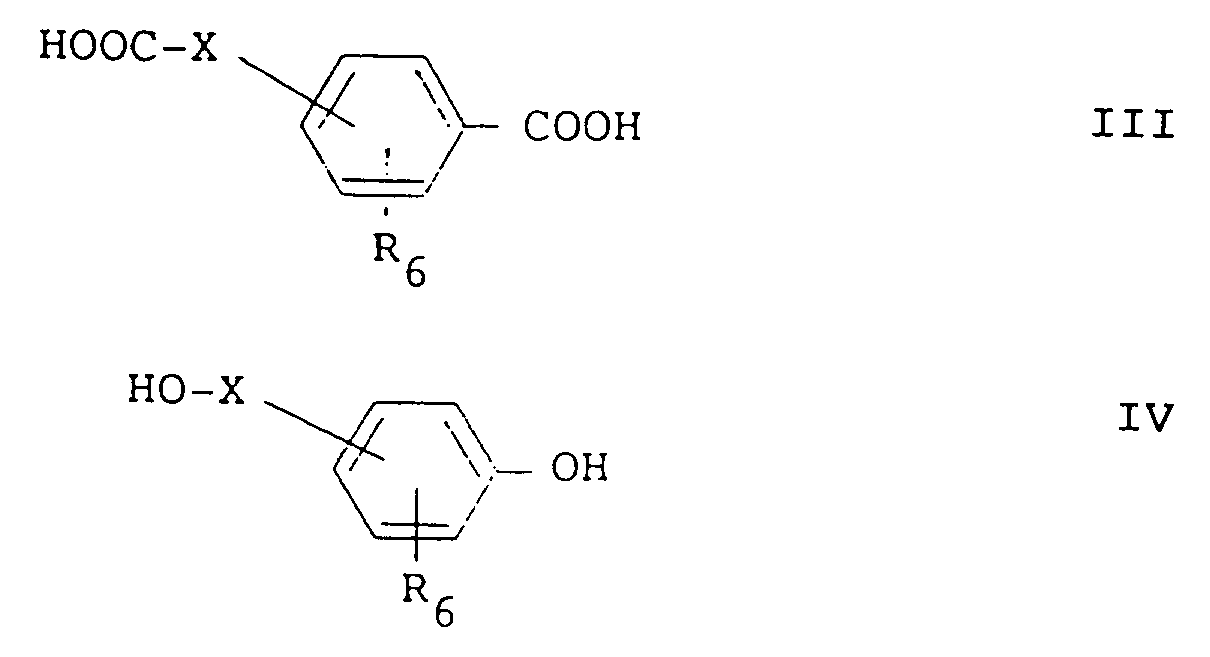

lorsque X est une liaison directe, R6 représente un groupe phényle ou benzyle qui peut avoir un substituant choisi parmi le groupe constitué des atomes d'halogènes et d'un groupe alkyle ayant 1 à 5 atomes de carbone ;
lorsque X est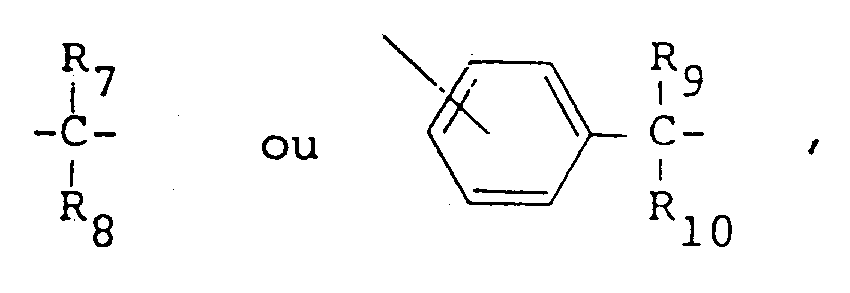
- Article optique selon l'une quelconque des revendications précédentes, qui comprend en outre une résine polyester thermoplastique amorphe comprenant des unités récurrentes qui dérivent d'un acide hydroxycarboxylique ayant un cycle aromatique dans la chaîne principale de celui-ci et un cycle aromatique dans un groupe pendant de celui-ci.
- Article optique selon la revendication 4, dans lequel ledit acide hydroxycarboxylique est représenté par la formule générale V suivante :

- Article optique selon l'une quelconque des revendications précédentes, qui est un disque optique.
- Article optique selon l'une quelconque des revendications 1 à 5, qui est une lentille optique.
Applications Claiming Priority (2)
| Application Number | Priority Date | Filing Date | Title |
|---|---|---|---|
| JP19526087 | 1987-08-06 | ||
| JP195260/87 | 1987-08-06 |
Publications (3)
| Publication Number | Publication Date |
|---|---|
| EP0302516A2 EP0302516A2 (fr) | 1989-02-08 |
| EP0302516A3 EP0302516A3 (en) | 1989-05-10 |
| EP0302516B1 true EP0302516B1 (fr) | 1993-12-15 |
Family
ID=16338180
Family Applications (1)
| Application Number | Title | Priority Date | Filing Date |
|---|---|---|---|
| EP88112796A Expired - Lifetime EP0302516B1 (fr) | 1987-08-06 | 1988-08-05 | Article optique réalisé en résine polyester thermoplastique amorphe |
Country Status (3)
| Country | Link |
|---|---|
| US (1) | US4910291A (fr) |
| EP (1) | EP0302516B1 (fr) |
| DE (1) | DE3886296T2 (fr) |
Families Citing this family (5)
| Publication number | Priority date | Publication date | Assignee | Title |
|---|---|---|---|---|
| US5938989A (en) * | 1997-01-24 | 1999-08-17 | Mems Optical, Inc. | Diffractive optical elements |
| US5967881A (en) * | 1997-05-29 | 1999-10-19 | Tucker; Thomas N. | Chemical mechanical planarization tool having a linear polishing roller |
| JP3532393B2 (ja) * | 1997-08-29 | 2004-05-31 | 大日本印刷株式会社 | 透過型スクリーン |
| US6893095B2 (en) | 2002-05-15 | 2005-05-17 | Daimlerchrysler Corporation | Horizontally pivoting headrest for motor vehicle |
| WO2010026066A1 (fr) * | 2008-09-04 | 2010-03-11 | Basf Se | Utilisation de 2-aryl-2-alkyl-1,3-propanediols substitués ou de 2-cyclohexyl-2-alkyl-1,3-propanediols substitués pour préparer des polymères |
Family Cites Families (7)
| Publication number | Priority date | Publication date | Assignee | Title |
|---|---|---|---|---|
| US3351624A (en) * | 1957-04-26 | 1967-11-07 | Production of linear aromatic polyesters | |
| US3291859A (en) * | 1963-08-12 | 1966-12-13 | Arthur V Tobolsky | Block copolymers formed by the reaction of an isocyanate-terminated polymer with a dual functional free radical initiator and an ethylenically unsaturated monomer |
| US3423280A (en) * | 1964-09-18 | 1969-01-21 | Goodyear Tire & Rubber | Copolyester resins |
| US3752802A (en) * | 1970-05-14 | 1973-08-14 | Pennwalt Corp | Mono azo compounds containing an acylating function |
| US4025493A (en) * | 1975-09-29 | 1977-05-24 | Phillips Petroleum Company | Polyamides and polyesters from phenyl-substituted alkane dioic acids |
| US4279803A (en) * | 1980-03-10 | 1981-07-21 | Celanese Corporation | Polyester of phenyl-4-hydroxybenzoic acid and 4-hydroxybenzoic acid and/or 6-hydroxy-2-naphthoic acid capable of forming an anisotropic melt |
| JPS6190343A (ja) * | 1984-10-09 | 1986-05-08 | Polyplastics Co | 光ディスク |
-
1988
- 1988-08-05 EP EP88112796A patent/EP0302516B1/fr not_active Expired - Lifetime
- 1988-08-05 DE DE88112796T patent/DE3886296T2/de not_active Expired - Fee Related
- 1988-08-05 US US07/228,459 patent/US4910291A/en not_active Expired - Lifetime
Also Published As
| Publication number | Publication date |
|---|---|
| DE3886296D1 (de) | 1994-01-27 |
| US4910291A (en) | 1990-03-20 |
| EP0302516A3 (en) | 1989-05-10 |
| EP0302516A2 (fr) | 1989-02-08 |
| DE3886296T2 (de) | 1994-04-28 |
Similar Documents
| Publication | Publication Date | Title |
|---|---|---|
| US6066711A (en) | Polyester polymer and its moldings | |
| JP2020012094A (ja) | 光学レンズ | |
| JP4164963B2 (ja) | 樹脂組成物、光学用素子、及び光学用非球面レンズ | |
| TW201938635A (zh) | 聚酯樹脂或聚酯碳酸酯樹脂及使用該樹脂之光學構件 | |
| JPH04325508A (ja) | プラスチックレンズ材料、プラスチックレンズおよび眼鏡用レンズ | |
| US7538176B2 (en) | Polyester polymer, its moldings, and production method of the polyester polymer | |
| JP2977714B2 (ja) | ポリエステル成形体 | |
| JPH07198901A (ja) | プラスチックレンズ用ポリエステル樹脂 | |
| JP2843215B2 (ja) | ポリエステル重合体およびその成形体並びに成形体の製造方法 | |
| US4910291A (en) | Optical article made of amorphous thermoplastic polyester resin | |
| EP1232497B1 (fr) | Support de stockage de donnees contenant du carbonate de polyester | |
| JP2840211B2 (ja) | ポリエステル重合体及びその成形体 | |
| US20060257512A1 (en) | Optical films comprising one or more polyarylates obtained from specific phenolic molecules | |
| JPS63178119A (ja) | 耐熱性および成形加工性に優れた熱可塑性樹脂およびその製造法 | |
| JP2001253960A (ja) | 高屈折率低複屈折性ポリカーボネート樹脂から形成された位相差フィルム用フィルムおよびその利用 | |
| JP2005232252A (ja) | 改質ポリカーボネート樹脂 | |
| US4632969A (en) | Resin for high-refractivity lenses | |
| CN1210115A (zh) | 从羟苯基1,2-二氢化醇衍生的光盘极共聚酯碳酸酯 | |
| JPH01138225A (ja) | 光学材料用樹脂 | |
| JP3440168B2 (ja) | ポリエステル重合体 | |
| JP3101453B2 (ja) | ポリエステル共重合体 | |
| JPH0517560A (ja) | 新規ポリエステル樹脂 | |
| JPS61149901A (ja) | 光学機器用素材 | |
| JP2005015505A (ja) | 高屈折、耐熱性芳香族ポリカーボネート樹脂組成物 | |
| JP2854796B2 (ja) | ポリエステル重合体及びその成形体 |
Legal Events
| Date | Code | Title | Description |
|---|---|---|---|
| PUAI | Public reference made under article 153(3) epc to a published international application that has entered the european phase |
Free format text: ORIGINAL CODE: 0009012 |
|
| AK | Designated contracting states |
Kind code of ref document: A2 Designated state(s): DE FR GB |
|
| PUAL | Search report despatched |
Free format text: ORIGINAL CODE: 0009013 |
|
| AK | Designated contracting states |
Kind code of ref document: A3 Designated state(s): DE FR GB |
|
| 17P | Request for examination filed |
Effective date: 19891011 |
|
| 17Q | First examination report despatched |
Effective date: 19911002 |
|
| GRAA | (expected) grant |
Free format text: ORIGINAL CODE: 0009210 |
|
| AK | Designated contracting states |
Kind code of ref document: B1 Designated state(s): DE FR GB |
|
| REF | Corresponds to: |
Ref document number: 3886296 Country of ref document: DE Date of ref document: 19940127 |
|
| ET | Fr: translation filed | ||
| PG25 | Lapsed in a contracting state [announced via postgrant information from national office to epo] |
Ref country code: GB Effective date: 19940805 |
|
| PLBE | No opposition filed within time limit |
Free format text: ORIGINAL CODE: 0009261 |
|
| STAA | Information on the status of an ep patent application or granted ep patent |
Free format text: STATUS: NO OPPOSITION FILED WITHIN TIME LIMIT |
|
| 26N | No opposition filed | ||
| GBPC | Gb: european patent ceased through non-payment of renewal fee |
Effective date: 19940805 |
|
| PG25 | Lapsed in a contracting state [announced via postgrant information from national office to epo] |
Ref country code: FR Effective date: 19950428 |
|
| PG25 | Lapsed in a contracting state [announced via postgrant information from national office to epo] |
Ref country code: DE Effective date: 19950503 |
|
| REG | Reference to a national code |
Ref country code: FR Ref legal event code: ST |