EP0302520B1 - Sekundärbatterie und Verfahren zur Herstellung derselben - Google Patents
Sekundärbatterie und Verfahren zur Herstellung derselben Download PDFInfo
- Publication number
- EP0302520B1 EP0302520B1 EP88112803A EP88112803A EP0302520B1 EP 0302520 B1 EP0302520 B1 EP 0302520B1 EP 88112803 A EP88112803 A EP 88112803A EP 88112803 A EP88112803 A EP 88112803A EP 0302520 B1 EP0302520 B1 EP 0302520B1
- Authority
- EP
- European Patent Office
- Prior art keywords
- positive
- negative electrode
- electrode members
- electrolyte
- end faces
- Prior art date
- Legal status (The legal status is an assumption and is not a legal conclusion. Google has not performed a legal analysis and makes no representation as to the accuracy of the status listed.)
- Expired - Lifetime
Links
Images



Classifications
-
- H—ELECTRICITY
- H01—ELECTRIC ELEMENTS
- H01M—PROCESSES OR MEANS, e.g. BATTERIES, FOR THE DIRECT CONVERSION OF CHEMICAL ENERGY INTO ELECTRICAL ENERGY
- H01M10/00—Secondary cells; Manufacture thereof
- H01M10/06—Lead-acid accumulators
- H01M10/12—Construction or manufacture
-
- H—ELECTRICITY
- H01—ELECTRIC ELEMENTS
- H01M—PROCESSES OR MEANS, e.g. BATTERIES, FOR THE DIRECT CONVERSION OF CHEMICAL ENERGY INTO ELECTRICAL ENERGY
- H01M10/00—Secondary cells; Manufacture thereof
- H01M10/04—Construction or manufacture in general
- H01M10/0436—Small-sized flat cells or batteries for portable equipment
-
- H—ELECTRICITY
- H01—ELECTRIC ELEMENTS
- H01M—PROCESSES OR MEANS, e.g. BATTERIES, FOR THE DIRECT CONVERSION OF CHEMICAL ENERGY INTO ELECTRICAL ENERGY
- H01M10/00—Secondary cells; Manufacture thereof
- H01M10/06—Lead-acid accumulators
- H01M10/12—Construction or manufacture
- H01M10/126—Small-sized flat cells or batteries for portable equipment
-
- Y—GENERAL TAGGING OF NEW TECHNOLOGICAL DEVELOPMENTS; GENERAL TAGGING OF CROSS-SECTIONAL TECHNOLOGIES SPANNING OVER SEVERAL SECTIONS OF THE IPC; TECHNICAL SUBJECTS COVERED BY FORMER USPC CROSS-REFERENCE ART COLLECTIONS [XRACs] AND DIGESTS
- Y02—TECHNOLOGIES OR APPLICATIONS FOR MITIGATION OR ADAPTATION AGAINST CLIMATE CHANGE
- Y02E—REDUCTION OF GREENHOUSE GAS [GHG] EMISSIONS, RELATED TO ENERGY GENERATION, TRANSMISSION OR DISTRIBUTION
- Y02E60/00—Enabling technologies; Technologies with a potential or indirect contribution to GHG emissions mitigation
- Y02E60/10—Energy storage using batteries
-
- Y—GENERAL TAGGING OF NEW TECHNOLOGICAL DEVELOPMENTS; GENERAL TAGGING OF CROSS-SECTIONAL TECHNOLOGIES SPANNING OVER SEVERAL SECTIONS OF THE IPC; TECHNICAL SUBJECTS COVERED BY FORMER USPC CROSS-REFERENCE ART COLLECTIONS [XRACs] AND DIGESTS
- Y02—TECHNOLOGIES OR APPLICATIONS FOR MITIGATION OR ADAPTATION AGAINST CLIMATE CHANGE
- Y02P—CLIMATE CHANGE MITIGATION TECHNOLOGIES IN THE PRODUCTION OR PROCESSING OF GOODS
- Y02P70/00—Climate change mitigation technologies in the production process for final industrial or consumer products
- Y02P70/50—Manufacturing or production processes characterised by the final manufactured product
-
- Y—GENERAL TAGGING OF NEW TECHNOLOGICAL DEVELOPMENTS; GENERAL TAGGING OF CROSS-SECTIONAL TECHNOLOGIES SPANNING OVER SEVERAL SECTIONS OF THE IPC; TECHNICAL SUBJECTS COVERED BY FORMER USPC CROSS-REFERENCE ART COLLECTIONS [XRACs] AND DIGESTS
- Y10—TECHNICAL SUBJECTS COVERED BY FORMER USPC
- Y10T—TECHNICAL SUBJECTS COVERED BY FORMER US CLASSIFICATION
- Y10T29/00—Metal working
- Y10T29/49—Method of mechanical manufacture
- Y10T29/49002—Electrical device making
- Y10T29/49108—Electric battery cell making
- Y10T29/49114—Electric battery cell making including adhesively bonding
Definitions
- the present invention relates to a secondary battery and a method of manufacturing the same and, more particularly, to a secondary battery which can be made thin without degrading its performance and a method of manufacturing the same.
- Typical conventional thin secondary batteries are a thin sealed lead battery and a button type nickel-cadmium battery, which have been recently put on market.
- a conventional thin secondary battery has positive and negative electrodes 2 and 3 each generally having a flat plate shape. Positive and negative electrode plates 2 and 3 are arranged in battery case 1 such that their major surfaces oppose each other. Separator 4 is interposed between electrodes 2 and 3. Electrolyte 5 is filled in battery case 1. Relief valve 6, positive terminal 7 and negative terminal 8 are provided on battery case 1.
- the conventional thin secondary battery has a structure wherein positive electrode plate 2, negative electrode plate 3, and separator 4 which are the main constituting elements of the battery are positioned one above the other in a direction of thickness thereof.
- the thicknesses of positive and negative electrode plates 2 and 3 may be reduced.
- the decrease in thickness is limited due to the following reasons.
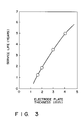
- the service life of the conventional secondary battery having the above structure greatly depends on the thickness of the electrode plate (positive electrode plate). As is well known in the art, when the thickness of the electrode plate is reduced, the service life of the battery is shortened. Taking a conventional lead battery having the above structure as an example, the relationship between the thickness of the electrode plate and the service life under use with a trickle charge is shown in Fig. 3. As is apparent from Fig. 3, the service life of the conventional battery is abruptly shortened when the thickness of the electrode plate is reduced. When the thickness of the electrode plate is 1 mm or less, the battery cannot be repeatedly used as a secondary battery due to the following reason.
- the battery reaction sites generated by charge/discharge extends in a direction perpendicular to the major surface of the electrode plate (i.e., the direction of thickness), as indicated by arrows in Fig. 2.
- a portion which is not associated with the battery reaction i.e., an energy concentration portion must always be present in the electrode.
- the energy concentration portion disappears upon charge/discharge. Therefore, the secondary battery cannot serve as a battery. This situation also occurs when the battery is cyclically used.
- a minimum overall thickness or height of the conventional thin sealed lead battery is 4 to 5 mm.
- an object of the present invention to provide a secondary battery which can be made thin without degrading its performance, and a method of manufacturing the same.
- a secondary battery comprising: positive and negative electrode members arranged on a substantially identical plane, end faces of the positive and negative electrode members opposing each other at a distance; a substrate for fixing and supporting the positive and negative electrode members; a cover member defining, with the substrate, a sealed chamber including the positive and negative electrode members; and an electrolyte sealed in the sealed chamber so as to be present between at least opposite end faces of the positive and negative electrode members, the electrolyte being associated with a battery reaction with the positive and negative electrode members.
- opposed edges of both the electrode members In order to increase the area (i.e., an effective electrode area) of the opposed end faces of both the electrode members, opposed edges of both the electrode members have a wave-like shape (triangular or rectangular shape) or a helical shape when viewed from the top.
- a method of manufacturing a secondary battery comprising the steps of: applying a positive electrode material containing a positive electrode active material and a negative electrode material containing a negative electrode active material to a substrate to form positive and negative electrode members whose end faces oppose each other at a distance; bonding a cover member to the substrate such that the cover member defines, with the substrate, a sealed chamber including the positive and negative electrode members; and filling an electrolyte associated with a battery reaction with the positive and negative electrode members so as to be present between at least the opposite end faces of the positive and negative electrode members.
- a secondary battery according to the present invention has the following characteristic feature.
- Positive and negative electrode members are arranged or juxtaposed on a substantially identical plane unlike the conventional structure wherein the positive and negative electrode members are arranged one above the other in the direction of thickness thereof.
- the end faces of both the electrode members are spaced apart from each other.
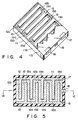
- Figs. 4 to 6 show a secondary battery according to a first embodiment of the present invention.
- interdigital positive and negative electrode members 12 and 13 are formed on one surface of flat substrate 11a.
- Electrolyte 15 associated with or involved in a battery reaction is filled in the space between the positive and negative electrode members 12 and 13.
- Positive electrode member 12 is made of a positive electrode material containing a positive electrode active material
- negative electrode member 13 is made of a negative electrode material containing a negative electrode active material.
- lead dioxide is the positive electrode active material and lead is a negative electrode active material therein.
- a liquid electrolyte such as sulfuric acid is used as electrolyte 15.
- Cover member 11b covers electrode members 12 and 13 and is connected to substrate 11a. Cover member 11b cooperates with substrate 11a to constitute battery case 11 which defines a sealed chamber.
- At least surfaces of substrate 11a and cover member 11b are electrically insulative and may be made of an acid-resistant polymer material (e.g., an acrylonitrile-butadiene-styrene resin (ABS resin) or a fluorine resin), a plastic material, or a glass-fiber reinforced plastic material.
- an acid-resistant polymer material e.g., an acrylonitrile-butadiene-styrene resin (ABS resin) or a fluorine resin
- ABS resin acrylonitrile-butadiene-styrene resin
- fluorine resin fluorine resin
- substrate 11a and cover member 11b may be made of a laminate material obtained by covering a metal layer (e.g., an aluminum layer) with an insulating polymer material, or of a polyvinylidene chloride resin.
- Battery case 11 also has positive and negative terminals 17 and 18, and relief valve 16 which communicates with a space between electrode members 12 and 13.
- positive electrode member 12 has a comb-like shape.
- a plurality of rectangular teeth 12a having a substantially identical shape extend from spine 12b at predetermined intervals.
- Negative electrode member 13 also has a comb-like shape.
- a plurality of rectangular teeth 13a having a substantially identical shape extend from spine 13b at predetermined intervals. Teeth 12a do not contact teeth 13a and constitute an interdigital electrode structure. Thus, the end faces of positive and negative electrode members 12 and 13 oppose each other.
- cover member 11b covers in tight contact with the surfaces of electrode members 12 and 13, so that electrolyte 15 does not enter between cover member 11a and electrode members 12, 13 to contact the upper surfaces of electrode members 12 and 13.
- positive and negative electrodes 12 and 13 are arranged on the surface of substrate 11a, i.e., on an identical plane. As compared with the conventional secondary battery wherein these members are arranged one above the other in the direction of thickness (Figs. 1 and 2), even if the electrode member has the same thickness as that of the conventional battery, the battery thickness can be reduced to about 1/3 that of the conventional battery.
- the extension direction of the sites of the battery reaction during charge/discharge is different from that of the conventional battery.
- the battery of the present invention has the extension direction perpendicular to the direction of thickness of the electrode member (i.e., parallel to the direction of width l of the tooth of the electrodes). For this reason, width l of teeth 12a and 13a (unit electrode) must be assured to be preferably 1-2 mm or more. If this is assured, thickness d of the electrode can be reduced to 1 mm or less, e.g., 0.1 mm in order to assure the same or longer battery service life as or than that of a commercially available conventional thin secondary battery.
- the overall thickness of the secondary battery according to the present invention can be reduced to 1 mm or less.
- substrate 11a is prepared.
- an active material-containing electrode material such as lead paste 72 is applied to substrate 11a by using roller 73 through screen 71 having a predetermined pattern (an interdigital pattern in this case).
- the positive and negative electrode member patterns can be simultaneously formed.
- the thickness of the lead paste is, e.g., 0.1 mm.
- an adhesive may be applied to the surface of substrate 11a in advance or a lead paste containing an adhesive may be used.
- electrolyte solution 15 is injected from electrolyte injection nozzle 74 to a space between positive and negative electrode member patterns 12 and 13.
- the electrolyte may be, e.g., sulfuric acid having a concentration of 30 to 50%, preferably 35 to 45%.
- Cover member 11b having positive and negative terminals 17 and 18 is adhered to substrate 11a by using an adhesive, e.g., an epoxy adhesive.
- Electrolyte 15 may be injected after cover member 11b is bonded to substrate 11a.
- a formation treatment of the electrodes is performed using DC power source 75. This treatment allows conversion of the positive electrode active material into lead dioxide, and conversion of the negative electrode active material into lead. If necessary, the electrolyte may be further injected after the above formation treatment.
- the secondary battery is prepared, and its performance is checked.
- the above formation treatment can be performed prior to mounting of cover member 11b.
- a plurality of substrates 11a shown in Fig. 7C are dipped in a formation treatment sulfuric acid, and the formation treatment can be performed.
- This treatment is suitable for mass production.
- the lead paste is used as both the positive and negative electrode active materials.
- a lead dioxide paste may be used for the positive electrode, and a lead paste may be used for the negative electrode.
- the positive and negative electrode patterns are sequentially formed using separate screens. According to this technique, the above formation treatment may be eliminated, and if so, the process for manufacturing the battery can be simplified. However, even in this case, the formation treatment is preferably conducted to improve the electrode properties.
- the manufacturing process described above can be performed in an automated treatment line.
- Fig. 8 is a longitudinal sectional view of a secondary battery according to a second embodiment of the present invention (thickness d of positive electrode tooth 12a and the negative electrode is emphasized with respect to the width, however, in practice, the thickness is much smaller than width l of teeth 12a and 13a).
- the secondary battery according to the second embodiment is substantially the same as that of the first embodiment except that cover member 11b is separated from the upper surfaces of electrode members 12 and 13.
- its service life is substantially the same as that of the first embodiment.
- the cover member need not be brought into tight contact with the upper surfaces of electrodes 12 and 13, so that the manufacturing process can be simplified.
- the overall thickness of the secondary battery can be reduced to about 1/3 that of the conventional battery.
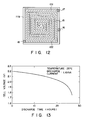
- a lead storage battery having a structure shown in Fig. 8 was manufactured. Dimensions of the battery were 0.65 mm thick, 50 mm wide, and 78 mm long. The weight of the battery was 4.7 g, and its volume was 2.5 cm3. The thickness of each of electrode members 12 and 13 was 0.4 mm. The discharge characteristics of this lead storage battery are shown in Fig. 13. As is apparent from Fig. 13, a discharge curve exhibits voltage changes unique to the lead storage battery as a function of time. The battery capacity was about 40 mAh. The durability of the battery was satisfactory, and the secondary battery of the present invention had characteristics satisfactory for use in practical applications.
- Fig. 9 is a horizontal sectional view of a secondary battery according to a third embodiment of the present invention.
- positive and negative electrode members 91a and 92a opposed to each other at a certain distance constitute one unit cell.
- Positive and negative electrode members 91b and 92b opposed to each other at a certain distance constitute one unit cell, and positive and negative electrode members 91c and 92c opposed to each other at a certain distance constitute one unit cell.
- Thin plate-like positive electrode members 91a to 91c and thin plate-like negative electrode members 92a to 92c are formed on substrate 11a.
- Negative and positive electrode members 92a and 91b are in contact with each other, and negative and positive electrode members 92b and 91c are in contact with each other.
- the secondary battery has a structure in which three unit cells are connected in series with each other.
- the secondary battery having the above structure can obtain a cell voltage of a magnitude three times that of the first embodiment.
- Figs. 10, 11, and 12 are horizontal sectional views of secondary batteries having electrode members of different shapes, respectively.
- each of positive and negative electrode members 101 and 102 is formed in a wave pattern of a substantially sine curve form having a small thickness.
- each of positive and negative electrode members 111 and 112 has a saw-toothed shape (or triangular waveform) having a small thickness.
- each of positive and negative electrode members 121 and 122 has a helical shape having a small thickness.
- the separator need not be used unlike the conventional secondary battery.
- the separator may be arranged as needed. In this case, the separator is arranged between the positive and negative electrode members.
- teeth 12a and 13a of the secondary batteries of the first and second embodiments have a rectangular shape, but may be a zig-zag shape.
- the method of manufacturing a secondary battery according to the present invention is exemplified by screen printing.
- the method of the present invention is not limited thereto.
- Metal flame spraying, plating, deposition, sputtering, ion plating, or plasma CVD, or a combination thereof may be used to form the electrodes.
- the positive plate, the electrolyte, and the negative plate which are the main constituting elements are arranged on a substantially identical plane of the substrate.
- the extension direction of the battery reaction sites during charge/discharge is parallel to the electrode surface. Therefore, the resultant secondary battery has excellent durability and a small thickness.
- the electrode plate is manufactured by a method including screen printing with a screen pattern. Therefore, various batteries can be manufactured by using only the patterns. In addition, the manufacturing process is simple, and great labor and energy saving can be achieved.
Landscapes
- Engineering & Computer Science (AREA)
- Manufacturing & Machinery (AREA)
- Chemical & Material Sciences (AREA)
- Chemical Kinetics & Catalysis (AREA)
- Electrochemistry (AREA)
- General Chemical & Material Sciences (AREA)
- Secondary Cells (AREA)
- Battery Electrode And Active Subsutance (AREA)
Claims (24)
- Sekundärbatterie, bestehend aus positiven und negativen Elektrodenteilen, von denen jede Hauptflächen und Endflächen aufweist, sowie einer abgeschlossenen Kammer mit einem Abdeckteil, das die Elektrodenteile und einen Elektrolyten einschließt, dadurch gekennzeichnet,
daß die positiven und negativen Elektrodenteile im wesentlichen in gleicher Ebene angeordnet sind, wobei die Endflächen der positiven und negativen Elektrodenteile einzeln in Zwischenräumen und sich in einiger Entfernung gegenüberliegend angeordnet sind,
daß ein Substrat (11a) mit einer Hauptfläche der positiven und negativen Elektrodenteile fest in Berührung steht und die positiven und negativen Elektrodenteile fest stützt,
daß das Abdeckteil (11b) mit dem Substrat (11a) eine abgeschlossene Kammer bildet, welche die positiven und negativen Elektrodenteile einschließt und abdeckt, und
daß der Elektrolyt (15) in der abgeschlossenen Kammer eingeschlossen ist und das Abdeckteil bezüglich der Elektrodenteile so angeordnet ist, daß sich der Elektrolyt im wesentlichen zwischen den gegenüberliegenden Endflächen der positiven und negativen Elektrodenteile befindet, daß der Elektrolyt im Zusammenhang mit einer Batteriereaktion mit den positiven und negativen Elektrodenteilen steht, und worin der Elektrolyt zwischen den Endflächen der positiven und negativen Elektrodenteile in einer Menge vorhanden ist, die ausreichend ist, damit die Batteriereaktion im wesentlichen in Batteriereaktionsgebieten stattfindet, die zwischen den gegenüberliegenden Endflächen der positiven und negativen Elektrodenteile festgelegt sind, wobei sich die genannten Batteriereaktionsgebiete im wesentlichen senkrecht zur Richtung der Dicke der positiven und negativen Elektrodenteile erstrecken, in welchen sich die Richtung der Dicke senkrecht zu den genannten Hauptflächen erstreckt. - Batterie nach Anspruch 1, dadurch gekennzeichnet, daß jedes der positiven und negativen Elektrodenteile (12, 13) eine kammförmige Gestalt aufweist, die eine Vielzahl von Zähnen (12a, 13a) besitzt.
- Batterie nach Anspruch 2, dadurch gekennzeichnet, daß die Zähne (12a, 13a) eine rechteckförmige Gestalt aufweisen.
- Batterie nach Anspruch 1, dadurch gekennzeichnet, daß jedes der positiven und negativen Elektrodenteile (101, 102, 111, 112) eine wellenförmige Gestalt aufweist.
- Batterie nach Anspruch 1, dadurch gekennzeichnet, daß jedes der positiven und negativen Elektrodenteile eine spiralförmige Gestalt (121, 122) aufweist.
- Batterie nach einem der Ansprüche 1 bis 5, dadurch gekennzeichnet, daß der positive Elektrodenteil aus Bleidioxyd besteht, daß der negative Elektrodenteil aus Blei besteht, und daß der Elektrolyt aus verdünnter Schwefelsäure besteht.
- Batterie nach einem der Ansprüche 1 bis 6, dadurch gekennzeichnet, daß jeses der positiven und negativen Elektrodenteile (12, 13; ...) eine Dicke besitzt, die nicht größer als 1 mm ist.
- Verfahren zur Herstellung einer Sekundärbatterie, welche dazu bestimmt ist, wiederholt Zyklen aus Laden und Entladen unterworfen zu werden, gekennzeichnet durch folgende Schritte:
Aufbringen eines positiven Elektrodenmaterials, das aktives positives Elektrodenmaterial enthält, und eines negativen Elektrodenmaterials, das aktives negatives Elektrodenmaterial enthält, auf ein Substrat (11a) zur Bildung von positiven und negativen Elektrodenteilen (12, 13; 101, 102; 111, 112; 121, 122), welche Endflächen aufweisen, die sich in einiger Entfernung gegenüberliegen, wobei die genannten positiven und negativen Elektrodenteile Hauptflächen aufweisen, welche am Substrat befestigt sind und an dieses derart angrenzen, daß sie durch das Substrat gestützt werden;
Verbinden eines Abdeckteils (11b) mit dem Substrat, so daß das Abdeckteil mit dem Substrat eine abgeschlossene Kammer bildet, welche die positiven und negativen Elektrodenteile einschließt und abdeckt; und
Einfüllen eines Elektrolyten (15), der im Zusammenhang mit einer Batteriereaktion mit den positiven und negativen Elektrodenteilen steht, in die genannte abgeschlossene Kammer, wobei das Abdeckteil bezüglich der Elektrodenteile so angeordnet ist, daß sich der Elektrolyt im wesentlichen zwischen den gegenüberliegenden Endflächen der positiven und negativen Elektrodenteile befindet, wobei der Elektrolyt zwischen den Endflächen der positiven und negativen Elektrodenteile in einer Menge vorhanden ist, um mit den Elektrodenteilen eine Batteriereaktion zu erzeugen, die im wesentlichen in zwischen den gegenüberliegenden Endflächen der positiven und negativen Elektrodenteile festgelegten Batteriereaktionsgebieten stattfindet, und wobei sich die genannten Batteriereaktionsgebiete im wesentlichen senkrecht zur Richtung der Dicke der positiven und negativen Elektrodenteile erstrecken, in welchen sich die Richtung der Dicke senkrecht zu den genannten Hauptflächen erstreckt. - Verfahren nach Anspruch 8, dadurch gekennzeichnet, daß die positiven und negativen Elektrodenteile (12, 13; ...) auf dem Substrat (11a) mittels Maskendruck, Metall-Flammspritzen, Galvanisieren, Ablagerung, Bedampfen, Ionen-Überzug oder plasmachemische Gasphasenabscheidung gebildet werden.
- Verfahren nach Anspruch 8 oder 9, dadurch gekennzeichnet, daß jedes der positiven und negativen Elektrodenteile eine Dicke besitzt, die nicht größer als 1 mm ist.
- Verfahren nach einem der Ansprüche 8 bis 10, gekennzeichnet durch den weiteren Schritt, das auf das genannte Substrat (11a) aufgebrachte genannte positive und negative Elektrodenmaterial einer Formations-Behandlung zu unterziehen.
- Sekundärbatterievorrichtung, bestehend aus einer Vielzahl von Einzelzellen, einer abgeschlossenene Kammer mit einem Abdeckteil, das die Einzelzellen und einen Elektrolyten einschließt, dadurch gekennzeichnet,
daß die Vielzahl von Einzelzellen nebeneinander gestellt sind, wobei sie in gleicher Ebene gegenseitig anliegen, daß jede Einzelzelle ein Paar von positiven und negativen Elektrodenteilen (91a, 92a; 91b, 92b; 91c, 92c) enthält, die in der genannten Ebene angeordnet sind, daß alle positiven und negativen Elektrodenteile Endflächen aufweisen, die sich in einiger Entfernung gegenüberliegen, daß das positive Elektrodenteil einer Einzelzelle und das negative Elektrodenteil einer anderen Einzellzelle in je zwei nebeneinanderliegenden Einzellzellen sich jeweils mit ihren Endflächen miteinander berühren;
daß in Substrat mit eine Hauptfläche der genannten positiven und negativen Elektrodenteile fest berührt und fest die Elektrodenteile der genannten Vielzahl von Einzelzellen stützt;
daß das Abdeckteil mit dem Substrat die geschlossene Kammer bildet, welche die genannte Vielzahl von Einzelzellen einschließt und abdeckt; und
daß der Elektrolyt (15) in der abgeschlossenen Kammer eingeschlossen ist, und das Abdeckteil bezüglich der Elektrodenteile so angeordnet ist, daß sich der Elektrolyt im wesentlichen zwischen den gegenüberliegenden Endflächen der positiven und negativen Elektrodenteile jeder Einzelzelle befindet, daß sich der Elektrolyt zwischen den Endflächen der positiven und negativen Elektrodenteile in einer Menge befindet, die ausreichend ist, um eine Batteriereaktion mit den positiven und negativen Elektrodenteilen jeder Einzelzelle zu erzeugen, wobei die Batteriereaktion im wesentlichen in Batteriereaktionsgebieten stattfindet, die zwischen den gegenüberliegenden Endflächen der positiven und negativen Elektrodenteile festgelegt sind, und wobei sich die genannten Batteriereaktionsgebiete im wesentlichen senkrecht zur Richtung der Dicke der positiven und negativen Elektrodenteile erstrecken, in welchen sich die Richtung der Dicke senkrecht zu den genannten Hauptflächen erstreckt. - Vorrichtung nach Anspruch 12, dadurch gekennzeichnet, daß jedes der positiven und negativen Elektrodenteile (12, 13; 12a, 13a) eine kammförmige Gestalt aufweist, die eine Vielzahl von Zähnen aufweist.
- Vorrichtung nach Anspruch 13, dadurch gekennzeichnet, daß die Zähne der genannten kammförmig gestalteten Elektrodenteile eine im wesentlichen rechteckförmige Gestalt aufweisen.
- Vorrichtung nach Anspruch 12, dadurch gekennzeichnet, daß jedes der positiven und negativen Elektrodenteile (101,102) eine wellenförmige Gestalt aufweist.
- Vorrichtung nach Anspruch 12, dadurch gekennzeichnet, daß jedes der positiven und negativen Elektrodenteile (121, 122) eine spiralförmige Gestalt aufweist.
- Vorrichtung nach einem der Ansprüche 12 bis 16, dadurch gekennzeichnet, daß der positive Elektrodenteil aus Bleidioxyd besteht, daß der negative Elektrodenteil aus Blei besteht, und daß der Elektrolyt aus verdünnter Schwefelsäure besteht.
- Vorrichtung nach einem der Ansprüche 12 bis 17, dadurch gekennzeichnet, daß jedes der positiven und negativen Elektrodenteile eine Dicke besitzt, die nicht größer als 1 mm ist.
- Vorrichtung nach einem der Ansprüche 12 bis 18, dadurch gekennzeichnet, daß sich im wesentlichen alle genannten Elektrolyte zwischen den gegenüberliegenden Endflächen der positiven und negativen Elektrodenteile befinden
- Vorrichtung nach einem der Ansprüche 12 bis 19, dadurch gekennzeichnet, daß das genannte Abdeckteil mit den Hauptflächen der genannten positiven und negativen Elektrodenteile Kontakt hat, welche jenen Hauptflächen gegenüberliegen, die mit dem Substrat Kontakt haben, wodurch sich alle Elektrolyte zwischen den gegenüberliegenden Endflächen befinden, und die Elektrolyte keinen Kontakt mit den Hauptflächen der positiven und negativen Elektrodenteile haben.
- Batterie nach einem der Ansprüche 1 bis 7, dadurch gekennzeichnet, daß sich im wesentlichen alle der genannten Elektrolyte zwischen den gegenüberliegenden Endflächen der positiven und negativen Elektrodenteile befinden.
- Batterie nach einem der Ansprüche 1 bis 7 und 21, dadurch gekennzeichnet, daß das genannte Abdeckteil mit den Hauptflächen der genannten positiven und negativen Elektrodenteile Kontakt hat, welche jenen Hauptflächen gegenüberliegen, die mit dem Substrat Kontakt haben, wodurch sich alle Elektrolyte zwischen den gegenüberliegenden Endflächen befinden, und die Elektrolyte keinen Kontakt mit den Hauptflächen der positiven und negativen Elektrodenteile haben.
- Verfahren nach einem der Ansprüche 8 bis 11, dadurch gekennzeichnet, daß der Schritt des Einfüllens des genannten Elektrolyten im wesentlichen das Einfüllen aller Elektrolyte in die Zwischenräume zwischen den gegenüberliegenden Endflächen der positiven und negativen Elektrodenteile umfaßt.
- Verfahren nach einem der Ansprüche 8 bis 11 und 23, dadurch gekennzeichnet, daß der Schritt des Verbindens des Abdeckteils mit dem Substrat das Kontaktieren des Abdeckteils mit den Hauptflachen der positiven und negativen Elektrodenteile umfaßt, welche den Hauptflächen gegenüberliegen, die mit dem Substrat Kontakt haben, so daß der Elektrolyt, der in die genannte Kammer eingefüllt wird, sich ganz in den Räumen zwischen den Endflächen der positiven und negativen Elektrodenteile befindet, und kein Elektrolyt mit der Hauptfläche Kontakt hat, die durch das Abdeckteil kontaktiert wird.
Applications Claiming Priority (2)
| Application Number | Priority Date | Filing Date | Title |
|---|---|---|---|
| JP19641587 | 1987-08-07 | ||
| JP196415/87 | 1987-08-07 |
Publications (2)
| Publication Number | Publication Date |
|---|---|
| EP0302520A1 EP0302520A1 (de) | 1989-02-08 |
| EP0302520B1 true EP0302520B1 (de) | 1992-11-25 |
Family
ID=16357476
Family Applications (1)
| Application Number | Title | Priority Date | Filing Date |
|---|---|---|---|
| EP88112803A Expired - Lifetime EP0302520B1 (de) | 1987-08-07 | 1988-08-05 | Sekundärbatterie und Verfahren zur Herstellung derselben |
Country Status (6)
| Country | Link |
|---|---|
| US (1) | US4889777A (de) |
| EP (1) | EP0302520B1 (de) |
| JP (1) | JPH0690934B2 (de) |
| KR (1) | KR920005187B1 (de) |
| CA (1) | CA1294670C (de) |
| DE (1) | DE3876166T2 (de) |
Families Citing this family (68)
| Publication number | Priority date | Publication date | Assignee | Title |
|---|---|---|---|---|
| US5619117A (en) * | 1982-06-07 | 1997-04-08 | Norand Corporation | Battery pack having memory |
| CA2410721C (en) * | 1989-06-14 | 2006-04-04 | Gp Batteries International Limited | Ultra-thin plate electrochemical cell and method of manufacture |
| JPH0754714B2 (ja) * | 1990-11-21 | 1995-06-07 | 日本電信電話株式会社 | 薄形鉛蓄電池およびその製造方法 |
| US5219673A (en) * | 1991-08-23 | 1993-06-15 | Kaun Thomas D | Cell structure for electrochemical devices and method of making same |
| JPH05129036A (ja) * | 1991-11-06 | 1993-05-25 | Shin Kobe Electric Mach Co Ltd | 密閉形2次電池 |
| FR2694136B1 (fr) * | 1992-07-27 | 1994-09-30 | Bertin & Cie | Batterie d'accumulateurs électriques équipée de moyens de refroidissement et ensemble de telles batteries. |
| US6063520A (en) * | 1996-04-12 | 2000-05-16 | Mitsubishi Chemical Corporation | Lightweight battery container and method for fabrication of same |
| US6040078A (en) * | 1997-03-06 | 2000-03-21 | Mitsubishi Chemical Corporation | Free form battery apparatus |
| US6224995B1 (en) | 1997-03-06 | 2001-05-01 | Mitsubishi Chemical Corporation | Three dimensional free form battery apparatus |
| US6045942A (en) * | 1997-12-15 | 2000-04-04 | Avery Dennison Corporation | Low profile battery and method of making same |
| US7662265B2 (en) * | 2000-10-20 | 2010-02-16 | Massachusetts Institute Of Technology | Electrophoretic assembly of electrochemical devices |
| KR101249133B1 (ko) * | 2000-10-20 | 2013-04-02 | 매사츄세츠 인스티튜트 오브 테크놀러지 | 2극 장치 |
| US7387851B2 (en) | 2001-07-27 | 2008-06-17 | A123 Systems, Inc. | Self-organizing battery structure with electrode particles that exert a repelling force on the opposite electrode |
| WO2003012908A2 (en) | 2001-07-27 | 2003-02-13 | Massachusetts Institute Of Technology | Battery structures, self-organizing structures and related methods |
| US7820320B2 (en) | 2001-08-20 | 2010-10-26 | Power Paper Ltd. | Method of making a thin layer electrochemical cell with self-formed separator |
| US7491465B2 (en) * | 2004-03-23 | 2009-02-17 | Power Paper, Ltd. | Method of making a thin layer electrochemical cell with self-formed separator |
| KR101209358B1 (ko) * | 2001-12-21 | 2012-12-07 | 메사추세츠 인스티튜트 오브 테크놀로지 | 전도성 리튬 저장 전극 |
| US7087348B2 (en) * | 2002-07-26 | 2006-08-08 | A123 Systems, Inc. | Coated electrode particles for composite electrodes and electrochemical cells |
| WO2004012286A1 (en) | 2002-07-26 | 2004-02-05 | A123 Systems, Inc. | Bipolar articles and related methods |
| US6986199B2 (en) * | 2003-06-11 | 2006-01-17 | The United States Of America As Represented By The Secretary Of The Navy | Laser-based technique for producing and embedding electrochemical cells and electronic components directly into circuit board materials |
| US7318982B2 (en) * | 2003-06-23 | 2008-01-15 | A123 Systems, Inc. | Polymer composition for encapsulation of electrode particles |
| DE10328316A1 (de) | 2003-06-23 | 2005-01-20 | Grünenthal GmbH | Verfahren zur Herstellung von Dimethyl-(3-aryl-buthyl)-aminverbindungen als pharmazeutische Wirkstoffe |
| TWI244789B (en) * | 2003-08-01 | 2005-12-01 | Hon Hai Prec Ind Co Ltd | A battery and make same |
| JP4920169B2 (ja) * | 2003-10-06 | 2012-04-18 | 日産自動車株式会社 | 電池およびこの電池を搭載する車両 |
| JP4581384B2 (ja) * | 2003-12-08 | 2010-11-17 | 日産自動車株式会社 | 電池およびその製造方法 |
| JP4645039B2 (ja) * | 2004-02-02 | 2011-03-09 | 新神戸電機株式会社 | 円筒形密閉式鉛蓄電池の製造方法 |
| US8722235B2 (en) | 2004-04-21 | 2014-05-13 | Blue Spark Technologies, Inc. | Thin printable flexible electrochemical cell and method of making the same |
| US7794510B1 (en) * | 2004-11-12 | 2010-09-14 | National Semiconductor Corporation | On chip battery |
| JP2006147210A (ja) * | 2004-11-17 | 2006-06-08 | Hitachi Ltd | 二次電池及びその製造方法 |
| US7842420B2 (en) | 2005-02-03 | 2010-11-30 | A123 Systems, Inc. | Electrode material with enhanced ionic transport properties |
| US8029927B2 (en) | 2005-03-22 | 2011-10-04 | Blue Spark Technologies, Inc. | Thin printable electrochemical cell utilizing a “picture frame” and methods of making the same |
| US8722233B2 (en) | 2005-05-06 | 2014-05-13 | Blue Spark Technologies, Inc. | RFID antenna-battery assembly and the method to make the same |
| DE102005052588A1 (de) | 2005-11-02 | 2007-05-10 | Grünenthal GmbH | Verfahren zur Herstellung substituierter Dimethyl-(3-aryl-butyl)-amin-Verbindungen mittels homogener Katalyse |
| JP5167584B2 (ja) * | 2005-12-01 | 2013-03-21 | 日本電気株式会社 | 非水電解液二次電池 |
| TWI496762B (zh) | 2006-07-24 | 2015-08-21 | 製備(1r,2r)-3-(3-二甲胺基-1-乙基-2-甲基-丙基)-酚之方法 | |
| MX2009006671A (es) * | 2006-12-21 | 2009-07-10 | Jan Petrus Human | Dispositivo de almacenamiento electrico. |
| JP2010524164A (ja) * | 2007-04-02 | 2010-07-15 | コーニンクレッカ フィリップス エレクトロニクス エヌ ヴィ | 電気化学的エネルギー源、およびそのような電気化学的エネルギー源を有する電子装置 |
| US20090202903A1 (en) | 2007-05-25 | 2009-08-13 | Massachusetts Institute Of Technology | Batteries and electrodes for use thereof |
| JP5104066B2 (ja) * | 2007-06-29 | 2012-12-19 | 住友電気工業株式会社 | 電池 |
| JP2009021148A (ja) * | 2007-07-13 | 2009-01-29 | Someya Densen Kk | 電線接続構造 |
| CN101802848A (zh) * | 2007-07-18 | 2010-08-11 | 蓝色火花科技有限公司 | 集成电子器件及其制造方法 |
| US8574754B2 (en) * | 2007-12-19 | 2013-11-05 | Blue Spark Technologies, Inc. | High current thin electrochemical cell and methods of making the same |
| EP2406793B1 (de) * | 2009-03-12 | 2016-11-09 | The Curators Of The University Of Missouri | Radioisotopen-mikroenergiequellen mit hoher energiedichte |
| JP5115591B2 (ja) * | 2010-06-10 | 2013-01-09 | 株式会社デンソー | 電池の電極積層体 |
| JP5639804B2 (ja) * | 2010-07-13 | 2014-12-10 | 株式会社Screenホールディングス | 電池の製造方法、電池、車両および電子機器 |
| US9065093B2 (en) | 2011-04-07 | 2015-06-23 | Massachusetts Institute Of Technology | Controlled porosity in electrodes |
| WO2013044224A2 (en) | 2011-09-22 | 2013-03-28 | Blue Spark Technologies, Inc. | Cell attachment method |
| GB201203713D0 (en) | 2012-03-02 | 2012-04-18 | Energy Diagnostic Ltd | Energy storage battery |
| US8765284B2 (en) | 2012-05-21 | 2014-07-01 | Blue Spark Technologies, Inc. | Multi-cell battery |
| KR20240055130A (ko) | 2012-08-16 | 2024-04-26 | 에노빅스 코오퍼레이션 | 3차원 배터리들을 위한 전극 구조들 |
| WO2014070254A1 (en) | 2012-11-01 | 2014-05-08 | Blue Spark Technologies, Inc. | Body temperature logging patch |
| WO2014085604A1 (en) | 2012-11-27 | 2014-06-05 | Blue Spark Technologies, Inc. | Battery cell construction |
| CN105308772B (zh) * | 2013-03-15 | 2018-11-16 | 艾诺维克斯公司 | 用于三维电池的隔膜 |
| JP5737313B2 (ja) * | 2013-03-28 | 2015-06-17 | Tdk株式会社 | 電子部品及びその製造方法 |
| FR3007207B1 (fr) * | 2013-06-12 | 2016-09-02 | Commissariat Energie Atomique | Batterie secondaire plane |
| EP3012897B1 (de) * | 2013-06-21 | 2017-11-29 | Tokyo Ohka Kogyo Co., Ltd. | Sekundärbatterie mit nichtwässrigem elektrolyten und verfahren zur herstellung davon |
| US10569480B2 (en) | 2014-10-03 | 2020-02-25 | Massachusetts Institute Of Technology | Pore orientation using magnetic fields |
| US10675819B2 (en) | 2014-10-03 | 2020-06-09 | Massachusetts Institute Of Technology | Magnetic field alignment of emulsions to produce porous articles |
| US9693689B2 (en) | 2014-12-31 | 2017-07-04 | Blue Spark Technologies, Inc. | Body temperature logging patch |
| TWI793480B (zh) | 2015-05-14 | 2023-02-21 | 美商易諾維公司 | 用於能量儲存裝置之縱向約束 |
| TWI739830B (zh) | 2016-05-13 | 2021-09-21 | 美商易諾維公司 | 用於三維電池之尺寸拘束件 |
| TWI819481B (zh) | 2016-11-16 | 2023-10-21 | 美商易諾維公司 | 具有可壓縮陰極之三維電池 |
| US10849501B2 (en) | 2017-08-09 | 2020-12-01 | Blue Spark Technologies, Inc. | Body temperature logging patch |
| KR102859540B1 (ko) | 2017-11-15 | 2025-09-17 | 에노빅스 코오퍼레이션 | 전극 어셈블리 및 2차 배터리 |
| US10256507B1 (en) | 2017-11-15 | 2019-04-09 | Enovix Corporation | Constrained electrode assembly |
| US11211639B2 (en) | 2018-08-06 | 2021-12-28 | Enovix Corporation | Electrode assembly manufacture and device |
| JP7844451B2 (ja) | 2020-09-18 | 2026-04-13 | エノビクス・コーポレイション | 電池に使用する電極の製造 |
| CN116783744A (zh) | 2020-12-09 | 2023-09-19 | 艾诺维克斯公司 | 用于制造二次电池的电极组合件的方法及装置 |
Citations (1)
| Publication number | Priority date | Publication date | Assignee | Title |
|---|---|---|---|---|
| WO1987004011A1 (en) * | 1985-12-19 | 1987-07-02 | Neste Oy | Storage battery |
Family Cites Families (8)
| Publication number | Priority date | Publication date | Assignee | Title |
|---|---|---|---|---|
| US629325A (en) * | 1897-07-29 | 1899-07-25 | Electric Power Dev Co | Secondary battery. |
| US629372A (en) * | 1898-08-29 | 1899-07-25 | Electric Power Dev Co | Storage battery. |
| DE2444691A1 (de) * | 1974-09-18 | 1976-04-01 | Rhein Westfael Elect Werk Ag | Verfahren zur herstellung von aus titantraeger und bleidioxidauflage aufgebauten elektroden fuer elektrolytische zwecke |
| GB1533116A (en) * | 1975-02-21 | 1978-11-22 | Chloride Group Ltd | Electric batteries |
| US4098965A (en) * | 1977-01-24 | 1978-07-04 | Polaroid Corporation | Flat batteries and method of making the same |
| JPS58133769A (ja) * | 1982-02-03 | 1983-08-09 | Toppan Printing Co Ltd | 平板状電池 |
| FR2544134A1 (fr) * | 1983-04-08 | 1984-10-12 | Europ Accumulateurs | Procede de fabrication d'une electrode pour generateur electrochimique, electrode ainsi obtenue et applications |
| JPS59228353A (ja) * | 1983-06-08 | 1984-12-21 | Matsushita Electric Ind Co Ltd | 扁平形電池 |
-
1988
- 1988-07-25 JP JP63185085A patent/JPH0690934B2/ja not_active Expired - Fee Related
- 1988-07-27 KR KR8809493A patent/KR920005187B1/ko not_active Expired
- 1988-08-02 US US07/227,370 patent/US4889777A/en not_active Expired - Lifetime
- 1988-08-05 CA CA000573977A patent/CA1294670C/en not_active Expired - Lifetime
- 1988-08-05 EP EP88112803A patent/EP0302520B1/de not_active Expired - Lifetime
- 1988-08-05 DE DE8888112803T patent/DE3876166T2/de not_active Expired - Lifetime
Patent Citations (1)
| Publication number | Priority date | Publication date | Assignee | Title |
|---|---|---|---|---|
| WO1987004011A1 (en) * | 1985-12-19 | 1987-07-02 | Neste Oy | Storage battery |
Also Published As
| Publication number | Publication date |
|---|---|
| US4889777A (en) | 1989-12-26 |
| CA1294670C (en) | 1992-01-21 |
| JPH01132064A (ja) | 1989-05-24 |
| KR920005187B1 (en) | 1992-06-29 |
| KR890004462A (ko) | 1989-04-22 |
| DE3876166D1 (de) | 1993-01-07 |
| EP0302520A1 (de) | 1989-02-08 |
| DE3876166T2 (de) | 1993-06-17 |
| JPH0690934B2 (ja) | 1994-11-14 |
Similar Documents
| Publication | Publication Date | Title |
|---|---|---|
| EP0302520B1 (de) | Sekundärbatterie und Verfahren zur Herstellung derselben | |
| US12347821B2 (en) | Dimensional constraints for three-dimensional batteries | |
| US11600864B2 (en) | Constrained electrode assembly | |
| US5047300A (en) | Ultra-thin plate electrochemical cell | |
| EP1318561A1 (de) | Münzenförmige batterie | |
| KR100622199B1 (ko) | 단추전지형 전기 재충전식 배터리 및 그 제조방법 | |
| US5705259A (en) | Method of using a bipolar electrochemical storage device | |
| EP0512417B1 (de) | Zink-Sekundärbatterie mit bipolären Elektrodeplatten die horizontal gelagert sind | |
| CA2333017C (en) | Electrochemical battery structure and method | |
| CA2177056A1 (en) | A solid state battery using an ionic or protonic electrolyte | |
| EP1497874B1 (de) | Akkumulator mit schwingungsfestem verbindungselement zwischen den positiven elektroden und einer polbrücke | |
| JPH04294071A (ja) | リチウム電池 | |
| JPH0773871A (ja) | 鉛蓄電池用バイポーラ極板 | |
| US6103417A (en) | Flat elementary electrochemical cell and precursor element | |
| US4194060A (en) | Electric accumulator and storage cell | |
| US4683648A (en) | Lead-titanium, bipolar electrode in a lead-acid battery | |
| JPS62165875A (ja) | 蓄電池 | |
| US20220223986A1 (en) | Cell battery | |
| JPS62165876A (ja) | 蓄電池 | |
| US4204034A (en) | Electrochemical cell | |
| US12620613B2 (en) | Dimensional constraints for three-dimensional batteries | |
| JP2773208B2 (ja) | 薄形蓄電池の製造方法 | |
| JPH05217574A (ja) | 鉛蓄電池用極板群 | |
| JPH0447665A (ja) | 角形電池 | |
| CN117242597A (zh) | 双极电池板及其制造 |
Legal Events
| Date | Code | Title | Description |
|---|---|---|---|
| PUAI | Public reference made under article 153(3) epc to a published international application that has entered the european phase |
Free format text: ORIGINAL CODE: 0009012 |
|
| 17P | Request for examination filed |
Effective date: 19880805 |
|
| AK | Designated contracting states |
Kind code of ref document: A1 Designated state(s): DE FR GB SE |
|
| 17Q | First examination report despatched |
Effective date: 19910219 |
|
| GRAA | (expected) grant |
Free format text: ORIGINAL CODE: 0009210 |
|
| AK | Designated contracting states |
Kind code of ref document: B1 Designated state(s): DE FR GB SE |
|
| ET | Fr: translation filed | ||
| REF | Corresponds to: |
Ref document number: 3876166 Country of ref document: DE Date of ref document: 19930107 |
|
| PLBE | No opposition filed within time limit |
Free format text: ORIGINAL CODE: 0009261 |
|
| STAA | Information on the status of an ep patent application or granted ep patent |
Free format text: STATUS: NO OPPOSITION FILED WITHIN TIME LIMIT |
|
| 26N | No opposition filed | ||
| EAL | Se: european patent in force in sweden |
Ref document number: 88112803.7 |
|
| REG | Reference to a national code |
Ref country code: FR Ref legal event code: CA |
|
| REG | Reference to a national code |
Ref country code: GB Ref legal event code: IF02 |
|
| PGFP | Annual fee paid to national office [announced via postgrant information from national office to epo] |
Ref country code: GB Payment date: 20070801 Year of fee payment: 20 |
|
| PGFP | Annual fee paid to national office [announced via postgrant information from national office to epo] |
Ref country code: DE Payment date: 20071030 Year of fee payment: 20 Ref country code: SE Payment date: 20070817 Year of fee payment: 20 |
|
| PGFP | Annual fee paid to national office [announced via postgrant information from national office to epo] |
Ref country code: FR Payment date: 20070718 Year of fee payment: 20 |
|
| REG | Reference to a national code |
Ref country code: GB Ref legal event code: PE20 Expiry date: 20080804 |
|
| EUG | Se: european patent has lapsed | ||
| PG25 | Lapsed in a contracting state [announced via postgrant information from national office to epo] |
Ref country code: GB Free format text: LAPSE BECAUSE OF EXPIRATION OF PROTECTION Effective date: 20080804 |