EP0303181A2 - 1,2-Diamino-Verbindungen, Verfahren zu ihrer Herstellung sowie Arzneimittel, die diese Verbindungen enthalten - Google Patents
1,2-Diamino-Verbindungen, Verfahren zu ihrer Herstellung sowie Arzneimittel, die diese Verbindungen enthalten Download PDFInfo
- Publication number
- EP0303181A2 EP0303181A2 EP88112679A EP88112679A EP0303181A2 EP 0303181 A2 EP0303181 A2 EP 0303181A2 EP 88112679 A EP88112679 A EP 88112679A EP 88112679 A EP88112679 A EP 88112679A EP 0303181 A2 EP0303181 A2 EP 0303181A2
- Authority
- EP
- European Patent Office
- Prior art keywords
- radical
- substituted
- alkoxy
- unsubstituted
- alkyl
- Prior art date
- Legal status (The legal status is an assumption and is not a legal conclusion. Google has not performed a legal analysis and makes no representation as to the accuracy of the status listed.)
- Withdrawn
Links
Classifications
-
- C—CHEMISTRY; METALLURGY
- C07—ORGANIC CHEMISTRY
- C07D—HETEROCYCLIC COMPOUNDS
- C07D207/00—Heterocyclic compounds containing five-membered rings not condensed with other rings, with one nitrogen atom as the only ring hetero atom
- C07D207/02—Heterocyclic compounds containing five-membered rings not condensed with other rings, with one nitrogen atom as the only ring hetero atom with only hydrogen or carbon atoms directly attached to the ring nitrogen atom
- C07D207/30—Heterocyclic compounds containing five-membered rings not condensed with other rings, with one nitrogen atom as the only ring hetero atom with only hydrogen or carbon atoms directly attached to the ring nitrogen atom having two double bonds between ring members or between ring members and non-ring members
- C07D207/32—Heterocyclic compounds containing five-membered rings not condensed with other rings, with one nitrogen atom as the only ring hetero atom with only hydrogen or carbon atoms directly attached to the ring nitrogen atom having two double bonds between ring members or between ring members and non-ring members with only hydrogen atoms, hydrocarbon or substituted hydrocarbon radicals, directly attached to ring carbon atoms
- C07D207/33—Heterocyclic compounds containing five-membered rings not condensed with other rings, with one nitrogen atom as the only ring hetero atom with only hydrogen or carbon atoms directly attached to the ring nitrogen atom having two double bonds between ring members or between ring members and non-ring members with only hydrogen atoms, hydrocarbon or substituted hydrocarbon radicals, directly attached to ring carbon atoms with substituted hydrocarbon radicals, directly attached to ring carbon atoms
- C07D207/335—Radicals substituted by nitrogen atoms not forming part of a nitro radical
-
- A—HUMAN NECESSITIES
- A61—MEDICAL OR VETERINARY SCIENCE; HYGIENE
- A61P—SPECIFIC THERAPEUTIC ACTIVITY OF CHEMICAL COMPOUNDS OR MEDICINAL PREPARATIONS
- A61P9/00—Drugs for disorders of the cardiovascular system
-
- A—HUMAN NECESSITIES
- A61—MEDICAL OR VETERINARY SCIENCE; HYGIENE
- A61P—SPECIFIC THERAPEUTIC ACTIVITY OF CHEMICAL COMPOUNDS OR MEDICINAL PREPARATIONS
- A61P9/00—Drugs for disorders of the cardiovascular system
- A61P9/08—Vasodilators for multiple indications
-
- C—CHEMISTRY; METALLURGY
- C07—ORGANIC CHEMISTRY
- C07D—HETEROCYCLIC COMPOUNDS
- C07D207/00—Heterocyclic compounds containing five-membered rings not condensed with other rings, with one nitrogen atom as the only ring hetero atom
- C07D207/02—Heterocyclic compounds containing five-membered rings not condensed with other rings, with one nitrogen atom as the only ring hetero atom with only hydrogen or carbon atoms directly attached to the ring nitrogen atom
- C07D207/04—Heterocyclic compounds containing five-membered rings not condensed with other rings, with one nitrogen atom as the only ring hetero atom with only hydrogen or carbon atoms directly attached to the ring nitrogen atom having no double bonds between ring members or between ring members and non-ring members
- C07D207/10—Heterocyclic compounds containing five-membered rings not condensed with other rings, with one nitrogen atom as the only ring hetero atom with only hydrogen or carbon atoms directly attached to the ring nitrogen atom having no double bonds between ring members or between ring members and non-ring members with hetero atoms or with carbon atoms having three bonds to hetero atoms with at the most one bond to halogen, e.g. ester or nitrile radicals, directly attached to ring carbon atoms
- C07D207/12—Oxygen or sulfur atoms
-
- C—CHEMISTRY; METALLURGY
- C07—ORGANIC CHEMISTRY
- C07D—HETEROCYCLIC COMPOUNDS
- C07D209/00—Heterocyclic compounds containing five-membered rings, condensed with other rings, with one nitrogen atom as the only ring hetero atom
- C07D209/02—Heterocyclic compounds containing five-membered rings, condensed with other rings, with one nitrogen atom as the only ring hetero atom condensed with one carbocyclic ring
- C07D209/04—Indoles; Hydrogenated indoles
- C07D209/10—Indoles; Hydrogenated indoles with substituted hydrocarbon radicals attached to carbon atoms of the hetero ring
- C07D209/14—Radicals substituted by nitrogen atoms, not forming part of a nitro radical
-
- C—CHEMISTRY; METALLURGY
- C07—ORGANIC CHEMISTRY
- C07D—HETEROCYCLIC COMPOUNDS
- C07D213/00—Heterocyclic compounds containing six-membered rings, not condensed with other rings, with one nitrogen atom as the only ring hetero atom and three or more double bonds between ring members or between ring members and non-ring members
- C07D213/02—Heterocyclic compounds containing six-membered rings, not condensed with other rings, with one nitrogen atom as the only ring hetero atom and three or more double bonds between ring members or between ring members and non-ring members having three double bonds between ring members or between ring members and non-ring members
- C07D213/04—Heterocyclic compounds containing six-membered rings, not condensed with other rings, with one nitrogen atom as the only ring hetero atom and three or more double bonds between ring members or between ring members and non-ring members having three double bonds between ring members or between ring members and non-ring members having no bond between the ring nitrogen atom and a non-ring member or having only hydrogen or carbon atoms directly attached to the ring nitrogen atom
- C07D213/24—Heterocyclic compounds containing six-membered rings, not condensed with other rings, with one nitrogen atom as the only ring hetero atom and three or more double bonds between ring members or between ring members and non-ring members having three double bonds between ring members or between ring members and non-ring members having no bond between the ring nitrogen atom and a non-ring member or having only hydrogen or carbon atoms directly attached to the ring nitrogen atom with substituted hydrocarbon radicals attached to ring carbon atoms
- C07D213/36—Radicals substituted by singly-bound nitrogen atoms
- C07D213/38—Radicals substituted by singly-bound nitrogen atoms having only hydrogen or hydrocarbon radicals attached to the substituent nitrogen atom
-
- C—CHEMISTRY; METALLURGY
- C07—ORGANIC CHEMISTRY
- C07D—HETEROCYCLIC COMPOUNDS
- C07D231/00—Heterocyclic compounds containing 1,2-diazole or hydrogenated 1,2-diazole rings
- C07D231/02—Heterocyclic compounds containing 1,2-diazole or hydrogenated 1,2-diazole rings not condensed with other rings
- C07D231/10—Heterocyclic compounds containing 1,2-diazole or hydrogenated 1,2-diazole rings not condensed with other rings having two or three double bonds between ring members or between ring members and non-ring members
- C07D231/12—Heterocyclic compounds containing 1,2-diazole or hydrogenated 1,2-diazole rings not condensed with other rings having two or three double bonds between ring members or between ring members and non-ring members with only hydrogen atoms, hydrocarbon or substituted hydrocarbon radicals, directly attached to ring carbon atoms
-
- C—CHEMISTRY; METALLURGY
- C07—ORGANIC CHEMISTRY
- C07D—HETEROCYCLIC COMPOUNDS
- C07D237/00—Heterocyclic compounds containing 1,2-diazine or hydrogenated 1,2-diazine rings
- C07D237/02—Heterocyclic compounds containing 1,2-diazine or hydrogenated 1,2-diazine rings not condensed with other rings
- C07D237/06—Heterocyclic compounds containing 1,2-diazine or hydrogenated 1,2-diazine rings not condensed with other rings having three double bonds between ring members or between ring members and non-ring members
- C07D237/08—Heterocyclic compounds containing 1,2-diazine or hydrogenated 1,2-diazine rings not condensed with other rings having three double bonds between ring members or between ring members and non-ring members with only hydrogen atoms, hydrocarbon or substituted hydrocarbon radicals, directly attached to ring carbon atoms
-
- C—CHEMISTRY; METALLURGY
- C07—ORGANIC CHEMISTRY
- C07D—HETEROCYCLIC COMPOUNDS
- C07D239/00—Heterocyclic compounds containing 1,3-diazine or hydrogenated 1,3-diazine rings
- C07D239/02—Heterocyclic compounds containing 1,3-diazine or hydrogenated 1,3-diazine rings not condensed with other rings
- C07D239/24—Heterocyclic compounds containing 1,3-diazine or hydrogenated 1,3-diazine rings not condensed with other rings having three or more double bonds between ring members or between ring members and non-ring members
- C07D239/26—Heterocyclic compounds containing 1,3-diazine or hydrogenated 1,3-diazine rings not condensed with other rings having three or more double bonds between ring members or between ring members and non-ring members with only hydrogen atoms, hydrocarbon or substituted hydrocarbon radicals, directly attached to ring carbon atoms
-
- C—CHEMISTRY; METALLURGY
- C07—ORGANIC CHEMISTRY
- C07D—HETEROCYCLIC COMPOUNDS
- C07D241/00—Heterocyclic compounds containing 1,4-diazine or hydrogenated 1,4-diazine rings
- C07D241/02—Heterocyclic compounds containing 1,4-diazine or hydrogenated 1,4-diazine rings not condensed with other rings
- C07D241/10—Heterocyclic compounds containing 1,4-diazine or hydrogenated 1,4-diazine rings not condensed with other rings having three double bonds between ring members or between ring members and non-ring members
- C07D241/12—Heterocyclic compounds containing 1,4-diazine or hydrogenated 1,4-diazine rings not condensed with other rings having three double bonds between ring members or between ring members and non-ring members with only hydrogen atoms, hydrocarbon or substituted hydrocarbon radicals, directly attached to ring carbon atoms
-
- C—CHEMISTRY; METALLURGY
- C07—ORGANIC CHEMISTRY
- C07D—HETEROCYCLIC COMPOUNDS
- C07D249/00—Heterocyclic compounds containing five-membered rings having three nitrogen atoms as the only ring hetero atoms
- C07D249/02—Heterocyclic compounds containing five-membered rings having three nitrogen atoms as the only ring hetero atoms not condensed with other rings
- C07D249/04—1,2,3-Triazoles; Hydrogenated 1,2,3-triazoles
-
- C—CHEMISTRY; METALLURGY
- C07—ORGANIC CHEMISTRY
- C07D—HETEROCYCLIC COMPOUNDS
- C07D249/00—Heterocyclic compounds containing five-membered rings having three nitrogen atoms as the only ring hetero atoms
- C07D249/02—Heterocyclic compounds containing five-membered rings having three nitrogen atoms as the only ring hetero atoms not condensed with other rings
- C07D249/08—1,2,4-Triazoles; Hydrogenated 1,2,4-triazoles
-
- C—CHEMISTRY; METALLURGY
- C07—ORGANIC CHEMISTRY
- C07D—HETEROCYCLIC COMPOUNDS
- C07D261/00—Heterocyclic compounds containing 1,2-oxazole or hydrogenated 1,2-oxazole rings
- C07D261/02—Heterocyclic compounds containing 1,2-oxazole or hydrogenated 1,2-oxazole rings not condensed with other rings
- C07D261/06—Heterocyclic compounds containing 1,2-oxazole or hydrogenated 1,2-oxazole rings not condensed with other rings having two or more double bonds between ring members or between ring members and non-ring members
- C07D261/08—Heterocyclic compounds containing 1,2-oxazole or hydrogenated 1,2-oxazole rings not condensed with other rings having two or more double bonds between ring members or between ring members and non-ring members with only hydrogen atoms, hydrocarbon or substituted hydrocarbon radicals, directly attached to ring carbon atoms
-
- C—CHEMISTRY; METALLURGY
- C07—ORGANIC CHEMISTRY
- C07D—HETEROCYCLIC COMPOUNDS
- C07D263/00—Heterocyclic compounds containing 1,3-oxazole or hydrogenated 1,3-oxazole rings
- C07D263/02—Heterocyclic compounds containing 1,3-oxazole or hydrogenated 1,3-oxazole rings not condensed with other rings
- C07D263/30—Heterocyclic compounds containing 1,3-oxazole or hydrogenated 1,3-oxazole rings not condensed with other rings having two or three double bonds between ring members or between ring members and non-ring members
- C07D263/32—Heterocyclic compounds containing 1,3-oxazole or hydrogenated 1,3-oxazole rings not condensed with other rings having two or three double bonds between ring members or between ring members and non-ring members with only hydrogen atoms, hydrocarbon or substituted hydrocarbon radicals, directly attached to ring carbon atoms
-
- C—CHEMISTRY; METALLURGY
- C07—ORGANIC CHEMISTRY
- C07D—HETEROCYCLIC COMPOUNDS
- C07D271/00—Heterocyclic compounds containing five-membered rings having two nitrogen atoms and one oxygen atom as the only ring hetero atoms
- C07D271/02—Heterocyclic compounds containing five-membered rings having two nitrogen atoms and one oxygen atom as the only ring hetero atoms not condensed with other rings
- C07D271/10—1,3,4-Oxadiazoles; Hydrogenated 1,3,4-oxadiazoles
- C07D271/113—1,3,4-Oxadiazoles; Hydrogenated 1,3,4-oxadiazoles with oxygen, sulfur or nitrogen atoms, directly attached to ring carbon atoms, the nitrogen atoms not forming part of a nitro radical
-
- C—CHEMISTRY; METALLURGY
- C07—ORGANIC CHEMISTRY
- C07D—HETEROCYCLIC COMPOUNDS
- C07D277/00—Heterocyclic compounds containing 1,3-thiazole or hydrogenated 1,3-thiazole rings
- C07D277/02—Heterocyclic compounds containing 1,3-thiazole or hydrogenated 1,3-thiazole rings not condensed with other rings
- C07D277/20—Heterocyclic compounds containing 1,3-thiazole or hydrogenated 1,3-thiazole rings not condensed with other rings having two or three double bonds between ring members or between ring members and non-ring members
- C07D277/22—Heterocyclic compounds containing 1,3-thiazole or hydrogenated 1,3-thiazole rings not condensed with other rings having two or three double bonds between ring members or between ring members and non-ring members with only hydrogen atoms, hydrocarbon or substituted hydrocarbon radicals, directly attached to ring carbon atoms
- C07D277/28—Radicals substituted by nitrogen atoms
-
- C—CHEMISTRY; METALLURGY
- C07—ORGANIC CHEMISTRY
- C07D—HETEROCYCLIC COMPOUNDS
- C07D285/00—Heterocyclic compounds containing rings having nitrogen and sulfur atoms as the only ring hetero atoms, not provided for by groups C07D275/00 - C07D283/00
- C07D285/01—Five-membered rings
- C07D285/02—Thiadiazoles; Hydrogenated thiadiazoles
- C07D285/04—Thiadiazoles; Hydrogenated thiadiazoles not condensed with other rings
- C07D285/06—1,2,3-Thiadiazoles; Hydrogenated 1,2,3-thiadiazoles
-
- C—CHEMISTRY; METALLURGY
- C07—ORGANIC CHEMISTRY
- C07D—HETEROCYCLIC COMPOUNDS
- C07D285/00—Heterocyclic compounds containing rings having nitrogen and sulfur atoms as the only ring hetero atoms, not provided for by groups C07D275/00 - C07D283/00
- C07D285/01—Five-membered rings
- C07D285/02—Thiadiazoles; Hydrogenated thiadiazoles
- C07D285/04—Thiadiazoles; Hydrogenated thiadiazoles not condensed with other rings
- C07D285/10—1,2,5-Thiadiazoles; Hydrogenated 1,2,5-thiadiazoles
-
- C—CHEMISTRY; METALLURGY
- C07—ORGANIC CHEMISTRY
- C07D—HETEROCYCLIC COMPOUNDS
- C07D295/00—Heterocyclic compounds containing polymethylene-imine rings with at least five ring members, 3-azabicyclo [3.2.2] nonane, piperazine, morpholine or thiomorpholine rings, having only hydrogen atoms directly attached to the ring carbon atoms
- C07D295/04—Heterocyclic compounds containing polymethylene-imine rings with at least five ring members, 3-azabicyclo [3.2.2] nonane, piperazine, morpholine or thiomorpholine rings, having only hydrogen atoms directly attached to the ring carbon atoms with substituted hydrocarbon radicals attached to ring nitrogen atoms
- C07D295/12—Heterocyclic compounds containing polymethylene-imine rings with at least five ring members, 3-azabicyclo [3.2.2] nonane, piperazine, morpholine or thiomorpholine rings, having only hydrogen atoms directly attached to the ring carbon atoms with substituted hydrocarbon radicals attached to ring nitrogen atoms substituted by singly or doubly bound nitrogen atoms
- C07D295/125—Heterocyclic compounds containing polymethylene-imine rings with at least five ring members, 3-azabicyclo [3.2.2] nonane, piperazine, morpholine or thiomorpholine rings, having only hydrogen atoms directly attached to the ring carbon atoms with substituted hydrocarbon radicals attached to ring nitrogen atoms substituted by singly or doubly bound nitrogen atoms with the ring nitrogen atoms and the substituent nitrogen atoms attached to the same carbon chain, which is not interrupted by carbocyclic rings
- C07D295/13—Heterocyclic compounds containing polymethylene-imine rings with at least five ring members, 3-azabicyclo [3.2.2] nonane, piperazine, morpholine or thiomorpholine rings, having only hydrogen atoms directly attached to the ring carbon atoms with substituted hydrocarbon radicals attached to ring nitrogen atoms substituted by singly or doubly bound nitrogen atoms with the ring nitrogen atoms and the substituent nitrogen atoms attached to the same carbon chain, which is not interrupted by carbocyclic rings to an acyclic saturated chain
-
- C—CHEMISTRY; METALLURGY
- C07—ORGANIC CHEMISTRY
- C07D—HETEROCYCLIC COMPOUNDS
- C07D307/00—Heterocyclic compounds containing five-membered rings having one oxygen atom as the only ring hetero atom
- C07D307/02—Heterocyclic compounds containing five-membered rings having one oxygen atom as the only ring hetero atom not condensed with other rings
- C07D307/34—Heterocyclic compounds containing five-membered rings having one oxygen atom as the only ring hetero atom not condensed with other rings having two or three double bonds between ring members or between ring members and non-ring members
- C07D307/38—Heterocyclic compounds containing five-membered rings having one oxygen atom as the only ring hetero atom not condensed with other rings having two or three double bonds between ring members or between ring members and non-ring members with substituted hydrocarbon radicals attached to ring carbon atoms
- C07D307/52—Radicals substituted by nitrogen atoms not forming part of a nitro radical
-
- C—CHEMISTRY; METALLURGY
- C07—ORGANIC CHEMISTRY
- C07D—HETEROCYCLIC COMPOUNDS
- C07D307/00—Heterocyclic compounds containing five-membered rings having one oxygen atom as the only ring hetero atom
- C07D307/77—Heterocyclic compounds containing five-membered rings having one oxygen atom as the only ring hetero atom ortho- or peri-condensed with carbocyclic rings or ring systems
- C07D307/78—Benzo [b] furans; Hydrogenated benzo [b] furans
- C07D307/79—Benzo [b] furans; Hydrogenated benzo [b] furans with only hydrogen atoms, hydrocarbon or substituted hydrocarbon radicals, directly attached to carbon atoms of the hetero ring
-
- C—CHEMISTRY; METALLURGY
- C07—ORGANIC CHEMISTRY
- C07D—HETEROCYCLIC COMPOUNDS
- C07D333/00—Heterocyclic compounds containing five-membered rings having one sulfur atom as the only ring hetero atom
- C07D333/02—Heterocyclic compounds containing five-membered rings having one sulfur atom as the only ring hetero atom not condensed with other rings
- C07D333/04—Heterocyclic compounds containing five-membered rings having one sulfur atom as the only ring hetero atom not condensed with other rings not substituted on the ring sulphur atom
- C07D333/06—Heterocyclic compounds containing five-membered rings having one sulfur atom as the only ring hetero atom not condensed with other rings not substituted on the ring sulphur atom with only hydrogen atoms, hydrocarbon or substituted hydrocarbon radicals, directly attached to the ring carbon atoms
- C07D333/14—Radicals substituted by singly bound hetero atoms other than halogen
- C07D333/20—Radicals substituted by singly bound hetero atoms other than halogen by nitrogen atoms
-
- C—CHEMISTRY; METALLURGY
- C07—ORGANIC CHEMISTRY
- C07D—HETEROCYCLIC COMPOUNDS
- C07D333/00—Heterocyclic compounds containing five-membered rings having one sulfur atom as the only ring hetero atom
- C07D333/02—Heterocyclic compounds containing five-membered rings having one sulfur atom as the only ring hetero atom not condensed with other rings
- C07D333/04—Heterocyclic compounds containing five-membered rings having one sulfur atom as the only ring hetero atom not condensed with other rings not substituted on the ring sulphur atom
- C07D333/26—Heterocyclic compounds containing five-membered rings having one sulfur atom as the only ring hetero atom not condensed with other rings not substituted on the ring sulphur atom with hetero atoms or with carbon atoms having three bonds to hetero atoms with at the most one bond to halogen, e.g. ester or nitrile radicals, directly attached to ring carbon atoms
- C07D333/30—Hetero atoms other than halogen
- C07D333/36—Nitrogen atoms
-
- C—CHEMISTRY; METALLURGY
- C07—ORGANIC CHEMISTRY
- C07D—HETEROCYCLIC COMPOUNDS
- C07D333/00—Heterocyclic compounds containing five-membered rings having one sulfur atom as the only ring hetero atom
- C07D333/50—Heterocyclic compounds containing five-membered rings having one sulfur atom as the only ring hetero atom condensed with carbocyclic rings or ring systems
- C07D333/52—Benzo[b]thiophenes; Hydrogenated benzo[b]thiophenes
- C07D333/54—Benzo[b]thiophenes; Hydrogenated benzo[b]thiophenes with only hydrogen atoms, hydrocarbon or substituted hydrocarbon radicals, directly attached to carbon atoms of the hetero ring
- C07D333/58—Radicals substituted by nitrogen atoms
Definitions
- the present invention relates to new 1,2-diamino compounds, their pharmacologically acceptable salts, their preparation and medicaments containing them.
- R1 is a straight-chain or branched C1-C12 alkyl radical or a C3-C7 cycloalkyl or C3-C7 cycloalkylmethyl radical
- W represents an oxygen atom, a sulfur atom or a valence line
- R2 and R3 may be the same or different and a straight-chain, branched, saturated or unsaturated C1-C6-alkyl radical which may optionally be substituted by hydroxy, C1-C3-alkoxy or C1-C3-alkoxy-C1-C3-alkoxy, mean or together with the nitrogen atom form a saturated or unsaturated ring which may also contain further heteroatoms and which is optionally substituted by a lower alkyl group, a lower alkoxy group or an oxygen atom
- A represents a valence line or a straight-chain or branched alkyl radical having 1-6, preferably 1-3 carbon
- R5 is a substituted benzyl radical, a substituted or unsubstituted naphthylmethyl radical, an unsubstituted or substituted five- or six-membered mono- or bicyclic hetarylmethyl radical or a substituted or unsubstituted indan-1-yl or indan-2-yl radical or a substituted one or unsubstituted tetralin-1-yl or tetralin-2-yl radical, being the substituents Alkyl, C2-C6-alkenyl, alkoxy, C2-C6-alkenyloxy, hydroxyalkyl, C2-C6-alkylenedioxy, hydroxyalkoxy, alkoxyalkoxy, alkylamino, dialkylamino, alkoxycarbonyl alkyloxy, alkylmercapto, alkylsulfinyl, alkylsulfonyl, alkylsulfonyloxy, carboxy, alk
- R5 can also be an unsubstituted phenyl radical if W is a valence dash or a sulfur atom or A is a methylene group, or R4 is a naphthyl radical, a tetralinyl radical or an indanyl radical and their pharmacologically acceptable salts.
- the C1-C12 alkyl radical of R1 is preferably methyl, ethyl, propyl, isopropyl, butyl, isobutyl, isoamyl, isohexyl, n-hexyl, n-octyl, n-dodecyl, in particular the isobutyl, isoamyl and isohexyl group.
- the C3-C7 cycloalkyl usually means cyclopentyl and cyclohexyl.
- R2 and R3 are preferably methyl, ethyl, propyl, allyl or methallyl. Rings which R2 and R3 can form together with the nitrogen atom to which they are attached are preferably the pyrrolidine and piperidine rings, especially the pyrrolidine ring.
- the heteroatoms that the rings can contain are nitrogen, sulfur or oxygen.
- Substituents of the rings mentioned above are in particular C1-C3-alkyl and C1-C3-alkoxy groups, such as. B. methyl, ethyl or propyl or Methoxy, ethoxy or propoxy.
- the oxygen substituent is usually a carbonyl group with the carbon atom to which it is attached.
- B. the pyrrolidinone and piperidinone ring is usually a carbonyl group with the carbon atom to which it is attached.
- R4 means a mono- or bicyclic aromatic radical. This includes phenyl, naphthyl, tetralinyl or indanyl.
- Five- or six-membered mono- or bicyclic hetarylmethyl radicals preferably contain, as hetaryl components, pyridyl, pyrimidinyl, pyrazinyl, thienyl, furanyl, pyrazolyl, imidazolyl, tetrazolyl, oxazolyl, isoxazolyl, thiazolyl, Isothiazolyl, quinolinyl, isoquinolinyl, benzofuranyl, benzothienyl, benzothiazolyl or indolyl radicals.
- alkyl groups alone or in combination with other radicals, of substituents of the ring systems of R5 contain 1-6, preferably 1-4 C atoms and are in particular methyl.
- the substitution can be one or more times.
- reaction of the compounds of the general formula II with a compound of the general formula III to give the compounds of the general formula I according to the invention is carried out in a manner known per se in an inert solvent such as toluene, xylene or dimethylformamide at room temperature or between 40 ° C and reflux temperature of the solvent in the presence of an alkaline condensing agent, for example Sodium hydride or sodium amide.
- an inert solvent such as toluene, xylene or dimethylformamide
- the compounds of the general formula II are known (cf. EPS 0.138.684). They can be prepared in a known manner by using a compound of the general formula VII R1WH (VII) in which R1 has the meanings given and W means an oxygen atom or sulfur atom with epichlorohydrin to react and the compound of general formula VIII Cl-CH2- -CH2-W-R1 (VIII) in the presence of sodium hydroxide solution to a compound of general formula IX implements.
- reaction of the compounds of general formula IV with compounds of general formula III to give the compounds of general formula I according to the invention takes place in an inert solvent such as toluene or xylene at temperatures between 40 ° C. and the reflux temperature of the solvent in the presence of an alkaline condensing agent such as sodium hydride or sodium amide .
- an inert solvent such as toluene or xylene at temperatures between 40 ° C. and the reflux temperature of the solvent in the presence of an alkaline condensing agent such as sodium hydride or sodium amide .
- the compounds of general formula IV can be prepared by using a compound of general formula XII in which R1, R2, R3 and W have the meanings given and R is an alkyl radical, with a complex hydride, for.
- the starting compounds of the general formula XII can be prepared by the process described in DE-B 2802864.
- reaction of the compounds of the general formula V with a compound of the general formula III to a compound of the general formula VI and the reduction of these compounds to the compounds of the general formula I according to the invention is carried out by customary methods, such as, for. B. by reduction with LiAlH4 or diborane in an inert solvent, for. B. ether or THF.
- the compounds of the general formula V in which B represents a halogen atom can be prepared by subjecting a compound of the general formula XII to hydrolysis and the resulting compound of the general formula XIV in which R1, R2, R3 and W have the meanings given above with a halogenating agent, for. B. brings thionyl chloride in an inert solvent to the reaction.
- the compounds of the general formula III can be prepared by reducing the corresponding azomethine derivatives or by reducing the corresponding acid amides (cf. Organikum, Organisch-Chemisches Grundpraktikum, 9th edition, Berlin 1970, p. 736).
- the compounds of general formula I according to the invention have an asymmetric carbon atom.
- the invention therefore also relates to racemates and the optically active forms of the compounds of the general formula I according to the invention and processes for their preparation.
- the optically active compounds can be prepared from their racemic mixtures by methods known per se using diasteromeric salts. For racemate resolution z. As tartaric acid, malic acid, camphoric acid, camphor sulfonic acid or dibenzoyl tartaric acid can be used.
- the compounds of the general formula I are set, preferably in an organic solvent, with the equivalent amount of an inorganic or organic acid, for example hydrochloric acid, hydrobromic acid, phosphoric acid, cyclamic acid, sulfuric acid, acetic acid, salicylic acid, citric acid, Fumaric acid, benzoic acid, naphthoic acid, o-acetoxybenzoic acid, adipic acid, maleic acid or oxalic acid.
- an inorganic or organic acid for example hydrochloric acid, hydrobromic acid, phosphoric acid, cyclamic acid, sulfuric acid, acetic acid, salicylic acid, citric acid, Fumaric acid, benzoic acid, naphthoic acid, o-acetoxybenzoic acid, adipic acid, maleic acid or oxalic acid.
- the compounds of general formula I according to the invention have valuable pharmacological properties. They are particularly characterized by a vasodilatory effect and can therefore be used to treat cardiovascular diseases.
- the new substances of general formula I according to the invention and their salts can be administered enterally or parenterally in liquid or solid form.
- Water is preferably used as the injection medium, which contains the additives customary for injection solutions, such as stabilizers, solubilizers or buffers.
- additives are e.g. Tartrate and citrate buffers, ethanol, complexing agents (such as ethylenediaminetetraacetic acid and its non-toxic salts), high molecular weight polymers (such as liquid polyethylene oxide) for viscosity regulation.
- Solid carriers are e.g.
- Starch lactose, mannitol, methyl cellulose, talcum highly disperse silica, higher molecular fatty acids (such as stearic acid), gelatin, agar, calcium phosphate, magnesium stearate, animal and vegetable fats and solid high molecular polymers (such as polyethylene glycols), suitable for oral application If desired, preparations can contain flavorings and sweeteners.
- higher molecular fatty acids such as stearic acid
- gelatin agar, calcium phosphate, magnesium stearate, animal and vegetable fats and solid high molecular polymers (such as polyethylene glycols)
- solid high molecular polymers such as polyethylene glycols
- the ethyl acetate phase is dried over sodium sulfate and evaporated.
- the residue is i. Vac. distilled. Bp 120 ° C / 2.5 mm.
- the acid obtained (40 g is mixed with 50 ml of thionyl chloride and the mixture is refluxed for 3 hours. Then it is evaporated and 44 g of bromine are added dropwise to the residue with stirring at 80 ° C. After the addition has ended, the mixture is heated for a further 5 hours The mixture is then cooled and the reaction mixture is added dropwise to 100 ml of alcohol, and after the addition has ended, the mixture is heated under reflux for a further 2 hours.
- the excess lithium aluminum hydride is by adding a conc. Solution of aluminum sulfate decomposed and the reaction product extracted with methylene chloride. The methylene chloride phase is dried over sodium sulfate and evaporated. 15.4 g of an oily residue of 6-methyl-2- (N-pyrrolidino) -heptanol-1 are obtained. 6 g of this compound are dissolved in 20 ml of methylene chloride and, after adding 8 g of thionyl chloride, the mixture is refluxed for 3 hours.
Landscapes
- Chemical & Material Sciences (AREA)
- Organic Chemistry (AREA)
- Health & Medical Sciences (AREA)
- General Health & Medical Sciences (AREA)
- Veterinary Medicine (AREA)
- Cardiology (AREA)
- Heart & Thoracic Surgery (AREA)
- Chemical Kinetics & Catalysis (AREA)
- General Chemical & Material Sciences (AREA)
- Medicinal Chemistry (AREA)
- Nuclear Medicine, Radiotherapy & Molecular Imaging (AREA)
- Pharmacology & Pharmacy (AREA)
- Life Sciences & Earth Sciences (AREA)
- Animal Behavior & Ethology (AREA)
- Engineering & Computer Science (AREA)
- Public Health (AREA)
- Bioinformatics & Cheminformatics (AREA)
- Pharmaceuticals Containing Other Organic And Inorganic Compounds (AREA)
- Organic Low-Molecular-Weight Compounds And Preparation Thereof (AREA)
- Acyclic And Carbocyclic Compounds In Medicinal Compositions (AREA)
- Furan Compounds (AREA)
- Indole Compounds (AREA)
- Heterocyclic Compounds Containing Sulfur Atoms (AREA)
- Pyridine Compounds (AREA)
- Heterocyclic Carbon Compounds Containing A Hetero Ring Having Nitrogen And Oxygen As The Only Ring Hetero Atoms (AREA)
- Pyrrole Compounds (AREA)
- Thiazole And Isothizaole Compounds (AREA)
- Nitrogen- Or Sulfur-Containing Heterocyclic Ring Compounds With Rings Of Six Or More Members (AREA)
- Plural Heterocyclic Compounds (AREA)
Abstract
Verbindungen der Formel I

worin
R₁ Alkyl, Cycloalkyl oder Cycloalkylmethyl,
W Sauerstoff, Schwefel oder einen Valenzstrich
R₂ und R₃ Alkyl oder zusammen einen Ring
A einen Valenzstrich oder einen Alkylenrest,
R₄ einen gegebenenfalls substituierten mono- oder bicyclischen aromatischen Rest
und
R₅ einen substituierten Benzylrest, einen substituierten oder unsubstituierten Naphthylmethyl-Rest, einen unsubstituierten oder substituierten fünf- oder sechsgliedrigen oder bicyclischen Hetarylmethyl-Rest oder einen substituierten oder unsubstituierten Indan-1-yl- oder Indan-2-yl-Rest oder einen substituierten oder unsubstituierten Tetralin-1-yl- oder Tetralin-2-yl-Rest bedeutetn,
wobei die Substituenten
Alkyl-, C₂-C₆-Alkenyl-, Alkoxy-, C₂-C₆-Alkenyloxy-, Hydroxyalkyl-, C₂-C₆-Alkylendioxy-, Hydroxy-alkoxy-, Alkoxy-alkoxy-, Alkylamino-, Dialkylamino-, Alkoxy-carbonyl-alkyloxy-, Alkylmercapto-, Alkylsulfinyl-, Alkylsulfonyl-, Alkylsulfonyloxy-, Carboxy-, Alkoxy-carbonyl-, Amino-carbonyl-, Mono- oder Dialkylamino-carbonyl-, Halogenalkyl-oder Cyano-Gruppen, sowie Halogenatome, wie Chlor, Brom oder Fluor sein können.
wobei
R₅ auch einen unsubstituierten Phenylrest bedeuten kann, wenn W einen Valenzstrich oder ein Schwefelatom bedeutet oder A eine Methylengruppe bedeutet, oder R₄ einen Naphthylrest, einen Tetralinylrest oder einen Indanylrest.
sowie deren pharmakologisch unbedenkliche Salze und Verfahren zur Herstellung von Verbindungen der Formel I, sowie Arzneimittel, die diese Verbindungen enthalten, zur Behandlung von Herz- und Kreislauferkrankungen.
R₁ Alkyl, Cycloalkyl oder Cycloalkylmethyl,
W Sauerstoff, Schwefel oder einen Valenzstrich
R₂ und R₃ Alkyl oder zusammen einen Ring
A einen Valenzstrich oder einen Alkylenrest,
R₄ einen gegebenenfalls substituierten mono- oder bicyclischen aromatischen Rest
und
R₅ einen substituierten Benzylrest, einen substituierten oder unsubstituierten Naphthylmethyl-Rest, einen unsubstituierten oder substituierten fünf- oder sechsgliedrigen oder bicyclischen Hetarylmethyl-Rest oder einen substituierten oder unsubstituierten Indan-1-yl- oder Indan-2-yl-Rest oder einen substituierten oder unsubstituierten Tetralin-1-yl- oder Tetralin-2-yl-Rest bedeutetn,
wobei die Substituenten
Alkyl-, C₂-C₆-Alkenyl-, Alkoxy-, C₂-C₆-Alkenyloxy-, Hydroxyalkyl-, C₂-C₆-Alkylendioxy-, Hydroxy-alkoxy-, Alkoxy-alkoxy-, Alkylamino-, Dialkylamino-, Alkoxy-carbonyl-alkyloxy-, Alkylmercapto-, Alkylsulfinyl-, Alkylsulfonyl-, Alkylsulfonyloxy-, Carboxy-, Alkoxy-carbonyl-, Amino-carbonyl-, Mono- oder Dialkylamino-carbonyl-, Halogenalkyl-oder Cyano-Gruppen, sowie Halogenatome, wie Chlor, Brom oder Fluor sein können.
wobei
R₅ auch einen unsubstituierten Phenylrest bedeuten kann, wenn W einen Valenzstrich oder ein Schwefelatom bedeutet oder A eine Methylengruppe bedeutet, oder R₄ einen Naphthylrest, einen Tetralinylrest oder einen Indanylrest.
sowie deren pharmakologisch unbedenkliche Salze und Verfahren zur Herstellung von Verbindungen der Formel I, sowie Arzneimittel, die diese Verbindungen enthalten, zur Behandlung von Herz- und Kreislauferkrankungen.
Description
- Die vorliegende Erfindung betrifft neue 1,2-Diamino-Verbindungen, deren pharmakologisch verträgliche Salze, ihre herstellung sowie diese enthaltende Arzneimittel.
- Gegenstand der Erfindung sind neue 1,2-Diamino-Verbindungen der allgemeinen Formel I

R₁ einen geradkettigen oder verzweigten C₁-C₁₂-Alkylrest oder einen C₃-C₇-Cycloalkyl- oder C₃-C₇-Cycloalkylmethylrest
W ein Sauerstoffatom, ein Schwefelatom oder einen Valenzstrich bedeutet,
R₂ und R₃ gleich oder verschieden sein können und einen geradkettigen, verzweigten, gesättigten oder ungesättigten C₁-C₆-Alkylrest, der gegebenenfalls durch Hydroxy, C₁-C₃-Alkoxy oder C₁-C₃-Alkoxy-C₁-C₃-alkoxy substituiert sein kann,
bedeuten oder zusammen mit dem Stickstoffatom einen gesättigten oder ungesättigten Ring bilden, der noch weitere Heteroatome enthalten kann und zusätzlich gegebenenfalls durch eine niedrige Alkylgruppe, eine niedrige Alkoxygruppe oder ein Sauerstoffatom substituiert ist,
A einen Valenzstrich oder einen geradkettigen oder verzweigten Alkylrest mit 1-6, vorzugsweise 1-3 Kohlenstoffatomen bedeutet,
R₄ einen ein- oder mehrfach substituierten oder unsubstituierten mono- oder bicyclischen aromatischen Rest,
wobei die Substituenten
Alkyl-, C₂-C₆-Alkenyl-, Alkoxy-, C₂-C₆-Alkenyloxy-, Hydroxy-alkyl-, C₂-C₆-Alkylendioxy-, Hydroxy-alkoxy-, Alkoxy-alkoxy-, Alkylamino-, Dialkylamino-, Alkoxy-carbonyl-alkoxy-, Alkylmercapto-, Alkylsulfinyl-, Alkylsufonyl-, Alkylsulfonyloxy-, Carboxy-, Alkoxy-carbonyl-, Amino-carbonyl-, Mono- oder Dialkylamino-carbonyl-, Halogenalkyl-oder Cyano-gruppen sowie Halogenatome, wie Chlor, Brom oder Fluor sein können.
und
R₅ einen substituierten Benzylrest, einen substituierten oder unsubstituierten Naphthylmethyl-Rest, einen unsubstituierten oder substituierten fünf- oder sechsgliedrigen mono- oder bicyclischen Hetarylmethyl-Rest oder einen substituierten oder unsubstituierten Indan-1-yl- oder Indan-2-yl-Rest oder einen substituierten oder unsubstituierten Tetralin-1-yl- oder Tetralin-2-yl-Rest bedeutet,
wobei die Substituenten
Alkyl-, C₂-C₆-Alkenyl-, Alkoxy-, C₂-C₆-Alkenyloxy-, Hydroxyalkyl-, C₂-C₆-Alkylendioxy-, Hydroxy-alkoxy-, Alkoxy-alkoxy-, Alkylamino-, Dialkylamino-, Alkoxy-carbonyl-alkyloxy-, Alkylmercapto-, Alkylsulfinyl-, Alkylsulfonyl-, Alkylsulfonyloxy-, Carboxy-, Alkoxy-carbonyl-, Amino-carbonyl-, Mono- oder Dialkylamino-carbonyl-, Halogenalkyl-oder Cyano-Gruppen, sowie Halogenatome, wie Chlor, Brom oder Fluor sein können.
wobei
R₅ auch einen unsubstituierten Phenylrest bedeuten kann, wenn W einen Valenzstrich oder ein Schwefelatom bedeutet oder A eine Methylengruppe bedeutet, oder R₄ einen Naphthylrest, einen Tetralinylrest oder einen Indanylrest bedeutet
sowie deren pharmakologisch unbedenkliche Salze. - Der C₁-C₁₂-Alkylrest von R₁ bedeutet vorzugsweise Methyl, Ethyl, Propyl, Isopropyl, Butyl, Isobutyl, Isoamyl, Isohexyl, n-Hexyl, n-Octyl, n-Dodecyl, insbesondere die Isobutyl-, Isoamyl- und Isohexyl-Gruppe. Der C₃-C₇-Cycloalkylrest bedeutet in der Regel Cyclopentyl und Cyclohexyl.
- R₂ und R₃ bedeuten vorzugsweise Methyl, Ethyl, Propyl, Allyl oder Methallyl. Ringe, die R₂ und R₃ zusammen mit dem Stickstoffatom, an das sie gebunden sind, bilden können, sind vorzugsweise der Pyrrolidin- und der Piperidinring, insbesondere der Pyrrolidinring. Die Heteroatome, die die Ringe enthalten können, sind Stickstoff, Schwefel oder Sauerstoff.Es sind hierunter Ringe wie z. B. Piperazin, Morpholin und Thiomorpholin zu verstehen. Substituenten der vorstehend genannten Ringe sind insbesondere C₁-C₃-Alkyl- und C₁-C₃-Alkoxygruppen, wie z. B. Methyl, Ethyl oder Propyl oder Methoxy, Ethoxy oder Propoxy. Der Sauerstoff-Substituent stellt in der Regel mit dem C-Atom, an das er gebunden ist, eine Carbonylgruppe dar. Entsprechende Ringe sind z. B. der Pyrrolidinon- und Piperidinon-Ring.
- R₄ bedeutet einen mono- oder bicyclischen aromatischen Rest. Hierunter sind Phenyl, Naphthyl, Tetralinyl- oder Indanyl zu verstehen. Die Alkylsubstituenten, allein oder in Verbindung mit anderen Resten, enthalten 1 - 6, vorzugsweise 1 - 4 C-Atome und bedeuten insbesondere Methyl.
- Fünf- oder sechsgliedrige mono- oder bicyclische Hetarylmethyl-Reste enthalten vorzugsweise als Hetaryl-Komponenten Pyridyl-, Pyrimidinyl-, Pyrazinyl-, Thienyl-, Furanyl-, Pyrazolyl-, Imidazolyl-, Tetrazolyl-, Oxazolyl-, Isoxazolyl-, Thiazolyl-, Isothiazolyl-, Chinolinyl-, Isochinolinyl-, Benzofuranyl-, Benzothienyl-, Benzothiazolyl- oder Indolyl-Reste.
- Die Alkylgruppen, allein oder in Verbindung mit anderen Resten, von Substituenten der Ringsysteme von R₅ enthalten 1 - 6, vorzugsweise 1- 4 C-Atome und bedeuten insbesondere Methyl. Die Substitution kann ein- oder mehrfach sein.
- Die erfindungsgemäßen Verbindungen der allgemeinen Formel I können in an sich bekannter Weise dargestellt werden, indem man
- a) eine Verbindung der allgemeinen Formel II,


oder - b) eine Verbindung der allgemeinen Formel IV,

oder - c) eine Verbindung der allgemeinen Formel V,


- Die Umsetzung der Verbindungen der allgemeinen Formel II mit einer Verbindung der allgemeinen Formel III zu den erfindungsgemäßen Verbindungen der allgemeinen Formel I erfolgt, in an sich bekannter Weise, in einem inerten Lösungsmittel, wie Toluol, Xylol oder Dimethylformamid bei Raumtemperatur, bzw. zwischen 40°C und Rückflußtemperatur des Lösungsmittels in Gegenwart eines alkalischen Kondensationsmittels, z.B. Natriumhydrid oder Natriumamid.
- Die Verbindungen der allgemeinen Formel II sind bekannt (vgl. EPS 0,138,684). Sie können in bekannter Weise dargestellt werden, daß man eine Verbindung der allgemeinen Formel VII
R₁WH (VII)
in der R₁ die angegebenen Bedeutungen besitzt und
W ein Sauerstoffatom oder Schwefelatom bedeutet mit Epichlorhydrin zur Reaktion bringt und die erhaltene Verbindung der allgemeinen Formel VIII
Cl-CH₂--CH₂-W-R₁ (VIII)
in Gegenwart von Natronlauge zu einer Verbindung der allgemeinen Formel IX
- Umsetzungen der Verbindungen der allgemeinen Formel IX mit einem Amin der allgemeinen Formel X,

ergeben die Verbindungen der allgemeinen Formel XI
- Die Umsetzung der Verbindungen der allgemeinen Formel IV mit Verbindungen der allgemeinen Formel III zu den erfindungsgemäßen Verbindungen der allgemeinen Formel I erfolgt in einem inerten Lösungsmittel wie Toluol oder Xylol bei Temperaturen zwischen 40°C und Rückflußtemperatur des Lösungsmittels in Gegenwart eines alkalischen Kondensationsmittels wie Natriumhydrid oder Natriumamid.
- Die Verbindungen der allgemeinen Formel IV können dargestellt werden, indem man eine Verbindung der allgemeinen Formel XII


Die Ausgangsverbindungen der allgemeinen Formel XII können nach dem in der DE-B 2802864 beschriebenen Verfahren hergestellt werden. - Die Umsetzung der Verbindungen der allgemeinen Formel V mit einer Verbindung der allgemeinen Formel III zu einer Verbindung der allgemeinen Formel VI sowie die Reduktion dieser Verbindungen zu den erfindungsgemäßen Verbindungen der allgemeinen Formel I erfolgt nach üblichen Verfahren, wie z. B. durch Reduktion mit LiAlH₄ oder Diboran in einem inerten Lösungsmittel, z. B. Ether oder THF.
- Die Verbindungen der allgemeinen Formel V, in der B ein Halogenatom bedeutet, können hergestellt werden, indem man eine Verbindung der allgemeinen Formel XII einer Hydrolyse unterwirft und die erhaltene Verbindung der allgemeinen Formel XIV

- Die Verbindungen der allgemeinen Formel lII können dargestellt werden durch Reduktion der entsprechenden Azomethin-Derivate oder durch Reduktion der entsprechenden Säureamide (vgl. Organikum, Organisch-Chemisches Grundpraktikum, 9. Auflage, Berlin 1970, S. 736).
- Die erfindungsgemäßen Verbindungen der allgemeinen Formel I besitzen ein asymmetrisches Kohlenstoffatom.
- Gegenstand der Erfindung sind daher auch Racemate und die optische aktiven Formen der erfindungsgemäßen Verbindungen der allgemeinen Formel I sowie Verfahren zu ihrer Herstellung. Die optisch aktiven Verbindungen können aus ihren racemischen Mischungen nach an sich bekannten Methoden über diasteromere Salze hergestellt werden. Zur Racematenspaltung können z. B. Weinsäure, Apfelsäure, Camphersäure, Camphersulfonsäure oder Dibenzoylweinsäure verwendet werden.
- Zur Überführung der Verbindungen der allgemeinen Formel I in ihre pharmakologisch unbedenklichen Salze setzt man diese, vorzugsweise in einem organischen Lösungsmittel, mit der äquivalenten Menge einer anorganischen oder organischen Säure, z.B. Salzsäure, Bromwasserstoffsäure, Phosphorsäure, Cyclaminsäure, Schwefelsäure, Essigsäure, Salicylsäure, Citronensäure, Fumarsäure, Benzoesäure, Naphthoesäure, o-Acetoxybenzoesäure, Adipinsäure, Maleinsäure oder Oxalsäure um.
- Die erfindungsgemäßen Verbindungen der allgemeinen Formel I besitzen wertvolle pharmakologische Eigenschaften. Sie zeichnen sich besonders durch eine gefäßrelaxierende Wirkung aus und können daher zur Therapie von Herz-/Kreislauf-Erkrankungen eingesetzt werden.
- Die erfindungsgemäßen neuen Substanzen der allgemeinen Formel I und ihre Salze können in flüssiger oder fester Form enteral oder parenteral appliziert werden. Als Injektionsmedium kommt vorzugsweise Wasser zu Anwendung, welches die bei Injektionslösungen üblichen Zusätze wie Stabilisierungsmittel, Lösungsvermittler oder Puffer enthält. Derartige Zusätze sind z.B. Tartrat- und Citratpuffer, Ethanol, Komplexbildner (wie Ethylendiamintetraessigsäure und deren nicht-toxischen Salze), hochmolekulare Polymere (wie flüssiges Polyethylenoxyd) zur Viskositätsregulierung. Feste Trägerstoffe sind z.B. Stärke, Lactose, Mannit, Methylcellulose, Talkum hochdisperse Kieselgelsäuren, höhermolekulare Fettsäuren (wie Stearinsäure), Gelatine, Agar-Agar, Calciumphosphat, Magnesiumstearat, tierische und pflanzliche Fette und feste hochmolekulare Polymere (wie z. B. Polyethylenglykole), für orale Applikation geeignete Zubereitungen können gewünschtenfalls Geschmacks- und Süßstoffe enthalten.
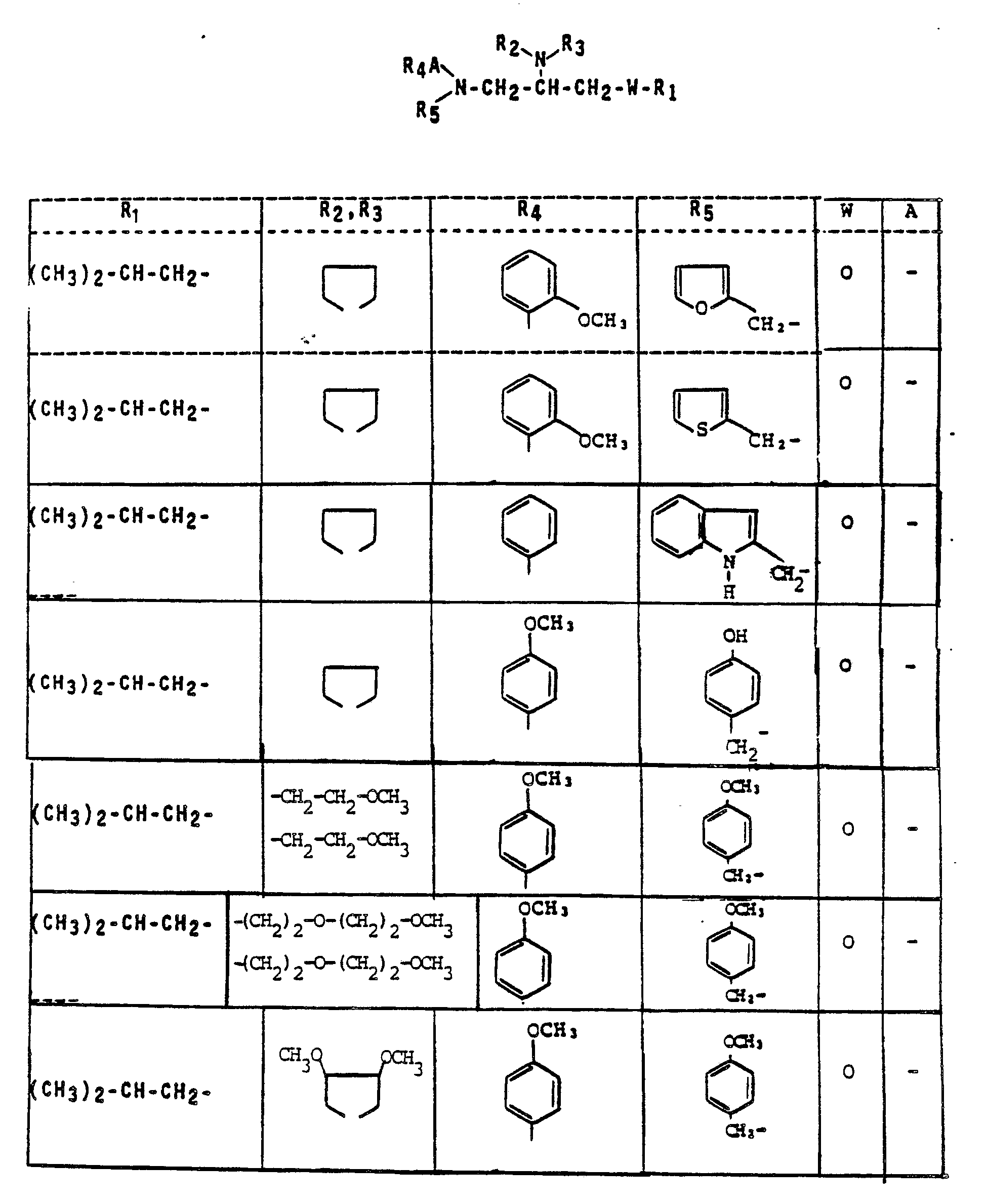
- Neben den nachfolgenden aufgeführten Beispielen sind insbesondere die folgenden Verbindungen im Sinne der Anmeldung bevorzugt:


- Zu einer Lösung von 5.5 g Natrium in 110 ml absol. Alkohol gibt man tropfenweise unter Rühren 34.8 g Diethylmalonat. Nach beendeter Zugabe erhitzt man noch eine Stunde am Rückfluß und gibt dann tropfenweise 41 g 4-Methyl-1-brompentan zu. Die Mischung wird noch 6 Stdn. am Rückfluß erhitzt und dann der Alkohol abdestilliert. Der Rückstand wird mit 100 ml konz. Kalilauge versetzt und die Mischung 2 Stdn. auf dem Wasserbad erwärmt. Dann wird abgekühlt und die Mischung mit 5 n Schwefelsäure sauer gestellt. Man erhitzt 3 Stdn. am Rückfluß, kühlt ab und extrahiert mit Essigester. Die Essigesterphase wird über Natriumsulfat getrocknet und eingedampft. Der Rückstand wird i. Vak. destilliert. Sdp. 120°C/2.5 mm. Die erhaltene Säure (40 g wird mit 50 ml Thionylchlorid versetzt und die Mischung 3 Stdn. am Rückfluß erhitzt. Dann wird eingedampft und der Rückstand unter Rühren bei 80°C tropfenweise mit 44 g Brom versetzt. Nach beendeter Zugabe erhitzt man 5 Stdn. weiter. Dann wird abgekühlt und das Reaktionsgemisch in 100 ml Alkohol eingetropft. Nach beendeter Zugabe erhitzt man 2 Stdn. am Rückfluß weiter.
- Man kühlt und versetzt die Mischung tropfenweise unter Rühren mit 25 ml Pyrrolidin. Nach beendeter Zugabe erhitzt man noch 2 Stdn. am Rückfluß und dampft dann zur Trockene ein. Der Rückstand wird zur Reinigung an einer Kieselgelsäule chromatographiert. Man erhält 25 g eines öligen Rückstands von 6-Methyl-2-(N-pyrrolidino)-heptancarbonsäureethylester. Dieser wird in 100 ml absol. Tetrahydrafuran gelöst und die Mischung nach Zugabe von 8 g Lithiumaluminiumhydrid 3 Stdn. bei Raumtemperatur gerührt.
- Das überschüssige Lithiumaluminiumhydrid wird durch Zugabe einer konz. Lösung von Aluminiumsulfat zersetzt und das Reaktionsprodukt mit Methylenchlorid extrahiert. Die Methylenchloridphase wird über Natriumsulfat getrocknet und eingedampft. Man erhält 15.4 g eines öligen Rückstandes von 6-Methyl-2-(N-pyrrolidino)-heptanol-1. 6 g dieser Verbindung werden in 20 ml Methylenchlorid gelöst und nach Zugabe von 8 g Thionylchlorid wird die Mischung 3 Stdn. am Rückfluß erhitzt. Dann wird eingedampft, der Rückstand in 20 ml Toluol gelöst, mit 7 g N-Benzylanilin und 2.8 g Natriumhydrid (50proz. ölige Suspension) versetzt und die Mischung 3 Stdn. am Rückfluß erhitzt. Dann wird abgekühlt, die Reaktionslösung mit Wasser versetzt und die organische Schicht abgetrennt. Diese wird über Natriumsulfat getrocknet und eingedampft. Der Rückstand wird zur Reinigung an einer Kieselgelsäule chromatographiert. (Elutionsmittel: Methylenchlorid/2 % Methanol). Die entsprechenden Säulenfraktionen werden eingedampft. Man erhält 7.2 g eines öligen Rückstandes. Dieser wird in Essigester gelöst und mit einer Lösung von Oxalsäure in Essigester versetzt. Die erhaltenen Kristalle werden abgesaugt und nochmals aus Essigester umkristallisiert. Man erhält 6.5 g der Titelverbindung vom Schmp. 125-126°C.
- 2.4 g 2-Methoxy-benzylanilin werden zusammen mit 2 g 2-Chlor-1-isobutoxy-3-(N-pyrrolidino)-propan in 20 ml absol. Toluol gelöst. Hierzu gibt man 0.9 g Natriumhydrid (50proz. ölige Suspension) und erhitzt die Mischung 3 Stdn. auf 100°C. Man kühlt ab, versetzt die Mischung mit Wasser und trennt die organische Schicht ab. Die wässrige Phase wird nochmals mit Toluol extrahiert. Die organischen Phasen werden vereinigt, über Natriumsulfat getrocknet und eingedampft. Der Rückstand wird durch Chromatographie an einer Kieselgelsäule gereinigt. (Fließmittel: Methylenchlorid/5 % Methanol). Die Säulenfraktionen werden eingedampft, der ölige Rückstand in Essigester gelöst und die Lösung mit einer Lösung von Oxalsäure in Essigester versetzt. Der Niederschlag wird abgesaugt und nochmals aus Essigester umkristallisiert. Man erhält 1.9 g der Titelverbindung.
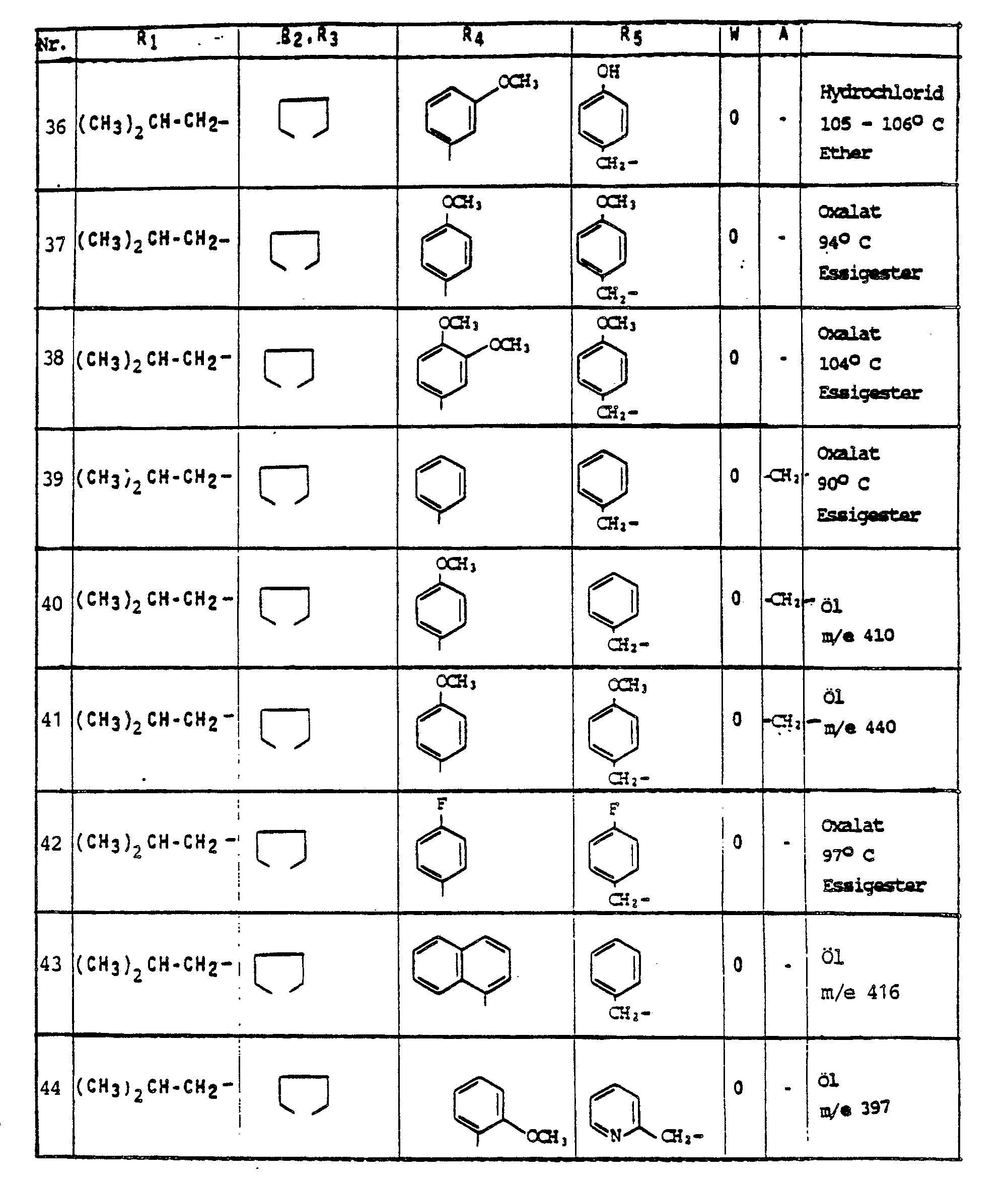
Schmp. 108°C - Die folgenden Beispiele wurden analog dargestellt.




Claims (4)
1. Verbindungen der Formel I

worin
R₁ einen geradkettigen oder verzweigten C₁-C₁₂-Alkylrest oder einen C₃-C₇ Cycloalkyl- oder C₃-C₇-Cycloalkylmethylrest
W ein Sauerstoffatom, ein Schwefelatom oder einen Valenzstrich bedeutet,
R₂ und R₃ gleich oder verschieden sein können und einen geradkettigen, verzweigten, gesättigten oder ungesättigten C₁-C₆-Alkylrest, der gegebenenfalls durch Hydroxy, C₁-C₃-Alkoxy oder C₁-C₃-Alkoxy-C₁-C₃-alkoxy substituiert sein kann,
bedeuten oder zusammen mit dem Stickstoffatom einen gesättigten oder ungesättigten Ring bilden, der noch weitere Heteroatome enthalten kann und zusätzlich gegebenenfalls durch eine niedrige Alkylgruppe, eine niedrige Alkoxygruppe oder ein Sauerstoffatom substituiert ist,
A einen Valenzstrich oder einen geradkettigen oder verzweigten Alkylrest mit 1-6, vorzugsweise 1-3 Kohlenstoffatomen bedeutet,
R₄ einen ein- oder mehrfach substituierten oder unsubstituierten mono- oder bicyclischen aromatischen Rest,
wobei die Substituenten
Alkyl-, C₂-C₆-Alkenyl-, Alkoxy-, C₂-C₆-Alkenyloxy-, Hydroxy-alkyl-, C₂-C₆-Alkylendioxy-, Hydroxy-alkoxy-, Alkoxy-alkoxy-, Alkylamino-, Dialkylamino-, Alkoxy-carbonyl-alkoxy-, Alkylmercapto-, Alkylsulfinyl-, Alkylsulfonyl-, Alkylsulfonyl-oxy-, Carboxy-, Alkoxy-carbonyl-, Amino-carbonyl-, Mono- oder Dialkylamino-carbonyl-, Halogenalkyl-oder Cyano-gruppen sowie Halogenatome, wie Chlor, Brom oder Fluor sein können.
und
R₅ einen substituierten Benzylrest, einen substituierten oder unsubstituierten Naphthylmethyl-Rest, einen unsubstituierten oder substituierten fünf- oder sechsgliedrigen mono- oder bicyclischen Hetarylmethyl-Rest oder einen substituierten oder unsubstituierten Indan-1-yl- oder Indan-2-yl-Rest oder einen substituierten oder unsubstituierten Tetralin-1-yl- oder Tetralin-2-yl-Rest bedeutet,
wobei die Substituenten
Alkyl-, C₂-C₆-Alkenyl-, Alkoxy-, C₂-C₆-Alkenyloxy-, Hydroxyalkyl-, C₂-C₆-Alkylendioxy-, Hydroxy-alkoxy-, Alkoxy-alkoxy-, Alkylamino-, Dialkylamino-, Alkoxy-carbonyl-alkyloxy-, Alkylmercapto-, Alkylsulfinyl-, Alkylsulfonyl-, Alkylsulfonyloxy-, Carboxy-, Alkoxy-carbonyl-, Amino-carbonyl-, Mono- oder Dialkylamino-carbonyl-, Halogenalkyl-oder Cyano-Gruppen, sowie Halogenatome, wie Chlor, Brom oder Fluor sein können.
wobei
R₅ auch einen unsubstituierten Phenylrest bedeuten kann, wenn W einen Valenzstrich oder ein Schwefelatom bedeutet oder A eine Methylengruppe bedeutet, oder R₄ einen Naphthylrest, einen Tetralinylrest oder einen Indanylrest.
sowie deren pharmakologisch unbedenklichen Salze und deren optische Isomeren.
R₁ einen geradkettigen oder verzweigten C₁-C₁₂-Alkylrest oder einen C₃-C₇ Cycloalkyl- oder C₃-C₇-Cycloalkylmethylrest
W ein Sauerstoffatom, ein Schwefelatom oder einen Valenzstrich bedeutet,
R₂ und R₃ gleich oder verschieden sein können und einen geradkettigen, verzweigten, gesättigten oder ungesättigten C₁-C₆-Alkylrest, der gegebenenfalls durch Hydroxy, C₁-C₃-Alkoxy oder C₁-C₃-Alkoxy-C₁-C₃-alkoxy substituiert sein kann,
bedeuten oder zusammen mit dem Stickstoffatom einen gesättigten oder ungesättigten Ring bilden, der noch weitere Heteroatome enthalten kann und zusätzlich gegebenenfalls durch eine niedrige Alkylgruppe, eine niedrige Alkoxygruppe oder ein Sauerstoffatom substituiert ist,
A einen Valenzstrich oder einen geradkettigen oder verzweigten Alkylrest mit 1-6, vorzugsweise 1-3 Kohlenstoffatomen bedeutet,
R₄ einen ein- oder mehrfach substituierten oder unsubstituierten mono- oder bicyclischen aromatischen Rest,
wobei die Substituenten
Alkyl-, C₂-C₆-Alkenyl-, Alkoxy-, C₂-C₆-Alkenyloxy-, Hydroxy-alkyl-, C₂-C₆-Alkylendioxy-, Hydroxy-alkoxy-, Alkoxy-alkoxy-, Alkylamino-, Dialkylamino-, Alkoxy-carbonyl-alkoxy-, Alkylmercapto-, Alkylsulfinyl-, Alkylsulfonyl-, Alkylsulfonyl-oxy-, Carboxy-, Alkoxy-carbonyl-, Amino-carbonyl-, Mono- oder Dialkylamino-carbonyl-, Halogenalkyl-oder Cyano-gruppen sowie Halogenatome, wie Chlor, Brom oder Fluor sein können.
und
R₅ einen substituierten Benzylrest, einen substituierten oder unsubstituierten Naphthylmethyl-Rest, einen unsubstituierten oder substituierten fünf- oder sechsgliedrigen mono- oder bicyclischen Hetarylmethyl-Rest oder einen substituierten oder unsubstituierten Indan-1-yl- oder Indan-2-yl-Rest oder einen substituierten oder unsubstituierten Tetralin-1-yl- oder Tetralin-2-yl-Rest bedeutet,
wobei die Substituenten
Alkyl-, C₂-C₆-Alkenyl-, Alkoxy-, C₂-C₆-Alkenyloxy-, Hydroxyalkyl-, C₂-C₆-Alkylendioxy-, Hydroxy-alkoxy-, Alkoxy-alkoxy-, Alkylamino-, Dialkylamino-, Alkoxy-carbonyl-alkyloxy-, Alkylmercapto-, Alkylsulfinyl-, Alkylsulfonyl-, Alkylsulfonyloxy-, Carboxy-, Alkoxy-carbonyl-, Amino-carbonyl-, Mono- oder Dialkylamino-carbonyl-, Halogenalkyl-oder Cyano-Gruppen, sowie Halogenatome, wie Chlor, Brom oder Fluor sein können.
wobei
R₅ auch einen unsubstituierten Phenylrest bedeuten kann, wenn W einen Valenzstrich oder ein Schwefelatom bedeutet oder A eine Methylengruppe bedeutet, oder R₄ einen Naphthylrest, einen Tetralinylrest oder einen Indanylrest.
sowie deren pharmakologisch unbedenklichen Salze und deren optische Isomeren.
2. Verfahren zur Herstellung von Verbindungen der Formel I
worin
R₁ einen geradkettigen oder verzweigten C₁-C₁₂-Alkylrest oder einen C₃-C₇ Cycloalkyl- oder C₃-C₇-Cycloalkylmethylrest
W ein Sauerstoffatom, ein Schwefelatom oder einen Valenzstrich bedeutet,
R₂ und R₃ gleich oder verschieden sein können und einen geradkettigen, verzweigten, gesättigten oder ungesättigten C₁-C₆-Alkylrest, der gegebenenfalls durch Hydroxy, C₁-C₃-Alkoxy oder C₁-C₃-Alkoxy-C₁-C₃-alkoxy substituiert sein kann,
bedeuten oder zusammen mit dem Stickstoffatom einen gesättigten oder ungesättigten Ring bilden, der noch weitere Heteroatome enthalten kann und zusätzlich gegebenenfalls durch eine niedrige Alkylgruppe, eine niedrige Alkoxygruppe oder ein Sauerstoffatom substituiert ist,
A einen Valenzstrich oder einen geradkettigen oder verzweigten Alkylrest mit 1-6, vorzugsweise 1-3 Kohlenstoffatomen bedeutet,
R₄ einen ein- oder mehrfach substituierten oder unsubstituierten mono- oder bicyclischen aromatischen Rest,
wobei die Substituenten
Alkyl-, C₂-C₆-Alkenyl-, Alkoxy-, C₂-C₆-Alkenyloxy-, Hydroxy-alkyl-, C₂-C₆-Alkylendioxy-, Hydroxy-alkoxy-, Alkoxy-alkoxy-, Alkylamino-, Dialkylamino-, Alkoxy-carbonyl-alkoxy-, Alkylmercapto-, Alkyl sulfinyl-, Alkylsulfonyl-, Alkylsulfonyloxy-, Carboxy-, Alkoxy-carbonyl-, Amino-carbonyl-, Mono- oder Dialkylamino-carbonyl-, Halogenalkyl-oder Cyano-gruppen sowie Halogenatome, wie Chlor, Brom oder Fluor sein können.
und
R₅ einen substituierten Benzylrest, einen substituierten oder unsubstituierten Naphthylmethyl-Rest, einen unsubstituierten oder substituierten fünf- oder sechsgliedrigen oder bicyclischen Hetarylmethyl-Rest oder einen substituierten oder unsubstituierten Indan-1-yl- oder Indan-2-yl-Rest oder einen substituierten oder unsubstituierten Tetralin-1-yl- oder Tetralin-2-yl-Rest bedeutet,
wobei die Substituenten
Alkyl-, C₂-C₆-Alkenyl-, Alkoxy-, C₂-C₆-Alkenyloxy-, Hydroxyalkyl-, C₂-C₆-Alkylendioxy-, Hydroxy-alkoxy-, Alkoxy-alkoxy-, Alkylamino-, Dialkylamino-, Alkoxy-carbonyl-alkyloxy-, Alkylmercapto-, Alkylsulfinyl-, Alkylsulfonyl-, Alkylsulfonyloxy-, Carboxy-, Alkoxy-carbonyl-, Amino-carbonyl-, Mono- oder Dialkylamino-carbonyl-, Halogenalkyl-oder Cyano-Gruppen, sowie Halogenatome, wie Chlor, Brom oder Fluor sein können.
wobei
R₅ auch einen unsubstituierten Phenylrest bedeuten kann, wenn W einen Valenzstrich oder ein Schwefelatom bedeutet oder A eine Methylengruppe bedeutet, oder R₄ einen Naphthylrest, einen Tetralinylrest oder einen Indanylrest.
sowie deren pharmakologisch unbedenklichen Salzen und deren optischen Isomeren,
dadurch gekennzeichnet, daß man in an sich bekannter Weise
worin
R₁ einen geradkettigen oder verzweigten C₁-C₁₂-Alkylrest oder einen C₃-C₇ Cycloalkyl- oder C₃-C₇-Cycloalkylmethylrest
W ein Sauerstoffatom, ein Schwefelatom oder einen Valenzstrich bedeutet,
R₂ und R₃ gleich oder verschieden sein können und einen geradkettigen, verzweigten, gesättigten oder ungesättigten C₁-C₆-Alkylrest, der gegebenenfalls durch Hydroxy, C₁-C₃-Alkoxy oder C₁-C₃-Alkoxy-C₁-C₃-alkoxy substituiert sein kann,
bedeuten oder zusammen mit dem Stickstoffatom einen gesättigten oder ungesättigten Ring bilden, der noch weitere Heteroatome enthalten kann und zusätzlich gegebenenfalls durch eine niedrige Alkylgruppe, eine niedrige Alkoxygruppe oder ein Sauerstoffatom substituiert ist,
A einen Valenzstrich oder einen geradkettigen oder verzweigten Alkylrest mit 1-6, vorzugsweise 1-3 Kohlenstoffatomen bedeutet,
R₄ einen ein- oder mehrfach substituierten oder unsubstituierten mono- oder bicyclischen aromatischen Rest,
wobei die Substituenten
Alkyl-, C₂-C₆-Alkenyl-, Alkoxy-, C₂-C₆-Alkenyloxy-, Hydroxy-alkyl-, C₂-C₆-Alkylendioxy-, Hydroxy-alkoxy-, Alkoxy-alkoxy-, Alkylamino-, Dialkylamino-, Alkoxy-carbonyl-alkoxy-, Alkylmercapto-, Alkyl sulfinyl-, Alkylsulfonyl-, Alkylsulfonyloxy-, Carboxy-, Alkoxy-carbonyl-, Amino-carbonyl-, Mono- oder Dialkylamino-carbonyl-, Halogenalkyl-oder Cyano-gruppen sowie Halogenatome, wie Chlor, Brom oder Fluor sein können.
und
R₅ einen substituierten Benzylrest, einen substituierten oder unsubstituierten Naphthylmethyl-Rest, einen unsubstituierten oder substituierten fünf- oder sechsgliedrigen oder bicyclischen Hetarylmethyl-Rest oder einen substituierten oder unsubstituierten Indan-1-yl- oder Indan-2-yl-Rest oder einen substituierten oder unsubstituierten Tetralin-1-yl- oder Tetralin-2-yl-Rest bedeutet,
wobei die Substituenten
Alkyl-, C₂-C₆-Alkenyl-, Alkoxy-, C₂-C₆-Alkenyloxy-, Hydroxyalkyl-, C₂-C₆-Alkylendioxy-, Hydroxy-alkoxy-, Alkoxy-alkoxy-, Alkylamino-, Dialkylamino-, Alkoxy-carbonyl-alkyloxy-, Alkylmercapto-, Alkylsulfinyl-, Alkylsulfonyl-, Alkylsulfonyloxy-, Carboxy-, Alkoxy-carbonyl-, Amino-carbonyl-, Mono- oder Dialkylamino-carbonyl-, Halogenalkyl-oder Cyano-Gruppen, sowie Halogenatome, wie Chlor, Brom oder Fluor sein können.
wobei
R₅ auch einen unsubstituierten Phenylrest bedeuten kann, wenn W einen Valenzstrich oder ein Schwefelatom bedeutet oder A eine Methylengruppe bedeutet, oder R₄ einen Naphthylrest, einen Tetralinylrest oder einen Indanylrest.
sowie deren pharmakologisch unbedenklichen Salzen und deren optischen Isomeren,
dadurch gekennzeichnet, daß man in an sich bekannter Weise
a) eine Verbindung der allgemeinen Formel II,

in der R₁, R₂, R₃ und W die oben genannten Bedeutungen besitzen, mit einer Verbindung der allgemeinen Formel III,

in der A, R₄ und R₅ die oben genannten Bedeutungen besitzen, umsetzt
oder
oder
b) eine Verbindung der allgemeinen Formel IV,

in der R₁, R₂, R₃ und W die oben genannten Bedeutungen besitzen, mit einer Verbindung der allgemeinen Formel III umsetzt,
oder
oder
c) eine Verbindung der allgemeinen Formel V,

in der R₁, R₂, R₃ und W die oben angegebenen Bedeutungen besitzen und B ein Halogenatom oder eine Alkoxy-gruppe bedeutet, einer Amidbildungsreaktion mit einer Verbindung der allgemeinen Formel III unterzieht und die erhaltene Verbindung der allgemeinen Formel VI,

in der R₁, R₂, R₃, R₄, R₅ und W die oben genannten Bedeutungen besitzen, einer Reduktion mit einem komplexen Hydrid oder Diboran unterwirft, und anschließend gewünschtenfalls die erhaltenen Verbindungen in ihre pharmakologisch unbedenkliche Salze überführt.
3. Arzneimittel, enthaltend eine Verbindung gemäß Anspruch 1 neben üblichen Träger- und Hilfsstoffen .
4. Verwendung von Verbindungen gemäß Anspruch 1, zur Behandlung von Herz- und Kreislauferkrankungen.
Applications Claiming Priority (2)
| Application Number | Priority Date | Filing Date | Title |
|---|---|---|---|
| DE19873726632 DE3726632A1 (de) | 1987-08-11 | 1987-08-11 | 1,2-diamino-verbindungen, verfahren zu ihrer herstellung sowie arzneimittel, die diese verbindungen enthalten |
| DE3726632 | 1987-08-11 |
Publications (2)
| Publication Number | Publication Date |
|---|---|
| EP0303181A2 true EP0303181A2 (de) | 1989-02-15 |
| EP0303181A3 EP0303181A3 (de) | 1991-09-04 |
Family
ID=6333479
Family Applications (1)
| Application Number | Title | Priority Date | Filing Date |
|---|---|---|---|
| EP19880112679 Withdrawn EP0303181A3 (de) | 1987-08-11 | 1988-08-04 | 1,2-Diamino-Verbindungen, Verfahren zu ihrer Herstellung sowie Arzneimittel, die diese Verbindungen enthalten |
Country Status (4)
| Country | Link |
|---|---|
| US (1) | US4923889A (de) |
| EP (1) | EP0303181A3 (de) |
| JP (1) | JPS6490158A (de) |
| DE (1) | DE3726632A1 (de) |
Cited By (1)
| Publication number | Priority date | Publication date | Assignee | Title |
|---|---|---|---|---|
| EP1730099A4 (de) * | 2004-03-22 | 2008-03-12 | Merck & Co Inc | Inhibitoren von mitotischem kinesin |
Family Cites Families (10)
| Publication number | Priority date | Publication date | Assignee | Title |
|---|---|---|---|---|
| CH298886A (de) * | 1951-06-15 | 1954-05-31 | Ag Sandoz | Verfahren zur Herstellung eines grünen substantiven Farbstoffes der Anthrachinonreihe. |
| GB853799A (en) * | 1957-11-21 | 1960-11-09 | Pfizer & Co C | Diquaternary compounds and process of preparing same |
| US3923813A (en) * | 1969-12-19 | 1975-12-02 | Christiaens Sa A | Derivatives of 2-aminoindanes |
| BE795735A (fr) * | 1972-03-06 | 1973-06-18 | Cerm Cent Europ Rech Mauvernay | Nouvelles ethylenediamines substituees a activite cardiovasculaire |
| FR2378024A1 (fr) * | 1977-01-25 | 1978-08-18 | Cerm Cent Europ Rech Mauvernay | Nouvelle propylamine substituee, obtention et application |
| AU559555B2 (en) * | 1981-12-28 | 1987-03-12 | Carter-Wallace, Inc. | Chemical process |
| DK156396C (da) * | 1983-09-27 | 1990-01-08 | Cerm Cent Europ Rech Mauvernay | 2-(n-pyrrolidino)-3-isobutoxy-n-substituerede phenyl-n-benzyl-propylamin-forbindelser og farmaceutiske midler indeholdende disse |
| AU568704B2 (en) * | 1983-11-11 | 1988-01-07 | Akzo N.V. | Ether of n-propanolamine derivative |
| US4727072A (en) * | 1986-02-12 | 1988-02-23 | Mcneilab, Inc. | 3-alkoxy-2-aminopropylamines compositions and use as cardiovascular agents |
| US4758563A (en) * | 1986-02-12 | 1988-07-19 | Mcneilab, Inc. | 3-alkoxy-2-aminopropyamines, cardiovascular compositions and use |
-
1987
- 1987-08-11 DE DE19873726632 patent/DE3726632A1/de not_active Withdrawn
-
1988
- 1988-08-04 EP EP19880112679 patent/EP0303181A3/de not_active Withdrawn
- 1988-08-09 JP JP63197310A patent/JPS6490158A/ja active Pending
- 1988-08-11 US US07/230,947 patent/US4923889A/en not_active Expired - Fee Related
Cited By (1)
| Publication number | Priority date | Publication date | Assignee | Title |
|---|---|---|---|---|
| EP1730099A4 (de) * | 2004-03-22 | 2008-03-12 | Merck & Co Inc | Inhibitoren von mitotischem kinesin |
Also Published As
| Publication number | Publication date |
|---|---|
| US4923889A (en) | 1990-05-08 |
| JPS6490158A (en) | 1989-04-06 |
| EP0303181A3 (de) | 1991-09-04 |
| DE3726632A1 (de) | 1989-05-18 |
Similar Documents
| Publication | Publication Date | Title |
|---|---|---|
| EP0934311B1 (de) | Neue heterocyclylmethyl-substituierte pyrazolderivate und ihre verwendung in der behandlung von herz-kreislauf-erkrankungen | |
| DE3875073T2 (de) | 3-(4(1-substituierte-4-piperazinyl)butyl)-4-thiazolidinone, verfahren zu deren herstellung und ihre anwendung als arzneimittel. | |
| DE2658610C2 (de) | Phenylessigsäureesterderivate | |
| EP0183159A2 (de) | 1-Heteroaryl-4-aryl-pyrazolin-5-one zur Verwendung als Arzneimittel | |
| DE10046029A1 (de) | Indazole | |
| DD267727A5 (de) | Verfahren zur herstellung von arylcyclobutylalkylamin-derivaten | |
| EP0271040A2 (de) | Neue Pyrrolobenzimidazole, Verfahren zu ihrer Herstellung, sowie Arzneimittel | |
| DE69225123T2 (de) | Thiazolidinederivate, die eine Quinone-Gruppe enthalten, ihre Herstellung und therapeutische Anwendung | |
| DE3209276A1 (de) | Arzneimittel mit antihypoxischer und ischaemie-protektiver wirkung | |
| EP0008645A1 (de) | Alkoxyphenylpyrrolidone, Verfahren zu ihrer Herstellung und Arzneimittel auf Basis dieser Verbindungen | |
| DE3532279A1 (de) | 1,4-benzoxathiin-derivate | |
| DE2735433A1 (de) | Neue phenylnitromethanverbindungen und verfahren zu ihrer herstellung | |
| DE3888811T2 (de) | Tricyclische Carbamate, Verfahren zu ihrer Herstellung und ihre therapeutische Verwendung. | |
| EP0330940A2 (de) | Neue trisubstituierte Amine, Verfahren zu ihrer Herstellung sowie Arzneimittel, die diese Verbindungen enthalten | |
| EP0303181A2 (de) | 1,2-Diamino-Verbindungen, Verfahren zu ihrer Herstellung sowie Arzneimittel, die diese Verbindungen enthalten | |
| DE3719488A1 (de) | Verfahren zur herstellung von 3,3-diarylacrylsaeureamiden | |
| EP0275024B1 (de) | Neue Carbonsäurederivate, Verfahren zu ihrer Herstellung sowie Arzneimittel, die diese Verbindungen enthalten | |
| EP0303179A1 (de) | Neue 1,2-Diamino-Verbindungen, Verfahren zu ihrer Herstellung sowie Arzneimittel, die diese Verbindungen enthalten | |
| EP0088323B1 (de) | Imidazothiadiazolalkencarbonsäureamide, neue Zwischenprodukte zu ihrer Herstellung, ihre Herstellung und ihre Verwendung in Arzneimitteln | |
| EP0009560A1 (de) | Neue 1,4-Dihydropyridazin-3-carbonylverbindungen, Verfahren zu ihrer Herstellung, die Verbindungen zur Verwendung bei der Behandlung von Krankheiten, diese enthaltende Arzneimittel und Verfahren zur Herstellung der Arzneimittel | |
| DE3020421A1 (de) | Imidazoazolalkensaeureamide, neue zwischenprodukte zu ihrer herstellung, ihre herstellung und ihre verwendung in arzneimitteln | |
| DE1035150B (de) | Verfahren zur Herstellung von N-monosubstituierten ª‡-(tert.-Aminoalkyl)-ª‡-phenyl-acetamiden | |
| EP0158312B1 (de) | 1-[Cyclohexyl]-3,4-di-[hydro]-isochinolinderivate, Verfahren zu ihrer Herstellung und diese enthaltende Arzneimittel | |
| EP0199323A2 (de) | 4-Aminoalkylidensubstituierte 3-Aryl-5(4H)-isoxazolone, Verfahren zur ihrer Herstellung, diese Verbindungen enthaltende Arzneimittel und ihre Verwendung | |
| DE3785963T2 (de) | Dihydropyridine, verfahren zu ihrer herstellung und ihre verwendung als arzneimittel. |
Legal Events
| Date | Code | Title | Description |
|---|---|---|---|
| PUAI | Public reference made under article 153(3) epc to a published international application that has entered the european phase |
Free format text: ORIGINAL CODE: 0009012 |
|
| 17P | Request for examination filed |
Effective date: 19880808 |
|
| AK | Designated contracting states |
Kind code of ref document: A2 Designated state(s): AT BE CH DE ES FR GB GR IT LI LU NL SE |
|
| PUAL | Search report despatched |
Free format text: ORIGINAL CODE: 0009013 |
|
| AK | Designated contracting states |
Kind code of ref document: A3 Designated state(s): AT BE CH DE ES FR GB GR IT LI LU NL SE |
|
| STAA | Information on the status of an ep patent application or granted ep patent |
Free format text: STATUS: THE APPLICATION IS DEEMED TO BE WITHDRAWN |
|
| 18D | Application deemed to be withdrawn |
Effective date: 19920305 |