EP0303381A1 - Nähfaden aus Kohlenstoffasern - Google Patents
Nähfaden aus Kohlenstoffasern Download PDFInfo
- Publication number
- EP0303381A1 EP0303381A1 EP88307093A EP88307093A EP0303381A1 EP 0303381 A1 EP0303381 A1 EP 0303381A1 EP 88307093 A EP88307093 A EP 88307093A EP 88307093 A EP88307093 A EP 88307093A EP 0303381 A1 EP0303381 A1 EP 0303381A1
- Authority
- EP
- European Patent Office
- Prior art keywords
- thread
- carbon fiber
- denier
- fineness
- stitching
- Prior art date
- Legal status (The legal status is an assumption and is not a legal conclusion. Google has not performed a legal analysis and makes no representation as to the accuracy of the status listed.)
- Granted
Links
- 229920000049 Carbon (fiber) Polymers 0.000 title claims abstract description 120
- 239000004917 carbon fiber Substances 0.000 title claims abstract description 120
- VNWKTOKETHGBQD-UHFFFAOYSA-N methane Chemical compound C VNWKTOKETHGBQD-UHFFFAOYSA-N 0.000 title claims abstract description 118
- 239000000835 fiber Substances 0.000 claims abstract description 64
- 238000012360 testing method Methods 0.000 claims description 22
- 239000004744 fabric Substances 0.000 description 39
- 238000000034 method Methods 0.000 description 18
- IAZDPXIOMUYVGZ-UHFFFAOYSA-N Dimethylsulphoxide Chemical compound CS(C)=O IAZDPXIOMUYVGZ-UHFFFAOYSA-N 0.000 description 17
- 230000003014 reinforcing effect Effects 0.000 description 11
- 239000000243 solution Substances 0.000 description 9
- 239000002131 composite material Substances 0.000 description 8
- 229920005989 resin Polymers 0.000 description 8
- 239000011347 resin Substances 0.000 description 8
- XLYOFNOQVPJJNP-UHFFFAOYSA-N water Substances O XLYOFNOQVPJJNP-UHFFFAOYSA-N 0.000 description 8
- 229920002972 Acrylic fiber Polymers 0.000 description 6
- 239000003795 chemical substances by application Substances 0.000 description 6
- 239000011159 matrix material Substances 0.000 description 6
- 238000004513 sizing Methods 0.000 description 6
- 230000000052 comparative effect Effects 0.000 description 5
- 238000009987 spinning Methods 0.000 description 5
- NLHHRLWOUZZQLW-UHFFFAOYSA-N Acrylonitrile Chemical compound C=CC#N NLHHRLWOUZZQLW-UHFFFAOYSA-N 0.000 description 4
- PEDCQBHIVMGVHV-UHFFFAOYSA-N Glycerine Chemical compound OCC(O)CO PEDCQBHIVMGVHV-UHFFFAOYSA-N 0.000 description 4
- 238000009661 fatigue test Methods 0.000 description 4
- 239000000314 lubricant Substances 0.000 description 4
- 230000003647 oxidation Effects 0.000 description 4
- 238000007254 oxidation reaction Methods 0.000 description 4
- 239000000047 product Substances 0.000 description 4
- 238000004381 surface treatment Methods 0.000 description 4
- 238000005303 weighing Methods 0.000 description 4
- 239000002759 woven fabric Substances 0.000 description 4
- 241001589086 Bellapiscis medius Species 0.000 description 3
- 239000000470 constituent Substances 0.000 description 3
- 239000006059 cover glass Substances 0.000 description 3
- 239000011521 glass Substances 0.000 description 3
- 230000014759 maintenance of location Effects 0.000 description 3
- 230000003287 optical effect Effects 0.000 description 3
- 229920001223 polyethylene glycol Polymers 0.000 description 3
- 238000002166 wet spinning Methods 0.000 description 3
- RBDWCSWYBOZGGD-UHFFFAOYSA-N [C].C(C=C)#N Chemical compound [C].C(C=C)#N RBDWCSWYBOZGGD-UHFFFAOYSA-N 0.000 description 2
- 238000010521 absorption reaction Methods 0.000 description 2
- 229920001577 copolymer Polymers 0.000 description 2
- 239000004205 dimethyl polysiloxane Substances 0.000 description 2
- 235000011187 glycerol Nutrition 0.000 description 2
- 238000010438 heat treatment Methods 0.000 description 2
- 238000004519 manufacturing process Methods 0.000 description 2
- 239000000463 material Substances 0.000 description 2
- 238000005259 measurement Methods 0.000 description 2
- 238000012986 modification Methods 0.000 description 2
- 230000004048 modification Effects 0.000 description 2
- 238000000465 moulding Methods 0.000 description 2
- 230000002093 peripheral effect Effects 0.000 description 2
- 229920000435 poly(dimethylsiloxane) Polymers 0.000 description 2
- -1 polydimethylsiloxane Polymers 0.000 description 2
- 229920000642 polymer Polymers 0.000 description 2
- 229920001296 polysiloxane Polymers 0.000 description 2
- 238000002360 preparation method Methods 0.000 description 2
- 125000002924 primary amino group Chemical group [H]N([H])* 0.000 description 2
- 239000012779 reinforcing material Substances 0.000 description 2
- 230000000630 rising effect Effects 0.000 description 2
- JAHNSTQSQJOJLO-UHFFFAOYSA-N 2-(3-fluorophenyl)-1h-imidazole Chemical compound FC1=CC=CC(C=2NC=CN=2)=C1 JAHNSTQSQJOJLO-UHFFFAOYSA-N 0.000 description 1
- QGZKDVFQNNGYKY-UHFFFAOYSA-N Ammonia Chemical compound N QGZKDVFQNNGYKY-UHFFFAOYSA-N 0.000 description 1
- 239000004593 Epoxy Substances 0.000 description 1
- UFHFLCQGNIYNRP-UHFFFAOYSA-N Hydrogen Chemical compound [H][H] UFHFLCQGNIYNRP-UHFFFAOYSA-N 0.000 description 1
- 239000002202 Polyethylene glycol Substances 0.000 description 1
- QGZKDVFQNNGYKY-UHFFFAOYSA-O ammonium group Chemical group [NH4+] QGZKDVFQNNGYKY-UHFFFAOYSA-O 0.000 description 1
- BFNBIHQBYMNNAN-UHFFFAOYSA-N ammonium sulfate Chemical compound N.N.OS(O)(=O)=O BFNBIHQBYMNNAN-UHFFFAOYSA-N 0.000 description 1
- 229910052921 ammonium sulfate Inorganic materials 0.000 description 1
- 235000011130 ammonium sulphate Nutrition 0.000 description 1
- 229920006231 aramid fiber Polymers 0.000 description 1
- 238000005452 bending Methods 0.000 description 1
- 230000015572 biosynthetic process Effects 0.000 description 1
- 239000011304 carbon pitch Substances 0.000 description 1
- 238000003763 carbonization Methods 0.000 description 1
- 238000010000 carbonizing Methods 0.000 description 1
- 125000003178 carboxy group Chemical group [H]OC(*)=O 0.000 description 1
- 230000015271 coagulation Effects 0.000 description 1
- 238000005345 coagulation Methods 0.000 description 1
- 239000013065 commercial product Substances 0.000 description 1
- 238000007796 conventional method Methods 0.000 description 1
- 238000001816 cooling Methods 0.000 description 1
- 230000003247 decreasing effect Effects 0.000 description 1
- 239000006185 dispersion Substances 0.000 description 1
- 238000005485 electric heating Methods 0.000 description 1
- 239000008151 electrolyte solution Substances 0.000 description 1
- 230000002708 enhancing effect Effects 0.000 description 1
- 239000003822 epoxy resin Substances 0.000 description 1
- 239000003365 glass fiber Substances 0.000 description 1
- BHEPBYXIRTUNPN-UHFFFAOYSA-N hydridophosphorus(.) (triplet) Chemical compound [PH] BHEPBYXIRTUNPN-UHFFFAOYSA-N 0.000 description 1
- 239000001257 hydrogen Substances 0.000 description 1
- 229910052739 hydrogen Inorganic materials 0.000 description 1
- 238000003475 lamination Methods 0.000 description 1
- 210000003041 ligament Anatomy 0.000 description 1
- 239000002184 metal Substances 0.000 description 1
- 229910052751 metal Inorganic materials 0.000 description 1
- LVHBHZANLOWSRM-UHFFFAOYSA-N methylenebutanedioic acid Natural products OC(=O)CC(=C)C(O)=O LVHBHZANLOWSRM-UHFFFAOYSA-N 0.000 description 1
- 239000012299 nitrogen atmosphere Substances 0.000 description 1
- 239000002736 nonionic surfactant Substances 0.000 description 1
- 230000001590 oxidative effect Effects 0.000 description 1
- 230000000704 physical effect Effects 0.000 description 1
- 239000011295 pitch Substances 0.000 description 1
- 229920002239 polyacrylonitrile Polymers 0.000 description 1
- 229920000647 polyepoxide Polymers 0.000 description 1
- 229920000728 polyester Polymers 0.000 description 1
- 230000002265 prevention Effects 0.000 description 1
- 239000007787 solid Substances 0.000 description 1
- 239000007858 starting material Substances 0.000 description 1
- 238000013519 translation Methods 0.000 description 1
- 238000009736 wetting Methods 0.000 description 1
Images

Classifications
-
- D—TEXTILES; PAPER
- D02—YARNS; MECHANICAL FINISHING OF YARNS OR ROPES; WARPING OR BEAMING
- D02G—CRIMPING OR CURLING FIBRES, FILAMENTS, THREADS, OR YARNS; YARNS OR THREADS
- D02G3/00—Yarns or threads, e.g. fancy yarns; Processes or apparatus for the production thereof, not otherwise provided for
- D02G3/02—Yarns or threads characterised by the material or by the materials from which they are made
- D02G3/16—Yarns or threads made from mineral substances
-
- C—CHEMISTRY; METALLURGY
- C08—ORGANIC MACROMOLECULAR COMPOUNDS; THEIR PREPARATION OR CHEMICAL WORKING-UP; COMPOSITIONS BASED THEREON
- C08F—MACROMOLECULAR COMPOUNDS OBTAINED BY REACTIONS ONLY INVOLVING CARBON-TO-CARBON UNSATURATED BONDS
- C08F8/00—Chemical modification by after-treatment
- C08F8/06—Oxidation
-
- D—TEXTILES; PAPER
- D02—YARNS; MECHANICAL FINISHING OF YARNS OR ROPES; WARPING OR BEAMING
- D02G—CRIMPING OR CURLING FIBRES, FILAMENTS, THREADS, OR YARNS; YARNS OR THREADS
- D02G3/00—Yarns or threads, e.g. fancy yarns; Processes or apparatus for the production thereof, not otherwise provided for
- D02G3/22—Yarns or threads characterised by constructional features, e.g. blending, filament/fibre
- D02G3/26—Yarns or threads characterised by constructional features, e.g. blending, filament/fibre with characteristics dependent on the amount or direction of twist
- D02G3/28—Doubled, plied, or cabled threads
-
- D—TEXTILES; PAPER
- D02—YARNS; MECHANICAL FINISHING OF YARNS OR ROPES; WARPING OR BEAMING
- D02G—CRIMPING OR CURLING FIBRES, FILAMENTS, THREADS, OR YARNS; YARNS OR THREADS
- D02G3/00—Yarns or threads, e.g. fancy yarns; Processes or apparatus for the production thereof, not otherwise provided for
- D02G3/44—Yarns or threads characterised by the purpose for which they are designed
- D02G3/46—Sewing-cottons or the like
-
- C—CHEMISTRY; METALLURGY
- C08—ORGANIC MACROMOLECULAR COMPOUNDS; THEIR PREPARATION OR CHEMICAL WORKING-UP; COMPOSITIONS BASED THEREON
- C08F—MACROMOLECULAR COMPOUNDS OBTAINED BY REACTIONS ONLY INVOLVING CARBON-TO-CARBON UNSATURATED BONDS
- C08F2800/00—Copolymer characterised by the proportions of the comonomers expressed
- C08F2800/10—Copolymer characterised by the proportions of the comonomers expressed as molar percentages
-
- Y—GENERAL TAGGING OF NEW TECHNOLOGICAL DEVELOPMENTS; GENERAL TAGGING OF CROSS-SECTIONAL TECHNOLOGIES SPANNING OVER SEVERAL SECTIONS OF THE IPC; TECHNICAL SUBJECTS COVERED BY FORMER USPC CROSS-REFERENCE ART COLLECTIONS [XRACs] AND DIGESTS
- Y10—TECHNICAL SUBJECTS COVERED BY FORMER USPC
- Y10S—TECHNICAL SUBJECTS COVERED BY FORMER USPC CROSS-REFERENCE ART COLLECTIONS [XRACs] AND DIGESTS
- Y10S57/00—Textiles: spinning, twisting, and twining
- Y10S57/903—Sewing threads
Definitions
- the present invention relates to a carbon fiber thread having high performance and particularly to a carbon fiber thread which exhibits excellent processability, shape retention, and reinforcing effect, for example, when used for stitching of a reinforcing fabric for a composite material.
- a woven fabric such as a carbon fiber woven fabric or a hybrid woven fabric comprising a carbon fiber and other fiber having high strength and high modulus, is utilized as a reinforcing material for a composite material.
- a fabric is formed after, for example, either it is impregnated with a matrix resin and plural impregnated fabrics are laminated or it is preformed into a desired shape and impregnated with a matrix resin.
- the above-described laminated fabrics are generally stitched with a stitching thread in order to improve the shape retention or the peel strength between the laminated fabrics.
- Examples of the stitching thread include a glass fiber, a polyester fiber, an aramid fiber, and a blended yarn of carbon fiber and organic fiber.
- these stitching threads had drawbacks, such as high water absorption, poor heat resistance, poor adhesion to a matrix material such as resin or poor strength and modulus, which made it impossible to sufficiently reflect the characteristics of the reinforcing fabric in the composite material.
- the above-described problems may be solved by preparing the stitching thread of a carbon fiber only.
- the carbon fiber has characteristics such that it is strong against tension but fragile against bending. This raised problems such as occurrence of breakage and fuzzing of the thread caused by thrust with a needle and friction with the fabric in the process of stitching. Therefore, it is the state of the art that no satisfactory stitching thread for reinforcing fabric has been prepared.
- An object of the present invention is to provide a carbon fiber thread which hardly causes breakage and fuzzing of a thread in the process of stitching.
- Another object of the present invention is to provide a carbon fiber stitching thread capable of improving the peel strength between reinforcing fabrics when the laminated reinforcing fabrics are stitched.
- the thread of the present invention has a basic thread structure prepared by doubling or plying and twisting plural carbon fiber strands having first twists in the direction reverse to the first twists to give final twists, wherein the number of first twists and the number of final twists are 80 turns/m or more and 50 turns/m or more, respectively.
- the thread of the present invention has features that the fineness and knot strength of the thread are 3000 denier or less and 1.0 g/denier or more, respectively, and the fineness of the single fibers of the above-described carbon fiber strand constituting the thread and the loop breaking strain of the single fiber as determined according to the single fiber loop test are 0.7 denier or less and 2.5% or more, respectively.
- the thread of the present invention comprises a plurality of interlaced carbon fiber strands.
- the interlacing structure should be one formed by plying and twisting the above-described plural carbon fiber strands having first twists to give final twists, thereby preparing a thread.
- the interlacing structure may be not the above-described multi-ply twist structure but a braid structure.
- a braid comprising plural carbon fiber strands has a drawback, such as poor shape retention, because the braid causes the thread to be twisted due to the residual torque which the carbon fiber strands have.
- the cross section of the braid comprising carbon fiber strands is not uniform in the longitudinal direction thereof, the frictional force between the thread and the fabric is increased during stitching, which unfavorably damages the fabric.
- the thread of the present invention comprises a multi-ply twist structure prepared by plying and twisting carbon fiber strands having first twists in the direction reverse to the first twists to give final twists. Therefore, a thread free from twisting and having excellent shape stability can be formed by balancing the first twists against the final twists. Further, the cross section of the thread is uniform in the longitudinal direction thereof, which makes it possible to substantially prevent the occurrence of the damage to the fabric during stitching.
- the number of first twists be 80 turns/m or more, particularly 80 to 400 turns/m and the number of final twists be 50 turns/m or more, particularly 50 to 300 turns/m.
- the number of twists is smaller than the above-described value, the uniformity of the cross section in the longitudinal direction of the thread and the bundling property are lowered, which brings about the occurrence of fuzzing of the thread and the damage to the fabric in the process of stitching.
- the number of twists is too large, the translation of strength of the stitching thread is lowered because it is difficult to impregnate the thread with a matrix material, such as a resin, during forming of the composite material.
- the term "number of first twists of the carbon fiber strands" is intended to mean the number of twists given to each carbon fiber strand before plying and twisting. Therefore, when the final twists are given in the reverse direction of the first twists during doubling, the number of twists remaining in the constituent carbon fiber strands which have been plied and twisted into a thread is equal to the number of first twists minus the number of final twists. That is, the expression “a first twist of 80 turns/m or more which the carbon fiber strands specified in the present invention have” is intended to mean that the number of twists obtained by adding the number of final twists to the number of twists of the constituent carbon fiber strand in the form of a commercial product is 80 turns/m or more.
- the number of carbon fiber strands constituting the thread is preferably 2 to 6, still preferably 2 to 3.
- the selection of the above-described number of carbon fiber strands makes it easy to prepare a stitching thread and improve the cross section of the stitching thread.
- the lengths of the carbon fiber strands constituting the thread be substantially the same with each other.
- the expression "the lengths of the carbon fiber strands are substantially the same with each other" used herein is intended to include not only the case where the lengths of the carbon fiber strands are literally identical to each other but also the case where the variation in the length is as small as 0.5% or less.
- the stretching of the thread brings about a condition where a load is first applied on the shortest carbon fiber strand and then on the next shortest carbon fiber strand, which unfavorably lowers the tenacity of the thread to a great extent. In this case, it is a matter of course that the knot tenacity of the thread is also lowered.
- the fineness of the thread is preferably 1500 denier or less, still preferably 1000 denier or less.
- the friction between the thread and the fabric is increased in stitching process, which not only renders both the thread and the fabric susceptible to damage but also brings about an increase in the yarn slippage of the fibers constituting the fabric.
- the fineness of carbon fiber strands constituting the above-described thread is preferably 1000 denier or less, still preferably 500 denier or less.
- the fineness of carbon fiber strand exceeds 1000 denier, the twisting of the carbon fiber strands yields a thread having a nonuniform cross section. As in the above-described case, this brings about an increase in the friction between the thread and the fabric in the step of stitching, which renders both the stitching thread and the fabric susceptible to damage.
- the thread of the present invention it is necessary that the thread have not only a fineness of 3000 denier or less as described above but also a knot strength of 1.0 g/denier or more.
- the knot strength is preferably 1.5 g/denier or more, still preferably 2.5 g/denier or more.
- the processability in the process of stitching can be improved only when the thread has a fineness of 3000 denier or less and a knot strength of 1.0 g/denier or more. That is, under these conditions, the breakage and fuzzing of the thread during stitching could remarkably be lowered.
- the single fibers of the carbon fiber strands constituting the thread each have a fineness of 0.7 denier or less, preferably 0.5 denier or less and a loop breaking strain of 2.5% or more, preferably 3.5% or more as determined according to the single fiber loop test.
- the strength of the carbon fiber strand is preferably 300 kg/mm2 or more, particularly preferably 500 kg/mm2 or more.
- the fiber characteristics were determined by the following methods.
- the fineness is determined according to the method prescribed in ASTM D578-61.
- the knot strength is determined according to the method prescribed in ASTM D2256-75.
- the strand strength is determined according to the resin-impregnated strand test prescribed in JIS R7601.
- the single fiber loop test is conducted with a zoom-lens optical microscope because the loop of the single fiber to be measured is small.
- the image observed under the optical microscope is recorded with a TV camera which hardly causes a residual image to read the diameter D of a loop L of a single fiber y immediately before breaking as shown in Fig. 1 on a cathode ray tube (CRT).
- the magnification of observation and the distortion of the image plane are checked with a microscale to adjust the final magnification of observation to 20 to 250.
- Model VC 820L subminiature photographing apparatus a product of Tokyo Denshi Kogaku K.K.
- Model 12M30A 12" video monitor a product of Tokyo Electronic Industry Co., Ltd.
- Model NV-180 video MACLORD a product of Matsushita Electric Industrial Co., Ltd.
- the single fiber loop is prepared by placing a single fiber on a slide glass, dropping one or two drops of glycerin on the central portion of the single fiber, twisting the single fiber to form a loop, and placing a cover glass on the loop. This is placed under the above-described optical microscope and both ends of the single fiber y are pulled in the direction of arrows shown in Fig. 1 with both ends of the single fiber on the slide glass with fingers while maintaining the loop within a field of view through observation on a CRT to apply a distortion until the loop L is broken.
- the cover glass is placed on the loop in order to prevent the loop from loosening because the loop has no knot, while glycerin is used for the purpose of decreasing the restriction against the fiber by the cover glass and the slide glass.
- the loop is pulled with fingers. Since the shape and the dimension of the loop portion are important in this measurement, the primitive way of pulling loop with fingers raises no problem. Rather this means makes it easy to always maintain the loop within a field of view and is therefore efficient from the viewpoint of handling.
- a thread is set on a twist counter, and the final twists are completely loosened under conditions of a test length of 500 mm and an initial load of 0.03 g/denier to determine the number of the final twists.
- a thread is set on a twist counter, and the final twists are completely loosened under the above-described conditions. Only one carbon fiber strand is left as it is and the other carbon fiber strands are cut and removed. The twists of the remaining carbon fiber strand are completely loosened to determine the number of the first twists.
- a thread is exactly cut to have a test length of 300 mm, and the final twists and first twists are completely loosened to measure the yarn length of each carbon fiber strand.
- the difference in the yarn length between the carbon fiber strand having the largest yarn length and the carbon fiber strand having the smallest yarn length is calculated to determine the percentage of the difference with respect to a test length of 300 mm.
- the thread of the instant invention can be prepared by previously twisting a carbon fiber strand comprising single fibers each having a fineness of 0.7 denier or less and a loop breaking strain of 2.5% or more as determined according to the single fiber loop test, preferably a carbon fiber strand having a fineness of 1000 denier or less and a strand strength of 300 kg/mm2 or more according to known twisting means, thereby giving first twists, and then twisting the twisted yarns in the direction reverse to the first twists to give final twists while, for example, doubling 2 to 6 twisted yarns.
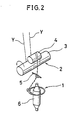
- the above-described plural carbon fiber strands can be plied and twisted by using a ring twister as shown in Fig. 2.
- numeral 1 designates a ring twisting section.
- the nip roller 2 comprises a pair of driving roller 3 and a driven roller 4.
- two carbon fiber strands Y, Y which each have previously been twisted to give a first twist of 80 turns/m or more are fed to the ring twister so that the carbon fiber strands Y, Y are brought into contact with the surface of the driving roller 3 and that of the driven roller 4 of the nip roller 2 over at least one-thirds of a circuit thereof while maintaining the spacing between the two carbon fiber strands Y, Y.
- the first twists given to the carbon fiber strands are partly loosened during doubling and twisting for giving the final twists, which brings about a decrease in the number of first twists.
- the spacing between a plurality of carbon fiber strands to be fed into the nip roller are maintained constant in order to prevent the carbon fiber strands from intertwisting each other and, at the same time, to enable the tension to effectively be conducted.
- This expedient is not conducted in the doubling of threads for general clothing.
- the carbon fiber strands are fed to the nip roller so as to be brought into contact with each roller constituting the nip roller over at least one-thirds of a circuit of each roller for the purpose of preventing the occurrence of the so-called difference in the yarn length between the carbon fiber strands constituting the thread through the prevention of slipping of the carbon fiber strands on the nip roller.
- the nip roller for use in the preparation of a thread for clothing serves to merely nip the thread of carbon fiber fed. Therefore, the above-described conventional process is fully different from the process for preparing the thread of carbon fiber of the present invention in this aspect as well.
- the acrylonitrile carbon fiber may be one prepared by a conventional technique, i.e., by oxidizing or carbonizing an acrylonitrile fiber.
- the acrylonitrile fiber used as the starting material is preferably a fiber prepared by a combination of spinning according to the dry-jet-wet spinning process with the use of a silicone lubricant as a process lubricant.
- the conditions for oxidation of the acrylonitrile fiber are preferably adjusted so that the degree of oxidation in the oxidation system is 3.7 to 7.0% in terms of moisture regain, while the conditions for the carbonization are preferably adjusted so that the temperature rising rate is 100 to 1000° C/min in a zone of a temperature ranging from 300 to 700° C and a zone of a temperature ranging from 1000 to 1200° C.
- the carbon fiber strand used in the present invention may be subjected to a known surface treatment for the purpose of enhancing the affinity for the matrix resin. Further, it is desired to use a sizing agent for the purpose of improving the processability during the formation of a thread and improving the processability during stitching. The kind of the sizing agent and the amount of sizing thereof may be selected based on known conditions depending upon intended applications.
- An ammonia gas is blown into a solution of an acrylonitrile (hereinafter referred to as "AN") copolymer having an intrinsic viscosity [ ⁇ ] of 1.80 and comprising 99.5% by mole of AN and 0.5% by mole of itaconic acid in dimethyl sulfoxide (hereinafter referred to as "DMSO") to substitute an ammonium group for hydrogen of the carboxyl terminal of the copolymer, thereby modifying the polymer.
- AN acrylonitrile
- DMSO dimethyl sulfoxide
- the spinning solution thus prepared was once extruded through a spinneret having 500 holes each having a diameter of 0.1 mm into the air, travelled in the air by about 3 mm, and introduced into an aqueous 30% DMSO solution of about 30° C, thereby preparing a coagulated fiber yarn through dry-jet-wet spinning.
- the coagulated fiber yarn was washed with water, drawn at a draw ratio of about four in hot water, and immersed in a mixed lubricant comprising an aqueous 0.8% solution of a polyethylene glycol (hereinafter referred to as "PEG") modified polydimethylsiloxane (degree of PEG modification: 50% by weight) and an aqueous 0.8% dispersion composed of 85 parts of an amino modified polydimethylsiloxane (degree of amino modification: 1% by weight) and 15 parts of a nonionic surfactant and then dried and densified on a heating roll having a surface temperature of 130° C.
- the dried and densified fiber yarn was drawn by a factor of about 3 in heated steam to prepare an acrylic fiber yarn having a single fiber fineness of 0.8 denier and a total fineness of 400 denier.
- the acrylic fiber yarn was heated in the air of 240 to 260° C under a draw ratio of 1.05 to prepare an oxidized fiber yarn having a moisture regain of 5.0%.
- the moisture regain for determining the degree of oxidation is measured according to the following procedures. Namely, about 2 g of an oxidized yarn is taken out and placed in a weighing bottle. This weighing bottle with its stop being opened is then placed in a desiccator containing a solid phase-containing, aqueous ammonium sulfate solution in the bottom, at room temperature for about 16 hours to permit the yarn to absorb moisture.
- the yarn After withdrawl from the desiccator, the yarn is precisely weighed quickly and the weight at this time is represented by W1.
- the above yarn is then placed in a weighing bottle, and this bottle with its stop being opened is placed in a dryer at 120° C for 2 hours. After quick application of the stop to the weighing bottle, the bottle is quickly transferred to a desiccator containing phosphorous pentaoxide in the bottom, and allowed to cool for 5 minutes in the desiccator. After cooling, the dry yarn is precisely weighed quickly, and the weight at this time is represented by W0.
- the moisture regain is calculated from the formula:
- the level of an oil finish adhered to an acrylonitrile polymer fiber is measured according to the following procedures. Namely, about 3 g of the fiber is taken out and precisely weighed. This weight is represented by W1.
- the oxidized fiber yarn was carbonized in a nitrogen atmosphere having a maximum temperature of 1400° C at a temperature rising rate of about 600° C/min in each of a zone of a temperature ranging from 300 to 700° C and a zone of a temperature ranging from 1000 to 1200° C, thereby preparing a carbon fiber yarn.
- the carbon fiber yarn thus prepared is subjected to an electrolytic surface treatment in an aqueous electrolyte solution by making use of the carbon fiber yarn as an anode, washed with water, dried, and sized with about 1% of an epoxy sizing agent to prepare a stitching thread material comprising a carbon fiber filament strand.
- the above-described stitching thread material comprising a carbon fiber filament strand had a fineness of about 200 denier and a strand strength of 560 kg/mm2.
- the single fibers constituting the carbon fiber filament strand had a fineness of 0.4 denier and a loop breaking strain of 4.1% as determined according to the single fiber loop test.
- the above-described carbon fiber filament strand was twisted to give an S-twist of 250 turns/m as first twists. Then, three S-twisted carbon fiber strands were fed at a rate of 24 m/min between nip rollers having the same peripheral speed while leaving a space of 5 mm among the carbon fiber strands so that each carbon fiber strand is brought into contact with the surface of each nip roller over one-half of the peripheral length thereof, and the three carbon fiber strands coming out of the nip rollers were plied and twisted with a ring twister to give a Z-twist of 160 turns/m as final twists, thereby preparing a thread.
- the thread thus prepared had a fineness of about 600 denier and a knot strength of 3.1 g/denier. Further, the difference in the yarn length between the carbon fiber strands constituting the thread was as small as about 0.2%, so the yarn lengths of the carbon fiber strands were substantially identical with each other.
- a laminate of carbon fiber woven fabrics was stitched with the above-described thread.
- the above-described stitched base fabric was filled into the space of a cavity formed by a male die and a female die, and an epoxy resin (Epikote 827/NMA/EMI) containing a curing agent previously added thereto is penetrated into the space of the cavity, followed by curing of the resin, thereby preparing a cured laminate having a thickness of 0.91 mm, a width of 20 cm and a length of 150 cm.
- the stitched base fabric brought about no fiber slippage and could easily be filled within the cavity.
- a specimen having a width of 25 mm and a length of 230 mm was cut from the cured laminate thus prepared and subjected to a repeated fatigue test under conditions of a maximum tensile load of 750 kg and a minimum tensile load of 100 kg. In the test, the cured laminate was damaged after repetition of about 2 x 10⁵ times.
- a carbon fiber strand having a fineness of about 400 denier was prepared in the same manner as that of Example 1, except that the spinneret was one having 1000 holes.
- the carbon fiber strand thus prepared had a strand strength of 530 kg/mm2, a single fiber fineness of 0.4 denier, and a loop breaking strain of 4.0% as determined according to the single fiber loop test.
- the above-described carbon fiber strand was twisted to give an S-twist of about 250 turns/m as first twists. Then, three S-twisted carbon fiber strands were plied and, at the same time, twisted to give a Z-twist of about 160 turns/m as final twists, thereby preparing a thread.
- the thread thus prepared had a fineness of about 1200 denier and a knot strength of 3.2 g/denier.
- Stitching was conducted with the above-described thread in the same manner as that of Example 1. Slight yarn slippage was observed in the fibers constituting the base fabric. However, as with Example 1, the thread caused neither breakage nor fuzzing of the thread and exhibited excellent stitch processability.
- a thread having a fineness of about 1600 denier and a knot strength of about 4.2 g/denier were prepared in the same manner as that of Example 2, except that the number of carbon fiber strands for plying was 4.
- Stitching was conducted with the above-described thread in the same manner as that of Example 1. In the stitching, slight yarn slippage and fuzzing were observed in the fibers constituting the base fabric. However, the stitching could smoothly be conducted without causing any breakage of the thread.
- a carbon fiber strand having a fineness of about 800 denier was prepared in the same manner as that of Example 1, except that the spinneret was one having 2000 holes.
- the carbon fiber strand thus prepared had a strand strength of 470 kg/mm2, a single fiber fineness of 0.4 denier, and a loop breaking strain of 3.7% as determined according to the single fiber loop test.
- the above-described carbon fiber strand was twisted to give an S-twist of about 200 turns/m as first twists. Then, three S-twisted carbon fiber strands were plied and, at the same time, twisted to give a Z-twist of about 140 turns/m as final twists, thereby preparing a thread.
- the thread thus prepared had a fineness of about 2400 denier and a knot strength of 4.5 g/denier.
- Stitching was conducted with the above-described thread in the same manner as that of Example 1. In the stitching, slight yarn slippage and fuzzing were observed in the fibers constituting the base fabric. However, the stitching could smoothly be conducted without causing any breakage of the thread.
- a cured laminate was prepared from the above-described stitched base fabric in the same manner as that of Example 1, followed by the repeated fatigue test. In the test, the cured laminate was damaged after repetition of about 1.6 x 10⁵ times.
- Example 2 The same carbon fiber strand as that of Example 1 was twisted to give an S-twist of about 350 turns/m as first twists. Three S-twisted strands were plied and, at the same time, twisted to give a Z-twist of about 250 turns/m as final twists, thereby preparing a thread.
- the thread thus prepared had a fineness of about 600 denier and a knot strength of 3.3 g/denier.
- the cured laminate thus prepared was subjected to a repeated fatigue test in the same manner as that of Example 1. In the test, the cured laminate was damaged after repetition of 1.4 x 10⁵ times.
- Example 4 The same carbon fiber strand as that of Example 4 was twisted to give an S-twist of about 100 turns/m as first twists. Three S-twisted strands were plied and, at the same time, twisted to give a Z-twist of about 80 turns/m as final twists, thereby preparing a thread.
- the thread thus prepared had a fineness of about 2400 denier and a knot strength of about 4.1 g/denier.
- Stitching was conducted with the above-described thread in the same manner as that of Example 1. In the stitching, slight yarn slippage and fuzzing were observed in the fibers constituting the base fabric, and slight fuzzing was observed in the thread as well. However, the stitching could smoothly be conducted without causing any breakage of the thread.
- Example 4 Four carbon fiber strands which are the same as that of Example 4 were plied and twisted in the same manner as that of Example 4 to prepare a thread having a fineness of about 3200 denier.
- the thread thus prepared had a knot strength of 5.7 g/denier.
- Stitching was conducted with the above-described thread in the same manner as that of Example 1. In the stitching, breakage of the thread occurred in the fabrics constituting the base fabric, so that stitching could not smoothly be conducted.
- Example 2 The same spinning solution as that of Example 1 was extruded through a spinneret having 500 holes each having a diameter of 0.05 mm into an aqueous DMSO solution having a DMSO concentration of 25% and a temperature of 60° C at a coagulation take-up speed of 18 m/min, thereby preparing a coagulated fiber yarn through wet spinning.
- the coagulated fiber yarn was washed with water, drawn at a draw ratio of about four in hot water, oiled with a silicone lubricant, dried and densified on a heating roll having a surface temperature of 130 to 160° C, and further drawn by a factor of about three in heated steam to prepare an acrylic fiber yarn having a single fiber fineness of 1.1 denier and a fineness of 550 denier.
- the acrylic fiber yarn thus prepared was oxidized, carbonized, subjected to surface treatment, and sized with a sizing agent in the same manner as that of Example 1, thereby preparing a carbon fiber strand having a fineness of about 300 denier.
- the carbon fiber strand thus prepared had a strand strength of 330 kg/mm2, a single fiber fineness of 0.6 denier, and a loop breaking strain of 2.4% as determined according to the single fiber loop test.
- Three carbon fiber strands as prepared above were plied and twisted in the same manner as that of Example 1 to prepare a thread.
- the thread thus prepared had a fineness of about 900 denier and a knot strength of 0.4 g/denier.
- Stitching was conducted with the above-described thread in the same manner as that of Example 1. In the process of stitching, the breakage of the thread occurred, so that the stitching could not be conducted.
- An acrylic fiber yarn having a single fiber fineness of 1.7 denier and a total fineness of 850 denier was prepared by dry-jet-wetting spinning in the same manner as that of Example 1.
- the acrylic fiber yarn thus prepared was oxidized, carbonized, subjected to surface treatment, and sized with a sizing agent in the same manner as that of Example 1, thereby preparing a carbon fiber strand having a fineness of about 400 denier.
- the carbon fiber strand thus prepared had a strand strength of 280 kg/mm2, a single fiber fineness of 0.8 denier, and a loop breaking strain of 2.7% as determined according to the single fiber loop test.
- Three carbon fiber strands as prepared above were plied and twisted in the same manner as that of Example 1 to prepare a thread.
- the thread thus prepared had a fineness of about 1200 denier and a knot strength of 0.8 g/denier.
- Stitching was conducted with the above-described thread in the same manner as that of Example 1.
- stitching not only fuzzing of the thread occurred but also the breakage of the thread occurred at several portions.
- the imperfectly stitched base fabric was molded in the same manner as that of Example 1.
- the relative positions of the four weaves were deviated in the portions at which the breakage of the stitching thread had occurred, and much time was taken to correct the relative positions.
- the cured laminate thus prepared were subjected to a repeated fatigue test in the same manner as that of Example 1. In the test, the cured laminate was damaged after repetition of about 4 x 10⁴.
- a carbon fiber thread was prepared in the same manner as that of Example 1, except that the carbon fiber strand prepared in Example 1 and having a fineness of about 200 denier was twisted to give an S-twist of 250 turns/m and two S-twisted carbon fiber strands were merely nipped between nip rollers.
- the difference in the yarn length between the two carbon fiber stands constituting the thread was measured and found to be as large as about 0.9%. Further, the knot strength of the thread was as low as 0.9 g/denier.
- Stitching was conducted with the above-described thread in the same manner as that of Example 1. In the stitching, not only fuzzing of the thread occurred but also the breakage of the thread occurred at several portions.
- a braid was prepared by making use of five carbon fiber strands each having a fineness of about 200 denier which had been prepared in the same manner as that of Example 1. However, the braid brought about a distortion and could not stably maintain a linear shape, so that the braid could not be used as a stitching thread.
- a carbon fiber having a predetermined fineness and knot strength is formed into a thread, particularly a stitching thread for a reinforcing fabric of a composite material by plying and twisting.
- This thread suppresses occurrence of the breakage and fuzzing when a reinforcing fabric is stitched with a thread and exhibits excellent higher processability. Further, since no damage to the fabric is caused during stitching, a reinforcing effect inherent in the reinforcing fabric is not spoiled.
- the thread comprises a carbon fiber having excellent mechanical properties, which not only leads to a very large reinforcing effect for the composite material but also eliminates a fear of spoiling the properties of the composite material through water absorption because the thread exhibits no water absorptivity.
- the applications of the thread comprising a carbon fiber according to the present invention are not limited to stitching threads only, and the thread can be used for various applications where high strength properties are required. Examples of these applications include (1) a linking thread, (2) a fishing line, (3) a rope or cable, (4) an electric heating element, (5) an artificial ligament, and (6) a tire cord.
- the thread may be used as such or in the form of a twisted thread prepared by twisting several threads, a combination of plural threads with a resin, rubber, a metal, or the like.
Landscapes
- Engineering & Computer Science (AREA)
- Mechanical Engineering (AREA)
- Textile Engineering (AREA)
- Chemical & Material Sciences (AREA)
- Chemical Kinetics & Catalysis (AREA)
- Health & Medical Sciences (AREA)
- General Chemical & Material Sciences (AREA)
- Medicinal Chemistry (AREA)
- Polymers & Plastics (AREA)
- Organic Chemistry (AREA)
- Yarns And Mechanical Finishing Of Yarns Or Ropes (AREA)
- Inorganic Fibers (AREA)
- Braiding, Manufacturing Of Bobbin-Net Or Lace, And Manufacturing Of Nets By Knotting (AREA)
Applications Claiming Priority (2)
| Application Number | Priority Date | Filing Date | Title |
|---|---|---|---|
| JP202129/87 | 1987-08-13 | ||
| JP62202129A JPS6445830A (en) | 1987-08-13 | 1987-08-13 | High performance carbon fiber cord |
Publications (2)
| Publication Number | Publication Date |
|---|---|
| EP0303381A1 true EP0303381A1 (de) | 1989-02-15 |
| EP0303381B1 EP0303381B1 (de) | 1992-07-22 |
Family
ID=16452444
Family Applications (1)
| Application Number | Title | Priority Date | Filing Date |
|---|---|---|---|
| EP88307093A Expired - Lifetime EP0303381B1 (de) | 1987-08-13 | 1988-08-01 | Nähfaden aus Kohlenstoffasern |
Country Status (6)
| Country | Link |
|---|---|
| US (1) | US4850186A (de) |
| EP (1) | EP0303381B1 (de) |
| JP (1) | JPS6445830A (de) |
| KR (1) | KR950010291B1 (de) |
| DE (1) | DE3872977T2 (de) |
| ES (1) | ES2033436T3 (de) |
Cited By (7)
| Publication number | Priority date | Publication date | Assignee | Title |
|---|---|---|---|---|
| RU2142064C1 (ru) * | 1998-02-02 | 1999-11-27 | ООО "Прецизика-сервис", Сухан Федор Федорович | Электромагнитная форсунка для двигателя внутреннего сгорания |
| DE19932842B4 (de) * | 1999-07-14 | 2004-08-12 | Institut Für Verbundwerkstoffe Gmbh | Kohlenstoffasernähgarn für Faser-Kunststoff-Verbund-Bauteile |
| WO2006018036A1 (de) * | 2004-08-10 | 2006-02-23 | Toho Tenax Europe Gmbh | Kabliertes kohlenstofffasergarn |
| WO2012045715A3 (de) * | 2010-10-07 | 2012-06-07 | Teufelberger Gesellschaft M.B.H. | Geflochtenes seil zum führen einer papierbahn in einer papiermaschine |
| EP2840173A4 (de) * | 2012-04-18 | 2015-04-22 | Mitsubishi Rayon Co | Kohlenstofffaserbündel und verfahren zur herstellung eines kohlenstofffaserbündels |
| WO2018130857A1 (en) * | 2017-01-16 | 2018-07-19 | The University Of Bath | Fibre ropes and composite materials containing fibre ropes |
| EP3604668A4 (de) * | 2017-03-31 | 2020-08-05 | Asahi Kasei Kabushiki Kaisha | Verdoppeltes und verdrilltes garn mit organischen fasern |
Families Citing this family (8)
| Publication number | Priority date | Publication date | Assignee | Title |
|---|---|---|---|---|
| US5272004A (en) * | 1988-03-17 | 1993-12-21 | Petoca Ltd. | Carbon fibers and process for producing the same |
| JPH029762A (ja) * | 1988-06-29 | 1990-01-12 | Kanto Yakin Kogyo Kk | 炭素繊維強化複合材の製造方法 |
| US5227238A (en) * | 1988-11-10 | 1993-07-13 | Toho Rayon Co., Ltd. | Carbon fiber chopped strands and method of production thereof |
| US5268221A (en) * | 1990-02-23 | 1993-12-07 | Bando Chemical Industries, Ltd. | Fiber reinforced rubber articles |
| GB2477531B (en) * | 2010-02-05 | 2015-02-18 | Univ Leeds | Carbon fibre yarn and method for the production thereof |
| JP2019500511A (ja) | 2015-12-31 | 2019-01-10 | ユーティー−バテル, エルエルシー | 多目的商用繊維からカーボン繊維を製造する方法 |
| CN106192115A (zh) * | 2016-09-19 | 2016-12-07 | 西安航天复合材料研究所 | 一种碳纤维缝合线的制备方法 |
| CN112481773B (zh) * | 2019-09-10 | 2022-06-28 | 中国航发商用航空发动机有限责任公司 | 三维机织结构、三维织物复合材料及工艺方法 |
Citations (1)
| Publication number | Priority date | Publication date | Assignee | Title |
|---|---|---|---|---|
| EP0085537A2 (de) * | 1982-01-29 | 1983-08-10 | Minnesota Mining And Manufacturing Company | Nähfaden aus Keramikfasern |
Family Cites Families (7)
| Publication number | Priority date | Publication date | Assignee | Title |
|---|---|---|---|---|
| US3838562A (en) * | 1969-10-06 | 1974-10-01 | Celanese Corp | Acrylonitrile yarn |
| US3841079A (en) * | 1970-04-14 | 1974-10-15 | Celanese Corp | Carbon filaments capable of substantial crack diversion during fracture |
| GB1498721A (en) * | 1975-02-17 | 1978-01-25 | Morganite Modmor Ltd | Production of carbon fibre |
| JPS5742934A (en) * | 1980-08-22 | 1982-03-10 | Toho Beslon Co | High property carbon fiber strand |
| US4513565A (en) * | 1981-08-14 | 1985-04-30 | Toray Industries, Inc. | Sewing thread |
| JPS5915531A (ja) * | 1982-07-17 | 1984-01-26 | 東邦レーヨン株式会社 | 活性炭素繊維紡績糸 |
| US4714642A (en) * | 1983-08-30 | 1987-12-22 | Basf Aktiengesellschaft | Carbon fiber multifilamentary tow which is particularly suited for weaving and/or resin impregnation |
-
1987
- 1987-08-13 JP JP62202129A patent/JPS6445830A/ja active Pending
-
1988
- 1988-08-01 ES ES198888307093T patent/ES2033436T3/es not_active Expired - Lifetime
- 1988-08-01 DE DE8888307093T patent/DE3872977T2/de not_active Expired - Lifetime
- 1988-08-01 EP EP88307093A patent/EP0303381B1/de not_active Expired - Lifetime
- 1988-08-04 US US07/228,089 patent/US4850186A/en not_active Expired - Lifetime
- 1988-08-06 KR KR1019880010035A patent/KR950010291B1/ko not_active Expired - Fee Related
Patent Citations (1)
| Publication number | Priority date | Publication date | Assignee | Title |
|---|---|---|---|---|
| EP0085537A2 (de) * | 1982-01-29 | 1983-08-10 | Minnesota Mining And Manufacturing Company | Nähfaden aus Keramikfasern |
Non-Patent Citations (1)
| Title |
|---|
| PATENT ABSTRACTS OF JAPAN, vol. 1, no. 106 (C-77)[2384], 19th September 1977; & JP-A-52 66 719 (NIPPON CARBON K.K.)06-02-1977 * |
Cited By (12)
| Publication number | Priority date | Publication date | Assignee | Title |
|---|---|---|---|---|
| RU2142064C1 (ru) * | 1998-02-02 | 1999-11-27 | ООО "Прецизика-сервис", Сухан Федор Федорович | Электромагнитная форсунка для двигателя внутреннего сгорания |
| DE19932842B4 (de) * | 1999-07-14 | 2004-08-12 | Institut Für Verbundwerkstoffe Gmbh | Kohlenstoffasernähgarn für Faser-Kunststoff-Verbund-Bauteile |
| WO2006018036A1 (de) * | 2004-08-10 | 2006-02-23 | Toho Tenax Europe Gmbh | Kabliertes kohlenstofffasergarn |
| US7677023B2 (en) | 2004-08-10 | 2010-03-16 | Toho Tenax Europe Gmbh | Cabled carbon-fiber thread |
| CN101001986B (zh) * | 2004-08-10 | 2010-06-16 | 东邦泰纳克丝欧洲有限公司 | 并捻的碳纤维丝 |
| WO2012045715A3 (de) * | 2010-10-07 | 2012-06-07 | Teufelberger Gesellschaft M.B.H. | Geflochtenes seil zum führen einer papierbahn in einer papiermaschine |
| US10273609B2 (en) | 2010-10-07 | 2019-04-30 | Teufelberger Gesellschaft M.B.H. | Paper guide rope |
| EP2840173A4 (de) * | 2012-04-18 | 2015-04-22 | Mitsubishi Rayon Co | Kohlenstofffaserbündel und verfahren zur herstellung eines kohlenstofffaserbündels |
| US10837127B2 (en) | 2012-04-18 | 2020-11-17 | Mitsubishi Chemical Corporation | Carbon fiber bundle and method of producing carbon fiber bundle |
| US11970791B2 (en) | 2012-04-18 | 2024-04-30 | Mitsubishi Chemical Corporation | Carbon fiber bundle and method of producing carbon fiber bundle |
| WO2018130857A1 (en) * | 2017-01-16 | 2018-07-19 | The University Of Bath | Fibre ropes and composite materials containing fibre ropes |
| EP3604668A4 (de) * | 2017-03-31 | 2020-08-05 | Asahi Kasei Kabushiki Kaisha | Verdoppeltes und verdrilltes garn mit organischen fasern |
Also Published As
| Publication number | Publication date |
|---|---|
| KR890004010A (ko) | 1989-04-19 |
| ES2033436T3 (es) | 1993-03-16 |
| KR950010291B1 (ko) | 1995-09-14 |
| DE3872977D1 (de) | 1992-08-27 |
| EP0303381B1 (de) | 1992-07-22 |
| US4850186A (en) | 1989-07-25 |
| DE3872977T2 (de) | 1992-12-03 |
| JPS6445830A (en) | 1989-02-20 |
Similar Documents
| Publication | Publication Date | Title |
|---|---|---|
| EP0303381B1 (de) | Nähfaden aus Kohlenstoffasern | |
| CA1061994A (en) | Multifilament yarn having novel configuration and a method for producing the same | |
| EP0205960B1 (de) | Polyolefinfaser mit hoher Festigkeit, niedrigem Schrumpfen, ultrahohem Modul, sehr niedrigem Kriechen und mit guter Festigkeitserhaltung bei hoher Temperatur sowie Verfahren zu deren Herstellung | |
| JP4584503B2 (ja) | すだれ織物 | |
| JP6702511B1 (ja) | 炭素繊維およびその製造方法 | |
| EP0835953B1 (de) | Ein Vorläuferfaserbündel für die Zubereitung von einem Kohlenstofffaserbündel, ein Kohlenstofffaserbündel und ein Verfahren zu dessen Herstellung | |
| US4929503A (en) | Composite fibrous material | |
| EP0384424A2 (de) | Stufenweises Verstrecken von noch nicht getrockneten Filamenten | |
| KR102127495B1 (ko) | 폴리에틸렌테레프탈레이트 원사, 그 제조방법, 및 그것을 이용하여 제조된 타이어 코드 | |
| KR100207300B1 (ko) | 고강도, 저수축성 폴리아미드 얀의 제조방법 및 그에 의해 제조된 얀 | |
| US4505100A (en) | Heat-durable spun-like fasciated yarn and method for producing the same | |
| EP0695819A1 (de) | Heterofilament-Verbundgarn und verstärkte Bündel aus Heterofilamenten und Draht | |
| JP2003527497A (ja) | ポリ(トリメチレン)テレフタレート織物ステープル製造 | |
| RU1827000C (ru) | Способ получени полигексаметиленадипамидного волокна | |
| EP1101843B2 (de) | Polyparaphenylenterephthalamidfasern und verfahren zur herstellung derselben | |
| JP3130683B2 (ja) | 寸法安定性の改善されたポリエステル繊維の製造法 | |
| EP0122949A1 (de) | Wärmebeständiges gespinsteähnliches, gebündeltes Garn, und Verfahren zur Herstellung desselben | |
| JP2782510B2 (ja) | ゴム製品補強材用ポリアミド糸及びその製造方法 | |
| WO2022191090A1 (ja) | ポリアミド捲縮糸、仮撚加工糸および布帛 | |
| JP2000154423A (ja) | 牽切用ポリパラフェニレンテレフタルアミド繊維トウ | |
| KR102219084B1 (ko) | 강도 및 신장률이 높은 인터레이스 복합사 및 그 제조방법 | |
| JP2002294568A (ja) | フィラメントワインディング用炭素繊維束 | |
| US20240337048A1 (en) | Carbon fiber bundle and production method therefor | |
| JP2001336038A (ja) | ゴム補強用繊維 | |
| JPS59187639A (ja) | ポリアミドタイヤコ−ド及びその製法 |
Legal Events
| Date | Code | Title | Description |
|---|---|---|---|
| PUAI | Public reference made under article 153(3) epc to a published international application that has entered the european phase |
Free format text: ORIGINAL CODE: 0009012 |
|
| AK | Designated contracting states |
Kind code of ref document: A1 Designated state(s): AT BE CH DE ES FR GB GR IT LI LU NL SE |
|
| 17P | Request for examination filed |
Effective date: 19890621 |
|
| 17Q | First examination report despatched |
Effective date: 19910221 |
|
| GRAA | (expected) grant |
Free format text: ORIGINAL CODE: 0009210 |
|
| AK | Designated contracting states |
Kind code of ref document: B1 Designated state(s): BE DE ES FR GB IT |
|
| REF | Corresponds to: |
Ref document number: 3872977 Country of ref document: DE Date of ref document: 19920827 |
|
| ET | Fr: translation filed | ||
| ITF | It: translation for a ep patent filed | ||
| REG | Reference to a national code |
Ref country code: ES Ref legal event code: FG2A Ref document number: 2033436 Country of ref document: ES Kind code of ref document: T3 |
|
| PLBE | No opposition filed within time limit |
Free format text: ORIGINAL CODE: 0009261 |
|
| STAA | Information on the status of an ep patent application or granted ep patent |
Free format text: STATUS: NO OPPOSITION FILED WITHIN TIME LIMIT |
|
| 26N | No opposition filed | ||
| PGFP | Annual fee paid to national office [announced via postgrant information from national office to epo] |
Ref country code: ES Payment date: 19960830 Year of fee payment: 9 |
|
| PGFP | Annual fee paid to national office [announced via postgrant information from national office to epo] |
Ref country code: BE Payment date: 19961003 Year of fee payment: 9 |
|
| PG25 | Lapsed in a contracting state [announced via postgrant information from national office to epo] |
Ref country code: ES Free format text: LAPSE BECAUSE OF THE APPLICANT RENOUNCES Effective date: 19970802 |
|
| PG25 | Lapsed in a contracting state [announced via postgrant information from national office to epo] |
Ref country code: BE Free format text: LAPSE BECAUSE OF NON-PAYMENT OF DUE FEES Effective date: 19970831 |
|
| BERE | Be: lapsed |
Owner name: TORAY INDUSTRIES INC. Effective date: 19970831 |
|
| REG | Reference to a national code |
Ref country code: ES Ref legal event code: FD2A Effective date: 20001102 |
|
| REG | Reference to a national code |
Ref country code: GB Ref legal event code: IF02 |
|
| PGFP | Annual fee paid to national office [announced via postgrant information from national office to epo] |
Ref country code: GB Payment date: 20020731 Year of fee payment: 15 |
|
| PG25 | Lapsed in a contracting state [announced via postgrant information from national office to epo] |
Ref country code: GB Free format text: LAPSE BECAUSE OF NON-PAYMENT OF DUE FEES Effective date: 20030801 |
|
| GBPC | Gb: european patent ceased through non-payment of renewal fee |
Effective date: 20030801 |
|
| PGFP | Annual fee paid to national office [announced via postgrant information from national office to epo] |
Ref country code: DE Payment date: 20050728 Year of fee payment: 18 |
|
| PG25 | Lapsed in a contracting state [announced via postgrant information from national office to epo] |
Ref country code: IT Free format text: LAPSE BECAUSE OF NON-PAYMENT OF DUE FEES;WARNING: LAPSES OF ITALIAN PATENTS WITH EFFECTIVE DATE BEFORE 2007 MAY HAVE OCCURRED AT ANY TIME BEFORE 2007. THE CORRECT EFFECTIVE DATE MAY BE DIFFERENT FROM THE ONE RECORDED. Effective date: 20050801 |
|
| PGFP | Annual fee paid to national office [announced via postgrant information from national office to epo] |
Ref country code: FR Payment date: 20050809 Year of fee payment: 18 |
|
| PG25 | Lapsed in a contracting state [announced via postgrant information from national office to epo] |
Ref country code: DE Free format text: LAPSE BECAUSE OF NON-PAYMENT OF DUE FEES Effective date: 20070301 |
|
| REG | Reference to a national code |
Ref country code: FR Ref legal event code: ST Effective date: 20070430 |
|
| PG25 | Lapsed in a contracting state [announced via postgrant information from national office to epo] |
Ref country code: FR Free format text: LAPSE BECAUSE OF NON-PAYMENT OF DUE FEES Effective date: 20060831 |