EP0306232B1 - Composition adhésive à la pression, bande adhésive et système de fermeture pour couche-culotte - Google Patents
Composition adhésive à la pression, bande adhésive et système de fermeture pour couche-culotte Download PDFInfo
- Publication number
- EP0306232B1 EP0306232B1 EP88307929A EP88307929A EP0306232B1 EP 0306232 B1 EP0306232 B1 EP 0306232B1 EP 88307929 A EP88307929 A EP 88307929A EP 88307929 A EP88307929 A EP 88307929A EP 0306232 B1 EP0306232 B1 EP 0306232B1
- Authority
- EP
- European Patent Office
- Prior art keywords
- weight
- sensitive adhesive
- pressure
- resins
- tape
- Prior art date
- Legal status (The legal status is an assumption and is not a legal conclusion. Google has not performed a legal analysis and makes no representation as to the accuracy of the status listed.)
- Expired - Lifetime
Links
- 239000000203 mixture Substances 0.000 title claims description 62
- 239000004820 Pressure-sensitive adhesive Substances 0.000 title claims description 30
- 229920005989 resin Polymers 0.000 claims description 102
- 239000011347 resin Substances 0.000 claims description 102
- 229920001400 block copolymer Polymers 0.000 claims description 43
- PPBRXRYQALVLMV-UHFFFAOYSA-N Styrene Chemical compound C=CC1=CC=CC=C1 PPBRXRYQALVLMV-UHFFFAOYSA-N 0.000 claims description 32
- 239000007788 liquid Substances 0.000 claims description 31
- RRHGJUQNOFWUDK-UHFFFAOYSA-N Isoprene Chemical compound CC(=C)C=C RRHGJUQNOFWUDK-UHFFFAOYSA-N 0.000 claims description 24
- 239000007787 solid Substances 0.000 claims description 24
- KAKZBPTYRLMSJV-UHFFFAOYSA-N Butadiene Chemical compound C=CC=C KAKZBPTYRLMSJV-UHFFFAOYSA-N 0.000 claims description 15
- 230000003014 reinforcing effect Effects 0.000 claims description 14
- 239000000758 substrate Substances 0.000 claims description 14
- XYLMUPLGERFSHI-UHFFFAOYSA-N alpha-Methylstyrene Chemical compound CC(=C)C1=CC=CC=C1 XYLMUPLGERFSHI-UHFFFAOYSA-N 0.000 claims description 13
- 239000013032 Hydrocarbon resin Substances 0.000 claims description 12
- 229920006270 hydrocarbon resin Polymers 0.000 claims description 12
- RSWGJHLUYNHPMX-UHFFFAOYSA-N Abietic-Saeure Natural products C12CCC(C(C)C)=CC2=CCC2C1(C)CCCC2(C)C(O)=O RSWGJHLUYNHPMX-UHFFFAOYSA-N 0.000 claims description 11
- KHPCPRHQVVSZAH-HUOMCSJISA-N Rosin Natural products O(C/C=C/c1ccccc1)[C@H]1[C@H](O)[C@@H](O)[C@@H](O)[C@@H](CO)O1 KHPCPRHQVVSZAH-HUOMCSJISA-N 0.000 claims description 11
- KHPCPRHQVVSZAH-UHFFFAOYSA-N trans-cinnamyl beta-D-glucopyranoside Natural products OC1C(O)C(O)C(CO)OC1OCC=CC1=CC=CC=C1 KHPCPRHQVVSZAH-UHFFFAOYSA-N 0.000 claims description 11
- 229920001971 elastomer Polymers 0.000 claims description 10
- 239000000178 monomer Substances 0.000 claims description 10
- 229920000642 polymer Polymers 0.000 claims description 9
- 150000002148 esters Chemical class 0.000 claims description 8
- 150000001993 dienes Chemical class 0.000 claims description 7
- 150000003097 polyterpenes Chemical class 0.000 claims description 7
- 239000003921 oil Substances 0.000 claims description 6
- HJWLCRVIBGQPNF-UHFFFAOYSA-N prop-2-enylbenzene Chemical compound C=CCC1=CC=CC=C1 HJWLCRVIBGQPNF-UHFFFAOYSA-N 0.000 claims description 6
- PMJHHCWVYXUKFD-SNAWJCMRSA-N (E)-1,3-pentadiene Chemical group C\C=C\C=C PMJHHCWVYXUKFD-SNAWJCMRSA-N 0.000 claims description 5
- HECLRDQVFMWTQS-RGOKHQFPSA-N 1755-01-7 Chemical class C1[C@H]2[C@@H]3CC=C[C@@H]3[C@@H]1C=C2 HECLRDQVFMWTQS-RGOKHQFPSA-N 0.000 claims description 5
- 239000004215 Carbon black (E152) Substances 0.000 claims description 5
- 239000000806 elastomer Substances 0.000 claims description 5
- 229930195733 hydrocarbon Natural products 0.000 claims description 5
- 150000002430 hydrocarbons Chemical class 0.000 claims description 5
- PMJHHCWVYXUKFD-UHFFFAOYSA-N piperylene Natural products CC=CC=C PMJHHCWVYXUKFD-UHFFFAOYSA-N 0.000 claims description 5
- 125000004432 carbon atom Chemical group C* 0.000 claims description 4
- 229920001577 copolymer Polymers 0.000 claims description 4
- 230000009477 glass transition Effects 0.000 claims description 4
- 229920000098 polyolefin Polymers 0.000 claims description 4
- 206010021639 Incontinence Diseases 0.000 claims description 3
- 239000004793 Polystyrene Substances 0.000 claims description 3
- 229920002223 polystyrene Polymers 0.000 claims description 3
- 239000010690 paraffinic oil Substances 0.000 claims description 2
- 239000003784 tall oil Substances 0.000 claims description 2
- -1 polyethylene Polymers 0.000 description 33
- 230000000052 comparative effect Effects 0.000 description 31
- 239000000853 adhesive Substances 0.000 description 28
- 230000001070 adhesive effect Effects 0.000 description 28
- 239000004698 Polyethylene Substances 0.000 description 16
- 229920000573 polyethylene Polymers 0.000 description 16
- 239000000126 substance Substances 0.000 description 15
- 239000004743 Polypropylene Substances 0.000 description 12
- 229920001155 polypropylene Polymers 0.000 description 12
- 238000009472 formulation Methods 0.000 description 11
- 238000012360 testing method Methods 0.000 description 10
- 238000000576 coating method Methods 0.000 description 8
- 239000011248 coating agent Substances 0.000 description 7
- YXFVVABEGXRONW-UHFFFAOYSA-N Toluene Chemical compound CC1=CC=CC=C1 YXFVVABEGXRONW-UHFFFAOYSA-N 0.000 description 6
- 229920003052 natural elastomer Polymers 0.000 description 6
- 229920001194 natural rubber Polymers 0.000 description 6
- 241000894007 species Species 0.000 description 6
- 239000000463 material Substances 0.000 description 5
- 244000043261 Hevea brasiliensis Species 0.000 description 4
- IMNFDUFMRHMDMM-UHFFFAOYSA-N N-Heptane Chemical compound CCCCCCC IMNFDUFMRHMDMM-UHFFFAOYSA-N 0.000 description 4
- 125000003118 aryl group Chemical group 0.000 description 4
- ZSWFCLXCOIISFI-UHFFFAOYSA-N cyclopentadiene Chemical compound C1C=CC=C1 ZSWFCLXCOIISFI-UHFFFAOYSA-N 0.000 description 4
- 150000005673 monoalkenes Chemical class 0.000 description 4
- 239000005060 rubber Substances 0.000 description 4
- GRWFGVWFFZKLTI-UHFFFAOYSA-N α-pinene Chemical compound CC1=CCC2C(C)(C)C1C2 GRWFGVWFFZKLTI-UHFFFAOYSA-N 0.000 description 4
- PEDCQBHIVMGVHV-UHFFFAOYSA-N Glycerine Chemical compound OCC(O)CO PEDCQBHIVMGVHV-UHFFFAOYSA-N 0.000 description 3
- 239000004831 Hot glue Substances 0.000 description 3
- 229920002633 Kraton (polymer) Polymers 0.000 description 3
- 239000000654 additive Substances 0.000 description 3
- 239000002390 adhesive tape Substances 0.000 description 3
- MTAZNLWOLGHBHU-UHFFFAOYSA-N butadiene-styrene rubber Chemical compound C=CC=C.C=CC1=CC=CC=C1 MTAZNLWOLGHBHU-UHFFFAOYSA-N 0.000 description 3
- 239000012943 hotmelt Substances 0.000 description 3
- 238000000034 method Methods 0.000 description 3
- 238000006116 polymerization reaction Methods 0.000 description 3
- 150000003505 terpenes Chemical class 0.000 description 3
- 235000007586 terpenes Nutrition 0.000 description 3
- GRWFGVWFFZKLTI-IUCAKERBSA-N 1S,5S-(-)-alpha-Pinene Natural products CC1=CC[C@@H]2C(C)(C)[C@H]1C2 GRWFGVWFFZKLTI-IUCAKERBSA-N 0.000 description 2
- VSKJLJHPAFKHBX-UHFFFAOYSA-N 2-methylbuta-1,3-diene;styrene Chemical compound CC(=C)C=C.C=CC1=CC=CC=C1.C=CC1=CC=CC=C1 VSKJLJHPAFKHBX-UHFFFAOYSA-N 0.000 description 2
- VTYYLEPIZMXCLO-UHFFFAOYSA-L Calcium carbonate Chemical compound [Ca+2].[O-]C([O-])=O VTYYLEPIZMXCLO-UHFFFAOYSA-L 0.000 description 2
- 244000212127 Gliricidia sepium Species 0.000 description 2
- 235000009664 Gliricidia sepium Nutrition 0.000 description 2
- GWEVSGVZZGPLCZ-UHFFFAOYSA-N Titan oxide Chemical compound O=[Ti]=O GWEVSGVZZGPLCZ-UHFFFAOYSA-N 0.000 description 2
- XLOMVQKBTHCTTD-UHFFFAOYSA-N Zinc monoxide Chemical compound [Zn]=O XLOMVQKBTHCTTD-UHFFFAOYSA-N 0.000 description 2
- 230000032683 aging Effects 0.000 description 2
- 230000003679 aging effect Effects 0.000 description 2
- 125000001931 aliphatic group Chemical group 0.000 description 2
- MVNCAPSFBDBCGF-UHFFFAOYSA-N alpha-pinene Natural products CC1=CCC23C1CC2C3(C)C MVNCAPSFBDBCGF-UHFFFAOYSA-N 0.000 description 2
- 239000003963 antioxidant agent Substances 0.000 description 2
- 239000012298 atmosphere Substances 0.000 description 2
- 238000000418 atomic force spectrum Methods 0.000 description 2
- 238000004049 embossing Methods 0.000 description 2
- 239000005038 ethylene vinyl acetate Substances 0.000 description 2
- 239000000835 fiber Substances 0.000 description 2
- 238000005984 hydrogenation reaction Methods 0.000 description 2
- 239000003209 petroleum derivative Substances 0.000 description 2
- 229920001200 poly(ethylene-vinyl acetate) Polymers 0.000 description 2
- 229920000728 polyester Polymers 0.000 description 2
- 229920001296 polysiloxane Polymers 0.000 description 2
- 239000002994 raw material Substances 0.000 description 2
- 239000002904 solvent Substances 0.000 description 2
- 239000003381 stabilizer Substances 0.000 description 2
- 229920003051 synthetic elastomer Polymers 0.000 description 2
- 229920000428 triblock copolymer Polymers 0.000 description 2
- 229920002554 vinyl polymer Polymers 0.000 description 2
- KPAPHODVWOVUJL-UHFFFAOYSA-N 1-benzofuran;1h-indene Chemical compound C1=CC=C2CC=CC2=C1.C1=CC=C2OC=CC2=C1 KPAPHODVWOVUJL-UHFFFAOYSA-N 0.000 description 1
- CZNRFEXEPBITDS-UHFFFAOYSA-N 2,5-bis(2-methylbutan-2-yl)benzene-1,4-diol Chemical compound CCC(C)(C)C1=CC(O)=C(C(C)(C)CC)C=C1O CZNRFEXEPBITDS-UHFFFAOYSA-N 0.000 description 1
- ROGIWVXWXZRRMZ-UHFFFAOYSA-N 2-methylbuta-1,3-diene;styrene Chemical compound CC(=C)C=C.C=CC1=CC=CC=C1 ROGIWVXWXZRRMZ-UHFFFAOYSA-N 0.000 description 1
- MIHQWNKDHBLQEZ-UHFFFAOYSA-N 3-tert-butyl-2-methylphenol Chemical compound CC1=C(O)C=CC=C1C(C)(C)C MIHQWNKDHBLQEZ-UHFFFAOYSA-N 0.000 description 1
- 239000005062 Polybutadiene Substances 0.000 description 1
- 239000004902 Softening Agent Substances 0.000 description 1
- 229910000831 Steel Inorganic materials 0.000 description 1
- XTXRWKRVRITETP-UHFFFAOYSA-N Vinyl acetate Chemical compound CC(=O)OC=C XTXRWKRVRITETP-UHFFFAOYSA-N 0.000 description 1
- 229920006271 aliphatic hydrocarbon resin Polymers 0.000 description 1
- 150000001336 alkenes Chemical class 0.000 description 1
- 230000003078 antioxidant effect Effects 0.000 description 1
- 229910000019 calcium carbonate Inorganic materials 0.000 description 1
- 239000006229 carbon black Substances 0.000 description 1
- 239000011203 carbon fibre reinforced carbon Substances 0.000 description 1
- 150000001732 carboxylic acid derivatives Chemical class 0.000 description 1
- 238000006243 chemical reaction Methods 0.000 description 1
- 239000003795 chemical substances by application Substances 0.000 description 1
- 239000004927 clay Substances 0.000 description 1
- 239000003086 colorant Substances 0.000 description 1
- 239000003431 cross linking reagent Substances 0.000 description 1
- 230000003247 decreasing effect Effects 0.000 description 1
- 229920000359 diblock copolymer Polymers 0.000 description 1
- 229920003244 diene elastomer Polymers 0.000 description 1
- 239000003085 diluting agent Substances 0.000 description 1
- 238000004821 distillation Methods 0.000 description 1
- 239000012990 dithiocarbamate Substances 0.000 description 1
- 230000001747 exhibiting effect Effects 0.000 description 1
- 239000000945 filler Substances 0.000 description 1
- 235000013305 food Nutrition 0.000 description 1
- 238000007756 gravure coating Methods 0.000 description 1
- 239000012760 heat stabilizer Substances 0.000 description 1
- 238000007757 hot melt coating Methods 0.000 description 1
- 238000009474 hot melt extrusion Methods 0.000 description 1
- 239000004615 ingredient Substances 0.000 description 1
- 229920000126 latex Polymers 0.000 description 1
- 239000004816 latex Substances 0.000 description 1
- 238000004519 manufacturing process Methods 0.000 description 1
- 238000002156 mixing Methods 0.000 description 1
- 125000002950 monocyclic group Chemical group 0.000 description 1
- 229920006030 multiblock copolymer Polymers 0.000 description 1
- 239000004745 nonwoven fabric Substances 0.000 description 1
- SSDSCDGVMJFTEQ-UHFFFAOYSA-N octadecyl 3-(3,5-ditert-butyl-4-hydroxyphenyl)propanoate Chemical compound CCCCCCCCCCCCCCCCCCOC(=O)CCC1=CC(C(C)(C)C)=C(O)C(C(C)(C)C)=C1 SSDSCDGVMJFTEQ-UHFFFAOYSA-N 0.000 description 1
- JRZJOMJEPLMPRA-UHFFFAOYSA-N olefin Natural products CCCCCCCC=C JRZJOMJEPLMPRA-UHFFFAOYSA-N 0.000 description 1
- WXZMFSXDPGVJKK-UHFFFAOYSA-N pentaerythritol Chemical class OCC(CO)(CO)CO WXZMFSXDPGVJKK-UHFFFAOYSA-N 0.000 description 1
- 239000003208 petroleum Substances 0.000 description 1
- 239000000049 pigment Substances 0.000 description 1
- 229920000435 poly(dimethylsiloxane) Polymers 0.000 description 1
- 229920002857 polybutadiene Polymers 0.000 description 1
- 229920001195 polyisoprene Polymers 0.000 description 1
- 230000000379 polymerizing effect Effects 0.000 description 1
- 239000012462 polypropylene substrate Substances 0.000 description 1
- 229920005990 polystyrene resin Polymers 0.000 description 1
- 239000010959 steel Substances 0.000 description 1
- 238000003860 storage Methods 0.000 description 1
- 239000005061 synthetic rubber Substances 0.000 description 1
- 238000010998 test method Methods 0.000 description 1
- 239000004408 titanium dioxide Substances 0.000 description 1
- 239000000326 ultraviolet stabilizing agent Substances 0.000 description 1
- 239000011701 zinc Substances 0.000 description 1
- 229910052725 zinc Inorganic materials 0.000 description 1
- 239000011787 zinc oxide Substances 0.000 description 1
Images



Classifications
-
- A—HUMAN NECESSITIES
- A61—MEDICAL OR VETERINARY SCIENCE; HYGIENE
- A61L—METHODS OR APPARATUS FOR STERILISING MATERIALS OR OBJECTS IN GENERAL; DISINFECTION, STERILISATION OR DEODORISATION OF AIR; CHEMICAL ASPECTS OF BANDAGES, DRESSINGS, ABSORBENT PADS OR SURGICAL ARTICLES; MATERIALS FOR BANDAGES, DRESSINGS, ABSORBENT PADS OR SURGICAL ARTICLES
- A61L15/00—Chemical aspects of, or use of materials for, bandages, dressings or absorbent pads
- A61L15/16—Bandages, dressings or absorbent pads for physiological fluids such as urine or blood, e.g. sanitary towels, tampons
- A61L15/42—Use of materials characterised by their function or physical properties
- A61L15/58—Adhesives
- A61L15/585—Mixtures of macromolecular compounds
-
- A—HUMAN NECESSITIES
- A61—MEDICAL OR VETERINARY SCIENCE; HYGIENE
- A61F—FILTERS IMPLANTABLE INTO BLOOD VESSELS; PROSTHESES; DEVICES PROVIDING PATENCY TO, OR PREVENTING COLLAPSING OF, TUBULAR STRUCTURES OF THE BODY, e.g. STENTS; ORTHOPAEDIC, NURSING OR CONTRACEPTIVE DEVICES; FOMENTATION; TREATMENT OR PROTECTION OF EYES OR EARS; BANDAGES, DRESSINGS OR ABSORBENT PADS; FIRST-AID KITS
- A61F13/00—Bandages or dressings; Absorbent pads
- A61F13/15—Absorbent pads, e.g. sanitary towels, swabs or tampons for external or internal application to the body; Supporting or fastening means therefor; Tampon applicators
- A61F13/56—Supporting or fastening means
- A61F13/58—Adhesive tab fastener elements
-
- C—CHEMISTRY; METALLURGY
- C09—DYES; PAINTS; POLISHES; NATURAL RESINS; ADHESIVES; COMPOSITIONS NOT OTHERWISE PROVIDED FOR; APPLICATIONS OF MATERIALS NOT OTHERWISE PROVIDED FOR
- C09J—ADHESIVES; NON-MECHANICAL ASPECTS OF ADHESIVE PROCESSES IN GENERAL; ADHESIVE PROCESSES NOT PROVIDED FOR ELSEWHERE; USE OF MATERIALS AS ADHESIVES
- C09J153/00—Adhesives based on block copolymers containing at least one sequence of a polymer obtained by reactions only involving carbon-to-carbon unsaturated bonds; Adhesives based on derivatives of such polymers
- C09J153/02—Vinyl aromatic monomers and conjugated dienes
-
- C—CHEMISTRY; METALLURGY
- C09—DYES; PAINTS; POLISHES; NATURAL RESINS; ADHESIVES; COMPOSITIONS NOT OTHERWISE PROVIDED FOR; APPLICATIONS OF MATERIALS NOT OTHERWISE PROVIDED FOR
- C09J—ADHESIVES; NON-MECHANICAL ASPECTS OF ADHESIVE PROCESSES IN GENERAL; ADHESIVE PROCESSES NOT PROVIDED FOR ELSEWHERE; USE OF MATERIALS AS ADHESIVES
- C09J7/00—Adhesives in the form of films or foils
- C09J7/30—Adhesives in the form of films or foils characterised by the adhesive composition
- C09J7/38—Pressure-sensitive adhesives [PSA]
- C09J7/381—Pressure-sensitive adhesives [PSA] based on macromolecular compounds obtained by reactions involving only carbon-to-carbon unsaturated bonds
- C09J7/387—Block-copolymers
-
- C—CHEMISTRY; METALLURGY
- C08—ORGANIC MACROMOLECULAR COMPOUNDS; THEIR PREPARATION OR CHEMICAL WORKING-UP; COMPOSITIONS BASED THEREON
- C08L—COMPOSITIONS OF MACROMOLECULAR COMPOUNDS
- C08L2666/00—Composition of polymers characterized by a further compound in the blend, being organic macromolecular compounds, natural resins, waxes or and bituminous materials, non-macromolecular organic substances, inorganic substances or characterized by their function in the composition
- C08L2666/02—Organic macromolecular compounds, natural resins, waxes or and bituminous materials
Definitions
- the present invention relates to pressure-sensitive adhesive compositions, pressure-sensitive adhesive tapes made therefrom and a refastenable pressure-sensitive adhesive tape closure system for disposable diapers, incontinence garments, and the like.
- U.S. Patent No. 3,951,149 discloses a three-tape target closure system for disposable diapers. Such a closure system affords reliable closure and refastenability but also has several disadvantages. These include the higher cost of a three-tape system, greater difficulty in applying three tapes during the manufacture of the diaper, and the potential for misuse on the part of the user.
- U.S. Patent No. 3,239,478 discloses a type of pressure-sensitive adhesive comprising an A-B-A block copolymer, a solid tackifying resin, and processing oil.
- adhesives of this type have very poor shear resistance.
- the formulations described in U.S. Patent No. 3,239,478 generally do not exhibit a maximum in the peel force for peel rates between 10 and 400 cm/min.
- U.S. Patent No. 3,932,328 (Korpman) describes a three component adhesive system comprising a styrene-isoprene-styrene A-B-A block copolymer, a liquid tackifying resin, and a solid tackifying resin.
- the solid tackifying resin is of the type prepared from a hydrocarbon stream comprising at least 40% isoprene and/or piperylene, the remainder being other dienes and mono-olefins.
- formulations within the specified range generally do not show a maximum in the peel force at a peel rate between 10 and 400 cm/min. However, selected composition can be found within the formulation range described in U.S.
- U.S. Patent No. 3,862,068 discloses a pressure-sensitive adhesive composition which comprises a resinous rubbery block copolymer of styrene and butadiene or isoprene; a rubber extending petroleum oil; a modified or unmodified rosin, a coumarone-indene resin, a polyterpene resin, a diene-olefin aliphatic hydrocarbon resin,or a polystyrene resin; and a resinous atactic polypropylene.
- U.S. Patent No. 4,038,346 discloses a tackifier composition comprises of both a tackifying resin derived from the polymerization of a mixture of at least one olefin and at least one diolefin as well as an oily polymer distillation cut at a temperature in the range of about 190 ° C to about 250 ° C of the product of polymerizing a monomer mixture of piperylene and selected monoolefins with the optional addition of dicyclopentadiene and a-methyl styrene.
- the tackifiers can be used with selected rubbery polymers to achieve adhesive compositions.
- U.S. Patent No. 4,136,071 discloses a pressure-sensitive adhesive which comprises a major proportion of styrene-isoprene-styrene A-B-A block copolymer elastomers and a minor proportion of styrene-isoprene A-B block copolymer elastomers in its elastomeric component and tackifier resins.
- U.S. Patent No. 4,345,349 discloses hot melt adhesives prepared from 15-30% of an A-B-A block polymer wherein A is a non-elastomeric polymer block derived from the moieties of a monovinyl aromatic hydrocarbon radical and B is an elastomeric polymer block derived from the moieties of a conjugated diene monomer; 5-10% of an ethylene vinyl acetate copolymer containing 17-42% vinyl acetate, wherein the ratio of the block polymer to the ethylene vinyl acetate copolymer is within the range of 1.75:1 to 6:1; 25-40% of at least one resin ester tackifier selected from the group consisting of glycerol and pentaerythritol esters of natural and modified rosins; 25-35% of a was diluent which is solid at room temperature; and 0.5 to 3% of at least one stabilizer.
- A is a non-elastomeric polymer block derived from the
- U.S. Patent No. 4,359,551 discloses a hot-melt pressure-sensitive adhesive composition
- a hot-melt pressure-sensitive adhesive composition comprising 100 parts by weight of a block copolymer formed by the graft reaction of at least one block copolymer comprising at least one polybutadiene or polyisoprene block and at least two polystyrene blocks with at least one unsaturated carboxylic acid monomer and/or derivative monomer thereof and 50 to 250 parts by weight of a specific tackifier mixture consisting of a tackifier S comprising at least 50% by weight of a terpene resin having a softening point of 60 ° C or more and a tackifier L comprising at least 50% by weight of a terpene resin having a softening point of 30 ° C or less and having an S/L mixing weight ratio of 9/1 to 3/7, and optionally 1 to 50 parts by weight of a softening agent.
- U.S. Patent No. 4,556,464 discloses a cured adhesive composition prepared using a block copolymer containing carbon-carbon double bonds in the endblocks which are crosslinked by a crosslinking agent preferentially compatible with the endblock phase of the block copolymer.
- U.S. Patent No. 4,581,400 discloses a rubber composition comprising (a) 100 parts by weight of a rubber selected from the group consisting of natural rubber and synthetic diene rubbers and (b) about 1 to about 30 parts by weight of a rosin derivative comprising a blend of (i) about 15 to 50% by weight of a rosin, (ii) about 10 to about 70% by weight of a polymerized rosin and (iii) not more than about 55% by weight of a rosin pitch, each based on the weight of the rosin derivative.
- U.S. Patent No. 4,717,749 discloses pressure-sensitive adhesive compositions comprising (1) a block copolymer of ABA configuration wherein A is a copolymer of alpha-methylstyrene and styrene and the B portion of the polymer is a polydiene; (2) a diblock copolymer of AB type of an amount from 0 to 50 parts per weight per hundred parts of the ABA triblock copolymer; (3) a tackifying resin compatible with block B in the amount of 10 to 200 parts per hundred parts of the block copolymer; (4) a reinforcing resin having a higher softening point than the block A in the ABA polymer in the amount of from about 0 to 100 parts per hundred parts of the ABA block copolymer; and (6) a stabilizer in the amount of 0 to 5 parts per hundred parts by weight of the block ABA block copolymer.
- U.S. Patent No. 4,719,261 discloses a hot melt adhesive for elastic banding and a method for utilizing the adhesive.
- a suitable viscoelastic hot melt pressure-sensitive adhesive is described as typically comprising (1) a rubbery block copolymer which includes a rubbery midblock portion and which is terminated with crystalline vinyl arene blocks, (2) a tackifying resin generally compatible with an generally associated with the midblock portion of the block copolymer, and, optionally, (3) an aromatic, essentially hydrocarbon resin having a glass transition temperature and a softening point above those of the tackifying resin and the endblocks of the block copolymer, which aromatic resin is generally compatible with and generally associated with the aforementioned end blocks.
- the present invention relates to a pressure-sensitive adhesive tape diaper closure system that is particularly advantageous when compared with current closure systems.
- the system is a two-tape refastenable closure system for disposable diapers and incontinence garments and comprises a release tape and a fastening tape.
- the fastening tape comprises a backing material such as paper, polyester, polypropylene, and other common-pressure-sensitive tape backings.
- the preferred backing material is polypropylene, especially polypropylene films between 50 /1.m (microns) and 150 /1.m (microns) thick with a fine random embossing pattern on each side.
- the pressure-sensitive adhesive used on the fastening tape is selected such that the fastening tape exhibits a maximum in the peel force at a peel rate between 10 and 400 cm/min, (log peel rate between about 1.0 and 2.6 cm/min) preferably between 25 and 300 cm/min (log peel rate between about 1.2 and 2.5 cm/min) when peeled from a polyolefin substrate particularly polypropylene and polyethylene films typical of that used for disposable diaper back sheets. Tapes exhibiting such a maximum have been found to be strongly preferred by consumers of disposable diapers.
- the back side of the fastening tape is coated with a release coating of a conventional type.
- the closure system includes a release tape of conventional design incorporating a film backing coated on one side with a silicone release layer and on the other side with a natural or synthetic rubber-based pressure-sensitive adhesive.
- the pressure-sensitive adhesive compositions of the present invention not only exhibit a maximum in the peel force at a peel rate between 10 and 400 cm/min when peeled from a polyolefin substrate such as polypropylene or polyethylene film typical of that used for disposable diaper back sheets, but also show good aging stability when exposed to a normal atmosphere at 40 C. for one month.
- the end block reinforcing resin is present in the range from 2 to 20% by weight, preferably from 4% to 14% by weight
- the liquid tackifying resin is present in the range from 10% to 40% by weight, preferably from 15% to 30% by weight.
- the compositions of the invention not only exhibit the maximum in the peel rate vs. peel force curve between 10 and 400 cm/min when peeled from a polyethylene substrate typical of that used for disposable diaper back sheets, but they also show excellent accelerated aging properties, good quick stick, tack, peel, and shear resistance properties. Furthermore, these compositions can be readily processed by either solvent coating processes or conventional hot-melt adhesives coating equipment.
- the present invention relates to a two-tape diaper closure system comprising a release tape and a fastening tape.
- the closure system of our invention not only exhibits the maximum in the peel rate vs. peel force curve when the fastening tape is peeled from a polyolefin substrate at between 10 and 400 cm/min (log peel rate between about 1.0 and 2.6 cm/min) as well as excellent accelerated aging properties, but it also exhibits excellent bond security and excellent refastenability.
- this closure system can be readily applied to disposable diapers by the manufacturer of the diapers. The cost of this closure system is equivalent to conventional two-tape refastenable systems.
- the release tape used in the closure system comprises a polypropylene film backing, preferably between 50 and 125 ⁇ m (microns) thick, with a fine, random matte embossing pattern on one side and a smooth finish on the other side.
- a release coating preferably a crosslinked poly(dimethylsiloxane) type.
- a pressure-sensitive adhesive that adheres well to nonwoven fabrics typically found as inner liners in disposable diapers such as those formed from fibers of polypropylene, polyethylene, ethylene/vinyl acetate copolymers, and blends of these fibers.
- the fastening tape comprises a conventional tape backing such as paper, polyester or polypropylene film backing and a pressure-sensitive adhesive composition of the present invention.
- the adhesive composition used for the fastening tape comprises an elastomer which is an A-B-A block copolymer wherein the A blocks are derived from styrene or alpha-methylstyrene and the B blocks are derived from isoprene, butadiene, or hydrogenated versions of these or an (AB) block copolymer of the same type of composition in another geometry such as a tapered block copolymer or a radial block copolymer, a solid tackifier resin, a liquid tackifier resin, and an end block reinforcing resin.
- the second block is usually present in the range of 8% to 30% by weight of the total block copolymer when the first block is isoprene-based and 20% to 50% by weight when the first block is butadiene-based.
- the molecular weight of the block copolymer is typically greater than 50,000.
- Useful block copolymers include an A-B-A linear triblock copolymer of styrene and isoprene ranging from 10% to 21% styrene such as those commercially available from Shell Chemical Company as Kraton TM 1107 and Kraton TM 1111 or from Nippon-Zeon as QuintacTM 3420, 3430, and 3530.
- Another useful block copolymer is a multiblock copolymer of butadiene and styrene such as those commercially available from Firestone Synthetic Latex and Rubber Company as Stereon TM 840A and StereonTM 845A.
- the solid tackifying resins suitable for use in this invention belong to several of the commercially important resin classes including rosin esters; hydrogenated rosin esters; polyterpene resins; polymerized hydrocarbon resins based on piperylene, isoprene, and other conjugated dienes containing 4 to 6 carbon atoms as well as hydrogenated versions of these materials; resins from polymerized and hydrogenated C9 hydrocarbon streams; resins from polymerized and hydrogenated dicyclopentadiene species; resins from polymerized and hydrogenated pure monomer species such as styrene, vinyl toluene, alphamethyl styrene; etc.
- Another useful solid tackifying resin includes a resin produced from the polymerization and hydrogenation of a pure monomer feedstock comprising styrene, vinyl toluene, and alphamethyl styrene, such as the resins available from Hercules Chemical Company as Regalrez TM 1094 and Regalrez TM 1126. Still another solid tackifier resin is a partially hydrogenated rosin ester. Such a resin is available as Permalyn TM 1105 from Hercules Chemical Company.
- a tackifying resin from styrene/butadiene block copolymers is a polymerized alpha pinene resin having a softening point of about 100°C available from Arizona Chemical Company as Zonarez TM A-100.
- a second solid resin for styrene/butadiene block copolymers is a styrenated terpene type resin available from Goodyear Chemical Company as WingtackTM 86.
- the reinforcing end block resin is an aromatic, essentially hydrocarbon resin which generally has a glass transition temperature higher than the service temperature of the adhesive and often higher than that of the end block of the block copolymer and the solid tackifier resin in the adhesive.
- the aromatic resin is compatible with and associated with the vinyl arene end blocks of the block copolymer.
- the end block resin have a glass transition temperature and a softening point above those of the end block and midblock of the block copolymer. For example, it would ordinarily not be desirable for the softening point of the end block resin to be in the 80-100 °C range and therefore, end block resins with somewhat higher molecular weights and softening points above 115°C are typically selected.
- the liquid tackifier component suitable for use in the fastening tape for this invention can be any one of a number of commonly known liquid tackifying agents including liquid hydrocarbon resins and hydrogenated hydrocarbon resins, liquid polystyrenes, liquid rosin esters, liquid polyterpenes, liquid resins from polymerized and hydrogenated C9 hydrocarbon streams; liquid resins from polymerized and hydrogenated dicyclopentadiene species; liquid resins from polymerized and hydrogenated pure monomer species such as styrene, vinyl toluene, alphamethyl styrene; oils such as naphthenic oils and paraffinic oils; etc.
- additives and fillers may be used in the adhesive formulations described for the release and fastening tapes for various purposes.
- additives include, but are not limited to, antioxidants such as 2,5-di(tertiary amyl) hydroquinone and t-butylcresol, heat stabilizers such as zinc alkyl dithiocarbamates, ultraviolet stabilizers, pigments and coloring agents such as zinc oxide and titanium dioxide, carbon black, clay, calcium carbonate, etc.
- Irganox 1076 is an antioxidant material available from Ciba-Geigy. The remaining raw materials have been described previously. All of the tape samples were prepared by dissolving the ingredients in a 4:1 blend of toluene and heptane at 50% solids by weight. The adhesive solutions were then coated using a knife coater onto a 100 ⁇ m (micron) polypropylene film and dried in a convection oven for 10 minutes at 60 C. to remove the solvent. The weight of the dried adhesive on the film was 3.5 mg/square centimeter. The tapes produced in this manner were then laminated to a silicone treated release liner and stored at room temperature until testing.
- the tapes were tested to find the maximum in the peel force vs. rate curve as follows.
- the tape samples were placed onto the polyethylene substrate such as is found in Tendresse TM brand disposable diapers manufactured by Colgate-Palmolive in France and were rolled down with a 2 kg. roll down force.
- the polyethylene in turn was held down to a flat steel panel with a very aggressive double-sided adhesive tape.
- the test tape was then peeled at an angle of 90 degrees to the substrate at various peel rates in order to determine the peel rate corresponding to the maximum peel force.
- the peel results are summarized in Table B.
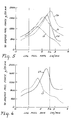
- the solid line represents Comparative Example C1
- the dashed line represents Example 1
- the dotted line represents Example 3
- the dash-dotted line represents Example 5
- the dash-dot-dotted line represents Example 7.
- the solid line represents Comparative Example C2
- the dash-dotted line represents Example 2
- the dotted line represents Example 4
- the dash-dot-dotted line represents Example 6.
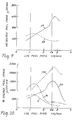
- the solid line represents Example 8
- the dotted line represents Example 9
- the dashed line represents Example 10
- the dash-dotted line represents Example 11
- the dash-dot-dotted line represents Example 12.
- Examples 13-17 illustrate the use of different solid tackifier resins in combination with different liquid resins in the embodiment of this invention.
- the end block resin used is Endex TM 160 and in Comparative Examples C3-C7, the end block resin is omitted.
- the compositions for Examples 13-17 and Comparative Examples C3-C7 are given in Table C.
- the tape samples were prepared and tested in the same manner as in Examples 1-12.
- the peel results are summarized in Table D. Again examples of the invention incorporating the end block resin display a maximum in the peel force between 10 and 400 cm/min, i.e., log peel rate between about 1.0 and 2.6 as shown in FIGS. 4, 5, and 6. In FIG.
- the solid line represents Comparative Example C3, the dashed line represents Comparative Example C4, the dotted line represents Example 13, and the dash-dotted line represents Example 14.
- the solid line represents Comparative Example C5
- the dotted line represents Comparative Example C6
- the dash-dot-dotted line represents Example 15, and the dash-dotted line represents Example 16.
- the solid line represents Comparative Example C7 and the dotted line represents Example 17.
- Examples 18-21 illustrate the similarity in peel properties when a typical embodiment of this invention (Example 5) is peeled from a variety of different diaper polyethylene substrates.
- the substrates used are as follows.
- Example 18 utilizes a polyethylene film such as is found on TendresseTM brand disposable diapers manufactured by Colgate-Palmolive in France.
- Example 19 employs a polyethylene film such as is found on HuggiesTM brand disposable diapers manufactured by Kimberly-Clark. This film is more completely described in U.S. Patent No. 4,655,761.
- Example 20 uses a polyethylene film such as is found on LUV'sTM brand disposable diapers manufactured by the Proctor and Gamble Company.
- Table F gives the adhesive formulations in parts by weight prepared for Examples 22-25 and Comparative Example C8.
- the tape samples were prepared in the same manner as Examples 1-12.
- Table G gives the peel force and rate data for Comparative Example C8 and Examples 22-25. These tape samples were tested in the following manner. Strips 25 mm wide and 100 mm long were cut from the tape samples. The strips were placed on a 35 ⁇ m (micron) corona treated polyethylene substrate such as is found on HuggiesTM brand disposable diapers (manufactured by Kimberly-Clark) and were rolled down using a 2 kg roller and 2 passes. The tape strips were subsequently peeled at 180 degrees at various peel rates using an MTS Model 810 Materials Testing System. The test procedure is that called for in the 180 degree peel adhesion test described in Pressure Sensitive Adhesive Tape Council, PSTC-1.
- Example C8 When no end block resin is used, as in Example C8 as taught by U.S. Patent No. 3,932,328, no maximum in the peel force vs. rate curve is seen below 400 cm/min. In fact, the peel force increases monotonically with rate until the peel force exceeds the strength of the tape backing. In this case the backing breaks before the tape peels from the substrate.
- a maximum in the peel force vs. peel rate between 10 and 400 cm/min occurred. This can further be seen in FIG. 8 where log peel values are between about 1.0 and 2.6 cm/min which correspond to peel values of 10 and 400 cm/min, respectively.
- the solid line represents Comparative Example C8, the dotted line represents Example 22, the dashed line represents Example 23, the dash-dot-dotted line represents Example 24, and the dash-dotted line represents Example 25.
- the tape samples were prepared in the same manner as Examples 1-12 using the formulations in Table H. In addition to determining the peel rate corresponding to the maximum peel force using the test described for Examples 1-12, the tape samples were also tested for reopenability.
- the samples were applied as tape tabs to commercially available disposable diapers that had a 25.4 ⁇ m (1.4 mil). polyethylene backsheet.
- the diapers used were the Tendresse TM brand disposable diaper manufactured by Colgate-Palmolive in France.
- the closure system now incorporating the example tapes was closed and subsequently reopened after having remained closed for 4 hours. A successful reopening leaves the polyethylene undamaged. Table I shows the rate at which the peel force reaches a maximum for these examples as well as the percent of the tabs tested for reopenability that passed the reopening test.
- Example C9 is the same as Example 3 from U.S. Patent No. 3,932, 328. It contains 100 parts Kraton TM 1107, 100 parts WingtackTM 10, and 100 parts WingtackTM 95.
- Example 35 contains the same amount of all of these raw materials but it also includes 50 parts of an end block reinforcing resin, EndexTM 160.
- the peel test used on these two examples is the same as for Example 22-25. The results are summarized in Table J.
- the example from U.S. Patent No. 3,932,328 does not exhibit the unique maximum in peel force vs. rate curve between 10 cm/min and 400 cm/min. This is further demonstrated in FIG. 9, where the solid line represents Comparative Example C9 and the dotted line represents Example 35.
- Comparative Example C10 and Example 36 use the same adhesive tapes as were used for Comparative Example C2 and Example 6, respectively.
- the peel test was the same 90 degree peel test as was used in Examples 1-12.
- the substrate for these examples was polypropylene instead of polyethylene.
- the polypropylene substrate does not change the general performance of the adhesives of this invention -- the maximum in the peel force is seen at peel bates between 10 and 400 cm/min, i.e., log peel rates between about 1.0 and 2.6 cm/min.
- the solid line represents Comparative Example C2
- the dotted line represents Comparative Example C10
- the dashed line represents Example 6
- the dash-dotted line represents Example 36.
Landscapes
- Health & Medical Sciences (AREA)
- Chemical & Material Sciences (AREA)
- General Health & Medical Sciences (AREA)
- Public Health (AREA)
- Veterinary Medicine (AREA)
- Engineering & Computer Science (AREA)
- Organic Chemistry (AREA)
- Epidemiology (AREA)
- Life Sciences & Earth Sciences (AREA)
- Animal Behavior & Ethology (AREA)
- Chemical Kinetics & Catalysis (AREA)
- Materials Engineering (AREA)
- Hematology (AREA)
- Biomedical Technology (AREA)
- Heart & Thoracic Surgery (AREA)
- Vascular Medicine (AREA)
- Adhesives Or Adhesive Processes (AREA)
- Absorbent Articles And Supports Therefor (AREA)
- Adhesive Tapes (AREA)
- Compositions Of Macromolecular Compounds (AREA)
- Orthopedics, Nursing, And Contraception (AREA)
Claims (9)
Applications Claiming Priority (2)
| Application Number | Priority Date | Filing Date | Title |
|---|---|---|---|
| US9112287A | 1987-08-31 | 1987-08-31 | |
| US91122 | 1987-08-31 |
Publications (4)
| Publication Number | Publication Date |
|---|---|
| EP0306232A2 EP0306232A2 (fr) | 1989-03-08 |
| EP0306232A3 EP0306232A3 (en) | 1989-05-17 |
| EP0306232B1 true EP0306232B1 (fr) | 1993-04-07 |
| EP0306232B2 EP0306232B2 (fr) | 1996-06-12 |
Family
ID=22226204
Family Applications (1)
| Application Number | Title | Priority Date | Filing Date |
|---|---|---|---|
| EP88307929A Expired - Lifetime EP0306232B2 (fr) | 1987-08-31 | 1988-08-26 | Composition adhésive à la pression, bande adhésive et système de fermeture pour couche-culotte |
Country Status (6)
| Country | Link |
|---|---|
| EP (1) | EP0306232B2 (fr) |
| JP (1) | JP2683376B2 (fr) |
| AU (1) | AU609859B2 (fr) |
| CA (1) | CA1323118C (fr) |
| DE (1) | DE3880054T3 (fr) |
| ES (1) | ES2039632T5 (fr) |
Families Citing this family (39)
| Publication number | Priority date | Publication date | Assignee | Title |
|---|---|---|---|---|
| JPH02202572A (ja) * | 1989-01-30 | 1990-08-10 | Arakawa Chem Ind Co Ltd | 感圧性接着剤組成物 |
| JPH0337062A (ja) * | 1989-07-03 | 1991-02-18 | Nitta Gelatin Inc | 使い捨て製品の製造方法 |
| US5358783A (en) * | 1989-08-11 | 1994-10-25 | The Dow Chemical Company | Blends containing polystyrene-polyisoprene-polystyrene block copolymers and articles thereof |
| US5292819A (en) * | 1989-08-11 | 1994-03-08 | The Dow Chemical Company | Radial block copolymers containing butadiene endblock |
| US5143968A (en) * | 1989-08-11 | 1992-09-01 | The Dow Chemical Company | Polystyrene-polyisoprene-polystyrene block copolymers, hot melt adhesive compositions, and articles produced therefrom |
| US5266394A (en) * | 1989-08-11 | 1993-11-30 | The Dow Chemical Company | Disposable articles of manufacture containing polystyrene-polyisoprene-polystyrene block copolymers |
| CA2032125A1 (fr) * | 1990-02-22 | 1991-08-23 | John A. Miller | Ruban adhesif pelable |
| AU618208B2 (en) * | 1990-03-19 | 1991-12-12 | National Starch And Chemical Investment Holding Corporation | Plasticizer resistant pressure sensitive adhesive |
| US5085655A (en) * | 1990-07-19 | 1992-02-04 | Avery Dennison Corporation | Cohesive tape system |
| JPH0759244B2 (ja) * | 1990-10-16 | 1995-06-28 | 日東電工株式会社 | 使い捨てオムツの剥離部の構造、及び剥離音を軽減した使い捨てオムツ |
| CA2091762C (fr) * | 1990-11-20 | 1997-08-05 | John A. Miller | Systeme de fermeture frontale par ruban adhesif pour couches de bebe |
| US5300057A (en) * | 1990-11-20 | 1994-04-05 | Minnesota Mining And Manufacturing Company | Frontal tape-based diaper closure system |
| US5147347A (en) * | 1991-01-17 | 1992-09-15 | Kimberly-Clark Corporation | Disposable garment having a refastenable adhesive taping system |
| US5468237A (en) * | 1991-08-20 | 1995-11-21 | Minnesota Mining And Manufacturing Company | Pressure-sensitive adhesive and disposable diaper closure system |
| JPH08501460A (ja) * | 1992-09-24 | 1996-02-20 | ミネソタ マイニング アンド マニュファクチャリング カンパニー | 低騒音使い捨ておむつのファスニングテープ |
| CZ58495A3 (en) * | 1992-09-24 | 1995-06-14 | Minnesota Mining & Mfg | Disposable lingerie |
| US5885269A (en) * | 1992-09-24 | 1999-03-23 | Minnesota Mining And Manufacturing Co. | Oil-tolerant reinforcement strip |
| US5500293A (en) * | 1993-02-05 | 1996-03-19 | Minnesota Mining And Manufacturing Company | Adhesive compositions with improved plasticizer resistance |
| WO1994021742A2 (fr) * | 1993-03-22 | 1994-09-29 | Minnesota Mining And Manufacturing Company | Elements de fixation a usages multiples sensibles au contact |
| ES2179844T3 (es) * | 1993-05-03 | 2003-02-01 | Avery Dennison Corp | Sistema de cinta adhesiva de sujecion repetible. |
| US5462538A (en) * | 1993-12-16 | 1995-10-31 | Mcneil-Ppc, Inc. | Molten adhesive fibers and products made therefrom |
| JP2981143B2 (ja) * | 1994-05-17 | 1999-11-22 | 日東電工株式会社 | 再剥離性粘着剤、粘着テープもしくはシート、及びこれらを用いたファスニングシステム |
| US5547766A (en) * | 1995-07-28 | 1996-08-20 | Minnesota Mining And Manufacturing Company | Non-yellowing tape article |
| US6120866A (en) * | 1995-08-07 | 2000-09-19 | Nitto Denko Corporation | Re-peeling pressure-sensitive adhesive tape or pressure-sensitive adhesive, and fastening system using the same |
| US6191055B1 (en) | 1996-12-18 | 2001-02-20 | 3M Innovative Properties Company | Oil-tolerant reinforcement strip |
| EP1449898A1 (fr) * | 2003-02-21 | 2004-08-25 | KRATON Polymers Research B.V. | Composition de la colle et rubans adhésives et étiquettes gommées a base de cette composition |
| JP2006519269A (ja) | 2003-02-21 | 2006-08-24 | クレイトン・ポリマーズ・リサーチ・ベー・ベー | 接着剤組成物、およびそれから得られるテープおよびラベル |
| DE602004014593D1 (de) * | 2003-02-21 | 2008-08-07 | Kraton Polymers Res Bv | Etikettenvormaterial mit verbessertem stanzverhalten |
| JP2005350650A (ja) * | 2004-05-14 | 2005-12-22 | Nitto Denko Corp | 剥離ライナー及びそれを用いた感圧性接着テープ又はシート |
| EP1784387B1 (fr) | 2004-07-13 | 2013-11-06 | Ricoh Company, Ltd. | Compose phenol, support de reproduction thermosensible reversible, etiquette de reproduction thermosensible et reversible, element de reproduction thermosensible et reversible, et procede de traitement de l'image |
| ES2474730T3 (es) * | 2005-04-20 | 2014-07-09 | Avery Dennison Corporation | Cintas adhesivas resistentes a termofluencia |
| JP4741024B1 (ja) * | 2010-01-27 | 2011-08-03 | シャープ株式会社 | 画像形成装置 |
| JP6095524B2 (ja) * | 2013-08-30 | 2017-03-15 | 東洋アルミニウム株式会社 | 撥水性表面への接着に適した粘着テープ |
| EP3243886A1 (fr) * | 2016-05-13 | 2017-11-15 | 3M Innovative Properties Company | Adhésif autocollant à base de caoutchouc présentant des caractéristiques à faible teneur en cov |
| WO2018152531A1 (fr) | 2017-02-20 | 2018-08-23 | Bostik, Inc. | Matériaux à base de styrène pour adhésifs thermofusibles |
| EP4353793B1 (fr) * | 2021-07-09 | 2025-05-14 | Denka Company Limited | Ruban adhésif |
| US20240287359A1 (en) * | 2021-07-09 | 2024-08-29 | Denka Company Limited | Pressure-sensitive adhesive tape |
| WO2023282218A1 (fr) * | 2021-07-09 | 2023-01-12 | デンカ株式会社 | Ruban adhésif |
| EP4441160A1 (fr) * | 2021-11-30 | 2024-10-09 | H.B. Fuller Company | Composition adhésive thermofusible comprenant de l'huile de résine liquide |
Family Cites Families (7)
| Publication number | Priority date | Publication date | Assignee | Title |
|---|---|---|---|---|
| US3862068A (en) * | 1968-06-28 | 1975-01-21 | Flintkote Co | Pressure-sensitive hot-melt adhesives |
| CA997084A (en) * | 1971-09-22 | 1976-09-14 | Shell Canada Limited | Adhesive composition |
| US3932328A (en) * | 1971-11-02 | 1976-01-13 | Johnson & Johnson | Hot melt adhesive composition and tape |
| US4104323A (en) * | 1977-04-18 | 1978-08-01 | Shell Oil Company | Adhesive composition containing a pre-blended polyphenylene ether resin |
| EP0016835B1 (fr) * | 1978-09-22 | 1984-06-13 | H.B. Fuller Company | Adhesif fondant a chaud pour le ceinturage elastique et procedes d'utilisation |
| US4411954A (en) * | 1982-08-16 | 1983-10-25 | National Starch And Chemical Corporation | Hot melt pressure sensitive adhesive and diaper tape closures coated therewith |
| JPH075873B2 (ja) * | 1986-02-10 | 1995-01-25 | 三井石油化学工業株式会社 | 粘着剤組成物 |
-
1988
- 1988-08-18 AU AU21171/88A patent/AU609859B2/en not_active Ceased
- 1988-08-22 CA CA000575362A patent/CA1323118C/fr not_active Expired - Fee Related
- 1988-08-26 ES ES88307929T patent/ES2039632T5/es not_active Expired - Lifetime
- 1988-08-26 EP EP88307929A patent/EP0306232B2/fr not_active Expired - Lifetime
- 1988-08-26 DE DE3880054T patent/DE3880054T3/de not_active Expired - Lifetime
- 1988-08-30 JP JP63216211A patent/JP2683376B2/ja not_active Expired - Fee Related
Also Published As
| Publication number | Publication date |
|---|---|
| JP2683376B2 (ja) | 1997-11-26 |
| DE3880054T3 (de) | 1997-01-23 |
| JPH0195175A (ja) | 1989-04-13 |
| DE3880054D1 (de) | 1993-05-13 |
| AU609859B2 (en) | 1991-05-09 |
| EP0306232B2 (fr) | 1996-06-12 |
| DE3880054T2 (de) | 1993-08-26 |
| AU2117188A (en) | 1989-03-02 |
| ES2039632T3 (es) | 1993-10-01 |
| CA1323118C (fr) | 1993-10-12 |
| EP0306232A2 (fr) | 1989-03-08 |
| EP0306232A3 (en) | 1989-05-17 |
| ES2039632T5 (es) | 1996-08-16 |
Similar Documents
| Publication | Publication Date | Title |
|---|---|---|
| EP0306232B1 (fr) | Composition adhésive à la pression, bande adhésive et système de fermeture pour couche-culotte | |
| US5112889A (en) | Pressure-sensitive adhesive composition, tape and diaper closure system | |
| KR0147053B1 (ko) | 접착제 고착 탭 | |
| AU652853B2 (en) | Improved novel pressure-sensitive adhesive and disposable diaper closure system | |
| JP2886686B2 (ja) | ホットメルト塗布性接着剤 | |
| US5300057A (en) | Frontal tape-based diaper closure system | |
| AU635559B2 (en) | Polystyrene-polyisoprene-polystyrene block copolymers, hot-melt adhesive compositions, and articles produced therefrom | |
| KR100216433B1 (ko) | 재부착할 수 있는 접착 테이프 | |
| EP2178974B1 (fr) | Adhésifs thermofusibles contenant un copolymère séquencé de styrène-butadiène | |
| WO1995033794A1 (fr) | Adhesifs sensibles a la pression | |
| US4652491A (en) | Pressure-sensitive adhesive and tape made therewith | |
| AU643354B2 (en) | Frontal tape-based diaper closure system | |
| WO1992010216A1 (fr) | Bande de fixation destinee a un article absorbant a sous-couche en mousse | |
| AU679449B2 (en) | Low noise disposable diaper fastening tape | |
| AU655378B1 (en) | Improved frontal tape-based diaper closure system | |
| WO1994006388A9 (fr) | Bandes de fixation de couches jetables faisant peu de bruit lorsqu'elles sont detachees |
Legal Events
| Date | Code | Title | Description |
|---|---|---|---|
| PUAI | Public reference made under article 153(3) epc to a published international application that has entered the european phase |
Free format text: ORIGINAL CODE: 0009012 |
|
| AK | Designated contracting states |
Kind code of ref document: A2 Designated state(s): DE ES FR GB IT SE |
|
| PUAL | Search report despatched |
Free format text: ORIGINAL CODE: 0009013 |
|
| AK | Designated contracting states |
Kind code of ref document: A3 Designated state(s): DE ES FR GB IT SE |
|
| 17P | Request for examination filed |
Effective date: 19891102 |
|
| 17Q | First examination report despatched |
Effective date: 19901011 |
|
| ITF | It: translation for a ep patent filed | ||
| GRAA | (expected) grant |
Free format text: ORIGINAL CODE: 0009210 |
|
| AK | Designated contracting states |
Kind code of ref document: B1 Designated state(s): DE ES FR GB IT SE |
|
| REF | Corresponds to: |
Ref document number: 3880054 Country of ref document: DE Date of ref document: 19930513 |
|
| ET | Fr: translation filed | ||
| PLBI | Opposition filed |
Free format text: ORIGINAL CODE: 0009260 |
|
| 26 | Opposition filed |
Opponent name: SHELL INTERNATIONALE RESEARCH MAATSCHAPPIJ B.V. Effective date: 19940107 |
|
| EAL | Se: european patent in force in sweden |
Ref document number: 88307929.5 |
|
| ITF | It: translation for a ep patent filed | ||
| PUAH | Patent maintained in amended form |
Free format text: ORIGINAL CODE: 0009272 |
|
| STAA | Information on the status of an ep patent application or granted ep patent |
Free format text: STATUS: PATENT MAINTAINED AS AMENDED |
|
| 27A | Patent maintained in amended form |
Effective date: 19960612 |
|
| AK | Designated contracting states |
Kind code of ref document: B2 Designated state(s): DE ES FR GB IT SE |
|
| REG | Reference to a national code |
Ref country code: ES Ref legal event code: BA2A Ref document number: 2039632 Country of ref document: ES Kind code of ref document: T5 |
|
| PLAW | Interlocutory decision in opposition |
Free format text: ORIGINAL CODE: EPIDOS IDOP |
|
| ET3 | Fr: translation filed ** decision concerning opposition | ||
| REG | Reference to a national code |
Ref country code: ES Ref legal event code: DC2A Kind code of ref document: T5 Effective date: 19960711 |
|
| PGFP | Annual fee paid to national office [announced via postgrant information from national office to epo] |
Ref country code: ES Payment date: 19980818 Year of fee payment: 11 |
|
| PGFP | Annual fee paid to national office [announced via postgrant information from national office to epo] |
Ref country code: SE Payment date: 19990802 Year of fee payment: 12 Ref country code: FR Payment date: 19990802 Year of fee payment: 12 |
|
| PG25 | Lapsed in a contracting state [announced via postgrant information from national office to epo] |
Ref country code: SE Free format text: LAPSE BECAUSE OF NON-PAYMENT OF DUE FEES Effective date: 20000827 |
|
| PG25 | Lapsed in a contracting state [announced via postgrant information from national office to epo] |
Ref country code: ES Free format text: LAPSE BECAUSE OF NON-PAYMENT OF DUE FEES Effective date: 20000828 |
|
| EUG | Se: european patent has lapsed |
Ref document number: 88307929.5 |
|
| PG25 | Lapsed in a contracting state [announced via postgrant information from national office to epo] |
Ref country code: FR Free format text: LAPSE BECAUSE OF NON-PAYMENT OF DUE FEES Effective date: 20010430 |
|
| REG | Reference to a national code |
Ref country code: FR Ref legal event code: ST |
|
| REG | Reference to a national code |
Ref country code: GB Ref legal event code: IF02 |
|
| PGFP | Annual fee paid to national office [announced via postgrant information from national office to epo] |
Ref country code: GB Payment date: 20020821 Year of fee payment: 15 |
|
| PGFP | Annual fee paid to national office [announced via postgrant information from national office to epo] |
Ref country code: DE Payment date: 20020830 Year of fee payment: 15 |
|
| PG25 | Lapsed in a contracting state [announced via postgrant information from national office to epo] |
Ref country code: GB Free format text: LAPSE BECAUSE OF NON-PAYMENT OF DUE FEES Effective date: 20030826 |
|
| PG25 | Lapsed in a contracting state [announced via postgrant information from national office to epo] |
Ref country code: DE Free format text: LAPSE BECAUSE OF NON-PAYMENT OF DUE FEES Effective date: 20040302 |
|
| REG | Reference to a national code |
Ref country code: ES Ref legal event code: FD2A Effective date: 20010911 |
|
| GBPC | Gb: european patent ceased through non-payment of renewal fee | ||
| PG25 | Lapsed in a contracting state [announced via postgrant information from national office to epo] |
Ref country code: IT Free format text: LAPSE BECAUSE OF NON-PAYMENT OF DUE FEES;WARNING: LAPSES OF ITALIAN PATENTS WITH EFFECTIVE DATE BEFORE 2007 MAY HAVE OCCURRED AT ANY TIME BEFORE 2007. THE CORRECT EFFECTIVE DATE MAY BE DIFFERENT FROM THE ONE RECORDED. Effective date: 20050826 |