EP0306436A2 - Verfahren zur Reduzierung des Gehaltes an ionogenen Schwermetallen bei der Herstellung von Metallkomplexfarbstoffen - Google Patents
Verfahren zur Reduzierung des Gehaltes an ionogenen Schwermetallen bei der Herstellung von Metallkomplexfarbstoffen Download PDFInfo
- Publication number
- EP0306436A2 EP0306436A2 EP88710024A EP88710024A EP0306436A2 EP 0306436 A2 EP0306436 A2 EP 0306436A2 EP 88710024 A EP88710024 A EP 88710024A EP 88710024 A EP88710024 A EP 88710024A EP 0306436 A2 EP0306436 A2 EP 0306436A2
- Authority
- EP
- European Patent Office
- Prior art keywords
- acid
- water
- heavy metal
- und
- group
- Prior art date
- Legal status (The legal status is an assumption and is not a legal conclusion. Google has not performed a legal analysis and makes no representation as to the accuracy of the status listed.)
- Granted
Links
- 229910001385 heavy metal Inorganic materials 0.000 title claims abstract description 73
- 239000000434 metal complex dye Substances 0.000 title claims abstract description 22
- 238000000034 method Methods 0.000 title claims description 21
- 230000008569 process Effects 0.000 title description 6
- -1 aliphatic sulfonic acids Chemical class 0.000 claims abstract description 114
- 239000000975 dye Substances 0.000 claims abstract description 88
- 150000002500 ions Chemical class 0.000 claims abstract description 30
- 125000004432 carbon atom Chemical group C* 0.000 claims abstract description 27
- 150000001875 compounds Chemical class 0.000 claims abstract description 25
- 125000004435 hydrogen atom Chemical group [H]* 0.000 claims abstract description 25
- 150000003839 salts Chemical class 0.000 claims abstract description 25
- RWZYAGGXGHYGMB-UHFFFAOYSA-N anthranilic acid Chemical compound NC1=CC=CC=C1C(O)=O RWZYAGGXGHYGMB-UHFFFAOYSA-N 0.000 claims abstract description 19
- NBIIXXVUZAFLBC-UHFFFAOYSA-N Phosphoric acid Chemical compound OP(O)(O)=O NBIIXXVUZAFLBC-UHFFFAOYSA-N 0.000 claims abstract description 15
- 230000015572 biosynthetic process Effects 0.000 claims abstract description 14
- 238000003786 synthesis reaction Methods 0.000 claims abstract description 14
- 229910052751 metal Inorganic materials 0.000 claims abstract description 11
- 239000002184 metal Substances 0.000 claims abstract description 11
- OFOBLEOULBTSOW-UHFFFAOYSA-N Malonic acid Chemical compound OC(=O)CC(O)=O OFOBLEOULBTSOW-UHFFFAOYSA-N 0.000 claims abstract description 10
- MCJGNVYPOGVAJF-UHFFFAOYSA-N quinolin-8-ol Chemical compound C1=CN=C2C(O)=CC=CC2=C1 MCJGNVYPOGVAJF-UHFFFAOYSA-N 0.000 claims abstract description 10
- 239000005725 8-Hydroxyquinoline Substances 0.000 claims abstract description 8
- 229960003540 oxyquinoline Drugs 0.000 claims abstract description 8
- 235000011007 phosphoric acid Nutrition 0.000 claims abstract description 7
- 229920006395 saturated elastomer Polymers 0.000 claims abstract description 7
- XLYOFNOQVPJJNP-UHFFFAOYSA-N water Substances O XLYOFNOQVPJJNP-UHFFFAOYSA-N 0.000 claims abstract description 7
- 150000005690 diesters Chemical class 0.000 claims abstract description 5
- 229910021645 metal ion Inorganic materials 0.000 claims abstract description 5
- 235000003441 saturated fatty acids Nutrition 0.000 claims abstract description 5
- 150000004671 saturated fatty acids Chemical class 0.000 claims abstract description 5
- 238000005342 ion exchange Methods 0.000 claims abstract description 4
- 150000004670 unsaturated fatty acids Chemical class 0.000 claims abstract description 4
- 235000021122 unsaturated fatty acids Nutrition 0.000 claims abstract description 4
- 229910052977 alkali metal sulfide Inorganic materials 0.000 claims abstract description 3
- 239000013522 chelant Substances 0.000 claims abstract description 3
- 125000000020 sulfo group Chemical group O=S(=O)([*])O[H] 0.000 claims description 34
- 238000001556 precipitation Methods 0.000 claims description 32
- 125000003178 carboxy group Chemical group [H]OC(*)=O 0.000 claims description 17
- 229910052783 alkali metal Inorganic materials 0.000 claims description 16
- 239000003153 chemical reaction reagent Substances 0.000 claims description 13
- 239000000203 mixture Substances 0.000 claims description 11
- 229910052979 sodium sulfide Inorganic materials 0.000 claims description 8
- GRVFOGOEDUUMBP-UHFFFAOYSA-N sodium sulfide (anhydrous) Chemical compound [Na+].[Na+].[S-2] GRVFOGOEDUUMBP-UHFFFAOYSA-N 0.000 claims description 8
- DGAQECJNVWCQMB-PUAWFVPOSA-M Ilexoside XXIX Chemical compound C[C@@H]1CC[C@@]2(CC[C@@]3(C(=CC[C@H]4[C@]3(CC[C@@H]5[C@@]4(CC[C@@H](C5(C)C)OS(=O)(=O)[O-])C)C)[C@@H]2[C@]1(C)O)C)C(=O)O[C@H]6[C@@H]([C@H]([C@@H]([C@H](O6)CO)O)O)O.[Na+] DGAQECJNVWCQMB-PUAWFVPOSA-M 0.000 claims description 7
- 238000006243 chemical reaction Methods 0.000 claims description 7
- 229910052708 sodium Inorganic materials 0.000 claims description 7
- 239000011734 sodium Substances 0.000 claims description 7
- OAOABCKPVCUNKO-UHFFFAOYSA-N 8-methyl Nonanoic acid Chemical compound CC(C)CCCCCCC(O)=O OAOABCKPVCUNKO-UHFFFAOYSA-N 0.000 claims description 6
- OBETXYAYXDNJHR-UHFFFAOYSA-N alpha-ethylcaproic acid Natural products CCCCC(CC)C(O)=O OBETXYAYXDNJHR-UHFFFAOYSA-N 0.000 claims description 6
- GHVNFZFCNZKVNT-UHFFFAOYSA-N decanoic acid Chemical compound CCCCCCCCCC(O)=O GHVNFZFCNZKVNT-UHFFFAOYSA-N 0.000 claims description 6
- POULHZVOKOAJMA-UHFFFAOYSA-N dodecanoic acid Chemical compound CCCCCCCCCCCC(O)=O POULHZVOKOAJMA-UHFFFAOYSA-N 0.000 claims description 6
- IPCSVZSSVZVIGE-UHFFFAOYSA-N hexadecanoic acid Chemical compound CCCCCCCCCCCCCCCC(O)=O IPCSVZSSVZVIGE-UHFFFAOYSA-N 0.000 claims description 6
- WWZKQHOCKIZLMA-UHFFFAOYSA-N octanoic acid Chemical compound CCCCCCCC(O)=O WWZKQHOCKIZLMA-UHFFFAOYSA-N 0.000 claims description 6
- RYYKJJJTJZKILX-UHFFFAOYSA-M sodium octadecanoate Chemical compound [Na+].CCCCCCCCCCCCCCCCCC([O-])=O RYYKJJJTJZKILX-UHFFFAOYSA-M 0.000 claims description 6
- 235000021355 Stearic acid Nutrition 0.000 claims description 5
- 150000001340 alkali metals Chemical class 0.000 claims description 5
- QIQXTHQIDYTFRH-UHFFFAOYSA-N octadecanoic acid Chemical compound CCCCCCCCCCCCCCCCCC(O)=O QIQXTHQIDYTFRH-UHFFFAOYSA-N 0.000 claims description 5
- OQCDKBAXFALNLD-UHFFFAOYSA-N octadecanoic acid Natural products CCCCCCCC(C)CCCCCCCCC(O)=O OQCDKBAXFALNLD-UHFFFAOYSA-N 0.000 claims description 5
- 239000008117 stearic acid Substances 0.000 claims description 5
- 150000002148 esters Chemical class 0.000 claims description 4
- 229920000642 polymer Polymers 0.000 claims description 4
- 159000000000 sodium salts Chemical class 0.000 claims description 4
- OBETXYAYXDNJHR-SSDOTTSWSA-M (2r)-2-ethylhexanoate Chemical compound CCCC[C@@H](CC)C([O-])=O OBETXYAYXDNJHR-SSDOTTSWSA-M 0.000 claims description 3
- WRIDQFICGBMAFQ-UHFFFAOYSA-N (E)-8-Octadecenoic acid Natural products CCCCCCCCCC=CCCCCCCC(O)=O WRIDQFICGBMAFQ-UHFFFAOYSA-N 0.000 claims description 3
- LQJBNNIYVWPHFW-UHFFFAOYSA-N 20:1omega9c fatty acid Natural products CCCCCCCCCCC=CCCCCCCCC(O)=O LQJBNNIYVWPHFW-UHFFFAOYSA-N 0.000 claims description 3
- XZOYHFBNQHPJRQ-UHFFFAOYSA-N 7-methyloctanoic acid Chemical compound CC(C)CCCCCC(O)=O XZOYHFBNQHPJRQ-UHFFFAOYSA-N 0.000 claims description 3
- QSBYPNXLFMSGKH-UHFFFAOYSA-N 9-Heptadecensaeure Natural products CCCCCCCC=CCCCCCCCC(O)=O QSBYPNXLFMSGKH-UHFFFAOYSA-N 0.000 claims description 3
- 239000005632 Capric acid (CAS 334-48-5) Substances 0.000 claims description 3
- 239000005639 Lauric acid Substances 0.000 claims description 3
- 239000005642 Oleic acid Substances 0.000 claims description 3
- ZQPPMHVWECSIRJ-UHFFFAOYSA-N Oleic acid Natural products CCCCCCCCC=CCCCCCCCC(O)=O ZQPPMHVWECSIRJ-UHFFFAOYSA-N 0.000 claims description 3
- 235000021314 Palmitic acid Nutrition 0.000 claims description 3
- QXJSBBXBKPUZAA-UHFFFAOYSA-N isooleic acid Natural products CCCCCCCC=CCCCCCCCCC(O)=O QXJSBBXBKPUZAA-UHFFFAOYSA-N 0.000 claims description 3
- WQEPLUUGTLDZJY-UHFFFAOYSA-N n-Pentadecanoic acid Natural products CCCCCCCCCCCCCCC(O)=O WQEPLUUGTLDZJY-UHFFFAOYSA-N 0.000 claims description 3
- ZQPPMHVWECSIRJ-KTKRTIGZSA-N oleic acid Chemical compound CCCCCCCC\C=C/CCCCCCCC(O)=O ZQPPMHVWECSIRJ-KTKRTIGZSA-N 0.000 claims description 3
- 159000000001 potassium salts Chemical class 0.000 claims description 3
- 125000002704 decyl group Chemical group [H]C([H])([H])C([H])([H])C([H])([H])C([H])([H])C([H])([H])C([H])([H])C([H])([H])C([H])([H])C([H])([H])C([H])([H])* 0.000 claims description 2
- 125000003438 dodecyl group Chemical group [H]C([H])([H])C([H])([H])C([H])([H])C([H])([H])C([H])([H])C([H])([H])C([H])([H])C([H])([H])C([H])([H])C([H])([H])C([H])([H])C([H])([H])* 0.000 claims description 2
- 125000001421 myristyl group Chemical group [H]C([*])([H])C([H])([H])C([H])([H])C([H])([H])C([H])([H])C([H])([H])C([H])([H])C([H])([H])C([H])([H])C([H])([H])C([H])([H])C([H])([H])C([H])([H])C([H])([H])[H] 0.000 claims description 2
- 125000002347 octyl group Chemical group [H]C([*])([H])C([H])([H])C([H])([H])C([H])([H])C([H])([H])C([H])([H])C([H])([H])C([H])([H])[H] 0.000 claims description 2
- 125000000913 palmityl group Chemical group [H]C([*])([H])C([H])([H])C([H])([H])C([H])([H])C([H])([H])C([H])([H])C([H])([H])C([H])([H])C([H])([H])C([H])([H])C([H])([H])C([H])([H])C([H])([H])C([H])([H])C([H])([H])C([H])([H])[H] 0.000 claims description 2
- 125000004079 stearyl group Chemical group [H]C([*])([H])C([H])([H])C([H])([H])C([H])([H])C([H])([H])C([H])([H])C([H])([H])C([H])([H])C([H])([H])C([H])([H])C([H])([H])C([H])([H])C([H])([H])C([H])([H])C([H])([H])C([H])([H])C([H])([H])C([H])([H])[H] 0.000 claims description 2
- 150000004763 sulfides Chemical class 0.000 claims description 2
- TUNFSRHWOTWDNC-HKGQFRNVSA-N tetradecanoic acid Chemical compound CCCCCCCCCCCCC[14C](O)=O TUNFSRHWOTWDNC-HKGQFRNVSA-N 0.000 claims description 2
- RWZYAGGXGHYGMB-WGGUOBTBSA-N 2-aminobenzoic acid Chemical group NC1=CC=CC=C1[14C](O)=O RWZYAGGXGHYGMB-WGGUOBTBSA-N 0.000 claims 1
- UCKMPCXJQFINFW-UHFFFAOYSA-N Sulphide Chemical compound [S-2] UCKMPCXJQFINFW-UHFFFAOYSA-N 0.000 abstract description 5
- 150000003568 thioethers Chemical class 0.000 abstract 1
- 229920003176 water-insoluble polymer Polymers 0.000 abstract 1
- 239000000243 solution Substances 0.000 description 44
- 125000000217 alkyl group Chemical group 0.000 description 35
- QTBSBXVTEAMEQO-UHFFFAOYSA-N Acetic acid Chemical compound CC(O)=O QTBSBXVTEAMEQO-UHFFFAOYSA-N 0.000 description 21
- 125000001424 substituent group Chemical group 0.000 description 21
- RYGMFSIKBFXOCR-UHFFFAOYSA-N Copper Chemical compound [Cu] RYGMFSIKBFXOCR-UHFFFAOYSA-N 0.000 description 18
- 229910052801 chlorine Inorganic materials 0.000 description 18
- 239000010949 copper Substances 0.000 description 18
- 125000003545 alkoxy group Chemical group 0.000 description 17
- 125000001997 phenyl group Chemical group [H]C1=C([H])C([H])=C(*)C([H])=C1[H] 0.000 description 17
- 229910052802 copper Inorganic materials 0.000 description 16
- PXHVJJICTQNCMI-UHFFFAOYSA-N Nickel Chemical compound [Ni] PXHVJJICTQNCMI-UHFFFAOYSA-N 0.000 description 14
- 239000000460 chlorine Substances 0.000 description 14
- 125000002496 methyl group Chemical group [H]C([H])([H])* 0.000 description 14
- WKBOTKDWSSQWDR-UHFFFAOYSA-N Bromine atom Chemical compound [Br] WKBOTKDWSSQWDR-UHFFFAOYSA-N 0.000 description 13
- UHOVQNZJYSORNB-UHFFFAOYSA-N Benzene Chemical compound C1=CC=CC=C1 UHOVQNZJYSORNB-UHFFFAOYSA-N 0.000 description 12
- CDBYLPFSWZWCQE-UHFFFAOYSA-L Sodium Carbonate Chemical compound [Na+].[Na+].[O-]C([O-])=O CDBYLPFSWZWCQE-UHFFFAOYSA-L 0.000 description 12
- 125000001495 ethyl group Chemical group [H]C([H])([H])C([H])([H])* 0.000 description 11
- VJMAITQRABEEKP-UHFFFAOYSA-N [6-(phenylmethoxymethyl)-1,4-dioxan-2-yl]methyl acetate Chemical compound O1C(COC(=O)C)COCC1COCC1=CC=CC=C1 VJMAITQRABEEKP-UHFFFAOYSA-N 0.000 description 10
- GDTBXPJZTBHREO-UHFFFAOYSA-N bromine Substances BrBr GDTBXPJZTBHREO-UHFFFAOYSA-N 0.000 description 10
- 229910052794 bromium Inorganic materials 0.000 description 10
- ZAMOUSCENKQFHK-UHFFFAOYSA-N Chlorine atom Chemical compound [Cl] ZAMOUSCENKQFHK-UHFFFAOYSA-N 0.000 description 9
- 150000003254 radicals Chemical class 0.000 description 9
- BVKZGUZCCUSVTD-UHFFFAOYSA-M Bicarbonate Chemical compound OC([O-])=O BVKZGUZCCUSVTD-UHFFFAOYSA-M 0.000 description 8
- 150000004699 copper complex Chemical class 0.000 description 8
- 125000002887 hydroxy group Chemical group [H]O* 0.000 description 8
- 125000001624 naphthyl group Chemical group 0.000 description 8
- 239000005909 Kieselgur Substances 0.000 description 7
- VYPSYNLAJGMNEJ-UHFFFAOYSA-N Silicium dioxide Chemical compound O=[Si]=O VYPSYNLAJGMNEJ-UHFFFAOYSA-N 0.000 description 7
- 239000008351 acetate buffer Substances 0.000 description 7
- 125000000449 nitro group Chemical group [O-][N+](*)=O 0.000 description 7
- 239000000843 powder Substances 0.000 description 7
- 239000007921 spray Substances 0.000 description 7
- MUBZPKHOEPUJKR-UHFFFAOYSA-N Oxalic acid Chemical compound OC(=O)C(O)=O MUBZPKHOEPUJKR-UHFFFAOYSA-N 0.000 description 6
- 125000005236 alkanoylamino group Chemical group 0.000 description 6
- 125000004397 aminosulfonyl group Chemical group NS(=O)(=O)* 0.000 description 6
- 125000001309 chloro group Chemical group Cl* 0.000 description 6
- 239000000706 filtrate Substances 0.000 description 6
- 229910000029 sodium carbonate Inorganic materials 0.000 description 6
- CIUQDSCDWFSTQR-UHFFFAOYSA-N [C]1=CC=CC=C1 Chemical compound [C]1=CC=CC=C1 CIUQDSCDWFSTQR-UHFFFAOYSA-N 0.000 description 5
- 125000000738 acetamido group Chemical group [H]C([H])([H])C(=O)N([H])[*] 0.000 description 5
- 239000010941 cobalt Substances 0.000 description 5
- GUTLYIVDDKVIGB-UHFFFAOYSA-N cobalt atom Chemical compound [Co] GUTLYIVDDKVIGB-UHFFFAOYSA-N 0.000 description 5
- 238000004519 manufacturing process Methods 0.000 description 5
- 125000000956 methoxy group Chemical group [H]C([H])([H])O* 0.000 description 5
- 229910052759 nickel Inorganic materials 0.000 description 5
- KZBUYRJDOAKODT-UHFFFAOYSA-N Chlorine Chemical compound ClCl KZBUYRJDOAKODT-UHFFFAOYSA-N 0.000 description 4
- XEEYBQQBJWHFJM-UHFFFAOYSA-N Iron Chemical compound [Fe] XEEYBQQBJWHFJM-UHFFFAOYSA-N 0.000 description 4
- 239000002253 acid Substances 0.000 description 4
- 230000002378 acidificating effect Effects 0.000 description 4
- 125000000751 azo group Chemical group [*]N=N[*] 0.000 description 4
- 125000000043 benzamido group Chemical group [H]N([*])C(=O)C1=C([H])C([H])=C([H])C([H])=C1[H] 0.000 description 4
- 150000001768 cations Chemical class 0.000 description 4
- 229910017052 cobalt Inorganic materials 0.000 description 4
- 238000004043 dyeing Methods 0.000 description 4
- 125000003754 ethoxycarbonyl group Chemical group C(=O)(OCC)* 0.000 description 4
- 229910052757 nitrogen Inorganic materials 0.000 description 4
- 125000004433 nitrogen atom Chemical group N* 0.000 description 4
- 125000004430 oxygen atom Chemical group O* 0.000 description 4
- IEQIEDJGQAUEQZ-UHFFFAOYSA-N phthalocyanine Chemical compound N1C(N=C2C3=CC=CC=C3C(N=C3C4=CC=CC=C4C(=N4)N3)=N2)=C(C=CC=C2)C2=C1N=C1C2=CC=CC=C2C4=N1 IEQIEDJGQAUEQZ-UHFFFAOYSA-N 0.000 description 4
- JPVYNHNXODAKFH-UHFFFAOYSA-N Cu2+ Chemical compound [Cu+2] JPVYNHNXODAKFH-UHFFFAOYSA-N 0.000 description 3
- ZLMJMSJWJFRBEC-UHFFFAOYSA-N Potassium Chemical compound [K] ZLMJMSJWJFRBEC-UHFFFAOYSA-N 0.000 description 3
- 150000007513 acids Chemical class 0.000 description 3
- 125000003118 aryl group Chemical group 0.000 description 3
- 125000004429 atom Chemical group 0.000 description 3
- 239000000987 azo dye Substances 0.000 description 3
- 239000008139 complexing agent Substances 0.000 description 3
- 229910001431 copper ion Inorganic materials 0.000 description 3
- 230000008878 coupling Effects 0.000 description 3
- 238000010168 coupling process Methods 0.000 description 3
- 238000005859 coupling reaction Methods 0.000 description 3
- 229910052731 fluorine Inorganic materials 0.000 description 3
- 229910052736 halogen Inorganic materials 0.000 description 3
- 150000002367 halogens Chemical class 0.000 description 3
- RAXXELZNTBOGNW-UHFFFAOYSA-N imidazole Natural products C1=CNC=N1 RAXXELZNTBOGNW-UHFFFAOYSA-N 0.000 description 3
- 150000002736 metal compounds Chemical class 0.000 description 3
- 125000001820 oxy group Chemical group [*:1]O[*:2] 0.000 description 3
- 238000007086 side reaction Methods 0.000 description 3
- QTBSBXVTEAMEQO-UHFFFAOYSA-M Acetate Chemical compound CC([O-])=O QTBSBXVTEAMEQO-UHFFFAOYSA-M 0.000 description 2
- QGZKDVFQNNGYKY-UHFFFAOYSA-N Ammonia Chemical compound N QGZKDVFQNNGYKY-UHFFFAOYSA-N 0.000 description 2
- RJSYPKWVIJGNLO-UHFFFAOYSA-N CCOClOC Chemical compound CCOClOC RJSYPKWVIJGNLO-UHFFFAOYSA-N 0.000 description 2
- OKTJSMMVPCPJKN-UHFFFAOYSA-N Carbon Chemical compound [C] OKTJSMMVPCPJKN-UHFFFAOYSA-N 0.000 description 2
- VYZAMTAEIAYCRO-UHFFFAOYSA-N Chromium Chemical compound [Cr] VYZAMTAEIAYCRO-UHFFFAOYSA-N 0.000 description 2
- RGHNJXZEOKUKBD-SQOUGZDYSA-N D-gluconic acid Chemical compound OC[C@@H](O)[C@@H](O)[C@H](O)[C@@H](O)C(O)=O RGHNJXZEOKUKBD-SQOUGZDYSA-N 0.000 description 2
- PXGOKWXKJXAPGV-UHFFFAOYSA-N Fluorine Chemical compound FF PXGOKWXKJXAPGV-UHFFFAOYSA-N 0.000 description 2
- YLQBMQCUIZJEEH-UHFFFAOYSA-N Furan Chemical compound C=1C=COC=1 YLQBMQCUIZJEEH-UHFFFAOYSA-N 0.000 description 2
- VEXZGXHMUGYJMC-UHFFFAOYSA-N Hydrochloric acid Chemical compound Cl VEXZGXHMUGYJMC-UHFFFAOYSA-N 0.000 description 2
- SIKJAQJRHWYJAI-UHFFFAOYSA-N Indole Chemical compound C1=CC=C2NC=CC2=C1 SIKJAQJRHWYJAI-UHFFFAOYSA-N 0.000 description 2
- WHXSMMKQMYFTQS-UHFFFAOYSA-N Lithium Chemical compound [Li] WHXSMMKQMYFTQS-UHFFFAOYSA-N 0.000 description 2
- WTKZEGDFNFYCGP-UHFFFAOYSA-N Pyrazole Chemical compound C=1C=NNC=1 WTKZEGDFNFYCGP-UHFFFAOYSA-N 0.000 description 2
- JUJWROOIHBZHMG-UHFFFAOYSA-N Pyridine Chemical compound C1=CC=NC=C1 JUJWROOIHBZHMG-UHFFFAOYSA-N 0.000 description 2
- KAESVJOAVNADME-UHFFFAOYSA-N Pyrrole Chemical compound C=1C=CNC=1 KAESVJOAVNADME-UHFFFAOYSA-N 0.000 description 2
- SMWDFEZZVXVKRB-UHFFFAOYSA-N Quinoline Chemical compound N1=CC=CC2=CC=CC=C21 SMWDFEZZVXVKRB-UHFFFAOYSA-N 0.000 description 2
- KEAYESYHFKHZAL-UHFFFAOYSA-N Sodium Chemical compound [Na] KEAYESYHFKHZAL-UHFFFAOYSA-N 0.000 description 2
- YTPLMLYBLZKORZ-UHFFFAOYSA-N Thiophene Chemical compound C=1C=CSC=1 YTPLMLYBLZKORZ-UHFFFAOYSA-N 0.000 description 2
- VRAKDAYLTPMBAW-UHFFFAOYSA-N [O-][N+](=O)ClC#N Chemical compound [O-][N+](=O)ClC#N VRAKDAYLTPMBAW-UHFFFAOYSA-N 0.000 description 2
- 125000003342 alkenyl group Chemical group 0.000 description 2
- 238000001479 atomic absorption spectroscopy Methods 0.000 description 2
- 230000008901 benefit Effects 0.000 description 2
- 150000001555 benzenes Chemical class 0.000 description 2
- WDEQGLDWZMIMJM-UHFFFAOYSA-N benzyl 4-hydroxy-2-(hydroxymethyl)pyrrolidine-1-carboxylate Chemical compound OCC1CC(O)CN1C(=O)OCC1=CC=CC=C1 WDEQGLDWZMIMJM-UHFFFAOYSA-N 0.000 description 2
- 125000002837 carbocyclic group Chemical group 0.000 description 2
- 125000005708 carbonyloxy group Chemical group [*:2]OC([*:1])=O 0.000 description 2
- 239000011651 chromium Substances 0.000 description 2
- 230000001419 dependent effect Effects 0.000 description 2
- 125000000664 diazo group Chemical group [N-]=[N+]=[*] 0.000 description 2
- 238000001914 filtration Methods 0.000 description 2
- 239000011737 fluorine Substances 0.000 description 2
- 125000005843 halogen group Chemical class 0.000 description 2
- 229910052742 iron Inorganic materials 0.000 description 2
- 125000001449 isopropyl group Chemical group [H]C([H])([H])C([H])(*)C([H])([H])[H] 0.000 description 2
- 229910052744 lithium Inorganic materials 0.000 description 2
- VMGAPWLDMVPYIA-HIDZBRGKSA-N n'-amino-n-iminomethanimidamide Chemical compound N\N=C\N=N VMGAPWLDMVPYIA-HIDZBRGKSA-N 0.000 description 2
- 150000002790 naphthalenes Chemical class 0.000 description 2
- 229910001453 nickel ion Inorganic materials 0.000 description 2
- 235000006408 oxalic acid Nutrition 0.000 description 2
- 125000000843 phenylene group Chemical group C1(=C(C=CC=C1)*)* 0.000 description 2
- 239000001007 phthalocyanine dye Substances 0.000 description 2
- 229910052700 potassium Inorganic materials 0.000 description 2
- 239000011591 potassium Substances 0.000 description 2
- 230000009467 reduction Effects 0.000 description 2
- BOLDJAUMGUJJKM-LSDHHAIUSA-N renifolin D Natural products CC(=C)[C@@H]1Cc2c(O)c(O)ccc2[C@H]1CC(=O)c3ccc(O)cc3O BOLDJAUMGUJJKM-LSDHHAIUSA-N 0.000 description 2
- 239000011347 resin Substances 0.000 description 2
- 229920005989 resin Polymers 0.000 description 2
- 238000000926 separation method Methods 0.000 description 2
- 125000000999 tert-butyl group Chemical group [H]C([H])([H])C(*)(C([H])([H])[H])C([H])([H])[H] 0.000 description 2
- 125000002023 trifluoromethyl group Chemical group FC(F)(F)* 0.000 description 2
- CPEONABTMRSIKA-UHFFFAOYSA-N 1,4$l^{2}-oxazinane Chemical compound C1COCC[N]1 CPEONABTMRSIKA-UHFFFAOYSA-N 0.000 description 1
- HYZJCKYKOHLVJF-UHFFFAOYSA-N 1H-benzimidazole Chemical compound C1=CC=C2NC=NC2=C1 HYZJCKYKOHLVJF-UHFFFAOYSA-N 0.000 description 1
- QPKNFEVLZVJGBM-UHFFFAOYSA-N 2-aminonaphthalen-1-ol Chemical compound C1=CC=CC2=C(O)C(N)=CC=C21 QPKNFEVLZVJGBM-UHFFFAOYSA-N 0.000 description 1
- TWJNQYPJQDRXPH-UHFFFAOYSA-N 2-cyanobenzohydrazide Chemical compound NNC(=O)C1=CC=CC=C1C#N TWJNQYPJQDRXPH-UHFFFAOYSA-N 0.000 description 1
- OJWYYSVOSNWCCE-UHFFFAOYSA-N 2-methoxyethyl hypofluorite Chemical compound COCCOF OJWYYSVOSNWCCE-UHFFFAOYSA-N 0.000 description 1
- 125000003903 2-propenyl group Chemical group [H]C([*])([H])C([H])=C([H])[H] 0.000 description 1
- 125000005330 8 membered heterocyclic group Chemical group 0.000 description 1
- 101100352919 Caenorhabditis elegans ppm-2 gene Proteins 0.000 description 1
- XFXPMWWXUTWYJX-UHFFFAOYSA-N Cyanide Chemical compound N#[C-] XFXPMWWXUTWYJX-UHFFFAOYSA-N 0.000 description 1
- RGHNJXZEOKUKBD-UHFFFAOYSA-N D-gluconic acid Natural products OCC(O)C(O)C(O)C(O)C(O)=O RGHNJXZEOKUKBD-UHFFFAOYSA-N 0.000 description 1
- FEWJPZIEWOKRBE-JCYAYHJZSA-N Dextrotartaric acid Chemical compound OC(=O)[C@H](O)[C@@H](O)C(O)=O FEWJPZIEWOKRBE-JCYAYHJZSA-N 0.000 description 1
- RWSOTUBLDIXVET-UHFFFAOYSA-N Dihydrogen sulfide Chemical compound S RWSOTUBLDIXVET-UHFFFAOYSA-N 0.000 description 1
- KCXVZYZYPLLWCC-UHFFFAOYSA-N EDTA Chemical compound OC(=O)CN(CC(O)=O)CCN(CC(O)=O)CC(O)=O KCXVZYZYPLLWCC-UHFFFAOYSA-N 0.000 description 1
- PIICEJLVQHRZGT-UHFFFAOYSA-N Ethylenediamine Chemical compound NCCN PIICEJLVQHRZGT-UHFFFAOYSA-N 0.000 description 1
- 235000021360 Myristic acid Nutrition 0.000 description 1
- TUNFSRHWOTWDNC-UHFFFAOYSA-N Myristic acid Natural products CCCCCCCCCCCCCC(O)=O TUNFSRHWOTWDNC-UHFFFAOYSA-N 0.000 description 1
- VNMGVBPCESRCOG-UHFFFAOYSA-N OC(=O)ClS(O)(=O)=O Chemical compound OC(=O)ClS(O)(=O)=O VNMGVBPCESRCOG-UHFFFAOYSA-N 0.000 description 1
- 229910019142 PO4 Inorganic materials 0.000 description 1
- XBDQKXXYIPTUBI-UHFFFAOYSA-N Propionic acid Chemical class CCC(O)=O XBDQKXXYIPTUBI-UHFFFAOYSA-N 0.000 description 1
- CZPWVGJYEJSRLH-UHFFFAOYSA-N Pyrimidine Chemical compound C1=CN=CN=C1 CZPWVGJYEJSRLH-UHFFFAOYSA-N 0.000 description 1
- 229910006127 SO3X Inorganic materials 0.000 description 1
- BCKXLBQYZLBQEK-KVVVOXFISA-M Sodium oleate Chemical compound [Na+].CCCCCCCC\C=C/CCCCCCCC([O-])=O BCKXLBQYZLBQEK-KVVVOXFISA-M 0.000 description 1
- FEWJPZIEWOKRBE-UHFFFAOYSA-N Tartaric acid Natural products [H+].[H+].[O-]C(=O)C(O)C(O)C([O-])=O FEWJPZIEWOKRBE-UHFFFAOYSA-N 0.000 description 1
- GSEJCLTVZPLZKY-UHFFFAOYSA-N Triethanolamine Chemical compound OCCN(CCO)CCO GSEJCLTVZPLZKY-UHFFFAOYSA-N 0.000 description 1
- 150000001242 acetic acid derivatives Chemical class 0.000 description 1
- 125000003668 acetyloxy group Chemical group [H]C([H])([H])C(=O)O[*] 0.000 description 1
- 230000002411 adverse Effects 0.000 description 1
- 150000001447 alkali salts Chemical class 0.000 description 1
- 125000003282 alkyl amino group Chemical group 0.000 description 1
- 125000004390 alkyl sulfonyl group Chemical group 0.000 description 1
- 125000002947 alkylene group Chemical group 0.000 description 1
- 125000005237 alkyleneamino group Chemical group 0.000 description 1
- 125000003277 amino group Chemical group 0.000 description 1
- 229910021529 ammonia Inorganic materials 0.000 description 1
- 238000004458 analytical method Methods 0.000 description 1
- 239000011260 aqueous acid Substances 0.000 description 1
- 239000012736 aqueous medium Substances 0.000 description 1
- 239000007864 aqueous solution Substances 0.000 description 1
- 239000007900 aqueous suspension Substances 0.000 description 1
- 125000001769 aryl amino group Chemical group 0.000 description 1
- 150000005840 aryl radicals Chemical class 0.000 description 1
- 125000000732 arylene group Chemical group 0.000 description 1
- 239000002585 base Substances 0.000 description 1
- 125000001797 benzyl group Chemical group [H]C1=C([H])C([H])=C(C([H])=C1[H])C([H])([H])* 0.000 description 1
- 230000001588 bifunctional effect Effects 0.000 description 1
- 239000000872 buffer Substances 0.000 description 1
- 239000007853 buffer solution Substances 0.000 description 1
- 125000003917 carbamoyl group Chemical group [H]N([H])C(*)=O 0.000 description 1
- 125000005521 carbonamide group Chemical group 0.000 description 1
- BVKZGUZCCUSVTD-UHFFFAOYSA-N carbonic acid Chemical class OC(O)=O BVKZGUZCCUSVTD-UHFFFAOYSA-N 0.000 description 1
- 150000004649 carbonic acid derivatives Chemical class 0.000 description 1
- 238000005119 centrifugation Methods 0.000 description 1
- 229910052804 chromium Inorganic materials 0.000 description 1
- 229910001430 chromium ion Inorganic materials 0.000 description 1
- 150000004700 cobalt complex Chemical class 0.000 description 1
- 229910001429 cobalt ion Inorganic materials 0.000 description 1
- 238000009833 condensation Methods 0.000 description 1
- 230000005494 condensation Effects 0.000 description 1
- 230000001143 conditioned effect Effects 0.000 description 1
- 230000003750 conditioning effect Effects 0.000 description 1
- 150000004696 coordination complex Chemical class 0.000 description 1
- 150000001879 copper Chemical class 0.000 description 1
- 239000006184 cosolvent Substances 0.000 description 1
- 238000002425 crystallisation Methods 0.000 description 1
- 230000008025 crystallization Effects 0.000 description 1
- 125000004093 cyano group Chemical group *C#N 0.000 description 1
- 125000000113 cyclohexyl group Chemical group [H]C1([H])C([H])([H])C([H])([H])C([H])(*)C([H])([H])C1([H])[H] 0.000 description 1
- 230000001335 demethylating effect Effects 0.000 description 1
- JWTNYFWHDZSFKD-UHFFFAOYSA-G dicopper trisodium 7-[[4-[4-[(6-anilino-1-oxido-3-sulfonatonaphthalen-2-yl)diazenyl]-3-oxidophenyl]-2-oxidophenyl]diazenyl]-8-oxidonaphthalene-1,6-disulfonate Chemical compound C1=CC=C(C=C1)NC2=CC3=CC(=C(C(=C3C=C2)[O-])N=NC4=C(C=C(C=C4)C5=CC(=C(C=C5)N=NC6=C(C=C7C=CC=C(C7=C6[O-])S(=O)(=O)[O-])S(=O)(=O)[O-])[O-])[O-])S(=O)(=O)[O-].[Na+].[Na+].[Na+].[Cu+2].[Cu+2] JWTNYFWHDZSFKD-UHFFFAOYSA-G 0.000 description 1
- 235000014113 dietary fatty acids Nutrition 0.000 description 1
- 238000009792 diffusion process Methods 0.000 description 1
- 229960001484 edetic acid Drugs 0.000 description 1
- 125000001301 ethoxy group Chemical group [H]C([H])([H])C([H])([H])O* 0.000 description 1
- 125000006125 ethylsulfonyl group Chemical group 0.000 description 1
- 239000000194 fatty acid Substances 0.000 description 1
- 229930195729 fatty acid Natural products 0.000 description 1
- 239000002657 fibrous material Substances 0.000 description 1
- 125000001153 fluoro group Chemical group F* 0.000 description 1
- 125000000524 functional group Chemical group 0.000 description 1
- 239000000174 gluconic acid Substances 0.000 description 1
- 235000012208 gluconic acid Nutrition 0.000 description 1
- RBTKNAXYKSUFRK-UHFFFAOYSA-N heliogen blue Chemical compound [Cu].[N-]1C2=C(C=CC=C3)C3=C1N=C([N-]1)C3=CC=CC=C3C1=NC([N-]1)=C(C=CC=C3)C3=C1N=C([N-]1)C3=CC=CC=C3C1=N2 RBTKNAXYKSUFRK-UHFFFAOYSA-N 0.000 description 1
- 125000001072 heteroaryl group Chemical group 0.000 description 1
- 125000005842 heteroatom Chemical group 0.000 description 1
- 125000000623 heterocyclic group Chemical group 0.000 description 1
- 125000004051 hexyl group Chemical group [H]C([H])([H])C([H])([H])C([H])([H])C([H])([H])C([H])([H])C([H])([H])* 0.000 description 1
- 229910000037 hydrogen sulfide Inorganic materials 0.000 description 1
- 230000007062 hydrolysis Effects 0.000 description 1
- 238000006460 hydrolysis reaction Methods 0.000 description 1
- PZOUSPYUWWUPPK-UHFFFAOYSA-N indole Natural products CC1=CC=CC2=C1C=CN2 PZOUSPYUWWUPPK-UHFFFAOYSA-N 0.000 description 1
- RKJUIXBNRJVNHR-UHFFFAOYSA-N indolenine Natural products C1=CC=C2CC=NC2=C1 RKJUIXBNRJVNHR-UHFFFAOYSA-N 0.000 description 1
- 125000000959 isobutyl group Chemical group [H]C([H])([H])C([H])(C([H])([H])[H])C([H])([H])* 0.000 description 1
- 239000000463 material Substances 0.000 description 1
- 229910052976 metal sulfide Inorganic materials 0.000 description 1
- 238000006263 metalation reaction Methods 0.000 description 1
- 238000001465 metallisation Methods 0.000 description 1
- 125000004170 methylsulfonyl group Chemical group [H]C([H])([H])S(*)(=O)=O 0.000 description 1
- 125000004108 n-butyl group Chemical group [H]C([H])([H])C([H])([H])C([H])([H])C([H])([H])* 0.000 description 1
- 125000003136 n-heptyl group Chemical group [H]C([H])([H])C([H])([H])C([H])([H])C([H])([H])C([H])([H])C([H])([H])C([H])([H])* 0.000 description 1
- UFWIBTONFRDIAS-UHFFFAOYSA-N naphthalene-acid Natural products C1=CC=CC2=CC=CC=C21 UFWIBTONFRDIAS-UHFFFAOYSA-N 0.000 description 1
- 125000004957 naphthylene group Chemical group 0.000 description 1
- 230000007935 neutral effect Effects 0.000 description 1
- 238000005457 optimization Methods 0.000 description 1
- 239000006174 pH buffer Substances 0.000 description 1
- 125000003170 phenylsulfonyl group Chemical group C1(=CC=CC=C1)S(=O)(=O)* 0.000 description 1
- 235000021317 phosphate Nutrition 0.000 description 1
- 150000003013 phosphoric acid derivatives Chemical class 0.000 description 1
- 150000003014 phosphoric acid esters Chemical class 0.000 description 1
- 229920000768 polyamine Polymers 0.000 description 1
- 238000006116 polymerization reaction Methods 0.000 description 1
- 239000011148 porous material Substances 0.000 description 1
- XAEFZNCEHLXOMS-UHFFFAOYSA-M potassium benzoate Chemical group [K+].[O-]C(=O)C1=CC=CC=C1 XAEFZNCEHLXOMS-UHFFFAOYSA-M 0.000 description 1
- 239000002244 precipitate Substances 0.000 description 1
- 125000002924 primary amino group Chemical group [H]N([H])* 0.000 description 1
- UMJSCPRVCHMLSP-UHFFFAOYSA-N pyridine Natural products COC1=CC=CN=C1 UMJSCPRVCHMLSP-UHFFFAOYSA-N 0.000 description 1
- 230000009257 reactivity Effects 0.000 description 1
- 230000001105 regulatory effect Effects 0.000 description 1
- 238000009877 rendering Methods 0.000 description 1
- 239000012266 salt solution Substances 0.000 description 1
- 125000002914 sec-butyl group Chemical group [H]C([H])([H])C([H])([H])C([H])(*)C([H])([H])[H] 0.000 description 1
- GEHJYWRUCIMESM-UHFFFAOYSA-L sodium sulfite Chemical compound [Na+].[Na+].[O-]S([O-])=O GEHJYWRUCIMESM-UHFFFAOYSA-L 0.000 description 1
- 239000007787 solid Substances 0.000 description 1
- 239000000126 substance Substances 0.000 description 1
- 125000003107 substituted aryl group Chemical group 0.000 description 1
- 229940124530 sulfonamide Drugs 0.000 description 1
- 150000003456 sulfonamides Chemical class 0.000 description 1
- XTHPWXDJESJLNJ-UHFFFAOYSA-N sulfurochloridic acid Chemical compound OS(Cl)(=O)=O XTHPWXDJESJLNJ-UHFFFAOYSA-N 0.000 description 1
- 235000002906 tartaric acid Nutrition 0.000 description 1
- 239000011975 tartaric acid Substances 0.000 description 1
- 150000003892 tartrate salts Chemical class 0.000 description 1
- 125000004149 thio group Chemical group *S* 0.000 description 1
- 229930192474 thiophene Natural products 0.000 description 1
- 150000004764 thiosulfuric acid derivatives Chemical class 0.000 description 1
- 230000001988 toxicity Effects 0.000 description 1
- 231100000419 toxicity Toxicity 0.000 description 1
- 239000002351 wastewater Substances 0.000 description 1
Classifications
-
- C—CHEMISTRY; METALLURGY
- C09—DYES; PAINTS; POLISHES; NATURAL RESINS; ADHESIVES; COMPOSITIONS NOT OTHERWISE PROVIDED FOR; APPLICATIONS OF MATERIALS NOT OTHERWISE PROVIDED FOR
- C09B—ORGANIC DYES OR CLOSELY-RELATED COMPOUNDS FOR PRODUCING DYES, e.g. PIGMENTS; MORDANTS; LAKES
- C09B67/00—Influencing the physical, e.g. the dyeing or printing properties of dyestuffs without chemical reactions, e.g. by treating with solvents grinding or grinding assistants, coating of pigments or dyes; Process features in the making of dyestuff preparations; Dyestuff preparations of a special physical nature, e.g. tablets, films
- C09B67/0096—Purification; Precipitation; Filtration
-
- C—CHEMISTRY; METALLURGY
- C09—DYES; PAINTS; POLISHES; NATURAL RESINS; ADHESIVES; COMPOSITIONS NOT OTHERWISE PROVIDED FOR; APPLICATIONS OF MATERIALS NOT OTHERWISE PROVIDED FOR
- C09B—ORGANIC DYES OR CLOSELY-RELATED COMPOUNDS FOR PRODUCING DYES, e.g. PIGMENTS; MORDANTS; LAKES
- C09B45/00—Complex metal compounds of azo dyes
- C09B45/01—Complex metal compounds of azo dyes characterised by the method of metallisation
Definitions
- the invention is in the technical field of water-soluble heavy metal complex dyes.
- the heavy metal salt is used in excess in order to achieve quantitative conversion in the metallization step or also to accelerate the reaction, for example in demethylating coppering.
- the excess is found in the finished heavy metal complex dye, which is why its dyeing is associated with coloristic and ecological problems. This is particularly the case when the aqueous dye solutions obtained after the synthesis are spray-dried (evaporated), as is customary nowadays.
- the ionic heavy metal content is then usually above 1000 ppm.
- heavy metal ions are particularly harmful to the environment because they cannot be destroyed, but can only be changed chemically, for example by conversion into soluble or insoluble heavy metal compounds or by reduction to the elemental state.
- application-related problems often arise when using heavy metal-containing dyes in combination dyeings with dyes which in turn carry, for example, hydroxyl, carboxy, amino or thio groups as substituents, which complex with the excess metal ions under the usual dyeing conditions, so that the dyeing properties thereof Dyes can be changed adversely.
- process measures are therefore preferred with which the heavy metal ions can be precipitated gravimetrically after the synthesis of the heavy metal complex dye and separated from the dye solution by filtration.
- oxalic acid is used in the synthesis of copper complex dyes.
- the effectiveness of this method is often unsatisfactory even after optimization, and if the amount of oxalic acid is increased, the already complex-bound copper in the final dye can be attacked and released from the final copper complex dye.
- Aromatic complexing agents are also known from the literature and are used for gravimetric determination of heavy metals. However, many of these are complexing agents cannot be used operationally to reduce the heavy metal content in the production of water-soluble heavy metal complex dyes, since they themselves are not sufficiently water-soluble, so that an organic cosolvent is required.
- organic and inorganic complexing agents such as cyanide, condensed phosphates, ammonia, thiosulfates, polyalkanolamines, such as, for example, triethanolamine, polyamines, such as, for example, ethylenediamine, polyaminopolycarboxylic acids, such as, for example, ethylenediamine-tetraacetic acid, or polycarboxylic acids, such as, for example, tartaric acid and gluconic acid, it only succeeds in sulfuric ions to transfer water-soluble complexes and thereby "mask" them. This procedural measure still leaves ecological problems unsolved.
- organic and inorganic complexing agents such as cyanide, condensed phosphates, ammonia, thiosulfates, polyalkanolamines, such as, for example, triethanolamine
- polyamines such as, for example, ethylenediamine, polyaminopolycarboxylic acids, such as, for example, ethylened
- the free heavy metal ions are removed from the aqueous dye solutions, such as, for example, iron, nickel, cobalt, chromium and copper ions, in particular nickel and copper ions, by means of the compounds used according to the invention mentioned under sections a) to g) by transfer in their water-insoluble compounds, which precipitate out of the aqueous dye solutions and can be easily separated therefrom, for example by filtration or centrifugation, if appropriate after adding a customary clarifying aid, such as activated carbon or diatomaceous earth.
- the dye solution is then largely free of heavy metal salts and can be worked up further in accordance with the existing manufacturing instructions for the respective dye. As a rule, the ionogenic metal content of the dye solution can be reduced to below 20 ppm with the measure according to the invention.
- the precipitation is generally carried out in a pH range from 2 to 10, preferably from 4 to 7, the preferred pH range also for heavy metal complexes.
- Dyes with fiber-reactive groups is cheap and harmless.
- the effectiveness of the compounds used according to the invention for the precipitation of heavy metal ions from the dye solutions is independent or only insignificantly dependent on whether these are used in the form of their acids or in the form of their salts, because their ratio is regulated by the pH of the solution. As a rule, the effectiveness of the precipitation increases with increasing pH.
- the desired or required pH range of the precipitation is advantageously controlled using customary buffer substances, such as, for example, alkali metal formates, acetates, hydrogen phosphates, hydrogen carbonates, carbonates, propionates and tartrates as corresponding bases of the buffer system.
- buffer substances such as, for example, alkali metal formates, acetates, hydrogen phosphates, hydrogen carbonates, carbonates, propionates and tartrates as corresponding bases of the buffer system.
- the usual acetic acid / alkali metal acetate buffer is particularly advantageous for the weakly acidic pH range.
- the removal (precipitation) of the heavy metal ions, in particular the Cu 2 (+) ions, from the synthesis solutions of the heavy metal complex dyes, preferably copper complex dyes, takes place with the compounds from sections a) to g) as a rule at one temperature between 10 and 100 ° C and, insofar as it relates to the compounds mentioned under sections a) to f), preferably at a temperature between 50 and 90 ° C.
- the compounds a) to g) can be added to the dye solutions in solid (powdered) form or in the form of an aqueous suspension or an aqueous solution which, in the case of poorly soluble precipitants, preferably has a temperature of 50 to 90 ° C.
- the added precipitation reagent is used in an amount which is matched to the excess of heavy metal ions. However, it is appropriate to complete Precipitation of the excess heavy metal ions in addition to the theoretically necessary and dependent on the ionic heavy metal content of the dye solution amount of a precipitation reagent. To this end, the ionogenic heavy metal content of the metalized dye solution is first determined using customary analytical methods, such as, for example, photometrically, potentiometrically or by means of atomic absorption spectroscopy.
- the precipitants listed in sections a) to g) such as 1 mol of sulfide or 2 mol of 2-aminobenzoic acid or 2/3 mol of trimercapto-s-triazine per mole of heavy metal ions, the is reduced ionic heavy metal content of the dye solution is clear, but it is usually above 20 ppm.
- the precipitant can be used in excess, the excess relating to the dye content of the dye solution.
- the excess amount depends on the precipitant used, on the complex stability of the dye and on the tendency of the dye to enter into undesirable side reactions with the precipitant.
- the effective amount of excess precipitant can be easily determined by preliminary tests. Excessive excess should, however, be avoided in order to avoid undesirable side reactions.
- the excess to be used for example, for sodium sulfide or trimercapto-s-triazine as the precipitation reagent is generally between 0.01 and 0.1 mol, for 2-aminobenzoic acid, 8-hydroxyquinoline or the alkali metal fatty acid Salts, such as sodium stearate in particular, between 0.01 and 0.25 mol and in the case of the precipitation reagents listed under sections b) to e) between 0.01 and 0.3 mol.
- the reaction solution After the precipitation of the heavy metal ions, it is advantageous to cool the reaction solution to room temperature before separating out the precipitated heavy metal compounds in order to achieve as complete a precipitation and separation as possible, because the solubility of the heavy metal compounds formed is lower at room temperature than in heat.
- Saturated and unsaturated fatty acids (or their salts) which are used according to the invention are in particular stearic acid, palmitic acid, myristic acid, lauric acid, capric acid, octanoic acid, isodecanoic acid, isononanoic acid, 2-ethylhexanoic acid and oleic acid, preferably in the form of their sodium salts.
- Stearic acid and sodium stearate are particularly preferred.
- R is the stearyl, palmityl, myristyl, lauryl, decyl, octyl, isodecyl, isononyl, 2-ethyl means hexyl or oleyl radical.
- the compounds under b in particular mixtures, preferably from approximately the same parts, for example in a weight ratio of 60:40 to 40:60 parts, of the mono- and dilauryl esters of orthophosphoric acid or their alkali metal salts, such as sodium salts, are to be emphasized; the hydrolysis of the phosphoric acid esters or the alkanephosphonic acid monoesters, which usually occurs in aqueous medium, can be neglected within the pH range from 4 to 8, in which the precipitation reaction of the heavy metal from the aqueous dye synthesis solution usually takes place.
- Ion-exchanging functional groups are, for example, carboxy and sulfo groups in their acidic or salt form, such as preferably lithium, sodium and potassium salt form.
- the use of ion exchangers to reduce the ionogenic heavy metal content has the advantage that the ion exchanger can be regenerated after use by conditioning with suitable, customary aqueous acids or alkali salt solutions and used again.
- Heavy metal complex dyes that are particularly suitable for this are the heavy metal complex dyes, in particular the 1: 1 copper, 1: 2 cobalt, 1: 2 chromium and the nickel and iron complex compounds, the mono-, dis- and trisazo dyes, of which preferably the 1: 1 copper complex mono- and disazo dyes, furthermore the heavy metal complex dyes of the azomethine and formazane type , in particular of carbo-aromatic or hetero-aromatic 1,5-diaryl-formazans with the structural element of the general formula (4) in which "arylene" represents an optionally substituted arylene radical, Q * represents a hydrogen atom, an optionally substituted aryl or alkyl radical or an optionally substituted heterocyclic radical or an acyl radical or a halogen atom which is cyano or nitro group, Me is a heavy metal atom, preferably here is the copper atom, and X 1 and X 2, identical to or different from one another, each represents an oxy, amino, al
- Such dyes are, for example, in particular dyes corresponding to the general formulas (6a), (6b), (6c), (6d) and (6e) in which mean: D1 is a benzene ring which can be substituted by 1, 2 or 3 substituents which are selected from the group lower alkyl, lower alkoxy, carboxy, lower alkanoylamino, benzoylamino, phenylamino, sulfobenzoylamino, sulfophenylamino, carbamoyl, by lower alkyl and / or phenyl mono- or disubstituted carbamoyl, sulfamoyl, sulfamoyl mono- or disubstituted by lower alkyl and / or phenyl, cyano, nitro, chlorine, bromine, trifluoromethyl and sulfo, or D1 is a naphthalene ring which can be substituted by 1, 2 or 3 sulf
- lower alkyl means an alkyl group of 1 to 5 carbon atoms, in particular of 1 to 4 carbon atoms, such as preferably the methyl or ethyl group.
- Lower alkoxy means an alkoxy group of 1 to 5 carbon atoms, in particular 1 to 4 carbon atoms, preferably the methoxy or methoxy group
- lower alkanoylamino means an alkanoylamino group with an alkyl radical of 1 to 4 carbon atoms, preferably the propionylamino and especially the acetylamino group.
- the grouping according to the general formula (9b) means preferably a radical of the general formulas (11a) to (11e) in which Z, M, R1, R2 and w have the meanings given above, R3 is a hydrogen atom, a lower alkyl group, a lower alkoxy group, a chlorine or bromine atom or a sulfo group, R4 is a hydrogen atom, a lower alkyl group or a sulfo group, R5 is a lower alkanoylamino group or a benzoylamino group which may be substituted by a sulfo group or a ⁇ -chloroethylsulfonyl group, B2 represents a benzene or naphthalene ring, B3 is a lower alkyl group, preferably the methyl group, a carboxy group, a carbomethoxy group, a carbethoxy group or the phenyl radical and
- Y is a hydrogen atom or a vinylsulfonyl group or a group of the general formula (7a) defined and defined above, wherein at least one of the two Y represents a vinylsulfonyl group or a group of the general formula (7a); Y1 is the vinylsulfonyl group or a group according to the general formula (7a) defined above; D3 is a benzene or naphthalene ring, both of which can be substituted by a nitro group or a lower alkoxy group, such as methoxy group, or a chlorine atom and / or 1 or 2 sulfo groups; K3 is a naphthalene ring which is substituted by 1 or 2 sulfo groups and may additionally be substituted by an acetylamino or
- the synthesized dyes corresponding to the general formula (12e) are also of particular interest: in which Y1 and D3 have the meanings given above and D14 is a phenyl radical which can be substituted by 1, 2 or 3 substituents from the group methyl, ethyl, methoxy, ethoxy, chlorine, bromine, carboxy, nitro and sulfo, preferably at least one Has sulfo group, or is a naphthyl radical which is substituted by 1, 2 or 3 sulfo groups.
- the following examples serve to explain the invention. Parts are parts by weight and percentages are percentages by weight unless otherwise noted. Volumes are by weight like liters to kilograms.
- the dye solutions described in the examples contain in addition the dye also other organic and inorganic components from the synthesis.
- the specified heavy metal concentrations (in ppm) were determined photometrically, potentiometrically or by means of atomic absorption spectroscopy using customary methods.
- the starting point is 6000 parts of a dye solution which contains 858 parts of the copper complex formazan dye described in Example 2 of German Offenlegungsschrift No. 2 945 537, has a pH of 3.8 and has an ionic copper content of 824 ppm.
- the solution is heated to 70 ° C., adjusted to a pH of 4.0 to 4.2 with a little sodium carbonate and then used with 8.05 parts of sodium sulfide (calculated as 100%; used, for example, as 13.4 parts of water of crystallization) 60% sodium sulfide) is added, which corresponds to a 2.5 mol% excess, based on the amount of dye present.
- the mixture is kept at a pH between 4.8 and 5.2 by means of an acetic acid / acetate buffer.
- the mixture is stirred for a further 30 minutes at 70 ° C. within this pH range, then 12.5 parts of diatomaceous earth are added, the mixture is cooled to 25 to 30 ° C. and filtered.
- the filtrate is spray dried.
- the dye powder obtained has an ionic copper content below 5 ppm; the dye yield is over 98%, based on the amount of dye in the initial solution.
- the solution is heated to 70 ° C., adjusted to a pH of 4.0 to 4.2 with a little sodium carbonate and then mixed with 108.8 parts of sodium stearate, which is a 20 mol% excess, based on the amount of dye used , corresponds.
- the mixture is kept at a pH between 4.8 and 5.2 by means of an acetic acid / acetate buffer.
- the mixture is stirred for a further 90 minutes at 70 ° C. within this pH range, then 12.5 parts of diatomaceous earth are added, the mixture is cooled to 25 to 30 ° C. and filtered.
- the filtrate is spray dried.
- the dye powder obtained has an ionic copper content of 39 ppm; the dye yield is over 98%, based on the amount of dye in the initial solution.
- An exchange column which is filled with 1000 parts of a weakly acidic cation exchanger with carboxy groups as exchange groups and with an exchange capacity of about 10 meq / g, is conditioned with an aqueous 2N hydrochloric acid solution. The resin is then washed with water until the eluate reacts neutral. The copper salt-containing dye solution is now placed on the exchange column and the dye is completely eluted with water. The eluate is spray dried.
- the dye powder obtained has an ionic copper content below 5 ppm; the dye yield is over 98%, based on the amount of dye in the starting solution.
- the solution is heated to 70 ° C., adjusted to a pH of 4.8 to 5.2 with a little sodium carbonate and then mixed with 22.3 parts of trimercapto-s-triazine, which is a 7.4 mol% excess , based on the amount of dye used.
- the mixture is kept at a pH between 4.8 and 5.2 using an acetic acid / acetate buffer and stirred for a further 60 minutes at 70 ° C. within this pH range, then mixed with 12.5 parts of diatomaceous earth to 25 to 30 Cooled and filtered.
- the filtrate is spray dried.
- the dye powder obtained has an ionic copper content below 5 ppm; the dye yield is over 98%, based on the amount of dye in the initial solution.
- the solution is heated to 70 ° C. and adjusted to a pH of 5.2 to 5.5 with a little sodium carbonate, then 51.4 parts of 2-amino-benzoic acid are added, which is based on a 22 mol% excess on the amount of dye used.
- the batch is kept at a pH between 4.8 and 5.2 using an acetic acid / acetate buffer and stirred for a further 60 minutes at 70 ° C. within this pH range, then mixed with 12.5 parts of diatomaceous earth to 25 to 30 Cooled and filtered.
- the filtrate is spray dried.
- the dye powder obtained has an ionic copper content of 24 ppm; the dye yield is over 98%, based on the amount of dye in the initial solution.
- the solution is heated to 70 ° C. and adjusted to a pH of 4.8 to 5.2 with a little sodium carbonate, then 47.7 parts of 8-hydroxyquinoline are added, which is a 17.3 mol% excess , based on the amount of dye used.
- the batch is kept at a pH between 4.8 and 5.2 using an acetic acid / acetate buffer and stirred for a further 60 minutes at 70 ° C. within this pH range, then mixed with 12.5 parts of diatomaceous earth to 25 to 30 Cooled and filtered. The filtrate is spray dried.
- the dye powder obtained has an ionic copper content below 5 ppm; the dye yield is over 98%, based on the amount of dye in the initial solution.
- precipitation reactions according to the invention described in Examples 2 to 5 below essentially become carried out analogously to the embodiments of Example 1, so that a literal rendering is unnecessary and the corresponding information can be listed in a table.
- the following precipitants or cation exchangers were used in sub-examples a) to f): in example a: sodium sulfide (calculated at 100%) in example b: sodium stearate in example c: cation exchanger with carboxy exchange groups and an exchange capacity of approx. 10 mVal / g in Example d: Trimercapto-s-triazine in Example e: 2-amino-benzoic acid in Example f: 8-hydroxy-quinoline.
- Parts to precipitation m indicates the number in brackets the excess amount used, based on the amount of dye; the amount equivalent to the metal ion is accordingly calculated from the difference between the two numerical values given.
- the dye yield of the practically metal ion-free end dye, based on the amount of dye of the respective starting solution, is in all cases over 98%.
- the starting point is 6000 parts of a dye solution which contains 797 parts of the copper complex monoazo dye described in Example 33 of German Offenlegungsschrift No. 2,016,862, has a pH of 4.7 and has an ionogenic copper content of 431 ppm.
- the starting point is 10,000 parts of an aqueous dye solution which contains 1,047 parts of the copper complex disazo dye described in US Pat. No. 2,817,656 (with the Color Index No. CI 23155), has a pH of 4.5 and is ionogenic Has copper content of 522 ppm.
- the starting point is 10,000 parts of an aqueous dye solution which contains 1,374 parts of the nickel phthalocyanine dye described in Example 4 of German Offenlegungsschrift No. 2,824,211, has a pH of 4.3 and has an ionic nickel content of 238 ppm.
- the starting point is 6000 parts of an aqueous dye solution which contains 654 parts of the 1: 2 cobalt complex azo dye mentioned in Color Index under No. CI 11640, has a pH of 6.8 and an ionic cobalt content of 315 ppm.
- aqueous dye solution which contains 654 parts of the 1: 2 cobalt complex azo dye mentioned in Color Index under No. CI 11640, has a pH of 6.8 and an ionic cobalt content of 315 ppm.
- the starting point is 6000 parts of a dye solution which contains 858 parts of the copper complex formazan dye described in Example 2 of German Offenlegungsschrift No. 2 945 357, has a pH of 3.8 and has an ionic copper content of 824 ppm.
- the solution is heated to 70 ° C. and adjusted to a pH of 4.0 to 4.2 with a little sodium carbonate, then mixed with the precipitation reagent specified in the respective table example, using an acetic acid / acetate buffer to a pH between 5 , 0 and 5.5, 60 minutes at 70 to 75 ° C within this pH range, then mixed with 12.5 parts of diatomaceous earth, cooled to 25 to 30 ° C and filtered.
- the filtrate is spray dried.
- the dye powder obtained has the ionic copper content given in the respective table example; the dye yield was in each case over 98%, based on the amount of dye in the initial solution.
- Precipitation reagent amount of it used Final content of Cu 2 (+) 6a Stearic acid 105.4 parts 28 ppm 6b Palmitic acid 91.0 parts 34 ppm 6c Myristic acid 85.7 parts 41 ppm 6d Lauric acid 81.1 parts 43 ppm 6e Capric acid 69.8 parts 25 ppm 6f Octanoic acid 65.6 parts 36 ppm 6g Isodecanoic acid 67.0 parts 54 ppm 6h Isononanoic acid 71.0 parts 71 ppm 6y 2-ethyl-hexanoic acid 69.0 parts 89 ppm 6k Oleic acid 102.0 parts 112 ppm 6m Sodium oleate 110.0 parts 123 ppm 6n Malonic acid 39.0 parts 132 ppm 6p 1: 1 mixture of the mono- and
Landscapes
- Chemical & Material Sciences (AREA)
- Organic Chemistry (AREA)
- Chemical Kinetics & Catalysis (AREA)
- Coloring (AREA)
- Organic Low-Molecular-Weight Compounds And Preparation Thereof (AREA)
- Treatment Of Water By Ion Exchange (AREA)
- Removal Of Specific Substances (AREA)
- Pigments, Carbon Blacks, Or Wood Stains (AREA)
Abstract
- a) gesättigte und ungesättigte Fettsäuren mit etwa 8 bis 18 C-Atomen und deren wasserlöslichen Salze;
- b) die Mono- und Diester der Orthophosphorsäure und deren Salze entsprechend den allgemeinen Formeln (1a) und (1b)

- c) aliphatische Sulfonsäuren und deren wasserlöslichen Salze entsprechend der allgemeinen Formel (2)
R―SO₃M (2)
mit R und M der obengenannten Bedeutungen; - d) aliphatische Phosphonsäuren, deren Monoester und deren Salze entsprechend den allgemeinen Formeln (3a) und (3b)
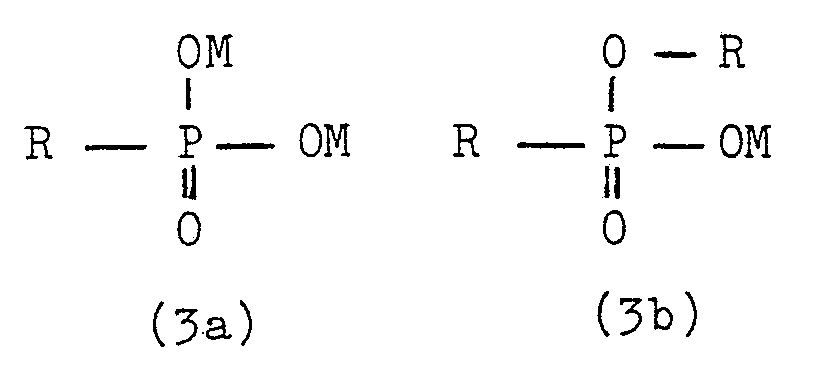
- e) Malonsäure und deren wasserlöslichen Salze;
- f) Trimercapto-s-triazin, 2-Amino-benzoesäure, 8-Hydroxy-chinolin und deren waserlöslichen Salze;
- g) wasserlösliche Sulfide, wie Alkalimetallsulfide;
- h) funktionalisierte wasserunlösliche Polymere, die nach dem Ionenaustauscherprinzip mit Metallionen reagieren oder Metallchelatkomplexe bilden.
Description
- Die Erfindung liegt auf dem technischen Gebiet der wasserlöslichen Schwermetallkomplex-Farbstoffe.
- Bei der Herstellung von Schwermetallkomplex-Farbstoffen wird zur Erzielung eines quantitativen Umsatzes im Metallierungsschritt oder auch zur Reaktionsbeschleunigung, wie bspw. bei der entmethylierenden Kupferung, das Schwermetallsalz in überschüssiger Menge eingesetzt; der Überschuß findet sich im fertiggestellten Schwermetallkomplex-Farbstoff wieder, weswegen seine färberische Anwendung mit coloristischen und ökologischen Problemen verbunden ist. Dies ist insbesondere dann der Fall, wenn die wäßrigen, nach der Synthese erhaltenen Farbstofflösungen - wie heutzutage üblich - sprühgetrocknet (eingedampft) werden. Der ionogene Schwermetallgehalt liegt dann in der Regel über 1000 ppm.
- Schwermetallionen belasten jedoch wegen ihrer Toxizität die Umwelt in besonderem Maße, weil sie nicht zerstört, sondern lediglich chemisch verändert werden können, wie beispielsweise durch Umwandlung in lösliche oder unlösliche Schwermetallverbindungen oder durch Reduktion in den elementaren Zustand. Weiterhin treten anwendungstechnisch oft Probleme beim Einsatz von schwermetallhaltigen Farbstoffen bei Kombinationsfärbungen mit Farbstoffen auf, die ihrerseits beispielsweise Hydroxy-, Carboxy-, Amino- oder Thiogruppen als Substituenten tragen, welche mit den überschüssigen Metallionen unter den üblichen Färbebedingungen komplexieren, so daß die färberischen Eigenschaften dieser Farbstoffe nachteilig verändert werden können.
- Versuche, den ionogenen Schwermetallgehalt in Schwermetallkomplex-Farbstoffen allein durch weitgehende Reduzierung des Metallsalzüberschusses möglichst gering zu halten, haben sich im Betrieb als nicht praktikabel erwiesen, weil die Endpunktbestimmung einer Metallierung zeitaufwendig und damit unwirtschaftlich ist.
- Zur Reduzierung des ionogenen Schwermetallgehaltes im Endfarbstoff werden deshalb Verfahrensmaßnahmen bevorzugt, mit welchen die Schwermetallionen nach der Synthese des Schwermetallkomplex-Farbstoffes gravimetrisch ausgefällt und durch Filtration von der Farbstofflösung abgetrennt werden können. So verwendet man hierfür bei der Synthese von Kupferkomplex-Farbstoffen Oxalsäure. Jedoch ist die Effektivität dieser Methode auch nach Optimierung oft unbefriedigend, und bei Erhöhung der Oxalsäuremenge kann das bereits komplex-gebundene Kupfer im Endfarbstoff angegriffen und aus dem Kupferkomplex-Endfarbstoff wieder herausgelöst werden.
- Auch übliche Verfahrensmaßnahmen zur Reduzierung des Schwermetallgehaltes in Abwässern, wie beispielsweise die Überführung der Schwermetallionen in deren schwerlösliche Metallsulfide durch Einleiten von Schwefelwasserstoff, wurden bisher nicht in die Herstellungsverfahren von Schwermetallkomplex-Farbstoffen integriert, weil angenommen wurde, daß das ionogene Schwermetall und das komplex-gebundene Schwermetall wegen der hohen Reaktivität des Sulfids unselektiv angegriffen werden, so daß der Metallkomplex-Farbstoff zerstört würde. Ferner ist bekannt, daß viele Farbstoffe, wie z.B. Azofarbstoffe, durch Sulfid reduziert werden können.
- Weiterhin sind aus der Literatur aromatische Komplexbildner bekannt, die zur gravimetrischen Schwermetallbestimmung Verwendung finden. Jedoch sind viele dieser Komplexbildner betrieblich für eine Reduzierung des Schwermetallgehaltes bei der Herstellung wasserlöslicher Schwermetallkomplex-Farbstoffe nicht einsetzbar, da sie selbst nicht hinreichend wasserlöslich sind, so daß ein organisches Kosolvens erforderlich wird. Mit organischen und anorganischen Komplexierungsmitteln, wie Cyanid, kondensierten Phosphaten, Ammoniak, Thiosulfaten, Polyalkanolaminen, wie beispielsweise Triethanolamin, Polyaminen, wie beispielsweise Ethylendiamin, Polyaminopolycarbonsäuren, wie beispielsweise Ethylendiamin-tetraessigsäure, oder Polycarbonsäuren, wie beispielsweise Weinsäure und Gluconsäure, gelingt es lediglich Schwermetallionen in wasserlösliche Komplexe zu überführen und dadurch zu "maskieren". Ökologische Probleme bleiben durch diese Verfahrensmaßnahme weiterhin ungelöst.
- Diese bekannten Verfahrensmaßnahmen sind somit unbefriedigend, um zu dem erwünschten Ziel uer Reduzierung des Schwermetallgehaltes zu gelangen. Es bestand deshalb weiterhin die Aufgabe, ein Verfahren zur selektiven Entfernung von ionogenem Schwermetall aus den Syntheselösungen aufzufinden.
- Mit der vorliegenden Erfindung wurde nunmehr gefunden, daß der ionogene Schwermetallgehalt bei der Synthese von wasserlöslichen Schwermetallkomplex-Farbstoffen überraschenderweise drastisch reduziert werden kann, ohne daß komplex-gebundene Schwermetallionen des Farbstoffes signifikant angegriffen werden oder qualitätsmindernde Nebenreaktionen auftreten, wenn man die Entfernung der überschüssigen Schwermetallionen aus der Syntheselösung mit Hilfe einer Verbindung, oder mehrerer, wie bspw. 2, 3 oder 4, solcher Verbindungen, aus der nachstehenden Gruppe von Verbindungen durchführt:
- a) gesättigte und ungesättigte Fettsäuren mit etwa 8 bis 18 C-Atomen, bevorzugt 12 bis 18 C-Atomen, bevorzugt die gesättigten Fettsäuren, und deren wasserlöslichen Salze, wie insbesondere Alkalimetallsalze, wie Natrium- und Kaliumsalze;
- b) die Mono- und Diester der Orthophosphorsäure und deren wasserlöslichen Salze entsprechend den allgemeinen Formeln (1a) und (1b)

- c) aliphatische Sulfonsäuren und deren wasserlöslichen Salze entsprechend der allgemeinen Formel (2)
R ― SO₃M (2)
in welcher R und M die obengenannten Bedeutungen haben; - d) aliphatische Phosphonsäuren und deren Monoester sowie deren wasserlöslichen Salze entsprechend den allgemeinen Formeln (3a) und (3b)

- e) Malonsäure und deren wasserlöslichen Salze, wie insbesondere Alkalimetallsalze, wie Natrium- und Kaliumsalze;
- f) Trimercapto-s-triazin, 2-Amino-benzoesäure, 8-Hydroxy-chinolin und die wasserlöslichen Salze dieser Verbindungen, insbesondere deren Alkalimetallsalze, bevorzugt Natriumsalze;
- g) wasserlösliche Sulfide, insbesondere Alkalimetallsulfide, bevorzugt Natriumsulfid;
- h) funktionalisierte Polymere, die nach dem Ionenaustauscherprinzip mit Metallionen reagieren oder Metallchelatkomplexe bilden, insbesondere Ionenaustauscher mit SO₃X- und COOX-Substituenten als austauschende Gruppen (wobei X für ein Wasserstoffatom oder ein Alkalimetall, wie Natrium, steht), davon bevorzugt schwach saure Ionenaustauscher mit COOX-Substituenten als austauschende Gruppen.
- Die Entfernung der freien Schwermetallionen aus den wäßrigen Farbstofflösungen, wie beispielsweise von Eisen-, Nickel-, Kobalt-, Chrom- und Kupferionen, insbesondere Nickel- und Kupferionen, erfolgt mittels der unter den Abschnitten a) bis g) genannten erfindungsgemäß verwendeten Verbindungen durch Überführung in deren wasserunlöslichen Verbindungen, die aus den wäßrigen Farbstofflösungen ausfallen und hieraus leicht abgetrennt werden können, bspw. durch Filtration oder Zentrifugieren, gegebenenfalls nach Zusatz eines üblichen Klärhilfsmittels, wie Aktivkohle oder Kieselgur. Die Farbstofflösung liegt dann weitgehend schwermetallsalzfrei vor und kann entsprechend der für den jeweiligen Farbstoff bestehenden Herstellungsvorschrift weiter aufgearbeitet werden. In der Regel läßt sich der ionogene Metallgehalt der Farbstofflösung mit der erfindungsgemäßen Maßnahme auf unter 20 ppm reduzieren.
- Im allgemeinen nimmt man die Fällung in einem pH-Bereich von 2 bis 10, bevorzugt von 4 bis 7, vor, wobei der bevorzugte pH-Bereich auch für Schwermetallkomplex- Farbstoffe mit faserreaktiven Gruppen günstig und unschädlich ist. Die Effektivität der erfindungsgemäß zur Fällung von Schwermetallionen aus den Farbstofflösungen verwendeten Verbindungen ist unabhängig oder nur unwesentlich abhängig davon, ob diese in Form ihrer Säuren oder in Form ihrer Salze eingesetzt werden, weil sich deren Verhältnis durch den pH-Wert der Lösung reguliert. In der Regel nimmt die Effektivität der Fällung mit steigendem pH-Wert zu. Vorteilhaft kontrolliert man den gewünschten oder erforderlichen pH-Bereich der Fällung mit Hilfe von üblichen Puffersubstanzen, wie beispielsweise Alkaliformiate, -acetate, -hydrogenphosphate, -hydrogencarbonate, -carbonate, -propionate und -tartrate als korrespondierende Basen des Puffersystems. Für den schwach sauren pH-Bereich ist insbesondere der übliche Essigsäure-/Alkalimetallacetat-Puffer von Vorteil.
- Die erfindungsgemäße Entfernung (Fällung) der Schwermetallionen, wie insbesondere der Cu2(+)-Ionen, aus den Syntheselösungen der Schwermetallkomplex-Farbstoffe, bevorzugt Kupferkomplex-Farbstoffe, erfolgt mit den Verbindungen von Abschnitten a) bis g) in der Regel bei einer Temperatur zwischen 10 und 100°C und, soweit es die unter den Abschnitten a) bis f) genannten Verbindungen betrifft, bevorzugt bei einer Temperatur zwischen 50 und 90°C.
- Die Verbindungen a) bis g) können den Farbstofflösungen in fester (pulverisierter) Form oder in Form einer wäßrigen Suspension oder einer wäßrigen Lösung, die bei schlechtlöslichen Fällungsmitteln bevorzugt eine Temperatur von 50 bis 90°C besitzt, zugesetzt werden.
- Das zugesetzte Fällungsreagenz wird in einer solchen Menge eingesetzt, die auf den Überschuß an Schwermetallionen abgestimmt ist. Jedoch ist es zweckmäßig, zur vollständigen Fällung der überschüssigen Schwermetallionen zusätzlich zur theoretisch notwendigen und vom ionogenen Schwermetallgehalt der Farbstofflösung abhängigen Menge an Fällungsreagenz einen Überschuß einzusetzen. Dazu wird zunächst der ionogene Schwermetallgehalt der metallierten Farbstofflösung mit üblichen analytischen Methoden bestimmt, wie beispielsweise photometrisch, potentiometrisch oder mittels Atomabsorptionsspektroskopie. Wenn lediglich die theoretisch notwendige Menge an den unter den Abschnitten a) bis g) aufgeführten Fällungsmitteln eingesetzt wird, wie beispielsweise pro Mol Schwermetallionen 1 Mol Sulfid oder 2 Mol 2-Aminobenzoesäure oder 2/3 Mol Trimercapto-s-triazin, dann reduziert sich der ionogene Schwermetallgehalt der Farbstofflösung zwar deutlich, jedoch liegt er in der Regel über 20 ppm.
- Um eine noch effektivere Reduzierung des ionogenen Schwermetallgehaltes zu erreichen, kann man das Fällungsmittel im Überschuß einsetzen, wobei der Überschuß sich auf den Farbstoffgehalt der Farbstofflösung bezieht. Die überschüssige Einsatzmenge ist abhängig vom verwendeten Fällungsmittel, von der Komplexstabilität des Farbstoffes und vom Bestreben des Farbstoffes, mit dem Fällungsmittel unerwünschte Nebenreaktionen einzugehen. Die effektiv wirkende Menge an Überschuß an dem Fällungsmittel läßt sich jedoch leicht durch Vorversuche ermitteln. Ein zu großer Überschuß sollte allerdings vermieden werden, um unerwünschte Nebenreaktionen zu vermeiden.
- Bezogen auf die Farbstoffmenge von 1 Mol liegt beispielsweise der einzusetzende Überschuß beim Natriumsulfid oder Trimercapto-s-triazin als Fällungsreagenz in der Regel zwischen 0,01 und 0,1 Mol, bei der 2-Aminobenzoesäure, dem 8-Hydroxy-chinolin oder den Alkalimetallfettsäure-Salzen, wie insbesondere Natriumstearat, zwischen 0,01 und 0,25 Mol und bei den unter Abschnitten b) bis e) aufgeführten Fällungsreagenzien zwischen 0,01 und 0,3 Mol.
- Nach der Fällung der Schwermetallionen ist es vorteilhaft, vor Abtrennung der ausgefallenen Schwermetallverbindungen die Reaktionslösung auf Raumtemperatur abzukühlen, um eine möglichst vollständige Fällung und Abtrennung zu erzielen, weil die Löslichkeit der gebildeten Schwermetallverbindungen bei Raumtemperatur geringer ist als in der Wärme.
- Gesättigte und ungesättigte Fettsäuren (bzw. deren Salze), die erfindungsgemäße zur Anwendung gelangen, sind insbesondere Stearinsäure, Palmitinsäure, Myristinsäure, Laurinsäure, Caprinsäure, Octansäure, Isodecansäure, Isononansäure, 2-Ethyl-hexansäure und Ölsäure, bevorzugt in Form ihrer Natriumsalze. Insbesondere bevorzugt sind Stearinsäure und Natriumstearat zu nennen.
- Für die unter b), c) und d) aufgeführten Verbindungen sind insbesondere solche geeignet, in denen R den Stearyl-, Palmityl-, Myristyl-, Lauryl-, Decyl-, Octyl-, Isodecyl-, Isononyl-, 2-Ethyl-hexyl- oder Oleyl-Rest bedeutet. Von den Verbindungen unter b) sind insbesondere Gemische, bevorzugt aus etwa gleichen Teilen, wie beispielsweise im Gewichtsverhältnis von 60:40 bis 40:60 Teilen, der Mono- und Dilaurylester der Orthophosphorsäure, bzw. deren Alkalimetallsalze, wie Natriumsalze, hervorzuheben; die in wäßrigem Medium üblicherweise auftretende Hydrolyse der Phosphorsäureester bzw. der Alkanphosphonsäure-monoester kann innerhalb des pH-Bereiches von 4 bis 8, bei welchem die Fällungsreaktion des Schwermetalles aus der wäßrigen Farbstoffsyntheselösung in der Regel erfolgt, vernachlässigt werden.
- Polymere entsprechend Abschnitt h) sind vor allem Systeme, bei denen ionenaustauschende Gruppen in Kondensations- oder Polymerisationsharzen eingebaut sind, wodurch ein wasserhaltiger, jedoch wasserunlöslicher Gelkörper entsteht, durch dessen Poren, in denen die ionenaustauschfähigen Gruppen hineinragen, die Diffusion der Syntheselösung der Schwermetallkomplex-Farbstoffe erfolgt. Ionenaustauschende funktionelle Gruppen sind beispielsweise Carboxy- und Sulfogruppen in deren sauren oder Salzform, wie bevorzugt Lithium-, Natrium- und Kaliumsalzform. Die Verwendung von Ionenaustauschern zur Reduzierung des ionogenen Schwermetallgehaltes hat den Vorteil, daß der Ionenaustauscher nach Gebrauch durch Konditionierung mit hierfür geeigneten, üblichen wäßrigen Säuren oder Alkalisalzlösungen regeneriert und erneut wieder eingesetzt werden kann. Ferner ergibt sich mit deren Verwendung der Vorteil, daß die Abtrennung der Schwermetallionen von der Farbstofflösung unter sehr schonenden Bedingungen erfolgt, weil hierfür keine erhöhten Temperaturen notwendig sind. In der Regel führt man den Austausch bei Raumtemperatur (10-30°C) durch. Zur Abtrennung von Schwermetallionen aus konzentrierten Farbstofflösungen ist es vorteilhat, das Verhältnis von Austauschkapazität zur Menge an auszutauschenden Schwermetallionen möglichst groß zu wählen.
- Die spezifische Abtrennung von Schwermetallionen in erfindungsgemäßer Weise mittels der unter den Abschnitten a) bis h) aufgeführten Fällungsmitteln bzw. Polymeren kann in die Herstellungsverfahren aller wasserlöslichen Schwermetallkomplex-Farbstoffe integriert werden, sofern die Schwermetallkomplex-Bindung im Farbstoff hinreichend stabil ist. Schwermetallkomplex-Farbstoffe, die hierfür besonders geeignet sind, sind die Schwermetallkomplex-Farbstoffe, insbesondere die 1:1-Kupfer-, 1:2-Kobalt-, 1:2-Chrom- sowie die Nickel- und Eisenkomplex-Verbindungen, der Mono-, Dis- und Trisazofarbstoffe, hiervon bevorzugt die 1:1-Kupferkomplex-Mono- und -Disazofarbstoffe, desweiteren die Schwermetallkomplex-Farbstoffe vom Typ der Azomethine und Formazane, insbesondere von carbo-aromatischen oder hetero-aromatischen 1,5-Diaryl-Formazanen mit dem Strukturelement der allgemeinen Formel (4)
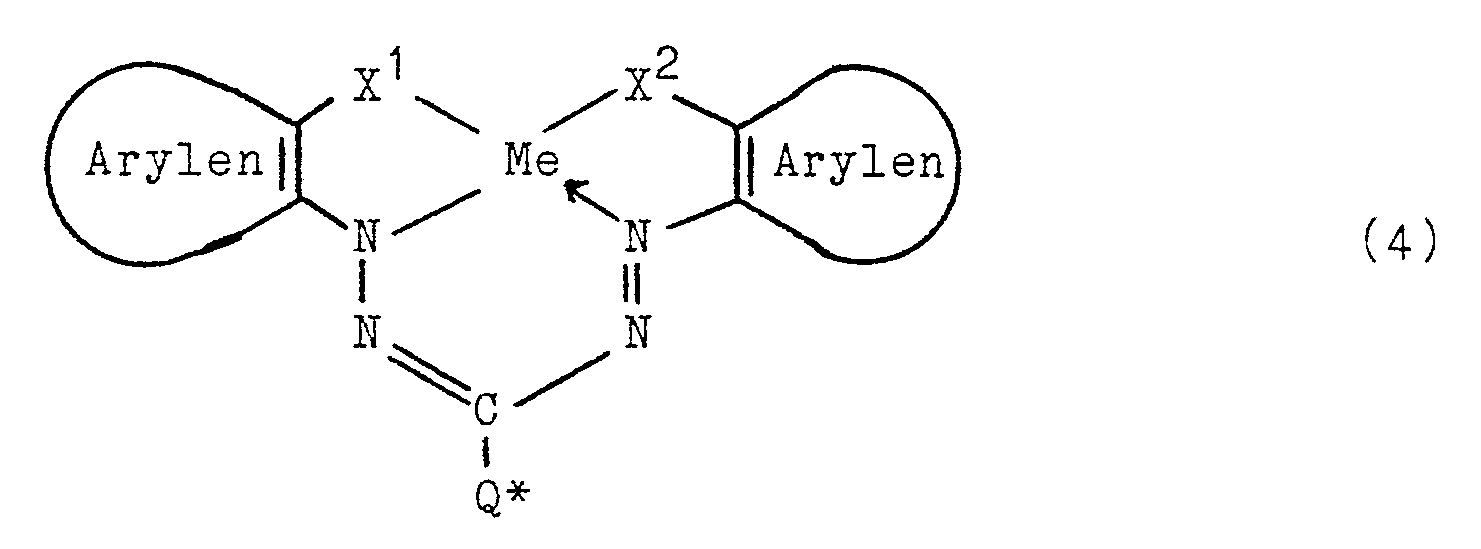
desweiteren tetracyclische Schwermetallkomplex-Farbstoffe mit dem Strukturelement entsprechend der allgemeinen Formel (5)
- Solche Farbstoffe sind beispielsweise insbesondere Farbstoffe entsprechend der allgemeinen Formeln (6a), (6b), (6c), (6d) und (6e)


D₁ ist ein Benzolring, der durch 1, 2 oder 3 Substituenten substituiert sein kann, die der Gruppe niederes Alkyl, niederes Alkoxy, Carboxy, niederes Alkanoylamino, Benzoylamino, Phenylamino, Sulfobenzoylamino, Sulfophenylamino, Carbamoyl, durch niederes Alkyl und/oder Phenyl mono- oder disubstituiertes Carbamoyl, Sulfamoyl, durch niederes Alkyl und/oder Phenyl mono- oder disubstituiertes Sulfamoyl, Cyan, Nitro, Chlor, Brom, Trifluormethyl und Sulfo angehören, oder
D₁ ist ein Naphthalinring, der durch 1, 2 oder 3 Sulfogruppen und/oder eine Carboxy-, Methyl-, Methoxy-, Ethoxy-, Nitro- oder Acetylaminogruppe oder ein Chloratom substituiert sein kann,
wobei in D₁ das komplexbildende Sauerstoffatom orthoständig zur Azogruppe gebunden ist;
D₂ hat eine der für D₁ genannten Bedeutungen oder ist der Benzthiazol-2-yl-Rest, an dessen Benzolkern die Gruppe Z gebunden ist und der durch eine Nitro-, Methyl-, Methoxy- oder Sulfogruppe substituiert sein kann;
K₁ ist ein Naphthalinring, der durch 1, 2 oder 3 Sulfogruppen und/oder eine Amino-, Methylamino-, Phenylamino-, niedere Alkanoylamino-, Benzoylamino- oder N-Methyl-N-acetylamino-Gruppe substituiert sein kann, oder
K₁ ist der Rest des Pyrazol-4,5-ylens, der in 3-Stellung durch Methyl, Carboxy, Carbamoyl, niederes Carbalkoxy, wie Carbomethoxy und Carbethoxy, oder Phenyl substituiert ist und in 1-Stellung einen Phenyl- oder Naphthylrest gebunden enthält, wobei der Phenylrest durch 1 oder 2 Sulfogruppen und/oder 1 oder 2 Substituenten aus der Gruppe niederes Alkyl, niederes Alkoxy, Chlor, Brom, Nitro, Acetylamino und Carboxy und der Naphthylrest durch 1, 2 oder 3 Sulfogruppen und/oder einen Substituenten aus der Gruppe niederes Alkyl, niederes Alkoxy, Nitro, Acetylamino und Carboxy substituiert sein können, oder
K₁ ist als Rest einer Kupplungskomponente der des Acetoacetylanilids oder -naphthylamids, wobei der Phenylrest durch 1 oder 2 Substituenten, die der Gruppe niederes Alkyl, niederes Alkoxy, Carboxy, Acetylamino, Benzoylamino, Carbamoyl, durch niederes Alkyl und/oder Phenyl mono- oder disubstituiertes Carbamoyl, Sulfamoyl, durch niederes Alkyl und/oder Phenyl mono- oder disubstituiertes Sulfamoyl, Cyan, Nitro, Chlor, Brom, Trifluormethyl und Sulfo angehören, und der Naphthylrest durch 1, 2 oder 3 Sulfogruppen und/oder einen Substituenten aus der Gruppe niederes Alkyl, niederes Alkoxy, Nitro, Acetylamino und Carboxy substituiert sein können,
wobei in K₁ das komplexbildende Sauerstoffatom ortho-ständig zur Azogruppe gebunden ist;
K₂ steht als Rest einer bifunktionellen Aminonaphthol-Kupplungskomponente für den Naphthylenrest, der eine oder zwei Sulfogruppen gebunden enthalten kann;
Z ist ein Wasserstoffatom oder bevorzugt die β-Hydroxyethylsulfonyl-Gruppe oder bevorzugt eine faserreaktive Gruppe, die mit carbonamid- und/oder hydroxygruppen-haltigem Material, insbesondere Fasermaterial, eine kovalente Bindung einzugehen vermag, wie insbesondere eine faserreaktive Gruppe aus der Chlortriazinylamino-, Fluortriazinylamino- oder Vinylsulfonyl-Reihe, wie beispielsweise die Vinylsulfonylgruppe oder eine Gruppe der allgemeinen Formel (7a)
― CH₂― CH₂― Z¹ (7a)
in welcher
Z¹ ein alkalisch eliminierbarer Substituent ist, wie beispielsweise ein Chloratom, die Acetyloxy-, Thiosulfato-, Phosphato- und insbesondere Sulfatogruppe,
oder wie beispielsweise eine faserreaktive Gruppe entsprechend der allgemeinen Formel (7b)
Hal für ein Chlor- oder Fluoratom steht,
Ro eine gegebenenfalls substituierte niedere Alkylgruppe, wie beispielsweise eine durch Hydroxy, Cyano, Carboxy, Sulfo, Phosphato, Sulfato oder Phenyl substituierte Alkylgruppe von 1 bis 4 C-Atomen, oder ein Phenyl- oder Naphthylrest ist, die durch Substituenten aus der Gruppe Carboxy, Sulfo, Chlor, Brom, Methyl, Ethyl, Methoxy, Ethoxy, Nitro, Vinylsulfonyl und einer Gruppe der obengenannten und definierten allgemeinen Formel (7a) substituiert sein kann und
Rδ ein Wasserstoffatom oder eine gegebenenfalls substituierte niedere Alkylgruppe ist, wie beispielsweise eine durch Hydroxy, Cyano, Carboxy, Sulfo, Sulfato, Phosphato oder Phenyl substituierte Alkylgruppe von 1 bis 4 C-Atomen;
m ist die Zahl 1 oder 2, bevorzugt 1, und
n ist die Zahl 1 oder 2, bevorzugt 1,
wobei die Summe (m + n) höchstens die Zahl 3 ist;
E stellt als Mittelkomponente, die beim Aufbau der Farbstoffe zuerst als Kupplungskomponente, dann als Diazokomponente diente, den Benzolkern dar, der durch 1 oder 2 Substituenten aus der Gruppe niederes Alkyl, niederes Alkoxy, Chlor, Acetylamino, Dimethylamino, Diethylamino, Ureido und Phenylureido substituiert sein kann, oder den Naphthalinkern dar, der durch niederes Alkyl, Nitro, Acetylamino oder Sulfo substituiert sein kann, oder
E ist ein Rest der allgemeinen Formel (B)
B₁ für die Methyl- oder Carboxygruppe steht und
A einen Benzol- oder Naphthalinkern bedeutet, der durch 1 oder 2 Substituenten aus der Gruppe Sulfo, Carboxy, niederes Alkyl, niederes Alkoxy und Chlor substituiert sein kann;
M ist ein Wasserstoffatom oder ein Alkalimetall, wie Natrium, Kalium und Lithium;
W ist ein Benzol- oder Naphthalinring, die beide durch Substituenten, vorzugsweise 1 oder 2 Substituenten, aus der Gruppe Halogen, wie Fluor, Chlor und Brom, Nitro, niederes Alkyl, wie Isopropyl, tert.-Butyl, tert.-Amyl oder Isobutyl, insbesondere Methyl und Ethyl, Alkoxy von 1 bis 4 C-Atomen, wie Methoxy und Ethoxy, Alkylsulfonyl von 1 bis 4 C-Atomen, wie Methylsulfonyl und Ethylsulfonyl, Phenylsulfonyl, Sulfamoyl, N-Mono- und N,N-Dialkylsulfamoyl mit jeweils 1 bis 4 C-Atomen im Alkyl substituiert sein können;
Q ist eine gerad- oder verzweigt-kettige Alkylgruppe von 1 bis 8 C-Atomen, wie die Methyl-, Ethyl-, Isopropyl-, n-Butyl-, sek.-Butyl-, tert.-Butyl-, n-Heptyl- oder n-Octylgruppe, oder eine gerad- oder verzweigt-kettige Alkenylgruppe von 2 bis 8 C-Atomen, wie die Allylgruppe, wobei diese Alkyl- und Alkenylgruppen noch durch den Phenylrest substituiert sein können, der wiederum durch Substituenten aus der Gruppe Methyl, Ethyl, Methoxy, Ethoxy, Fluor, Chlor, Brom und Sulfamoyl substituiert sein kann, oder ist ein Phenyl- oder Naphthylrest, die durch Substituenten, vorzugsweise 1 oder 2 Substituenten, aus der Gruppe Hydroxy, Nitro, Halogen, wie Fluor, Brom und Chlor, niederes Alkyl, niederes Alkoxy, Carbalkoxy mit 1 bis 4 C-Atomen im Alkylrest, wie Carbomethoxy und Carbethoxy oder eine Gruppe Z substituiert sein können, oder ist der Rest des Furans, Thiophens, Pyrrols, Imidazols, Indols, Pyrazols, Pyridins, Pyrimidins, Chinolins oder Benzimidazols, wobei diese heterocyclischen Reste an den aromatischen Kohlenstoffatomen durch Chlor, Phenyl, Methoxy, Ethoxy, Methyl und Ethyl und die Stickstoffatome in den NH-Gruppen dieser Heterocyclen durch Methyl, Ethyl und Benzyl substituiert sein können, oder ist ein Wasserstoffatom;
X ist ein Sauerstoffatom oder eine Carbonyloxygruppe der Formel -CO-O- , die in ortho-Stellung zum Stickstoffatom an W gebunden sind, oder X ist eine Sulfogruppe;
R¹ ist ein Wasserstoffatom oder eine niedere Alkylgruppe, eine niedere Alkoxygruppe, ein Chlor- oder Bromatom, eine niedere Alkanoylaminogruppe, wie eine Acetylaminogruppe oder eine Sulfogruppe;
Pc ist der Rest eines metallhaltigen Phthalocyanins, wie beispielsweise des Kupfer-, Kobalt- oder Nickelphthalocyanins, wobei der Phthalocyaninrest noch in den 3- und/oder 4-Stellungen der carbocyclischen aromatischen Ringe des Phthalocyanins substituiert sein kann, wie beispielsweise durch Halogenatome, wie Chloratome, oder Arylreste, wie Phenylreste, und in welchem die Sulfochlorid-, Sulfonamid- und/oder Sulfogruppen in den 3- und/oder 4-Stellungen der carbocyclischen aromatischen Ringe des Phthalocyanins gebunden sind;
Rα ist ein Wasserstoffatom oder eine gegebenenfalls substituierte niedere Alkylgruppe, wie beispielsweise eine durch Hydroxy, Cyano, Carboxy, Sulfo, Sulfato, Phosphato oder Phenyl substituierte Alkylgruppe von 1 bis 4 C-Atomen;
Rβ ist ein Wasserstoffatom oder eine niedere Alkylgruppe, die substituiert sein kann, wie beispielsweise durch Hydroxy, Carboxy, Acetyloxy, Sulfato, Sulfo, Phosphato, Phenyl und Sulfophenyl, oder ist Cyclohexyl;
Rγ ist ein Wasserstoffatom oder eine niedere Alkylgruppe, die substituiert sein kann, wie beispielsweise durch Hydroxy, Sulfo, Carboxy, Sulfato, Phosphato, Acetyloxy, Phenyl und Sulfophenyl, oder ist ein Phenyl oder Naphthylrest, der substituiert sein kann, beispielsweise durch niederes Alkyl, niederes Alkoxy, Chlor, Carboxy und Sulfo, oder
Rβ und Rγ bilden gemeinsam mit dem Stickstoffatom und einem Alkylenrest von 3 bis 8 C-Atomen, bevorzugt 4 bis 6 C-Atomen, oder mit einem weiteren Heteroatom, wie einem Stickstoffatom oder einem Sauerstoffatom, und zwei niederen Alkylenresten den Rest eines 4- bis 8-gliedrigen heterocyclischen Rings, wie beispielsweise den Piperidino-, Piperazino- oder Morpholino-Rest;
G ist ein aromatischer carbocyclischer oder aromatischer heterocyclischer Rest, bevorzugt ein gegebenenfalls substituierter Phenylen- oder Naphthylenrest, insbesondere ein Phenylen- oder Naphthylenrest, deren Substituenten bevorzugt aus der Gruppe niederes Alkyl, niederes Alkoxy, Halogen, wie Chlor und Brom, Carboxy, Nitro und Sulfo ausgewählt sind;
T ist eine direkte Bindung oder ein zweiwertiges organisches Bindeglied, wie beispielsweise ein Alkylenrest von 1 bis 6 C-Atomen oder eine Alkylenaminogruppe mit einem Alkylrest von 1 bis 6 C-Atomen, wobei deren Aminogruppe noch durch einen gegebenenfalls substituierten niederen Alkylrest, bspw. den obengenannten Rest, substituiert sein kann, oder beispielsweise ein Rest der Formel
k eine ganze Zahl von 1 bis 5,
r eine ganze Zahl von 2 bis 6 und
R* ein Wasserstoffatom oder eine Alkylgruppe von 1 bis 5 C-Atomen bedeutet,
oder
T bildet zusammen mit der Gruppe -N(Rα)- einen Rest der allgemeinen Formel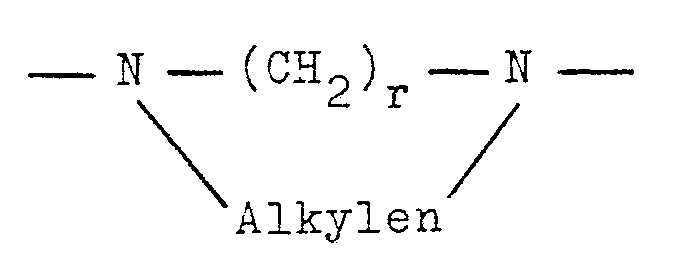
r die obengenannte Bedeutung hat und Alkylen einen niederen Alkylenrest darstellt;
V ist eine direkte Bindung oder eine Gruppe der Formel
a ist eine ganze Zahl von 1 bis 4;
b ist eine ganze Zahl von Null bis 3;
c ist eine ganze Zahl von Null bis 3, wobei a, b und c gleich oder verschieden voneinander sein können, jedoch die Summe von (a+b+c) höchstens 4 ist. - In den obigen und nachstehenden Angaben bedeutet niederes Alkyl eine Alkylgruppe von 1 bis 5 C-Atomen, insbesondere von 1 bis 4 C-Atomen, wie bevorzugt die Methyl- oder Ethylgruppe. Niederes Alkoxy bedeutet eine Alkoxygruppe von 1 bis 5 C-Atomen, insbesondere von 1 bis 4 C-Atomen, bevorzugt die Methoxy- oder Methoxygruppe, und niederes Alkanoylamino bedeutet eine Alkanoylaminogruppe mit einem Alkylrest von 1 bis 4 C-Atomen, bevorzugt die Propionylamino- und insbesondere die Acetylaminogruppe.
- In den Formeln (6a) und (6c) bedeutet die Gruppierung entsprechend der allgemeinen Formel (9a)
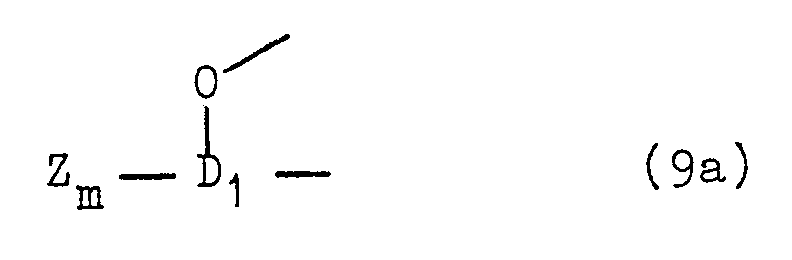

Z und M die obengenannten Bedeutungen haben,
t die Zahl Null, 1, 2, 3 oder 4 bedeutet,
v die Zahl Null oder 1 ist (wobei im Falle v = Null diese Gruppe für ein Wasserstoffatom steht) und
w die Zahl 1, 2 oder 3 bedeutet sowie
R² ein Wasserstoffatom, eine niedere Alkylgruppe, eine niedere Alkoxygruppe, ein Chlor- oder Bromatom ist. - In den Formeln (6a) und (6b) bedeutet die Gruppierung entsprechend der allgemeinen Formel (9b)


Z, M, R¹, R² und w die obengenannten Bedeutungen haben,
R³ ein Wasserstoffatom, eine niedere Alkylgruppe,eine niedere Alkoxygruppe, ein Chlor- oder Bromatom oder eine Sulfogruppe ist,
R⁴ ein Wasserstoffatom, eine niedere Alkylgruppe oder eine Sulfogruppe ist,
R⁵ eine niedere Alkanoylaminogruppe oder eine Benzoylaminogruppe, die durch eine Sulfogruppe oder eine β-Chlorethylsulfonyl-Gruppe substituiert sein kann, ist,
B₂ ein Benzol- oder Naphthalinring bedeutet,
B₃ eine niedere Alkylgruppe, bevorzugt die Methylgruppe, eine Carboxygruppe, eine Carbomethoxygruppe, eine Carbethoxygruppe oder der Phenylrest ist und
y für die Zahl Null oder bevorzugt 1 oder 2 steht (wobei hier im Falle y gleich Null diese Gruppe ein Wasserstoffatom bedeutet) - Von diesen Farbstoffen sind für das erfindungsgemäße Verfahren beispielsweise synthetisierte Farbstoffe von besonderem Interesse, die den allgemeinen Formeln (12a), (12b), (12c) und (12d) entsprechen:

Y ist ein Wasserstoffatom oder eine Vinylsulfonylgruppe oder eine Gruppe der obengenannten und definierten allgemeinen Formel (7a), wobei mindestens eines der beiden Y eine Vinylsulfonylgruppe oder eine Gruppe der allgemeinen Formel (7a) bedeutet;
Y¹ ist die Vinylsulfonylgruppe oder eine Gruppe entsprechend der obengenannten und definierten allgemeinen Formel (7a);
D₃ ist ein Benzol- oder Naphthalinring, die beide durch eine Nitrogruppe oder eine niedere Alkoxygruppe, wie Methoxygruppe, oder ein Chloratom und/oder 1 oder 2 Sulfogruppen substituiert sein können;
K₃ ist ein Naphthalinring, der durch 1 oder 2 Sulfogruppen substituiert ist und zusätzlich durch eine Acetylamino- oder Benzoylaminogruppe substituiert sein kann, wobei die das Kupferatom komplex-bindende Oxygruppe an den Naphthalinrest in ortho-Stellung zur Azogruppe gebunden ist, oder K₃ ist der Pyrazol-4,5-ylen-Rest, an dem die Oxygruppe in 5-Stellung steht und die Azogruppe in 4-Stellung und der in 3-Stellung durch die Carbomethoxy- oder Carbethoxy- oder bevorzugt die Carboxygruppe oder Methylgruppe substituiert ist und der in 1-Stellung durch einen Naphthyl- oder bevorzugt Phenylrest substituiert ist, wobei die Naphthyl- und Phenylreste durch 1, 2 oder 3 Substituenten aus der Gruppe Methoxy, Ethoxy, Chlor, Brom, Methyl und Sulfo substituiert sein können, wobei die gegebenenfalls faserreaktive Gruppe Y an K₃ im Falle des Pyrazolonrestes an diesen 1-ständigen Phenyl- oder Naphthylrest gebunden ist;
K₄ ist ein Naphtholrest, der durch 1 oder 2 oder 3 Sulfogruppen und gegebenenfalls zusätzlich durch eine Acetylamino- oder Benzoylaminogruppe substituiert sein kann, oder ist ein 3-Methyl- oder 4-Carboxy-pyrazol-5-on-4-yl-Rest, der in 1-Stellung durch einen Phenyl- oder Naphthylrest substituiert ist, der durch 1, 2 oder 3 Substituenten aus der Gruppe Methoxy, Ethoxy, Methyl, Ethyl, Carboxy, Sulfo und Chlor, bevorzugt 1 oder 2 Sulfogruppen, substituiert sein kann;
M hat die obengenannte Bedeutung;
z ist die Zahl 1 oder 2;
v ist die Zahl Null oder 1 (wobei im Falle v gleich Null diese Gruppe ein Wasserstoffatom bedeutet);
R⁸ ist ein Wasserstoffatom oder ein Chloratom oder eine Sulfogruppe;
R⁹ ist ein Wasserstoffatom oder eine Sulfogruppe;
R¹ hat die obengenannte Bedeutung;
Pc ist der Rest des Nickel- oder Kupferphthalocyanin-Moleküls;
Rβ ist ein Wasserstoffatom oder eine Methyl- oder Ethylgruppe, die durch eine Hydroxy-, Carboxy- oder Sulfogruppe substituiert sein kann;
Rγ ist ein Wasserstoffatom oder eine Methyl- oder Ethylgruppe, die durch eine Hydroxy-, Carboxy- oder Sulfogruppe substituiert sein kann;
d ist eine ganze oder gebrochene Zahl zwischen 1 und 2,5;
e ist eine ganze oder gebrochene Zahl zwischen 0 und 1,5;
f ist eine ganze oder eine gebrochene Zahl zwischen 0,5 und 2;
die Summe (d+e+f) ist eine ganze oder gebrochene Zahl zwischen 2,2 und 4. - Zur Minimierung des Kupferionengehaltes von synthetisierten Kupferkomplex-Azofarbstoffen gemäß dem erfindungsgemäßen Verfahren sind ebenfalls die synthetisierten Farbstoffe entsprechend der allgemeinen Formel (12e) von besonderem Interesse:
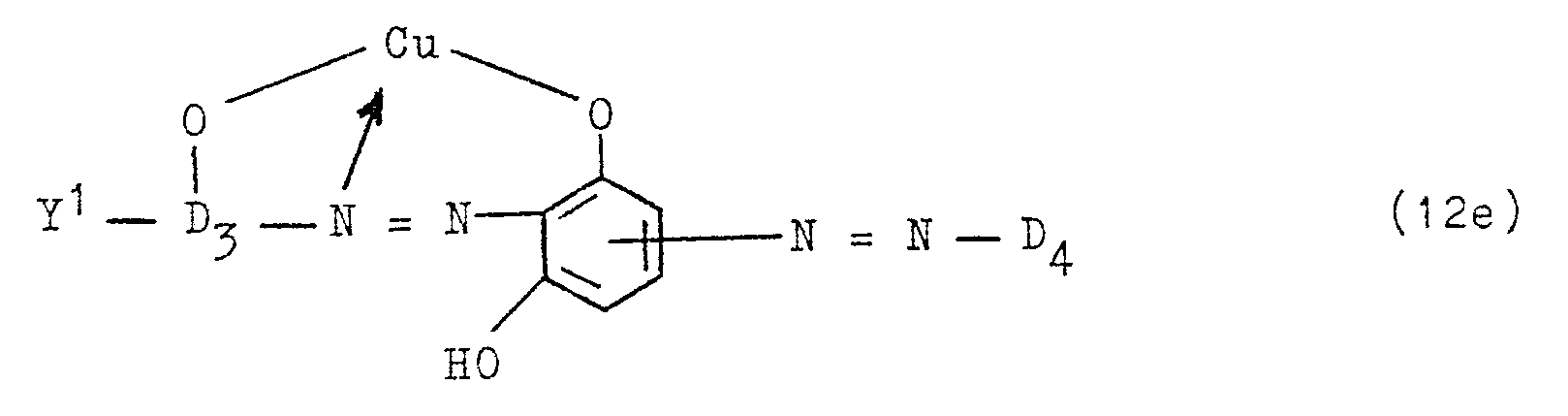
- In den oben genannten allgemeinen Formeln können die einzelnen Formelglieder im Rahmen ihrer Definitionen jeweils zueinander gleiche oder voneinander verschiedene Bedeutungen besitzen.
- Solche Schwermetallkomplex-Farbstoffe und deren Synthesewege sind zahlreich aus der Literatur bekannt, wie beispielsweise aus der deutschen Patentschrift Nr. 1 126 542, den deutschen Offenlegungsschriften Nrs. 2 461 481, 2 533 250, 2 634 497, 2 634 856, 2 634 909, 2 016 862, 2 634 787, 2 945 537, 2 655 625, 2 844 597, 2 922 722, 2 945 493, 2 839 562, 2 847 912, 3 124 172, 3 230 102, 3 239 364, 3 337 591 und 3 406 232, den europäischen Patentanmeldungs-Veröffentlichungen Nrs. 0 005 207A, 0 028 787A, 0 070 808A und 0 079 563A, den US-Patentschriften Nrs. 2 817 656, 4 138 395 und 4 544 739, den belgischen Patentschriften Nrs. 828 811, 856 009, 856 579, 871 734, 872 812 und 873 319, den britischen Patentanmeldungs-Veröffentlichungen Nrs. 2 024 236A und 2 031 931A und den schweizerischen Patentschriften Nrs. 634 094 und 639 991.
- Die nachfolgenden Beispiele dienen zur Erläuterung der Erfindung. Teile stellen Gewichtsteile dar, und die Prozentangaben beziehen sich auf Gewichtsprozent, sofern nicht anders vermerkt. Volumenteile verhalten sich zu Gewichtsteilen wie Liter zu Kilogramm. Die in den Beispielen beschriebenen Farbstofflösungen enthalten neben dem Farbstoff auch noch weitere aus der Synthese stammende organische und anorganische Bestandteile. Die angegebenen Schwermetallkonzentrationen (in ppm) wurden nach üblichen Methoden photometrisch, potentiometrisch oder mittels Atomabsorptionsspektroskopie bestimmt.
- Es wird von 6000 Teilen einer Farbstofflösung ausgegangen, die 858 Teile des im Beispiel 2 der deutschen Offenlegungsschrift Nr. 2 945 537 beschriebenen Kupferkomplex-Formazanfarbstoffes enthält, einen pH-Wert von 3,8 aufweist und einen ionogenen Kupfergehalt von 824 ppm besitzt.
- Die Lösung wird auf 70°C erwärmt, auf einen pH-Wert von 4,0 bis 4,2 mit wenig Natriumcarbonat eingestellt und anschlieBend mit 8,05 Teilen Natriumsulfid (berechnet als 100%ig; eingesetzt bspw. als 13,4 Teile kristallwasserhaltiges 60%iges Natriumsulfid) versetzt, was einem 2,5 mol-%igen Überschuß, bezogen auf die vorhandene Farbstoffmenge, entspricht. Der Ansatz wird mittels eines Essigsäure/Acetatpuffers auf einen pH-Wert zwischen 4,8 und 5,2 gehalten. Man rührt noch 30 Minuten bei 70°C innerhalb dieses pH-Bereiches nach, setzt sodann 12,5 Teile Kieselgur hinzu, kühlt den Ansatz auf 25 bis 30°C ab und filtriert ihn. Das Filtrat wird sprühgetrocknet. Das erhaltene Farbstoffpulver weist einen ionogenen Kupfergehalt unter 5 ppm auf; die Farbstoffausbeute liegt über 98%, bezogen auf die Farbstoffmenge der Anfangslösung.
- Die Lösung wird auf 70°C erwärmt, auf einen pH-Wert von 4,0 bis 4,2 mit wenig Natriumcarbonat eingestellt und anschließend mit 108,8 Teilen Natriumstearat versetzt, was einem 20 mol-%igen Überschuß, bezogen auf die eingesetzte Farbstoffmenge, entspricht. Der Ansatz wird mittels eines Essigsäure/Acetatpuffers auf einen pH-Wert zwischen 4,8 und 5,2 gehalten. Man rührt noch 90 Minuten bei 70°C innerhalb dieses pH-Bereiches nach, setzt sodann 12,5 Teile Kieselgur hinzu, kühlt den Ansatz auf 25 bis 30°C ab und filtriert ihn. Das Filtrat wird sprühgetrocknet.
- Das erhaltene Farbstoffpulver weist einen ionogenen Kupfergehalt 39 ppm auf; die Farbstoffausbeute liegt über 98%, bezogen auf die Farbstoffmenge der Anfangslösung.
- Eine Austauschersäule, die mit 1000 Teilen eines schwach sauren Kationenaustauschers mit Carboxygruppen als Austauschgruppen und mit einer Austauschkapazität von etwa 10 mVal/g gefüllt ist, wird mit einer wäßrigen 2n-Salzsäurelösung konditioniert. Anschließend wird das Harz bis zur neutralen Reaktion des Eluats mit Wasser gewaschen. Die kupfersalzhaltige Farbstofflösung wird nun auf die Austauschersäule gegeben und der Farbstoff vollständig mit Wasser eluiert. Das Eluat wird sprühgetrocknet. Das erhaltene Farbstoffpulver weist einen ionogenen Kupfergehalt unter 5 ppm auf; die Farbstoffausbeute liegt über 98 %, bezogen auf die Farbstoffmenge der Ausgangslösung.
- Die Lösung wird auf 70°C erwärmt, auf einen pH-Wert von 4,8 bis 5,2 mit wenig Natriumcarbonat eingestellt und anschließend mit 22,3 Teilen Trimercapto-s-triazin versetzt, was einem 7,4 mol-%igen Überschuß, bezogen auf die eingesetzte Farbstoffmenge, entspricht. Der Ansatz wird mittels eines Essigsäure/Acetatpuffers auf einem pH-Wert zwischen 4,8 und 5,2 gehalten und noch 60 Minuten bei 70°C innerhalb dieses pH-Bereiches nachgerührt, sodann mit 12,5 Teile Kieselgur versetzt, auf 25 bis 30°C abgekühlt und filtriert. Das Filtrat wird sprühgetrocknet.
Das erhaltene Farbstoffpulver weist einen ionogenen Kupfergehalt unter 5 ppm auf; die Farbstoffausbeute liegt über 98%, bezogen auf die Farbstoffmenge der Anfangslösung. - Die Lösung wird auf 70°C erwärmt und auf einen pH-Wert von 5,2 bis 5,5 mit wenig Natriumcarbonat eingestellt, anschließend mit 51,4 Teilen 2-Amino-benzoesäure versetzt, was einem 22 mol-%igen Überschuß, bezogen auf die eingesetzte Farbstoffmenge, entspricht. Der Ansatz wird mittels eines Essigsäure/Acetatpuffers auf einen pH-Wert zwischen 4,8 und 5,2 gehalten und noch 60 Minuten bei 70°C innerhalb dieses pH-Bereiches nachgerührt, sodann mit 12,5 Teile Kieselgur versetzt, auf 25 bis 30°C abgekühlt und filtriert. Das Filtrat wird sprühgetrocknet.
Das erhaltene Farbstoffpulver weist einen ionogenen Kupfergehalt 24 ppm auf; die Farbstoffausbeute liegt über 98%, bezogen auf die Farbstoffmenge der Anfangslösung. - Die Lösung wird auf 70°C erwärmt und auf einen pH-Wert von 4,8 bis 5,2 mit wenig Natriumcarbonat eingestellt, anschließend mit 47,7 Teilen 8-Hydroxy-chinolin versetzt, was einem 17,3 mol-%igen Überschuß, bezogen auf die eingesetzte Farbstoffmenge, entspricht. Der Ansatz wird mittels eines Essigsäure/Acetatpuffers auf einen pH-Wert zwischen 4,8 und 5,2 gehalten und noch 60 Minuten bei 70°C innerhalb dieses pH-Bereiches nachgerührt, sodann mit 12,5 Teile Kieselgur versetzt, auf 25 bis 30°C abgekühlt und filtriert. Das Filtrat wird sprühgetrocknet. Das erhaltene Farbstoffpulver weist einen ionogenen Kupfergehalt unter 5 ppm auf; die Farbstoffausbeute liegt über 98%, bezogen auf die Farbstoffmenge der Anfangslösung.
- Die in den nachfolgenden Beispielen 2 bis 5 beschriebenen erfindungsgemäßen Fällungsreaktionen werden im wesentlichen analog den Ausführungsformen des Beispieles 1 durchgeführt, so daß sich eine wörtliche Wiedergabe erübrigt und die entsprechenden Angaben tabellarisch aufgelistet werden können. In den Unterbeispielen a) bis f) wurden folgende Fällungsmittel bzw. Kationenaustauscher eingesetzt:
in den Bsp. a: Natriumsulfid (auf 100%ig berechnet)
in den Bsp. b: Natriumstearat
in den Bsp. c: Kationenaustauscher mit Carboxy-Austauschgruppen und einer Austauschkapazität von ca. 10 mVal/g
in den Bsp. d: Trimercapto-s-triazin
in den Bsp. e: 2-Amino-benzoesäure
in den Bsp. f: 8-Hydroxy-chinolin . - Unter der Rubrik "Teile an Fällungsm." gibt die in Klammern befindliche Zahl die eingesetzte überschüssige Menge, bezogen auf die Farbstoffmenge, an; die zum Metallion äquivalente Menge errechnet sich demgemäß aus der Differenz der beiden angegebenen Zahlenwerte. Die Farbstoffausbeute des praktisch Metallionen-freien Endfarbstoffes beträgt, bezogen auf die Farbstoffmenge der jeweiligen Ausgangslösung, in allen Fällen über 98 %.
- Man geht von 6000 Teilen einer Farbstofflösung aus, die 797 Teile des im Beispiel 33 der deutschen Offenlegungsschrift Nr. 2 016 862 beschriebenen Kupferkomplex-Monoazofarbstoffes enthält, einen pH-Wert von 4,7 aufweist und einen ionogenen Kupfergehalt von 431 ppm besitzt.
- Man geht von 10000 Teilen einer wäßrigen Farbstofflösung aus, die 1047 Teile des in der US-PS 2 817 656 beschriebenen Kupferkomplex-Disazofarbstoffes (mit der Colour Index Nr. C.I. 23155) enthält, einen pH-Wert von 4,5 aufweist und einen ionogenen Kupfergehalt von 522 ppm besitzt.
- Man geht von 10000 Teilen einer wäßrigen Farbstofflösung aus, die 1374 Teile des im Beispiel 4 der deutschen Offenlegungsschrift Nr. 2 824 211 beschriebenen Nickelphthalocyaninfarbstoffes enthält, einen pH-Wert von 4,3 aufweist und einen ionogenen Nickelgehalt von 238 ppm besitzt.
- Man geht von 6000 Teilen einer wäßrigen Farbstofflösung aus, die 654 Teile des in Colour Index unter Nr. C.I. 11640 genannten 1:2-Kobaltkomplex-Azofarbstoffes enthält, einen pH-Wert von 6,8 aufweist und einen ionogenen Kobaltgehalt von 315 ppm besitzt.
Bsp. Teile an Fällungsm. T (°C) Fällungsbedingungen Zeit Ionogener Metallgehalt im Endfarbstoff pH Puffer 2a 7,5 ( 4,3) 25-30 4,8-5,2 Acetat 30 min 6 ppm 2b 86,1 (61,2) 70-75 4,8-5,2 Acetat 90 min 41 ppm 2c 1000 25-30 - - - < 5 ppm 2d 9,2 ( 4,4) 40-45 6,2-6,5 Acetat 30 min 10 ppm 2e 34,4 (23,3) 70-75 4,8-5,2 Acetat 60 min 18 ppm 2f 33,6 (21,8) 70-75 4,8-5,2 Acetat 60 min 15 ppm 3a 10,3 ( 3,9) 25-30 6,0-6,5 Bicarbonat 30 min < 5 ppm 3b 126,8 (76,5) 70-75 4,8-5,2 Acetat 90 min 41 ppm 3c 1000 25-30 - - - < 5 ppm 3d 14,1 ( 4,4) 25-30 7,5-8,0 Bicarbonat 45 min < 5 ppm 3e 43,1 (20,6) 70-75 6,0-6,5 Bicarbonat 60 min 25 ppm 3f 49,9 (24,7) 70-75 6,5-6,7 Bicarbonat 60 min 22 ppm 4a 5,2 ( 2,0) 25-30 4,8-5,2 Acetat 30 min < 5 ppm 4b 86,0 (61,2) 70-75 4,8-5,2 Acetat 90 min 36 ppm 4c 1000 25-30 - - - < 5 ppm 4d 13,6 ( 8,8) 40-45 5,2-5,5 Acetat 45 min 10 ppm 4e 31,6 (20,5) 70-75 4,8-5,2 Acetat 60 min 12 ppm 4f 33,6 (21,8) 70-75 4,8-5,2 Acetat 60 min 18 ppm 5a 4,5 ( 2,0) 60-65 7,0-7,5 Bicarbonat 30 min < 5 ppm 5b 80,8 (61,2) 70-75 4,8-5,2 Acetat 90 min 52 ppm 5c 1000 25-30 - - - < 5 ppm 5d 12,7 ( 8,9) 40-45 7,5-8,0 Bicarbonat 45 min < 5 ppm 5e 36,2 (27,4) 70-75 7,0-7,5 Bicarbonat 60 min 25 ppm 5f 38,3 (29,0) 70-75 7,0-7,5 Bicarbonat 60 min 18 ppm - Man geht jeweils von 6000 Teilen einer Farbstofflösung aus, die 858 Teile des im Beispiel 2 der deutschen Offenlegungsschrift Nr. 2 945 357 beschriebenen Kupferkomplex-Formazanfarbstoffes enthält, einen pH-Wert von 3,8 aufweist und einen ionogenen Kupfergehalt von 824 ppm besitzt.
Die Lösung wird auf 70°C erwärmt und auf einen pH-Wert von 4,0 bis 4,2 mit wenig Natriumcarbonat eingestellt, anschließend mit dem in dem jeweiligen Tabellenbeispiel angegebenen Fällungsreagenz versetzt, mittels eines Essigsäure/Acetatpuffers auf einen pH-Wert zwischen 5,0 und 5,5 gehalten, noch 60 Minuten bei 70 bis 75°C innerhalb dieses pH-Bereiches nachgerührt, sodann mit 12,5 Teile Kieselgur versetzt, auf 25 bis 30°C abgekühlt und filtriert. Das Filtrat wird sprühgetrocknet.
Das erhaltene Farbstoffpulver weist den in dem jeweiligen Tabellenbeispiel angegebenen ionogenen Kupfergehalt auf; die Farbstoffausbeute betrug jeweils über 98%, bezogen auf die Farbstoffmenge der Anfangslösung.Bsp. Fällungsreagenz eingesetzte Menge davon Endgehalt an Cu2(+) 6a Stearinsäure 105,4 Teile 28 ppm 6b Palmitinsäure 91,0 Teile 34 ppm 6c Myristinsäure 85,7 Teile 41 ppm 6d Laurinsäure 81,1 Teile 43 ppm 6e Caprinsäure 69,8 Teile 25 ppm 6f Octansäure 65,6 Teile 36 ppm 6g Isodecansäure 67,0 Teile 54 ppm 6h Isononansäure 71,0 Teile 71 ppm 6j 2-Ethyl-hexansäure 69,0 Teile 89 ppm 6k Ölsäure 102,0 Teile 112 ppm 6m Natriumoleat 110,0 Teile 123 ppm 6n Malonsäure 39,0 Teile 132 ppm 6p 1:1-Mischung aus den Mono- und Dilaurylestern der Orthophosphorsäure 118,0 Teile 45 ppm 6q 1:1-Mischung aus den Mono- und Distearylestern der Orthophosphorsäure 111,3 Teile 51 ppm
Claims (13)

R―SO₃M (2)
in welcher R und M die obengenannten Bedeutungen haben;

Applications Claiming Priority (4)
| Application Number | Priority Date | Filing Date | Title |
|---|---|---|---|
| DE3729322 | 1987-09-02 | ||
| DE3729322 | 1987-09-02 | ||
| DE3825815 | 1988-07-29 | ||
| DE3825815 | 1988-07-29 |
Publications (3)
| Publication Number | Publication Date |
|---|---|
| EP0306436A2 true EP0306436A2 (de) | 1989-03-08 |
| EP0306436A3 EP0306436A3 (de) | 1991-09-04 |
| EP0306436B1 EP0306436B1 (de) | 1995-05-03 |
Family
ID=25859315
Family Applications (1)
| Application Number | Title | Priority Date | Filing Date |
|---|---|---|---|
| EP88710024A Expired - Lifetime EP0306436B1 (de) | 1987-09-02 | 1988-08-30 | Verfahren zur Reduzierung des Gehaltes an ionogenen Schwermetallen bei der Herstellung von Metallkomplexfarbstoffen |
Country Status (9)
| Country | Link |
|---|---|
| US (1) | US4963660A (de) |
| EP (1) | EP0306436B1 (de) |
| JP (1) | JPH0819349B2 (de) |
| KR (1) | KR970000743B1 (de) |
| BR (1) | BR8804484A (de) |
| CA (1) | CA1315275C (de) |
| DE (1) | DE3853705D1 (de) |
| IN (1) | IN170303B (de) |
| MX (1) | MX171577B (de) |
Cited By (4)
| Publication number | Priority date | Publication date | Assignee | Title |
|---|---|---|---|---|
| DE4213163A1 (de) * | 1992-04-22 | 1993-10-28 | Bayer Ag | Entfernung von Metallionen aus Farbstofflösungen |
| EP0750018A3 (de) * | 1995-06-21 | 1998-03-11 | Kawasaki Kasei Chemicals Ltd. | Kupferphthalocyanineherstellungsverfahren |
| WO1998051647A1 (en) * | 1997-05-13 | 1998-11-19 | Zambon Group S.P.A. | Method for removing heavy metals from organic compounds |
| WO2005047398A1 (de) * | 2003-11-17 | 2005-05-26 | Clariant Gmbh | Reinigung von wässrigen lösungen metallisierter farbstoffe |
Families Citing this family (6)
| Publication number | Priority date | Publication date | Assignee | Title |
|---|---|---|---|---|
| JP2561539B2 (ja) * | 1989-07-07 | 1996-12-11 | 日本化薬株式会社 | 染料組成物、その製法及びそれを用いたカラーフィルター |
| US5288728A (en) * | 1992-09-17 | 1994-02-22 | Eastman Kodak Company | Process for recovering silver from photographic solutions |
| KR100495794B1 (ko) | 1997-10-17 | 2005-09-28 | 삼성전자주식회사 | 액정표시장치용박막트랜지스터 |
| TWI251596B (en) * | 2002-12-31 | 2006-03-21 | Ind Tech Res Inst | Method for producing a double-crosslinked hyaluronate material |
| CN100427549C (zh) * | 2004-11-15 | 2008-10-22 | 东南大学 | 配合法去除染料中重金属的方法 |
| US20130071871A1 (en) * | 2011-09-21 | 2013-03-21 | Specialty Assays, Inc. | Enzymatic determination of lithium ions using phosphoglucomutase |
Family Cites Families (8)
| Publication number | Priority date | Publication date | Assignee | Title |
|---|---|---|---|---|
| JPS516459B2 (de) * | 1971-08-18 | 1976-02-27 | ||
| DE2257364A1 (de) * | 1972-11-23 | 1974-05-30 | Hoellmueller Maschbau H | Verfahren und vorrichtung zum reinigen von kupferhaltigen ammoniakalischen loesungen |
| US4180502A (en) * | 1976-07-31 | 1979-12-25 | Basf Aktiengesellschaft | Manufacture of concentrated solutions, having a low salt content, of cobalt and chromium 1:2 complex dyes which are free from sulfonic acid groups |
| US4329224A (en) * | 1980-11-14 | 1982-05-11 | General Electric Company | Wastewater treatment process |
| US4400317A (en) * | 1981-07-09 | 1983-08-23 | American Hoechst Corporation | Method of forming copper complexes of azo-dyestuffs using non-salt-forming copper (II) compounds |
| DE3427652A1 (de) * | 1983-07-28 | 1985-02-07 | Canon K.K., Tokio/Tokyo | Farbstoffreinigungs- und tintenherstellungssystem |
| US4607098A (en) * | 1984-07-19 | 1986-08-19 | Hoechst Aktiengesellschaft | Bicyclic copper complex formazan compounds having a fiber-reactive group of the vinyl sulfone series, containing a fiber-reactive group suitable as dyestuffs |
| SU1310414A1 (ru) * | 1985-01-21 | 1987-05-15 | Предприятие П/Я А-7346 | Способ получени концентрированных растворов хромсодержащих комплексов азокрасителей,не содержащих сульфо- или карбоксильных групп |
-
1988
- 1988-08-29 IN IN718/CAL/88A patent/IN170303B/en unknown
- 1988-08-30 DE DE3853705T patent/DE3853705D1/de not_active Expired - Fee Related
- 1988-08-30 US US07/238,359 patent/US4963660A/en not_active Expired - Lifetime
- 1988-08-30 EP EP88710024A patent/EP0306436B1/de not_active Expired - Lifetime
- 1988-08-31 JP JP63215355A patent/JPH0819349B2/ja not_active Expired - Fee Related
- 1988-09-01 BR BR8804484A patent/BR8804484A/pt not_active IP Right Cessation
- 1988-09-01 CA CA000576259A patent/CA1315275C/en not_active Expired - Fee Related
- 1988-09-02 MX MX012900A patent/MX171577B/es unknown
- 1988-09-02 KR KR1019880011326A patent/KR970000743B1/ko not_active Expired - Fee Related
Cited By (6)
| Publication number | Priority date | Publication date | Assignee | Title |
|---|---|---|---|---|
| DE4213163A1 (de) * | 1992-04-22 | 1993-10-28 | Bayer Ag | Entfernung von Metallionen aus Farbstofflösungen |
| DE4213163C2 (de) * | 1992-04-22 | 1999-05-27 | Bayer Ag | Entfernung von Metallionen aus Farbstofflösungen |
| EP0750018A3 (de) * | 1995-06-21 | 1998-03-11 | Kawasaki Kasei Chemicals Ltd. | Kupferphthalocyanineherstellungsverfahren |
| WO1998051647A1 (en) * | 1997-05-13 | 1998-11-19 | Zambon Group S.P.A. | Method for removing heavy metals from organic compounds |
| US6177571B1 (en) | 1997-05-13 | 2001-01-23 | Zambon Group S.P.A. | Method for removing heavy metals from organic compounds |
| WO2005047398A1 (de) * | 2003-11-17 | 2005-05-26 | Clariant Gmbh | Reinigung von wässrigen lösungen metallisierter farbstoffe |
Also Published As
| Publication number | Publication date |
|---|---|
| MX171577B (es) | 1993-11-08 |
| CA1315275C (en) | 1993-03-30 |
| JPH0819349B2 (ja) | 1996-02-28 |
| KR890005228A (ko) | 1989-05-13 |
| BR8804484A (pt) | 1989-03-28 |
| JPH0195162A (ja) | 1989-04-13 |
| IN170303B (de) | 1992-03-14 |
| DE3853705D1 (de) | 1995-06-08 |
| EP0306436A3 (de) | 1991-09-04 |
| KR970000743B1 (ko) | 1997-01-18 |
| EP0306436B1 (de) | 1995-05-03 |
| US4963660A (en) | 1990-10-16 |
Similar Documents
| Publication | Publication Date | Title |
|---|---|---|
| DE4136921A1 (de) | Verfahren zur trennung von 5-methyl-tetrahydrofolsaeure | |
| EP0069300B1 (de) | Flüssige Reaktivfarbstoffzubereitungen und ihre Verwendung | |
| EP0306436B1 (de) | Verfahren zur Reduzierung des Gehaltes an ionogenen Schwermetallen bei der Herstellung von Metallkomplexfarbstoffen | |
| DE1225318B (de) | Verfahren zur Herstellung von Azofarbstoffen und deren Metallkomplexverbindungen | |
| DE2363635C3 (de) | Verfahren zur Herstellung von Chromkomplexen aus metallisierbaren Farbstoffen | |
| EP0184556B1 (de) | Verfahren zur Herstellung konzentrierter salzarmer wässriger Lösungen von Aminotriazinyl-Reaktivfarbstoffen | |
| DE2353987C3 (de) | Verfahren zur Isolierung leichtlöslicher basischer Oxazin- und Phenazinfarbstoffe | |
| EP0120399B1 (de) | Verfahren zur Herstellung saurer, elektrolytarmer Farbstoffe der Triphenylmethan-Reihe | |
| DE69113175T2 (de) | Farbstoffe. | |
| EP0035152B1 (de) | Polyazofarbstoffe und deren konzentrierte wässrige Lösungen sowie ihre Verwendung zum Färben cellulosehaltiger Materialien und Leder | |
| DE2529657A1 (de) | Fluessige farbstoffzubereitungen von faserreaktiven azofarbstoffen | |
| DE3829265A1 (de) | Verfahren zur reduzierung des gehaltes an ionogenen schwermetallen bei der herstellung von metallkomplexfarbstoffen | |
| DE3839222C2 (de) | ||
| CH689425A5 (de) | Verfahren zur Herstellung von C.I. Reactive Blue 19. | |
| EP0187621B1 (de) | Verfahren zur Herstellung von metallisierbaren Azofarbstoffen | |
| EP0036133A2 (de) | Verfahren zur Herstellung von Dihalogentriazinyl-amino-naphthol-Verbindungen | |
| EP0103165B1 (de) | Verfahren zur Herstellung einer Mischung von 1:2-Kobaltkomplex- und 1:2-Chromkomplex-Azofarbstoffen | |
| DE1644319A1 (de) | Verfahren zur Herstellung von Azoverbindungen | |
| DE69024625T2 (de) | Verfahren zur Herstellung von konzentrierten 1:2-Metallkomplexfarbstoffpräparationen | |
| DE4213163C2 (de) | Entfernung von Metallionen aus Farbstofflösungen | |
| DE1271859B (de) | Verfahren zur Herstellung von Stilbenfarbstoffen | |
| EP0144701A2 (de) | Verfahren zur Herstellung von 2-Amino-l-hydroxy-4- oder -5-(beta-sulfatoäthylsulfonyl)-benzol-Verbindungen und deren Verwendung zur Synthese von faserreaktiven Verbindungen | |
| DE908732C (de) | Verfahren zur Herstellung von substituierten Pteridinen | |
| DE2629542C2 (de) | Cellulose-Ionenaustauscher und Verfahren zu ihrer Herstellung | |
| DE888907C (de) | Verfahren zur Herstellung von Azofarbstoffen |
Legal Events
| Date | Code | Title | Description |
|---|---|---|---|
| PUAI | Public reference made under article 153(3) epc to a published international application that has entered the european phase |
Free format text: ORIGINAL CODE: 0009012 |
|
| AK | Designated contracting states |
Kind code of ref document: A2 Designated state(s): BE CH DE FR GB IT LI |
|
| 17P | Request for examination filed |
Effective date: 19901221 |
|
| PUAL | Search report despatched |
Free format text: ORIGINAL CODE: 0009013 |
|
| AK | Designated contracting states |
Kind code of ref document: A3 Designated state(s): BE CH DE FR GB IT LI |
|
| 17Q | First examination report despatched |
Effective date: 19930611 |
|
| GRAA | (expected) grant |
Free format text: ORIGINAL CODE: 0009210 |
|
| AK | Designated contracting states |
Kind code of ref document: B1 Designated state(s): BE CH DE FR GB IT LI |
|
| REF | Corresponds to: |
Ref document number: 3853705 Country of ref document: DE Date of ref document: 19950608 |
|
| ITF | It: translation for a ep patent filed | ||
| GBT | Gb: translation of ep patent filed (gb section 77(6)(a)/1977) |
Effective date: 19950712 |
|
| ET | Fr: translation filed | ||
| PLBE | No opposition filed within time limit |
Free format text: ORIGINAL CODE: 0009261 |
|
| STAA | Information on the status of an ep patent application or granted ep patent |
Free format text: STATUS: NO OPPOSITION FILED WITHIN TIME LIMIT |
|
| 26N | No opposition filed | ||
| PGFP | Annual fee paid to national office [announced via postgrant information from national office to epo] |
Ref country code: FR Payment date: 19970715 Year of fee payment: 10 |
|
| PGFP | Annual fee paid to national office [announced via postgrant information from national office to epo] |
Ref country code: BE Payment date: 19970825 Year of fee payment: 10 |
|
| PG25 | Lapsed in a contracting state [announced via postgrant information from national office to epo] |
Ref country code: BE Free format text: LAPSE BECAUSE OF NON-PAYMENT OF DUE FEES Effective date: 19980831 |
|
| BERE | Be: lapsed |
Owner name: HOECHST A.G. Effective date: 19980831 |
|
| PG25 | Lapsed in a contracting state [announced via postgrant information from national office to epo] |
Ref country code: FR Free format text: LAPSE BECAUSE OF NON-PAYMENT OF DUE FEES Effective date: 19990430 |
|
| REG | Reference to a national code |
Ref country code: FR Ref legal event code: ST |
|
| REG | Reference to a national code |
Ref country code: GB Ref legal event code: IF02 |
|
| PG25 | Lapsed in a contracting state [announced via postgrant information from national office to epo] |
Ref country code: IT Free format text: LAPSE BECAUSE OF NON-PAYMENT OF DUE FEES Effective date: 20050830 |
|
| REG | Reference to a national code |
Ref country code: CH Ref legal event code: NV Representative=s name: PATENTANWAELTE SCHAAD, BALASS, MENZL & PARTNER AG Ref country code: CH Ref legal event code: PUE Owner name: DYSTAR TEXTILFARBEN GMBH & CO. DEUTSCHLAND KG Free format text: HOECHST AKTIENGESELLSCHAFT#POSTFACH 80 03 20#D-65926 FRANKFURT (DE) -TRANSFER TO- DYSTAR TEXTILFARBEN GMBH & CO. DEUTSCHLAND KG#INDUSTRIEPARK HOECHST#65926 FRANKFURT (DE) |
|
| REG | Reference to a national code |
Ref country code: GB Ref legal event code: 732E |
|
| PGFP | Annual fee paid to national office [announced via postgrant information from national office to epo] |
Ref country code: DE Payment date: 20060824 Year of fee payment: 19 |
|
| PGFP | Annual fee paid to national office [announced via postgrant information from national office to epo] |
Ref country code: GB Payment date: 20060830 Year of fee payment: 19 Ref country code: CH Payment date: 20060830 Year of fee payment: 19 |
|
| REG | Reference to a national code |
Ref country code: CH Ref legal event code: PL |
|
| GBPC | Gb: european patent ceased through non-payment of renewal fee |
Effective date: 20070830 |
|
| PG25 | Lapsed in a contracting state [announced via postgrant information from national office to epo] |
Ref country code: CH Free format text: LAPSE BECAUSE OF NON-PAYMENT OF DUE FEES Effective date: 20070831 Ref country code: LI Free format text: LAPSE BECAUSE OF NON-PAYMENT OF DUE FEES Effective date: 20070831 |
|
| PG25 | Lapsed in a contracting state [announced via postgrant information from national office to epo] |
Ref country code: DE Free format text: LAPSE BECAUSE OF NON-PAYMENT OF DUE FEES Effective date: 20080301 |
|
| PG25 | Lapsed in a contracting state [announced via postgrant information from national office to epo] |
Ref country code: GB Free format text: LAPSE BECAUSE OF NON-PAYMENT OF DUE FEES Effective date: 20070830 |