EP0307859A2 - Dispositif et procédé de régulation de l'écoulement du gaz dans un congélateur cryogénique - Google Patents
Dispositif et procédé de régulation de l'écoulement du gaz dans un congélateur cryogénique Download PDFInfo
- Publication number
- EP0307859A2 EP0307859A2 EP88114946A EP88114946A EP0307859A2 EP 0307859 A2 EP0307859 A2 EP 0307859A2 EP 88114946 A EP88114946 A EP 88114946A EP 88114946 A EP88114946 A EP 88114946A EP 0307859 A2 EP0307859 A2 EP 0307859A2
- Authority
- EP
- European Patent Office
- Prior art keywords
- freezer
- cryogen
- fan
- controller
- product
- Prior art date
- Legal status (The legal status is an assumption and is not a legal conclusion. Google has not performed a legal analysis and makes no representation as to the accuracy of the status listed.)
- Ceased
Links
Images

Classifications
-
- F—MECHANICAL ENGINEERING; LIGHTING; HEATING; WEAPONS; BLASTING
- F25—REFRIGERATION OR COOLING; COMBINED HEATING AND REFRIGERATION SYSTEMS; HEAT PUMP SYSTEMS; MANUFACTURE OR STORAGE OF ICE; LIQUEFACTION SOLIDIFICATION OF GASES
- F25D—REFRIGERATORS; COLD ROOMS; ICE-BOXES; COOLING OR FREEZING APPARATUS NOT OTHERWISE PROVIDED FOR
- F25D3/00—Devices using other cold materials; Devices using cold-storage bodies
- F25D3/10—Devices using other cold materials; Devices using cold-storage bodies using liquefied gases, e.g. liquid air
-
- F—MECHANICAL ENGINEERING; LIGHTING; HEATING; WEAPONS; BLASTING
- F25—REFRIGERATION OR COOLING; COMBINED HEATING AND REFRIGERATION SYSTEMS; HEAT PUMP SYSTEMS; MANUFACTURE OR STORAGE OF ICE; LIQUEFACTION SOLIDIFICATION OF GASES
- F25D—REFRIGERATORS; COLD ROOMS; ICE-BOXES; COOLING OR FREEZING APPARATUS NOT OTHERWISE PROVIDED FOR
- F25D3/00—Devices using other cold materials; Devices using cold-storage bodies
- F25D3/10—Devices using other cold materials; Devices using cold-storage bodies using liquefied gases, e.g. liquid air
- F25D3/11—Devices using other cold materials; Devices using cold-storage bodies using liquefied gases, e.g. liquid air with conveyors carrying articles to be cooled through the cooling space
Definitions
- the present invention relates to tunnel-type cryogenic food freezers such as shown and described in U.S. Patent 3,892,104, wherein the product (e.g. food) to be refrigerated and in some cases frozen moves through an elongated tunnel in counterflow relationship to vapors of the cryogen used to effect final freezing of the product.
- the product e.g. food
- One of the more prevalent types of freezers used to provide cyrogenic freezing of a product is a continuous, in-line tunnel that utilizes liquid nitrogen as an expendable refrigerant.
- a product e.g. foodstuffs
- U.S. Patent 3,813,895 and U.S. Patent 3,892,104 the specifications of both patents being incorporated herein by reference.
- the apparatus of the prior art can achieve high thermal efficiency because it is designed as a counterflow heat exchanger.
- the product moves through the tunnel on a continuous belt from an entry end (portal or opening) to a discharge end (portal or opening). Liquid nitrogen is sprayed onto the food product at a location adjacent to the discharge end (opening) of the freezer.
- Liquid nitrogen that is in equilibrium at 35.0 psia (241 kpa) has a latent heat of 80.5 BTU/lb. (187 J/g) when vaporized at atmospheric pressure.
- the nitrogen gas will leave the freezer entrance at approximately 0°F (-18°C) in a freezer such as shown in the aforementioned patents and offered for sale by Air Products and Chemicals, Inc. as a CRYO-QUICK freezer.
- the freezer is operating at optimum thermal efficiency and the nitrogen gas will have a sensible heat of 79.5 BTU/lb. (185 J/g).
- the liquid nitrogen has a total available refrigeration of 160 BTU/lb. (372 J/g). Since the sensible heat of the nitrogen gas is almost one-half of the total available refrigeration, it is necessary to provide correct nitrogen gas flow through the freezer to achieve high thermal efficiency.
- the amount of liquid nitrogen injected into the freezer will depend upon the amount of refrigeration required by the product to be frozen (e.g. foodstuff). Further, whenever production is interrupted, the liquid nitrogen flow rate should be reduced substantially to maintain the freezer at its operating temperature. In a typical CRYO-QUICK freezer, having a conveyor belt of 28" (711 mm) width and a length of 66' (20 m), the liquid nitrogen flow rate will vary from 3065 to 358 lb/hr (1390 to 162 kg/hr). In addition, the most efficient operation is obtained when the liquid nitrogen flow is shut off completely during the production interruption. If the production is stopped for a long period of time, then liquid nitrogen is readmitted to the freezer based upon the temperature within the freezer. Thus, the nitrogen gas flow through the freezer must change over a wide range from the maximum flow to zero flow.
- the gas flow control system moves a larger volume of gas than the amount of gaseous nitrogen evolved in the liquid nitrogen spray zone, warm room air will be pulled into the discharge opening of the freezer. The entry of warm room air will be a significant heat input, causing a loss of thermal efficiency. Further, the moisture contained in the room air will result in frost and ice accumulation within the freezer and impair its performance. If the fas flow control system moves a smaller volume than required, cold nitrogen gas will spill out of the discharge opening, causing a significant loss in thermal efficiency. Also, the nitrogen gas spilling into the processing room can cause an oxygen deficient condition that could result in a serious safety hazard.
- U.S. Patent 3,813,895 discloses the type of freezer using all radial fans wherein a curved damper, which is temperature actuated, can be used to control the total flow of gas in the freezer.
- this apparatus performed satisfactorily on freezers of small dimensions (e.g. tunnel length of 22ft. or less).
- the patentees in U.S. Patent 3,892,104 employed a centrifugal fan to move the cold cryogen toward the entry end of the tunnel. Control of the fan and hence control of the movement of gas through the tunnel was effected by sensing the spray header pressure which in turn controlled the speed of the fan.
- U.S. Patent 4,528,819 discloses an immersion-type cryogenic freezer suitable for freezing foodstuffs wherein movement of the vaporized cryogen is in concurrent flow with the movement of the product through the freezer.
- Patentees disclose control of an exhaust fan to control the direction of vaporized nitrogen flow, which in turn prevents air insufflation into the freezer.
- an exhaust fan cannot be used effectively in a tunnel type freezer to move the vaporized cryogen through the freezer. When the freezer is more than 30 ft long, the exhaust fan is unable to move a sufficient volume of vaporized cryogen through the freezer.
- an exhaust fan could be used on smaller freezers, the exhaust fan will also pull room air through the entry end opening of the freezer.
- U.S. Patent 3,613,386 discloses and claims a control system for regulating liquid nitrogen flow in a cryogenic freezer.
- the control system disclosed in the '386 patent is used in the radial-type freezers sold today and can be utilized with the control system of the present invention.
- the commercial CRYO-QUICK freezer employs a gas flow control system such as described in U.S. Patent 3,892,104.
- a freezer of this type with variable speed gas control system directs the flow of vaporized nitrogen by sensing the pressure in the liquid nitrogen spray header. The pressure signal is then used to change the speed of the gas control blower, which in this case is a centrifugal fan.
- This system although it will operate correctly during continuous production, has several disadvantages. When the food product first enters the freezer, the pressure drop through the freezer changes until the conveyor belt is completely covered through its entire path inside the freezer. As a result, the freezer operator must adjust the maximum speed potentiometer each time production is started. In the same manner, the flow condition throughout the freezer changes whenever production is stopped.
- the freezer operator must again adjust the maximum speed potentiometer as the freezer is emptied of product.
- the pressure drop through the freezer changes for different food products.
- the freezer operator must readjust the maximum speed potentiometer to achieve correct nitrogen gas flow through the freezer. If the equilibrium conditions of the liquid nitrogen, as indicated by the liquid nitrogen storage tank pressure, change significantly, the quality of the liquid nitrogen flowing through the spray nozzles will also change. It is for this reason that the liquid nitrogen spray header pressure will be different for the same liquid nitrogen flow rate. This same condition will obtain if the liquid nitrogen spray nozzles become clogged with debris.
- thermocouple adjacent to or at the discharge opening of the freezer.
- the thermocouple is in turn connected to a temperature controller which in turn is connected to a motor controller which motor controller controls the speed of the motor which powers the gas flow control fan in the tunnel.
- the thermocouple can sense the presence of the vaporized cryogen or ambient air at the discharge opening of the freezer. If room air is being pulled into the discharge opening of the freezer, the temperature will approach that of the processing room, e.g. 75°F (24°C). If cold nitrogen gas spills out of the discharge opening, the temperature will approach -320°F (-196°C).
- the correct gas flow condition can be achieved at some temperature level between these limits.
- Optimum setpoints can be arrived at for a particular product with a minimum of operator intervention. When a particular setpoint is identified for a particular product, then subsequent freezing runs can be effected by programming the setpoint into the temperature controller.
- the numeral 10 depicts a cryogenic freezer of tunnel of the type shown in U.S. Patents 3,813,895 or 3,892,104.
- Freezer or tunnel 10 includes a plurality of recirculating fans powered by a recirculating fan motor, each of which is shown as 12.
- Each of the recirculating fan and motor assemblies 12 recirculates vaporized cryogen inside the tunnel in accordance with the arrows 14, the recirculation paths being defined by a plurality of baffles 16, 18, 20, 22 and 24 disposed within the freezer in a manner adequately described in the prior art.
- Liquid cryogen e.g. liquid nitrogen
- a spray header 26 and a liquid cryogen 28 (liquid nitrogen) conduit connected thereto.
- Liquid cryogen conduit 28 is in turn connected to a suitable source of supply such as a liquid cryogen tank (not shown) by means of piping as is known in the art.
- a suitable source of supply such as a liquid cryogen tank (not shown) by means of piping as is known in the art.
- Disposed inside freezer 10 is a conveyor belt 30 which causes movement of a product placed thereon in the direction shown by arrow 32.
- the liquid nitrogen spray header 26 is disposed near the discharge end 34 of freezer 10. Liquid nitrogen sprayed from the header 26 vaporizes causing a buildup of vaporized cryogen inside the tunnel 10 in the area adjacent to spray header 26.
- a gas control fan or blower 36 driven by a variable speed motor 38 causes the vaporized cryogen to move through the tunnel in the direction shown by arrow 40.
- the freezer or tunnel 10 includes a product entry end 42 adjacent to which is placed an exhaust duct 44.
- Exhaust duct 44 can include a suitable exhaust fan and is usually vented outside of the immediate area of the freezer to prevent oxygen depletion in the ambient atmosphere in which the freezer 10 is used.
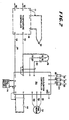
- thermocouple 46 Disposed adjacent the exit end 34 of the tunnel 10 is a thermocouple 46 which is connected to a temperature controller 48 which in turn is connected to a fan speed controller 50.
- thermocouple 46 is of a suitable type such as copper/constantan in order to be useful over a temperature range from -320°F (196°C) to ambient, e.g. 75°F (24°C).
- Thermocouple 46 is the input for a temperature controller 48 which in the preferred embodiment of the invention is a temperature controller, proportional with automatic reset, such as Series 900 manufactured and sold by Thermo Electric Company of Saddle Brook, New Jersey.
- the output through leads 52 and 54 of the temperature controller 48 are the input for the gas flow fan speed controller 50.
- Controller 50 in turn has output leads 56, 58 and 60 which are input for fan motor 38.
- the gas flow fan controller 50 can be an AC inverter such an AFC-2000 series offered for sale by T. B. Wood's Sons of Chambersburg, PA.
- the output of the gas flow fan controller (inverter) 50 can be 1 to 60 hertz (Hz) and is connected to the standard AC motor which in a preferred embodiment of the invention is an AC motor rated at 1750 rpm.
- the entire system consisting of the thermocouple, temperature controller and gas flow fan controller (46, 48 and 50) receives power through conventional power leads 62, 64 and 66 which contain suitable short circuit protection (e.g. fuses 68, 70 and 72).
- a frequency meter 74 can be connected to the gas flow fan controller 50 to give an indication of the speed of rotation of the motor 38.
- a potentiometer 76 having suitable taps 78, 80 and 82 is wired to the gas flow fan controller 50 in a known manner to provide manual operation of the gas control fan motor 38.
- a start circuit 84 is included which incorporates a suitable contact relay to energize the entire control system.
- the control system shown in Figure 2 can be integrated to the overall control system shown in U.S. Patent 3,613,386 by means of leads 90 and 92 to afford both liquid nitrogen delivery control and total gas flow control through the freezing tunnel 10.
- control system of Figure 2 can be wired so that it can be operated automatically or manually. This is achieved by using a push button and relays or relay shown as 86 in the circuit with potentiometer 76 so that energizing the relays 86 will put the system in automatic operation. Conversely, if the relays are open by being de-energized, the system can be operated manually by varying potentiometer 76.
- the circuit of Figure 2 can be constructed using a push button with contact blocks in place relay 86.
- the apparatus of the present invention functions so that the thermocouple 46 detects the temperature of the freezer at the location shown in Figure 1. If room or ambient air is being pulled into the discharge opening 34 of freezer 10, the temperature will approach that of the processing room, e.g. 75°F (24°C). If on the other hand excess nitrogen gas builds up inside the freezer 10 and spills out of discharge opening 34, the temperature sensed by thermocouple 46 will approach -320°F (-196°C). Thus, the correct gas flow condition can be achieved at a temperature level between these limits.
- the proportional temperature controller referred to above provides a constant output of approximately 12 milliamperes when the actual temperature equals the setpoint of the controller.
- the AC inverter identified above provides an output frequency of about 30 Hz which in turn drives the gas flow blower motor 38 to turn at about 875 rpm. If cold nitrogen gas spills out of the discharge opening 34, the temperature will become colder, increasing the output of the temperature controller 48.
- the AC inverter 50 then increases its output frequency to drive the gas control blower 38 faster, thus pumping more nitrogen toward the freezer entrance 42. Conversely, if any room air is pulled into the discharge opening, the temperature at the location of the thermocouple will become warmer, thus decreasing the output of temperature controller 48. This in turn will cause the output of the fan speed controller (AC inverter) 50 to decrease to thus slow down the gas control blower permitting nitrogen to prevent ingress of the room atmosphere.
- the AC motor set out above operated at 60 Hz (1750 rpm) when the actual temperature was 69°F (38°C) colder than the setpoint.
- the AC motor stopped running when the actual temperature was 48°F (27°C) warmer than the setpoint.
- a gas flow controller according to the present invention was installed in a commercial operation.
- the control was added to an existing CRYO-QUICK freezer and the freezer was used to process 2500 lbs/hr (1134 kg/hr) of chicken croquettes and sauce.
- lbs/hr (1134 kg/hr) of chicken croquettes and sauce.
- the following data was recorded: Discharge Opening Temperature -41°F (-40.6°C) Temperature Controller Setpoint -40°F (-40°C) AC Inverter Output 26 Hz Liquid Nitrogen Spray Header Pressure 6.4 psi (44 kPa)
- the foregoing operating parameters provided the correct gas flow to the freezer, thus minimizing ingress of ambient air into the tunnel, or egress of vaporized cold nitrogen gas from the tunnel.
- the AC inverter output varied between 0 to 26 Hz.
- the gas flow through the freezer remained correct at all times.
- the temperature controller setpoint may vary depending upon the product being frozen. However, this setpoint can be easily determined to maintain the proper gas flow through the freezer for subsequent processing runs.
- the improved gas flow control system of the present invention has several advantages over the systems shown in the prior art.
- the system of the present invention detects the relative movement of gas at the discharge opening, it will automatically correct for changing flow conditions within the freezer, such as when loading or unloading product. In the same manner, it will automatically compensate for different product type. Changes in the liquid nitrogen quality delivered to the liquid nitrogen spray header will not effect the performance of the gas flow control since it operates independently thereof.
- the most important and surprising advantage of the new system is that it does not require the freezer operator to readjust the system on a continuous basis. Furthermore, it does not require the operator's judgement of the current gas flow condition since the temperature controller has a specific setpoint that remains unchanged.
- a DC motor control could be used to drive a DC motor, which in turn controls the speed of rotation of the fan should that be desirable for a given freezer.
- motors and motor controls could be used so long as the net effect on one hand is that as cold nitrogen gas exits the discharge opening of the tunnel, the system must act to increase the speed of rotation of the gas control fan or blower to maintain zero flow conditions at the discharge opening. On the other hand, as room air enters the discharge opening, the system must act to slow down the speed of rotation of the gas control fan or blower and eventually to stop the rotation of the fan should conditions so indicate so that room air can be excluded from the freezer during normal operation.
Landscapes
- Engineering & Computer Science (AREA)
- Chemical & Material Sciences (AREA)
- Combustion & Propulsion (AREA)
- Physics & Mathematics (AREA)
- Mechanical Engineering (AREA)
- Thermal Sciences (AREA)
- General Engineering & Computer Science (AREA)
- Devices That Are Associated With Refrigeration Equipment (AREA)
- Filling Or Discharging Of Gas Storage Vessels (AREA)
Applications Claiming Priority (2)
| Application Number | Priority Date | Filing Date | Title |
|---|---|---|---|
| US99443 | 1987-09-18 | ||
| US07/099,443 US4800728A (en) | 1987-09-18 | 1987-09-18 | Method and apparatus for gas flow control in a cryogenic freezer |
Publications (2)
| Publication Number | Publication Date |
|---|---|
| EP0307859A2 true EP0307859A2 (fr) | 1989-03-22 |
| EP0307859A3 EP0307859A3 (fr) | 1990-07-04 |
Family
ID=22275034
Family Applications (1)
| Application Number | Title | Priority Date | Filing Date |
|---|---|---|---|
| EP88114946A Ceased EP0307859A3 (fr) | 1987-09-18 | 1988-09-13 | Dispositif et procédé de régulation de l'écoulement du gaz dans un congélateur cryogénique |
Country Status (5)
| Country | Link |
|---|---|
| US (1) | US4800728A (fr) |
| EP (1) | EP0307859A3 (fr) |
| JP (1) | JPH0615944B2 (fr) |
| KR (1) | KR920009628B1 (fr) |
| CA (1) | CA1297306C (fr) |
Cited By (4)
| Publication number | Priority date | Publication date | Assignee | Title |
|---|---|---|---|---|
| FR2779810A1 (fr) * | 1998-06-16 | 1999-12-17 | Roger Dew | Procede de refroidissement d'enceintes refrigerees et enceintes appliquant ce procede |
| WO2003038354A1 (fr) * | 2001-10-29 | 2003-05-08 | Norsk Hydro Asa | Procede et appareil de refrigeration et/ou de congelation de produits |
| DE102008007818A1 (de) | 2008-02-05 | 2009-08-06 | Hekro Dr.-Ing. E.H. Hermann Kronseder Sicherheits- Und Verpackungstechnik Gmbh | Presse für Biostoffe |
| US12618701B2 (en) * | 2023-12-18 | 2026-05-05 | Messer Industries Usa, Inc. | Probe apparatus and method for measuring cryogenic exhaust flow |
Families Citing this family (19)
| Publication number | Priority date | Publication date | Assignee | Title |
|---|---|---|---|---|
| US4947654A (en) * | 1989-11-30 | 1990-08-14 | Liquid Carbonic Corporation | Liquid cryogen freezer with improved vapor balance control |
| US4955206A (en) * | 1989-11-30 | 1990-09-11 | Liquid Carbonic Corporation | Liquid cryogen freezer with improved vapor balance control |
| US5054292A (en) * | 1990-07-13 | 1991-10-08 | Air Products And Chemicals, Inc. | Cryogenic freezer control |
| US5605049A (en) * | 1991-09-13 | 1997-02-25 | Air Products And Chemicals, Inc. | Exhaust system for a cryogenic freezer |
| GB9217189D0 (en) * | 1992-08-13 | 1992-09-23 | Air Prod & Chem | Control system for freezer |
| US5517827A (en) * | 1994-11-02 | 1996-05-21 | Air Products And Chemicals Inc. | Dual flow tunnel freezer |
| US5509277A (en) * | 1994-12-14 | 1996-04-23 | Air Products And Chemicals, Inc. | Combination immersion/impingement tunnel freezer |
| US5509278A (en) * | 1995-04-20 | 1996-04-23 | Air Products And Chemicals, Inc. | Dual chamber tunnel freezer |
| FR2765674B1 (fr) * | 1997-07-03 | 1999-08-06 | Air Liquide | Procede de commande du regime d'extraction d'un extracteur de gaz d'une enceinte d'un appareil cryogenique et appareil pour sa mise en oeuvre |
| US5966946A (en) | 1998-06-08 | 1999-10-19 | Praxair Technology, Inc. | Method and apparatus for retention of a refrigerant fluid in a refrigeration enclosure |
| US6497106B2 (en) | 2001-01-17 | 2002-12-24 | Praxair Technology, Inc. | Method and apparatus for chilling a food product |
| DE10224724A1 (de) * | 2001-06-04 | 2003-01-30 | Thermo King Corp | Steuerverfahren für ein CRYO-Kühlsystem mit Eigenantrieb |
| FR2837563B1 (fr) * | 2002-03-21 | 2004-10-22 | Air Liquide | Procede et dispositif de conduite d'un tunnel cryogenique, tunnel cryogenique associe |
| WO2004071643A2 (fr) * | 2003-02-07 | 2004-08-26 | Irm, Llc | Systeme de stockage de composes |
| US20070209653A1 (en) * | 2003-03-06 | 2007-09-13 | Exhausto, Inc. | Pressure Controller for a Mechanical Draft System |
| US7374579B2 (en) * | 2004-08-18 | 2008-05-20 | Cargill, Incorporated | System for extruding, cutting in strands, freezing, and chopping a ground food product and method thereof |
| US7197883B2 (en) * | 2005-05-06 | 2007-04-03 | Praxair Technology, Inc. | Cooling or heating with multi-pass fluid flow |
| US20090019869A1 (en) * | 2007-07-19 | 2009-01-22 | Girard John M | System and method for vapor control in cryogenic freezers |
| US20100269521A1 (en) * | 2009-04-28 | 2010-10-28 | Steven Clay Moore | Air-conditioning with dehumidification |
Family Cites Families (10)
| Publication number | Priority date | Publication date | Assignee | Title |
|---|---|---|---|---|
| US3345828A (en) * | 1965-06-11 | 1967-10-10 | Air Prod & Chem | Parallel flow cryogenic freezer |
| US3403527A (en) * | 1967-06-01 | 1968-10-01 | Air Prod & Chem | Transverse-parallel flow cryogenic freezer |
| US3613386A (en) * | 1970-03-23 | 1971-10-19 | Air Prod & Chem | Cryogenic freezer control |
| US3813895A (en) * | 1972-09-28 | 1974-06-04 | Air Prod & Chem | Food freezing apparatus |
| US3892104A (en) * | 1973-09-20 | 1975-07-01 | David J Klee | Cryogenic freezer with variable speed gas control system |
| CA1006365A (en) * | 1973-12-10 | 1977-03-08 | Barron M. Moody | Freeze tunnel |
| US4267500A (en) * | 1978-09-19 | 1981-05-12 | Gould Inc. | Control cooling means |
| JPS5548233A (en) * | 1978-09-29 | 1980-04-05 | D J- K Internatl Kk | Hot melt polymer composition with elasticity |
| US4276753A (en) * | 1980-05-19 | 1981-07-07 | Formax, Inc. | Cryogenic freezing tunnel control system |
| US4528819A (en) * | 1984-05-08 | 1985-07-16 | Air Products And Chemicals, Inc. | Exhaust control for cryogenic freezer |
-
1987
- 1987-09-18 US US07/099,443 patent/US4800728A/en not_active Expired - Fee Related
-
1988
- 1988-09-12 CA CA000577166A patent/CA1297306C/fr not_active Expired - Lifetime
- 1988-09-13 EP EP88114946A patent/EP0307859A3/fr not_active Ceased
- 1988-09-16 KR KR1019880012064A patent/KR920009628B1/ko not_active Expired
- 1988-09-19 JP JP63234703A patent/JPH0615944B2/ja not_active Expired - Lifetime
Cited By (4)
| Publication number | Priority date | Publication date | Assignee | Title |
|---|---|---|---|---|
| FR2779810A1 (fr) * | 1998-06-16 | 1999-12-17 | Roger Dew | Procede de refroidissement d'enceintes refrigerees et enceintes appliquant ce procede |
| WO2003038354A1 (fr) * | 2001-10-29 | 2003-05-08 | Norsk Hydro Asa | Procede et appareil de refrigeration et/ou de congelation de produits |
| DE102008007818A1 (de) | 2008-02-05 | 2009-08-06 | Hekro Dr.-Ing. E.H. Hermann Kronseder Sicherheits- Und Verpackungstechnik Gmbh | Presse für Biostoffe |
| US12618701B2 (en) * | 2023-12-18 | 2026-05-05 | Messer Industries Usa, Inc. | Probe apparatus and method for measuring cryogenic exhaust flow |
Also Published As
| Publication number | Publication date |
|---|---|
| US4800728A (en) | 1989-01-31 |
| EP0307859A3 (fr) | 1990-07-04 |
| KR920009628B1 (ko) | 1992-10-22 |
| JPH0615944B2 (ja) | 1994-03-02 |
| KR890005478A (ko) | 1989-05-15 |
| CA1297306C (fr) | 1992-03-17 |
| JPH01107072A (ja) | 1989-04-24 |
Similar Documents
| Publication | Publication Date | Title |
|---|---|---|
| US4800728A (en) | Method and apparatus for gas flow control in a cryogenic freezer | |
| US5605049A (en) | Exhaust system for a cryogenic freezer | |
| US3508881A (en) | Storage unit | |
| US4866946A (en) | Spiral cryogenic freezer | |
| US4528819A (en) | Exhaust control for cryogenic freezer | |
| US4812622A (en) | Apparatus for defrosting frozen articles | |
| US5170631A (en) | Combination cryogenic and mechanical freezer apparatus and method | |
| US4739623A (en) | Liquid cryogen freezer and method of operating same | |
| KR920004169B1 (ko) | 냉장제품 자동판매기의 온도조절장치 | |
| US4789025A (en) | Control apparatus for refrigerated cargo container | |
| EP0874204B1 (fr) | Congélateur | |
| US4947654A (en) | Liquid cryogen freezer with improved vapor balance control | |
| US4265092A (en) | Refrigerated display case using air defrost with supplemental heater | |
| US3613386A (en) | Cryogenic freezer control | |
| US4745762A (en) | Method and apparatus for cooling or freezing | |
| JPH07280404A (ja) | トンネルフリーザー | |
| US5054292A (en) | Cryogenic freezer control | |
| US4875341A (en) | Control apparatus for refrigerated cargo container | |
| US5065592A (en) | Cold box | |
| US3383877A (en) | Defrost control means for refrigerating systems | |
| FI94175C (fi) | Pakastusallas | |
| JPH09224849A (ja) | 食品貯蔵庫 | |
| KR100208368B1 (ko) | 냉장고 및 그 제상제어방법 | |
| JPH02124078A (ja) | 解凍装置および解凍方法 | |
| KR0162457B1 (ko) | 냉장고 냉동실의 온도와 증발기의 제상 제어방법 |
Legal Events
| Date | Code | Title | Description |
|---|---|---|---|
| PUAI | Public reference made under article 153(3) epc to a published international application that has entered the european phase |
Free format text: ORIGINAL CODE: 0009012 |
|
| AK | Designated contracting states |
Kind code of ref document: A2 Designated state(s): BE DE ES FR GB NL |
|
| PUAL | Search report despatched |
Free format text: ORIGINAL CODE: 0009013 |
|
| AK | Designated contracting states |
Kind code of ref document: A3 Designated state(s): BE DE ES FR GB NL |
|
| 17P | Request for examination filed |
Effective date: 19901128 |
|
| 17Q | First examination report despatched |
Effective date: 19911010 |
|
| STAA | Information on the status of an ep patent application or granted ep patent |
Free format text: STATUS: THE APPLICATION HAS BEEN REFUSED |
|
| 18R | Application refused |
Effective date: 19930405 |