EP0308232B1 - Filter mit einem verzögernd wirkenden Polymer und Prüfvorrichtung mit solchem Filter - Google Patents
Filter mit einem verzögernd wirkenden Polymer und Prüfvorrichtung mit solchem Filter Download PDFInfo
- Publication number
- EP0308232B1 EP0308232B1 EP88308559A EP88308559A EP0308232B1 EP 0308232 B1 EP0308232 B1 EP 0308232B1 EP 88308559 A EP88308559 A EP 88308559A EP 88308559 A EP88308559 A EP 88308559A EP 0308232 B1 EP0308232 B1 EP 0308232B1
- Authority
- EP
- European Patent Office
- Prior art keywords
- filter
- membrane
- water
- soluble polymer
- compartment
- Prior art date
- Legal status (The legal status is an assumption and is not a legal conclusion. Google has not performed a legal analysis and makes no representation as to the accuracy of the status listed.)
- Expired - Lifetime
Links
- 229920000642 polymer Polymers 0.000 title claims description 12
- 239000012528 membrane Substances 0.000 claims description 42
- 230000006698 induction Effects 0.000 claims description 25
- 239000000463 material Substances 0.000 claims description 19
- 239000007788 liquid Substances 0.000 claims description 17
- 229920003169 water-soluble polymer Polymers 0.000 claims description 17
- 239000011148 porous material Substances 0.000 claims description 16
- 239000004372 Polyvinyl alcohol Substances 0.000 claims description 9
- 239000000427 antigen Substances 0.000 claims description 9
- 238000006243 chemical reaction Methods 0.000 claims description 9
- 229920002451 polyvinyl alcohol Polymers 0.000 claims description 9
- 102000036639 antigens Human genes 0.000 claims description 8
- 108091007433 antigens Proteins 0.000 claims description 8
- 239000007787 solid Substances 0.000 claims description 8
- 229920000036 polyvinylpyrrolidone Polymers 0.000 claims description 7
- 239000001267 polyvinylpyrrolidone Substances 0.000 claims description 7
- 235000013855 polyvinylpyrrolidone Nutrition 0.000 claims description 7
- 229920002134 Carboxymethyl cellulose Polymers 0.000 claims description 6
- 239000002250 absorbent Substances 0.000 claims description 6
- 230000002745 absorbent Effects 0.000 claims description 6
- 239000001768 carboxy methyl cellulose Substances 0.000 claims description 6
- 235000010948 carboxy methyl cellulose Nutrition 0.000 claims description 6
- 239000008112 carboxymethyl-cellulose Substances 0.000 claims description 6
- 229920001577 copolymer Polymers 0.000 claims description 6
- 239000012530 fluid Substances 0.000 claims description 6
- 229920003064 carboxyethyl cellulose Polymers 0.000 claims description 4
- 239000002904 solvent Substances 0.000 claims description 4
- XLYOFNOQVPJJNP-UHFFFAOYSA-N water Substances O XLYOFNOQVPJJNP-UHFFFAOYSA-N 0.000 claims description 4
- 235000019422 polyvinyl alcohol Nutrition 0.000 claims description 3
- 239000000126 substance Substances 0.000 claims description 2
- 239000003153 chemical reaction reagent Substances 0.000 description 19
- 238000000576 coating method Methods 0.000 description 18
- 239000011248 coating agent Substances 0.000 description 12
- 235000018102 proteins Nutrition 0.000 description 12
- 102000004169 proteins and genes Human genes 0.000 description 12
- 108090000623 proteins and genes Proteins 0.000 description 12
- 150000001720 carbohydrates Chemical class 0.000 description 11
- 235000014633 carbohydrates Nutrition 0.000 description 11
- BECPQYXYKAMYBN-UHFFFAOYSA-N casein, tech. Chemical class NCCCCC(C(O)=O)N=C(O)C(CC(O)=O)N=C(O)C(CCC(O)=N)N=C(O)C(CC(C)C)N=C(O)C(CCC(O)=O)N=C(O)C(CC(O)=O)N=C(O)C(CCC(O)=O)N=C(O)C(C(C)O)N=C(O)C(CCC(O)=N)N=C(O)C(CCC(O)=N)N=C(O)C(CCC(O)=N)N=C(O)C(CCC(O)=O)N=C(O)C(CCC(O)=O)N=C(O)C(COP(O)(O)=O)N=C(O)C(CCC(O)=N)N=C(O)C(N)CC1=CC=CC=C1 BECPQYXYKAMYBN-UHFFFAOYSA-N 0.000 description 8
- 238000001035 drying Methods 0.000 description 8
- 239000000243 solution Substances 0.000 description 8
- 239000005018 casein Substances 0.000 description 7
- 235000021240 caseins Nutrition 0.000 description 7
- PEDCQBHIVMGVHV-UHFFFAOYSA-N Glycerine Chemical compound OCC(O)CO PEDCQBHIVMGVHV-UHFFFAOYSA-N 0.000 description 6
- 229920001778 nylon Polymers 0.000 description 6
- -1 poly(ethylene oxide) Polymers 0.000 description 6
- 239000004677 Nylon Substances 0.000 description 5
- 230000004888 barrier function Effects 0.000 description 5
- 238000003018 immunoassay Methods 0.000 description 5
- DHMQDGOQFOQNFH-UHFFFAOYSA-N Glycine Chemical compound NCC(O)=O DHMQDGOQFOQNFH-UHFFFAOYSA-N 0.000 description 4
- 239000003795 chemical substances by application Substances 0.000 description 4
- 239000004952 Polyamide Substances 0.000 description 3
- 238000001514 detection method Methods 0.000 description 3
- 238000000034 method Methods 0.000 description 3
- 239000012982 microporous membrane Substances 0.000 description 3
- 239000002245 particle Substances 0.000 description 3
- 229920002647 polyamide Polymers 0.000 description 3
- 239000011800 void material Substances 0.000 description 3
- 238000009736 wetting Methods 0.000 description 3
- HRPVXLWXLXDGHG-UHFFFAOYSA-N Acrylamide Chemical compound NC(=O)C=C HRPVXLWXLXDGHG-UHFFFAOYSA-N 0.000 description 2
- 108091003079 Bovine Serum Albumin Proteins 0.000 description 2
- 102000008186 Collagen Human genes 0.000 description 2
- 108010035532 Collagen Proteins 0.000 description 2
- 239000004471 Glycine Substances 0.000 description 2
- FAPWRFPIFSIZLT-UHFFFAOYSA-M Sodium chloride Chemical compound [Na+].[Cl-] FAPWRFPIFSIZLT-UHFFFAOYSA-M 0.000 description 2
- 230000004520 agglutination Effects 0.000 description 2
- 230000002152 alkylating effect Effects 0.000 description 2
- 125000003277 amino group Chemical group 0.000 description 2
- 150000008064 anhydrides Chemical class 0.000 description 2
- 239000007864 aqueous solution Substances 0.000 description 2
- 229940098773 bovine serum albumin Drugs 0.000 description 2
- 229920002678 cellulose Polymers 0.000 description 2
- 229920001436 collagen Polymers 0.000 description 2
- 230000000536 complexating effect Effects 0.000 description 2
- 238000004090 dissolution Methods 0.000 description 2
- 230000000694 effects Effects 0.000 description 2
- WBJINCZRORDGAQ-UHFFFAOYSA-N ethyl formate Chemical compound CCOC=O WBJINCZRORDGAQ-UHFFFAOYSA-N 0.000 description 2
- 238000011534 incubation Methods 0.000 description 2
- 239000013642 negative control Substances 0.000 description 2
- 239000013610 patient sample Substances 0.000 description 2
- 239000013641 positive control Substances 0.000 description 2
- 239000000376 reactant Substances 0.000 description 2
- 230000000717 retained effect Effects 0.000 description 2
- 239000000523 sample Substances 0.000 description 2
- PWKNBLFSJAVFAB-UHFFFAOYSA-N 1-fluoro-2-nitrobenzene Chemical compound [O-][N+](=O)C1=CC=CC=C1F PWKNBLFSJAVFAB-UHFFFAOYSA-N 0.000 description 1
- SMZOUWXMTYCWNB-UHFFFAOYSA-N 2-(2-methoxy-5-methylphenyl)ethanamine Chemical compound COC1=CC=C(C)C=C1CCN SMZOUWXMTYCWNB-UHFFFAOYSA-N 0.000 description 1
- FALRKNHUBBKYCC-UHFFFAOYSA-N 2-(chloromethyl)pyridine-3-carbonitrile Chemical compound ClCC1=NC=CC=C1C#N FALRKNHUBBKYCC-UHFFFAOYSA-N 0.000 description 1
- NIXOWILDQLNWCW-UHFFFAOYSA-N 2-Propenoic acid Natural products OC(=O)C=C NIXOWILDQLNWCW-UHFFFAOYSA-N 0.000 description 1
- VBZOUUJVGADJBK-UHFFFAOYSA-N 2-bromopropanedioic acid Chemical compound OC(=O)C(Br)C(O)=O VBZOUUJVGADJBK-UHFFFAOYSA-N 0.000 description 1
- MONMFXREYOKQTI-UHFFFAOYSA-N 2-bromopropanoic acid Chemical compound CC(Br)C(O)=O MONMFXREYOKQTI-UHFFFAOYSA-N 0.000 description 1
- LMRKXSDOAFUINK-UHFFFAOYSA-N 3-chlorosulfonylbenzoic acid Chemical compound OC(=O)C1=CC=CC(S(Cl)(=O)=O)=C1 LMRKXSDOAFUINK-UHFFFAOYSA-N 0.000 description 1
- PTCSSXYPZOFISK-UHFFFAOYSA-N 4-chlorosulfonylbenzoic acid Chemical compound OC(=O)C1=CC=C(S(Cl)(=O)=O)C=C1 PTCSSXYPZOFISK-UHFFFAOYSA-N 0.000 description 1
- 208000035473 Communicable disease Diseases 0.000 description 1
- 229920000742 Cotton Polymers 0.000 description 1
- WHNWPMSKXPGLAX-UHFFFAOYSA-N N-Vinyl-2-pyrrolidone Chemical compound C=CN1CCCC1=O WHNWPMSKXPGLAX-UHFFFAOYSA-N 0.000 description 1
- OVRNDRQMDRJTHS-UHFFFAOYSA-N N-acelyl-D-glucosamine Natural products CC(=O)NC1C(O)OC(CO)C(O)C1O OVRNDRQMDRJTHS-UHFFFAOYSA-N 0.000 description 1
- OVRNDRQMDRJTHS-FMDGEEDCSA-N N-acetyl-beta-D-glucosamine Chemical compound CC(=O)N[C@H]1[C@H](O)O[C@H](CO)[C@@H](O)[C@@H]1O OVRNDRQMDRJTHS-FMDGEEDCSA-N 0.000 description 1
- MBLBDJOUHNCFQT-LXGUWJNJSA-N N-acetylglucosamine Natural products CC(=O)N[C@@H](C=O)[C@@H](O)[C@H](O)[C@H](O)CO MBLBDJOUHNCFQT-LXGUWJNJSA-N 0.000 description 1
- 229920002302 Nylon 6,6 Polymers 0.000 description 1
- 229920003171 Poly (ethylene oxide) Polymers 0.000 description 1
- 229920002125 Sokalan® Polymers 0.000 description 1
- 230000010933 acylation Effects 0.000 description 1
- 238000005917 acylation reaction Methods 0.000 description 1
- 238000007818 agglutination assay Methods 0.000 description 1
- 125000005157 alkyl carboxy group Chemical group 0.000 description 1
- 230000029936 alkylation Effects 0.000 description 1
- 238000005804 alkylation reaction Methods 0.000 description 1
- 238000003556 assay Methods 0.000 description 1
- 239000000872 buffer Substances 0.000 description 1
- 239000007853 buffer solution Substances 0.000 description 1
- 125000003178 carboxy group Chemical group [H]OC(*)=O 0.000 description 1
- 239000001913 cellulose Substances 0.000 description 1
- 229920002301 cellulose acetate Polymers 0.000 description 1
- 239000000919 ceramic Substances 0.000 description 1
- FOCAUTSVDIKZOP-UHFFFAOYSA-N chloroacetic acid Chemical compound OC(=O)CCl FOCAUTSVDIKZOP-UHFFFAOYSA-N 0.000 description 1
- 229940106681 chloroacetic acid Drugs 0.000 description 1
- 230000000052 comparative effect Effects 0.000 description 1
- 150000001875 compounds Chemical class 0.000 description 1
- 238000009795 derivation Methods 0.000 description 1
- 230000003467 diminishing effect Effects 0.000 description 1
- 150000002148 esters Chemical class 0.000 description 1
- 239000004744 fabric Substances 0.000 description 1
- 239000000835 fiber Substances 0.000 description 1
- 238000001914 filtration Methods 0.000 description 1
- 239000011521 glass Substances 0.000 description 1
- 150000004820 halides Chemical class 0.000 description 1
- 238000010438 heat treatment Methods 0.000 description 1
- 230000007062 hydrolysis Effects 0.000 description 1
- 238000006460 hydrolysis reaction Methods 0.000 description 1
- 230000001900 immune effect Effects 0.000 description 1
- 230000000984 immunochemical effect Effects 0.000 description 1
- 229950006780 n-acetylglucosamine Drugs 0.000 description 1
- 229920005615 natural polymer Polymers 0.000 description 1
- 230000007935 neutral effect Effects 0.000 description 1
- 230000035515 penetration Effects 0.000 description 1
- 239000008363 phosphate buffer Substances 0.000 description 1
- 229920002401 polyacrylamide Polymers 0.000 description 1
- 229920000728 polyester Polymers 0.000 description 1
- 229920001223 polyethylene glycol Polymers 0.000 description 1
- 230000035935 pregnancy Effects 0.000 description 1
- 208000012113 pregnancy disease Diseases 0.000 description 1
- 150000003839 salts Chemical class 0.000 description 1
- 239000011780 sodium chloride Substances 0.000 description 1
- 241000894007 species Species 0.000 description 1
- 229940014800 succinic anhydride Drugs 0.000 description 1
- 125000000472 sulfonyl group Chemical group *S(*)(=O)=O 0.000 description 1
- 230000006103 sulfonylation Effects 0.000 description 1
- 238000005694 sulfonylation reaction Methods 0.000 description 1
- 229920001059 synthetic polymer Polymers 0.000 description 1
- 229920002554 vinyl polymer Polymers 0.000 description 1
Images
Classifications
-
- B—PERFORMING OPERATIONS; TRANSPORTING
- B01—PHYSICAL OR CHEMICAL PROCESSES OR APPARATUS IN GENERAL
- B01D—SEPARATION
- B01D67/00—Processes specially adapted for manufacturing semi-permeable membranes for separation processes or apparatus
- B01D67/0081—After-treatment of organic or inorganic membranes
- B01D67/0088—Physical treatment with compounds, e.g. swelling, coating or impregnation
-
- B—PERFORMING OPERATIONS; TRANSPORTING
- B01—PHYSICAL OR CHEMICAL PROCESSES OR APPARATUS IN GENERAL
- B01D—SEPARATION
- B01D61/00—Processes of separation using semi-permeable membranes, e.g. dialysis, osmosis or ultrafiltration; Apparatus, accessories or auxiliary operations specially adapted therefor
- B01D61/14—Ultrafiltration; Microfiltration
- B01D61/18—Apparatus therefor
-
- B—PERFORMING OPERATIONS; TRANSPORTING
- B01—PHYSICAL OR CHEMICAL PROCESSES OR APPARATUS IN GENERAL
- B01D—SEPARATION
- B01D69/00—Semi-permeable membranes for separation processes or apparatus characterised by their form, structure or properties; Manufacturing processes specially adapted therefor
- B01D69/12—Composite membranes; Ultra-thin membranes
- B01D69/1213—Laminated layers
-
- B—PERFORMING OPERATIONS; TRANSPORTING
- B01—PHYSICAL OR CHEMICAL PROCESSES OR APPARATUS IN GENERAL
- B01D—SEPARATION
- B01D69/00—Semi-permeable membranes for separation processes or apparatus characterised by their form, structure or properties; Manufacturing processes specially adapted therefor
- B01D69/12—Composite membranes; Ultra-thin membranes
- B01D69/1218—Layers having the same chemical composition, but different properties, e.g. pore size, molecular weight or porosity
-
- G—PHYSICS
- G01—MEASURING; TESTING
- G01N—INVESTIGATING OR ANALYSING MATERIALS BY DETERMINING THEIR CHEMICAL OR PHYSICAL PROPERTIES
- G01N33/00—Investigating or analysing materials by specific methods not covered by groups G01N1/00 - G01N31/00
- G01N33/48—Biological material, e.g. blood, urine; Haemocytometers
- G01N33/50—Chemical analysis of biological material, e.g. blood, urine; Testing involving biospecific ligand binding methods; Immunological testing
- G01N33/53—Immunoassay; Biospecific binding assay; Materials therefor
- G01N33/5302—Apparatus specially adapted for immunological test procedures
-
- G—PHYSICS
- G01—MEASURING; TESTING
- G01N—INVESTIGATING OR ANALYSING MATERIALS BY DETERMINING THEIR CHEMICAL OR PHYSICAL PROPERTIES
- G01N33/00—Investigating or analysing materials by specific methods not covered by groups G01N1/00 - G01N31/00
- G01N33/48—Biological material, e.g. blood, urine; Haemocytometers
- G01N33/50—Chemical analysis of biological material, e.g. blood, urine; Testing involving biospecific ligand binding methods; Immunological testing
- G01N33/53—Immunoassay; Biospecific binding assay; Materials therefor
- G01N33/543—Immunoassay; Biospecific binding assay; Materials therefor with an insoluble carrier for immobilising immunochemicals
- G01N33/54366—Apparatus specially adapted for solid-phase testing
-
- Y—GENERAL TAGGING OF NEW TECHNOLOGICAL DEVELOPMENTS; GENERAL TAGGING OF CROSS-SECTIONAL TECHNOLOGIES SPANNING OVER SEVERAL SECTIONS OF THE IPC; TECHNICAL SUBJECTS COVERED BY FORMER USPC CROSS-REFERENCE ART COLLECTIONS [XRACs] AND DIGESTS
- Y10—TECHNICAL SUBJECTS COVERED BY FORMER USPC
- Y10S—TECHNICAL SUBJECTS COVERED BY FORMER USPC CROSS-REFERENCE ART COLLECTIONS [XRACs] AND DIGESTS
- Y10S436/00—Chemistry: analytical and immunological testing
- Y10S436/807—Apparatus included in process claim, e.g. physical support structures
Definitions
- This invention relates to a test device containing a filter, effective to provide a delay time of flow therethrough of aqueous solutions. It is particularly applicable to a device for conducting an immunoassay on biological liquids.
- Disposable devices have been provided for conducting immunoassay tests for pregnancy and/or infectious diseases. Examples are described in U.S. Patent No. 3,888,629.
- a filter used to separate an upper reaction compartment from a lower compartment used to collect liquid that passes through the filter.
- Reagents comprising antigens or antibodies are often stored in the upper compartment, to react with an antibody or antigen, respectively, at the filter to produce a complex which is retained on the filter.
- the solvent passes through, carrying with it free, unreacted antigens and antibodies.
- the filter is sized to hold back just the complex that forms in the immunoassay of choice.
- US Patent No. 4,522,923 discloses a method and apparatus for conducting immunochemical reactions.
- the apparatus comprises a container which is subdivided into at least three chambers, each separated from another by water-soluble barriers.
- a water-containing reactant By introducing a water-containing reactant into the first chamber, the reactant is held in contact with the contents of the first chamber for a predetermined length of time before the barrier is ruptured and the contents in the first chamber are transferred to the second chamber.
- This predetermined length of time is controlled by the rate of dissolution of the barrier between the first and the second chambers and the amount of water in the sample.
- the process is then repeated for the second barrier between the second and the third chambers.
- Dissolution times for the barriers are about 1 to 30, preferably about 2 to 10, minutes.
- the reagents are applied to the upper chamber by coating them onto the top surface of the filter.
- the filter is designed to allow liquid to pass through containing such reagents in their uncomplexed form. Attempts to quickly dry the reagents have met with damage to the reagents if the drying temperature is too high.
- U.S. Patent No. 4,587,102 teaches a test element comprising stacked layers of porous fabric, wherein the void volume is preferably 50 to 90%.
- a time-delay layer is added to the detection layer, col. 12. It comprises one or two water soluble polymers, which can be polyvinyl alcohol, polyvinyl pyrrolidene, or carboxymethyl cellulose. The amount is said to be from 2 to 50 ⁇ m in thickness, col. 13. These amounts in turn provide a dry coverage that is between about 2.2 g/m2 to about 55 g/m2. No suggestion is made that a particular induction time be achieved or that drying temperatures might create a problem.
- a reaction test device comprising:- an upper reaction compartment; a lower fluid collection compartment; and a filter separating the upper compartment and the lower compartment, the filter comprising a membrane having pores generally less than 10 microns to retain selected material and to pass through a solvent, the lower compartment including an absorbent material, being in fluid contact with the bottom surface of the membrane, for drawing liquid from the upper compartment to the lower compartment through the filter; characterized in that the filter further comprises a first water-soluble polymer on and within portions of the membrane and an additional water-soluble polymer applied on the first water-soluble polymer after it is dry, the polymers producing, for a given molecular weight and a dry solids coverage, an induction time at room temperature of at least 30s and no greater than 300s, for a liquid head of pressure of 6mm of water.
- a time-delay filter and a reaction test device containing it are provided wherein a reagent-containing overcoat can be applied and dried to the top of the filter, without losing the reagents through the filter.
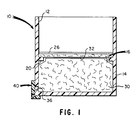
- Figure 1 is a vertical section view, partially schematic, of a device prepared in accordance with the invention.
- the invention is described herein in connection with the preferred embodiments, that is a disposable reaction test device to filter out antibody-antigen complexes in an immunoassay, a reagent comprising an antibody or antigen having been preapplied to the top of the filter as an overcoat.
- the invention is useful to provide a time-delay filter in any device, to retain particles of any kind, wherein it is desired that the induction time at room temperature be at least about 30 seconds and no greater than about 300 seconds, for the stated liquid head of pressure.
- induction time refers to the amount of time it takes for the liquid applied to the top of the filter with a given head of pressure, to wet through to the bottom of the filter at room temperature. This delay in penetration of the filter is a function of the amount of, and properties of, the water-soluble polymer coated onto the membrane. The delay, of course, is caused by the re-dissolving of the polymer.
- the induction time must be long enough to allow reagents to be applied as an aqueous-based overcoat and dried without first passing through the filter, but short enough to allow a customer to use the device, that is, have the test liquid pass through in the appropriate length of time. The induction time allows the liquid to incubate in the presence of immunoreagents.
- the minimum induction time is partly a function of the temperature used to dry the overcoat of reagents.
- the maximum tolerable drying temperature is about 50°C. This in turn produces a drying time of about 30 seconds for the preferred wet coverages. Therefore, the induction time must be at least 30 seconds.
- the induction time should not exceed about 200 seconds.
- the reasons for the preferred time of ⁇ 200 seconds are: a) the customer's induction time arises from a second wetting of the device, the application of the overcoat being the first, and b) the induction time for a second wetting is slightly longer than the induction time of the first wetting.
- the most preferred induction time of no greater than about 200 seconds allows for the fact that the customer's encountered induction time may be slightly longer.
- a device 10 prepared in accordance with the invention has an upper reaction compartment 12, a lower fluid-collection compartment 14, and a filter membrane 16 disposed between the two compartments.
- Suitable means such as a ledge 20, are used to hold membrane 16 in place.
- One or more water-soluble polymers are coated in one or more layers 26 on and into filter membrane 16. (Such layer(s) 26 may also penetrate into the membrane 16, even to the extent of not appearing as a separate layer above (not shown).)
- absorbent material 30 is provided in compartment 14, in fluid contact with bottom surface 32 of membrane 16. Any suitable absorbent material is useful.
- an aperture 36 is provided to vent compartment 14 to the atmosphere to avoid a liquid lock.
- a suitable cover such as hinged cover 40, is provided over aperture 36.
- a sliding cover (not shown) can be used. If only a single incubation of liquid above membrane 16 is required, cover 40 can be omitted since the overcoat layer 26 will appropriately delay flow. However, if plural incubation steps are required, cover 40 is included.
- the filters act as follows.
- antigen is supplied in the device as manufactured, and when antibody is added by the user, a complex forms as a positive control, and remains on the filter for detection.
- Membrane 16 can be any thin microporous biologically inert material.
- Preferred materials are those that do not interact with the immunoreactive species of interest or its receptor, and include materials, such as glass, ceramics, fibers, synthetic and natural polymers and others known in the art. Thus, most preferred materials are cellulose esters, polyamides and polyesters. The polyamides, such as nylons, are most preferred.
- the membrane structure has porosity and pore sizes sufficient for the intended use, whether it be filtration, assays or other likely uses.
- the porosity is sufficient to allow fluids and unagglutinated materials to pass through but to not allow passage of agglutinated materials.
- the membrane pores, after coating, must be large enough to allow passage of any reagents and unagglutinated or uncomplexed particles, but not large enough to allow agglutinated or complexed particles to pass through.
- the average membrane pore size is at least about 5 times, and preferably from about 6 to about 15 times the average diameter of the agglutination reagent used therein. Most particularly, the average pore size of the membrane is generally less than about 10 micrometers, and preferably with 90% of the pore being less than about 5 micrometers in average transverse dimension. (As used herein, the size of the pores is measured as a dimension that is transverse to the long dimension of the pore. If the pore were cylindrical in shape, the transverse dimension would be a diameter.)
- Useful membranes are commercially available from many sources.
- useful polyamide materials include those available from Pall Biomedical Products Corp. (Glen Cove, New York).
- a useful membrane is a nylon-66 microporous membrane manufactured and marketed by that company as BIODYNE A or ULTIPOR N-66.
- Useful cellulose acetate membranes are also commercially available.
- Useful membranes can be shaped to any desired configuration for a particular use.
- the microporous membrane most preferably is pre-coated prior to its treatment described hereinafter, with one or more water-soluble proteins or carbohydrates. Generally, only one protein or carbohydrate is coated thereon, and is selected so that the protein and/or carbohydrate does not have a pI greater than 5.0.
- pI is known as the pH at which there is an equal number of positive and negative charges so that the molecule is neutral in charge.
- Useful water-soluble proteins include casein derivatives (for example, derivations obtained from acylation, alkylation or sulfonylation of casein), such as succinylated casein, succinylated bovine serum albumin, and succinylated collagen and other highly negative proteins or carbohydrates readily apparent to one skilled in the art. These materials are readily prepared by acylating, alkylating or sulfonylating a protein having available amine groups under suitable conditions to change the amine groups into carboxy, alkylcarboxy or sulfonyl groups, respectively.
- Useful acylating agents include, but are not limited to, those described in U.S.
- Patent 4,591,571 (issued May 27, 1986 to Kuboyama et al), such as dicarboxylic anhydrides, polycarboxylic anhydrides, halides thereof and esters thereof.
- Succinic anhydride is a highly preferred acylating agent.
- Alkylating and sulfonylating agents useful in modifying the proteins or carbohydrates described above include, but are not limited to bromoacetic acid, chloroacetic acid, fluoronitrobenzene, bromomalonic acid, bromopropionic acid, m-(chlorosulfonyl)benzoic acid and p-(chlorosulfonyl)benzoic acid. Bromoacetic acid is most preferred.
- Useful carbohydrates include water-soluble cellulose derivatives. Representative compounds are carboxymethyl cellulose, carboxyethyl cellulose, and others which would readily apparent to one skilled in the art. These materials are commercially available or can be readily prepared using known synthetic techniques.
- Preferred pre-coating materials include succinylated casein, carboxymethyl cellulose, succinylated bovine serum albumin and succinylated collagen. Succinylated casein is most preferred.
- the membrane structure can be prepared by contacting a microporous membrane of desired configuration with an aqueous solution of the appropriate proteins or carbohydrates by allowing a solution of the protein or carbohydrate to flow through the membrane at room temperature. In some cases, heating the solution up to 40°C for several minutes prior to contact may be useful.
- the total protein or carbohydrate present in the solution is an amount sufficient to provide a coating over the entire membrane without substantially diminishing the porosity of the membrane.
- the pre-coating should completely cover the surface of the membrane, but be thin enough so that the pores of the membrane are not blocked to an undesirable extent. That is, at least 50% of the original porosity of the membrane prior to coating should be retained after the pre-coating.
- the amount of protein or carbohydrate needed to achieve these results can be varied depending upon the membrane porosity, solution viscosity and average pore size, but it is generally at least about 25 mg/cm2. Very little of the protein or carbohydrate is left in the coating solution after membrane pre-coating.
- Layer(s) 26 comprise at least one water-soluble polymer selected to have the appropriate molecular weight and solids coverage. It has been found that the most preferred examples of such polymers are selected from the group consisting of polyvinyl alcohol, polyvinyl pyrrolidone and copolymers of either polyvinyl alcohol or polyvinyl pyrrolidone, carboxymethyl cellulose, carboxyethyl cellulose, poly(ethylene oxide), poly(acrylic acid), polyacrylamide, and poly(ethylene glycol).
- Useful examples of copolymers include a 50:50 or 90:10 (by mole ratio) copolymer of acrylamide and N-vinyl-2-pyrrolidone, and similar copolymers of acrylamide and acrylic acid.
- polyvinyl alcohol means, at least 75% hydrolized. The actual degree of hydrolysis is believed to be not critical.
- any weight is useful, provided the water-soluble polymer is adjusted as to its dry solids coverage. That is, it has been found that polyvinyl alcohol will work at 2000 Daltons. A material that is much less than that in weight no longer qualifies as a polymer. Useful examples of Mw (weight-average molecular weight) have been found that extend up to about 360,000 Daltons.
- the layer(s) 26 are applied in one or more coatings that are dried between coatings.
- the polymer(s) and the solids content selected provide the induction time that falls within the aforestated range.
- the minimum time is needed to allow a subsequent overcoat of reagents (not shown in the drawing) to be applied and dried prior to passing through membrane 16.
- Maximum temperatures for drying immunological reagents have been found to be about 50°C.
- the induction time of layer(s) 26 need only be at least 30 seconds. However, if the drying temperature is reduced to 40°C, then the induction time needs to be at least 60 seconds, and so forth.
- the amount of useful solids coverage of the polymer varies depending upon the polymer selected, and upon the pore size and void volume of the membrane, as will be readily apparent.
- the following examples indicate useful amounts. Comparative examples are also included to indicate that merely selecting any coverage between 2.2 g/m2 and 55 g/m2 is no guarantee that layer(s) 26 will be provided that have the proper induction time. Instead, the proper selection of coverage for a given material and a given molecular weight is necessary, as is evident from the following test and examples.
- a membrane as described above, without pretreatment with succinylated casein, is coated with the candidate polymer.
- the coated membrane is clamped in a three-well holder to a Webril cotton absorbant (of any thickness).
- the induction time is the length of time required to initiate flow into the absorbent underneath, as is evident from the dye color.
- the following examples further illustrate the scope of the invention.
- the "Nylon disks” were 47 mm discs of Nylon obtained from the Pall Biomedical Products Corp. under the tradename Ultipor N-66, with either 3.0 or 5.0 ⁇ m nominal pore sizes.
- the "roll” of Nylon was a 5 ⁇ m nominal pore size roll obtained from the Pall Corp. under the tradename Ultipor N-66, in about 30 cm widths, slit to form widths of 12.5 cm.
- the membranes had a void volume of from about 75 to about 85% with 90% of the pore sizes being less than or equal to 5 ⁇ m.
- more than one coating of a water-soluble polymer was applied.
- the membranes were taken from the Nylon roll, and drying between coatings was done at the temperature noted in Table III.
- Dye was applied using the glycine buffer solution.
- Total flow time is the time it took for the entire sample to flow through the filter.
- the difference between induction time and total flow time is the time it took for flow-through to occur once the absorbent underneath had been wetted.
- a comparison between Ex. 2 and Comp. Ex. 1 is instructive. The latter is identical to the former, except that it includes the extra 7-9 g/m2 of polyvinyl pyrrolidone (dry solids coverage). That is enough to push the induction time well beyond the maximum time of 300 seconds.
Landscapes
- Health & Medical Sciences (AREA)
- Chemical & Material Sciences (AREA)
- Engineering & Computer Science (AREA)
- Immunology (AREA)
- Life Sciences & Earth Sciences (AREA)
- Molecular Biology (AREA)
- Hematology (AREA)
- Biomedical Technology (AREA)
- Urology & Nephrology (AREA)
- Chemical Kinetics & Catalysis (AREA)
- Physics & Mathematics (AREA)
- Analytical Chemistry (AREA)
- Cell Biology (AREA)
- Biotechnology (AREA)
- Food Science & Technology (AREA)
- Medicinal Chemistry (AREA)
- Water Supply & Treatment (AREA)
- Microbiology (AREA)
- Biochemistry (AREA)
- General Health & Medical Sciences (AREA)
- General Physics & Mathematics (AREA)
- Pathology (AREA)
- Inorganic Chemistry (AREA)
- Manufacturing & Machinery (AREA)
- Investigating Or Analysing Biological Materials (AREA)
- Filtration Of Liquid (AREA)
Claims (5)
- Reaktions-Prüfvorrichtung (10) mit:
einer oberen Reaktions-Kammer (12);
einer unteren Fluid-Sammelkammer (14); und
einem Filter (16, 26), das die obere Kammer (12) und die untere Kammer (14) voneinander trennt, wobei das Filter (16, 26) eine Membran (16) aufweist, mit Poren, die im allgemeinen kleiner als 10 Mikron sind, um ein ausgewähltes Material zurückzuhalten, und um ein Lösungsmittel durchzulassen, wobei die untere Kammer (14) ein absorbierendes Material (30) enthält, das sich in Fluid-Kontakt mit der Bodenoberfläche (32) der Membran (16) befindet, um Flüssigkeit aus der oberen Kammer (12) in die untere Kammer (14) durch das Filter (16, 26) abzuziehen;
dadurch gekennzeichnet, daß das Filter (16, 26) weiterhin ein erstes wasserlösliches Polymer auf und innerhalb von Teilen der Membran (16) aufweist sowie ein zusätzliches wasserlösliches Polymer, das auf das erste wasserlösliche Polymer aufgebracht worden ist, nachdem es trocken ist, wobei die Polymeren für ein gegebenes Molekulargewicht und eine Trockenfeststoff-Beschichtung eine Induktionszeit bei Raumtemperatur von mindestens 30 S und nicht größer als 300 S erzeugen, bei einem Druck einer Flüssigkeitssäule von 6 mm Wasser. - Vorrichtung nach Anspuch 1, in der das erste wasserlösliche Polymer ausgewählt ist aus der Gruppe bestehend aus Polyvinylalkohol, Polyvinylpyrrolidon und Copolymeren von entweder Polyvinylalkohol oder Polyvinylpyrrolidon, Carboxymethylcellulose und Carboxyethylcellulose.
- Vorrichtung nach Anspruch 1 oder 2, in der das zusätzliche wasserlösliche Polymer ausgewählt ist aus der Gruppe bestehend aus Polyvinylalkohol, Polyvinylpyrrolidon und Copolymeren von entweder Polyvinylalkohol oder Polyvinylpyrrolidon, Carboxymethylcellulose und Carboxyethylcellulose.
- Vorrichtung nach einem der Ansprüche 1 bis 3, in der das zusätzliche wasserlösliche Polymer und das erste wasserlösliche Polymer die gleiche chemische Struktur, jedoch verschiedene Molekulargewichte aufweisen.
- Vorrichtung nach einem der vorstehenden Ansprüche, die ferner ein Immunoreagens auf dem Filter (16, 26) enthält, das ausgewählt ist aus einem Antikörper oder einem Antigen.
Applications Claiming Priority (2)
| Application Number | Priority Date | Filing Date | Title |
|---|---|---|---|
| US98249 | 1987-09-18 | ||
| US07/098,249 US4923680A (en) | 1987-09-18 | 1987-09-18 | Test device containing an immunoassay filter with a flow-delaying polymer |
Publications (3)
| Publication Number | Publication Date |
|---|---|
| EP0308232A2 EP0308232A2 (de) | 1989-03-22 |
| EP0308232A3 EP0308232A3 (en) | 1990-10-24 |
| EP0308232B1 true EP0308232B1 (de) | 1994-11-09 |
Family
ID=22268355
Family Applications (1)
| Application Number | Title | Priority Date | Filing Date |
|---|---|---|---|
| EP88308559A Expired - Lifetime EP0308232B1 (de) | 1987-09-18 | 1988-09-16 | Filter mit einem verzögernd wirkenden Polymer und Prüfvorrichtung mit solchem Filter |
Country Status (5)
| Country | Link |
|---|---|
| US (1) | US4923680A (de) |
| EP (1) | EP0308232B1 (de) |
| JP (1) | JPH01101463A (de) |
| CA (1) | CA1321554C (de) |
| DE (1) | DE3852084T2 (de) |
Families Citing this family (34)
| Publication number | Priority date | Publication date | Assignee | Title |
|---|---|---|---|---|
| FR2621393B1 (fr) * | 1987-10-05 | 1991-12-13 | Toledano Jacques | Dispositif de detection immunoenzymatique de substances a partir d'une goutte de sang ou de liquide provenant d'un quelconque milieu biologique |
| US5268299A (en) * | 1988-04-14 | 1993-12-07 | Eastman Kodak Company | Diluent composition useful in the detection of antibodies in assays |
| US5244630A (en) * | 1988-04-22 | 1993-09-14 | Abbott Laboratories | Device for performing solid-phase diagnostic assay |
| US5051356A (en) * | 1988-06-13 | 1991-09-24 | Eastman Kodak Company | Specific binding composition comprising a low pI protein or carbohydrate and a diagnostic test kit and method of use |
| US5089424A (en) * | 1988-06-14 | 1992-02-18 | Abbott Laboratories | Method and apparatus for heterogeneous chemiluminescence assay |
| US5135872A (en) * | 1989-04-28 | 1992-08-04 | Sangstat Medical Corporation | Matrix controlled method of delayed fluid delivery for assays |
| US5998220A (en) | 1991-05-29 | 1999-12-07 | Beckman Coulter, Inc. | Opposable-element assay devices, kits, and methods employing them |
| US5877028A (en) | 1991-05-29 | 1999-03-02 | Smithkline Diagnostics, Inc. | Immunochromatographic assay device |
| US6168956B1 (en) | 1991-05-29 | 2001-01-02 | Beckman Coulter, Inc. | Multiple component chromatographic assay device |
| US5726010A (en) * | 1991-07-31 | 1998-03-10 | Idexx Laboratories, Inc. | Reversible flow chromatographic binding assay |
| US6007999A (en) * | 1991-07-31 | 1999-12-28 | Idexx Laboratories, Inc. | Reversible flow chromatographic binding assay |
| AU2115092A (en) * | 1991-10-08 | 1993-04-22 | Eastman Kodak Company | Method, test device and kit for assay of specific binding ligand using controlled flow through filtration membrane |
| DE4311252A1 (de) * | 1993-04-06 | 1994-10-13 | Boehringer Mannheim Gmbh | Bestimmung eines Analyten in einer Probeflüssigkeit |
| US5660798A (en) * | 1993-04-20 | 1997-08-26 | Actimed Laboratories, Inc. | Apparatus for red blood cell separation |
| US5766552A (en) * | 1993-04-20 | 1998-06-16 | Actimed Laboratories, Inc. | Apparatus for red blood cell separation |
| US5368729A (en) * | 1993-07-23 | 1994-11-29 | Whatman, Inc. | Solid phase extraction device |
| US5547833A (en) * | 1994-01-04 | 1996-08-20 | Intracel Corporation | Radial flow assay, delivering member, test kit, and methods |
| US5561045A (en) * | 1994-01-04 | 1996-10-01 | Intracel Corporation | Detection reagent, article, and immunoassay method |
| US5447689A (en) * | 1994-03-01 | 1995-09-05 | Actimed Laboratories, Inc. | Method and apparatus for flow control |
| WO1995032414A1 (en) * | 1994-05-20 | 1995-11-30 | Chemtrak, Inc. | Qualitative surface immunoassay using consecutive reagent application |
| US5589344A (en) | 1994-06-15 | 1996-12-31 | Johnson & Johnson Clinical Diagnostics, Inc. | Test kit and method for competitive specific binding assay |
| US5756049A (en) * | 1996-10-25 | 1998-05-26 | Hach Company | Water testing capsule using water soluble film membranes |
| WO2001055727A1 (en) * | 2000-01-31 | 2001-08-02 | Emory University | Immunological assay system and method |
| EP1294749A2 (de) * | 2000-03-09 | 2003-03-26 | Heska Corporation | Rekombinanten antigenen zur bestimmung des immun-zustandes eines tieres |
| US6436722B1 (en) | 2000-04-18 | 2002-08-20 | Idexx Laboratories, Inc. | Device and method for integrated diagnostics with multiple independent flow paths |
| FR2817961B1 (fr) * | 2000-12-08 | 2003-08-01 | Diagast | Barriere de separation temporaire, recipient la comprenant et procede de mise en oeuvre d'un test dans ce recipient |
| US7300633B2 (en) | 2001-07-25 | 2007-11-27 | Oakville Hong Kong Company Limited | Specimen collection container |
| US7270959B2 (en) | 2001-07-25 | 2007-09-18 | Oakville Hong Kong Company Limited | Specimen collection container |
| US7560272B2 (en) | 2003-01-04 | 2009-07-14 | Inverness Medical Switzerland Gmbh | Specimen collection and assay container |
| US7517495B2 (en) | 2003-08-25 | 2009-04-14 | Inverness Medical Switzerland Gmbh | Biological specimen collection and analysis system |
| JP6545556B2 (ja) * | 2015-07-23 | 2019-07-17 | キヤノンメディカルシステムズ株式会社 | 検査試薬及び検体測定システム |
| US20180332985A1 (en) * | 2017-05-22 | 2018-11-22 | All Turtles, Inc. | Tea bags and filters with variable porosity and custom steeping cycles |
| WO2023244321A2 (en) * | 2022-06-16 | 2023-12-21 | Absci Corporation | Inoculation test tube device |
| WO2025018998A1 (en) * | 2023-07-20 | 2025-01-23 | Google Llc | Assay stack with separation membrane containing soluble polymer coating to control flow rate |
Family Cites Families (11)
| Publication number | Priority date | Publication date | Assignee | Title |
|---|---|---|---|---|
| US2926088A (en) * | 1955-02-08 | 1960-02-23 | Phillip P Spiselman | Method of brewing coffee |
| US3272742A (en) * | 1963-06-25 | 1966-09-13 | Sun Oil Co | Coated adsorbents as treating agents for mineral oils |
| CA983358A (en) * | 1971-09-08 | 1976-02-10 | Kenneth D. Bagshawe | Performance of chemical or biological reactions |
| JPS5782766A (en) * | 1980-11-11 | 1982-05-24 | Konishiroku Photo Ind Co Ltd | Amynological measuring element |
| JPS57200862A (en) * | 1981-06-05 | 1982-12-09 | Fuji Photo Film Co Ltd | Mutilayer analysis element utilizing unique binding reaction |
| US4681782A (en) * | 1982-03-31 | 1987-07-21 | Biostar Medical Products, Inc. | Article for determining the presence of immune complexes |
| US4522923A (en) * | 1983-10-03 | 1985-06-11 | Genetic Diagnostics Corporation | Self-contained assay method and kit |
| US4615985A (en) * | 1984-04-16 | 1986-10-07 | Genetic Diagnostics Corporation | Immobilized protein on nylon for immunoassay |
| US4632901A (en) * | 1984-05-11 | 1986-12-30 | Hybritech Incorporated | Method and apparatus for immunoassays |
| US4618533A (en) * | 1984-11-30 | 1986-10-21 | Millipore Corporation | Porous membrane having hydrophilic surface and process |
| US4789526A (en) * | 1986-12-15 | 1988-12-06 | Pall Corporation | Vacuum diagnostic device |
-
1987
- 1987-09-18 US US07/098,249 patent/US4923680A/en not_active Expired - Lifetime
-
1988
- 1988-04-20 CA CA000564624A patent/CA1321554C/en not_active Expired - Fee Related
- 1988-09-16 EP EP88308559A patent/EP0308232B1/de not_active Expired - Lifetime
- 1988-09-16 DE DE3852084T patent/DE3852084T2/de not_active Expired - Fee Related
- 1988-09-19 JP JP63234693A patent/JPH01101463A/ja active Pending
Also Published As
| Publication number | Publication date |
|---|---|
| DE3852084T2 (de) | 1995-06-08 |
| CA1321554C (en) | 1993-08-24 |
| US4923680A (en) | 1990-05-08 |
| JPH01101463A (ja) | 1989-04-19 |
| EP0308232A2 (de) | 1989-03-22 |
| DE3852084D1 (de) | 1994-12-15 |
| EP0308232A3 (en) | 1990-10-24 |
Similar Documents
| Publication | Publication Date | Title |
|---|---|---|
| EP0308232B1 (de) | Filter mit einem verzögernd wirkenden Polymer und Prüfvorrichtung mit solchem Filter | |
| US5403706A (en) | Carrier matrix with dissolvably impregnated reagent | |
| US4965187A (en) | Method and apparatus for assaying whole blood | |
| US5137031A (en) | Urine testing apparatus with urinary sediment device | |
| EP0239318B1 (de) | Prüfung unter Verwendung von Bindungspaargliedern auf Teilchen und auf einem Filter oder einer Membran | |
| US5269931A (en) | Cationic charge modified microporous membranes | |
| US4851210A (en) | Blood typing device | |
| US4870007A (en) | Immobilized biotinylated receptor in test device, kit and method for determining a ligand | |
| EP0321260B1 (de) | Testvorrichtung mit getrockneten Reagenstropfen an einer geneigten Seitenwand | |
| JPS63243758A (ja) | 低pI蛋白質又は炭水化物で被覆された膜構造物並びにその製造及び使用法 | |
| IE61365B1 (en) | A solid phase system for use in ligand-receptor assays | |
| US5736099A (en) | Test plates for agglutination test and production process thereof | |
| US4939096A (en) | Method and apparatus for assaying whole blood | |
| US5547833A (en) | Radial flow assay, delivering member, test kit, and methods | |
| EP0299359A2 (de) | System zur Zuführung von Reagenzien bei Analysevorrichtungen mit fester Phase | |
| US4317810A (en) | Waffle-like matrix for immunoassay and preparation thereof | |
| EP1020726A1 (de) | Immunologische testverfahren und testsatz | |
| EP0280560B1 (de) | Mit Nieder-pI-Protein beschichtete Membranstruktur und Verfahren zu ihrer Herstellung und Verwendung | |
| EP0537827A1 (de) | Verfahren, Testvorrichtung und Satz zur Bestimmung eines spezifischen Bindungsliganden unter Verwendung eines kontrollierten Durchflusses durch eine Filtrationsmembran | |
| JP2511177B2 (ja) | 表面水酸基を有する膜を用いるクラミジア抗原の測定のための診断用試験キット及び方法 | |
| US4828980A (en) | Membrane structure coated with low pI protein or carbohydrate and methods of making and use | |
| CA1104927A (en) | Diagnostic immunochemical test material and procedure | |
| NZ231893A (en) | Dipstick for assaying viscous liquids or liquids containing cellular or particulate matter | |
| AU634960B2 (en) | Process for immobilizing or depositing molecules or substances on a support | |
| US5527672A (en) | Hydrophobic coated membranes |
Legal Events
| Date | Code | Title | Description |
|---|---|---|---|
| PUAI | Public reference made under article 153(3) epc to a published international application that has entered the european phase |
Free format text: ORIGINAL CODE: 0009012 |
|
| AK | Designated contracting states |
Kind code of ref document: A2 Designated state(s): CH DE FR GB IT LI SE |
|
| PUAL | Search report despatched |
Free format text: ORIGINAL CODE: 0009013 |
|
| AK | Designated contracting states |
Kind code of ref document: A3 Designated state(s): CH DE FR GB IT LI SE |
|
| 17P | Request for examination filed |
Effective date: 19901213 |
|
| 17Q | First examination report despatched |
Effective date: 19920904 |
|
| GRAA | (expected) grant |
Free format text: ORIGINAL CODE: 0009210 |
|
| ITF | It: translation for a ep patent filed | ||
| AK | Designated contracting states |
Kind code of ref document: B1 Designated state(s): CH DE FR GB IT LI SE |
|
| PG25 | Lapsed in a contracting state [announced via postgrant information from national office to epo] |
Ref country code: LI Effective date: 19941109 Ref country code: CH Effective date: 19941109 |
|
| REF | Corresponds to: |
Ref document number: 3852084 Country of ref document: DE Date of ref document: 19941215 |
|
| PG25 | Lapsed in a contracting state [announced via postgrant information from national office to epo] |
Ref country code: SE Effective date: 19950209 |
|
| REG | Reference to a national code |
Ref country code: CH Ref legal event code: PL |
|
| ET | Fr: translation filed | ||
| RAP2 | Party data changed (patent owner data changed or rights of a patent transferred) |
Owner name: CLINICAL DIAGNOSTIC SYSTEMS, INC. |
|
| PLBE | No opposition filed within time limit |
Free format text: ORIGINAL CODE: 0009261 |
|
| STAA | Information on the status of an ep patent application or granted ep patent |
Free format text: STATUS: NO OPPOSITION FILED WITHIN TIME LIMIT |
|
| RAP2 | Party data changed (patent owner data changed or rights of a patent transferred) |
Owner name: JOHNSON & JOHNSON CLINICAL DIAGNOSTICS, INC. |
|
| 26N | No opposition filed | ||
| REG | Reference to a national code |
Ref country code: GB Ref legal event code: 732E |
|
| PGFP | Annual fee paid to national office [announced via postgrant information from national office to epo] |
Ref country code: GB Payment date: 19960909 Year of fee payment: 9 |
|
| PGFP | Annual fee paid to national office [announced via postgrant information from national office to epo] |
Ref country code: FR Payment date: 19960910 Year of fee payment: 9 |
|
| PGFP | Annual fee paid to national office [announced via postgrant information from national office to epo] |
Ref country code: DE Payment date: 19960920 Year of fee payment: 9 |
|
| PG25 | Lapsed in a contracting state [announced via postgrant information from national office to epo] |
Ref country code: GB Free format text: LAPSE BECAUSE OF NON-PAYMENT OF DUE FEES Effective date: 19970916 |
|
| PG25 | Lapsed in a contracting state [announced via postgrant information from national office to epo] |
Ref country code: FR Free format text: THE PATENT HAS BEEN ANNULLED BY A DECISION OF A NATIONAL AUTHORITY Effective date: 19970930 |
|
| GBPC | Gb: european patent ceased through non-payment of renewal fee |
Effective date: 19970916 |
|
| PG25 | Lapsed in a contracting state [announced via postgrant information from national office to epo] |
Ref country code: DE Free format text: LAPSE BECAUSE OF NON-PAYMENT OF DUE FEES Effective date: 19980603 |
|
| REG | Reference to a national code |
Ref country code: FR Ref legal event code: ST |
|
| PG25 | Lapsed in a contracting state [announced via postgrant information from national office to epo] |
Ref country code: IT Free format text: LAPSE BECAUSE OF NON-PAYMENT OF DUE FEES Effective date: 20050916 |