EP0309252A2 - Préparation d'un matériau synthétique pour l'implantation dans des tissus de mammifères - Google Patents
Préparation d'un matériau synthétique pour l'implantation dans des tissus de mammifères Download PDFInfo
- Publication number
- EP0309252A2 EP0309252A2 EP88308821A EP88308821A EP0309252A2 EP 0309252 A2 EP0309252 A2 EP 0309252A2 EP 88308821 A EP88308821 A EP 88308821A EP 88308821 A EP88308821 A EP 88308821A EP 0309252 A2 EP0309252 A2 EP 0309252A2
- Authority
- EP
- European Patent Office
- Prior art keywords
- liquid
- pores
- surface tension
- low surface
- tissue
- Prior art date
- Legal status (The legal status is an assumption and is not a legal conclusion. Google has not performed a legal analysis and makes no representation as to the accuracy of the status listed.)
- Withdrawn
Links
Images


Classifications
-
- A—HUMAN NECESSITIES
- A61—MEDICAL OR VETERINARY SCIENCE; HYGIENE
- A61L—METHODS OR APPARATUS FOR STERILISING MATERIALS OR OBJECTS IN GENERAL; DISINFECTION, STERILISATION OR DEODORISATION OF AIR; CHEMICAL ASPECTS OF BANDAGES, DRESSINGS, ABSORBENT PADS OR SURGICAL ARTICLES; MATERIALS FOR BANDAGES, DRESSINGS, ABSORBENT PADS OR SURGICAL ARTICLES
- A61L27/00—Materials for grafts or prostheses or for coating grafts or prostheses
- A61L27/50—Materials characterised by their function or physical properties, e.g. injectable or lubricating compositions, shape-memory materials, surface modified materials
- A61L27/56—Porous materials, e.g. foams or sponges
-
- A—HUMAN NECESSITIES
- A61—MEDICAL OR VETERINARY SCIENCE; HYGIENE
- A61F—FILTERS IMPLANTABLE INTO BLOOD VESSELS; PROSTHESES; DEVICES PROVIDING PATENCY TO, OR PREVENTING COLLAPSING OF, TUBULAR STRUCTURES OF THE BODY, e.g. STENTS; ORTHOPAEDIC, NURSING OR CONTRACEPTIVE DEVICES; FOMENTATION; TREATMENT OR PROTECTION OF EYES OR EARS; BANDAGES, DRESSINGS OR ABSORBENT PADS; FIRST-AID KITS
- A61F2/00—Filters implantable into blood vessels; Prostheses, i.e. artificial substitutes or replacements for parts of the body; Appliances for connecting them with the body; Devices providing patency to, or preventing collapsing of, tubular structures of the body, e.g. stents
- A61F2/0077—Special surfaces of prostheses, e.g. for improving ingrowth
-
- A—HUMAN NECESSITIES
- A61—MEDICAL OR VETERINARY SCIENCE; HYGIENE
- A61L—METHODS OR APPARATUS FOR STERILISING MATERIALS OR OBJECTS IN GENERAL; DISINFECTION, STERILISATION OR DEODORISATION OF AIR; CHEMICAL ASPECTS OF BANDAGES, DRESSINGS, ABSORBENT PADS OR SURGICAL ARTICLES; MATERIALS FOR BANDAGES, DRESSINGS, ABSORBENT PADS OR SURGICAL ARTICLES
- A61L27/00—Materials for grafts or prostheses or for coating grafts or prostheses
- A61L27/14—Macromolecular materials
- A61L27/16—Macromolecular materials obtained by reactions only involving carbon-to-carbon unsaturated bonds
-
- Y—GENERAL TAGGING OF NEW TECHNOLOGICAL DEVELOPMENTS; GENERAL TAGGING OF CROSS-SECTIONAL TECHNOLOGIES SPANNING OVER SEVERAL SECTIONS OF THE IPC; TECHNICAL SUBJECTS COVERED BY FORMER USPC CROSS-REFERENCE ART COLLECTIONS [XRACs] AND DIGESTS
- Y10—TECHNICAL SUBJECTS COVERED BY FORMER USPC
- Y10S—TECHNICAL SUBJECTS COVERED BY FORMER USPC CROSS-REFERENCE ART COLLECTIONS [XRACs] AND DIGESTS
- Y10S623/00—Prosthesis, i.e. artificial body members, parts thereof, or aids and accessories therefor
- Y10S623/92—Method or apparatus for preparing or treating prosthetic
-
- Y—GENERAL TAGGING OF NEW TECHNOLOGICAL DEVELOPMENTS; GENERAL TAGGING OF CROSS-SECTIONAL TECHNOLOGIES SPANNING OVER SEVERAL SECTIONS OF THE IPC; TECHNICAL SUBJECTS COVERED BY FORMER USPC CROSS-REFERENCE ART COLLECTIONS [XRACs] AND DIGESTS
- Y10—TECHNICAL SUBJECTS COVERED BY FORMER USPC
- Y10S—TECHNICAL SUBJECTS COVERED BY FORMER USPC CROSS-REFERENCE ART COLLECTIONS [XRACs] AND DIGESTS
- Y10S623/00—Prosthesis, i.e. artificial body members, parts thereof, or aids and accessories therefor
- Y10S623/924—Material characteristic
- Y10S623/926—Synthetic
Definitions
- This invention relates to treating synthetic materials so that the materials become suitable for use in contact with mammalian tissue and/or body fluids.
- tubular material for blood vessel replacement that can be safely sutured in place as a means of replacing small diameter blood vessels, such as those found in the extremities of the body or in children.
- a small diameter (less than 6 mm) vessel replacement using presently available materials cannot be reliably implanted for a period of more than several months and expected to remain patent. Further, the period of time for which they remain patent diminishes as their diameter diminishes. This is thought to relate to the fact that gas nuclei are often trapped in the surface roughness of materials. As a result, the material activates the complement system of blood plasma and this enhances the adhesion and aggregation of both platelets and leukocytes and results in thrombus formation.
- a method for treating a porous synthetic material having pores extending therethrough to render the material suitable for use in bonding to living tissue comprises enveloping the material with a liquid of sufficiently low surface tension to permit the liquid to enter pores of the material.
- the liquid has a sufficiently low gas content to permit the liquid to remove essentially all gas nuclei held in the pores of the material.
- the liquid is induced to fill essentially all pores in the material and remove essentially all of the gas nuclei held in the pores.
- the liquid is replaced with an aqueous solution which is compatible with body fluid and in which proteins have a low solubility to provide the desired implantable synthetic material.
- a porous synthetic material suitable for body implant has an ability to bond to living tissue.
- the material comprises a low surface tension structure having a plurality of pores which are essentially free of any gas nuclei.
- the pores of the material are filled with an aqueous solution that is compatible with body fluids and tissues and in which proteins have minimal solubility.
- a method for implanting the material into mammalian tissue comprises contacting the material with exposed mammalian tissue to form a temporary bond at an interface of the tissue and material without suturing in place. Cell ingrowth occurs spontaneously at the interface of the bond to complete a permanent secure bond between the tissue and the material.
- the present invention provides a porous synthetic material substantially free of gas nuclei, which allows bonding between the synthetic material and tissue, provided they are in intimate contact, and with time, allows rapid cell ingrowth to occur into the pores of the material.
- the present invention can be relied on when desired to avoid the need for suturing the mammalian tissue, because the treated material forms almost immediately a suitable bond with the tissue and the bond subsequently becomes very strong.
- the synthetic material of the present invention is more compatible with blood. When the material is brought into contact with the blood after being primed there is substantially less complement activation by the material as well as less platelet and leukocyte adhesion to the material. There is thus less cellular aggregation and less thrombus formation at the blood-contact surface of the material.
- the synthetic material may be used as an implant is an artificial blood vessel.
- the synthetic material is bonded to the mammalian tissue of a natural blood vessel where the body fluid carried through the synthetic material is blood.
- the solution used to fill the pores of the synthetic material to render it compatible with the mammalian fluids is a constituent which is blood compatible.
- the surface tension of the low surface tension liquid is sufficiently low so that the contact angle between the low surface tension liquid and the surface of the synthetic material to be used is less than 90° and is preferably as near 0° as possible, i.e, it wets the material. This is preferably a contact angle in the range of 0° to 20°.
- the use of the term contact angle refers to the angle defined by intersecting surfaces of the liquid and solid material and measured in the liquid.
- a pressure on the liquid may be developed which is greater than the sum of the vapor pressure of the low surface tension liquid and the tension of any absorbed gas in the low surface tension liquid.
- the process is aided if the contact angle is small, the dissolved gas content of the liquid is low, and the pressure under which the process takes place is large. Under these conditions, the low surface tension liquid will enter the pores of the material because the surface tension effect will force the gas trapped in the pores to be absorbed into the low surface tension liquid or to be displaced by the liquid.
- the porous material preferably has a low surface energy (or surface tension) and is highly porous.
- the porosity can have a wide range, but the material must have structural integrity. Thus the porosity cannot be too high; nor can it be so low that cellular ingrowth cannot occur.
- Suitable materials include porous or expanded polytetrafluorethylene (PTFE), woven polyurethane and segmented polyurethane such as sold under the trademark BIOMER and a woven polymer fiber sold under the trademark DACRON.
- Porous PTFE is a particularly preferred material because of its low surface energy.
- the surface energy of the material is usually characterized by a high contact angle (in excess of 90°) when in contact with water.
- the preferred low surface tension liquid is ethanol or acetone. Either of these liquids is preferably degassed as they tend to enter readily the pores of the synthetic material when the low surface tension liquid is degassed. Furthermore, the degassed liquid has an increased ability to absorb gas nuclei in the pores. When the material to be used for conduit replacement is expanded PTFE, a suitable low surface tension liquid would be degassed ethanol. When a liquid such as acetone is to be used as the low surface tension liquid, great care must be taken to ensure that it is thoroughly washed out of the synthetic material before it is implanted in a patient.
- Suitable solutions compatible with body fluid depend on the type of mammalian tissue being bonded by the synthetic material and are readily apparent to one skilled in the art.
- the solution is degassed.
- the removal of the gas from the pores of the porous material and its replacement with the solution compatible with body fluid provides a suitable material for promoting cell ingrowth and in the case of blood vessels reduces both platelet and leukocyte adhesion, and prevents the formation of a seroma on the outside of the artificial vessel.
- the prior art method of adding only a blood-compatible solution to porous tubular polytetrafluoroethylene material for use as an artificial blood vessel does not remove many of the gas nuclei from the walls of the material.
- the contact angle between the surface of the material and the aqueous blood-compatible solution is well in excess of 90°; therefore, the blood-compatible solution cannot enter the pores of the material nor remove any of the gas nuclei trapped in the pores of the material.
- the present invention enhances the removal of the gas nuclei by initially bringing a low surface tension liquid, that is miscible with a physiological eluent, or rinse solution, in contact with the material, allowing the surface tension effects and vapor pressures to force it into the pores.
- the liquid with absorbed or dissolved gas nuclei is replaced by washing or eluting the low surface tension liquid from the pores of the synthetic material with a physiological eluent such as saline and thereby replacing the low surface tension liquid in the pores with the physiological solution.
- a PTFE material which has been expanded to form a porous structure is treated.
- Ethanol is placed in a vessel and then the PTFE tube is added.
- the vessel containing both the ethanol and the PTFE tube is then placed in a heated bath, brought to a temperature of greater than 37°C. A temperature of approximately 50°C is often used. Then they are allowed to stand under this condition for several hours.
- This procedure effectively degasses the ethanol and allows it to enter the pores of the PTFE tube.
- the blood-compatible liquid that is to be used to wash out the ethanol is thoroughly degassed by exposing it to a vacuum for several hours while it is being stirred and heated to maintain its temperature at or near 37°C.
- the vacuum is removed and its temperature is brought to the same as that of the ethanol. Then it is used to rinse slowly and thoroughly the ethanol from the vessel containing the porous PTFE tube. After the rinsing procedure, the synthetic material and the blood-compatible liquid are brought to 37°C.
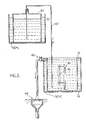
- a specially designed vessel 10 has an inner container 12 with a heat jacket defined by a bath solution held at a predetermined temperature.
- the implantable material 16 which is in the form of a small diameter vessel, is supported on a stand 18 having arms 20 and 22 which engage and support the implantable material 16.
- the stand 18 includes a base 24 which rests on the bottom of the container 12.
- the container 12 is filled with a low surface tension liquid 26. By immersing the implantable material 16 in the low surface tension liquid 26, the implantable material is enveloped by the low surface tension liquid to permit the liquid to permeate the porous implantable material and absorb or displace gas nuclei therein the manner previously discussed.
- the preferred low surface tension liquid is ethanol.
- the ethanol may be heated to near but below its boiling temperature to degas the ethanol.
- a vacuum may be drawn at conduit 28 to ensure complete degassing of the ethanol.
- the bath solution 14 may be then adjusted to a temperature of approximately 50°C. The material is left in the ethanol bath for a period of a few hours to allow the removal by absorption of displacement of the gas nuclei from the pores of the implantable material by the ethanol.
- the low surface tension liquid has a greater capacity for absorbing gas nuclei at cooler temperatures.
- concentration of gas in the ethanol at the higher temperature is lower, such as at boiling temperatures.
- the capacity of the ethanol to absorb gas increases as the ethanol is cooled down to 50°C and even lower such as in the range of 37°C. Allowing the material to remain in the ethanol for a period of time will insure the complete removal of the gas nuclei from the implantable material. While the gas nuclei absorption is taking place, the conduit 28 may be simply vented to room air.
- a vessel 30 is mounted on a heating unit 32 with provision for magnetic stirrer 34.
- the outlet conduit 36 of the vessel is connected to a vacuum pump to draw a vacuum in the vessel 30.
- the selected physiologically compatible fluid which may be for example saline, is placed in the container 30.
- the saline is heated to normal boiling point with vacuum drawn to completely degas the saline solution.
- the ethanol should be replaced with a degassed physiological solution. Care must be taken to insure that the physiological parameter such as osmolarity is not changed by this process.
- the container 12 is adapted to provide for continuous flow of the physiological fluid through the container to replace the ethanol.
- the bath fluid 14 holds the solution temperature at approximately 50°C (the same temperature as the ethanol) during this process.
- a bath 38 is provided to maintain the saline solution at that temperature.
- a suitable pump (not shown) or by syphoning passes the saline solution through conduit 40 into the vessel 12.
- An overflow conduit 42 is provided to remove the solution from the container 12 at the rate that saline is introduced thereto.
- Conduit 42 is connected to a drain as indicated by arrow 44.
- the thus treated porous tubular material is then stored in a closed vessel filled with the blood-compatible liquid to avoid re-nucleation of the air nuclei in the pores of the expanded PTFE. It is then ready for use with a patient.
- the tubular material should be inserted into the native artery above and below the opening made in the arterial wall. No suturing is necessary. The clamps are then released, allowing blood to flow through the inserted tubular material.
- porous PTFE tube is to be used to by-pass a portion of the patient's natural artery, then after the artery is exposed and clamped using standard surgical procedures, a small opening is made in the patient's artery at each end of the section of artery that is to be by-passed. A small portion of the prepared porous PTFE tube is inserted into the opening made in the patient's artery. If the diameter of the patient's artery is approximately the same or slightly smaller than the outside diameter of the porous PTFE tube, then a natural bond will form immediately after the patient's natural artery and the prepared porous PTFE tube is brought in contact. The artery can be unclamped and this bond will prevent any leakage of blood from the artery.
- a similar technique may be applied in grafting a prosthesis to bone.
- the prosthesis for example, a hip joint replacement may be coated or have connected thereto a porous PTFE expanded material treated in accordance with this invention. The treated prosthesis may then be implanted in the bone tissue without the need for adhesives.
- the porous PTFE tube can also be used in a manner that would obviate the need for suturing when replacing a heart valve.
- a valve is inserted inside the porous PTFE tube. If the PTFE tube is made slightly larger than the natural vessel into which it is placed, then an incision can be made in the vessel and the porous PTFE tube inserted. The natural vessel will then bond to the porous PTFE tube and eliminate the necessity for suturing the tube into place.
- a 2 mm diameter, 4 cm long tube of PTFE which had been expanded to obtain a porous structure was washed in degassed ethanol by the procedure described above.
- the tube was subsequently washed with a degassed physiological saline until the ethanol had been almost completely removed from the pores of the PTFE material. This required approximately three hours of rinsing with approximately 2 liters of degassed physiological saline.
- the porous PTFE tube was then stored in degassed physiological saline at 37°C until it was required for surgery.
- the aorta of a rabbit was then exposed using a standard surgical procedure, clamped, and a small incision made that allowed the PTFE tube to be inserted into the artery.
- a uniform layer of cellular growth 52 is formed to line the inner surface 50 of the implant to complete and form a normally healthy vessel. Such growth enhances the long term patency of the implant.
- the formation of the neo-intima cell layer 52 on the interior of blood contact surface of the PTFE implant demonstrates the blood compatibility of the contact surface.
- porous PTFE tube A 2 mm diameter, 6 cm long porous PTFE tube was primed by the procedure described above so that ultimately the pores were filled with physiological saline. The porous PTFE tube was then stored in physiological saline at 37°C without exposing it to air, until it was ready for use in by-passing a portion of the natural artery of a rabbit.
- the aorta of a rabbit was exposed using a standard surgical procedure. The aorta was clamped and small incisions were made approximately 3 cm apart. Then approximately 1.5 cm of the PTFE tube was inserted into the aorta of the rabbit, leaving approximately 3 cm of the PTFE tube outside the aorta of the rabbit. The aorta was then unclamped and blood was allowed to flow through the PTFE tube. It was observed that no leakage took place at the incisions. The bond between the primed porous PTFE and the natural artery was sufficient to prevent any leakage and no sutures were used to maintain this condition. It was found that the patency of the arterial by-pass attached to the natural artery in this fashion was much better than the same type of material primed by the prior art method of only using physiological saline, and suturing the artificial vessel into position.
- thrombus 64 has formed on the interior 62 of the implant.
- Such thrombus on the interior of the implant tube has occurred to the extent that occlusion of the tube is about to occur.
- the untreated material firstly does not establish a secure bond with the outer tissue 58 and secondly, encourages the growth of thrombus on the interior to provide only short term patency of the implant. Hence even if suturing had been used to secure the implant in place, the thrombus growth would still result in short term patency.
- the treated material of this invention regardless of whether the implant is sutured in place, long term patency of the implant is assured due to the immediate acceptance by the living tissue cells which provide extension cell ingrowth in the porous materials.
- a porous material has been primed in accordance with this invention, so as to fill the pores with an aqueous solution that is compatible with body fluids and tissues thereby removing the gas nuclei from the pores of the material and the material is brought in contact with blood, there is less complement activation by the material.
- Cell growth into the pores of the synthetic material is promoted and a thin cellular layer forms on the blood contact surface. This cellular layer is more compatible with blood than the unprimed surface.
Landscapes
- Health & Medical Sciences (AREA)
- Chemical & Material Sciences (AREA)
- General Health & Medical Sciences (AREA)
- Animal Behavior & Ethology (AREA)
- Veterinary Medicine (AREA)
- Oral & Maxillofacial Surgery (AREA)
- Transplantation (AREA)
- Public Health (AREA)
- Life Sciences & Earth Sciences (AREA)
- Epidemiology (AREA)
- Dermatology (AREA)
- Medicinal Chemistry (AREA)
- Dispersion Chemistry (AREA)
- Cardiology (AREA)
- Engineering & Computer Science (AREA)
- Biomedical Technology (AREA)
- Heart & Thoracic Surgery (AREA)
- Vascular Medicine (AREA)
- Chemical Kinetics & Catalysis (AREA)
- Materials For Medical Uses (AREA)
- Prostheses (AREA)
Applications Claiming Priority (2)
| Application Number | Priority Date | Filing Date | Title |
|---|---|---|---|
| CA547847 | 1987-09-25 | ||
| CA547847 | 1987-09-25 |
Publications (2)
| Publication Number | Publication Date |
|---|---|
| EP0309252A2 true EP0309252A2 (fr) | 1989-03-29 |
| EP0309252A3 EP0309252A3 (fr) | 1989-10-04 |
Family
ID=4136525
Family Applications (1)
| Application Number | Title | Priority Date | Filing Date |
|---|---|---|---|
| EP88308821A Withdrawn EP0309252A3 (fr) | 1987-09-25 | 1988-09-22 | Préparation d'un matériau synthétique pour l'implantation dans des tissus de mammifères |
Country Status (2)
| Country | Link |
|---|---|
| US (1) | US4941871A (fr) |
| EP (1) | EP0309252A3 (fr) |
Cited By (1)
| Publication number | Priority date | Publication date | Assignee | Title |
|---|---|---|---|---|
| EP0928612A3 (fr) * | 1997-12-10 | 2004-04-21 | SORIN BIOMEDICA CARDIO S.p.A. | Procédé pour le traitement de prothèses ayant une structure ouverte et de dispositifs associés |
Families Citing this family (4)
| Publication number | Priority date | Publication date | Assignee | Title |
|---|---|---|---|---|
| US5181903A (en) * | 1988-03-25 | 1993-01-26 | Duke University | Method for improving a biomaterial's resistance to thrombosis and infection and for improving tissue ingrowth |
| US5108413A (en) * | 1990-12-20 | 1992-04-28 | Moyers Robert E | Dilator for opening the lumen of a tubular organ |
| US20050107868A1 (en) * | 2002-03-28 | 2005-05-19 | JAPAN as represented by President of NATIONAL & CARDIOVASCULAR CENTER | Scaffold for tissue engineering, artificial blood vessel, cuff, and biological implant covering member |
| US8845624B2 (en) | 2010-06-25 | 2014-09-30 | Alcon LexSx, Inc. | Adaptive patient interface |
Family Cites Families (6)
| Publication number | Priority date | Publication date | Assignee | Title |
|---|---|---|---|---|
| US4164524A (en) * | 1974-05-31 | 1979-08-14 | Ward Charles A | Treatment of blood containing vessels |
| SE425372B (sv) * | 1977-07-18 | 1982-09-27 | Ird Biomaterial Ab | Sett att heparinisera en elektriskt laddad yta pa en medecinsk artikel avsedd att komma i kontakt med blod och medel for utforande av settet |
| US4302368A (en) * | 1978-04-24 | 1981-11-24 | Becton, Dickinson And Company | Nonthrombogenic articles and method of preparation |
| US4367749A (en) * | 1979-09-17 | 1983-01-11 | Becton, Dickinson & Company | Nonthrombogenic articles and method of preparation |
| JPS58180162A (ja) * | 1982-04-19 | 1983-10-21 | 株式会社高研 | 抗血栓性医用材料 |
| GB8626623D0 (en) * | 1986-11-07 | 1986-12-10 | Shirley Inst | Vascular prosthesis |
-
1988
- 1988-08-25 US US07/236,147 patent/US4941871A/en not_active Expired - Fee Related
- 1988-09-22 EP EP88308821A patent/EP0309252A3/fr not_active Withdrawn
Cited By (1)
| Publication number | Priority date | Publication date | Assignee | Title |
|---|---|---|---|---|
| EP0928612A3 (fr) * | 1997-12-10 | 2004-04-21 | SORIN BIOMEDICA CARDIO S.p.A. | Procédé pour le traitement de prothèses ayant une structure ouverte et de dispositifs associés |
Also Published As
| Publication number | Publication date |
|---|---|
| US4941871A (en) | 1990-07-17 |
| EP0309252A3 (fr) | 1989-10-04 |
Similar Documents
| Publication | Publication Date | Title |
|---|---|---|
| US5037377A (en) | Means for improving biocompatibility of implants, particularly of vascular grafts | |
| EP0457430B1 (fr) | Constructions en collagène | |
| JP4131611B2 (ja) | 治療用供給システムを備えた小孔生物的移植片 | |
| JP3748881B2 (ja) | 多孔度の調節された移植可能な第一内腔装置 | |
| JP3784798B2 (ja) | ポリテトラフルオロエチレン製の埋め込み可能なチューブ状プロテーゼ | |
| US5131908A (en) | Tubular prosthesis for vascular reconstructive surgery and process for preparing same | |
| US4502159A (en) | Tubular prostheses prepared from pericardial tissue | |
| US7118546B2 (en) | Apparatus and methods for facilitating repeated vascular access | |
| US20070078506A1 (en) | Method and apparatus for decompressing aneurysms | |
| JPS5892360A (ja) | 皮ふ横断移植用装置 | |
| CA2261027A1 (fr) | Dispositif et procede de sterilisation, d'ensemencement, de culture, de stockage, de transport et de controle de greffes de tissus vasculaires, d'origine synthetique ou naturelle | |
| US5181903A (en) | Method for improving a biomaterial's resistance to thrombosis and infection and for improving tissue ingrowth | |
| JPH08502917A (ja) | 組織等価物 | |
| US20050245891A1 (en) | Method and apparatus for decompressing aneurysms | |
| IE922327A1 (en) | Preparing grafts for implantation | |
| US4941871A (en) | Preparation of synthetic materials for implantation in mammalian tissue | |
| US4240794A (en) | Method of preforming vascular grafts of human and other animal origin | |
| KR20030036687A (ko) | 협소한 원위부를 갖는 혈관 이식편 | |
| Olsen et al. | Thrombus generation within the artificial heart | |
| JPH0292361A (ja) | 哺乳動物組織内移植用合成材料の処理方法 | |
| Kjaergard et al. | Autologous fibrin glue for sealing vascular prostheses of high porosity | |
| Vann et al. | Patency and blood flow in gas denucleated arterial prostheses | |
| Noishiki et al. | Development of a growable vascular graft | |
| Bhat | Cardiovascular implants and extracorporeal devices | |
| Naruse et al. | Development of a new extracorporeal whole-liver perfusion system |
Legal Events
| Date | Code | Title | Description |
|---|---|---|---|
| PUAI | Public reference made under article 153(3) epc to a published international application that has entered the european phase |
Free format text: ORIGINAL CODE: 0009012 |
|
| AK | Designated contracting states |
Kind code of ref document: A2 Designated state(s): AT BE CH DE FR GB IT LI NL SE |
|
| PUAL | Search report despatched |
Free format text: ORIGINAL CODE: 0009013 |
|
| AK | Designated contracting states |
Kind code of ref document: A3 Designated state(s): AT BE CH DE FR GB IT LI NL SE |
|
| 17P | Request for examination filed |
Effective date: 19900327 |
|
| 17Q | First examination report despatched |
Effective date: 19910829 |
|
| STAA | Information on the status of an ep patent application or granted ep patent |
Free format text: STATUS: THE APPLICATION IS DEEMED TO BE WITHDRAWN |
|
| 18D | Application deemed to be withdrawn |
Effective date: 19920109 |