EP0309330A2 - Prioritätszugriffssteuerungssystem zum Hauptspeicher für Rechner - Google Patents
Prioritätszugriffssteuerungssystem zum Hauptspeicher für Rechner Download PDFInfo
- Publication number
- EP0309330A2 EP0309330A2 EP88402360A EP88402360A EP0309330A2 EP 0309330 A2 EP0309330 A2 EP 0309330A2 EP 88402360 A EP88402360 A EP 88402360A EP 88402360 A EP88402360 A EP 88402360A EP 0309330 A2 EP0309330 A2 EP 0309330A2
- Authority
- EP
- European Patent Office
- Prior art keywords
- access
- storage
- access request
- main storage
- checking
- Prior art date
- Legal status (The legal status is an assumption and is not a legal conclusion. Google has not performed a legal analysis and makes no representation as to the accuracy of the status listed.)
- Granted
Links
Images






Classifications
-
- G—PHYSICS
- G06—COMPUTING OR CALCULATING; COUNTING
- G06F—ELECTRIC DIGITAL DATA PROCESSING
- G06F13/00—Interconnection of, or transfer of information or other signals between, memories, input/output devices or central processing units
- G06F13/14—Handling requests for interconnection or transfer
- G06F13/16—Handling requests for interconnection or transfer for access to memory bus
- G06F13/18—Handling requests for interconnection or transfer for access to memory bus based on priority control
Definitions
- the present invention relates to an access priority control system for a main storage for a computer.
- the system according to the present invention is used for access to a main storage for a computer in which the storage space of the main storage is hierarchically divided.
- the system according to the present invention can be used for control of an access priority order of a main storage in which a very high probability of existence of successive data of reading or writing, such as vector data, in the same divided storage space is utilized as in the multiple system.
- the system according to the present invention is applicable to a vector computer wherein a high speed vector calculation of scientific computation for carrying out a calculation in parallel or in the pipe-line manner is used, as well as to a general purpose computer.
- a main storage unit for a computer in which the storage space is divided into a plurality of segments having different buses and different storage banks, when an access request for read/write is received from a plurality of processors or other external devices, the priority order of the access requests must be determined and a bus conflict between the buses and a busy condition of the storage banks must be controlled.
- an access priority, control system for a main storage for a computer, for controlling a signal transmission to the main storage when a plurality of storage access requests are output from at least one processor related to the main storage, in which the system includes a first access request port unit for holding, at least temporarily, a segment address of the storage access requests from the processor; a first control unit responsive to the output of the first access request port unit for checking a bus conflict condition and prohibition condition of a destination storage segment determined by the address of the storage access request; a second access request port unit responsive to the output of the first control unit for holding at least temporarily an intra-segment address of the storage access request; and a second control unit responsive to the output of the second access request port unit for checking a logical storage busy condition in the storage segments.
- a prior art access priority control system for a main storage for a computer is explained with reference to Figs. 1 and 2.
- central processor units CPU(0) 10, CPU(1) 11, CPU(2) 12, CPU(3) 13, and CPU(4) 14; a first sequence of latch circuits (LA) 20, 21, 22, 23, and 24, as a first sequence of access request ports; a bus conflict check circuit 31; a logical storage busy check circuit 32, a prohibition condition check circuit 33, a main priority control circuit 4′ ; a second sequence of latch circuits (LA) 600, 601, 602, 603, 610, 611, 612, and 613, as a second sequence of access request ports; and main storage units MSU(0) 70 and MSU(1) 71.
- the main storage unit MSU(0) 70 is divided into a sequence of segments SEGMENT(0), SEGMENT(1), SEGMENT(2), and SEGMENT(3), and each of these segments is divided into, for example, 16 storage banks, which are called logical storages.
- the segments are connected with corresponding buses.
- the second sequence of latch circuits 600 to 603 corresponds to the sequence of segments SEGMENT(0) TO SEGMENT(3).
- a valid signal from the main priority control circuit 4′ is latched in the latch circuit 6, use of a bus and a storage bank corresponding to the valid signal is approved.
- Each main storage unit is constituted by 4 segments, and each segment is constituted by 16 storage banks, and therefore, the main storage units 70 and 71 include 128 storage banks.
- the busy check of the access to the storage banks is carried out such that a read and write cannot be carried out at a storage bank in the busy state, but a read and write can be carried out at a storage bank in the non-busy state.
- a non-busy storage bank must be selected when simultaneous accesses to two or more storage banks related to the same bus are required. Also, an unused bus must be selected, to avoid a bus conflict which might occur if a bus is required to transmit a plurality of data.
- the access request address signal When a storage access request is received from an external device, the access request address signal is latched in the latch circuit 2 in a given cycle, and the access request address signal is supplied to the bus conflict check circuit 31 through a signal line, to the logical storage busy check circuit 32 through a signal line, and to the prohibition condition check circuit 33 through a signal line, simultaneously, in the next cycle.
- the outputs of the bus conflict check circuit 31, the logical storage busy check circuit 32, and the prohibition condition check circuit 33 are supplied to the main priority control circuit 4′ in the same priority cycle, and the resulting output of the main priority control circuit 4′ is set in the latch circuit 6.
- the address signal to be latched in the latch circuit 2 is, for example, an address signal of seven bits: A6, A5, A4, A3, A2, A1, A0, which can access one of 128 storage banks.
- the A6 bit designates one of the main storage units 70 and 71
- the A5 and A4 bits designate one of the segments of the main storage unit. Accordingly, the upper 3 bits: A6, A5, A4, can be used to check the existence of a bus conflict with regard to eight segments of the main storage.
- the bus conflict check circuit 31 is supplied with the upper address bits: A6, A5, A4 of the address signal, checks whether or not the supplied address bits coincide with the code corresponding to the bus being used, and delivers a coincidence/non-coincidence signal to be supplied to the main priority control circuit 4′ through a signal line.
- the logical storage busy check circuit 32 is supplied with the entire 7 bits: A6 to A0, of the address signal, decodes the supplied address bits, checks whether or not the decoded 128 signals coincide with the busy signals indicating busy states of the 128 storage banks, and delivers a coincidence/non-coincidence signal to be supplied to the main priority control circuit 4′ through a signal line.
- the prohibition condition check circuit 33 is supplied with the address signal, decodes the supplied address bits, compares the decoded signal with the prohibition condition signal to produce a coincidence/non-coincidence signal, and supplies the produced coincidence/non-coincidence signal to the main priority control circuit 4′ through a signal line.
- a memory access request from the central processor unit or other external device is carried out; in the next priority cycle, a checking of all conflict conditions and prohibition conditions for all access ports and a checking of all priority orders are carried out, based on the setting of a request address in the latch circuit 2; and, in the next main storage unit transmitting cycle, a memory access is started based on the setting of the signal determined in the above-mentioned next priority cycle in the latch circuit 6.
- the structure of a part of a prior art logical storage busy check circuit 32 used for the prior art system of Fig. 1 is shown in Fig. 2.
- the logical storage busy check circuit of Fig. 2 is constituted by a sequence of GATES-00 to GATES-07, a sequence of GATES-10 to GATES-13, GATE-2, GATE-3, GATE-4, and GATE-5.
- Each of the GATE-00 to GATE-07, GATE-10 to GATE-13, GATE-3, and GATE-5 is constituted by an emitter coupled logic (ECL) circuit.
- ECL emitter coupled logic
- the address signal of 7 bits: A6, A5, A4, A3, A2, A1, A0 is supplied to GATE-00 through GATE-07.
- GATE-2 and GATE-4 are emitter dot type OR gates and do not cause delay problems.
- Fig. 2 Although only a part of the logical storage busy check circuit is shown in Fig. 2, there are actually 128 gate pairs including the shown 4 gate pairs GATE-00 and GATE-01; GATE-02 and GATE-03; GATE-04 and GATE-05; and GATE-06 and GATE-07, so that, in practice, the extent of circuit of the logical storage busy check circuit is 32 times that of the Fig. 2 circuit.
- GATE-00 and GATE-01 which are delivered when all of the input signal to GATE-00 and GATE-01 are logic "0's", are supplied to GATE-10, and GATE-10 delivers a logic "1" when the signals supplied from GATE-00 and GATE-01 are logic "0, 0" and the busy signal: BUSY(0) is logic "0".
- GATE-11, GATE-12, and GATE-13 operate in the same manner.
- the delay time of the logical storage busy check circuit of Fig. 2 is 4 ⁇ .
- There are 393 gates for one port, and when 5 ports exist, the number of gates is 393 x 5 1965, which is very large number.
- the busy checks must be carried out in parallel for request for a plurality of ports 2, and accordingly, a number of circuits of Fig. 2 corresponding to the number of the ports 2, must be provided.
- the system of Fig. 3 is constituted by a sequence of central processor units (CPU) 10 to 14, a first sequence of latch circuits (LA) 20 to 24 as a first sequence of access ports, a bus conflict check and prohibition condition check circuit 3, a second sequence of latch circuits (LA) 500 to 503 and 510 to 513 as a second sequence of access ports, a sequence of logical storage busy check circuits 400 t0 403 and 410 to 413, a third sequence of latch circuits 600 to 603 and 610 to 613, and main storage units (MSU) 70 to 71.
- CPU central processor units
- LA latch circuits
- MSU main storage units
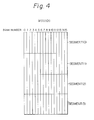
- Each of the main storage units is divided into segments: SEGMENT(0) to SEGMENT(3), and each of the segments is divided into, for example, 16 storage banks, as logical storages as shown in Fig. 4.
- the third sequence of latch circuits 600 to 603 and 610 to 613 corresponds to the segments of the main storage units 70 and 71. When a valid signal is latched in one of the latch circuits 600 to 603 and 610 to 613, use of a storage bank corresponding to the valid signal is approved.
- Each of the main storage units 70 and 71 is constituted by 4 segments, and each segment is constituted by 16 storage banks and therefore, the main storage units 70 and 71 is constituted by 128 storage banks.
- the logical storage busy check circuit 4 decodes the lower 4 bit address A3, A2, A1, A0 as an intra-segment address latched in the second latch circuit 5, and checks whether or not the decoded signal coincides with the busy signal. When it is determined to be in the busy state the read/write operation of the storage bank in question is not approved, but when it is determined to be in the non-busy state, the read/write operation of the storage bank in question is approved.
- the checking by the bus conflict check and prohibition condition check circuit 3 is carried out in a first priority cycle, to select a bus, and the storage bank busy checking by the logical storage busy check circuit 4 is carried out in a second priority cycle.
- the bus conflict check and prohibition condition check circuit 3 using the upper address bits: A6, A5, A4 set in the first latch circuit 2, carry out the bus selection based on the checking of the bus conflict.
- This checking is carried out to determine whether or not the lower 4 address bits as the intra-segment address bits: A3, A2, A1, A0 can be set in the second latch circuit 5, and the setting of the lower 4 address bits: A3, A2, A1, AO, to the second latch circuit 5 is carried out. Then, in the second priority cycle, the logical storage busy check circuit 4 checks the intra-segment conflict condition, and a determination of the transmission of the request to the main storage unit based on the result of the checking is carried out.
- the setting of the request address to the first latch circuit 2 in the first priority cycle can be carried out in the request transfer cycle.
- the upper 3 bits: A6, A5, A4, designating one of eight buses of the 7 bit address for designating one of the 128 storage banks: A6, A5, A4, A3, A2, A1, A0, are set in the first latch circuit 2.
- the bus conflict check and prohibition condition check circuit 3 receives this upper 3 bit address: A6, A5, A4, compares the upper 3 bit address: A6, A5, A4 with the code corresponding to the bus under use by the 3 bit comparison member to detect whether or not a coincidence exists, and determines whether or not the requested bus among the 8 buses corresponding to the 8 segments can be used.
- the selection of this requested bus is carried out.
- the request in question must wait until the use by the other access request is terminated and the use of the requested bus is approved.
- bus conflict check and prohibition condition check circuit 3 is constituted basically by comparator members, the length of the longest logic path of this circuit 3 is relatively short, and the amount of hardware needed for this circuit 3 is relatively small.
- the logical storage busy check circuit 4 decodes the lower 4 bit address; A3, A2, A1, A0 for designating one of 16 storage banks, and compares the decoded signal with the busy signal.
- the logical storage busy check circuit 4 can be constituted such that the amount of hardware needed is much less than needed by the prior art logical storage busy check circuit, and the length of the longest logic path is much shorter than that of the prior art logical storage busy check circuit.
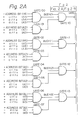
- the structure of the logical storage busy check circuit 4 used for the system of Fig. 3 is shown in Fig. 5.
- the logical storage busy check circuit of Fig. 5 is constituted by a sequence of GATE-00 to GATE-03, a sequence of GATE-10 to GATE-13, a sequence of GATE-20 to GATE-23, and GATE-3.
- the supplied 4 bit address: A3, A2, A1, A0 is decoded, and it is determined whether or not the 16 decoded signals coincide with the busy signal for the 16 storage banks in a section.
- GATE-00 to GATE-03, GATE-10 to GATE-13, and GATE-20 to GATE-23 is constituted by an emitter coupled logic circuit.
- GATE-3 is an emitter dot type OR gate.
- the input signal: +ADDRESS BIT(A0), +ADDRESS BIT(A1), +ADDRESS BIT(A2), +ADDRESS BIT(A3), for GATE-00, is a signal having all logic "0 s" when the address "A0, A1, A2, A3" is logically "0, 0, 0, 0”;
- the input signal: +ADDRESS BIT(A0), +ADDRESS BIT(A1), +ADDRESS BIT(A2), -ADDRESS BIT(A3), for GATE-01 is a signal having all logic "0,s” when the address "A0, A1, A2, A3” is logically "0, 0, 0, 1”;
- the input signal: +ADDRESS BIT(A0), +ADDRESS BIT(A1), -ADDRESS BIT(A), +ADDRESS BIT(A3), for GATE-02 is a signal having all logic "0's" when the address "A0, A1, A2, A3
- GATE-00, GATE-01, GATE-02 GATE-03 are shown as a first sequence in Fig. 5, 16 gates in all exist for all of the segments.
- GATE-00 delivers an output "0" when the input signal: +ADDRESS BIT(A0), +ADDRESS BIT(A1), +ADDRESS BIT(A2), +ADDRESS BIT(A3), are all logic "0's", and the delivered output is supplied to GATE-10.
- GATE-10 delivers an output "1" when one input supplied from GATE-10 is “0” and the other input of -BUSY(0) is "0".
- the output signals of GATE-10 to GATE-13 are supplied to GATE-20.
- the output signal of GATE-20 is a signal which is logic "1" when at least one of the output signals of GATE-10 to GATE-13 is logic "1".
- a check is made to detect a coincidence between the decoded 16 signals and the busy signal of 16 storage banks in a segment, and it is not necessary for a gate to be connected to the output terminal of GATE-3.
- the comparison of the delay time, the number of gates per unit, and the total number of gates between the device of Fig. 5 and the device of Fig. 2 is as follows.
- the delay time is 3 ⁇ for the device of Fig. 5, but 4 ⁇ for the device of Fig. 2 where ⁇ is the delay time for a unit gate.
- the system can be constituted by including at least one access request bus between the processor and the main storage corresponding to a unit data length, an access request from the processor to the main storage being transmitted with the unit data length or a multiple of the unit data length, and a block access from the processor to the main storage being divided into a plurality of smaller access units corresponding to the unit data length in the processor.
- This embodiment will be explained with reference to Figs. 3, 4, 5, 6, 7, and 8.
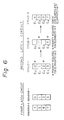
- the data of a block access of an access request from a processor is constituted by a sequence of elements (unit data): 0, 1, 2, 3, 4, 5, 6, 7.
- the logical storage bank busy condition is released (i.e., priority is acquired) for element 0 and element 2, and thus the access request can be transmitted. Since there is no logical storage bank conflict in CYCLE-1, the elements which have acquired priority are transmitted to the main storage.
- CYCLE-2 the logical storage bank busy condition is released for element 1 and element 3, and since the element 1 and element 3 have acquired priority, they are transmitted to the main storage.
- the completion of the block access in question i.e., the completion of transmitting of the data block, is acknowledged by a priority acquisition control table in a priority acquisition control portion.
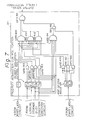
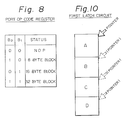
- the port OP code register (B0 , B1) is set to logic "1, 1", and according to the truth value table shown in Fig. 8, the output of GATE-820 becomes logic "1" and supplied to GATE-830.
- GATE-810 to GATE-813 the logical sum forming operation for the input signal and the output signal of the control table (E0 , E1 , E2 , E3) is carried out.
- the state of E0 , E1 , and E2 of the control table is logic "1, 1, 1”
- the output of GATE-830 becomes logic "1” through GATE-810 to GATE-813, and the output signal of GATE-86 is delivered to reset the control table (E0 , E1 , E2 , E3) so that the completion of the block access is acknowledged.
- the control table (E0 , E1 , E2 , E3) is constituted by flip-flop circuits of the set-priority type.
- the control table (E0 , E1 , E2 , E3) gives priority to the set operation. Accordingly, the control of the block access is achieved without logic delay.
- the system can be constituted by including at least one access request bus between the processor and the main storage corresponding to a unit data length, and at least one first request port, concerning an access request from the processor to the main storage, for setting an access request corresponding to an access request element which is an element having a unit data length or a length shorter than this unit data length, the order of the access request elements being designated with regard to the execution of a program of operation of the system, a selection of access bus according to address indication position of a request being carried out concerning the output signal of the first request port, and non-occurrence of a reversal of the order designated for execution of the program of the system being ensured in the case where a setting is carried out to a second access port corresponding to the access request bus.
- This embodiment will be explained with reference to Figs. 3, 7, 8, 9, 10, 11, and 12.
- the logical storage busy condition is checked to determine, for example, that an element 0 corresponding to access port A is busy, while elements 1, 2, and 3 are busy-released (i.e., priority is acquired).
- a busy-released status is marked by an asterisk. Since there is no conflict between the logical storage banks, the access requests of the elements 1, 2, and 3 for which busy conditions are released are transmitted to the main storage, as shown in CYCLE-2.
- CYCLE-2 since the logical storage bank busy condition for element 0 corresponding to access port A is not released, the status of CYCLE-2 is maintained.
- the subsequent elements 4, 5, 6, and 7 are not allowed be set in the second latch circuit 5, and thus the sequential order of the execution of program is maintained.
- CYCLE-4 In CYCLE-4, the pointer is moved successively to access ports B, C, D and A.
- the elements 4, 5, 6, and 7 are transmitted to the second latch circuit 5 where the logical storage bank busy conditions are checked, and thus the sequential order of the execution of program is maintained.
- a PORT SET ENABLE POINTA ⁇ AEN + POINTB ⁇ BEN ⁇ CEN ⁇ DEN ⁇ AEN ⁇ BCMTCH ⁇ CDMTCH ⁇ DAMTH .
- BDMTCH ⁇ BAMTCH ⁇ CAMTCH + POINTC ⁇ CEN ⁇ DEN ⁇ AEN ⁇ DCMTCH ⁇ CAMTCH ⁇ DAMTCH + POINTD ⁇ DEN ⁇ AEN ⁇ DAMTCH
- This setting condition equation (1) represents a condition of setting to the second latch circuits 5 to ensure the sequential order of execution of a program with regard to the access port A of the first latch circuit 2.
- "POINTA ⁇ AEN” represents a condition for enabling a setting of the element data of the access port A to the second latch circuit 5.
- AEN denotes that the bus corresponding to the destination address of element data set in access port A is “usable” or the access request occupying the bus in question is now “request-released”.
- the representations of "BEN”, “CEN” and “DEN” are similar.
- BCMTCH represents the bus conflict (bus match) from the first latch circuit 2 to the second latch circuit 5, preventing the transmission of an element of, for example, access port B to the second latch circuit 5.
- the representations of "CDMTCH”, “DAMTCH”, “BDMTCH”, “BAMTCH” and “CAMTCH” are similar.
- BCMTCH inverted BCMTCH
- the first term at the right side of the equation (1) represents the condition which enables the setting to the second latch circuit 5 when the pointer is directed to access port A
- the second term of the right side of equation (1) represents the condition which enables the setting to the second latch circuit 5 when the pointer is directed to access port B
- the third term of the right side of equation (1) represents the condition which enables the setting to the second latch circuit 5 when the pointer is directed to access port C
- the fourth term of the right side of equation (1) represents the condition which enables the setting to the second latch circuit 5 when the pointer is directed to access port D.
- the setting condition equations which represent the conditions of setting to the second latch circuit 5 to ensure the sequential order of execution of program, with regard to access ports B, C, and D of the first latch circuit 2 can be established in the same way.
- FIG. 11 An example of the circuit for performing the setting condition equation is shown in Fig. 11.
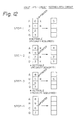
- FIG. 12 An example of the changes of designation by the pointer is shown in Fig. 12.
- the pointer In STEP-1, the pointer is directed to the access port A of the first latch circuit. Elements 0 and 1 satisfy the setting condition equation, and thus elements 0 and 1 are set to the second latch circuit, and accordingly, the pointer is moved to access port C.
- element 6, 7, and 8 are set to access ports C, D, and A.
- Elements 5 satisfies the setting condition equation, and is set to the second latch circuit, and accordingly, the pointer is moved to access port C to proceed to STEP-4.
Landscapes
- Engineering & Computer Science (AREA)
- Theoretical Computer Science (AREA)
- Physics & Mathematics (AREA)
- General Engineering & Computer Science (AREA)
- General Physics & Mathematics (AREA)
- Multi Processors (AREA)
Applications Claiming Priority (6)
| Application Number | Priority Date | Filing Date | Title |
|---|---|---|---|
| JP23370487A JPS6478337A (en) | 1987-09-19 | 1987-09-19 | Control system for main memory access priority order |
| JP233704/87 | 1987-09-19 | ||
| JP62256794A JPH0199143A (ja) | 1987-10-12 | 1987-10-12 | 主記憶アクセス制御方法 |
| JP256794/87 | 1987-10-12 | ||
| JP62314745A JPH0610801B2 (ja) | 1987-12-10 | 1987-12-10 | 主記憶アクセス制御装置 |
| JP314745/87 | 1987-12-10 |
Publications (3)
| Publication Number | Publication Date |
|---|---|
| EP0309330A2 true EP0309330A2 (de) | 1989-03-29 |
| EP0309330A3 EP0309330A3 (de) | 1991-05-08 |
| EP0309330B1 EP0309330B1 (de) | 1994-11-30 |
Family
ID=27332027
Family Applications (1)
| Application Number | Title | Priority Date | Filing Date |
|---|---|---|---|
| EP88402360A Expired - Lifetime EP0309330B1 (de) | 1987-09-19 | 1988-09-19 | Prioritätszugriffssteuerungssystem zum Hauptspeicher für Rechner |
Country Status (6)
| Country | Link |
|---|---|
| US (1) | US5073871A (de) |
| EP (1) | EP0309330B1 (de) |
| AU (1) | AU592717B2 (de) |
| CA (1) | CA1310429C (de) |
| DE (1) | DE3852261T2 (de) |
| ES (1) | ES2064364T3 (de) |
Cited By (2)
| Publication number | Priority date | Publication date | Assignee | Title |
|---|---|---|---|---|
| EP0323080A3 (en) * | 1987-12-24 | 1990-05-23 | Fujitsu Limited | Multiprocessor memory access control system |
| US5214769A (en) * | 1987-12-24 | 1993-05-25 | Fujitsu Limited | Multiprocessor control system |
Families Citing this family (9)
| Publication number | Priority date | Publication date | Assignee | Title |
|---|---|---|---|---|
| JPH01303543A (ja) * | 1988-05-31 | 1989-12-07 | Fujitsu Ltd | メモリアクセス制御装置 |
| FR2644260B1 (fr) * | 1989-03-08 | 1993-10-29 | Nec Corp | Dispositif de commande d'acces en memoire pouvant proceder a une commande simple |
| KR930002316B1 (ko) * | 1989-05-10 | 1993-03-29 | 미쯔비시덴끼 가부시끼가이샤 | 버스제어방법 및 화상처리 장치 |
| JPH0648477B2 (ja) * | 1990-09-17 | 1994-06-22 | 日通工株式会社 | マルチプロセッサシステムにおけるバス獲得方法 |
| US5515523A (en) * | 1991-06-03 | 1996-05-07 | Digital Equipment Corporation | Method and apparatus for arbitrating conflicts by monitoring number of access requests per unit of time in multiport memory systems |
| US5423008A (en) * | 1992-08-03 | 1995-06-06 | Silicon Graphics, Inc. | Apparatus and method for detecting the activities of a plurality of processors on a shared bus |
| JP3010947B2 (ja) * | 1992-11-26 | 2000-02-21 | 日本電気株式会社 | メモリアクセス制御装置 |
| US6055607A (en) * | 1996-12-23 | 2000-04-25 | Unisys Corporation | Interface queue with bypassing capability for main storage unit |
| DE10110578B4 (de) * | 2000-03-29 | 2004-06-03 | International Business Machines Corporation | Hierarchisches Prioritätsfilter mit integrierter Serialisierung |
Family Cites Families (7)
| Publication number | Priority date | Publication date | Assignee | Title |
|---|---|---|---|---|
| US3812473A (en) * | 1972-11-24 | 1974-05-21 | Ibm | Storage system with conflict-free multiple simultaneous access |
| US4212057A (en) * | 1976-04-22 | 1980-07-08 | General Electric Company | Shared memory multi-microprocessor computer system |
| US4314335A (en) * | 1980-02-06 | 1982-02-02 | The Perkin-Elmer Corporation | Multilevel priority arbiter |
| US4395753A (en) * | 1980-06-26 | 1983-07-26 | Gte Automatic Electric Labs Inc. | Allocation controller providing for access of multiple common resources by a plurality of central processing units |
| US4445174A (en) * | 1981-03-31 | 1984-04-24 | International Business Machines Corporation | Multiprocessing system including a shared cache |
| US4875161A (en) * | 1985-07-31 | 1989-10-17 | Unisys Corporation | Scientific processor vector file organization |
| JPH0628051B2 (ja) * | 1986-04-25 | 1994-04-13 | 株式会社日立製作所 | 記憶制御方式 |
-
1988
- 1988-09-15 CA CA000577485A patent/CA1310429C/en not_active Expired - Lifetime
- 1988-09-16 AU AU22318/88A patent/AU592717B2/en not_active Ceased
- 1988-09-19 ES ES88402360T patent/ES2064364T3/es not_active Expired - Lifetime
- 1988-09-19 US US07/246,087 patent/US5073871A/en not_active Expired - Lifetime
- 1988-09-19 DE DE3852261T patent/DE3852261T2/de not_active Expired - Fee Related
- 1988-09-19 EP EP88402360A patent/EP0309330B1/de not_active Expired - Lifetime
Cited By (2)
| Publication number | Priority date | Publication date | Assignee | Title |
|---|---|---|---|---|
| EP0323080A3 (en) * | 1987-12-24 | 1990-05-23 | Fujitsu Limited | Multiprocessor memory access control system |
| US5214769A (en) * | 1987-12-24 | 1993-05-25 | Fujitsu Limited | Multiprocessor control system |
Also Published As
| Publication number | Publication date |
|---|---|
| DE3852261T2 (de) | 1995-04-06 |
| DE3852261D1 (de) | 1995-01-12 |
| EP0309330A3 (de) | 1991-05-08 |
| EP0309330B1 (de) | 1994-11-30 |
| AU592717B2 (en) | 1990-01-18 |
| CA1310429C (en) | 1992-11-17 |
| ES2064364T3 (es) | 1995-02-01 |
| US5073871A (en) | 1991-12-17 |
| AU2231888A (en) | 1989-05-04 |
Similar Documents
| Publication | Publication Date | Title |
|---|---|---|
| US5016167A (en) | Resource contention deadlock detection and prevention | |
| US5251306A (en) | Apparatus for controlling execution of a program in a computing device | |
| US4481572A (en) | Multiconfigural computers utilizing a time-shared bus | |
| CA1184311A (en) | Peripheral interface adapter circuit for use in i/o controller card having multiple modes of operation | |
| US4214305A (en) | Multi-processor data processing system | |
| US4967398A (en) | Read/write random access memory with data prefetch | |
| US4965718A (en) | Data processing system incorporating a memory resident directive for synchronizing multiple tasks among plurality of processing elements by monitoring alternation of semaphore data | |
| US4805137A (en) | Bus controller command block processing system | |
| US4500958A (en) | Memory controller with data rotation arrangement | |
| US4675812A (en) | Priority circuit for channel subsystem having components with diverse and changing requirement for system resources | |
| CA1072216A (en) | Memory access control system | |
| US5142638A (en) | Apparatus for sharing memory in a multiprocessor system | |
| US6026451A (en) | System for controlling a dispatch of requested data packets by generating size signals for buffer space availability and preventing a dispatch prior to a data request granted signal asserted | |
| GB2075226A (en) | Cpu-to-memory interface unit | |
| JPS58142458A (ja) | 共通母線利用検出制御回路及び共通母線利用検出制御方法 | |
| US4371924A (en) | Computer system apparatus for prefetching data requested by a peripheral device from memory | |
| US20040177231A1 (en) | Data processor | |
| US4347567A (en) | Computer system apparatus for improving access to memory by deferring write operations | |
| EP0309330B1 (de) | Prioritätszugriffssteuerungssystem zum Hauptspeicher für Rechner | |
| US5353416A (en) | CPU lock logic for corrected operation with a posted write array | |
| US6055598A (en) | Arrangement and method for allowing sequence-independent command responses across a computer bus bridge | |
| US5357622A (en) | Apparatus for queing and storing data writes into valid word patterns | |
| US6738837B1 (en) | Digital system with split transaction memory access | |
| EP0220990A2 (de) | Pufferspeichersteuerungsanordnung | |
| US5742842A (en) | Data processing apparatus for executing a vector operation under control of a master processor |
Legal Events
| Date | Code | Title | Description |
|---|---|---|---|
| PUAI | Public reference made under article 153(3) epc to a published international application that has entered the european phase |
Free format text: ORIGINAL CODE: 0009012 |
|
| AK | Designated contracting states |
Kind code of ref document: A2 Designated state(s): DE ES FR GB |
|
| PUAL | Search report despatched |
Free format text: ORIGINAL CODE: 0009013 |
|
| AK | Designated contracting states |
Kind code of ref document: A3 Designated state(s): DE ES FR GB |
|
| 17P | Request for examination filed |
Effective date: 19911008 |
|
| 17Q | First examination report despatched |
Effective date: 19930201 |
|
| GRAA | (expected) grant |
Free format text: ORIGINAL CODE: 0009210 |
|
| AK | Designated contracting states |
Kind code of ref document: B1 Designated state(s): DE ES FR GB |
|
| REF | Corresponds to: |
Ref document number: 3852261 Country of ref document: DE Date of ref document: 19950112 |
|
| REG | Reference to a national code |
Ref country code: ES Ref legal event code: FG2A Ref document number: 2064364 Country of ref document: ES Kind code of ref document: T3 |
|
| ET | Fr: translation filed | ||
| PLBE | No opposition filed within time limit |
Free format text: ORIGINAL CODE: 0009261 |
|
| STAA | Information on the status of an ep patent application or granted ep patent |
Free format text: STATUS: NO OPPOSITION FILED WITHIN TIME LIMIT |
|
| 26N | No opposition filed | ||
| PGFP | Annual fee paid to national office [announced via postgrant information from national office to epo] |
Ref country code: ES Payment date: 19980921 Year of fee payment: 11 |
|
| PG25 | Lapsed in a contracting state [announced via postgrant information from national office to epo] |
Ref country code: ES Free format text: LAPSE BECAUSE OF NON-PAYMENT OF DUE FEES Effective date: 19990920 |
|
| REG | Reference to a national code |
Ref country code: GB Ref legal event code: IF02 |
|
| PGFP | Annual fee paid to national office [announced via postgrant information from national office to epo] |
Ref country code: FR Payment date: 20030909 Year of fee payment: 16 |
|
| PGFP | Annual fee paid to national office [announced via postgrant information from national office to epo] |
Ref country code: GB Payment date: 20030917 Year of fee payment: 16 |
|
| PGFP | Annual fee paid to national office [announced via postgrant information from national office to epo] |
Ref country code: DE Payment date: 20031002 Year of fee payment: 16 |
|
| REG | Reference to a national code |
Ref country code: ES Ref legal event code: FD2A Effective date: 20001013 |
|
| PG25 | Lapsed in a contracting state [announced via postgrant information from national office to epo] |
Ref country code: GB Free format text: LAPSE BECAUSE OF NON-PAYMENT OF DUE FEES Effective date: 20040919 |
|
| PG25 | Lapsed in a contracting state [announced via postgrant information from national office to epo] |
Ref country code: DE Free format text: LAPSE BECAUSE OF NON-PAYMENT OF DUE FEES Effective date: 20050401 |
|
| GBPC | Gb: european patent ceased through non-payment of renewal fee |
Effective date: 20040919 |
|
| PG25 | Lapsed in a contracting state [announced via postgrant information from national office to epo] |
Ref country code: FR Free format text: LAPSE BECAUSE OF NON-PAYMENT OF DUE FEES Effective date: 20050531 |
|
| REG | Reference to a national code |
Ref country code: FR Ref legal event code: ST |