EP0309864B1 - Dérivés d'acides alpha-(5-aryloxy-naphthalène-1-yl-oxy)-propioniques - Google Patents
Dérivés d'acides alpha-(5-aryloxy-naphthalène-1-yl-oxy)-propioniques Download PDFInfo
- Publication number
- EP0309864B1 EP0309864B1 EP88115372A EP88115372A EP0309864B1 EP 0309864 B1 EP0309864 B1 EP 0309864B1 EP 88115372 A EP88115372 A EP 88115372A EP 88115372 A EP88115372 A EP 88115372A EP 0309864 B1 EP0309864 B1 EP 0309864B1
- Authority
- EP
- European Patent Office
- Prior art keywords
- alkyl
- halogen
- formula
- represents hydrogen
- chlorine
- Prior art date
- Legal status (The legal status is an assumption and is not a legal conclusion. Google has not performed a legal analysis and makes no representation as to the accuracy of the status listed.)
- Expired - Lifetime
Links
- 0 CC(C(*)C1*)C(*)=C(*)C1OC1=CC=CC2C(***)=CC=CC12 Chemical compound CC(C(*)C1*)C(*)=C(*)C1OC1=CC=CC2C(***)=CC=CC12 0.000 description 2
Classifications
-
- C—CHEMISTRY; METALLURGY
- C07—ORGANIC CHEMISTRY
- C07C—ACYCLIC OR CARBOCYCLIC COMPOUNDS
- C07C323/00—Thiols, sulfides, hydropolysulfides or polysulfides substituted by halogen, oxygen or nitrogen atoms, or by sulfur atoms not being part of thio groups
-
- C—CHEMISTRY; METALLURGY
- C07—ORGANIC CHEMISTRY
- C07C—ACYCLIC OR CARBOCYCLIC COMPOUNDS
- C07C255/00—Carboxylic acid nitriles
- C07C255/49—Carboxylic acid nitriles having cyano groups bound to carbon atoms of six-membered aromatic rings of a carbon skeleton
- C07C255/54—Carboxylic acid nitriles having cyano groups bound to carbon atoms of six-membered aromatic rings of a carbon skeleton containing cyano groups and etherified hydroxy groups bound to the carbon skeleton
-
- C—CHEMISTRY; METALLURGY
- C07—ORGANIC CHEMISTRY
- C07C—ACYCLIC OR CARBOCYCLIC COMPOUNDS
- C07C327/00—Thiocarboxylic acids
-
- C—CHEMISTRY; METALLURGY
- C07—ORGANIC CHEMISTRY
- C07C—ACYCLIC OR CARBOCYCLIC COMPOUNDS
- C07C43/00—Ethers; Compounds having groups, groups or groups
- C07C43/02—Ethers
- C07C43/257—Ethers having an ether-oxygen atom bound to carbon atoms both belonging to six-membered aromatic rings
- C07C43/295—Ethers having an ether-oxygen atom bound to carbon atoms both belonging to six-membered aromatic rings containing hydroxy or O-metal groups
-
- C—CHEMISTRY; METALLURGY
- C07—ORGANIC CHEMISTRY
- C07C—ACYCLIC OR CARBOCYCLIC COMPOUNDS
- C07C59/00—Compounds having carboxyl groups bound to acyclic carbon atoms and containing any of the groups OH, O—metal, —CHO, keto, ether, groups, groups, or groups
- C07C59/40—Unsaturated compounds
- C07C59/58—Unsaturated compounds containing ether groups, groups, groups, or groups
- C07C59/64—Unsaturated compounds containing ether groups, groups, groups, or groups containing six-membered aromatic rings
- C07C59/66—Unsaturated compounds containing ether groups, groups, groups, or groups containing six-membered aromatic rings the non-carboxylic part of the ether containing six-membered aromatic rings
- C07C59/68—Unsaturated compounds containing ether groups, groups, groups, or groups containing six-membered aromatic rings the non-carboxylic part of the ether containing six-membered aromatic rings the oxygen atom of the ether group being bound to a non-condensed six-membered aromatic ring
-
- C—CHEMISTRY; METALLURGY
- C07—ORGANIC CHEMISTRY
- C07F—ACYCLIC, CARBOCYCLIC OR HETEROCYCLIC COMPOUNDS CONTAINING ELEMENTS OTHER THAN CARBON, HYDROGEN, HALOGEN, OXYGEN, NITROGEN, SULFUR, SELENIUM OR TELLURIUM
- C07F9/00—Compounds containing elements of Groups 5 or 15 of the Periodic Table
- C07F9/02—Phosphorus compounds
- C07F9/28—Phosphorus compounds with one or more P—C bonds
- C07F9/38—Phosphonic acids [RP(=O)(OH)2]; Thiophosphonic acids ; [RP(=X1)(X2H)2(X1, X2 are each independently O, S or Se)]
- C07F9/40—Esters thereof
- C07F9/4003—Esters thereof the acid moiety containing a substituent or a structure which is considered as characteristic
- C07F9/4006—Esters of acyclic acids which can have further substituents on alkyl
Definitions
- the invention relates to new ⁇ - (5-aryloxy-naphthalin-1-yl-oxy) propionic acid derivatives, processes and new intermediates for their preparation and their use as herbicides.
- R1 represents hydrogen, halogen, cyano or trifluoromethyl
- R2 represents hydrogen or halogen
- R3 represents halogen, cyano, trifluoromethyl or trifluoromethoxy
- R4 represents hydrogen or halogen
- R5 represents hydrogen or halogen
- Z represents halogen, hydroxyl, amino, alkylamino, alkenylamino, alkynylamino, arylamino, aralkylamino, alkoxycarbonylalkylamino, cyanamino, dialkylamino, dialkenylamino, alkylsulfonylamino, arylsulfonylamino, hydroxyamino, alkoxyamino, hydrazino, alkylsulfonylthiohydloxythiothioalkylthiothiohydroalkylthiothiohydrogen, arylthioidylthioalkyl, arylthiothio, arylthiothio, arylthiothiohydro, Grouping -O-R6 stands in which
- R6 is an optionally substituted by halogen radical from the series alkyl, alkenyl, alkynyl, alkoxyalkyl, alkylthioalkyl, alkylsulfinylalkyl, alkylsulfonylalkyl, aryloxyalkyl, trialkylsilylalkyl, arylthioalkyl, aralkoxyalkyl, aralkylthioalkyl, alkoxycarbonylalkyl, alkylaminocarbonylalkyl, aralkyl, azolylalkyl or an alkylamino, azolylalkyl, an alkylamido Alkylammonium-, alkali metal or alkaline earth metal equivalent or for the grouping
- R7 represents hydrogen, alkyl, aryl, furyl, thienyl or pyridyl
- R8 represents alkyl or alkoxy
- R9 represents alkoxy
- Q represents oxygen or sulfur
- R6 represents the grouping - (CH2) n -R10, wherein
- n stands for the numbers 0, 1 or 2.
- the compounds of formula (I) contain at least one asymmetrically substituted carbon atom and can therefore exist in various enantiomeric forms.
- the invention relates both to the possible individual isomers and to mixtures of these isomers.
- the invention preferably relates to compounds of the formula (I) in which
- R1 represents hydrogen, fluorine, chlorine, bromine, cyano or trifluoromethyl
- R2 represents hydrogen, fluorine or chlorine
- R3 represents fluorine, chlorine, bromine, cyano, trifluoromethyl or trifluoromethoxy
- R4 represents hydrogen, fluorine or chlorine
- R5 represents hydrogen, fluorine, chlorine or bromine
- R6 for an optionally substituted by fluorine and / or chlorine radical from the series C1-C6-alkyl, C3-C4-alkenyl, C3-C4-alkynyl, C1-C4-alkoxy-C1-C4-alkyl, C1-C4-alkylthio -C1-C4-alkyl, C1-C4-alkylsulfinyl-C1-C4-alkyl, C1-C4-alkylsulfonyl-C1-C4-alkyl, phenoxy-C1-C3-alkyl, trimethylsilylmethyl, phenylthio-C1-C3-alkyl, benzyloxy -C1-C3-alkyl, benzylthio-C1-C3-alkyl, C1-C4-alkoxy-carbonyl-C1-C2-alkyl, C1-C4-alkylamin
- R7 represents hydrogen, C1-C4-alkyl, phenyl, furyl, thienyl or pyridyl,
- R8 represents C1-C4-alkyl or C1-C4-alkoxy
- R9 represents C1-C4 alkoxy
- Q represents oxygen or sulfur
- R6 represents the grouping - (CH2) n -R10, wherein
- n stands for the numbers 0, 1 or 2 and
- R10 for an optionally substituted by fluorine, chlorine, bromine and / or C1-C4-alkyl heterocyclic radical from the series furyl, tetrahydrofuryl, oxotetrahydrofuryl, thienyl, tetrahydrothienyl, perhydropyranyl, oxazolyl, thiazolyl, thiadiazolyl, dioxhydyranyrolyl, perhydropyranylol, perhydropyranyl, pyrhydro Pyrimidinyl stands.
- the invention relates in particular to compounds of the formula (I) in which
- R1 represents hydrogen, cyano, fluorine or chlorine
- R2 represents hydrogen, fluorine or chlorine
- R3 represents trifluoromethyl
- R4 represents hydrogen, fluorine or chlorine
- R5 represents hydrogen, fluorine or chlorine
- R7 represents hydrogen, methyl, phenyl, furyl, thienyl or pyridyl
- R8 represents methoxy or ethoxy
- R9 represents methoxy or ethoxy
- Q represents oxygen or sulfur
- R6 represents the grouping (-CH2-) n -R10, wherein
- n stands for the numbers 0, 1 or 2 and
- R10 represents an optionally substituted by chlorine and / or methyl heterocyclic radical from the series furyl, tetrahydrofuryl, thienyl, perhydropyranyl, oxazolyl, thiazolyl and dioxolanyl.
- reaction sequence can be represented by the following formula:
- reaction can proceed can be represented by the following formula:
- Formula (II) provides a general definition of the 5-aryloxy-1-naphthols to be used as starting materials in process (a) according to the invention for the preparation of compounds of the formula (I).
- R1, R2, R3, R4 and R5 preferably or in particular have those meanings which have already been mentioned above in connection with the description of the compounds of the formula (I) according to the invention preferably or as particularly preferred for R1, R2, R3 , R4 and R5 were specified.
- R1, R2, R3, R4, R5 and X have the meanings given above,
- 1,5-dihydroxynaphthalene in the presence of an acid acceptor, e.g. Sodium hydroxide or potassium hydroxide, and in the presence of a diluent such as e.g. Dimethylformamide, dimethylacetamide, dimethyl sulfoxide, tetramethylene sulfone or N-methyl-pyrrolidone, reacted at temperatures between 20 ° C and 150 ° C and worked up by conventional methods.
- an acid acceptor e.g. Sodium hydroxide or potassium hydroxide
- a diluent such as e.g. Dimethylformamide, dimethylacetamide, dimethyl sulfoxide, tetramethylene sulfone or N-methyl-pyrrolidone
- halogen-benzene derivatives are generally defined by the formula (IV).
- R1, R2, R3, R4 and R5 preferably or in particular have those meanings which have already been in connection with the description the compounds of the formula (I) according to the invention have been indicated preferably or as particularly preferred for R1, R2, R3, R4 and R5 and X preferably represents chlorine or fluorine.
- 3-cyano-4-chloro-benzotrifluoride 4-chloro-benzotrifluoride, 3,4-dichloro-benzotrifluoride, 3,4,5-trichloro-benzotrifluoride, 3,4-dichloro-5-fluoro-benzotrifluoride, 2,3, 4,5-tetrachlorobenzotrifluoride, 3,5-dichloro-2,4-difluoro-benzotrifluoride and 3-chloro-4,5-difluoro-benzotrifluoride.
- the compounds of the formula (IV) are known and / or can be prepared by processes known per se (cf. J. Chem. Soc. 1969, 211-217; ibid. 1971, 1547-1549; EP-A 34 402; US -P 4 424 396; EP-A 145 314; FR-A 2 538 380 (Chem. Abstracts 102 (1985), 61914x)).
- Formula (III) provides a general definition of the propionic acid derivatives to be used further as starting materials in process (a) according to the invention.
- Z preferably or in particular has the meaning which has already been mentioned above in connection with the description of the compounds of the formula (I) according to the invention preferably or as particularly preferred, and Y preferably represents chlorine, bromine, iodine, if appropriate C1-C4 alkylsulfonyloxy substituted by fluorine or chlorine or phenylsulfonyloxy optionally substituted by fluorine, chlorine, bromine or methyl, especially for chlorine, bromine, methylsulfonyloxy, phenylsulfonyloxy or 4-methylphenylsulfonyloxy.
- the compounds of the formula (III) mentioned are understood to mean the R isomers, the S isomers and the racemic mixtures of these isomers.
- the starting materials of the formula (III) are known and / or can be prepared by processes known per se (cf. DE-OS 27 58 002, DE-OS 28 54 542).
- Process (a) according to the invention for the preparation of the new compounds of the formula (I) is preferably carried out using diluents.
- diluents Practically all inert organic solvents can be used as diluents. These preferably include aliphatic and aromatic, optionally halogenated hydrocarbons such as pentane, hexane, heptane, cyclohexane, petroleum ether, gasoline, ligroin, benzene, Toluene, xylene, methylene chloride, ethylene chloride, chloroform, carbon tetrachloride, chlorobenzene and o-dichlorobenzene, ethers such as diethyl and dibutyl ether, glycol dimethyl ether and diglycol dimethyl ether, tetrahydrofuran and dioxane, ketones such as acetone, methyl ethyl, methyl isopropyl and methyl -ket
- Acid acceptors which can be used in process (a) according to the invention are all acid binders which can customarily be used for such reactions.
- Alkali metal hydroxides such as e.g. Sodium and potassium hydroxide, alkaline earth metal hydroxides such as e.g.
- triethylamine trimethylamine
- dimethylaniline dimethylbenzylamine
- pyridine 1,5-diazabicyclo- [4.3 , 0] -non-5-ene (DBN), 1,8-diazabicyclo- [5,4,0] -undec-7-ene (DBU) and 1,4-diazabicy
- reaction temperatures in process (a) according to the invention can be varied within a substantial range. In general, temperatures between 0 ° C and 150 ° C, preferably at temperatures between 20 ° C and 100 ° C.
- Process (a) according to the invention is generally carried out under normal pressure. However, it is also possible to work under increased or reduced pressure.
- the workup can be carried out in the usual way.
- the reaction mixture is reacted with an acid, e.g. Hydrochloric acid or sulfuric acid and water, as well as an organic solvent that is practically immiscible with water, e.g. Methylene chloride or toluene, stirred or shaken, the organic phase separated, washed with water, dried and filtered.
- an acid e.g. Hydrochloric acid or sulfuric acid and water
- an organic solvent that is practically immiscible with water e.g. Methylene chloride or toluene
- the product of the formula (I) remaining in the residue after concentration of the filtrate can be purified in a customary manner, for example by column chromatography.
- Formula (V) provides a general definition of the ⁇ - (5-hydroxy-naphthalin-1-yl-oxy) propionic acid derivatives which are further to be used as starting materials in process (b) according to the invention.
- Z preferably or in particular has the meaning which has already been mentioned above in connection with the description of the compounds of the formula (I) according to the invention preferably or as particularly preferred.
- the starting materials of the formula (V) are known and / or can be prepared by processes known per se (cf. JP 79/32477, cited in Chem. Abstracts 91 (1979), 91510j).
- Process (b) is preferably carried out using a diluent.
- a diluent Those diluents which have already been mentioned in the description of process (a) according to the invention are particularly suitable.
- Aprotic polar organic solvents such as acetone, acetonitrile, methyl ethyl ketone, propionitrile, dimethylformamide, dimethylacetamide, dimethyl sulfoxide, sulfolane and N-methylpyrrolidone are particularly preferred.
- Process (b) is preferably carried out in the presence of an acid acceptor.
- an acid acceptor come into consideration which have already been mentioned in the description of process (a) according to the invention.
- reaction temperatures can be varied within a substantial range in process (b) according to the invention. In general, temperatures between 0 ° C and 200 ° C, preferably at temperatures between 20 ° C and 150 ° C.
- Process (b) according to the invention is generally carried out under normal pressure. However, it is also possible to work under increased or reduced pressure.
- the compounds to be used as starting materials in process (c) according to the invention are generally defined by the formula (I) with the proviso that Z represents methoxy or ethoxy.
- the radicals R1, R2, R3, R4 and R5 preferably or in particular those meanings which have already been given as preferred or as particularly preferred in the description of the compounds of the formula (I) according to the invention.
- the starting materials of formula (I) for process (c) described above are new compounds according to the invention; they can be prepared by process (a) or (b) according to the invention.
- Process (c) is carried out using alkali hydroxides.
- Lithium hydroxide, sodium hydroxide and potassium hydroxide may be mentioned as an example of this.
- Sodium hydroxide is preferably used.
- Process (c) is carried out in the presence of water and optionally in the presence of an organic solvent.
- Alcohols such as methanol or ethanol are preferably used as organic solvents.
- reaction temperatures can be varied within a substantial range in process (c) according to the invention. In general, temperatures between 10 ° C and 150 ° C, preferably at temperatures between 20 ° C and 100 ° C.
- Process (c) according to the invention is generally carried out under normal pressure. However, it is also possible to work under increased or reduced pressure.
- reaction components generally from 0.1 to 10 mol, preferably from 0.5 to 2 mol, of alkali metal hydroxide are used per mole of starting compound of the formula (I).
- the reaction components are generally combined at room temperature and, if appropriate, the reaction mixture is stirred at elevated temperature until the end of the reaction.
- the crystalline reaction product which may be obtained after concentration, cooling and acidification, can be isolated by suction.
- the compounds to be used as starting materials in process (d) according to the invention are generally defined by the formula (I) with the proviso that Z represents hydroxy.
- the radicals R1, R2, R2, R4 and R5 preferably or in particular those Meanings which have already been given as preferred or as particularly preferred in the context of the description of the compounds of the formula (I) according to the invention.
- the starting materials of the formula (I) described above for process (d) are novel compounds according to the invention; they can be prepared by process (c) according to the invention.
- Process (d) is carried out using a halogenating agent.
- a halogenating agent The usual means for converting carboxylic acids to carboxylic acid halides can be used. Examples include phosgene, thionyl chloride, phosphoryl chloride and benzotrichloride. Thionyl chloride is preferably used as the halogenating agent.
- Process (d) is optionally carried out in the presence of a catalyst.
- a catalyst customary for the production of acid chlorides from acids, e.g. Pyridine or dimethylformamide can be used.
- Process (d) is optionally carried out in the presence of a diluent.
- Inert organic solvents are preferably selected from the range of halogenated hydrocarbons, e.g. Methylene chloride, chloroform, carbon tetrachloride or 1,2-dichloroethane.
- reaction temperatures can be varied within a substantial range in process (d) according to the invention. In general, temperatures between 0 ° C and 100 ° C, preferably at temperatures between 10 ° C and 90 ° C.
- Process (d) is generally carried out under normal pressure.
- reaction components are generally combined at room temperature and the reaction mixture is stirred, if appropriate at elevated temperature, until the reaction has ended.
- the reaction product remaining after the volatile components have been distilled off under reduced pressure can be cleaned by recrystallization, but can also be used for subsequent reactions without further purification.
- the compounds to be used as starting materials in process (e) according to the invention are generally defined by the formula (I) with the proviso that Z represents halogen.
- the radicals R1, R2, R3, R4 and R5 preferably or in particular have those meanings which have already been given above or in the context of the description of the compounds of the formula (I) according to the invention preferably or as particularly preferred and Z preferably represents Fluorine, chlorine or bromine, especially for chlorine.
- Formula (VI) The compounds to be used further as starting materials in process (e) according to the invention are indicated by Formula (VI) generally defined.
- Z preferably or in particular has the meaning which has already been mentioned above in connection with the description of the compounds of the formula (I) according to the invention preferably or as particularly preferred.
- Process (e) is preferably carried out using a diluent.
- a diluent which have already been mentioned in the description of process (a) according to the invention are particularly suitable.
- Process (e) is preferably carried out in the presence of an acid acceptor.
- acid acceptors come into consideration which have already been mentioned in the description of process (a) according to the invention.
- reaction temperatures can be varied within a substantial range in process (e) according to the invention. In general, temperatures between -20 ° C and + 100 ° C, preferably at temperatures between 0 ° C and 50 ° C.
- Process (e) according to the invention is generally carried out under normal pressure. However, it is also possible to work under increased or reduced pressure.
- the starting materials required in each case are generally used in approximately equimolar amounts. However, it is also possible to use one of the two components used in each case in a larger excess.
- the reactions are generally carried out in a suitable diluent in the presence of an acid acceptor and the reaction mixture is stirred for several hours at the temperature required in each case.
- reaction mixture is - if necessary Concentrate - dilute with water and the desired reaction product is extracted with an organic solvent that is practically immiscible with water, eg methylene chloride, chloroform, diethyl ether, toluene or xylene.
- organic extraction solution is washed with water, dried with a customary drying agent, such as sodium sulfate, and filtered. After the filtrate has been concentrated, the compounds of the formula (I) are obtained as crude products, which can be purified in the customary manner, for example by chromatography and / or by recrystallization.
- the compounds to be used as starting materials in process (f) according to the invention are generally defined by the formula (I) with the proviso that Z represents hydroxy.
- the radicals R1, R2, R3, R4 and R5 preferably or in particular have those meanings which have already been mentioned above as preferred or as particularly preferred in the description of the compounds of the formula (I) according to the invention.
- Formula (VII) provides a general definition of the compounds to be used further as starting materials in process (f) according to the invention.
- formula (VII) are preferably R6 for C1-C6-alkyl, C3-C4-alkenyl, C3-C4-alkynyl, C1-C4-alkoxy-C1-C4-alkyl, C1-C4-alkylthio-C1-C4-alkyl , Phenoxy-C1-C3-alkyl, trimethylsilylmethyl, phenylthio-C1-C3-alkyl, benzyloxy-C1-C3-alkyl, benzylthio-C1-C3-alkyl, C1-C4-alkoxy-carbonyl-C1-C2-alkyl and X1 for chlorine, bromine or iodine.
- R6 is trimethylsilylmethyl and X1 is chlorine.
- Trimethylsilylmethyl chloride is particularly preferred as the starting compound of formula (VII) for process (f).
- the starting materials of the formula (VII) are known synthetic chemicals.
- Process (f) is preferably carried out using a diluent.
- a diluent which have already been mentioned in the description of process (a) according to the invention are particularly suitable.
- Acetone, acetonitrile and dimethylformamide are particularly preferred.
- Process (f) is preferably carried out in the presence of an acid acceptor.
- acid acceptors come into consideration which have already been mentioned in the description of process (a) according to the invention.
- 1,8-Diazabicyclo- [5.4.0] -undec-7-ene (DBU) is particularly preferred.
- reaction temperatures can be varied within a substantial range in process (f) according to the invention. In general, temperatures between 0 ° C and 150 ° C, preferably at temperatures between 20 ° C and 100 ° C.
- Process (f) according to the invention is generally carried out under normal pressure. However, it is also possible to work under increased or reduced pressure.
- the active compounds according to the invention can be used as defoliants, desiccants, haulm killers and in particular as weed killers. Under weeds in the broadest sense, all plants that grow in places where they are undesirable are to be understood. Whether the substances according to the invention act as total or selective herbicides depends essentially on the amount used.
- the active compounds according to the invention can e.g. can be used in the following plants:
- Echinochloa Setaria, Panicum, Digitaria, Phleum, Poa, Festuca, Eleusine, Brachiaria, Lolium, Bromus, Avena, Cyperus, Sorghum, Agropyron, Cynodon, Monochoria, Fimbristylis, Sagittaria, Eleocharis, Scirpus, Paspalum, Spochhenium, Ischatenumum, Ischaeaeaum Agrostis, Alopecurus, Apera.
- Oryza Zea, Triticum, Hordeum, Avena, Secale, Sorghum, Panicum, Saccharum, Pineapple, Asparagus, Allium.
- the compounds are suitable for total weed control, e.g. on industrial and track systems and on paths and squares with and without tree cover.
- the compounds for weed control in permanent crops e.g. Forests, ornamental trees, fruit, wine, citrus, nut, banana, coffee, tea, rubber, oil palm, cocoa, berry fruit and hop plants and for selective weed control in annual crops.
- the active compounds according to the invention are particularly suitable for the selective control of monocotyledon weeds in monocotyledon and in dicotyledon crops, especially in the post-emergence process.
- the active ingredients can be converted into the customary formulations, such as solutions, emulsions, wettable powders, suspensions, powders, dusts, pastes, soluble powders, granules, suspension emulsion concentrates, active ingredient-impregnated natural and synthetic substances and very fine encapsulations in polymeric substances.
- formulations are made in a known manner, e.g. by mixing the active ingredients with extenders, that is to say liquid solvents and / or solid carriers, optionally using surface-active agents, that is to say emulsifiers and / or dispersants and / or foam-generating agents.
- extenders that is to say liquid solvents and / or solid carriers
- surface-active agents that is to say emulsifiers and / or dispersants and / or foam-generating agents.
- organic solvents can also be used as auxiliary solvents.
- auxiliary solvents e.g. organic solvents
- aromatics such as xylene, toluene, or alkylnaphthalenes
- chlorinated aromatics and chlorinated aliphatic hydrocarbons such as chlorobenzenes, chlorethylenes or methylene chloride
- aliphatic hydrocarbons such as cyclohexane or paraffins, e.g.
- Petroleum fractions mineral and vegetable oils, alcohols such as butanol or glycol and their ethers and esters, ketones such as acetone, methyl ethyl ketone, methyl isobutyl ketone or cyclohexanone, strongly polar solvents such as dimethylformamide and dimethyl sulfoxide, and water.
- alcohols such as butanol or glycol and their ethers and esters
- ketones such as acetone, methyl ethyl ketone, methyl isobutyl ketone or cyclohexanone
- strongly polar solvents such as dimethylformamide and dimethyl sulfoxide, and water.
- ammonium salts and natural rock powders such as kaolins, clays, talc, chalk, quartz, attapulgite, montmorillonite or diatomaceous earth and synthetic rock powders, such as highly disperse silica, aluminum oxide and silicates, as solid carriers for granulates are possible: e.g.
- suitable emulsifiers and / or foam-generating agents are: for example nonionic and anionic emulsifiers, such as polyoxyethylene fatty acid esters, polyoxyethylene fatty alcohol ethers, for example alkylaryl polyglycol ethers, alkyl sulfonates, alkyl sulfates, aryl sulfonates and protein hydrolyzates;
- suitable emulsifiers and / or foam-generating agents are: for example nonionic and anionic emulsifiers, such as polyoxyethylene fatty acid esters, polyoxyethylene fatty alcohol ethers, for example alkylaryl polyglycol ethers, alkyl sulfonates, alkyl sulfates, aryl sulfonates and protein hydrolyzates;
- dispersants for example lignin sulfite waste liquor and methyl cellulose.
- Adhesives such as carboxymethyl cellulose, natural and synthetic powdery, granular or latex-shaped polymers, such as gum arabic, polyvinyl alcohol, polyvinyl acetate, and natural phospholipids such as cephalins and lecithins and synthetic phospholipids can be used in the formulations.
- Other additives can be mineral and vegetable oils.
- Dyes such as inorganic pigments, e.g. Iron oxide, titanium oxide, ferrocyan blue and organic dyes such as alizarin, azo and metal phthalocyanine dyes and trace nutrients such as salts of iron, manganese, boron, copper, cobalt, molybdenum and zinc can be used.
- the formulations generally contain between 0.1 and 95 percent by weight of active compound, preferably between 0.5 and 90%.
- the active compounds according to the invention can also be used in a mixture with known herbicides for weed control, finished formulations or tank mixes being possible.
- Known herbicides such as 1-amino-6-ethylthio-3- (2,2-dimethylpropyl) -1,3,5-triazine-2,4 (1H, 3H) -dione (AMETHYDIONE) or N- (2-benzothiazolyl) -N, N'-dimethyl-urea (METABENZTHIAZURON) for weed control in cereals; 4-amino-3-methyl-6-phenyl-1,2,4-triazin-5 (4H) -one (METAMITRON) for weed control in sugar beets and 4-amino-6- (1,1-dimethylethyl) -3- methylthio-1,2,4-triazin-5 (4H) -one (METRIBUZIN) for weed control in soybeans, in question, also 2,4-dichlorophenoxyacetic acid (2,4-D); 4- (2,4-dichlorophenoxy) butyric acid (2,4-DB); 2,4-d
- a mixture with other known active compounds such as fungicides, insecticides, acaricides, nematicides, bird repellants, plant nutrients and agents which improve soil structure, is also possible.
- the active compounds as such in the form of their formulations or the use forms prepared therefrom by further dilution, such as ready-to-use solutions, suspensions, emulsions, powders, pastes and granules be applied. They are used in the customary manner, for example by watering, spraying, spraying or scattering.
- the active compounds according to the invention can be applied both before and after emergence of the plants.
- the amount of active ingredient used can vary over a wide range. It essentially depends on the type of effect desired. In general, the application rates are between 0.01 and 10 kg of active ingredient per hectare of soil, preferably between 0.05 and 5 kg per ha.
- Emulsifier 1 part by weight of alkylaryl polyglycol ether
- active compound 1 part by weight of active compound is mixed with the stated amount of solvent, the stated amount of emulsifier is added and the concentrate is diluted with water to the desired concentration.
- Test plants which have a height of 5-15 cm are sprayed with the active compound preparation in such a way that the desired amounts of active compound are applied per unit area.
- the concentration of the spray liquor is chosen so that the particular amounts of active compound desired are applied in 2000 l of water / ha.
- the degree of damage to the plants is rated in% damage compared to the development of the untreated control.
- the compound according to preparation example (1) with good selectivity in soybeans, cotton and wheat, shows considerably stronger activity against problem weeds, such as e.g. Digitaria, Panicum and Setaria, as the reference substance (A).
Landscapes
- Chemical & Material Sciences (AREA)
- Organic Chemistry (AREA)
- Health & Medical Sciences (AREA)
- Life Sciences & Earth Sciences (AREA)
- Biochemistry (AREA)
- General Health & Medical Sciences (AREA)
- Molecular Biology (AREA)
- Organic Low-Molecular-Weight Compounds And Preparation Thereof (AREA)
- Agricultural Chemicals And Associated Chemicals (AREA)
Claims (10)

R¹ représente l'hydrogène, un groupe cyano ou trifluorométhyle,
R² représente l'hydrogène ou un halogène,
R³ représente un halogène, un groupe cyano, trifluorométhyle ou trifluorométhoxy,
R⁴ représente l'hydrogène ou un halogène,
R⁵ représente l'hydrogène ou un halogène, et
Z représente un halogène, un groupe hydroxy, amino, alkylamino, alcénylamino, alcynylamino, arylamino, aralkylamino, alcoxycarbonylalkylamino, cyanamino, dialkylamino, dialcénylamino, alkylsulfonylamino, arylsulfonylamino, hydroxyamino, alcoxyamino, hydrazino, alkylsulfonylhydrazino, arylsulfonylhydrazino, alkylthio, arylthio, aralkylthio, alcoxycarbonylalkylthio ou le groupement -O-R⁶ dans lequel
R⁶ représente un radical éventuellement substitué par des halogènes, choisi parmi les radicaux alkyle, alcényle, alcynyle, alcoxyalkyle, alkylthioalkyle, alkylsulfinylalkyle, alkylsulfonylalkyle, aryloxyalkyle, trialkylsilylalkyle, arylthioalkyle, aralcoxyalkyle, aralkylthioalkyle, alcoxycarbonylalkyle, alkylaminocarbonylalkyle, aralkyle, azolylalkyle, alkylidèneamino ou un équivalent d'ammonium, d'alkylammonium, de métal alcalin ou alcalino-terreux, ou bien encore le groupement

R⁷ représente l'hydrogène, un groupe alkyle, aryle, furyle, thiényle ou pyridyle,
R⁸ représente un groupe alkyle ou alcoxy,
R⁹ représente un groupe alcoxy, et
Q représente l'oxygène ou le soufre, ou bien
R⁶ représente le groupement -(CH₂)n-R¹⁰ dans lequel
R¹⁰ représente un radical hétérocyclique éventuellement substitué par des halogènes et/ou des groupes alkyle et choisi parmi les radicaux furyle, tétrahydrofuryle, oxotétrahydrofuryle, thiényle, tétrahydrothiényle, perhydropyrannyle, oxazolyle, thiazolyle, thiadiazolyle, dioxolannyle, perhydropyrrolyle, oxoperhydropyrrolyle, pyridinyle ou pyrimidinyle, et
n est égal a 0, 1 ou 2.
R¹ représente l'hydrogène, le fluor, le chlore, le brome, un groupe cyano, ou trifluorométhyle,
R² représente l'hydrogène, le fluor ou le chlore,
R³ représente le fluor, le chlore, le brome, un groupe cyano, trifluorométhyle ou trifluorométhoxy,
R⁴ représente l'hydrogène, le fluor ou le chlore,
R⁵ représente l'hydrogéne, le fluor, le chlore ou le brome, et
Z représente le chlore, un groupe hydroxy, amino, alkylamino en C₁-C₆, alcénylamino en C₃-C₄, alcynylamino en C₃-C₄, phénylamino, benzylamino, (alcoxy en C₁-C₄)-carbonyl-alkylamino en C₁-C₂, cyanamino, di-(alkyle en C₁-C₄)-amino, di-(alcényle en C₃-C₄)-amino, alkylsulfonylamino en C₁-C₄, phénylsulfonylamino, tolylsulfonylamino, hydroxyamino, alcoxyamino en C₁-C₆, hydrazino, (alkyle en C₁-C₄)-sulfonylhydrazino, phénylsulfonylhydrazino, tolylsulfonylhydrazino, alkylthio en C₁-C₄, phénylthio, benzylthio, (alcoxy en C₁-C₄)-carbonyl-alkylthio en C₁-C₂ ou le groupement -O-R⁶ dans lequel
R⁶ représente un radical éventuellement substitué par le fluor et/ou le chlore et choisi parmi les radicaux alkyle en C₁-C₆, alcényle en C₃-C₄, alcynyle en C₃-C₄, (alcoxy en C₁-C₄)-alkyle en C₁-C₄, (alkylthio en C₁-C₄)-alkyle en C₁-C₄, (alkyle en C₁-C₄)-sulfinyl-alkyle en C₁-C₄, (alkyle en C₁-C₄)-sulfonyl-alkyle en C₁-C₄, phénoxy-alkyle en C₁-C₃, triméthylsilylméthyle, phényl-thio-alkyle en C₁-C₃, benzyloxy-alkyle en C₁-C₃, benzylthioalkyle en C₁-C₃, (alcoxy en C₁-C₄)-carbonyl-alkyle en C₁-C₂, (alkylamino en C₁-C₄)-carbonyl-alkyle en C₁-C₂, benzyle, pyrazolyl-alkyle en C₁-C₄, alkylidène-amino en C₂-C₄ ou un equivalent d'ammonium, d'alkylammonium en C₁-C₄, de sodium, de potassium ou de calcium, ou bien le groupement

R⁷ représente l'hydrogène, un groupe alkyle en C₁-C₄, phényle, furyle, thiényle ou pyridyle,
R⁸ représente un groupe alkyle en C₁-C₄ ou alcoxy en C₁-C₄,
R⁹ représente un groupe alcoxy en C₁-C₄ et
Q représente l'oxygène ou le soufre, ou bien
R⁶ représente le groupement -(CH₂)n-R¹⁰ dans lequel
n est égal à 0, 1 ou 2,
R¹⁰ représente un radical hétérocyclique éventuellement substitué par le fluor, le chlore, le brome et/ou des groupes alkyle en C₁-C₄ et choisi parmi les radicaux furyle, tétrahydrofuryle, oxotétrahydrofuryle, thiényle, tétrahydrothiényle, perhydropyrannyle, oxazolyle, thiazolyle, thiadiazolyle, dioxolannyle, perhydropyrrolyle, oxoperhydropyrrolyle, pyridinyle ou pyrimidinyle.
R¹ représente l'hydrogène, un groupe cyano, le fluor ou le chlore,
R² représente l'hydrogène, le fluor ou le chlore,
R³ représente un groupe trifluorométhyle,
R⁴ représente l'hydrogène, le fluor ou le chlore,
R⁵ représente l'hydrogène, le fluor ou le chlore, et
Z représente le chlore, un groupe hydroxy, amino, alkylamino en C₁-C₄, phénylamino, (alcoxy en C₁-C₄)-carbonyl-alkylamino en C₁-C₂, di-(alkyle en C₁-C₃)-amino, alkylsulfonylamino en C₁-C₄, phénylsulfonylamino, hydroxyamino, cyanamino, alcoxyamino en C₁-C₄, hydrazino, (alkyle en C₁-C₄)-sulfonylhydrazino, phénylsulfonylhydrazino, alkylthio en C₁-C₄ ou (alcoxy en C₁-C₄)-carbonylalkylthio en C₁-C₂, ou bien le groupement -O-R⁶ dans lequel
R⁶ représente un groupe alkyle en C₁-C₄, (alcoxy en C₁-C₂)-alkyle en C₁-C₂, (alkylthio en C₁-C₂)-alkyle en C₁-C₂, (alkylsulfinyle en C₁-C₂)-alkyle en C₁-C₂, (alkylsulfonyle en C₁-C₂)-alkyle en C₁-C₂, benzyloxy-alkyle en C₁-C₃, benzylthio-alkyle en C₁-C₃, (alcoxy en C₁-C₄)-carbonyl-alkyle en C₁-C₂, (alkylamino en C₁-C₄)-carbonyl-alkyle en C₁-C₂, benzyle, triméthylsilylméthyle ou un équivalent d'ammonium, d'alkylammonium en C₁-C₃, de sodium ou de potassium, ou bien le groupement

R⁷ représente l'hydrogène, un groupe méthyle, phényle, furyle, thiényle ou pyridyle,
R⁸ représente un groupe méthoxy ou éthoxy,
R⁹ représente un groupe méthoxy ou éthoxy, et
Q représente l'oxygène ou le soufre,
ou bien
R⁶ représente le groupement (-CH₂-)n-R¹⁰ dans lequel
n est égal à 0, 1 ou 2, et
R¹⁰ représente un radical hétérocyclique éventuellement substitué par le chlore et/ou des groupes méthyle et choisi parmi les groupes furyle, tétrahydrofuryle, thiényle, perhydropyrannyle, oxazolyle, thiazolyle et dioxolannyle.
4. Enantiomères R de formule I de la revendication 3.
5. Procédé de préparation des dérivés d'acides α-(5-aryl-oxy-naphtalène-1-yl-oxy)-propioniques de formule I

R¹ représente l'hydrogène, un halogène, un groupe cyano ou trifluorométhyle,
R² représente l'hydrogène ou un halogène,
R³ représente un halogène, un groupe cyano, trifluorométhyle ou trifluorométhoxy,
R⁴ représente l'hydrogène ou un halogéne,
R⁵ représente l'hydrogène ou un halogène, et
Z représente un halogène, un groupe hydroxy, amino, alkylamino, alcénylamino, alcynylamino, arylamino, aralkylamino, alcoxycarbonylalkylamino, cyanamino, dialkylamino, dialcénylamino, alkylsulfonylamino, arylsulfonylamino, hydroxyamino, alcoxyamino, hydrazino, alkylsulfonylhydrazino, arylsulfonylhydrazino, alkylthio, arylthio, aralkylthio, alcoxycarbonylalkylthio ou le groupement -O-R⁶ dans lequel
R⁶ représente un radical éventuellement substitué par des halogènes et choisi parmi les radicaux alkyle, alcényle, alcynyle, alcoxyalkyle, alkylthioalkyle, alkylsulfinylalkyle, alkylsulfonylalkyle, aryloxyalkyle, trialkylsilylalkyle, arylthioalkyle, aralcoxyalkyle, aralkylthioalkyle, alcoxycarbonylalkyle, alkylaminocarbonylalkyle, aralkyle, azolylalkyle, alkylidène-amino ou un équivalent d'ammonium, d'alkylammonium, de métal alcalin ou alcalino-terreux, ou bien le groupement

R⁷ représente l'hydrogène, un groupe alkyle, aryle, furyle, thiényle ou pyridyle,
R⁸ représente un groupe alkyle ou alcoxy,
R⁹ représente un groupe alcoxy, et
Q représente l'oxygène ou le soufre,
ou bien
R⁶ représente le groupement -(CH₂)n-R¹⁰ dans lequel
R¹⁰ représente un radical hétérocyclique éventuellement substitué par des halogènes et/ou des groupes alkyle et choisi parmi les radicaux furyle, tétrahydrofuryle, oxotétrahydrofuryle, thiényle, tétrahydrothiényle, perhydropyrannyle, oxazolyle, thiazolyle, thiadiazolyle, dioxolannyle, perhydropyrrolyle, oxoperhydropyrrolyle, pyridinyle ou pyrimidinyle, et
n est égal à 0, 1 ou 2,
caractérisé en ce que:


Z a les significations indiquées ci-dessus, et
Y représente un groupe éliminable nucléophile, éventuellement en présence d'un accepteur d'acide et éventuellement en présence d'un diluant, ou bien

R¹, R², R³, R⁴ et R⁵ ont les significations indiquées ci-dessus, et
X représente un halogène, avec des dérivés de l'acide α-(5-hydroxy-naphtalène-1-yl-oxy)-propionique de formule générale V
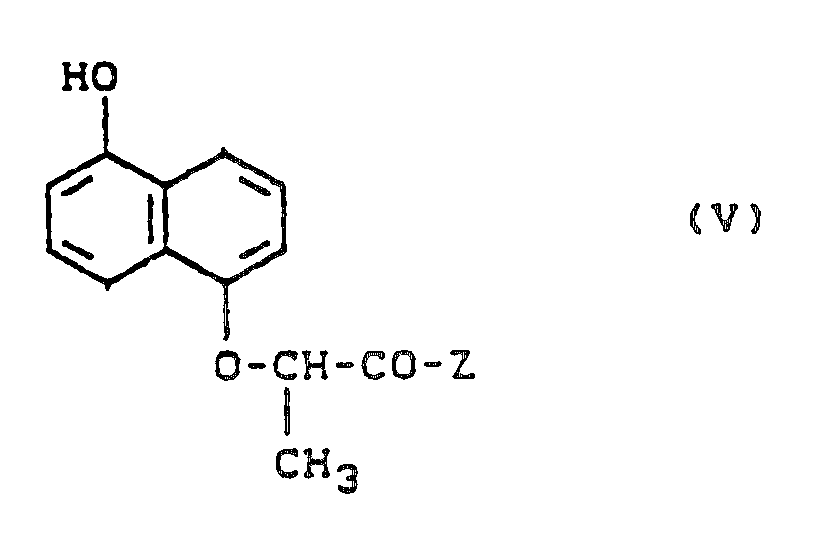
Z a les significations indiquées ci-dessus, éventuellement en présence d'un accepteur d'acide et éventuellement en présence d'un diluant, ou bien

dans laquelle Z a les significations indiquées ci-dessus, à l'exception d'un halogène, éventuellement en présence d'un accepteur d'acide et éventuellement en présence d'un diluant, ou bien

dans laquelle
R⁶ a les significations indiquées ci-dessus, à l'exception de l'ammonium, d'un alkylammonium, d'un métal alcalin ou alcalino-terreux, et
X¹ représente un halogène, éventuellement en présence d'un accepteur d'acide et éventuellement en présence d'un diluant.

R¹ représente l'hydrogène, un halogène, un groupe cyano ou trifluorométhyle,
R² représente l'hydrogéne ou un halogène,
R³ représente un halogène, un groupe cyano, trifluorométhyle ou trifluorométhoxy,
R⁴ représente l'hydrogène ou un halogène,
R⁵ représente l'hydrogène ou un halogène.
Applications Claiming Priority (2)
| Application Number | Priority Date | Filing Date | Title |
|---|---|---|---|
| DE3733067 | 1987-09-30 | ||
| DE19873733067 DE3733067A1 (de) | 1987-09-30 | 1987-09-30 | (alpha)-(5-aryloxy-naphthalin-1-yl-oxy)-propionsaeure-derivate |
Publications (2)
| Publication Number | Publication Date |
|---|---|
| EP0309864A1 EP0309864A1 (fr) | 1989-04-05 |
| EP0309864B1 true EP0309864B1 (fr) | 1991-05-22 |
Family
ID=6337310
Family Applications (1)
| Application Number | Title | Priority Date | Filing Date |
|---|---|---|---|
| EP88115372A Expired - Lifetime EP0309864B1 (fr) | 1987-09-30 | 1988-09-20 | Dérivés d'acides alpha-(5-aryloxy-naphthalène-1-yl-oxy)-propioniques |
Country Status (4)
| Country | Link |
|---|---|
| US (2) | US4994601A (fr) |
| EP (1) | EP0309864B1 (fr) |
| JP (1) | JPH01113331A (fr) |
| DE (2) | DE3733067A1 (fr) |
Families Citing this family (6)
| Publication number | Priority date | Publication date | Assignee | Title |
|---|---|---|---|---|
| DE3928988A1 (de) * | 1989-09-01 | 1991-03-07 | Bayer Ag | Aryloxynaphthalinderivate |
| DE4012711A1 (de) * | 1990-04-21 | 1991-10-24 | Bayer Ag | Fluor-substituierte (alpha)-(5-aryloxy-naphthalin-l-yl-oxy)-propionsaeure-derivate |
| DE4111618A1 (de) * | 1991-04-10 | 1992-10-15 | Bayer Ag | Cyanophenoxynaphthyloxycarbonsaeurederivate |
| DE4111619A1 (de) * | 1991-04-10 | 1992-10-15 | Bayer Ag | (alpha)-(5-aryloxy-naphthalin-1-yl-oxy)-carbonsaeure-derivate |
| DE4131585A1 (de) * | 1991-09-23 | 1993-03-25 | Bayer Ag | (alpha)-(5-dichlorphenoxy-naphthalin-l-yl-oxy) -propionsaeure-derivate |
| KR100622667B1 (ko) | 2004-08-31 | 2006-09-19 | 한국화학연구원 | 나프틸옥시아세트산 유도체 |
Family Cites Families (4)
| Publication number | Priority date | Publication date | Assignee | Title |
|---|---|---|---|---|
| EP0179015B1 (fr) * | 1984-09-17 | 1988-04-13 | Schering Aktiengesellschaft | Dérivés d'acide 7-(aryloxy)-2-naphthoxyalcane-carboxylique, procédés pour leur préparation et agents herbicides les contenant |
| DE3434447A1 (de) * | 1984-09-17 | 1986-03-27 | Schering AG, 1000 Berlin und 4709 Bergkamen | 7-(aryloxy)-2-naphthyloxy-alkancarbonsaeurederivate, verfahren zur herstellung dieser verbindungen sowie diese enthaltende mittel mit herbizider wirkung |
| JPS61165346A (ja) * | 1985-01-16 | 1986-07-26 | Mitsubishi Petrochem Co Ltd | フエノキシナフトキシ酢酸誘導体及びこれを含有する除草剤 |
| JPS6210041A (ja) * | 1985-07-08 | 1987-01-19 | Sumitomo Chem Co Ltd | ナフトキシプロピオン酸誘導体、その製造法およびそれを有効成分とする除草剤 |
-
1987
- 1987-09-30 DE DE19873733067 patent/DE3733067A1/de not_active Withdrawn
-
1988
- 1988-09-20 EP EP88115372A patent/EP0309864B1/fr not_active Expired - Lifetime
- 1988-09-20 DE DE8888115372T patent/DE3862918D1/de not_active Expired - Lifetime
- 1988-09-22 US US07/247,817 patent/US4994601A/en not_active Expired - Fee Related
- 1988-09-26 JP JP63239113A patent/JPH01113331A/ja active Pending
-
1990
- 1990-11-01 US US07/608,087 patent/US5166402A/en not_active Expired - Fee Related
Also Published As
| Publication number | Publication date |
|---|---|
| US5166402A (en) | 1992-11-24 |
| DE3733067A1 (de) | 1989-04-13 |
| EP0309864A1 (fr) | 1989-04-05 |
| JPH01113331A (ja) | 1989-05-02 |
| US4994601A (en) | 1991-02-19 |
| DE3862918D1 (en) | 1991-06-27 |
Similar Documents
| Publication | Publication Date | Title |
|---|---|---|
| EP0379915A1 (fr) | Dérivés substitués du phénoxybenzonitrile, procédés pour leur préparation et leur utilisation comme herbicides et comme régulateurs de la croissance des plantes | |
| EP0354329A1 (fr) | (Hétéro)-aryloxynaphthalènes avec des substituants liès à travers un atome de soufre | |
| EP0053321B1 (fr) | Dérivés substitués de l'acide cinnamique, leur procédé de préparation et leur application comme herbicides | |
| EP0308702A2 (fr) | Hétérocycles azotés N-arylés | |
| EP0403891A1 (fr) | Composés hétérocycliques comportant de l'azote N-arylés | |
| EP0272533A2 (fr) | Phénoxypyridines subtituées | |
| EP0349748B1 (fr) | N-aryl-hétérocycles substitués contenant de l'azote | |
| EP0309864B1 (fr) | Dérivés d'acides alpha-(5-aryloxy-naphthalène-1-yl-oxy)-propioniques | |
| EP0453842A2 (fr) | Dérivés de l'acide alpha-(5-aryloxy-naphtalène-1-yl-yloxy)propionique substitués par le fluor | |
| EP0369212B1 (fr) | Dérivés du (hétéro)-aryloxynaphtalène, procédé et (hétéro)aryloxynaphtylamines pour leur préparation ainsi que leur utilisation comme herbicides | |
| EP0315008B1 (fr) | Dérivés de l'acide (6-(hétéro)aryloxy-naphtaline-2-yl-oxy)alcanoique | |
| EP0347679A1 (fr) | Dérivés de la 1,7-dioxynaphtalène | |
| EP0308755B1 (fr) | Dérivés d'acide(7-(hétéro)aryloxy-naphtalen-2-yloxy)alcanoique | |
| EP0384192A2 (fr) | Hétérocycles de nitrogène à substituants N-aryle avec des substituants contenant du fluor | |
| EP0415212A1 (fr) | Dérivés d'aryloxynaphtalènes | |
| EP0362606A1 (fr) | Phénoxyphénylsulfonylazoles substitués, procédé de leur préparation comme leur application herbicide et régulatrice de croissance de plantes | |
| EP0509341A1 (fr) | Dérivés de cyanothiazole | |
| EP0338306A2 (fr) | Composés phénoxybenzyliques halogène-substitués | |
| EP0508263A2 (fr) | Dérivés de l'acide alpha-(5-aryloxy-naphthalényl-1-oxy)-carbonylique | |
| EP0384230A1 (fr) | Dérivés substitués de l'acide phénoxyphénylpropionique | |
| EP0313908A2 (fr) | Dérivés d'acides phénoxyphénylpropionique substitués par un halogène | |
| EP0342440A1 (fr) | Dérivés halogénés du phénoxybenzyl(thi)ol | |
| EP0095683A1 (fr) | Dérivés trifluorométhylphénoxiphényliques, procédé pour leur préparation et leur utilisation comme herbicides | |
| EP0220635A1 (fr) | Dérivés d'acide phénoxy-benzoiques | |
| WO1992018467A1 (fr) | Derives de l'acide cyanophenoxynaphtyloxycarboxylique |
Legal Events
| Date | Code | Title | Description |
|---|---|---|---|
| PUAI | Public reference made under article 153(3) epc to a published international application that has entered the european phase |
Free format text: ORIGINAL CODE: 0009012 |
|
| 17P | Request for examination filed |
Effective date: 19880920 |
|
| AK | Designated contracting states |
Kind code of ref document: A1 Designated state(s): BE CH DE FR GB IT LI NL |
|
| 17Q | First examination report despatched |
Effective date: 19901016 |
|
| GRAA | (expected) grant |
Free format text: ORIGINAL CODE: 0009210 |
|
| AK | Designated contracting states |
Kind code of ref document: B1 Designated state(s): BE CH DE FR GB IT LI NL |
|
| REF | Corresponds to: |
Ref document number: 3862918 Country of ref document: DE Date of ref document: 19910627 |
|
| GBT | Gb: translation of ep patent filed (gb section 77(6)(a)/1977) | ||
| ET | Fr: translation filed | ||
| ITF | It: translation for a ep patent filed | ||
| K2C3 | Correction of patent specification (complete document) published |
Effective date: 19910522 |
|
| PLBE | No opposition filed within time limit |
Free format text: ORIGINAL CODE: 0009261 |
|
| STAA | Information on the status of an ep patent application or granted ep patent |
Free format text: STATUS: NO OPPOSITION FILED WITHIN TIME LIMIT |
|
| 26N | No opposition filed | ||
| PGFP | Annual fee paid to national office [announced via postgrant information from national office to epo] |
Ref country code: DE Payment date: 19920817 Year of fee payment: 5 |
|
| PGFP | Annual fee paid to national office [announced via postgrant information from national office to epo] |
Ref country code: GB Payment date: 19920908 Year of fee payment: 5 |
|
| PGFP | Annual fee paid to national office [announced via postgrant information from national office to epo] |
Ref country code: FR Payment date: 19920922 Year of fee payment: 5 |
|
| PGFP | Annual fee paid to national office [announced via postgrant information from national office to epo] |
Ref country code: BE Payment date: 19920923 Year of fee payment: 5 |
|
| PGFP | Annual fee paid to national office [announced via postgrant information from national office to epo] |
Ref country code: NL Payment date: 19920930 Year of fee payment: 5 |
|
| PGFP | Annual fee paid to national office [announced via postgrant information from national office to epo] |
Ref country code: CH Payment date: 19921022 Year of fee payment: 5 |
|
| PG25 | Lapsed in a contracting state [announced via postgrant information from national office to epo] |
Ref country code: GB Effective date: 19930920 |
|
| PG25 | Lapsed in a contracting state [announced via postgrant information from national office to epo] |
Ref country code: LI Effective date: 19930930 Ref country code: CH Effective date: 19930930 Ref country code: BE Effective date: 19930930 |
|
| BERE | Be: lapsed |
Owner name: BAYER A.G. Effective date: 19930930 |
|
| PG25 | Lapsed in a contracting state [announced via postgrant information from national office to epo] |
Ref country code: NL Effective date: 19940401 |
|
| NLV4 | Nl: lapsed or anulled due to non-payment of the annual fee | ||
| GBPC | Gb: european patent ceased through non-payment of renewal fee |
Effective date: 19930920 |
|
| PG25 | Lapsed in a contracting state [announced via postgrant information from national office to epo] |
Ref country code: FR Free format text: LAPSE BECAUSE OF NON-PAYMENT OF DUE FEES Effective date: 19940531 |
|
| REG | Reference to a national code |
Ref country code: CH Ref legal event code: PL |
|
| PG25 | Lapsed in a contracting state [announced via postgrant information from national office to epo] |
Ref country code: DE Effective date: 19940601 |
|
| REG | Reference to a national code |
Ref country code: FR Ref legal event code: ST |
|
| PG25 | Lapsed in a contracting state [announced via postgrant information from national office to epo] |
Ref country code: IT Free format text: LAPSE BECAUSE OF NON-PAYMENT OF DUE FEES;WARNING: LAPSES OF ITALIAN PATENTS WITH EFFECTIVE DATE BEFORE 2007 MAY HAVE OCCURRED AT ANY TIME BEFORE 2007. THE CORRECT EFFECTIVE DATE MAY BE DIFFERENT FROM THE ONE RECORDED. Effective date: 20050920 |