EP0312017A2 - Differenzverstärker - Google Patents
Differenzverstärker Download PDFInfo
- Publication number
- EP0312017A2 EP0312017A2 EP88116944A EP88116944A EP0312017A2 EP 0312017 A2 EP0312017 A2 EP 0312017A2 EP 88116944 A EP88116944 A EP 88116944A EP 88116944 A EP88116944 A EP 88116944A EP 0312017 A2 EP0312017 A2 EP 0312017A2
- Authority
- EP
- European Patent Office
- Prior art keywords
- transistors
- amplifier
- pair
- output terminals
- differential amplifier
- Prior art date
- Legal status (The legal status is an assumption and is not a legal conclusion. Google has not performed a legal analysis and makes no representation as to the accuracy of the status listed.)
- Withdrawn
Links
Images




Classifications
-
- H—ELECTRICITY
- H03—ELECTRONIC CIRCUITRY
- H03F—AMPLIFIERS
- H03F1/00—Details of amplifiers with only discharge tubes, only semiconductor devices or only unspecified devices as amplifying elements
- H03F1/32—Modifications of amplifiers to reduce non-linear distortion
- H03F1/3211—Modifications of amplifiers to reduce non-linear distortion in differential amplifiers
-
- H—ELECTRICITY
- H03—ELECTRONIC CIRCUITRY
- H03F—AMPLIFIERS
- H03F3/00—Amplifiers with only discharge tubes or only semiconductor devices as amplifying elements
- H03F3/45—Differential amplifiers
- H03F3/45071—Differential amplifiers with semiconductor devices only
- H03F3/45076—Differential amplifiers with semiconductor devices only characterised by the way of implementation of the active amplifying circuit in the differential amplifier
- H03F3/4508—Differential amplifiers with semiconductor devices only characterised by the way of implementation of the active amplifying circuit in the differential amplifier using bipolar transistors as the active amplifying circuit
- H03F3/45098—PI types
- H03F3/45103—Non-folded cascode stages
Definitions
- the present invention relates to a differential amplifier and, more particularly, to a differential amplifier including only one type of active elements which is especially useful in forming integrated circuits for an active filter.
- a differential amplifier has frequently been utilized in forming an analog integrated circuit such as an operational amplifier. In such typical circumstances, it is considered desirable for an differential amplifier to possess a greater amplification and a wider frequency range.
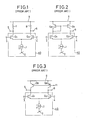
- Fig. 1 is the most basic one as a differential amplifier with load resistors.
- This differential amplifier is comprised of a transistor pair formed by an npn-type transistors Q1 and Q2 with their emitters connected with each other, a constant current source 1 connected to the emitters of the transistors Q1 and Q2, a negative power supply 2 connected to the constant current source 1, input terminals 3 and 4 connected to bases of the transistors Q1 and Q2, respectively, output terminals 5 and 6 connected to collectors of the transistors Q1 and Q2, respectively, load resistors 7 and 8 also connected to the collectors of the transistors Q1 and Q2, respectively, and a positive power supply 9 connected to the other ends of the load resistors 7 and 8.
- a portion 40 containing all of the above except the lord resisters 7 and 8, input terminals 3 and 4, and the output terminals 5 and 6 will be referred to in the following as a differential amplification portion.
- This differential amplifier possesses a wide frequency range but a limited amplification due to the fact that resistors are used as loading elements.
- Fig. 2 Another prior art differential amplifier with improved amplification is shown in Fig. 2, which has been widely used.
- the loading elements are comprised of a current mirror circuit as an active loading element formed by two pnp-type transistors Q3 and Q4 whose bases are connected with each other and whose collectors are connected to the collectors of the transistors Q1 and Q2, respectively, with a bypass between the collector of the transistor Q1 and the base of the transistor Q3 provided while the rest remains identical to that of Fig. 1 except that the output terminal 5 is not present.
- This differential amplifier possesses, contrary to the previous one, a very large amplification but a narrower frequency range due to the effect of the current mirror circuit.
- FIG. 3 A prior art differential amplifier which achieves this is shown in Fig. 3, where it has a constant current load formed by two pnp-type transistors Q5 and Q6 whose bases are connected with each other and whose collectors are connected to the collectors of the npn-type transistors Q1 and Q2, respectively, and a terminal 11 for supplying bias voltages to the transistors Q5 and Q6 while the rest remain identical to that of Fig. 1. With this configuration it is possible to obtain both a large amplification and a wide frequency range.
- the differential amplifier of Fig. 3 is equipped with elements for common mode feedback in practical applications, as shown in Fig. 4(A) and (B).
- a common mode feedback device 12 is connected between the output terminals 5 and 6, the constant current source 1 of Fig. 3 is replaced by a variable current source 1a, and a voltage source 11 for providing the bias voltage is connected between the positive power supply 9 and the terminal 11 while the rest remains identical to that of Fig. 3.
- the common mode feedback device 12 measures the common mode component between the output terminals 5 and 6, and control the variable current source 1a so as to make the common mode component equal to an appropriately predetermined value.
- the direct current voltage between the output terminals 5 and 6 in this differential amplifier is almost independent of the common mode voltage at the input terminals 3 and 4, although the increase in size of the differential amplifier due to the inclusion of the common mode feedback device 12 have to be tolerated.
- this differential amplifier is to be utilized in an active filter, however, it is necessary to have a variable transconductance and the variable current source 1a have to be used for this purpose which prevent it from being used for the common mode feedback simultaneously.
- a differential amplifier of Fig. 4(B) can be used.
- the common mode feedback device 12 controls the bias voltage of the transistor Q5 and Q6 through the terminal 11 so as to suppress the gain for the common mode components instead of the variable current source 1a.
- the transistor Q5 and Q6 are to have large amplification while being pnp-type at the same time, their frequency characteristics are poor and in order to perform the common mode feedback consistently it is necessary to incorporate phase compensation capacitor 13 and 14 having large capacitances, between collectors and bases of the transistors Q5 and Q6 But these capacitor 13 and 14 effectively behave as loading elements so that the frequency characteristic is further deteriorated which make it very difficult to utilize this differential amplifier in a device such as an integrator which already possesses capacitors.
- a differential amplifier shown in Fig. 5 has been proposed.
- a negative resistance 15 with a magnitude equal to that of the load resistors 7 and 8 combined is connected between the output terminals 5 and 6 while the rest remains identical to that of Fig. 1.
- the negative resistance 15 functions to increase the loading resistance for the transistors Q1 and Q2 only with respect to the differential component so that a large amplification is obtained for the differential component while keeping a high common mode rejection ratio.
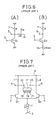
- Fig. 6(A) shows the equivalent circuit for the differential component, the so-called differential half circuit, where the negative resistance 15a have resistance -R which is equal to that of the load resistor 7 but opposite sign. Since the negative resistance 15a and the load resistor 7 are in parallel, together they appear as an infinite load for the transistor Q1 and this circuit effectively is equivalent to the aforementioned differential amplifier with a constant current load shown in Fig. 3, so that a large amplification can be obtained.
- the magnitude of the negative resistance 15a is ideally exactly equal to R but in any case it have to be less than R because otherwise the total resistance becomes negative and that give rises to the instability of the differential amplifier.
- Fig. 6(B) shows the equivalent circuit for the common mode component, the so-called common mode half circuit, where the constant current source 1 in Fig. 5 give rises to the resistance 16 having the magnitude twice as large as that of the internal resistance Ree of the constant current source 1, while the negative resistance 15 in Fig. 5 does not affect this circuit because it is connected between the points which are always maintained at the same level by the common mode component.
- the magnitude 2Ree of the resistance 16 is much larger than the magnitude of the usual load resistor 7 and takes the order of 10 K ⁇ to 1 M ⁇ approximately. Since the load resistor 7 and the resistance 16 is in series in this circuit, the amount of the voltage generated by the load resistor 7 is relatively small, and consequently the small amplification results for the common mode component.
- the differential amplifier of Fig. 5 is capable of achieving a large amplification, a wide frequency range, and a high common mode rejection ratio all at once.
- the negative resistance 15 of Fig. 5 comprises a positively feedbacked differential amplifier 17 as shown in Fig. 7 where it is connected between the first terminals 22 and 23 and accompanied by a terminal resistor 18 which is connected between second terminals 19 and 21, while the rest remains identical to that of Fig. 5.
- a detailed configuration of the positively feedbacked differential amplifier 17 is shown in Fig. 8. It is comprised of a pair of npn-type transistors Q7 and Q8 whose emitters are connected with each other through a terminal resistor 18 having a resistance 2R and being located between the second terminals 19 and 21, and each of whose collector is connected with the base of the other as well as to the first terminals 22 and 23. Also current sources 24, 25, 26 and 27 producing currents I1 are provided to each of the emitters and the collectors of the transistors Q7 and Q8 from positive and negative power supply 9 and 2, respectively.
- a positive feedback circuit is formed by connecting each base of the emitter-degenerated transistors Q7 and Q8 to the collector of the partner transistor, so that when there is large enough transconductance before the positive feedbacks take place, the resistance appearing between the first terminals 22 and 23 is going to be -1 times the resistance of the terminal resistor.
- this positively feedbacked differential amplifier is unstable by itself, by connecting the first terminals 22 and 23 to a circuit having a positive resistance so large as to make a net resistance positive, stable operations can be secured.
- the positively feedbacked differential amplifier of Fig. 8 incorporated into the differential amplifier of Fig. 7 as a negative resistance is shown in Fig. 9 where the currents produced by constant current source 1 is denoted as I Q to distinguish from the currents I1 produced by the other current sources 24, 25, 26 and 27, of which the current sources 26 and 27 are superfluous here as they are meant to provide bias currents to the positively feedbacked differential amplifier 17 in Fig. 8 but there are load resistors 7 and 8 in this circuit shown in Fig. 9.
- this differential amplifier shown in Fig. 9 is capable of achieving a large amplification, a wide frequency range, and a high common mode rejection ratio simultaneously.
- this differential amplifier since this differential amplifier possesses a large input and output impedances, it can potentially be utilized as a transconductance, such as for example, an integrator with a capacitor as a load to be used as an active filter. And in such an application, it is desirable for the differential amplifier to have a wide dynamic range.
- a differential amplifier comprising: input terminals(3,4); output terminals(5,6); load resistor means(7,8) connected to the output terminals(5,6) for generating output voltages; a pair of transistors(Q1,Q2), its emitters being connected with each other, its collectors being connected to the output terminals(5,6), and its bases being coupled to the input terminals(3,4); and current source means(1) connected to the emitters of the transistors for providing the emitter currents, characterized by comprising: means(17) for producing negative resistance including level shift circuit means(28,29) for producing additional voltages, the means(17) being connected to the output terminal(3,4).
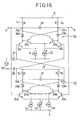
- Fig. 10 there is shown the first embodiment of a differential amplifier according to the present invention.
- This differential amplifier incorporates, in addition to the differential amplifier of Fig. 9, two level shift circuits 28 and 29, the level shift circuit 28 being connected between the base of the transistors Q7 and the collector of the transistor Q8, and the level shift circuit 29 being connected between the base of the transistors Q8 and the collector of the transistor Q7.
- the superfluous current sources 26 and 27 of Fig. 9 are removed, and unless the level shift circuits 28 and 29 possess exceedingly large internal resistances the sections crossed can be disconnected when the sections shown by the dotted lines are connected without any significant effect.
- These level shift circuits 28 and 29 raise the collector voltages of the transistors Q7 and Q8 with respect to their base voltages, so that the output voltages increase by the amount that the level shift circuits 28 and 29 raised, and the dynamic range is widened accordingly.
- the level shift circuits 28 and 29 can be of various different types such as those shown in Fig. 11, in which Fig. 11(A) shows a battery, Fig. 11(B) shows a series of n diodes where n is a positive integer, Fig. 11(C) shows a series of n transistors with its base connected to its collector, Fig. 11(D) shows a transistor with its base-emitter voltage amplified, and Fig. 11(E) shows a resistor.
- Fig. 12 there is shown the second embodiment of a differential amplifier according to the present invention.
- the level shift circuits 28 and 29 of Fig. 10 are chosen to be the transistors as shown in Fig. 11(C) with n equal to one.
- This differential amplifier can generate output voltage of approximately 1.2 V, so its dynamic range is twice as wide as the prior art amplifier of Fig. 9.
- Fig. 13 shows the input-output characteristics of the differential amplifier of Fig. 12 and the prior art differential amplifier of Fig. 9.
- Fig. 13 shows the input-output characteristics of the differential amplifier of Fig. 12 and the prior art differential amplifier of Fig. 9.
- the horizontal axis represents the differential input voltage between the input terminals 3 and 4
- the vertical axis represents the differential output voltage between the output terminals 5 and 6
- a curve 100 indicates the input-output characteristic of the differential amplifier of Fig. 9 which has no level shift circuit
- a curve 101 indicates the input-output characteristic of the differential amplifier of Fig. 12 which includes the level shift circuits 28 and 29.
- the output impedance of this differential amplifier can be quite large, although in practice contributions from the transistors of the positively feedbacked differential amplifier 17 lessen it to some extent. It is to be noted, however, that because of the variations in output resistance of the manufactured transistors, an attempt to make the magnitudes of the negative resistance by the positively feedbacked differential amplifier 17 and the net resistance of the load resistors 7 and 8 exactly equal in practice is not recommended from the consideration on instability as discussed in the description of the prior art. Meanwhile, because the transistors Q1 and Q2 are in common-emitter configuration, the input impedance of this differential amplifier is large, and thus it is suitable for applications as a transconductance.
- Fig. 14 there is shown the third embodiment of a differential amplifier according to the present invention.
- the level shift circuits 28 and 29 of Fig. 10 are chosen to be the diodes as shown in Fig. 11(B) with n equal to one, the constant current source 1 of Fig. 10 is replaced by a variable current source lb which can generate currents up to 2I Q and a capacitor 31 of capacitance C connected between the first terminals 22 and 23 is incorporated as a load which makes the entire circuit to function as an integrator.
- s is a variable of the Laplace transform
- this integrator since the time constant of this integrator is equal to C(Vt/I Q ), by the variation of the currents from the variable current source 1b it can function as an integrator with a variable time constant particularly suitable for an integrated active filter. Furthermore, in this embodiment, the capacitance of the integrating capacitor 31 can be reduced compared with the prior art case such as one shown in Fig. 4(B), where two capacitors 13 and 14 has to be placed in series, which reduces the net capacitance to half so that these capacitors have to have capacitance twice as large as necessary for the capacitor 31 of this embodiment in order to obtain the same time constant. This aspect of the present embodiment can contribute to the reduction of the device size.
- Fig. 15 there is shown the fourth embodiment of a differential amplifier according to the present invention.
- the level shift circuits are diodes as in the previous embodiment, but the terminal resistance 18 and the capacitor 31 are removed and the current source 24 and 25 are replaced by a variable current source 32 connected to the emitters of the transistors Q7 and Q8 while the variable current source 1b is replaced by the constant current source 1 connected to the emitters of the transistors Q1 and Q2.
- the input impedance of the positively feedbacked differential amplifier 17 seen from the output terminals 5 and 6 is determined solely by the transconductances of the transistors Q7 and Q8 of the positively feedbacked differential amplifier 17.
- the transconductance of each of the transistors Q1 and Q8 is equal to I/2Vt, and the input impedance r which is the same as a negative of a sum of the inverse of the transconductances is given by: which is inversely proportional to the current I from the variable current source 32.
- the load for the transistors Q1 and Q2 is given by: so that by varying the currents I the differential amplifier of variable amplification in the range
- a first integrator 33 identical to that of Fig. 14 is combined with a second integrator 34 made by the amplifier of Fig. 15 equipped with a load capacitor 35 such that the bases of the transistor Q 1b , Q 2b , Q 1c , Q 2c are connected to the terminals 22c, 23c, 23b, 22b, respectively, while the input generator 36 is connected through capacitors 37 and 38 to the terminals 23b and 22b, respectively, to form a band-pass filter.
- This band-pass filter is particularly suitable for the application to the adaptive filter because its quality factor Q can be varied by varying currents I from the variable current source 32.
- Fig. 17 there is shown the sixth embodiment of a differential amplifier according to the present invention.
- the transistors Q1, Q2, Q7, Q8 of Fig. 10 are replaced by the GaAs MESFETs (Metal Semiconductor Field Effected Transistors) X1, X2, X7, X8
- GaAs MESFET in practice is predominantly n-channel type because p-channel type is considerably slow in response. Since this differential amplifier of the present embodiment can be constructed only by n-channel type GaAs MESFETs, it can contribute to flexibility in circuit designing and reduction in device size. It is to be noted that the similar situation exists for the GaAs heterojunction bipolar transistor whose pnp-type is considerably slow in response compared with npn-type and is also very hard to manufacture.
- Fig. 18 there is shown the seventh embodiment of a differential amplifier according to the present invention.
- GaAs MESFETs X1, X2, X7, X8 of the previous embodiment are replaced by Si MOSFETs (Metal Oxide Semiconductor Field Effect Transistors) Y1, Y2, Y7, Y8.
- Si MOSFETs Metal Oxide Semiconductor Field Effect Transistors
- p-channel type is considerably slow in response compared with n-channel type.
- Si MOSFET p-channel type is also available and can be incorporated
- this differential amplifier of the present embodiment which can be constructed only by n-channel type Si MOSFETs obviously can be faster in response and thus be considered superior than any amplifier involving p-channel type Si MOSFETs.
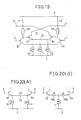
- Fig. 19 there is shown the eighth embodiment of a differential amplifier according to the present invention.
- Si MOSFETs Y1, Y2, Y7, Y8 of the previous embodiment are replaced by JFETs (Junction Field Effect Transistors) Z1, Z2, Z7, Z8.
- JFETs Junction Field Effect Transistors
- p-channel type is considerably slow in response compared with n-channel type.
- this differential amplifier of the present embodiment which can be constructed only by n-channel type JFETs obviously can be faster in response and thus be considered superior than any amplifier involving p-channel type JFETs.
- transistors Q1 and Q2 in the above embodiments formed an emitter-coupled pair in which their emitters are connected with each other directly, this configuration can be replaced by the so called emitter degeneration type such as those shown in Fig. 20(A) and (B). Though with such a replacement the amplification lowers, the linearity can be improved by means of the emitter degeneration so that it is possible to enhance the dynamic range further in the differential amplifier of the present invention.
- the transistors Q7 and Q8 in the above embodiments had the configuration similar to that shown in Fig. 20(A), it can be replaced by the configuration similar to that shown in Fig. 20(B) with the same effect.
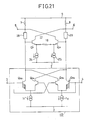
- the differential amplification portion 40 of the differential amplifier of Fig. 10 is replaced by the linear differential amplifier proposed by J.C.Schmoock in "An Input Stage Transconductance Reduction Technique for High-Slew Rate Operational Amplifiers" IEEE Journal of Solid State Circuits, vol. SC-10, no.6, pp.407-411, December 1975.
- the transistors Q 1a and Q 2b have the emitter areas four times as large as that of the transistors Q 1b and Q 2a and the constant current sources 1 f and 1 g provides the same amount of the emitter currents to these transistors so that the improvement of the linearity can be achieved without the emitter degeneration.
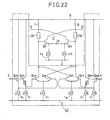
- the differential amplification portion 40 of the differential amplifier of Fig. 21 is modified so that the differential amplifier can operate faster.
- the transistors Q 11a , Q 2a , Q 1b , and Q 11b have the same emitter areas, but they are accompanied by the emitter followers formed by the transistors Q 9a , Q 9b , Q 10a , and Q 10b , and their emitter current sources 1h, 1i, 1k, and 1j, where the transistors Q 9b and Q 10b have the emitter areas four times as large as that of the transistors Q 11a , Q 2a , Q 1b , and Q 11b while the transistors Q 9a and Q 10a have the same emitter areas as the transistors Q 11a , Q 2a , Q 1b , and Q 11b so as to improve the linearity.
- this differential amplifier of Fig. 22 can operates at the higher frequency range because the emitter areas of the transistors Q 11a , Q 2a , Q 1b , and Q 11b can be made smaller. Also, this differential amplifier of Fig. 22 possesses a larger input impedance due to the inclusion of the emitter followers.
Landscapes
- Engineering & Computer Science (AREA)
- Power Engineering (AREA)
- Physics & Mathematics (AREA)
- Nonlinear Science (AREA)
- Amplifiers (AREA)
Applications Claiming Priority (2)
| Application Number | Priority Date | Filing Date | Title |
|---|---|---|---|
| JP254785/87 | 1987-10-12 | ||
| JP62254785A JP2766264B2 (ja) | 1987-10-12 | 1987-10-12 | 差動増幅回路 |
Publications (2)
| Publication Number | Publication Date |
|---|---|
| EP0312017A2 true EP0312017A2 (de) | 1989-04-19 |
| EP0312017A3 EP0312017A3 (de) | 1990-03-07 |
Family
ID=17269848
Family Applications (1)
| Application Number | Title | Priority Date | Filing Date |
|---|---|---|---|
| EP88116944A Withdrawn EP0312017A3 (de) | 1987-10-12 | 1988-10-12 | Differenzverstärker |
Country Status (3)
| Country | Link |
|---|---|
| US (1) | US4904952A (de) |
| EP (1) | EP0312017A3 (de) |
| JP (1) | JP2766264B2 (de) |
Cited By (10)
| Publication number | Priority date | Publication date | Assignee | Title |
|---|---|---|---|---|
| EP0352790A3 (de) * | 1988-07-28 | 1991-07-10 | Kabushiki Kaisha Toshiba | Integrator und aktives Filter mit Phasenkompensierung |
| EP0454982A1 (de) * | 1990-04-30 | 1991-11-06 | International Business Machines Corporation | Differenzempfänger |
| EP0400650B1 (de) * | 1989-05-31 | 1996-10-09 | Kabushiki Kaisha Toshiba | Linearisierter Differenzverstärker |
| FR2741759A1 (fr) * | 1995-11-29 | 1997-05-30 | Philips Electronics Nv | Amplificateur de tension a large plage de variation |
| EP0777322A1 (de) * | 1995-11-29 | 1997-06-04 | Philips Composants Et Semiconducteurs | Spannungsverstärker mit grossen dynamischen Bereich und A/D-Konverter damit |
| EP0863609A3 (de) * | 1997-03-05 | 2000-02-16 | Sony Corporation | Verstärkerschaltungen |
| EP0884837A3 (de) * | 1997-06-14 | 2001-01-17 | Philips Patentverwaltung GmbH | Schaltungsanordnung mit einer Differenzverstärkerstufe |
| WO2002056458A3 (en) * | 2001-01-10 | 2003-03-13 | Koninkl Philips Electronics Nv | A fully differential, variable-gain amplifier and a multidimensional amplifier arrangement |
| EP1603243A1 (de) * | 2004-05-31 | 2005-12-07 | STMicroelectronics S.r.l. | Vorteilerstufe für Hochfrequenzanwendungen |
| IT201800005277A1 (it) * | 2018-05-11 | 2019-11-11 | Sistema di amplificazione e trasduzione di un segnale, in particolare un segnale elettrico fornito a degli altoparlanti |
Families Citing this family (37)
| Publication number | Priority date | Publication date | Assignee | Title |
|---|---|---|---|---|
| US5089789A (en) * | 1990-05-16 | 1992-02-18 | Texas Instruments Incorporated | Differential amplifier |
| JPH04211508A (ja) * | 1990-06-15 | 1992-08-03 | Toshiba Corp | 積分回路 |
| US5053718A (en) * | 1990-07-03 | 1991-10-01 | Burr-Brown Corporation | Feedback control reducing signal distortion produced by differential amplifier stage |
| US5101126A (en) * | 1990-10-15 | 1992-03-31 | Analog Devices, Inc. | Wide dynamic range transconductance stage |
| GB2284719B (en) * | 1993-12-13 | 1998-03-11 | Nec Corp | Differential circuit capable of accomplishing a desirable characteritic |
| GB9424878D0 (en) * | 1994-12-09 | 1995-02-08 | Plessey Semiconductors Ltd | Amplifier circuit arrangements |
| US5596299A (en) * | 1995-05-30 | 1997-01-21 | Philips Electronics North America Corporation | IF amplifier/limiter with positive feedback |
| US5587689A (en) * | 1995-09-28 | 1996-12-24 | Analog Devices, Inc. | Voltage controlled amplifier with a negative resistance circuit for reducing non-linearity distortion |
| US5821809A (en) * | 1996-05-23 | 1998-10-13 | International Business Machines Corporation | CMOS high-speed differential to single-ended converter circuit |
| JPH1056336A (ja) * | 1996-08-09 | 1998-02-24 | Mitsubishi Electric Corp | ミキサ回路 |
| JP2002330038A (ja) * | 1997-01-16 | 2002-11-15 | Sony Corp | エミッタ共通差動トランジスタ回路 |
| JP3097598B2 (ja) * | 1997-04-25 | 2000-10-10 | 日本電気株式会社 | 差動増幅回路 |
| JPH11103237A (ja) * | 1997-09-29 | 1999-04-13 | Sony Corp | ハイインピーダンス回路 |
| FR2785107A1 (fr) * | 1998-10-27 | 2000-04-28 | Koninkl Philips Electronics Nv | Amplificateur de courant a faible impedance d'entree |
| US5994959A (en) * | 1998-12-18 | 1999-11-30 | Maxim Integrated Products, Inc. | Linearized amplifier core |
| US7038542B2 (en) * | 2003-10-22 | 2006-05-02 | Kabushiki Kaisha Toshiba | Variable gain amplifier |
| US20050134350A1 (en) * | 2003-12-19 | 2005-06-23 | Huang Lawrence L. | Analog delay circuit |
| US7561619B2 (en) * | 2003-12-19 | 2009-07-14 | Intel Corporation | Feedback filter |
| US20050135468A1 (en) * | 2003-12-19 | 2005-06-23 | Bhushan Asuri | Feed forward filter |
| US20060280239A1 (en) * | 2005-06-09 | 2006-12-14 | Joachim Moll | Signal shaping circuit |
| CN100399224C (zh) * | 2005-06-21 | 2008-07-02 | 电子科技大学 | 一种具有极高输出阻抗的电流源 |
| US7414456B2 (en) * | 2006-08-17 | 2008-08-19 | Analog Devices, Inc. | Constant ratio current source |
| US8319562B2 (en) * | 2009-08-26 | 2012-11-27 | Qualcomm Incorporated | System and method for amplifying a signal using multiple amplification stages sharing a common bias current |
| CN103636122B (zh) * | 2011-04-07 | 2016-06-15 | Hrl实验室有限责任公司 | 非福斯特电路 |
| CN103548205B (zh) | 2011-04-07 | 2017-02-22 | Hrl实验室有限责任公司 | 可调阻抗表面 |
| US9407239B2 (en) | 2011-07-06 | 2016-08-02 | Hrl Laboratories, Llc | Wide bandwidth automatic tuning circuit |
| US8878636B2 (en) * | 2011-08-09 | 2014-11-04 | Analog Devices, Inc. | Techniques for developing a negative impedance |
| US10103445B1 (en) | 2012-06-05 | 2018-10-16 | Hrl Laboratories, Llc | Cavity-backed slot antenna with an active artificial magnetic conductor |
| JP6102198B2 (ja) * | 2012-11-14 | 2017-03-29 | 富士通株式会社 | 増幅回路 |
| US9520849B2 (en) * | 2012-11-16 | 2016-12-13 | Texas Instruments Incorporated | Rail-to-rail constant transconductance differential input stage |
| US9705201B2 (en) | 2014-02-24 | 2017-07-11 | Hrl Laboratories, Llc | Cavity-backed artificial magnetic conductor |
| US20150372844A1 (en) * | 2014-06-18 | 2015-12-24 | Texas Instruments Incorporated | Wideband Parasitic Capacitance Cancellation for High Speed Switches in Serial Communication |
| US9425769B1 (en) | 2014-07-18 | 2016-08-23 | Hrl Laboratories, Llc | Optically powered and controlled non-foster circuit |
| US10193233B1 (en) | 2014-09-17 | 2019-01-29 | Hrl Laboratories, Llc | Linearly polarized active artificial magnetic conductor |
| FR3044845B1 (fr) * | 2015-12-02 | 2019-03-15 | Commissariat A L'energie Atomique Et Aux Energies Alternatives | Circuit d'impedance negative |
| US11024952B1 (en) | 2019-01-25 | 2021-06-01 | Hrl Laboratories, Llc | Broadband dual polarization active artificial magnetic conductor |
| CN110504933A (zh) * | 2019-08-07 | 2019-11-26 | 宁波大学 | 一种高线性可变增益放大器 |
Family Cites Families (8)
| Publication number | Priority date | Publication date | Assignee | Title |
|---|---|---|---|---|
| US4340866A (en) * | 1979-09-17 | 1982-07-20 | Tektronix, Inc. | Thermally-compensated variable gain differential amplifier |
| US4322688A (en) * | 1979-10-11 | 1982-03-30 | Tektronix, Inc. | Cascode feed-forward amplifier |
| US4468629A (en) * | 1982-05-27 | 1984-08-28 | Trw Inc. | NPN Operational amplifier |
| JPS58213414A (ja) * | 1982-06-04 | 1983-12-12 | Nippon Telegr & Teleph Corp <Ntt> | 半導体気相成長用装置 |
| US4468628A (en) * | 1983-01-17 | 1984-08-28 | Tektronix, Inc. | Differential amplifier with high common-mode rejection |
| EP0161627B1 (de) * | 1984-05-16 | 1989-11-29 | Siemens Aktiengesellschaft | Bipolare Verstärkerschaltung |
| NL8401847A (nl) * | 1984-06-12 | 1986-01-02 | Philips Nv | Niveauverschuivingsschakeling. |
| NL8501882A (nl) * | 1985-07-01 | 1987-02-02 | Philips Nv | Signaalspanning-stroom omzetter. |
-
1987
- 1987-10-12 JP JP62254785A patent/JP2766264B2/ja not_active Expired - Lifetime
-
1988
- 1988-10-06 US US07/254,242 patent/US4904952A/en not_active Expired - Lifetime
- 1988-10-12 EP EP88116944A patent/EP0312017A3/de not_active Withdrawn
Cited By (13)
| Publication number | Priority date | Publication date | Assignee | Title |
|---|---|---|---|---|
| EP0352790A3 (de) * | 1988-07-28 | 1991-07-10 | Kabushiki Kaisha Toshiba | Integrator und aktives Filter mit Phasenkompensierung |
| US5081423A (en) * | 1988-07-28 | 1992-01-14 | Kabushiki Kaisha Toshiba | Integrator and active filter including integrator with simple phase compensation |
| EP0400650B1 (de) * | 1989-05-31 | 1996-10-09 | Kabushiki Kaisha Toshiba | Linearisierter Differenzverstärker |
| EP0454982A1 (de) * | 1990-04-30 | 1991-11-06 | International Business Machines Corporation | Differenzempfänger |
| US5774086A (en) * | 1995-11-29 | 1998-06-30 | U.S. Philips Corporation | Voltage amplifier having a large range of variations, and A/D converter comprising such an amplifier |
| EP0777322A1 (de) * | 1995-11-29 | 1997-06-04 | Philips Composants Et Semiconducteurs | Spannungsverstärker mit grossen dynamischen Bereich und A/D-Konverter damit |
| FR2741759A1 (fr) * | 1995-11-29 | 1997-05-30 | Philips Electronics Nv | Amplificateur de tension a large plage de variation |
| EP0777321A3 (de) * | 1995-11-29 | 1999-09-22 | Philips Composants Et Semiconducteurs | Verstärkung einer Spannung mit grossem Veränderungsbereich und diesen Verstärker enthaltender Analog-Digitalumsetzer |
| EP0863609A3 (de) * | 1997-03-05 | 2000-02-16 | Sony Corporation | Verstärkerschaltungen |
| EP0884837A3 (de) * | 1997-06-14 | 2001-01-17 | Philips Patentverwaltung GmbH | Schaltungsanordnung mit einer Differenzverstärkerstufe |
| WO2002056458A3 (en) * | 2001-01-10 | 2003-03-13 | Koninkl Philips Electronics Nv | A fully differential, variable-gain amplifier and a multidimensional amplifier arrangement |
| EP1603243A1 (de) * | 2004-05-31 | 2005-12-07 | STMicroelectronics S.r.l. | Vorteilerstufe für Hochfrequenzanwendungen |
| IT201800005277A1 (it) * | 2018-05-11 | 2019-11-11 | Sistema di amplificazione e trasduzione di un segnale, in particolare un segnale elettrico fornito a degli altoparlanti |
Also Published As
| Publication number | Publication date |
|---|---|
| EP0312017A3 (de) | 1990-03-07 |
| US4904952A (en) | 1990-02-27 |
| JP2766264B2 (ja) | 1998-06-18 |
| JPH0198305A (ja) | 1989-04-17 |
Similar Documents
| Publication | Publication Date | Title |
|---|---|---|
| EP0312017A2 (de) | Differenzverstärker | |
| KR970008536B1 (ko) | 로그변환회로 | |
| US4723110A (en) | Transconductance amplifier | |
| US5465072A (en) | Tunable operational transcondunctance amplifier having high linearity | |
| US6335655B1 (en) | Filter circuit | |
| US5345190A (en) | Modular low voltage filter with common mode feedback | |
| US4528515A (en) | High frequency differential amplifier with adjustable damping factor | |
| Mahattanakul et al. | Current-mode versus voltage-mode G/sub m/-C biquad filters: what the theory says | |
| US5844443A (en) | Linear high-frequency amplifier with high input impedance and high power efficiency | |
| JP3390093B2 (ja) | 差動増幅器 | |
| US4629973A (en) | Current stabilizing circuit operable at low power supply voltages | |
| EP0352790B1 (de) | Integrator und aktives Filter mit Phasenkompensierung | |
| JPH0121642B2 (de) | ||
| US5392002A (en) | Low voltage bipolar negative impedance converter | |
| JPH0834395B2 (ja) | スイッチ付き増幅回路 | |
| JP2622321B2 (ja) | 高周波数クロス接合折返しカスコード回路 | |
| US5053718A (en) | Feedback control reducing signal distortion produced by differential amplifier stage | |
| EP0475507B1 (de) | Verstärkerschaltung | |
| JPS63136707A (ja) | フィルタ回路およびそれを用いたフィルタ装置 | |
| JPH0514119A (ja) | 積分回路 | |
| JPH05299949A (ja) | 帰還形差動増幅回路 | |
| US4998074A (en) | Transistor circuit with base-current compensation | |
| US6031424A (en) | Differential amplifier with improved voltage gain using operational amplifiers to eliminate diode voltage drops | |
| JP3833530B2 (ja) | 差動増幅器 | |
| WO1990004284A1 (en) | Bias current compensation for bipolar input stages |
Legal Events
| Date | Code | Title | Description |
|---|---|---|---|
| PUAI | Public reference made under article 153(3) epc to a published international application that has entered the european phase |
Free format text: ORIGINAL CODE: 0009012 |
|
| 17P | Request for examination filed |
Effective date: 19881012 |
|
| AK | Designated contracting states |
Kind code of ref document: A2 Designated state(s): DE FR |
|
| PUAL | Search report despatched |
Free format text: ORIGINAL CODE: 0009013 |
|
| AK | Designated contracting states |
Kind code of ref document: A3 Designated state(s): DE FR |
|
| 17Q | First examination report despatched |
Effective date: 19920508 |
|
| STAA | Information on the status of an ep patent application or granted ep patent |
Free format text: STATUS: THE APPLICATION IS DEEMED TO BE WITHDRAWN |
|
| 18D | Application deemed to be withdrawn |
Effective date: 19920919 |