EP0312086A2 - Polyschwefelsäureester von Bis-aldonsäureamiden und deren Derivaten, Verfahren zu ihrer Herstellung und Arzneimittel - Google Patents
Polyschwefelsäureester von Bis-aldonsäureamiden und deren Derivaten, Verfahren zu ihrer Herstellung und Arzneimittel Download PDFInfo
- Publication number
- EP0312086A2 EP0312086A2 EP19880117115 EP88117115A EP0312086A2 EP 0312086 A2 EP0312086 A2 EP 0312086A2 EP 19880117115 EP19880117115 EP 19880117115 EP 88117115 A EP88117115 A EP 88117115A EP 0312086 A2 EP0312086 A2 EP 0312086A2
- Authority
- EP
- European Patent Office
- Prior art keywords
- radical
- compounds according
- vii
- bis
- radicals
- Prior art date
- Legal status (The legal status is an assumption and is not a legal conclusion. Google has not performed a legal analysis and makes no representation as to the accuracy of the status listed.)
- Granted
Links
- 0 CCC(*)(C(*)(C([C@](C)N)(N)O)N)OC(*)(*1)C1O Chemical compound CCC(*)(C(*)(C([C@](C)N)(N)O)N)OC(*)(*1)C1O 0.000 description 3
Classifications
-
- C—CHEMISTRY; METALLURGY
- C07—ORGANIC CHEMISTRY
- C07H—SUGARS; DERIVATIVES THEREOF; NUCLEOSIDES; NUCLEOTIDES; NUCLEIC ACIDS
- C07H15/00—Compounds containing hydrocarbon or substituted hydrocarbon radicals directly attached to hetero atoms of saccharide radicals
- C07H15/02—Acyclic radicals, not substituted by cyclic structures
- C07H15/04—Acyclic radicals, not substituted by cyclic structures attached to an oxygen atom of the saccharide radical
-
- A—HUMAN NECESSITIES
- A61—MEDICAL OR VETERINARY SCIENCE; HYGIENE
- A61P—SPECIFIC THERAPEUTIC ACTIVITY OF CHEMICAL COMPOUNDS OR MEDICINAL PREPARATIONS
- A61P29/00—Non-central analgesic, antipyretic or antiinflammatory agents, e.g. antirheumatic agents; Non-steroidal antiinflammatory drugs [NSAID]
-
- A—HUMAN NECESSITIES
- A61—MEDICAL OR VETERINARY SCIENCE; HYGIENE
- A61P—SPECIFIC THERAPEUTIC ACTIVITY OF CHEMICAL COMPOUNDS OR MEDICINAL PREPARATIONS
- A61P7/00—Drugs for disorders of the blood or the extracellular fluid
- A61P7/02—Antithrombotic agents; Anticoagulants; Platelet aggregation inhibitors
Definitions
- aldonic acids on which the present poly sulfuric acid esters are based have the general formula VIII wherein R ', R 2 and R 3 have the meaning given. These aldonic acids can be in the D form, the L form or in the form of their racemates, preferably in their form which is predominant in nature.
- aldonic acids examples include the hexonic acids allonic, altronic, galactonic, gluconic, gulonic, idonic, mannonic and talonic, preferably galactonic, gluconic, gulonic and mannonic. Further examples are derivatives of these hexonic acids which are glycosidically linked to a radical R 3 or R 2 or R 'of the formulas II to VII in which X represents hydrogen on the oxygen atoms in the 3-, 4- or 6-position.
- the bond here can be ⁇ - or ⁇ -glycosidic.
- the residues II to V are galactopyranosyl and mannopyranosyl residues.
- the index m is preferably 0 or 1.
- the saccharide units linked to the aldonic acid are normally in the D form.
- hexonic acids of the general formula VIII which are substituted by radicals of the formulas II to VII are glucopyranosylgluconic acids, glucopyranosylmannonic acids, glucopyranosylgalactonic acids, galactopyranosylgluconic acids, mannopyranosylgluconic acids, mannopyranosylgluconic acids and oligogluconic acids.
- Lactobionic acid (4-O- ⁇ -D-galactopyranosylgluconic acid), gentiobionic acid, melibionic acid (6-OaD-galactopyranosylgluconic acid), mannobionic acid, cellobionic acid (4-0- ⁇ -D-glucopyranosylgluconic acid) and maltobionic acid (4-O-glucopyranosylgluconic acid) are preferred. as well as maltotrionic acid and cellotrionic acid.
- salt-forming bases are trialkylamines with 1 to 6 carbon atoms in the alkyl part, such as trimethylamine, triethylamine, tripropylamine, tributylamine, tripentylamine and trihexylamine. Trimethylamine, triethylamine and tributylamine are preferred.
- physiologically acceptable inorganic and organic salts are the ammonium, lithium, sodium, potassium, magnesium, calcium, aluminum salts and the salts with ethanolamine, triethanolamine, morpholine, pyridine and piperidine.
- the sodium, potassium, calcium, aluminum and ethanolamine salts are preferred.
- Examples of straight-chain or branched, saturated alkylene radicals with 2 to 22 carbon atoms which represent group A are ethylene, tri, tetra, penta-, hexa-, hepta-, octa-, nona-, deca-, undeca-, Dodeca-, tetradeca-, hexadeca-, octadeca-, icosa- and docosamethylene as well as methylethylene, methylpropylene, methylbutylene, methylpentylene and dimethylethylene.
- Ethylene, tri, tetra, hexa, nona, dodeca and docosamethylene as well as methyl ethylene and methyl pentylene are preferred.
- arylene radicals through which the alkylene group A can be interrupted are phenylene, naphthylene, anthrylene, phenanthrylene and fluorenylene. Ortho-, meta- and para-phenylene radicals are preferred here.
- cycloalkylene radicals through which the alkylene radical of group A can be interrupted are cyclopentylene, cyclohexylene, cycloheptylene and cyclooctylene, 1,3- and 1,4-cyclohexylene being preferred here.
- the straight-chain or branched, saturated alkylene radical of group A preferably has 2 to 12 carbon atoms. If the straight-chain or branched, saturated alkylene radical of group A is interrupted by one of the radicals or groups mentioned, it is preferably 1 or 2 such radicals or groups.
- alkylene radicals which represent group A are the groups derived from the following ⁇ , ⁇ -diamines:
- Group A can preferably represent the following radicals:
- C 1 -C 6 -alkyl radicals from the groups R 4 , R 5 and R 6 are methyl, ethyl, n-propyl, n-butyl, n-pentyl, n-hexyl, isopropyl, isobutyl, tert-butyl, neopentyl , with methyl, ethyl, n-propyl, isopropyl, tert-butyl and n-butyl being preferred.
- the invention also relates to a process for the preparation of polysulfuric esters of bis-aldonic acid amides of the general formula I, which is characterized in that bis-aldonic acid amides of the general formula IX wherein R 1 , R 2 , R 3 , R 4 and A have the meanings given, but X in the formulas II to VII is hydrogen, reacted in an aprotic solvent with a sulfating agent and the products thus obtained with an inorganic or organic Base converted into the corresponding salts.
- the compounds of the general formula IX are obtained analogously to processes known from the literature (for example: F. Scholnick, PE Pfeffer, J. Dairy Sci. 63 (3), 471 (1980); WN Emmerling, B.
- lactones are allowed to Aldonic acids of the general formula VIII react with a diamino compound R 4 HN-A-NHR 4 in a solvent.
- the lactones can be used both in the 1,4-lactone form of the general formula X and in the 1,5-lactone form of the general formula XI.
- the compounds of the general formulas X and XI are obtained by elimination of water from the aldonic acids VIII.
- the aldonic acids can be obtained by processes known from the literature (for example WN Emmerling, B. Pfannemüller, Starch 33 (6), 202 (1981); R. Schaffer, HS Isbell, J. Am. Chem. Soc. 81, 2178 (1959), HW Diehl et al., Carbohydrate Research 38, 364 (1974)) can be obtained from the corresponding aldoses by electrochemical or hypohalite oxidation.
- 2 moles of aldonic acid lactone are used per mole of diamino compound.
- Suitable solvents for the reaction are methanol, ethanol, ethylene glycol, dimethyl sulfoxide, dimethylformamide or N-methylpyrrolidone. Dimethylformamide is preferred.
- the reaction times range from several hours to days, preferably between 5 and 8 hours.
- the reaction temperatures are between room temperature and the boiling temperatures of the respective solvents, preferably between 40 C and 80 C.
- the aldonic acid amides either crystallize out of the reaction solution or can be precipitated by adding an organic solvent.
- Methanol, ethanol, isopropanol or acetone, preferably isopropanol, are suitable for this.
- the bis-aldonic acid amides of formula IX are dissolved or suspended in an aprotic solvent. Pyridine, dimethylformamide, dimethylacetamide, N-methylpyrrolidone etc. are suitable; dimethylformamide is preferred.
- the mixture is heated to temperatures between 20 ° C. and 100 ° C., preferably between 30 ° C. and 70 ° C., and a sulfating agent is added.
- a sulfating agent is added. Examples of these are chlorosulfonic acid, sulfur trioxide, oleum, ether or amine-sulfur trioxide complexes.
- the sulfur trioxide complexes with trimethylamine, triethylamine and pyridine are preferably used.
- each X represents the group -SO 3 H
- 1 to 2 equivalents of sulfating agent preferably 1.4-1.7 equivalents, are used for each esterifiable hydroxyl group.
- Compounds in which not every X represents the group -SO 3 H are obtained if the sulfating agents are used in a deficit.
- the amount of sulfating agent is chosen. Amounts between 0.5 and 1 equivalent of sulfating agent per esterifiable hydroxyl group are preferred.
- the reaction mixture is stirred for 1 to 24 h at temperatures between 20 ° C.
- the corresponding salts of inorganic bases are obtained by adding these bases or their inorganic salts.
- the hydroxides and acetates of the alkali and alkaline earth metals are preferably used here.
- Salts of physiologically harmless organic bases are obtained either by using a sulfur trioxide complex of these bases in the sulfation reaction or by treating the alkaline earth metal or alkali salts with a cation exchanger in the acidic form and subsequent neutralization of the acidic sulfuric acid half-esters with the organic base.
- the compounds according to the invention are generally isolated by precipitation from the reaction solutions or from aqueous solutions with organic solvents. Suitable organic solvents are methanol, ethanol, isopropanol or acetone, preferably methanol.
- the compounds can be purified by reprecipitation from aqueous solutions with the abovementioned solvents and by treatment with activated carbon or hydrogen peroxide.
- the products obtained in this way are mixtures with a more or less high content of compounds, all of whose hydroxyl groups are esterified with sulfate residues and of compounds, whose hydroxyl groups are only partially sulfated, depending on the amount of sulfating agent used.
- the mixtures obtained can optionally be separated into products with a uniform content of sulfate residues by various separation processes. The separation can be carried out according to different physical separation processes, such as fractional precipitation, gel, ion exchange or affinity chromatography, HPLC or electrophoretic processes. Fractional precipitation is preferred.
- an aqueous solution of the product mixture is prepared and one to four times the amount of an organic solvent is added.
- Water-miscible solvents such as methanol, ethanol, isopropanol, acetone or tetrahydrofuran are suitable; methanol is preferred.
- the precipitate thus obtained is allowed to settle.
- the compounds with a higher sulfate content are now enriched in the precipitation, those with a lower sulfate content in the supernatant solution. Repeated fractional precipitation of the precipitates or supernatants gives compounds with a defined number of sulfate groups.
- the compounds of the formula I are produced from the aldonic acids of the formula VIII without isolation of the necessary intermediates.
- the residue which is generally a water-containing mixture of aldonic acid and lactone, is dissolved in a high-boiling solvent.
- high-boiling solvents are dimethyl sulfoxide, dimethylformamide, N-methylpyrrolidone, dimethoxymethyl ether etc., dimethylformamide is preferred.
- a second, low-boiling solvent is added, which can form an azeotrope with water. Suitable solvents are, for example, n-pentane, n-hexane, cyclohexane, benzene etc., n-hexane is preferred.
- water separator water is then split off quantitatively from the aldonic acids.
- the low-boiling entrainer is distilled off and the lactone present in the remaining high-boiling solvent is reacted with the diamino compound without isolating the same.
- the reaction temperatures are between 20 ° C and 120 ° C, preferably between 50 ° C and 80 ° C. Stirring is carried out over a period of 3 to 24 hours, preferably 3 to 8 hours. Without isolating the bis-aldonic acid amide formed, it is reacted with a sulfating agent in the same reaction vessel. Reaction conditions as well as isolation and purification of the products are described in the aforementioned process.
- the compounds of general formula I are pharmacologically valuable substances. They have anti-thrombotic and anti-inflammatory properties.
- the compounds according to the invention are therefore suitable for the treatment of diseases of the rheumatic type and for the prophylaxis and therapy of venous and arterial thromboses.
- the invention therefore also relates to a medicament for use in humans and animals. Use in humans is preferred.
- the antithrombotic activity of the compounds according to the invention is particularly surprising.
- Heparin has been used primarily for thrombosis prophylaxis.
- Heparin is a mucopolysaccharide isolated from animal tissue, particularly pig intestine (Thomas, DP (1981) in Clinics in Haematology, Vol. 10, pp. 443-458, Saunders Comp. Ltd., 1981).
- other naturally occurring mucopolysaccharides such as dermatan sulfate or heparan sulfate also have antithrombotic properties (Rosenberg, RD, Rosenberg, JS (1984), J. Clin. Invest.
- chondroitin polysulfate is also known, for example from DE-PS 31 18 588, which has, among other things, antithrombotic properties.
- heparin is used therapeutically.
- some low molecular weight heparins have been developed for clinical use. These are substances which are obtained from heparin by various chemical or enzymatic depolymerization processes (Thomas, DP, Merton, RE (1982) Thrombos. Res.
- heparins and low molecular weight heparins are of natural origin (e.g. from animals). Small amounts of antigen are therefore present in animal tissue and can lead to anaphylactoid reactions such as platelet drop, thrombosis and embolism. While these side effects are relatively rare, they are serious and difficult to manage clinically.
- the compounds of the invention are fully synthetic and therefore free from animal antigen.
- the development of a clinically manifest (larger) thrombus can be prevented in various ways. Firstly, the factors involved in the formation of the primary thrombus, such as platelet aggregation or the blood coagulation system, can be eliminated. On the other hand, increasing the body's fibrinolysis can accelerate the dissolution of the primary thrombus. Enhancing the body's own fibrinolysis can also serve to dissolve thrombi that are already clinically manifest. The fibrinolytic effect of a substance is therefore of great importance in the prophylaxis and therapy of thromboses. The fibrinolytic effect of the substances according to the invention was determined in the test below. The test is a slight modification of a method known from the literature for determining the fibrinolytic activity (K Kunststoff, C. (1979) Thromb. Haemostas. 41, 365 - 383).
- the inhibition of blood coagulation can be measured in a simple manner using the activated partial thromboplastin time aPTT. It provides information about the general inhibition of the activated coagulation system. In order to reduce the incidence of bleeding, the least possible inhibition of blood clotting is desirable here.
- 0.1 ml of plasma and 0.1 ml of Pathromtino (Behringwerke, Marburg) are incubated for 2 minutes at 37 ° C. and mixed with 0.1 ml of 25 mM CaC1 2 solution.
- the clotting time is measured in a Schnitger & Gross coagulometer. The mean is formed from 5 individual determinations per concentration.
- a heparin from Pharmindustrie with 175 U / mg is used as standard.
- the extension of the clotting time is converted into heparin units via a calibration curve. Since the calibration curves are not parallel, the extension of the clotting time to 150% of the initial value is chosen as the reference point.
- Rats were cut an approximately 2 mm long piece of the tail. The time to stop bleeding was measured. The animals were given the test substance in various concentrations or physiological saline (control) 5 minutes before the bleeding started. Groups of 20 animals were treated. The prolongation of the bleeding time compared to the control was expressed as a percentage.
- the radical formation of leukocytes can be measured by measuring the luminol-enhanced chemiluminescence in whole blood (Peter, M. et al. (1985) in Chi. Forum 85 (Stelzner, F., eds), pp. 81-84, Springer Verlag, Berlin).
- Test substances are dissolved in PBS and dilution series prepared in PBS. 600 ⁇ l PBS, 100 ⁇ l solution of the test substance, 100 ⁇ l zymosan suspension (100 mg / ml) and 100 ⁇ l rabbit citrate blood are pipetted into cuvettes which match a 1251 luminometer from LKB. The measurement is started by adding 100 ⁇ l 10- 3 M luminol solution. Chemiluminescence is measured every 5 minutes in each batch for 90 minutes. The maximum chemiluminescence is determined. An approach without test substance serves as a reference value. An approach without the addition of zymosan serves as a blank. Three independent determinations are carried out for each substance. The remaining chemiluminescence is calculated using the formula:
- the present invention also relates to pharmaceutical preparations which, in addition to non-toxic, inert pharmaceutically suitable excipients, contain one or more active compounds according to the invention or which consist of one or more active compounds according to the invention.
- Non-toxic, inert pharmaceutically suitable carriers are to be understood as solid, semi-solid or liquid diluents, fillers and formulation auxiliaries of all kinds.
- Tablets, dragees, capsules, pills, granules, suppositories, solutions, suspensions and emulsions, pastes, ointments, gels, creams, lotions, powders, sprays and aerosols may be mentioned as preferred pharmaceutical preparations.
- Tablets, dragées, capsules, pills and granules can contain the active ingredient (s) in addition to the usual carriers, such as a) fillers and extenders, for example starches, lactose, cane sugar, glucose, mannitol and silica, b) binders, for example carboxymethyl cellulose, Alginates, gelatin, polyvinylpyrrolidone, c) humectants, for example glycerol, d) disintegrants, for example agar-agar, calcium carbonate and sodium bicarbonate, e) solution retarders, for example paraffin and f) absorption accelerators, g) wetting agents, for example cetyl alcohol, glycerol monostearate, h) adsorbents, for example kaolin and bentonite and i) lubricants, for example talc, calcium and magnesium stearate and solid polyethylene glycols or mixtures of the substances listed under a) to i).
- the tablets, dragees, capsules, pills and granules can be provided with the customary coatings, optionally containing opalizing agents, for example sugar, coating varnishes, and can also be composed such that they contain the active ingredient (s) only or preferably in a certain part of the intestinal tract, if appropriate release with a delay, whereby polymer substances and waxes can be used as embedding materials.
- customary coatings optionally containing opalizing agents, for example sugar, coating varnishes
- the active ingredient (s) can optionally also be in microencapsulated form with one or more of the excipients just specified.
- suppositories can contain the usual water-soluble or water-insoluble carriers, for example polyethylene glycols, fats, for example cocoa fat and higher esters (for example CH alcohol with C, s-fatty acid or mixtures of these substances).
- water-soluble or water-insoluble carriers for example polyethylene glycols, fats, for example cocoa fat and higher esters (for example CH alcohol with C, s-fatty acid or mixtures of these substances).
- ointments, pastes, creams and gels can contain the usual excipients, for example animal and vegetable fats and their derivatives, waxes, paraffins, emulsifiers, starch, tragacanth, cellulose derivatives, polyacrylates, polyethylene glycols, silicones, bentonites, talc, Silicic acid and zinc oxide or mixtures of these substances.
- excipients for example animal and vegetable fats and their derivatives, waxes, paraffins, emulsifiers, starch, tragacanth, cellulose derivatives, polyacrylates, polyethylene glycols, silicones, bentonites, talc, Silicic acid and zinc oxide or mixtures of these substances.
- sprays and powders can contain the usual carriers, for example lactose, talc, silica, aluminum hydroxide, calcium silicate and polyamide powder or mixtures of these.
- Sprays can additionally contain the usual blowing agents, for example chlorofluorocarbon.
- solutions and emulsions can include the usual carriers such as solvents, solubilizers and emulsifiers, for example water, ethyl alcohol, isopropyl alcohol, ethyl carbonate, ethyl acetate, benzyl alcohol, benzyl benzoate, propylene glycol, 1,3-butylene glycol, oils, in particular cottonseed oil, peanut oil, Contain cashew nut oil, corn oil, olive oil, castor oil and sesame oil, glycerin, glycerin formal, polyethylene glycols and fatty acid esters of sorbitan or mixtures of these substances.
- solvents such as solvents, solubilizers and emulsifiers, for example water, ethyl alcohol, isopropyl alcohol, ethyl carbonate, ethyl acetate, benzyl alcohol, benzyl benzoate, propylene glycol, 1,3-butylene glycol, oils
- solutions and emulsions can also be in sterile and blood isotonic form.
- suspensions can contain the usual carriers such as liquid diluents, for example ethyl alcohol, propylene glycol, suspending agents, for example ethoxylated isosteayl alcohols, polyoxyethylene sorbitol and sorbitan esters, microcrystalline cellulose, aluminum metahydroxide, Contain bentonite, agar-agar or tragacanth or mixtures of these substances.
- liquid diluents for example ethyl alcohol, propylene glycol
- suspending agents for example ethoxylated isosteayl alcohols, polyoxyethylene sorbitol and sorbitan esters, microcrystalline cellulose, aluminum metahydroxide, Contain bentonite, agar-agar or tragacanth or mixtures of these substances.
- the formulation forms mentioned can also contain colorants, preservatives and odor and taste-improving additives, for example peppermint oil and eucalyptus oil and sweeteners, for example saccharin.
- the therapeutically active compounds should be present in the pharmaceutical preparations listed above preferably in a concentration of about 0.1 to 99.5, preferably of about 0.5 to 95% by mass of the total mixture.
- the pharmaceutical preparations listed above can also contain further pharmaceutical active substances.
- the pharmaceutical preparations listed above are prepared in a customary manner by known methods, for example by mixing the active compounds with the excipients.
- the present invention also includes the use of the active compounds according to the invention and the pharmaceutical preparations which contain one or more active compounds in human and veterinary medicine to prevent, improve and / or cure the diseases mentioned above.
- the active ingredients or the pharmaceutical preparations can be administered locally, orally, parenterally, rectally and / or as an aerosol, preferably parenterally.
- the active ingredient (s) according to the invention in total amounts of about 0.1 to about 100, preferably 0.5 to 50 mg / kg of body weight per 24 hours, if appropriate in the form of several individual doses, in order to achieve the desired results .
- lactobionic acid 1,5-lactone 17.0 g of lactobionic acid 1,5-lactone are suspended in 100 ml of amine-free dimethylformamide, 2.9 g of 1,6-diaminohexane are added, and the mixture is stirred at 80 ° C. for 6 hours. After cooling, the mixture is filtered and the filtrate is dissolved in 1 liter Diethyl ether stirred. The partially oily precipitate is dissolved in 50 ml of water and treated with 80 ml of ion exchanger (Merck 4765, H + form). It is filtered and, after lyophilization, 19.5 g of colorless powder is obtained, which decomposes at 175 ° C. with a brown color.
- lactobionic acid-1,5-lactone 40.8 g are suspended in 150 ml of amine-free dimethylformamide, 12.0 g of 1,12-diaminododecane are added, and the mixture is stirred at 60 ° C. for 6 hours. The mixture is added dropwise to 1.5 l of isopropanol with stirring . The precipitate is washed with isopropanol and dissolved in 250 ml of water. The solution is first treated with 20 ml of an acidic ion exchanger (Lewatit S 100), then with a basic ion exchanger (Merck 4767). After lyophilization, 35.0 g of a colorless powder are obtained. Melting point: 79 - 81 ° C
- lactobionic acid 1,5-lactone is suspended in 100 ml of amine-free dimethylformamide, 2.28 ml of bis (3-aminopropyl) amine are added at room temperature and the mixture is stirred for 10 hours. Then stirred for 4 hours at 40 C and filtered. The filtrate is stirred into 900 ml of acetone and, after washing with acetone and drying, 23.0 g of white crystals are obtained. These are dissolved in 80 ml of water and precipitated with 900 ml of acetone. The partly oily precipitate is dissolved in 150 ml of water, filtered and lyophilized. Yield: 16.5 g.
- 250 g of a yellowish powder are obtained. This is dissolved in 2 l of water, mixed with 250 ml of 30% hydrogen peroxide and stirred for 1 hour at 45 C. After cooling, the mixture is neutralized and made up to 2.5 l with water. The solution is stirred into 3.06 l of methanol and let stand for 15 hours. Man decants from separated oil and rubs it with methanol. After drying, 188.5 g of colorless powder are obtained. the precipitation process is repeated four times and finally about 50 g of the pure title compound is obtained as a colorless powder which turns brown from 172 ° C. with decomposition and does not melt below 250 ° C.
- Example 23 Preparation and purification as in Example 23. From 4.23 g of N, N'-1,12-dodecanediylbis (4-O- ⁇ -D-galactopyranosyl-D-gluconamide) and 19.1 g of pyridine-sulfur trioxide complex, 13 is obtained , 30 g of crude product. After cleaning: 3.5 g of pure title compound as a colorless powder. Decomposition between 188 - 198 ° C with brown coloring
- N, N'- ⁇ , ⁇ '-m-xylenediylbis (4-O- ⁇ -D-galactopyranosyl-D-gluconamide) and 58.8 g of pyridine-sulfur trioxide complex are obtained analogously to Example 23 28, 0 g raw or 5.3 g pure product. Decomposition from 157 ° C with brown coloring.
- Example 23 70.7 g is obtained from 25.7 g of N, N'-4,4'-dicyclohexylmethanediylbis (4-O- ⁇ -D-galactopyranosyl-D-gluconamide) and 114.7 g of pyridine-sulfur trioxide complex raw or 15.2 g pure product that sinters from 120 ° C. Decomposition from 180 ° C with brown coloring.
- Example 23 are obtained from 18.2 g of N, N'-1,12- (4,9-dioxadodecanediylbis) 4-O- ⁇ -D-galactopyranosyl-D-gluconamide and 59.0 g of pyridine-sulfur trioxide complex , 1 g raw and 9.3 g pure product, which sinters from 120 ° C. Decomposition from 170 ° C with brown coloring.
- Example 37 Analogously to Example 37, 4.1 g of the title compound is obtained as a colorless powder from 7.12 g of D-galactono- ⁇ -lactone and 1.48 g of 1,2-diaminopropane.
- Example 18 Analogously to Example 18, 2.4 g of the title compound are obtained as a colorless powder from 3.56 g of L-mannono-y-lactone and 0.90 g of putrescine. Decomposition from 181 - 188 ° C with brown coloring
- Example 37 Analogously to Example 37, 6.1 g of crude product are obtained from 6.8 g of lactobionic acid 1,5-lactone and 0.5 ml of hydrazine hydrate. Column chromatography on Fractogel TSK HW 40S provides the pure product as a colorless powder after freeze-drying.
- Example 18 Analogously to Example 18, 13.0 g of crude or 9.8 g of pure product are obtained as a colorless powder from 3.3 g of N, N'-1,2-propanediylbis-D-galactonamide and 19.5 g of pyridine-sulfur trioxide complex . Decomposition from 191 ° C with brown coloring.
Landscapes
- Chemical & Material Sciences (AREA)
- Health & Medical Sciences (AREA)
- Organic Chemistry (AREA)
- General Health & Medical Sciences (AREA)
- Life Sciences & Earth Sciences (AREA)
- Engineering & Computer Science (AREA)
- Veterinary Medicine (AREA)
- Crystallography & Structural Chemistry (AREA)
- Medicinal Chemistry (AREA)
- Nuclear Medicine, Radiotherapy & Molecular Imaging (AREA)
- Chemical Kinetics & Catalysis (AREA)
- Pharmacology & Pharmacy (AREA)
- Molecular Biology (AREA)
- Animal Behavior & Ethology (AREA)
- Genetics & Genomics (AREA)
- Public Health (AREA)
- Biotechnology (AREA)
- Biochemistry (AREA)
- General Chemical & Material Sciences (AREA)
- Rheumatology (AREA)
- Pain & Pain Management (AREA)
- Bioinformatics & Cheminformatics (AREA)
- Diabetes (AREA)
- Hematology (AREA)
- Pharmaceuticals Containing Other Organic And Inorganic Compounds (AREA)
- Organic Low-Molecular-Weight Compounds And Preparation Thereof (AREA)
- Saccharide Compounds (AREA)
- Acyclic And Carbocyclic Compounds In Medicinal Compositions (AREA)
- Polysaccharides And Polysaccharide Derivatives (AREA)
- Furan Compounds (AREA)
- Heterocyclic Carbon Compounds Containing A Hetero Ring Having Nitrogen And Oxygen As The Only Ring Hetero Atoms (AREA)
- Medicinal Preparation (AREA)
Abstract
Description
- Die Erfindung betrifft Polyschwefelsäureester von Bis-aldonsäureamiden und deren Derivaten der allgemeinen Formel I,

- sämtliche Reste R1, R2 und R3 unabhängig voneinander für X stehen, oder
- zwei der Reste R1, R2 und R3 für X, und der dritte für einen Rest der Formeln II - VII stehen,


- X in den Formeln I bis VII gleichzeitig oder unabhängig voneinander ein Wasserstoffatom oder die Gruppe
- -SO3H bedeutet, wobei mindestens ein X für die Gruppe -SO3H steht,
- m für 0,1,2,3,4,5 oder 6 steht,
- A in Formel I für einen gegebenenfalls durch einen oder mehrere Reste -CO2R5 substituierten geradkettigen oder verzweigten, gesättigten Alkylenrest mit 2 bis 22 Kohlenstoffatomen steht, und dieser Alkylenrest gegebenenfalls durch bis zu 5 -O-, -S-, -S-S-, -S(O)n-, O
- - 8 -NH- oder/und -NR6-Gruppen oder Cycloalkylen- oder Arylenreste unterbrochen ist, oder A für eine einfache Bindung oder den Rest

- n 1 oder 2 ist,
- R4, R5 und R6 gleichzeitig oder unabhängig voneinander ein Wasserstoffatom oder einen C1-C6-Alkylrest bedeuten,
- sowie deren Salze mit anorganischen oder organischen Basen.
- Diese erfindungsgemäßen Verbindungen stellen Wirkstoffe mit wertvollen pharmakologischen Eigenschaften dar, wie weiter unten ausgeführt wird.
- Für die im Zusammenhang mit der vorliegenden Erfindung und Beschreibung genannten verschiedenen Substituenten beziehungsweise Reste (in den verschiedenen angegebenen Formeln) gelten folgende Erläuterungen:
- Die den vorliegenden Polyschwefelsäureestern zugrundeliegenden Aldonsäuren besitzen die allgemeine Formel VIII

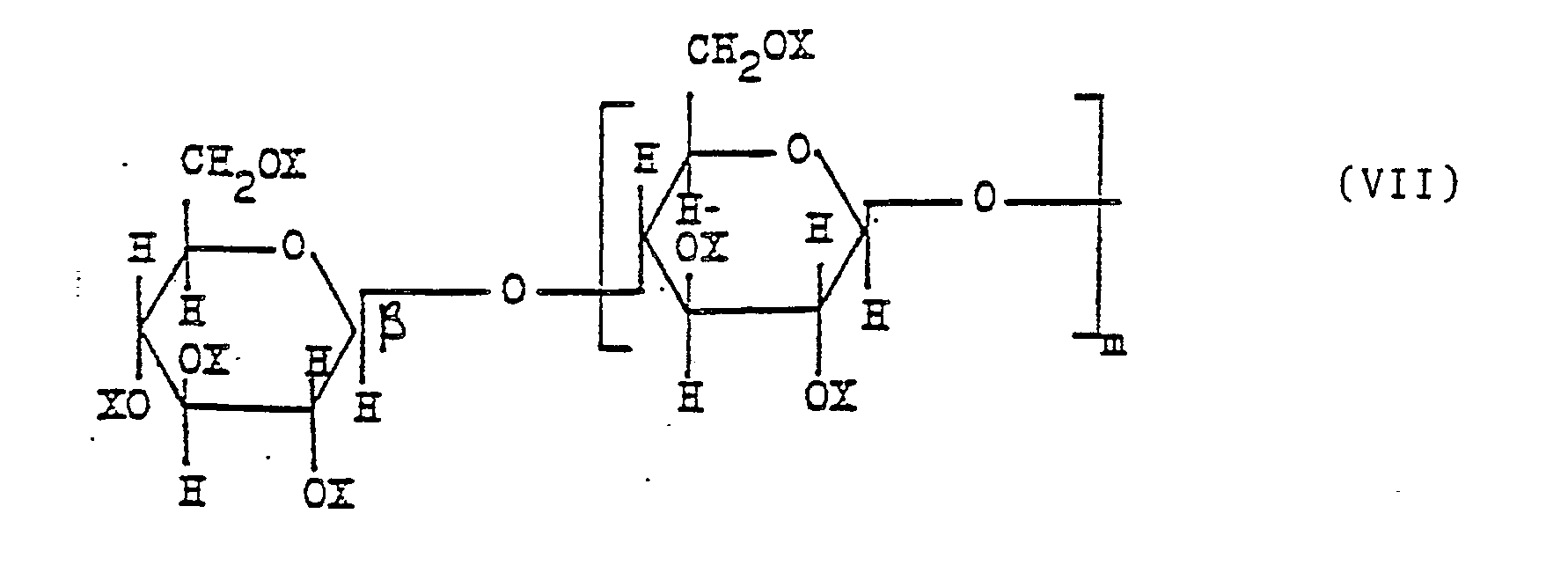
- Beispiele für diese Aldonsäuren umfassen die Hexonsäuren Allonsäure, Altronsäure, Galaktonsäure, Gluconsäure, Gulonsäure, Idonsäure, Mannonsäure und Talonsäure, bevorzugt Galaktonsäure, Gluconsäure, Gulonsäure und Mannonsäure. Weitere Beispiele sind Derivate dieser Hexonsäuren, welche an den Sauerstoffatomen in 3-, 4-, oder 6-Stellung glycosidisch mit einem Rest R3 oder R2 oder R' der Formeln II bis VII, in denen X für Wasserstoff steht, verbunden sind. Die Bindung kann hier α- oder β-glykosidisch sein. Bei den Resten II bis V handelt es sich um Galaktopyranosyl- und Mannopyranosylreste. Die Reste VI und VII sind Glucopyranosylreste (für den Fall, daß m = 0) und a(1-4) bzw. β(1→4) -verknüpfte Oligoglucopyranosylreste (wenn m = 1 bis 6). Vorzugsweise steht in den Formeln VI und VII der Index m für 0 oder 1. Die mit der Aldonsäure verknüpften Saccharideinheiten liegen normalerweise in der D-Form vor. Beispiele für Hexonsäuren der allgemeinen Formel VIII, die mit Resten der Formeln II bis VII substituiert sind, sind Glucopyranosylgluconsäuren, Glucopyranosylmannonsäuren, Glucopyranosylgalaktonsäuren, Galaktopyranosylgluconsäuren, Mannopyranosylgluconsäuren, Mannopyranosylmannonsäuren und Oligoglucopyranosylgluconsäuren. Bevorzugt sind hier Lactobionsäure (4-O-β-D-Galaktopyranosylgluconsäure), Gentiobionsäure, Melibionsäure (6-O-a-D-Galaktopyranosylgluconsäure), Mannobionsäure, Cellobionsäure (4-0-ß-D-Glucopyranosylgluconsäure) und Maltobionsäure (4-O-a-D-Glucopyranosylgluconsäure) sowie Maltotrionsäure und Cellotrionsäure.
- Beispiele für Salzbildende Basen sind Trialkylamine mit 1 bis 6 Kohlenstoffatomen im Alkylteil wie Trimethylamin, Triethylamin, Tripropylamin, Tributylamin, Tripentylamin und Trihexylamin. Bevorzugt sind Trimethylamin, Triethylamin und Tributylamin.
- Beispiele für physiologisch verträgliche anorganische und organische Salze sind die Ammonium-, Lithium-, Natrium-, Kalium-, Magnesium-, Calcium-, Aluminiumsalze und die Salze mit Ethanolamin, Triethanolamin, Morpholin, Pyridin und Piperidin. Bevorzugt sind die Natrium-, Kalium-, Calcium-, Aluminium- und Ethanolaminsalze.
- Beispiele für die Gruppe A darstellende geradkettige oder verzweigte, gesättigte Alkylenreste mit 2 bis 22 Kohlenstoffatomen sind Ethylen-, Tri-, Tetra-, Penta-, Hexa-, Hepta-, Octa-, Nona-, Deca-, Undeca-, Dodeca-, Tetradeca-, Hexadeca-, Octadeca-, Icosa- und Docosamethylen sowie Methylethylen, Methylpropylen, Methylbutylen, Methylpentylen und Dimethylethylen. Bevorzugt sind Ethylen-, Tri-, Tetra-, Hexa-, Nona-, Dodeca- und Docosamethylen sowie Methylethylen und Methylpentylen.
- Beispiele für Arylenreste, durch die der Alkylenrest der Gruppe A unterbrochen sein kann, sind Phenylen, Naphthylen, Anthrylen, Phenanthrylen und Fluorenylen. Bevorzugt sind hierbei ortho-, meta- und para-Phenylenreste.
- Beispiele für Cycloalkylenreste, durch die der Alkylenrest der Gruppe A unterbrochen sein kann, sind Cyclopentylen, Cyclohexylen, Cycloheptylen und Cyclooctylen, wobei hier 1,3-und 1,4-Cyclohexylen bevorzugt sind.
- Vorzugsweise besitzt der geradkettige oder verzweigte, gesättigte Alkylenrest der Gruppe A 2 bis 12 Kohlenstoffatome. Ist der geradkettige oder verzweigte, gesättigte Alkylenrest der Gruppe A durch einen der genannten Reste oder Gruppen unterbrochen, handelt es sich vorzugsweise um 1 oder 2 derartige Reste bzw. Gruppen.
- Spezielle Beispiele für definitionsgemäße, die Gruppe A darstellende Alkylenreste sind die sich von folgenden α,ω-Diaminen ableitenden Gruppen:
-


-
- RS O2C-HC(NH2)-CH2S-CH2-(NH2)CH-CO2 R5
- Diastereomere des Lanthionins (R5 = H)
- und Ester (RS = C1-C6-Alkyl)
- R5O2C-HC(NH2)-(CH2)X S-S-(CH2)x(NH2)CH-CO2R5
- Diastereomere des Cystins (x = 1, R5 = H)
- und Ester (R5 = C1 -C6-Alkyl)
- Diastereomere des Homocystins (x = 2, R5 = H)
- und Ester (RS = C1-C6-Alkyl)
- H02C-CH(NH2)-(CH2)2-S-CH2-CH(NH2)-C02H
- Diastereomere des Cystathionins

- Vorzugsweise kann die Gruppe A für folgende Reste stehen:


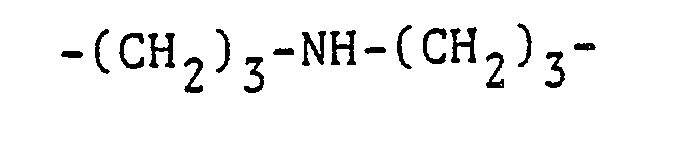

- Beispiele für C1- C6-Alkylreste der Gruppe R4, R5 und R6 sind Methyl, Ethyl, n-Propyl, n-Butyl, n-Pentyl, n-Hexyl, Isopropyl, Isobutyl, tert.-Butyl, Neopentyl, wobei Methyl, Ethyl, n-Propyl, Isopropyl, tert.-Butyl und n-Butyl bevorzugt sind.
- Die Erfindung betrifft auch ein Verfahren zur Herstellung von Polyschwefelsäureestern von Bis-aldonsäureamiden der allgemeinen Formel I, das dadurch gekennzeichnet ist, daß man Bis-Aldonsäureamide der allgemeinen Formel IX


- Man erhält die Verbindungen der allgemeinen Formeln X und XI durch Wasserabspaltung aus den Aldonsäuren VIII. Die Aldonsäuren können nach literaturbekannten Verfahren (z.B. W.N. Emmerling, B. Pfannemüller, Starch 33 (6), 202 (1981); R. Schaffer, H. S. Isbell, J. Am. Chem. Soc. 81, 2178 (1959), H. W. Diehl et al., Carbohydrate Research 38, 364 (1974)) durch elektrochemische oder Hypohalogenit-Oxidation aus den entsprechenden Aldosen gewonnen werden. Für die Herstellung der Bis-aldonsäureamide der allgemeinen Formel IX setzt man pro Mol Diaminoverbindung 2 Mol Aldonsäurelacton ein. Geeignete Lösungsmittel für die Umsetzung sind Methanol, Ethanol, Ethylenglykol, Dimethylsulfoxid, Dimethylformamid oder N-Methylpyrrolidön. Bevorzugt wird Dimethylformamid. Die Reaktionszeiten betragen mehrere Stunden bis Tage, bevorzugt zwischen 5 und 8 h. Die Reaktionstemperaturen liegen zwischen Raumtemperatur und den Siedetemperaturen der jeweiligen Lösungsmittel, bevorzugt zwischen 40 C und 80 C. Die Aldonsäureamide kristallisieren entweder aus der Reaktionslösung aus oder man kann sie durch Zusatz eines organischen Lösungsmittels ausfällen. Geeignet hierfür sind Methanol, Ethanol, Isopropanol oder Aceton, vorzugsweise Isopropanol.
- Die Bis-aldonsäureamide oder allgemeinen Formel IX sind Gegenstand der deutschen Patentanmeldung P ....... der gleichen Anmelderin vom gleichen Anmeldetag (Case BAA, Titel "Bis-aldonsäureamide und Verfahren zur ihrer Herstellung"), deren Offenbarung vorliegend durch Bezugnahme mitumfaßt sein soll.
- Für die Herstellung der vorliegenden Verbindungen der allgemeinen Formel 1 löst oder suspendiert man die Bis-aldonsäureamide der Formel IX in einem aprotischen Lösungsmittel. Geeignet sind Pyridin, Dimethylformamid, Dimethylacetamid, N-Methylpyrrolidon etc., bevorzugt wird Dimethylformamid.
- Man erwärmt das Gemisch auf Temperaturen zwischen 20 C und 100°C, bevorzugt zwischen 30 C und 70°C,und setzt ein Sulfatierungsmittel zu. Beispiele hierfür sind Chlorsulfonsäure, Schwefel-trioxid, Oleum, Ether- oder Amin-Schwefeltrioxid-Komplexe. Bevorzugt werden die Schwefeltrioxid-Komplexe mit Trimethylamin, Triethylamin und Pyridin eingesetzt.
- Um Polyschwefelsäureester von Bis-aldonsäureamiden der allgemeinen Formel I zu erhalten, worin jedes X für die Gruppe -SO3H steht, setzt man für jede veresterungsfähige Hydroxylgruppe 1 bis 2 Äquivalente Sulfatierungsmittel ein, bevorzugt 1,4 - 1,7 Äquivalente. Verbindungen, bei denen nicht jedes X für die Gruppe -SO3H steht, erhält man, wenn man die Sulfatierungsmittel im Unterschuß einsetzt. Je nachdem, wie hoch der Schwefelgehalt des Produktes sein soll, wählt man die Menge des Sulfatierungsmittels. Bevorzugt sind Mengen zwischen 0,5 und 1 Äquivalent Sulfatierungsmittel pro veresterungsfähiger Hydroxylgruppe. Man rührt das Reaktionsgemisch 1 bis 24 h bei Temperaturen zwischen 20 °C und 100 C. Aus den so gewonnenen Polysulfatverbindungen der allgemeinen Formel I, worin X für -SO3H steht, die auch als Salz des Amins des eingesetzten Amin-Schwefeltrioxid-Komplexes vorliegen können, erhält man die entsprechenden Salze anorganischer Basen durch Zugabe dieser Basen oder deren anorganischer Salze. Bevorzugt werden hier die Hydroxide und Acetate der Alkali-und Erdalkalimetalle eingesetzt. Salze physiologisch unbedenklicher organischer Basen erhält man entweder durch Verwendung eines Schwefeltrioxid-Komplexes dieser Basen bei der Sulfatierungsreaktion oder durch Behandeln der Erdalkali-oder Alkalisalze mit einem Kationenaustauscher in der sauren Form und anschließender Neutralisation der sauren Schwefelsäurehalbester mit der organischen Base. Die Isolierung der erfindungsgemäßen Verbindungen erfolgt im allgemeinen durch Fällung aus den Reaktionslösungen oder aus wässrigen Lösungen mit organischen Lösungsmitteln. Geeignete organische Lösungsmittel sind Methanol, Ethanol, Isopropanol oder Aceton, vorzugsweise Methanol.
- Die Verbindungen lassen sich durch wiederholtes Umfällen aus wässrigen Lösungen mit den oben genannten Lösungsmitteln und durch Behandeln mit Aktivkohle oder Wasserstoffperoxid reinigen. Im allgemeinen handelt es sich bei den so erhaltenen Produkten um Gemische mit einem mehr oder weniger hohen Gehalt an Verbindungen, deren sämtliche Hydroxylgruppen mit Sulfatresten verestert sind und an Verbindungen, deren Hydroxylgruppen nur teilweise sulfatiert sind, je nach Menge des eingesetzten Sulfatierungsmittels. Die erhaltenen Gemische können gegebenenfalls durch verschiedene Trennverfahren in Produkte mit einem einheitlichen Gehalt an Sulfatresten aufgetrennt werden. Die Auftrennung kann nach unterschiedlichen physikalischen Trennverfahren geschehen, wie zum Beispiel fraktionierter Fällung, Gel-, lonenaustausch- oder Affinitätschromatographie, HPLC oder elektrophoretischen Verfahren. Bevorzugt wird die fraktionierte Fällung. Zum Beispiel stellt man eine wässrige Lösung des Produktgemisches her und versetzt mit der ein- bis vierfachen Menge eines organischen Lösungsmittels. Geeignet sind mit Wasser mischbare Lösungsmittel wie Methanol, Ethanol, Isopropanol, Aceton oder Tetrahydrofuran, bevorzugt wird Methanol. Den so erhaltenen Niederschlag läßt man absetzen. Im allgemeinen sind nun die Verbindungen mit höherem Sulfatgehalt in der Fällung angereichert, die mit niedrigerem Sulfatgehalt in der überstehenden Lösung. Durch wiederholtes fraktioniertes Fällen der Niederschläge oder Überstände erhält man Verbindungen mit einer definierten Anzahl von Sulfatgruppen.
- In einer bevorzugten Ausführungsform des erfindungsgemäßen Verfahrens werden die Verbindungen der Formel I aus den Aldonsäuren der Formel VIII ohne Isolierung der nötigen Zwischenstufen erzeugt.
- Hierbei stellt man aus den käuflichen oder nach bekannten Literaturverfahren (zum Beispiel W. N. Emmerling, B. Pfannemüller, Starch 33 (6), 202 (1981); R. Schaffer, H. S. Isbell, J. Am. Chem. Soc. 81, 2178 (1959), H. W. Diehl et al., Carbohydrate Research 38, 364 (1974)) synthetisierten Alkali- oder Erdalkalisalzen der Aldonsäuren VIII mittels eines Kationenaustauschers eine wässrige Lösung der freien Aldonsäuren VIII her und engt diese weitgehend ein. Die den Aldonsäuren VIII entsprechenden Lactone werden nun in situ durch Wasserabspaltung erzeugt. Zu diesem Zweck löst man den Rückstand, der im allgemeinen ein wasserhaltiges Gemisch aus Aldonsäure und Lacton darstellt, in einem hochsiedenden Lösungsmittel. Beispiele für hochsiedende Lösungsmittel sind Dimethylsulfoxid, Dimethylformamid, N-Methylpyrrolidon, Dimethoxymethylether etc., bevorzugt wird Dimethylformamid. Nun setzt man ein zweites, niedrigsiedendes Lösungsmittel zu, welches ein Azeotrop mit Wasser bilden kann. Geeignete Lösungsmittel sind zum Beispiel n-Pentan, n-Hexan, Cyclohexan, Benzol etc., bevorzugt ist n-Hexan. Am Wasserabscheider wird nun aus den Aldonsäuren quantitativ Wasser abgespalten. Dann destilliert man das niedrigsiedende Schleppmittel ab und setzt das im zurückbleibenden, hochsiedenden Lösungsmittel befindliche Lacton, ohne Isolierung desselben, mit der Diaminoverbindung um. Die Reaktionstemperaturen liegen dabei zwischen 20 ° C und 120 ° C, bevorzugt zwischen 50 ° C und 80 ° C. Man rührt über Zeitspannen von 3 bis 24 Stunden, bevorzugt 3 bis 8 Stunden. Ohne Isolierung des entstandenen Bis-aldonsäureamids, wird dieses im selben Reaktionsgefäß mit einem Sulfatierungsmittel zur Reaktion gebracht. Reaktionsbedingungen sowie Isolierung und Reinigung der Produkte sind im vorher genannten Verfahren beschrieben.
- Die Verbindungen der allgemeinen Formel I stellen pharmakologisch wertvolle Substanzen dar. Sie besitzen antithrombotische und antientzündliche Eigenschaften. Die erfindungsgemäßen Verbindungen sind deshalb zur Behandlung von Erkrankungen des rheumatischen Formenkreises sowie zur Prophylaxe und Therapie von venösen und arteriellen Thrombosen geeignet. Gegenstand der Erfindung ist daher auch ein Arzneimittel für die Verwendung bei Mensch und Tier. Bevorzugt ist der Gebrauch beim Menschen.
- Besonders überraschend ist die antithrombotische Wirksamkeit der erfindungsgemäßen Verbindungen.
- Bislang wurde zur Thromboseprophylaxe in erster Linie Heparin verwendet. Heparin ist ein Mucopolysaccharid, das aus tierischem Gewebe, insbesondere Schweinedarm isoliert wird (Thomas, D.P. (1981) in Clinics in Haematology, Vol. 10, S. 443 - 458, Saunders Comp. Ltd., 1981). Neben Heparin besitzen auch andere natürlich vorkommende Mucopolysaccharide wie Dermatansulfat oder Heparansulfat antithrombotische Eigenschaften (Rosenberg, R.D., Rosenberg, J. S. (1984), J. Clin. Invest. 74, 1 - 6; Sie, P., Ofosu, F., Fernandez, F., Buchanan, M.R., Petitou M., Boneu, B.(1986) Br. J. Haematol. 64, 707 - 714). Es ist auch ein semisynthetische Chondroitinpolysulfat z.B. aus der DE-PS 31 18 588 bekannt, das unter anderem antithrombotische Eigenschaften aufweist. Nur Heparin wird jedoch therapeutisch verwendet. In jüngster Zeit sind einige niedermolekulare Heparine zur klinischen Anwendung entwickelt worden. Hierbei handelt es sich um Substanzen, die durch verschiedene chemische oder enzymatische Depolymerisationsverfahren aus Heparin gewonnen werden (Thomas, D.P., Merton, R.E. (1982) Thrombos. Res. 28, 343 - 350; Walenga, J.M., Fareed, J., Petitou, M., Samana, M., Lormeau, J.C., Choay, J. (1986) Thrombos. Res. 43, 243 - 248; Koller, M., Schoh, U., Buchmann, P. Largiader, F., von Felten, A., Frick, P.G. (1986) Thrombos. Haemostas. 56, 243 - 246).
- Ein Nachteil der Heparine und niedermolekularen Heparine besteht darin, daß sie natürlichen Ursprungs (z.B. von Tieren stammend) sind. Aus dem tierischen Gewebe stammend sind daher geringe Mengen von Antigen vorhanden, das zu anaphylaktoiden Reaktionen wie Thrombozytenabfall, Thrombose und Embolie führen kann. Diese Nebenwirkungen sind zwar relativ selten, doch schwerwiegend und klinisch schwer beherrschbar.
- Demgegenüber sind die erfindungsgemäßen Verbindungen vollsynthetisch und daher frei von tierischen Antigen.
- Eine andere wesentlich häufigere Komplikation bei der Thromboseprophylaxe mit Heparin und niedermolekularem Heparin ist das Auftreten von Blutungen. Substanzen, die bei gleicher antithrombotischer Wirkung weniger Blutungen verursachen, können daher einen wesentlichen therapeutischen Fortschritt darstellen.
- Zur Prüfung der erfindungsgemäßen Verbindungen auf antithrombotische Wirksamkeit und antientzündliche Wirksamkeit wurden mehrere pharmakologische Tests verwendet.
- Die Entstehung eines klinisch manifesten (größeren) Thrombus kann auf verschiedene Weise verhindert werden. Zum einen können die Faktoren, die an der Bildung des primären Thrombus beteiligt sind, wie Blutplättchenaggregation oder Blutgerinnungssystem, ausgeschaltet werden. Andererseits kann durch Verstärkung der körpereigenen Fibrinolyse die Auflösung des Primärthrombus beschleunigt werden. Eine Verstärkung der körpereigenen Fibrinolyse kann auch dazu dienen, bereits klinisch manifeste Thromben wieder aufzulösen. Der fibrinolytischen Wirkung einer Substanz kommt somit bei Prophylaxe und Therapie von Thrombosen eine große Bedeutung zu. Die fibrinolytische Wirkung der erfindungsmäßigen Substanzen wurde im nachstehenden Test bestimmt. Der Test ist eine leichte Modifikation einer literaturbekannten Methode zur Bestimmung der fibrinolytischen Wirkung (Kluft, C. (1979) Thromb. Haemostas. 41, 365 - 383).
- Die Fibrinolyse wurde mittels plasminogenhaltiger Fibrinplatten bestimmt.
- Petrischalen, 0 9 cm, wurden auf 40 °C vorgewärmt. Unter Schwenken der Schale wurden 3 ml einer 2 % Lösung von Fibrinogen (Behringwerke, Marburg) in Wasser, 1 ml einer Plasminogenlösung, 2 CTA/ml (Behringwerke, Marburg), 3 ml einer 1 % Agaroselösung (Serva, Heidelberg) in 50 mM TRIS/HCI, pH 7,8 und 1 ml einer Lösung von 15 U/ml Thrombin (Behringwerke, Marburg) in Wasser einpipettiert. Nach Abkühlen der Platte wurden Löcher von 5 mm Durchmesser ausgestanzt.
- 0,1 ml Plasma (Humanes Standardplasma, Behringwerke, Marburg), 0,8 ml Wasser und 0,1 mi-Lösung der Testsubstanz in verschiedenen Konzentrationen wurden 10 Minuten bei 37 °C inkubiert. Nach Zusatz von 0,9 ml 0,025 % Essigsäure wurde 5 Minuten bei 4 °C inkubiert und anschließend bei 2000 g 5 Minuten zentrifugiert. Der Niederschlag wurde in 0,1 ml Puffer (20 mM TRIS/HCI, 100 mM NaCI, 2,7 mM EDTA, pH 7,8) aufgenommen.
- 0,02 ml dieser Lösung und 0,005 ml 14,3 mM Flufenaminsäurelösung (Sigma, Taufkirchen) in Puffer werden in die Auftragelöcher der Fibrinplatten pipettiert. Nach 24 Stunden bei 37 C wurden die Lysehöfe planimetriert. Die Fläche der Lysehöfe abzüglich der Lysefläche ohne Substanzzusatz diente als Maß für die fibrinolysesteigernde Aktivität.
- Ergebnis: Das Ergebnis ist in der nachstehenden Tabelle dargestellt.

- Die Hemmung der Blutgerinnung kann auf einfache Weise mittels der aktivierten partiellen Thromboplastinzeit aPTT gemessen werden. Sie gibt einen Aufschluß über die generelle Hemmung des aktivierten Gerinnungssystems. Um die Inzidenz von Blutungen zu verringern, ist hier eine möglichst geringe Hemmung der Blutgerinnung erwünscht.
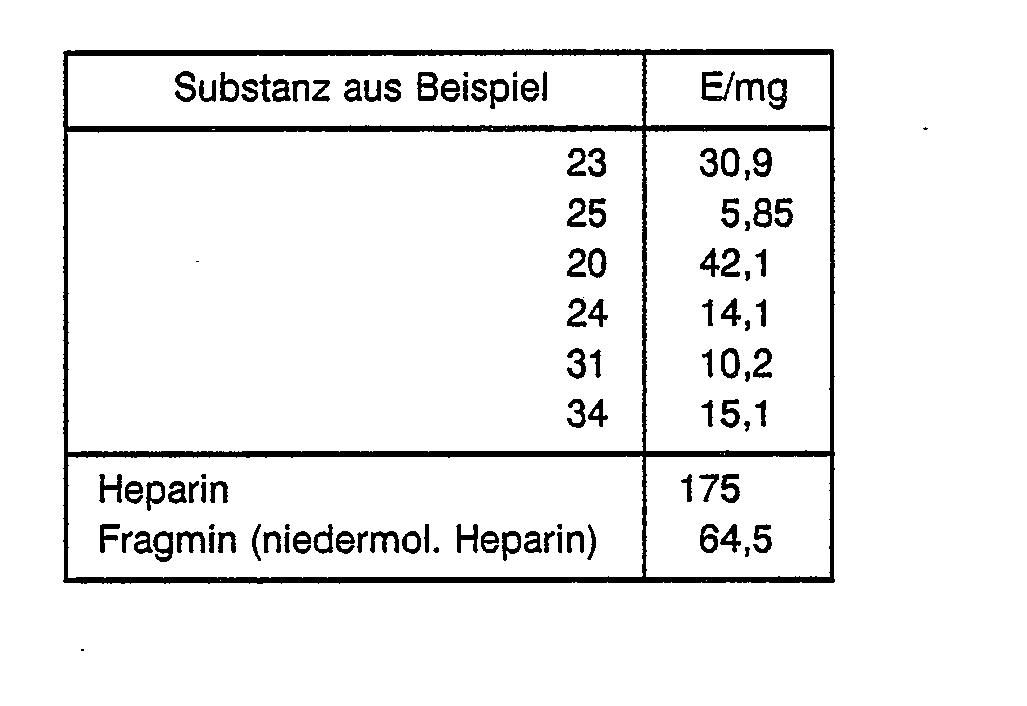
- 0,1 ml Plasma und 0,1 ml Pathromtino (Behringwerke, Marburg) werden 2 Minuten bei 37 °C inkubiert und mit 0,1 ml 25 mM CaC12-Lösung versetzt. Man mißt die Gerinnungszeit in einem Schnitger & Gross Coagulometer. Pro Konzentration wird das Mittel aus 5 Einzelbestimmungen gebildet. Als Standard dient ein Heparin der Firma Pharmindustrie mit 175 E/mg.
- Die Verlängerung der Gerinnungszeit wird über eine Eichkurve in Heparin Einheiten umgewandelt. Da die Eichkurven nicht parallel sind, wird die Verlängerung der Gerinnungszeit auf 150 % des Ausgangswerts als Bezugspunkt gewählt.
- Ergebnis: Die folgende Tabelle zeigt die Heparin Einheiten erfindungsgemäßer Verbindungen.
- Ratten wurde ein ca. 2 mm langes Stück des Schwanzes gekappt. Die Zeit bis zum Ende der Blutung wurde gemessen. Den Tieren wurde 5 Minuten vor Auslösen der Blutung die Prüfsubstanz in verschiedenen Konzentrationen oder physiologische Kochsalzlösung (Kontrolle) verabreicht. Es wurden Gruppen ä 20 Tiere behandelt. Die Verlängerung der Blutungszeit gegenüber der Kontrolle wurde in Prozent ausgedrückt.

- Bei entzündlichen Prozessen werden aus den Phagozyten (polymorphkernige Leukozyten und Makrophagen) große Mengen reaktiver Sauerstoffspezies freigesetzt, darunter Superoxidradikale und Hydroxylradikale. Diese Radikale sind an der Gewebszerstörung beteiligt. Substanzen, die die Radikalbildung in Leukozyten hemmen, sind deshalb von großem therapeutischen Interesse bei der Bekämpfung von Entzündungen (Flohe, L., Giertz, H., Beckmann, R. (1985) in The Pharmacology of inflammation, Vol 5 (Bonta, I. et al. eds.) S. 255 - 281, Elsevier, Amsterdam-New York.
- Die Radikalbildung von Leukozyten kann durch Messung der Luminol-verstärkten Chemilumineszenz in Vollblut gemessen werden (Peter, M. et al. (1985) in Chi. Forum 85 (Stelzner, F., eds), S. 81 - 84, Springer Verlag, Berlin).
- Testsubstanzen werden in PBS gelöst und Verdünnungsreihen in PBS angesetzt. In Küvetten, die zu einem 1251 Luminometer von LKB passen, werden 600 µl PBS, 100 µl Lösung der Testsubstanz, 100 µl Zymosansuspension (100 mg/ml) und 100 u.l Kaninchencitratblut pipettiert. Die Messung wird durch Zusatz von 100 µl 10-3 M Luminol-Lösung gestartet. Die Chemilumineszenz wird über 90 Minuten alle 5 Minuten in jedem Ansatz gemessen. Die maximale Chemilumineszenz wird ermittelt. Als Referenzwert dient ein Ansatz ohne Testsubstanz. Als Leerwert dient ein Ansatz ohne Zymosan-Zusatz. Es werden pro Substanz drei unabhängige Bestimmungen durchgeführt. Die Berechnung der restlichen Chemilumineszenz erfolgt nach der Formel:

- Aus einer semilogarithmischen Auftragung restlicher Chemilumineszenz über log Konzentration ergeben sich Konzentrationen der 50 % CL Hemmung (ICso-Werte).
- Die Hemmung der Luminol-verstärkten CL durch erfindungsmäßige Verbindungen ist in der nachstehenden Tabelle gezeigt.

- Gegenstand der vorliegenden Erfindung sind auch pharmazeutische Zubereitungen, die neben nicht toxischen, inerten pharmazeutisch geeigneten Trägerstoffen einen oder mehrere erfindungsgemäße Wirkstoffe enthalten oder die aus einem oder mehreren erfindungsgemäßen Wirkstoffen bestehen.
- Unter nicht toxischen, inerten pharmazeutisch geeigneten Trägerstoffen sind feste, halbfeste oder flüssige Verdünnungsmittel, Füllstoffe und Formulierungshilfsmittel jeder Art zu verstehen.
- Als bevorzugte pharmazeutische Zubereitungen seien Tabletten, Dragees, Kapseln, Pillen, Granulate, Suppositorien, Lösungen, Suspensionen und Emulsionen, Pasten, Salben, Gele, Cremes, Lotions, Puder, Sprays und Aerosole genannt.
- Tabletten, Dragees, Kapseln, Pillen und Granulate können den oder die Wirkstoffe neben den üblichen Trägerstoffen enthalten, wie a) Füll- und Streckmittel, zum Beispiel Stärken, Milchzucker, Rohrzucker, Glucose, Mannit und Kieselsäure, b) Bindemittel, zum Beispiel Carboxymethylcellulose, Alginate, Gelatine, Polyvinylpyrrolidon, c) Feuchthaltemittel, zum Beispiel Glycerin, d) Sprengmittel, zum Beispiel Agar-Agar, Calciumcarbonat und Natriumbicarbonat, e) Lösungsverzögerer, zum Beispiel Paraffin und f) Resorptionsbeschleuniger, g) Netzmittel, zum Beispiel Cetylalkohol, Glycerinmonostearat, h) Adsorptionsmittel, zum Beispiel Kaolin und Bentonit und i) Gleitmittel, zum Beispiel Talkum, Calcium- und Magnesiumstearat und feste Polyethylenglycole oder Gemische der unter a) bis i) aufgeführten Stoffe.
- Die Tabletten, Dragees, Kapseln, Pillen und Granulate können mit den üblichen gegebenenfalls Opalisierungsmittel enthaltenden Überzügen, zum Beispiel Zucker, Überzugslacke, versehen sein und auch so zusammengesetzt sein, daß sie den oder die Wirkstoffe nur oder bevorzugt in einem bestimmten Teil des Intestinaltraktes, gegebenenfalls verzögert abgeben, wobei als Einbettungsmassen zum Beispiel Polymersubstanzen und Wachse verwendet werden können.
- Der oder die Wirkstoffe können gegebenenfalls mit einem oder mehreren der eben angegebenen Trägerstoffe auch in mikroverkapselter Form vorliegen.
- Suppositorien können neben dem oder den Wirkstoffen die üblichen wasserlöslichen oder wasserunlöslichen Trägerstoffe enthalten, zum Beispiel Polyethylenglycole, Fette, zum Beispiel Kakaofett und höhere Ester (zum Beispiel CH-Alkohol mit C, s-Fettsäure oder Gemische dieser Stoffe).
- Salben, Pasten, Cremes und Gele können neben dem oder den Wirkstoffen die üblichen Trägerstoffe enthalten, zum Beispiel tierische und pflanzliche Fette und deren Derivate, Wachse, Paraffine, Emulgatoren, Stärke, Traganth, Cellulosederivate, Polyacrylate, Polyethylenglycole, Silicone, Bentonite, Talkum, Kieselsäure und Zinkoxid oder Gemische dieser Stoffe.
- Sprays und Puder können neben dem oder den Wirkstoffen die üblichen Trägerstoffe enthalten, zum Beispiel Milchzucker, Talkum, Kieselsäure, Aluminiumhydroxid, Calciumsilikat und Polyamidpulver oder Gemische dieser Stoffe. Sprays können zusätzlich die üblichen Treibmittel, zum Beispiel Chlorfluorkohlenwasserstoff enthalten.
- Lösungen und Emulsionen können neben dem oder den Wirkstoffen die üblichen Trägerstoffe wie Lösungsmittel, Lösungsvermittler und Emulgatoren, zum Beispiel Wasser, Ethylalkohol, Isopropylalkohol, Ethylcarbonat, Ethylacetat, Benzylalkohol, Benzylbenzoat, Propylenglycol, 1,3-Butylenglycol, Öle, insbesondere Baumwollsaatöl, Erdnußöl, Cashewnußöl, Maiskeimöl, Olivenöl, Ricinusöl und Sesamöl, Glycerin, Glycerinformal, Polyethylenglycole und Fettsäureester des Sorbitans oder Gemische dieser Stoffe enthalten.
- Zur parenteralen Applikation können die Lösungen und Emulsionen auch in steriler und blutisotonischer Form vorliegen.
- Suspensionen können neben dem oder den Wirkstoffen die üblichen Trägerstoffe wie flüssige Verdünnungsmittel, zum Beispiel Ethylalkohol, Propylenglycol, Suspendiermittel, zum Beispiel ethoxylierte Isosteaylalkohole, Polyoxyethylensorbit- und Sorbitanester, mikrokristalline Cellulose, Aluminiummetahydroxid, Bentonit, Agar-Agar oder Traganth oder Gemische dieser Stoffe enthalten.
- Die genannten Formulierungsformen können auch Färbemittel, Konservierungsstoffe sowie geruchs-und geschmacksverbessernde Zusätze, zum Beispiel Pfefferminzöl und Eucalyptusöl und Süßmittel, zum Beispiel Saccharin, enthalten.
- Die therapeutisch wirksamen Verbindungen sollen in den oben aufgeführten pharmazeutischen Zubereitungen vorzugsweise in einer Konzentration von etwa 0,1 bis 99,5, vorzugsweise von etwa 0,5 bis 95 Masse-% der Gesamtmischung vorhanden sein.
- Die oben aufgeführten pharmazeutischen Zubereitungen können außer den erfindungsmäßigen Wirkstoffen auch weitere pharmazeutische Wirkstoffe enthalten.
- Die Herstellung der oben aufgeführten pharmazeutischen Zubereitungen erfolgt in üblicher Weise nach bekannten Methoden, zum Beispiel durch Mischen der Wirkstoffe mit den Trägerstoffen.
- Zur vorliegenden Erfindung gehört auch die Verwendung der erfindungsgemäßen Wirkstoffe sowie der pharmazeutischen Zubereitungen, die einen oder mehrere Wirkstoffe enthalten, in der Human- und Veterinärmedizin zur Verhütung, Besserung und/oder Heilung der oben angeführten Krankheiten.
- Die Wirkstoffe oder die pharmazeutischen Zubereitungen können lokal, oral, parenteral, rektal und/oder als Aerosol vorzugsweise parenteral appliziert werden.
- Im allgemeinen hat es sich als vorteilhaft erwiesen, den oder die erfindungsgemäßen Wirkstoffe in Gesamtmengen von etwa 0,1 bis etwa 100, vorzugsweise 0,5 bis 50mg/kg Körpergewicht je 24 Stunden, gegebenenfalls in Form mehrerer Einzelgaben zur Erzielung der gewünschten Ergebnisse zu verabreichen.
- Es kann jedoch erforderlich sein, von den genannten Dosierungen abzuweichen, und zwar in Abhängigkeit von der Art und dem Körpergewicht des zu behandelnden Objektes, der Art und der Schwere der Erkrankung, der Art der Zubereitung und der Applikation des Arzneimittels sowie dem Zeitraum bzw. Intervall, innerhalb welchem die Verabreichung erfolgt. So kann es in einigen Fällen ausreichend sein, mit weniger als der oben genannten Wirkstoffmenge auszukommen, während in anderen Fällen die oben angeführte Menge Wirkstoff überschritten werden muß.
- Die nachfolgenden Beispiele erläutern die Erfindung näher, sollen ihren Umfang in keiner Weise beschränken.
- Man löst 7,13 g D(+)-Gluconsäure-1,5-lacton in 40 ml aminfreiem Dimethylformamid und versetzt mit 1,67 ml 1,3-Diaminopropan. Dann erwärmt man auf 60 C und rührt 5 Stunden. Der entstandene Niederschlag wird abfiltriert, mit Methanol gewaschen und getrocknet. Man erhält 7,96 g eines weißen Pulvers.

- Man suspendiert 7,1 g D-Gluconsäure-1,5-lacton in 90 ml Dimethylformamid, versetzt mit 4,0 g 1,12-Diaminododecan und rührt das Gemisch 5 Stunden bei 60 C. Nach Abkühlen rührt man das Gemisch in 0,3 I Methanol ein, sammelt den Feststoff und wäscht ihn mit Methanol. Nun suspendiert man den Feststoff in 1 N HCI, rührt eine Stunde bei Raumtemperatur, sammelt den Feststoff erneut und wäscht ihn mit Wasser, Aceton und schließlich mit Diethylether. Man erhält 9,9 g eines weißen Pulvers.

- Man löst 395,4 g Calciumlactobionat in 1,2 I Wasser und behandelt die Lösung 1 Stunde mit 0,7 I Lewatit S 100 (H Form) im Batch-Verfahren. Man saugt ab und wäscht den Austauscher mit 2 x 1 I Wasser. Die vereinigten Eluate engt man im Vakuum weitgehend ein. Nun löst man den glasartigen Rückstand in 800 ml aminfreiem Dimethylformamid, setzt 800 ml n-Hexan zu und erhitzt unter kräftigem Rühren am Wasserabscheider zum Sieden. Nach beendeter Wasserabscheidung destilliert man das n-Hexan ab, versetzt mit 43 ml 1,3-Diaminopropan und rührt 7 Stunden bei 63 C. Nun rührt man das Gemisch in 5 I Isopropanol ein, sammelt den Feststoff und wäscht mit 1 I Isopropanol. Nach Trocknung erhält man 350 g eines weißen Feststoffes. Zur Reinigung löst man diesen in 2 I Wasser. Die Lösung behandelt man 1 Stunde mit 100 ml Lewatit S 100 (H+-Form), dann mit 100 ml Amberlyst A 21 (OH-Form). Nach Gefriertrocknung erhält man die Titelverbindung in reiner Form.

- Man suspendiert 17,0 g Lactobionsäure-1,5-lacton in 100 ml aminfreiem Dimethylformamid, versetzt mit 2,9 g 1,6-Diaminohexan und rührt 6 Stunden bei 80 ° C. Nach Abkühlen wird filtriert, und das Filtrat in 1 I Diethylether eingerührt. Der teilweise ölige Niederschlag wird in 50 ml Wasser gelöst und mit 80 ml lonenaustauscher (Merck 4765, H+-Form) behandelt. Man filtriert und erhält nach Lyophilisierung 19,5 g farbloses Pulver, das sich ab 175 ° C unter Braunfärbung zersetzt.

- Man suspendiert 40,8 g Lactobionsäure-1,5-lacton in 150 ml aminfreiem Dimethylformamid, gibt 12,0 g 1,12-Diaminododecan zu und rührt 6 Stunden bei 60 C. Unter Rühren tropft man das Gemisch in 1,5 I Isopropanol. Der Niederschlag wird mit Isopropanol gewaschen und in 250 ml Wasser gelöst. Man behandelt die Lösung erst mit 20 ml eines sauren Ionenaustauschers (Lewatit S 100), dann mit einem basischen Ionenaustauscher (Merck 4767). Nach Lyophilisierung erhält man 35,0 g eines farblosen Pulvers. Schmelzpunkt: 79 - 81 ° C

- Herstellung und Reinigung analog Beispiel 5. Man erhält aus 15,0 g Lactobionsäure-1,5-lacton und 3,47 g 1,9-Diaminononan 15,0 g der Titelverbindung.

- Man setzt 2,04 g Cellobionsäure-1,5-lacton (H. W. Diehl et al., Carbohydr. Res. 38, 364 (1974)) analog Beispiel 5 mit 0,60 g 1,12-Diaminododecan um und erhält 0,60 g der Titelverbindung.

- Man setzt 20,0 g Calcium-maltobionat (W.N. Emmerling, B. Pfannemüller, Starch 33, 202, (1981)) analog Beispiel 3 mit 1,12-Di-aminododecan um und erhält 17,8 g Produkt.

- Man setzt 3,96 g Kalium-melibionat (Sigma-Chemie) analog Beispiel 3 mit 1,00 g 1,12-Diaminododecan um und erhält 3,3 g der Titelverbindung.

- Herstellung analog Beispiel 9. Aus 3,96 g Kalium-melibionat und 0,37 g 1,3-Diaminopropan erhält man 3,0 g Produkt.

- Verwendet man bei einem Verfahren gemäß Beispiel 5 17,0 g Lactobionsäure-1,5-lacton und 3,3 ml 3-(Aminomethyl)-benzylamin, so erhält man auf gleiche Weise 12,2 g der Titelverbindung als farbloses Pulver.

- Herstellung und Reinigung analog Beispiel 5 aus 17,0 g Lactobionsäure-1,5-lacton und 5,3 g 4,4'-Diamino-dicyclohexylmethan. Ausbeute: 21,3 g.

- Man versetzt 17,0 g Lactobionsäure-1,5-lacton und 5,63 g Cystamin Dihydrochlorid in 50 ml aminfreiem DMF bei Raumtemperatur mit 6,9 ml Triethylamin und rührt anschließend 6 Stunden bei 60 C. Man fällt mit 500 ml Ethanol und behandelt den Niederschlag wie in Beispiel 5 weiter. Man erhält 13,2 g weißes Pulver.

- Man suspendiert 17,0 g Lactobionsäure-1,5-lacton in 100 ml aminfreiem Dimethylformamid, versetzt bei Raumtemperatur mit 2,28 ml Bis-(3-aminopropyl)-amin und rührt 10 Stunden. Dann rührt man 4 Stunden bei 40 C und filtriert. Das Filtrat rührt man in 900 ml Aceton ein und erhält nach Waschen mit Aceton und Trocknen 23,0 g weiße Kristalle. Diese werden in 80 ml Wasser gelöst und mit 900 ml Aceton gefällt. Der teils ölige Niederschlag wird in 150 ml Wasser gelöst, filtriert und lyophilisiert. Ausbeute: 16,5 g.

- Herstellung und Reinigung analog Beispiel 5. Man erhält aus 17,0 g Lactobionsäure-1,5-lacton und 5,1 g 1,12-Diamino-4,9-dioxa-dodecan 18,9 g der Titelverbindung.

- Herstellung und Reinigung analog Beispiel 5. Man erhält aus 3,40 g Lactobionsäure-1,5-lacton und 0,44 g N,N'-Dimethylethylendiamin 3,0 g der Titelverbindung.

- Man suspendiert2,47 g Lysinethylester-Dihydrochlorid in 40 ml aminfreiem Dimethylformamid, versetzt mit 3,0 ml Triethylamin und rührt 15 Minuten. Dann gibt man 6,8 g Lactobionsäure-1,5-lacton zu, erwärmt auf 60° C und rührt 1 Tag. Man filtriert und rührt das Filtrat in 400 ml Isopropanol ein. Der Niederschlag wird gesammelt, in 60 ml Dimethylformamid gelöst und erneut mit 300 ml Isopropanol gefällt. Man wiederholt die Fällung, wäscht mit Isopropanol und Diethylether und erhält so 4,05 g eines weißen Pulvers.

- 4,30 g N,N'-1,3-Propandiylbis-D-gluconamid werden in 50 ml trockenem Dimethylformamid suspendiert, auf 40 C erwärmt und unter Rühren mit 23,9 g Pyridin-Schwefeltrioxid-Komplex versetzt. Nach wenigen Minuten fällt das Produkt in Form des Pyridiniumsalzes als Öl aus. Nach 1 Stunde läßt man abkühlen und dekantiert die überstehende Lösung ab. Das Öl wird in 50 ml Wasser gelöst und mit 6 N Natronlauge auf pH = 10 gebracht. Die Lösung wird mit Wasser auf 90 ml aufgefüllt und in 350 ml einer 1 %igen Natriumacetatlösung eingerührt. Der Niederschlag wird mit Methanol gewaschen und getrocknet. Man erhält 18,6 g eines farblosen Pulvers. Dieses löst man in 186 ml Wasser. In die Lösung rührt man 227 ml Methanol ein und läßt 15 Stunden stehen. Man dekantiert vom abgeschiedenen Öl und verreibt dieses mit Methanol. Man wiederholt die Fällung, bis die Titelverbindung rein vorliegt. Zersetzung ab 190 °C unter Braunfärbung.

- Man setzt 5,60 g N,N'-1,12-Dodecandiylbis-D-gluconamid analog Beispiel 18 mit 25,5 g Pyridin-Schwefeltrioxid-Komplex um und erhält 20,5 g rohes Produkt. Das reine Produkt gewinnt man durch Gelchromatographie einer wässrigen Lösung an einer Sephadex G 25-Säule. Nach Gefriertrocknung erhält man ein farbloses Pulver, das sich zwischen 175 °C und 189 °C unter Braunfärbung zersetzt.

- Man löst 79,1 g Calciumlactobionat in 240 ml Wasser und behandelt die Lösung mit 240 ml Lewatit S 100 (H -Form). Man wäscht den Ionenaustauscher mit 3 x 200 ml Wasser und engt die vereinigten Lösungen so weit wie möglich ein. Der glasartige Rückstand wird in 700 ml aminfreiem Dimethylformamid gelöst und mit 600 ml n-Hexan am Wasserabscheider zum Sieden erhitzt. Nach beendeter Wasserabscheidung dampft man das n-Hexan ab und versetzt die Lösung bei Raumtemperatur mit 7,7 g 1,3-Diaminopropan in 50 ml Dimethylformamid. Nach 5stündigem Rühren bei 60° C läßt man auf ca. 30 °C abkühlen, verdünnt mit 450 ml Dimethylformamid und gibt rasch portionsweise unter Rühren 400 g Pyridin-Schwefeltrioxid-Komplex zu. Man rührt 1 Stunde zwischen 40 und 45 °C und läßt abkühlen. Man dekantiert vom abgeschiedenen Öl, löst dieses in 500 ml Wasser und stellt die Lösung mit 30 %iger Natronlauge auf pH = 10 ein. man ergänzt mit Wasser auf ein Volumen von 1,5 I und rührt die Lösung in 4,5 I einer 1 %igen methanolischen Natriumacetatlösung ein. Der Niederschlag wird mit 1 I Methanol verrührt, abgesaugt und getrocknet. Man erhält 250 g eines gelblichen Pulvers. Dieses löst man in 2 I Wasser, versetzt mit 250 ml 30 %igem Hydrogenperoxid und rührt 1 Stunde bei 45 C. Nach dem Abkühlen neutralisiert man und ergänzt mit Wasser auf 2,5 I. Die Lösung rührt man in 3,06 I Methanol ein und läßt 15 Stunden stehen. Man dekantiert von abgeschiedenem Öl und verreibt dieses mit Methanol. Nach dem Trocknen erhält man 188,5 g farbloses Pulver. man wiederholt den Fällungsvorgang viermal und erhält schließlich ca. 50 g der reinen Titelverbindung als farbloses Pulver, das sich ab 172 C unter Zersetzung braun färbt und nicht unter 250 ° C schmilzt.

- Man löst 3,77 g N,N'-1,3-Propandiylbis (4-0-ß-D-galactopryanosyl-D-gluconamid) in 60 ml trockenem Dimethylformamid und versetzt bei 40 °C unter Rühren portionsweise mit 13,5 g Pyridin-Schwefeltrioxid-Komplex. Nach 1 Stunde arbeitet man wie in Beispiel 18 auf und erhält 10,3 g gelbliches, sulfathaltiges Rohprodukt. Man löst in 90 ml Wasser, versetzt mit 10 ml 30 %igem Hydrogenperoxid und rührt 1 Stunde bei 45° C. Nach Abkühlen rührt man 230 ml Methanol ein und läßt 15 Stunden stehen. Man dekantiert vom abgeschiedenen Öl ab, verreibt dieses mit Methanol und erhält 6,72 g sulfatfreies Produkt (mit einem Schwefelgehalt von 20,6 %). Man löst in 67 ml Wasser, rührt 82 ml Methanol ein und läßt 15 Stunden stehen. Man dekantiert vom abgeschiedenen Öl und rührt in den Überstand weitere 74 ml Methanol ein. Nach 15 Stunden isoliert man das Öl und wiederholt damit mehrmals die fraktionierte Fällung wie oben, bis die Titelverbindung rein vorliegt. Man erhält 0,53 g farbloses Pulver, das sich ab 180 C unter Braunfärbung zersetzt.

- Man behandelt eine Lösung von 1,76 g des Natriumsalzes aus Beispiel 20 15 Minuten mit 16 ml Lewatit S-100 (H -Form), filtriert den lonenaustauscher ab und versetzt das Filtrat mit 1,03 g Morpholin. Nach Lyophilisierung erhält man 2,40 g gelbliches Pulver. Zersetzung ab 120 °C und Schwarzfärbung bei 210 °C

- Man setzt 16,3 g N,N'-1,6-Hexandiylbis (4-O-ß-D-galactopyranosyl-D-gluconamid) mit 75,0 g Pyridin-Schwefeltrioxid-Komplex analog Beispiel 18 um. Nach der ersten Fällung erhält man 56,9 g eines gelblichen Pulvers, das man wie in Beispiel 20 reinigt. Man gelangt schließlich zu ca. 15 g der reinen Titelverbindung in Form eines farblosen Pulvers, das ab 120 °C sintert. Zersetzung ab 170 °C unter Braunfärbung.

- Herstellung und Reinigung analog Beispiel 23. Aus 15,0 g N,N'-1,9-Nonandiylbis(4-O-β-D-galactopyranosyl-D-gluconamid) und 63,0 g Pyridin-Schwefeltrioxid-Komplex erhält man 45,0 g Rohprodukt. Nach Reinigung: 10,5 g farbloses Pulver. Zersetzung zwischen 192-210 C unter Braunfärbung

- Herstellung und Reinigung analog Beispiel 23. Aus 4,23 g N,N'-1,12-Dodecandiylbis (4-O-ß-D-galactopyranosyl-D-gluconamid) und 19,1 g Pyridin-Schwefeltrioxid-Komplex erhält man 13,30 g Rohprodukt. Nach Reinigung: 3,5 g reine Titelverbindung als farbloses Pulver. Zersetzung zwischen 188 - 198 °C unter Braunfärbung

- Aus 0,34 g N,N'-1,12-Dodecandiylbis (4-0-ß-D-glucopyranosyl-D-gluconamid) und 1,12 g Pyridin-Schwefeltrioxid-Komplex erhält man analog Beispiel 23 0,68 g rohes bzw. 0,10 g reines Produkt. Zersetzung ab 148 ° C bis 159 ° C unter Braunfärbung.

- Aus 12,8 g N,N'-1,12-Dodecandiylbis (4-0-a-D-glucopyranosyl-D-gluconamid) und 64,6 g Pyridin-Schwefeltrioxid-Komplex erhält man analog Beispiel 23 47,5 g rohes bzw. 3,0 g reines Produkt. Zersetzung von 175 ° C bis 189 °C unter Braunfärbung.

- Analog Beispiel 23 erhält man aus 3,30 g N,N'-1,12-Dodecandiylbis (6-O-α-D-galactopyranosyl-D-gluconamid) und 14,9 g Pyridin-Schwefeltrioxid-Komplex 9,7 g rohes bzw. 3,4 g reines Produkt, das ab 57 °C sintert. Zersetzung ab 182 ° C unter Braunfärbung.

- Aus 0,34 g N,N'-1,3-Propandiylbis (6-O-α-D-galactopyranosyl-D-gluconamid) und 2,0 g Pyridin-Schwefeltrioxid-Komplex erhält man analog Beispiel 23 0,96 g rohes bzw. 0,50 g reines Produkt. Zersetzung ab 168 °C unter Braunfärbung
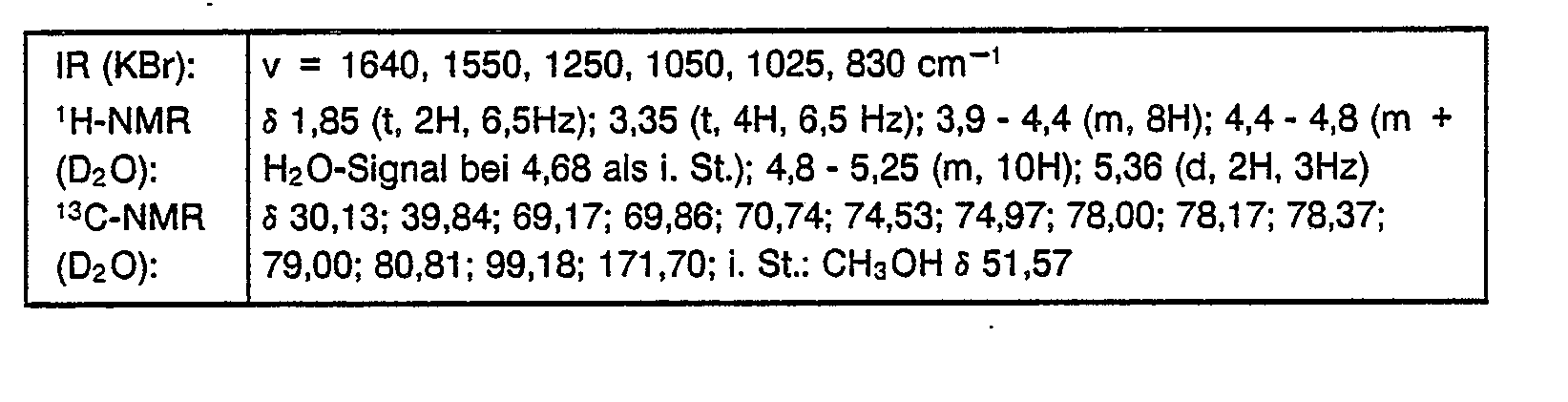
- Aus 12,0 g N,N'-α,α'-m-Xyloldiylbis(4-O-β-D-galactopyranosyl-D-gluconamid) und 58,8 g Pyridin-Schwefeltrioxid-Komplex erhält man analog Beispiel 23 28,0 g rohes bzw. 5,3 g reines Produkt. Zersetzung ab 157 °C unter Braunfärbung.

- Analog Beispiel 23 erhält man aus 25,7 g N,N'-4,4'-Dicyclohexylmethandiylbis (4-O-ß-D-galactopyranosyl-D-gluconamid) und 114,7 g Pyridin-Schwefeltrioxid-Komplex 70,7 g rohes bzw. 15,2 g reines Produkt, das ab 120 °C sintert. Zersetzung ab 180 °C unter Braunfärbung.

- Aus 11,2 g N,N'-1,6-(3,4-Dithiahexandiylbis)4-0-ß-D-gaiactopyranosyl-D-gluconamid) und 53,4 g Pyridin-Schwefeltrioxid-Komplex erhält man analog Beispiel 23 38,0 g rohres und 8,5 g reines Produkt. Zersetzung ab 163 °C unter Braunfärbung.

- Aus 11,0 g N,N'-1,7-(4-Azaheptandiylbis)4-O-β-D-galactopyranosyl-D-gluconamid und 50,0 g Pyridin-Schwefeltrioxid-Komplex erhält man analog Beispiel 23 15,4 g rohes und 2,2 g reines Produkt. Zersetzung ab 165 °C unter Braunfärbung.

- Aus 18,2 g N,N'-1,12-(4,9-dioxadodecandiylbis)4-O-β-D-galactopyranosyl-D-gluconamid und 59,0 g Pyridin-Schwefeltrioxid-Komplex erhält man gemäß Beispiel 23 37,1 g rohes und 9,3 g reines Produkt, das ab 120° C sintert. Zersetzung ab 170 °C unter Braunfärbung.

- Aus 2,50 g N,N'-Dimethyl-N,N'-1,2-ethandiylbis (4-0-ß-D-galactopyranosyl-D-gluconamid) und 12,4 g Pyridin-Schwefeltrioxid-Komplex erhält man analog Beispiel 23 8,2 g rohes und 1,2 g reines Produkt. Zersetzung von 188 - 200 °C unter Braunfärbung.

- Aus 3,6 g N,N'-1,5-(1-Ethoxycarbonyl)-pentandiylbis(4-O-β-D-galactopyranosyl-D-gluconamid) und 15,8 g Pyridin-Schwefeltrioxid-Komplex erhält man gemäß Beispiel 23 8,7 g rohes und 1,2 g reines Produkt, das ab 60 °C sintert. Zersetzung ab 161 °C unter Braunfärbung.

- Man löst 3,56 g D-Gulono-γ-lacton und 0,84 ml 1,3-Diaminopropan in 40 ml Dimethylformamid und rührt 6 Stunden bei 60 C. Nun rührt man das Gemisch in 200 ml Isopropanol ein und wäscht den Niederschlag mit Isopropanol und Diethylether. Man löst den Feststoff in 20 ml Dimethylformamid und fällt nochmals mit 200 ml Isopropanol. Der Niederschlag wird in Wasser gelöst und gefriergetrocknet. Man erhält 2,2 g eines farblosen Pulvers.

- Analog Beispiel 37 erhält man aus 7,12 g D-Galactono-γ-lacton und 1,48 g 1,2-Diaminopropan 4,1 g der Titelverbindung als farbloses Pulver.

- Analog Beispiel 18 erhält man aus 3,56 g L-Mannono-y-lacton und 0,90 g Putrescin 2,4 g der Titelverbindung als farbloses Pulver. Zersetzung von 181 - 188° C unter Braunfärbung

- Analog Beispiel 37 erhält man aus 6,8 g Lactobionsäure-1,5-lacton und 0,5 ml Hydrazinhydrat 6,1 g Rohprodukt. Säulenchromatographie über Fractogel TSK HW 40S liefert das reine Produkt als farbloses Pulver nach Gefriertrocknung.
- Analog Beispiel 18 erhält man aus 2,2 g N,N'-1,3-Propandiylbis-D-gulonamid und 12,3 g Pyridin-Schwefeltrioxid-Komplex 9,8 g rohes bzw. 6,4 g reines Produkt als farbloses Pulver. Zersetzung ab 185 ° C unter. Braunfärbung.

- Analog Beispiel 18 erhält man aus 3,3 g N,N'-1,2-Propandiylbis-D-galactonamid und 19,5 g Pyridin-Schwefeltrioxid-Komplex 13,0 g rohes bzw. 9,8 g reines Produkt als farbloses Pulver. Zersetzung ab 191 °C unter Braunfärbung.
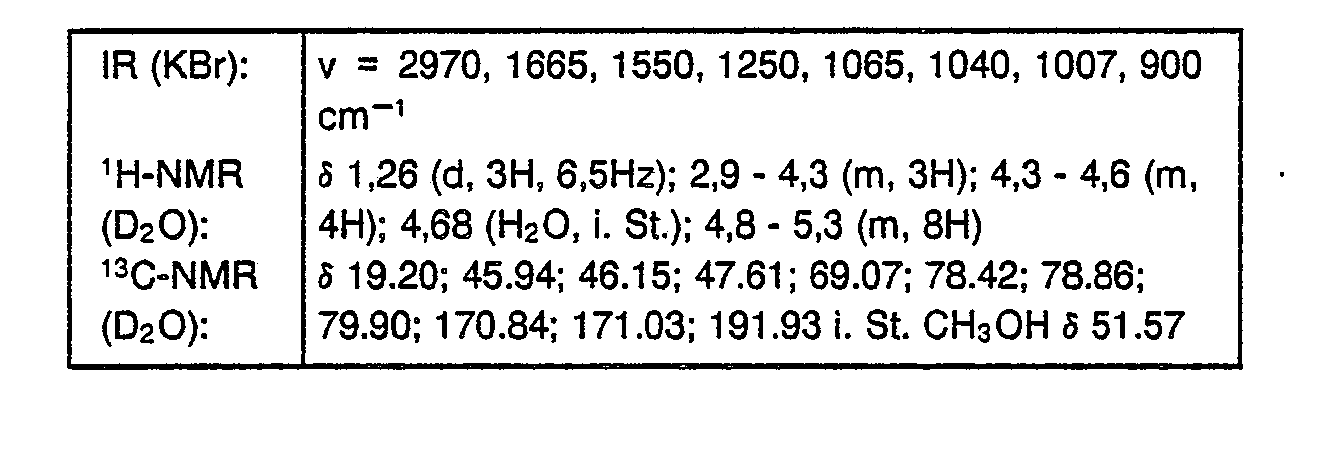
- Analog Beispiel 18 erhält man aus 2,5 g N,N'-1,4-Butandiylbis-L-mannonamid und 14,1 g Pyridin-Schwefeltrioxid-Komplex 10,5 g rohes bzw. 7,2 g reines Produkt als farbloses Pulver. Zersetzung ab 180°C unter Braunfärbung

- Analog Beispiel 18 erhält man aus 6,0 g N,N'-Dilactobionoylhydrazin und 33,7 g Pyridin-Schwefeltrioxid-Komplex 17,5 g rohes bzw. 7,3 g reines Produkt.
- Man löst bei Zimmertemperatur 5,000 kg Trockensubstanz von Hexadecanatrium N,N'-1,3-propandiylbis[2,3,5,6-tetra-O-sulfo-4-O-(2,3,4,6-tetra-O-sulfo-β-D-galactopyranosyl)-D-gluconamid] unter Rühren in 40 l aqua ad iniectabilia. Nach Einstellen des pH-Wertes der Lösung auf 7,5 mit verdünnter Natronlauge ergänzt man mit aqua ad iniectabilia auf 50,00 I und filtriert durch ein Membranfilter der Porenweite 0,2 u.m. Die Lösung wird unter aseptischen Bedingungen in Ampullen zu 1 ml abfiltriert und diese abgeschmolzen.
Claims (14)




Priority Applications (1)
| Application Number | Priority Date | Filing Date | Title |
|---|---|---|---|
| AT88117115T ATE101159T1 (de) | 1987-10-14 | 1988-10-14 | Polyschwefelsaeureester von bis-aldonsaeureamiden und deren derivaten, verfahren zu ihrer herstellung und arzneimittel. |
Applications Claiming Priority (2)
| Application Number | Priority Date | Filing Date | Title |
|---|---|---|---|
| DE19873734815 DE3734815A1 (de) | 1987-10-14 | 1987-10-14 | Polyschwefelsaeureester von bis-aldonsaeureamiden und deren derivaten, verfahren zu ihrer herstellung und arzneimittel |
| DE3734815 | 1987-10-14 |
Publications (3)
| Publication Number | Publication Date |
|---|---|
| EP0312086A2 true EP0312086A2 (de) | 1989-04-19 |
| EP0312086A3 EP0312086A3 (de) | 1991-07-03 |
| EP0312086B1 EP0312086B1 (de) | 1994-02-02 |
Family
ID=6338337
Family Applications (1)
| Application Number | Title | Priority Date | Filing Date |
|---|---|---|---|
| EP88117115A Expired - Lifetime EP0312086B1 (de) | 1987-10-14 | 1988-10-14 | Polyschwefelsäureester von Bis-aldonsäureamiden und deren Derivaten, Verfahren zu ihrer Herstellung und Arzneimittel |
Country Status (13)
| Country | Link |
|---|---|
| US (1) | US5008247A (de) |
| EP (1) | EP0312086B1 (de) |
| JP (1) | JPH064667B2 (de) |
| AT (1) | ATE101159T1 (de) |
| AU (1) | AU596755B2 (de) |
| CS (1) | CS395791A3 (de) |
| DE (2) | DE3734815A1 (de) |
| DK (1) | DK162393C (de) |
| ES (1) | ES2061592T3 (de) |
| FI (1) | FI89173C (de) |
| IE (1) | IE63947B1 (de) |
| IL (1) | IL87936A (de) |
| ZA (1) | ZA887641B (de) |
Cited By (22)
| Publication number | Priority date | Publication date | Assignee | Title |
|---|---|---|---|---|
| EP0649854A1 (de) * | 1993-09-01 | 1995-04-26 | Akzo Nobel N.V. | Biskonjugate, die zwei Saccharide und einen Spacer enthalten |
| EP0663391A1 (de) * | 1994-01-14 | 1995-07-19 | F. Hoffmann-La Roche Ag | Schwefelsäureester von Zuckeralkoholen zur Behandlung von arteriosklerotischen Gefässwandveränderungen |
| US5498775A (en) * | 1994-11-07 | 1996-03-12 | American Home Products Corporation | Polyanionic benzylglycosides as inhibitors of smooth muscle cell proliferation |
| US5565432A (en) * | 1994-11-07 | 1996-10-15 | American Home Products Corporation | Smooth muscle cell proliferation inhibitors |
| US5589588A (en) * | 1993-03-30 | 1996-12-31 | Reliable Biopharmaceutical Corporation | Sulfated acid amides having anticoagulant properties |
| TR28743A (tr) * | 1994-01-14 | 1997-03-06 | Hoffmann La Roche | Seker alkollerinin yeni sülfürik asid esterleri. |
| EP0741128A3 (de) * | 1995-05-05 | 1997-03-26 | Hoffmann La Roche | Schwefelsäureester von Zuckeralkoholen zum Hemmen von der Migration und Proliferation von glatten Muskelzellen der Gefässwand |
| WO1997012893A1 (en) * | 1995-10-04 | 1997-04-10 | Reliable Biopharmaceutical Corporation | Sulfated acid amides having anticoagulant properties |
| US5686603A (en) * | 1995-05-04 | 1997-11-11 | Lever Brothers Company, Division Of Conopco, Inc. | Sulfated polyhydroxy compounds as anionic surfactants and a process for their manufacture |
| US5767268A (en) * | 1995-05-05 | 1998-06-16 | Hoffmann-La Roche Inc. | Sulfuric acid esters of amino sugars |
| US5773420A (en) * | 1994-11-07 | 1998-06-30 | American Home Products Corporation | Acylated benzylglycosides as inhibitors of smooth muscle cell proliferation |
| WO2000031092A3 (en) * | 1998-11-24 | 2001-01-18 | American Home Prod | Benzyllactobionamides as inhibitors of smooth muscle cell proliferation |
| US6187755B1 (en) | 1998-11-24 | 2001-02-13 | American Home Products Corporation | Benzylmaltosides as inhibitors of smooth muscle cell proliferation |
| US6258784B1 (en) | 1998-11-24 | 2001-07-10 | American Home Products Corp. | Acetal benzylmaltosides as inhibitors of smooth muscle cell proliferation |
| US6291434B1 (en) | 1998-11-24 | 2001-09-18 | American Home Products Corp. | Benzylmaltotriosides as inhibitors of smooth muscle cell proliferation |
| US6339064B1 (en) | 1998-11-24 | 2002-01-15 | American Home Products Corporation | Benzylglycosylamides as inhibitors of smooth muscle cell proliferation |
| US6340670B1 (en) | 1998-11-24 | 2002-01-22 | American Home Products Corporation | Acetal benzylmaltosides as inhibitors of smooth muscle cell proliferation |
| US6362170B1 (en) | 1998-11-24 | 2002-03-26 | American Home Products Corporation | Benzylglycosylamides as inhibitors of smooth muscle cell proliferation |
| US6451767B1 (en) | 1998-11-24 | 2002-09-17 | Wyeth | Benzylmaltotriosides as inhibitors of smooth muscle cell proliferation |
| US6664243B1 (en) | 1998-11-24 | 2003-12-16 | Wyeth | Benzyllactobionamides as inhibitors of smooth muscle cell proliferation |
| US7081448B2 (en) | 1998-11-24 | 2006-07-25 | Wyeth | Benzyllactobionamides as inhibitors of smooth muscle cell proliferation |
| US7132402B2 (en) | 1998-11-24 | 2006-11-07 | Wyeth | Acylated benzylmaltosides as inhibitors of smooth muscle cell proliferation |
Families Citing this family (7)
| Publication number | Priority date | Publication date | Assignee | Title |
|---|---|---|---|---|
| DE3734853A1 (de) * | 1987-10-14 | 1989-04-27 | Luitpold Werk Chem Pharm | Bis-aldonsaeureamide und verfahren zu ihrer herstellung |
| IT1237518B (it) * | 1989-11-24 | 1993-06-08 | Renato Conti | Eparine supersolfatate |
| DK0454220T3 (da) * | 1990-04-23 | 1993-11-22 | Sanofi Elf | Carbohydratderivater omfattende en trisaccharidenhed |
| US5386018A (en) * | 1991-12-31 | 1995-01-31 | Lever Brothers Company, Division Of Conopco, Inc. | Process of preparing N-substituted aldonamides |
| US5849709A (en) * | 1995-05-10 | 1998-12-15 | Glycomed Incorporated | Saccharopeptides and derivatives thereof |
| CA2576131C (en) * | 2004-08-05 | 2012-04-24 | Ivax Drug Research Institute Ltd. | Polysulfated glycosides and salts thereof |
| GB0622688D0 (en) * | 2006-11-14 | 2006-12-27 | Diosamine Dev Corp | Novel compounds |
Family Cites Families (8)
| Publication number | Priority date | Publication date | Assignee | Title |
|---|---|---|---|---|
| US2752334A (en) * | 1952-03-01 | 1956-06-26 | Nat Dairy Res Lab Inc | Nu-substituted lactobionamides |
| DE1124938B (de) * | 1959-02-05 | 1962-03-08 | Akad Wissenschaften Ddr | Verfahren zur Herstellung von nichtionogenen Polyoxycarbonsaeureamiden |
| US4098995A (en) * | 1976-07-12 | 1978-07-04 | American Cyanamid Company | Polygalactosido-sucrose poly(h-)sulfate salts |
| US4229446A (en) * | 1979-03-13 | 1980-10-21 | Kyowa Hakko Kogyo Co., Ltd. | Aluminum acetylsalicylate glutaminate |
| US4357326A (en) * | 1981-08-28 | 1982-11-02 | American Cyanamid Company | Multi-glucopyranosyl-fructofuranosyl-galactopyranosyl-glucopyranoside sulfate salts and methods of use |
| DE3204373A1 (de) * | 1982-02-09 | 1983-08-18 | Luitpold-Werk, Chemisch-pharmazeutische Fabrik GmbH & Co, 8000 München | Thiazaspiranderivate, verfahren zu ihrer herstellung und arzneimittel |
| JPS6261965A (ja) * | 1985-09-11 | 1987-03-18 | Kao Corp | ビス(2−グルコンアミドアルキル)ジスルフイド |
| DE3734853A1 (de) * | 1987-10-14 | 1989-04-27 | Luitpold Werk Chem Pharm | Bis-aldonsaeureamide und verfahren zu ihrer herstellung |
-
1987
- 1987-10-14 DE DE19873734815 patent/DE3734815A1/de active Granted
-
1988
- 1988-10-05 IL IL87936A patent/IL87936A/xx not_active IP Right Cessation
- 1988-10-12 FI FI884697A patent/FI89173C/fi not_active IP Right Cessation
- 1988-10-12 AU AU23686/88A patent/AU596755B2/en not_active Ceased
- 1988-10-12 US US07/256,624 patent/US5008247A/en not_active Expired - Fee Related
- 1988-10-13 IE IE310388A patent/IE63947B1/en not_active IP Right Cessation
- 1988-10-13 ZA ZA887641A patent/ZA887641B/xx unknown
- 1988-10-14 DK DK572788A patent/DK162393C/da not_active IP Right Cessation
- 1988-10-14 AT AT88117115T patent/ATE101159T1/de not_active IP Right Cessation
- 1988-10-14 JP JP63257376A patent/JPH064667B2/ja not_active Expired - Lifetime
- 1988-10-14 ES ES88117115T patent/ES2061592T3/es not_active Expired - Lifetime
- 1988-10-14 DE DE88117115T patent/DE3887618D1/de not_active Expired - Fee Related
- 1988-10-14 EP EP88117115A patent/EP0312086B1/de not_active Expired - Lifetime
-
1991
- 1991-12-20 CS CS913957A patent/CS395791A3/cs unknown
Cited By (28)
| Publication number | Priority date | Publication date | Assignee | Title |
|---|---|---|---|---|
| US5589588A (en) * | 1993-03-30 | 1996-12-31 | Reliable Biopharmaceutical Corporation | Sulfated acid amides having anticoagulant properties |
| US5714598A (en) * | 1993-03-30 | 1998-02-03 | Reliable Biopharmaceutical Corporation | Sulfated acid amides having anticoagulant properties |
| EP0649854A1 (de) * | 1993-09-01 | 1995-04-26 | Akzo Nobel N.V. | Biskonjugate, die zwei Saccharide und einen Spacer enthalten |
| US5705489A (en) * | 1993-09-01 | 1998-01-06 | Akzo Nobel N.V. | Bisconjugates comprising two saccharides and a spacer |
| EP0663391A1 (de) * | 1994-01-14 | 1995-07-19 | F. Hoffmann-La Roche Ag | Schwefelsäureester von Zuckeralkoholen zur Behandlung von arteriosklerotischen Gefässwandveränderungen |
| US5521160A (en) * | 1994-01-14 | 1996-05-28 | Hoffmann-La Roche Inc. | Sulfuric acid esters of sugar alcohols |
| TR28743A (tr) * | 1994-01-14 | 1997-03-06 | Hoffmann La Roche | Seker alkollerinin yeni sülfürik asid esterleri. |
| CN1043349C (zh) * | 1994-01-14 | 1999-05-12 | 弗·哈夫曼-拉罗切有限公司 | 新的糖醇硫酸酯其制备方法及其应用 |
| US5773420A (en) * | 1994-11-07 | 1998-06-30 | American Home Products Corporation | Acylated benzylglycosides as inhibitors of smooth muscle cell proliferation |
| US5498775A (en) * | 1994-11-07 | 1996-03-12 | American Home Products Corporation | Polyanionic benzylglycosides as inhibitors of smooth muscle cell proliferation |
| US5565432A (en) * | 1994-11-07 | 1996-10-15 | American Home Products Corporation | Smooth muscle cell proliferation inhibitors |
| US5686603A (en) * | 1995-05-04 | 1997-11-11 | Lever Brothers Company, Division Of Conopco, Inc. | Sulfated polyhydroxy compounds as anionic surfactants and a process for their manufacture |
| US5830920A (en) * | 1995-05-05 | 1998-11-03 | Hoffmann-La Roche Inc. | Sulfuric acid esters of sugar alcohols |
| US5767268A (en) * | 1995-05-05 | 1998-06-16 | Hoffmann-La Roche Inc. | Sulfuric acid esters of amino sugars |
| EP0741128A3 (de) * | 1995-05-05 | 1997-03-26 | Hoffmann La Roche | Schwefelsäureester von Zuckeralkoholen zum Hemmen von der Migration und Proliferation von glatten Muskelzellen der Gefässwand |
| WO1997012893A1 (en) * | 1995-10-04 | 1997-04-10 | Reliable Biopharmaceutical Corporation | Sulfated acid amides having anticoagulant properties |
| US6291434B1 (en) | 1998-11-24 | 2001-09-18 | American Home Products Corp. | Benzylmaltotriosides as inhibitors of smooth muscle cell proliferation |
| US6187755B1 (en) | 1998-11-24 | 2001-02-13 | American Home Products Corporation | Benzylmaltosides as inhibitors of smooth muscle cell proliferation |
| US6258784B1 (en) | 1998-11-24 | 2001-07-10 | American Home Products Corp. | Acetal benzylmaltosides as inhibitors of smooth muscle cell proliferation |
| WO2000031092A3 (en) * | 1998-11-24 | 2001-01-18 | American Home Prod | Benzyllactobionamides as inhibitors of smooth muscle cell proliferation |
| US6339064B1 (en) | 1998-11-24 | 2002-01-15 | American Home Products Corporation | Benzylglycosylamides as inhibitors of smooth muscle cell proliferation |
| US6340670B1 (en) | 1998-11-24 | 2002-01-22 | American Home Products Corporation | Acetal benzylmaltosides as inhibitors of smooth muscle cell proliferation |
| US6362170B1 (en) | 1998-11-24 | 2002-03-26 | American Home Products Corporation | Benzylglycosylamides as inhibitors of smooth muscle cell proliferation |
| US6451767B1 (en) | 1998-11-24 | 2002-09-17 | Wyeth | Benzylmaltotriosides as inhibitors of smooth muscle cell proliferation |
| US6664243B1 (en) | 1998-11-24 | 2003-12-16 | Wyeth | Benzyllactobionamides as inhibitors of smooth muscle cell proliferation |
| US7081448B2 (en) | 1998-11-24 | 2006-07-25 | Wyeth | Benzyllactobionamides as inhibitors of smooth muscle cell proliferation |
| US7132402B2 (en) | 1998-11-24 | 2006-11-07 | Wyeth | Acylated benzylmaltosides as inhibitors of smooth muscle cell proliferation |
| US7514411B2 (en) | 1998-11-24 | 2009-04-07 | Wyeth | Acylated benzylmaltosides as inhibitors of smooth muscle cell proliferation |
Also Published As
| Publication number | Publication date |
|---|---|
| DE3734815C2 (de) | 1990-12-20 |
| ATE101159T1 (de) | 1994-02-15 |
| JPH01143890A (ja) | 1989-06-06 |
| FI884697L (fi) | 1989-04-15 |
| DE3734815A1 (de) | 1989-04-27 |
| FI89173B (fi) | 1993-05-14 |
| DK162393C (da) | 1992-03-09 |
| FI884697A0 (fi) | 1988-10-12 |
| FI89173C (fi) | 1993-08-25 |
| IE883103L (en) | 1989-04-14 |
| DE3887618D1 (de) | 1994-03-17 |
| ES2061592T3 (es) | 1994-12-16 |
| JPH064667B2 (ja) | 1994-01-19 |
| AU596755B2 (en) | 1990-05-10 |
| IL87936A0 (en) | 1989-03-31 |
| AU2368688A (en) | 1989-04-20 |
| EP0312086A3 (de) | 1991-07-03 |
| DK572788D0 (da) | 1988-10-14 |
| CS395791A3 (en) | 1992-09-16 |
| DK162393B (da) | 1991-10-21 |
| DK572788A (da) | 1989-04-15 |
| IL87936A (en) | 1993-01-31 |
| IE63947B1 (en) | 1995-06-28 |
| EP0312086B1 (de) | 1994-02-02 |
| US5008247A (en) | 1991-04-16 |
| ZA887641B (en) | 1989-07-26 |
Similar Documents
| Publication | Publication Date | Title |
|---|---|---|
| EP0312086B1 (de) | Polyschwefelsäureester von Bis-aldonsäureamiden und deren Derivaten, Verfahren zu ihrer Herstellung und Arzneimittel | |
| EP0312087B1 (de) | Bis-aldonsäureamide und Verfahren zu ihrer Herstellung | |
| DE69631376T2 (de) | Substituierte liposaccaride, nützlich in der behandlung und vorbeugung von endotoxemie | |
| DE69822482T2 (de) | Salze von di(uridine 5'-tetraphosphate), verfahren zur herstellung und verwendungen davon | |
| DE3856279T2 (de) | 7-Thia-Guanosin-Derivate mit antiviraler, antitumoraler, antimetastatischer und immunstimulierender Wirkung | |
| EP0845475B1 (de) | Inositolglykane mit insulinartiger Wirkung | |
| DE3876174T2 (de) | 2',3'-dideoxy-3'-fluorothymidin und verwandte verbindungen zur behandlung von adenovirus-infektionen. | |
| DE69404071T2 (de) | 3-Deoxyoligosacchariden, Verfahren zur ihrer Herstellung und diese enthaltende pharmazeutische Zusammensetzungen | |
| EP0504645A2 (de) | Verwendung von sulfatierten Oligosacchariden zur Behandlung arteriosklerotischer Erkrankungen und zur Verhinderung der Restenosierung | |
| DE69214070T2 (de) | Polysulfat eines Beta-Cyclodextrinderivates und Verfahren zu dessen Herstellung | |
| DE69113978T2 (de) | Anti-hiv mittel. | |
| DE69908298T2 (de) | Pentasaccharide, verfahren zu ihrer herstellung und pharmazeutische zubereitungen die sie enthalten | |
| EP0322659A1 (de) | Verwendung von polysulfatierten Heparinen | |
| EP0741139A1 (de) | Neue Schwefelsäureester von Aminozuckern | |
| DE69706418T2 (de) | Synthetische polysaccharide, verfahren zu deren herstellung und diese enthaltende pharmazeutische zusammensetzungen | |
| DE60109279T2 (de) | Pharmazeutische zusammensetzungen mit oligosacchariden und deren herstellung | |
| DE3116067C2 (de) | ||
| DE3621122A1 (de) | Neue saccharide, verfahren zu ihrer herstellung und ihre verwendung | |
| EP0300960B1 (de) | Neue pharmazeutische Präparate sowie neue Lactosylverbindungen und ihre Herstellung | |
| DE2808823A1 (de) | Pharmazeutische zubereitungen | |
| DE69624558T2 (de) | Inhibitor der eindickung der intravaskulären membran | |
| DD297165A5 (de) | Neue sulfatierte polysaccharide, physiologisch vertraegliche salze davon und verfahren zu ihrer herstellung | |
| DE2337067A1 (de) | Indensaeure-glucuronide | |
| DE2537294C3 (de) | S-Inosyl-L-cystein und Verfahren zu seiner Herstellung | |
| CH684092A5 (de) | Wasserlösliche Retinoide. |
Legal Events
| Date | Code | Title | Description |
|---|---|---|---|
| PUAI | Public reference made under article 153(3) epc to a published international application that has entered the european phase |
Free format text: ORIGINAL CODE: 0009012 |
|
| AK | Designated contracting states |
Kind code of ref document: A2 Designated state(s): AT BE CH DE ES FR GB GR IT LI LU NL SE |
|
| PUAL | Search report despatched |
Free format text: ORIGINAL CODE: 0009013 |
|
| AK | Designated contracting states |
Kind code of ref document: A3 Designated state(s): AT BE CH DE ES FR GB GR IT LI LU NL SE |
|
| 17P | Request for examination filed |
Effective date: 19910826 |
|
| 17Q | First examination report despatched |
Effective date: 19921019 |
|
| RAP1 | Party data changed (applicant data changed or rights of an application transferred) |
Owner name: LUITPOLD PHARMA GMBH |
|
| RAP3 | Party data changed (applicant data changed or rights of an application transferred) |
Owner name: LUITPOLD PHARMA GMBH |
|
| GRAA | (expected) grant |
Free format text: ORIGINAL CODE: 0009210 |
|
| ITF | It: translation for a ep patent filed | ||
| AK | Designated contracting states |
Kind code of ref document: B1 Designated state(s): AT BE CH DE ES FR GB GR IT LI LU NL SE |
|
| REF | Corresponds to: |
Ref document number: 101159 Country of ref document: AT Date of ref document: 19940215 Kind code of ref document: T |
|
| REF | Corresponds to: |
Ref document number: 3887618 Country of ref document: DE Date of ref document: 19940317 |
|
| GBT | Gb: translation of ep patent filed (gb section 77(6)(a)/1977) |
Effective date: 19940303 |
|
| REG | Reference to a national code |
Ref country code: GR Ref legal event code: FG4A Free format text: 3010910 |
|
| ET | Fr: translation filed | ||
| PLBE | No opposition filed within time limit |
Free format text: ORIGINAL CODE: 0009261 |
|
| STAA | Information on the status of an ep patent application or granted ep patent |
Free format text: STATUS: NO OPPOSITION FILED WITHIN TIME LIMIT |
|
| REG | Reference to a national code |
Ref country code: ES Ref legal event code: FG2A Ref document number: 2061592 Country of ref document: ES Kind code of ref document: T3 |
|
| 26N | No opposition filed | ||
| EAL | Se: european patent in force in sweden |
Ref document number: 88117115.1 |
|
| PGFP | Annual fee paid to national office [announced via postgrant information from national office to epo] |
Ref country code: FR Payment date: 19980918 Year of fee payment: 11 |
|
| PGFP | Annual fee paid to national office [announced via postgrant information from national office to epo] |
Ref country code: SE Payment date: 19980928 Year of fee payment: 11 |
|
| PGFP | Annual fee paid to national office [announced via postgrant information from national office to epo] |
Ref country code: AT Payment date: 19981012 Year of fee payment: 11 |
|
| PGFP | Annual fee paid to national office [announced via postgrant information from national office to epo] |
Ref country code: ES Payment date: 19981015 Year of fee payment: 11 |
|
| PGFP | Annual fee paid to national office [announced via postgrant information from national office to epo] |
Ref country code: LU Payment date: 19981016 Year of fee payment: 11 Ref country code: GB Payment date: 19981016 Year of fee payment: 11 |
|
| PGFP | Annual fee paid to national office [announced via postgrant information from national office to epo] |
Ref country code: GR Payment date: 19981020 Year of fee payment: 11 |
|
| PGFP | Annual fee paid to national office [announced via postgrant information from national office to epo] |
Ref country code: CH Payment date: 19981026 Year of fee payment: 11 |
|
| PGFP | Annual fee paid to national office [announced via postgrant information from national office to epo] |
Ref country code: BE Payment date: 19981030 Year of fee payment: 11 |
|
| PGFP | Annual fee paid to national office [announced via postgrant information from national office to epo] |
Ref country code: NL Payment date: 19981031 Year of fee payment: 11 |
|
| PGFP | Annual fee paid to national office [announced via postgrant information from national office to epo] |
Ref country code: DE Payment date: 19981130 Year of fee payment: 11 |
|
| PG25 | Lapsed in a contracting state [announced via postgrant information from national office to epo] |
Ref country code: LU Free format text: LAPSE BECAUSE OF NON-PAYMENT OF DUE FEES Effective date: 19991014 Ref country code: GB Free format text: LAPSE BECAUSE OF NON-PAYMENT OF DUE FEES Effective date: 19991014 Ref country code: AT Free format text: LAPSE BECAUSE OF NON-PAYMENT OF DUE FEES Effective date: 19991014 |
|
| PG25 | Lapsed in a contracting state [announced via postgrant information from national office to epo] |
Ref country code: ES Free format text: LAPSE BECAUSE OF NON-PAYMENT OF DUE FEES Effective date: 19991015 |
|
| PG25 | Lapsed in a contracting state [announced via postgrant information from national office to epo] |
Ref country code: SE Free format text: THE PATENT HAS BEEN ANNULLED BY A DECISION OF A NATIONAL AUTHORITY Effective date: 19991030 |
|
| PG25 | Lapsed in a contracting state [announced via postgrant information from national office to epo] |
Ref country code: LI Free format text: LAPSE BECAUSE OF NON-PAYMENT OF DUE FEES Effective date: 19991031 Ref country code: GR Free format text: LAPSE BECAUSE OF NON-PAYMENT OF DUE FEES Effective date: 19991031 Ref country code: CH Free format text: LAPSE BECAUSE OF NON-PAYMENT OF DUE FEES Effective date: 19991031 Ref country code: BE Free format text: LAPSE BECAUSE OF NON-PAYMENT OF DUE FEES Effective date: 19991031 |
|
| BERE | Be: lapsed |
Owner name: LUITPOLD PHARMA G.M.B.H. Effective date: 19991031 |
|
| PG25 | Lapsed in a contracting state [announced via postgrant information from national office to epo] |
Ref country code: NL Free format text: LAPSE BECAUSE OF NON-PAYMENT OF DUE FEES Effective date: 20000501 |
|
| GBPC | Gb: european patent ceased through non-payment of renewal fee |
Effective date: 19991014 |
|
| REG | Reference to a national code |
Ref country code: CH Ref legal event code: PL |
|
| EUG | Se: european patent has lapsed |
Ref document number: 88117115.1 |
|
| PG25 | Lapsed in a contracting state [announced via postgrant information from national office to epo] |
Ref country code: FR Free format text: LAPSE BECAUSE OF NON-PAYMENT OF DUE FEES Effective date: 20000630 |
|
| NLV4 | Nl: lapsed or anulled due to non-payment of the annual fee |
Effective date: 20000501 |
|
| PG25 | Lapsed in a contracting state [announced via postgrant information from national office to epo] |
Ref country code: DE Free format text: LAPSE BECAUSE OF NON-PAYMENT OF DUE FEES Effective date: 20000801 |
|
| REG | Reference to a national code |
Ref country code: FR Ref legal event code: ST |
|
| REG | Reference to a national code |
Ref country code: ES Ref legal event code: FD2A Effective date: 20001113 |
|
| PG25 | Lapsed in a contracting state [announced via postgrant information from national office to epo] |
Ref country code: IT Free format text: LAPSE BECAUSE OF NON-PAYMENT OF DUE FEES;WARNING: LAPSES OF ITALIAN PATENTS WITH EFFECTIVE DATE BEFORE 2007 MAY HAVE OCCURRED AT ANY TIME BEFORE 2007. THE CORRECT EFFECTIVE DATE MAY BE DIFFERENT FROM THE ONE RECORDED. Effective date: 20051014 |