EP0313080A2 - Instrument de contrôle électronique d'un ordinateur pour moniteur de projection - Google Patents
Instrument de contrôle électronique d'un ordinateur pour moniteur de projection Download PDFInfo
- Publication number
- EP0313080A2 EP0313080A2 EP88117588A EP88117588A EP0313080A2 EP 0313080 A2 EP0313080 A2 EP 0313080A2 EP 88117588 A EP88117588 A EP 88117588A EP 88117588 A EP88117588 A EP 88117588A EP 0313080 A2 EP0313080 A2 EP 0313080A2
- Authority
- EP
- European Patent Office
- Prior art keywords
- screen
- computer
- cursor
- light
- projection
- Prior art date
- Legal status (The legal status is an assumption and is not a legal conclusion. Google has not performed a legal analysis and makes no representation as to the accuracy of the status listed.)
- Granted
Links
Images


Classifications
-
- G—PHYSICS
- G06—COMPUTING OR CALCULATING; COUNTING
- G06F—ELECTRIC DIGITAL DATA PROCESSING
- G06F3/00—Input arrangements for transferring data to be processed into a form capable of being handled by the computer; Output arrangements for transferring data from processing unit to output unit, e.g. interface arrangements
- G06F3/01—Input arrangements or combined input and output arrangements for interaction between user and computer
- G06F3/03—Arrangements for converting the position or the displacement of a member into a coded form
- G06F3/033—Pointing devices displaced or positioned by the user, e.g. mice, trackballs, pens or joysticks; Accessories therefor
- G06F3/037—Pointing devices displaced or positioned by the user, e.g. mice, trackballs, pens or joysticks; Accessories therefor using the raster scan of a cathode-ray tube [CRT] for detecting the position of the member, e.g. light pens cooperating with CRT monitors
-
- G—PHYSICS
- G06—COMPUTING OR CALCULATING; COUNTING
- G06F—ELECTRIC DIGITAL DATA PROCESSING
- G06F3/00—Input arrangements for transferring data to be processed into a form capable of being handled by the computer; Output arrangements for transferring data from processing unit to output unit, e.g. interface arrangements
- G06F3/01—Input arrangements or combined input and output arrangements for interaction between user and computer
- G06F3/03—Arrangements for converting the position or the displacement of a member into a coded form
- G06F3/033—Pointing devices displaced or positioned by the user, e.g. mice, trackballs, pens or joysticks; Accessories therefor
- G06F3/038—Control and interface arrangements therefor, e.g. drivers or device-embedded control circuitry
- G06F3/0383—Signal control means within the pointing device
Definitions
- This invention relates to cursor positioning devices for computer systems, and more particulary to a cursor positioning device in the form of an elongated pointer for use with a projection display monitor and screen.
- Computer systems generally incorporate a display monitor unit having a cathode ray tube for providing a visual representation of selected data to a user.
- a specific point on the display is often indicated to the user by way of a brightly illuminated cursor.
- the cursor may be moved by the user to any desired point on the display, for example, to edit text files or select menu options.
- the positioning control for the cursor was typically provided by keys which were manually depressed by the user to incrementally move the cursor across the screen.
- other input devices were devised, such as the light pen.
- the light pen is positioned with its tip pointed toward the display face of a direct view CRT display.
- the tip of the light pen includes an optical sensor for detecting the raster scan trace as it excites the phosphors in the face of the cathode ray tube.
- the timing of the detected raster scan signal is translated into positional data, which, in turn, is used by the computer software to control the position of the cursor on the screen.
- the cursor moves along with it, giving the user the direct interactive "feel" of drawing on the CRT face.
- Prior art light pens can sense an area of the display screen only as small as a character, instead of a pixel, or picture element, so that lines drawn on a screen often appear as blobs of light. This is caused primarily by the large size of the optical sensor element compared to the small size of the pixels on the display screen, the persistence of the excited phosphor on the screen, and parallax effects caused by the thick glass of the cathode ray tube face.
- cursor positioning devices such as the "mouse”, the joystick, and the graphics input tablet, which provide improved resolution and ease of use.
- cursor positioning devices do not provide the direct interactive "feel” provided by light pens. Instead, the user manipulates these devices on a table top, for example, and this effects a corresponding movement of the cursor on the display screen.
- a projection display monitor could be greatly enhanced by a cursor control device that would provide for moving the displayed cursor, selecting items on menus, drawing on the projection screen, and calling up files and display windows, the same way a user of a does with a conventional "mouse" device. It would also be desirable if the user could interact directly with the projected image on the screen, similar to the way a light pen is used with a direct view CRT display unit. In this way, the actions of the user would be readily visable to the viewing group. It would be further desirable if the motion of the cursor could be resolved to the pixel level, making possible the writing or drawing fine lines on the screen.
- a novel light pointer for a computer using a projection display monitor and screen, whereby direct interactive control of a cursor is obtained.
- the present invention provides a user with the capability of walking up to the screen, as in a classroom, positioning the tip of the light pointer on the displayed image, and moving the cursor, selecting menus, drawing figures, and performing other control functions, with a resolution close to one pixel.
- a conventional monochrome projection monitor projects images of display data on a vertically oriented, wall mounted screen, by means of a raster scanned projection tube. This creates a projected image of generally three to five feet diagonal, allowing the displayed image to be viewed by a large number of users, as in a classroom or conference room.
- the projection monitor receives video and timing signals from a computer.
- the light pointer of the present invention is a wireless, battery-powered unit, and has a physical appearance not unlike that of a pointer used with a blackboard in classroom situations.
- the light pointer includes an elongated, cylindrical housing and is provided with a telescoping inner cylinder to permit a user to adjust the length of the housing for moving the tip to any point on the screen without creating shadows.
- the housing includes a handle portion including a select switch for performing computer control operations and a tip.
- the tip includes a flexible member and a light sensor for detecting the raster scan trace emitted from the projection tube at a user selected location on the screen.
- the light pointer contains circuitry for creating a timed electrical signal, in response to the detected raster scan trace, which is representative of the selected location of the tip on or near the screen surface.
- the light pointer is linked to an interface by means of an FM transmitter/receiver arrangement.
- the interface circuitry includes a microcontroller which determines the location of the light sensor on the screen by means of the timed electrical signal received from the light pointer.
- the interface translates the timing of this detected signal into vertical scan line and pixel position data, and transmits this position in the form of X and Y coordinate data to the video display controller of the computer, by a serial bus.
- the computer in turn, generates cursor signals adapted for controlling the position of the cursor on the screen of the projection display monitor.
- the user holds the light pointer on or near the screen and aims the light sensor at the projection tube, not at the screen.
- the flexible member aligns the sensor perpendicularly to the face of the projection tube so that it will receive the maximum intensity of projected image field from the projection tube.
- the light pointer gives the user the capability of calling up files and editing data on the screen, by means of the select switch provided, in a directly interactive manner, while providing commentary to the audience.
- the projected image on the screen becomes, in a very basic sense, a electronic blackboard.
- each pixel element is very close to the size of the light sensor, and very fine movement of the cursor may be effected. This feature is especially useful in writing on the projected image, or drawing representations of graphical data. High resolution of this type is generally not possible with direct view CRT displays using light pen input devices.
- a projection monitor 12 projects images on a screen 14.
- the screen 14 is oriented vertically, and preferably mounted on a wall.
- the monitor 12 is a conventional monochrome projection type, employing a projection tube 16, and would preferably be used for projecting images of computer display screens, including alphanumeric characters, graphical data, and computer menus.
- the projection monitor 12 and screen 14 employed herein are used identically to a direct view CRT display terminal unit employed in a conventional computer system. It is also important to note that the projection monitor 12 uses standard raster scanning, in which the timing of the displayed image data is determined by horizontal and vertical sync pulses.
- the image size projected on the screen 14 generally has a diagonal dimension of three to five feet. This is for the purpose of making the displayed image visable to a large number of viewers, as when the video projection system 10 is used in a classroom environment, a lecture hall, or an executive conference room.
- the principles of the present invention are applicable to rear projection video monitors, which incorporate a projection tube and translucent screen in a single unit and project the image from behind the screen.
- the preferred embodiment employs a monochrome projection monitor 12
- color monitors of various types may also be used.
- the projection monitor 12 receives video and timing signals from a computer 18 by means of a monitor cable 19.
- the computer 18 is also coupled to a keyboard 20 by means of a serial bus 22.
- the serial bus 22 carries keyboard control and data signals to and from the computer 18.
- the serial bus 22 also carries data to the computer 18 from an interface unit 26, which operates with the present invention and will described in more detail further on.
- the projection monitor 12 and keyboard 20 can conveniently be placed on a table top, and the computer 18 can be located some distance away, coupled to the keyboard 20 by the serial bus 22 cable and the monitor cable 19.
- a light pointer 28 is shown in FIG. 1, oriented with its tip 30 near the screen 14, within the raster scanned image field 32 emitted from the projection tube 16.
- the purpose of the light pointer 28 is to detect the individual raster scan trace emitted from the projection tube 16 at a selected location on or near the screen 14 and to provide a timed electrical signal to the interface 26, which is related to the location of the tip 30 on or near the screen.
- the light pointer 28 is linked to the interface 26 by means of an FM transmitter/receiver arrangement, which will be described. Used with the other elements of the present invention, the light pointer 28 is a versatile cursor control device for the screen 14.
- the light pointer 28 performs functions equaling those of "mouse" input devices, graphics input tablets, or light pens used with conventional direct view display units. The user is provided with the capability of moving a displayed cursor, selecting menus, drawing figures, and other interactive functions, with a resolution close to one pixel.
- the light pointer 28 includes a elongated, cylindrical housing 34, preferably fabricated from a durable, metallic material, to shield the components of the light pointer 28 from magnetic fields associated with the projection monitor 12.
- the housing 34 separates at collar 36 and includes an inner cylindrical member 37 to provide a telescoping action which permits a user to adjust the length of the housing 34, as desired.
- the length of the housing 34 may be varied from (12 to 20 inches) 30 to 50 cm.
- the housing 34 should be long enough to allow the user to select a position on the screen 14 without putting his hands or arms into the image field 32. This minimizes shadows on the screen 14.
- the housing 34 includes a handle portion 38 for gripping the light pointer 28.
- a SELECT switch 40 included in the handle portion 38, may be conveniently activated by the user's thumb pressure. It is within the scope of the present invention for additional switches to be included in the handle portion 38 with functions such as RETURN and EXECUTE. These are conventional functions for the manipulation of displayed data or graphics in a computer system having a "mouse" input device.
- Switch 41 provides power to the light pointer 28.
- the tip 30 includes a flexible member 42 and a light sensor 44.
- the light sensor 44 is for detecting the raster scan trace emitted from the projection tube 16.
- the user holds the light sensor 44 near the screen 14 at a selected location and aims the light sensor 44 at the projection tube 16, not at the screen 14; therefore, the raster scanned image field 32 is detected as it approaches the screen 14, rather than as it is reflected off the screen 14.
- the light sensor 44 therefore, detects a focused, high intensity light source. Operating off the reflected image, the light pointer would not be as sensitive.
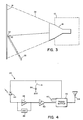
- the light pointer 28 is shown in the correct operating relationship with the screen 14.
- the light pointer 28 is held lightly against the screen 14 or slightly away from it.
- the flexible member 42 functions to align the light sensor 44 generally perpendicular to the face of the projection tube 16 so that it will receive the maximum intensity of the projected image field 32 from the projection tube 16.
- FIG. 4 a block schematic diagram of the light pointer 28 is shown.
- the circuitry of light pointer 28 is primarily for detecting the individual raster scan trace at the location of the light sensor 44 relative to the screen 14, and for generating a timed electrical signal representative of that location.
- the timed electrical signal is transmitted to the interface 26, which determines the position of the light sensor 44 in relation to the vertical scan line and pixel position in that display frame.
- the light sensor 44 is a photodiode.
- the light sensor detects the raster scan trace and presents a pulse to the input of an AC coupled, high-frequency amplifier 46.
- the amplifier 46 has a very high gain level, in order to ensure that it detects the low background level raster scan pulse.
- the amplifier 46 is provided with an automatic gain control 48.
- the automatic gain control 48 is needed to compensate for variations in the brightness of the image field 32. It is desirable for the amplifier 46 to function at same output amplitude level, with bright or dark pictures or in bright or dark areas of the screen, without becoming saturated and to ensure uniform operation.
- the automatic gain control 48 monitors the output of the amplifier 46 by sensing two threshold voltage levels. When the automatic gain control 48 senses a high level output voltage, it decreases the gain of the amplifier 46; when it senses a low level output voltage, it increases the gain of the amplifier 46.
- a Schmitt trigger 50 is used to square up the edges of the amplified analog pulse received from amplifier 48.
- the output of the Schmitt trigger is a logical low until the input signal reaches a threshold level, at which time the output goes high and remains high.
- the light pointer 28 is wireless, and an FM transmitter 52 and antenna 54 is used to transmit the amplified, squared raster scan pulse, in the form of a timed electrical signal to the interface 26.
- the FM transmitter 52 was selected because the time delay introduced in FM transmission is of a fixed value, and this delay is easily compensated for by the software in the computer 18.
- Power for the light pointer 28 provided by battery supply 56.
- the power switch 41 controls the battery supply.
- a select switch 40 for selecting and manipulating data is coupled to the transmitter 52.
- FIG. 5 a block schematic diagram of the interface 26 is shown.
- the interface 26 is contained on a circuit card in the projection monitor and includes the circuitry for determining the position of the light sensor 44 on the screen 14.
- a microcontroller 60 (Motorola type MC68701) and associated circuitry control the interface between the light pointer 28 and the serial bus 22.
- the microcontroller 60 detects the timed electrical signal transmitted from the light pointer 28, translates the timing of this detected signal into vertical scan line and pixel position data, and finally transmits this position in the form of X and Y coordinate data to the video display controller of the computer 18, by the serial bus 22. This occurs 60 times per second.
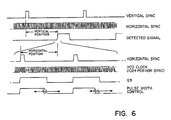
- the microcontroller 60 receives vertical sync 62 and horizontal sync 64 inputs from the video display controller in the computer 18, which are also presented to the display circuitry of the projection monitor 12. As is well known to those skilled in the art, each vertical sync pulse starts a new frame of displayed data in projection monitor 12, and each horizontal sync pulse starts a new scan line. This relationship can be appreciated by considering the first two timing signals illustrated in FIG. 6.
- the detected signal is received by an FM receiver 66 and antenna 68 and amplified through an amplifier 70.
- the leading edge of the detected signal indicates the location of the light sensor 44, as shown in the third timing signal of FIG. 6.
- the microcontroller 60 receives the detected signal and determines the frame and vertical scan line where the light sensor 44 is located by means of the vertical sync and horizontal sync pulses.
- pixel position is more difficult to determine, firstly, because there are no pixel timing signals coming from the video generator board in the computer 18, and secondly, because the frequency of the pixels is faster than the microcontroller 60 can count.
- the microcontroller 60 determines pixel position in the scan line by means of a phase lock loop arrangement which functions as a pixel counter, dividing each scan line into 1024 positions.
- the phase locked loop includes the pulse width control output 72 of the microcontroller 60, an integrator 74, a voltage controlled oscillator 76, a ten bit counter 78, and a return loop 80.
- the voltage controlled oscillator 76 operates continuously at approximately 20 MHz.
- the output, or VCO clock, is presented to the ten bit counter 78.
- the output pins (Q0 - Q9) of the counter 78 are connected to a latch 82, which will be described.
- the highest order bit (Q9) is also presented to the microcontroller 60 through the return loop 80. At a count of 1024, the Q9 output of the counter 78 goes high.
- the microcontroller 60 compares the horizontal sync pulse with the Q9 output and matches the timing of the two signals by varying the duty cycle of output 72.
- the output 72 signal is presented to integrator 74, which outputs a variable DC signal that controls the frequency of the voltage controlled oscillator 76.
- This phase lock loop arrangement ensures that the leading edge of each horizontal sync pulse will be synchronized with the leading edge of the Q9 output of counter 78. Therefore, every time a horizontal sync pulse occurs, starting a new scan line, the counter 78 accurately increments through 1024 pixel positions for that scan line. This provides a very high resolution of pixel position. This relationship is illustrated in the four bottom timing diagrams in FIG. 6.
- an RS flip-flop 84 sets the latch 82, which receives the outputs (Q0-Q9) of the counter 78.
- the latch 82 holds pixel position of light sensor 44 in the scan line.
- the RS flip-flop and latch 82 are reset at the start of the next frame by the the vertical sync pulse.
- the vertical scan line and pixel position are transmitted to the video display controller of the computer 18 over the bus 22.
- the computer 18 provides means for generating cursor control signals adapted for controlling the position of the cursor in response to the position signals received from the interface 26.
- the user holds the tip of the light pointer on or near a selection and aims the light sensor at the projection tube.
- the flexible member aligns the sensor perpendicularly to the face of the projection tube so that it will receive the maximum amount of intensity of the image field from the projection tube.
- the user In a classroom or executive office environment where a number of persons may be viewing the projected computer display, the user has the capability of calling up files and editing data on the screen, by means of the select switch provided, in a directly interactive manner, while providing commentary to the audience, or by direction from viewers in the audience.
- the projected image becomes, in a very basic sense, the computer display equivalent of an electronic blackboard.
- each pixel element is very close to the size of the light sensor, and very fine movement of the cursor may be effected.
- High resolution is generally not possible with direct view CRT displays using light pen input devices.
- a conventional direct view video display monitor with a standard 12 inch diagonal screen having a resolution of 800 x 300 pixels the width of the screen is approximately eight inches, and the diameter of each pixel is therefore .01 inches.
- the screen size is expanded, as in the present invention, to an image area having a five foot diagonal dimension, the width of the projected image is approximately four feet.
- each pixel now has a diameter of approximately .125 inches, which is also the approximate size of the light sensor.
- the high pixel resolution of the present invention makes it possible for a user to create fine lines on the projected image, as in writing or drawing.
- the light pointer does not require actual contact with screen to function properly. Still, it is desirable to keep the light pointer close enough to the screen to minimize shadows on the screen from the light pointer housing. Shadow effects caused by the operators hands or arms are eliminated by adjusting the length of the pointer housing so that all positions of the screen may be selected without the hands of the user intruding in the image field.
Landscapes
- Engineering & Computer Science (AREA)
- General Engineering & Computer Science (AREA)
- Theoretical Computer Science (AREA)
- Human Computer Interaction (AREA)
- Physics & Mathematics (AREA)
- General Physics & Mathematics (AREA)
- Position Input By Displaying (AREA)
- Controls And Circuits For Display Device (AREA)
Applications Claiming Priority (2)
| Application Number | Priority Date | Filing Date | Title |
|---|---|---|---|
| US112199 | 1987-10-22 | ||
| US07/112,199 US4808980A (en) | 1987-10-22 | 1987-10-22 | Electronic light pointer for a projection monitor |
Publications (3)
| Publication Number | Publication Date |
|---|---|
| EP0313080A2 true EP0313080A2 (fr) | 1989-04-26 |
| EP0313080A3 EP0313080A3 (en) | 1990-09-19 |
| EP0313080B1 EP0313080B1 (fr) | 1994-12-14 |
Family
ID=22342605
Family Applications (1)
| Application Number | Title | Priority Date | Filing Date |
|---|---|---|---|
| EP88117588A Expired - Lifetime EP0313080B1 (fr) | 1987-10-22 | 1988-10-21 | Instrument de contrôle électronique d'un ordinateur pour moniteur de projection |
Country Status (6)
| Country | Link |
|---|---|
| US (1) | US4808980A (fr) |
| EP (1) | EP0313080B1 (fr) |
| JP (1) | JP2851050B2 (fr) |
| AU (1) | AU612402B2 (fr) |
| CA (1) | CA1307861C (fr) |
| DE (1) | DE3852465T2 (fr) |
Cited By (2)
| Publication number | Priority date | Publication date | Assignee | Title |
|---|---|---|---|---|
| EP0443817A1 (fr) * | 1990-02-21 | 1991-08-28 | Texas Instruments Incorporated | Pointeur à lumiÀ¨re focalisée pour affichage tridimensionnel |
| DE4129602A1 (de) * | 1990-09-15 | 1992-03-19 | Fraunhofer Ges Forschung | Vorrichtung zur dateneingabe |
Families Citing this family (24)
| Publication number | Priority date | Publication date | Assignee | Title |
|---|---|---|---|---|
| EP0307893B1 (fr) * | 1987-09-14 | 1995-03-08 | Wacom Co., Ltd. | Système de tableau électronique avec un marqueur et un effaceur associés à ce tableau |
| US5181015A (en) * | 1989-11-07 | 1993-01-19 | Proxima Corporation | Method and apparatus for calibrating an optical computer input system |
| US5504501A (en) * | 1989-11-07 | 1996-04-02 | Proxima Corporation | Optical input arrangement and method of using same |
| JP2622620B2 (ja) * | 1989-11-07 | 1997-06-18 | プロクシマ コーポレイション | コンピュータにより発生されたデイスプレイ可視像を変更するためのコンピュータ入力システム |
| US5502459A (en) * | 1989-11-07 | 1996-03-26 | Proxima Corporation | Optical auxiliary input arrangement and method of using same |
| US5489923A (en) * | 1989-11-07 | 1996-02-06 | Proxima Corporation | Method and apparatus for calibrating an optical computer input system |
| US5235363A (en) * | 1991-05-10 | 1993-08-10 | Nview Corporation | Method and apparatus for interacting with a computer generated projected image |
| JPH06250619A (ja) * | 1993-02-26 | 1994-09-09 | Hitachi Ltd | ポインタ機能付きマルチスキャン式大画面ディスプレイシステム |
| US5400095A (en) * | 1993-05-11 | 1995-03-21 | Proxima Corporation | Display projection method and apparatus an optical input device therefor |
| US5321450A (en) * | 1993-05-11 | 1994-06-14 | Proxima Corporation | Low profile liquid crystal projector and method of using same |
| JPH0876082A (ja) * | 1994-06-28 | 1996-03-22 | Sharp Corp | 投影表示装置 |
| US5782548A (en) * | 1995-04-07 | 1998-07-21 | Seiko Epson Corporation | Image projection system and a method of controlling a projected pointer |
| DE19543959C2 (de) * | 1995-11-25 | 2000-04-20 | P & I Gmbh | Computergestützte Projektionsvorrichtung |
| US6050690A (en) * | 1998-01-08 | 2000-04-18 | Siemens Information And Communication Networks, Inc. | Apparatus and method for focusing a projected image |
| US6094189A (en) * | 1998-04-17 | 2000-07-25 | Quillen; Wendell A. | Visual echo remote laser pointer |
| US6952198B2 (en) * | 1999-07-06 | 2005-10-04 | Hansen Karl C | System and method for communication with enhanced optical pointer |
| US6534621B2 (en) * | 2000-05-18 | 2003-03-18 | Dow Global Technologies Inc. | Process for manufacturing a hydroxyester derivative intermediate and epoxy resins prepared therefrom |
| US6707444B1 (en) * | 2000-08-18 | 2004-03-16 | International Business Machines Corporation | Projector and camera arrangement with shared optics and optical marker for use with whiteboard systems |
| US7830362B2 (en) | 2001-07-05 | 2010-11-09 | Michael Cain Finley | Laser and digital camera computer pointer device system |
| US20080278444A1 (en) * | 2007-05-11 | 2008-11-13 | Schelling Anna C | User input system |
| US20080278443A1 (en) * | 2007-05-11 | 2008-11-13 | Schelling Anna C | User input device |
| US8519983B2 (en) * | 2007-12-29 | 2013-08-27 | Microvision, Inc. | Input device for a scanned beam display |
| CA2721073A1 (fr) * | 2008-04-10 | 2009-10-15 | Karl Christopher Hansen | Telecommande optique sans fil simple a utiliser |
| CN101963846B (zh) * | 2009-07-24 | 2013-04-24 | 精工爱普生株式会社 | 光学笔 |
Family Cites Families (16)
| Publication number | Priority date | Publication date | Assignee | Title |
|---|---|---|---|---|
| US3183773A (en) * | 1963-04-01 | 1965-05-18 | Ednalite Corp | Projection pointer |
| BE755561A (fr) * | 1969-09-09 | 1971-02-15 | Sodeteg | Perfectionnements aux machines a enseigner comportant notammentun projecteur d'images |
| JPS5420092B2 (fr) * | 1972-07-15 | 1979-07-20 | ||
| JPS5726369B2 (fr) * | 1973-09-06 | 1982-06-04 | ||
| US4097731A (en) * | 1977-06-02 | 1978-06-27 | Burroughs Corporation | Automatic gain control for photosensing devices |
| US4280135A (en) * | 1979-06-01 | 1981-07-21 | Schlossberg Howard R | Remote pointing system |
| JPS57166637A (en) * | 1981-04-03 | 1982-10-14 | Nec Corp | Light pen for video projector |
| US4468034A (en) * | 1983-02-16 | 1984-08-28 | Duclos Clovis R | Golf club loft and lie angle indicating device |
| US4565999A (en) * | 1983-04-01 | 1986-01-21 | Prime Computer, Inc. | Light pencil |
| JPS59212945A (ja) * | 1983-05-19 | 1984-12-01 | Nippon Telegr & Teleph Corp <Ntt> | 遠隔指示入力装置 |
| US4591841A (en) * | 1983-11-01 | 1986-05-27 | Wisconsin Alumni Research Foundation | Long range optical pointing for video screens |
| US4682159A (en) * | 1984-06-20 | 1987-07-21 | Personics Corporation | Apparatus and method for controlling a cursor on a computer display |
| US4654648A (en) * | 1984-12-17 | 1987-03-31 | Herrington Richard A | Wireless cursor control system |
| US4641440A (en) * | 1985-04-30 | 1987-02-10 | Vladimir Agranov | Map holder |
| US4698625A (en) * | 1985-05-30 | 1987-10-06 | International Business Machines Corp. | Graphic highlight adjacent a pointing cursor |
| JPH0337013Y2 (fr) * | 1986-02-05 | 1991-08-06 |
-
1987
- 1987-10-22 US US07/112,199 patent/US4808980A/en not_active Expired - Fee Related
-
1988
- 1988-09-08 AU AU21990/88A patent/AU612402B2/en not_active Expired
- 1988-10-11 CA CA000579720A patent/CA1307861C/fr not_active Expired - Lifetime
- 1988-10-21 JP JP26594588A patent/JP2851050B2/ja not_active Expired - Lifetime
- 1988-10-21 EP EP88117588A patent/EP0313080B1/fr not_active Expired - Lifetime
- 1988-10-21 DE DE3852465T patent/DE3852465T2/de not_active Expired - Fee Related
Cited By (2)
| Publication number | Priority date | Publication date | Assignee | Title |
|---|---|---|---|---|
| EP0443817A1 (fr) * | 1990-02-21 | 1991-08-28 | Texas Instruments Incorporated | Pointeur à lumiÀ¨re focalisée pour affichage tridimensionnel |
| DE4129602A1 (de) * | 1990-09-15 | 1992-03-19 | Fraunhofer Ges Forschung | Vorrichtung zur dateneingabe |
Also Published As
| Publication number | Publication date |
|---|---|
| EP0313080B1 (fr) | 1994-12-14 |
| DE3852465D1 (de) | 1995-01-26 |
| JPH01147498A (ja) | 1989-06-09 |
| CA1307861C (fr) | 1992-09-22 |
| AU612402B2 (en) | 1991-07-11 |
| JP2851050B2 (ja) | 1999-01-27 |
| AU2199088A (en) | 1989-04-27 |
| DE3852465T2 (de) | 1995-06-29 |
| US4808980A (en) | 1989-02-28 |
| EP0313080A3 (en) | 1990-09-19 |
Similar Documents
| Publication | Publication Date | Title |
|---|---|---|
| US4808980A (en) | Electronic light pointer for a projection monitor | |
| US5926168A (en) | Remote pointers for interactive televisions | |
| JP4666808B2 (ja) | 画像表示システム、画像表示方法、及び記憶媒体、プログラム | |
| CA2378154C (fr) | Systeme de presentation informatique et procede de suivi optique avec pointeur sans fil | |
| JP2622620B2 (ja) | コンピュータにより発生されたデイスプレイ可視像を変更するためのコンピュータ入力システム | |
| US6331848B1 (en) | Projection display system | |
| US6538643B2 (en) | Remote control having a touch pad operable in a pad-to-screen mapping mode for highlighting preselected parts of a slide displayed on a display screen | |
| US4430526A (en) | Interactive graphics transmission system employing an adaptive stylus for reduced bandwidth | |
| US5617312A (en) | Computer system that enters control information by means of video camera | |
| CN101238428B (zh) | 自由空间指点和手写 | |
| US4591841A (en) | Long range optical pointing for video screens | |
| US20010030668A1 (en) | Method and system for interacting with a display | |
| US20060202973A1 (en) | Coordinate input apparatus, control method thereof, and program | |
| JPH04299727A (ja) | 大型ディスプレイのための位置及び機能入力システム | |
| US20030210230A1 (en) | Invisible beam pointer system | |
| WO2001099045A1 (fr) | Systeme et procede pour determiner une position de curseur | |
| JPH04321093A (ja) | 投射型表示装置 | |
| CN209103267U (zh) | 基于信息实时交互的液晶拼接系统 | |
| EP0798659A1 (fr) | Méthode et dispositif pour la génération d'image et d'affichage | |
| WO2001046941A1 (fr) | Procede et dispositif d'association visuelle entre les actions d'un pointeur et des images projetees | |
| CN221446559U (zh) | 基于红外光线的交互系统 | |
| JPH07104927A (ja) | ポインティング装置 | |
| JPH09322270A (ja) | 表示装置に対する入力装置 | |
| KR100429796B1 (ko) | 전자 칠판 기능을 제공하는 디스플레이 장치 및 방법 | |
| EP1305697A2 (fr) | Systeme de visualisation d'images et bloc de telecommande correspondant |
Legal Events
| Date | Code | Title | Description |
|---|---|---|---|
| PUAI | Public reference made under article 153(3) epc to a published international application that has entered the european phase |
Free format text: ORIGINAL CODE: 0009012 |
|
| AK | Designated contracting states |
Kind code of ref document: A2 Designated state(s): BE DE FR GB |
|
| PUAL | Search report despatched |
Free format text: ORIGINAL CODE: 0009013 |
|
| RHK1 | Main classification (correction) |
Ipc: G06K 11/06 |
|
| AK | Designated contracting states |
Kind code of ref document: A3 Designated state(s): BE DE FR GB |
|
| 17P | Request for examination filed |
Effective date: 19910319 |
|
| 17Q | First examination report despatched |
Effective date: 19920910 |
|
| GRAA | (expected) grant |
Free format text: ORIGINAL CODE: 0009210 |
|
| AK | Designated contracting states |
Kind code of ref document: B1 Designated state(s): BE DE FR GB |
|
| REF | Corresponds to: |
Ref document number: 3852465 Country of ref document: DE Date of ref document: 19950126 |
|
| ET | Fr: translation filed | ||
| PGFP | Annual fee paid to national office [announced via postgrant information from national office to epo] |
Ref country code: BE Payment date: 19950925 Year of fee payment: 8 |
|
| PLBE | No opposition filed within time limit |
Free format text: ORIGINAL CODE: 0009261 |
|
| STAA | Information on the status of an ep patent application or granted ep patent |
Free format text: STATUS: NO OPPOSITION FILED WITHIN TIME LIMIT |
|
| 26N | No opposition filed | ||
| PG25 | Lapsed in a contracting state [announced via postgrant information from national office to epo] |
Ref country code: BE Effective date: 19961031 |
|
| BERE | Be: lapsed |
Owner name: WANG LABORATORIES INC. Effective date: 19961031 |
|
| PGFP | Annual fee paid to national office [announced via postgrant information from national office to epo] |
Ref country code: FR Payment date: 19990930 Year of fee payment: 12 |
|
| PGFP | Annual fee paid to national office [announced via postgrant information from national office to epo] |
Ref country code: GB Payment date: 19991001 Year of fee payment: 12 Ref country code: DE Payment date: 19991001 Year of fee payment: 12 |
|
| PG25 | Lapsed in a contracting state [announced via postgrant information from national office to epo] |
Ref country code: GB Free format text: LAPSE BECAUSE OF NON-PAYMENT OF DUE FEES Effective date: 20001021 |
|
| GBPC | Gb: european patent ceased through non-payment of renewal fee |
Effective date: 20001021 |
|
| PG25 | Lapsed in a contracting state [announced via postgrant information from national office to epo] |
Ref country code: FR Free format text: LAPSE BECAUSE OF NON-PAYMENT OF DUE FEES Effective date: 20010629 |
|
| PG25 | Lapsed in a contracting state [announced via postgrant information from national office to epo] |
Ref country code: DE Free format text: LAPSE BECAUSE OF NON-PAYMENT OF DUE FEES Effective date: 20010703 |
|
| REG | Reference to a national code |
Ref country code: FR Ref legal event code: ST |