EP0314011A2 - Purinderivate - Google Patents
Purinderivate Download PDFInfo
- Publication number
- EP0314011A2 EP0314011A2 EP88117572A EP88117572A EP0314011A2 EP 0314011 A2 EP0314011 A2 EP 0314011A2 EP 88117572 A EP88117572 A EP 88117572A EP 88117572 A EP88117572 A EP 88117572A EP 0314011 A2 EP0314011 A2 EP 0314011A2
- Authority
- EP
- European Patent Office
- Prior art keywords
- purine
- amino
- trityl
- fluoro
- compounds
- Prior art date
- Legal status (The legal status is an assumption and is not a legal conclusion. Google has not performed a legal analysis and makes no representation as to the accuracy of the status listed.)
- Withdrawn
Links
- 0 Nc1c(*=C*2CC([C@]3F)O[C@](CO)[C@@]3O)c2nc(Cl)n1 Chemical compound Nc1c(*=C*2CC([C@]3F)O[C@](CO)[C@@]3O)c2nc(Cl)n1 0.000 description 1
Classifications
-
- C—CHEMISTRY; METALLURGY
- C07—ORGANIC CHEMISTRY
- C07H—SUGARS; DERIVATIVES THEREOF; NUCLEOSIDES; NUCLEOTIDES; NUCLEIC ACIDS
- C07H19/00—Compounds containing a hetero ring sharing one ring hetero atom with a saccharide radical; Nucleosides; Mononucleotides; Anhydro-derivatives thereof
- C07H19/02—Compounds containing a hetero ring sharing one ring hetero atom with a saccharide radical; Nucleosides; Mononucleotides; Anhydro-derivatives thereof sharing nitrogen
- C07H19/04—Heterocyclic radicals containing only nitrogen atoms as ring hetero atom
- C07H19/16—Purine radicals
-
- A—HUMAN NECESSITIES
- A61—MEDICAL OR VETERINARY SCIENCE; HYGIENE
- A61P—SPECIFIC THERAPEUTIC ACTIVITY OF CHEMICAL COMPOUNDS OR MEDICINAL PREPARATIONS
- A61P31/00—Antiinfectives, i.e. antibiotics, antiseptics, chemotherapeutics
- A61P31/12—Antivirals
Definitions
- the present invention relates to purine derivatives of the general formula wherein R1 is chlorine, azido or amino, and amides and Schiff bases thereof.
- These compounds are new and have valuable pharmacodynamic properties. In particular, they have antiviral activity and can be used in the treatment and prophylaxis of viral infections in humans and animals in particular of retroviral infections such as HIV and the like are used.
- the present invention relates to the compounds defined above as such, and for use as therapeutically active substances, a process for the preparation of these compounds, intermediates for the preparation of these compounds, medicaments based on these compounds and the use of these compounds for treatment and prophylaxis diseases, in particular viral infections, or in the manufacture of medicaments for the treatment or prophylaxis of viral infections.
- Particularly preferred compounds of formula I are the following: 6-amino-2-chloro-9- (2,3-dideoxy-2-fluoro- ⁇ -D-threopentofuranosyl) -9H-purine, 6-amino-2-azido-9- (2,3-dideoxy-2-fluoro- ⁇ -D-threopentofuranosyl) -9H-purine and 2,6-diamino-9- (2,3-dideoxy-2-fluoro- ⁇ -D-threopentofuranosyl) -9H-purine.
- the above compounds can be prepared by removing the group R 2 from a compound of the general formula where R1 has the meaning given above and R2 is trityl or substituted trityl, for example monomethoxytrityl, is split off and, if desired, a compound of the formula I obtained is converted into an amide or into a Schiff base.
- the group R 2 can be split off in a manner known per se, e.g. by treatment with an inorganic acid such as hydrochloric acid in a solvent such as a halogenated aliphatic hydrocarbon e.g. Chloroform, suitably at about 0 ° C to room temperature, or by treatment with a strong organic acid such as acetic acid, suitably at elevated temperature e.g. at about 100 ° C.
- an inorganic acid such as hydrochloric acid in a solvent such as a halogenated aliphatic hydrocarbon e.g. Chloroform
- a strong organic acid such as acetic acid
- Amides of the compounds of formula I are prepared by substitution of the 6-amino group and any amino group R 1 present with an acyl group such as an alkanoyl group, e.g. Acetyl, propionyl, butyryl or pivaloyl, or an aroyl group e.g. Benzoyl.
- Schiff bases of the compounds of formula I are prepared using an aldehyde or ketone such as benzaldehyde; or with a dimethylformamide acetal.
- the compounds of formula II can be prepared by first using a compound of the general formula wherein R3 is C1-C6 alkanoyl, for example acetyl, or aroyl, for example benzoyl, and R4 is aroyl, treated with ammonia, suitably with ethanolic ammonia at about room temperature for several days, for example 7 days.
- This conversion can be carried out in a manner known per se with an optionally substituted trityl halide, e.g. Trityl chloride, in the presence of an acid binding agent, e.g. a tertiary amide such as pyridine, conveniently at elevated temperature, e.g. at about 100 ° C.
- an acid binding agent e.g. a tertiary amide such as pyridine
- a compound of the formula V is then advantageously combined with phenylthionochloroformate in an inert organic solvent such as acetonitrile in the presence of an acid-binding agent such as a tertiary amine, for example pyridine or 4-dimethylaminopyridine, and at about room temperature to give a compound of the general formula where R2 has the above meaning and Ph is phenyl, converted.
- an acid-binding agent such as a tertiary amine, for example pyridine or 4-dimethylaminopyridine
- a compound of formula VI is then converted to a compound of formula II in which R1 is chlorine by treatment with tributyltin hydride in the presence of a free radical initiator.
- a free radical initiator e.g. Azoisobutyronitrile, suitably in an inert organic solvent such as an aromatic hydrocarbon, e.g. Benzene or toluene, and at elevated temperature, e.g. at about 60 ° -90 ° C.
- a compound of formula II in which R1 is chlorine can be converted into a compound of formula II in which R1 is azido or amino in a manner known per se.
- the chlorine atom R1 can be replaced by azido by reaction with hydrazine and subsequent treatment of the resulting hydrazino-substituted compound with an alkali metal nitrite, e.g. Sodium nitrite, in the presence of a strong organic acid such as acetic acid.
- An azido group R1 can be converted to an amino group by catalytic hydrogenation in the presence of a palladium catalyst and in an inert organic solvent. e.g. an alkanol such as ethanol, conveniently at about room temperature.
- the chlorine atom R1 can be replaced by an amino group by reaction with ammonia in an inert organic solvent such as a lower alkanol, e.g. Methanol, at elevated temperature, e.g. at about 140 ° C in a bomb tube.
- an inert organic solvent such as a lower alkanol, e.g. Methanol
- the activity of the purine derivatives of the present invention against HIV can be demonstrated as follows.
- HTLV III grown in C8166 cells (a human CD4+ T lymphoblast line), is used, RPM1 1640 medium with bicarbonate buffer, antibiotics and 10% fetal bovine serum.
- a cell suspension is infected with 10 times the TCD50 of the virus. The mixture is allowed to adsorb at 37 ° C. for 90 minutes. The cells are washed with the medium.
- the experiment is carried out in 6 ml tissue culture tubes. Each tube contains 2 x 10⁵ infected cells in 1.5 ml medium. 15 ⁇ l of a solution of the substance in an aqueous medium or in DMSO are added. After 72 hours of incubation at 37 ° C in a humid atmosphere containing 5% CO2, the cultures are centrifuged.
- the puridine derivatives of the present invention can be used as drugs in the form of pharmaceutical preparations containing these compounds together with an acceptable pharmaceutical carrier. These preparations can be taken orally, for example in the form of tablets, dragées, hard gelatin capsules, soft capsules, solutions, emulsions or suspensions ions, or parenterally, for example in the form of injection solutions.
- the carriers mentioned above can be pharmaceutically inert, inorganic or organic materials.
- carriers for tablets, dragees and hard capsules are lactose, corn starch or derivatives thereof, talc, stearic acid or salts thereof.
- carriers for soft capsules are vegetable oils, waxes, fats, semi-solid and liquid polyols.
- carriers for the preparation of solutions or syrups are water, polyols, sucrose, invert sugar and glucose.
- carriers for injection solutions are water, alcohols, polyols, glycerol and vegetable oils.
- the pharmaceutical preparations can also contain conventional pharmaceutical auxiliaries, such as preservatives, solubilizers, stabilizers, moisturizers, emulsifiers, sweeteners, colorants or fragrances, salts for changing the osmotic pressure, buffers, coating agents or antioxidants. They can also contain other therapeutically valuable substances.
- the dosage at which the purine derivatives of the present invention can be administered can be varied up and down depending on factors such as the individual compound to be administered, the severity of the disease to be treated and the condition of the patient.
- the purine derivatives of the present invention can be administered in a daily dosage range of about 0.1 to 20, preferably 0.2 to 15, in particular about 0.4 to 10 mg / kg body weight.
- purine derivatives can be administered in single doses or preferably in multiple doses, for example up to 6 per day.
- a single dose for such an administration form can, for example, be from about 0.5 to 300, preferably contain about 1.0 to 300 and especially about 2.0 to 200 mg of purine derivative.
- the pharmaceutical preparations can be prepared in such a way that the above purine derivatives, if desired together with other therapeutically valuable substances, are mixed with a compatible pharmaceutical carrier and, if desired, with a pharmaceutical auxiliary, and the mixture is brought into the desired administration form.
- the starting material is produced as follows:
- Tablets and capsules with the following ingredients can be manufactured in a manner known per se:
Landscapes
- Health & Medical Sciences (AREA)
- Chemical & Material Sciences (AREA)
- Organic Chemistry (AREA)
- Life Sciences & Earth Sciences (AREA)
- General Health & Medical Sciences (AREA)
- Medicinal Chemistry (AREA)
- Public Health (AREA)
- General Chemical & Material Sciences (AREA)
- Communicable Diseases (AREA)
- Nuclear Medicine, Radiotherapy & Molecular Imaging (AREA)
- Virology (AREA)
- Pharmacology & Pharmacy (AREA)
- Animal Behavior & Ethology (AREA)
- Oncology (AREA)
- Chemical Kinetics & Catalysis (AREA)
- Veterinary Medicine (AREA)
- Engineering & Computer Science (AREA)
- Biochemistry (AREA)
- Biotechnology (AREA)
- Genetics & Genomics (AREA)
- Molecular Biology (AREA)
- Pharmaceuticals Containing Other Organic And Inorganic Compounds (AREA)
- Saccharide Compounds (AREA)
Abstract
Description
- Die vorliegende Erfindung betrifft Purinderivate der allgemeinen Formel
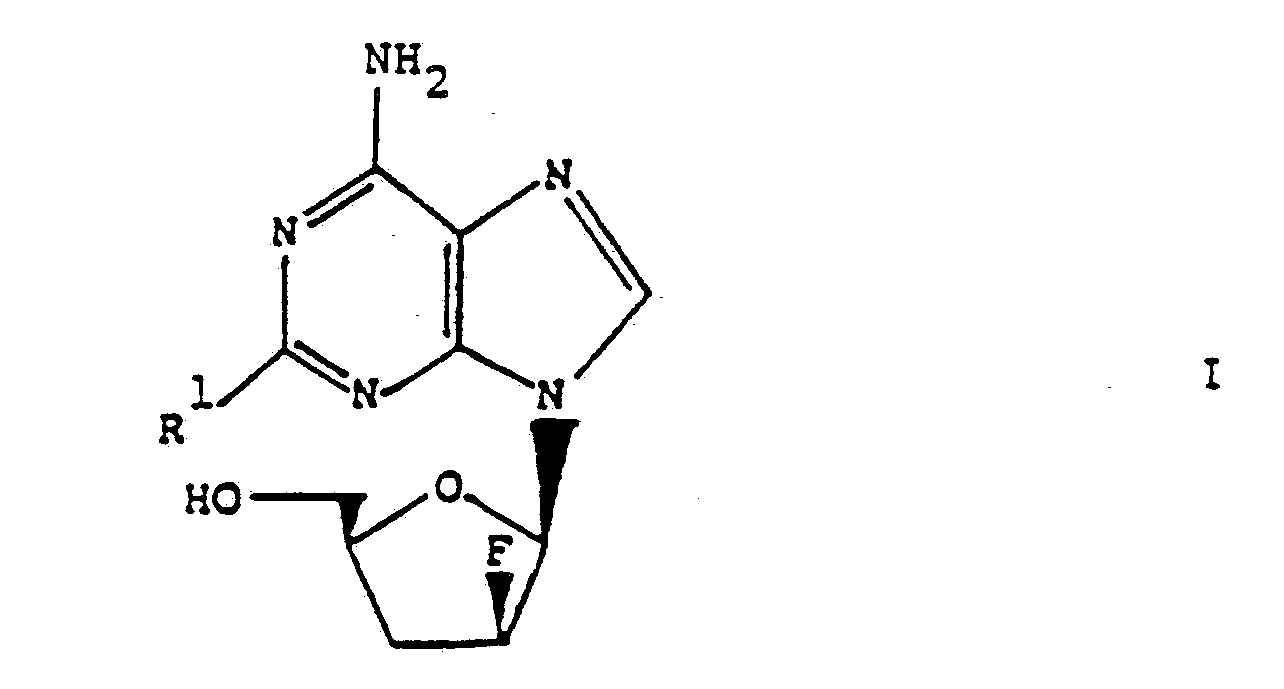
- Diese Verbindungen sind neu und haben wertvolle pharmakodynamische Eigenschaften. Insbesondere haben sie antivirale Wirksamkeit und können in der Behandlung und Prophylaxe von viralen Infektionen beim Menschen und beim Tier im speziellen von retroviralen Infektionen wie HIV und dergleichen Verwendung finden.
- Gegenstand der vorliegenden Erfindung sind die weiter oben definierten Verbindungen als solche, sowie zur Verwendung als therapeutisch aktive Substanzen, ein Verfahren zur Herstellung dieser Verbindungen, Zwischenprodukte für die Herstellung dieser Verbindungen, Medikamente auf der Basis dieser Verbindungen und die Verwendung dieser Verbindungen zur Behandlung und Prophylaxe von Krankheiten insbesondere von viralen Infektionen, oder bei der Herstellung von Medikamenten für die Behandlung oder Prophylaxe von viralen Infektionen.
- Die obigen Verbindungen können in Form von Tautomeren vorliegen die ebenfalls Gegenstand der Erfindung sind.
- Besonders bevorzugte Verbindungen der Formel I sind die folgenden:
6-Amino-2-chlor-9-(2,3-dideoxy-2-fluor-β-D-threopentofuranosyl)-9H-purin,
6-Amino-2-azido-9-(2,3-dideoxy-2-fluor-β-D-threopentofuranosyl)-9H-purin und
2,6-Diamino-9-(2,3-dideoxy-2-fluor-β-D-threopentofuranosyl)-9H-purin. - Die obigen Verbindungen können erfindungsgemäss dadurch hergestellt werden, dass man die Gruppe R² aus einer Verbindung der allgemeinen Formel

abspaltet und gewünschtenfalls eine erhaltene Verbindung der Formel I in ein Amid oder in eine Schiff'sche Base überführt. - Die Abspaltung der Gruppe R² kann in an sich bekannter Weise erfolgen z.B. durch Behandlung mit einer anorganischen Säure wie Salzsäure in einem Lösungsmittel wie einem halogenierten aliphatischen Kohlenwasserstoff z.B. Chloroform, zweckmässig bei etwa 0°C bis Raumtemperatur, oder durch Behandlung mit einer starken organischen Säure wie Essigsäure, zweckmässig bei erhöhter Temperatur z.B. bei etwa 100°C.
- Amide der Verbindungen der Formel I werden hergestellt durch Substitution der 6-Aminogruppe und einer allenfalls vorliegenden Aminogruppe R¹ durch eine Acylgruppe wie einer Alkanoylgruppe, z.B. Acetyl, Propionyl, Butyryl oder Pivaloyl, oder einer Aroylgruppe z.B. Benzoyl. Schiff'sche Basen der Verbindungen der Formel I werden hergestellt mittels eines Aldehyds oder Ketons wie Benzaldehyd; oder mit einem Dimethylformamidacetal.
- Die Verbindungen der Formel II können dadurch hergestellt werden, dass man zuerst eine Verbindung der allgemeinen Formel

mit Ammoniak, zweckmässig mit äthanolischem Ammoniak bei etwa Raumtemperatur während mehreren Tagen, z.B. 7 Tagen behandelt. - Im erhaltenen 6-Amino-2-chlor-9-(2-deoxy-2-fluor-β-D-arabinofuranosyl)-9H-purin der Formel


- Diese Ueberführung kann in an sich bekannter Weise erfolgen mit einem gegebenenfalls substituierten Tritylhalogenid, z.B. Tritylchlorid, in Gegenwart eines säurebindenden Mittels, z.B. eines tertiären Amids wie Pyridin, zweckmässig bei erhöhter Temperatur, z.B. bei etwa 100°C.
- Eine Verbindung der Formel V wird dann mit Phenylthionochloroformat zweckmässig in einem inerten organischen Lösungsmittel wie Acetonitril in Gegenwart eines säurebindenden Mittels wie einem tertiären Amin, z.B. Pyridin oder 4-Dimethylaminopyridin, und bei etwa Raumtemperatur zu einer Verbindung der allgemeinen Formel

umgewandelt. - Eine Verbindung der Formel VI wird dann in eine Verbindung der Formel II übergeführt, in der R¹ Chlor ist, durch Behandlung mit Tributylzinnhydrid in Gegenwart eines freien Radikalinitiators. z.B. Azoisobutyronitril, zweckmässig in einem inerten organischen Lösungsmittel wie einem aromatischen Kohlenwasserstoff, z.B. Benzol oder Toluol, und bei erhöhter Temperatur, z.B. bei etwa 60°-90°C.
- Eine Verbindung der Formel II, in der R¹ Chlor ist, kann in eine Verbindung der Formel II, in der R¹ Azido oder Amino ist, in an sich bekannter Weise übergeführt werden. So kann das Chloratom R¹ durch Azido ersetzt werden durch Reaktion mit Hydrazin und anschliessende Behandlung der entstandenen durch Hydrazino substituierten Verbindung mit einem Alkalimetallnitrit, z.B. Natriumnitrit, in Gegenwart einer starken organischen Säure wie Essigsäure. Eine Azidogruppe R¹ kann in eine Aminogruppe umgewandelt werden durch katalytische Hydrierung in Gegenwart eines Palladiumkatalysators und in einem inerten organischen Lösungsmittel. z.B. einem Alkanol wie Aethanol, zweckmässig bei etwa Raumtemperatur. In einer Variante kann das Chloratom R¹ durch eine Aminogruppe ersetzt werden durch Reaktion mit Ammoniak in einem inerten organischen Lösungsmittel wie einem nieder-Alkanol, z.B. Methanol, bei erhöhter Temperatur, z.B. bei etwa 140°C in einem Bombenrohr.
- Die Verbindungen der Formel III sind bekannt oder sind wie bekannte Analoga herstellbar.
- Die Verbindungen der Formeln II, IV, V und VI sind neu und als solche Gegenstand der vorliegenden Erfindung.
- Die Aktivität der Purinderivate der vorliegenden Erfindung gegen HIV kann wie folgt nachgewiesen werden.
- In diesem Versuch verwendet man HTLV III, gezüchtet in C8166-Zellen (eine menschliche CD4⁺ T-Lymphoblastenlinie), RPM1 1640 Medium mit Bicarbonatpuffer, Antibiotika und l0%igem fötalem Rinderserum. Eine Zellensuspension wird mit der 10-fachen TCD₅₀ des Virus infiziert. Man lässt 90 Minuten bei 37°C adsorbieren. Die Zellen werden mit dem Medium gewaschen. Der Versuch wird in 6 ml Gewebekulturröhrchen durchgeführt. Jedes Röhrchen enthält 2 x 10⁵ infizierte Zellen in 1,5 ml Medium. Es werden 15 µl einer Lösung der Substanz in wässrigem Medium oder in DMSO zugesetzt. Nach 72 Stunden Inkubation bei 37°C in einer feuchten 5% CO₂ enthaltenden Atmosphäre werden die Kulturen zentrifugiert. Ein aliquoter Teil des Ueberstandes wird solubilisiert und einem Antigenabfangversuch unterworfen unter Verwendung eines primären Antiserums mit besonderer Reaktivität gegen virales Protein 24 und eines Meerrettich-Peroxidase-Detektionssystems. Die Farbenerzeugung wird spektrophotometrisch gemessen und in Abhängigkeit der Konzentration der Testsubstanz dargestellt. Die einen 50%igen Schutz erzeugende Konzentration (IC₅₀) wird ermittelt. Die Resultate sind in der folgenden Tabelle angegeben:

- Die Puridinderivate der vorliegenden Erfindung können in Form pharmazeutischer Präparate, die diese Verbindungen zusammen mit einem verträglichen pharmazeutischen Träger enthalten, als Medikamente verwendet werden. Diese Präparate können oral, z.B. in Form von Tabletten, Dragées, Hartgelatinekapseln, Weichkapseln, Lösungen, Emulsionen oder Suspen sionen, oder parenteral, z.B. in Form von Injektionslösungen, verabreicht werden.
- Die weiter oben erwähnten Träger können pharmazeutisch inerte, anorganische oder organische Materialien sein. Beispiele von Träger für Tabletten, Dragées und Hartkapseln sind Lactose, Maisstärke oder Derivate davon, Talk, Stearinsäure oder Salze davon. Beispiele von Träger für Weichkapseln sind pflanzliche Oele, Wachse, Fette, halbfeste und flüssige Polyole. Beispiele von Träger für die Herstellung von Lösungen oder Sirups sind Wasser, Polyole, Saccharose, Invertzucker und Glucose. Beispiele von Träger für Injektionslösungen sind Wasser, Alkohole, Polyole, Glycerol und pflanzliche Oele.
- Die pharmazeutischen Präparate können auch herkömmliche pharmazeutische Hilfsmittel enthalten, wie Konservierungs-, Solubilisierungs-, Stabilisierungs-, Befeuchtungsmittel, Emulgatoren, Süssmittel, Farb- oder Riechstoffe, Salze zur Veränderung des osmotischen Druckes, Puffer, Ueberzugsmittel oder Antioxidantien. Sie können auch andere therapeutisch wertvolle Substanzen enthalten.
- Die Dosierung, in der die Purinderivate der vorliegenden Erfindung verabreicht werden können, kann nach oben und unten in Abhängigkeit von Faktoren, wie der einzelnen zu verabreichenden Verbindung, der Schwere der zu behandelnden Erkrankung und dem Zustand des Patienten, variiert werden. Die Purinderivate der vorliegenden Erfindung kann man in einem täglichen Dosierungsbereich von etwa 0,1 bis 20, vorzugsweise 0,2 bis 15, insbesondere etwa 0,4 bis 10 mg/kg Körpergewicht verabreichen.
- Diese Purinderivate können in Einzeldosen oder vorzugsweise in mehreren Dosen, z.B. bis zu 6 über den Tag verabreicht werden. Eine Einzeldosis für eine solche Verabreichungsform kann z.B. von etwa 0,5 bis 300, vorzugsweise etwa 1,0 bis 300 und insbesondere etwa 2,0 bis 200 mg Purinderivat enthalten.
- Die pharmazeutischen Präparate kann man so herstellen, dass man die obigen Purinderivate, gewünschenfalls zusammen mit anderen therapeutisch wertvollen Substanzen, mit einem verträglichen pharmazeutischen Träger und gewünschtenfalls einem pharmazeutischen Hilfsstoff vermischt und das Gemisch in die gewünschte Verabreichungsform bringt.
- Eine Lösung enthaltend 0,39 g 6-Amino-2 chlor-9-(2,3-dideoxy-2-fluor-5-O-trityl-β-D-threopentofuranosyl)-9H-purin in 24 ml trockenem Chloroform wird abgekühlt und mit 2,2 ml einer 0,35 Kochsalzlösung in Chloroform behandelt. Das Gemisch wird 15 Minuten bei 0-5°C, dann 1,5 Stunden bei Raumtemperatur gerührt und anschliessend unter vermindertem Druck eingedampft. Der Rückstand wird mit 20 ml Diäthyläther behandelt und die Suspension wird 30 Minuten gerührt. Der unlösliche weisse Feststoff wird abfiltriert und mit Diäthyläther gewaschen. Man erhält 0,16 g Produkt. Dieses wird in Wasser gelöst und auf einem Kationenaustauscherharz in H⁺-Form absorbiert. Nach Waschen mit Wasser wird mit 2M Ammoniaklösung eluiert. Nach Abdampfen des Eluats und Umkristallisation aus Wasser erhält man reines 6-Amino-2-chlor-9-(2,3-dideoxy-2-fluor-β-D-threopentofuranosyl)-9H-purin, Smp. 210-211°C.
- Das Ausgangsmaterial wird wie folgt hergestellt:
- a) Eine Lösung von 1,96 g 2,6-Dichlor-9-(3-O-acetyl-5-O-benzoyl-2-deoxy-2-fluor-β-D-arabinofuranosyl)-9H-purin in 195 ml Aethanol wird bei -5°C mit gesättigtem Ammoniak gesättigt und dann 7 Tage bei Raumtemperatur gehalten. Die Lösung wird unter vermindertem Druck eingedampft und der Rückstand wird aus 50 ml Aethanol umkristallisiert. Man erhält 0,38 g 6-Amino-2-chlor-9-(2-deoxy-2-fluor-β-D-arabinofuranosyl)-9H-purin, Smp. 212-215°C (Zersetzung). Die Mutterlaugen werden unter vermindertem Druck eingedampft und der Rückstand wird über Silicagel mittels 10% Methanol in Dichlormethan chromatographiert. Man erhält 0,56 g Produkt.
- b) Eine Lösung von 0,83 g des Produkts von Beispiel 1a) in 7,5 ml trockenem Pyridin wird bei 100°C unter Argon erhitzt. Eine Lösung von 1,53 g Tritylchlorid in 7,5 ml trockenem Pyridin wird zugetropft. Das Gemisch wird 2 Stunden bei 100°C erhitzt und dann unter vermindertem Druck eingedampft. Der Rückstand wird zwischen 100 ml Wasser und 100 ml Dichlormethan verteilt. Die wässrige Schicht wird abgetrennt und mit Dichlormethan extrahiert. Die organischen Phasen werden über Natriumsulfat getrocknet, filtriert und unter vermindertem Druck eingedampft. Der Rückstand wird über Silicagel mittels 5% Methanol in Dichlormethan chromatographiert. Man erhält 0,84 g 6-Amino-2-chlor-9-(2-deoxy-2-fluor-5-O-trityl -β-D-arabinofuranosyl)-9H-purin, Smp. 210-212°C nach Umkristalliation aus Aethylacetat.
- c) Eine Lösung von 0.73 g des Produktes von Beispiel 1b) und 0,365 g 4-Dimethylaminopyridin in 21 ml trockenem Acetonitril wird unter Argon gerührt und mit 0,20 ml Phenylchlorthionocarbonat behandelt. Die Lösung wird über Nacht unter Argon gerührt. Das Lösungsmittel wird unter vermindertem Druck abgedampft und der Rückstand wird über Silicagel mittels 2% Methanol in Dichlormethan chromatographiert. Man erhält 0,72 g 6-Amino-2-chlor-9-(2-deoxy-2-fluor-3-O-Phenoxythiocarbonyl-5-O-trityl-β-D-arabinofuranosyl)-9H-purin in Form eines Schaums.
- d) Eine Lösung von 0,72 g des Produktes von Beispiel 1c) und 0,04 g Azobisisobutyronitril in 20 ml trockenem Toluol wird unter Argon gerührt und mit 0,42 g ml Tributylzinnhydrid behandelt. Argon wird 15 Minuten in die Lösung eingeblasen und die Lösung wird dann 2 Stunden unter Argon bei 75°C erhitzt. Das Toluol wird unter vermindertem Druck abgedampft und der Rückstand wird über Silicagel mittels 10% Aceton in Dichlormethan chromatographiert. Man erhält 0,45 g 6-Amino-2-chlor-9-(2,3-dideoxy-2-fluor-5-O-trityl-β-D-threopentofuranosyl)-9H-purin, Smp. 233-234°C nach Umkristallisation aus Diäthyläther.
- 75 mg 6-Amino-2-azido-9-(2,3-dideoxy-2-fluor-5-O-trityl-β-D-threopentofuranosyl)-9H-purin werden 45 Minuten bei 100°C in 5 ml 80% Essigsäure/Wasser erhitzt. Das Gemisch wird eingedampft und der Rückstand wird mit Toluol eingedampft. Der Rückstand wird über Silicagel mittels Dichlormethan/Methanol (9:1) chromatographiert. Die das Produkt enthaltenden Fraktionen werden eingedampft. Das gummihaltige Produkt wird zu einem Feststoff eingedampft. Dieses wird mit Diäthyläther vermischt. Das Lösungsmittel wird durch Dekantieren entfernt. Der zurückbleibende Feststoff wird im Vakuum getrocknet. Man erhält 20 ml 6-Amino-2-azido-9-(2,3-dideoxy-2-fluor-β-D-threopentofuranosyl)-9H-purin, Smp. 202-204°C (Zersetzung).
- Das Ausgangsmaterial wird wie folgt hergestellt:
- a) 132 mg 6-Amino-2-chlor-9-(2,3-dideoxy-2-fluor-5-O-trityl-β-D-threopentofuranosyl)-9H-purin (hergestellt wie beschrieben in Beispiel 1d) werden unter Rühren unter Stickstoff 5 ml wasserfreiem Hydrazin zugesetzt. Das resultierende Gemisch wird 2 Tage unter Stickstoff gerührt. 10 ml Wasser werden dann zugesetzt und das Gemisch wird unter Vakuum in Wasser abgedampft. Der Rückstand wird mit Isopropanol unter Hochvakuum eingedampft. Man erhält 6-Amino-2-hydrazino-9-(2,3-dideoxy-2-fluor-5-O-trityl-β-D-threopentofuranosyl)-9H-purin in Form eines weissen Feststoffes.
- b) Dem Produkt von Beispiel 2a) gelöst in 15 ml Methanol werden 20 ml Wasser gefolgt von 2 ml Essigsäure zugesetzt. Das Gemisch wird gerührt und 21 mg Natriumhydrid werden zugesetzt. Das Gemisch wird 72 Stunden bei 4°C stehen gelassen, dann eingedampft und zwischen Dichlormethan und Wasser aufgeteilt. Die Dichlormethanphase wird zu einem gummiartigen Feststoff eingedampft. Dieser wird in ein Gemisch von 20 ml Wasser, 30 ml Methanol, 20 ml Dichlormethan und 4 ml Essigsäure gelöst. 69 mg Natriumhydrid werden dann zugesetzt. Man erhält eine Lösung die man 30 Minuten bei Raumtempertur und dann 2 Stunden bei 4°C stehen lässt. Die Lösungsmittel werden eingedampft und der Rückstand wird zwischen Dichlormethan und Wasser aufgteilt. Die Dichlormethanphase wird über wasserfreiem Natriumsulfat getrocknet und eingedampft. Man erhält ein Feststoff der über Silicagel mittels Dichlormethan/Methanol (9:1) chromatographiert wird. Man erhält 100 mg 6-Amino-2-azido-9-(2,3-dideoxy-2-fluor-5-O-trityl-β-D-threopentofuranosyl)-9H-purin, Smp. 220-222°C.
- 90 mg 2,6-Diamino-9-(2,3-dideoxy-2-fluor-5-O-trityl-β-D-threopentofuranosyl)-9H-purin werden 1 Stunde bei 100°C mit 10 ml 80% Essigsäure/Wasser erhitzt. Das Gemisch wird im Vakuum eingedampft und der Rückstand wird mit Toluol und dann mit Methanol eingedampft. Der zurückbleibende Feststoff wird in Dichlormethan/Methanol (9:1) gelöst und über Silicagel chromatographiert. Ein Nebenprodukt wird durch Elution mit Dichlormethan/Methanol (9:1) entfernt. Nach Elution mit Dichlormethan/Methanol (4:1) Eindampfen der das erwünschte Produkt enthaltenden Fraktionen und Eindampfen des Rückstands mit Diäthyläther erhält man 30 mg 2,6-Diamino-9-(2,3-dideoxy-2-fluor-β-D-threopentofuranosyl)-9H-purin, Smp. 235-237°C (Zersetzung).
- Das Ausgangsmaterial wird wie folgt hergestellt:
- Ein Gemisch von 0,131 g 6-Amino-2-chlor-9-(2,3-dideoxy-2-fluor-5-O-trityl-β-D-threopentofuranosyl)-9H-purin, hergestellt wie beschrieben in Beispiel 1d), 7 ml 33% wässriges Ammoniak und 10 ml Methanol wird 40 Stunden bei 140°C gerührt. Das Gemisch wird eingedampft und der entstandene Feststoff wird mit Aethanol und dann mit Methanol eingedampft. Der Rückstand wird in Dichlormethanol/Methanol (9:1) gelöst und über Silicagel mittels Dichlormethan/Methanol (9:1) chromatographiert. Die das Produkt enthaltenden Fraktionen werden eingedampft. Eindampfen des erhaltenen Feststoffs ergibt 90 mg 2,6-Diamino-9-(2,3-dideoxy-2-fluor-5-O-trityl-β-D-threopentofuranosyl)-9H-purin, Smp. 226-230°C (Zersetzung).
- Die folgenden Beispiele illustrieren pharmazeutische Zubereitungen mit einem purinderivat nach der vorliegenden Erfindung:
- Tabletten und Kapseln mit folgenden Inhaltsstoffen können in an sich bekannter Weise hergestellt werden:

Claims (12)


abspaltet und gewünschtenfalls eine Verbindung der Formel I in ein Amid oder eine Schiff'sche Base umwandelt.
Applications Claiming Priority (4)
| Application Number | Priority Date | Filing Date | Title |
|---|---|---|---|
| GB8725466 | 1987-10-30 | ||
| GB878725466A GB8725466D0 (en) | 1987-10-30 | 1987-10-30 | Purine derivatives |
| GB888816612A GB8816612D0 (en) | 1987-10-30 | 1988-06-13 | Purine derivatives |
| GB8816612 | 1988-07-13 |
Publications (2)
| Publication Number | Publication Date |
|---|---|
| EP0314011A2 true EP0314011A2 (de) | 1989-05-03 |
| EP0314011A3 EP0314011A3 (de) | 1990-04-11 |
Family
ID=26292971
Family Applications (1)
| Application Number | Title | Priority Date | Filing Date |
|---|---|---|---|
| EP88117572A Withdrawn EP0314011A3 (de) | 1987-10-30 | 1988-10-21 | Purinderivate |
Country Status (15)
| Country | Link |
|---|---|
| EP (1) | EP0314011A3 (de) |
| JP (1) | JPH01149797A (de) |
| CN (1) | CN1038102A (de) |
| AU (1) | AU2416088A (de) |
| CS (1) | CS270249B2 (de) |
| DK (1) | DK603788A (de) |
| FI (1) | FI884954A7 (de) |
| HU (1) | HU199502B (de) |
| IL (1) | IL88138A0 (de) |
| MC (1) | MC1984A1 (de) |
| NO (1) | NO168037C (de) |
| NZ (1) | NZ226672A (de) |
| PH (1) | PH25577A (de) |
| PT (1) | PT88891B (de) |
| YU (1) | YU199688A (de) |
Cited By (11)
| Publication number | Priority date | Publication date | Assignee | Title |
|---|---|---|---|---|
| EP0355135A4 (de) * | 1987-11-18 | 1990-04-09 | Scripps Clinic Res | Adenosin-deaminase-stabile anti-retroviral-nukleoside. |
| WO1990011081A1 (en) * | 1989-03-17 | 1990-10-04 | Oncogen Limited Partnership | Inhibition of hiv using synergistic combinations of nucleoside derivatives |
| EP0364559A4 (en) * | 1988-03-16 | 1991-01-09 | Scripps Clinic And Research Foundation | Substituted adenine derivatives useful as therapeutic agents |
| EP0428109A3 (en) * | 1989-11-13 | 1991-09-11 | Bristol-Myers Squibb Company | Deoxyfluoronucleoside process |
| US5106837A (en) * | 1988-03-16 | 1992-04-21 | The Scripps Research Institute | Adenosine derivatives with therapeutic activity |
| EP0473708A4 (en) * | 1989-05-23 | 1992-04-22 | Southern Research Institute | 2-halo-9-(2-deoxy-2-fluoro-b-d-arabinofuranosyl) adenine nucleoside derivatives |
| WO1992020347A1 (en) * | 1991-05-10 | 1992-11-26 | Southern Research Institute | 2'-fluoro-2-substituted adeninyl arabinosides as anti-cancer agents |
| US5310732A (en) * | 1986-02-03 | 1994-05-10 | The Scripps Research Institute | 2-halo-2'-deoxyadenosines in the treatment of rheumatoid arthritis |
| WO2001060383A1 (en) * | 2000-02-18 | 2001-08-23 | Southern Research Institute | METHODS FOR SYNTHESIZING 2-CHLORO-9-(2-DEOXY-2-FLUORO-β-D-ARABINOFURANOSYL)-9H-PURIN-6-AMINE |
| US7094769B2 (en) | 2000-06-06 | 2006-08-22 | Pfizer Inc | 2-aminocarbonyl-9H-purine derivatives |
| US7947824B2 (en) | 2001-08-02 | 2011-05-24 | Genzyme Corporation | Process for preparing purine nucleosides |
Families Citing this family (1)
| Publication number | Priority date | Publication date | Assignee | Title |
|---|---|---|---|---|
| US4908440A (en) * | 1987-11-12 | 1990-03-13 | Bristol Myers Company | 2',3'-dideoxy-2'-fluoroarabinopyrimidine nucleosides |
Family Cites Families (1)
| Publication number | Priority date | Publication date | Assignee | Title |
|---|---|---|---|---|
| CA1340645C (en) * | 1987-04-17 | 1999-07-13 | Victor E. Marquez | Acid stable dideoxynucleosides active against the cytopathic effects of human immunodeficiency virus |
-
1988
- 1988-10-21 EP EP88117572A patent/EP0314011A3/de not_active Withdrawn
- 1988-10-21 NZ NZ226672A patent/NZ226672A/en unknown
- 1988-10-24 IL IL8888138A patent/IL88138A0/xx unknown
- 1988-10-24 AU AU24160/88A patent/AU2416088A/en not_active Abandoned
- 1988-10-25 CS CS887057A patent/CS270249B2/cs unknown
- 1988-10-26 HU HU885588A patent/HU199502B/hu unknown
- 1988-10-26 YU YU01996/88A patent/YU199688A/xx unknown
- 1988-10-27 PH PH37735A patent/PH25577A/en unknown
- 1988-10-27 MC MC882013A patent/MC1984A1/fr unknown
- 1988-10-27 FI FI884954A patent/FI884954A7/fi not_active Application Discontinuation
- 1988-10-28 NO NO88884830A patent/NO168037C/no unknown
- 1988-10-28 JP JP63271119A patent/JPH01149797A/ja active Pending
- 1988-10-28 CN CN88107516A patent/CN1038102A/zh active Pending
- 1988-10-28 PT PT88891A patent/PT88891B/pt not_active IP Right Cessation
- 1988-10-28 DK DK603788A patent/DK603788A/da not_active Application Discontinuation
Cited By (15)
| Publication number | Priority date | Publication date | Assignee | Title |
|---|---|---|---|---|
| US5310732A (en) * | 1986-02-03 | 1994-05-10 | The Scripps Research Institute | 2-halo-2'-deoxyadenosines in the treatment of rheumatoid arthritis |
| EP0355135A4 (de) * | 1987-11-18 | 1990-04-09 | Scripps Clinic Res | Adenosin-deaminase-stabile anti-retroviral-nukleoside. |
| EP0364559A4 (en) * | 1988-03-16 | 1991-01-09 | Scripps Clinic And Research Foundation | Substituted adenine derivatives useful as therapeutic agents |
| US5106837A (en) * | 1988-03-16 | 1992-04-21 | The Scripps Research Institute | Adenosine derivatives with therapeutic activity |
| WO1990011081A1 (en) * | 1989-03-17 | 1990-10-04 | Oncogen Limited Partnership | Inhibition of hiv using synergistic combinations of nucleoside derivatives |
| US5384310A (en) * | 1989-05-23 | 1995-01-24 | Southern Research Institute | 2'-fluoro-2-haloarabinoadinosines and their pharmaceutical compositions |
| EP0473708A4 (en) * | 1989-05-23 | 1992-04-22 | Southern Research Institute | 2-halo-9-(2-deoxy-2-fluoro-b-d-arabinofuranosyl) adenine nucleoside derivatives |
| US5661136A (en) * | 1989-05-23 | 1997-08-26 | Southern Research Institute | 2-halo-2'-fluoro ARA adenosines as antinoplastic agents |
| EP0428109A3 (en) * | 1989-11-13 | 1991-09-11 | Bristol-Myers Squibb Company | Deoxyfluoronucleoside process |
| WO1992020347A1 (en) * | 1991-05-10 | 1992-11-26 | Southern Research Institute | 2'-fluoro-2-substituted adeninyl arabinosides as anti-cancer agents |
| WO2001060383A1 (en) * | 2000-02-18 | 2001-08-23 | Southern Research Institute | METHODS FOR SYNTHESIZING 2-CHLORO-9-(2-DEOXY-2-FLUORO-β-D-ARABINOFURANOSYL)-9H-PURIN-6-AMINE |
| US6949640B2 (en) | 2000-02-18 | 2005-09-27 | Southern Research Institute | Method for synthesizing 2-chloro-9-(2-fluoro-β-D-arabinofuranosyl)-9H-purin-6-amine |
| US7470784B2 (en) | 2000-02-18 | 2008-12-30 | Southern Research Institute | Methods for synthesizing 2-chloro-9-(2-deoxy-2-fluoro-β-D-arabinofuranosyl)-9H-purin-6-amine |
| US7094769B2 (en) | 2000-06-06 | 2006-08-22 | Pfizer Inc | 2-aminocarbonyl-9H-purine derivatives |
| US7947824B2 (en) | 2001-08-02 | 2011-05-24 | Genzyme Corporation | Process for preparing purine nucleosides |
Also Published As
| Publication number | Publication date |
|---|---|
| NO884830L (no) | 1989-05-02 |
| HU199502B (en) | 1990-02-28 |
| FI884954A7 (fi) | 1989-05-01 |
| NZ226672A (en) | 1991-07-26 |
| NO884830D0 (no) | 1988-10-28 |
| MC1984A1 (fr) | 1989-11-23 |
| NO168037B (no) | 1991-09-30 |
| EP0314011A3 (de) | 1990-04-11 |
| IL88138A0 (en) | 1989-06-30 |
| FI884954A0 (fi) | 1988-10-27 |
| CN1038102A (zh) | 1989-12-20 |
| YU199688A (en) | 1990-04-30 |
| NO168037C (no) | 1992-01-08 |
| CS705788A2 (en) | 1989-10-13 |
| HUT48270A (en) | 1989-05-29 |
| JPH01149797A (ja) | 1989-06-12 |
| DK603788A (da) | 1989-05-01 |
| DK603788D0 (da) | 1988-10-28 |
| CS270249B2 (en) | 1990-06-13 |
| PT88891B (pt) | 1993-01-29 |
| PH25577A (en) | 1991-08-08 |
| AU2416088A (en) | 1989-05-04 |
Similar Documents
| Publication | Publication Date | Title |
|---|---|---|
| DE3587500T2 (de) | Tumorbehandlung bei Säugetieren. | |
| DE3856154T2 (de) | Adenosin-Derivate | |
| DE69601345T2 (de) | Propiophenon-Derivate und Verfahren zur ihrer Herstellung | |
| EP0135762B1 (de) | Steroide | |
| CH630376A5 (de) | Verfahren zur herstellung von neuen sulfonylbenzimidazolen. | |
| EP0314011A2 (de) | Purinderivate | |
| DE2056327A1 (de) | Aminopunn Derivate | |
| EP0255894B1 (de) | Pyrimidinderivate, deren Herstellung und Arzneimittel, die diese Derivate enthalten | |
| EP0292023A2 (de) | Pyrimidinderivate | |
| EP0349928A2 (de) | Purinderivate | |
| EP0256400A2 (de) | Pyrimidinderivate, ihre Herstellung und Medikamente die diese Derivate enthalten | |
| DE2402804A1 (de) | Adenosinderivate | |
| DE69131522T2 (de) | Neuartige glukohydrolase-inhibitoren nützlich als antidiabetische, antivirale und antimetastatische mittel | |
| DE1793336A1 (de) | Neue Furanoside | |
| EP0003788B1 (de) | Glucofuranosyl-nitrosoharnstoffderivate, Verfahren zu deren Herstellung und ihre pharmazeutischen Präparate | |
| DE2537294C3 (de) | S-Inosyl-L-cystein und Verfahren zu seiner Herstellung | |
| EP0313935A2 (de) | Enolether von 6-Chlor-4-hydroxy-2-methyl-N-(2-pyridyl)-2H-thieno(2,3-e)-1,2-thiazin-3-carbonsäureamid-1,1-dioxid, ein Verfahren zu ihrer Herstellung sowie ihre Verwendung | |
| DE2601755C2 (de) | Pseudoisocytidin und dessen Salze, Verfahren zu deren Herstellung und diese Verbindungen enthaltende Arzneimittel | |
| US4423053A (en) | Derivatives of 2-amino-5-(o-sulphamidophenyl)-1,3,4-thiadiazol as antiviral agents and a process for the preparation thereof | |
| DE2728198C2 (de) | ||
| EP0464642A1 (de) | Pyrimidin-Derivate, deren Herstellung und Verwendung sowie diese enthaltende Arzneimittel | |
| EP0280017A1 (de) | Neue Isoxazolderivate, Verfahren zu ihrer Herstellung und diese enthaltende pharmazeutische Präparate | |
| DE1793340A1 (de) | Neue Furanoside | |
| EP0360130A2 (de) | Elaiophylinderivate, Verfahren zu ihrer Herstellung, ihre Verwendung als Arzneimittel und sie enthaltende Arzneimittel | |
| DE1904585C3 (de) | Ester der 7-(a-Amino-a- phenylacetamido)cephalosporansaure und ihre Herstellung |
Legal Events
| Date | Code | Title | Description |
|---|---|---|---|
| PUAI | Public reference made under article 153(3) epc to a published international application that has entered the european phase |
Free format text: ORIGINAL CODE: 0009012 |
|
| 17P | Request for examination filed |
Effective date: 19881021 |
|
| AK | Designated contracting states |
Kind code of ref document: A2 Designated state(s): AT BE CH DE ES FR GB GR IT LI LU NL SE |
|
| RAP1 | Party data changed (applicant data changed or rights of an application transferred) |
Owner name: F. HOFFMANN-LA ROCHE AG |
|
| PUAL | Search report despatched |
Free format text: ORIGINAL CODE: 0009013 |
|
| AK | Designated contracting states |
Kind code of ref document: A3 Designated state(s): AT BE CH DE ES FR GB GR IT LI LU NL SE |
|
| 16A | New documents despatched to applicant after publication of the search report | ||
| 17Q | First examination report despatched |
Effective date: 19920116 |
|
| STAA | Information on the status of an ep patent application or granted ep patent |
Free format text: STATUS: THE APPLICATION IS DEEMED TO BE WITHDRAWN |
|
| 18D | Application deemed to be withdrawn |
Effective date: 19920527 |