EP0314908A2 - Détermination automatique d'étiquettes et de représentations de mots par des modèles de Markov dans un système pour la reconnaissance de la parole - Google Patents
Détermination automatique d'étiquettes et de représentations de mots par des modèles de Markov dans un système pour la reconnaissance de la parole Download PDFInfo
- Publication number
- EP0314908A2 EP0314908A2 EP88115174A EP88115174A EP0314908A2 EP 0314908 A2 EP0314908 A2 EP 0314908A2 EP 88115174 A EP88115174 A EP 88115174A EP 88115174 A EP88115174 A EP 88115174A EP 0314908 A2 EP0314908 A2 EP 0314908A2
- Authority
- EP
- European Patent Office
- Prior art keywords
- label
- word
- model
- markov model
- labels
- Prior art date
- Legal status (The legal status is an assumption and is not a legal conclusion. Google has not performed a legal analysis and makes no representation as to the accuracy of the status listed.)
- Granted
Links
Images







Classifications
-
- G—PHYSICS
- G10—MUSICAL INSTRUMENTS; ACOUSTICS
- G10L—SPEECH ANALYSIS TECHNIQUES OR SPEECH SYNTHESIS; SPEECH RECOGNITION; SPEECH OR VOICE PROCESSING TECHNIQUES; SPEECH OR AUDIO CODING OR DECODING
- G10L15/00—Speech recognition
- G10L15/08—Speech classification or search
- G10L15/14—Speech classification or search using statistical models, e.g. Hidden Markov Models [HMMs]
Definitions
- the present invention relates in general to the recognition of speech probabilistically by representing words as respective sequences of Markov models in which labels --of a defined alphabet of labels-- represent Markov model outputs.
- phonetic sequences have been provided in standard dictionaries. Also, however, phonetic sequences have been applied to speech recognition in general and to Markov model speech recognition in particular.
- FIG.1 is a diagram depicting a sample Markov model which can represent a phonetic element. It is observed that the sample phonetic element Markov model includes seven states S1 through S7 and thirteen arcs (or transitions) which extend from a state to a state. Some arcs are simply loops extending from an arc back to itself while the other arcs extend from one arc to another. During a training session, a known word sequence is uttered and a probability for each arc in each Markov model is determined and stored.
- Non-null arcs are depicted with dashed lines. Non-null arcs are shown with solid lines. For each non-null arc, there are a plurality of label output probabilities associated therewith. A label output probability is the probability of a given label being produced at a given non-null arc in a given Markov model. These probabilities are also determined during the training session.
- the Markov models are employed in conjunction with an acoustic processor.
- the acoustic processor receives a speech input and processes successive intervals of speech based on pre-defined parameters.
- Sample parameters have, in the past, included energy amplitudes at various frequency bands. Treating each parameter characteristic (e.g. the amplitude at each frequency) as a vector component, the collection of amplitudes represents a vector in speech space.
- the acoustic processor stores a plurality of predefined prototype vectors having prescribed vector component --or parameter-- values and assigns a label to each prototype vector.
- a vector (referred to as a "feature vector") is generated by the acoustic processor 202 in response to an uttered input.
- Each component of a feature vector corresponds to the amplitude of a respective one of the parameters for a given interval.
- the label for the prototype vector which is "closest" to the feature vector is selected.
- a label is generated by the acoustic processor.
- the labels generated by the acoustic processor are the same labels which can be produced as label outputs along the arcs of the Markov models.
- a procedure may be followed to determine the likelihood of a certain Markov model or sequence of Markov models --which corresponds to a "word baseform"-- given a particular string of labels generated by the acoustic processor. That is, given that labels f1f2f3... have been generated by the acoustic processor for successive intervals of speech, the likelihood of proceeding through each path of a Markov model (or sequence of models) and producing the string of generated labels can be determined. Performing this calculation for a word in a vocabulary provides a measure of that word's likelihood.
- the accuracy of a Markov model speech recognizer is greatly dependent on (a) a proper selection of the parameter values for the labels in the alphabet of labels and (b) a proper selection of the Markov model structure and the statistics applied to the arcs. It has been found that reliance on human phoneticians to define the constituent parts of a word results in an arbitrariness in modelling, a lack of uniformity in the word baseforms (i.e., sequences of constituent parts which form a word), and accuracy levels which are not satisfactory.
- the label parameter values and Markov model word baseforms are determined interdependently. That is, the parameter values of the labels in the alphabet are initially specified; Markov model word baseforms are defined; and the parameter values of the labels in the alphabet are re-specified based on data used in defining the word baseforms.
- the present invention makes the label specification and word baseform definitions interdependent.
- the present invention employs Markov models which, instead of corresponding to phonetic elements, correspond to the labels.
- a label-related, or "fenemic” Markov model For each label there is a label-related, or "fenemic", Markov model.
- Each such model has a plurality of arcs --with at least some non-null arcs at which labels may be produced.
- a jth Markov model in the set of models --which corresponds to the jth label in the label alphabet-- typically includes arcs at which labels other than the jth label may have a non-zero probability of being produced.
- Each word is represented as a sequence of fenemic Markov models.
- the sequence of fenemic Markov models is aligned against the labels generated by an acoustic processor. For each fenemic Markov model in the sequence, the labels aligned thereagainst are identified. Moreover, the feature vectors which gave rise to the aligned labels are also identified. Using the mean and covariance values of all feature vectors aligned against a given fenemic Markov model, the prototype vector of the label associated with the given fenemic Markov model is re-specified. Repeating this for all fenemic Markov models results in a new alphabet of re-specified labels, i.e. labels with re-specified parameter values.
- the re-specified label alphabet is then used to up-date the word baseform structures and probabilities.
- the up-dated word baseform data may be used in again re-specifying the label parameters in the alphabet and the re-specified labels may be used in again up-dating the word baseform data, and so on for a desired number of iterations.
- speech input is chosen entering an acoustic processor 202.
- the speech input is in the form of an acoustic waveform.
- Stored in the acoustic processor 202 are parameters of an alphabet of two hundred labels L1, L2, L3,...,L200.
- the label parameter values are stored in memory as indicated in TABLE 1 under the heading "Labels”.
- Locations 1 through l11 contain label parameter values f111 through f respectively, where l in represents the number of labels in the nth utterance of the ith word.
- each label identifies a distinct cluster in the space. That is, each cluster of vectors in speech space is represented by a respective prototype vector and each prototype vector is identified with a respective label.
- the acoustic processor 202 puts out a string of labels where each successive label corresponds to a time interval of speech. Briefly, the acoustic processor 202 converts the speech input into successive feature vectors generated at successive time intervals and assigns a label to each successive feature vector.
- a feature vector is determined based on parameter values and a determination is made as to which cluster the feature vector belongs.
- the label identifying the determined cluster is provided as output for the given interval.
- a preferred form of the acoustic processor 202 is described in the European Patent Application 85 111 905.7 entitled "Nonlinear Signal Processing in Speech Recognition".
- the parameters representing components of each feature vector are "neural firing rates", each neutral firing rate corresponding to a distinct frequency band.
- the neural firing rate for each band is determined based on a model of the human ear and a neural firing rate equation (for each frequency band) derived from the human ear model.
- Each neural firing rate (for a respective frequency band) is one component of each feature vector.
- the coordinate space which contains all of the possible feature vectors having neural firing rate components are partitioned into unique clusters.
- the clusters are identified respectively by labels L1, L2, L3,...,L200.
- For each successive interval of time e.g., a centisecond, preferably twenty neural firing rates are determined; the feature vector having the determined firing rates as components is then compared to each of the two hundred clusters (or prototype vectors) to determine which is "closest" by some prescribed measure; and the label for said closest prototype vector is designated as the acoustic processor output for the given interval of speech.
- the speech analog waveform is digitized, time intervals are generated, and the digital signal is passed through a Fast Fourier Transform, as described in the aforementioned co-pending patent application.
- the outputs of the acoustic processor 202 include labels f1f2f3... and feature vectors y1y2y3... That is, for each interval of speech, there is a corresponding feature vector and a corresponding label.
- the baseform trainer 204 is used in determining the probabilities which are to be applied to the Markov models in each word baseform, where each "word baseform" represents a prescribed sequence of Markov models.
- storage in memory is provided (see TABLE 1) for containing arc probabilities and label probabili ties. The probabilities are computed during a training session in which a known text is uttered.
- the known text there is a corresponding known sequence of Markov models.
- an acoustic processor e.g., processor 202
- a string of labels is generated.
- probabilities for the arcs and for the labels produced at the non-null arcs of each Markov model are computed by the baseform trainer 204.
- the probability statistics computed by the baseform trainer 204 enter a baseform constructor 206.
- the baseform constructor 206 determines the sequence of Markov models for each word.
- the sequence of Markov models for each word and the arc probabilities and label output probabilities for each non-null arc in a Markov model are contained in a baseform dictionary 208.
- the storage structure of the baseform dictionary 208 is shown in TABLE 1 under the headings "Baseforms" and "Statistics".
- the baseform dictionary 208 stores the following types of data items:
- baseform data i.e., Markov model sequences and probability statistics therefor
- feature vectors corresponding to successive speech intervals enter a label re-specifier 210.
- the label re-specifier 210 redefines the prototype vectors and clusters associated with the labels based on data generated during word baseform construction.
- FIG.3 shows four major steps of the invention.
- word baseforms are "grown" or, more specifically, the sequence of Markov models and the statistics for the models are stored in computer memory (as described in greater detail hereinbelow).
- words are uttered in a known order and labels are generated in response to the utterance.
- a matching procedure step 304 referred to as Viterbi alignment
- successive substrings of labels generated in response to uttering the training text are associated with each Markov model in a word baseform.
- Each label corresponds to a prototype vector and each label is selected by comparing a feature vector input for an interval of speech with each prototype vector --the label of the "closest" prototype vector being assigned to such interval.
- each Markov model in the set of models corresponds to a respective label in the label alphabet and preferably has a simpler structure than the phonetic element Markov model structure of FIG.1.
- a sample structure 400 referred to as a "fenemic Markov model", is shown in FIG.4.
- "Feneme” is an alternative expression for "label”.
- the fenemic Markov model 400 has two states S1 and S2; a non-null loop arc extending from state S1 back to itself; a non-null arc extending from state S1 to state S2; and a null arc extending from state S1 to state S2.
- Each of the three arcs has a respective probability of being followed --namely p[tr1] , p[tr2], and p[tr3]-- which are computed during the training session.
- p[tr1] p[tr1]
- p[tr2] p[tr3]-- which are computed during the training session.
- each word baseform is characterized as a sequence of models each of which corresponds to a label and not a phonetic element. That is, instead of the word "THE” being defined as a sequence of three phonetic element Markov models (see FIG.1) --one for each of the respective phonetic elements DH, UH1, and XX-- the word "THE” is defined as a sequence of perhaps sixty fenemic Markov models each structured as in FIG.3.
- the word “THE” may be represented by the sequence of fenemic Markov models F30F30F30F32...F5 where F t corresponds to the tth label in the alphabet.
- the labels generated and models corresponding to the utterance may not correlate one-to-one due to variations in speech over time, noise, and variations in speech due to context.
- the word “THE” may, for example, be formed of the fenemic Markov models F30F30F30F32F12...F5
- the actual labels generated need not be L30-L30-L30-L32-L12... Zero, one, or more labels may be produced in response to the uttering of a word segment corresponding to a given fenemic Markov model. This fact is reflected by the transition probabilities and label output probabilities stored for each fenemic Markov model during the training session.
- the probability of the label corresponding to a given fenemic Markov model (e.g., label L20 for fenemic Markov model F20) is high and, for an utterance, the fenemic Markov model may produce only the label corresponding thereto.
- the non-zero label probabilities in each Markov model indicate that other labels may be produced also.
- the first fenemic Markov model F30 may produce simply the label L30 during an utterance or, depending on the utterance, may produce labels L28 followed by L30 followed by L28 or may produce other strings of labels.
- the number of arcs extending from each node is the same for each node (i.e., state).
- NT ij in this embodiment will be three.
- T111 will contain the value identifying the first node.
- the other two arcs from the first node both extend to the second node; accordingly, T112 and T113 will identify the second node as the destination thereof.
- the "Baseforms" section allocates storage for the data items pertaining to baseforms.
- the pointer S ijk points to the probabilities which apply to a given kth arc in an ith baseform.
- the first row in the "Statistics" section of memory applies.
- the second row applies; and so on through all arcs in the baseform.
- the baseforms in step 302 are preferably sequences of fenemic Markov models and that the Viterbi alignment step 304 involves the associating of each fenemic Markov model with labels.
- step 304 the labels aligned and associated with a given fenemic Markov model are identified. Also identified are the feature vectors from which the labels (corresponding to the given fenemic Markov model) are derived. For each fenemic Markov model, there are zero, one or more feature vectors identified therefor.
- step 306 the feature vectors identified for each fenemic Markov model are combined to compute mean values and covariance values. Referring again to the example sequence of fenemic Markov models for the word "THE”, namely F30F30F30F32F12...
- a mean is computed for the feature vectors which led to the generating of the label L30 (first occurrence of F30); the label 28, the label 30, and the label 28 (second occurrence of F30); and no feature vector.
- Covariances are also computed for the fenemic Markov model F30.
- means and covariances are computed pursuant to step 306.
- Mean values and covariance values determined for a subject fenemic Markov model define the prototype vector (i.e. the parameter values) and cluster associated with the label corresponding to the subject fenemic Markov model.
- the computed means and covariances for each fenemic Markov model is used in re-labelling incoming speech data pursuant to step 308.
- the feature vector generated therefor is compared to the means and covariances specified for each label (pursuant to step 306). That is, the means and covariances for a fenemic Markov model corresponding tc label j are used to determine the distance between an input feature vector and the label j.
- each jth label is re-specified based on the means and covariances of the fenemic Markov model corresponding to the jth label.
- the new specification of labels is entered into the acoustic processor 202 of FIG.2.
- the acoustic processor 202 then labels speech based on the re-specified labels.
- Step 302 The sequence of fenemic Markov models and the respective statistics therefor are then up-dated as new word baseforms are grown in step 302 based on re-specified labels. Steps 302 through 308 may be repeated several times as desired. The dovetailing of label specification and baseform growing has resulted in improved speech recognition accuracy.
- the re-specifier 210 includes a Viterbi alignment processor 502 which receives as input (a) the most recent constructed word baseforms, (b) statistics determined during training, and (c) the string of labels generated during the training session.
- a Viterbi alignment processor 502 receives as input (a) the most recent constructed word baseforms, (b) statistics determined during training, and (c) the string of labels generated during the training session.
- the purpose of the Viterbi alignment processor 502 is to match substrings of labels with Markov models in a word baseform.
- the operation of the Viterbi alignment processor 502 is described with reference to FIG.6.
- FIG.6 the following definitions apply.
- step 602 the Viterbi alignment processor 502 reads in f in k where l in ⁇ k ⁇ 1. That is, a label in the string of labels generated by the acoustic processor 202 during training is identified.
- step 604 the jth fenemic Markov model of one of the known words in the training text is identified. That is, p i j (where d i > j > 1) is read by the Viterbi alignment processor 502.
- step 606 the kth label is mapped to a value v in k which is stored in memory in step 608. For each utterance of each word, each kth label in the utterance has a v in k value determined and stored therefor.
- the v in k values represent a correspondence between a kth label and a Markov model in the baseform for the word uttered.
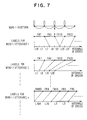
- a baseform for a first word is shown to include the sequence of fenemic Markov models :f. F sub F7F8F10F20.
- the acoustic processor 202 When the first word is uttered a first time, the acoustic processor 202 generates labels L10, L7, L7, L8, L8, L20, L21,... Looking first at label L10, the Viterbi alignment processor 502 maps label L10 to fenemic Markov model F7 and stores the result in the memory location 1 of TABLE 2.
- next two labels L7 and L7 are also aligned with the fenemic Markov model F7. Accordingly, locations 2 and 3 in the first row under Viterbi Alignment storage in TABLE 1 store a map to F7.
- the next two labels L8 and L8 are aligned with fenemic Markov model F8 and the v in k values stored therefor at locations 4 and 5 reflect this mapping. No labels are aligned with F10.
- Labels L20 and L21 are aligned with fenemic Markov model F20 and so on. As shown in FIG.7, the process is repeated for successive utterances of successive words.
- the alignment results exit the Viterbi alignment processor 502 and enter a mean and covariance estimator 504.
- the mean and covariance estimator 504 also receives as input the successive feature vectors from which the acoustic processor 202 (of FIG.2) derives labels.
- the feature vectors generated for each utterance of a word are stored in memory as shown in TABLE 1 under heading "Feature Vectors.”
- the baseform structures are also provided as input to the mean and covariance estimator 504.
- the mean and covariance estimator 504 operates as set forth in the flowchart of FIG.8. As discussed hereinabove, the estimator 504 operates to compute the mean of all feature vectors corresponding to labels generated for one fenemic Markov model after another.
- the covariances of the feature vectors associated with each fenemic Markov model is also computed.
- the estimator 504 first initializes all means and covariances to zero in step 800. That is, the mean vector M(i) and covariance matrix C(i) and a count value COUNT (i) are set to zero for each ith fenemic Markov model. The total number of Markov models is identified by the variable Nphones.
- step 802 the first word is selected.
- step 804 the fenemic Markov models for the selected word are read as p word .
- the first fenemic Markov model is selected by means of steps 806 and 808.
- step 810 the feature vector for the kth label of a given jth utterance of an ith word and the v in k value stored therefor are read.
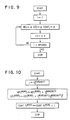
- step 812 means and covariances are accumulated as shown in FIG.10.
- j is set to the value of v in k and a mean value M(p w j ord ) is up-dated by adding the feature vector y in k to a previous value of the jth Markov model of the selected word, M(p w j ord ).
- the covariance matrix C(p w j ord ) is similarly up-dated by adding y in k x (y in k ) T to the previous set of covariances.
- a count COUNT (p w j ord ) is incremented from a previous value thereof by adding 1 thereto. It is recalled that each mean, covariance, and COUNT value is initially zeroed (in step 800).
- the accumulation of mean and covariance values for each kth label is performed pursuant to the loop prompted by steps 814 and 816. Accumulated mean and covariance and COUNT values are computed for successive labels until k exceeds the number of feature vectors aligned against the given word (i.e., the first word in the first iteration) and utterance thereof.
- the process of accumulating means, covariances, and COUNTs involves iterating the steps 810 through 820 for successive utterances until all utterances of the first word are examined and processed. After all utterances for a given word are processed, the next word is selected at step 822 provided that all words have not been processed previously. For the next selected word, steps 804 through 822 are repeated. After all utterances of all nwords have been processed (Step 824), means and covariances M(i) and C(i) are estimated in step 826.
- Step 826 is depicted in detail in FIG.11.
- M(i) T is the transpose of M(i).
- a first row of memory has locations 1 through N and contains mean values M1(1) through M1(N) where N is the number of feature vectors for a given label and M i is the mean value for the ith label.
- a second row in the memory includes locations (N+1) through 2N, which contain mean values M2(1) through M2(N) respectively.
- the last row of memory for the mean values include locations [ N x (n phones - 1) + 1] which contain mean values M nphones (1) through M nphones (N) where n phones is the number of Markov models.
- TABLE 1 Also shown in TABLE 1 is storage of the covariances.
- locations 1 through [N x (N + 1)/2] which contain covariances C1(1, 1) through C1(n,N).
- the last row includes locations [(n phones - 1) x N x (N + 1)/2] + 1 through n phones (N x (N + 1)/2) which contain covariance values C nphones (1, 1) through C nphones (N, N).
- the means and covariances computed by the estimator 504 enter the label specifier 506 together with the parameter vectors generated by the acoustic processor 202 (of FIG.2).
- the label specifier 506 up-dates the definitions of the labels in the label alphabet according to the flowchart of FIG.12.
- a feature vector y w k ord,nutt is read.
- the first feature vector in the string of labels generated for the first utterance of the first word --namely, y 1 1 ,1 -- is read (see steps 850, 851, 852, and 854).
- the closest Markov model to the feature vector is determined in step 854.
- Step 854 is expanded in FIG.13.
- a distance measurement is made between the currently read feature vector and the mean and covariance values stored for each Markov model.
- M(j) corresponds to the mean value of the jth fenemic Markov model
- C(j) corresponds to the covariance of the jth fenemic Markov model
- the distance measurement is defined as: d ⁇ log(det C(j))+[(y w k ord,nutt - M(j))] T C(j) ⁇ 1(y w k ord,nutt - M(j))
- the distance measurement is performed for one fenemic Markov model after another with the j resulting in the minimum d value being stored as j min , the closest fenemic Markov model for the kth feature vector.
- one kth feature vector after another is processed until the closest fenemic Markov model for each feature vector in an utterance of a word have been determined (see steps 854, 856, and 858).
- Successive utterances of the current word are processed according to steps 852 through 862 until all utterances of the current word have been processed.
- all feature vectors for one utterance of the current word after another are processed to determine the respective closest fenemic Markov models therefor.
- a next word is selected, with steps 850 through 866 being performed for each word until all nwords have been processed.
- new word baseforms are constructed based on the up-dated data.
- the constructing of fenemic word baseforms is described in detail in US Patent 4,718,094, entitled “Speech Recognition System", and in the European Patent Application 87 102 423.8, entitled “Improving the Training of Markov Models Used in a Speech Recognition System”.
- a discussion of baseform growing is also included hereinbelow, briefly outlining the method of applying the Forward-Backward algorithm in constructing Markov model sequences for words.
- the memory of TABLE 1 under the headings of "Baseforms" and “Statistics”, are up-dated as new baseforms and probability statistics therefor are computed.
- a simple method of forming fenemic Markov model baseforms involves uttering each word once at a known time.
- the string of labels generated by the acoustic processor 202 (of FIG.2) for a known word at a known time is noted.
- the fenemic models for the generated labels are concatenated to form a fenemic Markov model word baseform.
- XXX for example, suppose that the labels L1-L5-L5-L6-... are generated. Based on the single utterance method, the fenemic Markov model baseform for the word XXX is F1F5F5F6....
- An alternative, preferred feneme-based Markov model word baseform is constructed based on multiple utterances of a word.
- the word baseforms account for variations in pronunciation of a given word.
- One method for achieving this end is set forth in the European Patent Application 86 104 225.7.
- a method which includes the steps of: (a) transforming each of multiple utterances of the word segment into a re spective string of labels; (b) defining a set of fenemic Markov models; (c) determining the best single model P1 for producing the multiple label strings; (d) determining the best two model baseform of the form P1P2 or P2P1 for producing the multiple label strings; (e) aligning the best two-model baseform against each label string; (f) splitting each label string into a left portion and a right portion with the left portion corresponding to the first model of the two-model baseform and the right portion corresponding to the second model of the two-model baseform; (g) identifying each left portion as a left substring and each right
- the method includes the further steps of: (l) aligning the concatenated baseform against each of the label strings and identifying, for each model in the concatenated baseform, the substring in each label string which corresponds thereto, the substrings corresponding to a given model being a set of common substrings; (m) for each set of common substrings, determining the model having the highest joint probability of producing the common substrings; and (n) for each common substring, replacing the model therefor in the concatenated baseform by the determined model of highest joint probability; the baseform resulting from the replacing of models being a refined baseform. If the steps (l) through (n) are repeated until no models are replaced, a further refined baseform is achieved.
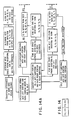
- the flowchart of FIG.14 illustrates a preferred methodology for constructing fenemic word baseforms from multiple utterances.
- the term "phone” corresponds to Markov model.
- a single phone baseform is a baseform constructed of a single Markov model.
- P1 and P2 correspond to two phones --that is, two Markov models. Basically, a divide-and-conquer strategy is employed.
- Transition probabilities and label output probabilities (i.e., probability items) stored in TABLE 1 are defined in terms of “counts”.
- a “count” typically defines the (expected) number of times a particular event occurs. In the present context, there are “single counts” and “cumulative counts.” Unless otherwise specified, the term “count” when used alone means “single count”.
- the probability items are computed based on data accumulated during a training session in which known words --each represented as a known sequence of fenemic Markov models --are uttered and a string of labels are generated.
- a "single count" is computed as the probability of a particular transition ⁇ i and state Sj given (a) a certain string Y of labels, (b) defined estimated values ⁇ ′, and (c) a particular time t.
- Each above-described single count is determined by applying the well-known forward-backward algorithm.
- the single count may be represented by the expression: Pr(S j , ⁇ i
- the ⁇ ′ may be omitted as implicit in a probability characterized as Pr′.
- the expression becomes: Pr′( ⁇ i ,S j , Y
- Pr′(Y) is the probability derived from the forward pass probability computed using the parameters ⁇ ′ in the well-known Forward-backward algorithm. The problem is thus reduced to computing the probabilities: Pr′ ( ⁇ i ,S j , Y
- a transition "cumulative count" is determined for a corresponding transition probability item. Because the transition cumulative count is a sum of probabilities, its value may exceed unity.
- a respective cumulative count is stored for each transition probability item. By dividing this cumulative count for a given transition by the sum of cumulative count for all transitions which can be taken from the same initial state as that for ⁇ i , a current probability value for the respective transition probability item is computed. The current probability value is preferably stored and associated with its respective transition probability item.
- Each transition probability item is preferably defined in estimated form as:
- each transition probability is defined in terms of counts.
- the numerator is a cumulative count --the sum of single count values for a given transition ⁇ i at any time through time T+1-- while the denominator represents the sum of single count values taken over all possible transitions ⁇ i through ⁇ k , which have the same initial state as ⁇ i taken over all times through time T+1.
- each label output probability at any non-null transition is preferably also defined in terms of counts. That is, an estimated label output probability Pr′ for a label f h being produced given a transition ⁇ i and state S j is mathematically represented as: where f h corresponds to a specific label selected from the alphabet of labels and y t corresponds to the label generated at a time interval t.
- Each summed term in the numerator represents the probability that a label y t generated in the string Y is label f h and the label y t was produced on transition ⁇ i out of state S j , given that the generated label output was the string Y.
- the sum in the numerator is a label "output cumulative count” and is preferably stored with the associated label output probability item corresponding therewith. By dividing this cumulative count by the sum of single counts over all label times for tile specific S j , ⁇ i , Y, and ⁇ ′, a current probability value is determined for the respective label output probability item.
- transition probabilities and label output probabilities are accordingly readily computed from the counts after an iteration of count adjustment.
- FIG.15 six fenemic Markov models F A , F B , F C , F D , F E , and F F are shown in a sample word baseform.
- word baseforms typically extend over sixty to one hundred fenemic Markov models, for purposes of explanation it is assumed that the sample word baseform starts at state S I and ends at state S VI .
- each time interval represents a time during which a label is produced.
- each interval is one centisecond.
- the trellis of FIG.16 illustrates the optional paths which may be followed. That is, point “a” in the trellis represents the first state of the first Markov model in the baseform -- F A -- at time t0. Proceeding vertically downward from point "a” to point “b” indi cates that the null arc of model F A is taken to state S II . Proceeding horizontally to the right of point “a” suggests that the non-null loop of model F A is followed and the first label is produced. Proceeding diagonally downward to the right of point "a” indicates that the non-null arc extending from state S I to state S II is followed and the first label is produced thereat. A similar analysis applies at the various time intervals for the successive states shown in the trellis.
- the probability of following an arc ⁇ i between states S j and S k to produce a label f t at a time t is determined. As depicted in FIG. 17, this is done by computing three elements in a probability product.
- a forward pass probability is determined for the probability Pr′ (S j , ⁇ i , Y, t).
- the second component of the product is the probability of taking transition ⁇ i from state S j and producing label f t . This may be expressed as: Pr( ⁇ i S j )Pr (f t
- This second component is based on the previously defined current value stored for a transition probability item (at transition ⁇ i ) or for a label output probability item (for label f h ).
- the third component of the product is denoted as ⁇ t+1 (k). This third component represents the probability of producing labels f t+1 through f T starting at state S k (at time t+1).
- the backward pass involves determining the probability ⁇ t (S), the probability of completing the output string of labels starting from state S at time t.
- the ⁇ 's satisfy a similar computation as do the ⁇ 's.
- the main difference is that the forward pass starts at state 1 and moves forward in time therefrom whereas the backward pass starts at the final state (S F ) and proceeds backward in time, and backwards through the states.
- FIG.18 A general diagram of a Markov model speech recognition system 1000 is shown in FIG.18.
- FIG.18 includes an acoustic processor 1002.
- the acoustic processor 1002 operates like the acoustic processor 202 (of FIG.2). Accordingly, at successive intervals (e.g., centisecond intervals), successive labels from an alphabet of re-specified labels are selected as corresponding to the feature vectors detected at successive time intervals.
- the labels enter a stack decoder 1004 to which is connected an acoustic match processor 1006, a language model processor 1008, and a work station 1010.
- the acoustic match processor 1006, in effect, performs a matching of the labels generated by the acoustic processor 1004 with word baseforms constructed interdependently with the re-specified labels (in step 302 of FIG. 3).
- Statistical data for the word baseforms is stored as shown in TABLE 1 for each.
- the acoustic match processor 1006 includes word baseforms --i.e., respective Markov model sequences for the vocabulary words-- with probability statistics stored for each arc and label output probability. (The probability statistics are determined during the training session.)
- the sequence of Markov models for each word is derived from the baseform dictionary 208 (of FIG.2). That is, after the labels are re-specified for the last time and baseforms are constructed therefrom, the sequence of Markov models in the baseform is set for the speech recognizer of FIG.18. For each speaker, the same sequence of Markov models is applied. As in the case of phonetic Markov models in which the word "THE" is represented by the three Markov model sequence DH-UH1-XX for all speakers, the present invention provides the same sequence of fenemic Markov models for each given word regardless of speaker.
- the probability statistics applied to the sequence of fenemic Markov models for a given word vary. Stated otherwise, for each speaker, an alphabet of labels having parameter values characteristic of a subject speaker. Based on his alphabet of labels and based on the labels generated in response to the speaker uttering a sample text --which corresponds to a known sequence of fenemic Markov models-- the arc and label output probabilities of the Markov models are determined for the subject speaker.
- the interdependent re-specifying of labels and construction of word baseforms is used in defining a universal sequence of fenemic Markov models for each word. Given the sequence for each word, each speaker utters the sample text to "train" --that is, compute and store probabilities for-- the fenemic Markov models. Training a Markov model speech recognizer is discussed in the co-pending patent application entitled "Improving the Training of Markov Models Used in a Speech Recognition System".
- the acoustic match processor 1006 determines a likelihood score for words in the vocabulary --based on the computed and stored acoustical probability data for the fenemic Markov models.
- the language model 1008 is based on word sequence data previously stored. Typically, millions of words are scanned and the number of times each sequence of m words (1 ⁇ m)occurs is tallied. In determining the language model score of a subject word as being the next word, the language model 1008 concatenates the subject word with two likely preceding words to form a subject tri-gram. Looking at the data base of word sequences and the number of times the subject tri-gram occurred in the data base text, a context likelihood is determined. If the word tri-gram did not occur in the data base, the subject word and the likely preceding word are considered as a bi-gram. The counts of the pair of words in the data base is then retrieved.
- a language model processor 1008 is set forth in the European Patent Application 87 102 789.2, entitled "Apparatus and Method for Estimating, from Sparse Data, the Probability that a Particular One of a Set of Events is the Next Event in a String of Events".
- the language model processor 1008 is of major value in distinguishing between homonyms or phrases which can be represented similarly acoustically but are distinct contextually.
- the stack decoder 1004 uses input from the acoustic processor 1006 and the language model 1008 in determining which sequences of words are sufficiently likely to warrant consideration as the sequence of words corresponding to a given speech input. Details of the acoustic decoder 1006 are set forth in a European Patent Application 86 104 218.2, entitled “Apparatus and Method for Determining a Likely Word Sequence from Labels Generated by an Acoustic Processor".
- a preferred mode of the speech recognizer of FIG.18 includes: (a) an IBM 4341 mainframe computer on which the stack decoding is performed; (b) three FPS 190L array processors for performing (i) detailed acoustic matching and approximate acoustic matching for producing a list of likely word candidates to which detailed matching is applied (see acoustic match 1006) and (ii) acoustic processing (see acoustic processor 1002) in which speech input is converted into labels, respectively; and a bank of IBM 3350 DASD units on which the statistics for the language model are stored.
- the interdependent re-specifying of labels and construction of baseforms as described hereinabove is, in a specific embodiment, implemented on an IBM 3090 mainframe computer with memory storage sufficient to store the following items: Feature vectors --- 10 kilobytes/word Word Baseforms --- 1 kilobyte/word Probabilities --- 200 kilobytes Alignment data --- .4 kilobytes/word Label (Prototype vector) data --- 200 kilobytes Label IDs (fenemes) --- 200 bytes / word
Landscapes
- Engineering & Computer Science (AREA)
- Physics & Mathematics (AREA)
- Human Computer Interaction (AREA)
- Computational Linguistics (AREA)
- Health & Medical Sciences (AREA)
- Audiology, Speech & Language Pathology (AREA)
- Probability & Statistics with Applications (AREA)
- Acoustics & Sound (AREA)
- Multimedia (AREA)
- Telephonic Communication Services (AREA)
- Machine Translation (AREA)
- Character Discrimination (AREA)
- Document Processing Apparatus (AREA)
Applications Claiming Priority (2)
| Application Number | Priority Date | Filing Date | Title |
|---|---|---|---|
| US11550587A | 1987-10-30 | 1987-10-30 | |
| US115505 | 1987-10-30 |
Publications (3)
| Publication Number | Publication Date |
|---|---|
| EP0314908A2 true EP0314908A2 (fr) | 1989-05-10 |
| EP0314908A3 EP0314908A3 (en) | 1989-10-25 |
| EP0314908B1 EP0314908B1 (fr) | 1992-12-02 |
Family
ID=22361837
Family Applications (1)
| Application Number | Title | Priority Date | Filing Date |
|---|---|---|---|
| EP19880115174 Expired EP0314908B1 (fr) | 1987-10-30 | 1988-09-16 | Détermination automatique d'étiquettes et de représentations de mots par des modèles de Markov dans un système pour la reconnaissance de la parole |
Country Status (3)
| Country | Link |
|---|---|
| EP (1) | EP0314908B1 (fr) |
| JP (1) | JPH01137297A (fr) |
| DE (1) | DE3876379T2 (fr) |
Cited By (152)
| Publication number | Priority date | Publication date | Assignee | Title |
|---|---|---|---|---|
| EP0625775A1 (fr) * | 1993-05-18 | 1994-11-23 | International Business Machines Corporation | Système de reconnaissance de la parole avec rejet des mots et des sons qui ne sont pas compris dans le vocabulaire du système |
| EP0938076A1 (fr) * | 1992-12-31 | 1999-08-25 | Apple Computer, Inc. | Système de reconnaissance de la parole |
| US8583418B2 (en) | 2008-09-29 | 2013-11-12 | Apple Inc. | Systems and methods of detecting language and natural language strings for text to speech synthesis |
| US8600743B2 (en) | 2010-01-06 | 2013-12-03 | Apple Inc. | Noise profile determination for voice-related feature |
| US8614431B2 (en) | 2005-09-30 | 2013-12-24 | Apple Inc. | Automated response to and sensing of user activity in portable devices |
| US8620662B2 (en) | 2007-11-20 | 2013-12-31 | Apple Inc. | Context-aware unit selection |
| US8645137B2 (en) | 2000-03-16 | 2014-02-04 | Apple Inc. | Fast, language-independent method for user authentication by voice |
| US8660849B2 (en) | 2010-01-18 | 2014-02-25 | Apple Inc. | Prioritizing selection criteria by automated assistant |
| US8670985B2 (en) | 2010-01-13 | 2014-03-11 | Apple Inc. | Devices and methods for identifying a prompt corresponding to a voice input in a sequence of prompts |
| US8677377B2 (en) | 2005-09-08 | 2014-03-18 | Apple Inc. | Method and apparatus for building an intelligent automated assistant |
| US8676904B2 (en) | 2008-10-02 | 2014-03-18 | Apple Inc. | Electronic devices with voice command and contextual data processing capabilities |
| US8682649B2 (en) | 2009-11-12 | 2014-03-25 | Apple Inc. | Sentiment prediction from textual data |
| US8682667B2 (en) | 2010-02-25 | 2014-03-25 | Apple Inc. | User profiling for selecting user specific voice input processing information |
| US8688446B2 (en) | 2008-02-22 | 2014-04-01 | Apple Inc. | Providing text input using speech data and non-speech data |
| US8706472B2 (en) | 2011-08-11 | 2014-04-22 | Apple Inc. | Method for disambiguating multiple readings in language conversion |
| US8713021B2 (en) | 2010-07-07 | 2014-04-29 | Apple Inc. | Unsupervised document clustering using latent semantic density analysis |
| US8712776B2 (en) | 2008-09-29 | 2014-04-29 | Apple Inc. | Systems and methods for selective text to speech synthesis |
| US8719006B2 (en) | 2010-08-27 | 2014-05-06 | Apple Inc. | Combined statistical and rule-based part-of-speech tagging for text-to-speech synthesis |
| US8719014B2 (en) | 2010-09-27 | 2014-05-06 | Apple Inc. | Electronic device with text error correction based on voice recognition data |
| US8718047B2 (en) | 2001-10-22 | 2014-05-06 | Apple Inc. | Text to speech conversion of text messages from mobile communication devices |
| US8751238B2 (en) | 2009-03-09 | 2014-06-10 | Apple Inc. | Systems and methods for determining the language to use for speech generated by a text to speech engine |
| US8762156B2 (en) | 2011-09-28 | 2014-06-24 | Apple Inc. | Speech recognition repair using contextual information |
| US8768702B2 (en) | 2008-09-05 | 2014-07-01 | Apple Inc. | Multi-tiered voice feedback in an electronic device |
| US8775442B2 (en) | 2012-05-15 | 2014-07-08 | Apple Inc. | Semantic search using a single-source semantic model |
| US8781836B2 (en) | 2011-02-22 | 2014-07-15 | Apple Inc. | Hearing assistance system for providing consistent human speech |
| US8812294B2 (en) | 2011-06-21 | 2014-08-19 | Apple Inc. | Translating phrases from one language into another using an order-based set of declarative rules |
| US8862252B2 (en) | 2009-01-30 | 2014-10-14 | Apple Inc. | Audio user interface for displayless electronic device |
| US8898568B2 (en) | 2008-09-09 | 2014-11-25 | Apple Inc. | Audio user interface |
| US8935167B2 (en) | 2012-09-25 | 2015-01-13 | Apple Inc. | Exemplar-based latent perceptual modeling for automatic speech recognition |
| US8977584B2 (en) | 2010-01-25 | 2015-03-10 | Newvaluexchange Global Ai Llp | Apparatuses, methods and systems for a digital conversation management platform |
| US8977255B2 (en) | 2007-04-03 | 2015-03-10 | Apple Inc. | Method and system for operating a multi-function portable electronic device using voice-activation |
| US8996376B2 (en) | 2008-04-05 | 2015-03-31 | Apple Inc. | Intelligent text-to-speech conversion |
| US9053089B2 (en) | 2007-10-02 | 2015-06-09 | Apple Inc. | Part-of-speech tagging using latent analogy |
| US9262612B2 (en) | 2011-03-21 | 2016-02-16 | Apple Inc. | Device access using voice authentication |
| US9280610B2 (en) | 2012-05-14 | 2016-03-08 | Apple Inc. | Crowd sourcing information to fulfill user requests |
| US9300784B2 (en) | 2013-06-13 | 2016-03-29 | Apple Inc. | System and method for emergency calls initiated by voice command |
| US9311043B2 (en) | 2010-01-13 | 2016-04-12 | Apple Inc. | Adaptive audio feedback system and method |
| US9330720B2 (en) | 2008-01-03 | 2016-05-03 | Apple Inc. | Methods and apparatus for altering audio output signals |
| US9338493B2 (en) | 2014-06-30 | 2016-05-10 | Apple Inc. | Intelligent automated assistant for TV user interactions |
| US9368114B2 (en) | 2013-03-14 | 2016-06-14 | Apple Inc. | Context-sensitive handling of interruptions |
| US9430463B2 (en) | 2014-05-30 | 2016-08-30 | Apple Inc. | Exemplar-based natural language processing |
| US9431006B2 (en) | 2009-07-02 | 2016-08-30 | Apple Inc. | Methods and apparatuses for automatic speech recognition |
| US9483461B2 (en) | 2012-03-06 | 2016-11-01 | Apple Inc. | Handling speech synthesis of content for multiple languages |
| US9495129B2 (en) | 2012-06-29 | 2016-11-15 | Apple Inc. | Device, method, and user interface for voice-activated navigation and browsing of a document |
| US9502031B2 (en) | 2014-05-27 | 2016-11-22 | Apple Inc. | Method for supporting dynamic grammars in WFST-based ASR |
| US9535906B2 (en) | 2008-07-31 | 2017-01-03 | Apple Inc. | Mobile device having human language translation capability with positional feedback |
| US9547647B2 (en) | 2012-09-19 | 2017-01-17 | Apple Inc. | Voice-based media searching |
| US9576574B2 (en) | 2012-09-10 | 2017-02-21 | Apple Inc. | Context-sensitive handling of interruptions by intelligent digital assistant |
| US9582608B2 (en) | 2013-06-07 | 2017-02-28 | Apple Inc. | Unified ranking with entropy-weighted information for phrase-based semantic auto-completion |
| US9620104B2 (en) | 2013-06-07 | 2017-04-11 | Apple Inc. | System and method for user-specified pronunciation of words for speech synthesis and recognition |
| US9620105B2 (en) | 2014-05-15 | 2017-04-11 | Apple Inc. | Analyzing audio input for efficient speech and music recognition |
| US9633004B2 (en) | 2014-05-30 | 2017-04-25 | Apple Inc. | Better resolution when referencing to concepts |
| US9633674B2 (en) | 2013-06-07 | 2017-04-25 | Apple Inc. | System and method for detecting errors in interactions with a voice-based digital assistant |
| US9646609B2 (en) | 2014-09-30 | 2017-05-09 | Apple Inc. | Caching apparatus for serving phonetic pronunciations |
| US9668121B2 (en) | 2014-09-30 | 2017-05-30 | Apple Inc. | Social reminders |
| US9697820B2 (en) | 2015-09-24 | 2017-07-04 | Apple Inc. | Unit-selection text-to-speech synthesis using concatenation-sensitive neural networks |
| US9697822B1 (en) | 2013-03-15 | 2017-07-04 | Apple Inc. | System and method for updating an adaptive speech recognition model |
| US9711141B2 (en) | 2014-12-09 | 2017-07-18 | Apple Inc. | Disambiguating heteronyms in speech synthesis |
| US9715875B2 (en) | 2014-05-30 | 2017-07-25 | Apple Inc. | Reducing the need for manual start/end-pointing and trigger phrases |
| US9721566B2 (en) | 2015-03-08 | 2017-08-01 | Apple Inc. | Competing devices responding to voice triggers |
| US9721563B2 (en) | 2012-06-08 | 2017-08-01 | Apple Inc. | Name recognition system |
| US9734193B2 (en) | 2014-05-30 | 2017-08-15 | Apple Inc. | Determining domain salience ranking from ambiguous words in natural speech |
| US9733821B2 (en) | 2013-03-14 | 2017-08-15 | Apple Inc. | Voice control to diagnose inadvertent activation of accessibility features |
| US9760559B2 (en) | 2014-05-30 | 2017-09-12 | Apple Inc. | Predictive text input |
| US9785630B2 (en) | 2014-05-30 | 2017-10-10 | Apple Inc. | Text prediction using combined word N-gram and unigram language models |
| US9798393B2 (en) | 2011-08-29 | 2017-10-24 | Apple Inc. | Text correction processing |
| US9818400B2 (en) | 2014-09-11 | 2017-11-14 | Apple Inc. | Method and apparatus for discovering trending terms in speech requests |
| US9842101B2 (en) | 2014-05-30 | 2017-12-12 | Apple Inc. | Predictive conversion of language input |
| US9842105B2 (en) | 2015-04-16 | 2017-12-12 | Apple Inc. | Parsimonious continuous-space phrase representations for natural language processing |
| US9858925B2 (en) | 2009-06-05 | 2018-01-02 | Apple Inc. | Using context information to facilitate processing of commands in a virtual assistant |
| US9865280B2 (en) | 2015-03-06 | 2018-01-09 | Apple Inc. | Structured dictation using intelligent automated assistants |
| US9886953B2 (en) | 2015-03-08 | 2018-02-06 | Apple Inc. | Virtual assistant activation |
| US9886432B2 (en) | 2014-09-30 | 2018-02-06 | Apple Inc. | Parsimonious handling of word inflection via categorical stem + suffix N-gram language models |
| US9899019B2 (en) | 2015-03-18 | 2018-02-20 | Apple Inc. | Systems and methods for structured stem and suffix language models |
| US9922642B2 (en) | 2013-03-15 | 2018-03-20 | Apple Inc. | Training an at least partial voice command system |
| US9934775B2 (en) | 2016-05-26 | 2018-04-03 | Apple Inc. | Unit-selection text-to-speech synthesis based on predicted concatenation parameters |
| US9946706B2 (en) | 2008-06-07 | 2018-04-17 | Apple Inc. | Automatic language identification for dynamic text processing |
| US9947313B2 (en) | 2015-01-26 | 2018-04-17 | William Drewes | Method for substantial ongoing cumulative voice recognition error reduction |
| US9959870B2 (en) | 2008-12-11 | 2018-05-01 | Apple Inc. | Speech recognition involving a mobile device |
| US9966065B2 (en) | 2014-05-30 | 2018-05-08 | Apple Inc. | Multi-command single utterance input method |
| US9966068B2 (en) | 2013-06-08 | 2018-05-08 | Apple Inc. | Interpreting and acting upon commands that involve sharing information with remote devices |
| US9972304B2 (en) | 2016-06-03 | 2018-05-15 | Apple Inc. | Privacy preserving distributed evaluation framework for embedded personalized systems |
| US9977779B2 (en) | 2013-03-14 | 2018-05-22 | Apple Inc. | Automatic supplementation of word correction dictionaries |
| US10002189B2 (en) | 2007-12-20 | 2018-06-19 | Apple Inc. | Method and apparatus for searching using an active ontology |
| US10019994B2 (en) | 2012-06-08 | 2018-07-10 | Apple Inc. | Systems and methods for recognizing textual identifiers within a plurality of words |
| US10049668B2 (en) | 2015-12-02 | 2018-08-14 | Apple Inc. | Applying neural network language models to weighted finite state transducers for automatic speech recognition |
| US10049663B2 (en) | 2016-06-08 | 2018-08-14 | Apple, Inc. | Intelligent automated assistant for media exploration |
| US10057736B2 (en) | 2011-06-03 | 2018-08-21 | Apple Inc. | Active transport based notifications |
| US10067938B2 (en) | 2016-06-10 | 2018-09-04 | Apple Inc. | Multilingual word prediction |
| US10074360B2 (en) | 2014-09-30 | 2018-09-11 | Apple Inc. | Providing an indication of the suitability of speech recognition |
| US10078487B2 (en) | 2013-03-15 | 2018-09-18 | Apple Inc. | Context-sensitive handling of interruptions |
| US10078631B2 (en) | 2014-05-30 | 2018-09-18 | Apple Inc. | Entropy-guided text prediction using combined word and character n-gram language models |
| US10083688B2 (en) | 2015-05-27 | 2018-09-25 | Apple Inc. | Device voice control for selecting a displayed affordance |
| US10089072B2 (en) | 2016-06-11 | 2018-10-02 | Apple Inc. | Intelligent device arbitration and control |
| US10101822B2 (en) | 2015-06-05 | 2018-10-16 | Apple Inc. | Language input correction |
| US10127911B2 (en) | 2014-09-30 | 2018-11-13 | Apple Inc. | Speaker identification and unsupervised speaker adaptation techniques |
| US10127220B2 (en) | 2015-06-04 | 2018-11-13 | Apple Inc. | Language identification from short strings |
| US10134385B2 (en) | 2012-03-02 | 2018-11-20 | Apple Inc. | Systems and methods for name pronunciation |
| US10170123B2 (en) | 2014-05-30 | 2019-01-01 | Apple Inc. | Intelligent assistant for home automation |
| US10176167B2 (en) | 2013-06-09 | 2019-01-08 | Apple Inc. | System and method for inferring user intent from speech inputs |
| US10186254B2 (en) | 2015-06-07 | 2019-01-22 | Apple Inc. | Context-based endpoint detection |
| US10185542B2 (en) | 2013-06-09 | 2019-01-22 | Apple Inc. | Device, method, and graphical user interface for enabling conversation persistence across two or more instances of a digital assistant |
| US10192552B2 (en) | 2016-06-10 | 2019-01-29 | Apple Inc. | Digital assistant providing whispered speech |
| US10199051B2 (en) | 2013-02-07 | 2019-02-05 | Apple Inc. | Voice trigger for a digital assistant |
| US10223066B2 (en) | 2015-12-23 | 2019-03-05 | Apple Inc. | Proactive assistance based on dialog communication between devices |
| US10241752B2 (en) | 2011-09-30 | 2019-03-26 | Apple Inc. | Interface for a virtual digital assistant |
| US10241644B2 (en) | 2011-06-03 | 2019-03-26 | Apple Inc. | Actionable reminder entries |
| US10249300B2 (en) | 2016-06-06 | 2019-04-02 | Apple Inc. | Intelligent list reading |
| US10255566B2 (en) | 2011-06-03 | 2019-04-09 | Apple Inc. | Generating and processing task items that represent tasks to perform |
| US10255907B2 (en) | 2015-06-07 | 2019-04-09 | Apple Inc. | Automatic accent detection using acoustic models |
| US10269345B2 (en) | 2016-06-11 | 2019-04-23 | Apple Inc. | Intelligent task discovery |
| US10276170B2 (en) | 2010-01-18 | 2019-04-30 | Apple Inc. | Intelligent automated assistant |
| US10289433B2 (en) | 2014-05-30 | 2019-05-14 | Apple Inc. | Domain specific language for encoding assistant dialog |
| US10297253B2 (en) | 2016-06-11 | 2019-05-21 | Apple Inc. | Application integration with a digital assistant |
| US10296160B2 (en) | 2013-12-06 | 2019-05-21 | Apple Inc. | Method for extracting salient dialog usage from live data |
| US10354011B2 (en) | 2016-06-09 | 2019-07-16 | Apple Inc. | Intelligent automated assistant in a home environment |
| US10366158B2 (en) | 2015-09-29 | 2019-07-30 | Apple Inc. | Efficient word encoding for recurrent neural network language models |
| US10417037B2 (en) | 2012-05-15 | 2019-09-17 | Apple Inc. | Systems and methods for integrating third party services with a digital assistant |
| US10446143B2 (en) | 2016-03-14 | 2019-10-15 | Apple Inc. | Identification of voice inputs providing credentials |
| US10446141B2 (en) | 2014-08-28 | 2019-10-15 | Apple Inc. | Automatic speech recognition based on user feedback |
| US10490187B2 (en) | 2016-06-10 | 2019-11-26 | Apple Inc. | Digital assistant providing automated status report |
| US10496753B2 (en) | 2010-01-18 | 2019-12-03 | Apple Inc. | Automatically adapting user interfaces for hands-free interaction |
| US10509862B2 (en) | 2016-06-10 | 2019-12-17 | Apple Inc. | Dynamic phrase expansion of language input |
| US10515147B2 (en) | 2010-12-22 | 2019-12-24 | Apple Inc. | Using statistical language models for contextual lookup |
| US10521466B2 (en) | 2016-06-11 | 2019-12-31 | Apple Inc. | Data driven natural language event detection and classification |
| US10540976B2 (en) | 2009-06-05 | 2020-01-21 | Apple Inc. | Contextual voice commands |
| US10553209B2 (en) | 2010-01-18 | 2020-02-04 | Apple Inc. | Systems and methods for hands-free notification summaries |
| US10552013B2 (en) | 2014-12-02 | 2020-02-04 | Apple Inc. | Data detection |
| US10567477B2 (en) | 2015-03-08 | 2020-02-18 | Apple Inc. | Virtual assistant continuity |
| US10572476B2 (en) | 2013-03-14 | 2020-02-25 | Apple Inc. | Refining a search based on schedule items |
| US10592095B2 (en) | 2014-05-23 | 2020-03-17 | Apple Inc. | Instantaneous speaking of content on touch devices |
| US10593346B2 (en) | 2016-12-22 | 2020-03-17 | Apple Inc. | Rank-reduced token representation for automatic speech recognition |
| US10642574B2 (en) | 2013-03-14 | 2020-05-05 | Apple Inc. | Device, method, and graphical user interface for outputting captions |
| US10652394B2 (en) | 2013-03-14 | 2020-05-12 | Apple Inc. | System and method for processing voicemail |
| US10659851B2 (en) | 2014-06-30 | 2020-05-19 | Apple Inc. | Real-time digital assistant knowledge updates |
| US10671428B2 (en) | 2015-09-08 | 2020-06-02 | Apple Inc. | Distributed personal assistant |
| US10672399B2 (en) | 2011-06-03 | 2020-06-02 | Apple Inc. | Switching between text data and audio data based on a mapping |
| US10679605B2 (en) | 2010-01-18 | 2020-06-09 | Apple Inc. | Hands-free list-reading by intelligent automated assistant |
| US10691473B2 (en) | 2015-11-06 | 2020-06-23 | Apple Inc. | Intelligent automated assistant in a messaging environment |
| US10705794B2 (en) | 2010-01-18 | 2020-07-07 | Apple Inc. | Automatically adapting user interfaces for hands-free interaction |
| US10733993B2 (en) | 2016-06-10 | 2020-08-04 | Apple Inc. | Intelligent digital assistant in a multi-tasking environment |
| US10747498B2 (en) | 2015-09-08 | 2020-08-18 | Apple Inc. | Zero latency digital assistant |
| US10748529B1 (en) | 2013-03-15 | 2020-08-18 | Apple Inc. | Voice activated device for use with a voice-based digital assistant |
| US10762293B2 (en) | 2010-12-22 | 2020-09-01 | Apple Inc. | Using parts-of-speech tagging and named entity recognition for spelling correction |
| US10791176B2 (en) | 2017-05-12 | 2020-09-29 | Apple Inc. | Synchronization and task delegation of a digital assistant |
| US10789041B2 (en) | 2014-09-12 | 2020-09-29 | Apple Inc. | Dynamic thresholds for always listening speech trigger |
| US10791216B2 (en) | 2013-08-06 | 2020-09-29 | Apple Inc. | Auto-activating smart responses based on activities from remote devices |
| US10810274B2 (en) | 2017-05-15 | 2020-10-20 | Apple Inc. | Optimizing dialogue policy decisions for digital assistants using implicit feedback |
| US11010550B2 (en) | 2015-09-29 | 2021-05-18 | Apple Inc. | Unified language modeling framework for word prediction, auto-completion and auto-correction |
| US11025565B2 (en) | 2015-06-07 | 2021-06-01 | Apple Inc. | Personalized prediction of responses for instant messaging |
| US11151899B2 (en) | 2013-03-15 | 2021-10-19 | Apple Inc. | User training by intelligent digital assistant |
| US11587559B2 (en) | 2015-09-30 | 2023-02-21 | Apple Inc. | Intelligent device identification |
Families Citing this family (2)
| Publication number | Priority date | Publication date | Assignee | Title |
|---|---|---|---|---|
| JP2885947B2 (ja) * | 1991-02-22 | 1999-04-26 | 前田建設工業株式会社 | 開閉式屋根構造 |
| KR101644854B1 (ko) * | 2014-11-19 | 2016-08-12 | 주식회사 픽스 | 영역 지정 방법 |
Family Cites Families (3)
| Publication number | Priority date | Publication date | Assignee | Title |
|---|---|---|---|---|
| JPS62231993A (ja) * | 1986-03-25 | 1987-10-12 | インタ−ナシヨナル ビジネス マシ−ンズ コ−ポレ−シヨン | 音声認識方法 |
| EP0238697B1 (fr) * | 1986-03-27 | 1991-08-14 | International Business Machines Corporation | Procédé pour produire des modèles de mots à partir de plusieurs prononciations pour la reconnaissance de la parole |
| DE3681155D1 (de) * | 1986-03-27 | 1991-10-02 | Ibm | Verfahren und einrichtung zur ermittlung einer wahrscheinlichen woerterfolge aus durch einen akustischen prozessor erzeugten kennsaetzen. |
-
1988
- 1988-09-16 DE DE19883876379 patent/DE3876379T2/de not_active Expired - Fee Related
- 1988-09-16 EP EP19880115174 patent/EP0314908B1/fr not_active Expired
- 1988-10-14 JP JP25746888A patent/JPH01137297A/ja active Granted
Cited By (231)
| Publication number | Priority date | Publication date | Assignee | Title |
|---|---|---|---|---|
| EP0938076A1 (fr) * | 1992-12-31 | 1999-08-25 | Apple Computer, Inc. | Système de reconnaissance de la parole |
| US5465317A (en) * | 1993-05-18 | 1995-11-07 | International Business Machines Corporation | Speech recognition system with improved rejection of words and sounds not in the system vocabulary |
| EP0625775A1 (fr) * | 1993-05-18 | 1994-11-23 | International Business Machines Corporation | Système de reconnaissance de la parole avec rejet des mots et des sons qui ne sont pas compris dans le vocabulaire du système |
| US9646614B2 (en) | 2000-03-16 | 2017-05-09 | Apple Inc. | Fast, language-independent method for user authentication by voice |
| US8645137B2 (en) | 2000-03-16 | 2014-02-04 | Apple Inc. | Fast, language-independent method for user authentication by voice |
| US8718047B2 (en) | 2001-10-22 | 2014-05-06 | Apple Inc. | Text to speech conversion of text messages from mobile communication devices |
| US10318871B2 (en) | 2005-09-08 | 2019-06-11 | Apple Inc. | Method and apparatus for building an intelligent automated assistant |
| US9501741B2 (en) | 2005-09-08 | 2016-11-22 | Apple Inc. | Method and apparatus for building an intelligent automated assistant |
| US8677377B2 (en) | 2005-09-08 | 2014-03-18 | Apple Inc. | Method and apparatus for building an intelligent automated assistant |
| US9619079B2 (en) | 2005-09-30 | 2017-04-11 | Apple Inc. | Automated response to and sensing of user activity in portable devices |
| US8614431B2 (en) | 2005-09-30 | 2013-12-24 | Apple Inc. | Automated response to and sensing of user activity in portable devices |
| US9958987B2 (en) | 2005-09-30 | 2018-05-01 | Apple Inc. | Automated response to and sensing of user activity in portable devices |
| US9389729B2 (en) | 2005-09-30 | 2016-07-12 | Apple Inc. | Automated response to and sensing of user activity in portable devices |
| US8930191B2 (en) | 2006-09-08 | 2015-01-06 | Apple Inc. | Paraphrasing of user requests and results by automated digital assistant |
| US9117447B2 (en) | 2006-09-08 | 2015-08-25 | Apple Inc. | Using event alert text as input to an automated assistant |
| US8942986B2 (en) | 2006-09-08 | 2015-01-27 | Apple Inc. | Determining user intent based on ontologies of domains |
| US8977255B2 (en) | 2007-04-03 | 2015-03-10 | Apple Inc. | Method and system for operating a multi-function portable electronic device using voice-activation |
| US10568032B2 (en) | 2007-04-03 | 2020-02-18 | Apple Inc. | Method and system for operating a multi-function portable electronic device using voice-activation |
| US9053089B2 (en) | 2007-10-02 | 2015-06-09 | Apple Inc. | Part-of-speech tagging using latent analogy |
| US8620662B2 (en) | 2007-11-20 | 2013-12-31 | Apple Inc. | Context-aware unit selection |
| US10002189B2 (en) | 2007-12-20 | 2018-06-19 | Apple Inc. | Method and apparatus for searching using an active ontology |
| US11023513B2 (en) | 2007-12-20 | 2021-06-01 | Apple Inc. | Method and apparatus for searching using an active ontology |
| US10381016B2 (en) | 2008-01-03 | 2019-08-13 | Apple Inc. | Methods and apparatus for altering audio output signals |
| US9330720B2 (en) | 2008-01-03 | 2016-05-03 | Apple Inc. | Methods and apparatus for altering audio output signals |
| US9361886B2 (en) | 2008-02-22 | 2016-06-07 | Apple Inc. | Providing text input using speech data and non-speech data |
| US8688446B2 (en) | 2008-02-22 | 2014-04-01 | Apple Inc. | Providing text input using speech data and non-speech data |
| US9626955B2 (en) | 2008-04-05 | 2017-04-18 | Apple Inc. | Intelligent text-to-speech conversion |
| US8996376B2 (en) | 2008-04-05 | 2015-03-31 | Apple Inc. | Intelligent text-to-speech conversion |
| US9865248B2 (en) | 2008-04-05 | 2018-01-09 | Apple Inc. | Intelligent text-to-speech conversion |
| US9946706B2 (en) | 2008-06-07 | 2018-04-17 | Apple Inc. | Automatic language identification for dynamic text processing |
| US9535906B2 (en) | 2008-07-31 | 2017-01-03 | Apple Inc. | Mobile device having human language translation capability with positional feedback |
| US10108612B2 (en) | 2008-07-31 | 2018-10-23 | Apple Inc. | Mobile device having human language translation capability with positional feedback |
| US9691383B2 (en) | 2008-09-05 | 2017-06-27 | Apple Inc. | Multi-tiered voice feedback in an electronic device |
| US8768702B2 (en) | 2008-09-05 | 2014-07-01 | Apple Inc. | Multi-tiered voice feedback in an electronic device |
| US8898568B2 (en) | 2008-09-09 | 2014-11-25 | Apple Inc. | Audio user interface |
| US8712776B2 (en) | 2008-09-29 | 2014-04-29 | Apple Inc. | Systems and methods for selective text to speech synthesis |
| US8583418B2 (en) | 2008-09-29 | 2013-11-12 | Apple Inc. | Systems and methods of detecting language and natural language strings for text to speech synthesis |
| US8676904B2 (en) | 2008-10-02 | 2014-03-18 | Apple Inc. | Electronic devices with voice command and contextual data processing capabilities |
| US9412392B2 (en) | 2008-10-02 | 2016-08-09 | Apple Inc. | Electronic devices with voice command and contextual data processing capabilities |
| US8713119B2 (en) | 2008-10-02 | 2014-04-29 | Apple Inc. | Electronic devices with voice command and contextual data processing capabilities |
| US10643611B2 (en) | 2008-10-02 | 2020-05-05 | Apple Inc. | Electronic devices with voice command and contextual data processing capabilities |
| US8762469B2 (en) | 2008-10-02 | 2014-06-24 | Apple Inc. | Electronic devices with voice command and contextual data processing capabilities |
| US11348582B2 (en) | 2008-10-02 | 2022-05-31 | Apple Inc. | Electronic devices with voice command and contextual data processing capabilities |
| US9959870B2 (en) | 2008-12-11 | 2018-05-01 | Apple Inc. | Speech recognition involving a mobile device |
| US8862252B2 (en) | 2009-01-30 | 2014-10-14 | Apple Inc. | Audio user interface for displayless electronic device |
| US8751238B2 (en) | 2009-03-09 | 2014-06-10 | Apple Inc. | Systems and methods for determining the language to use for speech generated by a text to speech engine |
| US10540976B2 (en) | 2009-06-05 | 2020-01-21 | Apple Inc. | Contextual voice commands |
| US9858925B2 (en) | 2009-06-05 | 2018-01-02 | Apple Inc. | Using context information to facilitate processing of commands in a virtual assistant |
| US10475446B2 (en) | 2009-06-05 | 2019-11-12 | Apple Inc. | Using context information to facilitate processing of commands in a virtual assistant |
| US10795541B2 (en) | 2009-06-05 | 2020-10-06 | Apple Inc. | Intelligent organization of tasks items |
| US11080012B2 (en) | 2009-06-05 | 2021-08-03 | Apple Inc. | Interface for a virtual digital assistant |
| US9431006B2 (en) | 2009-07-02 | 2016-08-30 | Apple Inc. | Methods and apparatuses for automatic speech recognition |
| US10283110B2 (en) | 2009-07-02 | 2019-05-07 | Apple Inc. | Methods and apparatuses for automatic speech recognition |
| US8682649B2 (en) | 2009-11-12 | 2014-03-25 | Apple Inc. | Sentiment prediction from textual data |
| US8600743B2 (en) | 2010-01-06 | 2013-12-03 | Apple Inc. | Noise profile determination for voice-related feature |
| US8670985B2 (en) | 2010-01-13 | 2014-03-11 | Apple Inc. | Devices and methods for identifying a prompt corresponding to a voice input in a sequence of prompts |
| US9311043B2 (en) | 2010-01-13 | 2016-04-12 | Apple Inc. | Adaptive audio feedback system and method |
| US9318108B2 (en) | 2010-01-18 | 2016-04-19 | Apple Inc. | Intelligent automated assistant |
| US8670979B2 (en) | 2010-01-18 | 2014-03-11 | Apple Inc. | Active input elicitation by intelligent automated assistant |
| US10553209B2 (en) | 2010-01-18 | 2020-02-04 | Apple Inc. | Systems and methods for hands-free notification summaries |
| US8706503B2 (en) | 2010-01-18 | 2014-04-22 | Apple Inc. | Intent deduction based on previous user interactions with voice assistant |
| US11423886B2 (en) | 2010-01-18 | 2022-08-23 | Apple Inc. | Task flow identification based on user intent |
| US10705794B2 (en) | 2010-01-18 | 2020-07-07 | Apple Inc. | Automatically adapting user interfaces for hands-free interaction |
| US10679605B2 (en) | 2010-01-18 | 2020-06-09 | Apple Inc. | Hands-free list-reading by intelligent automated assistant |
| US10706841B2 (en) | 2010-01-18 | 2020-07-07 | Apple Inc. | Task flow identification based on user intent |
| US8799000B2 (en) | 2010-01-18 | 2014-08-05 | Apple Inc. | Disambiguation based on active input elicitation by intelligent automated assistant |
| US8731942B2 (en) | 2010-01-18 | 2014-05-20 | Apple Inc. | Maintaining context information between user interactions with a voice assistant |
| US10496753B2 (en) | 2010-01-18 | 2019-12-03 | Apple Inc. | Automatically adapting user interfaces for hands-free interaction |
| US8892446B2 (en) | 2010-01-18 | 2014-11-18 | Apple Inc. | Service orchestration for intelligent automated assistant |
| US9548050B2 (en) | 2010-01-18 | 2017-01-17 | Apple Inc. | Intelligent automated assistant |
| US8660849B2 (en) | 2010-01-18 | 2014-02-25 | Apple Inc. | Prioritizing selection criteria by automated assistant |
| US10276170B2 (en) | 2010-01-18 | 2019-04-30 | Apple Inc. | Intelligent automated assistant |
| US12087308B2 (en) | 2010-01-18 | 2024-09-10 | Apple Inc. | Intelligent automated assistant |
| US8903716B2 (en) | 2010-01-18 | 2014-12-02 | Apple Inc. | Personalized vocabulary for digital assistant |
| US10984327B2 (en) | 2010-01-25 | 2021-04-20 | New Valuexchange Ltd. | Apparatuses, methods and systems for a digital conversation management platform |
| US12307383B2 (en) | 2010-01-25 | 2025-05-20 | Newvaluexchange Global Ai Llp | Apparatuses, methods and systems for a digital conversation management platform |
| US8977584B2 (en) | 2010-01-25 | 2015-03-10 | Newvaluexchange Global Ai Llp | Apparatuses, methods and systems for a digital conversation management platform |
| US10607140B2 (en) | 2010-01-25 | 2020-03-31 | Newvaluexchange Ltd. | Apparatuses, methods and systems for a digital conversation management platform |
| US10984326B2 (en) | 2010-01-25 | 2021-04-20 | Newvaluexchange Ltd. | Apparatuses, methods and systems for a digital conversation management platform |
| US11410053B2 (en) | 2010-01-25 | 2022-08-09 | Newvaluexchange Ltd. | Apparatuses, methods and systems for a digital conversation management platform |
| US9424862B2 (en) | 2010-01-25 | 2016-08-23 | Newvaluexchange Ltd | Apparatuses, methods and systems for a digital conversation management platform |
| US9424861B2 (en) | 2010-01-25 | 2016-08-23 | Newvaluexchange Ltd | Apparatuses, methods and systems for a digital conversation management platform |
| US10607141B2 (en) | 2010-01-25 | 2020-03-31 | Newvaluexchange Ltd. | Apparatuses, methods and systems for a digital conversation management platform |
| US9431028B2 (en) | 2010-01-25 | 2016-08-30 | Newvaluexchange Ltd | Apparatuses, methods and systems for a digital conversation management platform |
| US10049675B2 (en) | 2010-02-25 | 2018-08-14 | Apple Inc. | User profiling for voice input processing |
| US9633660B2 (en) | 2010-02-25 | 2017-04-25 | Apple Inc. | User profiling for voice input processing |
| US9190062B2 (en) | 2010-02-25 | 2015-11-17 | Apple Inc. | User profiling for voice input processing |
| US8682667B2 (en) | 2010-02-25 | 2014-03-25 | Apple Inc. | User profiling for selecting user specific voice input processing information |
| US8713021B2 (en) | 2010-07-07 | 2014-04-29 | Apple Inc. | Unsupervised document clustering using latent semantic density analysis |
| US8719006B2 (en) | 2010-08-27 | 2014-05-06 | Apple Inc. | Combined statistical and rule-based part-of-speech tagging for text-to-speech synthesis |
| US8719014B2 (en) | 2010-09-27 | 2014-05-06 | Apple Inc. | Electronic device with text error correction based on voice recognition data |
| US9075783B2 (en) | 2010-09-27 | 2015-07-07 | Apple Inc. | Electronic device with text error correction based on voice recognition data |
| US10515147B2 (en) | 2010-12-22 | 2019-12-24 | Apple Inc. | Using statistical language models for contextual lookup |
| US10762293B2 (en) | 2010-12-22 | 2020-09-01 | Apple Inc. | Using parts-of-speech tagging and named entity recognition for spelling correction |
| US8781836B2 (en) | 2011-02-22 | 2014-07-15 | Apple Inc. | Hearing assistance system for providing consistent human speech |
| US9262612B2 (en) | 2011-03-21 | 2016-02-16 | Apple Inc. | Device access using voice authentication |
| US10102359B2 (en) | 2011-03-21 | 2018-10-16 | Apple Inc. | Device access using voice authentication |
| US10255566B2 (en) | 2011-06-03 | 2019-04-09 | Apple Inc. | Generating and processing task items that represent tasks to perform |
| US10241644B2 (en) | 2011-06-03 | 2019-03-26 | Apple Inc. | Actionable reminder entries |
| US10706373B2 (en) | 2011-06-03 | 2020-07-07 | Apple Inc. | Performing actions associated with task items that represent tasks to perform |
| US11120372B2 (en) | 2011-06-03 | 2021-09-14 | Apple Inc. | Performing actions associated with task items that represent tasks to perform |
| US10672399B2 (en) | 2011-06-03 | 2020-06-02 | Apple Inc. | Switching between text data and audio data based on a mapping |
| US10057736B2 (en) | 2011-06-03 | 2018-08-21 | Apple Inc. | Active transport based notifications |
| US8812294B2 (en) | 2011-06-21 | 2014-08-19 | Apple Inc. | Translating phrases from one language into another using an order-based set of declarative rules |
| US8706472B2 (en) | 2011-08-11 | 2014-04-22 | Apple Inc. | Method for disambiguating multiple readings in language conversion |
| US9798393B2 (en) | 2011-08-29 | 2017-10-24 | Apple Inc. | Text correction processing |
| US8762156B2 (en) | 2011-09-28 | 2014-06-24 | Apple Inc. | Speech recognition repair using contextual information |
| US10241752B2 (en) | 2011-09-30 | 2019-03-26 | Apple Inc. | Interface for a virtual digital assistant |
| US10134385B2 (en) | 2012-03-02 | 2018-11-20 | Apple Inc. | Systems and methods for name pronunciation |
| US9483461B2 (en) | 2012-03-06 | 2016-11-01 | Apple Inc. | Handling speech synthesis of content for multiple languages |
| US9953088B2 (en) | 2012-05-14 | 2018-04-24 | Apple Inc. | Crowd sourcing information to fulfill user requests |
| US9280610B2 (en) | 2012-05-14 | 2016-03-08 | Apple Inc. | Crowd sourcing information to fulfill user requests |
| US10417037B2 (en) | 2012-05-15 | 2019-09-17 | Apple Inc. | Systems and methods for integrating third party services with a digital assistant |
| US8775442B2 (en) | 2012-05-15 | 2014-07-08 | Apple Inc. | Semantic search using a single-source semantic model |
| US9721563B2 (en) | 2012-06-08 | 2017-08-01 | Apple Inc. | Name recognition system |
| US10019994B2 (en) | 2012-06-08 | 2018-07-10 | Apple Inc. | Systems and methods for recognizing textual identifiers within a plurality of words |
| US10079014B2 (en) | 2012-06-08 | 2018-09-18 | Apple Inc. | Name recognition system |
| US9495129B2 (en) | 2012-06-29 | 2016-11-15 | Apple Inc. | Device, method, and user interface for voice-activated navigation and browsing of a document |
| US9576574B2 (en) | 2012-09-10 | 2017-02-21 | Apple Inc. | Context-sensitive handling of interruptions by intelligent digital assistant |
| US9971774B2 (en) | 2012-09-19 | 2018-05-15 | Apple Inc. | Voice-based media searching |
| US9547647B2 (en) | 2012-09-19 | 2017-01-17 | Apple Inc. | Voice-based media searching |
| US8935167B2 (en) | 2012-09-25 | 2015-01-13 | Apple Inc. | Exemplar-based latent perceptual modeling for automatic speech recognition |
| US10978090B2 (en) | 2013-02-07 | 2021-04-13 | Apple Inc. | Voice trigger for a digital assistant |
| US10199051B2 (en) | 2013-02-07 | 2019-02-05 | Apple Inc. | Voice trigger for a digital assistant |
| US11388291B2 (en) | 2013-03-14 | 2022-07-12 | Apple Inc. | System and method for processing voicemail |
| US10572476B2 (en) | 2013-03-14 | 2020-02-25 | Apple Inc. | Refining a search based on schedule items |
| US10642574B2 (en) | 2013-03-14 | 2020-05-05 | Apple Inc. | Device, method, and graphical user interface for outputting captions |
| US9977779B2 (en) | 2013-03-14 | 2018-05-22 | Apple Inc. | Automatic supplementation of word correction dictionaries |
| US10652394B2 (en) | 2013-03-14 | 2020-05-12 | Apple Inc. | System and method for processing voicemail |
| US9368114B2 (en) | 2013-03-14 | 2016-06-14 | Apple Inc. | Context-sensitive handling of interruptions |
| US9733821B2 (en) | 2013-03-14 | 2017-08-15 | Apple Inc. | Voice control to diagnose inadvertent activation of accessibility features |
| US9922642B2 (en) | 2013-03-15 | 2018-03-20 | Apple Inc. | Training an at least partial voice command system |
| US11151899B2 (en) | 2013-03-15 | 2021-10-19 | Apple Inc. | User training by intelligent digital assistant |
| US9697822B1 (en) | 2013-03-15 | 2017-07-04 | Apple Inc. | System and method for updating an adaptive speech recognition model |
| US10078487B2 (en) | 2013-03-15 | 2018-09-18 | Apple Inc. | Context-sensitive handling of interruptions |
| US10748529B1 (en) | 2013-03-15 | 2020-08-18 | Apple Inc. | Voice activated device for use with a voice-based digital assistant |
| US9633674B2 (en) | 2013-06-07 | 2017-04-25 | Apple Inc. | System and method for detecting errors in interactions with a voice-based digital assistant |
| US9620104B2 (en) | 2013-06-07 | 2017-04-11 | Apple Inc. | System and method for user-specified pronunciation of words for speech synthesis and recognition |
| US9582608B2 (en) | 2013-06-07 | 2017-02-28 | Apple Inc. | Unified ranking with entropy-weighted information for phrase-based semantic auto-completion |
| US9966060B2 (en) | 2013-06-07 | 2018-05-08 | Apple Inc. | System and method for user-specified pronunciation of words for speech synthesis and recognition |
| US9966068B2 (en) | 2013-06-08 | 2018-05-08 | Apple Inc. | Interpreting and acting upon commands that involve sharing information with remote devices |
| US10657961B2 (en) | 2013-06-08 | 2020-05-19 | Apple Inc. | Interpreting and acting upon commands that involve sharing information with remote devices |
| US10185542B2 (en) | 2013-06-09 | 2019-01-22 | Apple Inc. | Device, method, and graphical user interface for enabling conversation persistence across two or more instances of a digital assistant |
| US10176167B2 (en) | 2013-06-09 | 2019-01-08 | Apple Inc. | System and method for inferring user intent from speech inputs |
| US9300784B2 (en) | 2013-06-13 | 2016-03-29 | Apple Inc. | System and method for emergency calls initiated by voice command |
| US10791216B2 (en) | 2013-08-06 | 2020-09-29 | Apple Inc. | Auto-activating smart responses based on activities from remote devices |
| US10296160B2 (en) | 2013-12-06 | 2019-05-21 | Apple Inc. | Method for extracting salient dialog usage from live data |
| US9620105B2 (en) | 2014-05-15 | 2017-04-11 | Apple Inc. | Analyzing audio input for efficient speech and music recognition |
| US10592095B2 (en) | 2014-05-23 | 2020-03-17 | Apple Inc. | Instantaneous speaking of content on touch devices |
| US9502031B2 (en) | 2014-05-27 | 2016-11-22 | Apple Inc. | Method for supporting dynamic grammars in WFST-based ASR |
| US10083690B2 (en) | 2014-05-30 | 2018-09-25 | Apple Inc. | Better resolution when referencing to concepts |
| US9760559B2 (en) | 2014-05-30 | 2017-09-12 | Apple Inc. | Predictive text input |
| US9966065B2 (en) | 2014-05-30 | 2018-05-08 | Apple Inc. | Multi-command single utterance input method |
| US9633004B2 (en) | 2014-05-30 | 2017-04-25 | Apple Inc. | Better resolution when referencing to concepts |
| US10289433B2 (en) | 2014-05-30 | 2019-05-14 | Apple Inc. | Domain specific language for encoding assistant dialog |
| US11257504B2 (en) | 2014-05-30 | 2022-02-22 | Apple Inc. | Intelligent assistant for home automation |
| US10170123B2 (en) | 2014-05-30 | 2019-01-01 | Apple Inc. | Intelligent assistant for home automation |
| US9842101B2 (en) | 2014-05-30 | 2017-12-12 | Apple Inc. | Predictive conversion of language input |
| US11133008B2 (en) | 2014-05-30 | 2021-09-28 | Apple Inc. | Reducing the need for manual start/end-pointing and trigger phrases |
| US9785630B2 (en) | 2014-05-30 | 2017-10-10 | Apple Inc. | Text prediction using combined word N-gram and unigram language models |
| US9430463B2 (en) | 2014-05-30 | 2016-08-30 | Apple Inc. | Exemplar-based natural language processing |
| US10169329B2 (en) | 2014-05-30 | 2019-01-01 | Apple Inc. | Exemplar-based natural language processing |
| US9715875B2 (en) | 2014-05-30 | 2017-07-25 | Apple Inc. | Reducing the need for manual start/end-pointing and trigger phrases |
| US10497365B2 (en) | 2014-05-30 | 2019-12-03 | Apple Inc. | Multi-command single utterance input method |
| US9734193B2 (en) | 2014-05-30 | 2017-08-15 | Apple Inc. | Determining domain salience ranking from ambiguous words in natural speech |
| US10078631B2 (en) | 2014-05-30 | 2018-09-18 | Apple Inc. | Entropy-guided text prediction using combined word and character n-gram language models |
| US9668024B2 (en) | 2014-06-30 | 2017-05-30 | Apple Inc. | Intelligent automated assistant for TV user interactions |
| US10904611B2 (en) | 2014-06-30 | 2021-01-26 | Apple Inc. | Intelligent automated assistant for TV user interactions |
| US9338493B2 (en) | 2014-06-30 | 2016-05-10 | Apple Inc. | Intelligent automated assistant for TV user interactions |
| US10659851B2 (en) | 2014-06-30 | 2020-05-19 | Apple Inc. | Real-time digital assistant knowledge updates |
| US10446141B2 (en) | 2014-08-28 | 2019-10-15 | Apple Inc. | Automatic speech recognition based on user feedback |
| US9818400B2 (en) | 2014-09-11 | 2017-11-14 | Apple Inc. | Method and apparatus for discovering trending terms in speech requests |
| US10431204B2 (en) | 2014-09-11 | 2019-10-01 | Apple Inc. | Method and apparatus for discovering trending terms in speech requests |
| US10789041B2 (en) | 2014-09-12 | 2020-09-29 | Apple Inc. | Dynamic thresholds for always listening speech trigger |
| US9668121B2 (en) | 2014-09-30 | 2017-05-30 | Apple Inc. | Social reminders |
| US9886432B2 (en) | 2014-09-30 | 2018-02-06 | Apple Inc. | Parsimonious handling of word inflection via categorical stem + suffix N-gram language models |
| US9646609B2 (en) | 2014-09-30 | 2017-05-09 | Apple Inc. | Caching apparatus for serving phonetic pronunciations |
| US9986419B2 (en) | 2014-09-30 | 2018-05-29 | Apple Inc. | Social reminders |
| US10074360B2 (en) | 2014-09-30 | 2018-09-11 | Apple Inc. | Providing an indication of the suitability of speech recognition |
| US10127911B2 (en) | 2014-09-30 | 2018-11-13 | Apple Inc. | Speaker identification and unsupervised speaker adaptation techniques |
| US10552013B2 (en) | 2014-12-02 | 2020-02-04 | Apple Inc. | Data detection |
| US11556230B2 (en) | 2014-12-02 | 2023-01-17 | Apple Inc. | Data detection |
| US9711141B2 (en) | 2014-12-09 | 2017-07-18 | Apple Inc. | Disambiguating heteronyms in speech synthesis |
| US9947313B2 (en) | 2015-01-26 | 2018-04-17 | William Drewes | Method for substantial ongoing cumulative voice recognition error reduction |
| US9865280B2 (en) | 2015-03-06 | 2018-01-09 | Apple Inc. | Structured dictation using intelligent automated assistants |
| US9886953B2 (en) | 2015-03-08 | 2018-02-06 | Apple Inc. | Virtual assistant activation |
| US11087759B2 (en) | 2015-03-08 | 2021-08-10 | Apple Inc. | Virtual assistant activation |
| US9721566B2 (en) | 2015-03-08 | 2017-08-01 | Apple Inc. | Competing devices responding to voice triggers |
| US10311871B2 (en) | 2015-03-08 | 2019-06-04 | Apple Inc. | Competing devices responding to voice triggers |
| US10567477B2 (en) | 2015-03-08 | 2020-02-18 | Apple Inc. | Virtual assistant continuity |
| US9899019B2 (en) | 2015-03-18 | 2018-02-20 | Apple Inc. | Systems and methods for structured stem and suffix language models |
| US9842105B2 (en) | 2015-04-16 | 2017-12-12 | Apple Inc. | Parsimonious continuous-space phrase representations for natural language processing |
| US10083688B2 (en) | 2015-05-27 | 2018-09-25 | Apple Inc. | Device voice control for selecting a displayed affordance |
| US10127220B2 (en) | 2015-06-04 | 2018-11-13 | Apple Inc. | Language identification from short strings |
| US10101822B2 (en) | 2015-06-05 | 2018-10-16 | Apple Inc. | Language input correction |
| US10186254B2 (en) | 2015-06-07 | 2019-01-22 | Apple Inc. | Context-based endpoint detection |
| US10255907B2 (en) | 2015-06-07 | 2019-04-09 | Apple Inc. | Automatic accent detection using acoustic models |
| US11025565B2 (en) | 2015-06-07 | 2021-06-01 | Apple Inc. | Personalized prediction of responses for instant messaging |
| US10671428B2 (en) | 2015-09-08 | 2020-06-02 | Apple Inc. | Distributed personal assistant |
| US11500672B2 (en) | 2015-09-08 | 2022-11-15 | Apple Inc. | Distributed personal assistant |
| US10747498B2 (en) | 2015-09-08 | 2020-08-18 | Apple Inc. | Zero latency digital assistant |
| US9697820B2 (en) | 2015-09-24 | 2017-07-04 | Apple Inc. | Unit-selection text-to-speech synthesis using concatenation-sensitive neural networks |
| US11010550B2 (en) | 2015-09-29 | 2021-05-18 | Apple Inc. | Unified language modeling framework for word prediction, auto-completion and auto-correction |
| US10366158B2 (en) | 2015-09-29 | 2019-07-30 | Apple Inc. | Efficient word encoding for recurrent neural network language models |
| US11587559B2 (en) | 2015-09-30 | 2023-02-21 | Apple Inc. | Intelligent device identification |
| US10691473B2 (en) | 2015-11-06 | 2020-06-23 | Apple Inc. | Intelligent automated assistant in a messaging environment |
| US11526368B2 (en) | 2015-11-06 | 2022-12-13 | Apple Inc. | Intelligent automated assistant in a messaging environment |
| US10049668B2 (en) | 2015-12-02 | 2018-08-14 | Apple Inc. | Applying neural network language models to weighted finite state transducers for automatic speech recognition |
| US10223066B2 (en) | 2015-12-23 | 2019-03-05 | Apple Inc. | Proactive assistance based on dialog communication between devices |
| US10446143B2 (en) | 2016-03-14 | 2019-10-15 | Apple Inc. | Identification of voice inputs providing credentials |
| US9934775B2 (en) | 2016-05-26 | 2018-04-03 | Apple Inc. | Unit-selection text-to-speech synthesis based on predicted concatenation parameters |
| US9972304B2 (en) | 2016-06-03 | 2018-05-15 | Apple Inc. | Privacy preserving distributed evaluation framework for embedded personalized systems |
| US10249300B2 (en) | 2016-06-06 | 2019-04-02 | Apple Inc. | Intelligent list reading |
| US10049663B2 (en) | 2016-06-08 | 2018-08-14 | Apple, Inc. | Intelligent automated assistant for media exploration |
| US11069347B2 (en) | 2016-06-08 | 2021-07-20 | Apple Inc. | Intelligent automated assistant for media exploration |
| US10354011B2 (en) | 2016-06-09 | 2019-07-16 | Apple Inc. | Intelligent automated assistant in a home environment |
| US10733993B2 (en) | 2016-06-10 | 2020-08-04 | Apple Inc. | Intelligent digital assistant in a multi-tasking environment |
| US10067938B2 (en) | 2016-06-10 | 2018-09-04 | Apple Inc. | Multilingual word prediction |
| US10192552B2 (en) | 2016-06-10 | 2019-01-29 | Apple Inc. | Digital assistant providing whispered speech |
| US10509862B2 (en) | 2016-06-10 | 2019-12-17 | Apple Inc. | Dynamic phrase expansion of language input |
| US11037565B2 (en) | 2016-06-10 | 2021-06-15 | Apple Inc. | Intelligent digital assistant in a multi-tasking environment |
| US10490187B2 (en) | 2016-06-10 | 2019-11-26 | Apple Inc. | Digital assistant providing automated status report |
| US10269345B2 (en) | 2016-06-11 | 2019-04-23 | Apple Inc. | Intelligent task discovery |
| US10297253B2 (en) | 2016-06-11 | 2019-05-21 | Apple Inc. | Application integration with a digital assistant |
| US11152002B2 (en) | 2016-06-11 | 2021-10-19 | Apple Inc. | Application integration with a digital assistant |
| US10521466B2 (en) | 2016-06-11 | 2019-12-31 | Apple Inc. | Data driven natural language event detection and classification |
| US10089072B2 (en) | 2016-06-11 | 2018-10-02 | Apple Inc. | Intelligent device arbitration and control |
| US10593346B2 (en) | 2016-12-22 | 2020-03-17 | Apple Inc. | Rank-reduced token representation for automatic speech recognition |
| US11405466B2 (en) | 2017-05-12 | 2022-08-02 | Apple Inc. | Synchronization and task delegation of a digital assistant |
| US10791176B2 (en) | 2017-05-12 | 2020-09-29 | Apple Inc. | Synchronization and task delegation of a digital assistant |
| US10810274B2 (en) | 2017-05-15 | 2020-10-20 | Apple Inc. | Optimizing dialogue policy decisions for digital assistants using implicit feedback |
Also Published As
| Publication number | Publication date |
|---|---|
| DE3876379T2 (de) | 1993-06-09 |
| EP0314908B1 (fr) | 1992-12-02 |
| EP0314908A3 (en) | 1989-10-25 |
| DE3876379D1 (de) | 1993-01-14 |
| JPH01137297A (ja) | 1989-05-30 |
| JPH0581918B2 (fr) | 1993-11-16 |
Similar Documents
| Publication | Publication Date | Title |
|---|---|---|
| EP0314908B1 (fr) | Détermination automatique d'étiquettes et de représentations de mots par des modèles de Markov dans un système pour la reconnaissance de la parole | |
| US5072452A (en) | Automatic determination of labels and Markov word models in a speech recognition system | |
| EP0303022B1 (fr) | Adaptation rapide d'un dispositif de reconnaissance de la parole à un nouveau locuteur à partir des données correspondant à un locuteur de référence | |
| EP0321410B1 (fr) | Procédé et dispositif pour fabriquer des mots de référence utilisant le modèle de Markov | |
| EP0570660B1 (fr) | Système de reconnaissance de parole pour traduction naturelle de langage | |
| Soong et al. | A Tree. Trellis based fast search for finding the n best sentence hypotheses in continuous speech recognition | |
| US4827521A (en) | Training of markov models used in a speech recognition system | |
| US4718094A (en) | Speech recognition system | |
| US5515475A (en) | Speech recognition method using a two-pass search | |
| EP0387602B1 (fr) | Procédé et dispositif pour la détermination automatique des règles phonologiques pour un système de reconnaissance de la parole continue | |
| EP0241768B1 (fr) | Production de structures de base de mots pour la reconnaissance de la parole | |
| US4741036A (en) | Determination of phone weights for markov models in a speech recognition system | |
| EP0573553A4 (fr) | Procede de reconnaissance de la parole au moyen de modeles de markov caches motives du point de vue linguistique. | |
| JPH0772839B2 (ja) | 自動音声認識用に音類似に基づく文脈依存カテゴリへ音素の発音をグループ化する方法と装置 | |
| JPH10508392A (ja) | トリー構成確率密度に基づくパターン認識の方法及びシステム | |
| Lee et al. | Corrective and reinforcement learning for speaker-independent continuous speech recognition | |
| US6230128B1 (en) | Path link passing speech recognition with vocabulary node being capable of simultaneously processing plural path links | |
| US5764851A (en) | Fast speech recognition method for mandarin words | |
| Roucos et al. | A stochastic segment model for phoneme-based continuous speech recognition | |
| EP0238695A1 (fr) | Production automatique de gabarits simplifiés de mots basés sur un modèle de Markov | |
| EP0190489B1 (fr) | Procédé et dispositif de reconnaissance de la parole indépendant du locuteur | |
| EP0238691A1 (fr) | Procédé et dispositif pour déterminer une suite probable de mots à partir d'étiquettes produites par un processeur acoustique | |
| EP0692134B1 (fr) | Traitement de la parole | |
| Lee | Towards speaker-independent continuous speech recognition | |
| Caruntu | On the Implementation of a Speech Recognizer for Romanian Language Based on Hidden Markov Models |
Legal Events
| Date | Code | Title | Description |
|---|---|---|---|
| PUAI | Public reference made under article 153(3) epc to a published international application that has entered the european phase |
Free format text: ORIGINAL CODE: 0009012 |
|
| AK | Designated contracting states |
Kind code of ref document: A2 Designated state(s): DE FR GB |
|
| PUAL | Search report despatched |
Free format text: ORIGINAL CODE: 0009013 |
|
| 17P | Request for examination filed |
Effective date: 19890809 |
|
| AK | Designated contracting states |
Kind code of ref document: A3 Designated state(s): DE FR GB |
|
| 17Q | First examination report despatched |
Effective date: 19910618 |
|
| GRAA | (expected) grant |
Free format text: ORIGINAL CODE: 0009210 |
|
| AK | Designated contracting states |
Kind code of ref document: B1 Designated state(s): DE FR GB |
|
| REF | Corresponds to: |
Ref document number: 3876379 Country of ref document: DE Date of ref document: 19930114 |
|
| ET | Fr: translation filed | ||
| PLBE | No opposition filed within time limit |
Free format text: ORIGINAL CODE: 0009261 |
|
| STAA | Information on the status of an ep patent application or granted ep patent |
Free format text: STATUS: NO OPPOSITION FILED WITHIN TIME LIMIT |
|
| 26N | No opposition filed | ||
| PGFP | Annual fee paid to national office [announced via postgrant information from national office to epo] |
Ref country code: FR Payment date: 19950911 Year of fee payment: 8 |
|
| PG25 | Lapsed in a contracting state [announced via postgrant information from national office to epo] |
Ref country code: FR Effective date: 19960930 |
|
| REG | Reference to a national code |
Ref country code: FR Ref legal event code: ST |
|
| REG | Reference to a national code |
Ref country code: FR Ref legal event code: ST |
|
| PGFP | Annual fee paid to national office [announced via postgrant information from national office to epo] |
Ref country code: GB Payment date: 19980818 Year of fee payment: 11 |
|
| PGFP | Annual fee paid to national office [announced via postgrant information from national office to epo] |
Ref country code: DE Payment date: 19980909 Year of fee payment: 11 |
|
| PG25 | Lapsed in a contracting state [announced via postgrant information from national office to epo] |
Ref country code: GB Free format text: LAPSE BECAUSE OF NON-PAYMENT OF DUE FEES Effective date: 19990916 |
|
| GBPC | Gb: european patent ceased through non-payment of renewal fee |
Effective date: 19990916 |
|
| PG25 | Lapsed in a contracting state [announced via postgrant information from national office to epo] |
Ref country code: DE Free format text: LAPSE BECAUSE OF NON-PAYMENT OF DUE FEES Effective date: 20000701 |