EP0315788A2 - Senseur à ions - Google Patents
Senseur à ions Download PDFInfo
- Publication number
- EP0315788A2 EP0315788A2 EP88117028A EP88117028A EP0315788A2 EP 0315788 A2 EP0315788 A2 EP 0315788A2 EP 88117028 A EP88117028 A EP 88117028A EP 88117028 A EP88117028 A EP 88117028A EP 0315788 A2 EP0315788 A2 EP 0315788A2
- Authority
- EP
- European Patent Office
- Prior art keywords
- ion
- gate electrode
- effect type
- sensitive membrane
- field
- Prior art date
- Legal status (The legal status is an assumption and is not a legal conclusion. Google has not performed a legal analysis and makes no representation as to the accuracy of the status listed.)
- Granted
Links
Images


Classifications
-
- G—PHYSICS
- G01—MEASURING; TESTING
- G01N—INVESTIGATING OR ANALYSING MATERIALS BY DETERMINING THEIR CHEMICAL OR PHYSICAL PROPERTIES
- G01N27/00—Investigating or analysing materials by the use of electric, electrochemical, or magnetic means
- G01N27/26—Investigating or analysing materials by the use of electric, electrochemical, or magnetic means by investigating electrochemical variables; by using electrolysis or electrophoresis
- G01N27/28—Electrolytic cell components
- G01N27/30—Electrodes, e.g. test electrodes; Half-cells
- G01N27/333—Ion-selective electrodes or membranes
- G01N27/3335—Ion-selective electrodes or membranes the membrane containing at least one organic component
-
- G—PHYSICS
- G01—MEASURING; TESTING
- G01N—INVESTIGATING OR ANALYSING MATERIALS BY DETERMINING THEIR CHEMICAL OR PHYSICAL PROPERTIES
- G01N27/00—Investigating or analysing materials by the use of electric, electrochemical, or magnetic means
- G01N27/26—Investigating or analysing materials by the use of electric, electrochemical, or magnetic means by investigating electrochemical variables; by using electrolysis or electrophoresis
- G01N27/403—Cells and electrode assemblies
- G01N27/414—Ion-sensitive or chemical field-effect transistors, i.e. ISFETS or CHEMFETS
Definitions
- the present invention relates to an ion sensor having an improved ion sensitive portion and its divided part.
- Ion sensors are designed to detect chemical substances with the use of a membrane having a cyclic compound - called the ionophore - or ion exchange resin fixed thereon, and excel in the specificity of the chemical substances to be detected.
- an ion sensor for the measurement of the concentration of ions in a sample under examination which uses an ion sensitive field-effect type transistor (hereinafter often abbreviated as ISFET).
- This ISFET makes use of a conductivity change in the vicinity of a semiconductor surface, which occurs depending upon a field change on the interface of a solution and a sensitive membrane provided on the surface of that semiconductor.
- ISFET's use an ion sensitive membrane formed on an insulating film on the gate of a field-effect type transistor (herein strictlyafter often abbreviated as FET).
- FET field-effect type transistor
- extended gate type ISFET of a structure where the ion sensitive membrane is isolated from the FET on the same semiconductor substrate is also known.
- ion sensitive membranes for these ISFETs there are known hydrogen ion sensitive membranes formed of an inorganic material such as silicon nitride, aluminium oxide or indium oxide.
- an ion sensitive membrane formed of an organic material such as, for instance, a polyvinyl chloride membrane carrying thereon an active substance - called an ionophore - which selectively entrains ions.
- potassium and sodium ion sensitive membranes may be formed by using as the ionophores valinomycine and bis-(12-crown-4), respectively.
- the polyvinyl chloride film is poor in the adhesiveness to the surface of an electrode on which it is coated.
- the ion sensitive membrane may peel off, or vesicle may occur on the interface of it and the surface on which it is applied, thus posing a problem that the characteristics of an ion sensor degrade.
- a metal such as silver or gold or an oxide such as IrO2 or SnO2 have heretofore been used for an extended gate formed by extending the gate of the FET.
- IrO2 or SnO2 an oxide such as IrO2 or SnO2
- a first object of the present invention is to provide an ion sensor which includes an ion sensitive membrane showing an improved adhesiveness to electrodes, inter alia, an extended gate electrode and can be uniformly formed as well as a divided part including an extended gate having such an ion sensitive membrane.
- a second object of the present invention is to provide an ion sensor which can obtain an increased current from a potential occurring on an ion sensitive membrane and response more rapidly even to a structure wherein a gate electrode portion having an ion sensitive membrane formed thereon is isolated from a FET portion through an extended connecting line as well as a divided part including such an extended gate electrode.
- a vinyl polymer based compound containing a hydroxyl and/or carboxyl group so as to improve its adhesiveness and uniformity with respect to an electrode.
- the vinyl polymer based compound containing a hydroxyl and/or carboxyl group may either contain both the hydroxyl and carboxyl (inclusive of an anhydrous carboxylic acid) groups, or be a mixture of the polymer compounds containing them separately. Further, use may be made of polyvinyl chloride, vinyl chloride/vinyl acetate copolymers and vinyl polymer based compounds obtained by the copolymerization of monomers other than hydroxyl and carboxyl groups.
- copolymers of vinyl chloride/vinyl acetate, vinyl alcohol, partly saponified products of vinyl chloride/vinyl acetate, copolymers obtained as a result of reaction with unsaturated carboxylic acids being reacted such as copolymers of vinyl chloride/vinyl acetate/maleic acid (or its anhydride) and so on.
- vinyl polymer based compounds may further be copolymerized with other monomers.
- the afore-said vinyl polymer based compounds may also be used together with additives such as plasticizers, e.g. a plasticizer for vinyl resins.
- the vinyl polymer based compounds containing a hydroxyl and/carboxyl group are used as the component of ion sensitive membranes in the following manner.
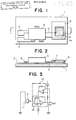
- an FET 5 is first connected and fixed to a source electrode 2, a drain electrode 3 and a gate electrode 4 formed on a glass substrate 1, as illustrated in Figures 1 and 2.
- the gate electrode is then extended to form an extended gate electrode 4a on its extreme end, which is in turn provided therearound with a bank body 6 comprising an insulating material such as an epoxy resin, thereby forming a window opening 7 through which a sample under examination is to be added dropwise.
- the extended gate electrode 4a facing to the window opening 7 is provided thereon with the following ion sensitive membranes 8.
- the sensitivity of the ion sensitive membrane was measured just after its preparation as well as after its 7 and 14-day immersion and storage in 10 mM of KCl. The results are set forth in a table to be described later. (mM means mili-Mol).
- Ion Sensitive Membranes Sensitivity Presence of Vesicle Date of Preparation After 7 days After 14 days Date of Preparation After 7 days After 14 days (a) 52(100) 52(100) 52(100) ⁇ ⁇ ⁇ (b) 49(100) 49(100) 49(100) ⁇ ⁇ ⁇ Comp. ex. 52(100) 49(100) 40(77) ⁇ X X
- bracketed figures indicate the percent (%) with respect to the sensitivity of the ion sensitive membranes on the day on which they were prepared.
- composition of the ion sensitive membranes is variable by optimization.
- the electrode on which they are to be formed be either of a double-layer structure comprising two layers composed mainly of silver chloride and silver, respectively, or contain silver and silver chloride. If this is the case, it is then considered that the following reaction takes place between silver and silver chloride.
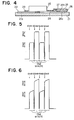
- a copper foil 21a is etched on a glass fiber reinforced epoxy resin substrate 21, and patterning for the formation of a circuit pattern is carried out to form a source electrode 22, a drain electrode 23 (not illustrated) and a gate electrode 24 on the surbstrate 21.
- This gate electrode is then extended to form an extended gate electrode 24a.
- the copper foil is silvered on the surface with a plating solution comprising silver and potassium cyanides.
- the portion of the extended gate electrode 24a is treated at the surface in 0.1N HCl to form a silver chloride film 24b thereon.
- a bank body 26 comprising an insulating material such as an epoxy resin is provided to form a window opening 27 through which a sample under examination is to be added dropwise, and an FET 25 is soldered to the source elelctrode 22, drain electrode 23 and gate electrode 24.
- a potassium ion sensitive film 28 was formed on the aforesaid extended gate 24a as the ion sensitive membrane in a similar manner as explained for the formation of the aforesaid ion sensitive membrane (a). It is noted that reference numeral 29 stands for an insulating film for an exposed portion of the gate electrode 24.
- the thus obtained assembly may be combined with a separate reference electrode and used as an ion sensor.
- a separate reference electrode is an example of the completely extended gate FET type structure.
- a potential occurring on the surface of the ion sensitive membrane is measured by a source follower circuit 10, shown in Figure 3, using KCl-saturated Ag/AgCl as a reference electrode 11, while varying alternatively the potassium ion concentration of the solution between 10 mM and 100 mM, and was recorded on a r corder.
- the results are shown in Figure 5.
- an ion sensor as shown in Fig. 4 was prepared in a similar manner as mentioned above, except that the portion of the aforesaid extended gate electrode 24a was not treated on the surface with silver chloride, and was used in combination with the aforesaid comparison electrode for similar measurement as already mentioned. The results are illustrated in Figure 6.
- a mixed layer of silver with silver chloride may be used. Such layers may be provided directly on a substrate, not on a copper foil. It is understood that the wording "composed mainly of silver chloride and silver” includes pure silver chloride and silver.
- a silver electrode may be first prepared by plating, vapor deposition, sputtering or like other means and, then, treated with NaCl, FeCl3 and so on.
- a sodium ion sensor may be prepared by using bis-12-crown-4 as an ion sensitive substance.
- bis-12-crown-4 is a kind of enzyme).
- the ion sensitive membranes containing a vinyl polymer based compound having a hydroxy and/or carboxyl group and the electrodes of the double-layer structure comprising two layers composed mainly of silver chloride and silver or the electrodes containing silver chloride and silver according to the present invention may be used for the ion sensors of the structure where said membranes and/or said electrodes are formed independently or in combination on the gate insulating (preferably water-resistant) films of the FET's. They are also applicable to the ion sensors of the extended gate type FET structure where gates are extended and separated from the FET's main bodies and reference electrodes are incorporated on the same substrates.
- an extended gate electrode 32 and a reference electrode 33 are formed on a glass substrate 31, and a window opening 35, which is not covered with a resin 34 and through which a sample under examination is to be added dropwise, is formed.
- an ion sensing chip 36 is prepared.
- reference source, drain and gate electrode pieces 39, 40, 41 and 42 are formed on the substrate 38, and are connected to said ion sensing chip 36, as shown in Figure 9.
- reference numeral 37 is an FET.
- the ion sensitive membranes and electrodes according to the present invention may further be applied to the ion sensitive membrane sensor plates which are used in combination with the FET's and in which only electrode portions to come in contact with samples under examination are separated, and the like. That is, as illustrated in Figure 10, a reference electrode 52 and an extended gate electrode 53 are formed on an alumina substrate 51, and is then surrounded with a bank body 54 comprising a glass layer to form a window opening 55 through which a sample under examination is to be added dropwise. For use, the thus obtained assembly is connected to leads 55a and 55b for the extended gate and reference electrodes of a circuit 55 shown in Figure 11. It is noted that reference numeral 36 is a FET.
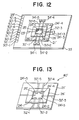
- a similar circuit board 33′ as illustrated in Figure 8 may be radially provided thereon with five sets of lead pieces for reference, source, drain and gate electrodes similar to those shown in Figure 8, and the lead pieces of each set may be connected together in a similar manner as shown in Figure 9 and provided with FET's 34′-1, 34′-2, 34′-3, 34′-4 and 34′-5. Then, extended gate pieces (extended gate electrodes) 32′-1, 32′-2, 32′-3, 32′-4 and 32′-5 are provided on a glass substrate 21′ with the one ends being centrically concentrated, as shown in Fig.
- extended gate pieces 12 are soldered to the lead pieces for gate electrodes of the FET's.
- These extended gate pieces are provided thereon with a bank body 26′ of an epoxy resin to form a window opening 25′ through which a sample is to be added dropwise. Further, the extended gate pieces are provided with ion sensitive membranes 24′-1, 24′-2, 24′-3, 24′-4 and 24′-5 carrying thereon such different ionophores as mentioned above.
- reference numeral 23′ stands for a reference electrode having its end located in the window opening 25′. It is also noted that reference numerals 30′-1 to 30′-5 indicate source electrode terminals, 31′-1 to 31′-5 drain electrode terminals and 29′ a reference electrode terminal. Connecting wires between the FET's and the reference electrode are coated on their surface with an insulating film, although not illustrated.
- the FET's and the window opening through which a sample is to be added dropwise are formed on the same substrate.
- the assembly of Figure 13 may be used as a divided part 40′, which is in turn connected to the associated parts, as illustrated in Figure 12.
- the divided part 40′ may be connected to the FET's and reference electrode terminal by insertion or like means.
- Such a divided part may be replaced separately from the FET's.
- a vinyl polymer based compound having a hydroxyl and/or carboxyl group is incorporated into an ion sensitive membrane.
- At least a surface-layer portion of the extended gate electrode is comprised of a multi-layered structure consisting of two layers composed mainly of silver chloride and silver, respectively, or a layer containing silver chloride and silver, it is possible to provide an ion sensor which can obtain an increased current on the basis of a sensitivity value determined by the ion sensitive membrane formed on the extended gate, and reduce its floating capacity to increase its response rate.
Landscapes
- Chemical & Material Sciences (AREA)
- Life Sciences & Earth Sciences (AREA)
- Health & Medical Sciences (AREA)
- Biochemistry (AREA)
- Chemical Kinetics & Catalysis (AREA)
- Electrochemistry (AREA)
- Physics & Mathematics (AREA)
- Analytical Chemistry (AREA)
- Molecular Biology (AREA)
- General Health & Medical Sciences (AREA)
- General Physics & Mathematics (AREA)
- Immunology (AREA)
- Pathology (AREA)
- Engineering & Computer Science (AREA)
- Microelectronics & Electronic Packaging (AREA)
- Investigating Or Analyzing Materials By The Use Of Electric Means (AREA)
Applications Claiming Priority (8)
| Application Number | Priority Date | Filing Date | Title |
|---|---|---|---|
| JP155625/87U | 1987-10-13 | ||
| JP1987155625U JPH0740208Y2 (ja) | 1987-10-13 | 1987-10-13 | 検体成分検知用センサ |
| JP7103/88U | 1988-01-25 | ||
| JP710388U JPH0612529Y2 (ja) | 1988-01-25 | 1988-01-25 | バイオセンサ及びそのセンサプレート |
| JP63110440A JPH0786500B2 (ja) | 1988-05-09 | 1988-05-09 | イオンセンサの検体滴下用電極部品 |
| JP110440/88 | 1988-05-09 | ||
| JP63162571A JPH0758276B2 (ja) | 1988-07-01 | 1988-07-01 | イオンセンサ、その検体滴下用電極部品及びイオンセンサの製造方法 |
| JP162571/88 | 1988-07-01 |
Publications (3)
| Publication Number | Publication Date |
|---|---|
| EP0315788A2 true EP0315788A2 (fr) | 1989-05-17 |
| EP0315788A3 EP0315788A3 (en) | 1989-05-31 |
| EP0315788B1 EP0315788B1 (fr) | 1992-12-09 |
Family
ID=27454634
Family Applications (1)
| Application Number | Title | Priority Date | Filing Date |
|---|---|---|---|
| EP88117028A Expired EP0315788B1 (fr) | 1987-10-13 | 1988-10-13 | Senseur à ions |
Country Status (3)
| Country | Link |
|---|---|
| US (1) | US4921591A (fr) |
| EP (1) | EP0315788B1 (fr) |
| DE (1) | DE3876602T2 (fr) |
Cited By (1)
| Publication number | Priority date | Publication date | Assignee | Title |
|---|---|---|---|---|
| WO1999051976A1 (fr) * | 1998-04-02 | 1999-10-14 | Tyco Electronics Logistics Ag | Detecteur de gaz fonctionnant selon le principe de la mesure du travail d'extraction |
Families Citing this family (14)
| Publication number | Priority date | Publication date | Assignee | Title |
|---|---|---|---|---|
| EP0315790B1 (fr) * | 1987-10-13 | 1992-04-15 | Taiyo Yuden Co., Ltd. | Senseurs chimiques et leurs diverses parties |
| DE3827314C1 (fr) * | 1988-08-11 | 1989-10-19 | Christoff Prof. Dr. Braeuchle | |
| GB8909561D0 (en) * | 1989-04-26 | 1989-06-14 | Kodak Ltd | Radiation-sensitive composition and use thereof in the preparation of electrochemical ion sensors |
| DE19623517C1 (de) * | 1996-06-12 | 1997-08-21 | Siemens Ag | MOS-Transistor für biotechnische Anwendungen |
| US5833824A (en) * | 1996-11-15 | 1998-11-10 | Rosemount Analytical Inc. | Dorsal substrate guarded ISFET sensor |
| DE19857953C2 (de) * | 1998-12-16 | 2001-02-15 | Conducta Endress & Hauser | Vorrichtung zum Messen der Konzentration von Ionen in einer Meßflüssigkeit |
| AU2003209808A1 (en) * | 2002-02-19 | 2003-09-09 | Austria Wirtschaftsservice Gesellschaft Mit Beschrankter Haftung | Double gate transistor arrangement for receiving electrical signals from living cells |
| DE10211901A1 (de) * | 2002-03-18 | 2003-10-16 | Infineon Technologies Ag | Verfahren zum Erfassen von makromolekularen Biopolymeren mittels eines Feldeffekt-Transistors, Biosensor und Schaltungsanordnung mit Biosensor und damit gekoppelter Auswerteschaltung |
| DE10211900A1 (de) * | 2002-03-18 | 2003-10-16 | Infineon Technologies Ag | Biosensor zum Erfassen von makromolekularen Biopolymeren und Verfahren zur Herstellung eines Biosensors zum Erfassen von makromolekularen Biopolymeren |
| WO2014176179A2 (fr) * | 2013-04-21 | 2014-10-30 | King-Smith Oliver | Dispositif sensible aux ions et procédé de fabrication |
| ES2683618T3 (es) * | 2015-07-09 | 2018-09-27 | Universite De Nantes | Sistema para evaluar la concentración de cloruro y el correspondiente método y sensor |
| US10557814B2 (en) | 2016-06-24 | 2020-02-11 | City University Of Hong Kong | Electrochemical detector |
| US10634654B2 (en) * | 2016-12-29 | 2020-04-28 | City University Of Hong Kong | Electrochemical detector |
| CN115508426B (zh) * | 2021-06-22 | 2024-11-05 | 高熹腾 | 具有流体装置的感测芯片 |
Family Cites Families (8)
| Publication number | Priority date | Publication date | Assignee | Title |
|---|---|---|---|---|
| US4020830A (en) * | 1975-03-12 | 1977-05-03 | The University Of Utah | Selective chemical sensitive FET transducers |
| GB2096824A (en) * | 1981-04-09 | 1982-10-20 | Sibbald Alastair | Chemically sensitive field effect transistor |
| JPS59131156A (ja) * | 1983-01-17 | 1984-07-27 | Kuraray Co Ltd | ガスセンサ− |
| US4508613A (en) * | 1983-12-19 | 1985-04-02 | Gould Inc. | Miniaturized potassium ion sensor |
| GB8406955D0 (en) * | 1984-03-16 | 1984-04-18 | Serono Diagnostics Ltd | Assay |
| NL8400916A (nl) * | 1984-03-22 | 1985-10-16 | Stichting Ct Voor Micro Elektr | Werkwijze voor het vervaardigen van een isfet en een aldus vervaardigde isfet. |
| GB8519373D0 (en) * | 1985-08-01 | 1985-09-04 | Unilever Plc | Encapsulation of fet transducers |
| US4592824A (en) * | 1985-09-13 | 1986-06-03 | Centre Suisse D'electronique Et De Microtechnique S.A. | Miniature liquid junction reference electrode and an integrated solid state electrochemical sensor including the same |
-
1988
- 1988-10-13 EP EP88117028A patent/EP0315788B1/fr not_active Expired
- 1988-10-13 DE DE8888117028T patent/DE3876602T2/de not_active Expired - Lifetime
- 1988-10-13 US US07/257,439 patent/US4921591A/en not_active Expired - Lifetime
Cited By (1)
| Publication number | Priority date | Publication date | Assignee | Title |
|---|---|---|---|---|
| WO1999051976A1 (fr) * | 1998-04-02 | 1999-10-14 | Tyco Electronics Logistics Ag | Detecteur de gaz fonctionnant selon le principe de la mesure du travail d'extraction |
Also Published As
| Publication number | Publication date |
|---|---|
| DE3876602D1 (de) | 1993-01-21 |
| US4921591A (en) | 1990-05-01 |
| EP0315788B1 (fr) | 1992-12-09 |
| EP0315788A3 (en) | 1989-05-31 |
| DE3876602T2 (de) | 1993-07-01 |
Similar Documents
| Publication | Publication Date | Title |
|---|---|---|
| EP0315788B1 (fr) | Senseur à ions | |
| US5078855A (en) | Chemical sensors and their divided parts | |
| US6416646B2 (en) | Method of making a material for establishing solid state contact for ion selective electrodes | |
| US5039390A (en) | Chemically sensitive transducer | |
| JPH0580020A (ja) | 炭酸ガスセンサ | |
| KR900000578B1 (ko) | 효소 센서 및 그 제조방법 | |
| US7435610B2 (en) | Fabrication of array pH sensitive EGFET and its readout circuit | |
| JP3194090B2 (ja) | 電気化学的センサー | |
| US20050263410A1 (en) | Ion-selective electrodes and method of fabricating sensing units thereof | |
| CN116165259A (zh) | 一种基于印制线路板制程工艺的微电极薄膜化加工方法 | |
| US8148756B2 (en) | Separative extended gate field effect transistor based uric acid sensing device, system and method for forming thereof | |
| US7638157B2 (en) | Method of fabricating electrode assembly of sensor | |
| EP0927884B1 (fr) | Utilisation d'un moyen, qui stabilise le potentiel, dans une membrane sensitive d'ions | |
| EP0241991A2 (fr) | Transistor à effet de champ ayant une membrane par-dessus l'isolant de porte | |
| JPH01282456A (ja) | イオンセンサの検体滴下用電極部品 | |
| JPH0740208Y2 (ja) | 検体成分検知用センサ | |
| JPS6450944A (en) | Chemical sensitive field effect transistor | |
| JPH0612529Y2 (ja) | バイオセンサ及びそのセンサプレート | |
| JPS59206756A (ja) | 参照電極を一体化したfet化学センサ− | |
| US7736478B2 (en) | Ion solution concentration-detecting device | |
| JPH06273376A (ja) | イオン感応性電界効果型トランジスタ用イオン感応膜の製造方法 | |
| JPS62132160A (ja) | 分離ゲ−ト型isfetを用いたバイオセンサ− | |
| JPH0375552A (ja) | 酵素電極 | |
| Hendrikse et al. | A drift free nernstian iridium oxide pH sensor | |
| Liao et al. | Development of a polyimide based potassium ion-selective membrane for ISFET sensor |
Legal Events
| Date | Code | Title | Description |
|---|---|---|---|
| PUAI | Public reference made under article 153(3) epc to a published international application that has entered the european phase |
Free format text: ORIGINAL CODE: 0009012 |
|
| PUAL | Search report despatched |
Free format text: ORIGINAL CODE: 0009013 |
|
| AK | Designated contracting states |
Kind code of ref document: A2 Designated state(s): DE FR GB |
|
| AK | Designated contracting states |
Kind code of ref document: A3 Designated state(s): DE FR GB |
|
| RHK1 | Main classification (correction) |
Ipc: G01N 27/00 |
|
| 17P | Request for examination filed |
Effective date: 19890929 |
|
| 17Q | First examination report despatched |
Effective date: 19910523 |
|
| RTI1 | Title (correction) | ||
| GRAA | (expected) grant |
Free format text: ORIGINAL CODE: 0009210 |
|
| AK | Designated contracting states |
Kind code of ref document: B1 Designated state(s): DE FR GB |
|
| REF | Corresponds to: |
Ref document number: 3876602 Country of ref document: DE Date of ref document: 19930121 |
|
| ET | Fr: translation filed | ||
| PLBE | No opposition filed within time limit |
Free format text: ORIGINAL CODE: 0009261 |
|
| STAA | Information on the status of an ep patent application or granted ep patent |
Free format text: STATUS: NO OPPOSITION FILED WITHIN TIME LIMIT |
|
| 26N | No opposition filed | ||
| REG | Reference to a national code |
Ref country code: GB Ref legal event code: IF02 |
|
| PGFP | Annual fee paid to national office [announced via postgrant information from national office to epo] |
Ref country code: DE Payment date: 20071025 Year of fee payment: 20 |
|
| PGFP | Annual fee paid to national office [announced via postgrant information from national office to epo] |
Ref country code: FR Payment date: 20071016 Year of fee payment: 20 Ref country code: GB Payment date: 20071023 Year of fee payment: 20 |
|
| REG | Reference to a national code |
Ref country code: GB Ref legal event code: PE20 Expiry date: 20081012 |
|
| PG25 | Lapsed in a contracting state [announced via postgrant information from national office to epo] |
Ref country code: GB Free format text: LAPSE BECAUSE OF EXPIRATION OF PROTECTION Effective date: 20081012 |