EP0318249A2 - Système pour mesurer des distances - Google Patents
Système pour mesurer des distances Download PDFInfo
- Publication number
- EP0318249A2 EP0318249A2 EP88311042A EP88311042A EP0318249A2 EP 0318249 A2 EP0318249 A2 EP 0318249A2 EP 88311042 A EP88311042 A EP 88311042A EP 88311042 A EP88311042 A EP 88311042A EP 0318249 A2 EP0318249 A2 EP 0318249A2
- Authority
- EP
- European Patent Office
- Prior art keywords
- light
- channels
- coded
- range
- line segment
- Prior art date
- Legal status (The legal status is an assumption and is not a legal conclusion. Google has not performed a legal analysis and makes no representation as to the accuracy of the status listed.)
- Ceased
Links
Images

Classifications
-
- G—PHYSICS
- G01—MEASURING; TESTING
- G01S—RADIO DIRECTION-FINDING; RADIO NAVIGATION; DETERMINING DISTANCE OR VELOCITY BY USE OF RADIO WAVES; LOCATING OR PRESENCE-DETECTING BY USE OF THE REFLECTION OR RERADIATION OF RADIO WAVES; ANALOGOUS ARRANGEMENTS USING OTHER WAVES
- G01S17/00—Systems using the reflection or reradiation of electromagnetic waves other than radio waves, e.g. lidar systems
- G01S17/02—Systems using the reflection of electromagnetic waves other than radio waves
- G01S17/06—Systems determining position data of a target
- G01S17/46—Indirect determination of position data
- G01S17/48—Active triangulation systems, i.e. using the transmission and reflection of electromagnetic waves other than radio waves
-
- G—PHYSICS
- G01—MEASURING; TESTING
- G01B—MEASURING LENGTH, THICKNESS OR SIMILAR LINEAR DIMENSIONS; MEASURING ANGLES; MEASURING AREAS; MEASURING IRREGULARITIES OF SURFACES OR CONTOURS
- G01B11/00—Measuring arrangements characterised by the use of optical techniques
- G01B11/02—Measuring arrangements characterised by the use of optical techniques for measuring length, width or thickness
- G01B11/026—Measuring arrangements characterised by the use of optical techniques for measuring length, width or thickness by measuring distance between sensor and object
-
- G—PHYSICS
- G01—MEASURING; TESTING
- G01S—RADIO DIRECTION-FINDING; RADIO NAVIGATION; DETERMINING DISTANCE OR VELOCITY BY USE OF RADIO WAVES; LOCATING OR PRESENCE-DETECTING BY USE OF THE REFLECTION OR RERADIATION OF RADIO WAVES; ANALOGOUS ARRANGEMENTS USING OTHER WAVES
- G01S7/00—Details of systems according to groups G01S13/00, G01S15/00, G01S17/00
- G01S7/48—Details of systems according to groups G01S13/00, G01S15/00, G01S17/00 of systems according to group G01S17/00
- G01S7/481—Constructional features, e.g. arrangements of optical elements
- G01S7/4816—Constructional features, e.g. arrangements of optical elements of receivers alone
Definitions
- This invention relates to a triangulation ranging system.
- Devices such as a three dimensional camera based on triangulation may require measurement speeds up to 10 million rang elements (rangels) per second.
- range measurement is obtained from the position of a spot of bright illumination, often in a varied diffuse background.
- Spot resolution to at least 8 bits (256 point resolution) typically may be required.
- Conventional approaches to this problem are summarized below and are too slow or of limited sensitivity, because of detector device limitations and because each range point must be processed sequentially. A faster range readout method is needed which preserves the signal verification capabilities of known approaches.
- Conventional triangulation range cameras use linear detector arrays, two dimensional arrays, or flying spot configurations.
- the position of a light spot on a linear array can be determined by reading out each pixel of the array and locating the pixel with the strongest recorded signal, or the center of a peak covering several pixels. If there are 256 pixels and the pixel readout rate is a typical 10 MHz, then 25.6 microseconds is required for a range measurement to a single point and the range measurement rate is 40 kHz, which is a factor of 100 below typical desired rates.
- a two-dimensional array such as used in CID (charge injection device) and CCD (charge coupled device) TV cameras allows multiple range points to be determined, one from each line of the array, if the light source is a line or a point swept over a line during the array exposure.
- the pixel readout rate from a conventional 2-D array is still limited to approximately 10 MHz, providing no advantage in range measurement rate since over 100 pixels must be read to provide a typical range measurement.
- present solid state cameras are much less sensitive to light, and have much smaller dynamic range than the best available light detectors, e.g. photomultipliers. Since those qualities are also important for robust high speed measurements, solid state detectors should either be improved or replaced for such applications.
- the photomultiplier-density wedge combination can provide range data rates on the order of 10 MHz for the same light levels; it senses the position of the centroid of light illumination rather than the position of the sharp point of light carrying range information.
- the photomultipler pair can give substantially incorrect range information whenever there is significant back ground illumination or secondary scattering from the projected beam.
- the signals from the density wedge detectors do not provide any signal quality information, which is necessary for good range data from shiny targets.
- a signal to noise analysis shows that analog light spot position measuring devices are less efficient than optimum digital equivalents when resolutions better than one part in 64 are required, as in the present case.
- An aspect of the invention provides a triangulation range system based on spatial coding of the light distribution and which can use photomultipliers or custom solid state detectors to detect the coded light.
- Another aspect provides a triangulation ranging system in a three dimensional range camera that utilizes a coded aperture to provide a direct digital readout of the position of a light spot.
- Yet another aspect provides, in such a system, enhanced signal quality by indicating a measure of signal accuracy and discriminating against diffuse background and multiple scattering.
- One embodiment of the invention is a ranging system based on triangulation comprised of means to project onto a coded aperture light detecting means, a line segment of light whose position along the coded aperture is related to range to a surface.
- the light detecting means has a plurality of coded channels which transmit light to separate detectors and the coded aperture at the front of said channels is such as to provide a direct digital representation of the position of the line segment.
- the light detecting means may be photomultipliers or solid state light detectors which generate separate electrical signals.
- the signals may be fed to a vision computer whose outputs are range values.
- the coded channels according to one arrangement may have a row of clear and opaque cells and there may be a clear reference light value channel.
- a preferred embodiment of the invention is a system in a three dimensional range camera having: means to project a light spot onto a surface whose range or height is to be measured; optical means to spread a spot of light scattered from the surface into a straight line segment of linear stripe that is incident on all channels of the coded aperture light detector; wherein the coded aperture detector comprises a plurality of channels each transmitting light to a separate detector device and a spatially coded aperture such that every channel contributes to one bit of the binary address of the light spot height position.
- a clear reference channel transmits ambient light to another detector device.
- the channels are constructed as individual noncoherent fiber optic bundles and the coded aperture is provided by a patterned mask in front of the fiber optic bundles.
- a lens focuses the light scattered from the surface into a light spot that passes through a slit aperture before being spread by an optical system, typically composed of a combination of spherical and cylindrical lenses, into a line segment that falls on the coded aperture.
- range z to a point is to be measured by triangulation at high speed, such that the point can be scanned rapidly to provide a three dimensional representation of an object. Methods of scanning are not described here because it will be evident to those skilled in the art that the illustrative embodiments can be scanned using known techniques.
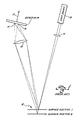
- a typical triangulation ranging geometry is shown in Fig. 1. Range is determined from the position of the light peak caused by focusing light scattered from the transmitted beam by the observed surface. Surfaces at two positions are shown to illustrate the relationship of focal spot position to range.
- the beam from a collimated light source 10, preferably a laser is focused by a lens 11 and projected onto the surface 12.
- Light scattered by the surface is collected by a receiving lens 13 and focused onto a detector 14 which is sensitive to the position of the light spot.
- the detector surface can be angled to maintain tight focus with changes in range, an application of the Scheinpflug principle which is well known in photographic optics.
- the light spot from the surface at position 1 is incident on the detector at 15, and the light spot from surface postion 2 at 16.
- a signal containing surface position information is output at 17.
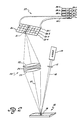
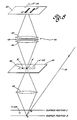
- Fig. 2 illustrates the principles of the present invention.
- a light beam 18 is projected onto the surface to which height or range is measured and the light spot 19, instead of being refocused as a light spot that falls on the detector, is spread out by an optical system 20 into a straight line segment 21 perpendicular to the direction of its range-dependent motion, so that the light can be shared among a number of light detection channels.
- Any optical system may be used, as known to those versed in optics, that expands a small spot of light into a narrow, linear light stripe, with nominally uniform intensity along its length and long enough to be incident on all the light detecting channels
- This spreading action is accomplished in this figure by a combination of spherical and cylindrical lenses 22-24, and in Fig.
- Fig. 3 is a top view of spherical lenses 22 and 23 and cylindrical lens 24, showing the relation of line segment 21 of light to the optical system, projected light ray 18, and the optical axis 25 of the receiving lens system.
- Line segment 21 is perpendicular to the plane of the optical axis 25 and incident light beam 18.
- Line segment of light 21 falls on a coded aperture 26 at the front of a coded aperture light detecting means indicated generally at 27 in Fig. 2.
- the illustrated coded aperture has three coded channels 26-1 to 26-3 each constructed so that the light transmitted through it gives one bit of the digital address of the light spot position.
- the fourth channel 26-4 is clear and provides a reference light value against which light passing through the other channels is compared.
- Four light transmitting channels 28-1 to 28-4 are provided and may be a segmented coherent fiber optic bundle, arranged so that the light passing through each channel of the coded aperture is led to a different light detector device 29-1 to 29-4.
- the latter may be photomultipliers or sensitive, wide dynamic range solid state light detectors.
- the separate signal outputs are processed to determine if a 0 or 1 light value is detected and these are fed to a computer to calculate a light spot height position.
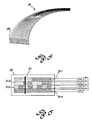
- Fig. 4 is an enlarged view in the image plane of coded aperture 26.
- Channels 1, 2 and 3 are binary coded; the first has four opaque and clear cells, the second two opaque and clear, and so on, and the third alternating opaque and clear cells.
- the binary coded channels For the illustrated position of straight line segment 21 along the coded aperture, the binary coded channels have a "001" readout meaning that the line segment is in column 4.
- Channel 1 has a high level signal and the other two channels low level signals; the fourth is needed to determine the overall light level against which the three signal channels must be compared.
- N 1 + log2R.
- R 8 resolved points
- N 4 detector channels are needed.
- R 256 resolved points
- N 9 detector channels.
- a few more channels may be used to provide checks on the signal.
- the concoherent bundle of fiber optics 32 is rectangular at the coded aperture end and is gathered together and has a circular cross-section at the other end where light is coupled to a detector device. Typical dimensions are that the channel at the front is one inch long and a few mils in width.
- Fig. 6 shows four such stacked noncoherent fiber optic bundles 31-1 to 31-4 and, at the front of the bundles, a patterned mask 33 which provides the coded aperture. It is seen that the four channels of the coded aperture have clear and opaque cells as in Fig. 4.
- the address data provided by the photomultiplier tube detectors 34-1 to 34-4 viewing the linear light stripes of code provide the digital address of the position of light stripe 21 along a coordinate perpendicular to its length. This information is provided instantaneously, in parallel. There are no daunting barriers preventing operation of this type of system up to data rates approaching the maximum response frequency of typical photomultiplier detectors (on the order of 100 MHz).
- photomultipliers have ideal light detection qualities, i.e. sensitivity and dynamic range, they are relatively large and require light piping from the coded aperture to each detector and individual high voltage supplies and preamplifiers. Therefore, a solid state detector which can perform the same function is desirable. Recently solid state arrays having improved sensitivity and dynamic range have been developed; another good choice is certain types of photodiodes.
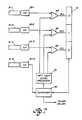
- the processing of the separate detector signals and computation of range values is illustrated in Fig. 7.
- the signal produced by reference channel light detector 35-4 is fed to a vision computer 36 and hence to a reference light level processor 37.
- the reference voltages change as the ambient light level changes and are one input to comparators 38-40 and the other inputs are respectively the signals generated by the coded channel light detectors 35-1 to 35-3.
- the detectors 35-1 to 35-4 are suitably either photomultipliers or photodiodes.
- the comparator outputs are 1 to 0.
- These are presented to the digital address register 41 which, by way of example shows "010" which signifies that the line segment of light 21 in Fig. 6 is incident on column "2".
- This digital address is read out to computer 36 where the light spot range or height position is calculated and these values are the system outputs. As the light beam is scanned over the surface whose height is measured, a series of range values are produced at high speed.
- this improved triangulation ranging system is that is allows verification of the presence of a point of light indicating a range measurement, and determination of the position of this point even in the presence of diffuse background radiation. For example, suppose only diffuse background radiation is present. Then, as reference ot Fig. 2 will indicate, the all-clear reference channel 26-4 will have a signal that is precisely twice that of each other coded channel 26-1 to 26-3 (half the cells are opaque). Conversely, if only a single line segment of illumination is used by the detector, each channel will indicate either a zero signal or one equal to the all-clear reference channel value.
- the reference channel would again indicate a signal twice that of each other channel.
- One possible confusing situation might arise if a single line segment straddled the demarcation between bright and dark stripes (opaque and clear cells) on the highest resolution code strip.
- One effective way to resolve this confusion is to include one additional high resolution channel with cells offset in quadrature; i.e., by one-quarter of a cycle. This channel would give a full signal if the other high resolution channel is straddled.
- the channel coding can be changed from simple binary to a Gray code in which each channel is shifted by 90 spatial degrees such that clear-opaque boundaries do not line up.
- Line segment A ⁇ falls in the plane of coded aperture 26 illustrated diagramatically at 50.
- Light spot B at surface position 1 (see also Fig. 1) is imaged as light spot B′ that passes through slit aperture 44 before being spread by optical system 46 into line segment B ⁇ . Unwanted secondary reflections are blocked by aperture plate 45.
- the secondary reflection A-SR of light spot A is focused by lens 43 as spot A′-SR which does not fall on the slit aperture.
- optical system 46 would spread the secondary reflection of spot A into the light stripe A ⁇ -SR. This spurious light stripe could cause problems in interpreting the detector signals.
- a high speed, sensitive, wide dynamic range coded aperture light detector and range camera are provided by the illustrative embodiments of this invention.
- Illustrative applications are inspecting a loaded printed wiring board and an integrated circuit package, whose complexity is expected to be such that inspection and test will have to be highly automated in order to attain the required yields with the required reliability.
- Another is the measurement and inspection of mechanical parts and assemblies with significant three dimensionality.
Landscapes
- Physics & Mathematics (AREA)
- Engineering & Computer Science (AREA)
- General Physics & Mathematics (AREA)
- Electromagnetism (AREA)
- Computer Networks & Wireless Communication (AREA)
- Radar, Positioning & Navigation (AREA)
- Remote Sensing (AREA)
- Length Measuring Devices By Optical Means (AREA)
- Measurement Of Optical Distance (AREA)
Applications Claiming Priority (2)
| Application Number | Priority Date | Filing Date | Title |
|---|---|---|---|
| US124239 | 1987-11-23 | ||
| US07/124,239 US4830485A (en) | 1987-11-23 | 1987-11-23 | Coded aperture light detector for three dimensional camera |
Publications (2)
| Publication Number | Publication Date |
|---|---|
| EP0318249A2 true EP0318249A2 (fr) | 1989-05-31 |
| EP0318249A3 EP0318249A3 (fr) | 1989-12-20 |
Family
ID=22413649
Family Applications (1)
| Application Number | Title | Priority Date | Filing Date |
|---|---|---|---|
| EP88311042A Ceased EP0318249A3 (fr) | 1987-11-23 | 1988-11-22 | Système pour mesurer des distances |
Country Status (2)
| Country | Link |
|---|---|
| US (1) | US4830485A (fr) |
| EP (1) | EP0318249A3 (fr) |
Cited By (20)
| Publication number | Priority date | Publication date | Assignee | Title |
|---|---|---|---|---|
| DE3920133A1 (de) * | 1989-06-20 | 1991-01-03 | Siemens Ag | Optischer sensor zur untersuchung der lage und/oder der kontur eines objekts |
| EP0399138A3 (fr) * | 1989-02-28 | 1992-03-04 | Siemens Aktiengesellschaft | Procédé pour l'examen en trois dimensions de circuits imprimés |
| EP0492723A1 (fr) * | 1990-12-27 | 1992-07-01 | Koninklijke Philips Electronics N.V. | Dispositif pour mesurer optiquement la hauteur d'une surface |
| EP0499778A3 (fr) * | 1991-02-18 | 1992-09-02 | Ushio Co. Ltd | Appareil de traitement d'images |
| DE4213908A1 (de) * | 1992-04-28 | 1993-11-04 | Mtu Muenchen Gmbh | Verfahren zur vermessung von kruemmungsprofilen von kanten |
| DE4213909A1 (de) * | 1992-04-28 | 1993-11-04 | Mtu Muenchen Gmbh | Vorrichtung zur vermessung von kruemmungsprofilen von kanten |
| WO1994016289A1 (fr) * | 1993-01-11 | 1994-07-21 | Limab Laser & Instrumentmekanik Ab | Procede et appareil pour mesurer des distances |
| US5444536A (en) * | 1992-04-28 | 1995-08-22 | Mtu Motoren- Und Turbinen-Union Muenchen Gmbh | Apparatus for measuring the curvature of a profile, such as an edge of a turbine blade |
| US5570186A (en) * | 1992-04-28 | 1996-10-29 | Mtu Motoren- Und Turbinen-Union Munich Gmbh | Method for inspecting the curvature of a profile, such an edge of a turbine blade |
| EP1160537A3 (fr) * | 2000-05-29 | 2003-07-02 | Omron Electronics Manufacturing of Germany GmbH | Capteur de mesure par triangulation |
| EP1845334A1 (fr) * | 2006-04-11 | 2007-10-17 | Leuze electronic GmbH + Co. KG | Capteur optique |
| US7888626B2 (en) | 2005-05-23 | 2011-02-15 | Qinetiq Limited | Coded aperture imaging system having adjustable imaging performance with a reconfigurable coded aperture mask |
| US7923677B2 (en) | 2006-02-06 | 2011-04-12 | Qinetiq Limited | Coded aperture imager comprising a coded diffractive mask |
| US7969639B2 (en) | 2006-02-06 | 2011-06-28 | Qinetiq Limited | Optical modulator |
| US8017899B2 (en) | 2006-02-06 | 2011-09-13 | Qinetiq Limited | Coded aperture imaging using successive imaging of a reference object at different positions |
| US8035085B2 (en) | 2006-02-06 | 2011-10-11 | Qinetiq Limited | Coded aperture imaging system |
| US8068680B2 (en) | 2006-02-06 | 2011-11-29 | Qinetiq Limited | Processing methods for coded aperture imaging |
| US8073268B2 (en) | 2006-02-06 | 2011-12-06 | Qinetiq Limited | Method and apparatus for coded aperture imaging |
| US8229165B2 (en) | 2006-07-28 | 2012-07-24 | Qinetiq Limited | Processing method for coded aperture sensor |
| TWI577971B (zh) * | 2015-10-22 | 2017-04-11 | 原相科技股份有限公司 | 雙孔徑測距系統 |
Families Citing this family (32)
| Publication number | Priority date | Publication date | Assignee | Title |
|---|---|---|---|---|
| US4900146A (en) * | 1988-03-18 | 1990-02-13 | General Electric Company | Multiple channel optical flying spot triangulation ranger system |
| US5102226A (en) * | 1989-01-12 | 1992-04-07 | Matsushita Electric Works, Ltd. | Optical measurement system for determination of an object profile |
| US4963017A (en) * | 1989-05-01 | 1990-10-16 | General Electric Company | Variable depth range camera |
| US5082362A (en) * | 1990-07-02 | 1992-01-21 | General Electric Company | Zoom lens for a variable depth range camera |
| US5032023A (en) * | 1990-07-02 | 1991-07-16 | General Electric Company | Optical fiber based sensor for a variable depth range camera |
| US5061062A (en) * | 1990-07-02 | 1991-10-29 | General Electric Company | Focus spot size controller for a variable depth range camera |
| US5113080A (en) * | 1990-07-10 | 1992-05-12 | New Jersey Institute Of Technology | Non-linear displacement sensor based on optical triangulation principle |
| US5056914A (en) * | 1990-07-12 | 1991-10-15 | Ball Corporation | Charge integration range detector |
| JP3288523B2 (ja) * | 1994-02-22 | 2002-06-04 | 株式会社ワコム | 光点位置計測装置及び光点位置計測方法 |
| US7006132B2 (en) * | 1998-02-25 | 2006-02-28 | California Institute Of Technology | Aperture coded camera for three dimensional imaging |
| US7612870B2 (en) * | 1998-02-25 | 2009-11-03 | California Institute Of Technology | Single-lens aperture-coded camera for three dimensional imaging in small volumes |
| JP2001141429A (ja) * | 1999-11-18 | 2001-05-25 | Japan Atom Energy Res Inst | 基線長可動型表面形状測定装置 |
| US6469777B2 (en) * | 2000-06-12 | 2002-10-22 | Asahi Kogaku Kogyo Kabushiki Kaisha | Surveying instrument having an optical distance meter |
| CA2319898C (fr) | 2000-09-18 | 2006-05-16 | Institut National D'optique | Dispositif optique et methode de codage de position |
| US7837742B2 (en) * | 2003-05-19 | 2010-11-23 | The Procter & Gamble Company | Cosmetic compositions comprising a polymer and a colorant |
| US7434453B2 (en) * | 2005-07-08 | 2008-10-14 | General Electric Company | Vacuum-assisted fixture for holding a part |
| US20070268366A1 (en) * | 2006-05-17 | 2007-11-22 | Ramesh Raskar | System and method for sensing geometric and photometric attributes of a scene with multiplexed illumination and solid state optical devices |
| US8243353B1 (en) | 2008-04-07 | 2012-08-14 | Applied Science Innovations, Inc. | Holography-based device, system and method for coded aperture imaging |
| FR2939516B1 (fr) * | 2008-12-05 | 2011-01-21 | Thales Sa | Telemetre |
| US10132925B2 (en) * | 2010-09-15 | 2018-11-20 | Ascentia Imaging, Inc. | Imaging, fabrication and measurement systems and methods |
| US9739864B2 (en) | 2012-01-03 | 2017-08-22 | Ascentia Imaging, Inc. | Optical guidance systems and methods using mutually distinct signal-modifying |
| CN104246826B (zh) | 2012-01-03 | 2017-12-15 | 阿森蒂亚影像有限公司 | 编码定位系统、方法和装置 |
| US20140009762A1 (en) * | 2012-06-21 | 2014-01-09 | Nikon Corporation | Measurement assembly with fiber optic array |
| WO2014023342A1 (fr) * | 2012-08-07 | 2014-02-13 | Carl Zeiss Industrielle Messtechnik Gmbh | Dispositif d'inspection d'un objet à mesurer comprenant un capteur de triangulation |
| FR2997198A1 (fr) * | 2012-10-18 | 2014-04-25 | Thales Sa | Telemetrie longue portee de petite cible |
| US10126114B2 (en) | 2015-05-21 | 2018-11-13 | Ascentia Imaging, Inc. | Angular localization system, associated repositionable mechanical structure, and associated method |
| KR101785034B1 (ko) * | 2015-09-09 | 2017-10-12 | 광주과학기술원 | 라인 빔을 사용한 레이저 검지 장치 및 이를 이용한 차량정보 인식 방법 |
| EP4155763A4 (fr) | 2020-05-22 | 2024-09-11 | SOS Lab Co., Ltd. | Dispositif lidar |
| JP7594735B2 (ja) * | 2021-03-10 | 2024-12-05 | オムロン株式会社 | 三角測距式変位センサ |
| CN113237435B (zh) * | 2021-05-08 | 2022-02-08 | 北京航空航天大学 | 一种高反光表面三维视觉测量系统及方法 |
| EP4310443B1 (fr) * | 2022-07-21 | 2025-01-15 | Leuze electronic GmbH + Co. KG | Palpeur optique de triangulation |
| EP4711708A1 (fr) * | 2024-09-17 | 2026-03-18 | Sick IVP AB | Capteur d'image, caméra et système d'imagerie à couche de diffusion de lumière asymétrique pour une utilisation dans une imagerie tridimensionnelle basée sur une triangulation de lumière |
Family Cites Families (11)
| Publication number | Priority date | Publication date | Assignee | Title |
|---|---|---|---|---|
| US3555285A (en) * | 1966-04-29 | 1971-01-12 | Bunker Ramo | Coded arrangement of photocells mounted on rigid body to determine position thereof |
| US3858201A (en) * | 1973-10-15 | 1974-12-31 | Itek Corp | High angular resolution sensor |
| US4165939A (en) * | 1975-01-22 | 1979-08-28 | Tsn Company, Inc. | Apparatus for inspection and dimensional measurement by sequential reading |
| US4198164A (en) * | 1976-10-07 | 1980-04-15 | Ensco, Inc. | Proximity sensor and method and apparatus for continuously measuring rail gauge |
| US4150897A (en) * | 1977-03-02 | 1979-04-24 | FMC Corporaton | Wheel-mounted vehicle wheel aligner |
| US4200787A (en) * | 1978-05-30 | 1980-04-29 | CLS Industries, Inc. | Fiber optic elevation sensing apparatus |
| US4277170A (en) * | 1979-11-01 | 1981-07-07 | Miles Richard B | Laser beacon and optical detector system for aircraft collision hazard determination |
| US4317991A (en) * | 1980-03-12 | 1982-03-02 | Honeywell Inc. | Digital auto focus system utilizing a photodetector array |
| US4687325A (en) * | 1985-03-28 | 1987-08-18 | General Electric Company | Three-dimensional range camera |
| US4645917A (en) * | 1985-05-31 | 1987-02-24 | General Electric Company | Swept aperture flying spot profiler |
| US4687326A (en) * | 1985-11-12 | 1987-08-18 | General Electric Company | Integrated range and luminance camera |
-
1987
- 1987-11-23 US US07/124,239 patent/US4830485A/en not_active Expired - Fee Related
-
1988
- 1988-11-22 EP EP88311042A patent/EP0318249A3/fr not_active Ceased
Cited By (22)
| Publication number | Priority date | Publication date | Assignee | Title |
|---|---|---|---|---|
| EP0399138A3 (fr) * | 1989-02-28 | 1992-03-04 | Siemens Aktiengesellschaft | Procédé pour l'examen en trois dimensions de circuits imprimés |
| DE3920133A1 (de) * | 1989-06-20 | 1991-01-03 | Siemens Ag | Optischer sensor zur untersuchung der lage und/oder der kontur eines objekts |
| EP0492723A1 (fr) * | 1990-12-27 | 1992-07-01 | Koninklijke Philips Electronics N.V. | Dispositif pour mesurer optiquement la hauteur d'une surface |
| EP0499778A3 (fr) * | 1991-02-18 | 1992-09-02 | Ushio Co. Ltd | Appareil de traitement d'images |
| US5351316A (en) * | 1991-02-18 | 1994-09-27 | Ushio Co., Ltd. | Image processing apparatus |
| US5570186A (en) * | 1992-04-28 | 1996-10-29 | Mtu Motoren- Und Turbinen-Union Munich Gmbh | Method for inspecting the curvature of a profile, such an edge of a turbine blade |
| DE4213908A1 (de) * | 1992-04-28 | 1993-11-04 | Mtu Muenchen Gmbh | Verfahren zur vermessung von kruemmungsprofilen von kanten |
| DE4213909A1 (de) * | 1992-04-28 | 1993-11-04 | Mtu Muenchen Gmbh | Vorrichtung zur vermessung von kruemmungsprofilen von kanten |
| US5444536A (en) * | 1992-04-28 | 1995-08-22 | Mtu Motoren- Und Turbinen-Union Muenchen Gmbh | Apparatus for measuring the curvature of a profile, such as an edge of a turbine blade |
| US5673111A (en) * | 1993-01-11 | 1997-09-30 | Limab Laser & Instrumentmekanik Ab | Method and arrangement for measuring distance |
| WO1994016289A1 (fr) * | 1993-01-11 | 1994-07-21 | Limab Laser & Instrumentmekanik Ab | Procede et appareil pour mesurer des distances |
| EP1160537A3 (fr) * | 2000-05-29 | 2003-07-02 | Omron Electronics Manufacturing of Germany GmbH | Capteur de mesure par triangulation |
| US7888626B2 (en) | 2005-05-23 | 2011-02-15 | Qinetiq Limited | Coded aperture imaging system having adjustable imaging performance with a reconfigurable coded aperture mask |
| US7923677B2 (en) | 2006-02-06 | 2011-04-12 | Qinetiq Limited | Coded aperture imager comprising a coded diffractive mask |
| US7969639B2 (en) | 2006-02-06 | 2011-06-28 | Qinetiq Limited | Optical modulator |
| US8017899B2 (en) | 2006-02-06 | 2011-09-13 | Qinetiq Limited | Coded aperture imaging using successive imaging of a reference object at different positions |
| US8035085B2 (en) | 2006-02-06 | 2011-10-11 | Qinetiq Limited | Coded aperture imaging system |
| US8068680B2 (en) | 2006-02-06 | 2011-11-29 | Qinetiq Limited | Processing methods for coded aperture imaging |
| US8073268B2 (en) | 2006-02-06 | 2011-12-06 | Qinetiq Limited | Method and apparatus for coded aperture imaging |
| EP1845334A1 (fr) * | 2006-04-11 | 2007-10-17 | Leuze electronic GmbH + Co. KG | Capteur optique |
| US8229165B2 (en) | 2006-07-28 | 2012-07-24 | Qinetiq Limited | Processing method for coded aperture sensor |
| TWI577971B (zh) * | 2015-10-22 | 2017-04-11 | 原相科技股份有限公司 | 雙孔徑測距系統 |
Also Published As
| Publication number | Publication date |
|---|---|
| US4830485A (en) | 1989-05-16 |
| EP0318249A3 (fr) | 1989-12-20 |
Similar Documents
| Publication | Publication Date | Title |
|---|---|---|
| US4830485A (en) | Coded aperture light detector for three dimensional camera | |
| EP0134597B1 (fr) | Système de mesure selon le principe de triangulation, pour le contrôle dimensionnel d'objets | |
| EP0997748B1 (fr) | Capteur optique chromatique pour mesure de distance | |
| US6781705B2 (en) | Distance determination | |
| US4796997A (en) | Method and system for high-speed, 3-D imaging of an object at a vision station | |
| US4939379A (en) | Contour measurement using time-based triangulation methods | |
| US3922093A (en) | Device for measuring the roughness of a surface | |
| US5319442A (en) | Optical inspection probe | |
| US4900146A (en) | Multiple channel optical flying spot triangulation ranger system | |
| EP1095305A1 (fr) | Procede et systeme pour l'imagerie d'un objet via plusieurs faisceaux optiques | |
| US4673817A (en) | Measuring system for contactless measuring the distance between a predetermined point of an object surface and a reference level | |
| US4071297A (en) | Method and apparatus for photoelectrically determining the position of at least one image focus plane | |
| EP0872722B1 (fr) | Appareil de mesure de particules et méthode pour sa calibration | |
| US4527893A (en) | Method and apparatus for optically measuring the distance to a workpiece | |
| JPH04319615A (ja) | 光学式高さ測定装置 | |
| US4993830A (en) | Depth and distance measuring system | |
| US5640240A (en) | Probe for surface measurement | |
| US4207002A (en) | Apparatus for detecting an output image of an optical correlation | |
| JPH02278103A (ja) | 印刷回路基板の三次元検査方法及び装置 | |
| JPH11201725A (ja) | 三次元アレイ・センサ | |
| CA1193880A (fr) | Appareil pour determiner l'indice de refraction des fibres optiques et de leurs preformes | |
| US4871910A (en) | Method and apparatus for measuring the size of wire rod with laser beam and reference rod | |
| GB2204947A (en) | Method and system for high speed, 3-D imaging of an object at a vision station | |
| JPS6281616A (ja) | 焦点位置検出装置 | |
| RU2037768C1 (ru) | Интерференционный сферометр |
Legal Events
| Date | Code | Title | Description |
|---|---|---|---|
| PUAI | Public reference made under article 153(3) epc to a published international application that has entered the european phase |
Free format text: ORIGINAL CODE: 0009012 |
|
| AK | Designated contracting states |
Kind code of ref document: A2 Designated state(s): DE FR GB IT |
|
| PUAL | Search report despatched |
Free format text: ORIGINAL CODE: 0009013 |
|
| AK | Designated contracting states |
Kind code of ref document: A3 Designated state(s): DE FR GB IT |
|
| 17P | Request for examination filed |
Effective date: 19900521 |
|
| 17Q | First examination report despatched |
Effective date: 19910605 |
|
| STAA | Information on the status of an ep patent application or granted ep patent |
Free format text: STATUS: THE APPLICATION HAS BEEN REFUSED |
|
| 18R | Application refused |
Effective date: 19920509 |