EP0319938A2 - Modifizierte Cellulose für biocompatible Dialysemembranen - Google Patents
Modifizierte Cellulose für biocompatible Dialysemembranen Download PDFInfo
- Publication number
- EP0319938A2 EP0319938A2 EP88120408A EP88120408A EP0319938A2 EP 0319938 A2 EP0319938 A2 EP 0319938A2 EP 88120408 A EP88120408 A EP 88120408A EP 88120408 A EP88120408 A EP 88120408A EP 0319938 A2 EP0319938 A2 EP 0319938A2
- Authority
- EP
- European Patent Office
- Prior art keywords
- groups
- modified cellulose
- optionally
- optionally substituted
- substituted
- Prior art date
- Legal status (The legal status is an assumption and is not a legal conclusion. Google has not performed a legal analysis and makes no representation as to the accuracy of the status listed.)
- Granted
Links
Classifications
-
- C—CHEMISTRY; METALLURGY
- C08—ORGANIC MACROMOLECULAR COMPOUNDS; THEIR PREPARATION OR CHEMICAL WORKING-UP; COMPOSITIONS BASED THEREON
- C08B—POLYSACCHARIDES; DERIVATIVES THEREOF
- C08B15/00—Preparation of other cellulose derivatives or modified cellulose, e.g. complexes
- C08B15/05—Derivatives containing elements other than carbon, hydrogen, oxygen, halogens or sulfur
- C08B15/06—Derivatives containing elements other than carbon, hydrogen, oxygen, halogens or sulfur containing nitrogen, e.g. carbamates
-
- B—PERFORMING OPERATIONS; TRANSPORTING
- B01—PHYSICAL OR CHEMICAL PROCESSES OR APPARATUS IN GENERAL
- B01D—SEPARATION
- B01D71/00—Semi-permeable membranes for separation processes or apparatus characterised by the material; Manufacturing processes specially adapted therefor
- B01D71/06—Organic material
- B01D71/08—Polysaccharides
-
- B—PERFORMING OPERATIONS; TRANSPORTING
- B01—PHYSICAL OR CHEMICAL PROCESSES OR APPARATUS IN GENERAL
- B01D—SEPARATION
- B01D71/00—Semi-permeable membranes for separation processes or apparatus characterised by the material; Manufacturing processes specially adapted therefor
- B01D71/06—Organic material
- B01D71/08—Polysaccharides
- B01D71/10—Cellulose; Modified cellulose
-
- C—CHEMISTRY; METALLURGY
- C08—ORGANIC MACROMOLECULAR COMPOUNDS; THEIR PREPARATION OR CHEMICAL WORKING-UP; COMPOSITIONS BASED THEREON
- C08B—POLYSACCHARIDES; DERIVATIVES THEREOF
- C08B13/00—Preparation of cellulose ether-esters
-
- C—CHEMISTRY; METALLURGY
- C08—ORGANIC MACROMOLECULAR COMPOUNDS; THEIR PREPARATION OR CHEMICAL WORKING-UP; COMPOSITIONS BASED THEREON
- C08B—POLYSACCHARIDES; DERIVATIVES THEREOF
- C08B37/00—Preparation of polysaccharides not provided for in groups C08B1/00 - C08B35/00; Derivatives thereof
- C08B37/0006—Homoglycans, i.e. polysaccharides having a main chain consisting of one single sugar, e.g. colominic acid
- C08B37/0024—Homoglycans, i.e. polysaccharides having a main chain consisting of one single sugar, e.g. colominic acid beta-D-Glucans; (beta-1,3)-D-Glucans, e.g. paramylon, coriolan, sclerotan, pachyman, callose, scleroglucan, schizophyllan, laminaran, lentinan or curdlan; (beta-1,6)-D-Glucans, e.g. pustulan; (beta-1,4)-D-Glucans; (beta-1,3)(beta-1,4)-D-Glucans, e.g. lichenan; Derivatives thereof
- C08B37/0027—2-Acetamido-2-deoxy-beta-glucans; Derivatives thereof
- C08B37/003—Chitin, i.e. 2-acetamido-2-deoxy-(beta-1,4)-D-glucan or N-acetyl-beta-1,4-D-glucosamine; Chitosan, i.e. deacetylated product of chitin or (beta-1,4)-D-glucosamine; Derivatives thereof
Definitions
- the invention relates to cellulose derivatives which can be prepared by homogeneous reaction in dimethylacetamide and lithium chloride.
- No. 4,278,790 discloses cellulose solutions using lithium chloride and dimethylacetamide as solvents.
- the solutions can contain up to 8% lithium chloride and up to about 3% cellulose.
- Cellulose derivatives can also be prepared in these cellulose solutions. According to the US patent, the solutions are prepared in such a way that cellulose is introduced into a mixture of dimethylacetamide and lithium chloride and is first heated to about 150 ° C. for a long time. The solution then formed is subsequently cooled to room temperature with stirring.
- a dialysis membrane for hemodialysis with chemically bound antithrombogenic compounds is known, the dialysis membrane consisting of two or more layers of a cellulose regenerated from Cuoxam cellulose solutions, each obtained from separately fed slots of a spinneret contains antithrombogenic agents chemically bound.
- dialysis membranes made of synthetic or natural polymers when used in artificial kidneys, can very easily cause blood to clot, which is largely prevented by appropriate medication, dialysis membranes made from regenerated cellulose often occur when treating a kidney patient with cellulose membranes in the first period of dialysis treatment a temporary drop in leukocytes. This effect is called leukopenia.
- Leukopenia is a decrease in the number of leukocytes (white blood cells) in the bloodstream.
- the number of white blood cells in humans is approximately 4,000 to 12,000 cells / mm 3 .
- the leukopenia during dialysis is most pronounced 15 to 20 minutes after the beginning, whereby the neutrophils (these are the leukocytes that can be stained with neutral or simultaneously with acid and basic dyes) can disappear almost completely. After that, the number of leukocytes recovers to almost the original value or exceeds it within about an hour.
- leukopenia will return to the same extent.
- the complement system within the blood serum is a complex, multi-component plasma enzyme system that is used in various ways to ward off damage caused by the invasion of foreign cells (bacteria, etc.). If antibodies against the penetrating organism are present, the complex can be activated in a complement-specific manner by the complex of the antibodies with antigenic structures of the foreign cells, otherwise the complement activation takes place in an alternative way through special surface features of the foreign cells.
- the complement system is based on a large number of plasma proteins. After activation, these proteins react with each other specifically in a certain order and in the end a cell-damaging complex is formed that destroys the foreign cell.
- Peptides are released from individual components, which trigger inflammation symptoms and can occasionally also have undesirable pathological consequences for the organism. It is believed that activation in regenerated cellulose hemodialysis membranes occurs via the alternative route. These complement activations are objectively determined by determining the complement fragments C3a and C5a.
- Carpal tunnel syndrome is influenced by modified cellulose derivatives.
- modified cellulose derivatives there is a considerable need for further modifications of the cellulose in order to eliminate this phenomenon as much as possible.
- modified cellulose which is characterized in that the modified cellulose has a formula
- alkylene an optionally substituted alkylene, alkenylene, alkynylene radical (straight-chain and / or branched, the carbon chain also being interrupted by heteroatoms such as 0, S, N, P, Si and CO, CONR or COO groups may) and / or cycloalkylene (possibly with heteroatoms.
- a hydrogen atom and / or an optionally substituted alkyl, alkenyl, alkynyl group with 1 to 36 C atoms (straight-chain and / or branched, the carbon chain also being formed by heteroatoms such as O, S, N, P, Si and CO- , CONR or COO groups can be interrupted) and / or cycloalkyl (optionally with heteroatoms and / or substituted) and / or aryl and / or arylalkyl and / or arylalkenyl and / or arylalkynyl (optionally with Heteroatoms and / or substituted) and / or bisarylalkyl and / or bisaryl residue (optionally substituted) and / or residue of a condensed aromatic compound (optionally substituted) and / or residue of a heterocyclic compound (optionally substituted) and X the same or different from X and Y is the same or different from Y and in the case that Q
- unmodified cellulose 3 contains hydroxyl groups available for substitution, with chitin a hydroxyl group is already substituted by acetamide groups. In the context of the present invention, this substitution is no longer taken into account for the average degree of substitution, provided modified celluloses based on the chitin molecule skeleton are used.
- s is preferably 0 to 0.5. n.
- s is preferably 0.25. n to n.
- Dialysis membranes with the cellulose derivatives according to the invention can be adjusted to the desired degree of substitution from substituted cellulose in a mixture with unmodified cellulose.
- the substitution to the intermediate product is carried out according to methods known per se and subsequent reaction of this intermediate product with acid anhydrides, acid chlorides or isocyanates, for example in dimethylacetamide / LiCl solution.
- the complement activation was assessed on the basis of fragments C3a or C5a.
- 300 ml of heparinized blood plasma were in vitro over a period of 4 hours with a plasma flow of 100 ml / min. recirculated through a dialyzer with 1 m 2 effective exchange area.
- the C3a fragments in the plasma were determined using the RIA method (Upjohn test).
- the relative complement activation for the respective time of measurement was calculated by forming the ratio of the concentration at the time of sampling with the initial value in percent.
- the measured value after 4 hours of recirculation was used for the evaluation.
- Flat membranes are incubated with heparinized blood plasma for 3 hours and then the C3a fragments are determined.
- the C5a fragments were determined analogously.
- the increase in the beta-2 microglobulin level in long-term dialysis patients is observed after the use of membranes made from regenerated cellulose and is attributed to the fact that these membranes are less permeable to substances in the molecular range from 1000 to 20,000 and the latter are therefore not sufficient during dialysis be removed.
- the beta-2-microglobulin is not adsorbed to any appreciable extent on the usual membranes made from regenerated cellulose.
- the cellulose derivatives according to the invention can contribute to this in an unexpected manner.
- the average degree of polymerization DP was determined in a Cuen solution according to DIN 54270.
- the degree of etherification and / or degree of esterification were determined on the basis of the analysis results which are known and typical of the substituents, for example nitrogen according to Kjeldahl, sulfur according to Schöniger or phosphorus according to the molybdate method, if appropriate from the difference before and after saponification.
- Modified celluloses in which the substituents Y and Y are secondary, tertiary or quaternary amino groups and / or carboxy groups and / or sulfo groups and / or phosphonate groups and / or silicate groups are generally preferred.
- dialysis membranes which contain modified cellulose, in which - [XY] dialkylaminoalkylene and / or carboxyalkylene and / or carboxyarylalkylene and / or sulfoalkylene and / or sulfoarylalkylene and / or phosphonatealkylene and / or in the structural formula given Phosphonatarylalkylen means.
- Alkyl radicals for R are preferably methyl groups and / or ethyl groups and / or propyl groups.
- reaction mixture was stirred for 6 hours at 65 ° C and 15 hours at room temperature.
- the reaction solution obtained was filtered, deaerated and spun into hollow fibers.
- I-Propyl myristate was used as the lumen filling.
- the methylaminocellullose maleinate membranes obtained in this way had the following properties:
- the cellulose derivative membrane mentioned above has a lower complementary activation compared to unmodified cellulose membranes. Compared to the unmodified cellulose membrane, the C3a reduction is 98%.
- the reaction product was reacted in DMAc / LiCI with dodecylsuccinic anhydride and processed into capillary membranes.
- the capillary membranes had the following properties:
- the product was dissolved in formic acid-polyethylene glycol-water mixture (82: 11: 7 parts by weight) and processed into flat membranes.
- Example 1 Analogously to Example 1, 2 or 3, the derivatives listed in the table were synthesized, processed into flat membranes and their complement activation was determined using fragments C5a.
Landscapes
- Chemical & Material Sciences (AREA)
- Chemical Kinetics & Catalysis (AREA)
- Health & Medical Sciences (AREA)
- Life Sciences & Earth Sciences (AREA)
- Engineering & Computer Science (AREA)
- Materials Engineering (AREA)
- Biochemistry (AREA)
- Medicinal Chemistry (AREA)
- Polymers & Plastics (AREA)
- Organic Chemistry (AREA)
- General Health & Medical Sciences (AREA)
- Molecular Biology (AREA)
- Polysaccharides And Polysaccharide Derivatives (AREA)
- External Artificial Organs (AREA)
- Separation Using Semi-Permeable Membranes (AREA)
Abstract

Description
- Die Erfindung betrifft Cellulosederivate, die durch homogene Umsetzung in Dimethylacetamid und Lithiumchlorid herstellbar sind.
- Aus der US-PS 4 278 790 sind Celluloselösungen unter Verwendung von Lithiumchlorid und Dimethylacetamid als Lösungsmittel bekannt. Die Lösungen können bis zu 8 % Lithiumchlorid und bis zu etwa 3 % Cellulose enthalten. In diesen Celluloselösungen können auch Cellulosederivate hergestellt werden. Gemäß der US-Patentschrift werden die Lösungen in der Weise hergestellt, daß in ein Gemisch von Dimethylacetamid und Lithiumchlorid Cellulose eingetragen und zunächst für eine längere Zeit auf etwa 150 C erhitzt wird. Später wird die dann gebildete Lösung unter Rühren auf Raumtemperatur abgekühlt.
- Außerdem sind aus der DE-OS 33 12 022 sowie der DE-OS 32 46 417 wasserunlösliche Fasern aus Celluloseestern bekannt. Sie weisen ein extrem hohes Adsorptionsvermögen für Wasser und physiologische Flüssigkeiten auf. Das mag für manche Einsatzgebiete ein Vorteil sein, für viele ist es jedoch ein Nachteil.
- Aus der DE-PS 27 05 735 ist eine Dialysemembran für die Hämodialyse mit daran chemisch gebundenen antithrombogenen Verbindungen bekannt, wobei die Dialysemembran aus zwei oder mehreren Schichten einer aus Cuoxamcelluloselösungen regenerierten Cellulose besteht, die jeweils aus getrennt gespeisten Schlitzen einer Spinndüse erhalten worden ist, die antithrombogene Wirkstoffe chemisch gebunden enthält.
- Es ist aber auch bereits in der DE-OS 17 20 087 vorgeschlagen worden, dadurch daß das Polymermaterial der Membran mit einem Alkylhalogenid umgesetzt und danach das erhaltene Material mit einem Alkalisalz einer antithrombogenen Verbindung mit kationischem Rest (z.B. Heparin oder eine Heparinoidverbindung) umgesetzt wird, die Gefahr der Gerinnung des Blutes zu verringern. Zu den möglichen Alkylhalogeniden werden dabei auch Halogenalkyldialkylamine gerechnet. Auch Cellulose, jedoch im wesentlichen Celluloseacetat, zählt zu den möglichen Polymeren.
- Eine antithrombogene Wirkung dieser bekannten Dialysemembranen wird nur beobachtet, wenn der Substitutionsgrad der modifizierten Cellulose hoch ist, d.h. größer als mindestens 0,1 und in einem gesonderten Schritt eine Vorheparinisierung mit relativ hoher Heparinkonzentration (0,1 bis 1 Gew.%-ige Lösungen) durchgeführt wird.
- Aus der DE-OS 35 24.596 ist bereits eine Dialysemembran mit verbesserter Biocompatibilität bekannt, die sich dadurch auszeichnet, daß der mittlere Substitutionsgrad einer modifizierten Cellulose 0,02 bis 0,07 beträgt. Vorzugsweise enthält die bekannte Dialysemembran aus modifizierter Cellulose solche modifizierte Cellulose, die eine durch die Formel
Cellulose-R'-X-Y wiedergegebene Struktur aufweist, wobei - X für -NR - und/oder -


- Y für -R und/oder -NR2 und/oder -Si(OR")3 und/oder -SO2H und/oder -COOH und/oder -PO3H2 und/oder - NHR2 bzw. deren Salze,
- R' für eine Alkylengruppe und/oder Cycloalkylengruppe und/oder Arylengruppe mit insgesamt 1 bis 25 C-Atomen,
- R" für ein Wasserstoffatom oder R und
- R für eine Alkylgruppe mit 1 bis 5 C-Atomen und/oder eine Cycloalkylgruppe und/oder Arylgruppe steht.
- Diese bekannte Dialysemembran war bereits in der Lage, Blutgerinnung, Leucopenie und Komplement- aktivierung in erheblichem Umfange zu reduzieren. Eine Adsorption von Beta-2-Mikroglobulin konnte jedoch in nennenswertem Umfange nicht festgestellt werden.
- In der deutschen Patentanmeldung P 37 23 897.3 sind Cellulosederivate beschrieben mit der allgemeinen Formel
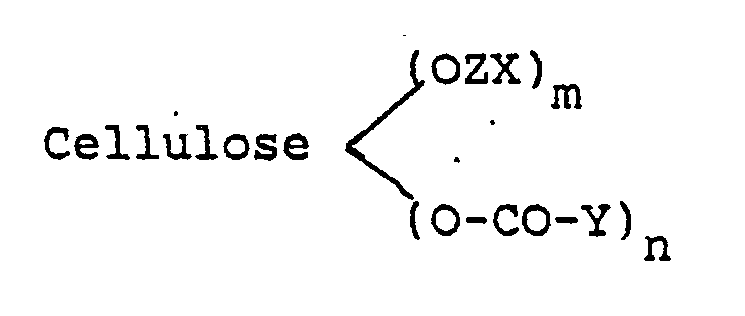
- -Z- einen gegebenenfalls substituierten Alkylen-, Alkenylen-, Alkinylen-, Cycloalkylen- oder Benzylen-oder Xylylenrest,
- X -H, -NR2, -NR3, -CN, -COOH, -S03H, -PO(OR)2, -CONR2 oder -Si(OR)3 bedeutet, wobei
- R ein Wasserstoffatom oder eine Alkyl- oder Alkenylgruppe mit 1 bis 25 C-Atomen, Cycloalkyl-, Toluyl-oder Phenylgruppe bedeutet und
- Y eine gegebenenfalls substituierte Alkyl-, Alkenyl-, Alkinylgruppe mit 1 bis 36 C-Atomen, eine Cycloalkylgruppe oder eine Phenyl-, Toluyl-oder Benzylgruppe oder ein


- oder (-CH = CH-COOH) oder NH-R -Rest ist und R die gleiche Bedeutung hat und
- r = 1 -20
- m = 0 - 2,5
- n = 0,2 bis 2,95
- mit der Maßgabe, daß bei m = o n > 1,55 ist, wenn Y ein Alkyl-Rest mit 1 - 5 C-Atomen, ein -(CH2)r-COOH-Rest mit r = 0, 1 oder 2 oder ein Rest der Phthalsäure ist,
- sowie
- der Polymerisationsgrad mehr als 400 beträgt und herstellbar ist durch homogene Umsetzung in einem Gemisch von Dimethylacetamid und/oder N-Methylpyrrolidon mit LiCI nach Aktivierung des Celluloseausgangsproduktes ohne Anwesenheit von LiCl,
- deren Herstellung und deren Verwendung zu Membranen und Fasern.
- Neben dem Umstand, daß Dialysemembranen aus synthetischen bzw. natürlichen Polymeren bei ihrem Einsatz in künstlichen Nieren sehr leicht eine Gerinnung des Blutes hervorrufen können, die durch entsprechende medikamentöse Behandlung weitgehend verhindert wird, tritt bei Dialysemembranen aus regenerierter Cellulose häufig bei der Behandlung eines Nierenkranken mit Dialysatoren mit Cellulose-Membranen in der ersten Zeit der Dialysebehandlung ein vorübergehender Leukozytenabfall auf. Dieser Effekt wird als Leukopenie bezeichnet.
- Leukopenie ist eine Erniedrigung der Leukozytenzahl (weiße Blutkörper) im Blutkreislauf. Die Zahl der weißen Blutkörper beim Menschen beträgt ca. 4000 bis 12000 Zellen/mm3.
- Die Leukopenie bei der Dialyse ist am stärksten ausgeprägt 15 bis 20 Min. nach Beginn, wobei die Neutrophilen (das sind die mit neutralen oder gleichzeitig mit sauren und basischen Farbstoffen anfärbbaren Leukozyten) fast vollständig verschwinden können. Danach erholt sich die Zahl der Leukozyten innerhalb etwa einer Stunde wieder auf fast den Ausgangswert oder übersteigt diesen.
- Wird nach Erholung der Leukozyten ein neuer Dialysator angeschlossen, tritt wieder Leukopenie im gieichen Ausmaß ein.
- Cellulose-Membranen verursachen eine ausgeprägte Leukopenie. Auch wenn die klinische Bedeutung der Leukopenie wissenschaftlich nicht geklärt ist, besteht doch der Wunsch nach einer Dialysemembran für die Hämodialyse, die den Effekt der Leukopenie nicht zeigt, ohne daß dadurch die anderen sehr erwünschten Eigenschaften von Dialysemembranen aus regenerierter Cellulose beeinträchtigt werden.
- Bei der Hämodialyse mittels Membranen aus regenerierter Cellulose hat man neben der Leukopenie auch eine deutliche Komplement-Aktivierung festgestellt. Das Komplement-System innerhalb des Blutserums ist ein komplexes, aus vielen Komponenten bestehendes Plasmaenzym-System, das auf verschiedene Weise der Abwehr von Schädigungen durch eindringende fremde Zellen (Bakterien u.a.) dient. Wenn Antikörper gegen den eindringenden Organismus vorhanden sind, kann komplementspezifisch durch den Komplex der Antikörper mit antigenen Strukturen der Fremdzellen aktiviert werden, anderenfalls erfolgt auf einem Alternativ-Weg durch besondere Oberflächenmerkmale der Fremdzellen die Komplement-Aktivierung. Das Komplement-System beruht auf einer Vielzahl von Plasma-Proteinen. Nach Aktivierung reagieren diese Proteine spezifisch in einer bestimmten Reihenfolge miteinander und am Ende wird ein zellschädigender Komplex gebildet, der die Fremdzelle zerstört.
- Aus einzelnen Komponenten werden Peptide freigesetzt, die Entzündungserscheinungen auslösen und gelegentlich auch unerwünschte pathologische Folgen für den Organismus haben können. Es wird angenommen, daß die Aktivierung bei Hämodialysemembranen aus regenerierter Cellulose über den alternativen Weg erfolgt. Objektiv festgestellt werden diese Komplement-Aktivierungen durch eine Bestimmung der Komplement-Fragmente C3a und C5a.
- In diesem Zusammenhang wird auf folgende Arbeiten hingewiesen: D.E. Chenoweth et al., Kidney International Vol. 24, Seite 764 ff, 1983 und D.E. Chenoweth, Asaio-Journal Vol.. 7, Seite 44 ff, 1984.
- Das Carpal-Tunnel-Syndrom wird durch modifizierte Cellulosederivate beeinflußt. Es besteht aber ein erhebliches Bedürfnis nach weiteren Modifizierungen der Cellulose, um auch dieses Phänomen möglichst weitgehend auszuschalten.
- Aufgabe der vorliegenden Erfindung war es, modifizierte Cellulose zur Verfügung zu stellen, die hinsichtlich der Leukopenie, der Komplementaktivierung und der Blutgerinnung Membranen optimale Eigenschaften verleiht und darüber hinaus das für den Carpal-Tunnel-Effekt verantwortliche Beta-2-Micro- globulin in erheblichem Umfange zu adsorbieren in der Lage ist.
- Gelöst wird diese Aufgabe durch eine modifizierte Cellulose, die dadurch gekennzeichnet ist, daß die modifizierte Cellulose eine durch die Formel
-

- -einen gegebenenfalls substituierten Alkylen-, Alkenylen-, Alkinylen-Rest (gerad-kettig und/oder verzweigt, wobei die Kohlenstoffkette auch durch Heteroatome wie 0, S, N, P, Si sowie CO-, CONR- oder COO-Gruppen unterbrochen sein kann) und/oder Cycloalkylen(ggf. mit Heteroatomen. und/oder substituiert) und/oder Arylen- und/oder Arylalkylen- und/oder Arylalkenylen-und/oder Arylalkinylen- (ggf. mit Heteroatomen und/oder substituiert) und/oder Bisarylalkylen- und/oder Bisarylen-Rest (ggf. substituiert) und/oder Rest einer kondensierten aromatischen Verbindung (ggf. substituiert) und/oder Rest einer heterocyclischen Verbindung (ggf. substituiert)
- -Y und -Y
- -H, und/oder -NR2 und/oder -N+R3 und/oder -COOH auch als Salz und/oder -COOR und/oder -CONR2 und/oder -CO-R und/oder -CS-R und/oder -CSOH auch als Salz und/oder -CSOR und/oder -CSNR2 und/oder -SO3H auch als Salz und/oder -SO3R und/oder -SO2-R und/oder -SO2NR2 und/oder -SR und/oder -SOR und/oder -SONR2 und/oder -P03H2 auch als Salz und/oder -PO(OR)2 und/oder -P02H(NR2) und/oder -PO(NR2)2 und/oder -P02H2 und/oder -POH(OR) und/oder -CN und/oder -N02 und/oder -OR und/oder Halogen und/oder -Si(OR)3 bedeuten, wobei R
- ein Wasserstoffatom und/oder eine gegebenenfalls substituierte Alkyl-, Alkenyl-, Alkinylgruppe mit 1 bis 36 C-Atomen (gerad-kettig und/oder verzweigt, wobei die Kohlenstoffkette auch durch Heteroatome wie O, S, N, P, Si sowie CO-, CONR- oder COO-Gruppen unterbrochen sein kann) und/oder Cycloalkyl-(ggf. mit Heteroatomen und/oder substituiert) und/oder Aryl- und/oder Arylalkyl- und/oder Arylalkenyl- und/oder Arylalkinyl- (ggf. mit Heteroatomen und/oder substituiert) und/oder Bisarylalkyl- und/oder Bisaryl-Rest (ggf. substituiert) und/oder Rest einer kondensierten aromatischen Verbindung (ggf. substituiert) und/oder Rest einer heterocyclischen Verbindung (ggf. substituiert) bedeutet und X gleich oder verschieden von X und Y gleich oder verschieden von Y ist und in dem Falle, daß Q zusammen mit dem 0 eine Ester- und/oder Carbamatgruppe ist, Q die nachfolgende Bedeutung hat:

und/oder -CO-(CH2)r-COOH und/oder
- Während unmodifizierte Cellulose 3 für eine Substitution zur Verfügung stehende Hydroxylgruppen enthält, ist bei Chitin bereits eine Hydroxylgruppe durch Acetamidgruppen substituiert. Diese Substitution wird im Rahmen der vorliegenden Erfindung beim mittleren Substitutionsgrad nicht mehr berücksichtigt, sofern modifizierte Cellulosen auf der Basis des Chitinmolekül-Gerüstes eingesetzt werden.
- Wenn Z ein Stickstoffatom ist, beträgt s vorzugsweise 0 bis 0,5 . n. Wenn Z ein Schwefelatom ist, beträgt s vorzugsweise 0,25 . n bis n.
- Dialysemembranen mit den erfindungsgemäßen Cellulosederivaten lassen sich aus substituierter Cellulose im Gemisch mit unmodifizierter Cellulose auf den gewünschten Substitutionsgrad einstellen. Die Substitution zum Zwischenprodukt erfolgt nach an sich bekannten Verfahren und anschließender Umsetzung dieses Zwischenproduktes mit Säureanhydriden, Säurechloriden oder Isocyanaten, beispielsweise in Dimethylacetamid/LiCI-Lösung.
- Das in der US-PS 3 702 754 beschriebene Verfahren ist zur Herstellung der Zwischenprodukte geeignet, wenn darauf geachtet wird, daß der Abbau begrenzt bleibt. Sofern bei diesem Verfahren eine Vernetzung eintritt, sind die Produkte zum Teil unlöslich, so daß sie dann ungeeignet sind.
- Andere bekannte Verfahren haben sich jedoch als besser geeignet zur Herstellung des Zwischenproduktes erwiesen. Beispielsweise kann hierzu auf Journal of Polymer Science - Part C, No. 11, (1965), Seiten 107 - 118 oder J. Am. Chem. Soc. Febr. 1950, Seiten 670 - 674 und auf "Cellulose and Cellulose Derivatives" Part 11, herausgegeben von Ott, Spurlin und Grafflin, Interscience Publishers, Inc., New York, 2. Auflage, 1954, Seite 822 verwiesen werden. Bei diesen Verfahren wird der Substitutionsgrad beliebig hoch eingestellt.
- Im Rahmen der vorliegenden Erfindung wurde die Komplement-Aktivierung anhand der Fragmente C3a oder C5a beurteilt. Dazu wurden in vitro 300 ml heparinisiertes Blutplasma über einen Zeitraum von 4 Std. mit einem Plasmafluß von 100 ml/min. durch einen Dialysator mit 1 m2 effektiver Austauschfläche rezirkuliert. In dem Plasma wurden die C3a-Fragmente mit Hilfe der RIA-Methode (Upjohn-Test) bestimmt. Die relative Komplement-Aktivierung für den jeweiligen Meßzeitpunkt wurde durch Bildung des Verhältnisses der Konzentration zum Zeitpunkt der Probenahme mit dem Anfangswert in Prozent errechnet. Zur Bewertung wurde der Meßwert nach 4 Std. Rezirkulationszeit herangezogen. Flachmembranen werden mit heparinisiertem Blutplasma 3 Stunden inkubiert und anschließend die C3a-Fragmente bestimmt. Die C5a-Fragmente wurden analog bestimmt.
- Die Erhöhung des beta-2-Mikroglobulinspiegels bei Langzeit-Dialysepatienten wird nach Verwendung von Membranen aus regenerierter Cellulose beobachtet und wird darauf zurückgeführt, daß diese Membranen für Stoffe im Molekularbereich von 1000 bis 20.000 weniger durchlässig sind und letztere deshalb bei der Dialyse nicht in ausreichendem Maße entfernt werden. An die üblichen Membranen aus regenerierter Cellulose adsorbiert sich das beta-2-Mikroglobulin nicht in nennenswertem Umfang. Hierzu aber können in unerwarteter Weise die erfindungsgemäßen Cellulosederivate beitragen.
- Gemessen wird im Rahmen der Erfindung der beta-2-Mikroglobulingehalt, der an die Membran adsorbiert wird, auf folgende Weise:
- In je 500 mg Substanz (Dialysemembran) werden 10 ml Humanblutplasma gegeben und 30 min. bei 37 °C inkubiert. Das Humanblutplasma hat einen Gehalt an beta-2-Mikroglobulin von 13,67 mg/I. Die Probe wird bei 3000 Upm 15 min. zentrifugiert. Im Überstand wird der Gehalt an beta-2-Mikroglobulin festgestellt. Anschließend wird die Probe 2 x mit je 10 ml Phosphat-buffer-saline gewaschen. In den Waschflüssigkeiten wird der Mikroglobulingehalt ebenfalls festgestellt. Aus der Differenz zwischen ursprünglichem und nicht absorbiertem beta-2-Mikroglobulin läßt sich die prozentuale Menge an absorbiertem beta-2-Mikroglobulin errechnen.
- Der Durchschnittspolymerisationsgrad DP wurde in einer Cuen-Lösung nach DIN 54270 bestimmt.
- Der Verätherungsgrad und/oder Veresterungsgrad wurden anhand der Analysenergebnisse bestimmt, die für die Substituenten bekannt und typisch sind, beispielsweise Stickstoff nach Kjeldahl, Schwefel nach Schöniger oder Phosphor nach der Molybdatmethode, gegebenenfalls aus der Differenz vor und nach einer Verseifung.
- Gut geeignete Dialysemembranen ergeben sich bei modifizierten Cellulosen, sofern gegebenenfalls von substituierten X-bzw. X-Molekülresten ausgegangen wird, wenn X bzw. X' mit den Molekülresten Y bzw. Y' substituiert sind.
- Im allgemeinen sind modifizierte Cellulosen bevorzugt, bei denen die Substituenten Y bzw. Y sekundäre, tertiäre oder quaternäre Aminogruppen und/oder Carboxygruppen und/oder Sulfogruppen und/oder Phosphonatgruppen und/oder Silicatgruppen sind.
- Gute Ergebnisse hinsichtlich der angestrebten Biocompatibilität erhält man mit Dialysemembranen, die modifizierte Cellulose enthalten, bei denen in der angegebenen Strukturformel -[ XY ] Dialkylaminoalkylen und/oder Carboxyalkylen und/oder Carboxyarylalkylen und/oder Sulfoalkylen und/oder Sulfoarylalkylen und/oder Phosphonatalkylen und/oder Phosphonatarylalkylen bedeutet.
- Eine weitere Ausführungsform der Erfindung ergibt sich dadurch, daß -[ XY ] Silicatopropylen bedeutet.
- Alkylreste für R sind vorzugsweise Methylgruppen und/oder Äthylgruppen und/oder Propylgruppen.
- 1m Rahmen der Erfindung ist es ohne Einschränkung möglich, die Regeneration beispielsweise aus Dimethylacetamid/LiCI durchzuführen, während die erfindungsgemäßen modifizierten Cellulosen, beispielsweise wegen ihrer Unlöslichkeit, für die Regeneration aus Cuoxamlösungen nicht geeignet sind.
- In einem 2 I-Dreihalskolben wurden 83,175 g (0,50 Mol) Methylaminocellulose (n = 0,15) in 1006,4 g (11,57 Mol) Dimethylacetamid suspendiert und bei 145 °C 30 Minuten lang unter Stickstoff aktiviert. Nach dem Abkühlen auf 100 C wurden 95,8 g (2,25 Mol) LICI zugesetzt, wobei die Temperatur um 5 - 10 C anstieg; anschließend wurde rasch auf Raumtemperatur (RT stets 20 - 25 C) abgekühlt und über Nacht gerührt. Zur klaren Viskose-Lösung wurden 2 g (0,02 Mol) Kaliumacetat und 14,7 g (0,15 Mol) Maleinsäureanhydrid zugesetzt.
- Zur Vervollständigung der Reaktion wurde das Reaktionsgemisch 6 Stunden bei 65 °C und 15 Stunden bei Raumtemperatur weitergerührt. Die erhaltene Reaktionslösung wurde filtriert, entlüftet und zu Hohlfäden versponnen.
- Als Lumenfüllung wurde i-Propylmyristat verwendet.
- Die auf diese Weise erhaltenen Methylaminocellullosemaleinat-Membranen wiesen folgende Eigenschaften auf:

- Die obengenannte Cellulosederivatmembran weist im Vergleich zu unmodifizierten Cellulose-Membranen eine geringere Komplemeritaktivierung auf. Gegenüber der unmodifizierten Cellulosemembran beträgt die C3a-Reduzierung 98 %.
- In einem 2 I-Dreihalskolben wurden 81 g (0,5 Mol) Cellulose in 1006,4 g (11,57 Mol) Dimethylacetamid suspendiert und bei 145 °C 30 Minuten lang unter Stickstoff aktiviert. Nach dem Abkühlen auf 100 C wurden 95,8 g (2,25 Mol) LiCI zugesetzt, wobei die Temperatur um 5 - 10 °C anstieg; anschließend wurde rasch auf Raumtemperatur (RT stets 20 - 25° C) abgekühlt und über Nacht gerührt. Zur klaren, viskosen Lösung wurden zunächst 40,4 g (0,4 Mol) Triäthylamin und nach Homogenisierung 47,625 g (0,25 Mol) p-Toluolsulfonsäurechlorid hinzugefügt, und zur Vervollständigung der Reaktion das Gemisch 24 Stunden bei 70 °C gerührt. Die Analyse einer kleinen Probemenge ergab einen Veresterungsgrad von 0,35. Zum Reaktionsgemisch wurden 151,5 g (1,50 Mol) Hexylamin zugesetzt. Zur Vervollständigung der Reaktion wurde das Gemisch 24 Stunden bei 80` C weitergerührt. Das Reaktiongemisch wurde mit Wasser ausgefällt, zunächst mit Wasser chloridfrei, dann mit Äthanol gewaschen und im Vakuum-Trockenschrank bei 65 °C getrocknet. Dabei wurden 92 g eines Produktes mit einem Stickstoffgehalt von 2,19 %, entsprechend einem Substitutionsgrad DS (n) von 0,30 erhalten.
- Analog dem Beispiel 1 wurde das Reaktionsprodukt in DMAc/LiCI mit Dodecylbernsteinsäureanhydrid umgesetzt und zu Kapillar-Membranen verarbeitet. Die Kapillarmembranen wiesen folgende Eigenschaften auf:
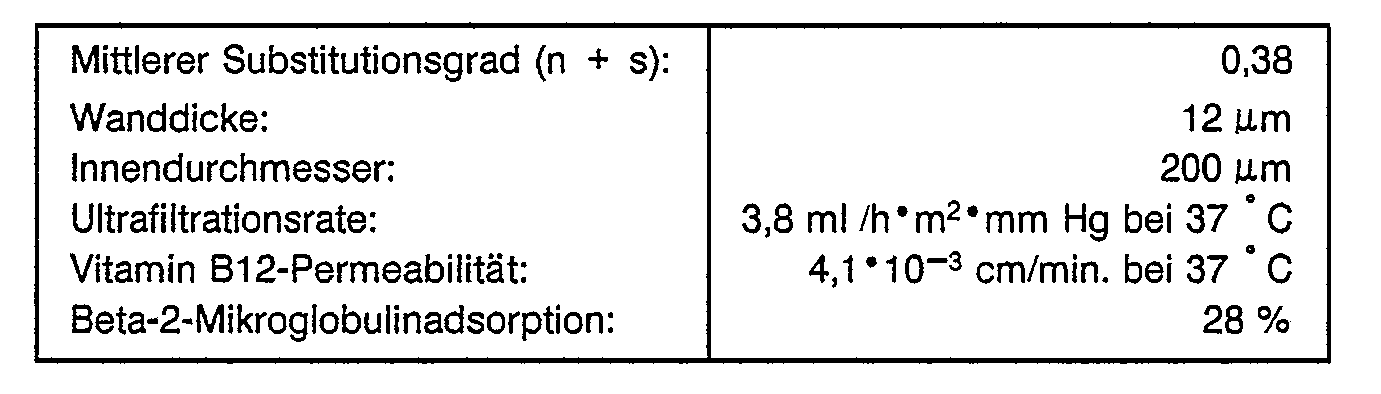
- Gegenüber der unmodifizierten Cellulosemembran beträgt die C3a-Reduktion 99 %.
- Durch Veresterung von Carboxymethylthiocellulose (n = 0,12) mit Essigsäureanhydrid nach bekannter Verfahrensweise wurde ein Produkt mit einem Veresterungsgrad von s = 2,2 erhalten.
- Das Produkt wurde in Ameisensäure-Polyethylenglykol-Wasser-Gemisch (82 : 11 : 7 Gewichtsteile) gelöst und zu Flachmembranen verarbeitet.
- Im Vergleich zu unmodifizierter Cellulose beträgt die C5a-Reduktion 92%.
- Analog dem Beispiel 1, 2 oder 3 wurden die in der Tabelle aufgeführten Derivate synthetisiert, zu Flachmembranen verarbeitet und ihre Komplementaktivierung anhand der Fragmente C5a bestimmt.

Claims (11)

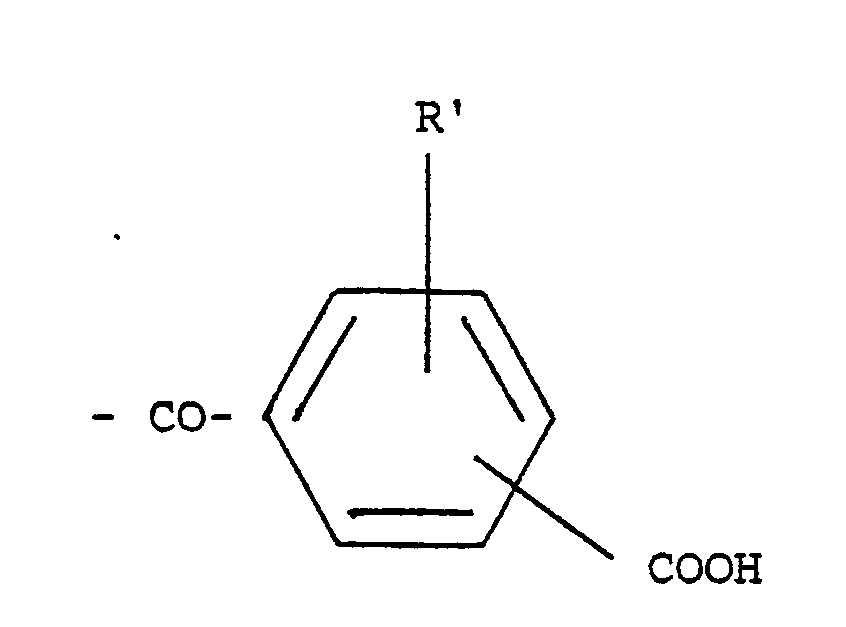
und/oder -CO-(CH2)r-COOH und/oder

Applications Claiming Priority (2)
| Application Number | Priority Date | Filing Date | Title |
|---|---|---|---|
| DE3742071 | 1987-12-11 | ||
| DE3742071 | 1987-12-11 |
Publications (3)
| Publication Number | Publication Date |
|---|---|
| EP0319938A2 true EP0319938A2 (de) | 1989-06-14 |
| EP0319938A3 EP0319938A3 (en) | 1990-07-25 |
| EP0319938B1 EP0319938B1 (de) | 1996-05-08 |
Family
ID=6342406
Family Applications (1)
| Application Number | Title | Priority Date | Filing Date |
|---|---|---|---|
| EP88120408A Expired - Lifetime EP0319938B1 (de) | 1987-12-11 | 1988-12-07 | Modifizierte Cellulose für biocompatible Dialysemembranen |
Country Status (6)
| Country | Link |
|---|---|
| US (1) | US5026834A (de) |
| EP (1) | EP0319938B1 (de) |
| JP (1) | JP2792873B2 (de) |
| AT (1) | ATE137766T1 (de) |
| DE (1) | DE3855279D1 (de) |
| ES (1) | ES2086295T3 (de) |
Cited By (4)
| Publication number | Priority date | Publication date | Assignee | Title |
|---|---|---|---|---|
| DE4017745A1 (de) * | 1990-06-01 | 1991-12-05 | Akzo Gmbh | Dialysemembran aus polysaccharidether |
| EP0527235A4 (en) * | 1991-02-28 | 1993-10-13 | Daicel Chemical Industries, Ltd. | Novel polysaccharide drivative and separating agent |
| US5427684A (en) * | 1992-06-05 | 1995-06-27 | Akzo Nv | Dialysis membrane composed of polysaccharide ether II |
| US5543506A (en) * | 1992-06-25 | 1996-08-06 | Daicel Chemical Industries, Ltd. | Polysaccharide derivative and separating agent |
Families Citing this family (5)
| Publication number | Priority date | Publication date | Assignee | Title |
|---|---|---|---|---|
| DE59208184D1 (de) * | 1992-01-07 | 1997-04-17 | Akzo Nobel Nv | Verfahren zum Beschichten cellulosischer Membranen |
| JP2000297103A (ja) * | 1999-04-16 | 2000-10-24 | Daicel Chem Ind Ltd | キチン誘導体の製造方法 |
| JP6136594B2 (ja) * | 2013-06-03 | 2017-05-31 | 王子ホールディングス株式会社 | 微細セルロース繊維の製造方法 |
| JP2017133037A (ja) * | 2017-04-26 | 2017-08-03 | 王子ホールディングス株式会社 | 微細セルロース繊維の製造方法 |
| JP2019001876A (ja) | 2017-06-14 | 2019-01-10 | 国立大学法人京都大学 | 微細セルロース繊維、その製造方法、スラリー及び複合体 |
Family Cites Families (10)
| Publication number | Priority date | Publication date | Assignee | Title |
|---|---|---|---|---|
| US1833286A (en) * | 1926-10-30 | 1931-11-24 | Ig Farbenindustrie Ag | Amino cellulose derivatives |
| US2136299A (en) * | 1935-06-20 | 1938-11-08 | Du Pont | Aminocellulose derivatives |
| US3441142A (en) * | 1966-07-21 | 1969-04-29 | Dow Chemical Co | Nonthrombogenic plastic membranes |
| US3702754A (en) * | 1971-01-26 | 1972-11-14 | Us Agriculture | Fibrous (carboxyalkylthio)- and (carboxyarylthio) chlorodeoxycelluloses and method of preparation |
| DE2705735C3 (de) * | 1977-02-11 | 1982-05-19 | Akzo Gmbh, 5600 Wuppertal | Dialysemembran für die Hämodialyse |
| US4278790A (en) * | 1978-07-31 | 1981-07-14 | Hopkins Agricultural Chemical Co. | Novel cellulose solutions |
| DE3246417C2 (de) * | 1982-12-15 | 1987-04-09 | Akzo Gmbh, 5600 Wuppertal | Wasserunlösliche Fasern aus Celluloseacetat, Cellulosepropionat und Cellulosebutyrat mit einem extrem hohen Absorptionsvermögen für Wasser und physiologische Flüssigkeiten |
| DE3312022C2 (de) * | 1983-04-02 | 1987-02-26 | Akzo Gmbh, 5600 Wuppertal | Verfahren zur Herstellung von wasserunlöslichen Fasern aus Cellulosemonoestern der Maleinsäure, Bernsteinsäure und Phthalsäure mit einem extrem hohen Absorptionsvermögen für Wasser und physiologische Flüssigkeiten |
| DE3524596A1 (de) * | 1985-07-10 | 1987-01-15 | Akzo Gmbh | Dialysemembran aus modifizierter cellulose mit verbesserter biokompatibilitaet |
| ES2048191T3 (es) * | 1987-12-11 | 1994-03-16 | Akzo Nv | Membrana de dialisis biocompatible a base de celulosa con adsorcion incrementada de beta-2-microglobulina. |
-
1988
- 1988-12-07 DE DE3855279T patent/DE3855279D1/de not_active Expired - Fee Related
- 1988-12-07 ES ES88120408T patent/ES2086295T3/es not_active Expired - Lifetime
- 1988-12-07 AT AT88120408T patent/ATE137766T1/de not_active IP Right Cessation
- 1988-12-07 EP EP88120408A patent/EP0319938B1/de not_active Expired - Lifetime
- 1988-12-09 US US07/281,629 patent/US5026834A/en not_active Expired - Lifetime
- 1988-12-12 JP JP63312145A patent/JP2792873B2/ja not_active Expired - Fee Related
Cited By (5)
| Publication number | Priority date | Publication date | Assignee | Title |
|---|---|---|---|---|
| DE4017745A1 (de) * | 1990-06-01 | 1991-12-05 | Akzo Gmbh | Dialysemembran aus polysaccharidether |
| US5171444A (en) * | 1990-06-01 | 1992-12-15 | Akzo N.V. | Dialysis membrane made of polysaccharide ether |
| EP0527235A4 (en) * | 1991-02-28 | 1993-10-13 | Daicel Chemical Industries, Ltd. | Novel polysaccharide drivative and separating agent |
| US5427684A (en) * | 1992-06-05 | 1995-06-27 | Akzo Nv | Dialysis membrane composed of polysaccharide ether II |
| US5543506A (en) * | 1992-06-25 | 1996-08-06 | Daicel Chemical Industries, Ltd. | Polysaccharide derivative and separating agent |
Also Published As
| Publication number | Publication date |
|---|---|
| EP0319938B1 (de) | 1996-05-08 |
| JP2792873B2 (ja) | 1998-09-03 |
| ES2086295T3 (es) | 1996-07-01 |
| US5026834A (en) | 1991-06-25 |
| ATE137766T1 (de) | 1996-05-15 |
| JPH01190701A (ja) | 1989-07-31 |
| EP0319938A3 (en) | 1990-07-25 |
| DE3855279D1 (de) | 1996-06-13 |
Similar Documents
| Publication | Publication Date | Title |
|---|---|---|
| EP0319862B1 (de) | Biocompatible Dialysemembran aus Cellulose mit erhöhter Beta-2-Microglobulinadsorption | |
| EP0300250B1 (de) | Biokompatible Hämodialysemembranen aus modifizierter Cellulose | |
| EP0330134A1 (de) | Modifizierte Cellulose für biocompatible Dialysemembranen IV und Verfahren zu deren Herstellung | |
| EP0330106A1 (de) | Modifizierte Cellulose für biocompatible Dialysemembranen II und Verfahren zu deren Herstellung | |
| EP0172437B1 (de) | Dialysemembran aus modifizierter Cellulose mit verbesserter Biokompatibilität | |
| EP0339200A1 (de) | Modifizierte Cellulose für biocompatible Dialysemembranen III und Verfahren zu deren Herstellung | |
| EP0807460A1 (de) | Cellulosische Dialysemembran | |
| DE2832536A1 (de) | Kuenstliches medizinisches material mit gerinnungshemmender wirkung | |
| EP0416377B1 (de) | Cellulosische Membranen | |
| EP0319938B1 (de) | Modifizierte Cellulose für biocompatible Dialysemembranen | |
| EP0339502A2 (de) | Verfahren zur Modifizierung von cellulosischen Dialysemembranen zur Verbesserung der Biocompatibilität und Vorrichtung zur Durchführung des Verfahrens | |
| DE19981169B4 (de) | Kovalent an Gallensäuren oder Sterine gebundenes Heparin, dessen Verwendung und diese enthaltende pharmazeutische Zusammensetzung | |
| EP0459293B1 (de) | Dialysemembran aus Polysaccharidether | |
| DE3524596A1 (de) | Dialysemembran aus modifizierter cellulose mit verbesserter biokompatibilitaet | |
| EP0376069B1 (de) | Biocompatible Dialysemembran aus einem gemischten Polysaccharidester | |
| EP0550879B1 (de) | Verfahren zum Beschichten cellulosischer Membranen | |
| EP0353561B1 (de) | Dialysemembranen aus cuoxamstabilen Celluloseestern und Carbamaten | |
| DE3840175A1 (de) | Modifizierte cellulose fuer biocompatible dialysemembranen | |
| EP0572910B1 (de) | Dialysemembran aus Polysaccharidether II | |
| EP0416565B1 (de) | Verfahren zur Herstellung von Desoxycelluloseverbindungen | |
| DE3901946A1 (de) | Modifizierte cellulose fuer biocompatible dialysemembranen iii und verfahren zu deren herstellung | |
| DE3901947A1 (de) | Modifizierte cellulose fuer biocompatible dialysemembranen ii und verfahren zu deren herstellung | |
| DE3840174A1 (de) | Biocompatible dialysemembran aus cellulose mit erhoehter beta-2-microglobulinadsorption | |
| DE3901945A1 (de) | Modifizierte cellulose fuer biocompatible dialysemembranen iv und verfahren zu deren herstellung | |
| DE4218568A1 (de) | Dialysemembran aus Polysaccharidether II |
Legal Events
| Date | Code | Title | Description |
|---|---|---|---|
| PUAI | Public reference made under article 153(3) epc to a published international application that has entered the european phase |
Free format text: ORIGINAL CODE: 0009012 |
|
| AK | Designated contracting states |
Kind code of ref document: A2 Designated state(s): AT BE CH DE ES FR GB GR IT LI LU NL SE |
|
| PUAL | Search report despatched |
Free format text: ORIGINAL CODE: 0009013 |
|
| AK | Designated contracting states |
Kind code of ref document: A3 Designated state(s): AT BE CH DE ES FR GB GR IT LI LU NL SE |
|
| 17P | Request for examination filed |
Effective date: 19901222 |
|
| 17Q | First examination report despatched |
Effective date: 19920923 |
|
| RAP1 | Party data changed (applicant data changed or rights of an application transferred) |
Owner name: AKZO NOBEL N.V. |
|
| ITF | It: translation for a ep patent filed | ||
| GRAA | (expected) grant |
Free format text: ORIGINAL CODE: 0009210 |
|
| AK | Designated contracting states |
Kind code of ref document: B1 Designated state(s): AT BE CH DE ES FR GB GR IT LI LU NL SE |
|
| PG25 | Lapsed in a contracting state [announced via postgrant information from national office to epo] |
Ref country code: BE Effective date: 19960508 Ref country code: GR Free format text: LAPSE BECAUSE OF FAILURE TO SUBMIT A TRANSLATION OF THE DESCRIPTION OR TO PAY THE FEE WITHIN THE PRESCRIBED TIME-LIMIT Effective date: 19960508 |
|
| REF | Corresponds to: |
Ref document number: 137766 Country of ref document: AT Date of ref document: 19960515 Kind code of ref document: T |
|
| ET | Fr: translation filed | ||
| REF | Corresponds to: |
Ref document number: 3855279 Country of ref document: DE Date of ref document: 19960613 |
|
| REG | Reference to a national code |
Ref country code: ES Ref legal event code: FG2A Ref document number: 2086295 Country of ref document: ES Kind code of ref document: T3 |
|
| ET1 | Fr: translation filed ** revision of the translation of the patent or the claims | ||
| GBT | Gb: translation of ep patent filed (gb section 77(6)(a)/1977) |
Effective date: 19960607 |
|
| PG25 | Lapsed in a contracting state [announced via postgrant information from national office to epo] |
Ref country code: AT Effective date: 19961207 |
|
| PG25 | Lapsed in a contracting state [announced via postgrant information from national office to epo] |
Ref country code: CH Effective date: 19961231 Ref country code: LU Free format text: LAPSE BECAUSE OF NON-PAYMENT OF DUE FEES Effective date: 19961231 Ref country code: LI Effective date: 19961231 |
|
| PLBE | No opposition filed within time limit |
Free format text: ORIGINAL CODE: 0009261 |
|
| STAA | Information on the status of an ep patent application or granted ep patent |
Free format text: STATUS: NO OPPOSITION FILED WITHIN TIME LIMIT |
|
| 26N | No opposition filed | ||
| REG | Reference to a national code |
Ref country code: CH Ref legal event code: PL |
|
| PGFP | Annual fee paid to national office [announced via postgrant information from national office to epo] |
Ref country code: NL Payment date: 19971231 Year of fee payment: 10 |
|
| PG25 | Lapsed in a contracting state [announced via postgrant information from national office to epo] |
Ref country code: NL Free format text: LAPSE BECAUSE OF NON-PAYMENT OF DUE FEES Effective date: 19990701 |
|
| NLV4 | Nl: lapsed or anulled due to non-payment of the annual fee |
Effective date: 19990701 |
|
| REG | Reference to a national code |
Ref country code: GB Ref legal event code: IF02 |
|
| REG | Reference to a national code |
Ref country code: FR Ref legal event code: TP |
|
| REG | Reference to a national code |
Ref country code: GB Ref legal event code: 732E |
|
| APAH | Appeal reference modified |
Free format text: ORIGINAL CODE: EPIDOSCREFNO |
|
| PGFP | Annual fee paid to national office [announced via postgrant information from national office to epo] |
Ref country code: GB Payment date: 20051122 Year of fee payment: 18 |
|
| PGFP | Annual fee paid to national office [announced via postgrant information from national office to epo] |
Ref country code: ES Payment date: 20051202 Year of fee payment: 18 |
|
| PGFP | Annual fee paid to national office [announced via postgrant information from national office to epo] |
Ref country code: SE Payment date: 20051214 Year of fee payment: 18 |
|
| PGFP | Annual fee paid to national office [announced via postgrant information from national office to epo] |
Ref country code: FR Payment date: 20051216 Year of fee payment: 18 |
|
| PGFP | Annual fee paid to national office [announced via postgrant information from national office to epo] |
Ref country code: DE Payment date: 20060103 Year of fee payment: 18 |
|
| PG25 | Lapsed in a contracting state [announced via postgrant information from national office to epo] |
Ref country code: SE Free format text: LAPSE BECAUSE OF NON-PAYMENT OF DUE FEES Effective date: 20061208 |
|
| PGFP | Annual fee paid to national office [announced via postgrant information from national office to epo] |
Ref country code: IT Payment date: 20061231 Year of fee payment: 19 |
|
| PG25 | Lapsed in a contracting state [announced via postgrant information from national office to epo] |
Ref country code: DE Free format text: LAPSE BECAUSE OF NON-PAYMENT OF DUE FEES Effective date: 20070703 |
|
| EUG | Se: european patent has lapsed | ||
| GBPC | Gb: european patent ceased through non-payment of renewal fee |
Effective date: 20061207 |
|
| REG | Reference to a national code |
Ref country code: FR Ref legal event code: ST Effective date: 20070831 |
|
| PG25 | Lapsed in a contracting state [announced via postgrant information from national office to epo] |
Ref country code: GB Free format text: LAPSE BECAUSE OF NON-PAYMENT OF DUE FEES Effective date: 20061207 |
|
| REG | Reference to a national code |
Ref country code: ES Ref legal event code: FD2A Effective date: 20061209 |
|
| PG25 | Lapsed in a contracting state [announced via postgrant information from national office to epo] |
Ref country code: FR Free format text: LAPSE BECAUSE OF NON-PAYMENT OF DUE FEES Effective date: 20070102 Ref country code: ES Free format text: LAPSE BECAUSE OF NON-PAYMENT OF DUE FEES Effective date: 20061209 |
|
| PG25 | Lapsed in a contracting state [announced via postgrant information from national office to epo] |
Ref country code: IT Free format text: LAPSE BECAUSE OF NON-PAYMENT OF DUE FEES Effective date: 20071207 |