EP0320052B1 - Zwischenprodukte und Verfahren für 6-Carboxy-HMG-CoA-Reduktase-Inhibitoren - Google Patents
Zwischenprodukte und Verfahren für 6-Carboxy-HMG-CoA-Reduktase-Inhibitoren Download PDFInfo
- Publication number
- EP0320052B1 EP0320052B1 EP88202761A EP88202761A EP0320052B1 EP 0320052 B1 EP0320052 B1 EP 0320052B1 EP 88202761 A EP88202761 A EP 88202761A EP 88202761 A EP88202761 A EP 88202761A EP 0320052 B1 EP0320052 B1 EP 0320052B1
- Authority
- EP
- European Patent Office
- Prior art keywords
- alkyl
- compound
- hydrogen
- phenyl
- independently
- Prior art date
- Legal status (The legal status is an assumption and is not a legal conclusion. Google has not performed a legal analysis and makes no representation as to the accuracy of the status listed.)
- Expired - Lifetime
Links
- 0 CCC[C@@]([C@@](C)C=C1)[C@@]2C1=C[C@](CC#*)C[C@@]2OC([C@@](C)C(C)O)=O Chemical compound CCC[C@@]([C@@](C)C=C1)[C@@]2C1=C[C@](CC#*)C[C@@]2OC([C@@](C)C(C)O)=O 0.000 description 3
Classifications
-
- C—CHEMISTRY; METALLURGY
- C07—ORGANIC CHEMISTRY
- C07F—ACYCLIC, CARBOCYCLIC OR HETEROCYCLIC COMPOUNDS CONTAINING ELEMENTS OTHER THAN CARBON, HYDROGEN, HALOGEN, OXYGEN, NITROGEN, SULFUR, SELENIUM OR TELLURIUM
- C07F7/00—Compounds containing elements of Groups 4 or 14 of the Periodic Table
- C07F7/02—Silicon compounds
- C07F7/08—Compounds having one or more C—Si linkages
- C07F7/18—Compounds having one or more C—Si linkages as well as one or more C—O—Si linkages
- C07F7/1804—Compounds having Si-O-C linkages
Definitions
- Hypercholesterolemia is known to be one of the prime risk factors for ischemic cardiovascular disease, such as arteriosclerosis. Bile acid sequestrants have been used to treat this condition ; they seem to be moderately effective but they must be consumed in large quantities, i.e. several grams at a time and they are not very palatable.
- Mevacor (lovastatin), now commercially available, is one of a group of very active antihypercholesterolemic agents that function by limiting cholesterol biosynthesis by inhibiting the enzyme, HMG-CoA reductase.
- mevastatin and lovastatin there are a variety of semi-synthetic and totally synthetic analogs thereof.
- U.S. Patent 4,376,863 discloses a fermentation product, isolated after cultivation of a microorganism belonging to the genus Aspergillus, which has a hydroxy containing butyryloxy side chain and is represented by the above general formula wherein R 4 is
- Japanese unexamined patent application J59-122,483-A discloses a semi-synthetic hydroxy-containing compound represented by the above general formula wherein R 4 is
- EP-A-0251625 a document following under Article 54 (3) EPC discloses 6-substituted compounds of the above general formula wherein R 4 is wherein R is and R1, R 3 , R 4 , R 6 and R 7 are broadly defined organic moieties.
- This invention relates to novel intermediates, and a novel process for their preparation, where said intermediates are useful in a novel preparation of 6-desmethyl-6-carboxy (I) derivatives of lovastatin and analogs thereof at the 8-acyl side chain.
- Said 6-carboxy derivatives of lovastatin and analogs thereof are useful in treating hypercholesterolemia and are disclosed in EP-A-0251625.
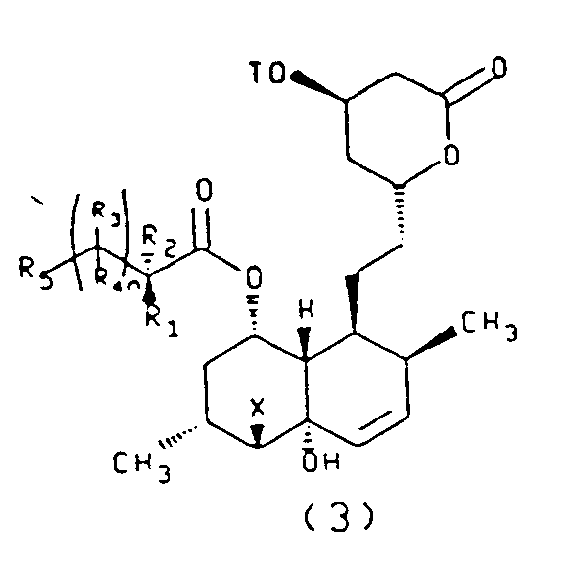
- the intermediates (3) of the instant invention are prepared in a novel process (i) which comprises : (A) contacting the compound (2) wherein :
- alkyl, alkylthio, alkenyl and alkanoyl groups of this invention may either be in a straight chain or branched configuration.
- One embodiment of this invention is the compounds of formula (3) : In one class of this embodiment are the compounds of formula (3) wherein :
- a second embodiment of this invention is the process for the preparation of intermediates (3) from the starting materials (2). This process consists of contacting a compound of formula (2) with a halogenating agent in an inert solvent followed by treatment with an oxidizing agent in an ethereal solvent.
- a third embodiment of the instant invention is the compounds of formula (7) :
- In one class of this embodiment are the compounds of formula (7) wherein :
- a fourth embodiment of the instant invention is the compounds of formula (8) :
- a fifth embodiment of the instant invention is the process for the preparation of intermediates (8) from intermediates (7).
- This process consists in oxidizing a compound of formula (7) with an agent such as pyridinium chlorochromate or chromium trioxide or chromium trioxide-pyridine or silver carbonate.
- a sixth embodiment of the present invention is the process for the preparation of intermediates (9) from intermediates (8).
- This process consists in contacting a compound of formula (8) with a samarium (II) halide, such as samarium (II) iodide in an ethereal solvent.
- a samarium (II) halide such as samarium (II) iodide
- the diene (2) of step (A) is treated with a halogenating agent such as phenylselenyl chloride or bromide or phenylsulfinyl chloride, preferably phenylselenyl chloride, in an approximately equimolar ratio in an inert solvent at about - 80°C, for approximately 20 minutes ; illustrative of such inert solvents are methylene chloride, ether and the like.
- a halogenating agent such as phenylselenyl chloride or bromide or phenylsulfinyl chloride, preferably phenylselenyl chloride
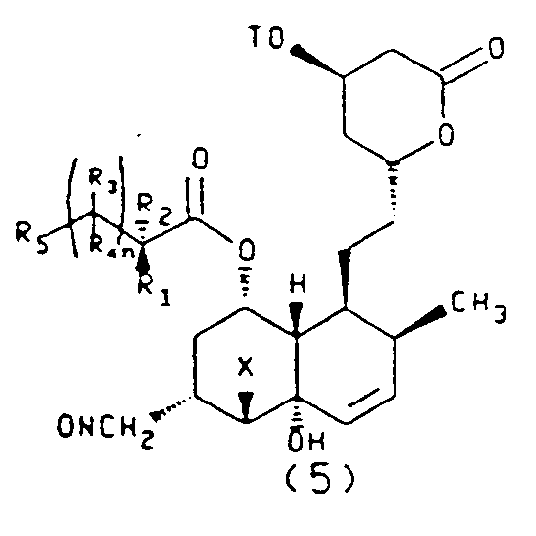
- Compound (3) is treated with nitrosyl chloride at a temperature between - 10 and 10°C, preferably 0°C for several minutes in a basic solvent until TLC analysis of an aliquot showed the reaction to be complete.
- a basic solvent pyridine and quinoline and the like.
- the irradiation of a compound of formula (4) is conducted using light of wavelength greater than 320 A°.
- One source of the irradiation is a medium pressure mercury lamp, at a temperature between 0° and 30°C, preferably at about 20°C, for a period of from 0.5 to 5 hours, most preferably about 0.7 hours at 20°C, in an inert solvent such as benzene, pyridine, hexane or the like, or a mixture of inert solvents.
- the rearrangement of a compound of formula (5) to a compound of formula (6) is conducted at a temperature between 60° and 100°C, preferably at 80°C for a period of 0.5 to 10 hours, most preferably for 1 hour at about 80°C, in a protic solvent and an amine base.
- a protic solvent and an amine base are alcohols such as isopropanol or 2-butanol and the like.
- amine bases are pyridine, triethylamine, quinoline, and the like.
- the conversion of an oxime (6) to a lactol (7) is conducted using an approximately 40% aqueous paraformaldehyde solution and a carboxylic acid such as acetic acid.
- the lactol (7) is oxidized with pyridinium chlorochromate ("PCC") or chromium trioxide or a chromium trioxide-pyridine complex or silver carbonate, preferably PCC in an inert solvent at about 25°C for about 5 to 7 hours, preferably 7 hours.
- PCC pyridinium chlorochromate
- chromium trioxide or a chromium trioxide-pyridine complex or silver carbonate preferably PCC
- an inert solvent at about 25°C for about 5 to 7 hours, preferably 7 hours.
- the inert solvents are methylene chloride, benzene and the like.
- the mole ratio of oxidizing agent to lactol (7) is approximately 2 : 1.
- the samarium iodide is formed in situ by treating 1,2-diiodoethane with samarium powder in an ethereal solvent at about 25°C for about 1 hour.
- the mole ratio of 1,2-diiodoethane to samarium powder is 1 : 2.
- the lactone (8) is treated with preformed samarium iodide at 25 to 80°C, preferably 75°C for about 0.5 to 4 hours, preferably 1.5 hours, in an ethereal solvent.
- the mole ratio of lactone to samarium powder is approximately 1: 2.
- Examples of such ethereal solvents are ethyl ether, tetrahydrofuran or dimethoxyethane.
- the silyl ether or tetrahydropyranyl protecting group is removed by treating a compound (9) in acetonitrile with an aqueous HF/CH 3 CN mixture at about 0°C for about 2.0 hours.
- Starting material (2) wherein the acyl side chain is 2-methylbutyryloxy is obtained from lovastatin by reaction with a silyl chloride protecting group such as tert-butyldimethylsilyl chloride following the procedure in U.S. Patent 4,444,784 or by treatment with dihydropyran to yield the tetrahydropyranyl protecting moiety.
- Lovastatin is prepared according to the fermentation procedure disclosed in U.S. Patent 4,231,938.
- a solution of compound 4' in benzene and pyridine, freshly prepared from compound 3' (4 g, 6.83 mmol) as described in step (b) was deoxygenated by bubbling nitrogen gas through the solution for 10 minutes. Then, it was irradiated (450W Hanovia medium pressure mercury lamp, pyrex sleeve) at room temperature for 40 minutes while nitrogen continued to bubble through the solution. The photolyzed solution was transferred to a 500 ml R-B flask and concentrated in vacuo to a volume of ca. 25 ml. This residue was diluted with ether and shaken with dilute hydrochloric acid (1 N, 150 ml) to remove pyridine.
Landscapes
- Chemical & Material Sciences (AREA)
- Organic Chemistry (AREA)
- Pyrane Compounds (AREA)
- Plural Heterocyclic Compounds (AREA)
Claims (10)




Applications Claiming Priority (2)
| Application Number | Priority Date | Filing Date | Title |
|---|---|---|---|
| US131695 | 1987-12-11 | ||
| US07/131,695 US4841074A (en) | 1987-12-11 | 1987-12-11 | Intermediates and processes for 6-carboxy HMG-CoA reductase inhibitors |
Publications (3)
| Publication Number | Publication Date |
|---|---|
| EP0320052A2 EP0320052A2 (de) | 1989-06-14 |
| EP0320052A3 EP0320052A3 (en) | 1989-08-16 |
| EP0320052B1 true EP0320052B1 (de) | 1992-01-15 |
Family
ID=22450612
Family Applications (1)
| Application Number | Title | Priority Date | Filing Date |
|---|---|---|---|
| EP88202761A Expired - Lifetime EP0320052B1 (de) | 1987-12-11 | 1988-12-02 | Zwischenprodukte und Verfahren für 6-Carboxy-HMG-CoA-Reduktase-Inhibitoren |
Country Status (5)
| Country | Link |
|---|---|
| US (1) | US4841074A (de) |
| EP (1) | EP0320052B1 (de) |
| JP (1) | JPH01265084A (de) |
| CA (1) | CA1307264C (de) |
| DE (1) | DE3867822D1 (de) |
Families Citing this family (5)
| Publication number | Priority date | Publication date | Assignee | Title |
|---|---|---|---|---|
| US5116870A (en) * | 1986-06-23 | 1992-05-26 | Merck & Co., Inc. | HMG-CoA reductase inhibitors |
| US4940727A (en) * | 1986-06-23 | 1990-07-10 | Merck & Co., Inc. | Novel HMG-CoA reductase inhibitors |
| USRE36481E (en) * | 1986-06-23 | 2000-01-04 | Merck & Co., Inc. | HMG-CoA reductase inhibitors |
| US5173487A (en) * | 1989-11-13 | 1992-12-22 | E. R. Squibb & Sons, Inc. | Mevinic acid derivatives |
| US10736871B2 (en) | 2015-04-01 | 2020-08-11 | Cedars-Sinai Medical Center | Anti-methanogenic lovastatin analogs or derivatives and uses thereof |
Citations (1)
| Publication number | Priority date | Publication date | Assignee | Title |
|---|---|---|---|---|
| EP0251625A2 (de) * | 1986-06-23 | 1988-01-07 | Merck & Co. Inc. | Inhibitoren von HMG-CoA-Reduktase |
Family Cites Families (8)
| Publication number | Priority date | Publication date | Assignee | Title |
|---|---|---|---|---|
| US4282155A (en) * | 1980-02-04 | 1981-08-04 | Merck & Co., Inc. | Antihypercholesterolemic compounds |
| JPS5815968A (ja) * | 1981-07-21 | 1983-01-29 | Sankyo Co Ltd | Ml−236b誘導体およびその製法 |
| JPS5855443A (ja) * | 1981-09-25 | 1983-04-01 | Sankyo Co Ltd | オクタヒドロナフタリン誘導体およびその製造法 |
| US4584389A (en) * | 1983-10-11 | 1986-04-22 | Merck & Co., Inc. | Processes for preparing 6(R)-[2-[8(S)(2,2-dimethylbutyryloxy)-2(S),6(S)-dimethyl-1,2,3,4,4a(S),5,6,7,8,8a(S)-decahydronaphthyl-1(S)]ethyl]-4(R)-hydroxy-3,4,5,6-tetrahydro-2H-pyran-2-one |
| US4582915A (en) * | 1983-10-11 | 1986-04-15 | Merck & Co., Inc. | Process for C-methylation of 2-methylbutyrates |
| US4738982A (en) * | 1986-04-28 | 1988-04-19 | Merck & Co., Inc. | HMG-CoA reductase inhibitors |
| US4719229A (en) * | 1987-05-13 | 1988-01-12 | Merck & Co., Inc. | Antihypercholesterolemic agents |
| US4782084A (en) * | 1987-06-29 | 1988-11-01 | Merck & Co., Inc. | HMG-COA reductase inhibitors |
-
1987
- 1987-12-11 US US07/131,695 patent/US4841074A/en not_active Expired - Fee Related
-
1988
- 1988-12-02 EP EP88202761A patent/EP0320052B1/de not_active Expired - Lifetime
- 1988-12-02 DE DE8888202761T patent/DE3867822D1/de not_active Expired - Lifetime
- 1988-12-09 CA CA000585579A patent/CA1307264C/en not_active Expired - Lifetime
- 1988-12-09 JP JP63310247A patent/JPH01265084A/ja active Pending
Patent Citations (1)
| Publication number | Priority date | Publication date | Assignee | Title |
|---|---|---|---|---|
| EP0251625A2 (de) * | 1986-06-23 | 1988-01-07 | Merck & Co. Inc. | Inhibitoren von HMG-CoA-Reduktase |
Also Published As
| Publication number | Publication date |
|---|---|
| DE3867822D1 (de) | 1992-02-27 |
| CA1307264C (en) | 1992-09-08 |
| JPH01265084A (ja) | 1989-10-23 |
| EP0320052A3 (en) | 1989-08-16 |
| US4841074A (en) | 1989-06-20 |
| EP0320052A2 (de) | 1989-06-14 |
Similar Documents
| Publication | Publication Date | Title |
|---|---|---|
| US4894466A (en) | Intermediates and processes for β-6-hydroxymethyl HMG-CoA reductable inhibitors | |
| US5130306A (en) | 5-Oxygenated HMG-COA reductase inhibitors | |
| KR890000364B1 (ko) | 옥타히드로나프탈렌 유도체의 제조방법 | |
| US5010105A (en) | Antihypercholesterolemic compounds | |
| CA2018483A1 (en) | 4-substituted hmg-coa reductase inhibitors | |
| US4855456A (en) | Intermediates for 6-alpha-hydroxymethyl HMG-CoA reductase inhibitors | |
| US4894465A (en) | Intermediates and processes for 6-hydroxymethyl HMG-CoA reductable inhibitors | |
| US4921974A (en) | Intermediates and processes in the preparation of 5-oxygenated HMG-COA reductase inhibitors | |
| IL175350A (en) | Method for the production of statins | |
| US4841074A (en) | Intermediates and processes for 6-carboxy HMG-CoA reductase inhibitors | |
| EP0183132A2 (de) | Verfahren zur Herstellung von HMG-CoA-Reduktase-Hemmern und verwendete zwischenprodukte dafür | |
| EP0296810A1 (de) | Zwischenprodukte und Verfahren zur Herstellung von HMG-CoA-Reduktasehemmern | |
| US4833258A (en) | Intermediates useful in the preparation of HMG-COA reductase inhibitors | |
| CA2036962C (en) | Process for the desilylation of a 4-silyloxy-tetrahydro-pyran-2-one | |
| EP0065638B1 (de) | Substituierte 7-(4-substituierte-Cyclopent-2-en-1-on-2-yl)-hept-2-trans-enoate | |
| CA1317295C (en) | Acylation process for the synthesis of hmg-coa reductase inhibitors | |
| US4866186A (en) | Process for the formation of 6-desmethyl-6-exo-methylene derivatives of lovastatin and analogs thereof | |
| US7528265B2 (en) | Process for the preparation of simvastatin | |
| US5059696A (en) | Processes and intermediates for the preparation of 5-oxygenated hmg-coa reductase inhibitors | |
| US5210228A (en) | Decaline based hmc-coa reductase inhibitors with two c-6 substituents | |
| CA1307263C (en) | Hmg-coa reductase inhibitors | |
| US4937259A (en) | Antihypercholesterolemic compounds | |
| CA2040530A1 (en) | Fluorinated derivatives of mevinic acids | |
| US5166369A (en) | Precursors and synthesis of D1-(methyl)-16,16-(dimethyl)-11-alpha, 15-alpha, beta-dihydroxy-9-oxo-2,13,-trans, trans-prostadienoates | |
| US5041562A (en) | 3-keto HMG-CoA reductase inhibitors |
Legal Events
| Date | Code | Title | Description |
|---|---|---|---|
| PUAI | Public reference made under article 153(3) epc to a published international application that has entered the european phase |
Free format text: ORIGINAL CODE: 0009012 |
|
| AK | Designated contracting states |
Kind code of ref document: A2 Designated state(s): CH DE FR GB IT LI NL |
|
| ITCL | It: translation for ep claims filed |
Representative=s name: SOCIETA' ITALIANA BREVETTI S.P.A. |
|
| PUAL | Search report despatched |
Free format text: ORIGINAL CODE: 0009013 |
|
| AK | Designated contracting states |
Kind code of ref document: A3 Designated state(s): CH DE FR GB IT LI NL |
|
| 17P | Request for examination filed |
Effective date: 19900105 |
|
| 17Q | First examination report despatched |
Effective date: 19910417 |
|
| GRAA | (expected) grant |
Free format text: ORIGINAL CODE: 0009210 |
|
| AK | Designated contracting states |
Kind code of ref document: B1 Designated state(s): CH DE FR GB IT LI NL |
|
| REF | Corresponds to: |
Ref document number: 3867822 Country of ref document: DE Date of ref document: 19920227 |
|
| ET | Fr: translation filed | ||
| ITF | It: translation for a ep patent filed | ||
| PGFP | Annual fee paid to national office [announced via postgrant information from national office to epo] |
Ref country code: GB Payment date: 19920924 Year of fee payment: 5 Ref country code: FR Payment date: 19920924 Year of fee payment: 5 |
|
| PGFP | Annual fee paid to national office [announced via postgrant information from national office to epo] |
Ref country code: CH Payment date: 19921119 Year of fee payment: 5 |
|
| PLBE | No opposition filed within time limit |
Free format text: ORIGINAL CODE: 0009261 |
|
| STAA | Information on the status of an ep patent application or granted ep patent |
Free format text: STATUS: NO OPPOSITION FILED WITHIN TIME LIMIT |
|
| PGFP | Annual fee paid to national office [announced via postgrant information from national office to epo] |
Ref country code: DE Payment date: 19921230 Year of fee payment: 5 |
|
| PGFP | Annual fee paid to national office [announced via postgrant information from national office to epo] |
Ref country code: NL Payment date: 19921231 Year of fee payment: 5 |
|
| 26N | No opposition filed | ||
| PG25 | Lapsed in a contracting state [announced via postgrant information from national office to epo] |
Ref country code: GB Effective date: 19931202 |
|
| PG25 | Lapsed in a contracting state [announced via postgrant information from national office to epo] |
Ref country code: LI Effective date: 19931231 Ref country code: CH Effective date: 19931231 |
|
| PG25 | Lapsed in a contracting state [announced via postgrant information from national office to epo] |
Ref country code: NL Effective date: 19940701 |
|
| GBPC | Gb: european patent ceased through non-payment of renewal fee |
Effective date: 19931202 |
|
| NLV4 | Nl: lapsed or anulled due to non-payment of the annual fee | ||
| PG25 | Lapsed in a contracting state [announced via postgrant information from national office to epo] |
Ref country code: FR Effective date: 19940831 |
|
| REG | Reference to a national code |
Ref country code: CH Ref legal event code: PL |
|
| PG25 | Lapsed in a contracting state [announced via postgrant information from national office to epo] |
Ref country code: DE Effective date: 19940901 |
|
| REG | Reference to a national code |
Ref country code: FR Ref legal event code: ST |
|
| PG25 | Lapsed in a contracting state [announced via postgrant information from national office to epo] |
Ref country code: IT Free format text: LAPSE BECAUSE OF NON-PAYMENT OF DUE FEES;WARNING: LAPSES OF ITALIAN PATENTS WITH EFFECTIVE DATE BEFORE 2007 MAY HAVE OCCURRED AT ANY TIME BEFORE 2007. THE CORRECT EFFECTIVE DATE MAY BE DIFFERENT FROM THE ONE RECORDED. Effective date: 20051202 |