EP0320742B1 - Verfahren zur Nachbehandlung von entwickelten Reliefdruckformen für den Flexodruck - Google Patents
Verfahren zur Nachbehandlung von entwickelten Reliefdruckformen für den Flexodruck Download PDFInfo
- Publication number
- EP0320742B1 EP0320742B1 EP88120308A EP88120308A EP0320742B1 EP 0320742 B1 EP0320742 B1 EP 0320742B1 EP 88120308 A EP88120308 A EP 88120308A EP 88120308 A EP88120308 A EP 88120308A EP 0320742 B1 EP0320742 B1 EP 0320742B1
- Authority
- EP
- European Patent Office
- Prior art keywords
- aryl
- bis
- hetaryl
- trihalogenomethyl
- post
- Prior art date
- Legal status (The legal status is an assumption and is not a legal conclusion. Google has not performed a legal analysis and makes no representation as to the accuracy of the status listed.)
- Expired - Lifetime
Links
- 238000000034 method Methods 0.000 title claims description 29
- 125000003118 aryl group Chemical group 0.000 claims description 19
- 239000011230 binding agent Substances 0.000 claims description 13
- 239000000203 mixture Substances 0.000 claims description 12
- 239000002904 solvent Substances 0.000 claims description 12
- GDTBXPJZTBHREO-UHFFFAOYSA-N bromine Chemical compound BrBr GDTBXPJZTBHREO-UHFFFAOYSA-N 0.000 claims description 11
- 229910052794 bromium Inorganic materials 0.000 claims description 11
- 229910052801 chlorine Inorganic materials 0.000 claims description 9
- 229920000642 polymer Polymers 0.000 claims description 8
- 239000000460 chlorine Substances 0.000 claims description 7
- ZCYVEMRRCGMTRW-UHFFFAOYSA-N 7553-56-2 Chemical group [I] ZCYVEMRRCGMTRW-UHFFFAOYSA-N 0.000 claims description 5
- 229910052740 iodine Inorganic materials 0.000 claims description 4
- 239000003960 organic solvent Substances 0.000 claims description 4
- 229910052799 carbon Inorganic materials 0.000 claims description 3
- 125000004432 carbon atom Chemical group C* 0.000 claims description 3
- 150000002148 esters Chemical class 0.000 claims description 3
- 150000002170 ethers Chemical class 0.000 claims description 3
- KZBUYRJDOAKODT-UHFFFAOYSA-N Chlorine Chemical compound ClCl KZBUYRJDOAKODT-UHFFFAOYSA-N 0.000 claims description 2
- 238000010521 absorption reaction Methods 0.000 claims description 2
- 150000001298 alcohols Chemical class 0.000 claims description 2
- 150000001338 aliphatic hydrocarbons Chemical class 0.000 claims description 2
- 150000004945 aromatic hydrocarbons Chemical class 0.000 claims description 2
- 125000001309 chloro group Chemical group Cl* 0.000 claims description 2
- 150000008282 halocarbons Chemical class 0.000 claims description 2
- 150000002576 ketones Chemical class 0.000 claims description 2
- -1 Chlor- Chemical class 0.000 description 75
- 239000010410 layer Substances 0.000 description 37
- 239000000243 solution Substances 0.000 description 28
- YXFVVABEGXRONW-UHFFFAOYSA-N Toluene Chemical compound CC1=CC=CC=C1 YXFVVABEGXRONW-UHFFFAOYSA-N 0.000 description 15
- CBENFWSGALASAD-UHFFFAOYSA-N Ozone Chemical compound [O-][O+]=O CBENFWSGALASAD-UHFFFAOYSA-N 0.000 description 11
- WKBOTKDWSSQWDR-UHFFFAOYSA-N Bromine atom Chemical compound [Br] WKBOTKDWSSQWDR-UHFFFAOYSA-N 0.000 description 9
- 125000001997 phenyl group Chemical group [H]C1=C([H])C([H])=C(*)C([H])=C1[H] 0.000 description 9
- 150000001875 compounds Chemical class 0.000 description 7
- 229920001971 elastomer Polymers 0.000 description 7
- 229910052736 halogen Inorganic materials 0.000 description 7
- 150000002367 halogens Chemical class 0.000 description 7
- 239000000853 adhesive Substances 0.000 description 6
- 230000001070 adhesive effect Effects 0.000 description 6
- 239000012790 adhesive layer Substances 0.000 description 6
- 125000003342 alkenyl group Chemical group 0.000 description 6
- 239000000178 monomer Substances 0.000 description 6
- 125000000217 alkyl group Chemical group 0.000 description 5
- 230000001681 protective effect Effects 0.000 description 5
- 125000001424 substituent group Chemical group 0.000 description 5
- 150000003918 triazines Chemical class 0.000 description 5
- QBEVXARITBKPNS-UHFFFAOYSA-N 2-[2-(2-phenylethenyl)phenyl]-4,6-bis(trichloromethyl)-1,3,5-triazine Chemical compound ClC(Cl)(Cl)C1=NC(C(Cl)(Cl)Cl)=NC(C=2C(=CC=CC=2)C=CC=2C=CC=CC=2)=N1 QBEVXARITBKPNS-UHFFFAOYSA-N 0.000 description 4
- ZAMOUSCENKQFHK-UHFFFAOYSA-N Chlorine atom Chemical compound [Cl] ZAMOUSCENKQFHK-UHFFFAOYSA-N 0.000 description 4
- 239000004952 Polyamide Substances 0.000 description 4
- 239000000806 elastomer Substances 0.000 description 4
- 229910052739 hydrogen Inorganic materials 0.000 description 4
- 229920002647 polyamide Polymers 0.000 description 4
- 150000003254 radicals Chemical class 0.000 description 4
- ZWEHNKRNPOVVGH-UHFFFAOYSA-N 2-Butanone Chemical compound CCC(C)=O ZWEHNKRNPOVVGH-UHFFFAOYSA-N 0.000 description 3
- 125000000882 C2-C6 alkenyl group Chemical group 0.000 description 3
- XEKOWRVHYACXOJ-UHFFFAOYSA-N Ethyl acetate Chemical compound CCOC(C)=O XEKOWRVHYACXOJ-UHFFFAOYSA-N 0.000 description 3
- UFHFLCQGNIYNRP-UHFFFAOYSA-N Hydrogen Chemical compound [H][H] UFHFLCQGNIYNRP-UHFFFAOYSA-N 0.000 description 3
- ZMXDDKWLCZADIW-UHFFFAOYSA-N N,N-Dimethylformamide Chemical compound CN(C)C=O ZMXDDKWLCZADIW-UHFFFAOYSA-N 0.000 description 3
- 239000000654 additive Substances 0.000 description 3
- 125000003545 alkoxy group Chemical group 0.000 description 3
- 229910052760 oxygen Inorganic materials 0.000 description 3
- 239000005060 rubber Substances 0.000 description 3
- 239000000126 substance Substances 0.000 description 3
- 125000006590 (C2-C6) alkenylene group Chemical group 0.000 description 2
- JYEUMXHLPRZUAT-UHFFFAOYSA-N 1,2,3-triazine Chemical group C1=CN=NN=C1 JYEUMXHLPRZUAT-UHFFFAOYSA-N 0.000 description 2
- FCEHBMOGCRZNNI-UHFFFAOYSA-N 1-benzothiophene Chemical compound C1=CC=C2SC=CC2=C1 FCEHBMOGCRZNNI-UHFFFAOYSA-N 0.000 description 2
- KAKZBPTYRLMSJV-UHFFFAOYSA-N Butadiene Chemical compound C=CC=C KAKZBPTYRLMSJV-UHFFFAOYSA-N 0.000 description 2
- VEXZGXHMUGYJMC-UHFFFAOYSA-N Hydrochloric acid Chemical compound Cl VEXZGXHMUGYJMC-UHFFFAOYSA-N 0.000 description 2
- RRHGJUQNOFWUDK-UHFFFAOYSA-N Isoprene Chemical compound CC(=C)C=C RRHGJUQNOFWUDK-UHFFFAOYSA-N 0.000 description 2
- LRHPLDYGYMQRHN-UHFFFAOYSA-N N-Butanol Chemical compound CCCCO LRHPLDYGYMQRHN-UHFFFAOYSA-N 0.000 description 2
- 229910019093 NaOCl Inorganic materials 0.000 description 2
- UFWIBTONFRDIAS-UHFFFAOYSA-N Naphthalene Chemical compound C1=CC=CC2=CC=CC=C21 UFWIBTONFRDIAS-UHFFFAOYSA-N 0.000 description 2
- PXHVJJICTQNCMI-UHFFFAOYSA-N Nickel Chemical compound [Ni] PXHVJJICTQNCMI-UHFFFAOYSA-N 0.000 description 2
- SMWDFEZZVXVKRB-UHFFFAOYSA-N Quinoline Chemical compound N1=CC=CC2=CC=CC=C21 SMWDFEZZVXVKRB-UHFFFAOYSA-N 0.000 description 2
- PPBRXRYQALVLMV-UHFFFAOYSA-N Styrene Chemical compound C=CC1=CC=CC=C1 PPBRXRYQALVLMV-UHFFFAOYSA-N 0.000 description 2
- WYURNTSHIVDZCO-UHFFFAOYSA-N Tetrahydrofuran Chemical compound C1CCOC1 WYURNTSHIVDZCO-UHFFFAOYSA-N 0.000 description 2
- 125000004450 alkenylene group Chemical group 0.000 description 2
- MWPLVEDNUUSJAV-UHFFFAOYSA-N anthracene Chemical compound C1=CC=CC2=CC3=CC=CC=C3C=C21 MWPLVEDNUUSJAV-UHFFFAOYSA-N 0.000 description 2
- 239000007864 aqueous solution Substances 0.000 description 2
- 125000006615 aromatic heterocyclic group Chemical group 0.000 description 2
- 150000005840 aryl radicals Chemical class 0.000 description 2
- 230000015572 biosynthetic process Effects 0.000 description 2
- 238000006243 chemical reaction Methods 0.000 description 2
- 238000000576 coating method Methods 0.000 description 2
- 238000004132 cross linking Methods 0.000 description 2
- 125000000753 cycloalkyl group Chemical group 0.000 description 2
- TXCDCPKCNAJMEE-UHFFFAOYSA-N dibenzofuran Chemical compound C1=CC=C2C3=CC=CC=C3OC2=C1 TXCDCPKCNAJMEE-UHFFFAOYSA-N 0.000 description 2
- IYYZUPMFVPLQIF-UHFFFAOYSA-N dibenzothiophene Chemical compound C1=CC=C2C3=CC=CC=C3SC2=C1 IYYZUPMFVPLQIF-UHFFFAOYSA-N 0.000 description 2
- 239000000975 dye Substances 0.000 description 2
- 230000000694 effects Effects 0.000 description 2
- ACCCMOQWYVYDOT-UHFFFAOYSA-N hexane-1,1-diol Chemical compound CCCCCC(O)O ACCCMOQWYVYDOT-UHFFFAOYSA-N 0.000 description 2
- 239000001257 hydrogen Substances 0.000 description 2
- 125000002887 hydroxy group Chemical group [H]O* 0.000 description 2
- 239000003999 initiator Substances 0.000 description 2
- 239000011630 iodine Substances 0.000 description 2
- AWJUIBRHMBBTKR-UHFFFAOYSA-N isoquinoline Chemical compound C1=NC=CC2=CC=CC=C21 AWJUIBRHMBBTKR-UHFFFAOYSA-N 0.000 description 2
- 125000001570 methylene group Chemical group [H]C([H])([*:1])[*:2] 0.000 description 2
- 150000002790 naphthalenes Chemical class 0.000 description 2
- 125000001624 naphthyl group Chemical group 0.000 description 2
- YNPNZTXNASCQKK-UHFFFAOYSA-N phenanthrene Chemical compound C1=CC=C2C3=CC=CC=C3C=CC2=C1 YNPNZTXNASCQKK-UHFFFAOYSA-N 0.000 description 2
- 125000000951 phenoxy group Chemical group [H]C1=C([H])C([H])=C(O*)C([H])=C1[H] 0.000 description 2
- 229920003023 plastic Polymers 0.000 description 2
- 239000002985 plastic film Substances 0.000 description 2
- 239000004014 plasticizer Substances 0.000 description 2
- 229920000515 polycarbonate Polymers 0.000 description 2
- 239000004417 polycarbonate Substances 0.000 description 2
- 229920000728 polyester Polymers 0.000 description 2
- 229920000139 polyethylene terephthalate Polymers 0.000 description 2
- 239000005020 polyethylene terephthalate Substances 0.000 description 2
- 238000006116 polymerization reaction Methods 0.000 description 2
- 229920002635 polyurethane Polymers 0.000 description 2
- 239000004814 polyurethane Substances 0.000 description 2
- SUKJFIGYRHOWBL-UHFFFAOYSA-N sodium hypochlorite Chemical compound [Na+].Cl[O-] SUKJFIGYRHOWBL-UHFFFAOYSA-N 0.000 description 2
- 125000005504 styryl group Chemical group 0.000 description 2
- 150000005846 sugar alcohols Polymers 0.000 description 2
- 229910052717 sulfur Inorganic materials 0.000 description 2
- 125000000391 vinyl group Chemical group [H]C([*])=C([H])[H] 0.000 description 2
- 125000006273 (C1-C3) alkyl group Chemical group 0.000 description 1
- 125000006274 (C1-C3)alkoxy group Chemical group 0.000 description 1
- 125000004178 (C1-C4) alkyl group Chemical group 0.000 description 1
- 125000004191 (C1-C6) alkoxy group Chemical group 0.000 description 1
- UXNCDAQNSQBHEN-UHFFFAOYSA-N 1,2,3,4-tetrahydrophenanthrene Chemical compound C1=CC2=CC=CC=C2C2=C1CCCC2 UXNCDAQNSQBHEN-UHFFFAOYSA-N 0.000 description 1
- BCMCBBGGLRIHSE-UHFFFAOYSA-N 1,3-benzoxazole Chemical compound C1=CC=C2OC=NC2=C1 BCMCBBGGLRIHSE-UHFFFAOYSA-N 0.000 description 1
- 125000001637 1-naphthyl group Chemical group [H]C1=C([H])C([H])=C2C(*)=C([H])C([H])=C([H])C2=C1[H] 0.000 description 1
- 125000004201 2,4-dichlorophenyl group Chemical group [H]C1=C([H])C(*)=C(Cl)C([H])=C1Cl 0.000 description 1
- VPUQWCPXNUGDML-UHFFFAOYSA-N 2-(1,2-dihydroacenaphthylen-5-yl)-4,6-bis(trichloromethyl)-1,3,5-triazine Chemical compound ClC(Cl)(Cl)C1=NC(C(Cl)(Cl)Cl)=NC(C=2C=3C=CC=C4CCC(C=34)=CC=2)=N1 VPUQWCPXNUGDML-UHFFFAOYSA-N 0.000 description 1
- SMZOUWXMTYCWNB-UHFFFAOYSA-N 2-(2-methoxy-5-methylphenyl)ethanamine Chemical compound COC1=CC=C(C)C=C1CCN SMZOUWXMTYCWNB-UHFFFAOYSA-N 0.000 description 1
- QTUVQQKHBMGYEH-UHFFFAOYSA-N 2-(trichloromethyl)-1,3,5-triazine Chemical class ClC(Cl)(Cl)C1=NC=NC=N1 QTUVQQKHBMGYEH-UHFFFAOYSA-N 0.000 description 1
- 125000001622 2-naphthyl group Chemical group [H]C1=C([H])C([H])=C2C([H])=C(*)C([H])=C([H])C2=C1[H] 0.000 description 1
- 125000004172 4-methoxyphenyl group Chemical group [H]C1=C([H])C(OC([H])([H])[H])=C([H])C([H])=C1* 0.000 description 1
- KYNSBQPICQTCGU-UHFFFAOYSA-N Benzopyrane Chemical compound C1=CC=C2C=CCOC2=C1 KYNSBQPICQTCGU-UHFFFAOYSA-N 0.000 description 1
- OKTJSMMVPCPJKN-UHFFFAOYSA-N Carbon Chemical compound [C] OKTJSMMVPCPJKN-UHFFFAOYSA-N 0.000 description 1
- 239000004971 Cross linker Substances 0.000 description 1
- VZCYOOQTPOCHFL-OWOJBTEDSA-N Fumaric acid Chemical class OC(=O)\C=C\C(O)=O VZCYOOQTPOCHFL-OWOJBTEDSA-N 0.000 description 1
- 241001295925 Gegenes Species 0.000 description 1
- CERQOIWHTDAKMF-UHFFFAOYSA-N Methacrylic acid Chemical compound CC(=C)C(O)=O CERQOIWHTDAKMF-UHFFFAOYSA-N 0.000 description 1
- CYTYCFOTNPOANT-UHFFFAOYSA-N Perchloroethylene Chemical group ClC(Cl)=C(Cl)Cl CYTYCFOTNPOANT-UHFFFAOYSA-N 0.000 description 1
- 239000004642 Polyimide Substances 0.000 description 1
- 239000004793 Polystyrene Substances 0.000 description 1
- 229920001756 Polyvinyl chloride acetate Polymers 0.000 description 1
- OFOBLEOULBTSOW-UHFFFAOYSA-N Propanedioic acid Natural products OC(=O)CC(O)=O OFOBLEOULBTSOW-UHFFFAOYSA-N 0.000 description 1
- 235000000126 Styrax benzoin Nutrition 0.000 description 1
- 244000028419 Styrax benzoin Species 0.000 description 1
- 235000008411 Sumatra benzointree Nutrition 0.000 description 1
- HCHKCACWOHOZIP-UHFFFAOYSA-N Zinc Chemical compound [Zn] HCHKCACWOHOZIP-UHFFFAOYSA-N 0.000 description 1
- 230000002745 absorbent Effects 0.000 description 1
- 239000002250 absorbent Substances 0.000 description 1
- CWRYPZZKDGJXCA-UHFFFAOYSA-N acenaphthene Chemical compound C1=CC(CC2)=C3C2=CC=CC3=C1 CWRYPZZKDGJXCA-UHFFFAOYSA-N 0.000 description 1
- 150000001251 acridines Chemical class 0.000 description 1
- NIXOWILDQLNWCW-UHFFFAOYSA-N acrylic acid group Chemical group C(C=C)(=O)O NIXOWILDQLNWCW-UHFFFAOYSA-N 0.000 description 1
- 125000002252 acyl group Chemical group 0.000 description 1
- 239000002318 adhesion promoter Substances 0.000 description 1
- 230000001476 alcoholic effect Effects 0.000 description 1
- 125000004183 alkoxy alkyl group Chemical group 0.000 description 1
- 125000004414 alkyl thio group Chemical group 0.000 description 1
- 125000005336 allyloxy group Chemical group 0.000 description 1
- 239000003963 antioxidant agent Substances 0.000 description 1
- 125000004104 aryloxy group Chemical group 0.000 description 1
- QVGXLLKOCUKJST-UHFFFAOYSA-N atomic oxygen Chemical compound [O] QVGXLLKOCUKJST-UHFFFAOYSA-N 0.000 description 1
- RFRXIWQYSOIBDI-UHFFFAOYSA-N benzarone Chemical compound CCC=1OC2=CC=CC=C2C=1C(=O)C1=CC=C(O)C=C1 RFRXIWQYSOIBDI-UHFFFAOYSA-N 0.000 description 1
- WURBFLDFSFBTLW-UHFFFAOYSA-N benzil Chemical compound C=1C=CC=CC=1C(=O)C(=O)C1=CC=CC=C1 WURBFLDFSFBTLW-UHFFFAOYSA-N 0.000 description 1
- 239000012965 benzophenone Substances 0.000 description 1
- 150000008366 benzophenones Chemical class 0.000 description 1
- 229920001400 block copolymer Polymers 0.000 description 1
- 238000003490 calendering Methods 0.000 description 1
- 150000001721 carbon Chemical group 0.000 description 1
- 150000001728 carbonyl compounds Chemical class 0.000 description 1
- 230000000052 comparative effect Effects 0.000 description 1
- 239000002131 composite material Substances 0.000 description 1
- 239000000470 constituent Substances 0.000 description 1
- 229920001577 copolymer Polymers 0.000 description 1
- 238000005336 cracking Methods 0.000 description 1
- 125000000000 cycloalkoxy group Chemical group 0.000 description 1
- 238000000354 decomposition reaction Methods 0.000 description 1
- 150000001993 dienes Chemical class 0.000 description 1
- 239000006185 dispersion Substances 0.000 description 1
- 239000012990 dithiocarbamate Substances 0.000 description 1
- 150000004659 dithiocarbamates Chemical class 0.000 description 1
- 239000000428 dust Substances 0.000 description 1
- 238000001704 evaporation Methods 0.000 description 1
- 239000000945 filler Substances 0.000 description 1
- YLQWCDOCJODRMT-UHFFFAOYSA-N fluoren-9-one Chemical compound C1=CC=C2C(=O)C3=CC=CC=C3C2=C1 YLQWCDOCJODRMT-UHFFFAOYSA-N 0.000 description 1
- RMBPEFMHABBEKP-UHFFFAOYSA-N fluorene Chemical compound C1=CC=C2C3=C[CH]C=CC3=CC2=C1 RMBPEFMHABBEKP-UHFFFAOYSA-N 0.000 description 1
- 239000006260 foam Substances 0.000 description 1
- 235000019382 gum benzoic Nutrition 0.000 description 1
- 150000002391 heterocyclic compounds Chemical class 0.000 description 1
- 150000002431 hydrogen Chemical class 0.000 description 1
- 229920002681 hypalon Polymers 0.000 description 1
- 238000007654 immersion Methods 0.000 description 1
- 239000003112 inhibitor Substances 0.000 description 1
- 239000000976 ink Substances 0.000 description 1
- 238000003475 lamination Methods 0.000 description 1
- 239000007788 liquid Substances 0.000 description 1
- VZCYOOQTPOCHFL-UPHRSURJSA-N maleic acid Chemical compound OC(=O)\C=C/C(O)=O VZCYOOQTPOCHFL-UPHRSURJSA-N 0.000 description 1
- 239000011976 maleic acid Substances 0.000 description 1
- 239000000463 material Substances 0.000 description 1
- QSHDDOUJBYECFT-UHFFFAOYSA-N mercury Chemical compound [Hg] QSHDDOUJBYECFT-UHFFFAOYSA-N 0.000 description 1
- 229910052753 mercury Inorganic materials 0.000 description 1
- 229910052751 metal Inorganic materials 0.000 description 1
- 239000002184 metal Substances 0.000 description 1
- 229910001507 metal halide Inorganic materials 0.000 description 1
- 150000005309 metal halides Chemical class 0.000 description 1
- 125000005397 methacrylic acid ester group Chemical group 0.000 description 1
- 238000002156 mixing Methods 0.000 description 1
- 229920003052 natural elastomer Polymers 0.000 description 1
- 229920001194 natural rubber Polymers 0.000 description 1
- 229910052759 nickel Inorganic materials 0.000 description 1
- 231100000252 nontoxic Toxicity 0.000 description 1
- 230000003000 nontoxic effect Effects 0.000 description 1
- NIHNNTQXNPWCJQ-UHFFFAOYSA-N o-biphenylenemethane Natural products C1=CC=C2CC3=CC=CC=C3C2=C1 NIHNNTQXNPWCJQ-UHFFFAOYSA-N 0.000 description 1
- 239000001301 oxygen Substances 0.000 description 1
- 125000003854 p-chlorophenyl group Chemical group [H]C1=C([H])C(*)=C([H])C([H])=C1Cl 0.000 description 1
- 229920001084 poly(chloroprene) Polymers 0.000 description 1
- 229920000058 polyacrylate Polymers 0.000 description 1
- 229920000151 polyglycol Polymers 0.000 description 1
- 239000010695 polyglycol Substances 0.000 description 1
- 229920001721 polyimide Polymers 0.000 description 1
- 229920000098 polyolefin Polymers 0.000 description 1
- 229920002223 polystyrene Polymers 0.000 description 1
- 239000011118 polyvinyl acetate Substances 0.000 description 1
- 229920002689 polyvinyl acetate Polymers 0.000 description 1
- 239000004800 polyvinyl chloride Substances 0.000 description 1
- 238000003825 pressing Methods 0.000 description 1
- 125000002924 primary amino group Chemical group [H]N([H])* 0.000 description 1
- 150000004053 quinones Chemical class 0.000 description 1
- 150000003252 quinoxalines Chemical class 0.000 description 1
- 230000035945 sensitivity Effects 0.000 description 1
- 239000007787 solid Substances 0.000 description 1
- 238000003860 storage Methods 0.000 description 1
- 125000003107 substituted aryl group Chemical group 0.000 description 1
- 238000006467 substitution reaction Methods 0.000 description 1
- 239000000758 substrate Substances 0.000 description 1
- 229920003051 synthetic elastomer Polymers 0.000 description 1
- 239000005061 synthetic rubber Substances 0.000 description 1
- 229950011008 tetrachloroethylene Drugs 0.000 description 1
- YLQBMQCUIZJEEH-UHFFFAOYSA-N tetrahydrofuran Natural products C=1C=COC=1 YLQBMQCUIZJEEH-UHFFFAOYSA-N 0.000 description 1
- 238000012719 thermal polymerization Methods 0.000 description 1
- YRHRIQCWCFGUEQ-UHFFFAOYSA-N thioxanthen-9-one Chemical compound C1=CC=C2C(=O)C3=CC=CC=C3SC2=C1 YRHRIQCWCFGUEQ-UHFFFAOYSA-N 0.000 description 1
- VZCYOOQTPOCHFL-UHFFFAOYSA-N trans-butenedioic acid Natural products OC(=O)C=CC(O)=O VZCYOOQTPOCHFL-UHFFFAOYSA-N 0.000 description 1
- 125000004953 trihalomethyl group Chemical group 0.000 description 1
- 229920001567 vinyl ester resin Polymers 0.000 description 1
- 238000010792 warming Methods 0.000 description 1
- XLYOFNOQVPJJNP-UHFFFAOYSA-N water Substances O XLYOFNOQVPJJNP-UHFFFAOYSA-N 0.000 description 1
- 239000000080 wetting agent Substances 0.000 description 1
- 229910052725 zinc Inorganic materials 0.000 description 1
- 239000011701 zinc Substances 0.000 description 1
Classifications
-
- G—PHYSICS
- G03—PHOTOGRAPHY; CINEMATOGRAPHY; ANALOGOUS TECHNIQUES USING WAVES OTHER THAN OPTICAL WAVES; ELECTROGRAPHY; HOLOGRAPHY
- G03F—PHOTOMECHANICAL PRODUCTION OF TEXTURED OR PATTERNED SURFACES, e.g. FOR PRINTING, FOR PROCESSING OF SEMICONDUCTOR DEVICES; MATERIALS THEREFOR; ORIGINALS THEREFOR; APPARATUS SPECIALLY ADAPTED THEREFOR
- G03F7/00—Photomechanical, e.g. photolithographic, production of textured or patterned surfaces, e.g. printing surfaces; Materials therefor, e.g. comprising photoresists; Apparatus specially adapted therefor
- G03F7/26—Processing photosensitive materials; Apparatus therefor
- G03F7/40—Treatment after imagewise removal, e.g. baking
-
- G—PHYSICS
- G03—PHOTOGRAPHY; CINEMATOGRAPHY; ANALOGOUS TECHNIQUES USING WAVES OTHER THAN OPTICAL WAVES; ELECTROGRAPHY; HOLOGRAPHY
- G03F—PHOTOMECHANICAL PRODUCTION OF TEXTURED OR PATTERNED SURFACES, e.g. FOR PRINTING, FOR PROCESSING OF SEMICONDUCTOR DEVICES; MATERIALS THEREFOR; ORIGINALS THEREFOR; APPARATUS SPECIALLY ADAPTED THEREFOR
- G03F7/00—Photomechanical, e.g. photolithographic, production of textured or patterned surfaces, e.g. printing surfaces; Materials therefor, e.g. comprising photoresists; Apparatus specially adapted therefor
- G03F7/20—Exposure; Apparatus therefor
- G03F7/2022—Multi-step exposure, e.g. hybrid; backside exposure; blanket exposure, e.g. for image reversal; edge exposure, e.g. for edge bead removal; corrective exposure
- G03F7/2024—Multi-step exposure, e.g. hybrid; backside exposure; blanket exposure, e.g. for image reversal; edge exposure, e.g. for edge bead removal; corrective exposure of the already developed image
Definitions
- the invention relates to a method for the aftertreatment of developed relief printing forms for flexographic printing, which are post-exposed in a known manner.
- Photosensitive flexographic printing plates usually have a multi-layer structure and mostly consist of a dimensionally stable substrate, an adhesive layer, a mostly 0.5-7 mm thick photopolymerizable or photocrosslinkable elastomer layer, which contains an elastomeric binder, polymerizable monomers, a photoinitiator and, if necessary, additives non-adhesive cover layer (polymer overcoat) and a removable protective film.
- the layer support can consist of metal or preferably a dimensionally stable transparent plastic film and serves to reinforce and maintain the dimensional stability of the elastomeric layer during printing, which can be up to several millimeters thick.
- an adhesive layer is required, which consists, for example, of a one- or two-component adhesive based on polyurethane or polychloroprene, as described in DE-A-31 00 175, 31 07 741, 24 44 118 and 31 37 416 is described, consists of a polymerizable layer (US-A-3,036,913) or a mixture of polyvinyl chloride and polyvinyl acetate (DE-A-33 19 676).
- the photopolymerization on the layer surface of the photopolymer layer presumably proceeds only incompletely as a result of the increased oxygen concentration present there. Incomplete polymerization can be recognized from the stickiness of the plate surface.
- a sticky surface interferes with the use of the plates as printing plates: During the printing process, for example, paper dust sticks to the sticky plates, which results in a reduction in print quality. On the other hand, sticky, stacked plates can only be separated with difficulty.
- the annoying surface stickiness can be removed by various methods.
- an aftertreatment with an aqueous Solution containing free halogen or halogen-releasing substances is common.
- the plate can be bathed in an aqueous solution of NaOCl and HCl or with a bromine solution (DE-C-28 23 300), a wetting agent-containing bromine solution (DE-A-35 21 955) or an iodine solution (DE-A- 30 71 141).
- the printing form can also be treated with a solution of carbonyl compounds which form free radicals in UV light and then irradiated with short-wave UV light (US Pat. No. 4,202,696).
- the disadvantage of this method is the use of harmful UV light (200-300 nm), which is only generated by special lamps. After all, the exposure times of up to 15 minutes are relatively long.
- the sticky printing form is exposed to UV light while it is in an aqueous bath which contains photopolymerizable monomers and photoinitiators (WO 86/02177).
- the printing form can be coated with a solution which contains non-tacky binders, photopolymerizable monomers and photoinitiators and then exposed to UV light (DE-A-37 04 067).
- these coatings are relatively hard and reduce the flexibility of the printing form.
- Such a method relates to the treatment of the printing forms with solutions of nickel or zinc dialkyl dithiocarbamates in organic solvent (EP-A-0 137 331), but the disadvantage is the physiological questionability of the solutions used.
- the relief printing form is coated with an alcoholic polyamide solution (DE-A-34 15 044) or treated according to DE-A-35 12 632 with liquid polyglycol ethers.
- the task is solved by providing a method for the aftertreatment of developed relief printing plates for flexographic printing, which are post-exposed in a known manner, and which is characterized in that the relief printing plates with a solution consisting essentially of an organic solvent and a dissolved aryl or hetaryl-bis-trihalomethyl-s- triazine of the general formula I is treated, the relief printing plate is dried and then briefly exposed to UV light.
- the method according to the invention is effective in all light-curable photopolymer flexographic printing plates which have a sticky surface. It can also be used with other non-elastomeric sticky photopolymer printing forms. In general, the process is suitable for reducing the stickiness of any solid polymer layers.
- Halogen especially chlorine and bromine, lower, optionally substituted alkyl radicals with preferably 1 to 3 carbon atoms, optionally substituted aryl radicals, nitro, sulfonyl, alkylmercapto, phenylmercapto, acyl, aryloxy, hydroxy and preferably alkoxy radicals , particularly preferably (C1-C8) alkoxy radicals, which in turn are substituted by halogen, phenyl or phenoxy and in which individual methylene groups can be replaced by O or S bridges, and phenoxy, cycloalkoxy and alkenyloxy radicals.
- Phenyl and bi- or polynuclear aromatic radicals can be used as aromatic radicals, but heterocyclic aromatic compounds are also included.
- Suitable aromatic or heteroaromatic radicals are: naphthalene, anthracene, phenanthrene, quinoline, isoquinoline, benzofuran, benzopyran, dibenzofuran, benzothiophene, dibenzothiophene, acenaphthene, benzoxazole, Fluorene, tetrahydrophenanthrene and dihydrophenals.
- Y is an aryl or aralkenyl radical, this is preferably substituted by halogen, especially chlorine, alkoxy, especially (C1-C6) alkoxy, alkyl, especially (C1-C1) alkyl, allyloxy, hydroxy or amino, which also can be substituted by alkyl.
- aryl is phenyl, this is preferably substituted in positions 2 and / or 4, but also in positions 3 and / or 4, provided the substituent is alkoxy.
- Y is an aralkenylene radical, in particular with (C2-C4) alkenylene.
- Styryl and phenylbutadienyl compounds are particularly preferred.
- the aromatic radicals bonded to the triazine ring via an alkenyl group very particularly preferably include: Styryl, 4-methylstyryl-, 4-chlorostyryl, 2-hydroxystyryl, 4-methoxystyryl-, 4-tert-butoxystyryl-, 4-amyloxystyryl-, 4-allyloxystyryl-, 3-methoxy-4-hydroxy-styryl-, 2, 4-dimethoxystyryl, 3,4-dimethoxystyryl-, 4-dimethylaminostyryl, phenyl-butadienyl-, 4-dimethylaminophenyl-butadienyl-, and 3- (N-ethyl-benzoxazolyl-2-iden) -propen-1-yl-.
- Y is an aryl radical which is not bonded to the triazine ring via an alkenyl group, this is preferably phenyl or naphthyl or one of the two or polynuclear or heterocyclic compounds which have already been mentioned above.
- these can be substituted by aryl or ar (C2-C6) alkenyl.
- a substitution with Ar (C2-C6) alkenyl is particularly preferred if the aromatic radical bearing this substituent is phenyl.
- an Ar (C2) alkenyl radical is particularly preferred.
- Position 4 is preferably substituted by Ar (C2) alkenyl.
- phenyl is used in particular for aryl.
- Y represents an optionally substituted phenyl
- Phenyl 4-chlorophenyl, 4-methoxyphenyl, 2,4-dichlorophenyl, 4-phenylphenyl.
- Y represents a phenyl substituted by Ar (C2-C6) alkenyl
- the restriction to eight carbon atoms in -OY3 is not to be regarded as a rigid limit, but can, if appropriate, be broken, for example with nonyloxy, dodecyloxy or octadecyloxy radicals .
- Y can include the following naphthyl radicals: Naphth-1-yl-, naphth-2-yl-, 2-methoxynaphth-1-yl, 4-methoxynaphth-1-yl-, 5-methoxynaphth-1-yl-, 4-ethoxynaphth-1-yl-, 4 -Butoxynaphth-1-yl-, 1-methoxynaphth-2-yl-, 3-methoxynaphth-2-yl-, 6-methoxynaphth-2-yl-, 6-ethoxynaphth-2-yl-, 4,5-dimethoxynaphth- 1-yl-, 4,7-dimethoxynaphth-1-yl-, 4- (2-methoxyethyl) -naphth-1-yl-, 4- (2-ethoxyethyl) -naphth-1-yl, 4- (2-
- Y1 and Y2 together form an alkylene radical which is preferably linked to the naphthalene nucleus to form a 5- or 6-membered ring.
- alkylene radical which is preferably linked to the naphthalene nucleus to form a 5- or 6-membered ring.
- acenaphth-5-yl- should be mentioned in particular.
- Y preferred multinuclear residues for Y are: 4-methoxy-anthrac-1-yl-, phenanthr-9-yl-, benzopyran-3-yl-, quinol-3-yl- and dibenzothien-3-yl.
- Aryl- or hetaryl-bis-trihalomethyl-s-triazines which have their absorption maximum in the range from 300 to 500 nm are preferably used.
- organic solvents can be used as solvents for the triazine derivatives described. Examples are aliphatic and aromatic hydrocarbons, halogenated hydrocarbons, ethers, esters, ketones, alcohols, dimethylformamide, etc. Mixtures of two or more solvents can also be used. It is preferred to use readily dissolving, volatile, physiologically unobjectionable solvents such as toluene, tetrahydrofuran, ethyl acetate, methyl ethyl ketone, etc.
- the concentration of the triazine derivatives in the solvents can vary within wide limits and from 0.1% by weight to range to the saturation value. Solutions with concentrations of 2 to 15% by weight, in particular 2 to 7% by weight, are particularly preferred.
- the treatment solutions used according to the invention can additionally contain smaller amounts of soluble binders and also soluble dyes.
- Suitable binders are non-tacky polymers such as, for example, vinylidene chloride copolymers, cyclo-rubbers, polycarbonates, polyacrylates, polystyrenes, polyamides, etc.
- binder 0.01 to 1 part, preferably 0.05 to 0.5 part, of binder can be used for one part of aryl- or hetaryl-bis-trihalomethyl-s-triazine. If the binder content is higher, non-sticky coatings result on the printing forms, which can be easily removed with solvents.
- the concentration of aryl or hetaryl-bis-trihalomethyl-s-triazine can be reduced, since the polymers used themselves make a contribution to eliminating the stickiness.
- up to 50% of the triazine derivative can be replaced by binders without questioning the advantageous properties of the process according to the invention.
- the treatment solution is even advantageously less expensive.
- the light-curable layer can be used as a light-curable compound contain a polymer which is crosslinked to the insoluble state when exposed itself or by a light-sensitive crosslinker. It is preferably a photopolymerizable layer which, in addition to the elastomeric binder, contains an ethylenically unsaturated, free-radically polymerizable compound and a photoinitiator which forms free radicals on exposure.
- a photopolymerizable layer which, in addition to the elastomeric binder, contains an ethylenically unsaturated, free-radically polymerizable compound and a photoinitiator which forms free radicals on exposure.
- Block copolymers of vinyl compounds e.g. B. styrene, and dienes such as butadiene or isoprene.
- the polymerizable, ethylenically unsaturated monomers used are mostly acrylic or methacrylic acid esters of polyhydric alcohols, e.g. B. hexanediol 1,6-diacrylate and hexanediol 1,6-dimethacrylate.
- polyhydric alcohols e.g. B. hexanediol 1,6-diacrylate and hexanediol 1,6-dimethacrylate.
- esters of acrylic and methacrylic acid with mono- or polyhydric alcohols can also be contained in the layer.
- elastomeric binder uses 0.05 to 0.3 part of ethylenically unsaturated monomer.
- a large number of substances can be used as photoinitiators in the mixture. Examples are those which are derived from the main body of benzophenones, benzoins, benzils, benzil monoketals, fluorenone, thioxanthone, multinuclear quinones, acridines and quinoxalines; also trichloromethyl-s-triazines, trihalomethyl-containing carbonylmethylene heterocycles according to DE-A 33 33 450 or acylphosphine oxide compounds, as described, for. B. are described in DE-A 31 33 419.
- the initiators are generally used in an amount of from 0.01 to 10% by weight, preferably from 0.05 to 5% by weight, based on the non-volatile constituents of the layer.
- the photopolymerizable layer can also contain additives which improve the shelf life, the copying behavior and other properties.
- additives are e.g. B. thermal polymerization inhibitors, dyes, antioxidants, antiozonants, plasticizers and fillers.
- the photopolymerizable layer can be uniform or consist of several superimposed layers of different compositions.
- two-layer photopolymerizable layers can be used in which the layer facing away from the layer support has a higher hardness after the polymerization than the layer facing the support.
- the entire photopolymerizable Layer generally has a thickness of 0.05 to 7, preferably 0.2 to 5 mm.
- a thin, non-adhesive, developer-soluble polymer layer e.g. B. from soluble polyamides, and a thicker, peelable protective film.
- the polymer layer generally has a thickness of 1 to 20 »m, the protective film one of about 50 to 200» m.
- the dimensionally stable carrier films for the photopolymer layer are preferably 50 to 300 »m thick transparent plastic films, for. B. from polyesters, polycarbonates, polyimides or the like. Polyethylene terephthalate films are particularly preferred. If the support is to be arranged between a photopolymer layer and a rubber-elastic base plate, the thickness can also be smaller, e.g. B. down to 10 »m. There is usually an adhesive or adhesion promoter layer on the surface of the polyethylene terephthalate film.
- the rubber-elastic 0.5-7 mm thick photopolymerizable layer can be produced in a known manner by evaporating a solution of the components, by pressing a homogeneous plasticine between parallel plates or by extruding through a slot die and then calendering the web.
- the carrier film must be provided with the adhesive layer on both sides.
- the rear adhesive layer can be applied before, during or after the connection to the photopolymerizable layer. If the composite is not produced in one operation, the exposed adhesive layer must be protected with an easily peelable film during the lamination process, so that the rollers of the laminator are not contaminated.
- a pressure plate base is created by uniformly exposing the element through the carrier film. Then the opposite side is exposed - after removing the protective film - through a negative film template. Subsequently, the unexposed, uncured portions are washed with a suitable developer, e.g. B. a mixture of perchlorethylene and n-butanol.
- a suitable developer e.g. B. a mixture of perchlorethylene and n-butanol.
- Printing forms are first exposed in a known manner to complete the crosslinking reaction - for example for 10 minutes in a 320 W tube exposure device, as is usually used for producing the printing forms - and then subjected to the treatment according to the invention in order to eliminate the stickiness.
- the post-exposure must be carried out before the post-treatment because the aryl or hetarylbis-trihalogenomethyl-s-triazine present on the printing form in the post-treatment according to the invention would absorb the actinic light necessary for the further crosslinking to a decisive extent.
- the treatment of the post-exposed, still tacky printing form according to the invention can be carried out in various ways.
- the aryl or hetaryl-bis-trihalomethyl-s-triazine solutions can be sprayed onto the printing form, brushed on or rolled up using suitable soft, absorbent rollers.
- the printing forms can also be bathed in the solutions.
- the duration of treatment can range from 1 second to many minutes. The more concentrated the solutions used, the shorter it is. As a rule, immersion for approx. 10 seconds with approx. 5% by weight solutions is sufficient.
- the printing forms After treatment with the solutions, the printing forms are dried. When using volatile solvents, this can be done by briefly leaving them in the air. But you can also dry the printing forms with warm air or in a warming cabinet. Here care must be taken to ensure that the decomposition temperatures of the aryl-bis-trihalomethyl-s-triazines are not reached. Temperatures below 120 ° C are preferred.
- the printing forms treated with an aryl or hetaryl-bis-trihalomethyl-s-triazine solution often still have significant stickiness even after the solvent has evaporated. They only become completely tack-free if they are exposed for a short time with long-wave UV light.
- All light sources that emit light of this type can be used.
- tube devices, mercury lamps and metal halide lamps are mentioned. These lamps have a power of approx. 1 to 5 mW / cm2 at the usual distance. When using these lamps with light energies of 350 to 500 mJ / cm2, post-exposure times of 2 to 5 minutes are required.
- the amount of light required for post-exposure of the treated printing forms is only about 10% of the amount of light required for the relief formation.
- the plates had no surface stickiness. They also showed a relatively high resistance to ozone. To test this, the printing plates were exposed to the air at a room temperature of 0.4 ppm at room temperature.
- the commercially available flexographic printing plates used in Examples 1 to 5 were exposed and developed as described in Examples 1 to 5.
- the printing plates were then in a known manner for 5 min in 0.4 wt .-% immersed aqueous bromine solution, rinsed with water for 10 minutes and then exposed for a further 10 minutes with a 320 W tube exposure device.
- the printing forms were dried and exposed for a further 3 minutes in a 120 W tube exposure device.
Landscapes
- Physics & Mathematics (AREA)
- General Physics & Mathematics (AREA)
- Photosensitive Polymer And Photoresist Processing (AREA)
Description
- Die Erfindung betrifft ein Verfahren zur Nachbehandlung von entwickelten Reliefdruckformen für den Flexodruck, die in bekannter Wiese nachbelichtet sind.
- Lichtempfindliche Flexodruckplatten sind gewöhnlich mehrschichtig aufgebaut und setzen sich zumeist aus einem maßbeständigen Schichtträger, einer Haftschicht, einer zumeist 0,5-7 mm dicken photopolymerisierbaren oder photovernetzbaren elastomeren Schicht, die ein elastomeres Bindemittel, polymerisierbare Monomere, einen Photoinitiator und ggf. Zusätze enthält, einer nichtklebenden Deckschicht (Polymer-Overcoat) und einer abtrennbaren Schutzfolie zusammen.
- Der Schichtträger kann aus Metall oder vorzugsweise einer maßbeständigen transparenten Kunststoffolie bestehen und dient zur Verstärkung und Einhaltung der Maßhaltigkeit der elastomeren Schicht beim Druck, die bis zu mehrere Millimeter dick sein kann. Um die lichthärtbare Schicht fest auf dem Schichtträger zu verankern, ist eine Haftschicht erforderlich, die z.B. aus einem Ein- oder Zweikomponentenkleber auf Polyurethan- oder Polychloroprenbasis, wie es in den DE-A-31 00 175, 31 07 741, 24 44 118 und 31 37 416 beschrieben ist, aus einer polymerisierbaren Schicht (US-A-3,036,913) oder einem Gemisch aus Polyvinylchlorid und Polyvinylacetat (DE-A-33 19 676) besteht. Gemische aus speziellen Polyestern und Polyamiden, Polyurethanen oder Polyolefinen sind für den gleichen Zweck aus der EP-A-0 064 564 bekannt. Haftschichten, die chlorsulfoniertes Polyethylen enthalten, sind aus der P 37 40 432.6 (int.Nr. Hoe 87/K080) bekannt.
- Bei bildmäßiger Belichtung solcher lichtempfindlichen Flexodruckplatten werden die Bildstellen der Photopolymerschicht photopolymerisiert bzw. photovernetzt. Nach Auswaschen der ungehärteten Schichtbereiche mittels eines geeigneten Lösemittels erhält man eine gummielastische Reliefdruckform, die in der Regel durch eine Nachbelichtung mit aktinischem Licht weiter verfestigt werden kann.
- An der Schichtoberfläche der Photopolymerschicht verläuft die Photopolymerisation vermutlich infolge der dort vorhandenen erhöhten Sauerstoffkonzentration nur unvollständig. Eine unvollständige Polymerisation ist an der Klebrigkeit der Plattenoberfläche erkennbar.
- Eine klebrige Oberfläche stört bei der Anwendung der Platten als Druckplatten: Beim Druckvorgang bleibt zum Beispiel Papierstaub an den klebrigen Platten haften, eine Verminderung der Druckqualität ist die Folge. Auf der anderen Seite lassen sich klebrige aufgestapelte Platten nur mit Mühe voneinander trennen.
- Die störende Oberflächenklebrigkeit kann nach verschiedenen Methoden beseitigt werden.
- In der Praxis ist eine Nachbehandlung mit einer wäßrigen Lösung, die freies Halogen oder halogenfreisetzende Stoffe enthält, üblich. So kann die Platte zum Beispiel in einer wäßrigen Lösung von NaOCl und HCl gebadet werden oder mit einer Bromlösung (DE-C-28 23 300), einer netzmittelhaltigen Bromlösung (DE-A-35 21 955) oder einer Jodlösung (DE-A-30 71 141) behandelt werden. Auch eine Doppelbehandlung zuerst in einem Brom- bzw. Jod-Bad und anschließend in einem NaOCl/HCl-Bad wird empfohlen (EP-A-0 096 835 = US-A-4,451,553).
- Die in diesen Verfahren verwendeten Lösungen sind aber aggressiv und wirken korrodierend.
- Daneben kann man die Druckform auch mit einer Lösung aus Carbonylverbindungen, die in UV-Licht Radikale bilden, behandeln und anschließend mit kurzwelligem UV-Licht bestrahlen (US-A-4,202,696). Der Nachteil dieses Verfahrens ist aber die Verwendung von gesundheitsschädlichem UV-Licht (200-300 nm), das nur von Speziallampen erzeugt wird. Schließlich sind die Belichtungszeiten mit bis zu 15 Minuten relativ lang.
- Nach einer anderen Methode belichtet man die klebrige Druckform mit UV-Licht, während sie sich in einem wäßrigen Bad, das photopolymerisierbare Monomere und Photoinitiatoren enthält, befindet (WO 86/02177).
- Nachteil dieser Methode ist, daß eine aufwendige spezielle Apparatur notwendig wird und die verwendeten Lösungen bzw. Dispersionen nicht haltbar sind.
- Schließlich kann man die Druckform mit einer Lösung, die nicht klebrige Bindemittel, photopolymerisierbare Monomere und Photoinitiatoren enthält, lackieren und belichtet anschließend mit UV-Licht (DE-A-37 04 067). Diese Überzüge sind aber relativ hart und mindern die Flexibilität der Druckform.
- Die meistausgeführte Nachbehandlung im bromhaltigen Bad verstärkt neben den schon beschriebenen Nachteilen auch die Neigung der Druckformen zur Bildung von Rissen bei Kontakt mit ozonhaltiger Luft. Rißbildung kann die Druckform unbrauchbar machen. Die Zahl der Risse und ihre Stärke sind abhängig von der Zusammensetzung der elastomeren Photopolymerschicht. Durch Verwendung von Antiozonantien, von Weichmachern und von Elastomeren, die keine olefinischen Doppelbindungen enthalten, kann die Neigung zur Rißbildung vermindert werden. Es ist jedoch schwierig, geeignete, verträgliche und ungiftige Mischungen zu finden, die bei der Photopolymerisation Reliefdruckformen mit guten mechanischen Eigenschaften und gleichzeitig geringer Ozon-Empfindlichkeit liefern.
- Die Stabilität gegen Ozon ist bei fast allen handelsüblichen Photopolymer-Flexodruckplatten verbesserungsbedürftig, auch wenn die Photopolymerschicht einen hohen Anteil an Antiozonantien enthält. Es wurden deshalb auch verschiedene Nachbehandlungsmethoden vorgeschlagen, die die Bildung von Rissen in schon klebefrei gemachten Druckformen während der Lagerung verhindern sollen.
- Ein solches Verfahren betrifft die Behandlung der Druckformen mit Lösungen von Nickel- oder Zink-dialkyl-dithiocarbamaten in organischem Lösemittel (EP-A-0 137 331), Nachteil ist aber die physiologische Bedenklichkeit der verwendeten Lösungen.
- Nach anderen Verfahrensweisen wird die Reliefdruckform mit einer alkoholischen Polyamidlösung lackiert (DE-A-34 15 044) oder nach der DE-A-35 12 632 mit flüssigen Polyglykolethern behandelt. Diese Verfahren können zwar die Druckform vor oder auch nach dem Druckvorgang schützen, während des Druckvorgangs werden aber die gegen Ozon schützenden Substanzen durch die Lösemittel der Druckfarben aus den Druckformen ausgewaschen.
- Es bestand daher die Aufgabe, ein Verfahren zur Nachbehandlung von entwickelten Reliefdruckformen bereitzustellen, welches
- schnell und einfach durchführbar ist,
- keine aggressiven Lösungen zur Anwendung bringt und
- eine dauerhafte Erhöhung der Resistenz der Druckformen gegen ozonhaltige Luft bewirkt und schließlich
- die Oberflächenklebrigkeit der Druckform beseitigt.
- Gelöst wird die Aufgabe durch Bereitstellen eines Verfahrens zur Nachbehandlung von entwickelten Reliefdruckformen für den Flexodruck, die in bekannter Weise nachbelichtet werden, und welches dadurch gekennzeichnet ist, daß die Reliefdruckformen mit einer Lösung im wesentlichen bestehend aus einem organischen Lösemittel und einem gelösten Aryl- bzw. Hetaryl-bis-trihalogenmethyl-s-triazin der allgemeinen Formel I behandelt wird,

die Reliefdruckform getrocknet wird und anschließend kurzzeitig mit UV-Licht nachbelichtet wird. - Das erfindungsgemäße Verfahren ist wirksam bei allen lichthärtbaren Photopolymer-Flexodruckformen, die eine klebrige Oberfläche besitzen. Darüber hinaus kann es auch angewendet werden bei anderen, nicht elastomeren klebrigen Photopolymerdruckformen. Generell eignet sich das Verfahren zur Verminderung der Klebrigkeit beliebiger fester Polymerschichten.
- Die Verbindungen der allgemeinen Formel I enthalten als
- Y
- einen ggf. substituierten aromatischen oder heterocyclischen aromatischen, ggf. über eine konjugierte Alkenylenkette, insbesondere (C₂-C₆)Alkenylen, gebundenen Rest oder einen ggf. partiell hydrierten Rest, der über ein ungesättigtes Ring-C-Atom gebunden ist und wiederum ggf. substituiert sein kann, insbesondere durch Aryl oder Ar(C₂-C₆)alkenylen, und als
- K
- ein Chlor-, Brom oder Jodatom, vorzugsweise ein Chloratom.
- Als Substituenten sind z.B. zu nennen:
- Halogen, besonders Chlor und Brom, niedere, ggf. substituierte Alkylreste mit vorzugsweise 1 - 3 C-Atomen, ggf. substituierte Arylreste, Nitro-, Sulfonyl-, Alkylmercapto-, Phenylmercapto-, Acyl-, Aryloxy-, Hydroxy- und vorzugsweise Alkoxyreste, besonders bevorzugt (C₁-C₈)-Alkoxyreste, die wiederum durch Halogen, Phenyl oder Phenoxy substituiert und in denen einzelne Methylengruppen durch O- oder S-Brücken ersetzt sein können, sowie Phenoxy-, Cycloalkoxy- und Alkenyloxyreste.
- Als aromatische Reste können Phenyl und zwei oder mehrkernige aromatische Reste verwendet werden, aber auch heterocyclische aromatische Verbindungen sind mitumfaßt.
- Beispiele für geeignete aromatische oder heteroaromatische Reste sind: Naphthalin, Anthracen, Phenanthren, Chinolin, Isochinolin, Benzofuran, Benzopyran, Dibenzofuran, Benzothiophen,Dibenzothiophen, Acenaphthen, Benzoxazol, Fluoren, Tetrahydrophenanthren und Dihydrophenalen.
- Ist Y ein Aryl- bzw. Aralkenyl-Rest, so ist dieser bevorzugt substituiert durch Halogen, insbesondere Chlor, Alkoxy, insbesondere (C₁-C₆)Alkoxy, Alkyl, insbesondere (C₁-C₄)Alkyl, Allyloxy, Hydroxy oder Amino, das auch durch Alkyl substituiert sein kann.
- Wenn Aryl Phenyl bedeutet, so ist dieser bevorzugt in den Positionen 2 und/oder 4 substituiert, aber auch in Position 3 und/oder 4, sofern der Substituent Alkoxy ist.
- Diese genannten Substituenten gelten auch für den Fall, daß Y einen Aralkenylen-Rest bedeutet, insbesondere mit (C₂-C₄)Alkenylen. Besonders bevorzugt sind Styryl- und Phenylbutadienylverbindungen.
- Zu den über eine Alkenylgruppe an den Triazin-Ring gebundenen aromatischen Resten zählen ganz besonders bevorzugt:
Styryl, 4-Methylstyryl-, 4-Chlorstyryl, 2-Hydroxystyryl, 4-Methoxystyryl-, 4-tert.Butoxystyryl-, 4-Amyloxystyryl-, 4-Allyloxystyryl-, 3-Methoxy-4-hydroxy-styryl-, 2,4-Dimethoxystyryl, 3,4-Dimethoxystyryl-, 4-Dimethylaminostyryl, Phenyl-butadienyl-, 4-Dimethylaminophenyl-butadienyl-, und 3-(N-Ethyl-benzoxazolyl-2-iden)-propen-1-yl-. - Ist Y ein Aryl-Rest, der nicht über eine Alkenyl-Gruppe an den Triazin-Ring gebunden ist, so ist dieser vorzugsweise Phenyl oder Naphthyl oder eine der zwei oder mehrkernigen auch heterocyclischen Verbindungen, die schon oben genannt wurden. Diese können neben den schon obengenannten allgemeinen Substituenten substituiert sein durch Aryl oder Ar(C₂-C₆)alkenyl. Eine Substitution mit Ar(C₂-C₆)alkenyl ist besonders bevorzugt, wenn der diesen Substituenten tragende aromatische Rest Phenyl ist. Hierunter wird insbesondere ein Ar(C₂)-alkenyl-Rest bevorzugt. Bevorzugt wird Position 4 durch Ar(C₂)alkenyl substituiert. Für Aryl wird in diesem Fall insbesondere Phenyl eingesetzt.
- Beispiele, in denen Y ein ggf. substituiertes Phenyl bedeutet, sind im folgenden zusammengestellt:
Phenyl-, 4-Chlorphenyl-, 4-Methoxyphenyl-, 2,4-Dichlorphenyl-, 4-Phenylphenyl-. - Beispiele, in denen Y ein durch Ar(C₂-C₆)alkenyl substituiertes Phenyl bedeutet, werden im folgenden aufgezeigt:
4-Styrylphenyl-, 4-p-Methoxystyryl-phenyl-, 4-p-Methylstyryl-phenyl-, 4-p-Chlorstyryl-phenyl-, 4-o-Chlorstyrylphenyl-, 4-m-Chlorstyryl-phenyl-, 4-p-Bromstyryl-phenyl-, 4-m,p-Dimethoxystyryl-phenyl-, 4-p-Ethoxystyryl-phenyl-, 4-m,m,p-Trimethoxystyryl-phenyl-, 4-p-Hexylstyryl-phenyl-, 3-Chlor-4-styryl-phenyl-, 3-Chlor-4-m-chlorstyryl-phenyl-, 3-Chlor-4-p-methylstyryl-phenyl- und 2-Styryl-phenyl-. - Ist Y ein Naphthyl-Rest, so gilt für ihn die allgemeine Formel II
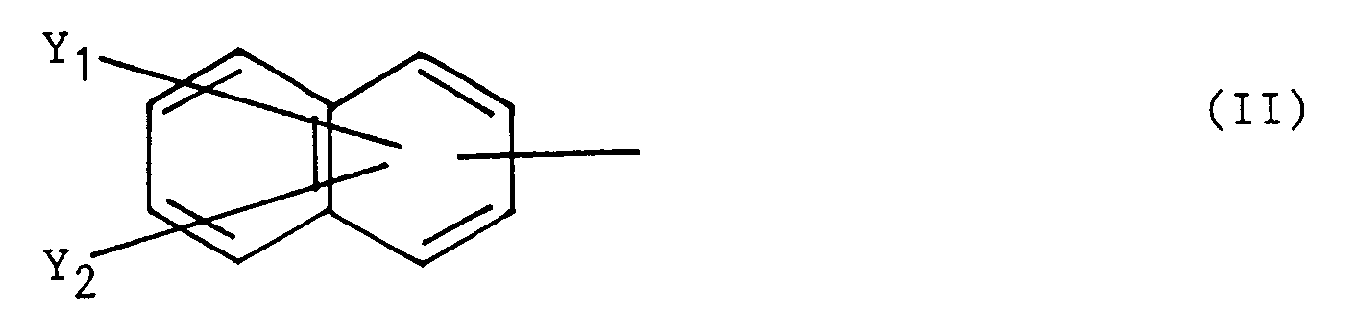
- Hierin bedeuten:
- Y₁
- Wasserstoff oder -OY₃, bevorzugt -OY₃,
- Y₂
- H, Cl, Br, einen niederen Alkyl-, Alkenyl-, Aryl-, oder einen ggf. substituierten (C₁-C₄)-Alkoxyrest, besonders bevorzugt Wasserstoff, einen (C₁-C₃)-Alkyl- oder (C₁-C₃)-Alkoxyrest und
- Y₃
- einen (C₁-C₈)-Alkylrest, der durch Halogen, vorzugsweise Chlor oder Brom, Aryl- oder Aryloxyreste substituiert sein kann und in dem einzelne Methylengruppen durch O- oder S-Brücken ersetzt sein können, einen Cycloalkyl-, Alkenyl-
oder
Arylrest, insbesondere einen (C₁-C₄)-Alkyl-
oder
Alkoxyalkylrest
oder
Y₁ und Y₂ bedeuten gemeinsam einen Alkylenrest, der vorzugsweise mit dem Naphthalinkern unter Ausbildung eines 5- oder 6-gliedrigen Rings verknüpft ist. - Bevorzugt werden auch Verbindungen, in denen der s-Triazinylrest und ein Alkoxyrest in 1,4- oder 2,6-Stellung des Naphthalinkerns angeordnet sind.
- Da durch die Kohlenstoffzahl der Alkoxygruppen die photochemische Aktivität der Initiatoren nur unwesentlich beeinflußt wird, ist die Beschränkung auf acht C-Atome in -OY₃ nicht als starre Grenze zu betrachten, sondern kann ggf. durchbrochen werden, beispielsweise mit Nonyloxy-, Dodecyloxy- oder Octadecyloxyresten.
- Im einzelnen kann Y folgende Naphthyl-Reste umfassen:
Naphth-1-yl-, Naphth-2-yl-, 2-Methoxynaphth-1-yl, 4-Methoxynaphth-1-yl-, 5-Methoxynaphth-1-yl-, 4-Ethoxynaphth-1-yl-, 4-Butoxynaphth-1-yl-, 1-Methoxynaphth-2-yl-, 3-Methoxynaphth-2-yl-, 6-Methoxynaphth-2-yl-, 6-Ethoxynaphth-2-yl-, 4,5-Dimethoxynaphth-1-yl-, 4,7-Dimethoxynaphth-1-yl-, 4-(2-Methoxyethyl)-naphth-1-yl-, 4-(2-Ethoxyethyl)-naphth-1-yl, 4-(2-Butoxyethyl)-naphth-1-yl-, 5-Methyl-6-methoxynaphth-2-yl- und 4-(2-Ethoxy)-ethoxynaphth-1-yl-. - Ebenso besonders bevorzugt sind Verbindungen, in denen Y₁ und Y₂ gemeinsam einen Alkylenrest bilden, der vorzugsweise mit dem Naphthalinkern unter Ausbildung eines 5- oder 6-gliedrigen Ringes verknüpft ist. Insbesondere ist in diesem Zusammenhang Acenaphth-5-yl- zu nennen.
- Andere bevorzugte mehrkernige Reste für Y sind:
4-Methoxy-anthrac-1-yl-, Phenanthr-9-yl-, Benzopyran-3-yl-, Chinol-3-yl- sowie Dibenzothien-3-yl. - Die Verbindungen, die unter die allgemeine Formel I fallen, sind an sich bekannt und in den US-A-3,779,778 (= DE-A-23 06 248); 3,954,475 (= DE-A-22 43 621) und 4,239,850 sowie den DE-A-27 18 259; 29 34 758 und 33 37 024 beschrieben.
- Vorzugsweise werden solche Aryl- bzw. Hetaryl-bis-trihalogenmethyl-s-triazine eingesetzt, die ihr Absorptionsmaximum im Bereich von 300 bis 500 nm besitzen.
- Es können auch Gemische aus mehreren, insbesondere aus 2 oder 3 Aryl- bzw. Hetaryl-bis-trihalogenmethyl-s-triazinen in dem erfindungsgemäßen Verfahren verwendet werden.
- Als Lösemittel für die beschriebenen Triazin-Derivate können fast alle organischen Lösemittel verwendet werden. Beispiele sind aliphatische und aromatische Kohlenwasserstoffe, Halogenkohlenwasserstoffe, Ether, Ester, Ketone, Alkohole, Dimethylformamid usw. Auch Gemische von zwei oder mehreren Lösemitteln können eingesetzt werden. Vorzugsweise verwendet man gut lösende, leicht flüchtige physiologisch wenig bedenkliche Lösemittel wie zum Beispiel Toluol, Tetrahydrofuran, Ethylacetat, Methylethylketon usw.
- Die Konzentration der Triazin-Derivate in den Lösemitteln kann in weiten Grenzen schwanken und von 0,1 Gew.-% bis zum Sättigungswert reichen. Besonders bevorzugt sind Lösungen mit Konzentrationen von 2 bis 15 Gew.-%, insbesondere von 2 bis 7 Gew.-%
- Die erfindungsgemäß verwendeten Behandlungslösungen können zusätzlich noch kleinere Mengen löslicher Bindemittel sowie auch lösliche Farbstoffe enthalten. Als Bindemittel eignen sich nichtklebrige Polymere wie zum Beispiel Vinylidenchlorid-Copolymerisate, Cyclokautschuke, Polycarbonate, Polyacrylate, Polystyrole, Polyamide usw.
- Auf einen Teil Aryl- bzw. Hetaryl-bis-trihalogenmethyl-s-triazin können 0,01 bis 1 Teil, vorzugsweise 0,05 bis 0,5 Teile Bindemittel eingesetzt werden. Bei höherem Bindemittelgehalt resultieren nichtklebrige Überzüge auf den Druckformen, die sich mit Lösemitteln leicht wieder entfernen lassen.
- Durch den Zusatz von Bindemitteln kann die Konzentration an Aryl- bzw. Hetaryl-bis-trihalogen-methyl-s-triazin herabgesetzt werden, da die verwendeten Polymere selbst einen Beitrag zur Beseitigung der Klebrigkeit leisten. Im allgemeinen können bis 50 % des Triazin-Derivates durch Bindemittel ersetzt werden, ohne die vorteilhaften Eigenschaften des erfindungsgemäßen Verfahrens in Frage zu stellen. Durch Ersatz eines Teils der Triazin-Derivate durch Bindemittel wird die Behandlungslösung sogar in vorteilhafter Weise kostengünstiger.
- Die lichthärtbare Schicht kann als lichthärtbare Verbindung ein Polymeres enthalten, das bei Belichtung selbst oder durch einen lichtempfindlichen Vernetzer zum unlöslichen Zustand vernetzt wird. Sie ist vorzugsweise eine photopolymerisierbare Schicht, die neben dem elastomeren Bindemittel eine ethylenisch ungesättigte radikalisch polymerisierbare Verbindung und einen Photoinitiator enthält, der bei Belichtung freie Radikale bildet. Derartige Gemische sind bekannt und z. B. in den eingangs genannten Druckschriften beschrieben.
- Als Elastomere können alle möglichen natürlichen und synthetischen Kautschuktypen eingesetzt werden. Vorzugsweise verwendet man Blockcopolymerisate aus Vinylverbindungen, z. B. Styrol, und Dienen, wie Butadien oder Isopren.
- Als polymerisierbare, ethylenisch ungesättigte Monomere verwendet man meist Acryl- oder Methacrylsäureester von mehrwertigen Alkoholen, z. B. Hexandiol-1,6-diacrylat und Hexandiol-1,6-dimethacrylat. Aber auch andere Ester der Acryl- und Methacrylsäure mit ein- oder mehrwertigen Alkoholen können in der Schicht enthalten sein.
- Darüber hinaus kann man auch andere ungesättigte Monomere einsetzen, z. B. Vinylester aliphatischer Monocarbonsäuren oder Maleinsäure- und Fumarsäureester usw.
- Auf einen Teil elastomeres Bindemittel verwendet man 0,05 bis 0,3 Teile ethylenisch ungesättigtes Monomeres.
- Als Photoinitiatoren in dem Gemisch können eine Vielzahl von Substanzen Verwendung finden. Beispiele sind solche, die sich vom Grundkörper der Benzophenone, Benzoine, Benzile, Benzilmonoketale, des Fluorenons, Thioxanthons, der Mehrkernchinone, Acridine und Chinoxaline ableiten; ferner Trichlormethyl-s-triazine, Trihalogenmethylgruppen enthaltende Carbonylmethylenheterocyclen gemäß DE-A 33 33 450 oder Acylphosphinoxidverbindungen, wie sie z. B. in der DE-A 31 33 419 beschrieben sind.
- Die Initiatoren werden allgemein in einer Menge von 0,01 bis 10, vorzugsweise von 0,05 bis 5 Gew.-%, bezogen auf die nichtflüchtigen Bestandteile der Schicht, eingesetzt.
- Die photopolymerisierbare Schicht kann außerdem noch Zusatzstoffe enthalten, die die Lagerfähigkeit, das Kopierverhalten und andere Eigenschaften verbessern. Übliche Zusatzstoffe sind z. B. thermische Polymerisationsinhibitoren, Farbstoffe, Antioxidantien, Antiozonantien, Weichmacher und Füllstoffe.
- Die photopolymerisierbare Schicht kann einheitlich sein oder aus mehreren übereinanderliegenden Schichten verschiedener Zusammensetzung bestehen. Beispielsweise kann man zweilagige photopolymerisierbare Schichten verwenden, bei denen die dem Schichtträger abgewandte Lage nach der Polymerisation eine höhere Härte aufweist als die dem Träger zugewandte Lage. Die gesamte photopolymerisierbare Schicht hat im allgemeinen eine Dicke von 0,05 bis 7, vorzugsweise 0,2 bis 5 mm.
- Über der photopolymerisierbaren Schicht können sich in bekannter Weise noch eine dünne, nicht klebende, im Entwickler lösliche Polymerschicht, z. B. aus löslichen Polyamiden, und eine dickere, abziehbare Schutzfolie befinden. Die Polymerschicht hat im allgemeinen eine Dicke von 1 bis 20 »m, die Schutzfolie eine von etwa 50 bis 200 »m.
- Als dimensionsstabile Trägerfolien für die Photopolymerschicht verwendet man bevorzugt 50 bis 300 »m dicke transparente Kunststoffolien, z. B. aus Polyestern, Polycarbonaten, Polyimiden oder dgl. Besonders bevorzugt werden Polyethylenterephthalatfolien. Falls der Träger zwischen einer Photopolymerschicht und einer gummielastischen Basisplatte angeordnet werden soll, kann die Dicke auch geringer sein, z. B. bis herab zu 10 »m. Auf der Oberfläche der Polyethylenterephthalatfolie befindet sich in der Regel eine Klebestoff- oder Haftvermittler-Schicht.
- Die Herstellung der gummielastischen 0,5-7 mm dicken photopolymerisierbaren Schicht kann in bekannter Weise durch Eindampfen einer Lösung der Komponenten, durch Verpressen einer homogenen Knetmasse zwischen parallelen Platten oder durch Extrudieren durch eine Breitschlitzdüse und nachfolgendes Kalandrieren der Bahn erfolgen. Bei Herstellung nach der letztgenannten Methode ist es von Vorteil, die Schicht im heißen Zustand schon im Kalander mit der haftvermittelten Trägerfolie und der Schutzfolie zu vereinigen.
- Soll auf die Rückseite der Trägerfolie eine nicht lichtempfindliche Weichgummi- oder elastische Schaumstoff-Platte aufgebracht werden, dann muß die Trägerfolie beidseitig mit der Haftschicht versehen werden. Das Aufbringen der rückseitigen Haftschicht kann vor, während oder nach dem Verbinden mit der photopolymerisierbaren Schicht geschehen. Falls die Herstellung des Verbunds nicht in einem Arbeitsgang erfolgt, muß die freiliegende Haftschicht beim Laminiervorgang mit einer leicht abziehbaren Folie geschützt werden, damit die Walzen des Laminators nicht verschmutzt werden.
- Die Verarbeitung des mehrschichtigen Flexodruckplattenmaterials zu gebrauchsfertigen Druckformen geschieht in bekannter Weise. Zunächst erzeugt man einen Druckplattensockel durch gleichmäßige Belichtung des Elementes durch die Trägerfolie hindurch. Danach belichtet man die Gegenseite - nach Abziehen der Schutzfolie - durch eine Negativ-Filmvorlage. Anschließend wäscht man die unbelichteten, nicht gehärteten Partien mit einem geeigneten Entwickler, z. B. einem Gemisch aus Perchlorethylen und n-Butanol, aus.
- Die in dieser Weise hergestellten klebrigen elastomeren Druckformen werden zur Vervollständigung der Vernetzungsreaktion zunächst in bekannter Weise nachbelichtet - zum Beispiel 10 Minuten lang in einem 320 W Röhrenbelichtungsgerät, wie es üblicherweise zur Herstellung der Druckformen verwendet wird - und anschließend zur Beseitigung der Klebrigkeit der erfindungsgemäßen Behandlung unterzogen. Die Nachbelichtung muß vor der Nachbehandlung erfolgen, weil das bei der erfindungsgemäßen Nachbehandlung auf der Druckform befindliche Aryl- bzw. Hetarylbis-trihalogen-methyl-s-triazin das für die Weitervernetzung notwendige aktinische Licht in entscheidendem Ausmaß absorbieren würde.
- Die erfindungsgemäße Behandlung der nachbelichteten, noch klebrigen Druckform kann auf verschiedene Weise erfolgen. Man kann die Aryl- bzw. Hetaryl-bis-trihalogenmethyl-s-triazin-Lösungen auf die Druckform aufspritzen, aufstreichen oder mit geeigneten weichen, saugfähigen Walzen aufrollen. Man kann die Druckformen aber auch in den Lösungen baden. Die Behandlungsdauer kann 1 Sekunde bis viele Minuten betragen. Sie ist umso kürzer, je konzentrierter die verwendeten Lösungen sind. In der Regel reicht ein Eintauchen für ca. 10 Sekunden bei ca. 5 Gew.-%igen Lösungen aus.
- Nach der Behandlung mit den Lösungen werden die Druckformen getrocknet. Bei Verwendung leicht flüchtiger Lösemittel kann dies durch kurzzeitiges Liegenlassen an der Luft erfolgen. Man kann aber auch die Druckformen mit warmer Luft oder in einem Wärmeschrank trocknen. Dabei muß darauf geachtet werden, daß nicht die Zersetzungstemperaturen der Aryl-bis-trihalogenmethyl-s-triazine erreicht werden. Temperaturen von unter 120° C werden bevorzugt.
- Die mit einer Aryl- bzw. Hetaryl-bis-trihalogenmethyl-s-triazin-Lösung behandelten Druckformen besitzen auch nach Verdunsten des Lösungsmittels vielfach noch deutliche Klebrigkeit. Vollständig klebefrei werden sie erst, wenn mit langwelligem UV-Licht kurzzeitig nachbelichtet wird. Alle Lichtquellen, die Licht dieser Art aussenden, können verwendet werden. Genannt werden zum Beispiel Röhrengeräte, Quecksilberlampen und Metallhalogenidlampen. Diese Lampen haben im üblich verwendeten Abstand eine Leistung von ca. 1 bis 5 mW/cm². Bei Verwendung dieser Lampen mit Lichtenergien von 350 bis 500 mJ/cm² sind Nachbelichtungszeiten von 2 bis 5 min erforderlich.
- Die zur Nachbelichtung der behandelten Druckformen benötigte Lichtmenge beträgt nur etwa 10 % der zur Reliefausbildung benötigten Lichtmenge.
- Der Chemismus der Reaktion, die zur Beseitigung der Klebrigkeit führt, ist noch nicht geklärt. Die Oberfläche der Druckform erfährt bei der Behandlung eine bleibende Veränderung. Nachträgliches Abwischen mit Lösemitteln führt nicht zum klebrigen Zustand zurück.
- Die folgenden Beispiele beschreiben bevorzugte Ausführungsformen der Erfindung. Alle Prozente und Mengenverhältnisse sind, wenn nichts anderes angegeben ist, in Gewichtseinheiten zu verstehen. Gewichtsteile (Gt) und Volumteile (Vt) stehen im Verhältnis von g zu ccm.
- Fünf verschiedene handelsübliche Flexodruckplatten wurden in bekannter Weise entsprechend den Angaben in der Beschreibung bildmäßig belichtet und anschließend die unbelichteten, nicht gehärteten Partien mit einem jeweils geeigneten handelsüblichen Entwickler ausgewaschen. Anschließend wurde 10 min lang mit einem 320 W Röhrenbelichtungsgerät nachbelichtet. Die noch klebrigen Druckformen wurden dann in erfindungsgemäßer Weise mit einer 6 Gew.-%igen Lösung von 2-Stilbenyl-4,6-bis-trichlormethyl-s-triazin in Toluol für 10 s behandelt, d.h. in eine solche Lösung getaucht, kurzzeitig getrocknet und anschließend nochmals, allerdings für 2 min, mit dem beschriebenen Röhrenbelichtungsgerät nachbelichtet.
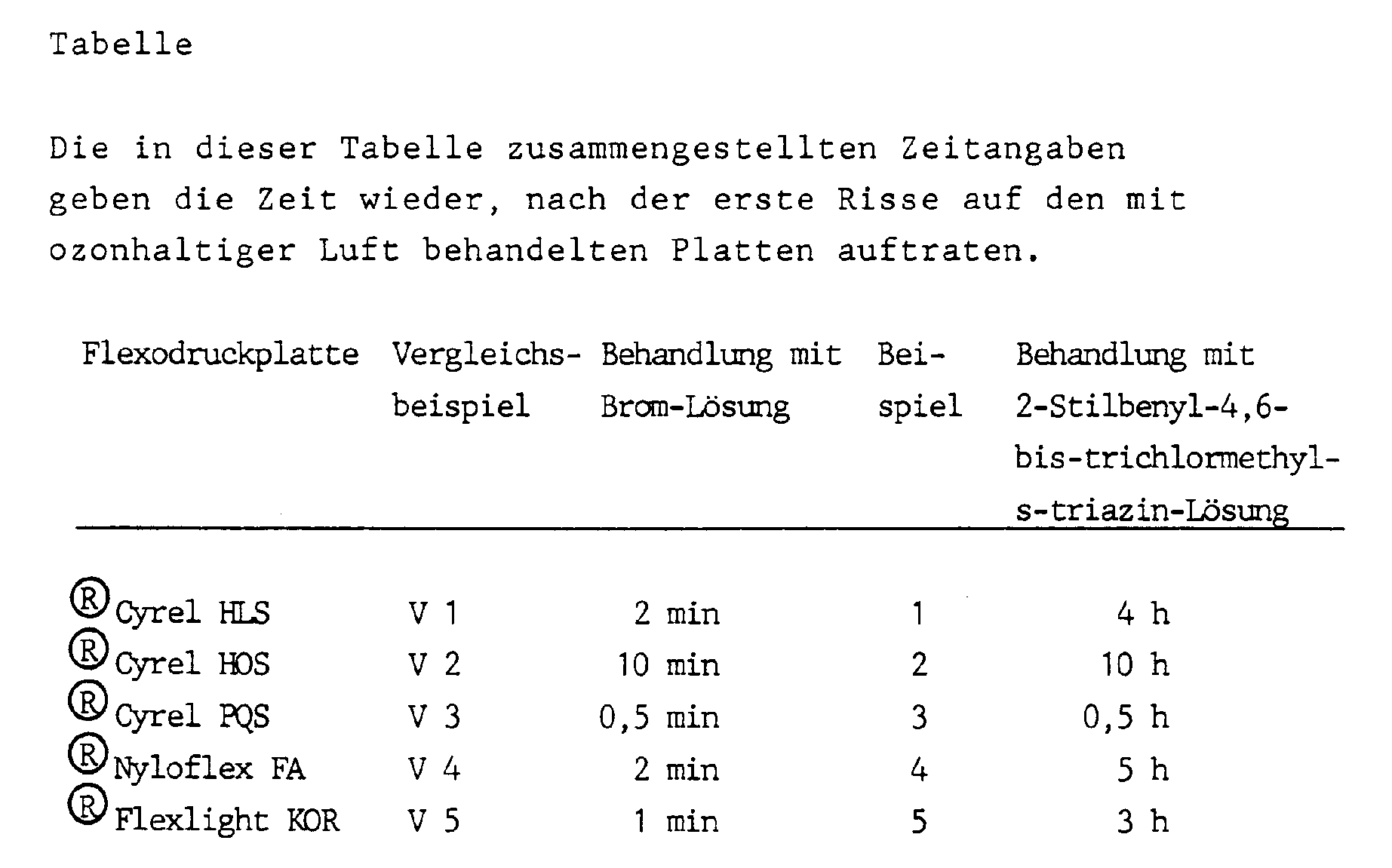
- Die Platten wiesen keine Oberflächenklebrigkeit auf. Außerdem zeigten sie eine relativ hohe Resistenz gegenüber Ozon. Um dies zu testen, wurden die Druckplatten in einem Kasten bei Raumtemperatur der Luft eines Ozongehaltes von 0,4 ppm ausgesetzt.
- Eine Zusammenfassung der Ergebnisse ist in der Tabelle zu finden.
- Die in den Beispielen 1 bis 5 verwendeten handelsüblichen Flexodruckplatten wurden, wie in den Beispielen 1 bis 5 beschrieben belichtet und entwickelt. Anschließend wurden die Druckformen in bekannter Weise für 5 min in 0,4 Gew.-%ige wäßrige Bromlösung getaucht, 10 min lang mit Wasser gespült und abschließend für 10 min mit einem 320 W Röhrenbelichtungsgerät nachbelichtet.
- Auch diese Platten wiesen keine Oberflächenklebrigkeit auf. Allerdings zeigten sie, wenn sie, wie in den Beispielen 1 bis 5 angegeben wurde, mit ozonhaltiger Luft behandelt wurden, eine weitaus geringere Resistenz gegenüber Ozon als dies bei den erfindungsgemäß hergestellten Platten anzutreffen war.
- Eine Zusammenfassung der Ergebnisse zeigt Tabelle I:
- Die handelsübliche Flexodruckplatte® Cyrel HLS (DuPont) wurde, wie in den Beispielen 1 bis 5 angegeben, zu einer Flexodruckform verarbeitet. Die Nachbelichtungszeit betrug 10 min. Daraufhin wurde die Druckform für 20 s mit einer Lösung aus 4 Gew.-% 2-Stilbenyl-4,6-bis-trichlormethyl-s-triazin und 1 Gew.-% Cyclokautschuk in Toluol behandelt. Nachdem für 2 min mit einem 120 W Röhrenbelichtungsgerät nachbelichtet worden war, resultierte eine nicht-klebende Druckform mit ausgezeichneter Resistenz gegenüber ozonhaltiger Luft.
- Drei handelsübliche Flexodruckplatten vom Typ® Cyrel HLS wurden entsprechend den Beispielen 1 bis 5 belichtet, entwickelt und nachbelichtet. Anschließend wurden die Platten jeweils mit einem der folgenden Aryl-bis-trichlormethyl-s-triazine, jeweils als 5 Gew.-%ige Lösung in Toluol, für 15 s behandelt.
-
- 7
- 2-Stilbenyl-4,6-bis-trichlormethyl-s-triazin
- 8
- 2-(4-Ethoxy)naphth-1-yl-4,6-bis-trichlormethyl-s-triazin
- 9
- 2-Acenaphth-5-yl-4,6-bis-trichlormethyl-s-triazin
- Die Druckformen wurden getrocknet und 3 min in einem 120 W Röhrenbelichtungsgerät nachbelichtet.
- In allen Fällen konnten nicht klebende und gegen ozonhaltige Luft resistente Druckformen erhalten werden. Auch Gemische dieser Triazin-Derivate lieferten gute Ergebnisse. Das Mischungsverhältnis kann in breiten Grenzen variiert werden, jeweils nach den Erfordernissen der speziell eingesetzten handelsüblichen Flexodruckplatte.
- Die handelsüblichen Flexodruckplatten vom Typ® Cyrel HLS wurden entsprechend den Angaben in den Beispielen 1 bis 5 belichtet, entwickelt und nachbelichtet. Anschließend wurden die Druckformen mit einer 6 Gew.-%igen Lösung von 2-Stilbenyl-4,6-bis-trichlormethyl-s-triazin in Toluol behandelt.
- In Abhängigkeit vom jeweils verwendeten Belichtungsgerät waren folgende Belichtungszeiten bzw. Lichtenergien notwendig, um nicht klebende und gegen ozonhaltige Luft hervorragend beständige Druckformen zu erzielen.

Claims (7)
- Verfahren zur Nachbehandlung von entwickelten Reliefdruckformen für den Flexodruck, die in bekannter Weise nachbelichtet werden, dadurch gekennzeichnet, daß die Reliefdruckformen mit einer Lösung im wesentlichen bestehend aus einem organischen Lösemittel und einem gelösten Aryl- bzw. Hetaryl-bis-trihalogenmethyl-s-triazin der allgemeinen Formel I behandelt werden,
 Y einen ggf. substituierten aromatischen oder heterocyclischen aromatischen, ggf. über eine konjugierte Alkenylenkette, insbesondere (C₂-C₆)Alkenylen, gebundenen Rest oder einen ggf. partiell hydrierten Rest, der über ein ungesättigtes Ring-C-Atom gebunden ist und wiederum ggf. substituiert sein kann, insbesondere durch Aryl oder Ar(C₂-C₆)alkenylen, undK ein Chlor-, Brom oder Jodatom, vorzugsweise ein Chloratom,bedeuten.
 - Verfahren nach Anspruch 1, dadurch gekennzeichnet, daß die Aryl- bzw. Hetaryl-bis-trihalogenmethyl-s-triazinverbindung im Lösemittel in einer Konzentration von 0,1 Gew.-% bis zum Sättigungswert, insbesondere von 2 bis 15 Gew.-%, enthalten ist.
- Verfahren nach den Ansprüchen 1 oder 2, dadurch gekennzeichnet, daß Gemische von verschiedenen, insbesondere von 2 oder 3 Aryl- bzw. Hetaryl-bis-trihalogenmethyl-s-triazinen verwendet werden.
- Verfahren nach einem oder mehreren der Ansprüche 1 bis 3, dadurch gekennzeichnet, daß die Aryl- bzw. Hetaryl-bis-trihalogenmethyl-s-triazine ein Absorptionsmaximum im Bereich von 300 bis 500 nm besitzen.
- Verfahren nach einem oder mehreren der Ansprüche 1 bis 4, dadurch gekennzeichnet, daß die Nachbehandlungslösung zusätzlich ein Bindemittel enthält.
- Verfahren nach Anspruch 5, dadurch gekennzeichnet, daß das Bindemittel ein nichtklebriges Polymeres ist, das zu 0,01 bis 1 Teil, insbesondere 0,05 bis 0,5 Teile auf ein Teil Aryl- bzw. Hetaryl-bis-trihalogenmethyl-s-triazin in der Nachbehandlungslösung enthalten ist.
- Verfahren nach einem oder mehreren der Ansprüche 1 bis 6, dadurch gekennzeichnet, daß als Lösemittel aliphatische oder aromatische Kohlenwasserstoffe, Halogenkohlenwasserstoffe, Ether, Ester, Ketone und Alkohole verwendet werden.
Applications Claiming Priority (2)
| Application Number | Priority Date | Filing Date | Title |
|---|---|---|---|
| DE3742275 | 1987-12-12 | ||
| DE19873742275 DE3742275A1 (de) | 1987-12-12 | 1987-12-12 | Verfahren zur nachbehandlung von entwickelten reliefdruckformen fuer den flexodruck |
Publications (3)
| Publication Number | Publication Date |
|---|---|
| EP0320742A2 EP0320742A2 (de) | 1989-06-21 |
| EP0320742A3 EP0320742A3 (de) | 1991-04-17 |
| EP0320742B1 true EP0320742B1 (de) | 1995-04-05 |
Family
ID=6342535
Family Applications (1)
| Application Number | Title | Priority Date | Filing Date |
|---|---|---|---|
| EP88120308A Expired - Lifetime EP0320742B1 (de) | 1987-12-12 | 1988-12-06 | Verfahren zur Nachbehandlung von entwickelten Reliefdruckformen für den Flexodruck |
Country Status (4)
| Country | Link |
|---|---|
| US (1) | US4906551A (de) |
| EP (1) | EP0320742B1 (de) |
| JP (1) | JP2825513B2 (de) |
| DE (2) | DE3742275A1 (de) |
Families Citing this family (9)
| Publication number | Priority date | Publication date | Assignee | Title |
|---|---|---|---|---|
| DE3904780A1 (de) * | 1989-02-17 | 1990-08-23 | Basf Ag | Verfahren zur herstellung von photopolymerisierten reliefdruckplatten mit klebfreier oberflaeche |
| US5085976A (en) * | 1990-06-11 | 1992-02-04 | E. I. Du Pont De Nemours And Company | Process for dimensionally stabilizing photopolymer flexographic printing plates |
| US5147890A (en) * | 1991-12-16 | 1992-09-15 | Betz Laboratories, Inc. | Biocidal compositions and use thereof containing a synergistic mixture of 3-iodo-2-propynyl-butyl carbamate and N,N-dimethyl-N'-phenyl-(N'-fluorodichloromethylthio) sulfamide |
| US5147891A (en) * | 1991-12-16 | 1992-09-15 | Betz Laboratories, Inc. | Biocidal compositions and use thereof containing a synergistic mixture of 3-iodo-2-propynyl-butyl carbamate and phenyl-(2-cyano-2-chlorovinyl) sulfone |
| US5260166A (en) * | 1992-03-04 | 1993-11-09 | Graphic Controls Corporation | Seamless, trilaminate, photopolymer cylindrical printing plate and method of manufacture |
| US5364740A (en) * | 1992-12-30 | 1994-11-15 | Minnesota Mining And Manufacturing Company | Bleaching of dyes in photosensitive systems |
| US6742453B1 (en) | 1998-07-30 | 2004-06-01 | Mark Alan Borski | Printing sleeves and methods for producing same |
| US20030118939A1 (en) * | 2001-11-09 | 2003-06-26 | Kodak Polychrome Graphics, L.L.C. | High speed negative working thermal printing plates |
| US7056639B2 (en) * | 2001-08-21 | 2006-06-06 | Eastman Kodak Company | Imageable composition containing an infrared absorber with counter anion derived from a non-volatile acid |
Family Cites Families (23)
| Publication number | Priority date | Publication date | Assignee | Title |
|---|---|---|---|---|
| GB574244A (en) * | 1958-07-25 | 1945-12-28 | Sparklets Ltd | Improvements in or relating to means for producing a spray of atomised liquid |
| US3723120A (en) * | 1971-08-30 | 1973-03-27 | Du Pont | Process for hardening photohardenable images |
| DE2444118C2 (de) * | 1974-09-14 | 1987-02-12 | Basf Ag, 6700 Ludwigshafen | Mehrschichtige Druckplatte sowie mehrschichtige Reliefdruckform für den Flexodruck |
| DE2718259C2 (de) * | 1977-04-25 | 1982-11-25 | Hoechst Ag, 6000 Frankfurt | Strahlungsempfindliches Gemisch |
| US4189323A (en) * | 1977-04-25 | 1980-02-19 | Hoechst Aktiengesellschaft | Radiation-sensitive copying composition |
| JPS53143669A (en) * | 1977-05-23 | 1978-12-14 | Asahi Chem Ind Co Ltd | Elimination of surface tuckiness of radically-polymerizable resin cured product |
| DE2823300C2 (de) * | 1978-05-29 | 1986-02-20 | Basf Ag, 6700 Ludwigshafen | Verfahren zur Herstellung von klebfreien Oberflächen von photopolymeren Reliefdruckformen |
| US4292150A (en) * | 1979-06-26 | 1981-09-29 | Uniroyal, Inc. | Iodine treated elastomeric article |
| DE3100175A1 (de) * | 1981-01-07 | 1982-08-05 | Basf Ag, 6700 Ludwigshafen | Zur herstellung von druck- und reliefformen geeignete mehrschichten-elemente |
| JPS57119366A (en) * | 1981-01-16 | 1982-07-24 | Ricoh Co Ltd | Developing method |
| US4400460A (en) * | 1981-05-07 | 1983-08-23 | E. I. Du Pont De Nemours And Compamy | Process for surface treatment of flexographic printing plates containing butadiene/acrylonitrile copolymers |
| DE3137416A1 (de) * | 1981-09-19 | 1983-03-31 | Basf Ag, 6700 Ludwigshafen | Fotopolymerisierbare gemische und elemente daraus |
| GB2122762B (en) * | 1982-06-02 | 1986-01-08 | Grace W R & Co | Flexographic printing plates methods of their production and laminates for use in their production |
| US4451553A (en) * | 1982-06-10 | 1984-05-29 | E. I. Du Pont De Nemours And Company | Halogen finishing of flexographic printing plates containing butadiene/acrylonitrile copolymers |
| US4452879A (en) * | 1983-09-13 | 1984-06-05 | E. I. Du Pont De Nemours And Company | Preparation of ozone resistant printing plates |
| DE3337024A1 (de) * | 1983-10-12 | 1985-04-25 | Hoechst Ag, 6230 Frankfurt | Lichtempfindliche, trichlormethylgruppen aufweisende verbindungen, verfahren zu ihrer herstellung und diese verbindungen enthaltendes lichtempfindliches gemisch |
| FR2554447B1 (fr) * | 1983-11-08 | 1987-02-13 | Hoechst France | Procede de fabrication d'urees cycliques de structure imidazolidinique et son application notamment dans la fabrication d'apprets textiles |
| US4680251A (en) * | 1984-04-21 | 1987-07-14 | E. I. Du Pont De Nemours And Company | Process for the ozone protection of photopolymer flexographic printing plates by treatment with liquid polyethers |
| US4603058A (en) * | 1984-10-05 | 1986-07-29 | Macdermid, Incorporated | Post-treatment of cured, radiation sensitive, polymerizable resins to eliminate surface tack |
| DE3521955A1 (de) * | 1985-06-20 | 1987-01-02 | Basf Ag | Verfahren zur herstellung von klebfreien, glatten oberflaechen von photopolymerisierten reliefdruckformen fuer den flexodruck |
| JPH0652425B2 (ja) * | 1986-01-30 | 1994-07-06 | 富士写真フイルム株式会社 | 感光性組成物 |
| JPS62187848A (ja) * | 1986-02-10 | 1987-08-17 | Fuotopori Ouka Kk | 感光性樹脂表面の粘着防止方法 |
| DE3625264A1 (de) * | 1986-07-25 | 1988-02-04 | Basf Ag | Verfahren zur nachbehandlung der oberflaeche von durch photopolymerisation vernetzten reliefformen |
-
1987
- 1987-12-12 DE DE19873742275 patent/DE3742275A1/de not_active Withdrawn
-
1988
- 1988-12-06 EP EP88120308A patent/EP0320742B1/de not_active Expired - Lifetime
- 1988-12-06 US US07/280,426 patent/US4906551A/en not_active Expired - Fee Related
- 1988-12-06 DE DE3853517T patent/DE3853517D1/de not_active Expired - Fee Related
- 1988-12-12 JP JP63312149A patent/JP2825513B2/ja not_active Expired - Fee Related
Also Published As
| Publication number | Publication date |
|---|---|
| JPH02979A (ja) | 1990-01-05 |
| EP0320742A3 (de) | 1991-04-17 |
| US4906551A (en) | 1990-03-06 |
| EP0320742A2 (de) | 1989-06-21 |
| DE3853517D1 (de) | 1995-05-11 |
| DE3742275A1 (de) | 1989-06-22 |
| JP2825513B2 (ja) | 1998-11-18 |
Similar Documents
| Publication | Publication Date | Title |
|---|---|---|
| EP0028749B1 (de) | Photopolymerisierbares Gemisch und damit hergestelltes photopolymerisierbares Kopiermaterial | |
| DE2939989C2 (de) | Lichtempfindliches Gemisch und flexographische Druckplatte | |
| DE69630902T2 (de) | Lichtempfindliche Schicht | |
| DE2823300C2 (de) | Verfahren zur Herstellung von klebfreien Oberflächen von photopolymeren Reliefdruckformen | |
| DE2821500A1 (de) | Verfahren zum entfernen der oberflaechenklebrigkeit von einer gehaerteten, radikalisch polymerisierten harzmasse | |
| DE69127148T2 (de) | Lichtempfindliches elastomeres Element mit verbesserter Lösungsmittelbeständigkeit | |
| EP0320742B1 (de) | Verfahren zur Nachbehandlung von entwickelten Reliefdruckformen für den Flexodruck | |
| DE3814567C2 (de) | ||
| DE2615055C3 (de) | Lichtempfindliches Gemisch | |
| DE3043911C2 (de) | Elastomeres Gemisch und dessen Verwendung zur Herstellung von flexiblen Photopolymer-Druckplatten | |
| EP0002805B1 (de) | Photopolymerisierbare Überzugs- und Aufzeichnungsmaterialien, wie Photolackübertragungsfolien und Photoresistmaterialien, enthaltend einen Photoinitiator und eine organische Halogenverbindung | |
| DE3704067A1 (de) | Verfahren zum nicht-klebrigmachen der oberflaeche einer harzplatte | |
| EP0103218B1 (de) | 10-Phenyl-1,3,9-triazaanthracene und diese enthaltendes photopolymerisierbares Gemisch | |
| DE4022980C1 (de) | ||
| EP0365988B1 (de) | Entwicklungslösemittel für durch Photopolymerisation vernetzbare Schichten sowie Verfahren zur Herstellung von Reliefformen | |
| EP0365989A2 (de) | Entwicklungslösemittel für durch Photopolymerisation vernetzbare Schichten sowie Verfahren zur Herstellung von Reliefformen | |
| DD159226A5 (de) | Fotoresistelement | |
| EP0373474B1 (de) | Verfahren zur Herstellung einer ozonresistenten Flexodruckform | |
| DE19628541A1 (de) | Strahlungsempfindliche Zusammensetzung und ein diese enthaltendes strahlungsempfindliches Aufzeichnungsmaterial | |
| EP0681221B1 (de) | Lichtempfindliches Material und Verfahren zur Herstellung von Flachdruckplatten | |
| EP0355335A1 (de) | Lichtempfindliches Aufzeichnungsmaterial, dessen Verwendung und dafür geeignete neue Leukoverbindung | |
| EP0373473B1 (de) | Photopolymerisierbares elastomeres Gemisch und dieses enthaltendes Aufzeichnungsmaterial für die Herstellung von ozonresistenten Flexodruckformen | |
| EP0365987A2 (de) | Entwicklungslösemittel für durch Photopolymerisation vernetzbare Schichten sowie Verfahren zur Herstellung von Reliefformen | |
| EP0387578B1 (de) | Verfahren zur Herstellung einer Reliefdruckplatte mit klebfreier druckender Oberfläche | |
| EP0102586B1 (de) | 1,3-Diaza-9-thia-anthracen-2,4-dione und diese enthaltendes photopolymerisierbares Gemisch |
Legal Events
| Date | Code | Title | Description |
|---|---|---|---|
| PUAI | Public reference made under article 153(3) epc to a published international application that has entered the european phase |
Free format text: ORIGINAL CODE: 0009012 |
|
| AK | Designated contracting states |
Kind code of ref document: A2 Designated state(s): DE FR GB |
|
| 17P | Request for examination filed |
Effective date: 19901219 |
|
| PUAL | Search report despatched |
Free format text: ORIGINAL CODE: 0009013 |
|
| AK | Designated contracting states |
Kind code of ref document: A3 Designated state(s): DE FR GB |
|
| 17Q | First examination report despatched |
Effective date: 19931119 |
|
| RAP1 | Party data changed (applicant data changed or rights of an application transferred) |
Owner name: E.I. DU PONT DE NEMOURS AND COMPANY |
|
| GRAA | (expected) grant |
Free format text: ORIGINAL CODE: 0009210 |
|
| AK | Designated contracting states |
Kind code of ref document: B1 Designated state(s): DE FR GB |
|
| REF | Corresponds to: |
Ref document number: 3853517 Country of ref document: DE Date of ref document: 19950511 |
|
| ET | Fr: translation filed | ||
| GBT | Gb: translation of ep patent filed (gb section 77(6)(a)/1977) |
Effective date: 19950712 |
|
| PLBE | No opposition filed within time limit |
Free format text: ORIGINAL CODE: 0009261 |
|
| STAA | Information on the status of an ep patent application or granted ep patent |
Free format text: STATUS: NO OPPOSITION FILED WITHIN TIME LIMIT |
|
| 26N | No opposition filed | ||
| REG | Reference to a national code |
Ref country code: GB Ref legal event code: IF02 |
|
| PGFP | Annual fee paid to national office [announced via postgrant information from national office to epo] |
Ref country code: GB Payment date: 20041201 Year of fee payment: 17 |
|
| PGFP | Annual fee paid to national office [announced via postgrant information from national office to epo] |
Ref country code: DE Payment date: 20041202 Year of fee payment: 17 |
|
| PGFP | Annual fee paid to national office [announced via postgrant information from national office to epo] |
Ref country code: FR Payment date: 20041208 Year of fee payment: 17 |
|
| PG25 | Lapsed in a contracting state [announced via postgrant information from national office to epo] |
Ref country code: GB Free format text: LAPSE BECAUSE OF NON-PAYMENT OF DUE FEES Effective date: 20051206 |
|
| PG25 | Lapsed in a contracting state [announced via postgrant information from national office to epo] |
Ref country code: DE Free format text: LAPSE BECAUSE OF NON-PAYMENT OF DUE FEES Effective date: 20060701 |
|
| GBPC | Gb: european patent ceased through non-payment of renewal fee |
Effective date: 20051206 |
|
| PG25 | Lapsed in a contracting state [announced via postgrant information from national office to epo] |
Ref country code: FR Free format text: LAPSE BECAUSE OF NON-PAYMENT OF DUE FEES Effective date: 20060831 |
|
| REG | Reference to a national code |
Ref country code: FR Ref legal event code: ST Effective date: 20060831 |