EP0320828A2 - Verfahren zur Übertragung und Anzeige eines Standbildes in einem Standbild-Videotelefon - Google Patents
Verfahren zur Übertragung und Anzeige eines Standbildes in einem Standbild-Videotelefon Download PDFInfo
- Publication number
- EP0320828A2 EP0320828A2 EP88120672A EP88120672A EP0320828A2 EP 0320828 A2 EP0320828 A2 EP 0320828A2 EP 88120672 A EP88120672 A EP 88120672A EP 88120672 A EP88120672 A EP 88120672A EP 0320828 A2 EP0320828 A2 EP 0320828A2
- Authority
- EP
- European Patent Office
- Prior art keywords
- picture
- still picture
- information
- memory
- still
- Prior art date
- Legal status (The legal status is an assumption and is not a legal conclusion. Google has not performed a legal analysis and makes no representation as to the accuracy of the status listed.)
- Granted
Links
Images





Classifications
-
- H—ELECTRICITY
- H04—ELECTRIC COMMUNICATION TECHNIQUE
- H04N—PICTORIAL COMMUNICATION, e.g. TELEVISION
- H04N5/00—Details of television systems
- H04N5/76—Television signal recording
- H04N5/78—Television signal recording using magnetic recording
- H04N5/782—Television signal recording using magnetic recording on tape
- H04N5/783—Adaptations for reproducing at a rate different from the recording rate
-
- H—ELECTRICITY
- H04—ELECTRIC COMMUNICATION TECHNIQUE
- H04N—PICTORIAL COMMUNICATION, e.g. TELEVISION
- H04N7/00—Television systems
- H04N7/14—Systems for two-way working
- H04N7/141—Systems for two-way working between two video terminals, e.g. videophone
-
- H—ELECTRICITY
- H04—ELECTRIC COMMUNICATION TECHNIQUE
- H04N—PICTORIAL COMMUNICATION, e.g. TELEVISION
- H04N7/00—Television systems
- H04N7/12—Systems in which the television signal is transmitted via one channel or a plurality of parallel channels, the bandwidth of each channel being less than the bandwidth of the television signal
Definitions
- the present invention relates to apparatus for still picture video telephone and methods for transmitting and displaying still picture image for use therein.
- the still picture video telephone is a system capable, in the course of a telephone conversation with an ordinary voice signal, of temporarily stopping the conversation and transmitting, in the meantime, a desired still picture, such as the face of the speaker, photo, picture, and drawing relative to the contents of the conversation.
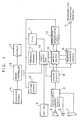
- FIG. 1 is a circuit configuration diagram of the simplified still picture video telephone apparatus disclosed therein.
- reference numeral 1 denotes a hand set
- 2 denotes a microphone
- 3 denotes a voice input/output circuit
- 4 denotes an analog circuit
- 5 denotes a matrix switch
- 6 denotes a telephone interface circuit
- 7 denotes a telephone line connection terminal
- 8 denotes a speaker
- 9 denotes a key pad
- 10 denotes an input/output port
- 11 denotes a CPU
- 12 denotes a program memory
- 13 denotes a modulator/demodulator circuit
- 14 denotes a television camera
- 15 denotes an image controller
- 16 denotes a picture memory
- 17 denotes a display.
- Speech by voice is delivered from the hand set 1 or microphone 2 through the voice input/output circuit 3, the analog circuit 4, the matrix switch 5, and the telephone interface circuit 6 to the telephone line connection terminal 7.
- the audio signal from the person on the other end of the line is passed through the above signal path in the opposite direction and reproduced by the hand set 1 or speaker 8.
- the transmitter side When transmitting a picture image signal in this case, the transmitter side sends a header including an ID code such as data on communicating capability to the receiver side for confirming that the set on the receiver side is a video telephone apparatus capable of communicating picture data in the same data format. After confirming that the other party has the same capability upon receipt of a header therefrom, the transmission of the picture data is carried out.
- an ID code such as data on communicating capability
- the CPU 11 detects this through the input/output port 10, and delivers a header in accordance with a program previously stored in the program memory 12 to the modulator/demodulator circuit 13. Therein, the header is converted into an analog signal and this signal is then transmitted through the matrix switch 5 from the telephone line connection terminal 7. The header from the other end is passed through the same path in the opposite direction and subjected to confirmation by the CPU 11 as to its code or the like.
- picture images picked up by the television camera 14 are quantized in the image controller 15 and stored in the picture memory 16, and then, led out to the display 17 to be displayed thereon in succession, and the stored picture data are read out from the picture memory 16 under the instruction of the CPU 11 and delivered to the telephone line connection terminal 7.
- the picture data has a header added thereto indicating the data length or the like.
- the matrix switch 5 based on a received carrier signal, switches, from the analog circuit 4 to the modulator/demodulator circuit 13, the delivering path of the incoming signal from the telephone interface circuit 6.
- the CPU 11 After the received signal is demodulated in the modulator/demodulator circuit 13, the CPU 11 sends back a header or stores the data in the picture memory 16.
- the image controller 15 leads out the picture data prepared in its own system and the picture data received from the system on the other end from the picture memory 16 in succession to be displayed on the display 17. Also to the front of ordinary picture data is attached a simple header including an indication that picture data will follow.
- the matrix switch 5 connects the telephone interface circuit 6 with the analog circuit 4 and thereby resumes the voice communication.
- the receiver side upon receipt of the header, prepares the arrangement for receiving the picture data in the same manner as described above.
- the picture memory 16 of the prior art is composed of a camera-taken picture memory portion which stores picture information input from its own television camera 14, rewriting it at intervals of a predetermined period (e.g., 1/30 second), and an incoming picture memory portion for storing picture information obtained by demodulating still picture information received from the system on the other end of the line during the telephone call, and the memory portions of the picture memory 16 each have storage capacity for one page of picture information.
- a predetermined period e.g. 1/30 second
- the transmitted and received picture image has only one resolution.
- the video telephone apparatus reads out the image data stored in the region for storing the received image data in the picture memory 16 and displays this data on the display 17.
- it writes the received picture data in the same region of the picture memory 16. More particularly, as shown in FIG. 4, the received picture data is overwritten in the region for storing the received picture data in the picture memory 16.
- FIG. 5(A) indicates the state on the display 17 before reception of new picture data
- FIG. 5(B) indicates the state in the course of the reception
- FIG. 5(C) indicates the state when the reception has been finished.
- the reading out of the picture data from the picture memory 16 has only been possible to be performed in the unit of a predetermined frame.
- the prior art video telephone apparatus is unable to make a normal display.
- the resolution of the earlier received picture data was 160 x 100 as shown in FIG. 6(B) and the resolution of the newly received picture data is 96 x 100 as shown in FIG. 6(A)
- the data array in the picture memory 16 becomes as shown in FIG. 6(B).
- a first object of the present invention is to provide a still picture video telephone apparatus capable of storing self-prepared picture image in advance and also storing a plurality of pages of picture images incoming from the system on the other end of the line.
- a second object of the present invention is to provide a method for transmitting still picture image capable of extracting, according to the need, only desired portion of the picture data stored in the picture memory, thereby achieving highly efficient short-time transmission.
- a third object of the present invention is to provide a method for display still picture image for use in a still picture video telephone apparatus whereby clear picture image displaying can be performed even if picture data of a different resolution is received.
- a fourth object of the present invention is to provide a method for transmitting still picture image whereby accurate display can be performed by the signal receiver side even if picture data of a different aspect ratio is received.
- the still picture video telephone apparatus comprises a picture memory for storing a plurality of pages of picture information consisting of a camera-taken picture memory portion which rewrites still picture information input therein delivered from the television camera at intervals of a predetermined period, a self-prepared picture memory portion which stores desired still picture information until arrival of a rewrite instruction, and an incoming picture memory portion which sequentially rewrites still picture information therein upon receipt of still picture information when its storage regions are filled up, an input means of memory region information for setting up regions for the self-prepared picture memory portion and the incoming picture memory portion within the picture memory, and picture memory control circuit for controlling still picture information input to and output from the picture memory based on the memory region information.
- the still picture video telephone apparatus is capable of storing a plurality of pages of still picture information and allocating memory regions to the self-provided picture memory portion and the incoming picture memory portion in various ways.
- the present still picture video telephone apparatus it is possible to store desired picture information in the self-prepared picture memory portion of the picture memory and retain the picture information stored in the self-prepared picture memory portion until an erase signal is input thereto through the picture memory control circuit.
- the storage regions allocated to the self-prepared picture memory portion and the incoming picture memory portion within the picture memory can be set up at will according to convenience of the user.
- the present invention is adapted such that, when it is desired to transmit only a portion of the picture data stored in the picture memory, that portion is transferred to and stored in another specific region within the picture memory, and the transferred and stored picture data is sequentially read out and transmitted to the system on the other end through the telephone line.
- the picture data taken in from the television camera is once written into the picture memory as a whole and then displayed on a display monitor.
- the transferred and stored picture data is sequentially read out to be displayed again on the display, and thereafter, the data is converted into a transmission signal to be transmitted through the telephone line.
- the method for displaying picture image for use in a still picture video telephone apparatus is adapted therein such that resolution of received still picture data is acknowledged according to data attached to the picture data, the received still picture data is sequentially stored in a special reception region, and during reception of the still picture data, the still picture data stored in the special reception region is displayed on a display in accordance with the recognized resolution of the still picture data, and further, the still picture data stored in the special reception region is transferred to the picture memory for use in displaying a picture image at the time of the normal operation, and after the end of the signal reception, the data stored in the special reception region is erased.
- the picture data is displayed on a display during the signal reception, in accordance with a predetermined resolution.
- the resolution of the still picture data is first recognized according to the data incoming prior to the arrival of the picture data to be received.
- the picture data is stored in the special reception region within the picture memory and at the same time the picture data stored in the special reception region is displayed on the display.
- the special reception region is a separate region from the storage region for storing the incoming picture data for use under the normal operation.
- the picture data stored in the special reception region is erased.
- next picture data is received and it is displayed, its display is performed in accordance with the resolution of the then received picture data, irrespective of the previously received picture data. Thus no disturbed display is made at the time of signal reception.
- the method for transmitting still picture image of the present invention is characterized therein by that data on aspect ratio of the picture plane is put in the header of the picture data to be transmitted and received, and when data of a relatively wider, to be strict, a smaller aspect ratio than that of its own picture plane is obtained, the picture data thereof corresponding to at least a portion of the peripheral region in the horizontal direction of its own picture plane is deleted therefrom so that display adapted for the picture plane on the receiver side is obtained.
- the method for transmitting still picture image of the present invention is also characterized therein by that data on aspect ratio of the picture plane is put in the header of the picture data, and further, when data of a different aspect ratio of the picture plane is received, picture data of a predetermined pattern stored in advance is added to at least a portion of the peripheral region of its own picture plane so that a display adapted for its own picture plane is carried out.
- the system on the receiver side can acknowledge what aspect ratio of the picture plane the incoming data has.
- the data corresponding to portions of the peripheral region of the picture data received is deleted, or the specific pattern is added to the portions corresponding to the peripheral region of its own picture plane, therefrom so that a display adapted for its own picture plane can be performed.
- this invention makes it possible to communicate each other between still picture video telephone apparatus with different picture configuration.
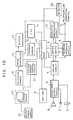
- FIG. 7 is a block diagram of a first embodiment of the present invention, wherein corresponding parts to those in the prior art example in FIG. 1 are denoted by corresponding reference numerals and hence explanation thereof will be omitted.
- the present embodiment is characterized in that it comprises a picture memory 20 storing a plurality of pages of picture information, a picture memory control circuit 21 for controlling input and output of picture information to and from the picture memory 20, and a backup power supply 22 for supplying current to the picture memory 20.
- an input means of memory region information for setting up regions for a self-prepared picture memory portion and an incoming picture memory portion within the picture memory 20 is provided in the key pad 9.
- the picture memory 20 is a memory capable of storing totally N picture planes as shown in FIG. 8 and consists of a camera-taken picture memory portion (a), self-prepared picture memory portion (b), and incoming picture memory portion (c).
- the number of pictures planes stored in the self-prepared picture memory portion is represented by l
- the number of pictures planes stored in the incoming picture memory portion, m equals N - l - 1.
- the picture information in the camera-taken picture memory portion (a) is rewritten at intervals of a predetermined period (1/30 second), while the picture information stored in the self-prepared picture memory portion (b) is retained until an erase instruction is read thereby.
- the incoming picture memory portion (c) is a memory for storing received picture information. Upon receipt of new pages of picture information when its memory regions are filled up, it sequentially rewrites the information therein.
- the memory region information is input through the input/output port 10 to the picture memory control circuit 21.
- the picture memory control circuit 21 based on the memory region information, performs allocation of the memory regions within the picture memory 20.
- desired picture information is read by the television camera 14 and it is displayed on the display 17 as live picture display updated at intervals of 1/30 second.
- the picture information taken by the television camera 14 is updated and stored in the camera-taken picture memory portion (a) of the picture memory 20.
- the user When a desired picture image is obtained, the user inputs an instruction signal for providing a still display on the display 17 using the key pad 9.
- the picture memory control circuit 21 Upon receipt of the instruction signal for a still display, the picture memory control circuit 21 stops the updating in the camera-taken picture memory portion (a).
- the user using the key pad 9, selectively inputs the memory number indicating the storage position in the self-prepared picture memory portion (b) into which the desired picture information is to be stored.
- the picture memory control circuit 21 displays on the display 17 the picture information currently stored in the region of the self-prepared picture memory portion (b) corresponding to that memory number.
- the user confirms the picture image displayed on the display 17, and if it can be erased, enters an instruction using the key pad 9 to rewrite the self-prepared picture information (confirmation process).
- the picture memory control circuit 21 Upon receipt of the instruction to rewrite the self-prepared picture information through the input/ output port 10, the picture memory control circuit 21 writes the picture information currently stored in the camera-taken picture memory portion (a) into the region in the self-prepared picture memory portion (b) where the aforesaid displayed picture information has been stored.
- the user can reenter the memory number, whereby making an error to erase necessary picture information is prevented.
- incoming picture information is produced by demodulating a picture signal received through the communication line.
- Each of pages of incoming picture information is stored through the picture memory control circuit 21 into the incoming picture memory portion (c) of the picture memory 20, sequentially from the front position.
- desired picture images can be stored, as pictures to be transmitted, in the self-prepared picture memory portion (b) of the picture memory 20 in advance.
- the incoming picture memory portion (c) can be arranged so that a plurality of pages are stored therein, and hence, the need for repeated transmission of the same picture information can be eliminated and operability of the apparatus is enhanced.
- FIG. 10 is a block diagram showing configuration of the present embodiment, wherein corresponding parts to those in the first embodiment are denoted by corresponding reference numerals and hence description thereof will be omitted.
- reference numeral 23 denotes a detector circuit for detecting a loop-off to detect the end of a call.
- the picture memory control circuit 21 erases the picture information in the incoming picture memory portion (c) of the picture memory 20.
- the manner of storing the incoming picture information and the self-prepared picture information into the picture memory 20 is the same as that in the first embodiment and hence description thereof will be omitted.
- the detected signal from the detector circuit 23 detecting a loop-off is input through the input/output port 10 to the picture memory control circuit 21.
- the picture memory control circuit 21 upon receipt of the detected signal, erases the picture information stored in the incoming picture memory portion (c) of the picture memory 20.
- the incoming picture information can be erased after a call is finished, and hence, such an effect is obtained that privacy of the user can be protected when other persons also use the same apparatus.
- the still picture video telephone apparatus for the first object of the present invention has a picture memory capable of storing self-prepared picture information as well as a camera-taken picture image as picture information to be transmitted and also capable of storing incoming picture information and further a function enabling the user to allocate the memory regions to the self-prepared memory portion and the incoming picture memory portion in various ways at will.
- a still picture video telephone apparatus with high operability can be provided.
- FIG. 11 shows an example of configuration of a still picture video telephone apparatus to which the method of the present invention is applied. What is characteristic of the present embodiment is that a desired portion extracted from picture data stored in the picture memory is transferred to and stored in another specific region within the same picture memory and the transferred and stored data only is enabled to be transmitted.
- this still picture video telephone apparatus is newly provided with a quick/normal setting switch 18, and by operating the switch to change the setting, it is made possible at will either to transmit the whole of a camera-taken picture image or to transmit a portion thereof.
- FIG. 12(A) shows a diagram explaining transfer and storage of the picture data within the picture memory 16, from which it is known that, when the quick/normal switch 18 is turned on, only partial picture data D q corresponding thereto extracted from the original data D n , that are taken in by the television camera 14 and written as they are through the image controller 15 into the picture memory 16 in succession, is transferred to another specific region within the picture memory 16 and stored therein.
- the relation of the transferred picture data D q to the original picture data D n is expressed, for example, as shown in FIG. 12(B). Only the specified portion of the unit picture data indicated by oblique lines in the drawing becomes the object of transmission. Further, the picture data at the specified portion becoming the object of transmission has the data amount previously set to be in accordance with the display picture plane of the system on the other end of the line.
- FIG. 13 is a flow chart of transmission of picture data from the picture memory 16 according to the present embodiment.
- the CPU 11 transfers a partial picture image D q , having a data amount preset to follow the display picture plane of the system on the other end of the line and extracted from the existing picture data D n as the object of transmission, to another specified region within the picture memory 16 through the image controller 15 and stores the same therein (III-5).
- the CPU 11 subjects the partial picture image data D q to conversion into a predetermined transmission signal in the modulator/demodulator circuit 13, in the same manner as in the above mentioned transmission of the existing picture data D n , and delivers the signal to the system on the other end through the telephone line (III-7).
- FIG. 14 is a flow chart showing operations in the present embodiment of the invention.
- the display 17, in the same manner as in the above described prior art example, displays the picture data stored in the region of the picture memory 16 for storing the picture data already received. Then, according to the present embodiment, when new picture data is received, the newly received picture data is stored not into the ordinary storage region for received picture data, but into a special reception region separately provided in the picture memory 16, and at the time of this reception, the image controller 15 reads the picture data in the special reception region and display the data on the display 17.
- the transmitter side transmits information about the resolution of the picture data prior to the transmission of the picture data.
- the header of the prior art is arranged to include that information.
- the receiver side is enabled to read and display on the display 17 the picture data stored in the special reception region in accordance with the resolution of the received picture data.
- the resolution included in the header of the received picture data is 96 x 100
- the CPU 11 sets up the resolution, 96 x 100, in the image controller 15 so that the received picture data is displayed on the display 17 in accordance with the resolution, 96 x 100, whereas when the received resolution is 160 x 100, the received picture data, in the same manner as above, is displayed in accordance with the resolution, 160 x 100.
- the picture data being received is sequentially overwritten in the special reception region of the picture memory 16.
- the picture data in the special reception region is transferred, as shown in FIG. 15, to the ordinary storage region, namely, to the ordinary storage region for use under normal operation in the picture memory 16.
- the reading from the special reception region is stopped and the reading from the ordinary storage region is started and, at the same time, the stored contents in the special reception region are cleared.
- the special reception region is always kept cleared except when receiving a signal.
- the area where no picture data has been overwritten is all in a state without any data, namely, in white color in general.
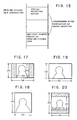
- FIG. 16(A) shows this state.
- the initial picture plane during signal reception will be in that predetermined single color and this picture plane will be gradually rewritten into the received picture image as shown in FIG. 16(B) and FIG. 16(C).
- the picture plane in the single color is gradually rewritten into the received picture image as shown in FIGS. 16(A), (B), and (C).
- the picture image during the reception is not at all disturbed and smoothly displayed on the display 17.
- the signal reception is finished, it is then possible to make a display from the ordinary region of the picture memory 16 in the same way as in the normal case, and the apparatus is thus made ready for receiving next incoming signal.
- the method for displaying picture image for use in the video telephone apparatus of the present embodiment there is provided, in the picture memory, another reception region separate from the ordinary region for received picture image, and the incoming picture data is stored in this reception region during the signal reception, and further, the picture data read out from this reception region is displayed in accordance with the received resolution thereof. Hence, the picture image displayed on the display does not disturb even during the signal reception.
- the method for still picture transmission according to the present invention is characterized in the procedures carried out within the CPU 11.
- the component parts 1 to 17 of the apparatus are the same as those in the prior art example as shown in FIG. 1 and hence explanation thereof will be omitted.
- the header preceding the picture data to be transmitted and received is provided with data representative of the aspect ratio of the picture plane of the system of the transmitter.
- Such data may be put in the header used for exchange of the ID codes to be performed prior to transmission and reception of the picture data, as in the prior art example, or it may be put in the header provided at the front portion of the picture data.
- the CPU 11 according to the program previously stored in the program memory 12, prepares the header including the data representative of the aspect ratio of its own display 17.
- the header for the ID code as aforesaid or the header to be provided at the front portion of the picture data there are generally included such data on the picture data as number of lines, number of data, extension bits, and FCS (frame check sequence) and the like, other than the pixel data frame representative of the aspect ratio of its own.
- FCS frame check sequence
- the CPU 11 In receiving picture data, the CPU 11, in the present embodiment, first receives the header. It recognizes the aspect ratio included in the header and determines whether or not the aspect ratio is in agreement with that of its own picture plane. If it is in agreement therewith, the CPU 11 performs ordinary processes as heretofore.
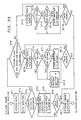
- FIG. 21 is a flow chart describing such ordinarily performed processes.
- the aspect ratio of the incoming picture data is different from the aspect ratio of its own picture plane, the following processes are performed.
- the CPU 11 deletes the data corresponding to specific pixels from the received picture data.
- the transmitted picture images are those for pictures of the person on the transmitter side or the like, and therefore, the deletion of both the side portions are not much of a problem in most cases.
- the display on the receiver side in this example must be of 96 x 96 pixels, the CPU 11 gives some treatment, such as interpolation of the same data as adjoining data, to the data so that a display corresponding to 96 x 96 is obtained. In this way, an accurate display can be obtained even when picture data of a different aspect ratio is received.
- a matching treatment for number of pixels may first be given to the received picture data and then the data corresponding to the pixels at both sides may be deleted, and thereby, the same effect as described above will be obtained.
- FIG. 22 is a flow chart describing in a concrete manner the processes performed in deleting both sides of the picture data.
- a specific pattern may be added to received oblong picture data as shown in FIG. 20 to convert the data into picture data adapted for its own picture plane thereby to obtain a proper display.
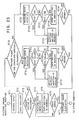
- the CPU 11 compresses the 96-line picture data to the 58-line data. For compensating for 19 lines in each of the upper and lower picture data, it adds specific patterns in white, black, or the like. Thereby, the picture image displayed on the display 17 becomes similar to that displayed on the picture plane on the transmitter side. Thus, also by the method used in this example, picture data of a different respect ratio can be received.
- FIG. 23 is a flow chart describing in a concrete manner the processes performed in adding picture data as described above.
Landscapes
- Engineering & Computer Science (AREA)
- Multimedia (AREA)
- Signal Processing (AREA)
- Two-Way Televisions, Distribution Of Moving Picture Or The Like (AREA)
- Television Systems (AREA)
- Closed-Circuit Television Systems (AREA)
Applications Claiming Priority (8)
| Application Number | Priority Date | Filing Date | Title |
|---|---|---|---|
| JP62319725A JP2761209B2 (ja) | 1987-12-17 | 1987-12-17 | 静止画テレビ電話通信方式 |
| JP319725/87 | 1987-12-17 | ||
| JP99804/88 | 1988-04-22 | ||
| JP63099806A JPH01270475A (ja) | 1988-04-22 | 1988-04-22 | 静止画テレビ電話装置の画像表示方法 |
| JP99806/88 | 1988-04-22 | ||
| JP99805/88 | 1988-04-22 | ||
| JP63099805A JPH01270474A (ja) | 1988-04-22 | 1988-04-22 | 静止画像伝送方法 |
| JP63099804A JPH01270473A (ja) | 1988-04-22 | 1988-04-22 | 静止画テレビ電話装置 |
Publications (3)
| Publication Number | Publication Date |
|---|---|
| EP0320828A2 true EP0320828A2 (de) | 1989-06-21 |
| EP0320828A3 EP0320828A3 (de) | 1991-03-06 |
| EP0320828B1 EP0320828B1 (de) | 1995-05-03 |
Family
ID=27468770
Family Applications (1)
| Application Number | Title | Priority Date | Filing Date |
|---|---|---|---|
| EP88120672A Expired - Lifetime EP0320828B1 (de) | 1987-12-17 | 1988-12-10 | Verfahren zur Übertragung und Anzeige eines Standbildes in einem Standbild-Videotelefon |
Country Status (4)
| Country | Link |
|---|---|
| US (1) | US4962521A (de) |
| EP (1) | EP0320828B1 (de) |
| KR (1) | KR920001005B1 (de) |
| DE (1) | DE3853713T2 (de) |
Cited By (13)
| Publication number | Priority date | Publication date | Assignee | Title |
|---|---|---|---|---|
| US4996592A (en) * | 1988-08-12 | 1991-02-26 | Oki Electric Industry Co., Ltd. | Video communication apparatus capable of electronically adjusting the field of view of a video frame |
| US5036390A (en) * | 1988-08-30 | 1991-07-30 | Canon Kabushiki Kaisha | Image communication apparatus |
| US5073927A (en) * | 1989-08-29 | 1991-12-17 | Motorola, Inc. | Imaging identification method for a communication system |
| EP0436345A3 (en) * | 1989-12-20 | 1991-12-18 | Canon Kabushiki Kaisha | Voice and image communicating apparatus |
| GB2219465B (en) * | 1988-05-30 | 1992-09-23 | Sony Corp | Video telephones |
| EP0456248A3 (en) * | 1990-05-11 | 1993-04-28 | Kabushiki Kaisha Toshiba | Video phone |
| EP0538013A3 (en) * | 1991-10-15 | 1993-10-27 | Sony Corp | Still image transmission system |
| EP0572257A1 (de) * | 1992-05-28 | 1993-12-01 | Sharp Kabushiki Kaisha | System zur Speicherung und Wiedergabe von Bildern |
| WO1994019907A1 (en) * | 1993-02-26 | 1994-09-01 | John Charles Chater | Communication system |
| EP0674439A1 (de) * | 1994-03-25 | 1995-09-27 | THOMSON multimedia | Bildkodierungs- und -dekodierungsmethode mit flexiblem Format für Übertragungssystem mit niedriger Datenrate |
| EP0773685A1 (de) * | 1990-12-26 | 1997-05-14 | Canon Kabushiki Kaisha | Multimedia-Kommunikationsvorrichtung |
| GB2365241A (en) * | 2000-07-19 | 2002-02-13 | Nec Technologies | Extraction and replacement of background signals in communication systems |
| USRE45982E1 (en) | 2001-12-31 | 2016-04-19 | Nokia Technologies Oy | Method and device for speeding up and simplifying information transfer between electronic devices |
Families Citing this family (43)
| Publication number | Priority date | Publication date | Assignee | Title |
|---|---|---|---|---|
| JP2998960B2 (ja) * | 1988-08-26 | 2000-01-17 | キヤノン株式会社 | 通信方法 |
| US6124882A (en) * | 1992-02-19 | 2000-09-26 | 8×8, Inc. | Videocommunicating apparatus and method therefor |
| US5426513A (en) * | 1989-06-16 | 1995-06-20 | Harris Corporation | Prioritized image transmission system and method |
| US5128776A (en) * | 1989-06-16 | 1992-07-07 | Harris Corporation | Prioritized image transmission system and method |
| US5589849A (en) * | 1989-07-03 | 1996-12-31 | Ditzik; Richard J. | Display monitor position adjustment apparatus |
| US5347305A (en) * | 1990-02-21 | 1994-09-13 | Alkanox Corporation | Video telephone system |
| US5164980A (en) * | 1990-02-21 | 1992-11-17 | Alkanox Corporation | Video telephone system |
| US5283638A (en) * | 1991-04-25 | 1994-02-01 | Compuadd Corporation | Multimedia computing and telecommunications workstation |
| US5192999A (en) * | 1991-04-25 | 1993-03-09 | Compuadd Corporation | Multipurpose computerized television |
| US5283819A (en) * | 1991-04-25 | 1994-02-01 | Compuadd Corporation | Computing and multimedia entertainment system |
| US5751722A (en) * | 1992-02-10 | 1998-05-12 | Canon Kabushiki Kaisha | Method of displaying a frozen image when transmission of image information is suspended in a multimedia system |
| US6121998A (en) * | 1992-02-19 | 2000-09-19 | 8×8, Inc. | Apparatus and method for videocommunicating having programmable architecture permitting data revisions |
| US6577324B1 (en) | 1992-06-03 | 2003-06-10 | Compaq Information Technologies Group, L.P. | Video and audio multimedia pop-up documentation by performing selected functions on selected topics |
| US5475421A (en) * | 1992-06-03 | 1995-12-12 | Digital Equipment Corporation | Video data scaling for video teleconferencing workstations communicating by digital data network |
| US5594859A (en) * | 1992-06-03 | 1997-01-14 | Digital Equipment Corporation | Graphical user interface for video teleconferencing |
| US5623690A (en) | 1992-06-03 | 1997-04-22 | Digital Equipment Corporation | Audio/video storage and retrieval for multimedia workstations by interleaving audio and video data in data file |
| US5375068A (en) * | 1992-06-03 | 1994-12-20 | Digital Equipment Corporation | Video teleconferencing for networked workstations |
| US5757418A (en) * | 1992-07-31 | 1998-05-26 | Canon Kabushiki Kaisha | Television conference system and method therefor |
| JP3526057B2 (ja) * | 1992-07-31 | 2004-05-10 | キヤノン株式会社 | 動画像伝送装置 |
| US5367629A (en) * | 1992-12-18 | 1994-11-22 | Sharevision Technology, Inc. | Digital video compression system utilizing vector adaptive transform |
| US6738357B1 (en) | 1993-06-09 | 2004-05-18 | Btg International Inc. | Method and apparatus for multiple media digital communication system |
| US5760752A (en) * | 1993-07-15 | 1998-06-02 | Nec Corporation | Image display apparatus for displaying an image corresponding to an image state at the transmitting end |
| US5581560A (en) * | 1993-08-27 | 1996-12-03 | Canon Kabushiki Kaisha | Communication apparatus and method for simultaneous communication of audio and data signals with improved audio control |
| JP3893480B2 (ja) * | 1994-09-28 | 2007-03-14 | 株式会社リコー | デジタル電子カメラ |
| JPH08195944A (ja) * | 1994-11-18 | 1996-07-30 | Casio Comput Co Ltd | テレビ電話装置 |
| US5854898A (en) | 1995-02-24 | 1998-12-29 | Apple Computer, Inc. | System for automatically adding additional data stream to existing media connection between two end points upon exchange of notifying and confirmation messages therebetween |
| US5606365A (en) * | 1995-03-28 | 1997-02-25 | Eastman Kodak Company | Interactive camera for network processing of captured images |
| USH1714H (en) * | 1995-05-03 | 1998-03-03 | Lucent Technologies Inc. | Automatic still image transmission upon call connection |
| JPH09149396A (ja) * | 1995-11-27 | 1997-06-06 | Fujitsu Ltd | 多地点テレビ会議システム |
| US7321783B2 (en) | 1997-04-25 | 2008-01-22 | Minerva Industries, Inc. | Mobile entertainment and communication device |
| JP3350901B2 (ja) * | 1998-10-30 | 2002-11-25 | インターナショナル・ビジネス・マシーンズ・コーポレーション | デジタル情報交換のためのシステム及びその方法 |
| US20020038456A1 (en) * | 2000-09-22 | 2002-03-28 | Hansen Michael W. | Method and system for the automatic production and distribution of media content using the internet |
| JP2002305733A (ja) * | 2001-04-06 | 2002-10-18 | Matsushita Electric Ind Co Ltd | マルチキャスト会議装置、及びマルチキャスト会議プログラム |
| JP2005184632A (ja) * | 2003-12-22 | 2005-07-07 | Nec Access Technica Ltd | 通信端末における消費電力削減方法及び通信端末 |
| JP4222213B2 (ja) * | 2004-01-16 | 2009-02-12 | カシオ計算機株式会社 | カメラ装置、撮影感度設定プログラム及び撮影感度設定方法 |
| EP1571813A1 (de) | 2004-03-02 | 2005-09-07 | LG Electronics, Inc. | Methode und Kommunikationssystem zum Übermitteln eines Bildes vom Anrufer an den angerufenen Teilnehmer welches den Anrufer identifiziert |
| JP2005249959A (ja) * | 2004-03-02 | 2005-09-15 | Casio Comput Co Ltd | 撮像装置、この撮像装置に用いられる発光制御方法及びプログラム |
| US20110149811A1 (en) | 2009-12-23 | 2011-06-23 | Ramprakash Narayanaswamy | Web-Enabled Conferencing and Meeting Implementations with Flexible User Calling Features |
| US20110149809A1 (en) | 2009-12-23 | 2011-06-23 | Ramprakash Narayanaswamy | Web-Enabled Conferencing and Meeting Implementations with Flexible User Calling and Content Sharing Features |
| US20110150194A1 (en) | 2009-12-23 | 2011-06-23 | Ramprakash Narayanaswamy | Web-Enabled Conferencing and Meeting Implementations with Flexible User Calling Features |
| US8914734B2 (en) | 2009-12-23 | 2014-12-16 | 8X8, Inc. | Web-enabled conferencing and meeting implementations with a subscription-based model |
| US8817801B1 (en) | 2011-07-08 | 2014-08-26 | 8X8, Inc. | Conferencing and meeting implementations with advanced features |
| WO2015196462A1 (en) * | 2014-06-27 | 2015-12-30 | Thomson Licensing | Method and device for displaying a video sequence |
Family Cites Families (9)
| Publication number | Priority date | Publication date | Assignee | Title |
|---|---|---|---|---|
| JPS5318819B2 (de) * | 1973-05-07 | 1978-06-17 | ||
| US4291198A (en) * | 1979-06-28 | 1981-09-22 | Bell Telephone Laboratories, Incorporated | General-purpose electronic telephone station set |
| US4258387A (en) * | 1979-10-17 | 1981-03-24 | Lemelson Jerome H | Video telephone |
| US4485400A (en) * | 1981-01-13 | 1984-11-27 | Lemelson Jerome H | Video telephone |
| US4739413A (en) * | 1985-06-14 | 1988-04-19 | Luma Telecom, Inc. | Video-optimized modulator-demodulator with adjacent modulating amplitudes matched to adjacent pixel gray values |
| US4715059A (en) * | 1985-11-07 | 1987-12-22 | Luma Telecom, Inc. | Conversational video phone |
| US4979028A (en) * | 1988-05-30 | 1990-12-18 | Sony Corporation | Video telephone |
| JPH042986A (ja) * | 1990-04-20 | 1992-01-07 | Nec Corp | 電波探知システム |
| JP3155066B2 (ja) * | 1992-06-17 | 2001-04-09 | キヤノン株式会社 | 定着装置 |
-
1988
- 1988-12-10 DE DE3853713T patent/DE3853713T2/de not_active Expired - Fee Related
- 1988-12-10 EP EP88120672A patent/EP0320828B1/de not_active Expired - Lifetime
- 1988-12-12 KR KR1019880016462A patent/KR920001005B1/ko not_active Expired
- 1988-12-16 US US07/285,816 patent/US4962521A/en not_active Expired - Fee Related
Cited By (18)
| Publication number | Priority date | Publication date | Assignee | Title |
|---|---|---|---|---|
| GB2219465B (en) * | 1988-05-30 | 1992-09-23 | Sony Corp | Video telephones |
| US4996592A (en) * | 1988-08-12 | 1991-02-26 | Oki Electric Industry Co., Ltd. | Video communication apparatus capable of electronically adjusting the field of view of a video frame |
| US5036390A (en) * | 1988-08-30 | 1991-07-30 | Canon Kabushiki Kaisha | Image communication apparatus |
| US5073927A (en) * | 1989-08-29 | 1991-12-17 | Motorola, Inc. | Imaging identification method for a communication system |
| US5305097A (en) * | 1989-12-20 | 1994-04-19 | Canon Kabushiki Kaisha | Communicating apparatus having a calling party number display device |
| EP0436345A3 (en) * | 1989-12-20 | 1991-12-18 | Canon Kabushiki Kaisha | Voice and image communicating apparatus |
| EP0456248A3 (en) * | 1990-05-11 | 1993-04-28 | Kabushiki Kaisha Toshiba | Video phone |
| EP0773685A1 (de) * | 1990-12-26 | 1997-05-14 | Canon Kabushiki Kaisha | Multimedia-Kommunikationsvorrichtung |
| US5691767A (en) * | 1991-10-15 | 1997-11-25 | Sony Corporation | Video conferencing system with high resolution still image capability |
| EP0538013A3 (en) * | 1991-10-15 | 1993-10-27 | Sony Corp | Still image transmission system |
| EP0572257A1 (de) * | 1992-05-28 | 1993-12-01 | Sharp Kabushiki Kaisha | System zur Speicherung und Wiedergabe von Bildern |
| WO1994019907A1 (en) * | 1993-02-26 | 1994-09-01 | John Charles Chater | Communication system |
| EP0674439A1 (de) * | 1994-03-25 | 1995-09-27 | THOMSON multimedia | Bildkodierungs- und -dekodierungsmethode mit flexiblem Format für Übertragungssystem mit niedriger Datenrate |
| FR2717976A1 (fr) * | 1994-03-25 | 1995-09-29 | Thomson Consumer Electronics | Procédé de transmission d'images à format flexible pour systèmes de transmission de données à bas débit. |
| US5600572A (en) * | 1994-03-25 | 1997-02-04 | Thomson Consumer Electronics S.A. | Method for transmission of variable-format images via low data rate transmission systems |
| GB2365241A (en) * | 2000-07-19 | 2002-02-13 | Nec Technologies | Extraction and replacement of background signals in communication systems |
| GB2365241B (en) * | 2000-07-19 | 2005-01-19 | Nec Technologies | Introducing background signals to communication systems |
| USRE45982E1 (en) | 2001-12-31 | 2016-04-19 | Nokia Technologies Oy | Method and device for speeding up and simplifying information transfer between electronic devices |
Also Published As
| Publication number | Publication date |
|---|---|
| EP0320828B1 (de) | 1995-05-03 |
| KR890011431A (ko) | 1989-08-14 |
| DE3853713D1 (de) | 1995-06-08 |
| KR920001005B1 (ko) | 1992-02-01 |
| EP0320828A3 (de) | 1991-03-06 |
| DE3853713T2 (de) | 1996-01-18 |
| US4962521A (en) | 1990-10-09 |
Similar Documents
| Publication | Publication Date | Title |
|---|---|---|
| US4962521A (en) | Apparatus for still picture video telephone apparatus and methods for transmitting and displaying still picture image for use therein | |
| EP0602010B1 (de) | Standbildtelephonkommunikationssystem | |
| EP1048166B1 (de) | Bildkommunikationsvorrichtung und verfahren für ein kommmunikationsendgerät | |
| KR100308311B1 (ko) | 화상 전화기의 화상 저장방법 | |
| JP3118640B2 (ja) | 処理装置および表示制御方法 | |
| JPS63234789A (ja) | マイクロコンピユ−タを使つた静止画テレビ電話システム | |
| JPH05207212A (ja) | 遠隔会議用通信端末装置 | |
| EP0400543B1 (de) | Gerät zur Faksimileübertragung | |
| JP2626777B2 (ja) | 画像通信装置 | |
| JP2709922B2 (ja) | データ処理装置のメモリ管理方法 | |
| JP2846107B2 (ja) | 画像通信システム | |
| GB2327011A (en) | Data communication system | |
| JPH01320884A (ja) | 静止画像伝送装置 | |
| JPH01270475A (ja) | 静止画テレビ電話装置の画像表示方法 | |
| JP2557120B2 (ja) | 画像伝送装置 | |
| JP2804540B2 (ja) | 通信会議端末 | |
| CN1087545C (zh) | 接传真系统的电话分机的记忆式拨号方法 | |
| JPH06121089A (ja) | テレライティング通信端末装置 | |
| JPS63190488A (ja) | キヤプテン端末機 | |
| JPS63190486A (ja) | キヤプテン端末機 | |
| JPH0362767A (ja) | 複数回線利用の通信方法 | |
| JPH04253465A (ja) | ファクシミリ通信システム | |
| EP0920181A2 (de) | Ubertragungsgerät und Speichermedium | |
| JPS6364465A (ja) | 描画像通信装置 | |
| JPH01261982A (ja) | 静止画テレビ電話装置 |
Legal Events
| Date | Code | Title | Description |
|---|---|---|---|
| PUAI | Public reference made under article 153(3) epc to a published international application that has entered the european phase |
Free format text: ORIGINAL CODE: 0009012 |
|
| AK | Designated contracting states |
Kind code of ref document: A2 Designated state(s): DE FR GB |
|
| PUAL | Search report despatched |
Free format text: ORIGINAL CODE: 0009013 |
|
| AK | Designated contracting states |
Kind code of ref document: A3 Designated state(s): DE FR GB |
|
| 17P | Request for examination filed |
Effective date: 19910320 |
|
| 17Q | First examination report despatched |
Effective date: 19930225 |
|
| GRAA | (expected) grant |
Free format text: ORIGINAL CODE: 0009210 |
|
| AK | Designated contracting states |
Kind code of ref document: B1 Designated state(s): DE FR GB |
|
| REF | Corresponds to: |
Ref document number: 3853713 Country of ref document: DE Date of ref document: 19950608 |
|
| ET | Fr: translation filed | ||
| PGFP | Annual fee paid to national office [announced via postgrant information from national office to epo] |
Ref country code: FR Payment date: 19951116 Year of fee payment: 8 |
|
| PGFP | Annual fee paid to national office [announced via postgrant information from national office to epo] |
Ref country code: GB Payment date: 19951120 Year of fee payment: 8 |
|
| PGFP | Annual fee paid to national office [announced via postgrant information from national office to epo] |
Ref country code: DE Payment date: 19951227 Year of fee payment: 8 |
|
| PLBE | No opposition filed within time limit |
Free format text: ORIGINAL CODE: 0009261 |
|
| STAA | Information on the status of an ep patent application or granted ep patent |
Free format text: STATUS: NO OPPOSITION FILED WITHIN TIME LIMIT |
|
| 26N | No opposition filed | ||
| PG25 | Lapsed in a contracting state [announced via postgrant information from national office to epo] |
Ref country code: GB Effective date: 19961210 |
|
| GBPC | Gb: european patent ceased through non-payment of renewal fee |
Effective date: 19961210 |
|
| PG25 | Lapsed in a contracting state [announced via postgrant information from national office to epo] |
Ref country code: FR Effective date: 19970829 |
|
| PG25 | Lapsed in a contracting state [announced via postgrant information from national office to epo] |
Ref country code: DE Effective date: 19970902 |
|
| REG | Reference to a national code |
Ref country code: FR Ref legal event code: ST |