EP0321375A2 - Automatisches Produktionsbeförderungssystem mit Rückführungssteuerung - Google Patents
Automatisches Produktionsbeförderungssystem mit Rückführungssteuerung Download PDFInfo
- Publication number
- EP0321375A2 EP0321375A2 EP88480082A EP88480082A EP0321375A2 EP 0321375 A2 EP0321375 A2 EP 0321375A2 EP 88480082 A EP88480082 A EP 88480082A EP 88480082 A EP88480082 A EP 88480082A EP 0321375 A2 EP0321375 A2 EP 0321375A2
- Authority
- EP
- European Patent Office
- Prior art keywords
- dispatch
- production
- orders
- database
- automated production
- Prior art date
- Legal status (The legal status is an assumption and is not a legal conclusion. Google has not performed a legal analysis and makes no representation as to the accuracy of the status listed.)
- Granted
Links
Images


Classifications
-
- G—PHYSICS
- G06—COMPUTING OR CALCULATING; COUNTING
- G06Q—INFORMATION AND COMMUNICATION TECHNOLOGY [ICT] SPECIALLY ADAPTED FOR ADMINISTRATIVE, COMMERCIAL, FINANCIAL, MANAGERIAL OR SUPERVISORY PURPOSES; SYSTEMS OR METHODS SPECIALLY ADAPTED FOR ADMINISTRATIVE, COMMERCIAL, FINANCIAL, MANAGERIAL OR SUPERVISORY PURPOSES, NOT OTHERWISE PROVIDED FOR
- G06Q10/00—Administration; Management
- G06Q10/06—Resources, workflows, human or project management; Enterprise or organisation planning; Enterprise or organisation modelling
-
- G—PHYSICS
- G05—CONTROLLING; REGULATING
- G05B—CONTROL OR REGULATING SYSTEMS IN GENERAL; FUNCTIONAL ELEMENTS OF SUCH SYSTEMS; MONITORING OR TESTING ARRANGEMENTS FOR SUCH SYSTEMS OR ELEMENTS
- G05B19/00—Program-control systems
- G05B19/02—Program-control systems electric
- G05B19/418—Total factory control, i.e. centrally controlling a plurality of machines, e.g. direct or distributed numerical control [DNC], flexible manufacturing systems [FMS], integrated manufacturing systems [IMS] or computer integrated manufacturing [CIM]
- G05B19/41865—Total factory control, i.e. centrally controlling a plurality of machines, e.g. direct or distributed numerical control [DNC], flexible manufacturing systems [FMS], integrated manufacturing systems [IMS] or computer integrated manufacturing [CIM] characterised by job scheduling, process planning, material flow
-
- G—PHYSICS
- G07—CHECKING-DEVICES
- G07C—TIME OR ATTENDANCE REGISTERS; REGISTERING OR INDICATING THE WORKING OF MACHINES; GENERATING RANDOM NUMBERS; VOTING OR LOTTERY APPARATUS; ARRANGEMENTS, SYSTEMS OR APPARATUS FOR CHECKING NOT PROVIDED FOR ELSEWHERE
- G07C3/00—Registering or indicating the condition or the working of machines or other apparatus, other than vehicles
- G07C3/08—Registering or indicating the production of the machine either with or without registering working or idle time
- G07C3/10—Registering or indicating the production of the machine either with or without registering working or idle time using counting means
-
- H—ELECTRICITY
- H10—SEMICONDUCTOR DEVICES; ELECTRIC SOLID-STATE DEVICES NOT OTHERWISE PROVIDED FOR
- H10P—GENERIC PROCESSES OR APPARATUS FOR THE MANUFACTURE OR TREATMENT OF DEVICES COVERED BY CLASS H10
- H10P74/00—Testing or measuring during manufacture or treatment of wafers, substrates or devices
- H10P74/23—Testing or measuring during manufacture or treatment of wafers, substrates or devices characterised by multiple measurements, corrections, marking or sorting processes
-
- Y—GENERAL TAGGING OF NEW TECHNOLOGICAL DEVELOPMENTS; GENERAL TAGGING OF CROSS-SECTIONAL TECHNOLOGIES SPANNING OVER SEVERAL SECTIONS OF THE IPC; TECHNICAL SUBJECTS COVERED BY FORMER USPC CROSS-REFERENCE ART COLLECTIONS [XRACs] AND DIGESTS
- Y02—TECHNOLOGIES OR APPLICATIONS FOR MITIGATION OR ADAPTATION AGAINST CLIMATE CHANGE
- Y02P—CLIMATE CHANGE MITIGATION TECHNOLOGIES IN THE PRODUCTION OR PROCESSING OF GOODS
- Y02P90/00—Enabling technologies with a potential contribution to greenhouse gas [GHG] emissions mitigation
- Y02P90/02—Total factory control, e.g. smart factories, flexible manufacturing systems [FMS] or integrated manufacturing systems [IMS]
-
- Y—GENERAL TAGGING OF NEW TECHNOLOGICAL DEVELOPMENTS; GENERAL TAGGING OF CROSS-SECTIONAL TECHNOLOGIES SPANNING OVER SEVERAL SECTIONS OF THE IPC; TECHNICAL SUBJECTS COVERED BY FORMER USPC CROSS-REFERENCE ART COLLECTIONS [XRACs] AND DIGESTS
- Y10—TECHNICAL SUBJECTS COVERED BY FORMER USPC
- Y10S—TECHNICAL SUBJECTS COVERED BY FORMER USPC CROSS-REFERENCE ART COLLECTIONS [XRACs] AND DIGESTS
- Y10S706/00—Data processing: artificial intelligence
- Y10S706/902—Application using ai with detail of the ai system
- Y10S706/903—Control
- Y10S706/904—Manufacturing or machine, e.g. agricultural machinery, machine tool
Definitions
- the present invention generally relates to a computer based production dispatch system on the manufacturing shop floor and, more particularly, to a system which automatically interfaces a production dispatch tool to a production planning system to provide an integrated approach to a manufacturing software design.
- the invention provides an easy to use, user friendly interface for the shop foreman to dispatch orders in the most efficient way in the event of production stoppage at any point in the manufacturing process.
- This invention deals with released orders that have to be dispatched, whereas a copending application claiming U.S. Priority S/N 07/127,334 deals with the issue of planning and releasing orders prior to actual release.
- Expert systems are a branch of computer science, generally referred to as artificial intelligence, which exhibits characteristics normally associated with human behavior including learning, reasoning, solving problems and so forth. More specifically, an expert system or “knowledge based” system uses certain rules and a database to provide a user interactive environment in the form of a "consultation dialog", just as the user would interact with a human expert.
- the automated production release system disclosed in the copending application uses a set of order release and dispatch rules to meet certain management criteria of increased throughput, reduced cycle time and reduced work-in-process inventory and recommends a set of order release sequences to the manufacturing floor prior to actual release.
- the system according to the present invention is used after orders are released and production disruption is encountered on the shop floor.
- the key management criteria at such time would be to make sure orders are not late or, in the alternative, to minimize the tardiness of orders and reduce the manufacturing cycle time. Most of the material bought for the manufacturing process would already be on the shop floor.
- the system based on this invention analyzes current dispatch rules, using a simulation process, to determine if those rules will satisfy the management criteria of reducing cycle time and minimizing tardiness of shop orders. Based on the priority settings of orders, the system recommends the rule to be used. When such decisions have to be made and action taken, the information needs to be passed to the planning system so that the current status of the floor is used for future release of orders to the manufacturing floor.
- the subject invention builds on the foundation of the automated production release system of the copending patent application, although the invention can be implemented and practiced independently.
- this invention aims primarily at developing revised dispatch rules to be followed and the associated sequence of operations to be followed after a production disruption on the shop floor which causes re-analysis of the dispatching system.
- the approach taken by the invention is repeated interactively and forms what may be characterized as a "bottoms up" approach to feed information to the original planning process. More speciflcally, the system automatically creates a list of alternative processes that any production order can follow and establishes the optimum process flows in the event of a disruption on the manufacturing shop floor.
- the system automatically passes the information to the planning system which then re- calculates the revised order release sequence for the remaining orders in the release process.
- FIG. 1 there is shown in functional block diagram form the normal set of processes that take place in a typical manufacturing environment from the time of planning through production and shipment.
- the key parts of this system includes the master schedule planning 10, where items are planned at the completed item level, the material requirement planning (MRP) system 20, where completed item requirements are exploded into sub-components and planned, and the production release system 30, where shop orders planned at the material requirement planning level are set for releasing to the shop floor.
- the production release system 30 is the subject of the copending patent application .
- the next part of the system, the manufacturing control system 40 is the process affected according to the present invention. This system monitors and analyzes the performance at the shop floor and provides signals to move items from one work center to another.
- the last block in the system is the shipping system 50 and is standard to any manufacturing enterprise.
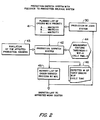
- FIG. 2 illustrates the production dispatch system, which constitutes that part of the manufacturing control system 40 according to the present invention, and its releationship to the simulation and production release planning system 30.
- the list of orders and due dates 41 as received from the production release system 30 are monitored by the production dispatch system 42 to ensure that all dispatching is done as planned.
- the dispatch system 42 takes charge and decides the revised dispatch rule to be followed and the location for the item in the process to be sent. The system does this function by invoking the common function simulation system of the shop manufacturing floor 43. Using planned priority rules, as set out in List 1 below, and completed operations, an analysis is made to determine the effect of the production disruption.
- the system Based on the modified capacity and/or usage availability, the system performs calculations to determine if the original planned quantities and dates can be met. If not, the system prompts the user to input the priorities from among order tardiness, work-in-process inventory and cycle time. This is done by displaying the original management criteria priority as developed by the production planning system 30, and the user responds and provides input at block 44. Based on the revised priority input by the user, the production dispatch system 42 then re-calculates the dispatch rule to be followed together with the sequence to complete the work units and generates a recommended revised sequence and priorities in block 45 based on the results of the analysis. This information is then fed back to the production release system 30, providing the "bottoms up" approach to generating the planned list of orders 41. The system also automatically sets up management reports in block 46 which can be printed upon request.
- FIG. 2 illustrates that part of the manufacturing control system 40 according to the invention as self-contained, in the preferred embodiment of the invention, the system illustrated is actually integrated with the production planning system 30. More speciflcally, the common function simulation system 43 is shared with the production planning system 30. As described in more detail in the copending application the simulation function 43 can be accomplished with a commercially available computer program marketed under the name of "GEMS II", a Generalized Manufacturing Simulator published by Loadestone-II, Inc. of Bryan, Texas. This software package has the natural orientation to modeling manufacturing environments. GEMS II is a network based tachnique such that its model is largely represented in a graphical format which resembles both manufacturing process flow diagrams and a PERT (Program Evaluation and Review Technique) chart.
- GEMS II is a network based tachnique such that its model is largely represented in a graphical format which resembles both manufacturing process flow diagrams and a PERT (Program Evaluation and Review Technique) chart.
- the model consists of boxes or nodes which, in general, represent various manufacturing and decision activities of the system, and arcs which show the procedural relationships among the activities.
- the logic of GEMS II recognizes queues (in-process inventories, production backlogs, etc.) and assembly processes. Further, it recognizes competition among activities for limited resources, such as tools, fixtures, space and manpower.
- shop order release is described as having two major conceptual parts: The functions to release shop orders for manufactured items, and the functions required to communicate the need for purchased items to the purchasing systems.
- the shop order release system as described in the COPICS publication addresses the functions required to release shop orders and establish the database records needed to maintain the information by which other systems will monitor and control the detailed feedback throughout the order.
- the system provides shop order reports with a list of open orders. Assuming this list or a similar list is sent to the manufacturing floor and the manufacturing process begins, the sequence of orders started would be displayed under the shop order generated by COPICS.
- the production dispatch system would re-analyze the sequence and priority and re-set the sequence in order to meet the due dates or best reduce tardiness. The results would then be provided to the COPICS product as the production release system 30.
- the process begins in function block 60 where the original management priority on work-in-process, cycle time and tardiness is extracted.
- the process is then simulated in function block 62 to determine how the process is affected through the end of the process.
- an estimate is made in function block 64 to order tardiness, work-in- process and cycle time with varied dispatching rules.
- This estimate is then tested in decision block 66 to determine if it is acceptable.
- the estimate would be considered acceptable, for example, if the original release schedule is not significantly affected by the production disruption. What is significant in each case could be a default value or a user input value. Thus, if only a slight slippage in scheduling work at the various work stations on the production floor is experienced, this might be considered acceptable.
- the system prompts the user to re-state the priority sequence between work-in-process, tardiness and cycle time in operation block 68, and then control passes back to function block 62 to simulate the process again with the re-ordered priorities input by the user.
- Figure 4 illustrates the key parts of the system from the user point of view.
- the key parts are the database 81 and the query system 82.
- the database can be any of several products currently available, but for purposes of the preferred embodiment, IBM'S DataBase 2 (DB2) is used.
- DB2 is a relational database system, but it will be understood by those skilled in the art that other databases, including hierarchical databases, could be used.
- General information on IBM'S DB2 can be had with reference to publication GC26-4073-2 published by IBM Corp.
- the query system can be an expert system, but for purposes of the preferred embodiment of this invention, IBM'S Restructured EXtended eXecutor (REXX) language is used.
- REXX IBM'S Restructured EXtended eXecutor
- the user 83 can query the current status, completion date and the priority sequence of any job in question using the query system 82.
- the query system 82 interfaces with the production dispatch system 42 which accesses database 81 and provides the revised dispatch sequence to be followed.
- the database 81 as defined has the capability to capture the decision variables tested and the results obtained for each test. The user can access the results using the query facility at a later date, if needed, and obtain an output in the form of a revised order sequence for dispatch in block 84. This enhances the analysis capability of future test data. This also provides an additional enhancement to the system.
- the operations manager When a disruption occurs in the production process, the operations manager is very concerned about the expected completion time of the order that has been affected as well as the impact on other orders on the shop floor. He or she would also be concerned with the excessive work-in- process inventory and the cycle time needed to complete all orders on the shop floor.
- This dipatch system gives the manager the needed capability to recover from the situation, if possible, or the best alternative. Having taken a course of action as analyzed by the production dispatch system, the planning system and production release system need to be informed of the revised plan and status of the operation centers in order to effectively plan future orders. This is an added enhancement to this system.
Landscapes
- Engineering & Computer Science (AREA)
- Physics & Mathematics (AREA)
- General Physics & Mathematics (AREA)
- Business, Economics & Management (AREA)
- Economics (AREA)
- Strategic Management (AREA)
- Human Resources & Organizations (AREA)
- Quality & Reliability (AREA)
- Entrepreneurship & Innovation (AREA)
- Game Theory and Decision Science (AREA)
- Operations Research (AREA)
- Development Economics (AREA)
- Automation & Control Theory (AREA)
- Manufacturing & Machinery (AREA)
- General Engineering & Computer Science (AREA)
- Marketing (AREA)
- Educational Administration (AREA)
- Tourism & Hospitality (AREA)
- General Business, Economics & Management (AREA)
- Theoretical Computer Science (AREA)
- General Factory Administration (AREA)
- Management, Administration, Business Operations System, And Electronic Commerce (AREA)
- Control By Computers (AREA)
- Multi-Process Working Machines And Systems (AREA)
Applications Claiming Priority (2)
| Application Number | Priority Date | Filing Date | Title |
|---|---|---|---|
| US135122 | 1987-12-18 | ||
| US07/135,122 US4866628A (en) | 1987-12-18 | 1987-12-18 | Automated production dispatch system with feedback control |
Publications (3)
| Publication Number | Publication Date |
|---|---|
| EP0321375A2 true EP0321375A2 (de) | 1989-06-21 |
| EP0321375A3 EP0321375A3 (en) | 1990-09-26 |
| EP0321375B1 EP0321375B1 (de) | 1996-05-15 |
Family
ID=22466654
Family Applications (1)
| Application Number | Title | Priority Date | Filing Date |
|---|---|---|---|
| EP88480082A Expired - Lifetime EP0321375B1 (de) | 1987-12-18 | 1988-11-22 | Automatisches Produktionsbeförderungssystem mit Rückführungssteuerung |
Country Status (5)
| Country | Link |
|---|---|
| US (1) | US4866628A (de) |
| EP (1) | EP0321375B1 (de) |
| JP (1) | JPH01169604A (de) |
| BR (1) | BR8806630A (de) |
| DE (1) | DE3855296D1 (de) |
Cited By (8)
| Publication number | Priority date | Publication date | Assignee | Title |
|---|---|---|---|---|
| EP0512442A1 (de) * | 1991-05-07 | 1992-11-11 | Maschinenfabrik Rieter Ag | Produktionsplanung und -steuerung für eine Spinnereianlage |
| EP0466089A3 (en) * | 1990-07-10 | 1993-10-13 | Fujitsu Limited | Production control system for controlling producing points |
| EP0463616A3 (en) * | 1990-06-27 | 1993-12-29 | Fujitsu Ltd | System and method for automatically answering production status inquiry |
| EP0473522A3 (de) * | 1990-08-21 | 1994-03-02 | Ibm | |
| WO1995026535A1 (en) * | 1994-03-25 | 1995-10-05 | British Telecommunications Public Limited Company | Resource allocation |
| EP0644470A3 (de) * | 1993-08-05 | 1998-04-15 | Nec Corporation | Produktionssteuersystem mit Auswahl der optimalen Zuteilungsregel |
| EP0488246B1 (de) * | 1990-11-28 | 1998-05-20 | Hitachi, Ltd. | Planungssystem für Herstellung |
| GB2370132A (en) * | 2000-12-13 | 2002-06-19 | Itt Mfg Enterprises Inc | Procument system |
Families Citing this family (63)
| Publication number | Priority date | Publication date | Assignee | Title |
|---|---|---|---|---|
| US5170355A (en) * | 1988-12-14 | 1992-12-08 | Siemens Corporate Research, Inc. | Apparatus and a method for controlling the release of jobs from a pool of pending jobs into a factory |
| US5216619A (en) * | 1989-10-13 | 1993-06-01 | The Foxboro Company | Path management for a process system |
| US5099431A (en) * | 1989-10-23 | 1992-03-24 | International Business Machines Corporation | Automated re-work shop order scheduling system |
| US5155679A (en) * | 1989-12-18 | 1992-10-13 | Hewlett-Packard Company | Set-up optimization for flexible manufacturing systems |
| US5233533A (en) * | 1989-12-19 | 1993-08-03 | Symmetrix, Inc. | Scheduling method and apparatus |
| JP2753142B2 (ja) * | 1990-11-27 | 1998-05-18 | 株式会社東芝 | 半導体装置の生産システムにおける生産管理方法、生産管理装置および製造装置 |
| US5402350A (en) * | 1991-06-28 | 1995-03-28 | Texas Instruments Incorporated | Scheduling for multi-task manufacturing equipment |
| JP2773489B2 (ja) * | 1991-09-27 | 1998-07-09 | 澁谷工業株式会社 | 物品処理システムの運転状況表示装置 |
| US5369570A (en) * | 1991-11-14 | 1994-11-29 | Parad; Harvey A. | Method and system for continuous integrated resource management |
| US5285392A (en) * | 1991-11-27 | 1994-02-08 | Mckinsey & Company, Inc. | Parallel manufacturing system |
| US5440480A (en) * | 1992-05-15 | 1995-08-08 | Jit Institute Of Technology, Inc. | Method for determining flexible demand in a manufacturing process |
| JPH06215014A (ja) * | 1993-01-18 | 1994-08-05 | Mitsubishi Electric Corp | 製品の投入数指示方法、その装置及び製造システム |
| US5963911A (en) * | 1994-03-25 | 1999-10-05 | British Telecommunications Public Limited Company | Resource allocation |
| US5638519A (en) * | 1994-05-20 | 1997-06-10 | Haluska; John E. | Electronic method and system for controlling and tracking information related to business transactions |
| US5612886A (en) * | 1995-05-12 | 1997-03-18 | Taiwan Semiconductor Manufacturing Company Ltd. | Method and system for dynamic dispatching in semiconductor manufacturing plants |
| US6952801B2 (en) * | 1995-06-07 | 2005-10-04 | R.R. Donnelley | Book assembly process and apparatus for variable imaging system |
| US7623932B2 (en) * | 1996-03-28 | 2009-11-24 | Fisher-Rosemount Systems, Inc. | Rule set for root cause diagnostics |
| US7630861B2 (en) | 1996-03-28 | 2009-12-08 | Rosemount Inc. | Dedicated process diagnostic device |
| US8290721B2 (en) | 1996-03-28 | 2012-10-16 | Rosemount Inc. | Flow measurement diagnostics |
| US6049774A (en) * | 1996-07-08 | 2000-04-11 | At&T Corp. | Machine, method and medium for dynamic optimization for resource allocation |
| US5751580A (en) * | 1996-07-26 | 1998-05-12 | Chartered Semiconductor Manufacturing, Ltd. | Fuzzy logic method and system for adjustment of priority rating of work in process in a production line |
| US5971585A (en) * | 1997-09-09 | 1999-10-26 | International Business Machines Corporation | Best can do matching of assets with demand in microelectronics manufacturing |
| US7020594B1 (en) * | 1997-10-01 | 2006-03-28 | Sony Corporation | Electronic Kanban worksheet for the design and implementation of virtual or electronic Kanban systems |
| US6889178B1 (en) * | 1997-10-01 | 2005-05-03 | Sony Corporation | Integrated wafer fabrication production characterization and scheduling system |
| US6246993B1 (en) * | 1997-10-29 | 2001-06-12 | R. R. Donnelly & Sons Company | Reorder system for use with an electronic printing press |
| US6167406A (en) * | 1998-05-08 | 2000-12-26 | Allen-Bradley Company, Llc | System, method and article of manufacture for building an enterprise-wide data model |
| US6157916A (en) * | 1998-06-17 | 2000-12-05 | The Hoffman Group | Method and apparatus to control the operating speed of a papermaking facility |
| US7319965B1 (en) | 1998-06-17 | 2008-01-15 | The Hoffman Group | Method and apparatus to control the operating speed of a manufacturing facility |
| US7278094B1 (en) | 2000-05-03 | 2007-10-02 | R. R. Donnelley & Sons Co. | Variable text processing for an electronic press |
| US6711798B2 (en) | 2000-01-18 | 2004-03-30 | Dell Products L.P. | Method for manufacturing products according to customer orders |
| US6892104B2 (en) * | 2000-01-18 | 2005-05-10 | Dell Products L.P. | System and method for manufacturing products according to customer orders |
| US6631606B2 (en) * | 2000-01-18 | 2003-10-14 | Dell Products L.P. | System and method for accommodating atypical customer requirements in a mass customization manufacturing facility |
| US6584369B2 (en) | 2000-02-02 | 2003-06-24 | Texas Instruments Incorporated | Method and system for dispatching semiconductor lots to manufacturing equipment for fabrication |
| JP2002023823A (ja) * | 2000-07-12 | 2002-01-25 | Mitsubishi Electric Corp | 生産管理システム |
| US6816746B2 (en) * | 2001-03-05 | 2004-11-09 | Dell Products L.P. | Method and system for monitoring resources within a manufacturing environment |
| US6615092B2 (en) | 2001-03-05 | 2003-09-02 | Dell Products L.P. | Method, system and facility for controlling resource allocation within a manufacturing environment |
| US20020123918A1 (en) * | 2001-03-05 | 2002-09-05 | Dell Products L.P. | System and method for manufacturing and shipping products according to customer orders |
| US6611727B2 (en) * | 2001-03-05 | 2003-08-26 | Dell Products L.P. | Method and system for simulating production within a manufacturing environment |
| US6634506B2 (en) | 2001-03-05 | 2003-10-21 | Dell Products L.P. | Reusable container management system and method |
| US6981003B2 (en) * | 2001-08-03 | 2005-12-27 | International Business Machines Corporation | Method and system for master planning priority assignment |
| US20030078820A1 (en) * | 2001-10-19 | 2003-04-24 | Ouchi Norman Ken | Object based workflow route |
| US6983189B2 (en) * | 2002-06-14 | 2006-01-03 | The Boeing Company | Systems and methods for manufacturing a product in a pull and push manufacturing system and associated methods and computer program products for modeling the same |
| US20030233216A1 (en) * | 2002-06-15 | 2003-12-18 | Ouchi Norman Ken | Tester information web service |
| US6962306B2 (en) * | 2002-07-15 | 2005-11-08 | West Ronald R | Units for storing flexible elongated objects |
| US20040133583A1 (en) * | 2002-11-20 | 2004-07-08 | Tingey Kenneth B. | system architecture and method for entering and accessing entity data in events accounting |
| US7606724B2 (en) * | 2003-08-22 | 2009-10-20 | Taiwan Semiconductor Manufacturing Co., Ltd. | Demand dispatch system and method |
| US20060064190A1 (en) * | 2004-09-17 | 2006-03-23 | Taiwan Semiconductor Manufacturing Company, Ltd. | Method and system for dispatching semiconductor component during manufacture |
| US9214033B2 (en) | 2005-06-01 | 2015-12-15 | Invention Science Fund I, Llc | Map display system and method |
| US20060235814A1 (en) * | 2005-04-18 | 2006-10-19 | International Business Machines Corporation | Method for isolating improvement opportunities from linear program output |
| US7239930B2 (en) * | 2005-05-24 | 2007-07-03 | International Business Machines Corporation | Method, system, and computer program product for improved flow of development lots in a manufacturing facility |
| US20070068225A1 (en) | 2005-09-29 | 2007-03-29 | Brown Gregory C | Leak detector for process valve |
| US7953501B2 (en) * | 2006-09-25 | 2011-05-31 | Fisher-Rosemount Systems, Inc. | Industrial process control loop monitor |
| US8788070B2 (en) | 2006-09-26 | 2014-07-22 | Rosemount Inc. | Automatic field device service adviser |
| JP2010505121A (ja) * | 2006-09-29 | 2010-02-18 | ローズマウント インコーポレイテッド | 検証を備える磁気流量計 |
| US8898036B2 (en) | 2007-08-06 | 2014-11-25 | Rosemount Inc. | Process variable transmitter with acceleration sensor |
| US9207670B2 (en) | 2011-03-21 | 2015-12-08 | Rosemount Inc. | Degrading sensor detection implemented within a transmitter |
| US9052240B2 (en) | 2012-06-29 | 2015-06-09 | Rosemount Inc. | Industrial process temperature transmitter with sensor stress diagnostics |
| US9602122B2 (en) | 2012-09-28 | 2017-03-21 | Rosemount Inc. | Process variable measurement noise diagnostic |
| JP7318460B2 (ja) * | 2019-09-30 | 2023-08-01 | 横河電機株式会社 | システム、方法、および、プログラム |
| CN110989535B (zh) * | 2019-12-20 | 2022-12-16 | 华南理工大学 | 一种应对加工次序变动的生产计划动态调整方法 |
| CN112966876B (zh) * | 2021-03-19 | 2024-04-12 | 北京京东振世信息技术有限公司 | 订单的生产调度方法、装置、电子设备及可读介质 |
| CN113159593A (zh) * | 2021-04-28 | 2021-07-23 | 深圳云集智造系统技术有限公司 | 一种基于大数据计算与分析的智能排程系统 |
| CN116011757B (zh) * | 2022-12-28 | 2024-03-29 | 广州汽车集团股份有限公司 | 订单接收和调度方法、装置以及电子设备 |
Family Cites Families (12)
| Publication number | Priority date | Publication date | Assignee | Title |
|---|---|---|---|---|
| US3698766A (en) * | 1969-11-10 | 1972-10-17 | Martin Borenstein | Sling type upholstered furniture |
| EP0052713B1 (de) * | 1980-11-20 | 1988-04-27 | International Business Machines Corporation | ProzeBverwaltungssystem zum Einplanen von Arbeitsanforderungen in einem Datenverarbeitungssystem |
| US4604718A (en) * | 1983-04-25 | 1986-08-05 | Simulated Designs, Ltd. | Computer simulation system |
| JPH0778810B2 (ja) * | 1983-11-18 | 1995-08-23 | 株式会社日立製作所 | 製造工程の信頼性分析システム |
| JPS60247706A (ja) * | 1984-05-23 | 1985-12-07 | Hitachi Ltd | 設備群制御装置のシステム状態トラツキング方式 |
| JPS60263656A (ja) * | 1984-06-08 | 1985-12-27 | Hitachi Ltd | 生産進行制御方法 |
| US4646238A (en) * | 1984-10-26 | 1987-02-24 | Analog Devices, Inc. | Material requirements planning system and procedures for use in process industries |
| US4648023A (en) * | 1985-05-23 | 1987-03-03 | Powell Roger A | Method for resource allocation for the manufacture of a product |
| JPS6268260A (ja) * | 1985-09-20 | 1987-03-28 | Hitachi Ltd | 生産制御装置 |
| JPS62210546A (ja) * | 1986-03-11 | 1987-09-16 | Fujitsu Ltd | ジヨブスケジユ−ル処理方式 |
| JPS62251051A (ja) * | 1986-04-25 | 1987-10-31 | Hitachi Ltd | 部品手配のための所要量展開方式 |
| JPS62288903A (ja) * | 1986-06-09 | 1987-12-15 | Hitachi Ltd | 製造プロセスラインにおける計算機制御装置 |
-
1987
- 1987-12-18 US US07/135,122 patent/US4866628A/en not_active Expired - Fee Related
-
1988
- 1988-10-20 JP JP63263015A patent/JPH01169604A/ja active Pending
- 1988-11-22 DE DE3855296T patent/DE3855296D1/de not_active Expired - Lifetime
- 1988-11-22 EP EP88480082A patent/EP0321375B1/de not_active Expired - Lifetime
- 1988-12-15 BR BR888806630A patent/BR8806630A/pt not_active Application Discontinuation
Cited By (9)
| Publication number | Priority date | Publication date | Assignee | Title |
|---|---|---|---|---|
| EP0463616A3 (en) * | 1990-06-27 | 1993-12-29 | Fujitsu Ltd | System and method for automatically answering production status inquiry |
| EP0466089A3 (en) * | 1990-07-10 | 1993-10-13 | Fujitsu Limited | Production control system for controlling producing points |
| EP0473522A3 (de) * | 1990-08-21 | 1994-03-02 | Ibm | |
| EP0488246B1 (de) * | 1990-11-28 | 1998-05-20 | Hitachi, Ltd. | Planungssystem für Herstellung |
| EP0512442A1 (de) * | 1991-05-07 | 1992-11-11 | Maschinenfabrik Rieter Ag | Produktionsplanung und -steuerung für eine Spinnereianlage |
| EP0644470A3 (de) * | 1993-08-05 | 1998-04-15 | Nec Corporation | Produktionssteuersystem mit Auswahl der optimalen Zuteilungsregel |
| WO1995026535A1 (en) * | 1994-03-25 | 1995-10-05 | British Telecommunications Public Limited Company | Resource allocation |
| AU682585B2 (en) * | 1994-03-25 | 1997-10-09 | Trimble Navigation Limited | Resource allocation |
| GB2370132A (en) * | 2000-12-13 | 2002-06-19 | Itt Mfg Enterprises Inc | Procument system |
Also Published As
| Publication number | Publication date |
|---|---|
| DE3855296D1 (de) | 1996-06-20 |
| JPH01169604A (ja) | 1989-07-04 |
| US4866628A (en) | 1989-09-12 |
| EP0321375A3 (en) | 1990-09-26 |
| EP0321375B1 (de) | 1996-05-15 |
| BR8806630A (pt) | 1989-08-22 |
Similar Documents
| Publication | Publication Date | Title |
|---|---|---|
| US4866628A (en) | Automated production dispatch system with feedback control | |
| US5099431A (en) | Automated re-work shop order scheduling system | |
| EP0319442B1 (de) | Automatisiertes System zur Freigabe von Produktion | |
| Bauer | Shop floor control systems: from design to implementation | |
| US4887207A (en) | Automated system for evaluating the sensitivity of inventory costs due to fluctuations in customer demand | |
| US5544348A (en) | Simulation method and apparatus | |
| McKay et al. | ‘Common sense’realities of planning and scheduling in printed circuit board production | |
| EP0323382A2 (de) | Automatisiertes System zur Schätzung der Beeinflussung von Inventarkosten infolge einer technischen Veränderung eines Komponenten | |
| Chen et al. | A case study in the design of BTO/CTO shop floor control system | |
| Aytug ̄ et al. | A framework and a simulation generator for kanban-controlled manufacturing systems | |
| Usher et al. | Establishing information requirements for supervisory controllers in a flexible manufacturing system using GTA | |
| Li | Proposing an architectural framework of a hybrid knowledge‐based system for production rescheduling | |
| Cardin et al. | Handling uncertainty in production activity control using proactive simulation | |
| Michelini et al. | Shop controllers-managers for intelligent manufacturing | |
| Calinescu et al. | Assessing decision-making and process complexity in a manufacturer through simulation | |
| Tumay | Factory simulation with animation: the no programming approach | |
| De Swaan Arons et al. | Integration of dynamic expert scheduling in production control | |
| Gordon | Dynamic finite capacity scheduling using on-line discrete-event simulation | |
| Stasiuk-Piekarska et al. | Organizational Risk in Custom Manufacturing of Complex Products | |
| Jagdev | Design of a generalized job shop control system and pm packages | |
| Qi-Zhi | Expert simulation for online production control | |
| Grant | Simulation technology for the design and scheduling of material handling and storage systems | |
| Chan | Enterprise Modelling | |
| Grant et al. | The user's role in a simulation based scheduling system | |
| Aluskan | Emulated Flexible Manufacturing Facility |
Legal Events
| Date | Code | Title | Description |
|---|---|---|---|
| PUAI | Public reference made under article 153(3) epc to a published international application that has entered the european phase |
Free format text: ORIGINAL CODE: 0009012 |
|
| AK | Designated contracting states |
Kind code of ref document: A2 Designated state(s): DE FR GB |
|
| 17P | Request for examination filed |
Effective date: 19891011 |
|
| PUAL | Search report despatched |
Free format text: ORIGINAL CODE: 0009013 |
|
| AK | Designated contracting states |
Kind code of ref document: A3 Designated state(s): DE FR GB |
|
| 17Q | First examination report despatched |
Effective date: 19930322 |
|
| GRAH | Despatch of communication of intention to grant a patent |
Free format text: ORIGINAL CODE: EPIDOS IGRA |
|
| GRAA | (expected) grant |
Free format text: ORIGINAL CODE: 0009210 |
|
| AK | Designated contracting states |
Kind code of ref document: B1 Designated state(s): DE FR GB |
|
| PG25 | Lapsed in a contracting state [announced via postgrant information from national office to epo] |
Ref country code: FR Effective date: 19960515 |
|
| REF | Corresponds to: |
Ref document number: 3855296 Country of ref document: DE Date of ref document: 19960620 |
|
| PG25 | Lapsed in a contracting state [announced via postgrant information from national office to epo] |
Ref country code: DE Effective date: 19960817 |
|
| EN | Fr: translation not filed | ||
| PG25 | Lapsed in a contracting state [announced via postgrant information from national office to epo] |
Ref country code: GB Effective date: 19961122 |
|
| PLBE | No opposition filed within time limit |
Free format text: ORIGINAL CODE: 0009261 |
|
| STAA | Information on the status of an ep patent application or granted ep patent |
Free format text: STATUS: NO OPPOSITION FILED WITHIN TIME LIMIT |
|
| 26N | No opposition filed | ||
| GBPC | Gb: european patent ceased through non-payment of renewal fee |
Effective date: 19961122 |