EP0321657A1 - Procédé pour la commande des départs de cabines d'ascenseurs depuis le palier principal lors des pointes de trafic - Google Patents
Procédé pour la commande des départs de cabines d'ascenseurs depuis le palier principal lors des pointes de trafic Download PDFInfo
- Publication number
- EP0321657A1 EP0321657A1 EP88115869A EP88115869A EP0321657A1 EP 0321657 A1 EP0321657 A1 EP 0321657A1 EP 88115869 A EP88115869 A EP 88115869A EP 88115869 A EP88115869 A EP 88115869A EP 0321657 A1 EP0321657 A1 EP 0321657A1
- Authority
- EP
- European Patent Office
- Prior art keywords
- algorithm
- controller
- boarding
- target
- time interval
- Prior art date
- Legal status (The legal status is an assumption and is not a legal conclusion. Google has not performed a legal analysis and makes no representation as to the accuracy of the status listed.)
- Granted
Links
- 238000000034 method Methods 0.000 title claims abstract description 56
- 230000008569 process Effects 0.000 title abstract description 8
- 238000001514 detection method Methods 0.000 claims description 8
- 230000001419 dependent effect Effects 0.000 claims description 6
- 238000005259 measurement Methods 0.000 claims 10
- 238000004364 calculation method Methods 0.000 claims 5
- 108010066057 cabin-1 Proteins 0.000 abstract 1
- 230000008901 benefit Effects 0.000 description 2
- 238000010586 diagram Methods 0.000 description 2
- 230000008676 import Effects 0.000 description 2
- 230000001133 acceleration Effects 0.000 description 1
- 230000006978 adaptation Effects 0.000 description 1
- 230000004888 barrier function Effects 0.000 description 1
- 230000008859 change Effects 0.000 description 1
Images


Classifications
-
- B—PERFORMING OPERATIONS; TRANSPORTING
- B66—HOISTING; LIFTING; HAULING
- B66B—ELEVATORS; ESCALATORS OR MOVING WALKWAYS
- B66B1/00—Control systems of elevators in general
- B66B1/24—Control systems with regulation, i.e. with retroactive action, for influencing travelling speed, acceleration, or deceleration
- B66B1/2408—Control systems with regulation, i.e. with retroactive action, for influencing travelling speed, acceleration, or deceleration where the allocation of a call to an elevator car is of importance, i.e. by means of a supervisory or group controller
- B66B1/2458—For elevator systems with multiple shafts and a single car per shaft
-
- B—PERFORMING OPERATIONS; TRANSPORTING
- B66—HOISTING; LIFTING; HAULING
- B66B—ELEVATORS; ESCALATORS OR MOVING WALKWAYS
- B66B2201/00—Aspects of control systems of elevators
- B66B2201/10—Details with respect to the type of call input
- B66B2201/103—Destination call input before entering the elevator car
-
- B—PERFORMING OPERATIONS; TRANSPORTING
- B66—HOISTING; LIFTING; HAULING
- B66B—ELEVATORS; ESCALATORS OR MOVING WALKWAYS
- B66B2201/00—Aspects of control systems of elevators
- B66B2201/20—Details of the evaluation method for the allocation of a call to an elevator car
- B66B2201/215—Transportation capacity
-
- B—PERFORMING OPERATIONS; TRANSPORTING
- B66—HOISTING; LIFTING; HAULING
- B66B—ELEVATORS; ESCALATORS OR MOVING WALKWAYS
- B66B2201/00—Aspects of control systems of elevators
- B66B2201/20—Details of the evaluation method for the allocation of a call to an elevator car
- B66B2201/222—Taking into account the number of passengers present in the elevator car to be allocated
-
- B—PERFORMING OPERATIONS; TRANSPORTING
- B66—HOISTING; LIFTING; HAULING
- B66B—ELEVATORS; ESCALATORS OR MOVING WALKWAYS
- B66B2201/00—Aspects of control systems of elevators
- B66B2201/40—Details of the change of control mode
- B66B2201/403—Details of the change of control mode by real-time traffic data
Definitions
- the invention relates to a method for controlling the dispatch of elevator cars from the main stopping point of an elevator group consisting of at least one elevator, wherein in the case of upward peak traffic, the elevator cabs are dispatched from the main stopping point as a function of a sending interval that can be adapted to the fluctuating passenger traffic.
- a dispatch control for an elevator group consisting of several elevators according to EP-A3 0 030 163 is known, in which the dispatch interval relates to an approximate revolution time of an elevator car or to an average revolution time which results from the three preceding, approximate revolution times.
- the round trip time is divided by the number of elevator cars involved in the operation of the main stop. This results in an average sending interval time.
- the approximate round trip time is the expected time that the elevator car needs for the ascent, the service of the car calls registered at the main stop and for the return trip to the main stop and is calculated from building parameters, system parameters and operating parameters. If, after the calculated interval time, the elevator car has less than half the nominal load, the calculated interval time is reduced as a function of the cars available at the main stop. If, after the calculated interval time, the elevator car has at least half the nominal load, the calculated interval time is shortened in the same way, but with a different weighting of the available cars.
- the disadvantage of this known control is that the current send interval time is determined on the basis of approximate round trip times calculated from the data of the past. The best way to estimate the send interval required to cope with the actual volume of traffic.
- Another disadvantage is that the control system only differentiates between a departure load that is less than half the nominal load and a departure load that is at least equal to half the nominal load, thereby reducing the interval time due to the cabins available at the main stop. This in turn results in an approximate adaptation to the effective fluctuations in traffic. Both disadvantages result in the elevator cabs not being used optimally.
- the invention seeks to remedy this.
- the invention as characterized in the claims, solves the problem of creating a method in which the transport offer is adapted to the transport demand at the main stop of an elevator system.
- the advantages achieved by the invention can essentially be seen in the fact that the elevator passengers benefit from user-friendly operation thanks to the variable conveying capacity of the elevators.
- the cabin load which is adapted to the peak traffic, enables a smooth traffic flow at the main stop.
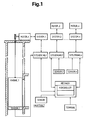
- a conveyor machine labeled MOTOR.1 drives an elevator car KABINE.1 of the elevator 1.
- the MOTOR.1 carrier is supplied with electrical energy by a SYSTEM.1 drive system, which is controlled by an elevator control unit CONTROL.1.
- load measuring devices or people counting devices are provided as design variants of a sensor SENSOR.1 arranged on the elevator car CABIN.1.
- the sensor SENSOR.1 is connected to the elevator control CONTROL1.
- KABINE.n correspond in structure and function to elevator 1.
- a sensor labeled SENSOR detects the arriving, building-filling passenger traffic at the main stop MAIN STOP.
- a process computer RECHNER stands with the elevator controls CONTROL 1; STEUERUNG.2 ... STEUERUNG.n, in connection with the sensor SENSOR and with an input / output unit TERMINAL.
- An algorithm CONTROLLER implemented in the process computer RECHNER controls the sending of the elevator cars CABIN.1; CABIN.2 ... CABIN.n.
- FIG. 2 shows the CONTROLLER algorithm implemented in the process computer RECHNER and the data sources and data sinks involved in the method.
- RECHNER the CONTROLLER algorithm implemented in the process computer RECHNER and the data sources and data sinks involved in the method.
- light barriers, turnstiles, infrared detectors, field detectors or call registration devices are provided for the detection of incoming, building-filling passenger traffic as design variants of the SENSOR sensor.
- the building-filling passenger traffic departing from the main MAIN STOP station is served by the KABINE.1; KABINE.2 ... KABINE.n arranged sensors SENSOR.1; SENSOR.2 ... SENSOR.n recorded and sent to the elevator controls CONTROL1. STEUERUNG.2 ... STEUERUNG.n passed on.
- Constants required in the process can be freely selected and are controlled by the CONTROLLER algorithm using the input / output unit TERMINAL communicated.
- Target calls DCL detected by the sensor SENSOR and by the sensors SENSOR.1; SENSOR.2 ... SENSOR.n recorded actual shutdown loads LFB.1; LFB.2 ... LFB.n are imported and processed by the KONTROLLER algorithm.
- the constants calibration factor 1 CF1, calibration factor 2 CF2, calibration factor 3 CF3, calibration factor 4 CF4, calibration factor 5 CF5, calibration factor 6 CF6, nominal load LCC, minimum conveying capacity MTC, number of lifts NOC, number of floors NOF, step-on basis PAB are used in the KONTROLLER algorithm Freely selectable input / output unit TERMINAL.
- the KONTROLLER algorithm creates a TCA funding field and an IVA interval field.
- a delivery capacity TC and a target time interval IV are determined as a function of a target shutdown load SL, the value of SL being equal to one.
- the value of the calculated delivery rate TC or the calculated target time interval IV is stored in a field component designated by the index SL, which is represented by the symbol [], of the delivery rate field TCA or the interval field IVA.
- the symbol: means an assignment of the value to the right of the symbol to the variable to the left of the symbol.
- SL is increased by one in each case.
- the first sequence of steps is repeated until SL has reached the value LCC.
- the KONTROLLER algorithm prepares the data necessary to control the sending.
- a traffic volume UT depends on the destination calls DCL imported from the sensor SENSOR and a traffic volume UT determined depending on the actual departure load LFB.x of the boarding cabin (KABINE.x) imported from the elevator control STEUERUNG.x.
- the KONTROLLER algorithm then calculates the delivery rate TC from the higher of the two traffic volumes UT and checks whether the value corresponds to at least the minimum delivery rate MTC.
- the target departure load SL corresponding to the delivery capacity TC determined from the traffic volume UT is determined from the delivery performance field TCA.
- the target time interval IV is determined in an analogous manner.
- the CONTROLLER algorithm evaluates the now known data for controlling the dispatch.
- the actual departure load LFB.x is compared with the target departure load SL until there is equality between the actual and target.
- a comparison is made between an actual time interval IT and the target time interval IV.
- step S1 shows the structure and the sequential sequence of the CONTROLLER algorithm.
- step S2 all the constants and variables used in the CONTROLLER algorithm are brought once to the initial state in a known manner.
- step S2 one of the steps S3; S4 ... S6 comprehensive iteration procedure for calculating the delivery rate TC and the target time interval IV as well as for creating the data fields delivery rate field TCA and interval field IVA.
- step S3 the delivery rate TC is calculated as a function of the target departure load SL.
- the to calculate the including acceleration, deceleration, door and exit losses are estimated at m seconds.
- the round trip time can be calculated from the stop number and the stop time.
- the target time interval IV is calculated as a function of the calibration factor 2 CF2, the target departure load SL, the conveying capacity TC and the number of elevators NOC.
- the conveying capacity TC or calculated in step S3 the target time interval IV calculated in step S4 is stored in the output field TCA or in the interval field IVA. With each iteration of the iteration procedure, the calculated values are assigned to the field components of the one-dimensional data fields indexed with SL.
- step S7 in which it is checked whether the control controls from the elevator controls 1; STEUERUNG.2 ... STEUERUNG.n imported status variable Elevator Start CS.1; linked with the OR operator V; CS.2 ... CS.n have a one.
- a positive result of the test justifies the start of the actual time interval IT shown in step S8.
- step S9 it is checked whether CONTROLLING.1; STEUERUNG.2 ... STEUERUNG.n using the status variable data request DR.1; DR.2 ... DR.n data are requested.
- the elevator control STEUERUNG.x demanding data is identified.
- the KONTROLLER algorithm thus knows the index of the actual shutdown load LFB.x to be imported in later steps and the door closing command DC.x to be exported in later steps.
- a positive result of the test justifies the execution of the steps S10 explained in FIG. 4; S11 ... S28, in which the traffic volume UT is determined depending on the building-filling passenger traffic.
- the delivery rate TC is in Step S29 is calculated from the calibration factor 5 CF5 and the traffic volume UT.
- the conveying capacity TC which is dependent on the traffic volume UT, is checked in step S30 to determine whether it corresponds in value to at least the minimum conveying capacity MTC.
- a negative result of the test justifies the execution of step S39, in which the target departure load SL and the target time interval IV are assigned predetermined values.
- step S39 the CONTROLLER algorithm continues the control cycle in step S36.
- a positive result of the test carried out in step S30 justifies the execution of step sequence S31; S32 ... S38.
- step S31 the target departure load SL is reset to zero.
- the target departure load SL is set to one and the field component of the delivery performance field TCA indicated with SL is compared with the delivery performance TC calculated on the basis of the traffic volume UT.
- the target departure load SL made into the run variable is increased by one and the field component indicated with SL is thus selected.
- step S32 The iteration procedure of step S32 is repeated until the delivery rate TC stored in the delivery rate field TCA corresponds to the delivery rate TC calculated on the basis of the traffic volume UT.
- step S34 the field component of the interval field IVA indicated with SL is addressed and the component value is assigned to the variable target time interval IV.
- the target time interval IV addressed in the interval field IVA on the basis of the departure load SL determined in steps S32 and S33 is calibrated in step S35 with the calibration factor 6 CF6.
- step S36 checks in step S37 the actual departure load LFB.x of the boarding cabin (KABINE.x) and the actual time interval IT until either the actual departure load LFB.x equals the target departure load SL or the actual -Time interval IT is equal to the target time interval IV.
- the door closing command DC.x is exported in step S38 to the elevator control unit CONTROL.x, which sends the boarding cabin (KABINE.x). This completes a control cycle of the CONTROLLER algorithm.
- step S10 the variables necessary for determining the traffic volume UT are prepared by resetting the variable boarding calls PCL and the variable boarding PCA to zero in steps S10 and S11.
- step S12 the CONTROLLER algorithm imports the destination calls DCL detected by the sensor SENSOR.
- steps S13 and S14 the target calls ALT DCL ALT and actual departure load ALT LFB.x ALT used in the detection of the traffic volume UT are assigned the target calls DCL current at the beginning of the detection and the current actual departure load LFB.x at the beginning of the detection .
- step S16 With the start of the boarding time PAT in step S15, the detection of the traffic volume UT is initiated.
- step S16 one of the steps S17; S18 ... S24 comprehensive iteration procedure for recording the change made during the boarding time PAT with regard to target calls DCL and actual departure load LFB.x.
- the current destination calls DCL are imported in step S17 and a call difference DDC is calculated in step S18 from the current destination calls DCL and the old destination calls DCL ALT .
- the current target calls DCL are then assigned to the old target calls DCL ALT in step S19.
- step S20 the call difference DDC is added to the boarding calls PCL which have already been recorded.
- steps S21; S22 ... S24 a sequence is shown, which with the in steps S17; S18 ... S20 is identical and in which essentially a boarding difference LD is calculated and this already registered boarders PCA is added up.
- the iteration procedure shown in step S16 is repeated until either the boarding calls PCL or the boarding PCA have reached the value of the boarding base PAB imported from the input / output unit TERMINAL.
- the detection of the traffic volume UT is completed.
- step S26 it is checked whether more boarding calls PCL than boarding PCA were detected during the boarding time PAT.
- step S27 A positive result of the test justifies the execution of step S27, in which the traffic volume UT is extrapolated, for example, to five minutes from the boarding calls PCL and the boarding time PAT.
- step S26 A negative result of the check in step S26 justifies the execution of step S28, in which the traffic volume UT is extrapolated, for example, to five minutes from the boarders PCA and the boarding time PAT.
Landscapes
- Engineering & Computer Science (AREA)
- Automation & Control Theory (AREA)
- Elevator Control (AREA)
- Sub-Exchange Stations And Push- Button Telephones (AREA)
- Traffic Control Systems (AREA)
- Indicating And Signalling Devices For Elevators (AREA)
Priority Applications (1)
| Application Number | Priority Date | Filing Date | Title |
|---|---|---|---|
| AT88115869T ATE88980T1 (de) | 1987-12-22 | 1988-09-27 | Verfahren zur steuerung der absendung von aufzugskabinen von der haupthaltestelle bei aufwaertsspitzenverkehr. |
Applications Claiming Priority (2)
| Application Number | Priority Date | Filing Date | Title |
|---|---|---|---|
| CH5000/87 | 1987-12-22 | ||
| CH500087 | 1987-12-22 |
Publications (2)
| Publication Number | Publication Date |
|---|---|
| EP0321657A1 true EP0321657A1 (fr) | 1989-06-28 |
| EP0321657B1 EP0321657B1 (fr) | 1993-05-05 |
Family
ID=4286228
Family Applications (1)
| Application Number | Title | Priority Date | Filing Date |
|---|---|---|---|
| EP88115869A Expired - Lifetime EP0321657B1 (fr) | 1987-12-22 | 1988-09-27 | Procédé pour la commande des départs de cabines d'ascenseurs depuis le palier principal lors des pointes de trafic |
Country Status (10)
| Country | Link |
|---|---|
| US (1) | US4926976A (fr) |
| EP (1) | EP0321657B1 (fr) |
| JP (1) | JP2648505B2 (fr) |
| CN (1) | CN1010298B (fr) |
| AT (1) | ATE88980T1 (fr) |
| CA (1) | CA1301968C (fr) |
| DE (1) | DE3880805D1 (fr) |
| ES (1) | ES2041756T3 (fr) |
| FI (1) | FI98062C (fr) |
| HK (1) | HK58794A (fr) |
Cited By (4)
| Publication number | Priority date | Publication date | Assignee | Title |
|---|---|---|---|---|
| WO1997019882A1 (fr) * | 1995-11-30 | 1997-06-05 | Otis Elevator Company | Estimation par logique floue de la frequentation en rez-de-chaussee et du coefficient de frequentation pour la gestion des renvois d'ascenseurs en situation de trafic a une seule origine |
| WO1997019878A1 (fr) * | 1995-11-30 | 1997-06-05 | Otis Elevator Company | Fenetres de planification pour repartiteur d'ascenseurs |
| US6439349B1 (en) | 2000-12-21 | 2002-08-27 | Thyssen Elevator Capital Corp. | Method and apparatus for assigning new hall calls to one of a plurality of elevator cars |
| US8534426B2 (en) | 2007-08-06 | 2013-09-17 | Thyssenkrupp Elevator Corporation | Control for limiting elevator passenger tympanic pressure and method for the same |
Families Citing this family (16)
| Publication number | Priority date | Publication date | Assignee | Title |
|---|---|---|---|---|
| US5241142A (en) * | 1988-06-21 | 1993-08-31 | Otis Elevator Company | "Artificial intelligence", based learning system predicting "peak-period" ti |
| US5276295A (en) * | 1990-09-11 | 1994-01-04 | Nader Kameli | Predictor elevator for traffic during peak conditions |
| US5139112A (en) * | 1990-10-31 | 1992-08-18 | Otis Elevator Company | Elevator car door lock |
| US5329076A (en) * | 1992-07-24 | 1994-07-12 | Otis Elevator Company | Elevator car dispatcher having artificially intelligent supervisor for crowds |
| JPH07187525A (ja) * | 1993-11-18 | 1995-07-25 | Masami Sakita | 複数ばこエレベータシステム |
| US5625176A (en) * | 1995-06-26 | 1997-04-29 | Otis Elevator Company | Crowd service enhancements with multi-deck elevators |
| US5714725A (en) * | 1995-11-30 | 1998-02-03 | Otis Elevator Company | Closed loop adaptive fuzzy logic controller for elevator dispatching |
| US5841084A (en) * | 1995-11-30 | 1998-11-24 | Otis Elevator Company | Open loop adaptive fuzzy logic controller for elevator dispatching |
| US5767462A (en) * | 1995-11-30 | 1998-06-16 | Otis Elevator Company | Open loop fuzzy logic controller for elevator dispatching |
| US5767460A (en) * | 1995-11-30 | 1998-06-16 | Otis Elevator Company | Elevator controller having an adaptive constraint generator |
| US5786551A (en) * | 1995-11-30 | 1998-07-28 | Otis Elevator Company | Closed loop fuzzy logic controller for elevator dispatching |
| US5786550A (en) * | 1995-11-30 | 1998-07-28 | Otis Elevator Company | Dynamic scheduling elevator dispatcher for single source traffic conditions |
| JP3551618B2 (ja) * | 1996-05-20 | 2004-08-11 | 株式会社日立製作所 | エレベーターの群管理制御装置 |
| JP2009502691A (ja) | 2005-08-04 | 2009-01-29 | インベンテイオ・アクテイエンゲゼルシヤフト | ユーザをエレベータシステムへと割り当てるための方法 |
| WO2009024853A1 (fr) * | 2007-08-21 | 2009-02-26 | De Groot Pieter J | Système de commande d'ascenseur de destination intelligent |
| US8950555B2 (en) * | 2011-04-21 | 2015-02-10 | Mitsubishi Electric Research Laboratories, Inc. | Method for scheduling cars in elevator systems to minimize round-trip times |
Citations (5)
| Publication number | Priority date | Publication date | Assignee | Title |
|---|---|---|---|---|
| BE626924A (fr) * | ||||
| US2938604A (en) * | 1958-12-24 | 1960-05-31 | Elevators Supplies Company Inc | Elevator control system |
| US4058187A (en) * | 1975-09-04 | 1977-11-15 | United Technologies Corporation | Limited stop elevator dispatching system |
| EP0030163A2 (fr) * | 1979-12-03 | 1981-06-10 | Otis Elevator Company | Intervalle variable d'envoi de cabines d'ascenseur pendant une pointe de trafic montant |
| GB2121212A (en) * | 1982-05-06 | 1983-12-14 | Master Designer Limited | Building services control |
Family Cites Families (3)
| Publication number | Priority date | Publication date | Assignee | Title |
|---|---|---|---|---|
| US2854096A (en) * | 1956-10-12 | 1958-09-30 | K M White Company | Elevator dispatching and control system |
| US4838384A (en) * | 1988-06-21 | 1989-06-13 | Otis Elevator Company | Queue based elevator dispatching system using peak period traffic prediction |
| US4846311A (en) * | 1988-06-21 | 1989-07-11 | Otis Elevator Company | Optimized "up-peak" elevator channeling system with predicted traffic volume equalized sector assignments |
-
1988
- 1988-09-27 EP EP88115869A patent/EP0321657B1/fr not_active Expired - Lifetime
- 1988-09-27 AT AT88115869T patent/ATE88980T1/de not_active IP Right Cessation
- 1988-09-27 ES ES198888115869T patent/ES2041756T3/es not_active Expired - Lifetime
- 1988-09-27 DE DE8888115869T patent/DE3880805D1/de not_active Expired - Lifetime
- 1988-11-15 CA CA000583141A patent/CA1301968C/fr not_active Expired - Lifetime
- 1988-12-20 US US07/287,009 patent/US4926976A/en not_active Expired - Lifetime
- 1988-12-21 FI FI885899A patent/FI98062C/fi not_active IP Right Cessation
- 1988-12-21 CN CN88108798A patent/CN1010298B/zh not_active Expired
- 1988-12-22 JP JP63324729A patent/JP2648505B2/ja not_active Expired - Fee Related
-
1994
- 1994-06-04 HK HK58794A patent/HK58794A/xx not_active IP Right Cessation
Patent Citations (5)
| Publication number | Priority date | Publication date | Assignee | Title |
|---|---|---|---|---|
| BE626924A (fr) * | ||||
| US2938604A (en) * | 1958-12-24 | 1960-05-31 | Elevators Supplies Company Inc | Elevator control system |
| US4058187A (en) * | 1975-09-04 | 1977-11-15 | United Technologies Corporation | Limited stop elevator dispatching system |
| EP0030163A2 (fr) * | 1979-12-03 | 1981-06-10 | Otis Elevator Company | Intervalle variable d'envoi de cabines d'ascenseur pendant une pointe de trafic montant |
| GB2121212A (en) * | 1982-05-06 | 1983-12-14 | Master Designer Limited | Building services control |
Cited By (6)
| Publication number | Priority date | Publication date | Assignee | Title |
|---|---|---|---|---|
| WO1997019882A1 (fr) * | 1995-11-30 | 1997-06-05 | Otis Elevator Company | Estimation par logique floue de la frequentation en rez-de-chaussee et du coefficient de frequentation pour la gestion des renvois d'ascenseurs en situation de trafic a une seule origine |
| WO1997019878A1 (fr) * | 1995-11-30 | 1997-06-05 | Otis Elevator Company | Fenetres de planification pour repartiteur d'ascenseurs |
| US5750946A (en) * | 1995-11-30 | 1998-05-12 | Otis Elevator Company | Estimation of lobby traffic and traffic rate using fuzzy logic to control elevator dispatching for single source traffic |
| US5808247A (en) * | 1995-11-30 | 1998-09-15 | Otis Elevator Company | Schedule windows for an elevator dispatcher |
| US6439349B1 (en) | 2000-12-21 | 2002-08-27 | Thyssen Elevator Capital Corp. | Method and apparatus for assigning new hall calls to one of a plurality of elevator cars |
| US8534426B2 (en) | 2007-08-06 | 2013-09-17 | Thyssenkrupp Elevator Corporation | Control for limiting elevator passenger tympanic pressure and method for the same |
Also Published As
| Publication number | Publication date |
|---|---|
| FI885899A7 (fi) | 1989-06-23 |
| ES2041756T3 (es) | 1993-12-01 |
| US4926976A (en) | 1990-05-22 |
| HK58794A (en) | 1994-06-17 |
| EP0321657B1 (fr) | 1993-05-05 |
| JPH01203184A (ja) | 1989-08-15 |
| DE3880805D1 (de) | 1993-06-09 |
| CN1010298B (zh) | 1990-11-07 |
| FI98062B (fi) | 1996-12-31 |
| CA1301968C (fr) | 1992-05-26 |
| CN1034519A (zh) | 1989-08-09 |
| FI98062C (fi) | 1997-04-10 |
| ATE88980T1 (de) | 1993-05-15 |
| JP2648505B2 (ja) | 1997-09-03 |
Similar Documents
| Publication | Publication Date | Title |
|---|---|---|
| EP0321657B1 (fr) | Procédé pour la commande des départs de cabines d'ascenseurs depuis le palier principal lors des pointes de trafic | |
| EP1319625B1 (fr) | Dispositif et méthode pour la modernisation d'ascenseur | |
| EP2391567B1 (fr) | Procédé de fonctionnement d'une installation d'ascenseur | |
| DE3611173C2 (de) | Fahrstuhlanlage mit mehreren Doppelabteil-Kabinen | |
| EP2475606B1 (fr) | Procédé permettant de faire fonctionner un système d'ascenseur | |
| DE69417152T2 (de) | Steuerungsverfahren für eine Aufzugsgruppe | |
| DE69714347T2 (de) | Aufzugssystem mit Gruppensteuerung | |
| EP2370334A1 (fr) | Commande d'ascenseur pour une installation d'ascenseur | |
| EP1418147A1 (fr) | Contrôleur pour ascenseur avec cabine avec plusieurs compartiments | |
| EP0324068A1 (fr) | Procédé pour régler le trafic sur le palier principal d'une installation d'ascenceurs | |
| DE69205949T2 (de) | Aufzugssystem mit dynamisch veränderbarer Türhaltezeit. | |
| EP0301173A1 (fr) | Commande d'un groupe d'ascenceurs | |
| EP0419802B1 (fr) | Méthode de traîtement des appels de destination faits en cabine d'ascenseur | |
| EP0846642A1 (fr) | Système d'optimisation de groupes pour traffic décroissant | |
| DE112016006890B4 (de) | Aufzugseinrichtung | |
| EP1935824B1 (fr) | Procédé et système destinés à la modernisation d'un élévateur | |
| DE60104689T2 (de) | Verteilungsalgorithmus für zyklisch betriebener aufzug | |
| DE112013007085B4 (de) | Aufzugsteuersystem | |
| WO2016091919A1 (fr) | Procédé de détermination d'une charge dans une cabine d'un système d'ascenseur | |
| DE2004812C2 (de) | Steuereinrichtung zur Steuerung der Geschwindigkeit einer schnell fahrenden Fahrstuhlkabine | |
| CN114890258A (zh) | 一种电梯智能速度控制方法和系统 | |
| EP0407731A1 (fr) | Méthode de traitement d'appels enregistrés en cabine d'ascenseur | |
| DE102018201757A1 (de) | Personenfördervorrichtung mit vorgegebener Fahrtrichtung | |
| DE102018213575B4 (de) | Verfahren zum Betreiben einer Aufzuganlage mit Vorgabe einer vorbestimmten Fahrtroute sowie Aufzuganlage und Aufzugsteuerung zur Ausführung eines solchen Verfahrens | |
| WO2012004274A1 (fr) | Dispositif électronique doté d' un dispositif de refroidissement |
Legal Events
| Date | Code | Title | Description |
|---|---|---|---|
| PUAI | Public reference made under article 153(3) epc to a published international application that has entered the european phase |
Free format text: ORIGINAL CODE: 0009012 |
|
| AK | Designated contracting states |
Kind code of ref document: A1 Designated state(s): AT CH DE ES FR GB IT LI NL |
|
| 17P | Request for examination filed |
Effective date: 19891113 |
|
| 17Q | First examination report despatched |
Effective date: 19911004 |
|
| GRAA | (expected) grant |
Free format text: ORIGINAL CODE: 0009210 |
|
| AK | Designated contracting states |
Kind code of ref document: B1 Designated state(s): AT CH DE ES FR GB IT LI NL |
|
| REF | Corresponds to: |
Ref document number: 88980 Country of ref document: AT Date of ref document: 19930515 Kind code of ref document: T |
|
| REF | Corresponds to: |
Ref document number: 3880805 Country of ref document: DE Date of ref document: 19930609 |
|
| GBT | Gb: translation of ep patent filed (gb section 77(6)(a)/1977) |
Effective date: 19930601 |
|
| ET | Fr: translation filed | ||
| ITF | It: translation for a ep patent filed | ||
| REG | Reference to a national code |
Ref country code: ES Ref legal event code: FG2A Ref document number: 2041756 Country of ref document: ES Kind code of ref document: T3 |
|
| PLBE | No opposition filed within time limit |
Free format text: ORIGINAL CODE: 0009261 |
|
| STAA | Information on the status of an ep patent application or granted ep patent |
Free format text: STATUS: NO OPPOSITION FILED WITHIN TIME LIMIT |
|
| 26N | No opposition filed | ||
| REG | Reference to a national code |
Ref country code: GB Ref legal event code: IF02 |
|
| PGFP | Annual fee paid to national office [announced via postgrant information from national office to epo] |
Ref country code: DE Payment date: 20070921 Year of fee payment: 20 |
|
| PGFP | Annual fee paid to national office [announced via postgrant information from national office to epo] |
Ref country code: ES Payment date: 20070927 Year of fee payment: 20 |
|
| PGFP | Annual fee paid to national office [announced via postgrant information from national office to epo] |
Ref country code: AT Payment date: 20070917 Year of fee payment: 20 |
|
| PGFP | Annual fee paid to national office [announced via postgrant information from national office to epo] |
Ref country code: GB Payment date: 20070914 Year of fee payment: 20 |
|
| PGFP | Annual fee paid to national office [announced via postgrant information from national office to epo] |
Ref country code: NL Payment date: 20070913 Year of fee payment: 20 Ref country code: IT Payment date: 20070924 Year of fee payment: 20 |
|
| PGFP | Annual fee paid to national office [announced via postgrant information from national office to epo] |
Ref country code: CH Payment date: 20071212 Year of fee payment: 20 |
|
| PGFP | Annual fee paid to national office [announced via postgrant information from national office to epo] |
Ref country code: FR Payment date: 20070914 Year of fee payment: 20 |
|
| REG | Reference to a national code |
Ref country code: CH Ref legal event code: PL |
|
| REG | Reference to a national code |
Ref country code: GB Ref legal event code: PE20 Expiry date: 20080926 |
|
| PG25 | Lapsed in a contracting state [announced via postgrant information from national office to epo] |
Ref country code: NL Free format text: LAPSE BECAUSE OF EXPIRATION OF PROTECTION Effective date: 20080927 |
|
| NLV7 | Nl: ceased due to reaching the maximum lifetime of a patent |
Effective date: 20080927 |
|
| REG | Reference to a national code |
Ref country code: ES Ref legal event code: FD2A Effective date: 20080929 |
|
| PG25 | Lapsed in a contracting state [announced via postgrant information from national office to epo] |
Ref country code: GB Free format text: LAPSE BECAUSE OF EXPIRATION OF PROTECTION Effective date: 20080926 |
|
| PG25 | Lapsed in a contracting state [announced via postgrant information from national office to epo] |
Ref country code: ES Free format text: LAPSE BECAUSE OF EXPIRATION OF PROTECTION Effective date: 20080929 |