EP0321974A1 - Commande du battant pour un métier à tisser - Google Patents
Commande du battant pour un métier à tisser Download PDFInfo
- Publication number
- EP0321974A1 EP0321974A1 EP88121482A EP88121482A EP0321974A1 EP 0321974 A1 EP0321974 A1 EP 0321974A1 EP 88121482 A EP88121482 A EP 88121482A EP 88121482 A EP88121482 A EP 88121482A EP 0321974 A1 EP0321974 A1 EP 0321974A1
- Authority
- EP
- European Patent Office
- Prior art keywords
- toggle lever
- drive
- support
- slay
- arm
- Prior art date
- Legal status (The legal status is an assumption and is not a legal conclusion. Google has not performed a legal analysis and makes no representation as to the accuracy of the status listed.)
- Granted
Links
- 238000009941 weaving Methods 0.000 claims abstract description 19
- 235000014676 Phragmites communis Nutrition 0.000 claims abstract description 15
- 230000000295 complement effect Effects 0.000 claims abstract description 15
- 239000006096 absorbing agent Substances 0.000 claims description 3
- 230000035939 shock Effects 0.000 claims description 3
- 239000004744 fabric Substances 0.000 abstract description 6
- 230000007246 mechanism Effects 0.000 abstract description 3
- 238000004519 manufacturing process Methods 0.000 description 2
- 238000000034 method Methods 0.000 description 2
- 230000008569 process Effects 0.000 description 2
- 238000005452 bending Methods 0.000 description 1
- 230000008859 change Effects 0.000 description 1
- 230000006835 compression Effects 0.000 description 1
- 238000007906 compression Methods 0.000 description 1
- 230000005484 gravity Effects 0.000 description 1
- 230000003993 interaction Effects 0.000 description 1
- 230000009467 reduction Effects 0.000 description 1
- 239000000126 substance Substances 0.000 description 1
- 239000004753 textile Substances 0.000 description 1
Images

Classifications
-
- D—TEXTILES; PAPER
- D03—WEAVING
- D03D—WOVEN FABRICS; METHODS OF WEAVING; LOOMS
- D03D49/00—Details or constructional features not specially adapted for looms of a particular type
- D03D49/60—Construction or operation of slay
Definitions
- the invention relates to a loom drive for a loom with a toggle lever moved by a complementary curve drive, which is articulated on the one hand on the machine frame and on the other hand on the loom support.
- a parking device for a weaving machine in which the sley is driven by a crank rod that can be bent.
- the crank rod is bent by an angle lever under spring resistance.
- the break point is arranged slightly below the longitudinal line of the crank rod, so that the crank rod is stable when pressure is exerted.
- it cannot be subjected to tension, since the crank rod would then stretch somewhat, so that the break point and the two end points of the crank rod lie on one line, as a result of which the crank lever would be in an unstable position.
- the return movement of the sley takes place in the known storage device by the weight of the sley. Because to turn off the kink point of the crank rod against the angle lever, it can only be switched off when the sley is moving.
- the sley In textile looms, the sley is usually driven directly by a crank or other cam mechanism. In the heavier weaving machines for technical fabrics, for example paper machine clothing, a higher impact force of the reed is required and the sley is therefore mostly driven by a toggle lever which is driven by an eccentric or complementary curve drive. The toggle lever is guided.
- the invention has for its object to improve a shutter drive of the type mentioned so that the weaving speed is increased.
- the pivot point of the sley support can be placed close to the sley, which means that when the stop point moves e.g. 80 mm the massive sley only has to move by 63 mm.
- a further reduction in the mass to be moved can be achieved in that the complementary curve drive and the toggle lever are arranged below the heald support and the toggle lever engages the heald support below its pivot point, since the height of the loom support can then be reduced to less than half. At the same time, the shutter drive takes up less space.
- the arm of the toggle lever articulated on the loom support is preferably designed to be able to be bent about a break point and the inflection point is guided on a curve, the curve being swiveled away for quick shutdown and, in addition, with quick shutdown a shock absorber being pivoted up to the point at which the toggle lever is articulated on the loom support.
- the quick-release device takes into account that the part of the toggle lever articulated on the loom support works both on pressure and on tension. Since the curve can be swung away regardless of a movement of the sley, the quick shutdown can also be carried out when the sley is stationary.
- the complementary curve drive is driven by the main shaft of the weaving machine. While in a conventional weaving machine for the production of paper machine screens from chemical wires, the loom support has a length of typically 1.3 m, the pivot point being at the lower end and the reed making a movement of 270 mm, a loom support is sufficient in a comparable loom drive according to the invention a length of about 0.5 m.
- the upper fret of the reed moves on an arc with a radius of 255 mm.
- the toggle lever is also articulated at a distance of 255 mm below the pivot point.
- the upper fret of the reed like the articulation point between the shop support and the toggle, moves on an arc of 91 mm in length.
- the center of gravity of the sley which is closer to the fulcrum, moves on an arc of 63 mm in length.
- the shorter length of the loom support not only reduces the mass to be moved, but the reed also describes a shorter path. Both contribute to increasing the working speed of the weaving machine.
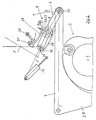
- FIG 1 only the warp beam 12, the shaft frame 13, the goods tree 14 and the sley 18 of the loom support 1 and its drive are shown of a weaving machine.
- the shutter drive has a toggle lever 2 and a complementary curve drive 3.
- the sley 18 carries the reed 4 at its upper end.
- the sley support 1 can be pivoted about a pivot point 5, which is located approximately in the middle of the sley support 1.
- the toggle lever 2 has a first arm 6, which is articulated at the lower end of the weaving support 1 (articulation point 16), and a second arm 7, which is driven by the complementary curve drive 3.
- the first arm 6 is only about half the length of the second arm 7, and the toggle lever 2 is designed such that when the reed 4 is attached to the fabric (attachment point 15) it is almost completely folded, so that the two arms 6, 7 extend almost parallel and the toggle lever 2 is able to exert the greatest force.
- the toggle lever 2 opens so far that the two arms 6, 7 form an angle of approximately 30 °.
- the second arm 7 of the toggle lever 2 extends approximately horizontally and is arranged in such a way that its hinge point 17, with which it is attached to the machine frame, is offset on one side below the weaving support 1, while the connection point 19 of the two arms 6, 7 offset to the other side below the shop support 1 lies.
- the drive 3 is expediently designed as a double roller guide with two complementary curves.
- the second arm 7 has a leg 20 projecting approximately at an angle of 90 ° from the articulation point 17.
- a roller 21 or 22 is arranged, which roll on different curves 23, 24, which are complementary to each other, that is, the two curves 23, 24 have such a shape that both roles 21, 22 rest against the associated curve 23 or 24 and the second arm 7 is thereby positively guided in its movement.
- the shape of the curves 23, 24 and their interaction with the two rollers 21, 22 need not be described in more detail, since such double roller guides with complementary curves are generally known.
- the reed 4 strikes with its upper fret.
- the permissible stop force of the reed 4 is not as high as with a stop with the lower fret. However, it has been shown that in the production of sheet forming sieves from plastic wires, the striking force is sufficient even with a stop with the upper collar of the reed 4.
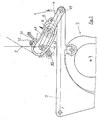
- Figure 2 shows a first embodiment of the quick-release device.
- the first arm 6 is designed to be foldable, so that the first arm 6 itself acts as a toggle lever.
- the first arm 6 In normal operation of the weaving machine, the first arm 6 is always in its almost extended position. It is only slightly bent upwards by a degree or two.
- the Bending point 8 of the first arm 6 In order to avoid buckling of the first arm 6 in normal operation, the Bending point 8 of the first arm 6 positively guided on a curve 9.
- two cam rollers 26, 27 are rotatably mounted next to one another at the break point 8, which roll during the normal weaving process in a cam 9, which is formed by a lower cam track 28 and an upper cam track 29.
- the lower cam track 28 is fixed, while the upper cam track 29 can be swung away upwards.
- the upper cam track 29 is pivoted upwards.
- a locking lever 30, which locks the upper cam track 29 during the weaving process is released by a cam disk 31.
- the first arm 6 can thereby buckle upward, so that it no longer exerts any force on the loom support 1.
- a shock absorber 10 is pivoted towards the articulation point 16.
- Figure 3 shows another embodiment of the quick-release device. It differs from the embodiment of Figure 2 in that the two cam tracks 28, 29 are firmly connected to each other and therefore the curve 9 is pivoted away at a quick stop, for which purpose the locking lever 30 is pivoted away by turning the cam 31 so that it Curve 9 releases.
- the pivoting away of the curve 9 and thus the buckling of the first arm 6 is supported by a compression spring 32.
Landscapes
- Engineering & Computer Science (AREA)
- Textile Engineering (AREA)
- Looms (AREA)
Priority Applications (1)
| Application Number | Priority Date | Filing Date | Title |
|---|---|---|---|
| AT88121482T ATE76666T1 (de) | 1987-12-22 | 1988-12-22 | Webladenantrieb fuer eine webmaschine. |
Applications Claiming Priority (2)
| Application Number | Priority Date | Filing Date | Title |
|---|---|---|---|
| DE19873743661 DE3743661A1 (de) | 1987-12-22 | 1987-12-22 | Webladenantrieb fuer eine webmaschine |
| DE3743661 | 1987-12-22 |
Publications (2)
| Publication Number | Publication Date |
|---|---|
| EP0321974A1 true EP0321974A1 (fr) | 1989-06-28 |
| EP0321974B1 EP0321974B1 (fr) | 1992-05-27 |
Family
ID=6343328
Family Applications (1)
| Application Number | Title | Priority Date | Filing Date |
|---|---|---|---|
| EP88121482A Expired - Lifetime EP0321974B1 (fr) | 1987-12-22 | 1988-12-22 | Commande du battant pour un métier à tisser |
Country Status (6)
| Country | Link |
|---|---|
| US (1) | US5000230A (fr) |
| EP (1) | EP0321974B1 (fr) |
| JP (1) | JPH01201552A (fr) |
| AT (1) | ATE76666T1 (fr) |
| CA (1) | CA1322316C (fr) |
| DE (2) | DE3743661A1 (fr) |
Cited By (1)
| Publication number | Priority date | Publication date | Assignee | Title |
|---|---|---|---|---|
| DE4122249C1 (fr) * | 1991-07-05 | 1992-09-24 | Juergens Maschinenbau Gmbh & Co Kg, 4407 Emsdetten, De |
Families Citing this family (1)
| Publication number | Priority date | Publication date | Assignee | Title |
|---|---|---|---|---|
| DE202005018856U1 (de) * | 2005-12-01 | 2007-04-12 | Wangner Gmbh & Co Kg | Halterung für das Webblatt einer Nahtwebmaschine, um den Nahtschussfaden wahlweise mittels Schrägstellung der Riete oder verfahrbarer Rolle einzuwälzen |
Citations (3)
| Publication number | Priority date | Publication date | Assignee | Title |
|---|---|---|---|---|
| DE302114C (fr) * | ||||
| DE2101720A1 (de) * | 1971-01-15 | 1972-09-21 | Emil Jäger KG, 4400 Münster | Antrieb für die Ladenbewegung von Webstühlen |
| DE2246431A1 (de) * | 1972-09-21 | 1974-04-04 | Rueti Ag Vorm Caspar Honegger | Webmaschine |
Family Cites Families (7)
| Publication number | Priority date | Publication date | Assignee | Title |
|---|---|---|---|---|
| US2159865A (en) * | 1937-10-05 | 1939-05-23 | Shimwell Oliver | Beat-up mechanism of looms for weaving |
| US2624372A (en) * | 1949-04-18 | 1953-01-06 | Draper Corp | Lay motion for looms |
| CS150044B1 (fr) * | 1971-07-12 | 1973-09-04 | ||
| DE2208881A1 (de) * | 1972-02-25 | 1973-09-06 | Jaeger Emil Kg | Drahtwebmaschine |
| CH633837A5 (de) * | 1978-06-30 | 1982-12-31 | Rueti Ag Maschf | Verfahren zur herstellung von florgewebe und webmaschine zur durchfuehrung des verfahrens. |
| FR2486550A1 (fr) * | 1980-07-10 | 1982-01-15 | Alsacienne Constr Meca | Dispositif permettant de modifier la position du peigne sur le battant d'une machine a tisser |
| FR2520015A1 (fr) * | 1982-01-21 | 1983-07-22 | Gagey Etienne | Dispositif pour la commande du battant d'un metier a tisser |
-
1987
- 1987-12-22 DE DE19873743661 patent/DE3743661A1/de not_active Withdrawn
-
1988
- 1988-12-21 CA CA000586704A patent/CA1322316C/fr not_active Expired - Fee Related
- 1988-12-22 DE DE8888121482T patent/DE3871510D1/de not_active Expired - Lifetime
- 1988-12-22 AT AT88121482T patent/ATE76666T1/de not_active IP Right Cessation
- 1988-12-22 EP EP88121482A patent/EP0321974B1/fr not_active Expired - Lifetime
- 1988-12-22 JP JP63325665A patent/JPH01201552A/ja active Pending
-
1990
- 1990-01-16 US US07/465,661 patent/US5000230A/en not_active Expired - Fee Related
Patent Citations (3)
| Publication number | Priority date | Publication date | Assignee | Title |
|---|---|---|---|---|
| DE302114C (fr) * | ||||
| DE2101720A1 (de) * | 1971-01-15 | 1972-09-21 | Emil Jäger KG, 4400 Münster | Antrieb für die Ladenbewegung von Webstühlen |
| DE2246431A1 (de) * | 1972-09-21 | 1974-04-04 | Rueti Ag Vorm Caspar Honegger | Webmaschine |
Cited By (3)
| Publication number | Priority date | Publication date | Assignee | Title |
|---|---|---|---|---|
| DE4122249C1 (fr) * | 1991-07-05 | 1992-09-24 | Juergens Maschinenbau Gmbh & Co Kg, 4407 Emsdetten, De | |
| EP0521244A1 (fr) * | 1991-07-05 | 1993-01-07 | JÜRGENS MASCHINENBAU GMBH & CO. KG | Métier à tisser |
| US5285820A (en) * | 1991-07-05 | 1994-02-15 | Jurgens Maschinenbau Gmbh & Co. Kg | Power loom lay or baton drive |
Also Published As
| Publication number | Publication date |
|---|---|
| EP0321974B1 (fr) | 1992-05-27 |
| US5000230A (en) | 1991-03-19 |
| CA1322316C (fr) | 1993-09-21 |
| ATE76666T1 (de) | 1992-06-15 |
| DE3871510D1 (de) | 1992-07-02 |
| JPH01201552A (ja) | 1989-08-14 |
| DE3743661A1 (de) | 1989-07-06 |
Similar Documents
| Publication | Publication Date | Title |
|---|---|---|
| DE3346487C2 (de) | Verfahren und Vorrichtung zum Bilden einer Einlegekante bei einem Frottiergewebe | |
| EP0450120A1 (fr) | Procédé et dispositif de gaze pour la réalisation des fausses lisières d'un tissu double sur métier à doubles grittes | |
| CH633837A5 (de) | Verfahren zur herstellung von florgewebe und webmaschine zur durchfuehrung des verfahrens. | |
| DE3408565A1 (de) | Einrichtung zur regulierung der spannung und zur ueberwachung der kettfaeden an einer webmaschine, insbesondere rundwebmaschine | |
| DE2911079C2 (de) | Bandwebmaschine mit Schäften und diesen zugeordneten Hebeln | |
| EP0321974B1 (fr) | Commande du battant pour un métier à tisser | |
| CH669799A5 (fr) | ||
| DE3319420C1 (de) | Stoffklammer fuer Naehmaschinen | |
| EP0586959B1 (fr) | Support pour le peigne d'un métier à tisser les jointures | |
| DE2329302A1 (de) | Vorrichtung zur gewebekantenbildung an webmaschinen | |
| DE1760975B2 (de) | Vorrichtung zum waehlen und vorlegen verschiedenartiger, immer mit dem gewebe verbunden bleibender schussfaeden fuer webmaschinen | |
| DE2659530A1 (de) | Webmaschine | |
| DE69102716T3 (de) | Schaltmechanismus für die Bewegung des Greiferrahmens einer Fachbildungsvorrichtung. | |
| DE2544199B2 (de) | Drehervorrichtung zur Bildung einer Endleiste an einer Gewebebahn | |
| DE2540265A1 (de) | Einrichtung zum steuern eines greiffingers eines schuss-austrag-traegers einer schuetzenlosen webmaschine | |
| AT517087B1 (de) | Rundwebmaschine mit einer Hauptwelle | |
| DE2442914B2 (de) | Vorrichtung zum herstellen von dreherkanten an den kanten eines doppelflorgewebes | |
| DE69104536T2 (de) | Verbesserter Mechanismus zur Webkantenerzeugung bei einem Gewebe, das auf einer schützenfreien Webmaschine gewebt wird. | |
| DE4415862C1 (de) | Einrichtung zum gesteuerten Betätigen der Fadenklemme eines Greifers in Webmaschinen | |
| EP0999161B1 (fr) | Dispositif pour compenser le mouvement d'avance d'une bande de film | |
| DE3224708A1 (de) | Einrichtung zur zwangslaeufigen betaetigung der klemmvorrichtung von schussfadeneintragorganen an schuetzenlosen webmaschinen | |
| CH648362A5 (de) | Fachbildevorrichtung an einer webmaschine. | |
| CH579162A5 (en) | Shedding arrangement for loom with needle rods - accurately guided auxiliary shaft prevents movements caused by deflection | |
| DE2626869C2 (de) | Cord-Schneidemaschine | |
| DE1152070B (de) | Doppelhub-Schaftmaschine |
Legal Events
| Date | Code | Title | Description |
|---|---|---|---|
| PUAI | Public reference made under article 153(3) epc to a published international application that has entered the european phase |
Free format text: ORIGINAL CODE: 0009012 |
|
| AK | Designated contracting states |
Kind code of ref document: A1 Designated state(s): AT BE CH DE ES FR GB IT LI NL SE |
|
| 17P | Request for examination filed |
Effective date: 19890721 |
|
| 17Q | First examination report despatched |
Effective date: 19910508 |
|
| ITF | It: translation for a ep patent filed | ||
| GRAA | (expected) grant |
Free format text: ORIGINAL CODE: 0009210 |
|
| AK | Designated contracting states |
Kind code of ref document: B1 Designated state(s): AT BE CH DE ES FR GB IT LI NL SE |
|
| PG25 | Lapsed in a contracting state [announced via postgrant information from national office to epo] |
Ref country code: NL Effective date: 19920527 Ref country code: ES Free format text: THE PATENT HAS BEEN ANNULLED BY A DECISION OF A NATIONAL AUTHORITY Effective date: 19920527 Ref country code: BE Effective date: 19920527 |
|
| REF | Corresponds to: |
Ref document number: 76666 Country of ref document: AT Date of ref document: 19920615 Kind code of ref document: T |
|
| REF | Corresponds to: |
Ref document number: 3871510 Country of ref document: DE Date of ref document: 19920702 |
|
| GBT | Gb: translation of ep patent filed (gb section 77(6)(a)/1977) | ||
| ET | Fr: translation filed | ||
| NLV1 | Nl: lapsed or annulled due to failure to fulfill the requirements of art. 29p and 29m of the patents act | ||
| PG25 | Lapsed in a contracting state [announced via postgrant information from national office to epo] |
Ref country code: AT Effective date: 19921222 |
|
| RAP2 | Party data changed (patent owner data changed or rights of a patent transferred) |
Owner name: NOVATECH GMBH SIEBE UND TECHNOLOGIE FUER PAPIER |
|
| PLBE | No opposition filed within time limit |
Free format text: ORIGINAL CODE: 0009261 |
|
| STAA | Information on the status of an ep patent application or granted ep patent |
Free format text: STATUS: NO OPPOSITION FILED WITHIN TIME LIMIT |
|
| 26N | No opposition filed | ||
| PGFP | Annual fee paid to national office [announced via postgrant information from national office to epo] |
Ref country code: FR Payment date: 19941012 Year of fee payment: 7 |
|
| PGFP | Annual fee paid to national office [announced via postgrant information from national office to epo] |
Ref country code: SE Payment date: 19941123 Year of fee payment: 7 |
|
| PGFP | Annual fee paid to national office [announced via postgrant information from national office to epo] |
Ref country code: GB Payment date: 19941201 Year of fee payment: 7 |
|
| PGFP | Annual fee paid to national office [announced via postgrant information from national office to epo] |
Ref country code: CH Payment date: 19941222 Year of fee payment: 7 |
|
| PGFP | Annual fee paid to national office [announced via postgrant information from national office to epo] |
Ref country code: DE Payment date: 19941229 Year of fee payment: 7 |
|
| EAL | Se: european patent in force in sweden |
Ref document number: 88121482.9 |
|
| PG25 | Lapsed in a contracting state [announced via postgrant information from national office to epo] |
Ref country code: GB Effective date: 19951222 |
|
| PG25 | Lapsed in a contracting state [announced via postgrant information from national office to epo] |
Ref country code: SE Effective date: 19951223 |
|
| PG25 | Lapsed in a contracting state [announced via postgrant information from national office to epo] |
Ref country code: LI Effective date: 19951231 Ref country code: CH Effective date: 19951231 |
|
| GBPC | Gb: european patent ceased through non-payment of renewal fee |
Effective date: 19951222 |
|
| REG | Reference to a national code |
Ref country code: CH Ref legal event code: PL |
|
| PG25 | Lapsed in a contracting state [announced via postgrant information from national office to epo] |
Ref country code: FR Effective date: 19960830 |
|
| PG25 | Lapsed in a contracting state [announced via postgrant information from national office to epo] |
Ref country code: DE Effective date: 19960903 |
|
| REG | Reference to a national code |
Ref country code: FR Ref legal event code: ST |
|
| PG25 | Lapsed in a contracting state [announced via postgrant information from national office to epo] |
Ref country code: IT Free format text: LAPSE BECAUSE OF NON-PAYMENT OF DUE FEES;WARNING: LAPSES OF ITALIAN PATENTS WITH EFFECTIVE DATE BEFORE 2007 MAY HAVE OCCURRED AT ANY TIME BEFORE 2007. THE CORRECT EFFECTIVE DATE MAY BE DIFFERENT FROM THE ONE RECORDED. Effective date: 20051222 |