EP0322155A1 - Synthèse de diméthylaluminium hydride à haute pureté - Google Patents
Synthèse de diméthylaluminium hydride à haute pureté Download PDFInfo
- Publication number
- EP0322155A1 EP0322155A1 EP88311880A EP88311880A EP0322155A1 EP 0322155 A1 EP0322155 A1 EP 0322155A1 EP 88311880 A EP88311880 A EP 88311880A EP 88311880 A EP88311880 A EP 88311880A EP 0322155 A1 EP0322155 A1 EP 0322155A1
- Authority
- EP
- European Patent Office
- Prior art keywords
- hydride
- dimethylaluminum
- group
- waste product
- reaction
- Prior art date
- Legal status (The legal status is an assumption and is not a legal conclusion. Google has not performed a legal analysis and makes no representation as to the accuracy of the status listed.)
- Withdrawn
Links
Images
Classifications
-
- C—CHEMISTRY; METALLURGY
- C07—ORGANIC CHEMISTRY
- C07F—ACYCLIC, CARBOCYCLIC OR HETEROCYCLIC COMPOUNDS CONTAINING ELEMENTS OTHER THAN CARBON, HYDROGEN, HALOGEN, OXYGEN, NITROGEN, SULFUR, SELENIUM OR TELLURIUM
- C07F5/00—Compounds containing elements of Groups 3 or 13 of the Periodic Table
- C07F5/06—Aluminium compounds
- C07F5/061—Aluminium compounds with C-aluminium linkage
- C07F5/065—Aluminium compounds with C-aluminium linkage compounds with an Al-H linkage
Definitions
- the present invention is directed to a method of producing high-purity dimethylaluminum hydride, and is particularly directed to a method of producing high-purity dimethylaluminum hydride from a waste source, i.e., the residual materials from a common method of producing trimethylgallium.
- III-V films such as Al-Ga-As films, useful for semiconducting applications, may be grown by chemical vapor deposition (CVD) as described by R. Bhat et al. J. of Crystal Growth , 77 (1986) 7-10.
- CVD requires a decomposable source material of each of the metallic elements to be deposited.
- the decomposable source of aluminum has traditionally been trimethylaluminum; however, dimethylaluminum hydride is advantageous in that less carbon contamination in the film results.
- Dimethylaluminum hydride is conventionally prepared from lithium aluminum hydride (LiAlH4) (referred to herein as LAH) and trimethylaluminum (TMA) by reaction (I) as follows: (I) (CH3)3Al + LiAlH4 ⁇ (CH3)2AlH + LiAlH3CH3, T. Wartick et al. J.A.C.S. 75 (1953) 835. It has also been prepared by splitting TMA under hydrogen pressure at 150-200°C.; T. Koster et al., German Democratic Republic Patent 16650 (1957); H.E. Podall et al. J. Org. Chem. 24 (1959) 1222.
- TMG trimethylgallium
- the conventional method of producing trimethylgallium is described by D.F. Gaines et al., Inorganic Synthesis 15 (1974) 203-207.
- Gallium trichloride is reacted with TMA according to the following reaction: GaCl3 + 3 (CH3)3Al ⁇ Ga(CH3)3 + 3 (CH3)2AlCl.
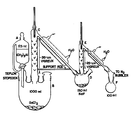
- Synthesis of TMG and disposal of the residual material is described as follows: "Sodium fluoride is dried in vacuo overnight.
- trimethylaluminum (a twofold excess) is transferred from a lecture cylinder to the addition funnel. This transfer is accomplished most readily by inverting the lecture bottle, attaching a hose connector (to which a 4-in. length of ca. 1/8-in.-o.d. stainless-steel tubing is soldered), and cautiously opening the main lecture-bottle valve after the stainless-steel tube has been inserted into the addition funnel.
- the trimethylaluminum is added slowly to the gallium trichloride over a period of about one hour. The reaction is extremely exothermic and is controlled by varying the addition rate of trimethylaluminum. External cooling should be avoided, as this may adversely affect the product yield.
- pyrophoric residues in flask B may be safely disposed of using the following procedure. After flask B has cooled to room temperature, about 900 ml. of heptane is run into it through the additional funnel A. The mixture is then stirred magnetically to ensure that all soluble residues are dissolved. The resulting 10% solution in heptane does not appear to be pyrophoric (it does smoke, however, when exposed to air).
- Flask B is then removed from the rest of the apparatus and its contents slowly poured onto 2-3 lb. of crushed Dry Ice contained in a 5-gal metal bucket. After the dry ice-heptane solution slurry has stood for about 0.5 hour, 1 l. of 95% ethyl alcohol is added slowly to ensure complete solvolysis. The bucket is then left undisturbed until it has warmed to room temperature.
- An alternate method suggested by the checkers is as follows. After flask B has cooled to room temperature about 600 ml. of a 10% ethyl acetate solution in heptane is run slowly into it through the addition funnel A. This addition is followed by slow addition of 300 ml. of 30% ethyl acetate in heptane.
- the waste product of the conventional synthesis of TMG rather that being discarded, can be used as a source of producing DMAH of high purity.
- the resulting DMAH is easily separated from the residual materials.
- the residual or waste products from the production of trimethylgallium are reacted with a metal hydride to produce dimethylaluminum hydride.
- the waste product of the production of trimethylgallium primarily contains three chemical species, each of which reacts with lithium aluminum hydride to yield dimethylaluminum hydride.
- the major species of the waste product is dimethylaluminum chloride which reacts with either a complex hydride of group IA and IIIA metals, an alkali metal hydride, or a group IIIA hydride to produce DMAH.
- the hydride may be a simple alkali metal hydride, such as sodium hydride, lithium hydride, or potassium hydride, a complex group IA-IIIA hydride, such as lithium aluminum hydride, or a group IIIA hydride such as AlH3 (aluminum hydride) or B2H6 (diborane).
- group IA-IIIA hydrides are that the residual products of the reaction be readily separable from the DMAH so that high-purity DMAH may be produced.
- reaction (II) of an alkali metal hydride (MH) with dimethylaluminum chloride is: (II) MH + (CH3)2AlCl ⁇ MC1 + (CH3)2AlH.
- Reaction (II) proceeds stoichiometrically.
- DMAH is a liquid having a boiling point of 154°C. DMAH is readily separable by distillation from the minor amount of TMG (B.P. 55°C), which remains after distillation and collection of the major portion of the TMG product, and from residual trimethylaluminum (B.P. 130°C). Unreacted metal hydride and metal chloride are solids, permitting initial separation of the liquid components therefrom, e.g., simply by decanting and/or filtering the liquid.
- MH and dimethylaluminum chloride it is considered to be desirable to use, as closely as possible, equal molar amounts of MH and dimethylaluminum chloride to minimize the levels of pyrophoric residue, i.e., MH and dimethylaluminum chloride.
- An advantage of the use of a MH is the reduction in the levels of pyrophoric waste product which is left.
- substantial precautions are required for disposal of the residue of TMG production, and the conversion of dimethylaluminum chloride to product dimethylaluminum hydride greatly minimizes these disposal problems.
- each of the metal-containing species reacts with LAH to yield DMAH as one of the reaction products.
- the DMAH which is produced is easily separable from the other reaction products; LiAlH3Cl, LiGaH3CH3 and LiAlH3CH3 are each solid at room temperature, and the liquid DMAH and other liquid components may be decanted and/or filtered therefrom.
- LAH at a molar equivalent of the combined TMA, TMG, and dimethylaluminum chloride. These can be calculated. A slight deficiency, e.g., up to about 10 molar %, of LAH will merely reduce efficiency slightly (each of reactions (I), (III), and (IV) are substantially stoichiometric). A molar ratio of LAH above about molar 10% relative to the metal-containing components of the waste material is considered to be wasteful and increases disposal problems.
- LAH alkali metal hydride
- the residual material is a very viscous material.
- the hydride be added to this viscous mixture to produce DMAH, it is preferred that the residual material be diluted with a suitable solvent to facilitate mixing of the solid hydride material with the liquid components.
- Suitable solvents are those which do not react with any of the reactants or other residual materials. Hydrocarbon solvents, including alphatic and aromatic solvents are useful, e.g., toluene, benzene, xylenes, hexanes, and petroleum ether are likewise suitable.
- Ether solvents such as n-butyl ether are also suitable. Water and alcohols are unsuitable. In selecting a solvent, it is preferred to select one with a boiling point substantially removed from that of DMAH (154°C) to facilitate removal by distillation.
- the reaction of the waste material from TMG material with a hydride is carried out under a dry, non-reactive atmosphere, e.g., dry nitrogen.
- reaction temperature is not considered to be critical, as the reactions will proceed readily at room temperature or above; however, as the reactions of hydrides with the waste product from the synthesis of TMG are exothermic, precautions, such as slow addition of the hydride to the waste material (or vise versa) are generally taken. If solvent is used, the reflux temperature of the solvent may be used to determine the reaction temperature.
- complex hydrides of the IA-IIIA type may be used, including but not limited to: NaBH4 (sodium borohydride), LiBH4 (lithium borohydride), LiBHR3, where R is a short-chain alkyl group (lithium trialkylborohydride), and NaAlH4 (sodium aluminum hydride).
- group III hydrides including aluminum hydride and diborane. These react with dimethylaluminum chloride as follows: (CH3)2AlCl + AlH3 ⁇ (CH3)2AlH + AlH2Cl 2 ( CH3)2AlCl + B2H6 ⁇ 2 (CH3)2Al + 2 BH2Cl
- the process of the present invention is considered highly advantageous in that it utilizes material which has heretofore been considered to be waste. Utilization of this "waste" material is considered to be especially valuable in view of precautions required for disposal of the same.
- a surprising and unexpected advantage of the process of the present invention is that it produces DMAH having a lower silicon content than DMAH produced according to conventional methods, i.e., from TMA. Hence, distillation of TMG from the residual materials removes many of the silicon-containing compounds. Because silicon, like carbon, is considered detrimental to III-V films formed by CVD, the TMA produced in accordance to the inventions is considered superior to that produced from substantially pure TMA.
- Liquid trimethylgallium reaction waste (480g) containing 90% Me2AlCl, 9% AlMe3 and ⁇ 1% TMG (all figures w/w) was placed in a 3-neck vessel which was then equipped with a constant addition funnel containing 1 l. of toluene. The solvent was added rapidly while stirring. Lithium aluminum hydride (250g) was added in 5-7g portions from a solid addition funnel at a rate such that the reaction mixture was maintained at a maximum temperature of 60°C. After completing the addition, the flask was immersed in an oil bath and further heated to 100°C for two (2) hours. After cooling, a Claisen distillation head and receiving flask was attached and the volatiles were taken off under full vacuum.
- the solid gray residue in the reaction flask was stored for deactivation and disposal.
- the flask containing the liquid phase was fitted with a fresh Claisen head and receiver; the system was evacuated and toluene was taken off at room temperature until the pressure was reduced to 2.5mm Hg. After changing receiver, the system was fully evacuated and a 30g forerun was collected. The receiver was changed yet again and under similar conditions; a 206g main fraction was collected, heating the distillaticn flask to a maximum temperature of 50°.
- a preparation of DMAH from TMG waste and NaH is carried out as follows: Working in a glove bag under argon atmosphere, a suspension of NaH in mineral oil is washed with pentane and dried by filtration and suction. Solid NaH powder (50g) is charged into a flask and added to 200g of trimethylgallium reaction waste diluted with 100ml of toluene. Again, the rate of addition is controlled by the rise in temperature of the solution. When the addition is complete, the flask is heated at 100°C for two (2) hours. After cooling, the solid NaCl is allowed to settle and the liquid phase is decanted into a fresh flask. Isolation of the product then proceeds as per Example I. The solid NaCl contains active material, possibly NaA1Me3H, and so it is suspended in toluene and deactivated by addition of isopropanol.
Landscapes
- Chemical & Material Sciences (AREA)
- Organic Chemistry (AREA)
- Organic Low-Molecular-Weight Compounds And Preparation Thereof (AREA)
Applications Claiming Priority (2)
| Application Number | Priority Date | Filing Date | Title |
|---|---|---|---|
| US13603287A | 1987-12-21 | 1987-12-21 | |
| US136032 | 1987-12-21 |
Publications (1)
| Publication Number | Publication Date |
|---|---|
| EP0322155A1 true EP0322155A1 (fr) | 1989-06-28 |
Family
ID=22470945
Family Applications (1)
| Application Number | Title | Priority Date | Filing Date |
|---|---|---|---|
| EP88311880A Withdrawn EP0322155A1 (fr) | 1987-12-21 | 1988-12-15 | Synthèse de diméthylaluminium hydride à haute pureté |
Country Status (2)
| Country | Link |
|---|---|
| EP (1) | EP0322155A1 (fr) |
| JP (1) | JPH01197489A (fr) |
Families Citing this family (4)
| Publication number | Priority date | Publication date | Assignee | Title |
|---|---|---|---|---|
| JP2763659B2 (ja) * | 1990-07-06 | 1998-06-11 | キヤノン株式会社 | 金属薄膜形成法 |
| JP2763658B2 (ja) * | 1990-07-06 | 1998-06-11 | キヤノン株式会社 | 金属薄膜形成法 |
| JP2016113365A (ja) * | 2013-03-29 | 2016-06-23 | 三井化学株式会社 | ジメチルアルミニウムハイドライドの製造方法 |
| JP7744264B2 (ja) * | 2022-03-01 | 2025-09-25 | 東ソー・ファインケム株式会社 | トリメチルアルミニウム含有組成物およびその製造方法 |
Citations (3)
| Publication number | Priority date | Publication date | Assignee | Title |
|---|---|---|---|---|
| US2915542A (en) * | 1958-02-04 | 1959-12-01 | Nat Distillers Chem Corp | Preparation of dimethylaluminum hydride |
| DE1164404B (de) * | 1958-12-29 | 1964-03-05 | Continental Oil Co | Verfahren zur Herstellung von Diaethylaluminiumhydrid |
| US4170604A (en) * | 1976-02-27 | 1979-10-09 | Stauffer Chemical Company | Production of dialkylaluminum hydrides |
-
1988
- 1988-12-15 EP EP88311880A patent/EP0322155A1/fr not_active Withdrawn
- 1988-12-19 JP JP31868688A patent/JPH01197489A/ja active Pending
Patent Citations (3)
| Publication number | Priority date | Publication date | Assignee | Title |
|---|---|---|---|---|
| US2915542A (en) * | 1958-02-04 | 1959-12-01 | Nat Distillers Chem Corp | Preparation of dimethylaluminum hydride |
| DE1164404B (de) * | 1958-12-29 | 1964-03-05 | Continental Oil Co | Verfahren zur Herstellung von Diaethylaluminiumhydrid |
| US4170604A (en) * | 1976-02-27 | 1979-10-09 | Stauffer Chemical Company | Production of dialkylaluminum hydrides |
Non-Patent Citations (1)
| Title |
|---|
| INORGANIC SYNTHESES * |
Also Published As
| Publication number | Publication date |
|---|---|
| JPH01197489A (ja) | 1989-08-09 |
Similar Documents
| Publication | Publication Date | Title |
|---|---|---|
| CA1323034C (fr) | Procede de fabrication ou de purification de composes organometalliques du groupe iii-a | |
| EP1153026B1 (fr) | Procede de preparation d'etherate de trifluoroarylaluminium | |
| CN103958529A (zh) | 制备三烷基镓化合物的方法 | |
| JP3880025B2 (ja) | 高純度トリメチルインジウムおよびその合成方法 | |
| EP0322155A1 (fr) | Synthèse de diméthylaluminium hydride à haute pureté | |
| US4924019A (en) | Synthesis of high purity dimethylaluminum hydride | |
| US4656013A (en) | Process for producing germanes | |
| EP0648215B1 (fr) | Procede de preparation de composes trialkyle de metaux du groupe 3a | |
| JP6890649B2 (ja) | トリアルキルガリウム化合物の調製及びその使用 | |
| US4118409A (en) | Process for the simultaneous production of trimethylaluminum and alkylaluminum halides | |
| CN105473599B (zh) | 用于生产烷基铟化合物的方法及其用途 | |
| US5380895A (en) | Method for the synthesis of metal alkyls and metal aryls | |
| US3255224A (en) | Process for the production of complex alkali aluminum alkyls or alkali aluminum alkyl hydrides | |
| US5145600A (en) | Low viscosity hydrocarbon solution of dialkylmagnesium compounds | |
| US7256314B2 (en) | Method for generating secondary phosphines | |
| US5097052A (en) | Preparation of sodium aluminum alkyls | |
| US10640519B2 (en) | Method for producing metal organyls | |
| EP1284949A2 (fr) | Synthese et isolation d'alcoxydes metalliques | |
| JPH05310764A (ja) | 高純度モノアルキルまたはモノアリ−ルアルシン化合物の製造方法 | |
| GB2268489A (en) | Process for the preparation of DI-ALKYL compounds of group 2B metals |
Legal Events
| Date | Code | Title | Description |
|---|---|---|---|
| PUAI | Public reference made under article 153(3) epc to a published international application that has entered the european phase |
Free format text: ORIGINAL CODE: 0009012 |
|
| AK | Designated contracting states |
Kind code of ref document: A1 Designated state(s): BE DE FR GB NL SE |
|
| 17P | Request for examination filed |
Effective date: 19891220 |
|
| RAP1 | Party data changed (applicant data changed or rights of an application transferred) |
Owner name: MORTON INTERNATIONAL, INC. |
|
| 17Q | First examination report despatched |
Effective date: 19910517 |
|
| STAA | Information on the status of an ep patent application or granted ep patent |
Free format text: STATUS: THE APPLICATION IS DEEMED TO BE WITHDRAWN |
|
| 18D | Application deemed to be withdrawn |
Effective date: 19910928 |