EP0324747B1 - Silylgruppen enthaltendes verzweigtes polymerisat, verfahren zu seiner herstellung, überzugsmittel auf basis des polymerisats sowie deren verwendung - Google Patents
Silylgruppen enthaltendes verzweigtes polymerisat, verfahren zu seiner herstellung, überzugsmittel auf basis des polymerisats sowie deren verwendung Download PDFInfo
- Publication number
- EP0324747B1 EP0324747B1 EP87905748A EP87905748A EP0324747B1 EP 0324747 B1 EP0324747 B1 EP 0324747B1 EP 87905748 A EP87905748 A EP 87905748A EP 87905748 A EP87905748 A EP 87905748A EP 0324747 B1 EP0324747 B1 EP 0324747B1
- Authority
- EP
- European Patent Office
- Prior art keywords
- weight
- monomers
- polymer
- ethylenically unsaturated
- appropriate
- Prior art date
- Legal status (The legal status is an assumption and is not a legal conclusion. Google has not performed a legal analysis and makes no representation as to the accuracy of the status listed.)
- Expired - Lifetime
Links
Classifications
-
- C—CHEMISTRY; METALLURGY
- C08—ORGANIC MACROMOLECULAR COMPOUNDS; THEIR PREPARATION OR CHEMICAL WORKING-UP; COMPOSITIONS BASED THEREON
- C08F—MACROMOLECULAR COMPOUNDS OBTAINED BY REACTIONS ONLY INVOLVING CARBON-TO-CARBON UNSATURATED BONDS
- C08F230/00—Copolymers of compounds having one or more unsaturated aliphatic radicals, each having only one carbon-to-carbon double bond, and containing phosphorus, selenium, tellurium or a metal
- C08F230/04—Copolymers of compounds having one or more unsaturated aliphatic radicals, each having only one carbon-to-carbon double bond, and containing phosphorus, selenium, tellurium or a metal containing a metal
- C08F230/08—Copolymers of compounds having one or more unsaturated aliphatic radicals, each having only one carbon-to-carbon double bond, and containing phosphorus, selenium, tellurium or a metal containing a metal containing silicon
-
- C—CHEMISTRY; METALLURGY
- C09—DYES; PAINTS; POLISHES; NATURAL RESINS; ADHESIVES; COMPOSITIONS NOT OTHERWISE PROVIDED FOR; APPLICATIONS OF MATERIALS NOT OTHERWISE PROVIDED FOR
- C09D—COATING COMPOSITIONS, e.g. PAINTS, VARNISHES OR LACQUERS; FILLING PASTES; CHEMICAL PAINT OR INK REMOVERS; INKS; CORRECTING FLUIDS; WOODSTAINS; PASTES OR SOLIDS FOR COLOURING OR PRINTING; USE OF MATERIALS THEREFOR
- C09D143/00—Coating compositions based on homopolymers or copolymers of compounds having one or more unsaturated aliphatic radicals, each having only one carbon-to-carbon double bond, and containing boron, silicon, phosphorus, selenium, tellurium, or a metal; Coating compositions based on derivatives of such polymers
- C09D143/04—Homopolymers or copolymers of monomers containing silicon
-
- C—CHEMISTRY; METALLURGY
- C08—ORGANIC MACROMOLECULAR COMPOUNDS; THEIR PREPARATION OR CHEMICAL WORKING-UP; COMPOSITIONS BASED THEREON
- C08F—MACROMOLECULAR COMPOUNDS OBTAINED BY REACTIONS ONLY INVOLVING CARBON-TO-CARBON UNSATURATED BONDS
- C08F230/00—Copolymers of compounds having one or more unsaturated aliphatic radicals, each having only one carbon-to-carbon double bond, and containing phosphorus, selenium, tellurium or a metal
- C08F230/04—Copolymers of compounds having one or more unsaturated aliphatic radicals, each having only one carbon-to-carbon double bond, and containing phosphorus, selenium, tellurium or a metal containing a metal
- C08F230/08—Copolymers of compounds having one or more unsaturated aliphatic radicals, each having only one carbon-to-carbon double bond, and containing phosphorus, selenium, tellurium or a metal containing a metal containing silicon
- C08F230/085—Copolymers of compounds having one or more unsaturated aliphatic radicals, each having only one carbon-to-carbon double bond, and containing phosphorus, selenium, tellurium or a metal containing a metal containing silicon the monomer being a polymerisable silane, e.g. (meth)acryloyloxy trialkoxy silanes or vinyl trialkoxysilanes
Definitions
- EP-A-158 161 discloses hydroxyl-containing branched acrylate copolymers which are obtained by copolymerizing hydroxyl-containing esters of acrylic or methacrylic acid, monomers with at least 2 polymerizable, olefinically unsaturated double bonds and other ethylenically unsaturated monomers.
- the branched acrylate copolymers can be combined with melamine-formaldehyde resins or with polyisocyanates to form a coating agent which can be cured at low temperatures.
- the coating compositions have good properties with regard to petrol resistance and resistance to long-term exposure to water or water vapor, these properties being in particular due to the branched structure of the acrylate copolymers.
- the polymers can be prepared by catalytic hydrosilylation on the double bonds of a polymer with olefinically unsaturated groups.
- the described resins dissolved in organic solvent result in one-component coating compositions which, when using suitable curing catalysts, cure under the influence of moisture even at low temperatures.
- a metallic basecoat which contains polymers containing silyl groups, the silyl groups being bound to hydrolyzable groups, an acrylate resin and / or a cellulose compound and / or a reactive silicone component.
- Basecoat / clearcoat systems are known from US Pat. Nos. 4,499,150 and 4,499,151, in which either the basecoat, the clearcoat or both the basecoat and the clearcoat contain polyadducts with alkoxy or acyloxysilane units.
- the basecoat can be overcoated with the clearcoat after a short flash-off.
- all conventional monomers with at least one double bond can be used for the polyacrylate.
- only monomers with an ethylenically unsaturated double bond are used to prepare the acrylate copolymers containing silyl groups.
- EP-A-159 715 describes a silicone polymer which can be obtained by polymerizing at least one ethylenically unsaturated monomer with reactive, hydrolyzable silicone groups, a compound with at least two ethylenically unsaturated groups and in the presence of a radical initiator or a polymerization regulator with reactive silicone groups .
- a polyalkylene oxide with reactive silicone groups is used as the organic polymer.
- the moisture-curable polymer described can be obtained, for example, by reacting 100 parts of the unsaturated monomer, 10 to 1000 parts of the silicone polymer, 0.5 to 50 parts of the monomers with at least two independent ethylenically unsaturated groups and 0.01 to 20 parts of the silicone regulator or of the silicone initiator. Too high a proportion of polyfunctional monomer leads to gelation, furthermore the tendency towards gelation depends on both the regulator and initiator content.
- EP-A-159 715 states that too high a proportion of polyfunctional monomers can lead to gelation of the product.
- compositions described lead to an improved tensile strength of the cured polymer.
- a disadvantage of the compositions described is that a high proportion of undesirable side reactions can occur.
- the cited document does not show that there is a dependency between the tendency to gel and the polymerization temperature.
- EP-A-159 716 describes silicone resins which are prepared by polymerizing at least one unsaturated compound in the presence of an organic polymer with reactive, hydrolyzable silicone groups and with ethylenically unsaturated groups and at least one component from the group of silicone regulators or silicone initiators.
- the organic polymer is based, for example, on polyalkylene oxides. Together with ethylenically unsaturated monomers, compounds with at least two ethylenically unsaturated double bonds can also be polymerized, silicone-modified monomers also being used. Too high a proportion of polyethylenically unsaturated monomers leads to gelation. According to the description of EP-A-159 716, the polymerization temperature is not critical for the tendency to gel.
- EP-A-169 536 describes moisture-curing systems based on a polymer with at least one reactive silicone group per molecule and on the basis of silanol compounds or compounds which can hydrolyze to silanols.
- the silicone groups of the polymer react with the silanol compound in such a way that some of the reactive silicone groups are no longer available as crosslinking sites but only serve to extend the chain.
- the compositions described cure under the influence of moisture to give an elastomeric material with good tensile strength and good surface properties.
- the compositions are preferably used as sealing materials.
- the polymer with at least one reactive silicone group per molecule can be formed by addition polymerization, monomers with reactive silicone groups also being used.
- monomers with at least two ethylenically unsaturated double bonds can also be incorporated into the addition polymer.
- these are used in a proportion of less than 4% by weight, based on the total weight of the monomers, in the addition polymerization.
- the improvement in the elasticity of the coatings obtained is attributed in particular to the addition of the silanol component.
- the object of the present invention was to provide binders for moisture-curing one-component coating compositions, which should cure at low temperature and the resulting coatings compared to the known moisture-curing silicone resins have improved properties with regard to gasoline resistance and with respect to the resistance to long-term exposure to Wasesr or should have water vapor.
- the coating agents should be easy to prepare and largely avoid side reactions.
- Component b) can furthermore advantageously be a polycarboxylic acid or unsaturated monocarboxylic acid esterified with an unsaturated alcohol containing a polymerizable double bond.
- a reaction product product of a polyisocyanate and an unsaturated alcohol or an amine can advantageously be used as component b).
- An example of this is the reaction product from one mole of hexamethylene diisocyanate and two moles of allyl alcohol or the reaction product from isophorone diisocyanate and hydroxyethyl acrylate.
- Another advantageous component b) is a diester of polyethylene glycol and / or polypropylene glycol with an average molecular weight of less than 1500, preferably less than 1000, and acrylic acid and / or methacrylic acid.
- reaction products from a carboxylic acid with a polymerizable, olefinically unsaturated double bond and glycidyl acrylate and / or glycidyl methacrylate and reaction products of dicarboxylic acid with glycidyl acrylate and / or glycidyl methacrylate are also suitable.
- Such polyethylenically unsaturated monomers should, however, only be used according to the invention in small proportions because they contain hydroxyl groups which can react with the silane monomers (a). This also applies to polyethylenically unsaturated monomers which are formed from diepoxide compounds and ethylenically unsaturated monomers with a primary or secondary amino group, since these products also contain hydroxyl groups.
- ethylenically unsaturated neutral monomers (component c) is not particularly critical. These can be selected from the group of styrene, vinyl toluene, alkyl esters of acrylic acid and methacrylic acid, alkoxyethyl acrylates and aryloxyethyl acrylates and the corresponding methacrylates and esters of maleic and fumaric acid.
- Examples are methyl acrylate, ethyl acrylate, propyl acrylate, butyl acrylate, isopropyl acrylate, isobutyl acrylate, pentyl acrylate, isoamyl acrylate, hexyl acrylate, 2-ethylhexyl acrylate, octyl acrylate, 3,5,5-trimethylhexyl acrylate, decyl acrylate, dodecyl acrylate, hexadecyl acrylate, octadecyl acrylate, octadecenyl acrylate, pentyl acrylate, isoamyl methacrylate, hexyl methacrylate , 2-Ethylbutylmethyacrylat, octyl methacrylate, 3,5,5-Trimethylhexylmethacrylat methacrylate, decyl methacrylate, dodecy
- an ethylenically unsaturated carboxamide can be used.
- Suitable components d) are, for example, acrylic acid amide, methacrylic acid amide, itaconic acid diamide, ⁇ -ethyl acrylamide, crotonic acid amide, fumaric acid amide and maleic acid diamide.
- ethylenically unsaturated monomers with a hydroxyl group a carboxyl group or an amino group
- component e up to 5% by weight of ethylenically unsaturated monomers with a hydroxyl group, a carboxyl group or an amino group
- hydroxyl group-containing ethylenically unsaturated monomers are hydroxyl alkyl esters of acrylic acid and / or methacrylic acid, e.g. Hydroxyethyl acrylate, hydroxypropyl acrylate, hydroxybutyl acrylate, hydroxyamyl acrylate, hydroxyhexyl acrylate, hydroxyoctyl acrylate and the corresponding methacrylates.
- Component e) can also be a reaction product of one mole of hydroxyethyl acrylate and / or hydroxyethyl methacrylate and an average of 2 moles of e-caprolactone.
- Component e) can also be a hydroxyl-containing ester of acrylic acid or methacrylic acid with a secondary hydroxyl group, such as 2-hydroxypropyl acrylate, 2-hydroxybutyl acrylate, 3-hydroxybutyl acrylate and the corresponding methacrylates.
- polymerizable monomer containing hydroxyl groups is a reaction product of acrylic acid and / or methacrylic acid with the glycidyl ester of a carboxylic acid having a tertiary a-carbon atom.
- ethylenically unsaturated monomers with a carboxyl group are methacrylic acid and acrylic acid.
- a suitable ethylenically unsaturated monomer with an amino group is N-tert-butylaminoethyl acrylate.
- the copolymerization reactions for the preparation of the polymers according to the invention are carried out using at least 2% by weight, based on the total weight of the ethylenically unsaturated monomers, of a polymerization regulator without active OH or NH groups, mercaptosilanes being preferably used as regulators. It follows that only certain regulators are often suitable for certain combinations of the monomers a) to e) to be polymerized.
- multiply ethylenically unsaturated acrylate or methacrylate compounds are copolymerized in a proportion of at least 15% by weight, based on the moment weight, monomers without groups with active hydrogen (component c)) should predominantly be acrylate monomers and / or methacrylate atoms and / or maleic and / or fumaric acid esters can be used.
- the copolymerization should be carried out in the presence of more than 6% by weight, based on the monomer wiped, of a mercaptosilane, preferably mercaptoethyltriethoxysilane or mercaptopropylmethyldimethoxysilane, optionally together with other mercapto compounds.
- Suitable ethylenically unsaturated monomers a) to c) and of the monomers d) and e) which may be used additionally are the aforementioned examples of components a) to e) of the polymer containing silyl groups described.
- a pre-crosslinked but not gelled copolymer can be obtained by suitable polymerization conditions.
- Preferred initiators are azo initiators, such as azobisiobutyronitrile. With a low proportion of the polyhydric unsaturated monomers used (component b)), peroxyesters can also be used as initiators. An example of this is tert-butyl peroxy-2-ethylhexanoate. Of course, azo initiators with reactive silicone groups can also be used. These are used in a proportion of 0.01 to 20 parts by weight per 100 parts by weight of the polymerizable monomers.
- EP-A-159 715 and EP-A-159 716 Examples of azo initiators containing reactive silicone groups can be found in EP-A-159 715 and EP-A-159 716.
- Mercaptosilanes or mixtures of mercaptosilanes with other mercapto compounds are preferably used as polymerization regulators. Only those mercapto compounds which do not react with silyl groups, ie which have no OH or NH groups, are suitable. Examples of suitable mercaptosilanes which can be used as polymerization regulators are listed below:
- Examples of other mercapto compounds are an n- or t-dodecyl mercaptan.
- Mercaptoethyltriethyloxysilane is particularly preferably used as a polymerization regulator.
- the polymerization regulators are advantageously used in a proportion of at least 4% by weight, based on the total weight of the monomers.
- the radial-scale polymerization is carried out at temperatures of 80-130 ° C, preferably at 90-120 ° C.
- the free-radical polymerization for producing the polymer containing silyl groups is advantageously carried out in such a way that a solution of the polymer with a solids content of 40-65% by weight results.
- Non-reactive solvents such as, for example, esters, ethers, hydrocarbons, alcohols and ketones, are suitable as solvents for the radialcalic polymerization.
- the present invention also relates to moisture-curable coating compositions which contain the previously described silyl group-containing polymer, organic solvent, optionally pigments, fillers and customary auxiliaries and additives, and a crosslinking catalyst. Without the addition of a crosslinking catalyst, the coating compositions have a sufficiently long pot life. If suitable crosslinking catalysts are added, the coating compositions cure quickly with moisture at room temperature or slightly elevated temperature.
- Suitable crosslinking catalysts are, for example, phosphoric acid, p-toluenesulfonic acid, tin dibutyl dilaurate, tin dioctyl dilaurate, amines, for example aliphatic diamines such as ethylenediamine, hexane diamine, aliphatic polyamines such as diethylene triamine, triethylene tetramine, tetraethylene pentamine, alicyclic amine, pamine amine, pamine furthermore alkali catalysts, such as, for example, potassium hydroxide or sodium hydroxide.
- 0.01 to 10 parts by weight of the catalyst are used per 100 parts by weight of the polymer.
- the invention also relates to processes for the preparation of the coating compositions described above, which are characterized in that the polymer containing silyl groups, organic solvent, optionally pigments, fillers and additives are processed into a coating composition by mixing and, if appropriate, dispersing agents and are used shortly before use Crosslinking catalyst is added.
- the coating agents described are particularly suitable for the refinishing of car bodies.
- the coating compositions according to the invention are also outstandingly suitable as basecoats containing pigments and / or metal pigments or as topcoats or as basecoats and topcoats of a multi-coat coating system, which can optionally be applied by the two-coat wet process.
- the coating compositions described have improved properties with regard to petrol resistance and with respect to resistance to long-term exposure to water or water vapor compared to known silicone-modified copolymers.
- the solvent mixture was heated to the stated polymerization temperature, the temperature was maintained throughout the polymerization.
- the specified monomer mixtures (including regulator) and initiator solutions were metered in separately.
- the feed times were 3 hours for the monomer mixture (inci. Regulator), 3.5 hours for the initiator solution, in Example 5 the initiator feed was started 10 minutes after the monomer feed, otherwise the two feeds were started simultaneously; the feed was carried out uniformly over the stated time, and after the initiator feed had ended, the polymerization was continued for a further 2 hours at the stated polymerization temperature.
- the acrylic resins from Examples 3 and 6 were concentrated by distilling off the solvent mixture to a solids content of 64.4 (3) and 59.8% (6) and used in this form in the paints.
Landscapes
- Chemical & Material Sciences (AREA)
- Organic Chemistry (AREA)
- Polymers & Plastics (AREA)
- Health & Medical Sciences (AREA)
- Chemical Kinetics & Catalysis (AREA)
- Medicinal Chemistry (AREA)
- Materials Engineering (AREA)
- Wood Science & Technology (AREA)
- Engineering & Computer Science (AREA)
- Life Sciences & Earth Sciences (AREA)
- Addition Polymer Or Copolymer, Post-Treatments, Or Chemical Modifications (AREA)
- Paints Or Removers (AREA)
- Automobile Manufacture Line, Endless Track Vehicle, Trailer (AREA)
- Application Of Or Painting With Fluid Materials (AREA)
Description
- Die Erfindung betrifft ein Silylgruppen enthaltendes Polymerisat, wobei die Silylgruppen durch ethylenisch ungesättigte Monomere der allgemeinen Formel

- R1 = Alkyl, Aryl, Acyl, Aralkyl mit 1 bis 10 Kohlenstoffatomen
- R2 = organischer Rest mit polymerisierbarer Doppelbindung
- X = hydrolisierbare Gruppe
- n = 1, 2 oder 3
in das Polymerisat eingebracht werden. - Aus der EP-A-158 161 sind Hydroxylgruppen enthaltende verzweigte Acrylatcopolymerisate bekannt, die erhalten werden durch Copolymerisation von hydroxylgruppenhaltigen Estern der Acryl- oder Methacrylsäure, Monomeren mit mindestens 2 polymerisierbaren, olefinisch ungesättigten Doppelbindungen und weiteren ethylenisch ungesättigten Monomeren. Die verzweigten Acrylatcopolymerisate können mit Melamin-Formaldehyd-Harzen oder mit Polyisocyanaten zu einem Überzugsmittel kombiniert werden, welches bei niedrigen Temperaturen gehärtet werden kann. Die Überzugsmittel haben gute Eigenschaften in bezug auf Benzinfestigkeit und Beständigkeit gegenüber langfristiger Belastung durch Wasser bzw. Waserdampf, wobei diese Eigenschaften insbesondere auf die verzweigte Struktur der Acrylatcopolymerisate zurückzuführen sind.
- Aus der EP-A-48 461 und der EP-A-63 753 sind Vinylharze bekannt, die Silylgruppen enthalten, welche mit einem hydrolisierbaren Rest verknüpft sind. Die Silylgruppen enthaltenden Polymerisate können u.a. erhalten werden durch radikalische Polymerisation von Silylmonomeren der allgemeinen Formel

- R1 = Alkyl, Aryl, Acyl, Aralkyl mit 1 bis 10 Kohlenstoffatomen
- R2 = organischer Rest mit polymerisierbarer Doppelbindung
- X = hydrolisierbare Gruppe
- n=1,2oder3 3
- Darüber hinaus sind die Polymeren herstellbar durch katalytische Hydrosilylierung an die Doppelbindungen eines Polymeren mit olefinisch ungesättigten Gruppen. Die beschriebenen, in organischem Lösungsmittel gelösteon Harze ergeben Einkomponenten-Überzugszusammensetzungen, die bei Verwendung geeigneter Härtungskatalysatoren unter Feuchtigkeitseinfluß bereits bei niedrigen Temperaturen aushärten.
- Aus der EP-A-63 817 ist ein Metallic-Basislack bekannt, der Silylgruppen enthaltende Polymerisate, wobei die Silylgruppen an hydrolisierbare Gruppen gebunden sind, ein Acrylatharz und/oder eine Celluloseverbindung und/oder eine rekative Silicon-Komponente enthält.
- Aus den US-Patentschriften Nr. 4,499,150 und 4,499,151 sind Basislack/Klarlack-Systeme bekannt, bei denen entweder der Basislack, der Klarlack oder sowohl der Basis- als auch der Klarlack Polyadditionsprodukte mit Alkoxy- oder Acyloxysilaneinheiten enthalten. Der Basislack kann nach kurzem Ablüften mit dem Klarlack überlackiert werden. Gemäß dieser Patentschriften können für das Polyacrylat alle üblichen Monomeren mit midestens einer Doppelbindung verwendet werden. In der Beschreibung und in den Ausführungsbeispielen werden ausschließlich Monomere mit einer ethylenisch ungesättigten Doppelbindung zur Herstellung der Silylgruppen enthaltenden Acrylatcopolymerisate verwendet.
- Die EP-A-159 715 beschreibt ein Silicon-Polymer, welches erhältlich ist durch Polymerisation von mindestens einem ethylenisch ugesättigten Monomeren mit reaktiven, hydrolisierbaren Silicongruppen, einer Verbindung mit mindestens zwei ethylenisch ungesättigten Gruppen und in Gegenwart eines radikalischen Initiators oder eines Polymerisationsreglers mit reaktiven Silicongruppen. Als organisches Polymeres wird beispielsweise ein Polyalkylenoxid mit reaktiven Silicongruppen verwendet. Diese reaktiven Silicongruppen sind befähigt, Kondensationsreaktionen in Gegenwart von Feuchtigkeit und in Gegenwart geeigneter Katalysatoren einzugehen. Das beschriebene feuchtigkeitshärtbare Polymere ist beispielsweise erhältlich durch Reaktion von 100 Teilen des ungesättigten Monomeren, 10 bis 1000 Teilen des Siliconpolymeren, 0,5 bis 50 Teilen der Monomeren mit mindestens zwei unabhängigen ethylenisch ungesättigten Gruppen und 0,01 bis 20 Teilen des Silicon-Reglers oder des Silicon-Initiators. Ein zu hoher Anteil an polyfunktionellem Monomer führt zum Gelieren, des weiteren ist die Gelierungstendenz abhängig sowohl vom Regler- als auch von Initiatorgehalt.
- Unter den genannten Reaktionsbedingungen ist eine Pfropfreaktion der ethylenisch ungesättigten Monomeren auf das vorgelegte Siliconharz nicht auszuschließen. In der EP-A-159 715 erfolgt die Aussage, daß ein zu hoher Anteil an polyfunktionellen Monomeren zur Gelierung des Produktes führen kann.
- Die beschriebenen Zusammensetzungen führen zu einer verbesserten Zugfestigkeit des gehärteten Polymeren. Ein Nachteil der beschriebenen Zusammensetzungen besteht darin, daß ein hoher Anteil an unerwünschten Nebenreaktionen auftreten kann. Der genannten Druckschrift ist nicht zu entnehmen, daß eine Abhängigkeit zwischen der Gelierungstendenz und der Polymerisationstemperatur besteht.
- Die EP-A-159 716 beschreibt Siliconharze, welche hergestellt werden durch Polymerisation von mindestens einer ungesättigten Verbindung in Gegenwart eines organischen Polymeren mit reaktiven, hydrolisierbaren Silicongruppen und mit ethylenisch ungesättigten Gruppen und mindestens einer Komponente aus der Gruppe von Siliconreglern oder Siliconinitiatoren. Das organische Polymere basiert beispielsweise auf Polyalkylenoxiden. Zusammen mit ethylenisch ungesättigten Monomeren können auch Verbindungen mit mindestens zwei ethylenisch ungesättigten Doppelbindungen polymerisiert werden, wobei auch Silicon-modifizierte Monomere verwendet werden. Ein zu hoher Anteil an mehrfach ethylenisch ungesättigten Monomeren führt zur Gelierung, gemäß der Beschreibung der EP-A-159 716 ist die Polymerisationstemperatur nicht kritisch für die Gelierungstendenz.
- Die EP-A-169 536 beschreibt feuchtigkeitshärtende Systeme auf Basis eines Polymeren mit mindestens einer reaktiven Silicongruppe pro Molekül und auf der Basis von Silanolverbindungen bzw. Verbindungen, die zu Silanolen hydrolisieren können. Bei der Feuchtigkeitshärtung reagieren die Silicongruppen des Polymeren mit der Silanolverbindung in der Weise, daß ein Teil der reaktiven Silicongruppen nicht mehr als Vernetzungsstellen zur Verfügung stehen, sondern lediglich zur Kettenverlängerung dienen. Die beschriebenen Zusammensetzungen härten unter dem Einfluß von Feuchtigkeit zu einem elastomeren Material mit guter Zugfestigkeit und guten Oberflächeneigenschaften. Die Zusammensetzungen werden bevorzugt verwendet als Versiegelungsmaterialien.
- Das Polymere mit mindestens einer reaktiven Silicongruppe pro Molekül kann durch Additionspolymerisation gebildet werden, wobei Monomere mit reaktiven Silicongruppen mitverwendet werden. Bei dieser Additionspolymerisation können auch Monomere mit mindestens zwei ethylenisch ungesättigten Doppelbindungen mit in das Additionspolymere eingebaut werden. In den Ausführungsbeispielen werden diese in einem Anteil von weniger als 4 Gew.%, bezogen auf das Gesamtgewicht der Monomeren, bei der Additionspolymerisation verwendet. Die Verbesserung der Elastizität der erhaltenen Überzüge wird insbesondere zurückgeführt auf den Zusatz der Silanol-Komponente.
- Die Aufgabe der vorliegenden Erfindung bestand darin, Bindemittel für feuchtigkeitshärtende Einkomponenten-Beschichtungsmittel zur Verfügung zu stellen, wobei diese bei niedriger Temperatur aushärten sollten und die resultierenden Überzüge im Vergleich zu den bekannten feuchtigkeitshärtenden Siliconharzen verbesserte Eingenschaften bezüglich Benzinfestigkeit und bezüglich der Beständigkeit gegenüber langfristiger Belastung durch Wasesr bzw. Wasserdampf aufweisen sollten. Die Überzugsmittel sollten sich problemlos und unter weitgehender Vermeidung von Nebenreaktionen darstellen lassen.
- Die der Erfindung zugrundeliegende Aufgabe wird durch ein Silylgruppen enthaltendes Polymerisat der eingangs genannten Art gelöst, das dadurch gekennzeichnet ist, daß das Polymerisat erhälten ist durch Copolymerisation von
- a) 0,1 bis 40 Gew.% der Silanmonomeren (a),
- b) 5 bis 30 Gew.%, bevorzugt 8 bis 25 Gew.%, Monomeren mit mindestens zwei polymerisierbaren enthlenisch ungesättigten Doppelbindungen und
- c) 30 bis 90 Gew.% ethylenisch ungesättigten Monomeren ohne Gruppen mit aktivem Wasserstoff, wobei die Summe von a), b) und c) 100 Gew.% beträgt.
- Als Silanmonomere (Komponente a) werden ethlenisch ungesättigte Monomere der allgemeinen Formel

- R1 = Alkyl, Aryl, Acyl, Aralkyl mit 1 bis 10 Kohlenstoffatomen
- R2 = organischer Rest mit polymerisierbarer Doppelbindung
- X = hydrolisierbare Gruppe
- n = 1, 2 oder 3
eingesetzt. Die hydrolisierbare Gruppe X kann beispielsweise ein Halogenrest, ein Alkoxirest, ein Acyloxirest, ein Mercaptorest oder ein Alkenyloxirest sein. - Im folgenden werden geeignete Beispiele für die Silanmonomeren aufgeführt:


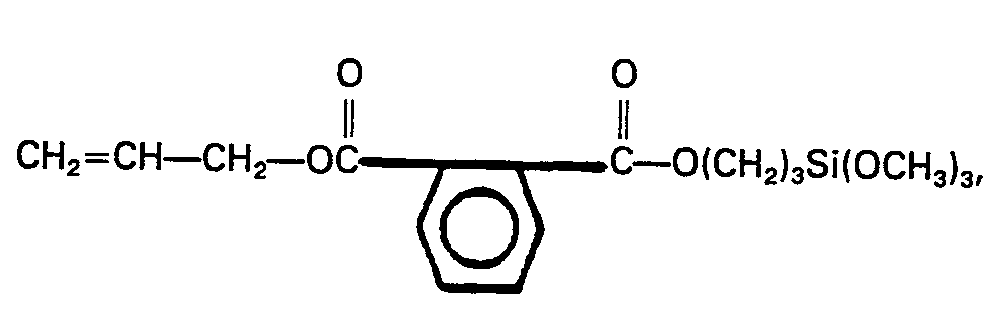


- Besonders bevorzugt wird als Kompnente a)
- y - Methylacryloxypropyltrimethyoxysilan
eingesetzt. - Als komponente b) können vorteilhaft Verbindungen der allgemeinen Formel

- R = H, CH3 oder Alkyl
- X = 0, NH, S
- n = 2 bis 8
verwendent werden. Beispiele für derartige Verbindungen sind Hexandioldiacrylat, Hexandioldimethacrylat, Glykoldiacrylat, Glykoldimethacrylat, Butandioldiacrylat, Butandioldimethacrylat, Trimethylolpropantriacrylat und Trimethylolpropantrimethacrylat. Des weiteren ist auch Divinylbenzol als Komponente b) geeignet. Selbstverständlich können auch Kombinationen dieser mehrfach ungesättigten Monomeren verwendet werden. - Weiterhin kann die Komponente b) vorteilhaft eine mit einem ungesättigten, eine polymerisierbare Doppelbindung enthaltenden Alkohol veresterte Polycarbonsäure oder ungesättigte Monocarbonsäure sein.
- Ferner kann vorteilhaft als Komponente b) ein Umsetzungsproduktsprodukt eines Polyisocyanats und eines ungesättigten Alkohols oder eines Amins verwendet werden. Als Beispiel hierfür sei das Reaktionsprodukt aus einem Mol Hexamethylendiisocyanat und zwei Mol Allylalkohol oder das Reaktionsprodukt aus lsophorondiisocyanat und Hydroxyethylacrylat genannt.
- Eine weitere vorteilhafte Komponente b) ist ein Diester von Polyethylenglykol und/oder Polypropylenglykol mit einem mittleren Molekulargewicht von weniger als 1500, bevorzugt weniger als 1000, und Acrylsäure und/oder Methacrylsäure.
- Als Komponente b) kommen weiterhin Umsetzungsprodukte aus einer Carbonsäure mit einer polymerisierbaren, olefinisch ungesättigten Doppelbindung und Glycidylacrylat und/oder Glycidylmethacrylat sowie Umsetzungsprodukte von Dicarbonsäure mit Glycidylacrylat und/oder Glycidylmethacrylat in Frage. Derartige mehrfach ethylenisch ungesättigte Monomere sollten erfindungsgemäß jedoch nur in kleinen Anteilen eingesetzt werden, das sie Hydroxylgruppen enthalten, die mit den Silanmonomeren (a) reagieren können. Dies gilt auch für mehrfach ethylenisch ungesättigte Monomere, die aus Diepoxidverbindungen und ethylenisch ungesättigten Monomeren mit einer primären oder sekundären Aminogruppe gebildet werden, da diese Produkte ebenfalls Hydroxylgruppen enthalten.
- Die Auswahl der ethylenisch ungesättigten Neutralmonomere (Komponente c) ist nicht besonders kritisch. Diese können augewählt sein aus der Gruppe Styrol, Vinyltoluol, Alkylester der Acrylsäure und der Methacrylsäure, Alkoxiethylacrylate und Aryloxiethylacrylate und die entsprechenden Methacrylate sowie Ester der Malein- und Fumarsäure. Beispiele hierfür sind Methylacrylat, Ethylacrylat, Propylacrylat, Butylacrylat, Isopropylacrylat, Isobutylacrylat, Pentylacrylat, Isoamylacrylat, Hexylacrylat, 2-Ethylhexylacrylat, Octylacrylat, 3,5,5-Trimethylhexylacrylat, Decylacrylat, Dodecylacrylat, Hexadecylacrylat, Octadecylacrylat, Octadecenylacrylat, Pentylacrylat, Isoamylmethacrylat, Hexylmethacrylat, 2-Ethylbutylmethyacrylat, Octylmethacrylat, 3,5,5-Trimethylhexylmethacrylat, Decylmethacrylat, Dodecylmethacrylat, Hexadecylmethacrylat, Octadecylmethacrylat, Butoxiethylacrylat, Butoxiethylmethacrylat, Methlmethacrylat, Ethylmethacrylat, Propylmethacrylat, Isopropylmethacrylat, Butylmethacrylat, Cyclohexylacrylat, Cyclohexylmethacrylat, Acrylnitril, Methacrylnitril, Vinylacetat, Vinylchlorid und Phenoxiethylacrylat. Weitere Monomere können eingesetzt werden, sofern sie nicht zu unerwünschten Eigenschaften des Copolymerisats führen.
- Um eine schnellere Wasseraufnahme bei der Vernetzung unter dem Einfluß von Luftfeuchtigkeit zu ermöglichen, ist es besonders vorteilhaft, wenn als zusätzliches Comonomer d) zu den ethylenisch ungesättigten Monomeren a), b) und c) bis zu 10 Gew.%, bezogen auf die Summe von a) bis d), eines ethylenisch ungesättigten Carbonsäureamids verwendet werden.
- Geeignete Komponenten d) sind beispielsweise Acrylsäureamid, Methacrylsäureamid, Itakonsäurediamid, a-Ethylacrylamid, Crotonsäureamid, Fumarsäureamid und Maleinsäurediamid.
- Ggf. können bis zu 5 Gew.% auch ethylenisch ungesättigte Monomere mit einer Hydroxygruppe, einer Carboxylgruppe oder einer Aminogruppe mit verwendet werden (Komponente e). Beispiele für Hydroxylgruppen enthaltende ethylenisch ungesättigte Monomere sind Hydroxylalkylester der Acrylsäure und/oder Methacrylsäure, z.B. Hydroxyethylacrylat, Hydroxyproylacrylat, Hydroxybutylacrylat, Hydroxyamylacrylat, Hydroxyhexylacrylat, Hydroxyoctylacrylat und die entsprechenden Methacrylate. Als Komponente e) kann auch ein Umsetzungsprodukt aus einem Mol Hydroxyethylacrylat und/oder Hydroxyethylmethacrylat und durchschnittlich 2 Mol e-Caprolacton sein. Als Komponente e) kann auch ein hydroxylgruppenhaltiger Ester der Acrylsäure oder der Methacrylsäure mit einer sekundären Hydorxylgruppe sein, wie beispielsweise 2-Hydroxypropylacrylat, 2-Hydroxybutylacrylat, 3-Hydroxybutylacrylat und die entsprechenden Methacrylate. Als Hydroxylgruppen enthaltendes polymerisierbares Monomer ist auch ein Umsetzungsprodukt aus Acrylsäure und/oder Methacrylsäure mit dem Glycidylester einer Carbonsäure mit einem tertiären a-Kohlenstoffatom geeignet. Beispiele für ethylenisch ungesättigte Monomere mit einer Carboxylgruppe sind Methacrylsäure und Acrylsäure. Ein geeignetes ethylenisch ungesättigtes Monomere mit einer Aminogruppe ist N-tert.-Butylaminoethylacrylat.
- Die Copolymerisationsreaktionen zur Herstellung der erfindungsgemäßen Polymerisate werden unter Verwendung von mindestens 2 Gew.%, bezogen auf das Gesamtgewicht der ethylenisch ungesättigten Monomeren, eines Polymerisationsreglers ohne aktive OH- oder NH-Gruppen ausgeführt, wobei borzugsweise Mercaptosilane als Regler verwendet werden. Es ergibt sich, daß des öfteren nur bestimmte Regler für bestimmte Kombinationen der zu polymerisierenden Monomeren a) bis e) geeignet sind.
- Werden beispielsweise als Komponente b) Diacrylate bzw. Dimethacrylate der allgemeinen Formel

- R = H, CH3 oder Alkyl
- X = 0, NH, S
- n=2bis8
in einem Anteil von mehr als 10 Gew.%, bezogen auf das Gesamtgewicht aller Monomeren, polymerisiert, sollte die Polymerisation unter Verwendung von mehr als 5 Gew:%, bezogen auf das Gesamtgewicht der Monomeren, Mercaptoethyltriethoxysilan und/oder Mercaptopropylmethyldimethoxysilan, ggf. zusammen mit anderen Mercaptoverbindungen, in einem Temperaturbereich zwischen 100°C und 120°C ausgeführt werden. - Werden die zuvor genannten, mehrfach ethylenisch ungesättigten Acrylat- bzw. Methacrylatverbindungen in einem Anteil von mindestens 15 Gew.%, bezogen auf das Momerengewicht, copolymerisiert, sollten als Monomere ohne Gruppen mit aktivem Wasserstoff (Komponente c)) vorwiegend Acrylatmonomere und/oder Methacrylatomomere und/oder Maleinsäure- und/oder Fumarsäureester verwendet werden. Die Copolymerisation sollte in Gegenwart von mehr als 6 Gew.%, bezogen auf das Monomerengewischt, eines Mercaptosilans, bevorzugt Mercaptoethyltriethoxysilan oder Mercaptopropylmethyldimethoxysilan, ggf. zusammen mit anderen Mercaptoverbindungen, ausgeführt werden.
- Falls als Komponente b) mehr als 10 Gew.% Divinylaromaten, wie biespielsweise Divinylbenzol, zusammen mit dem Monomeren a), c), ggf. d) und ggf. e) copolymerisiert werden, sollten als Regler vorzugsweise mehr als 10 Gew.% bezogen auf das Monomerengewicht, Mercaptoethyltriethoxysilan und/ oder Mercaptopropylmethyldimethoxysilan eingesetzt werden, um eine Gelierung des Copolymerisats zu . verhindern.
- Die vorliegende Erfindung betrifft auch Verfahren zur Herstellung der zuvor genannten Silylgruppen enthaltenden Polymerisate.
- Die vorliegende Erfindung betrifft auch ein Verfahren zur Herstellung eines Silylgruppen enthaltenden Polymerisats, wobei die Silylgruppen durch ethylenisch ungesättigte Monomere der allgemeinen Formel

- R1 = Alkyl, Aryl, Acyl, Aralkyl mit 1 bis 10 Kohlenstoffatomen
- R2 = organischer Rest mit polymerisierbarer Doppelbindung
- X = hydrolisierbare Gruppe
- n = 1, 2 oder 3
in das Polymerisat eingebracht werden, das dadurch gekennzeichnet ist, daß zu seiner Herstellung- a) 0,1 bis 40 Gew.% der Silanmonomeren (a),
- b) 5 bis 30 Gew.%, bevorzugt 8 bis 25 Gew.%, Monomere mit mindestens zwei polymerisierbaren ethylenisch ungesättigten Doppelbindungen und
- c) 30 bis 90 Gew.% ethylenisch ungesättigte Neutralmonomere wobei die Summe von a), b) und c) 100 Gew.% beträgt, in einem organischen Lösungsmittel unter Verwendung von Initiatoren und unter Verwendung von mindestens 2 Gew.%, bezogen auf das Gesamtgewicht der Monomeren, Polymerisationsreglern ohne OH- und NH-Gruppen bei 80°C bis 130°C, vorzugsweise bei 90°C bis 120°C, copolymerisiert werden.
- Beispiele für geeignete ethylenisch ungesättigte Monomere a) bis c) sowie für die ggf. zusätzlich zu verwendenden Monomeren d) und e) sind die zuvor genannten Beispiele für die Komponenten a) bis e) des beschriebenen Silylgruppen enthaltenden Polymerisats.
- Durch geeignete Polymersationsbedingungen läßt sich ein vorvernetztes, aber nicht geliertes Copolymerisat erhalten.
- Als Initiatoren kommen vorzugsweise Azoinitiatoren, wie beispielsweise Azobisiobutyronitril in Frage. Bei niederigem Anteil am eingesetzten mehrfach enthlenisch ungesättigten Monomeren (Komponente b)) können auch Peroxyester als Initiatoren verwendet werden. Als Beispiel hierfür sei tert.-Butylperoxy-2-ethylhexanoat genannt. Selbstverständlich können auch Azo-Initiatoren mit reaktiven Silicongruppen verwendet werden. Diese werden in einem Anteil von 0,01 bis 20 Gew.-Teilen pro 100 Gew.-Teile der polymeriserbaren Monomeren eingesetzt.
- Beispiele für einsetzbare reaktive Silicongruppen enthaltende Azoinitiatoren finden sich in EP-A-159 715 und EP-A-159 716.
- Als Polymerisationsregler werden vorzugsweise Mercaptosilane oder Mischungen von Mercaptosilanen mit anderen Mercaptoverbindungen verwendet. Dabei kommen nur solche Mercaptoverbindungen in Frage, die nicht mit Silylgruppen reagieren, d.h. die keine OH- oder NH-Gruppen besitzen. Beispiele für geeignete, als Polymerisationsregler einsetzbare Mercaptosilane werden im folgenden aufgeführt:





- Beispiele für andere Mercaptoverbindungen sind ein n- oder t-Dodecylmercaptan.
- Bei den Mercaptosilanen treten Reaktivitätsunterschiede auf. Besonders bevorzugt wird Mercaptoethyltriethyloxysilan als Polymerisationsregler eingesetzt.
- Vorteilhafterweise werden die Polymerisationsregler in eninem Anteil von mindestens 4 Gew.%, bezogen auf das Gesamtgewicht der Monomeren, eingesetzt.
- Die radialkalische Polymerisation wird bei Temperaturen von 80-130°C, vorzugsweise bei 90-120°C, durchgeführt. Vorteilhafterweise wird die radikalische Polymerisation zur Herstellung des Silylgruppen enthaltenden Polymerisats so durchgeführt, daß eine Lösung des Polymerisats mit einem Festkörper-Gehalt von 40-65 Gew.% resultiert.
- Als Löungsmittel für die radialkalische Polymerisation kommen nichtreaktive Lösungsmittel, wie beispielsweise Ester, Ether, Kohlenwasserstoffe, Alkohole und Ketone, in Frage.
- Die vorliegende Erfindung betrifft auch durch Feuchtigkeit härtbare Überzugsmittel, die das zuvor beschriebene Silylgruppen-enthaltende Polymerisat, organisches Lösungsmittel, ggf. Pigmente, Füllstoffe und übliche Hilfsstoffe und Additive sowie einen Vernetzungskatalysator enthalten. Ohne Zusatz eines Vernetzungskatalysators haben die Überzugszusammensetzungen eine genügend lange Topfzeit. Setzt man geeignete Vernetzungskatalysatoren zu, so härten die Überzugsammensetzungen mit Feuchtigkeit bei Raumtemperatur oder leicht erhöhter Temperature schnell aus.
- Geeignete Vernetzungskatalysatoren sind beispielsweise Phosphorsäure, p-Toluolsulfonsäure, Zinndibutyldilaurat, Zinndioctyldilaurat, Amine, beispielsweise aliphatische Diamine, wie Ethylendiamin, Hexandiamin, aliphatische Polyamine, wie Diethylentriamin, Triethylentetramin, Tetraethylenpentamin, alicyclische Amine, wie Piperidin, Piperazin, aromatische Amine, Ethanolamin, Triethylamin, weiterhin Alkali-Katalysatoren, wie beispielsweise Kaliumhydroxyd oder Natriumhydroxyd. Vorteilhafterweise werden 0,01 bis 10 Gew.-Teile des Katalysators auf 100 Gew.-Teile des Polymeren verwendet.
- Als organsiche Zinnverbindungen, die als Vernetzungskatalysatoren einsetzbar sind, seien weiterhin Verbindungen mit Zinn-Schwefel-Einfach- oder Doppelbindungen genannt, wie z.B.
- (n-C4H9)2 Sn(SCH2 COO),
- (n-C8H17)2 Sn(SCH2CH2COO),
- (n-C8H17)2 Sn(SCH2C00 CH2 CH2 OCO CH2S),
- (n-C8H17)2 Sn(SCH2 COO CH2 CH2 CH2 CH2 OCO CH2S).
- (n-C4H9 Sn(SCH2 COO C8H17-iso)2,
- (n-C8H17)2 Sn(SCH2 COO C12H25-n)2,
- (n-C4H9)2 Sn(SCH2 COO C8H17-iso)2 und
- (n-C8H17)2 Sn = S.
- Es sind auch Mischungen der obengenannten Zinn-Schwelfel-Verbindungen mit Zinn-Verbindunden, wie beispielsweise mit Dialkylzinndimaleaten, zur Katalysierung geeignet.
- Weitere ebenfalls geeignete Katalysatoren finden sich in EP-A-48461 und in EPA-A-63753.
- Die Erfindung betrifft auch Verfahren zur Herstellung der zuvor beschriebenen Überzugsmittel, die dadurch gekennzeichnet sind, daß das Silylgruppen enthaltende Polymerisat, organisches Lösungsmittel, ggf. Pigmente, Füllstoffe und Additive durch Mischen und ggf. Dispersigeren zu einer Überzugsmasse verarbeitet werden und kurz vor der Anwendung ein Vernetzungskatalysator zugemischt wird.
- Aufgrund der niedrigen Härtungstemperaturen sind die beschriebenen Überzugsmittel insbesondere geeignet für die Reparaturlackierung von Autokarossen.
- Die erfindungsgemäßen Überzugsmittel sind ebenfalls hervorragend geeignet als Pigmente und/oder Metallpigmente enthaltende Basislacke oder als Decklacke oder als Basis- und als Decklacke einer Mehrschichtlackierung, welche ggf. nach dem Zweischicht-in-naß-Verfahren aufgetragen werden können.
- Die beschriebenen Überzugsmittel weisen verbesserte Eigenschaften in bezug auf Benzinfestigkeit und in bezug auf Beständigkeit gengenüber langfristiger Belastung durch Wasser bzw. Wasserdampf verglichen mit bekannten Siliconmodifizierten Copolymerisaten auf.
- Nachfolgend wird die Erfindung anhand von Ausführungsbeispielen näher erläutert:
- In den folgenden Beispielen beziehen sich, wenn nicht anders angegeben, alle Prozentangaben auf Gewichtsteile. Die Festkörperwerte wurden in einem Umluftofen bestimmt nach 2 Stunden bei 100°C. Die Viskositäten wurden auf einem Kegel-Platte-Viskosimeter (ICI-Viskosimeter) bei 23°C bestimmt.
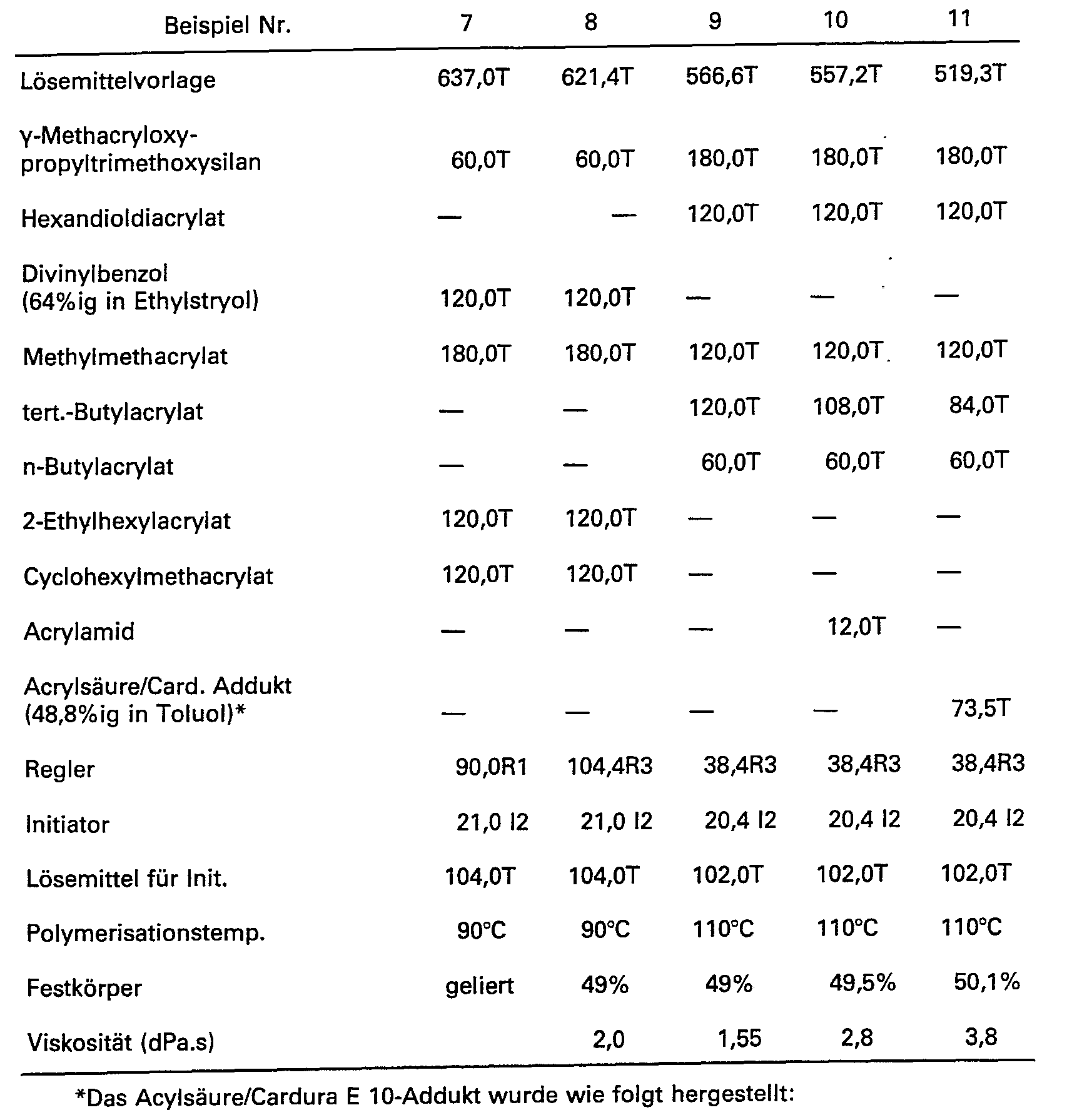
- Die Anteile der einzelnen Monomeren, Lösemittelmengen, Initiator- und Regelermengen sowie Polymerisationstemperatur und Bindemitteldaten sind aus der Tabelle I ersichtlich. Die Herstellung der Acrylate erfolgte in Standardapparaten (2 Liter Glasreaktoren) mit Rührer, Rückflußkühler, Zulaufgefäßen. Als Lösemittel wurde eine 1:1-Mischung auz Xylol und 1-Methoxypropyl-2-acetat verwendet. Das Lösemittelgemisch wurde vorgelegt, ein Teil wurde zum Lösen des Initiators verwendet. An Initiatoren wurden 2,2'-azobis(isobutyronitril) = 11 und 2,2'-azobis)-methylbutyronitril) = 12 verwendet. An Polymerisationsreglern wurden eingesetzt:
- Mercaptoethyltrisethoxysilan = R1
- Mercaptopropyltrimethoxysilan = R2
- Mercaptopropylmethyldimethoxysilan = R3
- Das Lösenmittelgemisch wurde auf die angegebene Polymerisationstemperatur aufgeheizt, die Temperatur wurde während der ganzen Polymerisationszeit gehalten. Die angegebenen Monomerenmischungen (incl. Regler) und Initiatorlösungen wurden getrennt zudosiert.
- Die Zulaufzeiten betrugen bei der Monomerenmischung (inci. Regler) 3 Stunden, bei der Initiatorlösung 3,5 Stunden, bei Beispiel 5 wurden der Initiatorzulauf 10 Minuten nach dem Monomerenzulauf gestartet, ansonsten wurde mit den beiden Zuläufen gleichzeitig begonnen; der Zulauf erfolgte gleichmäßig über die angegebene Zeit, nach Ende des Initiatorzulaufs wurde noch 2 Stunden bei der angegebenen Polymerisationstemperatur nachpolymerisiert. Die Mengen an Monomeren, Lösemittel etc. sind in T = Gewichtsteilen angegeben.

- Die Acrylatharze aus den Beispielen 3 und 6 wurden durch Abdestillieren von Lösemittelgemisch auf einen Festkörper von 64,4 (3) und von 59,8% (6) aufkozentriert und in dieser Form in den Lacken eingesetzt.
- Die Copolymerisate der Beispiele 6, 8, 10 wurden mittels Gelpermeationschromatographie untersucht. Es wurden folgende Werte erhalten:

- 750 Teile Cardura E 10 (Glycidylester einer verzweigten C-10-Carbonsäure) und 988 Teile Toluol wurden zusammen mit 0,988 Teilen Hydrochinon auf 100°C aufgeheizt, innerhalb 30 Minuten wurden 238 Teile Acrylsäure zudosiert. Es wurde bei 100°C gehalten, 2,5 Stunden nach der Acrylsäure-Zugabe wurde 1 Teil eines Chromsalzkomplexes zugegeben, nach weiteren 5 Stunden bei 100°C wurden nochmals 0,1 Teile eines Chromsalzkomplexes zugegeben, nach weitern 5 Stunden war eine Säurezahl von 18,5 (mg KOH) erreicht. Das Produkt hatte einen Festkörper von 48,4%.
- Kalarlackzusammensetzung1


Claims (21)

in das Polymerisat eingebracht werden, dadurch gekennzeichnet, daß das Polymerisat erhältlich ist durch Copolymerisation von

in das Polymerisat eingebracht werden, dadurch gekennzeichnet, daß zu seiner Herstellung

entspricht.
Priority Applications (1)
| Application Number | Priority Date | Filing Date | Title |
|---|---|---|---|
| AT87905748T ATE59052T1 (de) | 1986-09-10 | 1987-09-04 | Silylgruppen enthaltendes verzweigtes polymerisat, verfahren zu seiner herstellung, ueberzugsmittel auf basis des polymerisats sowie deren verwendung. |
Applications Claiming Priority (2)
| Application Number | Priority Date | Filing Date | Title |
|---|---|---|---|
| DE19863630793 DE3630793A1 (de) | 1986-09-10 | 1986-09-10 | Silylgruppen enthaltendes verzweigtes polymerisat, verfahren zu seiner herstellung, ueberzugsmittel auf basis des polymerisats sowie deren verwendung |
| DE3630793 | 1986-09-10 |
Publications (2)
| Publication Number | Publication Date |
|---|---|
| EP0324747A1 EP0324747A1 (de) | 1989-07-26 |
| EP0324747B1 true EP0324747B1 (de) | 1990-12-12 |
Family
ID=6309291
Family Applications (2)
| Application Number | Title | Priority Date | Filing Date |
|---|---|---|---|
| EP87905748A Expired - Lifetime EP0324747B1 (de) | 1986-09-10 | 1987-09-04 | Silylgruppen enthaltendes verzweigtes polymerisat, verfahren zu seiner herstellung, überzugsmittel auf basis des polymerisats sowie deren verwendung |
| EP87112924A Pending EP0263306A1 (de) | 1986-09-10 | 1987-09-04 | Silylgruppen enthaltendes verzweigtes Polymerisat, Verfahren zu seiner Herstellung, Überzugsmittel auf Basis des Polymerisats sowie deren Verwendung |
Family Applications After (1)
| Application Number | Title | Priority Date | Filing Date |
|---|---|---|---|
| EP87112924A Pending EP0263306A1 (de) | 1986-09-10 | 1987-09-04 | Silylgruppen enthaltendes verzweigtes Polymerisat, Verfahren zu seiner Herstellung, Überzugsmittel auf Basis des Polymerisats sowie deren Verwendung |
Country Status (11)
| Country | Link |
|---|---|
| EP (2) | EP0324747B1 (de) |
| JP (1) | JPH0649843B2 (de) |
| KR (1) | KR950003048B1 (de) |
| AU (1) | AU607712B2 (de) |
| BR (1) | BR8707852A (de) |
| CA (1) | CA1290089C (de) |
| DE (2) | DE3630793A1 (de) |
| DK (1) | DK248288A (de) |
| ES (1) | ES2019971B3 (de) |
| WO (1) | WO1988002010A1 (de) |
| ZA (1) | ZA876577B (de) |
Cited By (1)
| Publication number | Priority date | Publication date | Assignee | Title |
|---|---|---|---|---|
| EP0702016A2 (de) | 1994-08-30 | 1996-03-20 | Hüls Aktiengesellschaft | Acryloxypropylalkoxysilane, Verfahren zu deren Herstellung und deren Verwendung |
Families Citing this family (14)
| Publication number | Priority date | Publication date | Assignee | Title |
|---|---|---|---|---|
| DE3803450A1 (de) * | 1988-02-05 | 1989-08-17 | Hoechst Ag | Emissionsarme dispersionsfarben, anstrichmittel und kunststoffdispersionsputze sowie verfahren zu ihrer herstellung |
| EP0601219B1 (de) * | 1990-08-16 | 1997-09-10 | E.I. Du Pont De Nemours And Company | Wässriges Acrylsilan- und polyurethanhaltige Beschichtungszusammensetzung |
| US5204404A (en) * | 1989-03-21 | 1993-04-20 | E. I. Du Pont De Nemours And Company | Waterbased acrylic silane and polyurethane containing coating composition |
| DE3942803A1 (de) * | 1989-12-23 | 1991-06-27 | Basf Lacke & Farben | Verfahren zur herstellung eines mehrschichtigen, schuetzenden und/oder dekorativen ueberzuges |
| DE4016999A1 (de) * | 1990-05-26 | 1991-11-28 | Basf Lacke & Farben | Verfahren zur herstellung einer haertbaren zusammensetzung, die nach diesem verfahren hergestellten haertbaren zusammensetzungen und ihre verwendung |
| JP3094044B2 (ja) * | 1991-11-15 | 2000-10-03 | 鐘淵化学工業株式会社 | 硬化性組成物 |
| DE4329088A1 (de) * | 1993-08-30 | 1995-03-02 | Huels Chemische Werke Ag | Wäßrige, silanolgruppenmodifizierte Dispersionen |
| KR100593427B1 (ko) | 1998-03-12 | 2006-06-28 | 루사이트 인터내셔널 유케이 리미티드 | 폴리머 조성물 |
| WO2001089720A1 (en) * | 2000-11-02 | 2001-11-29 | Corus Staal Bv | Solution polymerized vinyl resin for primer applications |
| DE102007023282A1 (de) * | 2007-05-18 | 2008-11-20 | Bayer Materialscience Ag | Silanlacke aus Aminosilanen und epoxyfunktionellen Polyacrylaten |
| US20100183540A1 (en) * | 2007-07-06 | 2010-07-22 | Jotun A/S | Branched polymer and antifouling coating composition comprising the polymer |
| WO2010091001A1 (en) * | 2009-02-04 | 2010-08-12 | Dow Corning Corporation | Method of forming a non-random copolymer |
| DE102009016195A1 (de) | 2009-04-03 | 2010-10-07 | Basf Coatings Ag | Feuchtigkeitshärtende Beschichtungsmittel auf der Basis aprotischer Lösemittel enthaltend Bindemittel mit Alkoxysilangruppen und deren Verwendung |
| ES2660482T3 (es) | 2013-01-03 | 2018-03-22 | Basf Coatings Gmbh | Procesos para preparar una composición de revestimiento apta para curado, de un componente y uso de la misma, y revestimientos y artículos preparados con ella |
Family Cites Families (11)
| Publication number | Priority date | Publication date | Assignee | Title |
|---|---|---|---|---|
| JPS5114934A (ja) * | 1974-07-30 | 1976-02-05 | Saiden Kagaku Kk | Ekijosetsuchakuryokukyokahifukusoseibutsu |
| US4152508A (en) * | 1978-02-15 | 1979-05-01 | Polymer Technology Corporation | Silicone-containing hard contact lens material |
| US4216303A (en) * | 1979-01-26 | 1980-08-05 | George F. Tsuetaki | Oxygen-permeable contact lens compositions, methods and articles of manufacture |
| JPS5792004A (en) * | 1980-11-29 | 1982-06-08 | Dainippon Printing Co Ltd | Electron radiation curing composition |
| GB2089826B (en) * | 1980-12-18 | 1985-01-03 | Gen Electric | Abrasion resistant ultraviolet light curable hard coating compositions |
| CA1186436A (en) * | 1981-09-30 | 1985-04-30 | Michael J. Michno, Jr. | Curable molding compositions containing a poly(acrylate) |
| JPS5919918A (ja) * | 1982-07-27 | 1984-02-01 | Hoya Corp | 酸素透過性ハ−ドコンタクトレンズ |
| JPS6157612A (ja) * | 1984-08-23 | 1986-03-24 | Nippon Contact Lens:Kk | コンタクトレンズ材料 |
| EP0169536B1 (de) * | 1984-07-26 | 1994-05-18 | Kanegafuchi Chemical Industry Co., Ltd. | Vernetzbare Polymerzusammensetzung |
| JPS6160771A (ja) * | 1984-08-31 | 1986-03-28 | Kanegafuchi Chem Ind Co Ltd | 粘着剤組成物 |
| JPS61141761A (ja) * | 1984-12-12 | 1986-06-28 | Kanegafuchi Chem Ind Co Ltd | 硬化性組成物 |
-
1986
- 1986-09-10 DE DE19863630793 patent/DE3630793A1/de not_active Withdrawn
-
1987
- 1987-09-03 ZA ZA876577A patent/ZA876577B/xx unknown
- 1987-09-04 JP JP62505352A patent/JPH0649843B2/ja not_active Expired - Lifetime
- 1987-09-04 AU AU78777/87A patent/AU607712B2/en not_active Ceased
- 1987-09-04 DE DE8787905748T patent/DE3766708D1/de not_active Expired - Lifetime
- 1987-09-04 BR BR8707852A patent/BR8707852A/pt not_active IP Right Cessation
- 1987-09-04 ES ES87905748T patent/ES2019971B3/es not_active Expired - Lifetime
- 1987-09-04 EP EP87905748A patent/EP0324747B1/de not_active Expired - Lifetime
- 1987-09-04 EP EP87112924A patent/EP0263306A1/de active Pending
- 1987-09-04 WO PCT/EP1987/000499 patent/WO1988002010A1/de not_active Ceased
- 1987-09-04 KR KR1019880700516A patent/KR950003048B1/ko not_active Expired - Fee Related
- 1987-09-09 CA CA000546383A patent/CA1290089C/en not_active Expired - Lifetime
-
1988
- 1988-05-06 DK DK248288A patent/DK248288A/da not_active Application Discontinuation
Non-Patent Citations (1)
| Title |
|---|
| Patent abstracts of Japan, Band 8, Nr 184 (C-239) (1621), 23 August 1984 & JP, A, 59-78222 * |
Cited By (2)
| Publication number | Priority date | Publication date | Assignee | Title |
|---|---|---|---|---|
| EP0702016A2 (de) | 1994-08-30 | 1996-03-20 | Hüls Aktiengesellschaft | Acryloxypropylalkoxysilane, Verfahren zu deren Herstellung und deren Verwendung |
| US5543538A (en) * | 1994-08-30 | 1996-08-06 | Huels Aktiengesellschaft | Acryloyloxypropylalkoxysilanes, process for their preparation and use thereof |
Also Published As
| Publication number | Publication date |
|---|---|
| WO1988002010A1 (fr) | 1988-03-24 |
| KR950003048B1 (ko) | 1995-03-30 |
| DK248288D0 (da) | 1988-05-06 |
| AU607712B2 (en) | 1991-03-14 |
| ES2019971B3 (es) | 1991-07-16 |
| EP0324747A1 (de) | 1989-07-26 |
| JPH01502342A (ja) | 1989-08-17 |
| AU7877787A (en) | 1988-04-07 |
| CA1290089C (en) | 1991-10-01 |
| ZA876577B (en) | 1988-03-07 |
| EP0263306A1 (de) | 1988-04-13 |
| JPH0649843B2 (ja) | 1994-06-29 |
| DE3766708D1 (de) | 1991-01-24 |
| DE3630793A1 (de) | 1988-03-24 |
| DK248288A (da) | 1988-05-06 |
| BR8707852A (pt) | 1989-10-03 |
| KR880701747A (ko) | 1988-11-04 |
Similar Documents
| Publication | Publication Date | Title |
|---|---|---|
| EP0291662B1 (de) | Verfahren zur Herstellung eines verzweigten Acrylatcopolymerisats mit Polymerisierbaren Doppelbingungen und seine Verwendung | |
| EP0506703B1 (de) | Lösliche vernetzbare copolymerisate auf der basis von vinylester-, vinylaromat- und acrylatmonomeren, verfahren zu ihrer herstellung sowie ihre verwendung in beschichtungsmitteln | |
| DE69129079T2 (de) | Emulsionspolymere für hochleistungswässrige Beschichtungszusammensetzungen | |
| DE19914605A1 (de) | Polyalkylmethacrylat-Plastisole mit verbesserten Fließeigenschaften | |
| EP0263306A1 (de) | Silylgruppen enthaltendes verzweigtes Polymerisat, Verfahren zu seiner Herstellung, Überzugsmittel auf Basis des Polymerisats sowie deren Verwendung | |
| EP0158161A1 (de) | Hydroxylgruppenhaltiges Acrylatcopolymerisat, Verfahren zu seiner Herstellung und Überzugsmittel auf Basis des Acrylatcopolymerisats | |
| EP0473148A1 (de) | Wasserverdünnbares Copolymerisat, dessen Herstellung und Verwendung, sowie wässrige Überzugsmittel | |
| EP2291413A1 (de) | Verfahren zur herstellung einer wässrigen polymerisatdispersion | |
| WO1990000570A1 (de) | Hydroxylgruppenhaltige copolymerisate auf der basis von vinylester-, vinylaromat- und hydroxylalkylester- monomeren, verfahren zu ihrer herstellung sowie ihre verwendung in beschichtungsmitteln | |
| EP0727441A2 (de) | Verfahren zur Herstellung von emulgatorfreien wässrigen Polymerdispersionen | |
| EP0680977B1 (de) | Hydroxy- und Carboxylgruppen enthaltende Copolymerisate, ihre Herstellung und ihre Verwendung in festkörperreichen Beschichtungsmitteln | |
| EP0287842B1 (de) | Härtbare Zusammensetzung auf Basis eines Michael-Additionsproduktes, Verfahren zu seiner Herstellung sowie seine Verwendung | |
| EP0276213B1 (de) | Lösliches, vernetzbares acrylatcopolymerisat, verfahren zu seiner herstellung und überzugsmittel auf der basis des acrylatcopolymerisats | |
| EP0361048B1 (de) | Härtbare Zusammensetzung auf Basis eines Michael-Additionsproduktes, Verfahren zu seiner Herstellung sowie seine Verwendung | |
| EP0475981B1 (de) | Carboxylgruppen und ggf. tertiäre aminogruppen enthaltende copolymere, verfahren zu ihrer herstellung und ihre verwendung in beschichtungsmassen | |
| EP0022514A1 (de) | Wässrige Dispersion auf Grundlage von (Meth-)Acrylsäurederivaten, ihre Herstellung und Verwendung | |
| EP0285034B1 (de) | Härtbare Zusammensetzung auf Basis verzweigter Acrylate mit Carboxylgruppen und/oder verzweigter Acrylate mit Epoxidgruppen sowie Aminoplastharzen | |
| EP0355408B1 (de) | Aminogruppenhaltige Copolymerisate, Verfahren zu ihrer Herstellung sowie ihre Verwendung in Beschichtungsmitteln | |
| DE4016999A1 (de) | Verfahren zur herstellung einer haertbaren zusammensetzung, die nach diesem verfahren hergestellten haertbaren zusammensetzungen und ihre verwendung | |
| DE2208255C3 (de) | Verfahren zur Herstellung von in organischen Lösungsmitteln löslichen filmbildenden Copolymerisaten |
Legal Events
| Date | Code | Title | Description |
|---|---|---|---|
| PUAI | Public reference made under article 153(3) epc to a published international application that has entered the european phase |
Free format text: ORIGINAL CODE: 0009012 |
|
| 17P | Request for examination filed |
Effective date: 19890224 |
|
| AK | Designated contracting states |
Kind code of ref document: A1 Designated state(s): AT BE CH DE FR GB IT LI NL SE |
|
| 17Q | First examination report despatched |
Effective date: 19891018 |
|
| RBV | Designated contracting states (corrected) |
Designated state(s): AT BE CH DE ES FR GB IT LI NL SE |
|
| XX | Miscellaneous (additional remarks) |
Free format text: VERBUNDEN MIT 87112924.3/0263306 (EUROPAEISCHE ANMELDENUMMER/VEROEFFENTLICHUNGSNUMMER) DURCH ENTSCHEIDUNG VOM 19.04.90. |
|
| GRAA | (expected) grant |
Free format text: ORIGINAL CODE: 0009210 |
|
| AK | Designated contracting states |
Kind code of ref document: B1 Designated state(s): AT BE CH DE ES FR GB IT LI NL SE |
|
| REF | Corresponds to: |
Ref document number: 59052 Country of ref document: AT Date of ref document: 19901215 Kind code of ref document: T |
|
| XX | Miscellaneous (additional remarks) |
Free format text: VERBUNDEN MIT 87112924.3/0263306 (EUROPAEISCHE ANMELDENUMMER/VEROEFFENTLICHUNGSNUMMER) DURCH ENTSCHEIDUNG VOM 19.04.90. |
|
| GBT | Gb: translation of ep patent filed (gb section 77(6)(a)/1977) | ||
| ET | Fr: translation filed | ||
| ITF | It: translation for a ep patent filed | ||
| REF | Corresponds to: |
Ref document number: 3766708 Country of ref document: DE Date of ref document: 19910124 |
|
| ITTA | It: last paid annual fee | ||
| PLBE | No opposition filed within time limit |
Free format text: ORIGINAL CODE: 0009261 |
|
| STAA | Information on the status of an ep patent application or granted ep patent |
Free format text: STATUS: NO OPPOSITION FILED WITHIN TIME LIMIT |
|
| 26N | No opposition filed | ||
| EAL | Se: european patent in force in sweden |
Ref document number: 87905748.7 |
|
| REG | Reference to a national code |
Ref country code: ES Ref legal event code: PC2A |
|
| PGFP | Annual fee paid to national office [announced via postgrant information from national office to epo] |
Ref country code: GB Payment date: 20000821 Year of fee payment: 14 |
|
| PGFP | Annual fee paid to national office [announced via postgrant information from national office to epo] |
Ref country code: BE Payment date: 20000919 Year of fee payment: 14 Ref country code: AT Payment date: 20000919 Year of fee payment: 14 |
|
| PGFP | Annual fee paid to national office [announced via postgrant information from national office to epo] |
Ref country code: NL Payment date: 20000920 Year of fee payment: 14 |
|
| PGFP | Annual fee paid to national office [announced via postgrant information from national office to epo] |
Ref country code: SE Payment date: 20000921 Year of fee payment: 14 |
|
| PGFP | Annual fee paid to national office [announced via postgrant information from national office to epo] |
Ref country code: CH Payment date: 20001002 Year of fee payment: 14 |
|
| PG25 | Lapsed in a contracting state [announced via postgrant information from national office to epo] |
Ref country code: GB Free format text: LAPSE BECAUSE OF NON-PAYMENT OF DUE FEES Effective date: 20010904 Ref country code: AT Free format text: LAPSE BECAUSE OF NON-PAYMENT OF DUE FEES Effective date: 20010904 |
|
| PG25 | Lapsed in a contracting state [announced via postgrant information from national office to epo] |
Ref country code: SE Free format text: LAPSE BECAUSE OF NON-PAYMENT OF DUE FEES Effective date: 20010905 |
|
| PG25 | Lapsed in a contracting state [announced via postgrant information from national office to epo] |
Ref country code: LI Free format text: LAPSE BECAUSE OF NON-PAYMENT OF DUE FEES Effective date: 20010930 Ref country code: CH Free format text: LAPSE BECAUSE OF NON-PAYMENT OF DUE FEES Effective date: 20010930 Ref country code: BE Free format text: LAPSE BECAUSE OF NON-PAYMENT OF DUE FEES Effective date: 20010930 |
|
| BERE | Be: lapsed |
Owner name: BASF LACKE + FARBEN A.G. Effective date: 20010930 |
|
| PG25 | Lapsed in a contracting state [announced via postgrant information from national office to epo] |
Ref country code: NL Free format text: LAPSE BECAUSE OF NON-PAYMENT OF DUE FEES Effective date: 20020401 |
|
| EUG | Se: european patent has lapsed |
Ref document number: 87905748.7 |
|
| REG | Reference to a national code |
Ref country code: CH Ref legal event code: PL |
|
| NLV4 | Nl: lapsed or anulled due to non-payment of the annual fee |
Effective date: 20020401 |
|
| NLV4 | Nl: lapsed or anulled due to non-payment of the annual fee |
Effective date: 20020401 |
|
| PG25 | Lapsed in a contracting state [announced via postgrant information from national office to epo] |
Ref country code: IT Free format text: LAPSE BECAUSE OF NON-PAYMENT OF DUE FEES Effective date: 20050904 |
|
| PGFP | Annual fee paid to national office [announced via postgrant information from national office to epo] |
Ref country code: DE Payment date: 20060831 Year of fee payment: 20 |
|
| PGFP | Annual fee paid to national office [announced via postgrant information from national office to epo] |
Ref country code: FR Payment date: 20060908 Year of fee payment: 20 |
|
| PGFP | Annual fee paid to national office [announced via postgrant information from national office to epo] |
Ref country code: ES Payment date: 20061023 Year of fee payment: 20 |
|
| REG | Reference to a national code |
Ref country code: ES Ref legal event code: FD2A Effective date: 20070905 |
|
| PG25 | Lapsed in a contracting state [announced via postgrant information from national office to epo] |
Ref country code: ES Free format text: LAPSE BECAUSE OF EXPIRATION OF PROTECTION Effective date: 20070905 |