EP0324875A1 - Antivirus-Mittel - Google Patents
Antivirus-Mittel Download PDFInfo
- Publication number
- EP0324875A1 EP0324875A1 EP88100806A EP88100806A EP0324875A1 EP 0324875 A1 EP0324875 A1 EP 0324875A1 EP 88100806 A EP88100806 A EP 88100806A EP 88100806 A EP88100806 A EP 88100806A EP 0324875 A1 EP0324875 A1 EP 0324875A1
- Authority
- EP
- European Patent Office
- Prior art keywords
- virus
- rimantadine
- flu
- effectiveness
- combination
- Prior art date
- Legal status (The legal status is an assumption and is not a legal conclusion. Google has not performed a legal analysis and makes no representation as to the accuracy of the status listed.)
- Withdrawn
Links
- 239000003814 drug Substances 0.000 title abstract description 6
- 229940079593 drug Drugs 0.000 title abstract description 4
- 230000002155 anti-virotic effect Effects 0.000 title description 3
- ZSWVOFMSMUXCLY-UHFFFAOYSA-N 1-(morpholin-4-ylmethyl)-1,3-diazinan-2-one Chemical compound O=C1NCCCN1CN1CCOCC1 ZSWVOFMSMUXCLY-UHFFFAOYSA-N 0.000 claims abstract description 20
- WGJPFMZKOPCWIQ-UHFFFAOYSA-N 1-(1-adamantyl)-n-methylmethanamine;hydrochloride Chemical compound Cl.C1C(C2)CC3CC2CC1(CNC)C3 WGJPFMZKOPCWIQ-UHFFFAOYSA-N 0.000 claims abstract description 3
- 239000003443 antiviral agent Substances 0.000 claims description 7
- 206010022000 influenza Diseases 0.000 abstract description 26
- 150000001875 compounds Chemical class 0.000 abstract description 16
- 230000000840 anti-viral effect Effects 0.000 abstract description 12
- 238000001228 spectrum Methods 0.000 abstract description 3
- 238000002512 chemotherapy Methods 0.000 abstract 1
- 241000700605 Viruses Species 0.000 description 31
- UBCHPRBFMUDMNC-UHFFFAOYSA-N 1-(1-adamantyl)ethanamine Chemical compound C1C(C2)CC3CC2CC1(C(N)C)C3 UBCHPRBFMUDMNC-UHFFFAOYSA-N 0.000 description 29
- 229960000888 rimantadine Drugs 0.000 description 27
- 238000012360 testing method Methods 0.000 description 22
- 230000000694 effects Effects 0.000 description 12
- 208000015181 infectious disease Diseases 0.000 description 12
- 239000000126 substance Substances 0.000 description 7
- 229920001817 Agar Polymers 0.000 description 6
- 239000008272 agar Substances 0.000 description 6
- 230000002401 inhibitory effect Effects 0.000 description 6
- 230000002458 infectious effect Effects 0.000 description 5
- 230000005764 inhibitory process Effects 0.000 description 5
- 241000282414 Homo sapiens Species 0.000 description 4
- 230000000996 additive effect Effects 0.000 description 4
- 238000004113 cell culture Methods 0.000 description 4
- 201000010099 disease Diseases 0.000 description 4
- 208000037265 diseases, disorders, signs and symptoms Diseases 0.000 description 4
- 239000010410 layer Substances 0.000 description 4
- 238000011321 prophylaxis Methods 0.000 description 4
- 238000011282 treatment Methods 0.000 description 4
- 230000003612 virological effect Effects 0.000 description 4
- 241000557626 Corvus corax Species 0.000 description 3
- WOLHOYHSEKDWQH-UHFFFAOYSA-N amantadine hydrochloride Chemical compound [Cl-].C1C(C2)CC3CC2CC1([NH3+])C3 WOLHOYHSEKDWQH-UHFFFAOYSA-N 0.000 description 3
- 244000309466 calf Species 0.000 description 3
- 239000003795 chemical substances by application Substances 0.000 description 3
- 235000015220 hamburgers Nutrition 0.000 description 3
- 210000003734 kidney Anatomy 0.000 description 3
- 230000002195 synergetic effect Effects 0.000 description 3
- XLYOFNOQVPJJNP-UHFFFAOYSA-N water Substances O XLYOFNOQVPJJNP-UHFFFAOYSA-N 0.000 description 3
- IWUCXVSUMQZMFG-AFCXAGJDSA-N Ribavirin Chemical compound N1=C(C(=O)N)N=CN1[C@H]1[C@H](O)[C@H](O)[C@@H](CO)O1 IWUCXVSUMQZMFG-AFCXAGJDSA-N 0.000 description 2
- OZBDFBJXRJWNAV-UHFFFAOYSA-N Rimantadine hydrochloride Chemical compound Cl.C1C(C2)CC3CC2CC1(C(N)C)C3 OZBDFBJXRJWNAV-UHFFFAOYSA-N 0.000 description 2
- 208000001203 Smallpox Diseases 0.000 description 2
- 241000870995 Variola Species 0.000 description 2
- DKNWSYNQZKUICI-UHFFFAOYSA-N amantadine Chemical class C1C(C2)CC3CC2CC1(N)C3 DKNWSYNQZKUICI-UHFFFAOYSA-N 0.000 description 2
- 238000011161 development Methods 0.000 description 2
- 238000009792 diffusion process Methods 0.000 description 2
- UYTPUPDQBNUYGX-UHFFFAOYSA-N guanine Chemical compound O=C1NC(N)=NC2=C1N=CN2 UYTPUPDQBNUYGX-UHFFFAOYSA-N 0.000 description 2
- 238000001727 in vivo Methods 0.000 description 2
- 239000003112 inhibitor Substances 0.000 description 2
- 230000001681 protective effect Effects 0.000 description 2
- 239000002356 single layer Substances 0.000 description 2
- 238000002560 therapeutic procedure Methods 0.000 description 2
- BPRCWSNCXPHMIW-UHFFFAOYSA-N 2-[2-(1-adamantylamino)-2-oxoethoxy]ethyl-dimethylazanium;chloride Chemical compound Cl.C1C(C2)CC3CC2CC1(NC(=O)COCCN(C)C)C3 BPRCWSNCXPHMIW-UHFFFAOYSA-N 0.000 description 1
- -1 2-hydroxyethoxymethyl Chemical group 0.000 description 1
- SMPFVGOGVVEABT-XWHIBYANSA-N 3-[[(4r,5r,6r)-4-benzyl-5-hydroxy-3-[[3-[(z)-n'-hydroxycarbamimidoyl]phenyl]methyl]-2-oxo-6-(2-phenylethyl)-1,3-diazinan-1-yl]methyl]-n'-hydroxybenzenecarboximidamide Chemical compound O\N=C(/N)C1=CC=CC(CN2C(N(CC=3C=C(C=CC=3)C(\N)=N\O)[C@H](CC=3C=CC=CC=3)[C@H](O)[C@H]2CCC=2C=CC=CC=2)=O)=C1 SMPFVGOGVVEABT-XWHIBYANSA-N 0.000 description 1
- 201000006082 Chickenpox Diseases 0.000 description 1
- UHDGCWIWMRVCDJ-CCXZUQQUSA-N Cytarabine Chemical compound O=C1N=C(N)C=CN1[C@H]1[C@@H](O)[C@H](O)[C@@H](CO)O1 UHDGCWIWMRVCDJ-CCXZUQQUSA-N 0.000 description 1
- 241000287828 Gallus gallus Species 0.000 description 1
- 208000009889 Herpes Simplex Diseases 0.000 description 1
- 208000007514 Herpes zoster Diseases 0.000 description 1
- 241000282412 Homo Species 0.000 description 1
- XQFRJNBWHJMXHO-RRKCRQDMSA-N IDUR Chemical compound C1[C@H](O)[C@@H](CO)O[C@H]1N1C(=O)NC(=O)C(I)=C1 XQFRJNBWHJMXHO-RRKCRQDMSA-N 0.000 description 1
- 238000002768 Kirby-Bauer method Methods 0.000 description 1
- 241000699670 Mus sp. Species 0.000 description 1
- 206010046980 Varicella Diseases 0.000 description 1
- OIRDTQYFTABQOQ-UHTZMRCNSA-N Vidarabine Chemical compound C1=NC=2C(N)=NC=NC=2N1[C@@H]1O[C@H](CO)[C@@H](O)[C@@H]1O OIRDTQYFTABQOQ-UHTZMRCNSA-N 0.000 description 1
- MKUXAQIIEYXACX-UHFFFAOYSA-N aciclovir Chemical compound N1C(N)=NC(=O)C2=C1N(COCCO)C=N2 MKUXAQIIEYXACX-UHFFFAOYSA-N 0.000 description 1
- 239000000654 additive Substances 0.000 description 1
- 229960003805 amantadine Drugs 0.000 description 1
- 230000008485 antagonism Effects 0.000 description 1
- 229940121357 antivirals Drugs 0.000 description 1
- 239000013553 cell monolayer Substances 0.000 description 1
- TTZUCVNWOZLIGL-UHFFFAOYSA-N chembl362994 Chemical compound C1=CC=C2N(C)C(O)=C(N=NC(S)=N)C2=C1 TTZUCVNWOZLIGL-UHFFFAOYSA-N 0.000 description 1
- 238000012258 culturing Methods 0.000 description 1
- 230000001186 cumulative effect Effects 0.000 description 1
- 231100000433 cytotoxic Toxicity 0.000 description 1
- 230000001472 cytotoxic effect Effects 0.000 description 1
- 231100000135 cytotoxicity Toxicity 0.000 description 1
- 230000003013 cytotoxicity Effects 0.000 description 1
- 231100000676 disease causative agent Toxicity 0.000 description 1
- XACKNLSZYYIACO-DJLDLDEBSA-N edoxudine Chemical compound O=C1NC(=O)C(CC)=CN1[C@@H]1O[C@H](CO)[C@@H](O)C1 XACKNLSZYYIACO-DJLDLDEBSA-N 0.000 description 1
- 238000006911 enzymatic reaction Methods 0.000 description 1
- 238000002474 experimental method Methods 0.000 description 1
- 230000002349 favourable effect Effects 0.000 description 1
- 239000011521 glass Substances 0.000 description 1
- 238000011534 incubation Methods 0.000 description 1
- 239000002054 inoculum Substances 0.000 description 1
- 231100000225 lethality Toxicity 0.000 description 1
- 238000000034 method Methods 0.000 description 1
- 238000012544 monitoring process Methods 0.000 description 1
- 239000000902 placebo Substances 0.000 description 1
- 229940068196 placebo Drugs 0.000 description 1
- 230000007505 plaque formation Effects 0.000 description 1
- 239000000843 powder Substances 0.000 description 1
- 230000001850 reproductive effect Effects 0.000 description 1
- 229960000329 ribavirin Drugs 0.000 description 1
- HZCAHMRRMINHDJ-DBRKOABJSA-N ribavirin Natural products O[C@@H]1[C@H](O)[C@@H](CO)O[C@H]1N1N=CN=C1 HZCAHMRRMINHDJ-DBRKOABJSA-N 0.000 description 1
- 230000035945 sensitivity Effects 0.000 description 1
- 230000004083 survival effect Effects 0.000 description 1
- 150000005326 tetrahydropyrimidines Chemical class 0.000 description 1
- 230000001225 therapeutic effect Effects 0.000 description 1
- 231100000331 toxic Toxicity 0.000 description 1
- 230000002588 toxic effect Effects 0.000 description 1
- VSQQQLOSPVPRAZ-RRKCRQDMSA-N trifluridine Chemical compound C1[C@H](O)[C@@H](CO)O[C@H]1N1C(=O)NC(=O)C(C(F)(F)F)=C1 VSQQQLOSPVPRAZ-RRKCRQDMSA-N 0.000 description 1
- 241000712461 unidentified influenza virus Species 0.000 description 1
- 238000002255 vaccination Methods 0.000 description 1
- 229960003636 vidarabine Drugs 0.000 description 1
- 229940100050 virazole Drugs 0.000 description 1
- 239000005723 virus inoculator Substances 0.000 description 1
- 238000005303 weighing Methods 0.000 description 1
Classifications
-
- A—HUMAN NECESSITIES
- A61—MEDICAL OR VETERINARY SCIENCE; HYGIENE
- A61K—PREPARATIONS FOR MEDICAL, DENTAL OR TOILETRY PURPOSES
- A61K31/00—Medicinal preparations containing organic active ingredients
- A61K31/33—Heterocyclic compounds
- A61K31/395—Heterocyclic compounds having nitrogen as a ring hetero atom, e.g. guanethidine or rifamycins
- A61K31/535—Heterocyclic compounds having nitrogen as a ring hetero atom, e.g. guanethidine or rifamycins having six-membered rings with at least one nitrogen and one oxygen as the ring hetero atoms, e.g. 1,2-oxazines
Definitions
- the invention relates to an antivirus agent which will be used for the treatment and prophylaxis of viral diseases in human medicine.
- Antivirals used to treat and prevent flu in humans include adamantanamine hydrochloride, N-methyl-1-adamantanmethylamine hydrochloride / rimantadine, remantadine / and other derivatives of adamantanamine, 1- ⁇ -D-ribofuranosil- 1,2,4-triazole-3-carboxamide / ribavirin, virazole / (Sidwell, RW, and JT Witkowski, Burger's Medicinal Chemistry (MEWolf, ed.), Part II. Wilies & Sons Inc., New York, pp. 543 -593 (1979); Galasso, GJ, Amer.Soc.Microbiol.
- adamantanamine hydrochloride it should also be mentioned that this is characterized by a relatively low value of the therapeutic range (index of selective activity).
- the object of the invention was now to provide a means for chemical prophylaxis and chemical therapy of flu with a higher and a broader spectrum of antiviral activity.
- rimantadine is a clinically proven agent for chemical prophylaxis and chemical therapy of human flu infections, with one causative agent - strains of the flu virus A (Sidwell, RW, and JT Witkowski, Burger's Medicinal Chemistry (ME Wolf, ed. ), Part II. Wilies & Sons Inc., New York, pp 543-593 (1979); Galasso, GJ, Amer. Soc. Microbiol.News 45 , 353-358 (1979); Antiviral Agents and Viral Diseases of Man ( GJGalasso, TC Meridan and RA Buchanan, eds), Raven Press, New York (1979); Galabov, AS, Sb.
- the effectiveness of the antiviral agent according to the invention - combination of two antiviral substances - is determined as follows: - Radar and Závada agar diffusion plaque inhibition test; - Plaque reduction (plaque inhibition) method by Hermann - Simonoff; - multi-cycle test; - Single cycle test (setting a one-step virus reproductive cycle).
- the agar diffusion method [Rada, B., J. Závada, Neoplasma 9, 57-63 1962)] to test the combined effectiveness is carried out on single-layer cell cultures from embryonic chicken fibroblastema (EHF) in petri dishes with a diameter of 90 mm. The latter are inoculated with the FPV / A / H7 N7 virus / Weibridge strain / in a dose which gives semi-confluent plaques after 72 hours of incubation at a temperature of 37 ° C. An agar cover layer is applied, in which rimantadine is contained in different concentrations that are not toxic to the cells.
- EHF embryonic chicken fibroblastema
- Small glass cylinders are fixed in the agar layer, in which a tetrahydropyrimidinone derivative (II) with a code name DD-13 (water solution) is added dropwise. Controls of the virus dose, the independent effectiveness of rimantadine and DD-13, as well as their cytotoxicity are established. The antiviral activity of the DD-13 is calculated based on the size (diameter in mm) of the zone of inhibition (which contains no plaques or contains plaques with a reduced diameter) and the cytotoxic zone.
- DD-13 water solution
- the number of plaque-forming units is calculated and the percentage of inhibition is calculated by comparing the number of plaques in the control (not containing both compounds in the agar layer) .
- the assessment of the character of the combined activity is based on an equation , to test the effect of inhibitors of enzyme reactions and in pharmacology [Uebb, L., "Inhibitori Fermentow i Metabolisma (obschtie Prinzipi Tormojenija)", Mir, Moscow, pp.
- the antiviral effectiveness of the combination is also found in the test in vivo - in experimental infections in white mice with flu viruses A / H3N2 / Aichi, A / H1N1 / Porto Riko 8, B / Lii. It's getting white M line H or Suis weighing 10 g are infected intranasally. The compounds are used orally in the form of water solutions (prepared ex tempore). The antiviral effectiveness is assessed according to the dynamics of the cumulative percent of lethality during the observation period of 14 days (compared to the placebo group). The protection coefficient (PK) and the protection index (SI) as well as the average survival time (DZÜ) are calculated.
- PK protection coefficient
- SI protection index
- DZÜ average survival time
- the combined use of the compounds (I) and (II) shows an additive activity for each concentration of the DD-13 plus 10 ⁇ 8M / 1 rimantadine and in the combinations of the DD-13 (each concentration with 10 ⁇ 9M / 1 or 10 ⁇ 10M / 1 rimantadine) a clear synergetic activity (less often an additive activity), ie that there is a favorable combination of the activities of both compounds - summation or more often - synergism.
- the advantages of the medicament according to the invention with antivirus activity are as follows: - it shows a stronger antiviral effectiveness; - It is characterized by a higher selectivity of effectiveness; - It is effective except for a flu infection with causative flu virus A and also for infections with causative flu virus B; - the possibility of developing resistant mutants of flu virus A versus Remantadine is restricted.
- the combination of 60 mkg / ml DD-13 with 5 mkg / ml rimantadine leads to a 256-fold reduction in the yield of the hemaglutivating virus, while the independent effectiveness of 60 mkg / ml DD-13 leads to a four-fold decrease tion (reduction), and from 5 mkg / ml rimantadine is a 64-fold reduction.
- a synergistic effectiveness is also calculated when estimating the yield of infectious virus in the plaque-forming units / ml.
- Table 1 shows the effect of infection with the A / H3N2 / Aichi flu virus.
Landscapes
- Health & Medical Sciences (AREA)
- Chemical & Material Sciences (AREA)
- Medicinal Chemistry (AREA)
- Pharmacology & Pharmacy (AREA)
- Epidemiology (AREA)
- Life Sciences & Earth Sciences (AREA)
- Animal Behavior & Ethology (AREA)
- General Health & Medical Sciences (AREA)
- Public Health (AREA)
- Veterinary Medicine (AREA)
- Pharmaceuticals Containing Other Organic And Inorganic Compounds (AREA)
Abstract
Das erfindungsgemäße Antivirus-Mittel wird für die Chemieprophylaxe und Chemietherapeutik von Grippe mit einer höheren und einer ein breiteres Spektrum aufweisenden antivirellen Wirksamkeit eingesetzt. Das Mittel enthält die Verbindung (I) <IMAGE> in Kombination mit der Verbindung (II) <IMAGE>
Description
- Die Erfindung betrifft ein Antivirus-Mittel, das zur Behandlung und Prophylaxe von Virus-Erkrankungen in der Humanmedizin Anwendung finden wird.
- Als Arzneimittel mit Antivirus-Wirksamkeit und bekannt N-Methylisatin-β-thiosemicarbazon, 5-Jod-2′-desoxyuridin, 5-Trifluormethyl-2′-desoxyuridin, Adenin-Arabinosid, Zytosin-Arabinosid, 5-Ethyl-2′-desoxyuridin, N-Dimethylaminoethoxyacetyl-Adamantanamin-Hydrochlorid, 9-/2-Hydroxyethoxymethyl/Guanin/Acycloguanosin und andere, die für die Behandlung von Herpes Simplex, Herpes Zoster, Variola und Komplikationen nach einer Impfung gegen Variola, Windpocken (Varizelle) (Sidwell, R.W., and J.T. Witkowski, Burger's Medicinal Chemistry (M.E. Wolf, ed.), Part II. Wilies & Sons Inc., New York, pp. 543-593 1979; Galasso, G.J. Amer. Soc. Microbiol. News 45, 353-358 1979; Antiviral Agents and Viral Diseases of Man (G.J. Galasso, T.C. Meridan and R.A. Buchanan, eds.), Raven Press, New York 1979; Galabov, A.S., Sb. "Savremenni Problemi na Infektiosnata Pathologia, H.6, Medizina i Fiskultura, Sofia, S. 51-81 1981) benutzt werden.
- Unter den antivirellen Mitteln, die zur Behandlung und Prophylaxe von Grippe beim Menschen angewandt werden, sind Adamantanamin-Hydrochlorid, N-Methyl-1-adamantanmethylamin-Hydrochlorid/Rimantadin, Remantadin/ und andere Derivate des Adamantanamins, 1-Þ-D-Ribofuranosil-1,2,4-Triazol-3-Karbonsäureamid /Ribavirin, Virazol/ (Sidwell, R.W., and J.T. Witkowski, Burger's Medicinal Chemistry (M.E.Wolf, ed.), Part II. Wilies & Sons Inc., New York, pp. 543-593 (1979); Galasso, G.J., Amer.Soc.Microbiol. News 45, 353-358 (1979); Antiviral Agents and Viral Diseases of Man (G.J. Galasso, T.C. Meridan and R.A. Buchanan, eds.), Raven Press, New York (1979); Galabov, A.S., Sb. "Savremenni Problemi na Infektiosnata Pathologia", H.6, Medizina i Fiskultura, Sofia, S.51-81 (1981; Eldnikov, D.M., A.P. Kazanzev i P.D.Starschov - "Therapija Virusnich Bolesnej", Medizina, Leningrad (1979)). Mit besonders hoher Effektivität zeichnet sich das Rimantadin aus (Galasso, G.J., Amer. Soc.Micorobiol.News 45, 353-358 (1979); Galabov, A.S., Sb. "Savremenni Problemi na Infektiosnata Pathologia, H.6, Medizina i Fiskultura, Sofia, S. 51 - 81 (1981); Eldnikov, D.M., A.P.Kazanzev i P.D. Starschov - "Therapija Virusnich Bolesnej", Medizinia, Leningrad (1979)).
- Die Anwendung von Rimantadin und Adamantanamin-Hydrochlorid als Antigrippe-Mittel birgt zwei ernste Probleme:
- Das Spektrum der gegen diese Stoffe empfindlichen Grippe-Viren ist nicht vollständig - es schließt nicht die Stämme des Grippe-Virus B ein.
- Es besteht eine reelle Gefahr der Entstehung von widerstandsfähigen(resistenten) gegenüber dem Adamantanamin und Rimantadin Mutanten des Grippe-Virus A bei der breiten Anwendung der Präparate zur Prophylaxe und Behandlung der Grippe. Dies wurde bei Versuchen eindeutig bewiesen. - In Bezug auf das Adamantanamin-Hydrochlorid ist noch zu erwähnen, daß dieses sich durch einen verhältnismäßig niedrigen Wert der therapeutischen Breite (Index der selektiven Wirksamkeit) auszeichnet.
- Was das Rivavirin angeht samt einigen widersprüchlichen Daten über seine klinische Wirksamkeit bei Grippe-Infektionen, ist bekannt, daß keine volle Garantie für seine Unschädlichkeit besteht (Galasso, G.J., Amer.Soc. Microbiol.News 45, 353-358 (1979); Galabov, A.S., Sb. "Savremenni Problemi na Infektiosnata Pathologia", H.6, Medizina i Fiskultura, Sofia, S. 51-81 (1981)), was zur Zeit ein wichtiges Hindernis für seine Anwendung als Antigrippe-Mittel (peroral) ist.
- Aufgabe der Erfindung war es nun, ein Mittel für eine Chemieprophylaxe und Chemietherapeutik von Grippe mit einer höheren und einer ein breiteres Spektrum aufweisenden antivirellen Wirksamkeit bereit zu stellen.
- Diese Aufgabe wird gelöst, indem die Verbindung (I)


- Verbindung (I), Rimantadin ist ein klinisch erprobtes Mittel zur Chemieprophylaxe und Chemietherapeutik von Grippe-Infektionen beim Menschen, mit einem Verursacher - Stämmen des Grippe-Virus A (Sidwell, R.W., and J.T. Witkowski, Burger's Medicinal Chemistry (M.E. Wolf, ed.), Part II. Wilies & Sons Inc., New York, pp 543-593 (1979); Galasso, G.J., Amer.Soc. Microbiol.News 45, 353-358 (1979); Antiviral Agents and Viral Diseases of Man (G.J.Galasso, T.C. Meridan and R.A. Buchanan, eds), Raven Press, New York (1979); Galabov, A.S., Sb. "Savremenni Problemi na Infektiosnata Pathologia", H.6, Medizina i Fiskultura, Sofia, S. 51-81 (1981)); Eldnikov, D.M., A.P. Kazanzev i P.D. Starschov - "Therapija Virusnich Bolesnej", Medizina, Leningrad (1979)), und Verbindung (II) ist ein Stoff mit einer bewiesenen antivirellen Wirksamkeit bei Infektionen mit Grippe-Viren A und B und mit Togaviren [Urheberschein-Nr. 38396/1978; Urheberschein-Nr. 53809/1981].
- Die Wirksamkeit des erfindungsgemäßen antivirellen Mittels - Kombination von zwei antivirellen Stoffen - wird wie folgt festgestellt:
- Agar-Diffusions-Plaque-Inhibitions-Test von Rada und Závada;
- Plaque-Reduktions (Plaque-Inhibitions) Verfahren von Hermann - Simonoff;
- Mehrcyclen-Test;
- Eincyclus-Test (Einstellen eines Einschritt-Virus-Fortpflanzungscyclus). - Das Agar-Diffusionsverfahren [Rada, B., J.Závada, Neoplasma 9, 57-63 1962)] sum Testen der kombinierten Wirksamkeit wird auf einschichtigen Zellkulturen vom embryonalen Hühnerfibroblastemen (EHF) in Petrischalen mit einem Durchmesser von 90 mm durchgeführt. Die letzteren werden mit dem Virus FPV/A/H7 N7/ Stamm Weibridge / in einer Dosis inokuliert, die halbkonfluierende Plaques nach 72-stündiger Inkubationsdauer bei einer Temperatur von 37° C ergibt. Es wird eine Agar-Deckschicht aufgelegt, in der Rimantadin in unterschiedlichen für die Zellen nicht toxischen Konzentrationen enthalten ist. In der Agarschicht werden kleine Glaszylinder fixiert, in denen ein Tetrahydropyrimidinon-Derivat (II) mit einer Kodebezeichnung DD-13 (Wasserlösung) eingetropft wird. Es werden Kontrollen der Virus-Dosis, der selbständigen Wirksamkeit des Rimantadins und des DD-13, sowie auch derer Zytotoxizität angelegt. Die antivirelle Wirksamkeit des DD-13 wird auf Grund des Ausmaßes (Durchmesser in mm) der Inhibitionszone (die keine Plaques enthält oder Plaques mit vermindertem Durchmesser enthält) und der zytotoxischen Zone abgerechnet.
- Beim Einstellen des Plaque-Reduktionstestes (Hermann, E.C., Proc. Soc.Exp.Biol.Med. 107, 142 - 145 (1961); Simonoff, P., App. Microbiol., 9, 66-72 (1961) wird die Zellenmonoschicht (Zellen EHF) in einer Petrischale mit einem Durchmesser von 70 mm mit 100 bis 1000 Plaque-bildenden Einheiten (PBE) Virus FPV inokuliert. Die Verbindungen werden in geeigneten Konzentrationen in die Agarschicht eingeschlossen. Die Kulturen werden während 72 Stunden bei einer Temperatur von 37° C inkubiert. Die Anzahl der Plaque-bildenden Einheiten wird ausgerechnet und das Inhibitionsprozent mit einem Vergleich der Plaque-Anzahl in der Kontrolle (nicht enthaltend beide Verbindungen in der Agarschicht) berechnet. Die Einschätzung für den Charakter der kombinierten Wirksamkeit erfolgt nach einer Gleichung, die zur Prüfung der Wirkung von Inhibitoren der Enzym-Reaktionen und in der Pharmakologie [Uebb, L., "Inhibitori Fermentow i Metabolisma (obschtie Prinzipi Tormojenija)", Mir, Moskau, S. 484 - 486 (1966)] angewandt wird:
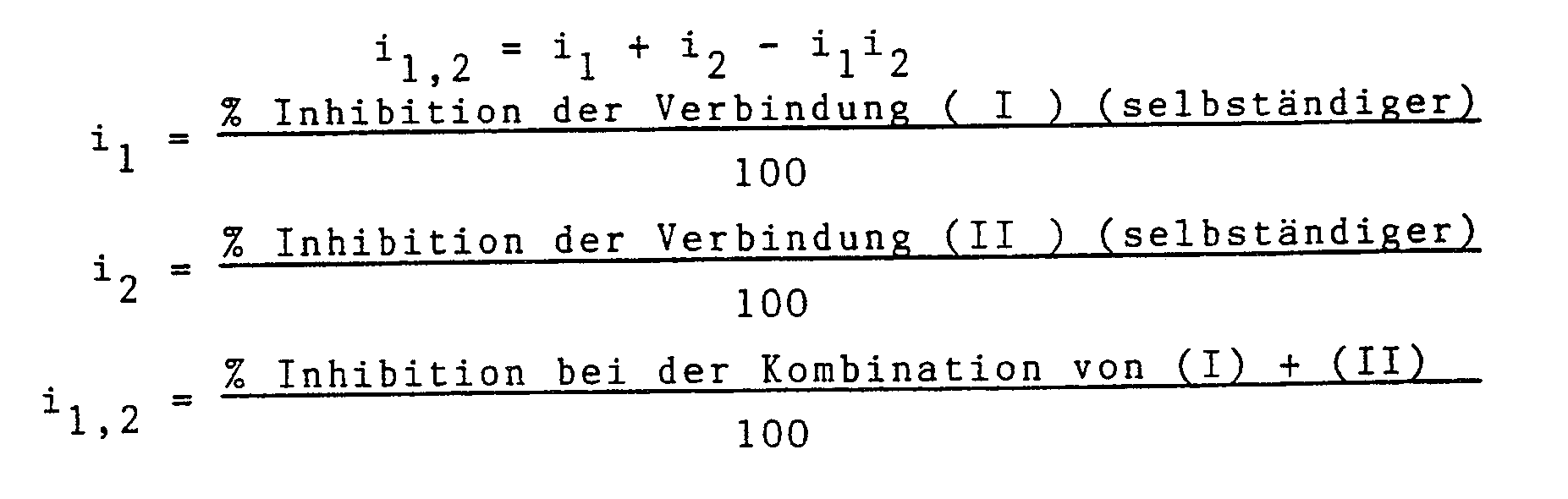
bei einem Antagonismus i1,2 < i₁ + i₂ - i₁i₂
bei einem Synergismus i1,2 > i₁ + i₂ - i₁i₂ - Bei den Mehrcyclen- und Eincyclustests werden einschichtige Zellkulturen einer embryonalen Kalbsniere verwendet, welche mit Grippe-Viren A/H3N2/Texas/77 und B/Lii/MOI = 0.01-0.5 und 1-10 entsprechend infiziert werden. Die Ausbeute an infektiösem und hämaglutinierendem Virus wird in der 24sten Stunde (bei einem Mehrcyclentest) und entsprechend in der zwölften bis fünfzehnten Stunde (bei einem Eincyclustest) ausgerechnet. Der infektiöse Titer wird EID₅₀/ml bestimmt. Dieselben Versuche werden auch mit Virus FPV (Stamm Weibridge) in Zellen EHF(bei Ausrechnung des infektiösen Virus Plaque-bildenden Einheiten und des hämaglutinierenden Virus) durchgeführt. Die Wirksamkeit der Verbindungen wird im Bezug auf die Kontrolle (ohne Inhibitoren) ausgerechnet.
- Beim Verfolgen der Wirkung des DD-13 auf die Entwicklung einer Resistenz gegen Rimantadin werden aufeinanderfolgende Passagen der Kultivierung des Virus FPV in Zellen EHF (in Reagensgläsern) in Anwesenheit nur von Rimantadin in Konzentrationen im Bereich 25 - 150 mkg/ml (d.h. unter oder ein wenig über der für die Zellen maximal verträglichen Konzentration) durchgeführt und parallel damit Passagen des Virus in denselben Konzentrationen des Rimantadins + 60 mkg/ml DD-13. Nach jeder dritten Passage bei einem Eincyclustest wird die Empfindlichkeit von jedem Zweig-Virus zum Rimantadin durch Bestimmung der Ausbeute des infektiösen Virus (in Plaque-bildenden Einheiten/ml) geprüft.
- Die antivirelle Wirksamkeit der Kombination wird auch bei der Prüfung in vivo - bei experimentellen Infektionen bei weißen Mäusen mit Grippe-Viren A/H3N2/Aichi, A/H1N1/Porto Riko 8, B/Lii festgestellt. Es werden weiße Mäuse von der Linie H oder Suis mit einem Gewicht von 10 g intranasal angesteckt. Die Verbindungen werden peroral in Form von Wasserlösungen (hergestellt ex tempore) angewandt. Über die antivirelle Wirksamkeit wird nach der Dynamik des kumulativen Prozentes der Letalität während der Beobachtungsperiode von 14 Tagen (im Vergleich zur Placebogruppe) beurteilt. Es werden der Protektionskoeffizient (PK) und der Schutzindex (SI) sowie auch die durchschnittliche Zeit des Überlebens (DZÜ) berechnet.
- Im Agar-Diffusionstest überschreitet die antivirelle Wirkung der Kombination (I) + (II) die individuellen Effekte der (I) und (II), wenn sie getrennt angewandt werden.
- Im Plaque-Reduktionstest zeigt die kombinierte Anwendung der Verbindungen (I) und (II) eine additive Wirksamkeit für jede Konzentration des DD-13 plus 10⁻⁸M/1 Rimantadin und in den Kombinationen des DD-13 (jede Konzentration mit 10⁻⁹M/1 oder 10⁻¹⁰M/1 Rimantadin) eine klare synergetische Wirksamkeit (seltener eine additive Wirksamkeit), d.h., daß eine günstige Kombination der Wirksamkeiten beider Verbindungen - Summation oder häufiger - Synergismus vorhanden ist.
- Bei den Eincyclus- und Mehrcyclentests führte die Kombination der Verbindungen (I) + (II) zu einem deutlichen Verstärken der antivirellen Wirksamkeit beider Verbindungen gegenüber dem Grippe-Virus A/H3N2/Texas/77 und dem Virus FPV/A/H7N7/Weibridge. Bei dem Grippe-Virus B/Lii wird ebenso ein deutliches Verstärken der inhibierenden Wirksamkeit des DD-13 in Anweseheit von Rimantadin festgestellt, bei welchem man weiß, daß der letztere allein angewandt gegen über den Stämmen des Grippe-Virus B nicht aktiv ist (oder seine Wirksamkeit ist unwesentlich).
- Es ist klar, daß die Anwendung der Verbindungen (I) und (II) in Kombination die Verwendung von niedrigeren Konzentrationen erlaubt - unter deren wirksamen Konzentrationen oder an der unteren Grenze der Wirksamkeit bei der Anwendung von (I) und (II) selbständig. Dabei zeigt die Kombination eine ausgeprägte antivirelle Wirksamkeit.
- Die Entwicklung einer Resistenz des Virus FPV/Grippe-Virus A/H7N7/ gegenüber dem Rimantadin wird deutlich durch das Vorhandensein des DD-13 gehemmt. Auf diese Weise ist die inhibierende Wirksamkeit des Rimantadins (25 mkg/ml) auf das Virus, das 3 Passagen in Anwesenheit von 100 mkg/ml Rimantadin passiert hat, 0 %, 3 Passagen in Anwesenheit von 100 mkg/ml Rimantadin und 60 mkg/ml DD-13 97,14 %, während die inhibierende Wirkung auf das Ausgangsvirus über 99,23 % ist.
Bei der Verwendung von Rimantadin in Kombination mit DD-13 können diese als Pulver, granuliert oder als Wasserlösungen angewandt werden. - Die Vorteile des erfindungsgemäßen Arzneimittels mit Antivirus-Wirksamkeit (eine Kombination von Rimantadin mit dem Tetrahydropyrimidin-Derivat II) sind folgende:
- es zeigt eine stärkere antivirelle Wirksamkeit;
- es zeichnet sich durch eine höhere Selektivität der Wirksamkeit aus;
- es ist wirksam außer bei einer Grippe-Infektion mit Verursacher Grippe-Virus A und ebenso bei Infektionen mit Verursacher Grippe-Virus B;
- die Möglichkeit zum Entstehen von resistenten Mutanten des Grippe-Virus A gegenüber dem Remantadin wird eingeschränkt. - Anhand der nachstehend als Beispiel angeführten Ausführung wird die Erfindung näher erläutert.
- Bei dem Plaque-Reduktionstest bei der Prüfung der Wirksamkeit der Kombination des Remantadins mit dem DD-13 (Tabelle 1) 10⁻⁸M/1 Rimantadin plus 10⁻⁵M/1, 3 x 10⁻⁵M/1 oder 10⁻⁴M/1 DD-13 zeigen eine additive Wirksamkeit.

- Bei einer niedrigeren Konzentration des Rimantadins 10⁻⁹ oder 10⁻¹⁰M/1 wird ein deutlicher Synergismus festgestellt. So ist die selbständige Wirksamkeit d.h. die selbständige inhibierende Wirksamkeit des 3 x 10⁻⁴M/1 DD-13 85 % (eine Verminderung der Plaquebildung). Beim Zufügen von 10⁻¹⁰M/1 Rimantadin, praktisch eine Konzentration ohne Wirksamkeit, wächst die inhibierende Wirksamkeit auf 94,55, und bei Beifügung von 10⁻⁹M/1 Rimantadin (mit einer selbständigen Wirksamkeit - 18,37 % Inhibition) erlangt die inhibierende Wirksamkeit 97,27 %.
- Im Mehrcyclentest zeigt die Prüfung der Wirksamkeit der Kombination gegenüber dem Virus FPV (MOI = 0,5) einen deutlichen Synergismus (Tabelle 2).

- So z.B. führt die Kombination 60 mkg/ml DD-13 mit 5 mkg/ml Rimantadin zu einer 256-maligen Verminderung der Ausbeute des hämaglutivierenden Virus, während die selbständige Wirksamkeit von 60 mkg/ml DD-13 eine viermalige Verminde rung (Senkung) ist, und von 5 mkg/ml Rimantadin eine 64-malige Senkung. Eine synergistische Wirksamkeit wird ausgerechnet auch beim Einschätzen der Ausbeute an infektiösem Virus in den plaquebildenden Einheiten/ml.
- Die Wirksamkeit der Kombination Rimantadin plus DD-13 auf die Fortpflanzung der Grippe-Virus A/H3N2/Texas/77 in einer Zellkultur von Kalbsniere in einem Mehrcyclentest (MOI = 0,05) zeichnet sich ebenso durch eine Verstärken der Wirksamkeit (Tabelle 3) aus.

- Die Kombination der Verbindungen (I) und (II) zeigt einen verstärkten Effekt auch auf die Fortpflanzung des Grippe-Virus B/Lii in einer Zellkultur von Kalbsniere bei Prüfung in einem Eincyclustest (MOI = 1) (Tabelle 4).

- Bei der Prüfung in vivo des Modells der experimentellen Infektionen mit Grippe-Viren A/H3N2) Aichi, A/H1N1) Porto Rico 8 und B/Lii erfolgt ebenso eine deutliche synergetische antivirelle Wirksamkeit der Kombination DD-13 plus Rimantadin.
- In Tabelle 1 ist der Effekt bei einer Infektion mit Grippe-Virus A/H3N2/Aichi gezeigt. Die Kombination von dem DD-13 18,7 mg/kg 1/213 von LD₅₀ und Rimantadin 10 mg/kg, angewandt peroral bei einer 5-tägigen Behandlung (bei einem 12-stündigen Dosen-Interval) vom Tag der Virus-Inokulation an, zeigt den maximalen protektiven Effekt. Er ist gleich oder größer als die Wirksamkeit beider Komponenten, allein oder in Kombination in zwei mal höherer Dosis eingenommen. Dabei werden hohe Werte des Protektiv-Indexes (80 %) auch bei massiven Virus-Inokulumen (über 50 LD₅₀) ausgerechnet.
Claims (1)
- Antivirus-Mittel, dadurch gekennzeichnet, daß es N-Methyl-1-adamantanmethylamin-Hydrochlorid


Priority Applications (1)
| Application Number | Priority Date | Filing Date | Title |
|---|---|---|---|
| EP88100806A EP0324875A1 (de) | 1988-01-20 | 1988-01-20 | Antivirus-Mittel |
Applications Claiming Priority (1)
| Application Number | Priority Date | Filing Date | Title |
|---|---|---|---|
| EP88100806A EP0324875A1 (de) | 1988-01-20 | 1988-01-20 | Antivirus-Mittel |
Publications (1)
| Publication Number | Publication Date |
|---|---|
| EP0324875A1 true EP0324875A1 (de) | 1989-07-26 |
Family
ID=8198661
Family Applications (1)
| Application Number | Title | Priority Date | Filing Date |
|---|---|---|---|
| EP88100806A Withdrawn EP0324875A1 (de) | 1988-01-20 | 1988-01-20 | Antivirus-Mittel |
Country Status (1)
| Country | Link |
|---|---|
| EP (1) | EP0324875A1 (de) |
Cited By (2)
| Publication number | Priority date | Publication date | Assignee | Title |
|---|---|---|---|---|
| RU2205000C2 (ru) * | 2001-08-09 | 2003-05-27 | Самарский государственный технический университет | Применение оксима (3-хлор-1-адамантил)метилкетона в качестве ингибитора вируса герпеса простого типа 1 и вируса гриппа а |
| EA007919B1 (ru) * | 2006-04-19 | 2007-02-27 | Закрытое Акционерное Общество "Вега Фарм" | Средство, обладающее противовирусной активностью, и способ его получения |
-
1988
- 1988-01-20 EP EP88100806A patent/EP0324875A1/de not_active Withdrawn
Non-Patent Citations (2)
| Title |
|---|
| ARZNEIMITTEL FORSCHUNG, DRUG RESEARCH, Band 34 (I), Nr. 1, 1984, Seiten 9-14; A.S. GALABOV et al.: "Antiviral activity of tetrahydro-2(1H)-pyrimidinones and related compounds" * |
| ARZNEIMITTEL FORSCHUNG, DRUG RESEARCH, Band 35(II), Nr. 8, 1985, Seiten 1269-1275; A. KARPAROV et al.: "Antiviral effect of 1-morpholinomethyl-tetrahydro-2(1H)-pyrimidinone (DD-13) in experimental alphaviral infections in white mice" * |
Cited By (2)
| Publication number | Priority date | Publication date | Assignee | Title |
|---|---|---|---|---|
| RU2205000C2 (ru) * | 2001-08-09 | 2003-05-27 | Самарский государственный технический университет | Применение оксима (3-хлор-1-адамантил)метилкетона в качестве ингибитора вируса герпеса простого типа 1 и вируса гриппа а |
| EA007919B1 (ru) * | 2006-04-19 | 2007-02-27 | Закрытое Акционерное Общество "Вега Фарм" | Средство, обладающее противовирусной активностью, и способ его получения |
Similar Documents
| Publication | Publication Date | Title |
|---|---|---|
| DE3689220T2 (de) | Hemmung der In-vitro-Infektivität und des zytopathischen Effektes von HTLV-III/LAV durch 2'3'-Dideoxyinosin, 2'3'-Dideoxyguanosin oder 2'3'-Dideoxyadenosin. | |
| US4628063A (en) | Antiviral pharmaceutical preparations and methods for their use | |
| DE3852665T2 (de) | Säurebeständige Dideoxynucleoside, wirksam gegen den HIV-Virus. | |
| DE69028775T2 (de) | Antivirale therapie unter verwendung von thiazin- und xanthenfarbstoffen | |
| Maudgal et al. | (E)-5-(2-bromovinyl)-2'-Deoxyuridine in the treatment of experimental herpes simplex keratitis | |
| DE2728685A1 (de) | Arzneimittel | |
| DE69313872T2 (de) | Verbindung von nucleocidanaloga zur behandlung viraler infektionen | |
| DE69526936T2 (de) | Benzamide-derivate, zubereitungen die sie erhalten und ihre anwendung | |
| Roat et al. | The antiviral effects of rose bengal and fluorescein | |
| DE3873207T2 (de) | Antivirale therapie gegen hepatitis b mit 2',3'-didesoxynucleosiden. | |
| US4081534A (en) | Amino purine nucleosides as autoimmune suppressant agents | |
| Klein et al. | Herpes simplex virus skin infection in hairless mice: treatment with antiviral compounds | |
| EP0374096B1 (de) | 2',3'-Dideoxypurinnucleosid/Purinnucleosid-Phosphorylase-Inhibitor Kombinationstherapie und Zusammensetzungen dafür | |
| US5039667A (en) | Antiviral therapy for hepatitis B with 2',3'-dideoxypurine nucleosides | |
| JP2724711B2 (ja) | 医薬品生成物 | |
| DE3689221T2 (de) | Hemmung der In-vitro-Infektivität und des zytopathischen Effektes von HTLV-III/LAV durch 2'3'-Dideoxycytidin. | |
| DE3780814T2 (de) | Verwendung von nukleosiden zur herstellung eines medikamentes zur behandlung von krankheiten, die durch einen retrovirus oder den hepatitis-b-virus verursacht werden. | |
| DE3686514T2 (de) | N-(2-carboxy)-ethyl-1,8-naphthalenimid und dessen salze zur behandlung von diabetischen retinopathien und neuropathien. | |
| EP0324875A1 (de) | Antivirus-Mittel | |
| Hyndiuk et al. | Newer compounds in therapy of herpes simplex keratitis | |
| DE69125610T2 (de) | Penciclovir und famciclovir und verwandte guaninderivate zur behandlung von hiv-1-infektionen | |
| DE69019404T2 (de) | Derivate von Penciclovir zur Behandlung von Hepatitis-B-Infektionen. | |
| DE69535366T2 (de) | Zusammensetzung zur behandlung und vorbeugung von hiv-1 infektionen, welche mindestens zwei verschiedene hiv-1 reverse transcriptase inhibitoren enthalt | |
| JPS60202822A (ja) | 抗ウイルス薬 | |
| US5102902A (en) | Reagents and method for therapeutic treatment of multiple sclerosis |
Legal Events
| Date | Code | Title | Description |
|---|---|---|---|
| PUAI | Public reference made under article 153(3) epc to a published international application that has entered the european phase |
Free format text: ORIGINAL CODE: 0009012 |
|
| AK | Designated contracting states |
Kind code of ref document: A1 Designated state(s): AT BE CH DE ES FR GB IT LI |
|
| 17P | Request for examination filed |
Effective date: 19890920 |
|
| 17Q | First examination report despatched |
Effective date: 19901001 |
|
| STAA | Information on the status of an ep patent application or granted ep patent |
Free format text: STATUS: THE APPLICATION HAS BEEN WITHDRAWN |
|
| 18W | Application withdrawn |
Withdrawal date: 19910129 |