EP0325973A2 - Aufzeichnungsflüssigkeit für das Ink-Jet-Verfahren - Google Patents
Aufzeichnungsflüssigkeit für das Ink-Jet-Verfahren Download PDFInfo
- Publication number
- EP0325973A2 EP0325973A2 EP89100616A EP89100616A EP0325973A2 EP 0325973 A2 EP0325973 A2 EP 0325973A2 EP 89100616 A EP89100616 A EP 89100616A EP 89100616 A EP89100616 A EP 89100616A EP 0325973 A2 EP0325973 A2 EP 0325973A2
- Authority
- EP
- European Patent Office
- Prior art keywords
- recording liquid
- formula
- mono
- alkyl
- dye
- Prior art date
- Legal status (The legal status is an assumption and is not a legal conclusion. Google has not performed a legal analysis and makes no representation as to the accuracy of the status listed.)
- Withdrawn
Links
Classifications
-
- C—CHEMISTRY; METALLURGY
- C09—DYES; PAINTS; POLISHES; NATURAL RESINS; ADHESIVES; COMPOSITIONS NOT OTHERWISE PROVIDED FOR; APPLICATIONS OF MATERIALS NOT OTHERWISE PROVIDED FOR
- C09D—COATING COMPOSITIONS, e.g. PAINTS, VARNISHES OR LACQUERS; FILLING PASTES; CHEMICAL PAINT OR INK REMOVERS; INKS; CORRECTING FLUIDS; WOODSTAINS; PASTES OR SOLIDS FOR COLOURING OR PRINTING; USE OF MATERIALS THEREFOR
- C09D11/00—Inks
- C09D11/30—Inkjet printing inks
- C09D11/32—Inkjet printing inks characterised by colouring agents
- C09D11/328—Inkjet printing inks characterised by colouring agents characterised by dyes
Definitions
- the present invention relates to a new recording liquid for the ink jet process, comprising a water-miscible organic solvent and a basic dye which has two 6-hydroxypyrid-2-one residues, each of which has a pyridinium residue in ring position 5 and in Ring position 3 are each linked via an azo group to a bridge member which comes from the diaryl (hetero) alkane, arylazoaryl, arylcarbonylaminoaryl or arylsulfonylaminoaryl series.
- the ink jet process is known per se. Droplets of writing fluid from one or more small nozzles are targeted onto a carrier, e.g. shot on paper, wood, textiles, plastic or metal. The electronic droplets are combined into characters or graphic patterns.
- Recording liquids suitable for the ink jet process generally contain dyes which are soluble in water and / or organic solvents as colorants.
- some of these dyes have shortcomings in their application properties, e.g. in waterfastness or smearfastness.
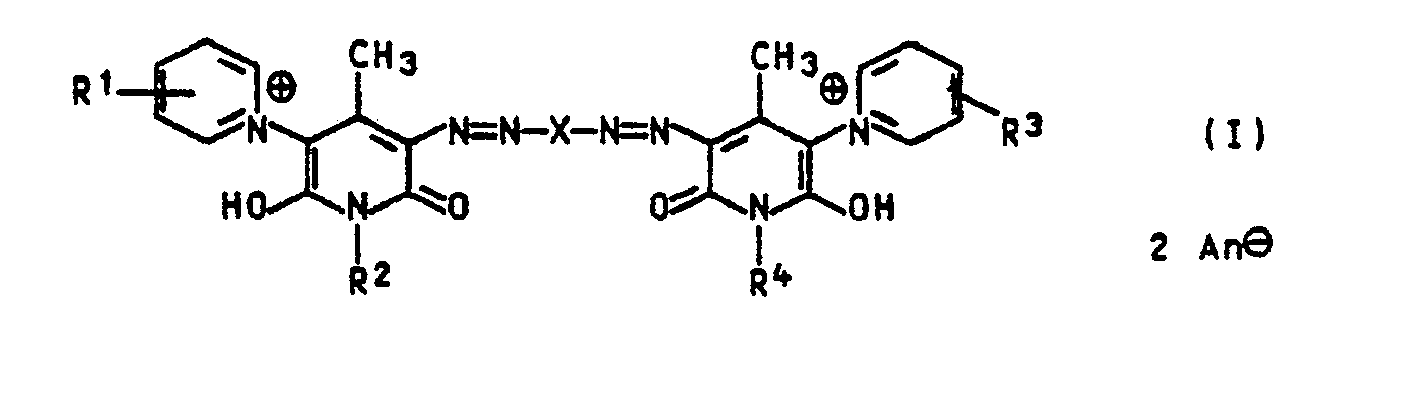
- a new recording liquid for the ink jet process comprising dye and a water-miscible organic solvent, which is characterized in that it contains a dye of the formula I. contains in the An ⁇ an anion, R1 and R3 are the same or different and are each independently hydrogen, C1-C4-alkyl, carboxyl, C1-C4-alkoxycarbonyl, carbamoyl or C1-C4-mono- or dialkylcarbamoyl, R2 and R4 are the same or different and are each independently hydrogen or C1-C4-alkyl, optionally by amino, C1-C4-mono- or dialkylamino, or the rest where R5, R6 and R7 are the same or different and each independently represents C1-C4-alkyl and An ⁇ has the abovementioned meaning, is substituted, and X is a bridge member of the formula II or III where Y is C1-C6-alkylene, which is optionally interrupted by oxygen, imin
- C1-C4-alkyl optionally benzo-fused and / or substituted by C1-C4-alkyl, hydroxy, C1-C4-alkoxy, amino, C1-C4-mono- or dialkylamino or hydroxysulfonyl.
- Anions An ⁇ are derived from inorganic or organic acids and are for example fluoride, chloride, bromide, hydrogen sulfate, sulfate, aminosulfate, methosulfate, ethosulfate, perchlorate, tetrafluoroborate, trichlorozincate, methanesulfonate, benzenesulfonate, p-toluenesulfonate, formate, acetate, acetate Lactate, benzoate, oxalate or succinate.
- R1, R2, R3, R4, R5, R6 and R7 are, for example, methyl, ethyl, propyl, isopropyl, butyl, isobutyl or sec-butyl.
- Residues R1 and R3 are furthermore, for example, methoxycarbonyl, ethoxycarbonyl, propoxycarbonyl, isopropoxycarbonyl, butoxycarbonyl, isobutoxycarbonyl, sec-butoxycarbonyl, mono- or dimethylcarbamoyl, mono- or diethyl carbamoyl, mono- or dipropylcarbamoyl, mono- or diisopropylcarbamoyl, mono- or dibutylcarbamoyl or N-methyl-N-ethylcarbamoyl.
- Residues R2 and R4 are further e.g. 2-aminoethyl, 2-methylaminoethyl, 2-dimethylaminoethyl, 2- or 3-aminopropyl, 2- or 3-methylaminopropyl, 2- or 3-dimethylaminopropyl, 2- or 4-aminobutyl, 2- or 4-methylaminobutyl or 2- or 4-dimethylaminobutyl.
- R2 and R4 are further examples -C2H4- (CH3) 3Cl ⁇ , -C2H4- (CH3) 3 CH3OSO3 ⁇ , -C2H4- (C2H5) 3Cl ⁇ , -C3H6- (CH3) 3 CH3OSO3 ⁇ or -C3H6- (C2H5) 3 C2H5OSO3 ⁇ .
- Y means, for example, methylene, ethylene, trimethylene, tetramethylene, pentamethylene, hexamethylene, 1-methylethylene, 1,2-dimethylethylene, 2-methyltrimethylene, 2-oxatrimethylene, 2-azatrimethylene, 2-aza-2-methyltrimethylene, 3-oxapentamethylene, 3 -Azapentamethylene or 3-aza-3-methylpentamethylene.
- a recording liquid which contains such dyes of the formula I in which R1 and R3 are each hydrogen, methyl or ethyl, R2 and R4 are each hydrogen, dimethylaminopropyl or diethylaminopropyl and X is a bridge member of the formula IIa or IIIa where Y is C2-C4-alkylene, especially ethylene, -CO-NH- or -SO2-NH- mean.
- dyes of the formula I are known and are described, for example, in DE-A-2 627 680, DE-A-3 302 614 or DE-A-3 213 826, or they can be prepared by the methods listed there (loc.cit.) be preserved.
- the recording liquid according to the invention for the ink jet process contains one or more dyes of the formula I and a water-miscible organic solvent.
- Water-miscible organic solvents are e.g. C1-C4 alkanols, such as methanol, ethanol, propanol, isopropanol, butanol, isobutanol, sec-butanol or tert-butanol, carboxamides, such as N, N-dimethylformamide or N, N-dimethylacetamide, lactams, such as N-methylpyrrolid-2 -one, cyclic ureas, such as 1,3-dimethylimidazolidin-2-one, ketones or keto alcohols, such as acetone, methyl ethyl ketone or 2-methyl-2-hydroxypentan-4-one, ethers, such as tetrahydrofuran or dioxane, mono-, oligo- or polyalkylene glycols or thioglycols which have C2-C6 alkylene units, such as ethylene glycol, 1,2- or 1,3-propylene
- Water-miscible organic solvents which are preferred are, for example, N-methylpyrrolidin-2-one, mono-, di- or trialkylene glycols which have C2-C6-alkylene units, in particular mono-, di- or triethylene glycol, or dimethyl sulfoxide. Particularly noteworthy are N-methylpyrrolidin-2-one, diethylene glycol or dimethyl sulfoxide.
- the proportion of the dye of the formula I is generally 2 to 10% by weight, preferably 3 to 5% by weight, in each case based on the total weight of the recording liquid.
- recording liquid according to the invention for the ink jet process generally contains 50 to 95% by weight and in particular 70 to 95% by weight, in each case based on the total weight of the solvent system, of water.
- the new recording liquid can further contain auxiliaries, for example agents for influencing the viscosity, such as polyvinyl chloride or cellulose derivatives, surfactants (nonionic, anionic or cationic) or buffer systems.
- auxiliaries for example agents for influencing the viscosity, such as polyvinyl chloride or cellulose derivatives, surfactants (nonionic, anionic or cationic) or buffer systems.
- This recording liquid is used to fill the receptacle of an ink jet print head, which ejects the ink in droplets under the influence of heat supplied.
- This thermal ink jet print head is used to print commercially available paper, such as that used for typewriting.
- the authenticity of the typeface is rated on a scale from 5 to 1, where 5 means that there is no bleeding and 1 means that the typeface smeared so much that it is no longer recognizable.
- the dyes of the formula described in Table 1 were used to prepare the inks used.
- the dyes 1, 2, 3, 4, 5 and 6 were in accordance with Examples 1, 50, 55, 7, 61 and 66 of DE-A-2 627 680, the dyes 7, 8 and 9 in accordance with Examples 33, 34 and 35a of DE-A-3 302 614 and dye 10 according to Example 49 of DE-A-3 213 826.
- composition of the inks and the evaluation of the abrasion resistance of the typeface appear from Table 2.
- the water-miscible solvents (diethylene glycol or a mixture of diethylene glycol and N-methylpyrrolidin-2-one) are abbreviated to DEG and NMP. W stands for water.
Landscapes
- Chemical & Material Sciences (AREA)
- Life Sciences & Earth Sciences (AREA)
- Engineering & Computer Science (AREA)
- Materials Engineering (AREA)
- Wood Science & Technology (AREA)
- Organic Chemistry (AREA)
- Inks, Pencil-Leads, Or Crayons (AREA)
- Ink Jet Recording Methods And Recording Media Thereof (AREA)
Abstract

Description
- Die vorliegende Erfindung betrifft eine neue Aufzeichnungsflüssigkeit für das Ink-Jet-Verfahren, enthaltend ein mit Wasser mischbares organisches Lösungsmittel und einen basischen Farbstoff, der zwei 6-Hydroxypyrid-2-on-Reste aufweist, die jeweils in Ringposition 5 einen Pyridiniumrest tragen und in Ringposition 3 jeweils über eine Azogruppe mit einem Brückenglied, das aus der Diaryl(hetero)alkan-, Arylazoaryl-, Arylcarbonylaminoaryl- oder Arylsulfonylaminoaryl-Reihe stammt, verknüpft sind.
- Das Ink-Jet-Verfahren ist an sich bekannt. Dabei werden Tröpfchen einer Schreibflüssigkeit aus einer oder mehreren kleinen Düsen gezielt auf einen Träger, z.B. auf Papier, Holz, Textilien, Kunststoff oder Metall, geschossen. Durch elektronische Aussteuerung werden die einzelnen Tröpfchen zu Schriftzeichen oder graphischen Mustern zusammengefaßt.
- Für das Ink-Jet-Verfahren geeignete Aufzeichnungsflüssigkeiten enthalten im allgemeinen als Farbmittel in Wasser und/oder organischen Lösungsmitteln lösliche Farbstoffe. Einige dieser Farbstoffe weisen jedoch Mängel in ihren anwendungstechnischen Eigenschaften, z.B. in der Wasserechtheit oder Schmierechtheit, auf.
- Aufgabe der vorliegenden Erfindung war es deshalb, eine neue Aufzeichnungsflüssigkeit für das Ink-Jet-Verfahren bereitzustellen, wobei die darin enthaltenden Farbstoffe ein günstiges anwendungstechnisches Eigenschaftsprofil besitzen sollten.
- Es wurde eine neue Aufzeichnungsflüssigkeit für das Ink-Jet-Verfahren gefunden, enthaltend Farbstoff und ein mit Wasser mischbares organisches Lösungsmittel, die dadurch gekennzeichnet ist, daß sie einen Farbstoff der Formel I

An⊖ ein Anion,
R¹ und R³ gleich oder verschieden sind und unabhängig voneinander jeweils Wasserstoff, C₁-C₄-Alkyl, Carboxyl, C₁-C₄-Alkoxycarbonyl, Carbamoyl oder C₁-C₄-Mono- oder Dialkylcarbamoyl,
R² und R⁴ gleich oder verschieden sind und unabhängig voneinander jeweils Wasserstoff oder C₁-C₄-Alkyl, das gegebenenfalls durch Amino, C₁-C₄-Mono- oder Dialkylamino, oder den Rest
X ein Brückenglied der Formel II oder III
- Alle in der obengenannten Formel auftretenden Alkyl- und Alkylenreste können sowohl geradkettig als auch verzweigt sein.
- Anionen An⊖ leiten sich von anorganischen oder organischen Säuren ab und sind z.B. Fluorid, Chlorid, Bromid, Hydrogensulfat, Sulfat, Aminosulfat, Methosulfat, Ethosulfat, Perchlorat, Tetrafluoroborat, Trichlorozinkat, Methansulfonat, Benzolsulfonat, p-Toluolsulfonat, Formiat, Acetat, Propionat, Lactat, Benzoat, Oxalat oder Succinat.
- Reste R¹, R², R³, R⁴, R⁵, R⁶ und R⁷ sind beispielsweise Methyl, Ethyl, Propyl, Isopropyl, Butyl, Isobutyl oder sec-Butyl.
- Reste R¹ und R³ sind weiterhin z.B. Methoxycarbonyl, Ethoxycarbonyl, Propoxycarbonyl, Isopropoxycarbonyl, Butoxycarbonyl, Isobutoxycarbonyl, sec-Butoxycarbonyl, Mono- oder Dimethylcarbamoyl, Mono- oder Diethyl carbamoyl, Mono- oder Dipropylcarbamoyl, Mono- oder Diisopropylcarbamoyl, Mono- oder Dibutylcarbamoyl oder N-Methyl-N-ethylcarbamoyl.
- Reste R² und R⁴ sind weiterhin z.B. 2-Aminoethyl, 2-Methylaminoethyl, 2-Dimethylaminoethyl, 2- oder 3-Aminopropyl, 2- oder 3-Methylaminopropyl, 2- oder 3-Dimethylaminopropyl, 2- oder 4-Aminobutyl, 2- oder 4-Methylaminobutyl oder 2- oder 4-Dimethylaminobutyl.
- Reste R² und R⁴ sind weiterhin z.B.
-C₂H₄-(CH₃)₃Cl⊖, -C₂H₄- (CH₃)₃ CH₃OSO₃⊖, -C₂H₄-
 (C₂H₅)₃Cl⊖, -C₃H₆-
 (CH₃)₃ CH₃OSO₃⊖ oder -C₃H₆-
 (C₂H₅)₃ C₂H₅OSO₃⊖.
- Y bedeutet beispielsweise Methylen, Ethylen, Trimethylen, Tetramethylen, Pentamethylen, Hexamethylen, 1-Methylethylen, 1,2-Dimethylethylen, 2-Methyltrimethylen, 2-Oxatrimethylen, 2-Azatrimethylen, 2-Aza-2-methyltrimethylen, 3-Oxapentamethylen, 3-Azapentamethylen oder 3-Aza-3-methylpentamethylen.
- Bevorzugt ist eine Aufzeichnungsflüssigkeit, die solche Farbstoffe der Formel I enthält, in der
R¹ und R³ jeweils Wasserstoff, Methyl oder Ethyl,
R² und R⁴ jeweils Wasserstoff, Dimethylaminopropyl oder Diethylaminopropyl und
X ein Brückenglied der Formel IIa oder IIIa
- Die Farbstoffe der Formel I sind größtenteils bekannt und beispielsweise in der DE-A-2 627 680, DE-A-3 302 614 oder DE-A-3 213 826 beschrieben oder sie können nach den dort (loc.cit.) aufgeführten Methoden erhalten werden.
- Die erfindungsgemäße Aufzeichnungsflüssigkeit für das Ink-Jet-Verfahren enthält einen oder mehrere Farbstoffe der Formel I und ein mit Wasser mischbares organisches Lösungsmittel.
- Mit Wasser mischbare organische Lösungsmittel sind z.B. C₁-C₄-Alkanole, wie Methanol, Ethanol, Propanol, Isopropanol, Butanol, Isobutanol, sec-Butanol oder tert-Butanol, Carbonsäureamide, wie N,N-Dimethylformamid oder N,N-Dimethylacetamid, Lactame, wie N-Methylpyrrolid-2-on, cyclische Harnstoffe, wie 1,3-Dimethylimidazolidin-2-on, Ketone oder Ketoalkohole, wie Aceton, Methylethylketon oder 2-Methyl-2-hydroxypentan-4-on, Ether, wie Tetrahydrofuran oder Dioxan, Mono-, Oligo- oder Polyalkylenglykole oder -thioglykole, die C₂-C₆-Alkyleneinheiten aufweisen, wie Ethylenglykol, 1,2- oder 1,3-Propylenglykol, 1,2- oder 1,4-Butylenglykol, 1,6-Hexylenglykol, Diethylenglykol, Triethylenglykol, Thiodiglykol, Polyethylenglykol oder Polypropylenglykol, andere Polyole, wie Glycerin oder Hexan-1,2,6-triol, C₁-C₄-Alkylether von mehrwertigen Alkoholen, wie Ethylenglykolmonomethyl- oder -monoethylether, Diethylenglykolmonomethyl-oder -monoethylether oder Triethylenglykolmonomethyl- oder -monoethylether oder Dimethylsulfoxid.
- Mit Wasser mischbare organische Lösungsmittel, die bevorzugt sind, sind beispielsweise N-Methylpyrrolidin-2-on, Mono-, Di- oder Trialkylenglykole, die C₂-C₆-Alkyleneinheiten aufweisen, insbesondere Mono-, Di- oder Triethylenglykol, oder Dimethylsulfoxid. Ganz besonders hervorzuheben sind N-Methylpyrrolidin-2-on, Diethylenglykol oder Dimethylsulfoxid.
- Der Anteil des Farbstoffs der Formel I liegt in der Regel bei 2 bis 10 Gew.%, vorzugsweise 3 bis 5 Gew.%, jeweils bezogen auf das Gesamtgewicht der Aufzeichnungsflüssigkeit.
- Bevorzugt ist eine Aufzeichnungsflüssigkeit, die neben dem Farbstoff der Formel I und einem mit Wasser mischbaren organischen Lösungsmittel zusätzlich noch Wasser enthält.
- In diesem Fall enthält erfindungsgemäße Aufzeichnungsflüssigkeit für das Ink-Jet-Verfahren im allgemeinen 50 bis 95 Gew.% und insbesondere 70 bis 95 Gew.%, jeweils bezogen auf das Gesamtgewicht des Lösungsmittelsystems, an Wasser.
- Die neue Aufzeichnungsflüssigkeit kann weiterhin Hilfsmittel, beispielsweise Mittel zur Beeinflussung der Viskosität, wie Polyvinylchlorid oder Cellulosederivate, Tenside (nichtionisch, anionisch oder kationisch) oder Puffersysteme enthalten.
- Die folgenden Beispiele sollen die Erfindung näher erläutern.
- 4 bis 5 Gew.-Teile eines Farbstoffs, der nach dem an sich bekannten Verfahren der umgekehrten Osmose von Elektrolyten befreit worden ist, werden in 95 bis 96 Gew.-Teilen einer Flüssigkeit gelöst, deren Zusammensetzung in den nachfolgenden Beispielen angegeben ist. Die Lösung wird unter Druck durch ein Teflon-Filter der Porengröße 1 µm filtriert und danach unter vermindertem Druck entgast.
- Mit dieser Aufzeichnungsflüssigkeit wird das Aufnahmegefäß eines Tintenstrahl-Druckkopfes gefüllt, der unter dem Einfluß von zugeführter Wärme die Tinte tröpfchenförmig auswirft. Mit diesem Thermo-Ink-Jet-Druckkopf wird ein handelsübliches Papier, wie es für Maschinenschriften verwendet wird, bedruckt.
- Die Abriebechtheit des erhaltenen Schriftbildes wird nach zwei Methoden geprüft:
- Methode 1: Überstreichen der Schrift mit einem handelsüblichen Text-Marker
- Methode 2: Reiben einer beschriebenen Stelle mit einem angefeuchteten Finger
- Die Echtheit des Schriftbildes wird im Rahmen einer von 5 bis 1 reichenden Skala bewertet, wobei 5 bedeutet, daß kein Ausbluten erfolgt, und 1 bedeutet, daß das Schriftbild so stark verschmiert, daß es nicht mehr erkennbar ist.
- Zur Herstellung der Tinten wurden die in der Tabelle 1 beschriebenen Farbstoffe der Formel
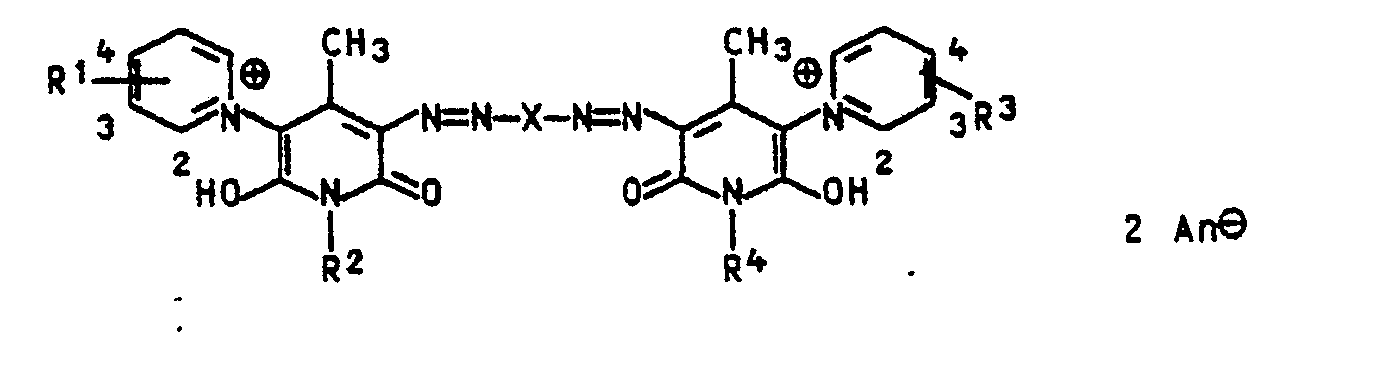

- Die Farbstoffe 1, 2, 3, 4, 5 und 6 wurden dabei gemäß den Beispielen 1, 50, 55, 7, 61 und 66 der DE-A-2 627 680, die Farbstoffe 7, 8 und 9 gemäß den Beispielen 33, 34 und 35a der DE-A-3 302 614 und der Farbstoff 10 gemäß Beispiel 49 der DE-A-3 213 826 hergestellt.
- Die Zusammensetzung der Tinten sowie die Bewertung der Abriebechtheit des Schriftbildes gehen aus der Tabelle 2 hervor. Die wassermischbaren Lösungsmittel (Diethylenglykol oder eine Mischung aus Diethylenglykol und N-Methylpyrrolidin-2-on) sind mit DEG und NMP abgekürzt. W steht für Wasser.
Tabelle 2 Anwendungsbeispiel Nr. Farbstoff-Nr. Anteil des Farbstoffs an der Aufzeichnungsflüssigkeit [Gew.%] Zusammensetzung des Lösungsmittelsystems [Gew.-Teile] Farbe Echtheit nach Methode 1 Methode 2 1 1 4,5 W:DEG = 9:1 gelb 5 4-5 2 2 4,5 W:DEG = 9:1 gelb 4 4 3 3 4,5 W:DEG = 9,5:0,5 gelb 4-5 4 4 4 4,0 W:DEG = 9:1 orange 4 4-5 5 5 4,0 W:DEG = 9:1 orange 4 3-4 6 6 4,5 W:DEG = 9:1 orange 4 4 7 7 5 W:DEG:NMP = 6:3:1 schwarz 5 4-5 8 8 5 W:DEG:NMP = 6:3:1 schwarz 4-5 4-5 9 9 4,5 W:DEG:NMP = 6:3:1 schwarz 4-5 4 10 10 4,5 W:DEG:NMP = 6:3:1 schwarz 4 3-4
Claims (3)
An⊖ ein Anion,
R¹ und R³ gleich oder verschieden sind und unabhängig voneinander jeweils Wasserstoff, C₁-C₄-Alkyl, Carboxyl, C₁-C₄-Alkoxycarbonyl, Carbamoyl oder C₁-C₄-Mono- oder Dialkylcarbamoyl,
R² und R⁴ gleich oder verschieden sind und unabhängig voneinander jeweils Wasserstoff oder C₁-C₄-Alkyl, das gegebenenfalls durch Amino, C₁-C₄-Mono-oder Dialkylamino oder den Rest

X ein Brückenglied der Formel II oder III

R¹ und R³ jeweils Wasserstoff, Methyl oder Ethyl,
R² und R⁴ jeweils Wasserstoff, Dimethylaminopropyl oder Diethylaminopropyl und
X ein Brückenglied der Formel IIa oder IIIa

Applications Claiming Priority (2)
| Application Number | Priority Date | Filing Date | Title |
|---|---|---|---|
| DE3801945 | 1988-01-23 | ||
| DE3801945A DE3801945A1 (de) | 1988-01-23 | 1988-01-23 | Aufzeichnungsfluessigkeit fuer das ink-jet-verfahren |
Publications (2)
| Publication Number | Publication Date |
|---|---|
| EP0325973A2 true EP0325973A2 (de) | 1989-08-02 |
| EP0325973A3 EP0325973A3 (de) | 1991-09-11 |
Family
ID=6345860
Family Applications (1)
| Application Number | Title | Priority Date | Filing Date |
|---|---|---|---|
| EP19890100616 Withdrawn EP0325973A3 (de) | 1988-01-23 | 1989-01-14 | Aufzeichnungsflüssigkeit für das Ink-Jet-Verfahren |
Country Status (4)
| Country | Link |
|---|---|
| US (1) | US5015292A (de) |
| EP (1) | EP0325973A3 (de) |
| JP (1) | JPH01236286A (de) |
| DE (1) | DE3801945A1 (de) |
Cited By (3)
| Publication number | Priority date | Publication date | Assignee | Title |
|---|---|---|---|---|
| WO1999043754A1 (en) * | 1998-02-28 | 1999-09-02 | Avecia Limited | Monoazo dyestuffs, a composition and an ink for ink jet printing comprising them |
| EP2085428A1 (de) * | 2008-01-24 | 2009-08-05 | Clariant International Ltd. | Basische Bisazo-Verbindungen |
| EP2085429A1 (de) * | 2008-01-25 | 2009-08-05 | Clariant International Ltd. | Basische Bisazo-Verbindungen |
Families Citing this family (7)
| Publication number | Priority date | Publication date | Assignee | Title |
|---|---|---|---|---|
| DE4034060A1 (de) * | 1990-10-26 | 1992-04-30 | Basf Ag | Biskationische azofarbstoffe |
| DE4107377A1 (de) * | 1991-03-08 | 1992-09-10 | Basf Ag | Reaktivfarbstoffe mit einer kupplungskomponente aus der hydroxypyridonreihe |
| GB2303634B (en) * | 1995-07-21 | 1997-12-10 | Clariant Finance Bvi Ltd | Basic azo compounds,their production and use |
| US6797745B1 (en) * | 1999-09-23 | 2004-09-28 | Xerox Corporation | Hot melt inks containing styrene or terpene polymers |
| JP4377254B2 (ja) * | 2003-03-27 | 2009-12-02 | 富士フイルム株式会社 | インクセット |
| FR2864781B1 (fr) * | 2004-01-07 | 2006-02-17 | Oreal | Composition tinctoriale comprenant au moins un colorant direct de la famille azo-pyridinio-pyridone et au moins un colorant de synthese different, procede de coloration des fibres keratiniques |
| GB0711963D0 (en) * | 2007-06-21 | 2007-08-01 | Fujifilm Imaging Colorants Ltd | Colorant composition,ink,printing process |
Family Cites Families (13)
| Publication number | Priority date | Publication date | Assignee | Title |
|---|---|---|---|---|
| GB1332477A (en) * | 1969-11-07 | 1973-10-03 | Sandoz Ltd | Basic azo dyes free from sulphonic acid groups their production and use |
| JPS51137506A (en) * | 1975-05-22 | 1976-11-27 | Konishiroku Photo Ind | Composition of ink for ink jet recording |
| FI66893C (fi) * | 1975-06-30 | 1984-12-10 | Sandoz Ag | Saosom faergaemnen anvaendbara biskatjoniska azofoereningar forfarande foer deras framstaellning och deras anvaendning |
| CH627201A5 (de) * | 1977-03-14 | 1981-12-31 | Sandoz Ag | |
| US4673735A (en) * | 1982-04-15 | 1987-06-16 | Sandoz Ltd. | Azo compounds having at least one 6-hydroxypyrid-2-one coupling component radical metal complexes thereof and intermediates therefor |
| EP0092520B1 (de) * | 1982-04-15 | 1986-11-12 | Sandoz Ag | Basische Verbindungen, deren Herstellung und Verwendung |
| US4780106A (en) * | 1982-04-15 | 1988-10-25 | Sandoz Ltd. | Use of metal-free azo _compounds having at least one _6-hydroxypyrid-2-one _coupling component radical and metal _complexes thereof for dyeing _substrates and substrates dyed therewith |
| DE3213826A1 (de) * | 1982-04-15 | 1983-10-27 | Sandoz-Patent-GmbH, 7850 Lörrach | Basische und/oder kationische pyridonhaltige dis- oder polyazoverbindungen, ihre herstellung und verwendung |
| JPS6060170A (ja) * | 1983-09-12 | 1985-04-06 | Canon Inc | 記録液 |
| CH667464A5 (de) * | 1985-03-30 | 1988-10-14 | Sandoz Ag | Sulfonsaeuregruppenfreie basische azoverbindungen. |
| US4724001A (en) * | 1985-05-14 | 1988-02-09 | Canon Kabushiki Kaisha | Disazoic dye and recording liquid containing the same |
| JPS62232472A (ja) * | 1986-04-02 | 1987-10-12 | Ricoh Co Ltd | 水性インク組成物 |
| US4780105A (en) * | 1987-04-15 | 1988-10-25 | Stockhausen, Inc. | Composition for dyeing material of synthetic aromatic polyamide fibers: cationic dye and n-alkyl phthalimide |
-
1988
- 1988-01-23 DE DE3801945A patent/DE3801945A1/de not_active Withdrawn
-
1989
- 1989-01-14 EP EP19890100616 patent/EP0325973A3/de not_active Withdrawn
- 1989-01-23 JP JP1012059A patent/JPH01236286A/ja active Pending
- 1989-01-23 US US07/299,462 patent/US5015292A/en not_active Expired - Fee Related
Cited By (4)
| Publication number | Priority date | Publication date | Assignee | Title |
|---|---|---|---|---|
| WO1999043754A1 (en) * | 1998-02-28 | 1999-09-02 | Avecia Limited | Monoazo dyestuffs, a composition and an ink for ink jet printing comprising them |
| US6488752B1 (en) | 1998-02-28 | 2002-12-03 | Avecia Limited | Monoazo dyestuffs, a composition and an ink for ink jet printing comprising them |
| EP2085428A1 (de) * | 2008-01-24 | 2009-08-05 | Clariant International Ltd. | Basische Bisazo-Verbindungen |
| EP2085429A1 (de) * | 2008-01-25 | 2009-08-05 | Clariant International Ltd. | Basische Bisazo-Verbindungen |
Also Published As
| Publication number | Publication date |
|---|---|
| DE3801945A1 (de) | 1989-07-27 |
| US5015292A (en) | 1991-05-14 |
| JPH01236286A (ja) | 1989-09-21 |
| EP0325973A3 (de) | 1991-09-11 |
Similar Documents
| Publication | Publication Date | Title |
|---|---|---|
| DE69232625T2 (de) | Strahldrucktintenzusammensetzung und Druckverfahren | |
| DE69106750T2 (de) | Tinte, Tintenstrahlaufzeichnungsverfahren und diese Tinte verwendendes Instrument. | |
| DE69827581T2 (de) | Wässriges tintenset für den tintenstrahldruck | |
| DE69330333T2 (de) | Schwarze Tintenzusammensetzung mit einer vortrefflichen schwarzen Farbe | |
| DE602004002619T2 (de) | Auf Öl basierende pigmenthaltige Tintenzusammensetzung | |
| DE69704247T2 (de) | Zerfliessverminderung in Tintenstrahldrucktinten unter Verwendung von Säuren, die basische funktionelle Gruppen enthalten | |
| DE69308186T2 (de) | Schwarz/Farbe Verlaufskontrolle in thermischem Tintenstrahldruckverfahren | |
| DE69204199T2 (de) | Schmierenfeste Tinte für Tintenstrahldruckvorrichtung. | |
| DE69418135T2 (de) | Tintenzusammensetzung für Tintenstrahl-Aufzeichnung | |
| DE69201931T2 (de) | Zerflussverminderung durch Verwendung zwitterionischer Tenside und kationischer Farbstoffe. | |
| DE69329613T2 (de) | Tinte, Verfahren zur Tintenstrahlaufzeichnung und Tintenstrahlaufzeichnungsgerät | |
| DE19808672C2 (de) | Tinte des pigmenthaltigen Typs auf Wasserbasis | |
| DE69817790T2 (de) | Tintenzusatzmittel | |
| DE69233374T2 (de) | Aufzeichnungsflüssigkeit | |
| DE69112726T2 (de) | Tintenstrahldruckzusammensetzung, Verfahren zum Formen von Druckbildern und so bereitete Gegenstände. | |
| EP0565286B1 (de) | Farbstoffzusammensetzungen und Tinten für das Tintenstrahldruckverfahren | |
| DE69601553T2 (de) | Tinte für den tintenstrahldruck | |
| DE3438421A1 (de) | Aufzeichnungsfluessigkeit | |
| DE60002693T2 (de) | Farbstoffzusammensetzung mit hoher lichtechtheit | |
| EP0825233B1 (de) | Wässrige Farbstoffpräparationen | |
| DE69613267T2 (de) | Tintenstrahldrucktinte und Druckverfahren | |
| DE3801945A1 (de) | Aufzeichnungsfluessigkeit fuer das ink-jet-verfahren | |
| DE60107342T2 (de) | Wässrige Tintenzusammensetzung | |
| DE69409478T3 (de) | Wässrige Tinte für Tintenstrahl-Aufzeichnung | |
| DE69916977T2 (de) | Tintenzusammensetzung enthaltend ein kationisches wasserlösliches Harz und Tiintensortiment |
Legal Events
| Date | Code | Title | Description |
|---|---|---|---|
| PUAI | Public reference made under article 153(3) epc to a published international application that has entered the european phase |
Free format text: ORIGINAL CODE: 0009012 |
|
| AK | Designated contracting states |
Kind code of ref document: A2 Designated state(s): CH DE FR GB IT LI |
|
| 17P | Request for examination filed |
Effective date: 19901227 |
|
| PUAL | Search report despatched |
Free format text: ORIGINAL CODE: 0009013 |
|
| AK | Designated contracting states |
Kind code of ref document: A3 Designated state(s): CH DE FR GB IT LI |
|
| 17Q | First examination report despatched |
Effective date: 19920622 |
|
| STAA | Information on the status of an ep patent application or granted ep patent |
Free format text: STATUS: THE APPLICATION HAS BEEN WITHDRAWN |
|
| 18W | Application withdrawn |
Withdrawal date: 19920904 |