EP0326165A2 - Feine Eisenkarbidteilchen und Verfahren zu ihrer Herstellung - Google Patents
Feine Eisenkarbidteilchen und Verfahren zu ihrer Herstellung Download PDFInfo
- Publication number
- EP0326165A2 EP0326165A2 EP89101464A EP89101464A EP0326165A2 EP 0326165 A2 EP0326165 A2 EP 0326165A2 EP 89101464 A EP89101464 A EP 89101464A EP 89101464 A EP89101464 A EP 89101464A EP 0326165 A2 EP0326165 A2 EP 0326165A2
- Authority
- EP
- European Patent Office
- Prior art keywords
- compound
- iron
- particles
- fine particles
- fe2o3
- Prior art date
- Legal status (The legal status is an assumption and is not a legal conclusion. Google has not performed a legal analysis and makes no representation as to the accuracy of the status listed.)
- Granted
Links
Images

Classifications
-
- G—PHYSICS
- G11—INFORMATION STORAGE
- G11B—INFORMATION STORAGE BASED ON RELATIVE MOVEMENT BETWEEN RECORD CARRIER AND TRANSDUCER
- G11B5/00—Recording by magnetisation or demagnetisation of a record carrier; Reproducing by magnetic means; Record carriers therefor
- G11B5/62—Record carriers characterised by the selection of the material
- G11B5/68—Record carriers characterised by the selection of the material comprising one or more layers of magnetisable material homogeneously mixed with a bonding agent
- G11B5/70—Record carriers characterised by the selection of the material comprising one or more layers of magnetisable material homogeneously mixed with a bonding agent on a base layer
- G11B5/706—Record carriers characterised by the selection of the material comprising one or more layers of magnetisable material homogeneously mixed with a bonding agent on a base layer characterised by the composition of the magnetic material
- G11B5/70605—Record carriers characterised by the selection of the material comprising one or more layers of magnetisable material homogeneously mixed with a bonding agent on a base layer characterised by the composition of the magnetic material metals or alloys
- G11B5/70615—Record carriers characterised by the selection of the material comprising one or more layers of magnetisable material homogeneously mixed with a bonding agent on a base layer characterised by the composition of the magnetic material metals or alloys containing Fe metal or alloys
-
- B—PERFORMING OPERATIONS; TRANSPORTING
- B01—PHYSICAL OR CHEMICAL PROCESSES OR APPARATUS IN GENERAL
- B01J—CHEMICAL OR PHYSICAL PROCESSES, e.g. CATALYSIS OR COLLOID CHEMISTRY; THEIR RELEVANT APPARATUS
- B01J27/00—Catalysts comprising the elements or compounds of halogens, sulfur, selenium, tellurium, phosphorus or nitrogen; Catalysts comprising carbon compounds
- B01J27/20—Carbon compounds
- B01J27/22—Carbides
-
- C—CHEMISTRY; METALLURGY
- C01—INORGANIC CHEMISTRY
- C01B—NON-METALLIC ELEMENTS; COMPOUNDS THEREOF; METALLOIDS OR COMPOUNDS THEREOF NOT COVERED BY SUBCLASS C01C
- C01B32/00—Carbon; Compounds thereof
- C01B32/90—Carbides
- C01B32/914—Carbides of single elements
-
- G—PHYSICS
- G11—INFORMATION STORAGE
- G11B—INFORMATION STORAGE BASED ON RELATIVE MOVEMENT BETWEEN RECORD CARRIER AND TRANSDUCER
- G11B5/00—Recording by magnetisation or demagnetisation of a record carrier; Reproducing by magnetic means; Record carriers therefor
- G11B5/62—Record carriers characterised by the selection of the material
- G11B5/68—Record carriers characterised by the selection of the material comprising one or more layers of magnetisable material homogeneously mixed with a bonding agent
- G11B5/70—Record carriers characterised by the selection of the material comprising one or more layers of magnetisable material homogeneously mixed with a bonding agent on a base layer
- G11B5/712—Record carriers characterised by the selection of the material comprising one or more layers of magnetisable material homogeneously mixed with a bonding agent on a base layer characterised by the surface treatment or coating of magnetic particles
-
- C—CHEMISTRY; METALLURGY
- C01—INORGANIC CHEMISTRY
- C01P—INDEXING SCHEME RELATING TO STRUCTURAL AND PHYSICAL ASPECTS OF SOLID INORGANIC COMPOUNDS
- C01P2004/00—Particle morphology
- C01P2004/01—Particle morphology depicted by an image
- C01P2004/03—Particle morphology depicted by an image obtained by SEM
-
- C—CHEMISTRY; METALLURGY
- C01—INORGANIC CHEMISTRY
- C01P—INDEXING SCHEME RELATING TO STRUCTURAL AND PHYSICAL ASPECTS OF SOLID INORGANIC COMPOUNDS
- C01P2004/00—Particle morphology
- C01P2004/10—Particle morphology extending in one dimension, e.g. needle-like
-
- C—CHEMISTRY; METALLURGY
- C01—INORGANIC CHEMISTRY
- C01P—INDEXING SCHEME RELATING TO STRUCTURAL AND PHYSICAL ASPECTS OF SOLID INORGANIC COMPOUNDS
- C01P2004/00—Particle morphology
- C01P2004/80—Particles consisting of a mixture of two or more inorganic phases
-
- C—CHEMISTRY; METALLURGY
- C01—INORGANIC CHEMISTRY
- C01P—INDEXING SCHEME RELATING TO STRUCTURAL AND PHYSICAL ASPECTS OF SOLID INORGANIC COMPOUNDS
- C01P2006/00—Physical properties of inorganic compounds
- C01P2006/42—Magnetic properties
Definitions
- the present invention relates to iron carbide fine particles and a process for preparing the same.
- acicular particles containing iron carbide are prepared by contacting acicular iron oxyhydroxide or acicular iron oxide with CO or a mixture of CO and H2 at 250 to 400°C and that the resulting particles are stable chemically, have a high coercive force and are useful as a magnetic material for magnetic recording media.
- JP-A -60-71509, 60-108309, 60-127212 and 60-155522.
- JP-A as used herein means an "unexamined published Japanese patent application”.
- iron carbide fine particles are generally used as a coating-type magnetic recording medium, they are required to have characteristics as a pigment. However, iron carbide fine particles sometimes sinter or are deformed during reduction or carburizing step. Therefore, the starting particles are coated with a silicon compound or aluminum compound and then reduced and carburized. Although the particles are prevented from sintering or deformation, a large amount of carbon deposit on the resulting particles to cause deterioration of the magnetic characteristics.
- An object of the invention is to provide iron carbide fine particles and a process for preparing the same, the iron carbide fine particles being free from sintering and deformation and having excellent magnetic characteristics.
- the present invention provides iron carbide fine particles which have a coating layer of at least one metal compound selected from the group consisting of nickel compound, copper compound and manganese compound and further having a coating layer thereon of at least one compound selected from the group consisting of silicon compound and aluminum compound.
- the present invention also provides a process for preparing iron carbide fine particles which comprises,
- Examples of preferred iron oxyhydroxides are ⁇ -FeOOH (goethite), ⁇ -FeOOH (akaganite) and ⁇ -FeOOH (lepidocrosite).
- Examples of preferred iron oxides are ⁇ -Fe2O3 (hematite), ⁇ -Fe2O3 (maghemite) and Fe3O4 (magnetite).
- ⁇ -Fe2O3 or ⁇ -Fe2O3 is, for example, any of one prepared by heating ⁇ -FeOOH, ⁇ -FeOOH or ⁇ -FeOOH at about 200 to about 350°C, followed by dehydrating it, ⁇ -Fe2O3 or ⁇ -Fe2O3 prepared by heating the resulting product further at about 350 to about 900°C to compact the crystals, and others.
- ⁇ -FeOOH is preferably treated with an aqueous solution of alkaline compound.
- the above-mentioned Fe3O4 can be prepared by contacting an iron oxide other than Fe3O4 or iron oxyhydroxide with a reducing-and-carburizing agent containing carbon atoms or a reducing agent which does not contain carbon atoms, or a mixture thereof, although the Fe3O4 is not limited to one prepared in those methods.
- a reducing-and-carburizing agent containing carbon atoms or a mixture thereof with a reducing agent which does not contain carbon atoms is contacted with an iron oxyhydroxide or iron oxide other than Fe3O4 to prepare Fe3O4
- the same contact conditions as those in the process (b) of the invention can also be employed except for the time condition.
- the Fe3O4 formed can be subsequently held in contact with the gas under the same conditions as the preceding reaction without any interruption to obtain the desired particles of the invention.
- the starting iron oxyhydroxides or iron oxides can be those at least 3, preferably 3 to 20, in average axial ratio and having an average particle size (long axis) of up to 2 ⁇ m, preferably 0.1 to 2 ⁇ m, most preferably 0.1 to 1.0 ⁇ m.
- the particles produced are slightly smaller than, but almost unchanged from, the starting material in average axial ratio and in average particle size, so that the particles of the invention in general preferably have such sizes as already stated.
- the iron oxyhydroxide or iron oxide to be used for the process for producing particles according to the invention may have added thereto a small amount or small amounts of a compound, such as oxide or carbonate of copper, magnesium, manganese or nickel; silicon oxide; potassium salt, sodium salt, etc., insofar as the starting material chiefly comprises an iron oxyhydroxide or iron oxide.
- a compound such as oxide or carbonate of copper, magnesium, manganese or nickel; silicon oxide; potassium salt, sodium salt, etc.
- the starting iron oxyhydroxide preferably has a pH of at least 5 on the surface thereof as disclosed in JP-A-60-108309. In this case are produced particles having a higher coercive force.
- the starting iron oxyhydroxide having a pH of less than 5 can be used after it is increased to at least 5 in pH by contacting with an aqueous solution of an alkali compound (eg, sodium hydroxide, potassium hydroxide, ammonium hydroxide). Further, alkali-treated iron oxide can also be used.
- an alkali compound eg, sodium hydroxide, potassium hydroxide, ammonium hydroxide.
- the starting material can be treated with an alkaline compound by contacting the material with an aqueous solution of sodium hydroxide, potassium hydroxide, ammonium hydroxide and like alkaline compound (eg, with an aqueous solution having a pH of at least 8, preferably at least 10), stirring for 30 minutes to 1 hour when required, filtering the mixture and drying.
- an aqueous solution of sodium hydroxide, potassium hydroxide, ammonium hydroxide and like alkaline compound eg, with an aqueous solution having a pH of at least 8, preferably at least 10
- the surface pH is defined as a value which is obtained by boiling 5g of a sample in 100cc of distilled water for one hour, cooling the solution to room temperature, allowed to stand for one hour and measuring a pH of the resulting supernatant with a pH meter.
- iron compound the particles of the above iron oxyhydroxide or iron oxide (hereinafter both compounds may be referred to as "iron compound") is coated with at least one metal compound selected from the group consisting of nickel compound, copper compound and manganese compound and then further coated with at least one compound selected from the group consisting of silicon compound and aluminum compound.
- nickel compound examples include nickel chloride, nickel nitrate, nickel sulfate, nickel bromide and nickel acetate.
- Copper compounds include copper (II) sulfate, copper nitrate, copper (II) chloride, copper (II) bromide and copper acetate.
- Manganese compounds include manganese sulfate, manganese nitrate, manganese chloride and manganese bromide.
- silicon compounds are sodium orthosilicate, sodium metasilicate, potassium metasilicate and water glass, which includes various compositions.
- Aluminum compounds include aluminum sulfate, aluminum nitrate, aluminum chloride, various aluminum alum, sodium alminate and potassium alminate.
- Each of these compounds can be coated on the surface of the iron compound, for example, by adding an aqueous solution of the above compound to a dispersion of the iron compound and then neutralizing the mixture. After the neutralization in the first coating step, it is not particularly necessary to filtrate or dry the reaction mixture. However, the filtration and drying are required after the neutralization in the second coating step.
- the amount for coating of the metal compound is 0.01 to 10% by weight in terms of the atom of the metal based on the weight of the iron oxyhydroxide or iron oxide in terms of Fe2O3.
- the amount for coating of the silicon compound or aluminum compound is 0.01 to 10% by weight in terms of silicon atom or aluminum atom based on the weight of the iron oxyhydroxide or iron oxide in terms of Fe2O3. Then the obtained iron compound fine particles are optionally contacted with a reducing agent which does not contain carbon atoms.
- typical examples of the reducing agent which does not contain carbon atoms are H2, NH2NH2, etc.
- the reducing-and-carburizing agent containing carbon atoms at least one of the following compounds can be used.
- Particularly preferable reducing-and-carburizing agent containing carbon atoms are CO, CH3OH, HCOOCH3, saturated or unsaturated aliphatic hydrocarbons having 1 to 5 carbon atoms.
- the reducing agent which does not contain carbon atoms can be used as it is or as diluted.
- diluents are N2, CO2, argon, helium, etc.
- the dilution ratio is suitably selected but is preferably up to about 10 times (by volume).
- the contacting temperature, contacting time, gas flow rate and other conditions depend, for example, on the production history, average axial ratio, average particle size and specific surface area of the iron compound.
- the preferred contacting temperature is about 200 to about 700°C, preferably about 300 to about 400°C.
- the preferred contacting time is about 0.5 to about 6 hours.
- the preferred gas flow rate (excluding diluent) is about 1 to about 1000 ml S.T.P./min per gram of the starting iron compound.
- the contacting pressure inclusive of that of the diluent is usually 1 to 2 atom. although not particularly limitative.
- the reducing-and-carburizing agent containing carbon atoms or a mixture thereof with the reducing agent which does not contain carbon atoms can be used as it is or as diluted.
- the mixing ratio of the reducing-and-carburizing agent to the reducing agent is suitably selected but is preferably up to 1 to 5 by volume.
- Contact conditions are also suitably selected but the preferred contacting temperature is about 250 to about 400°C, more preferably about 300 to about 400°C.
- the preferred contacting time is about 0.5 to 6 hours when the contact in (a) is conducted, and about 1 to about 12 hours when the contact in (a) is not conducted.
- the preferred gas flow rate (excluding diluent) is about 1 to about 1000 ml S.T.P./min per gram of the starting iron compound.
- the contacting pressure inclusive of that of the diluent is usually 1 to 2 atom. although not particularly limitative.
- the particles obtained by the present invention are in the form of generally uniform particles when observed under an electron microscope.
- the particles are present as primary particles and have the same particulate form as the starting particles of iron oxyhydroxide and iron oxide.
- the particles obtained by the process are found to contain carbon by elementary analysis and to contain an iron carbide by its X-ray diffraction pattern, which exhibits plane spacings at 2.28 ⁇ , 2.20 ⁇ , 2.08 ⁇ , 2.05 ⁇ and 1.92 ⁇ . Such pattern corresponds to Fe5C2.
- the iron carbide component of the present invention chiefly comprises Fe5C2, with Fe2C, Fe20C9 (Fe2.2C), Fe3C, etc. present conjointly therewith in some cases. It is suitable to represent the iron carbide as FexC (2 ⁇ x ⁇ 3).
- the iron carbide fine particles of the present invention are useful as a magnetic material for magnetic recording as is apparent from the foregoing characteristics, etc., while the use thereof is not limited thereto.
- the particulate material is usable as a catalyst for preparing lower aliphatic hydrocarbons from CO and H2.
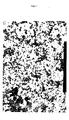
- Figs. 1 and 2 are electron microscopic photographs (X20,000) showing structure of particles obtained in each of Example 3 and Comparison Example 3.
- Coercive force (Hc, Oe), saturation magnetization ( ⁇ s, e.m.u./g) and square ratio (Sq) are measured in a magnetic field with a strength of 5 kOe, using a gauss meter equipped with a Hall-effect element and the sample with a packing ratio of 0.2.
- the sample is subjected to elementary analysis in the conventional method using MT2 CHN CORDER Yanaco, Yanagimoto Mfg. Co., Ltd, with passage of oxygen (helium carrier) at 900°C.
- the goethite particles obtained in Reference Example 1 were heated and dehydrated in air at 500°C for 30 minutes to obtain ⁇ -Fe2O3 which was coated firstly with the metal compound and secondly with the compound listed in Table 1.
- the X-ray diffraction pattern of the product matched that of Fe5C2 Iron Carbide on ASTM X-Ray Powder Data File 20-509.
- the magnetic characteristics were given in Table 2.
- Goethite particles coated with specific amounts of copper compound and aluminum compound listed in Table 1 were obtained in the same manner as in Reference Example 1 except that cupric chloride (CuCl2 . 2H2O) was used in place of nickel chloride.
- the above goethite particles are heated in air at 500°C for 30 minutes to obtain ⁇ -Fe2O3 particles.
- Goethite particles coated with nickel compound and silicon compound were obtained in the same manner as in Reference Example 1 except that 0.25g of sodium orthosilicate (Na4SiO4) was added in place of sodium alminate.
- the above goethite particles are heated in air at 500°C for 30 minutes to obtain ⁇ -Fe2O3 particles.
- Goethite particles coated with copper compound and silicon compound were obtained in the same manner as in Reference Example 1 except that 0.04g of copper chloride was added in place of nickel chloride and 0.25g of sodium orthosilicate (Na4SiO4) was added in place of sodium alminate.
- the above goethite particles are heated in air at 500°C for 30 minutes to obtain ⁇ -Fe2O3 particles.
- Goethite particles coated with manganese compound and aluminum compound were obtained in the same manner as in Reference Example 1 except that 0.9g of manganese chloride was used in place of nickel chloride.
- the above goethite particles are heated in air at 500°C for 30 minutes to obtain ⁇ -Fe2O3 particles.
- Goethite particles coated with nickel compound, aluminum compound and silicon compound were obtained in the same manner as is Reference Example 1 except that 0.06g of sodium alminate and 0.12g of sodium orthosilicate were added in place of 0.12g of sodium alminate.
- the above goethite particles are heated in air at 500°C for 30 minutes to obtain ⁇ -Fe2O3 particles.
- a black powder was obtained in the same manner as in Example 1 with the exception of using goethite particles which are not coated with nickel compound or aluminum compound.
- a black powder was obtained in the same manner as in Example 2 except that the coating of nickel compound is omitted.
- a black powder was obtained in the same manner as in Example 2 except that the coating of aluminum compound is omitted.
- Figs. 1 and 2 are electron microscopic photographs showing structure of particles obtained in each of Example 3 and Comparison Example 3. Particles are sintered and deformed in Fig. 2, but not in Fig. 1. Table 2 iron compound coated metal coated amount (wt%) Hc (Oe) ⁇ s (emu/g) Sq Ex.
Landscapes
- Chemical & Material Sciences (AREA)
- Engineering & Computer Science (AREA)
- Organic Chemistry (AREA)
- Metallurgy (AREA)
- Materials Engineering (AREA)
- Chemical Kinetics & Catalysis (AREA)
- Inorganic Chemistry (AREA)
- Hard Magnetic Materials (AREA)
- Carbon And Carbon Compounds (AREA)
- Compounds Of Iron (AREA)
- Manufacture Of Metal Powder And Suspensions Thereof (AREA)
Applications Claiming Priority (2)
| Application Number | Priority Date | Filing Date | Title |
|---|---|---|---|
| JP16652/88 | 1988-01-27 | ||
| JP63016652A JPH0729765B2 (ja) | 1988-01-27 | 1988-01-27 | 炭化鉄微粒子及びその製造方法 |
Publications (3)
| Publication Number | Publication Date |
|---|---|
| EP0326165A2 true EP0326165A2 (de) | 1989-08-02 |
| EP0326165A3 EP0326165A3 (en) | 1990-07-18 |
| EP0326165B1 EP0326165B1 (de) | 1993-03-31 |
Family
ID=11922275
Family Applications (1)
| Application Number | Title | Priority Date | Filing Date |
|---|---|---|---|
| EP89101464A Expired - Lifetime EP0326165B1 (de) | 1988-01-27 | 1989-01-27 | Feine Eisenkarbidteilchen und Verfahren zu ihrer Herstellung |
Country Status (3)
| Country | Link |
|---|---|
| EP (1) | EP0326165B1 (de) |
| JP (1) | JPH0729765B2 (de) |
| DE (1) | DE68905620T2 (de) |
Cited By (5)
| Publication number | Priority date | Publication date | Assignee | Title |
|---|---|---|---|---|
| EP0340689A3 (de) * | 1988-04-28 | 1990-10-24 | Daikin Industries, Limited | Feine Teilchen aus Eisenkarbid und Verfahren zu deren Herstellung |
| EP0464745A3 (en) * | 1990-07-02 | 1992-01-15 | Daikin Industries, Limited | Process for preparing iron carbide fine particles |
| EP0762441A4 (de) * | 1994-05-24 | 1997-04-09 | ||
| CN103030143A (zh) * | 2012-08-09 | 2013-04-10 | 北京大学 | 碳化铁颗粒、其制备方法及用途 |
| US10913857B2 (en) | 2017-09-28 | 2021-02-09 | Fujimi Incorporated | Method for producing aluminum hydroxide-coated silicon carbide particle powder and method for producing dispersion containing the same powder and dispersing medium |
Family Cites Families (7)
| Publication number | Priority date | Publication date | Assignee | Title |
|---|---|---|---|---|
| US3572993A (en) * | 1968-07-23 | 1971-03-30 | Du Pont | Ultrafine,nonpyrophoric,chi-iron carbide having high coercivity |
| JPS60141611A (ja) * | 1983-12-28 | 1985-07-26 | Daikin Ind Ltd | 炭化鉄を含有する針状粒子及びその製法 |
| JPS61111921A (ja) * | 1984-11-01 | 1986-05-30 | Daikin Ind Ltd | 炭化鉄を含有する針状粒子の製造法 |
| JPS61196502A (ja) * | 1985-02-27 | 1986-08-30 | Mitsui Toatsu Chem Inc | 磁性素材及びその製造方法 |
| JPS61234506A (ja) * | 1985-04-11 | 1986-10-18 | Mitsui Toatsu Chem Inc | 磁性素材及びその製造方法 |
| US4900464A (en) * | 1985-12-24 | 1990-02-13 | Daikin Industries Ltd. | Particles containing iron carbide |
| JPH0635326B2 (ja) * | 1986-07-04 | 1994-05-11 | ダイキン工業株式会社 | 炭化鉄を含有する粒子の製造法 |
-
1988
- 1988-01-27 JP JP63016652A patent/JPH0729765B2/ja not_active Expired - Lifetime
-
1989
- 1989-01-27 EP EP89101464A patent/EP0326165B1/de not_active Expired - Lifetime
- 1989-01-27 DE DE89101464T patent/DE68905620T2/de not_active Expired - Fee Related
Cited By (7)
| Publication number | Priority date | Publication date | Assignee | Title |
|---|---|---|---|---|
| EP0340689A3 (de) * | 1988-04-28 | 1990-10-24 | Daikin Industries, Limited | Feine Teilchen aus Eisenkarbid und Verfahren zu deren Herstellung |
| EP0464745A3 (en) * | 1990-07-02 | 1992-01-15 | Daikin Industries, Limited | Process for preparing iron carbide fine particles |
| US5205950A (en) * | 1990-07-02 | 1993-04-27 | Daikin Industries, Ltd. | Process for preparing iron carbide fine particles |
| EP0762441A4 (de) * | 1994-05-24 | 1997-04-09 | ||
| CN103030143A (zh) * | 2012-08-09 | 2013-04-10 | 北京大学 | 碳化铁颗粒、其制备方法及用途 |
| CN103030143B (zh) * | 2012-08-09 | 2015-02-18 | 北京大学 | 碳化铁颗粒、其制备方法及用途 |
| US10913857B2 (en) | 2017-09-28 | 2021-02-09 | Fujimi Incorporated | Method for producing aluminum hydroxide-coated silicon carbide particle powder and method for producing dispersion containing the same powder and dispersing medium |
Also Published As
| Publication number | Publication date |
|---|---|
| DE68905620D1 (de) | 1993-05-06 |
| EP0326165A3 (en) | 1990-07-18 |
| JPH0729765B2 (ja) | 1995-04-05 |
| JPH01192713A (ja) | 1989-08-02 |
| EP0326165B1 (de) | 1993-03-31 |
| DE68905620T2 (de) | 1993-10-21 |
Similar Documents
| Publication | Publication Date | Title |
|---|---|---|
| US4668414A (en) | Process for producing acicular particles containing an iron carbide | |
| GB1597680A (en) | Manufacture of acicular ferromagnetic pigment particles | |
| JPH0145202B2 (de) | ||
| US5026605A (en) | Coated iron carbide fine particles | |
| EP0227104B1 (de) | Eisenkarbid enthaltende Teilchen | |
| EP0326165B1 (de) | Feine Eisenkarbidteilchen und Verfahren zu ihrer Herstellung | |
| EP0312032B1 (de) | Feine Eisencarbidteilchen und Verfahren zu deren Herstellung | |
| EP0464745B1 (de) | Verfahren zur Herstellung von feinen Eisenkarbidteilchen | |
| EP0263485B1 (de) | Fe7C3-enthaltende Partikel und Verfahren zu ihrer Herstellung | |
| JPH0123402B2 (de) | ||
| EP0179490B1 (de) | Ein Eisencarbid enthaltende Teilchen, Verfahren zu ihrer Herstellung und ihre Verwendung | |
| JPH0143683B2 (de) | ||
| JPH107420A (ja) | コバルト被着型針状磁性酸化鉄粒子粉末 | |
| JP3303896B2 (ja) | 紡錘状を呈した鉄を主成分とする金属磁性粒子粉末及びその製造法 | |
| US4497654A (en) | Ferromagnetic metallic powders useful for magnetic recording and processes for producing said metallic powders | |
| JP2735885B2 (ja) | 磁気記録用金属磁性粉末の製造方法 | |
| EP0179489B1 (de) | Verfahren zur Herstellung von ein Eisencarbid enthaltenden nadelförmigen Teilchen | |
| JP3171223B2 (ja) | 針状磁性粒子粉末の製造法 | |
| JP3141907B2 (ja) | 紡錘状を呈した鉄を主成分とする金属磁性粒子粉末の製造法 | |
| JP3087808B2 (ja) | 磁気記録用磁性粒子粉末の製造法 | |
| JPH05140620A (ja) | 強磁性金属粉末の製造方法 | |
| JPS61229305A (ja) | 金属磁性粉末の製造方法 | |
| JPS63143204A (ja) | 磁性鉄粉の製造方法 | |
| JPH05270836A (ja) | α−オキシ水酸化鉄およびこれを用いた磁気記録用磁性金属粉末の製造方法 | |
| JPH0729764B2 (ja) | 炭化鉄微粒子、磁性材料及び該微粒子の製造法 |
Legal Events
| Date | Code | Title | Description |
|---|---|---|---|
| PUAI | Public reference made under article 153(3) epc to a published international application that has entered the european phase |
Free format text: ORIGINAL CODE: 0009012 |
|
| AK | Designated contracting states |
Kind code of ref document: A2 Designated state(s): DE FR GB |
|
| PUAL | Search report despatched |
Free format text: ORIGINAL CODE: 0009013 |
|
| AK | Designated contracting states |
Kind code of ref document: A3 Designated state(s): DE FR GB |
|
| 17P | Request for examination filed |
Effective date: 19901026 |
|
| 17Q | First examination report despatched |
Effective date: 19911008 |
|
| GRAA | (expected) grant |
Free format text: ORIGINAL CODE: 0009210 |
|
| AK | Designated contracting states |
Kind code of ref document: B1 Designated state(s): DE FR GB |
|
| REF | Corresponds to: |
Ref document number: 68905620 Country of ref document: DE Date of ref document: 19930506 |
|
| ET | Fr: translation filed | ||
| PLBE | No opposition filed within time limit |
Free format text: ORIGINAL CODE: 0009261 |
|
| STAA | Information on the status of an ep patent application or granted ep patent |
Free format text: STATUS: NO OPPOSITION FILED WITHIN TIME LIMIT |
|
| 26N | No opposition filed | ||
| PGFP | Annual fee paid to national office [announced via postgrant information from national office to epo] |
Ref country code: DE Payment date: 20010122 Year of fee payment: 13 |
|
| PGFP | Annual fee paid to national office [announced via postgrant information from national office to epo] |
Ref country code: GB Payment date: 20010124 Year of fee payment: 13 |
|
| PGFP | Annual fee paid to national office [announced via postgrant information from national office to epo] |
Ref country code: FR Payment date: 20010125 Year of fee payment: 13 |
|
| REG | Reference to a national code |
Ref country code: GB Ref legal event code: IF02 |
|
| PG25 | Lapsed in a contracting state [announced via postgrant information from national office to epo] |
Ref country code: GB Free format text: LAPSE BECAUSE OF NON-PAYMENT OF DUE FEES Effective date: 20020127 |
|
| PG25 | Lapsed in a contracting state [announced via postgrant information from national office to epo] |
Ref country code: DE Free format text: LAPSE BECAUSE OF NON-PAYMENT OF DUE FEES Effective date: 20020801 |
|
| GBPC | Gb: european patent ceased through non-payment of renewal fee |
Effective date: 20020127 |
|
| PG25 | Lapsed in a contracting state [announced via postgrant information from national office to epo] |
Ref country code: FR Free format text: LAPSE BECAUSE OF NON-PAYMENT OF DUE FEES Effective date: 20020930 |
|
| REG | Reference to a national code |
Ref country code: FR Ref legal event code: ST |