EP0327792A2 - 3-(4-Amino-2-hydroxyphenyl)-1-oxoisoindolenine, Verfahren zu deren Herstellung und deren Verseifung zu 2-(4-Amino-2-hydroxybenzoyl)-benzoesäuren - Google Patents
3-(4-Amino-2-hydroxyphenyl)-1-oxoisoindolenine, Verfahren zu deren Herstellung und deren Verseifung zu 2-(4-Amino-2-hydroxybenzoyl)-benzoesäuren Download PDFInfo
- Publication number
- EP0327792A2 EP0327792A2 EP89100028A EP89100028A EP0327792A2 EP 0327792 A2 EP0327792 A2 EP 0327792A2 EP 89100028 A EP89100028 A EP 89100028A EP 89100028 A EP89100028 A EP 89100028A EP 0327792 A2 EP0327792 A2 EP 0327792A2
- Authority
- EP
- European Patent Office
- Prior art keywords
- chlorine
- optionally substituted
- alkyl
- hydrogen
- phenyl
- Prior art date
- Legal status (The legal status is an assumption and is not a legal conclusion. Google has not performed a legal analysis and makes no representation as to the accuracy of the status listed.)
- Granted
Links
- 0 CC1(C)C=C(C(c2c3cccc2)=NC3=O)C(O)=CC1N(*)* Chemical compound CC1(C)C=C(C(c2c3cccc2)=NC3=O)C(O)=CC1N(*)* 0.000 description 1
Classifications
-
- C—CHEMISTRY; METALLURGY
- C07—ORGANIC CHEMISTRY
- C07D—HETEROCYCLIC COMPOUNDS
- C07D295/00—Heterocyclic compounds containing polymethylene-imine rings with at least five ring members, 3-azabicyclo [3.2.2] nonane, piperazine, morpholine or thiomorpholine rings, having only hydrogen atoms directly attached to the ring carbon atoms
- C07D295/04—Heterocyclic compounds containing polymethylene-imine rings with at least five ring members, 3-azabicyclo [3.2.2] nonane, piperazine, morpholine or thiomorpholine rings, having only hydrogen atoms directly attached to the ring carbon atoms with substituted hydrocarbon radicals attached to ring nitrogen atoms
- C07D295/14—Heterocyclic compounds containing polymethylene-imine rings with at least five ring members, 3-azabicyclo [3.2.2] nonane, piperazine, morpholine or thiomorpholine rings, having only hydrogen atoms directly attached to the ring carbon atoms with substituted hydrocarbon radicals attached to ring nitrogen atoms substituted by carbon atoms having three bonds to hetero atoms with at the most one bond to halogen, e.g. ester or nitrile radicals
- C07D295/155—Heterocyclic compounds containing polymethylene-imine rings with at least five ring members, 3-azabicyclo [3.2.2] nonane, piperazine, morpholine or thiomorpholine rings, having only hydrogen atoms directly attached to the ring carbon atoms with substituted hydrocarbon radicals attached to ring nitrogen atoms substituted by carbon atoms having three bonds to hetero atoms with at the most one bond to halogen, e.g. ester or nitrile radicals with the ring nitrogen atoms and the carbon atoms with three bonds to hetero atoms separated by carbocyclic rings or by carbon chains interrupted by carbocyclic rings
-
- C—CHEMISTRY; METALLURGY
- C07—ORGANIC CHEMISTRY
- C07C—ACYCLIC OR CARBOCYCLIC COMPOUNDS
- C07C229/00—Compounds containing amino and carboxyl groups bound to the same carbon skeleton
- C07C229/52—Compounds containing amino and carboxyl groups bound to the same carbon skeleton having amino and carboxyl groups bound to carbon atoms of six-membered aromatic rings of the same carbon skeleton
-
- C—CHEMISTRY; METALLURGY
- C07—ORGANIC CHEMISTRY
- C07D—HETEROCYCLIC COMPOUNDS
- C07D209/00—Heterocyclic compounds containing five-membered rings, condensed with other rings, with one nitrogen atom as the only ring hetero atom
- C07D209/02—Heterocyclic compounds containing five-membered rings, condensed with other rings, with one nitrogen atom as the only ring hetero atom condensed with one carbocyclic ring
- C07D209/44—Iso-indoles; Hydrogenated iso-indoles
- C07D209/46—Iso-indoles; Hydrogenated iso-indoles with an oxygen atom in position 1
-
- C—CHEMISTRY; METALLURGY
- C07—ORGANIC CHEMISTRY
- C07C—ACYCLIC OR CARBOCYCLIC COMPOUNDS
- C07C2601/00—Systems containing only non-condensed rings
- C07C2601/12—Systems containing only non-condensed rings with a six-membered ring
- C07C2601/14—The ring being saturated
Definitions
- the object of the present invention was to find a technically feasible process for the preparation of benzoylbenzoic acids by which the desired benzoylbenzoic acids can be obtained in good to high yield and high purity. It was found that benzoylbenzoic acids (IV) can be easily prepared from the new isoindolenine compounds (I).
- the invention relates to new isoindolenines of the general formula (I) in the R1 is hydrogen, C1-C12-alkyl, C5-C8-cycloalkyl optionally substituted by chlorine, hydroxy, phenyl or cyano or phenyl optionally substituted by chlorine or methyl, R2 for hydrogen, optionally substituted by chlorine, hydroxy, phenyl or cyano-substituted C1-C6-alkyl or for a morpholino, pyrrolidino or piperidino radical and R3 is hydrogen or methyl and the benzene ring A is optionally substituted by 1 to 4 chlorine, 1 or 2 C1-C4-alkyl or a nitro group.
- the invention further relates to a process for the preparation of isoindolenines of the general formula I, which is characterized in that aminophenols of the general formula (II) in the R1 is hydrogen, C1-C12-alkyl, C5-C8-cycloalkyl optionally substituted by chlorine, hydroxy, phenyl or cyano or phenyl optionally substituted by chlorine or methyl, R2 for hydrogen, optionally substituted by chlorine, hydroxy, phenyl or cyano-substituted C1-C6-alkyl or for a morpholino, pyrrolidino or piperidino radical and R3 represents hydrogen or methyl, with 3-amino-1-oxo-isoindolenines of the general formula (III) in which the benzene ring A is optionally substituted by 1 to 4 chlorine, 1 or 2 C1-C4-alkyl or a nitro group, condensed in the presence of an acid.
- the isoindolenines I according to the invention are advantageously prepared by condensing the 3-aminophenol (II) with the 3-amino-1-oxo-isoindolenine (III) in an organic solvent in the presence of an equivalent of an acid at 60 to 140 ° C.
- suitable solvents are dimethylformamide, toluene, xylene, chlorobenzene, dichlorobenzene and straight-chain or branched alkanols.
- Preferred solvents are dimethylformamide and isobutanol.
- acids which can be used are hydrochloric acid, sulfuric acid, phosphoric acid or p-toluenesulfonic acid.
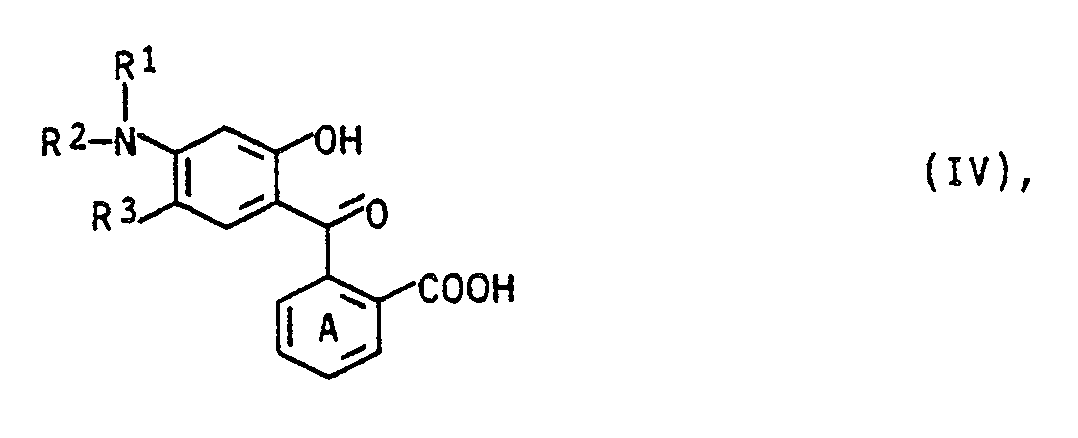
- the invention also relates to a process for the preparation of benzoylbenzoic acids (IV), in which compounds of the general formula (I) are saponified.
- the saponification can be acidic or, preferably, under alkaline conditions.
- the benzoylbenzoic acids (IV) obtained are very pure and not contaminated by rhodamines.
- Some benzoylbenzoic acids can either not be prepared or can only be prepared in low yield according to the prior art processes (condensation of the aminophenol with phthalic anhydride).
- the saponification is usually carried out by heating (I) in dilute acid or preferably in aqueous alkali metal hydroxide solution, in the latter case the benzoylbenzoic acid goes into solution.
- acids such as sulfuric acid or hydrochloric acid are used as the acid.
- the bases used are preferably 5 to 40% by weight aqueous solutions of alkali and alkaline earth metal hydroxide, in particular sodium or potassium hydroxide solution.
- the acid (IV) is precipitated from the alkaline solution by acidification and isolated in the usual way.
- the substituted 1-oxo-isoindolenines (VI) and benzoylbenzoic acids (VII) are prepared analogously to Examples 2a) and 2b).
- the compounds are characterized in Table 1 by their melting points.
Landscapes
- Chemical & Material Sciences (AREA)
- Organic Chemistry (AREA)
- Indole Compounds (AREA)
Abstract

R¹ für Wasserstoff, für gegebenenfalls durch Chlor, Hydroxy, Phenyl oder Cyan substituiertes C₁-C₁₂-Alkyl, C₅-C₈-Cycloalkyl oder für gegebenenfalls durch Chlor oder Methyl substituiertes Phenyl,
R² für Wasserstoff, gegebenenfalls durch Chlor, Hydroxy, Phenyl oder Cyan substituiertes C₁-C₆-Alkyl oder

R³ für Wasserstoff oder Methyl stehen und der Benzolring A gegebenenfalls durch 1 bis 4 Chlor, 1 oder 2 C₁-C₄-Alkyl oder eine Nitrogruppe substituiert ist,
werden durch Kondensation von 3-Aminophenolen der Formel (II)


Description
- 2-(4-Amino-2-hydroxybenzoyl)-benzoesäuren (IV) sind wichtige Zwischenprodukte bei der Herstellung von Fluoranen und Rhodaminen. Die Säuren (IV) werden nach dem Stand der Technik durch Umsetzen von 3-Aminophenolen mit gegebenenfalls substituierten Phthalsäureanhydriden hergestellt (DE-A-85 931; DE-A-23 22 131 und 24 44 297; US-A-45 15 971; DE-A-34 15 331; EP-A-176 161; JP-A-70 350/1987). Bei dieser Reaktion werden Rhodamine als Nebenprodukte gebildet. Die gewünschten Benzoylbenzoesäuren (IV) entstehen oft nur in niedrigen Ausbeuten. Bestimmte Benzoylbenzoesäuren sind auf diesem Weg überhaupt nicht darstellbar.
- Aufgabe der vorliegenden Erfindung war es, ein technisch gut durchführbares Verfahren zu Herstellung von Benzoylbenzoesäuren aufzufinden, nach dem die gewünschten Benzoylbenzoesäuren in guter bis hoher Ausbeute und hoher Reinheit erhalten werden können. Dabei wurde gefunden, daß sich Benzoylbenzoesäuren (IV) gut aus den neuen Isoindolenin-Verbindungen (I) herstellen lassen.
- Dementsprechend betrifft die Erfindung neue Isoindolenine der allgemeinen Formel (I)

R¹ für Wasserstoff, für gegebenenfalls durch Chlor, Hydroxy, Phenyl oder Cyan substituiertes C₁-C₁₂-Alkyl, C₅-C₈-Cycloalkyl oder für gegebenenfalls durch Chlor oder Methyl substituiertes Phenyl,
R² für Wasserstoff, gegebenenfalls durch Chlor, Hydroxy, Phenyl oder Cyan substituiertes C₁-C₆-Alkyl oder
R³ für Wasserstoff oder Methyl stehen und der Benzolring A gegebenenfalls durch 1 bis 4 Chlor, 1 oder 2 C₁-C₄-Alkyl oder eine Nitrogruppe substituiert ist. - Weiterhin betrifft die Erfindung ein Verfahren zur Herstellung von Isoindoleninen der allgemeinen Formel I, das dadurch gekennzeichnet ist, daß man Aminophenole der allgemeinen Formel (II)

R¹ für Wasserstoff, für gegebenenfalls durch Chlor, Hydroxy, Phenyl oder Cyan substituiertes C₁-C₁₂-Alkyl, C₅-C₈-Cycloalkyl oder für gegebenenfalls durch Chlor oder Methyl substituiertes Phenyl,
R² für Wasserstoff, gegebenenfalls durch Chlor, Hydroxy, Phenyl oder Cyan substituiertes C₁-C₆-Alkyl oder
R³ für Wasserstoff oder Methyl stehen,
mit 3-Amino-1-oxo-isoindoleninen der allgemeinen Formel (III)
- Die erfindungsgemäßen Isoindolenine I werden vorteilhafterweise durch Kondensation des 3-Aminophenols (II) mit dem 3-Amino-1-oxo-isoindolenin (III) in einem organischen Lösungsmittel in Gegenwart eines Äquivalents einer Säure bei 60 bis 140 °C hergestellt. Als Lösungsmittel kommen z.B. Dimethylformamid, Toluol, Xylol, Chlorbenzol, Dichlorbenzol und geradkettige oder verzweigte Alkanole in Betracht. Bevorzugte Lösungsmittel sind Dimethylformamid und Isobutanol. Als Säuren können z.B. Salzsäure, Schwefelsäure, Phosphorsäure oder p-Toluolsulfonsäure verwendet werden. Vorzugsweise verwendet man zur Kondensation das Isoindolenin-Hydrochlorid der Formel (IIIa)


- Dementsprechend betrifft die Erfindung außerdem ein Verfahren zur Herstellung von Benzoylbenzoesäuren (IV), bei dem Verbindungen der allgemeinen Formel (I) verseift werden. Die Verseifung kann sauer oder vorzugsweise unter alkalischen Bedingungen erfolgen. Die erhaltenen Benzoylbenzoesäuren (IV) sind sehr rein und nicht durch Rhodamine verunreinigt. Einige Benzoylbenzoesäuren sind nach den Verfahren des Standes der Technik (Kondensation des Aminophenols mit Phthalsäureanhydrid) entweder nicht oder nur in geringer Ausbeute darstellbar.
- Die Verseifung erfolgt in der Regel durch Erwärmen von (I) in verdünnter Säure oder vorzugsweise in wäßriger Alkalimetallhydroxidlösung, wobei im letzteren Fall die Benzoylbenzoesäure in Lösung geht.
- Als Säure verwendet man 5 bis 30 gew.%ige Säuren wie Schwefelsäure oder Salzsäure.
- Als Basen verwendet man vorzugsweise 5 bis 40 gew.%ige wäßrige Lösungen von Alkali- und Erdalkalimetallhydroxid, insbesondere Natron- oder Kalilauge. Die Säure (IV) wird durch Ansäuern aus der alkalischen Lösung gefällt und in üblicher Weise isoliert.
- Die Erfindung soll durch die folgenden Beispiele zusätzlich erläutert werden. Die in den Beispielen genannten Teile und Prozentangaben beziehen sich auf das Gewicht.
-
a) In eine Lösung von 151 Teilen 3-Ethylamino-4-methylphenol in 240 Teilen Dimethylformamid werden bei 120°C portionsweise 183 Teile 3-Amino-1-oxo-isoindolenin-hydrochlorid eingetragen. Die Mischung wird eine Stunde lang auf 120 °C erhitzt. Nach dem Erkalten wird der Feststoff abgesaugt, mit 200 Teilen Ethanol gewaschen und bei 60°C im Vakuum getrocknet. Man erhält 263 Teile 3-(4′-Ethylamino-2′-hydroxy-5′-methylphenyl)-1-oxo-isoindolenin als braune Kristalle vom Schmelzpunkt 258 bis 260°C.
C₁₇H₁₆N₂O₂ MM 280,33C H N O ber.: 72,84 5,75 9,99 11,41 gef.: 72,6 5,9 10,2 11,4
b) 28 Teile
3-(4′-Ethylamino-2′-hydroxy-5′-methylphenyl)-1-oxo-isoindolenin werden in 118 Teilen 20 %iger Kalilauge 5 Stunden lang unter Rückfluß erhitzt. Die Lösung wird filtriert und das Filtrat nach dem Abkühlen mit konzentrierter Salzsäure auf pH 4,5 gestellt. Der ausgefallene Feststoff wird abgesaugt, mit Wasser gewaschen und im Vakuum bei 60°C getrocknet. Man erhält 23,5 Teile 2-(4′-Ethylamino-2′-hydroxy-5′-methylbenzoyl)-benzoesäure als gelblichen Feststoff vom Schmelzpunkt 200 bis 202°C.
C₁₇H₁₇NO₄ MM 299,33C H N O ber.: 68,22 5,72 4,68 21,38 gef.: 68,1 5,7 4,7 21,2 -
a) In eine Lösung von 17,9 Teilen 3-Morpholinophenol in 24 Teilen Isobutanol werden bei 100°C portionsweise 18,3 Teile 3-Amino-1-oxo-isoindolenin-hydrochlorid eingetragen. Die Mischung wird 5 Stunden lang auf 100°C erhitzt. Nach dem Erkalten wird der Feststoff abgesaugt, mit Isobutanol gewaschen und im Vakuum bei 60°C getrocknet. Man erhält 24,1 Teile 3-(4′-Morpholino-2′-hydroxyphenyl)-1-oxo-isoindolenin als rotbraunen Feststoff. Eine Probe wird aus Dimethylformamid umkristallisiert: rotbraune Nadeln vom Schmelzpunkt 290 bis 292°C. C₁₈H₁₆N₂O₂ MM 308,34C H N O ber.: 70,12 5,23 9,09 15,57 gef.: 69,9 5,4 9,2 15,5
b) 15,4 Teile 3-(4′-Morpholino-2′-hydroxyphenyl)-1-oxo-isoindolenin werden in 60 Teilen 20 %iger Natronlauge 1 Stunde lang unter Rückfluß erhitzt. Die Lösung wird filtriert und das Filtrat nach dem Abkühlen mit konzentrierter Salzsäure auf pH 4,5 gestellt. Der ausgefallene Feststoff wird abgesaugt, mit Wasser gewaschen und im Vakuum bei 60°C getrocknet. Man erhält 10,7 Teile 2-(4′-Morpholino-2′-hydroxybenzoyl)-benzoesäure als gelblichen Feststoff vom Schmelzpunkt 184 bis 187°C.
C₁₈H₁₇NO₅ MM 327,34C H N O ber.: 66,05 5,23 4,28 24,44 gef.: 65,9 5,0 4,0 24,4 - Analog Beispiel 2a) und 2b) werden die substituierten 1-Oxo-isoindolenine (VI) und Benzoylbenzoesäuren (VII) hergestellt.

- Die Verbindungen sind in Tabelle 1 durch ihre Schmelzpunkte charakterisiert.

- Außerdem wurden auf dem gleichen Wege die in der folgenden Tabelle aufgeführten substituierten 1-Oxo-isoindolenine (VI) und Benzoylbenzoesäuren (VII) hergestellt.

Claims (10)

R¹ für Wasserstoff, für gegebenenfalls durch Chlor, Hydroxy, Phenyl oder Cyan substituiertes C₁-C₁₂-Alkyl, C₅-C₈-Cycloalkyl oder für gegebenenfalls durch Chlor oder Methyl substituiertes Phenyl,
R² für Wasserstoff, gegebenenfalls durch Chlor, Hydroxy, Phenyl oder Cyan substituiertes C₁-C₆-Alkyl oder

R³ für Wasserstoff oder Methyl stehen und der Benzolring A gegebenenfalls durch 1 bis 4 Chlor, 1 oder 2 C₁-C₄-Alkyl oder eine Nitrogruppe substituiert ist.


R¹ für Wasserstoff, für gegebenenfalls durch Chlor, Hydroxy, Phenyl oder Cyan substituiertes C₁-C₁₂-Alkyl, C₅-C₈-Cycloalkyl oder für gegebenenfalls durch Chlor oder Methyl substituiertes Phenyl,
R² für Wasserstoff, gegebenenfalls durch Chlor, Hydroxy, Phenyl oder Cyan substituiertes C₁-C₆-Alkyl oder

dadurch gekennzeichnet, daß man Isoindolenine der allgemeinen Formel (I)

Applications Claiming Priority (2)
| Application Number | Priority Date | Filing Date | Title |
|---|---|---|---|
| DE3800577A DE3800577A1 (de) | 1988-01-12 | 1988-01-12 | 3-(4-amino-2-hydroxyphenyl)-1-oxo-isoindolenine, verfahren zu deren herstellung und deren verseifung zu 2-(4-amino-2-hydroxybenzoyl)-benzoesaeuren |
| DE3800577 | 1988-01-12 |
Publications (3)
| Publication Number | Publication Date |
|---|---|
| EP0327792A2 true EP0327792A2 (de) | 1989-08-16 |
| EP0327792A3 EP0327792A3 (en) | 1989-10-04 |
| EP0327792B1 EP0327792B1 (de) | 1993-12-22 |
Family
ID=6345092
Family Applications (1)
| Application Number | Title | Priority Date | Filing Date |
|---|---|---|---|
| EP89100028A Expired - Lifetime EP0327792B1 (de) | 1988-01-12 | 1989-01-03 | 3-(4-Amino-2-hydroxyphenyl)-1-oxoisoindolenine, Verfahren zu deren Herstellung und deren Verseifung zu 2-(4-Amino-2-hydroxybenzoyl)-benzoesäuren |
Country Status (4)
| Country | Link |
|---|---|
| US (1) | US4904798A (de) |
| EP (1) | EP0327792B1 (de) |
| JP (1) | JPH01213261A (de) |
| DE (2) | DE3800577A1 (de) |
Families Citing this family (3)
| Publication number | Priority date | Publication date | Assignee | Title |
|---|---|---|---|---|
| DE4128080A1 (de) * | 1991-08-23 | 1993-02-25 | Bayer Ag | Elektrofotografische toner und neue 3-iminoisoindolinone |
| WO2002020500A2 (en) * | 2000-09-01 | 2002-03-14 | Icos Corporation | Materials and methods to potentiate cancer treatment |
| WO2004085418A2 (en) * | 2003-03-24 | 2004-10-07 | Luitpold Pharmaceuticals, Inc. | Xanthones, thioxanthones and acridinones as dna-pk inhibitors |
Family Cites Families (3)
| Publication number | Priority date | Publication date | Assignee | Title |
|---|---|---|---|---|
| DE1445489A1 (de) * | 1963-02-07 | 1968-12-05 | Cassella Farbwerke Mainkur Ag | Verfahren zur Herstellung neuer Pseudoisoindolone |
| FR2533563A1 (fr) * | 1982-09-23 | 1984-03-30 | Adir | Nouveaux derives de la sulfonyluree, leurs procedes de preparation et les compositions pharmaceutiques les renfermant |
| EP0176161A1 (de) * | 1984-08-24 | 1986-04-02 | Taoka Chemical Co., Ltd | Fluoranverbindungen und Herstellung sowie deren Verwendung |
-
1988
- 1988-01-12 DE DE3800577A patent/DE3800577A1/de not_active Withdrawn
-
1989
- 1989-01-03 EP EP89100028A patent/EP0327792B1/de not_active Expired - Lifetime
- 1989-01-03 DE DE89100028T patent/DE58906464D1/de not_active Expired - Lifetime
- 1989-01-10 US US07/295,462 patent/US4904798A/en not_active Expired - Fee Related
- 1989-01-11 JP JP1002964A patent/JPH01213261A/ja active Pending
Also Published As
| Publication number | Publication date |
|---|---|
| DE58906464D1 (de) | 1994-02-03 |
| JPH01213261A (ja) | 1989-08-28 |
| DE3800577A1 (de) | 1989-07-20 |
| US4904798A (en) | 1990-02-27 |
| EP0327792A3 (en) | 1989-10-04 |
| EP0327792B1 (de) | 1993-12-22 |
Similar Documents
| Publication | Publication Date | Title |
|---|---|---|
| EP0252406B2 (de) | Verfahren zur Herstellung polycyclischer Verbindungen | |
| DE2453324A1 (de) | Optisch aktive epoxidverbindungen | |
| EP0327792B1 (de) | 3-(4-Amino-2-hydroxyphenyl)-1-oxoisoindolenine, Verfahren zu deren Herstellung und deren Verseifung zu 2-(4-Amino-2-hydroxybenzoyl)-benzoesäuren | |
| EP0380712B1 (de) | Verfahren zur Herstellung von 2,6-Dichlordiphenylaminessigsäurederivaten | |
| EP0504182B1 (de) | Verfahren zur herstellung von chinophthalonderivaten | |
| EP0003105B1 (de) | Verfahren zur Anilidierung von Carbonsäureestern | |
| CH653996A5 (de) | Tryptaminderivate und verfahren zu deren herstellung. | |
| DE2731566A1 (de) | Verfahren zur herstellung von neuen chromon-derivaten, sowie ihre verwendung als pflanzenschutzmittel | |
| DE2509793C2 (de) | Diazarhodaminlactone und deren Verwendung als Farbbildner für Kopieverfahren | |
| DE2215048C3 (de) | Verfahren zur Herstellung von 2-[Bis-(4,4'-dialkylamino)-benzhydryl)-5-aminobenzoesäuren | |
| DE1038047B (de) | Verfahren zur Herstellung von N-aminoalkylierten Iminodibenzylen und deren Salzen | |
| EP0005251B1 (de) | Verfahren zur Herstellung von Sulfinaten des 4,4'-Diaminobenzhydrols und seiner Substitutionsprodukte und diese Verbindungen enthaltende Kopierpapiere | |
| DE2244371C3 (de) | Quaternäres e-Diäthylamino-2 eckige Klammer auf 1,3-dimethylbenzbnldazoUnium (2) eckige Klammer zu -benzofuran -salz | |
| DE1011887B (de) | Verfahren zur Herstellung von in 10-Stellung basisch substituierten Phenthiazinabkoemmlingen | |
| AT242128B (de) | Verfahren zur Herstellung von neuen Benzofuryl-(3)-äthylaminen und deren Salzen | |
| CH646167A5 (de) | Verfahren zur herstellung von apovincaminsaeureestern. | |
| EP0010607B1 (de) | Triazolylstyryl-Verbindungen sowie deren Verwendung zum Weisstönen organischer Materialien | |
| AT224119B (de) | Verfahren zur Isomerisierung von basisch substituierten tricyclischen Verbindungen | |
| DE1143515B (de) | Verfahren zur Herstellung von Arylaminopyrazolen | |
| AT225718B (de) | Verfahren zur Herstellung von neuen Dithiophosphonsäure-O-aminoalkyl-S-äthylestern | |
| AT214582B (de) | Verfahren zur Herstellung von 3β-Hydroxy- oder 3β-Acyloxy-6-methyl-25D-spirost-5-en | |
| AT366673B (de) | Verfahren zur herstellung neuer phthalazin-4ylessigs[uren und deren salze | |
| AT206899B (de) | Verfahren zur Herstellung von neuen, substituierten 3,5-Dioxo-tetrahydro-1,2,6-thiadiazin-1,1-dioxyden | |
| DE1445620C3 (de) | Verfahren zur Herstellung von 1,2,4-Oxadiazolderivaten | |
| DE1194845B (de) | Verfahren zur Herstellung von Derivaten des p-Benzochinonmethidoxims |
Legal Events
| Date | Code | Title | Description |
|---|---|---|---|
| PUAI | Public reference made under article 153(3) epc to a published international application that has entered the european phase |
Free format text: ORIGINAL CODE: 0009012 |
|
| AK | Designated contracting states |
Kind code of ref document: A2 Designated state(s): CH DE FR GB IT LI |
|
| PUAL | Search report despatched |
Free format text: ORIGINAL CODE: 0009013 |
|
| AK | Designated contracting states |
Kind code of ref document: A3 Designated state(s): CH DE FR GB IT LI |
|
| 17P | Request for examination filed |
Effective date: 19890829 |
|
| 17Q | First examination report despatched |
Effective date: 19920206 |
|
| GRAA | (expected) grant |
Free format text: ORIGINAL CODE: 0009210 |
|
| AK | Designated contracting states |
Kind code of ref document: B1 Designated state(s): CH DE FR GB IT LI |
|
| ITF | It: translation for a ep patent filed | ||
| REF | Corresponds to: |
Ref document number: 58906464 Country of ref document: DE Date of ref document: 19940203 |
|
| GBT | Gb: translation of ep patent filed (gb section 77(6)(a)/1977) |
Effective date: 19940110 |
|
| ET | Fr: translation filed | ||
| PLBE | No opposition filed within time limit |
Free format text: ORIGINAL CODE: 0009261 |
|
| STAA | Information on the status of an ep patent application or granted ep patent |
Free format text: STATUS: NO OPPOSITION FILED WITHIN TIME LIMIT |
|
| 26N | No opposition filed | ||
| PGFP | Annual fee paid to national office [announced via postgrant information from national office to epo] |
Ref country code: FR Payment date: 19951215 Year of fee payment: 8 |
|
| PGFP | Annual fee paid to national office [announced via postgrant information from national office to epo] |
Ref country code: GB Payment date: 19960102 Year of fee payment: 8 |
|
| PGFP | Annual fee paid to national office [announced via postgrant information from national office to epo] |
Ref country code: CH Payment date: 19960111 Year of fee payment: 8 |
|
| PGFP | Annual fee paid to national office [announced via postgrant information from national office to epo] |
Ref country code: DE Payment date: 19960123 Year of fee payment: 8 |
|
| PG25 | Lapsed in a contracting state [announced via postgrant information from national office to epo] |
Ref country code: GB Effective date: 19970103 |
|
| PG25 | Lapsed in a contracting state [announced via postgrant information from national office to epo] |
Ref country code: DE Effective date: 19970128 |
|
| PG25 | Lapsed in a contracting state [announced via postgrant information from national office to epo] |
Ref country code: LI Effective date: 19970131 Ref country code: CH Effective date: 19970131 |
|
| GBPC | Gb: european patent ceased through non-payment of renewal fee |
Effective date: 19970103 |
|
| REG | Reference to a national code |
Ref country code: CH Ref legal event code: PL |
|
| PG25 | Lapsed in a contracting state [announced via postgrant information from national office to epo] |
Ref country code: FR Effective date: 19970930 |
|
| REG | Reference to a national code |
Ref country code: FR Ref legal event code: ST |
|
| PG25 | Lapsed in a contracting state [announced via postgrant information from national office to epo] |
Ref country code: IT Free format text: LAPSE BECAUSE OF NON-PAYMENT OF DUE FEES;WARNING: LAPSES OF ITALIAN PATENTS WITH EFFECTIVE DATE BEFORE 2007 MAY HAVE OCCURRED AT ANY TIME BEFORE 2007. THE CORRECT EFFECTIVE DATE MAY BE DIFFERENT FROM THE ONE RECORDED. Effective date: 20050103 |