EP0328029B1 - Substrats colorés de cholestérol-estérase - Google Patents
Substrats colorés de cholestérol-estérase Download PDFInfo
- Publication number
- EP0328029B1 EP0328029B1 EP89102028A EP89102028A EP0328029B1 EP 0328029 B1 EP0328029 B1 EP 0328029B1 EP 89102028 A EP89102028 A EP 89102028A EP 89102028 A EP89102028 A EP 89102028A EP 0328029 B1 EP0328029 B1 EP 0328029B1
- Authority
- EP
- European Patent Office
- Prior art keywords
- cholesterol
- cholesterol esterase
- substrate
- radical
- esterase
- Prior art date
- Legal status (The legal status is an assumption and is not a legal conclusion. Google has not performed a legal analysis and makes no representation as to the accuracy of the status listed.)
- Expired - Lifetime
Links
Images
Classifications
-
- C—CHEMISTRY; METALLURGY
- C12—BIOCHEMISTRY; BEER; SPIRITS; WINE; VINEGAR; MICROBIOLOGY; ENZYMOLOGY; MUTATION OR GENETIC ENGINEERING
- C12Q—MEASURING OR TESTING PROCESSES INVOLVING ENZYMES, NUCLEIC ACIDS OR MICROORGANISMS; COMPOSITIONS OR TEST PAPERS THEREFOR; PROCESSES OF PREPARING SUCH COMPOSITIONS; CONDITION-RESPONSIVE CONTROL IN MICROBIOLOGICAL OR ENZYMOLOGICAL PROCESSES
- C12Q1/00—Measuring or testing processes involving enzymes, nucleic acids or microorganisms; Compositions therefor; Processes of preparing such compositions
- C12Q1/60—Measuring or testing processes involving enzymes, nucleic acids or microorganisms; Compositions therefor; Processes of preparing such compositions involving cholesterol
-
- C—CHEMISTRY; METALLURGY
- C07—ORGANIC CHEMISTRY
- C07J—STEROIDS
- C07J43/00—Normal steroids having a nitrogen-containing hetero ring spiro-condensed or not condensed with the cyclopenta(a)hydrophenanthrene skeleton
- C07J43/003—Normal steroids having a nitrogen-containing hetero ring spiro-condensed or not condensed with the cyclopenta(a)hydrophenanthrene skeleton not condensed
-
- C—CHEMISTRY; METALLURGY
- C07—ORGANIC CHEMISTRY
- C07J—STEROIDS
- C07J9/00—Normal steroids containing carbon, hydrogen, halogen or oxygen substituted in position 17 beta by a chain of more than two carbon atoms, e.g. cholane, cholestane, coprostane
-
- C—CHEMISTRY; METALLURGY
- C12—BIOCHEMISTRY; BEER; SPIRITS; WINE; VINEGAR; MICROBIOLOGY; ENZYMOLOGY; MUTATION OR GENETIC ENGINEERING
- C12Q—MEASURING OR TESTING PROCESSES INVOLVING ENZYMES, NUCLEIC ACIDS OR MICROORGANISMS; COMPOSITIONS OR TEST PAPERS THEREFOR; PROCESSES OF PREPARING SUCH COMPOSITIONS; CONDITION-RESPONSIVE CONTROL IN MICROBIOLOGICAL OR ENZYMOLOGICAL PROCESSES
- C12Q1/00—Measuring or testing processes involving enzymes, nucleic acids or microorganisms; Compositions therefor; Processes of preparing such compositions
- C12Q1/34—Measuring or testing processes involving enzymes, nucleic acids or microorganisms; Compositions therefor; Processes of preparing such compositions involving hydrolase
- C12Q1/44—Measuring or testing processes involving enzymes, nucleic acids or microorganisms; Compositions therefor; Processes of preparing such compositions involving hydrolase involving esterase
Definitions
- Cholesterol esterase (cholesterol ester hydrolase EC 3.1.1.13) hydrolyzes emulsified cholesterol esters of long-chain fatty acids at the interface between the lipophilic and aqueous phases. Cholesterol esterase occurs in the human organism, including in microorganisms. Cholesterol esterase is used particularly frequently as a research reagent and in biochemical analysis. In particular, it is used as an auxiliary enzyme in many (diagnostic) enzymatic tests. Cholesterol esterase determination is therefore of considerable importance for clinical chemistry, but also for biochemistry, microbiology and food chemistry. There is therefore a need for a specific, uncomplicated test for this and in the production and isolation of the enzyme.
- Fluorescent substrates such as pyrenebutyric acid or pyrendecanoic acid esters of cholesterol are also used. After cleavage, a change in the fluorescence yield can be determined (Uster, Arch.Biochem.Biophys. 209 , 385 (81)). However, this method is very susceptible to interference and most laboratories are not equipped with fluorescence measuring devices.
- chromogenic substrates for the quantification of cholesterol esterase, for example fluorescein dilaurate or methylumbelliferylester (Meyer-Bertenrath, Enzyme Vol. 28 , 336 (82); A. Negre, Biochim. Biophys. Acta 794 , 89 (84)).
- fluorescein dilaurate or methylumbelliferylester Meyer-Bertenrath, Enzyme Vol. 28 , 336 (82); A. Negre, Biochim. Biophys. Acta 794 , 89 (84).
- these substrates are not specific and are also cleaved by esterases.
- the object of the invention is to create a substrate and a color test for the determination of cholesterol esterase using this substrate, which does not have the disadvantages of the known color tests, provides accurate results, is easy to use, has high sensitivity and is only low lag phase, so that the adaptation to the various analyzer systems is not difficult.
- 3-cholesterol residue is understood to mean any unsubstituted or substituted steroid residue which is esterified via the 3-O group and which is hydrolyzed by the cholesterol esterase.
- steroid residues are, for example, cholesterol, cholestanol, dihydrocholesterol, ⁇ -sitosterol, stigmasterol or ergosterol.
- the cholesterol ester according to the invention is cleaved to liberate the aromatic hydroxy or thiol compound corresponding to radical X, which is either determined directly optically or coupled with a suitable chromophore or fluorophore and the coupling product is measured. If the chain length of A 4 exceeds C atoms, an esterase is preferably added as an auxiliary enzyme to accelerate the reaction. Suitable esterases are e.g. Carboxylesterase or aryl esterase.
- the cholesterol esterase substrate according to the invention further contains the rest of a dicarboxylic acid COOH-A-COOH, in which A preferably has 3 to 7 carbon atoms.
- A preferably has 3 to 7 carbon atoms.
- acids from which A is derived are malonic acid, succinic acid, glutaric acid, adipic acid, pimelic acid, suberic acid, azelaic acid, sebacic acid, nonandicarboxylic acid, Decanedicarboxylic acid and undecanedicarboxylic acid.
- the acids from glutaric acid to azelaic acid, which correspond to A having 3 to 7 carbon atoms, are preferred as mentioned above.
- X is the remainder of an aromatic hydroxy or thiol compound, which is a chromophore or can only be converted into a dye by a subsequent reaction.
- Typical examples are phenol, thiophenol, naphthol, thionaphthol and their derivatives and the chromogenic compounds such as the resorufin, chlorophenol red, indoxyl or thiofluorescein residue.
- An exhaustive list of the suitable hydroxyl or thiol compounds is not possible because of their large number, but the directly chromophoric or convertible aromatic hydroxyl or thiol compounds are known to the person skilled in the art.
- the subsequent reaction to the dye can be carried out either by direct coupling (for example with a diazonium salt such as 4-chloro-2-methylbenzene diazonium salt (Fast Red), 4-benzamido-2-methoxy-5-methylbenzene diazonium salt (Fast Violet), diazotized sulfanilic acid, 2,4- and 2,5-substituted phenyldiazonium salts, for example 2,4-dichlorophenyldiazonium-1,5-naphthalenedisulfonic acid), or by an oxidative coupling, for example with 4-aminoantipyrine or other aminopyrazolones (such as trimethylaminopyrazolone, diaminoantipyrine) or MBTHS (3-methyl-2-benzothiazolinone hydrazone-6-sulfonic acid).
- a diazonium salt such as 4-chloro-2-methylbenzene diazonium salt (Fast Red),
- Chromophores which have a low polarity and are lipophilic are preferred.
- the lipophilic character of the above-mentioned chromophores can be positively influenced by suitable substitution, such as with alkyl groups.
- suitable substituents especially for the Resorufinrest, the methyl, dimethyl and ethyl group and bromine have proven.
- cholesterol esterase substrates according to the invention can be produced by methods known per se.
- cholesterol and dicarboxylic acid anhydrides can be derived from dicarboxylic acids of the general formula HOOC - A - COOH derive, in which A has the meaning given above, synthesize the half esters in anhydrous medium such as chloroform / pyridine.
- the esterification of the half ester thus obtained with the aromatic hydroxy or thiol compound from which the radical X is derived can be carried out, for example, by directly reacting the dicarboxylic acid monoester with the aromatic alcohol or thiol in the presence of a dehydrating agent such as dicyclohexylcarbodiimide.
- a dehydrating agent such as dicyclohexylcarbodiimide.
- the dicarboxylic acid monoester is first converted to an activated ester, for example the hydroxysuccinimide ester or the imidazolide, and the activated ester is then reacted with the aromatic alcohol or thiol.
- a monoester of dicarboxylic acid with the aromatic alcohol or thiol for example the mononitrophenyl adipate or monophenyl glutarate, and these then to esterify with the cholesterol, for example via the intermediate formation of an acid chloride, anhydride or activated ester.
- the dicarboxylic acid monoesters with the aromatic alcohol or thiol can be prepared, for example, from acid anhydride and aromatic compound in a molar ratio of 1: 1 or from activated dicarboxylic acid and aromatic compound or from a dicarboxylic acid monoester with an easily removable protective group and the aromatic compound. Suitable methods are described, for example, in Arch. Pharm. 287 , 514 (1954).
- the process according to the invention for the optical determination of cholesterol esterase is characterized in that a cholesterol esterase substrate according to the invention is subjected to the action of the sample containing cholesterol esterase and the amount of aromatic hydroxy or thiol compound released is determined optically or, after coupling with a suitable chromogen, the color formed therefrom.
- a special feature of this process is that, in a preferred embodiment, it does not require any auxiliary enzymes or esterase inhibitors, as are frequently required in the known methods. Such additives are not only expensive, but also often not very stable.
- Another object of the invention is a simple and long-lasting reagent for the optical determination of cholesterol esterase which, in addition to a cholesterol esterase substrate and buffer substance according to the invention, also a detergent, in particular a nonionic detergent, a chromogenic coupler and / or a salt such as contains sodium chloride.
- the reagent can suitably contain preservatives and / or activators.
- this contains reagent 0.05 to 2 mg / ml substrate, 10 to 50 ⁇ l detergent, 10 to 50 ⁇ l dioxane, 50 to 500 mM buffer substance, each based on the ready-to-use solution in the test.
- Polyethylene glycol monododecyl ester (Thesit®) is preferred as the detergent.
- Suitable buffer substances are those which are able to set a pH between 5.5 and 10.5 in the context of the reagent according to the invention.
- the preferred pH range is between 6.5 and 7.8.
- suitable buffers are diethanolamine buffers, triethanolamine buffers, tris buffers and good buffers such as Hepes buffers (well suited for addition before lyophilization), taps buffers, CHES buffers (2- (cyclohexylamino) ethanesulfonic acid) and bicine. Potassium phosphate buffer is particularly preferred.
- the preferred amount of buffer substance is between 50 and 500 mM.
- the reagent according to the invention is in a dry or concentrated form, to be diluted to the final composition, it contains the substances mentioned in appropriate proportions, and preferably a protective colloid.
- Suitable protective colloids are the substances known to those skilled in the art, such as polyhydroxy compounds, Serum albumin, polyvinyl pyrrolidone, solid polyethylene oxides and the like.
- Polyhydroxy compounds in particular monomeric or polymeric pentose or hexose having 1 to 10 pentose or hexose units in the molecule and / or polyethylene glycol which is solid at room temperature, are preferred.
- Preferred examples of suitable polyhydroxy compounds are mannitol and similar sugar alcohols, oligosaccharide of glucose, mannose, maltoheptaose, polyethylene glycol with an average molecular weight between 3500 and 7000 u.
- Other protective colloids that can be used are e.g. B.
- protective colloid or a mixture of protective colloids is 20 to 90 wt .-%.
- a mixture of sugar alcohol and polyalkylene glycol proved to be particularly suitable.
- the reagent according to the invention can also be present impregnated on a suitable carrier material. Both an absorbent carrier material and a swellable, soluble film-forming carrier material can be considered.
- the reagent according to the invention enables the production of test strips, which can be evaluated directly visually or using suitable measuring devices.
- the color test according to the invention for determining the cholesterol esterase provides very precise results with high sensitivity. It is very easy to use and is even suitable for test strips. Since it has only a very small or no lag phase, it can be easily adapted to the various analyzer systems.
- the determination itself can be carried out both as an end point determination and kinetically. Compared to many known processes, the kinetic feasibility has the advantage that the reaction product formed does not have to be stopped or shaken out.
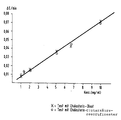
- FIG. 1 shows the comparison of the calibration curves ( ⁇ E / min against substrate concentration mg / ml) for the cholesterol-oleate method and the method using a substrate according to the invention (cholesterol-3-glutaric acid resorufine ester).
- resorufin 1.1 g of resorufin are slurried in 40 ml of chloroform, 0.75 ml of diazabicycloundecene and 0.1 mg of dimethylaminopyridine are added. With ice cooling, a solution of 1b) in 20 ml of chloroform is slowly added dropwise and the mixture is then stirred at room temperature for 8 h. Then it is diluted with 50 ml of chloroform and shaken with 50 ml of 2N hydrochloric acid. After drying over sodium sulfate, the organic phase is concentrated and the residue is chromatographed on silica gel (mobile phase: ethyl acetate / petroleum ether 1: 3).
Landscapes
- Chemical & Material Sciences (AREA)
- Organic Chemistry (AREA)
- Health & Medical Sciences (AREA)
- Life Sciences & Earth Sciences (AREA)
- General Health & Medical Sciences (AREA)
- Zoology (AREA)
- Proteomics, Peptides & Aminoacids (AREA)
- Engineering & Computer Science (AREA)
- Wood Science & Technology (AREA)
- Immunology (AREA)
- Molecular Biology (AREA)
- Analytical Chemistry (AREA)
- Biotechnology (AREA)
- Physics & Mathematics (AREA)
- Bioinformatics & Cheminformatics (AREA)
- Biochemistry (AREA)
- Microbiology (AREA)
- General Engineering & Computer Science (AREA)
- Biophysics (AREA)
- Genetics & Genomics (AREA)
- Measuring Or Testing Involving Enzymes Or Micro-Organisms (AREA)
- Pharmaceuticals Containing Other Organic And Inorganic Compounds (AREA)
- Steroid Compounds (AREA)
- Medicines Containing Plant Substances (AREA)
Claims (10)
- Substrat de cholestérol-estérase de formule générale I

A représente un groupe alkylène ou alcénylène de 1 à 20 atomes de carbone, Chol représente un reste stéroïde substitué ou non substitué, estérifié par l'intermédiaire du groupe 3-O et hydrolysable par la cholestérol-estérase, X représente le reste d'un composé hydroxylé ou thiolique aromatique et Y représente -S- ou -O-. - Substrat de cholestérol-estérase selon la revendication 1, caractérisé en ce que A comporte 3 à 7 atomes de carbone.
- Substrat de cholestérol-estérase selon la revendication 1 ou 2, caractérisé en ce que X représente un reste résorufine éventuellement substitué, un reste rouge de chlorophénol, un reste indoxyle, un reste naphtol, un reste thiophénol, un reste thiofluorescéine ou un reste phénol.
- Substrat de cholestérol-estérase selon la revendication 3, caractérisé en ce que X est un reste résorufine substitué par méthyle, diméthyle, éthyle ou le brome.
- 3-cholestérylglutarate de résorufine.
- Procédé de détermination optique de la cholestérolestérase, caractérisé en ce que l'on soumet un substrat selon la revendication 1 à l'action de l'échantillon contenant la cholestérol-estérase et on détermine la quantité de composé hydroxylé ou thiolique aromatique libéré directement ou bien, après couplage avec un chromogène approprié, on détermine optiquement la couleur qui en résulte.
- Réactif pour la détermination optique de la cholestérol-estérase, caractérisé en ce qu'il contient au moins un substrat selon l'une des revendications 1 à 5, une substance tampon pH 5,5 à 10,5, un détergent et/ou un coupleur chromogène.
- Réactif selon la revendication 7, caractérisé en ce qu'il contient
0,05 à 2 mg/ml de substrat,
10 à 50 µl de détergent,
10 à 50 µl de dioxanne,
50 mM à 500 mM de substance tampon pH 6,5 à 7,8
rapportés chacun à la solution prête à l'emploi dans le test. - Réactif selon l'une des revendications 7 et 8, caractérisé en ce qu'il contient comme coupleur chromogène un sel de diazonium capable de couplage, la 4-aminoantipyrine ou MBTHS.
- Réactif selon l'une des revendications 7 à 9, caractérisé en ce qu'il est sous forme imprégnée sur un matériau support.
Priority Applications (1)
| Application Number | Priority Date | Filing Date | Title |
|---|---|---|---|
| AT89102028T ATE98254T1 (de) | 1988-02-08 | 1989-02-06 | Cholesterin-esterase-farbsubstrat. |
Applications Claiming Priority (2)
| Application Number | Priority Date | Filing Date | Title |
|---|---|---|---|
| DE3803757A DE3803757A1 (de) | 1988-02-08 | 1988-02-08 | Cholesterin-esterase-farbsubstrat |
| DE3803757 | 1988-02-08 |
Publications (3)
| Publication Number | Publication Date |
|---|---|
| EP0328029A2 EP0328029A2 (fr) | 1989-08-16 |
| EP0328029A3 EP0328029A3 (en) | 1990-02-07 |
| EP0328029B1 true EP0328029B1 (fr) | 1993-12-08 |
Family
ID=6346892
Family Applications (1)
| Application Number | Title | Priority Date | Filing Date |
|---|---|---|---|
| EP89102028A Expired - Lifetime EP0328029B1 (fr) | 1988-02-08 | 1989-02-06 | Substrats colorés de cholestérol-estérase |
Country Status (4)
| Country | Link |
|---|---|
| EP (1) | EP0328029B1 (fr) |
| JP (1) | JPH0659239B2 (fr) |
| AT (1) | ATE98254T1 (fr) |
| DE (2) | DE3803757A1 (fr) |
Families Citing this family (3)
| Publication number | Priority date | Publication date | Assignee | Title |
|---|---|---|---|---|
| US5989845A (en) | 1996-04-05 | 1999-11-23 | Mercury Diagnostics, Inc. | Diagnostic compositions and devices utilizing same |
| US6040151A (en) | 1998-03-10 | 2000-03-21 | Mercury Diagnostics, Inc. | Diagnostic compositions and devices utilizing same |
| US5776719A (en) * | 1997-07-07 | 1998-07-07 | Mercury Diagnostics, Inc. | Diagnostic compositions and devices utilizing same |
Family Cites Families (2)
| Publication number | Priority date | Publication date | Assignee | Title |
|---|---|---|---|---|
| US4042330A (en) * | 1976-08-23 | 1977-08-16 | Deshmukh Arvind D | In a method for checking the accuracy of a test using an enzymatically hydrolyzable, serum-soluble cholesterol compound |
| JPS563000A (en) * | 1979-06-20 | 1981-01-13 | Green Cross Corp:The | Water-soluble cholesterol derivative |
-
1988
- 1988-02-08 DE DE3803757A patent/DE3803757A1/de not_active Withdrawn
-
1989
- 1989-02-06 EP EP89102028A patent/EP0328029B1/fr not_active Expired - Lifetime
- 1989-02-06 DE DE89102028T patent/DE58906327D1/de not_active Expired - Fee Related
- 1989-02-06 AT AT89102028T patent/ATE98254T1/de not_active IP Right Cessation
- 1989-02-08 JP JP1027750A patent/JPH0659239B2/ja not_active Expired - Lifetime
Also Published As
| Publication number | Publication date |
|---|---|
| JPH0659239B2 (ja) | 1994-08-10 |
| DE58906327D1 (de) | 1994-01-20 |
| ATE98254T1 (de) | 1993-12-15 |
| EP0328029A3 (en) | 1990-02-07 |
| DE3803757A1 (de) | 1989-08-17 |
| EP0328029A2 (fr) | 1989-08-16 |
| JPH01243999A (ja) | 1989-09-28 |
Similar Documents
| Publication | Publication Date | Title |
|---|---|---|
| EP0207252B1 (fr) | Dérivés aromatiques hydroxyliques ou thiolisés d'esters d'acide carbonique comme substrat pour la lipase | |
| EP0331167B1 (fr) | Substrats pour phospholipases | |
| EP0157384B1 (fr) | Substrats pour hydrolases, leur méthode de préparation et leur emploi | |
| EP0068356B1 (fr) | Réactif et procédé pour la détection d'hydropéroxyde ou de péroxydases | |
| DE3851265T2 (de) | Hydrolysierbare Verbindungen, die elektronübertragende Mittel freigeben und ihre analytische Verwendung. | |
| DE2950381A1 (de) | Verfahren und reagens zur bestimmulng von triglyceriden | |
| DE69828035T2 (de) | Nachweis von mikrobiellen metaboliten | |
| EP0156347B1 (fr) | Glycosides de dérivés de la résofurine, leur méthode de préparation et emploi pour la détermination de l'activité de la glycosidase | |
| EP0274700B1 (fr) | Substrats pour hydrolases | |
| EP0033540A2 (fr) | Procédé et réactifs pour la détermination du glycérol | |
| DE3046241A1 (de) | Verfahren und reagenz zur bestimmung von cholesterin | |
| DE3618752A1 (de) | 4,6-dinitrobenzthiazolonhydrazone(2) | |
| EP0031941A1 (fr) | Indoxylmaltodextrines, procédé pour leur préparation et leur utilisation | |
| EP0433855A2 (fr) | Ammophenols O- et N-substitués, intermédaires pour leur préparation, leur utilisation comme substrats pour hydrolases, procédé d'analyse correspondant et agents diagnostiques | |
| EP0328029A2 (fr) | Substrats colorés de cholestérol-estérase | |
| DE3443415A1 (de) | Zusammensetzung zur bestimmung von wasserstoffperoxid | |
| EP0048347B1 (fr) | Procédé et réactif pour la détermination de glycérol | |
| DE69219855T2 (de) | Verfahren zur Bestimmung der alpha-Amylase-Aktivität | |
| DE69315721T2 (de) | Oligosaccharidderivate für die Alpha-Amylasebestimmung | |
| EP0230985B1 (fr) | Gamma-glutamyl-4-azoanilides, procédé pour leur préparation et leur utilisation pour la détermination de l'gamma-glutamyltransferase | |
| EP0321871A2 (fr) | Substrats pour la détermination de l'alpha-analyse | |
| EP0067234A1 (fr) | Procede de determination de l'activite de cholinesterase | |
| DE4220984A1 (de) | Maltooligosidderivat, dieses als wirksamen bestandteil enthaltendes reagens zur bestimmung der alpha-amylase-aktivitaet und verfahren unter verwendung dieses derivats zur bestimmung der alpha-amylase-aktivitaet | |
| DE68928496T2 (de) | Zuckerester-Derivate, Reagenzien zur Messung der Hydrolase-Aktivität und Verfahren zur Messung der Hydrolase-Aktivität | |
| DD244826A5 (de) | Verfahren zur optischen Bestimmung der Lipase |
Legal Events
| Date | Code | Title | Description |
|---|---|---|---|
| PUAI | Public reference made under article 153(3) epc to a published international application that has entered the european phase |
Free format text: ORIGINAL CODE: 0009012 |
|
| 17P | Request for examination filed |
Effective date: 19890206 |
|
| AK | Designated contracting states |
Kind code of ref document: A2 Designated state(s): AT BE CH DE ES FR GB GR IT LI LU NL SE |
|
| PUAL | Search report despatched |
Free format text: ORIGINAL CODE: 0009013 |
|
| AK | Designated contracting states |
Kind code of ref document: A3 Designated state(s): AT BE CH DE ES FR GB GR IT LI LU NL SE |
|
| 17Q | First examination report despatched |
Effective date: 19920505 |
|
| GRAA | (expected) grant |
Free format text: ORIGINAL CODE: 0009210 |
|
| AK | Designated contracting states |
Kind code of ref document: B1 Designated state(s): AT BE CH DE ES FR GB GR IT LI LU NL SE |
|
| PG25 | Lapsed in a contracting state [announced via postgrant information from national office to epo] |
Ref country code: IT Free format text: LAPSE BECAUSE OF FAILURE TO SUBMIT A TRANSLATION OF THE DESCRIPTION OR TO PAY THE FEE WITHIN THE PRE;WARNING: LAPSES OF ITALIAN PATENTS WITH EFFECTIVE DATE BEFORE 2007 MAY HAVE OCCURRED AT ANY TIME BEFORE 2007. THE CORRECT EFFECTIVE DATE MAY BE DIFFERENT FROM THE ONE RECORDED.SCRIBED TIME-LIMIT Effective date: 19931208 Ref country code: BE Effective date: 19931208 Ref country code: GB Effective date: 19931208 Ref country code: NL Effective date: 19931208 Ref country code: FR Effective date: 19931208 Ref country code: GR Free format text: LAPSE BECAUSE OF FAILURE TO SUBMIT A TRANSLATION OF THE DESCRIPTION OR TO PAY THE FEE WITHIN THE PRESCRIBED TIME-LIMIT Effective date: 19931208 Ref country code: SE Effective date: 19931208 Ref country code: ES Free format text: THE PATENT HAS BEEN ANNULLED BY A DECISION OF A NATIONAL AUTHORITY Effective date: 19931208 |
|
| REF | Corresponds to: |
Ref document number: 98254 Country of ref document: AT Date of ref document: 19931215 Kind code of ref document: T |
|
| REF | Corresponds to: |
Ref document number: 58906327 Country of ref document: DE Date of ref document: 19940120 |
|
| PG25 | Lapsed in a contracting state [announced via postgrant information from national office to epo] |
Ref country code: AT Effective date: 19940206 |
|
| PG25 | Lapsed in a contracting state [announced via postgrant information from national office to epo] |
Ref country code: LI Effective date: 19940228 Ref country code: CH Effective date: 19940228 Ref country code: LU Free format text: LAPSE BECAUSE OF NON-PAYMENT OF DUE FEES Effective date: 19940228 |
|
| EN | Fr: translation not filed | ||
| NLV1 | Nl: lapsed or annulled due to failure to fulfill the requirements of art. 29p and 29m of the patents act | ||
| GBV | Gb: ep patent (uk) treated as always having been void in accordance with gb section 77(7)/1977 [no translation filed] |
Effective date: 19931208 |
|
| PLBE | No opposition filed within time limit |
Free format text: ORIGINAL CODE: 0009261 |
|
| STAA | Information on the status of an ep patent application or granted ep patent |
Free format text: STATUS: NO OPPOSITION FILED WITHIN TIME LIMIT |
|
| REG | Reference to a national code |
Ref country code: CH Ref legal event code: PL |
|
| 26N | No opposition filed | ||
| PGFP | Annual fee paid to national office [announced via postgrant information from national office to epo] |
Ref country code: DE Payment date: 20010129 Year of fee payment: 13 |
|
| PG25 | Lapsed in a contracting state [announced via postgrant information from national office to epo] |
Ref country code: DE Free format text: LAPSE BECAUSE OF NON-PAYMENT OF DUE FEES Effective date: 20020903 |